Category: Featured

  • College students are tired of being told that we ‘should be grateful’ for our internships. We also want to get paid

    College students are tired of being told that we ‘should be grateful’ for our internships. We also want to get paid

    by Savannah Celeste Scott, The Hechinger Report
    November 17, 2025

    Imagine clocking out of an eight-hour shift and your compensation is a pat on the back and experience for your resume.  

    This scenario is a disturbing reality for around one million college students, and it needs to stop. Students work countless hours on top of their academic pursuits only to be told they should be “grateful for the opportunity.”  

    The government must pass legislation mandating that all internships include monetary compensation; employers must stop exploiting students and recent graduates while they build necessary work experience.  

    The idea of an unpaid internship is odd considering that most of us grew up learning that work is rewarded. Some 71 percent of American households give children ages 5 to 17 an allowance for doing their chores, a Wells Fargo study found.  

    Practices like that have led many of us to believe that labor should be paid, and it should be no different when we enter the job market.  

    Related: Interested in innovations in higher education? Subscribe to our free biweekly higher education newsletter.  

    There is a disturbing correlation between unpaid internships and exploitation, especially for people from marginalized communities. Historically, Black people have been the face of working without compensation — a phenomenon dating back to early American slave practices.  

    Unpaid work is not just exploitation — it is dehumanizing. No person can survive without money, so no one should be required to work with no compensation to help them live. The reality is that, unlike higher-income students, low-income students cannot afford to work for free. They need money to cover their tuition, afford groceries and pay for a place to live. This is why unpaid internships further the cycle of economic exploitation, the student-run Columbia Spectator noted.  

    Yet there are plenty of people who believe compensation does not always have to be monetary. Many students have heard employers extol the value of “experience” as they try to persuade them to work without pay.  

    Such was the case for me when I was hired for a legal internship as a freshman in college. I thoroughly enjoyed my internship, as it gave me both professional and social opportunities. But it was an extremely difficult time for me both mentally and financially.  

    I was taking 16 credit hours, regularly writing for a student publication and working another part-time job to save money for law school. The stress of going into the office every day to handle casework — often ranging from domestic violence to sexual assault cases — was mentally taxing when combined with schoolwork and extracurricular responsibilities.  

    While the experience that the internship provided was incredible, monetary compensation would have made it much less stressful, as I would not have needed the other job.  

    Unpaid internships can also hurt graduates’ prospects in the job market. Those who have had unpaid internships receive fewer job offers on average than those who completed paid internships, statistics from the National Association of Colleges and Employers (NACE) show.  

    The average student who completed an unpaid internship also saw $22,500 less in their starting salaries than those who completed paid internships. According to the Delta Institute, “employers offering compensation tend to invest more in mentoring, performance feedback, and skill-building”; that added investment provides students with more preparation for the job market and helps them look more impressive to an employer.  

    Related: Looking for internships? They are in short supply 

    Unpaid interns have been fighting for compensation for decades. A lawsuit filed by two interns against Fox Searchlight over their lack of compensation when working on the movie “Black Swan” resulted in a legal battle that lasted five years. The two interns were finally compensated a total of $13,500 for their work — despite the film grossing more than $300 million.  

    The Fox Searchlight lawsuit sparked a wave of other impassioned interns to plead their cases as well, including a class-action lawsuit against NBCUniversal back in July 2013. That resulted in a $6.4 million settlement split among thousands of interns.  

    In both cases, the employers made millions of dollars in profits but still refused to pay their interns until they were legally forced to do so.  

    According to Shawn VanDerziel, the president and chief executive officer of NACE, paid internships are a “game changer” to employers and employees alike. The dilemma is this: Employers want labor, and students want internships. The most obvious solution would be to pay students for the work that they do.  

    Students do not work for fun. They work because they want to create better futures for themselves; their success will be less likely if they don’t receive monetary compensation. The government needs to make it illegal for employers to exploit students by having them work without pay.  

    College students should not be expected to work for free.  

    Savannah Celeste Scott is a senior at the University of Georgia in Athens, studying journalism, Spanish and law, jurisprudence and the state on a pre-law track.  

    Contact the opinion editor at [email protected].  

    This story about unpaid internships was produced by The Hechinger Report, a nonprofit, independent news organization focused on inequality and innovation in education. Sign up for Hechinger’s weekly newsletter.

    This <a target=”_blank” href=”https://hechingerreport.org/student-voice-college-students-are-tired-of-being-told-that-we-should-be-grateful-for-our-internships-we-also-want-to-get-paid/”>article</a> first appeared on <a target=”_blank” href=”https://hechingerreport.org”>The Hechinger Report</a> and is republished here under a <a target=”_blank” href=”https://creativecommons.org/licenses/by-nc-nd/4.0/”>Creative Commons Attribution-NonCommercial-NoDerivatives 4.0 International License</a>.<img src=”https://i0.wp.com/hechingerreport.org/wp-content/uploads/2018/06/cropped-favicon.jpg?fit=150%2C150&amp;ssl=1″ style=”width:1em;height:1em;margin-left:10px;”>

    <img id=”republication-tracker-tool-source” src=”https://hechingerreport.org/?republication-pixel=true&post=113342&amp;ga4=G-03KPHXDF3H” style=”width:1px;height:1px;”><script> PARSELY = { autotrack: false, onload: function() { PARSELY.beacon.trackPageView({ url: “https://hechingerreport.org/student-voice-college-students-are-tired-of-being-told-that-we-should-be-grateful-for-our-internships-we-also-want-to-get-paid/”, urlref: window.location.href }); } } </script> <script id=”parsely-cfg” src=”//cdn.parsely.com/keys/hechingerreport.org/p.js”></script>
    Source link

  • One Platform, Endless Possibilities: Meet ScaleFunder Giving Form

    One Platform, Endless Possibilities: Meet ScaleFunder Giving Form

    Did you know that beyond powering multi-million dollar Giving Days and dynamic crowdfunding initiatives, ScaleFunder also offers functionality for creating simple and easy to use giving forms?

    This versatility is why ScaleFunder Giving Forms are rapidly gaining momentum! If your institution is already a ScaleFunder Crowdfunding partner, you automatically have unlimited access to create as many Giving Forms as you need. Continue reading to explore how consolidating all your giving initiatives to the ScaleFunder platform can strengthen cross-campus collaboration, simplify the donor experience, and offer operational flexibility.

    Stay friends with your gift processing team

    Keep your gift processing team smiling, because fewer platforms mean fewer headaches. With every gift flowing through the same trusted payment processor (of your choice), your payment mapping fields stay consistent across all ScaleFunder Giving Day and crowdfunding campaigns. Plus, digital wallet options activated through your payment integration let donors give how they prefer without throwing your processing pals a curveball. In addition, you can now easily add opt-in questions for university-wide texts and emails, making it easier than ever to gather big-picture data while keeping your systems (and friendships) running smoothly.

    Build consistency with donors

    Familiarity builds confidence, and ScaleFunder keeps things beautifully consistent. Whether a donor is supporting your Giving Day, a crowdfunding project, or a giving form, the experience looks and feels consistent once they land on the donation form. After a few gifts, they’ll be pros at checkout…breezing through the form with ease. That comfort can translate to higher completion rates, faster transactions, and more donors exploring other opportunities on your platform.

    Plus, once they’ve landed on one Giving Form, connecting them to others is a snap. Link to additional forms—like athletics, annual fund, or individual colleges and schools—just like our partners at Michigan Tech do, making it effortless for donors to discover new ways to give.

    Pictured: The Michigan Technological University annual fund giving page.

    Enjoy the flexibility you know and love

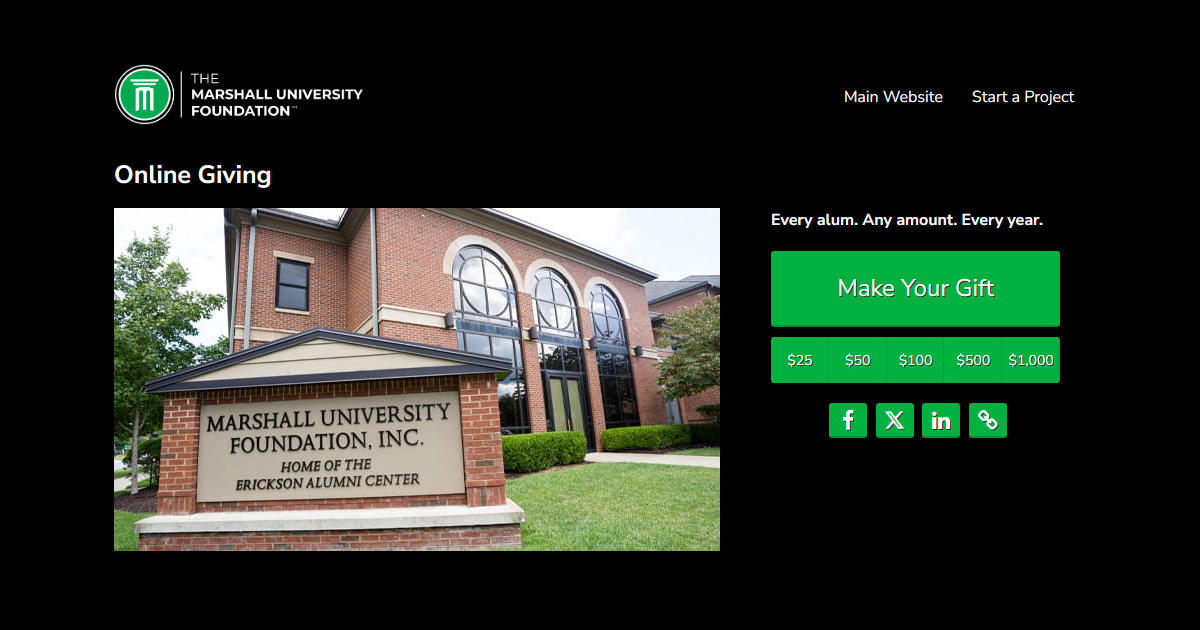
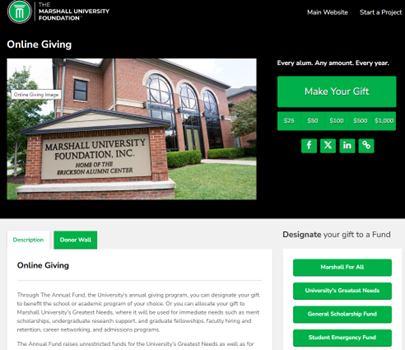
    Marshall University Foundation

    Creating a universal giving form has never been easier—you can do it in under five minutes! Need a simple form for one fund? Done. Want to showcase all 3,000 of your institution’s funds on a single page? Easy. The athletic director dreaming of a QR code in the banquet program that links to every athletic fund? Consider it handled.

    You can add unlimited custom questions to make your form as fun—or as functional—as you like. Ask for T-shirt sizes, invite donors to share their stories, or let them vote for their favorite residence hall. The options are limitless, and the setup is a breeze.

    Pictured: Our partners at Marshall University have identified nearly 20 priority funds on their Giving Form, which appear in two ways: visually appealing buttons on the project page and a searchable, scrollable list on the Giving Form.

    Maintain your identity

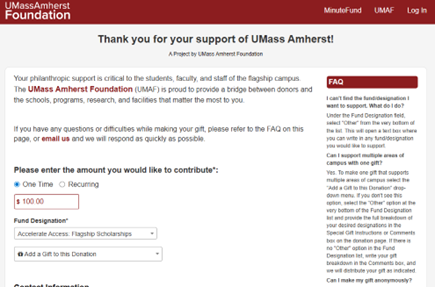
    UMass Amherst Foundation

    Your brand is uniquely yours and it should shine through every click, color, and contribution. When you join the ScaleFunder family, our team crafts a custom site design and background that aligns with your institution’s brand standards, colors, and tone. Every page carries that same cohesive look and feel, so donors always know they’re in your world.

    From your logo and language to your custom domain, everything says “you,” while Google reCAPTCHA quietly works behind the scenes to reassure them that every gift is safe and secure. This consistency of branding also means it’s easy to link to your Giving Forms from external pages, just like our partners at UMass Amherst have done from their main foundation website.

    Pictured: The UMass Amherst Foundation giving page.

    Ready to learn more?

    Whether you’re exploring digital fundraising platforms or already part of the ScaleFunder family, we’d love to help you get the most out of your tools. Connect with Courtney Pourciaux, senior consultant, to learn how Giving Forms and ScaleFunder can elevate your fundraising strategy. Reach out and we can schedule a demo as well as discuss how to make your giving experience easy and consistent for your donors.

    Talk with our digital giving experts

    RNL works with institutions on digital giving and donor engagement, including crowdfunding, giving days, and omnichannel fundraising. Set up a time to talk with our fundraising experts to find your optimal strategies.

    Request Consultation

    Source link

  • The AI Teammate: Three Roles to Build Student AI Fluency – Faculty Focus

    The AI Teammate: Three Roles to Build Student AI Fluency – Faculty Focus

    Source link

  • The AI Teammate: Three Roles to Build Student AI Fluency – Faculty Focus

    The AI Teammate: Three Roles to Build Student AI Fluency – Faculty Focus

    Source link

  • The surprising pragmatism of Reform UK voters towards international education

    The surprising pragmatism of Reform UK voters towards international education

    In polls and focus groups across the country, Reform voters have been singing from the same hymn sheet. They share a deep sense of national and local decline. They view the country through a lens of crumbling high streets, strained public services, and an economy seemingly trapped in a doom loop.

    In this environment, they have developed a corrosive scepticism towards the modern university model, judging it a failed investment that saddles their children with debt for a degree that is only good for getting through graduate recruiters’ first sift of CVs. They demand contraction, utility, and accountability for a system they believe serves neither the student nor the economy.

    To delve into these views, Public First conducted focus groups with those who currently intend to vote Reform UK in university towns in England. This revealed a surprising chink of light in an otherwise very gloomy outlook on universities: focus group participants were broadly very positive about international students.

    Foreign subsidy as necessary evil

    This needs to come with a heavy caveat: when we polled Reform voters, we found that 63 per cent agree that the UK government should restrict international student numbers in order to cut net migration. Cutting net migration remains a top priority for these voters, and for many, it appears that this should be done by any means necessary.

    However, when confronted with the economics, Reform voters we have spoken to reveal a sophisticated and transactional view of international student recruitment. For them, students from overseas are not a problem to be solved, but a “great business.”

    As polling has consistently demonstrated, the typical Reform voter is highly sceptical of mass, unmanaged immigration. Yet, when asked about foreign students, the response of those who live in university towns was not hostility, but economic pragmatism.

    They see international recruitment as a clear, contained, and mutually beneficial transaction: the UK offers a world-class education (a product) and, in return, receives a higher rate of tuition fee (a profitable revenue stream). The students come to study, they contribute economically, and then – the crucial expectation – they either contribute to the UK economy or they leave.

    This isn’t merely tolerance; it’s a qualified acceptance rooted in financial necessity. In these voters’ minds, these lucrative international fees act as the foreign subsidy that keeps the entire system afloat. As one participant noted, “If universities can’t stay open because they haven’t got any foreign students, then that is a detriment to UK students.” The implication is clear: to maintain a domestic higher education offering, the international revenue stream must be protected.

    The conditions for goodwill

    This surprising goodwill, however, is fragile and rests on extremely strict conditions. Voters grant the sector a licence to recruit internationally only as long as two core boundaries are strictly maintained.

    No back doors: The arrangement must remain a transactional exchange, not a migration loophole. Support instantly evaporates when student visas are perceived as a “back door” into the country, particularly when students bring dependents or “disappear” into the country during the degree programme, or after graduation. The transaction is valid only if the purpose is learning, not permanent residency. “If you’re coming to learn, then you come to learn. You don’t bring your family, your dog, your cat and your goldfish,” argued one voter.

    No crowding out: Crucially, if voters feel that their children are being denied places in favour of higher-paying overseas customers, the economic argument collapses under the weight of perceived injustice.

    Despite the conditional acceptance of international fees, the core challenge for universities remains their perceived lack of utility to their students, and in their local communities. While Reform voters are pragmatic about international revenue streams, they are profoundly sceptical about the value of many domestic degrees that this income subsidises, and they see very little economic spillover in their towns: “…the areas outside of the city centre, I can’t see what benefit [universities] have.”

    The sector cannot win over these key voters – and thus cannot escape the threat of cuts from political parties who want their support – by simply defending the status quo. Making the case to this influential group of voters requires clearly showing how international students are paying for local resources and subsidising domestic places, while demonstrating robust checks that ensure the system is not abused.

    More widely, universities need to move beyond abstract civic rhetoric and show tangible value, taking concerted action to ensure and evidence that all degree courses benefit the student, the community and/or the country at large.

    The support for international students presents a unique opportunity. It is the one pillar of the current HE model that Reform voters’ economic logic allows them to broadly accept, even if this acceptance is currently secondary to the desire to cut net migration.

    The sector must leverage this pragmatic lifeline to pave the way to a secure future, while not telling but showing voters that their domestic offering is part of the solution to the UK’s economic doom loop.

    Source link

  • Academics showcase alternative plan for ANU – Campus Review

    Academics showcase alternative plan for ANU – Campus Review

    Australian National University (ANU) staff feel “fundamentally disconnected” from the university’s leadership, a group of academics told a federal governance inquiry on Wednesday.

    Please login below to view content or subscribe now.

    Membership Login

    Source link

  • Consultant spend ‘relatively small,’ inquiry hears – Campus Review

    Consultant spend ‘relatively small,’ inquiry hears – Campus Review

    The head of consultant firm Nous Group told a federal inquiry into university governance that most institutions have hired his firm, spending just under $40 million total.

    Please login below to view content or subscribe now.

    Membership Login

    Source link

  • How degrees got so expensive – Campus Review

    How degrees got so expensive – Campus Review

    Australians think students are being asked to pay far too much for their degrees.

    Please login below to view content or subscribe now.

    Membership Login

    Source link

  • The political centre of gravity continues to shift towards higher education sceptics

    The political centre of gravity continues to shift towards higher education sceptics

    Declining trust in institutions is a defining trend of our times. Universities are certainly not immune to it, with the idea of the deteriorating “social licence to operate” of the university now a common item of discussion.

    Some point to the negative press coverage universities have faced in recent years. However, our recent report by UCL Policy Lab and More in Common highlights that something more fundamental is going on in our politics that universities must grapple with: the political centre of gravity has moved towards voters who are more sceptical of universities.

    Since 2016 it is well understood that political attention has shifted towards working class or “left-behind” voters (depending on your preferred characterisation) and to seats in the Midlands and northern England. These voters tend to be non-graduates and are now more commonly those seeing Reform as a potential answer to their frustrations. What our analysis found was a striking gap between how they view universities compared to the remainder of the country.

    Gap analysis

    Graduates are overwhelmingly positive about universities – 81 per cent say universities have a positive impact on the nation. Among non-graduates, that figure drops to just 55 per cent. This is reflected in the wider set of concerns non-graduates have about higher education. Non-graduates are more likely to believe universities only benefit those who attend them and that the system is rigged in favour of the rich and powerful. They are also less convinced that universities have become more accessible to working-class students over the past 30 years.

    It is their concerns that are driving the fact that a majority of voters emphasise the importance of vocational education over degrees and are worried about there being too many “Mickey Mouse” courses (although even graduates agree on that later point). Fewer than half are even fully aware that universities conduct research.

    The graduate gap is in part what creates the more direct political challenge universities face. Reform voters are markedly more sceptical of universities than any other voter group. Less than half believe universities are good for the country. More than a third think they only benefit attendees, and nearly one in ten believe they benefit no one at all. Reform voters overwhelmingly did not go to university. If a key battleground of British politics over the next four years is to be Labour vs Reform, universities will need to engage with these voters’ concerns if they going to find their place in the conversation.

    Reaching the sceptics

    This challenge is not insurmountable. There is as much to be positive about as concerned. Our polling showed the clear majority, 61 per cent, see universities as a positive influence, both nationally and locally and the cynicism regarding some aspects of what universities are delivering is not as dire as that faced by many other institutions. Despite their relative scepticism, 45 per cent of Reform voters still see universities as benefiting the country.

    Those we spoke to in focus groups were not unpersuadable. We found some scepticism, but not hostility. Another recent report by More in Common and the UCL Policy Lab ranked universities as “medium-high” in terms of how trusted they are by voters. In the turbulent times we are in, that is not a bad position.

    As well as outlining where the challenges lie, our report shows how universities might go about maintaining trust and reaching more sceptical voters. Three lessons stood out.

    The first is addressing the sense that universities are not supporting the skills needs of the country. The biggest concern we found about universities is the declining perception of the value of a degree. Focus groups bore out what this meant – degrees not resulting in a good job. There are two arguments which played out in focus groups that might help convince sceptics. Either that more degrees have a clear path, like those for teachers, lawyers and doctors, or by explaining the value of a degree in broadening minds and “opening doors” – that is, leading to a good job that may not relate to the content studied. Regardless, the public want confidence that universities are training the next generation of skilled professionals.

    The second is by demonstrating the value of research, and the innovation and civic engagement it allows, to those who do not attend university. On this point there is much potential. When asked, the public are highly supportive of universities’ role in R&D and see it as a core purpose. In focus group discussions, a sense emerged of the benefits of university research – seen as carried out with a long term and neutral perspective. Yet few raise research unprompted, and less than half of non-graduates in our poll were even fully aware that universities do research. Articulating this role and how it benefits lives is a clear imperative.

    Third is the local role. We found many see universities as a source of local pride, with the idea that universities support local business – and make their areas more vibrant – resonating. At the same time there are concerns, for example around housing and anti-social behaviour. A focus on enhancing the former and acting as a good neighbour on the latter would therefore be advisable.

    All this sits in a wider context of how the public sees universities, which was at the core of what we found. In the public imagination, universities are national institutions with clear responsibilities. Indeed, Reform voters are the most likely to say that universities should focus on their national responsibilities as opposed to their international connections. Showing how these responsibilities are being met – for the whole country, not just those who study for a degree – is how the sector can maintain public trust, and meet the political challenge it faces.

    Source link

  • In Los Angeles, 45 Elementary Schools Beat the Odds in Teaching Kids to Read – The 74

    In Los Angeles, 45 Elementary Schools Beat the Odds in Teaching Kids to Read – The 74

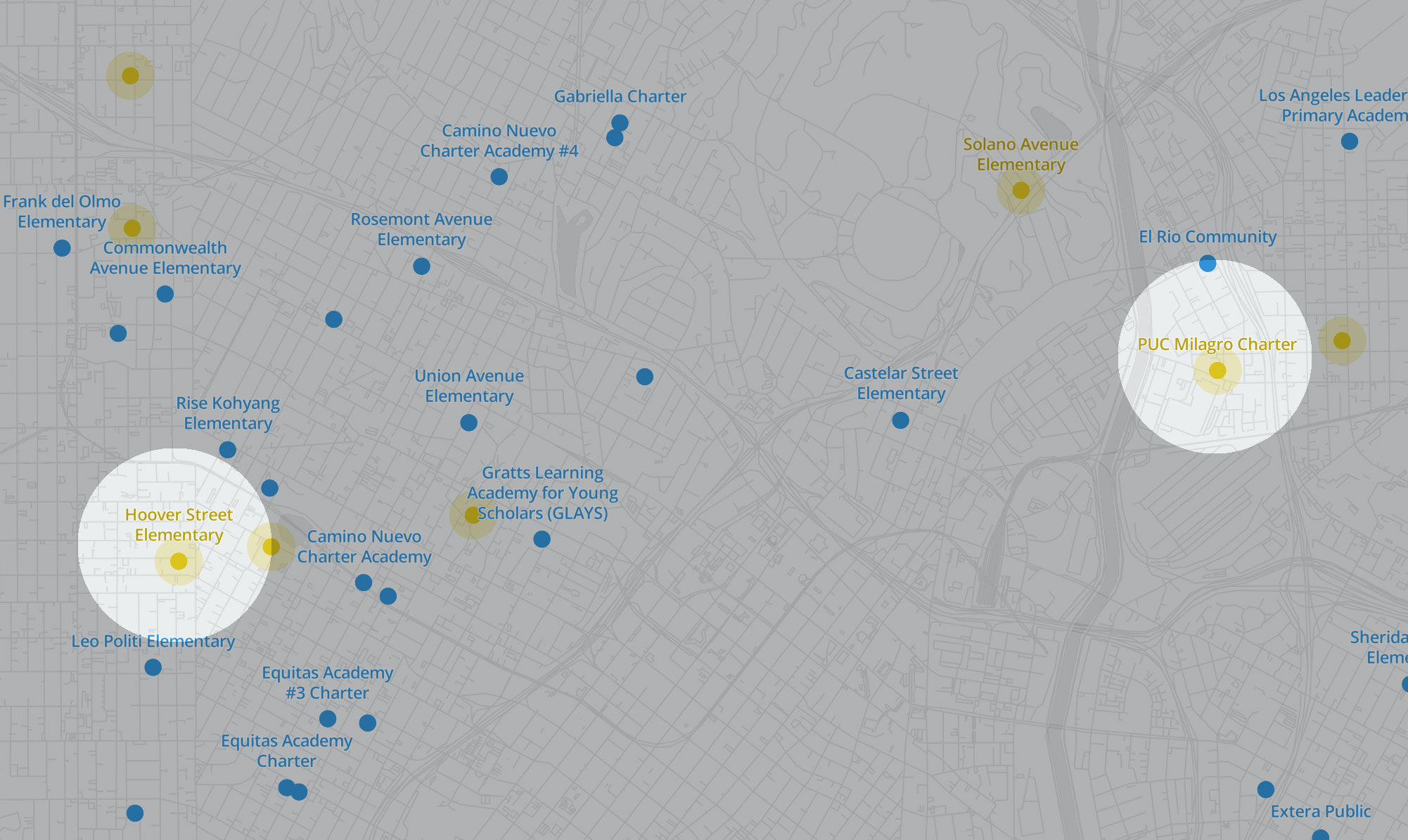
    This article is part of Bright Spots, a series highlighting schools where every child learns to read, no matter their zip code. Explore the Bright Spots map to find out which schools are beating the odds in terms of literacy versus poverty rates.

    This story is part of The 74’s special coverage marking the 65th anniversary of the Los Angeles Unified School District. Read all our stories here.

    When The 74 started looking for schools that were doing a good job teaching kids to read, we began with the data. We crunched the numbers for nearly 42,000 schools across all 50 states and Washington, D.C. and identified 2,158 that were beating the odds by significantly outperforming what would be expected given their student demographics. 

    Seeing all that data was interesting. But they were just numbers in a spreadsheet until we decided to map out the results. And that geographic analysis revealed some surprising findings. 

    For example, we found that, based on our metrics, two of the three highest-performing schools in California happened to be less than 5 miles apart from each other in Los Angeles. 

    The PUC Milagro Charter School came out No. 1 in the state of California. With 91% of its students in poverty, our calculations projected it would have a third grade reading rate of 27%. Instead, 92% of its students scored proficient or above. Despite serving a high-poverty student population, the school’s literacy scores were practically off the charts.  

    PUC Milagro is a charter school, and charters tended to do well in our rankings. Nationally, they made up 7% of all schools in our sample but 11% of those that we identified as exceptional. 

    But some district schools are also beating the odds. Just miles away from PUC Milagro is our No. 3-rated school in California, Hoover Street Elementary. It is a traditional public school run by the Los Angeles Unified School District. With 92% of its students qualifying for free- or reduced-price lunch, our calculations suggest that only 23% of its third graders would likely be proficient in reading. Instead, its actual score was 78%. 

    For this project, we used data from 2024, and Hoover Street didn’t do quite as well in 2025. (Milagro continued to perform admirably.)

    Still, as Linda Jacobson reported last month, the district as a whole has been making impressive gains in reading and math over the last few years. In 2025, it reported its highest-ever performance on California’s state test. Moreover, those gains were broadly shared across the district’s most challenging, high-poverty schools. 

    Our data showed that the district as a whole slightly overperformed expectations, based purely on the economic challenges of its students. We also found that, while Los Angeles is a large, high-poverty school district, it had a disproportionately large share of what we identified as the state’s “bright spot” schools. L.A. accounted for 8% of all California schools in our sample but 16% of those that are the most exceptional. 

    All told, we found 45 L.A. district schools that were beating the odds and helping low-income students read proficiently. Some of these were selective magnet schools, but many were not. 

    Map of Los Angeles Area Bright Spots

    Some of the schools on the map may not meet most people’s definition of a good school, let alone a great one. For example, at Stanford Avenue Elementary, 47% of its third graders scored proficient in reading in 2024. That may not sound like very many, but 97% of its students are low-income, and yet it still managed to outperform the rest of the state by 4 percentage points. (It did even a bit better in 2025.)

    Schools like Stanford Avenue Elementary don’t have the highest scores in California. On the surface, they don’t look like they’re doing anything special. But that’s why it’s important for analyses like ours to consider a school’s demographics. High-poverty elementary schools that are doing a good job of helping their students learn to read deserve to be celebrated for their results.


    Did you use this article in your work?

    We’d love to hear how The 74’s reporting is helping educators, researchers, and policymakers. Tell us how


    Source link