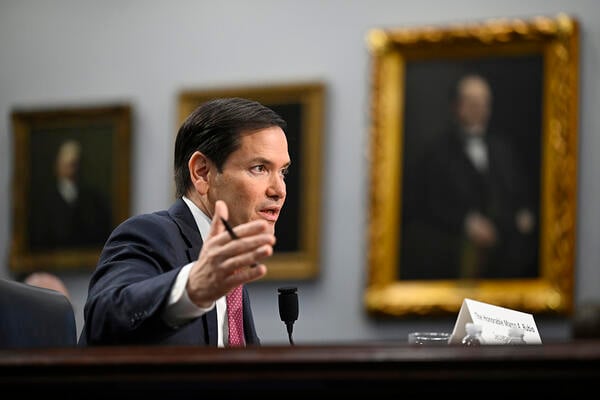
The plans to expand social media screening, first reported by Politico, were outlined in a memo sent by Secretary of State Marco Rubio.
John McDonnell/Getty Images
The Trump administration is planning to implement a policy that would require all student visa applicants to undergo social media vetting, according to a cable sent by Secretary of State Marco Rubio, Politico reported Tuesday. All new student visa interviews have been paused in preparation for the new policy.
“The Department is conducting a review of existing operations and process for screening and vetting of student and exchange visitor (F, M, J) visa applicants, and based on that review, plans to issue guidance on expanded social media vetting for all such applicants,” the memo reads, according to a copy published in full on social media by independent journalist Marisa Kabas.
The planned changes come amid the federal government’s ongoing attacks on student visa holders, which began in March with the detention of multiple students and recent graduates who had been involved in pro-Palestinian protests on their campuses. Shortly after, the administration terminated thousands of student visa holders’ records in the Student Exchange and Visitor Information System, the database the houses international students’ records, leading to a slew of legal actions from students who feared they wouldn’t be able to continue studying in the U.S.
Most recently, the Trump administration announced last week that it would prohibit Harvard University from enrolling international students as punishment for allegedly failing to prevent antisemitism and harassment on campus during last year’s pro-Palestinian encampments. Though that action was quickly blocked by a judge, the move could be devastating for the Ivy League institution, where international students make up more than a quarter of the student body.
The proposed policy would increase the amount of time, manpower and resources required to process visa applications, according to experts.
Faye Kolly, an immigration attorney based in Texas, noted that it’s not unusual for immigration officials to review visa applicants’ social media profiles, which they are required to list on certain immigration forms. But the administration has begun specifically screening the social media accounts of some returning students with visas who had participated in pro-Palestinian campus protests, though Politico reported that State Department officials had found the guidance on how to complete those screenings vague.
It is not clear how this expanded vetting process will unfold; Rubio included no details in the memo, which said further guidance would be disseminated in the coming days. Though the memo didn’t say as much, Kolly predicted that the extra screening will involve looking “at [applicants’] social media handles more closely for what I’m assuming is going to be speech that could be considered either anti-Israel or pro-Gaza.”
International education advocates have sounded the alarm on the proposed policy, arguing that it limits prospective students’ right to free expression and illustrates the Trump administration’s devaluation and distrust of international students.
Fanta Aw, the CEO of NAFSA, an association for international educators, told Politico, “The idea that the embassies have the time, the capacity and taxpayer dollars are being spent this way is very problematic. International students are not a threat to this country. If anything, they’re an incredible asset to this country.”
Kolly told Inside Higher Ed that the move harks back to the SEVIS terminations in March and April. Both actions, she said, indicate the administration’s lack “of nuance … regarding international students. It’s [taking] a simplistic approach to a very complex issue. When you target international students en masse, it’s irresponsible.”
Daryl Bish, the president of EnglishUSA, which represents all English language programs in the country, said the change will reverse recent progress on the visa approval process and have an “immediate impact” on enrollment in English language programs.
“The extraordinary decision to pause visa interviews, under the guise of security and enhanced vetting, is a dangerous precedent that will have immediate short-term consequences,” Bish said. “Visa appointment wait times have, generally, improved since the pandemic. This means that many students apply for the visa close to their program start date. The pause in interviews, if protracted, will force these students to change their plans.”
Elora Mukherjee, a law professor at Columbia University and the director of the law school’s Immigrants’ Rights Clinic, also criticized the government for pausing new student visa interviews in the interim—especially as the memo gave no indication of how long the pause might last.
“The pause is destructive to our national interests and America’s reputation in the world, and its effects may be felt for years. It has thrown the lives of tens of thousands of prospective international students into turmoil and will cause chaos and disruption at colleges and universities across the country. International students have been preparing for months to join U.S. colleges and universities in the fall, and schools have been preparing to welcome them,” she wrote in an email to Inside Higher Ed.
“It is unclear how long the ‘pause’ will be in place, what heightened scrutiny visa applicants will face once the pause is lifted, and the extent to which decisions about granting visas may be tainted by prejudices based on race, religion, and national origin.”
I’d be hard-pressed to find any person in higher ed who has had a larger influence on my own thinking than James Lang. Many folks will know Jim from his books like Cheating Lessons, Small Teaching and Distracted. He’s consistently ahead of the curve when it comes to identifying a problem in teaching and learning spaces—academic dishonesty, class disengagement, student attention problems—and proposing remedies that instructors can explore and make use of for themselves.
His new book, Write Like You Teach: Taking Your Classroom Skills to a Bigger Audience, part of the University of Chicago Press series of guides to writing, editing and publishing, is the best book I’ve ever seen for showing academics how to translate their current skills and practices to another audience and purpose. I’m excited by this book because we need as many academics as possible putting their voices into the world, not just because they have so many interesting and worthwhile things to say as individuals, but because it also helps remind everyone about the value of institutions where this kind of work happens.
I had a great time talking to Jim over email. This Q&A even breaks some news on Jim’s next book, too.
Jim Lang is a professor of the practice at the Kaneb Center for Teaching Excellence at the University of Notre Dame, and an emeritus professor of English at Assumption University. He’s the author of multiple books, including Small Teachingand Distracted, and a longtime columnist for The Chronicle of Higher Education. You can follow him on Substack at A General Education or connect with him on LinkedIn.
John Warner: One of my favorite initial questions for people who write is if they enjoy writing. So that’s my question: Do you enjoy writing?
James Lang: “Enjoyment” doesn’t seem like the right word for my feelings about writing. Writing has always been the activity that drives and gives meaning to my life. It helps me make sense of the world; if I have deep questions about the purpose of my life, or questions about anything important, I seek answers through writing, both within my published work and in my various notebooks. I have always been a very curious person who gets excited about learning new things, so writing has always been a way to satisfy those curiosities and push me into new places in my life.
If I focus specifically on the emotion of enjoyment … I hate to admit it, but I don’t seem to enjoy the actual writing process quite as much as I used to. I think I had a more unreserved embrace of writing when I was younger, when I felt like I had a lot to say and was confident that I had the ability to say it. I think both of those feelings have diminished, which I attribute in equal parts to the stroke I had a few years ago and to my age. I had to learn to speak and write again after my stroke, and while I have regained all of the words and writing skills I had before, I have to work a little harder than I used to [to] call them up and apply them. But even beyond the stroke, I guess I feel less of a desire to announce my ideas confidently to the world than I once felt. I have a great family, lots of friends and ongoing interests in many areas of my life. As my appreciation for those things has increased, the available real estate in the enjoyment part of my brain has shrunk slightly.
But the key word in that sentence is “slightly.” I do still take much pleasure from finding the perfect word, crafting a great sentence or launching a new essay or book. Writing still fills my life with meaning, and I could never envision my life without writing, or at least the desire to write, being part of who I am.
Q: What you describe sounds a bit like a winding down or maybe a shift in focus? I often say about myself that I’m never going to retire because I can’t imagine not reading and writing, which is both my pleasure and my work. But I do sometimes wonder if there’s a space to do less of it, if that makes sense. But as you note, it seems impossible to shut off that curiosity that drives those activities.
Where does that curiosity come from for you? You’ve had a varied career and it seems like every so often you shifted gears. Was that necessity or design or something else?
A: It comes from both a negative and a positive place. The negative place is that I do get bored of routines in any form, and when I feel like my life has fallen into a routine place, I start getting this itch to break it. I received tenure in the usual time frame, and it was only a couple of years after that I was seeking a new challenge, so I applied to direct our honors program. I enjoyed that work tremendously, but then once again sought a change and founded a new teaching center on campus. Right after the pandemic, based on the success of Small Teaching and Distracted, I decided to give myself a new challenge: give up tenure and try to make it with a mix of writing, speaking and adjunct teaching. That plan was upended by my long medical ordeal, but even after I was able to return to that life, I realized that I missed deeply having a home on a campus, which led me to Notre Dame. So that has definitely been a pattern in my career and in my life.
For the positive explanation for this restlessness, I would point to something my wife (an elementary school teacher) told me about the kids who come into her classrooms each year. She says that while we might be all born curious, by the time children get into school, they are already separating in terms of how much curiosity they bring to school. The differentiating factor she sees is how much exposure kids have to different kinds of life experiences. The kids who sit in their bedroom on their parents’ tablets all day or play video games in their rooms just don’t see as much of the world, and they aren’t being prompted to ask questions, wonder and explore. The ones who come in curious are the ones whose parents have deliberately tried to expose them to new things in some form—trips, walks outside, reading aloud, giving them books, etc.
When I heard that, I realized that I had been raised as one of those latter kids. My mother was also an elementary school teacher, but her best years were in preschool. She had a special love, and special gift, for very young children. And while I have only a few memories of my preschool years, I know from seeing how she interacted with my children that I must have been raised to become a curious person.
Q: I had a mini epiphany while reading the opening section of Write Like You Teach, which is that good teachers and good writers think of the needs of their audience (students/readers) first. This is something I think I’ve always done as a teacher, perhaps because I was a writer before I was a teacher, but you make it pretty explicit and then give it a little specific flesh. When did this connection first come to you?
A: I actually can’t quite remember where that specific connection came from. I do know that this book really came out of my desire to write some more about attention, the subject of my previous book. I have written books about several major issues in teaching and learning, and some of them I finished and felt like I was done with that topic. That wasn’t true for attention. The more you read and learn about attention, the more you realize how it has a part in almost everything that matters in our lives. Work, play, relationships, spirituality, learning—all of them demand our attention. They often go well or poorly depending upon the quality of our attention. And so I still find attention fascinating, and I keep reading and thinking and writing about it. I also just really enjoyed writing the book Distracted. So I think maybe I was trying to determine what else I could write about attention which would relate to another area where I have some interest and expertise.
Reading was the initial bridge to further thinking about attention. Anyone who reads a lot knows that some books capture our attention more than others. I think the teaching-writing connection that produced this book came from realizing both in classrooms and books, you have to be aware of the limits of a learner’s attention. Both as teachers and writers, we can either just expect people to pay attention or we can try to help them. I had made the case for the latter approach in Distracted and realized I could make the same case to writers: If you want readers to sustain their attention over the course of many pages, don’t just bang away at them with paragraph after paragraph of argument and idea. They need breaks, they need stories, they need space to pause and think—just as students do in the classroom. Seeing how attention informs both teaching and writing led to the basic idea of the book: The things we do in the classroom to help students learn can also be useful for our readers.
Q: In a note at Substack, Arvind Narayanan (coauthor of AI Snake Oil) offered a “hypothesis on the accelerating decline of reading.” It’s got a bunch of bullets, so I’ll do my best to paraphrase: Essentially, people mostly read for pleasure or to obtain information. These functions have been replaced by other things. Video is more entertaining than reading. We can use large language models to summarize long texts and deliver information to us. He theorizes that most people will be happy with the trade-off of increased speed/efficiency, the same way we’ve gravitated toward “shallow web search over deeper reading.” He’s worried about this but also believes that merely “moralizing” about this is not going to be helpful. (I tend to agree.) I’ve argued for years that getting students engaged with writing is a great way to get them reading, because reading is the necessary fodder for writing. Writing is also a tremendous way to cultivate our ability to pay attention. I’m wondering if you’re worried in the same way as Narayanan or if you have any additional ideas of what we can do about this.
A: First, thanks for sharing that note, which will be helpful to me as I am working on my next project—which I am happy to announce here. My next book will be The End of Reading?, which will be published by W. W. Norton, a publisher whose books I have been reading since high school and assigning in my courses for my entire teaching career. I’m so excited to dig into this project, but I am going to beg off on an answer here because I am just in the beginning of my thinking and writing and need more time to formulate my ideas. Put another way: Ask me that question again in two years!
Q: I have sort of the opposite problem as the folks this book is addressed to, in that I find it very natural to write to regular people—because that’s where I started—while writing for more formal or academic audiences is something I can struggle with. What is it about the experience of the academic that makes the transition you’re writing about difficult?
A: The problem here is that experts often lose track of what novices don’t know in their fields. The more we know in a discipline, the further away we get from our memories of what it was like to know very little about biology or literature or politics. When academics write to each other, they can assume their readers know certain things: basic facts, theories, common examples or cases, histories, major players in the field. Let’s say I’m a scholar of Victorian literature and want to write something about a work of Victorian literature. If I am writing to other scholars in that field, I can be confident that my readers know things I know: the expansion of the British Empire during that time period, the impact of Darwin and evolutionary theory on many writers in that era, the political turbulence and social unrest accompanying the Industrial Revolution.
If I am writing to a more public audience, I can’t assume my reader knows any of that stuff. In a classroom, I can always stop and just ask students, “Have you heard of this before?” If they haven’t, I can give a quick introduction. But as a writer with deep expertise in a subject, I have no idea what a more public audience knows or doesn’t know. Faced with that problem, I think a lot of academics just say, “Never mind, I’ll just keep writing to my people.” And that writing is important and can be great! I love a good scholarly book, and I still read them regularly. That kind of writing also helps people get and keep academic jobs, so I am not on some crusade to encourage everyone to write for the public. But I think the major sticking point for people who do want to expand their audiences is thinking more deeply about their audiences: what they know or don’t know, why they are reading your work, and what you want them to take away from the experience.
Q: Something I’ve often said about both writing and teaching is that they are “extended exercises in failure,” where failure means not missing the target entirely, but falling short of one’s initial expectations. I find this reality interesting, fascinating, really, because with both activities, you usually get a chance to try again. Does this make sense to you, or do you have any different frames for how you view these two activities?
A: No absolutely, and in fact that framework applies to all of the pursuits that give me satisfaction, including the other major intellectual pursuit of my life: learning languages. I did not start learning other languages until my first year of high school, where I started with Latin. Immediately I was fascinated, and so in my junior year I added ancient Greek into my curriculum. When I got to college, I took classes in both those languages, and then also took French. Over the next 30 years I have gone back and forth with those original three languages and also tried to learn Spanish and Italian and German.
I start every new language with this expectation that this time I’m going to really dig in and master this thing and become just totally fluent. The truth is that I have some basic knowledge in all six of those languages but know none of them particularly well. But I just love the fact that I can go back to any of them, at any time, and start trying again. I’m 55, and my brain has a different shape than it used to (because of the stroke), so I have to be realistic and acknowledge that it’s unlikely that I will ever become a fluent speaker in any other language than English. But gosh, I just love to keep trying.
As you say, teaching and writing are the same. You start off with such hope and expectation and excitement: This will be the best class I will ever teach! This essay or book is the one that will change people’s lives! But it never quite works out that way. Even when you teach a great course, not every class period will be perfect. Not every student will have a great experience. When I look at my own books, I am proud of them but can see places where I cringe and wish I had done better. But I don’t feel defeated by those feelings: They make me want to keep trying.
Q: The book is filled with practical approaches to writing for broader audiences, but I wouldn’t quite call it a book of “advice.” The word that comes to mind is “guidance.” Does that distinction make sense to you?
A: This distinction matters a lot to me, actually. I think because of the success of Small Teaching, which had a lot of concrete pieces of advice, people can view me as a “teaching tips” guy. I do love learning and thinking about specific practices in the classroom, so I don’t wholly disavow that association. Presenting theories and big ideas about teaching only gets people so far; they need to envision what those theories look like when they are standing in the classroom on Tuesday of week seven with 20 blank faces in front of them. Describing examples of specific practices helps them with that imaginative work.
But I always want people to understand that I am not advising them to do anything in particular: I am showing examples designed to spur their own creative thinking. Write Like You Teach, for example, has a chapter about the challenge of reader attention, and I do offer some very concrete pieces of advice based on writing strategies that I have observed in great writers. Ultimately, though, I want the readers of my book to move beyond these specific examples and develop their own strategies based on the principle readers are learners, and learners need support for their attention. With that principle in mind, I want people to analyze their classroom practices and see what translates to the page.
That leads me to the final thing I want to say: The first and final goal of this book is to help academics feel empowered and enabled to write for the public. The prospect of doing that kind of writing can be intimidating, and many of us shy away from it. But if I can convince academics of this one principle—a great teacher can become a great writer—then I hope they will be able to develop their own writing practices based on their experiences in the classroom.
Q: And finally, the last question I ask everyone: What’s one book you recommend that you think not enough people are aware of?
A: When people ask me to recommend a novel to them, or when people ask me to share my favorite novel, I always mention two: Zadie Smith’s White Teeth and Arundhati Roy’s The God of Small Things. I am cheating a little bit here because both of these novels were very well-known when they were published, sold many copies and won prizes. But they are both a couple of decades old now, and I believe that their themes are as relevant today as they were when they were first published. If you are a word person, choose Roy, whose prose comes as close to poetry as a novel can get; if you love a great plot, choose Smith, whose genius shines through the ebullience of her narrative construction. If I were forced to choose between the two, I would choose … I can’t. I just can’t.
In reflecting on my feelings about the advent of artificial intelligence in our lives, I must report they are mixed. I have the strong sense of the inevitability that this technology will meet and exceed its hype to alter the course of humanity, generally for the better. However, at the same time there is a measure of trepidation in my awe of the potential power and performance of AI.
I am receiving more frequent emails from colleagues reporting renewed intransigence among faculty regarding the push to adapt to AI use by students, to integrate the technology into teaching and to help prepare learners for the AI-enhanced workplace. I see parallels to the 1990s and early 2000s, when faculty also resisted the advent of online and blended learning. That resistance gradually subsided until the pandemic, when remote learning, albeit a less refined use of the technology, came to the rescue of universities.
In both instances, the resistance seems to be prompted by a general lack of understanding and comfort with the technology. This creates an elevated level of anxiety. It also requires a change in pedagogy to adapt to expanded capabilities in the hands of students. This involves reconceiving and rewriting lesson plans and, in some cases, learning outcomes for multiple classes. This can be time-consuming. Yet, this is not the first time that emerging technology has impacted teaching modes and methods.
I am fortunate to remember, as a faculty member, the advent of the personal computer in the late 1970s, graphing calculators in the mid-1980s, the rise of the World Wide Web in the early 1990s, Google Search in 1998 and, in 2001, the launch of Wikipedia. Each one of these technologies demanded changes in the ways we presented and assessed learning. Questions of student integrity were raised in each of these cases. We also were urged to consider the students’ needs to become facile with these tools as they left to commence their careers. Imagine HR’s response to applicants who could not conduct an internet search or use a personal computer. The pressure was on to adapt to the emerging technologies while ensuring integrity.
Each of the technologies has become incrementally more sophisticated and more capable. They have required more and more attention by faculty to maintain a quality learning environment, and to prepare students for the rapidly changing workplace environment. In the case of AI, larger leaps in sophistication are coming on a weekly or monthly basis. The stakes are high. The integrity of the instruction, the relevance of the learning and the future employment of the students hang in the balance. The pressure is on the faculty to maintain quality and security in a rapidly changing environment.
Change in the AI field comes not on the rather pedestrian pace of new releases of the past, when we would see new versions released on annual schedules by just a handful of providers. Now, we must track 10 or 12 of the largest providers, as each of them releases new versions about every three or four months, or more often. Generative models still see improvements while agentic models offering awesome deep research and autonomous agents are flooding the market from around the world.
In a TED talk recorded last month in Vancouver, former Google CEO and chairman Eric Schmidt explained that, if anything, artificial intelligence is wildly underhyped, as near-constant breakthroughs give rise to systems capable of doing even the most complex tasks on their own. He points to the staggering opportunities, sobering challenges and urgent risks of AI. Schmidt asserts that everyone will need to engage with this technology in order to remain relevant. Meanwhile, in an interview this month, the current Alphabet/Google CEO, Sundar Pichai, on the All In podcast, affirms the commitment of the company to developing AI. He describes the evolution from Google search through AI, while it continues on the continuum of a discovery path of quantum computing and pursuing the concept of autonomous robots.
Just as Google is working to further develop and refine their multiple versions of AI, so too are many other major corporations and start-ups. What they come up with over the coming months and years will have a huge impact on higher education, the workplace, job market and society as a whole. The very nature of human jobs will change. Meanwhile, Elon Musk predicts smart robots will proliferate and will outnumber humans. His Optimus robots are to sell under the Tesla label, priced at $20,000 to $30,000. Of course, AI is central to the operation and functioning of such humanoid robots.
So, what might the workplace, or more specifically the individual human work assignment within that workplace, look like? In his recent podcast, Wes Roth reviews “The Age of the Agent Orchestrator” by OpenAI’s Shyamal Hitesh Anadkat. In the article, Anadkat describes the key new role that humans may play in the AI-enhanced workplace, noting that in the future “the scarce thing is no longer ‘who knows how to do that task by hand.’ The scarce thing becomes ‘who can orchestrate resources well’—compute, capital, access to data, and human/expert judgment.” That role he describes as the “agent orchestrator.” In sum, Anadkat writes,
“As always, the most important thing is to build something that users want. In a world where your marginal cost of expertise/knowledge goes to zero, your ability to turn cheap intelligence and expensive resources into valuable products is what will matter. i’m [sic] very excited to see the new companies, the new tools, and the new jobs that come out of this. Welcome to the Age of the Agent Orchestrator!”
The human will orchestrate what may be a very large number of highly capable intelligent AI agents. That may not seem as creative of a job as many of us now hold, such as authors, researchers, graphic designers, Web developers and the diversity of positions in designing and enhancing instructional resources. Yet, there is creativity, and certainly impact, in marshaling the vast resources at hand in the workplace of the future. Implicitly, the job becomes one of orchestrating abundant resources in conducting a symphony of interacting virtual workers to achieve desired goals. Doing so in the very best way calls upon higher-order creative thinking, strategic planning and execution.
All of these developments bring to mind the assertion of the pre-Socratic philosopher, Heraclitus, who is credited with saying 2,500 years ago, “The only constant is change.” We can expect much more change in the field of AI over the coming months and years. It will be far-reaching and long-lasting. It will penetrate the very essence of what it means to be a human in a technological society. We in higher education cannot ignore this change or make it stop simply because it is inconvenient or incompatible to our teaching style. The money, momentum and weight of advantages of AI make it an inevitable advance to civilization. It is not stoppable. We must change our practice to meet the needs of the students and society.
I am left with a less-than-easy feeling to welcome artificial intelligence with all of its sweeping ramifications into our work, lives and future. Yet, at the same time, I know that we must move forward to meet that future, if not so much for ourselves, but rather for our students who will live the greater part of their lives alongside their AI companions.
In the late 1960s, a gifted folk music composer and performer, Joni Mitchell, released an impactful song titled “Both Sides Now.” Within that song is a phrase that has stayed with me through the decades: “Well, something’s lost, but something’s gained in living every day.” I suppose it helps to sum up my feelings about this new technology that is rapidly gaining momentum and promising to change our learning systems, workplaces, lives, identities and society.
Another former Florida lawmaker is stepping into a presidency after the University of West Florida Board of Trustees voted to hire Manny Diaz Jr. in an interim capacity Tuesday.
Diaz, who is currently Florida’s education commissioner, served in Florida’s Senate from 2019 to 2022. The former GOP lawmaker is a close ally of the state’s Republican governor, Ron DeSantis.
The UWF board approved the hire despite the objections of two trustees who raised concerns about transparency and argued that the process of selecting an interim was rushed. UWF’s current president, Martha Saunders, announced her resignation earlier this month after a board member took issue with social media posts from the university dating back several years. Zach Smith, who works for the Heritage Foundation, said he was troubled by actions that included encouraging students to read a book about antiracism and promoting a drag event in 2019.
Both board members and the public questioned Diaz’s qualifications at the meeting.
Trustee Alonzie Scott noted that it was unusual to select an interim without considering internal options and questioned how Diaz was elevated as a sudden candidate without a prior board discussion. He also pressed board chair Rebecca Matthews on whom she spoke with before advancing Diaz as the pick, though she did not offer specifics on those conversations.
“I don’t feel as if I have to run through that list with you today,” Matthews told Scott when he asked whom she had discussed the appointment with before adding it to the board agenda.
Scott also questioned whether the board had violated state sunshine laws.
“I can’t prove that any of us have violated the sunshine guidelines, but I can tell you everything that I read about all the different Florida news outlets, it appears that those decisions were made before this board even had a chance to even discuss. And to me, ma’am, that is a travesty in terms of how we operate,” Scott said, adding the process was “a disservice to the community.”
Matthews defended the hire, noting Diaz’s past work in K-12 education and the State Legislature.
Diaz will formally assume the interim presidency July 14. Despite tapping Diaz as interim, the board will begin a search for its next president, though some trustees argued that naming Diaz instead of an internal candidate to lead UWF would likely suppress the number of applicants.
Of five presidents hired at Florida’s public universities this year (including interim roles), Diaz is one of four who are either former lawmakers or directly connected to the governor’s office. Santa Ono, who was hired as president of the University of Florida on the same day UWF tapped Diaz, is the outlier.
By Vincenzo Raimo, an independent international higher education consultant and a Visiting Fellow at the University of Reading, where he was previously Pro Vice-Chancellor for Global Engagement.
Vincenzo Raimo will be joining David Pilsbury and Janet Ilieva at the International Higher Education Forum (IHEF 2025) on 4 June 2025 to discuss the topic: ‘Outdated policy and unfounded optimism drive British universities to the abyss.’
“If we want things to stay as they are, things will have to change.”
— The Leopard, Giuseppe Tomasi di Lampedusa
UK universities are awash with the language of transformation. Internationalisation and Global Engagement strategies speak of partnerships, student mobility, intercultural learning and global citizenship. Vice-Chancellors and Pro Vice-Chancellors for Internationalisation describe international education as central to institutional values and academic mission. And yet, for many, the real driver is far simpler: money.
There is a widening gap between the rhetoric of internationalisation and the reality of its execution. Strategic plans position it as an enabler of diversity, excellence and global reach, but the day-to-day reality is that it functions as a financial lifeline. In a sector facing significant funding pressures, international student income is often the difference between surplus and deficit. That tension matters. It undermines credibility, risks student experience and can lead institutions to prioritise volume over value.
The quote from The Leopard, Lampedusa’s novel of aristocratic decline during the unification of Italy, captures a central paradox of institutional reform. It speaks to the instinct to embrace the appearance of change in order to preserve the status quo. In recent months, this sentiment has felt uncomfortably familiar in UK higher education. We appear to be entering a period of cosmetic transformation: new job titles, rebranded structures and revised plans, but all too often without the deeper shifts in strategy, culture or resourcing that genuine transformation demands.
This is particularly evident in international student recruitment.
Universities in the UK have long faced political headwinds. International students are welcomed in principle but scrutinised in practice. Brief moments of progress, such as allowing students to bring dependents, are quickly reversed in response to migration debates. The result is unpredictability, which undermines confidence in the UK offer.
Despite this, the UK has historically benefited from a position of passive advantage in international recruitment. We speak the global language of higher education. Our qualifications are widely recognised. Many of our institutions enjoy long-established reputations. And our complex legacy of Commonwealth ties, colonial familiarity and cultural affinity has offered visibility and access in key markets.
But that advantage is fading.
Policy instability is only part of the challenge. Global competition is intensifying, and not just from the traditional English-speaking destinations. European countries are increasingly offering high-quality, English-taught programmes at lower cost, often with clearer post-study pathways. In Asia, more students are opting to stay closer to home, choosing emerging regional providers with improving reputations and stronger cultural fit. The UK can no longer assume it is the default choice.
In response, institutions are making changes, or at least talking about them. The mood music is shifting: towards diversification, resilience and sustainability. Yet much of this amounts to cosmetic change. Beneath the surface, many universities are still operating on the same assumptions, deploying the same strategies, and relying on the same markets and channels as they have for years.
I have argued that recruitment targets are vanity, quality and retention are sanity, but margin is king. Growth in international enrolments may look impressive, but it means little if acquisition costs are rising, if retention is falling, or if students leave feeling unsupported. In one recent project, I found that recruitment costs, dominated by agent commissions, amounted to nearly a third of the net tuition income per student. That model is unsustainable in the long term.
And the consequences are already visible: redundancies, departmental reconfigurations and even the closure of entire disciplines. The pursuit of international income has not protected the sector from financial strain. Rather, it may simply have postponed the difficult decisions needed to build genuinely sustainable institutions.
One apparent solution is transnational education (TNE). There is renewed enthusiasm for TNE as universities seek to diversify income and reach. I have worked with institutions developing long-term TNE partnerships that deliver real benefits: stronger reputation, broader access and more distributed risk. But TNE is not a short-term fix. It takes time to design and deliver well, requires significant investment and cannot plug immediate financial gaps.
Nor can TNE substitute for a broader rethink of international strategy. In my International Student Recruitment Success and TNE Success scorecards, I offer practical frameworks for assessing capabilities, identifying risks and planning more strategically. These tools are designed to help institutions move beyond tactical fixes and focus on longer-term sustainability. Key questions include:
What is our purpose in internationalisation?
How distinctive and competitive is our offer?
Are our structures and resources aligned to support quality and retention?
And are we being honest about what our strategy is really for, and is that clearly communicated across the institution and to our wider stakeholders?
Too often, international strategies present one set of values, while day-to-day activities pursue another. This misalignment makes success harder to define, measure and achieve.
The danger today is that we confuse activity with progress. Structural tweaks and strategic refreshes may signal intent, but unless they are anchored in purpose and matched by investment, they will not deliver the resilience the sector needs.
Lampedusa’s quote reminds us that change can be used either to preserve the status quo or to enable transformation. The UK higher education sector faces a choice: to make difficult, strategic changes now, or to continue changing just enough to maintain the illusion of stability, while the foundations quietly erode.
Have you ever felt the weight of being overworked and underpaid? Do you find yourself questioning your value in your workplace? Are you contemplating exploring new employment opportunities in the near future? If these thoughts resonate, knowing you are not alone in this journey is important. Many of your peers share these concerns.
The CUPA-HR 2023 Higher Education Employee Retention Survey (ERS) is not just a study; it’s a comprehensive collection of your experiences and opinions. It gathered data from 4,783 higher education employees across 539 institutions, including administrators, professionals, and non-exempt staff from various departments. This survey is valuable for understanding the job satisfaction and retention challenges you and your peers face in higher education (Bichsel et al., 2023).
The 2023 survey asked questions in the following areas:
Likelihood of looking for other employment opportunities in the near future
Reasons for looking for other employment
Remote work policies and opportunities
Work performed beyond normal hours and duties (overwork)
Satisfaction with benefits
Well-being and satisfaction with the job environment
Retention incentives experienced in the past year
Challenges for supervisors
Demographic questions on gender, race/ethnicity, and age
Characteristics of the employee’s position (Bichsel et al., 2023)
The survey’s analyses provided critical insights into the proportion of our higher education workforce at risk of leaving, the reasons why employees are considering other job opportunities, and the underlying factors contributing to their desire to leave. These findings are crucial in addressing our shared concerns. (Bichsel et al., 2023)
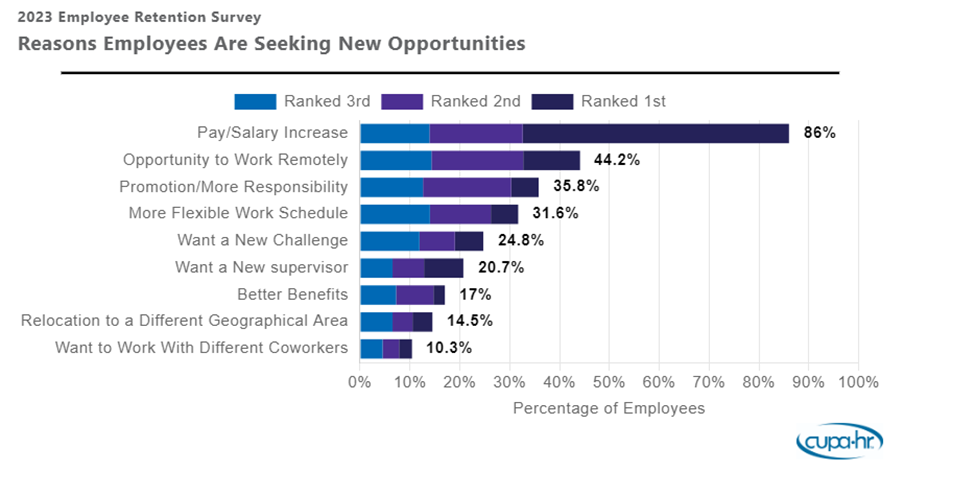
The survey results are as follows: one-third (33%) of higher ed employees are very likely or likely to look for new employment opportunities in the next year, which is unchanged from last year. This indicates that retention remains a significant and urgent challenge in higher ed. The area with the most acute retention challenge is student affairs, where 39% of employees surveyed say they are likely or very likely to look for other employment opportunities within the next year (Bichsel et al., 2023)
*A graph of reasons employees are seeking new opportunities was obtained from CUPA-HR’s 2023 survey data. (Bichsel et al., 2023)
A notable aspect of dissatisfaction revolves around their institution’s support for their professional growth. Almost half of employees (44%) express disagreement when asked whether they have opportunities for advancement at their institution, and around one-third (34%) disagree that their institution invests in their career development. Moreover, more than one-fourth of respondents (28%) disagree that their institution’s leaders show they care about their mental health and well-being. (Bichsel et al., 2023)
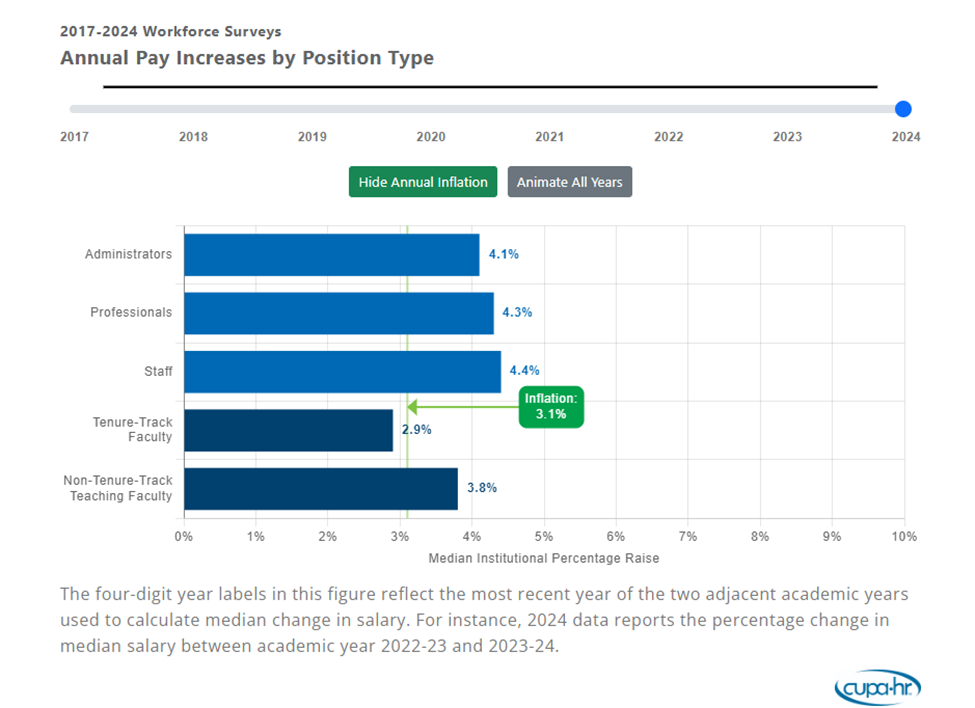
According to CUPA-HR research and key findings for 2023-2024, across higher education, employees are still paid less in inflation-adjusted dollars than in 2019-20 (pre-pandemic). (CUPA, 2024)
*A screenshot of a graph of Annual Pay Increases by Position Type was obtained from CUPA-HR research and key findings for 2023-2024. (CUPA, 2024)
In a well-run organization, these nuts and bolts that shape compensation are routinely checked and updated to stay competitive and achieve strategic goals. However, for many colleges, compensation practices have become the ‘deferred maintenance’ of the human resources world. This term refers to the practice of postponing necessary maintenance, often due to a need for more funds or resources. In the context of compensation, these practices must be regularly reviewed and updated, leading to issues such as stagnant salaries, late paychecks, inaccurate titles, and confusion over how pay is pegged to performance. (McClure, 2024)
Despite the availability of rich data backed by years of research, institutions are still mainly lagging in implementing standard-raised pay scales, resulting in higher attrition levels.
The survey’s findings are a call to action. Senior management and leadership must approach the situation holistically and use the data to implement a solution swiftly. This is crucial to prevent the loss of trained, qualified, and high-performing employees, a loss that higher educational institutions cannot afford!
Ranjitha Rao is the Budget/Financial Analyst Manager at the College of Nursing at Texas Woman’s University. She is dedicated to supporting academic and administrative goals through financial oversight. As an active member of the TWU Staff Council, she fosters a spirit of unified community among staff members and provides opportunities for their democratic representation. Through her involvement in the Staff Council, she promotes a positive and collaborative work environment and serves as a representative advisory member, presenting recommendations to university leadership. Ranjitha is also committed to fostering healthy workspaces, ensuring faculty, staff, and students thrive in a supportive and productive environment. Ranjitha holds a background in engineering and is currently a Ph.D. student focusing on leadership in higher education. She also holds a Master’s in Business Administration, with an emphasis in Accounting and Management. Additionally, as an adjunct, Ranjitha has taught first-year incoming classes, focusing on curriculum and strategic success, to help students transition smoothly into their academic journeys, along with accounting and healthcare administration classes for undergraduates. Ranjitha’s research interests include competency-based education, workforce development, leadership, management, and financial well-being in higher education.In her free time, Ranjitha enjoys exploring financial trends, participating in community events, and contributing to initiatives that promote financial literacy and education.
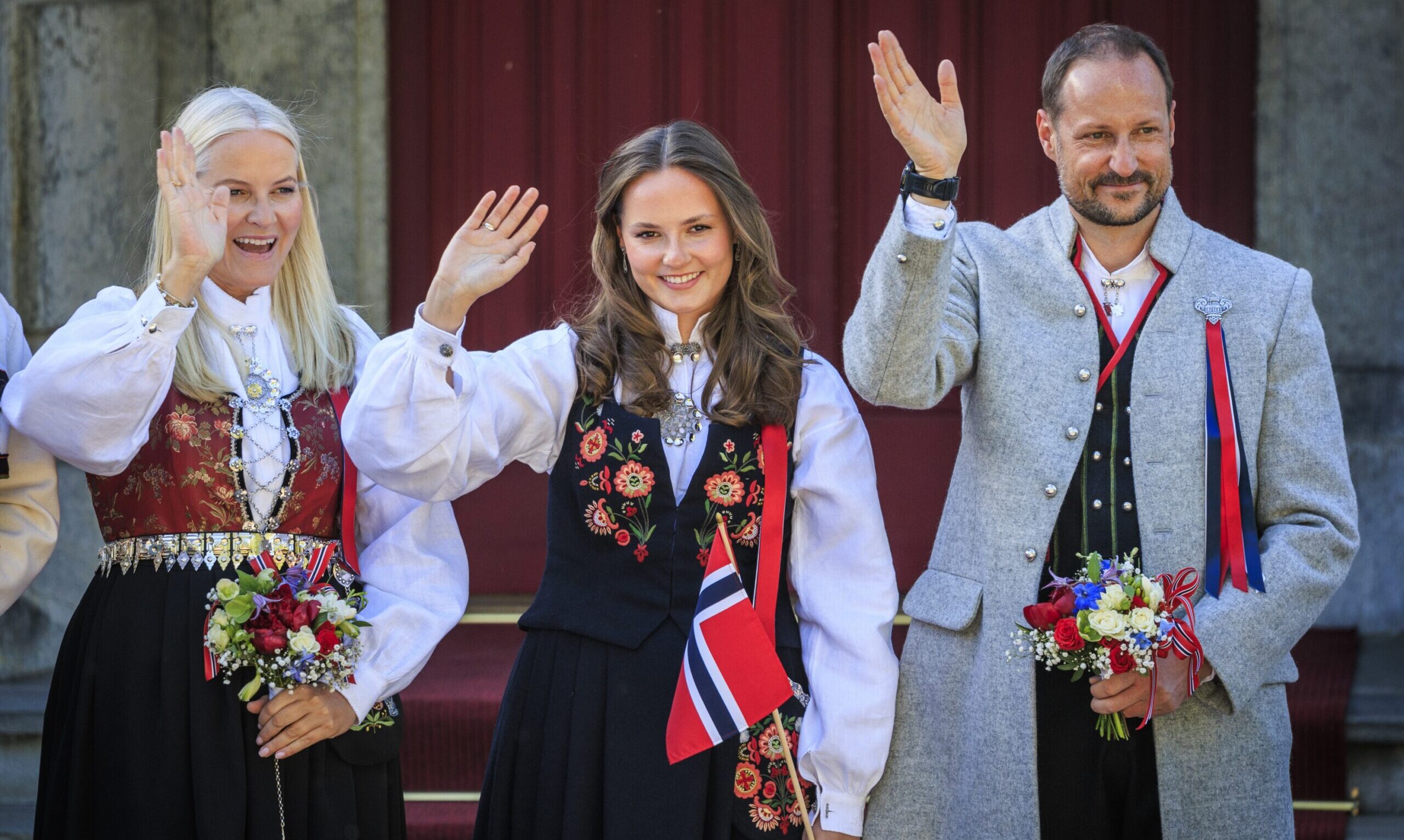
Left to right: Crown Princess Mette Marit, Princess Ingrid Alexandra and Crown Prince Hakon Magnus of Norway attend the Norwegian Constitution Day on with the children’s parade at their residence Skaugum on May 17 in Oslo, Norway. Picture: Per Ole Hagen
A future monarch of Norway, Princess Ingrid Alexandra, will relocate to Sydney in August to study at the University of Sydney.
Please login below to view content or subscribe now.
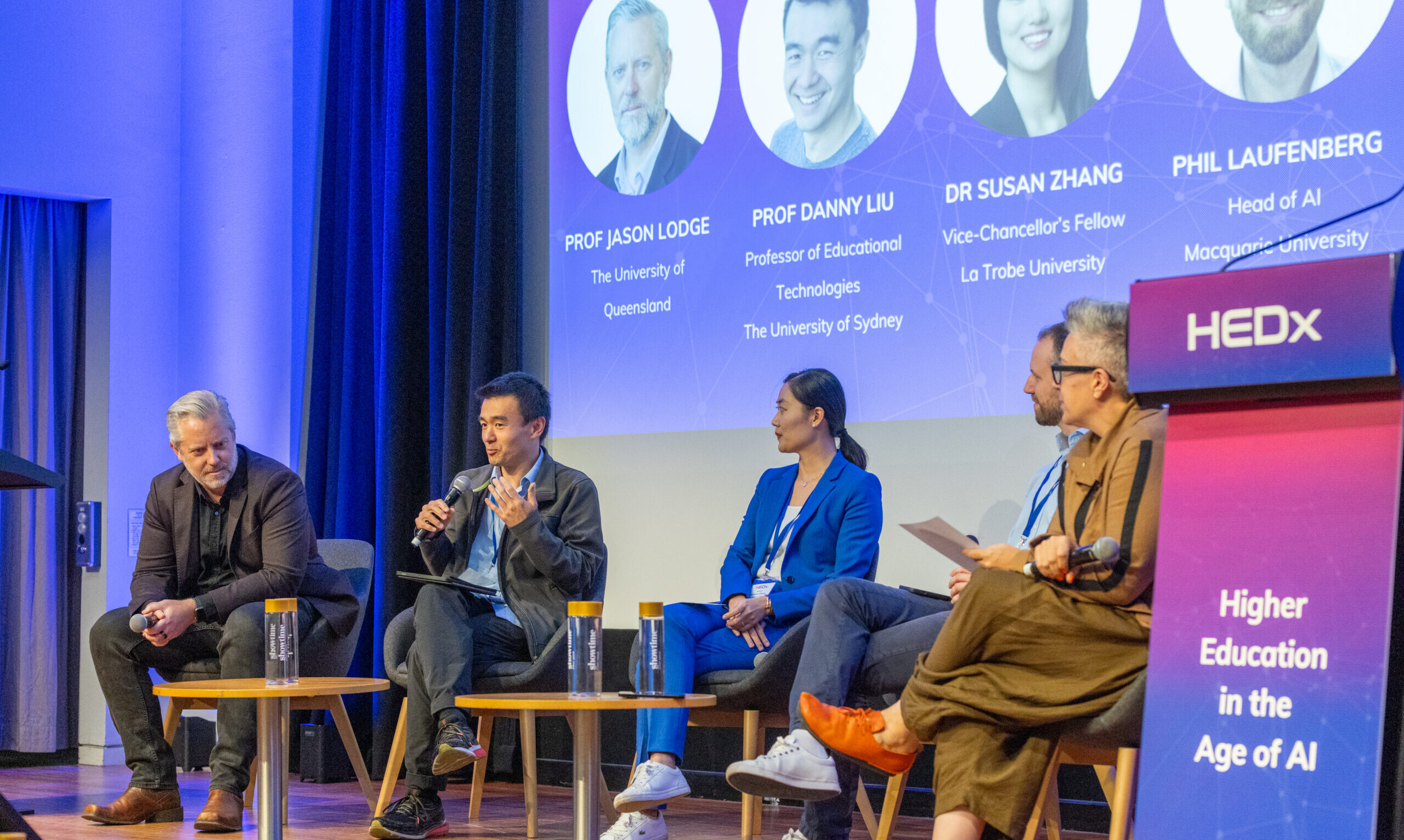
Danny Liu from the University of Sydney posited that artificial intelligence compelled us to re-evaluate not just the methodology, but the very purpose of our teaching practices.
Please login below to view content or subscribe now.
Are you on the job market or seeking a new career? Professors and researchers, this interview is especially for academics considering leaving academia (or if you’re forced to leave unexpectedly). I’m happy career coach, Dr. Jennifer Polk of From PhD to Life is back for this 2025 episode.
Jen’s been on The Social Academic to chat with me back in 2022 when we talked about Informational Interviews. She also joined me for a YouTube live in 2020 where she answered the question, What Is Networking? This year especially, mid-career and senior academics may be pivoting away from their more traditional academic career path. Many researchers and scientists in the United States of America have been let go. While there’s many resources out there to help with your next steps, such as the From PhD to Life blog, you may want personalized support from a career coach and community. We talk about Jen’s PhD Career Clarity Program which you may find helpful.
While we talk about a service for academics in this and other interviews on The Social Academic, I don’t receive any gift or monies if you choose to move forward with Jen’s PhD Career Clarity Program. I share people including Dr. Jen Polk with you, because I trust and recommend her to clients and friends.
In this interview
Reintroducing Dr. Jennifer Polk (@FromPhDToLife)
Jennifer Van Alstyne[‘Jennifer’]: Hi! Welcome back to The Social Academic, a podcast, blog, YouTube channel about online presence for professors, researchers, PhDs, people who are in academia. Dr. Jennifer Polk is back with me today. She’s someone who we featured here on The Social Academic in the past. She’s been live on the YouTube channel, but this time we have new things to talk about. I mean, the social media landscape has changed in 2025. Jen, would you start by introducing yourself?
Dr. Jennifer Polk [‘Jen’]: Oh no, I’m on the spot!
Yes, I’m Jen Polk. My business is called From PhD to Life. I work with professors, postdocs, and other PhDs who are ready to leave academia and go somewhere where they will be respected and valued and all that good stuff, even if they don’t yet know what the heck that could ever be. I’ll help them figure it out.
Jennifer: I love that. You’re a career coach who’s like, you’re not new to this space, right? You’ve been doing this for a while.
Jen: A while, indeed. What’s a while? More than 10 years? More than 10 years, yes.
Jennifer: Amazing.
Jen: Yes. Someone called me the OG PhD career coach. Am I saying that right? OG, is that what the kids say?
Social media climate for academics in 2025
Jennifer: OG, yeah. I love it. I love it. I’m curious because you’re actually like an early social media user, early online user. How have you seen things shifting or changing in social media in the past year or so?
Jen: Big sigh, sob, hysterics. [Sighs]. Okay, one way of putting it is Twitter is dead to me. I mean, Twitter is dead, right? Twitter is dead to me and Twitter is dead. And now that was a big problem. And please interrupt me when I go on and on and on about this. Most of my clients the last few years found me via Twitter. Not 100%, but that was a big place where people got to know me and eventually work with me. And that was true for individuals who wanted to work with me as like for career coaching, guidance on their own individual job searches, as well as the folks who work in universities and bring in speakers to do workshops and presentations. And so a lot of my business happened in part on Twitter.
Now, I don’t even go to Twitter anymore. So just for me personally, Elon Musk has ruined my life. No, I’m being dramatic. Yeah, just like that’s a small but sort of huge thing for me when it comes to social media. I mean, that’s the first thing that comes to mind.
Jennifer: I’m curious, like, gosh, you’ve been such a prolific Twitter user. Are you finding community elsewhere? Like, are you using other platforms the way you used to use Twitter or what?
Jen: Yeah, it’s a good question. And I don’t have a good answer because my answer right now is also a sigh. And I am on Bluesky, but I haven’t quite started using it for my career. Let’s put it that way. So it’s not that I’m not using it at all, but I tend to go on there more as like a personal, I want to share a thing. And ideally, if it was, if it made sense to spend the time, it would have a mix of like me as a person and me as a business owner that you could work with. That is how I always used Twitter. And Bluesky is different in terms of reach and engagement. That is not just because I’m bad at it, but that was like a deliberate, you know, that’s how it works.
Jennifer: I think that’s so helpful to share with people. I mean, like you are, you have a huge following on social media. Whether Twitter is dead or not, like people still follow you there. And yet on Bluesky, what was working for you in the past, maybe it doesn’t feel the same, maybe it doesn’t get the same engagement. The same thing on different platforms can have different results. And that’s something helpful for people to know when someone has an audience size of yours is still experiencing that, I don’t know, that frustration.
Jen: Yeah. And something else that might be interesting for your audience is that I have mixed feelings, I mean, I have mixed feelings about so many things in life, but including LinkedIn as well. I go through like seasons with LinkedIn. Last year, what is it, 2025 now. So back in 2024, for the first almost six months of the year, most days of the week, I would say I was posting on LinkedIn. And yeah, I did that consistently for those first six months and I got out of the habit and I’m much more sporadic now and I want to like it, but it’s just never, it’s just never really done it for me the way it’s . . . oh, lament, lament for Twitter of old.
I don’t know. I don’t know. I mean, I don’t know social media, you’re not doing it for me, but I want to like it.
Social media for academics who are job seekers in 2025
Jennifer: Mm. Hmm. Now, there are so many job seekers right now, whether they’ve been laid off in federal government and their PhDs or their academics who are finding funding issues that are now unexpectedly needing to search for jobsl for their financial future. I’m curious, what we just talked about in terms of social media, how might that impact job seekers?
Jen: Man, it’s such a scary time. One thing that comes to mind for the impact on job seekers is folks that do have jobs in the US federal government, in the US in general maybe, in universities, I think they might want to be a little bit more circumspect if that’s the right word. A little more cautious about what they put out there. I mean, we’re reading like insane things. Who knows if they’re true, but like, is Grok reading your tweets? Is DOGE [Department of Government Efficiency], are the teenagers surrounding Musk like turning the AI on your tweets and deciding who to fire that way? Like, I don’t mean to sound like a conspiracy theorist, but I think there’s some evidence that, anyways, I think people might be right to be a little bit more cautious about what they put out there. Even Bluesky, my understanding is that Bluesky is open. So you don’t even, I mean, even though it’s not owned by bad faith actors, foreign actors, it’s still maybe, you still want to maybe be a bit cautious about it. I don’t know if that’s what you were getting at with your question, but that’s one thing. That’s not the only thing, but I think that’s one thing that folks might want to think about.
Jennifer: Yeah, I really appreciate you saying that because that’s a question that’s been on my mind lately as professors who, this actually came up in a workshop, have sensitive topics. That was a good way of putting it. Sensitive in the sense that if they talk about it, the thing that they do in their research, in their work every day, they could attract hate. They could attract political controversy, even if they’re just posting about a new publication. And so this is actually something I brought up in a social media mastermind group that I’m in monthly because I wanted to hear how other people, how strategists who work on social media with companies and different agencies are handling the political divide. And it was really great to be open about the worries and fears that some professors are having right now. Yeah, everyone kind of said, “Airing on the side of caution.” Airing on the side of facts doesn’t even always work. It’s not enough anymore. And so really thinking about protecting yourself and having that feeling of safety, if you’re unsure before you post, maybe don’t do it. Ask a friend to look it over in advance. It’s hard.
Jen: I hate it, right? I hate it. I don’t want this. I have a client who is, well, let me not give away too many details, but who is a target of bad actors, right-wing bad actors as a person that shows up on lists, the kind of lists that you don’t want to be on and that is just total BS, right? And her solution, one solution anyways, to continue to be a public intellectual, to write because that’s important to her, is that she has changed the name that she uses. So it’s still kind of basically the same name, but the addition of like an initial or, I forget exactly what it was, the decision, but like of using like the first name instead of the middle name kind of thing as just one, it just makes it easier to differentiate herself from the person who’s being targeted on the internet. And I thought that was a nice, you know, partial kind of practical thing that was in her control, you know, because she can’t scrub the web, doesn’t have any control over that, but she could, you know, add an initial or anyways, you know what I’m saying?
Jennifer: I really like that. That’s such a, it’s a doable solution for people when you’re unsure, just know that you have that option. And maybe now is a time that anonymous accounts could protect you. If you’re someone who does want to say something politically, and you don’t want it to touch your professional or your personal kind of social media. I did hear from a couple of people who do like to say, what is truth? What is science? What is facts? And they need to protect themselves in order to do that by creating maybe an anonymous profile that’s not connected with themselves. So there are options, even though yes, it is scary. Yes, things have changed. [Sighs]
Jen: It’s just like you’re in that lament mode.
Jennifer: I know. I’m sorry. I’m kind of a downer. But honestly, I think that’s how people are feeling. And that’s what people are experiencing right now. So if we didn’t say it, it would be not right.
Jen: Yeah. The free speech brigade is, that’s not what they care about. I mean, this is obvious, right? But let’s just say we know that this is obvious. They don’t have consequences, but you might experience consequences.
Blogging and other ways to share online
Jennifer: Exactly. Exactly. Now, there are other ways to create content and you’re someone who’s actually for a long time tried different forms of content. Blogging is one of them.
Jen: [Laughs] In other words, you have failed so many times, Jen. You have failed to hit on the thing that works.
Jennifer: No. In other words, you’ve experimented with lots of different forms of media and you found things that really work for you for a time. And then sometimes you get curious about something else. And so you switch it up.
Jen: That’s a better way to put it.
Jennifer: I think that’s really what’s happened with you because you were prolific at the things that you do try and experiment with. And the From PhD to Life blog is one of them. I mean, when did you start that? That’s pretty old, right?
Jen: It’s old. So unless my memory is going, I started, so From PhD to Life started as a blog and a website the same day, December 12, 2012. I bought the domain and I got the WordPress site and I wrote my first two posts, I think, if memory serves. Yes, back in 2012, I was really excited about it. The internet was a different place back in 2012, but that is how I started and that is how I grew my business in the early years. I was on Twitter pretty quickly as well, but first the blog, then came Twitter. I think important for folks to know is that although I started my blog on my own website, within, I think I’m getting this right, within a few months, I got asked to blog on an external site. So universityaffairs.ca, which is a Canadian post-secondary ed sector magazine. I don’t know if they’re still a physical magazine, but they were like a 10 times a year kind of magazine and they also had a website. And so I was one of their bloggers, one of their columnists as they called me, but just online. So that was amazing for reach in Canada and beyond as a legitimizing place. Again, the internet is different now, but that was cool.
Jennifer: That is so cool. And you actually, I remember you won an award for that, didn’t you?
Jen: Three!
Jennifer: Three! You won three awards!
Jen: I mean, it’s been a few years now. I think back in 2015, 16, 17, I got the Gold Award in front of the Canadian Online Publishing Awards for best blog or column in the Blue category, which was for business.
Jennifer: Amazing. It’s amazing. I mean, it’s amazing because having a blog about PhDs seeking careers and finding a path that works for their life is like, that should be awarded. But I mean, it’s exciting that that’s the topic that they chose because your blog was so great. Now, the blog did win awards and it did have this big reach, but recently kind of disappeared from the university affairs website, which is typical. I will say like, websites do this. They take down the public writing sometimes in order to put new stuff up. And so when did you notice that it was gone?
Jen: Yeah. So I think I noticed maybe late fall 2024, something like that. I noticed because I think it was when a client alerted me to a broken link in our online platform for my online course. And I was like, “Oh. Oh, it’s all gone. Okay. Okay. All right. Fair enough.” I know. Gut punch, stab, but also, “Yeah, fair enough.” Okay. It’s been a few years. I stopped blogging for them back in 2020. So it’s been a few years. They owe me nothing. But there was a bit of a moment of, there was at least some good content there that, of course, I didn’t have a record of because who’s that organized? Maybe everybody else listening, but not me.
Jernnifer: No, when I’m thinking about it now, like my first two years of blogging, I backed up everything. Like I have like a word document of them at least. Recently, nothing. I don’t have anything saved outside of the website itself.
Jen: Well, it’s time.
Reclaiming online presence from out of the past
Jennifer: I know, it’s time, especially after what happened with the University Affairs version of your blog. Now, what did you do? Like, that stuff was just gone and you had a solution for actually finding the most important things and bringing it back. What happened?
Jen: Yeah. So the immediate issue was that there was this post that I’d linked to from my course that I think was a good one and useful. And I found it on Internet Archive. And so when it came time to think sort of beyond this immediate problem of like, “Okay, that one post, I want to continue to link to it. Oh, can I find all of the ones on Internet Archive?” In fact, I made a donation to Internet Archive because I was like, “Thank you so much!” Yeah. So then with your help JVA, I went through and picked out the blog posts that I thought were worth saving. I mean, there were, there were a handful that was like, “Eh, that was what I was thinking, you know, eight years ago, but whatever.” And yeah, you helped me put them on my website, copy and paste. Anyways, if you want to say more about that, I’ll let you say more about that. But I’m glad for that because now it’s on my site, I own it. Well, whoever owns the internet owns it. I feel like it’s a little bit more in my hands.
Jennifer: Yeah. I think that process is overwhelming for people. So it was kind of nice that we got to do it together. But my father-in-law, for instance, is a critic of art. And so he’s had a long career where he’s written, I mean, like hundreds, like thousands, I don’t know, like so many reviews and articles that, when art critics were being laid off quite a while ago and since then, his writing has disappeared from, a lot of his writing has disappeared from the website. And they did give him permission to pull all of the things that he wanted. But like, is he going to go back through the Internet Archive and pull all of those things? No, he doesn’t have the same drive or motivation that someone like you does. So a lot of that stuff, it’s not lost. He has it in physically bound, beautiful books, but it doesn’t mean that it’s like accessible for other people. And so when that’s the goal, when like that’s what you want, yeah, sometimes the project takes a little bit longer than we might want. It can be a little bit frustrating to have to search down old things, but then you have agency and choice in what you do about it next. And so for Jen, she got to pick the ones that were most important to her, we put them back on her blog, on her website FromPhDtolife.com. And that’s something that you could do for your own website. There’s so many options for you, but just knowing that the Wayback Machine and the Internet Archive exist for you to search, it’s a huge tip for people. Actually, after we worked together on that, I went back and I found some things that I’d written as like guest posts for other people in the past that had disappeared. Like they weren’t on the blog anymore because maybe the business had changed or what they were doing with the organization had changed. And so it was really easy for me to pull my original writing, which I didn’t have a good copy of, and put it back on my website so it could still help people. And when I did, I still put a little note at the bottom that said this has originally appeared on this place because I still want to honor that original purpose for the writing. And it’s really interesting to see how we can create afterlives for the things that we’ve written and created. So I love that.
Jen: Yeah, I will say one thing for folks to know, at least in my experience, the Internet Archive kind of crapped out after a few years. So if you’ve got stuff from like 20 years ago, well, is it even alive after 20 years, I don’t know. But anyways, just do it now. You know, put an hour or two in your calendar, do it now. Don’t wait for five years.
Jennifer: Yeah, right. Pull the content now and you can always do something with it later.
Jen: Yep. Yeah, it really only took me an hour or two-
Jennifer: Perfect.
Jen: And I didn’t have your father-in-law’s archive, but you know, I had a few years of stuff.
Jennifer: There was actually more than I expected in a good way, in the sense that like it really created new life for those pieces of writing that were just lost in the Internet Archive. Now, I’m curious about how your website has kind of changed over time, because the website is 2012. That’s a long time to have a website and actually add new things to it. Like, that’s a lot of new things. So what’s it been like to have a website for that long?
Jen: Whew, boy. Yeah. And for most of that time, I, and only I was the one doing all the things and you could tell. That’s okay, but you know. I always used a free WordPress. So it’s always been a WordPress and I, it’s always been on WordPress.org, is that right?
Jennifer: Yeah, that’s correct for you.
Jen: Yeah. And it’s always been connected to my domain FromPhDtolife.com. Anyways, I’m veering from your question. What was it, a year and a half ago that I hired you? Two years ago?
Jennifer: Yeah, something like that.
Jen: And you, so we’ve done this in two or three stages now. Which has felt manageable, you know, both financially and also in terms of my own need to do some homework, pre-work.
Jennifer: We only have so much capacity to do things for our own websites and stuff.
Jen: Yeah. So that was, I think that’s really a key point because I had not an outrageous number of pages, but it’s not, it’s not just a one page or two or three page website. There’s a few more pages than that. And for the most part I think my pages were ones that I wanted to keep, but they just over, over time they get longer like an academic CV, right? I’m thinking of like one or two pages in particular that they just, they just grow. You know, as if I was some sort of like tenured professor. So it was really good to say, “Okay, let’s focus on this page and this page and then let’s stop.” And then six months later, “Okay, now I’m ready to do this and this,” right? So that was, so yeah, it just made the process a lot more manageable. And now if you go to my website now, unless I’ve messed it up, unless I have messed it up, it’s looking so much more in-, it’s just more inviting and welcoming, easier for people to use and get at the information that will help them. Yeah, so that I can help them, whether they’re just looking at my website or wanting to take another step or two into working with me.
How to work with Dr. Jen Polk
Jennifer: Yeah. Like what, what does that look like? Like what if someone does come to your website and they want to take those next steps to work with you? How can PhDs, professors, researchers thinking of leaving academia, you know, work one-on-one with you, work in a group with you? How does that work?
Jen: Yeah. So folks that are like raring to go. They have options to just pay me money and start working with me immediately. Of course, that’s not going to be most people, especially if you’ve never heard of me before. The main thing that I recommend, so this is for individuals who are interested in their own job search, right? You know, getting another job. There is a free webinar, it’s a video on my website and then there’s like a yellow button kind of all over the place. So I recommend starting with that. You can sign up, you can watch this whenever, you can put it in your schedule and watch it later. It’s got captions and you can press pause, all that good stuff, right? So that I really recommend because it is a, a rich intro to what I teach my clients and the step-by-step process that I recommend everybody go through from like, “Uhh” to “Okay!” You know, I have a great offer and I’m starting a job. Yeah, and then at that point, what most folks do is of course, they feel more confident and more ready to, and they just have a sense of, “Okay, I’m going to stop doing that approach and,” you know, shift my energies more in this direction. And they can go off and do it on their own. There’s a couple of options after that. Individuals can sign up for a one-on-one with me, over Zoom, phone if you want and we can go more in depth for an hour on, you know, your particular issue, whether that’s networking or LinkedIn, or I don’t even know what I should be doing for the rest of my life. Or even better, depending on the person, I have a program. It’s an online course plus, plus other stuff, right? I called a PhD Career Clarity Program and that’s really great for professors, postdocs, other PhDs who are ready to leave academia and leaving academia can mean that you are right now working in academia, or it can mean like in some way you still identify with that profession even if you don’t currently work there. I often get clients who already got a job outside of academia, but that’s not the right fit. So anyways, that’s a very long answer. Start with the free thing and then take it from there.
Feeling hope with the PhD Clarity Program
Jennifer: I love that. And one of the things that we talked about when we were working on kind of the sales page for the PhD career clarity program is that feeling of hope that people have when they are joining this group and feeling like, “Oh, okay, now I can have that support.” What is the emotional journey for some of these people who are going through your program?
Jen: Yeah, it’s really interesting because I asked one of my clients a while back, asked somebody that was in the program like, “Why did you join?” And what my, the things that I thought that she would share or that I think sort of in general people share is that they’re feeling kind of like, despair. Maybe not completely, but like there’s some moment of, there’s some feeling of, “I can’t do anything. I’m no good for anybody. Nobody’s ever going to pay me money to do anything. I can’t do it.” And I think sometimes that’s relatable for some people, not everybody.
Jennifer: Yeah, yeah.
Jen: There are certainly other people that are like, “No, I’m feeling confident. I know I have something to offer. I don’t know what it is outside of academia. And so it’s not that I feel bad about myself. It’s that I need to figure out like, what is this called elsewhere?” So those are kind of two things that I had in mind, depending on the person. I mean, maybe you can tell resonated more personally with the first one.
Jennifer: I think my husband did too. He’s also a PhD who felt some despair. Yeah.
Jen: Yes. So okay, you’re in good company. If you consider me to be good company anyways.
Jennifer: Yes!
Jen: So there was a third option that I found when I asked my own client who was in the program. And, I think of course she probably felt both of those two things. And a third thing, which is the moment that she decided to join the program, she felt hope. Right? It was like, okay, I don’t know. I don’t know what it is that I’m going to do. Right? I don’t, I’m not entirely sure about my place in the world and what I have to offer and how to tell people about who I am and all of that stuff. But I’m hopeful and I’m going to invest that hope, that energy, that time, some money into moving myself forward. And I really, I love that, right? Cause that’s actually, that was I think a missing piece in my understanding of where people were at. Because yeah, I want you to bring some energy, some hope into this, which is not to downplay any of the other emotions: good, bad, ugly. But I think there’s some . . . Yeah, I think that’s a good, that’s a good, helpful thing to have and a hard thing, a hard thing, right?
Jennifer:The PhD Career Clarity Program has like a core course, it has workshops and resources. It also has a community. I’d love to hear a little bit more about that community aspect and how people from all these different fields are coming together and like actually finding support within their job search process?
Yeah. So the community I would say tends to exist, communities are amorphous things, but I would say it comes alive for the most part during our live meetings. And I, there’s two types of live meetings. One is the small group coaching sessions, which these days I do three times a month for an hour. Those are drop-in, you know, bring yourself and whatever’s going on. And then three of those a month. And then once a month, you mentioned I do live workshops. That’s really where the community comes alive, yeah? And it’s really great because the question that sometimes folks ask me is, “Oh, have you ever worked with, you know, a biochemical engineer, right? Or have you ever worked with somebody who goes into like X specific company, right? And the answer could very well be yes, but then the second part of the answer is it doesn’t matter. It doesn’t matter because it’s really magical what happens when people with disparate backgrounds and career trajectories and, you know, knowledge, expertise and skill areas. In fact, we have a lot in common and that there are differences really enrich the discussions that we have because of course, we’re all different. We’re all different men, women, trans folks, like we, you know, life is different: mothers, fathers, people without kids, et cetera. But it really, it’s really great what happens when we’re together sharing updates and commiserations and strategizing and putting our eyeballs, you know, on each other’s resumes and LinkedIn profiles. I think it really helps people feel much more confident. Academia can be so siloed within disciplines that it can be difficult to imagine yourself stepping into a professional world where you’re not surrounded by other chemists or other anthropologists or whoever, right?
Jennifer: Yeah.
Jen: So in a way this is like part of growing your confidence, is interacting in a semi-professional space with people from different backgrounds.
Jennifer: I think it sounds really warm. I think that I’m someone who personally had avoided community or group type things in the past and it was only in the last like five years or so that I have found not just comfort, but like comfortableness within myself because of group programs. Like because I feel more comfortable in smaller communities where we can actually get like a surprising amount of stuff done, whether it’s like emotional relationship building or whether it’s like really getting down and working on strategy and doing something harder. But like my resistance to group programs is like something that, I’m so glad that I have left behind because it really opens up my world to new things. So I’m glad you said that. Yeah.
Jen: You know, when I started my business, I was doing one-on-one coaching and that’s like the typical model for someone with a coaching approach. And I sometimes do that now, but the coaching I do for the most part is group coaching. And it’s facilitation, group discussions, And that I think is, yeah, is just really powerful and fun. You know, I’m happy to chat with anybody who’s interested but concerned because I know that, there are concerns that people have like, “Am I going to be drowning in all of these other people? Am I going to be the odd person out with nothing in common with anybody else,” etc. But let me know. Let’s chat about it. It’s not for everybody, but I think it’s probably for you.
Big sigh, last words
Jennifer: I appreciate you, Jen. I’m so glad you came back on The Social Academic. Is there anything else you’d like to add before we wrap up?
Jen: Big sigh. You know, I think there’s still connection to be made online. There’s still good people out there trying to make a difference in the world in the ways that they can, including online.
Jennifer: Yeah.
Jen: There’s still value in sharing what you’re about. Even if right now in some circumstances, you might choose to be a little bit more circumspect. There’s still value in that. And in the meantime, you may build community in other ways and that’s okay too. You know, you don’t owe your social media followers. Can I say this? You don’t owe them anything, right? You don’t owe them your presence. You don’t, you can choose to pause your activity and you don’t have to stress about it. I mean, what would you say?
Jennifer: Yeah, I think that’s really good. I think that last year, personally, I leaned into more of the pause in the sense that like, I didn’t put as much effort into social media. I really tried to be more relaxed about it. And that meant I was posting less. It meant I was taking some long breaks, sometimes weeks. And it made a difference for my mental health, but it also made a difference for like my brain and what I was able to focus on instead. Letting go of some of that need to post was helpful for me. But on the flip side of that, if you’re someone who struggles to post, being conscientious, being cautious does make sense, but also know that there’s other ways that you can have a strong online presence, whether it’s filling out your LinkedIn profile, creating a simple personal website or portfolio website. There’s so many options for you. And it’s okay if social media isn’t where you want to be spending your time.
Jen: Yeah, it’s great when people reach out and they write because they found you somewhere.
Jen: Thank you. Always, always nice to chat, even if it’s a bit formal like this.
Jennifer: And for everyone who’s listening, I’m going to drop the links to Jen and I’s past interviews on informational interviews and on what is networking so you can check those resources out too.
Jen: Can I say one more thing?
Jennifer: Yeah.
Jen: Just anybody who is thinking about hiring my friend JVA to help with your online presence, writing a bio, you know, let me be more specific, getting your website looking a little better, maybe a lot better. Do not hesitate. Act now. Run, don’t walk.
It’s been really, really fun to work with you, Jennifer. And we’re going to do it again. I’m warning you now. We’re not done.
Jen: Thank you. I love it. I love it. Thank you so much for coming on the Social Academic, Jen.
Dr. Jennifer Polk’s Bio
Dr. Jennifer Polk, photo by Nadalie Bardowell
Jennifer Polk, PhD, is a career coach and expert on PhD careers. Since 2013, she’s worked with graduate students and doctoral degree holders based in Canada, the United States, the UK, Australia, and elsewhere. Jen created her PhD Career Clarity Program to help PhDs navigate their career paths with confidence.
Jen has spoken on university campuses and at academic and professional conferences throughout North America on issues related to graduate education and career outcomes for PhDs. Jen regularly facilitates professional development workshops (now online) and delivers presentations for graduate students and postdocs. In addition, she currently serves on the board of directors for CAGS, the Canadian Association for Graduate Studies.
Her writing has appeared in University Affairs, Inside Higher Ed, the Chronicle of Higher Education, the Globe and Mail, and Academic Matters. Her University Affairs blog (2013–20), “From PhD to Life,” won three gold awards at the Canadian Online Publishing Awards. She’s also contributed essays to three books: Moving On: Essays on the Aftermath of Leaving Academia (2014), Reflections on Academic Lives: Identities, Struggles, and Triumphs in Graduate School and Beyond (2017), and How to Get Your PhD: A Handbook for the Journey (2021). Jen was also an expert panelist for the 2021 Canadian Council of Academies report, Degrees of Success, on the challenges PhDs face transitioning to employment.
Jen was co-founder of Beyond the Professoriate from the company’s founding until her departure in January 2020. Between 2014 and 2019 she co-produced and -hosted several online conferences attended by hundreds of graduate students, PhDs, and career education professionals. For several years she also ran Self-Employed PhD, an online network of freelancers, independent consultants, entrepreneurs, and small business owners. She hosted #withaPhD chat, a twice-monthly Twitter discussion, for three years.
Jen is actively engaged in online conversations about careers for PhDs, especially on social media. Follow her @FromPhDtoLife, or interact with her on LinkedIn and Facebook.
Jen earned her PhD in history from the University of Toronto in 2012, and an MA and BA from Carleton University.