
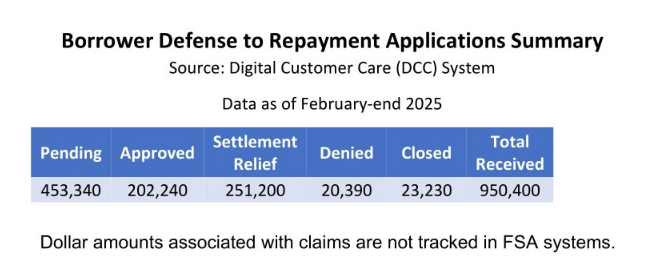
The Higher Education Inquirer has received information today from the US Department of Education about Borrower Defense to Repayment claims. Here are the results from ED FOIA 25-02047-F.
Category: Featured
-

Marielle van der Meer, La Sagesse
Introduce yourself in three words or phrases.
Serial university starter.
What do you like most about your job?
The opportunity to do something new within a sector that is challenged by legacy, tradition and archaic systems – and to drive real change. And to transform young people’s lives, of course…
Best work trip/Worst work trip?
Difficult, as there have been so many. Corny as it sounds, perhaps my best trip is the first trip I ever made – to Cyprus, the British Council Clearing Fair in August 2007. I had just started as Europe officer at London Metropolitan University, and it was my first time ever to travel for work. I can still remember walking into my poolside hotel room in the Hilton Park and pinching myself. I couldn’t believe my luck!
I met some great people that trip (again, poolside, and there may have been some cocktails involved) but mostly, it was a first realisation of how the work we do within this industry really matters. So I guess it was a trip of great promise – and in hindsight, one that cemented my subsequent career, and passion for what I do.
Worst – I could talk about being tear-gassed in Istanbul, stuck in a riot in the West Bank, ducking underneath the passenger seat of a car at a traffic light in Karachi for fear of standing out (as a blonde female) and being mugged, losing my luggage for a total of three months on a simple work trip to Berlin, being pushed against a wall by a frisky, groping male at a conference party who mistook my smile and friendliness for consent… but ultimately we are the sum of all our experiences and even the not-so-good ones make for good reflections and stories to tell.
If you could learn a language instantly, which would you pick and why?
Spanish. I am now at day 1,565 of Duolingo and still struggling. My husband and I got stuck in Spain during the pandemic and randomly ended up buying a house there, so we have been going back and forth a lot ever since. It would make my life a lot easier if I could instantly become fluent.
What makes you get up in the morning?
Birds singing outside my window. An over-enthusiastic dog named Ted Hilton. The sense of duty to complete my Spanish Duolingo lesson (see above).
Champion/cheerleader which we should all follow and why?
So many! In all honesty, I have met so many great people over the years, along the way – some of whom are now very close friends. I think all of us are doing our part in making a difference. But if I were to give one shoutout – one that’s only fitting considering this is The PIE – it’s Amy Baker. From humble beginnings around a kitchen table to what The PIE has grown into now, all with such grace, humility, great insight and kindness, and by building a kick-a*se team.
Best international ed conference and why
I loved the Innovative Universities Summit hosted in Korea by the New Challenge Foundation last year. Not only did it bring together some fascinating, passionate global leaders in the international higher education innovation space, the format was brilliant – intimate, lots of space for meaningful dialogue, and extra-curricular activities such as Makgeolli making and rainforest walks on the island of Jeju. It was possibly also the only four-day conference I ever attended where they gave us a weekend off in the middle to do our own thing. How civilised!
Worst conference food/beverage experience
I must admit, at any big conference such as NAFSA or ICEF or EAIE, I tend to sneak out for lunch. Not only do I despise the queues and the mediocre buffets, but I also like to take that moment in the day to NOT make small talk and find a nice place for lunch to enjoy a meal and glass of wine in silence.
Book or podcast recommendation for others in the sector?
I don’t really peruse any sector-related content, but I can recommend anyone to stick a copy of Alan Watts’ book of quotes There is never anything but the present in their travel bag. A reminder of how we can all benefit to pause and ground ourselves a little bit more in the here and now rather than rushing off to the next thing and find joy in the small things around us. To quote: “Instant coffee is a well-deserved punishment for being in a hurry to reach the future”. Amen.
Describe a project or initiative you’re currently working on that excites you
It’ll have to be The School of Innovation, an aspiring new university-in-the-making that I am currently consulting for as fractional co-CEO. An ambitious project aiming to launch with a first pilot cohort in the fall of 2025, TSOI is building a new university solely focused on the study, advancement and application of innovation.
The post Marielle van der Meer, La Sagesse appeared first on The PIE News.
-

With no warning
The term ‘observations’ comes from the days trained weather observers recorded standard meteorological information. Now observations from radiosondes — attached to weather balloons rising to the upper stratosphere — collect data on temperature, humidity, air pressure and wind.
Automated surface-observing systems on land provide real-time data and satellites gather imagery and more data which is fed into supercomputers to provide forecasts.
So what are the benefits of accurate weather forecasts?
Staying prepared for the worst
Evan Thompson, the director of the Meteorological Service in Jamaica, has seen his island hit by extreme weather events as seasonal hurricanes have become more severe.
Thompson said that people need to know how to protect themselves from extreme weather such as tropical storms and hurricanes.
“Whether it means moving to higher ground in the moment or at least ensuring you don’t take chances crossing flooded roadways that are with waters moving fast, or rivers,” he said.
Thompson wants his country to be prepared for severe weather. “More data always means better observations which in turn leads to better forecasts.”
Over the last decades, the accuracy of weather forecasting in the United States has vastly increased what is known as storm resiliency, helped airlines reroute flights, farmers to plant crops at the optimal times and power companies to deal with demand from their customers.
Climate change intensifies weather.
Elsewhere, the World Meteorological Organisation (WMO) and the World Environmental Programme (WEP) have targeted the need for more observation stations in countries across the Middle East, Africa, South America and Pacific Island states, countries which are at risk of seeing economic progress wiped out by increasing impacts of climate change.
The WMO target is for weather observation to reach the levels of countries in Europe and the United States. But it may not be citing the United States as a model in the future. Since January, the United States has been reducing its capacity to provide weather data.
The cuts come at a time when the intensity and frequency of extreme weather events have increased due to climate change linked to human induced warming according to the Intergovernmental Panel on Climate Change report of August 2021. However, the Trump administration has taken a decision to eliminate the term “climate change” from federal websites.
Especially dependent on accurate forecasts are the construction industry, agriculture, power companies and aviation.
Fabio Venuti of the European Centre for Medium-Range Weather Forecasts inputs weather data into a supercomputer. “Global weather forecasting like ours can assimilate data then produce high resolution local forecasts for each country,” he said. “They can be more prepared.”
Information farmers can rely on
Fabio said that the ability to forecast rain and drought can help farmers and governments plan food crops. And it can help public health officials prepare for and lessen the spread of diseases, such as malaria, that are affected by environmental factors as insects transported by winds.
Thompson in Jamaica said that the policies and plans that governments take are affected by weather forecasting. “For example, building codes can be adjusted because we recognise more severe downpours in areas that don’t normally have flooding,” he said.
In the United States, the National Oceanic and Atmospheric Administration (NOAA), the parent agency of the National Weather Service, is tasked with daily weather forecasts, severe storm warnings and climate monitoring. In 2025 NOAA has already lost 800 employees and a further 500 have been offered buyouts.
According to the former heads of the National Weather Service, the proposed cuts of close to 30% for NOAA would essentially eliminate NOAA’s research function for weather.
Inger Anderson, executive director of the UN Environment Programme, said that accurate weather forecasting pays off in many ways — lives saved, improved disaster management, protecting livelihoods, biodiversity, food security, water supply and economic growth.
Besides cutting staffing, the Trump administration has also cut back on funds used to record tidal predictions and weather disasters such as heat waves, hurricanes, tornados, floods and wildfires. The U.S. National Centers for Environmental Information, the agency that collates historical meteorological records, will cease to update its Billion-Dollar Weather and Climate Disasters database beyond 2024. Previous records will be archived.
Jeff Masters, a meteorologist for Yale Climate Connections says the database is the “gold standard” used to evaluate the costs of extreme weather. “It’s a major loss, since it comes at a time when we need to better understand how much climate change is increasing disaster losses,” he said.
Weather forecasting can tell us more than whether to carry an umbrella, when to plan a picnic or plant flowers in the gardens. Accurate forecasting can save your life, your home and your livelihood.
Questions to consider:
1. How do you use weather forecasts?
2. Should politicians work more closely with scientists?
3. Have you experienced a severe weather event?
-

The Harvard experience: could it happen here?
by GR Evans
On 1 May 2025 The Guardian headline read: ‘Trump administration exploits landmark civil rights act to fight universities’ diversity initiatives‘. What prevents a British King or Prime Minister from attempting to impose sanctions on universities?
US higher education is exposed both to presidential and to state interference. Government powers to intervene in US HE reside in presidential control of federal funding, which may come with conditions. Trump cannot simply shut down the Department of Education by executive order but it seems he can direct that the Department’s grant- and loan-giving functions are taken on by another government department.
As early as 2023 Donald Trump had said ‘We are going to choke off the money to schools that aid the Marxist assault on our American heritage and on Western civilization itself’. In response to campus protest he removed $400m of Columbia’s federal funding in March 2025 on the grounds that the University had failed to address the alleged ‘persistent harassment of Jewish students’. In April 2025 he gave orders to Ivy League universities, threatening withdrawal of funding if their teaching and research did not comply with Government policy as the President defined it and that their appointments should have regard to those expectations.
On 8 April the Washington Examiner reported a planned attempt to counter such action by legislation, that is to prevent Trump’s directives taking effect by amending the Higher Education Act of 1965 ‘to prohibit political litmus tests in accreditation of institutions of higher education and for other purposes. On 10 April the Chronicle of Higher Education foresaw an Executive Order.
A letter to Harvard dated 11 April signed on behalf of the Department of Education and other federal agencies asserted that the United States had ‘invested in Harvard University’s operations’ because of ‘the value to the country’ of its work, but warned that ‘an investment is not an entitlement.’ This letter, if accepted, was to constitute ‘an agreement in principle’. Governance was to be ‘exclusively’ in the hands of those ‘tenured professors’ and ‘senior leadership’ who were ‘committed to the ‘changes indicated in this letter’. Its ‘hiring and related data’ and its student ‘admissions data’ were to be ‘shared with the federal Government’. International students ‘hostile to American values’ were not to be admitted and those already admitted were to be reported to federal authorities. Policies on diversity, equity and inclusion were to end and student protest restricted.
Harvard and other Ivy League Universities were indignant. Harvard in particular rode the headlines for some days, objecting to the Government demand that it immediately agree:
to implement the Trump administration’s demands to overhaul the University’s governance and leadership, academic programs, admissions system, hiring process, and discipline system—with the promise of more demands to come
and thus ‘overtly seek to impose on Harvard University political views and policy preferences advanced by the Trump administration and commit the University to punishing disfavored speech’. There were reports that US academics were seeking to escape to employment in Canada, the UK or Europe.
The American Association of Colleges and Universities(AACU), founded in 1915 as the Association of American Colleges, now has a wide-ranging and international membership. It is a loose counterpart to the British Universities UK which also has a membership including an extensive range of higher education providers. The AACU issued a Call for Constructive Engagement on 22 April, 2025, but litigation was already in hand, with the President and Fellows of Harvard seeking declaratory and injunctive relief on 21 April. Harvard is listed as the plaintiff with a considerable list of defendants identified (paras 15-30). In its submission Harvard argued that:
American institutions of higher learning have in common the essential freedom to determine, on academic grounds, whom to admit and what is taught, how, and by whom
and that such ‘American institutions of higher learning’ were ‘essential to American prosperity’.
It stressed a ‘longstanding collaboration between universities such as Harvard and the federal government dating back to the Second World War’. It pointed to Harvard’s success in using federal funding to achieving significant research outcomes. The recent ‘broad attack of Government’ on ‘universities across America’, not only on Harvard and the other Ivy League Universities listed, had affected the ‘critical funding partnerships’ that made this invaluable research possible.
This case was being brought because, it was argued, the Government had been using ‘the withholding of federal funding as leverage to gain control of academic decision making at Harvard’. Harvard cited the Government’s letter of 11 April as demanding governance reform and a ‘third-party’ audit ‘of the viewpoints of Harvard’s student body, faculty, and staff’, followed by the hiring of new Faculty and admission of students whose views were satisfactory to the Government. It had asserted that teaching should be ‘to the Government’s satisfaction as determined in the Government’s sole discretion’ and to that end Harvard should ‘terminate or reform its academic “programs” to the Government’s liking’. The Government had since ‘launched multiple investigations and other actions against Harvard’.
The Government had ‘within hours of the Freeze Order ‘ended ‘$2.2 billion in multiyear grants and $60M in multiyear contract value to Harvard University’ and Harvard began receiving ‘stop work orders’. In order to bring a case against the Government it was essential for Harvard to establish that the Government’s action constituted a breach of public law. To that end it stated that the ‘Court has jurisdiction over Harvard’s claims’ because the University did not ‘seek money damages or an order mandating specific performance of any contract’, but:
an order declaring unlawful and setting aside sweeping agency action taken in violation of Harvard’s constitutional rights under the First Amendment and its rights guaranteed by statute and regulation.
Harvard stressed that even though it is a private university its research is federally funded ‘through a grant process administered by federal agencies’. It cited Title VI of the Civil Rights Act of 1964 which requires ‘a detailed and mandatory statutory framework’ of procedures to be followed. Harvard had its own procedures, added to or created in August, September and November 2024. Specifically in March 2025, Harvard released updated “Frequently Asked Questions” clarifying that both Jewish and Israeli identities are covered by the University’s Non-Discrimination Policy.
Harvard explained that it had attempted ‘collaboration’ in the weeks following the government letter and the Federal Task Force’s press release announcing campus visits. It had sought to arrange a meeting on the campus and that was scheduled for late April 2025, yet on April 20 it was reported that the ‘Trump administration has grown so furious with Harvard University’ that ‘it is planning to pull an additional $1 billion of the school’s funding for health research.’
Trump’s threatened sanctions concerned the future of Harvard’s funding. Harvard has endowments of c$53 billion so any threat from Trump to reduce federal funding posed a limited risk to its future. However he made a further proposal on 18 April to remove Harvard’s exemption from Government tax on its income, which could have hit its normal operation harder.
The US counterpart to HMRC is its Internal Revenue Service (IRS). The IRS may grant tax-exempt status to a charitable, religious, scientific or literary organization, on condition that it refrains from campaigning or seeking to modify legislation. However, the President is not permitted to direct the IRS to conduct an investigation or audit. To that extent the counterbalancing of executive, legislative and judicial powers in the US seems to be holding.
Harvard was making its challenge at a time when the balance between the executive and the judiciary in the US had come into question in a number of cases where Trump’s executive orders sought to override the courts. It claimed that ‘the Freeze Order is part of a broader effort by the Government to punish Harvard for protecting its constitutional rights. … multiple news outlets have reported that the Internal Revenue Service is considering revoking its recognition of Harvard’s tax exempt status’. Representing 86 universities, the Presidents’ Alliance has filed an Amicus brief supporting the litigation.
Harvard sought in its litigation to have the Freeze Order declared unconstitutional and also the ‘unconstitutional conditions’ sought to be imposed in the April 3 and April 11 and any action taken under it so far, also banning any future orders in the same vein. It pleaded six Counts, first a violation of the First Amendment in that the letters had targeted the ‘academic content that Harvard professors “teach students”’. Count 2 was that ‘even if the prerequisites of review under the Administrative Procedure Act were not satisfied, federal courts have the “equitable power” to “enjoin unconstitutional actions by state and federal officers.”’ Count 3 was that Title VI does not permit wholesale freezing of a recipient’s federal financial assistance. Instead, it requires that a “refusal to grant or to continue assistance” be “limited in its effect to the particular program, or part thereof, in which . . . noncompliance has been so found.” Count 4 was the Government’s failure to ‘comply with their own regulations before freezing Harvard’s federal financial assistance’. Count 5 alleged that the action had been arbitrary and capricious and Count 6 that it had been ultra vires.
At Indiana University a professor of Germanic studies was recently investigated under a state law after a student accused him of speech in support of Palestine.
Could this happen in the UK?
English higher education providers have their autonomy protected by the Higher Education and Research Act (2017)s.2 [HERA]. This legislation created the Office for Students, a non-departmental public body, whose nearest US counterpart is the Higher Learning Commission, an independent agency founded in 1895 which accredits higher education institutions. The University of Michigan, for example seeks, renewal of its accreditation from the Higher Learning Commission every ten years.
The Office for Students is both regulator and funder, and distributes Government funding to higher education providers. This may take into account ‘particular policy areas and government priorities. Yet HERA outlaws any attempt by the OfS to impose the restrictions Trump sought to impose on the universities of the USA. English higher education providers must be free:
(i) to determine the content of particular courses and the manner in which they are taught, supervised and assessed,
(ii) to determine the criteria for the selection, appointment and dismissal of academic staff and apply those criteria in particular cases, and
(iii) to determine the criteria for the admission of students and apply those criteria in particular cases.
Academic staff in England also enjoy ‘freedom within the law’:
(i) to question and test received wisdom, and
(ii) to put forward new ideas and controversial or unpopular opinions,
without placing themselves in jeopardy of losing their jobs or privileges they may have at the providers.
There is some Government oversight. In protecting ‘the institutional autonomy of English higher e providers’, the Office for Students is subject to the ‘guidance’ of the Secretary of State, though Government requirements are held off by the legislative fencing. The guidance of a higher education provider by the Office for Students:
must not relate to—
(a) particular parts of courses of study,
(b) the content of such courses,
(c) the manner in which they are taught, supervised or assessed,
(d) the criteria for the selection, appointment or dismissal of academic staff, or how they are applied, or
(e) the criteria for the admission of students, or how they are applied.
The legislation adds that:
guidance framed by reference to a particular course of study must not guide the OfS to perform a function in a way which prohibits or requires the provision of a particular course of study.
This seems to place universities safely out of reach of the kind of restrictions Trump sought to impose on Harvard and other Ivy League Universities, but the Office for Students is potentially able not only to set its Government funding levels but also affect its students’ access to loans from the Student Loans Company. That can certainly be at risk, for example in the case of the Oxford Business College, whose funding (via franchise arrangements) was blocked in April 2025 when it was found to have abused the student loan system by admitting unqualified students. (US accreditors do hold a lot of power, because universities must be accredited by a federally recognized agency in order to access federal student aid.)
Access to Government funding through the OfS requires listing by the Office for Students on its Register as an approved provider. The Office for Students did not impose its Conditions of Registration on pre-existing universities before including them in 2018 on its first Register under HERA. It simply treated them as proven acceptable providers of higher education. Each university duly publishes an account of its compliance (eg at Oxford) with the requirements which enable it to remain on the Office for Students Register. What might happen if they were found not to have done so? Short of removal from its Register the OfS has been known to impose fines, notably of more than £500,000 in the recent case of the University of Sussex when it was alleged to have failed to follow its own procedures designed to protect academic freedom.
Government oversight of the work of HE providers may overlap with or sit uneasily beside forms of ‘accreditation’ and ’qualification’. The accreditation of qualifications in the UK may be the responsibility of a number of ‘agencies’ external to HE providers, some of which are bodies offering professional qualifications. For example the Solicitors Regulation Authority keeps its own register of qualified solicitors. A university degree may not constitute a ‘qualification’ without the completion of further recognised study, some of which may be provided by the university itself, for example the Postgraduate Certificate in Education.
An area of ‘accreditation’ undergoing significant reform and expansion in the UK covers ‘skills’, including apprenticeships. Not all universities offer their own apprenticeships, though they may recognise some of those available from other providers at Levels 4 and 5. Nevertheless ‘skills’ are potentially at risk of Government intervention. At the beginning of March 2025, the House of Lords was debating whether ‘skills’ might benefit from the establishment of a ‘new executive agency’.
It was recognised that there would need to be a report from the Secretary of State ‘containing draft proposals’ for an agency, ‘to be known as “Skills England”. Ian Sollom MPobjected that that that would represent ‘a significant centralising of power in the hands of the Secretary of State, without providing proper mechanisms for parliamentary oversight or accountability.’ A ‘statutory, departmental body would have more clout’, he argued.
An Institute for Apprenticeships and Technical Education (IfATE) already existed, but it was concerned with qualifications up to Level 5, short of degree-level 6. ‘Skills England’ was intended to begin work in April 2025. ‘When Skills England calls, will anybody answer the phone?’ asked HEPI, pointing to ‘limited autonomy, complex cross-departmental coordination, tensions between national and local priorities, and competing objectives between foundational and higher-level skills need’. Its ‘cross-departmental working’ with Government was unclear.
It looks as though some universities, at least, are safe from any initiative to interfere from above with the right to self-government and to determine what to teach and research. Harvard records a ‘revenue base’ of $65billion, with ‘federal funding ‘ as its largest source of support for research. The research income of Oxford, for example, is £778m, with commercial research income of £148m. That cannot compare with Harvard, but at least Oxford and some others will remain free to choose how to use that income for its academic purposes.
This is a modified version of an article first published by the Oxford Magazine No 477 in May 2025, republished with the permission of the editor and author.
SRHE member GR Evans is Emeritus Professor of Medieval Theology and Intellectual History in the University of Cambridge.
-
DOD Fails to Update Postsecondary Education Complaint System
Is the US Department of Defense (DOD) actually handling complaints from service members and their spouses who are using DOD Tuition Assistance and MyTAA (the education program for spouses)? It’s difficult to tell, and it’s unlikely that they’ll tell us.
DD Form 2961 is used for servicemembers and their spouses to make complaints about schools. And it appears up to date. And on their website, DOD still claims to help consumers work with schools about their complaints.
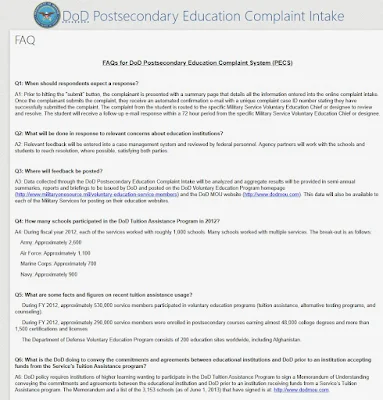
But information about the US Department of Defense Postsecondary Education Complaint System (PECS), the system that handles the complaints, has not been updated in about a decade. Here’s a screenshot from May 25, 2025.
What we do know is that DOD VOL ED and the DOD FOIA team have stonewalled us for eight years to get important information about their oversight. We also know that DOD VOL ED has allowed bad actor schools to violate DOD policies as they prey upon those who serve. Over the years we have notified a number of media outlets about these issues but few if any have shown interest.
-

Simplicity as strategy: The future of higher ed procurement
Procurement in higher education has come a long way from its back-office roots. Today’s procurement leaders juggle a dizzying array of demands: shrinking budgets, responsible purchasing goals, compliance issues and more — all while navigating persistent supply chain disruptions.
The solution to this mounting complexity isn’t more complexity — it’s thoughtful simplification. Forward-thinking institutions are discovering that streamlined, user-friendly procurement processes aren’t just nice to have; they’re essential in an era where procurement teams are expected to deliver far more than just cost savings.
Simplification as a strategic imperative
Procurement professionals manage competing priorities, endless spreadsheets, documentation hiccups and disconnected technologies that don’t “talk” to each other. It’s like trying to conduct an orchestra where musicians practice in isolation, playing from different sheets of music.
Beyond cost control, today’s procurement teams are expected to simultaneously deliver on quality, speed and responsible purchasing goals, while mitigating risks, innovating and more — often with fewer resources. Despite best intentions, attempts to work around complexity might simplify one step in the short run while adding more steps down the road. Like adding another lane to an already congested highway, workarounds may shift the bottleneck elsewhere.
There’s a better way: To crack procurement complexity, leaders must “bake” user-friendly simplicity into every stage of their workflows, creating processes that feel intuitive rather than burdensome.
What makes a process truly simple? According to KPMG’s research, simple procurement workflows share four traits:
- The job is easier to do with the workflow than without it.
- The workflow is easy to understand and follow.
- There are no gaps or ambiguities in the process.
- The workflow covers even rare scenarios.
Simplification doesn’t mean cutting corners. Rather, it means creating visibility across the entire procurement lifecycle, centralizing information and generating actionable data insights to enable smarter decisions. When done right, simplification enhances control while reducing frustration.
The shift to AI: Making simple feel sophisticated
In a report for Procurement Magazine, Libby Hargreaves, editor of Supply Chain Digital, predicts AI use cases in procurement will explode in the coming months, as past hesitation or playful experimentation gives way to full integration. Thanks to AI advancements, self-service can now feel like full-service, with interactions that are proactive, intelligent, helpful, efficient and frictionless, KPMG writes.
In procurement, emerging automations can range from contract management to supplier discovery, proposal customization, compliance documentation, vendor communications, spend analytics and more. As Forrester describes it, savvy procurement executives will find that investment in AI and automation tools frees up their teams from mundane tasks, prioritizes actions needing closer human attention and optimizes decisions.
Greg Muller, director of strategic sourcing and campus partnerships at UC San Diego, shares that vision. “Basic procurement functions need to be easy and automated for our users. We don’t want a Nobel Laureate wasting time looking for a good pair of gloves when they could be curing cancer,” Muller quips.
Sharon Loosman, director of procurement and business services at North Carolina State University, can relate. With one procurement team serving 12 colleges and 150 departments, Loosman aimed to create systems that would allow colleges to operate independently as experts of their own needs, while making policy-compliant purchases. Notably, Loosman noticed that faculty and staff often sidestepped the university’s official procurement channels to shop on Amazon, drawn by the wider selection, better pricing and faster delivery. Her team then set out to centralize and simplify processes without “breaking anything” or incurring implementation costs, while accessing better reporting.
To make that possible, procurement teams at UC San Diego and North Carolina State have adopted Amazon Business solutions, expanding access for internal customers across the organization. In doing so, the two institutions have integrated purchasing across departments, enabling buyers to access a vast, pre-vetted supplier network and robust functionality: custom approval workflows, deep spend analytics, preferred pricing, enhanced delivery options, Guided Buying policies and more.
Leaning into experimentation, procurement transformation
Looking ahead, procurement teams looking to innovate should embrace experimentation. “My advice is to take the blinders off, get outside your box and explore what else is out there that you haven’t thought about yet,” Loosman advises.
Muller echoes the sentiment: “We’re focused on a broader perspective,” he shares, engaging internal customers to understand their needs beyond one-off transactions and leaning on peers at other institutions to identify strategies already proven successful elsewhere.
“Sometimes we, as procurement leaders, get stuck in the way we’ve always done it,” Loosman concludes. “Let’s raise the bar. Let’s go find solutions and partners who are willing to work with you to make changes that move you forward.”
▷ Learn how Amazon Business can help accelerate your procurement goals: business.amazon.com/education
-

Legal defense fund will seek to fill gap left by OCR reduction
This audio is auto-generated. Please let us know if you have feedback.Education attorneys are set to launch a new organization by fall 2025 that would defend students’ civil rights in court and also track and report civil rights data. The effort, according to its founding nonprofit, aims to fill the gap left by the Trump administration’s dismantling of the U.S. Department of Education and its civil rights enforcement arm.
The Public Education Defense Fund will be launched by the National Center for Youth Law, which advocates for educational equity among other youth-related issues. It will contract with former Office for Civil Rights attorneys.
“At a time when civil rights protections for students are under unprecedented attack, preserving those rights is not negotiable — it’s vital,” said Johnathan Smith, chief of staff and general counsel at NCYL. “We can’t stand by while the federal government abandons its responsibility to uphold the basic rights of children and young people in this country.”
As part of the administration’s efforts to “end bureaucratic bloat” and send educational control to the states, U.S. Secretary of Education Linda McMahon laid off half of the Education Department’s staff as part of what she called the agency’s “final mission.” The move was followed by an executive order from President Donald Trump calling for the department to be shut down to “the maximum extent appropriate and permitted by law.”
The Education Department’s Office for Civil Rights took a major blow, with the department shuttering seven of the 12 regional offices that were in charge of more than half of the nation’s open civil rights cases. Over 200 OCR employees were laid off as part of the reduction in force.
Under the Biden administration, those employees carried a load of more than 40 cases per person. Attorneys fired as part of the reduction in force were in charge of investigating civil rights complaints related to discrimination and harassment in schools, as well as overseeing resolution agreements with school districts. These agreements guide the school systems involved in making policy changes to improve educational access, especially for historically marginalized students.
Prior to the announcement of the Public Education Defense Fund, NCYL filed a lawsuit against the Education Department in March to challenge the changes at the OCR. The lawsuit said the civil rights enforcement arm “stopped investigating complaints from the public based on race or sex discrimination, it cherry-picked and, on its own initiative, began targeted investigations into purported discrimination against white and cisgender students.”
-

Is federal support waning for registered teacher apprenticeships?
This audio is auto-generated. Please let us know if you have feedback.As momentum grows for registered teacher apprenticeships nationwide, advocates fear federal support for the workforce model is starting to wane.
Those concerns stem from the U.S. Department of Labor’s cancellation this month of a $12 million contract to support states and districts in rolling out their own registered educator apprenticeships. Specifically, the DOL contract funded the Educator Registered Apprenticeship Intermediary initiative, awarded to RTI International, a nonprofit research institution.
As of July 2023, DOL had funded registered apprenticeship intermediaries across industries ranging from early childhood education and healthcare to information technology and cybersecurity to accelerate the growth of apprenticeships nationwide.
It’s still unclear why DOL severed the ERA contract, and the department did not respond to a request to comment.
The workforce model has gained particular popularity among school districts and states as a way to address teacher shortages in critical areas, as it allows them to pay new educators as they work in classrooms under veteran teachers’ mentorship and earn teaching degrees or credentials.
Between 2022 and 2024, the number of participating states offering registered teacher apprenticeship programs surged from 3 to 47. On top of that, DOL data reveals the total number of teacher apprentices rose from 356 to 3,884 between fiscal years 2022 and 2025.
In a May 16 letter to U.S. Labor Secretary Lori Chavez-DeRemer, a group of universities, school districts, advocacy organizations and nonprofits called for the department to reconsider its decision to cancel the ERA contract. The letter also noted that “the growth and scale” of educator registered apprenticeship programs “would not have been possible without the support of the ERA contract,” which was awarded in July 2023.
Through the five-year contract, RTI has provided states and districts with free technical assistance to implement and design their own registered teacher apprenticeship programs. This support is also “paramount” for efforts to develop national standards for registered apprenticeships in education, the groups wrote in their letter.
“The sudden termination of this work will significantly halt meaningful progress and disrupt services that states and districts depend on to address urgent workforce needs,” the groups wrote. “We respectfully request that the Department restore the work within this administration’s priorities or identify an alternate pathway for this critical work to continue.”
Additionally, the group wrote that without the DOL funds, the quality of programs could worsen, administrative burden could grow for states and districts, and the department’s broader workforce priorities could slow down.
Supporters of registered teacher apprenticeship programs have also said the contract’s cancellation conflicts with the Trump administration’s push to establish 1 million new active apprentices. When President Donald Trump signed an executive order to “protect and strengthen” registered apprenticeships, advocates for the workforce model in education were initially optimistic.
Teacher apprenticeships are also a strong example of successfully giving local control to schools, said Amaya Garcia, director of pre-K-12 research and practice at New America, which partnered with RTI in implementing the ERA contract.
As Trump continues to call for the dismantling of the U.S. Department of Education, Garcia said, “it’s a little ironic that an administration that claims to want to bring education back in the hands of the states is pulling back on supporting states from essentially doing just that.”
The letter sent to Chavez-DeRemer said that the contract represents a bipartisan strategy to bolster the education workforce and address the “nonpartisan need for qualified educators.”
Those who signed the May 16 letter include the American Association of Colleges for Teacher Education, Deans for Impact, EdTrust, Vermont State University, the office of employer and apprenticeship services at Kentucky’s departments of labor and education, and Mississippi’s Jackson Public School District.
The cut comes at a time when the registered teacher apprenticeship model remains in its early stages, Garcia said.
“There’s still a lot for us to learn and to document about what’s actually happening in these programs and the impacts that they’re having on the communities that they’re in,” Garcia said.
-

Supporting their success: Uncovering the underrepresentation of Chinese students in Higher Education
- Baiyu Liu is a BSc Computer Science student studying at King’s College London (KCL). He has been elected President of the King’s College London Students’ Union (KCLSU) in March 2025. His election marks the first time a Chinese student breaks into Student Union leadership in a major London Russell Group university. In this article, Baiyu writes about his thoughts on Chinese representation in student leadership.
I have thoroughly enjoyed my time as an undergraduate student at KCL and I will look back fondly on my experience and the positive imprint the university has left on me. As I leave my undergraduate studies and move on to my new role as President of the KCLSU, I can’t help but reflect on my time. What went well, and what could be improved about university offerings to students, especially Chinese students.
Chinese students form one of the largest international student groups in the UK, yet they are strikingly underrepresented in leadership, governance, and public discourse. Until my election at King’s College London Students’ Union, there was not one East Asian President in its 150 year history. This highlights the stark imbalance of Chinese representation in student leadership at universities in the UK. We believe this underrepresentation must be addressed in order to keep UK universities competitive in attracting Chinese international students, whose tuition fees form a large part of British university income.
At King’s College London, out of the 23,000 international students, over 7,000 are Chinese. However, despite being a third of the international demographic and a fifth of the total student demographic, there is a virtually non-existent Chinese presence in the Students’ Union or senior leadership. Even with the commendable efforts of KCL’s leadership and our renowned Student Union, there is still much more to be done to bridge the gap.
We have identified two major factors that have led to this lack of leadership representation: a lack of existing minority representation and a lack of cross-cultural interaction. In the past, there have been discriminatory beliefs about Chinese students ‘keeping quiet’ or ‘keeping to themselves’. My election is a wake-up call – UK universities’ reliance on Chinese students’ tuition fees and treatment of them as merely consumers must come to an end. I picked up the mantle of leadership not because it was absent among the Chinese community, but because nobody had envisioned that a Chinese student could be an SU President.
Due to the Chinese culture of deference and Confucian principles, which value social harmony above individual agency, many Chinese international students do not believe they are empowered to speak out or stand up for their communities. They have very few role models or trailblazers – they couldn’t see themselves being student leaders.
There is of course also an element of the self-fulfilling prophecy of the bigotry of low expectations. The stereotype of Chinese students as being ‘hardworking but quiet’ rears its ugly head when many previous student leaders have presumed that students will simply accept what they are told and the changes the SU intends to make. They do not expect Chinese students to put up a fight.
As Chinese international students often cluster and stay within their own circles, they are often apathetic to the wider happenings of the Student Union. This effectively creates a distance between them and the policymaking processes in channelling their student voice.
The wider implication of the lack of Chinese representation is that their concerns are not always adequately addressed. One example at KCL is the issue of Digital Graduation Certificates (DGC), wherein the time discrepancy between receiving their degrees and having their physical certificates shipped to them in China leads to graduates missing out on crucial job application windows. For many years, Chinese students at KCL have suffered in silence as they have missed job opportunities due to the lack of DGCs. We do not believe this is an oversight from KCL’s administration, but instead simply that they did not know this was a problem.
Authentic Chinese food is absent in our kitchens, despite the sizable Chinese demographic. Many international students find the whitewashed Asian food disagreeable to their palates, whilst calls for food reform often fall on deaf ears. Similarly, hot drinking water dispensers are still unavailable for Chinese students who are not accustomed to drinking cold water.
These problems, combined with many others, lead to Chinese students questioning whether they ought to study in the UK at all, which already costs far more than Chinese universities. UK universities, it should be noted, are also beginning to fall behind in STEM fields, which Chinese parents are becoming increasingly more aware of. It is thus in the best interests of UK universities to maintain a competitive edge in the Chinese higher education market.
We believe it is imperative that we diversify the Student Unions of UK universities and empower Chinese international student voices. Although KCLSU is a start, it must not be the end. We hope more Chinese students could be emboldened to run for Student Union positions across this country.
KCL is one of the greatest academic institutions in the world, with a great diversity of students from different backgrounds and cultures. The world-class staff of the university and the student union have done great work in enriching and fostering inclusivity. We believe that King’s could serve as a beacon to the rest of the country moving forward, especially in uplifting student voices within the Chinese community. I envision a world where all students, regardless of nationality, can see themselves in top leadership positions and have their voices heard. I hope to see Chinese students not just study in UK universities, but also help to shape them.
-

Five Science-Backed Ways to Improve Academic Writing (opinion)
I vividly recall when an editor in chief invited me to publish in a well-known journal. Fresh from defending my dissertation, I still grappled with understanding how publishing worked in academia—like whether I should try to imitate the densely written, abstract sentences that appeared in the journal he edited. I thumbed the latest issue and looked at him. “Do you have a house style I should use?”
He shuddered and gave a response I’ve since heard echoed by other editors in chief of similarly well-respected journals: “Please don’t! We publish manuscripts despite how they’re written.”
But this candid advice leaves most graduate students and even seasoned faculty members with another dilemma. If you can’t imitate articles published in the best journals, how do you write up your research so it gets published?
During my early years of teaching writing courses, I discovered that students seldom revised their work significantly, even when they received extensive feedback from both me and their peers. In fact, students failed to revise even when they received feedback and grades from their peers.
All writing students also struggle with the idea that both feedback and grades on their writing are subjective, a reflection of how a particular instructor prefers students to write in a specific course. In addition, English literature and creative writing courses teach students that writing is a combination of mystery and art.
In contrast, researchers in cognitive neuroscience and psycholinguistics identified the features that make sentences easy or difficult to read decades ago. As a result, we can teach students how to make their sentences clear—no matter how complex the subject—by teaching science-based writing methods. And as a graduate student or faculty member, you can improve your own academic writing—and your chances for publication—by focusing on the five basic principles that cause readers to perceive sentences as clear.
- Active voice makes sentences easier to read.
In studies, researchers have discovered that readers comprehend sentences more rapidly when sentences reflect cause and effect. We can trace this to two factors. First, our brains naturally perceive cause and effect, which evolved as a survival mechanism. Research shows, for instance, that infants as young as 6 months old may identify cause and effect.
Second, English sentence structure reflects causes and effects in its ordering of words: subject-verb-object. As researchers discovered, participants read sentences with active voice at speeds one-third faster than they read sentences in passive voice. Moreover, these same participants misunderstood even simple sentences in passive voice about one-quarter of the time. While many writing instructors require students to use active voice, few alert students to the specific benefits of active sentences that make them easier to read. These sentences are shorter, more efficient and more concrete, while sharpening readers’ sense of cause and effect.
Consider the differences between the first example below, which relies on passive voice, and the second, which uses active voice.
Passive: It has been reported that satiety may be induced by the distention of the gastric antrum due to the release of dissolved gas from carbonated water, which may improve gastric motility, thereby reducing hunger.
Active: Cuomo, Savarese, Sarnelli et al. reported that drinking carbonated water distends the gastric antrum through the release of dissolved gas, inducing satiety and improving gastric motility, all of which reduce hunger.
- Actors or concrete objects turn sentences into microstories.
Academic writing naturally tackles complex content that can prove challenging even to subject matter experts. However, writers can make even challenging content comprehensible to nonexperts by making cause and effect clear in their sentences by using nouns that readers can easily identify as subjects. When the grammatical subjects in sentences are nouns clearly capable of performing actions, readers process sentences with greater speed and less effort. For actors, use people, organizations or publications—any individual, group or item created with intention that generates impact.
We unconsciously perceive these sentences as easier to read and recall because identifying actors and actions in sentences aids readers in fixing both a word’s meaning and the role it plays in sentence structure. Furthermore, these nouns enhance the efficiency of any sentence by paring down its words. Take these examples below:
Abstract noun as subject: Virginia Woolf’s examination of the social and economic obstacles female writers faced, due to the presumption that women had no place in literary professions and so were instead relegated to the household, particularly resonated with her audience of young women who had struggled to fight for their right to study at their colleges, even after the political successes of the suffragettes.
Actor as subject: In A Room of One’s Own, Virginia Woolf examined social and economic obstacles female writers faced. Despite the political success of the suffragettes, writers like Woolf battled the perception that women had no place in the literary professions. Thus Woolf’s book resonated with her audience, young women who had to fight for the right to study at their colleges.
- Pronouns send readers backward, but readers make sense of sentences by anticipating what comes next.
If writers imitate the academic writing they see in print, they typically rely on pronouns as the subjects of sentences, especially “this,” “that,” “these,” “those” and “it.” However, pronouns save writers time but cost readers significantly, for two reasons.
First, readers typically assume that pronouns refer to a single noun rather than a cluster of nouns, a phrase or even an entire sentence. Second, when writers use these pronouns without nouns to anchor their meaning, readers slow down and frequently misidentify the meanings of pronouns. Moreover, readers rated writing samples with higher numbers of pronouns as less well-written than sentences that relied on actors as subjects—or even pronouns like “this” anchored by nouns like “outcome.”
Pronoun as subject: Due to the potential confounding detrimental effects of sulfonylureas and insulin in the comparator arms of the trials evaluating anticancer effects of metformin/thiazolidinediones, it is difficult to draw any firm conclusions from prior studies.
Actor as subject: In trials to assess the anticancer effects of metformin/thiazolidinediones, we had difficulty drawing any firm conclusions from prior studies due to potential confounding detrimental effects from sulfonylureas and insulin.
- Action verbs make sentences more concrete, efficient and memorable.
Open any newspaper or magazine and, even in just-the-facts-ma’am hard news stories, you’ll find action verbs, like “argues,” “reinvents,” “writes” and “remakes.” In contrast, most writers overrely on nonaction verbs. These verbs include “is,” “has been,” “seems,” “appears,” “becomes,” “represents” and that evergreen staple of academic writing, “tends.”
Action verbs enable readers to immediately identify verbs, a process central to comprehending sentence structure and understanding meaning alike. Furthermore, action verbs make sentences more efficient, more concrete and more memorable. In one study of verbs and memory, readers recalled concrete verbs more accurately than nonaction verbs.
When we read action verbs, our brains recruit the sensory-motor system, generating faster reaction times than with abstract or nonaction verbs, which are processed outside that system. Even in patients with dementia, action verbs remain among words patients with advanced disease can identify due to the semantic richness of connections action verbs recruit in the brain.
Nonaction verbs: Claiming the promotion of research “excellence” and priding oneself in the record of “excellence” has become commonplace, but what this excellence is concretely about is unclear.
Action verbs: Research institutions claim to promote faculty on the basis of research “excellence,” but institutions define “excellence” in many ways, with few clear definitions.
- Place subjects and verbs close together.
When we read, we understand sentences’ meaning based on our predictions of how sentences unfold. We unconsciously make these predictions from our encounters with thousands of sentences. Most important, these predictions rely on our ability to identify grammatical subjects and verbs.
We make these predictions easily when writers place subjects and verbs close together. In contrast, we struggle when writers separate subjects and verbs. With each increase in distance between subjects and verbs, readers exert greater effort, while reading speeds slow down. More strikingly, readers also make more errors in identifying subjects and verbs with increases in the number of words between subjects and verbs—even in relatively short sentences.
For example, in this sentence, readers must stumble through two adjective clauses, noted in orange below, before encountering the verb “decreases,” paired with the underlined subject, “rule”:
Specifically, a rule that indicates a reduction in delay that precedes an aversive consequence decreases procrastination in university students.
But this separation strains working memory, as readers rely on subject-verb-object order to identify sentence structure. Ironically, as academic writers gain sophistication in their subject-matter expertise, they frustrate readers’ mechanisms for comprehension. Your urge to immediately modify the subject of your sentence with phrases and clauses slows reading and increases readers’ sense of conscious effort.
On the other hand, reading speeds increase while effort decreases when subjects and verbs appear close together. Introduce your main point with a subject and verb, then modify them with clauses or phrases:
Specifically, university students decrease procrastination when they face aversive consequences immediately for failure to meet deadlines.
These principles will work in any discipline, enabling writers to control how editors and peer reviewers respond to their manuscripts and proposals. These changes can help make an academic career successful, crucial in today’s competitive environment.


