Category: Featured

  • ‘A shell of itself’: Federal judge pauses efforts to wind down Education Department

    ‘A shell of itself’: Federal judge pauses efforts to wind down Education Department

    This audio is auto-generated. Please let us know if you have feedback.

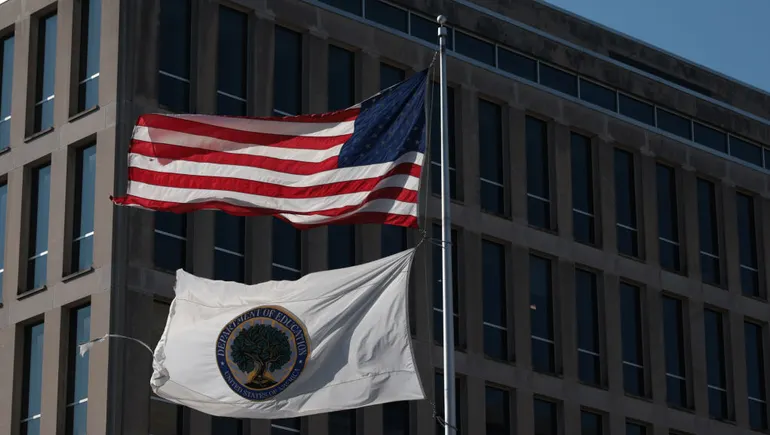
    The U.S. Department of Education is temporarily barred from carrying out an executive order to shut down the agency and must reinstate employees who were fired as part of a mass reduction in force in March, a federal judge ruled Thursday.

    In the preliminary injunction in State of New York v. McMahon, U.S. District Judge Myong Joun ordered that the department be “restored to the status quo” prior to the day President Donald Trump retook office.

    The agency’s actions since show no evidence that its workforce reductions have improved efficiency or that the agency is making progress in working with Congress to close the department, Joun said. 

    “The supporting declarations of former Department employees, educational institutions, unions, and educators paint a stark picture of the irreparable harm that will result from financial uncertainty and delay, impeded access to vital knowledge on which students and educators rely, and loss of essential services for America’s most vulnerable student populations,” his ruling stated.

    Joun also said the Education Department is prohibited from carrying out President Donald Trump’s March 21 directive to transfer management of the federal student loans portfolio and special education management and oversight out of the Education Department.

    “A department without enough employees to perform statutorily mandated functions is not a department at all,” Joun wrote. “This court cannot be asked to cover its eyes while the Department’s employees are continuously fired and units are transferred out until the Department becomes a shell of itself.”

    The preliminary injunction requires the agency to submit a report to the court within 72 hours of the order, outlining all the steps it is taking to comply, and to do so “every week thereafter until the Department is restored to the status quo prior to January 20, 2025.”

    Thursday’s ruling is a setback to the Trump administration’s goals of reducing the size and scope of the federal government. The ambitions are to give more flexibility and decision-making power to the states, supporters of the administration action said.

    Madi Biedermann, deputy assistant secretary for communications at the Education Department, said the agency will challenge the ruling “on an emergency basis.”

    “Once again, a far-left Judge has dramatically overstepped his authority, based on a complaint from biased plaintiffs, and issued an injunction against the obviously lawful efforts to make the Department of Education more efficient and functional for the American people,” Biedermann said in an emailed statement Thursday. 

    Biedermann added, “This ruling is not in the best interest of American students or families.”

    Higher education advocates, on the other hand, celebrated the ruling.

    Today, the court rightly rejected one of the administration’s very first illegal, and consequential, acts: abolishing the federal role in education,” said Randi Weingarten, president of the American Federation of Teachers, in a Thursday statement. Most Americans and states “want to keep the education department because it ensures all kids, not just some, can get a shot at a better life,” she said.

    The legal challenge began March 13, when the attorneys general in 20 states and the District of Columbia sued the Education Department to halt the mass workforce reductions announced March 11. 

    About half of the agency’s 4,133 employees were let go or accepted buy outs. Almost a third of the affected employees had worked in one of three offices within the Education Department: Federal Student Aid, the Office for Civil Rights and the Institute for Education Sciences. 

    Later that month, Trump signed an executive order at a White House ceremony that directed U.S. Education Secretary Linda McMahon to begin closing down the agency to the “maximum extent appropriate.”

    My administration will take all lawful steps to shut down the department,” Trump said at the March 20 signing ceremony. “We’re going to shut it down, and shut it down as quickly as possible.”

    McMahon, during several appearances on Capitol Hill, has acknowledged that only Congress has the authority to close the agency and said she is working with lawmakers to do so.
    Source link

  • The reconciliation bill cleared the House. Here’s how it would change higher ed.

    The reconciliation bill cleared the House. Here’s how it would change higher ed.

    This audio is auto-generated. Please let us know if you have feedback.

    House Republicans on Thursday narrowly passed a massive tax and spending bill that, if signed into law, would add new financial pressures on U.S. colleges and students while extending the tax cuts instituted in 2017. 

    Backed by President Donald Trump and dubbed the “One Big Beautiful Bill Act,” the proposal includes provisions for dramatically increasing the endowment tax, a risk-sharing policy that would put colleges on the hook for unpaid student loans, and changes to the federal student aid program that critics say would reduce access to higher education. 

    It also includes work requirements to the Medicaid health insurance program, changes to which could impact university hospitals and leave many college students without health insurance.

    The bill is headed to the Senate after it passed the House by one vote, with every Democrat and two Republicans voting against it. Three other Republicans either abstained or did not participate in the vote. 

    The Senate, held by Republicans with a 53-person majority, is widely expected to add changes to the bill.

    Since lawmakers passed the legislation as part of the reconciliation process — a rule allowing the Senate to approve spending-related policies with a simple majority — Republicans can avoid a filibuster that would take 60 votes to break.  

    In a Wednesday letter to House leaders, American Council on Education President Ted Mitchell wrote that the higher ed policy changes would have “a historic and negative impact on the ability of current and future students to access postsecondary education, as well as on colleges and universities striving to carry out their vital educational and research missions.”

    Here is a look at some of the major higher ed provisions:

    Endowment tax

    Today, the richest private colleges — the few dozen with at least 500 students and at least $500,000 endowment assets per student — pay an endowment excise tax set at 1.4%.

    Wednesday’s bill would implement a graduated rate structure, with levels starting at 1.4%, and rising to 7%, 14% and 21% depending on endowment assets per student. Under that tiered system, the wealthiest college would be taxed the same as the current corporate income rate. 

    When House Republicans advanced the endowment tax proposal earlier this month, they decried “woke, elite universities that operate more like major corporations.”

    The lowest tax bracket targets colleges whose endowments are valued between $500,000 and $749,999 per student.

    Endowment taxes would rise to 21% for the nation’s wealthiest private colleges

    Excise tax tiers for private colleges based on endowment funds per student

    Industry experts and insiders worry the tax could hurt colleges’ long-term missions and diminish the resources they rely on to recruit lower-income students. 

    In a statement Thursday, Kara Freeman, president and CEO of the National Association of College and University Business Officers, pointed to research by her organization and Commonfund finding that nearly half of endowment spending went toward student aid in fiscal 2024. 

    This scholarship tax takes funds away from students and makes it less possible for colleges to support them,” Freeman said. 

    Colleges spend the largest share of endowment funds on student financial aid

    Endowment spending distribution by function in fiscal 2024

    Financial aid changes

    The bill eliminates federal subsidized loans for undergraduates and Direct Plus loans for graduate students beginning on July 1, 2026.

    It also limits Parent Plus Loans, capping how much parents can borrow and only allowing them to take out loans if their dependent student has already taken out the maximum in unsubsidized loans. 

    The bill sets an overall lifetime student loan limit of $200,000 for any single borrower across all federal loan types.

    Additionally, it raises the course hours for the full-time student designation needed to receive the maximum Pell Grant from 24 to 30 per academic year, and it changes the formula for Pell eligibility.

    ACE’s Mitchell called the proposed changes to Pell Grants “crippling,” saying some 700,000 students could lose eligibility under the bill. 

    Regarding changes to federal student funding writ large, Mitchell described them as “deep cuts and damaging changes to important federal student aid programs” that would limit access to education. 

    The bill also cuts several student loan repayment programs, consolidating a “litany” of repayment plans into two, according to the House Committee on Education and Workforce.

    Source link

  • DHS Terminates Harvard’s SEVP Certification, Blocking Foreign Student Enrollment – CUPA-HR

    DHS Terminates Harvard’s SEVP Certification, Blocking Foreign Student Enrollment – CUPA-HR

    by CUPA-HR | May 22, 2025

    On May 22, the Department of Homeland Security (DHS) announced that it terminated Harvard University’s Student and Exchange Visitor Program (SEVP) certification. According to DHS, this action bars Harvard from enrolling foreign students and requires foreign students currently enrolled at the institution to transfer to another U.S. institution or lose legal status.

    In the announcement, DHS states that “Harvard’s leadership has created an unsafe campus environment by permitting anti-American, pro-terrorist agitators to harass and physically assault individuals, including many Jewish students, and otherwise obstruct its once-venerable learning environment.” DHS claims that many of the agitators are foreign students. The announcement also accuses Harvard’s leadership of facilitating and engaging in coordinated activity with the Chinese Communist Party.

    On April 16, DHS Secretary Kristi Noem sent a letter to Harvard requesting the university to provide records on foreign students’ illegal activity or misconduct. The letter stated that Harvard could face immediate loss of SEVP certification if it did not comply. According to the DHS announcement on the SEVP termination, Harvard did not provide “the required information requested and ignored a follow up request from the Department’s Office of General Counsel.”

    In DHS’s announcement regarding the termination of Harvard’s SEVP certification, Noem states that DHS’s decision to terminate Harvard’s SEVP certification is “holding Harvard accountable for fostering violence, antisemitism, and coordinating with the Chinese Communist Party on campus.” She further states that “it is a privilege, not a right, for universities to enroll foreign students” and to “let this serve as a warning to all universities and academic institutions across the country.”

    CUPA-HR will monitor for additional updates on this decision and other actions taken by DHS.


    Source link

  • Trump bars Harvard from enrolling international students in alarming crackdown on speech

    Trump bars Harvard from enrolling international students in alarming crackdown on speech

    Today, the Trump administration revoked Harvard University’s ability to enroll international students.

    Homeland Security Secretary Kristi Noem ordered her department to end Harvard’s Student and Exchange Visitor Program certification, citing the university’s failure to hand over the behavioral records of student visa holders.

    The Department of Homeland Security’s decision to escalate its assault against Harvard University by revoking its ability to enroll international students is retaliatory and unlawful.

    Secretary Noem’s letter warns that the Trump administration seeks to “root out the evils of anti-Americanism and antisemitism in society and campuses.” But little is more un-American than a federal bureaucrat demanding that a private university demonstrate its ideological fealty to the government under pain of punishment.

    The Department’s demand that Harvard produce audio and video footage of all protest activity involving international students over the last five years is gravely alarming. This sweeping fishing expedition reaches protected expression and must be flatly rejected.

    The Department is already arresting and seeking to deport students for engaging in protected political activity it disfavors. Were Harvard to capitulate to Secretary Noem’s unlawful demands, more students could face such consequences. The administration’s demand for a surveillance state at Harvard is anathema to American freedom. 

    The administration seems hellbent on employing every means at its disposal — no matter how unlawful or unconstitutional — to retaliate against Harvard and other colleges and universities for speech it doesn’t like. This has to stop. 

    Since 1999, FIRE has fought for free speech and academic freedom at Harvard and campuses nationwide, and we will continue to do so. We know there is work to do. Whatever Harvard’s past failings, core campus rights cannot and will not be secured by surveillance, retaliation, and censorship.

    No American should accept the federal government punishing its political opponents by demanding ideological conformity, surveilling and retaliating against protected speech, and violating the First Amendment.

    Source link

  • Trump Administration Strips Harvard’s SEVIS Certification

    Trump Administration Strips Harvard’s SEVIS Certification

    Amid an ongoing legal showdown with Harvard University, the Trump administration has carried through on a recent threat to halt the private institution’s ability to host international students.

    The move was first reported Thursday afternoon by The New York Times, then subsequently announced on social media by Secretary of Homeland Security Kristi Noem.

    “This administration is holding Harvard accountable for fostering violence, antisemitism, and coordinating with the Chinese Communist Party on its campus. It is a privilege, not a right, for universities to enroll foreign students and benefit from their higher tuition payments to help pad their multibillion-dollar endowments,” Noem wrote in the announcement. “Harvard had plenty of opportunity to do the right thing. It refused.”

    (Though much of the federal government’s recent focus on Harvard has concerned the university’s alleged failure to address antisemitism on campus, the Trump administration has also raised questions about collaboration with foreign researchers, particularly those with ties to the Chinese and Iranian governments.)

    In her statement, Noem wrote that Harvard’s Student Exchange and Visitor Information System certification was being stripped “as a result of their failure to adhere to the law,” which she said should “serve as a warning to all universities” across the U.S.

    Current international students would be required to transfer to maintain their visa status.

    Noem added that Harvard would need to turn over demanded records within 72 hours if it would “like the opportunity of regaining” SEVIS certification “before the upcoming school year.”

    A Harvard spokesperson called the action “unlawful” in an emailed statement.

    “We are fully committed to maintaining Harvard’s ability to host international students and scholars, who hail from more than 140 countries and enrich the University—and this nation—immeasurably,” the spokesperson wrote. “This retaliatory action threatens serious harm to the Harvard community and our country, and undermines Harvard’s academic and research mission.”

    Impact on Harvard

    Harvard enrolled 6,793 international students last fall, according to university data. International students have made up about a quarter of Harvard’s head count over the last decade—a population that could disappear, along with their substantial tuition dollars, if the Trump administration’s directive holds.

    Noem threatened to revoke Harvard’s SEVIS certification last month after the university pushed back on federal government demands to turn over “detailed records on Harvard’s foreign student visa holders’ illegal and violent activities by April 30.” That threat followed Harvard’s refusal to acquiesce to sweeping demands to overhaul its governance, admissions and hiring processes and more in response to allegations of antisemitic conduct. The university then sued the Trump administration over a federal funding freeze and other recent actions.

    Revoking Harvard’s SEVIS certification is the second punch the government threw at the university this week, coming after the Department of Health and Human Services announced the termination of $60 million in multiyear federal grants, which officials attributed to concerns about campus antisemitism.

    Other sources of federal funding are on hold. Altogether, the Trump administration has frozen at least $2.7 billion flowing to the private university, or about a third of Harvard’s federal funds.

    A New Political Cudgel

    The Student Exchange and Visitor Program’s process for revoking universities’ SEVIS status is usually a prolonged and complicated bureaucratic affair, typically preceded by a thorough investigation of the institution and the possibility of appeal.

    Sarah Spreitzer, vice president and chief of staff for government relations at the American Council on Education, told Inside Higher Ed that the manner in which the federal government stripped Harvard’s SEVIS certification was unprecedented.

    “In a normal world, Harvard is supposed to actually get a notice that their SEVIS certification is being revoked, and then there is an appeals process,” Spreitzer said. “It doesn’t seem that DHS is following any of the regular requirements that are included in statute for taking this action.”

    In late March, Trump officials first proposed revoking SEVIS status from institutions that they believed fostered antisemitism on campus, aiming their threats specifically at Columbia and the University of California, Los Angeles, which were home to major pro-Palestinian protests in 2024. In mid-April they threatened Harvard with decertification.

    Clay Harmon, director of AIRC: The Association of International Enrollment Management, told Inside Higher Ed in March that historically, SEVP investigations are conducted when universities are suspected of delivering less-than-bona-fide degree programs, using shady coursework as a way to essentially sell student visas to would-be immigrants who want a fast way to enter the country. 

    “It is the government’s primary way of ensuring that international student visas are not granted for diploma mills, fake institutions or institutions that are not adequately financially supported,” Harmon said. “I’ve never heard of a fully accredited, reputable institution—whether it’s Columbia or Bunker Hill Community College—being subjected to some kind of extraordinary SEVP investigation outside of the standard recertification process.”

    The initial process of certification, Harmon added, is intensive and can take institutions months or even longer to complete, which is one reason why decertification is so rare. Wielding the organization’s oversight powers as a tool for leverage in a larger political battle, he said, would be “a significant departure from past practices and established precedents.”

    “It is clear that the administration is putting forward new interpretations of laws and powers that have not been established through case law or regular practice,” Harmon said.

    In an email to Inside Higher Ed on Thursday, Harmon said the administration’s decision to use decertification against Harvard “imposes real, immediate, and significant harm on thousands of students for reasons outside their control and unrelated to their own actions.”

    “This action may have broad and long-term negative impacts—well beyond Harvard and well beyond 2025—to the educational experience and financial health of U.S. institutions,” he wrote.

    Revocation of Harvard’s SEVIS certification prompted sharp reactions online.

    Aaron Reichlin-Melnick, a senior fellow at the American Immigration Council, wrote on social media that Noem’s actions are “likely illegal” and her letter showed no evidence of Harvard’s violations.

    “Nothing in here alleges ANY specific violation of the Student and Exchange Visitor Program. Nothing. She cites no law violated, no regulation broken, no policy ignored,” Reichlin-Melnick wrote. “I don’t care what you think of Harvard; this is clear weaponization of government.”

    Will Creeley, legal director of the Foundation for Individual Rights and Expression, called the government’s revocation of Harvard’s ability to host international students “retaliatory and unlawful.”

    In a statement posted on X, he assailed the Education Department’s demands that Harvard hand over footage of international students protesting on campus.

    “This sweeping fishing expedition reaches protected expression and must be flatly rejected,” Creeley wrote. “The administration’s demand for a surveillance state at Harvard is anathema to American freedom … This has to stop.”

    But some officials in the MAGA camp celebrated the move.

    “This is a remarkable first step,” Republican senator Ashley Moody of Florida wrote on X. “I applaud the administration for taking a stand to rid our universities of malign foreign influence.”

    Source link

  • ‘A shell of itself’: Federal judge pauses efforts to wind down Education Department

    ‘A shell of itself’: Federal judge pauses efforts to wind down Education Department

    This audio is auto-generated. Please let us know if you have feedback.

    The U.S. Department of Education is temporarily barred from carrying out an executive order to shut down the agency and must reinstate employees who were fired as part of a mass reduction in force in March, a federal judge ruled Thursday.

    In the preliminary injunction in State of New York v. McMahon, U.S. District Judge Myong Joun ordered that the department be “restored to the status quo” prior to the day President Donald Trump retook office.

    The agency’s actions since show no evidence that its workforce reductions have improved efficiency or that the agency is making progress in working with Congress to close the department, Joun said. 

    “The supporting declarations of former Department employees, educational institutions, unions, and educators paint a stark picture of the irreparable harm that will result from financial uncertainty and delay, impeded access to vital knowledge on which students and educators rely, and loss of essential services for America’s most vulnerable student populations,” his ruling stated.

    Joun also said the Education Department is prohibited from carrying out President Donald Trump’s March 21 directive to transfer management of the federal student loans portfolio and special education management and oversight out of the Education Department.

    “A department without enough employees to perform statutorily mandated functions is not a department at all,” Joun wrote. “This court cannot be asked to cover its eyes while the Department’s employees are continuously fired and units are transferred out until the Department becomes a shell of itself.”

    The preliminary injunction requires the agency to submit a report to the court within 72 hours of the order, outlining all the steps it is taking to comply, and to do so “every week thereafter until the Department is restored to the status quo prior to January 20, 2025.”

    Thursday’s ruling is a setback to the Trump administration’s goals of reducing the size and scope of the federal government. The ambitions are to give more flexibility and decision-making power to the states, supporters of the administration action said.

    Madi Biedermann, deputy assistant secretary for communications at the Education Department, said the agency will challenge the ruling “on an emergency basis.”

    “Once again, a far-left Judge has dramatically overstepped his authority, based on a complaint from biased plaintiffs, and issued an injunction against the obviously lawful efforts to make the Department of Education more efficient and functional for the American people,” Biedermann said in an emailed statement Thursday. 

    Biedermann added, “This ruling is not in the best interest of American students or families.”

    Public school supporters, on the other hand, celebrated the ruling.

    Today, the court rightly rejected one of the administration’s very first illegal, and consequential, acts: abolishing the federal role in education,” said Randi Weingarten, president of the American Federation of Teachers, in a Thursday statement. Most Americans and states “want to keep the education department because it ensures all kids, not just some, can get a shot at a better life,” she said.

    The legal challenge began March 13, when the attorneys general in 20 states and the District of Columbia sued the Education Department to halt the mass workforce reductions announced March 11. 

    About half of the agency’s 4,133 employees were let go or accepted buy outs. Almost a third of the affected employees had worked in one of three offices within the Education Department: Federal Student Aid, the Office for Civil Rights and the Institute for Education Sciences. 

    Later that month, Trump signed an executive order at a White House ceremony that directed U.S. Education Secretary Linda McMahon to begin closing down the agency to the “maximum extent appropriate.”

    My administration will take all lawful steps to shut down the department,” Trump said at the March 20 signing ceremony. “We’re going to shut it down, and shut it down as quickly as possible.”

    McMahon, during several appearances on Capitol Hill, has acknowledged that only Congress has the authority to close the agency and said she is working with lawmakers to do so.

    Source link

  • Judge Orders Education Department Employees Reinstated

    Judge Orders Education Department Employees Reinstated

    Photo illustration by Justin Morrison/Inside Higher Ed | Tierney L. Cross/Getty Images | Matveev_Aleksandr and raweenuttapong/iStock/Getty Images

    A federal judge blocked the Trump administration from firing thousands of employees at the Department of Education in a decisive rebuke of this spring’s sweeping reduction in force and the executive branch’s efforts to weaken the Education Department.

    Judge Myong Joun rejected the administration’s argument that the layoffs, which affected half of the department’s workforce, were part of a “reorganization” aimed at improving efficiency and said evidence showed the administration’s “true intention is to effectively dismantle the Department without an authorizing statute.” His order also prevents the department from implementing President Donald Trump’s March directive to dismantle the agency.

    Joun of the District of Massachusetts also said the injunction to rehire the fired staffers was necessary in order to restore the department’s ability to accomplish its core functions and statutorily mandated responsibilities.

    “Not only is there no evidence that Defendants are pursuing a ‘legislative goal’ or otherwise working with Congress to reach a resolution, but there is also no evidence that the RIF has actually made the Department more efficient,” Joun wrote in his 88-page ruling. “Plaintiffs have demonstrated that the Department will not be able to carry out its statutory functions—and in some cases, is already unable to do so.”

    Reports of systemic failings and overloaded staff have streamed out of the beleaguered department ever since the March layoffs, from an untouched backlog of complaints at the Office for Civil Rights to the piling up of applications for student loan repayment and forgiveness plans.

    The injunction, handed down Thursday morning, means the administration must reinstate more than 2,000 Education Department employees and reopen regional offices that were shuttered during the reduction in force.

    The administration has already said it has issued a challenge to the ruling. Madi Biedermann, the department’s deputy assistant secretary for communication, said the administration has already appealed.

    In an email to Inside Higher Ed, Biedermann decried the decision, calling Joun a “far-left judge” who “dramatically overstepped his authority” and maintaining that the layoffs were “lawful efforts to make the Department of Education more efficient and functional.”

    “President Trump and the Senate-confirmed Secretary of Education clearly have the authority to make decisions about agency reorganization efforts, not an unelected Judge with a political axe to grind,” she wrote.

    A spokesperson for the Association of American University Professors, one of the plaintiffs in the case, wrote in a statement that they were “thrilled” with the decision.

    “Eliminating the [Education Department] would hurt everyday Americans, severely limit access to education, eviscerate funding for HBCUs and [tribal colleges and universities] while benefiting partisan politicians and private corporations,” they wrote.

    Education Secretary Linda McMahon defended the layoffs at a budget hearing just a day prior to the ruling. She said the goal was to “wind down the bureaucracy” of the department, and that while she hoped to have congressional support to dismantle it eventually, the administration did not intend to so on its own.

    Joun’s decision undercuts that defense. In the budget hearing, Rep. Rosa DeLauro, a Democrat of Connecticut, told McMahon that the cuts were “unlawful” and a usurpation of congressional authority.

    “As long as you continue to deliberately and flagrantly defy the law, you will continue to lose in court,” DeLauro said.

    The injunction is the latest in a string of court orders challenging the Trump administration’s rapid cuts to federal agencies in its first 100 days, often under the supervision of Elon Musk’s Department of Government Efficiency. DOGE was responsible for the vast majority of the Education Department layoffs, according to McMahon’s House testimony Wednesday.

    Joun’s ruling wasn’t the only one aimed at undoing the administration’s Education Department cuts. Judge Paul Friedman of the U.S. District Court for the District of Columbia also ordered that the department restore grant funding to a Southern nonprofit that has helped further school desegregation efforts since the 1960s. The grant had been defunded as part of the administration’s push to eliminate spending on diversity, equity and inclusion.

    Source link

  • Scholar-Athlete Turned NBA Coach Returns Home: Jacque Vaughn Joins Kansas Staff

    Scholar-Athlete Turned NBA Coach Returns Home: Jacque Vaughn Joins Kansas Staff

    Jacque VaughnThe University of Kansas has made a significant addition to its basketball coaching staff with the hiring of alumnus Jacque Vaughn.

    Vaughn returns to Kansas as an assistant coach under Bill Self, becoming the first former NBA head coach to join the Jayhawks’ coaching staff.

    Vaughn brings more than 15 years of NBA coaching experience, having served as head coach for both the Orlando Magic and Brooklyn Nets. During his coaching tenure, he mentored NBA All-Stars including Kevin Durant, Kyrie Irving, and Ben Simmons, as well as former Kansas players Markieff Morris and Jalen Wilson.

    “We’re very excited to welcome Jacque and Laura into the fold,” Self said. “I’ve known Jacque from a distance for several years now and have always admired how he has conducted himself professionally and how he has treated people.”

    Vaughn’s Kansas career from 1993-97 established him as one of the program’s most exceptional student-athletes. He concluded his collegiate career as the Big Eight Conference’s all-time assists leader with 804 assists, earning second-team All-American honors during his senior season under Roy Williams while maintaining extraordinary academic standards.

    His scholarly achievements were equally impressive, earning Academic All-American First Team selections in both 1996 and 1997. Most notably, Vaughn received the 1997 Academic All-American of the Year award, joining Cole Aldrich as the only Kansas players to earn this prestigious national recognition. Additionally, he was honored by Diverse with the Arthur Ashe Jr. Scholar-Athlete Award in 1996, cementing his status as a role model for student-athletes nationwide.

    Following his collegiate career, Vaughn was drafted 27th overall by the Utah Jazz in 1997 and enjoyed a 12-season NBA playing career that included stops with five teams and culminated in an NBA Championship with the San Antonio Spurs in 2007. He transitioned to coaching as an assistant with San Antonio before becoming head coach of the Orlando Magic in 2012, later leading the Brooklyn Nets to playoff appearances in 2020 and 2023.

    “I’m truly honored and overwhelmed with excitement to return to my alma mater,” Vaughn said. “I couldn’t pass up the opportunity to bring those experiences back to the school that means so much to me.”


    Vaughn replaces Norm Roberts, who recently retired, representing a powerful example of how academic excellence and athletic achievement can create pathways for continued leadership in higher education.

    Source link

  • Oklahoma religious charter remains blocked in SCOTUS split

    Oklahoma religious charter remains blocked in SCOTUS split

    This audio is auto-generated. Please let us know if you have feedback.

    The nation’s first religious public charter school will not be able to open its doors in Oklahoma after a 4-4 split in the U.S. Supreme Court on Thursday morning upheld the state supreme court’s ruling that blocked the school.

    The high court did not issue written opinions in the case.

    In its June 2024 ruling in St. Isidore of Seville Catholic Virtual School v. Drummond, a six-justice majority of the Oklahoma Supreme Court sided with state Attorney General Genter Drummond, writing that the virtual public charter school’s creation would violate the Oklahoma Constitution and the First Amendment’s Establishment Clause. St. Isidore was originally scheduled to open for the 2024-25 school year.

    Enforcing the St. Isidore Contract would create a slippery slope and what the framers’ warned against — the destruction of Oklahomans’ freedom to practice religion without fear of governmental intervention,” the Oklahoma court’s majority wrote in the decision.

    If the U.S. Supreme Court had ruled in favor of St. Isidore, the high-profile religious liberty case could have opened the door for a wave of other publicly funded religious schools. The split decision, however, leaves no national precedent on the question of whether religious schools can participate in public charter school programs without violating the First Amendment’s Establishment Clause.

    Justice Amy Coney Barrett recused herself from the case.

    St. Isidore is “disappointed” that the decision to block the school’s opening was upheld “without explanation” from the U.S. Supreme Court, said Archbishop of Oklahoma City Rev. Paul Coakley and Bishop of Tulsa Rev. David Konderla, in a joint statement Thursday.

    Given this latest ruling, Coakley and Konderla said they are exploring alternative options to offer a virtual Catholic education “to all persons” in Oklahoma and remain committed to parental choice in education.

    The Oklahoma Statewide Charter School Board, which initially approved St. Isidore’s contract in October 2023, will respect the Supreme Court’s authority following its split decision to uphold the Oklahoma Supreme Court’s ruling, said the board’s Executive Director Rebecca Wilkinson, in a Thursday statement.

    “The split decision of the court affirms this was indeed a complicated matter with a wide spectrum of views on the appropriate relationship between education, public funding, and religious institutions in our state and country,” Wilkinson said. “The Statewide Charter School Board remains committed to upholding our constitutional responsibilities and the highest standards of transparency and excellence. We will move forward in that vein, ensuring our policies and practices reflect both the rule of law and commitment to all students.”

    Drummond said in a Thursday statement that the Supreme Court’s decision is a “resounding victory for religious liberty and for the foundational principles that have guided our nation since its founding.”

    “I have always maintained that we must faithfully uphold the Constitution, even when it requires us to make difficult decisions,” Drummond said. “I will continue upholding the law, protecting our Christian values, and defending religious liberty — regardless of how difficult the battle may be.”

    Oklahoma Superintendent of Public Instruction Ryan Walters spoke out against the Supreme Court’s move, adding in a Thursday statement that he will always oppose “religious discrimination” and that all children in Oklahoma should be free to choose the best school to attend, whether that’s “religious or otherwise.”

    “Allowing the exclusion of religious schools from our charter school program in the name of 19th century religious bigotry is wrong,” Walters said in the statement sent by First Liberty Institute, a nonprofit law firm focused on First Amendment cases on religion.

    Still, it seems likely the issues involving the First Amendment’s religious clauses will eventually return to the U.S. Supreme Court, “perhaps in a case better suited for resolution,” said Thomas Jipping, a senior legal fellow in the Edwin Meese III Center for Legal and Judicial Studies at The Heritage Foundation, a national conservative think tank.

    While it may not be the last time the Supreme Court takes on a case over religious charter schools, “today’s outcome offers clarity for families and educators,” said Starlee Coleman, president and CEO of the National Alliance for Public Charter Schools, in a statement.

    About 8.1% of all public schools are charters. These schools serve 3.7 million enrolled students, of whom two-thirds are from low-income, Black or Latino communities, according to NAPCS.

    Source link

  • A new way of addressing the enigma of student engagement

    A new way of addressing the enigma of student engagement

    by Caroline Jones and Leonie Sweeney

    Psychosocial and Academic Trust Alienation (PATA) Theory as a Methodological Lens

    Higher education is experiencing post-pandemic challenges which have increased pressure on students in multifaceted and interconnecting ways (Jones & Bell, 2024). Existing research suggests that post-pandemic, students’ mental health and wellbeing has been significantly impacted (Chen & Lubock, 2022; Defeyter et al, 2021; Jones & Bell, 2025; McGiven & Shepherd, 2022; Nunn et al, 2021). This indicates that research into the field of higher education is needed more pro-actively than ever before, especially given the diverse student market.

    Currently there is considerable research in the form of critique of policy trends or evaluation of the effectiveness of changes in practice; however, the PATA theory lens suggests an approach to research centring on the educational psychologies and intricacies of the student and the enigma of student engagement (Buckley, 2018; Jones & Nangah, 2020: McFarlane & Thomas, 2017).

    Our recent article presents the PATA theory as a methodological lens through which higher education student behaviours, characteristics, and demographics can be researched. Furthermore, it provides an explanation of the PATA theory with specific links to student engagement. The idea of the PATA theory was first explored by Jones in 2017 and developed further in 2020 and 2021 in response to recognised issues faced relating to student engagement in widening participation student demographics. This research establishes the theory which can be applied to investigating the complexities of student demographics, with the aim being to develop knowledge and understanding of issues affecting students such as post-pandemic engagement.

    Guidelines from the QAA (2018) state that due to the demographic of the students who attend each institution, student engagement needs to be interpreted and encouraged in response to student/higher education institutional need. Therefore, student engagement can be interpreted in a variety of ways, examining the links between time, energy and other properties invested by HEIs and students with the aims of cultivating the student experience, strengthening educational outcomes, encouraging development and raising student achievement. Positive student engagement can lead to successful student outcomes, lower attrition rates and improved social mobility, demonstrating the importance of research for understanding and investing in student engagement practices.

    The PATA theory sits under the umbrella of alienation theory: it considers the individual student’s psychosocial status (self-concept/self-esteem levels) and has identified links to academic trust levels (Jones, 2021), particularly for students from the widening participation demographics or those who have experienced socio-economic disadvantage, see figure 1.

    Figure 1. PATA Theory (Jones, 2021)

    The PATA theory fits as a methodology within the realms of phenomenology as it enables researchers to present a narrative to represent the phenomena studied to extract significant statements from the data to formulate meaning. Neubauer, Witkop and Varpio (2019, p91) believe it is imperative for the researcher engaging in phenomenological research to be familiar with the philosophical ‘interpretations of human experience’, whilst Morrow, Rodriguez and King (2015, p644) advise that ‘descriptive phenomenology is especially valuable in areas where there is little existing research’. An additional crucial aspect of phenomenology is understanding that social reality has to be grounded in an individual’s encounters in authentic social situations. The focal point of the PATA theory lens research is to understand how students’ psychosocial status affects the academic trust of their higher education experiences and the relationships that arise out of the social exchanges therein, permitting researchers to construe the associations that the participants make.

    This article analyses the PATA theory potential range of research methods that can be employed and used in higher education practice and is supported by three case vignette examples with reflection points.  For example, we would usually see student disengagement relating to activities such as non-attendance, but the PATA theory shows us that the concept of student engagement is much more complex and encourages higher education institutions and professionals to view the issue in a more holistic student-centred way rather than homogenously.

    Additionally, post-Covid there has been a significant rise in the number of students presenting with mental health issues, with students struggling to attend and engage with their programmes of study. Currently, the assessment strategies used by HEIs for capturing student engagement fail accurately to measure both student engagement and sense of belonging. However, using the PATA theory as the research lens would provide a deeper insight into the post pandemic issues faced, by focussing on student alienation and the strengthening of trust between the student and the institution. HEIs could then scrutinise their existing on-campus experiences to aid the re-engagement process, and practice could be adapted to increase the student experience, such as including more pastoral 1:1 support time within the timetable.

    Some further practical illustrations of how the PATA theory might influence our understanding or make a difference in practice are:

    • To understand potential psychological barriers to student engagement based on demographics, behaviours and characteristics.
    • To identify success stories of positive engagement where good practice can be disseminated or shared to improve student outcomes.
    • To take a deep dive into higher education practices, course or programmes to find out if there are specific teaching and learning barriers affecting students.
    • Provides time and space to analyse intricate needs of specific demographics; behaviours and characteristics such as impact of low tariff on entry gaps or previous educational experiences.
    • Can lead to bespoke action to address potential equality and inclusion concerns.
    • Can be used as an early intervention tool to support students’ re-engagement potentially contributing to reduced attrition and improvements in social mobility.
    • Can be used to explore wider societal issues that affect engagement

    The PATA theory has its limitations, being a new and emerging theoretical perspective, and is very much open to academic critique. However, this concept does bring new insight to the complexities of the student community, the higher education institutional and political landscapes and could be used as a methodological lens to develop deeper knowledge and understanding of student engagement challenges. Whilst the PATA theory is a complex idea applied to a range of complex student issues, when the phenomenon is understood well, there is the potential to really make a difference to the educational outcomes for students. Furthermore, existing theories do not make connections between psychosocial status and academic trust which is where the PATA theory can contribute to a stronger understanding of the student phenomena.

    The article on which this blog is based is

    Jones, C. S., and Sweeney, L (2025) ‘The Psychosocial and Academic Trust Alienation (PATA) Theory: A new lens to research higher education student phenomena: behaviours, characteristics, and demographics’ Student Engagement in Higher Education Journal, 6(1), 79–110 https://sehej.raise-network.com/raise/article/view/1240.

    Caroline Jones is an applied social sciences teaching professional with extensive experience working in the children and young people field and lecturing/programme leading in Higher Education. Currently employed as a Tutor based within the Health and Education Faculty at Manchester Metropolitan University, having previously been a Lecturer at the University Campus Oldham and at Stockport University Centre. Also an External Examiner for Derby University/Middlesex University and a Peer Reviewer for IETI. Research interests include; leadership and management, social mobility and social policy, risk, resilience and adolescent mental health, young care leavers, widening participation and disadvantage, originator of the ‘psychosocial and academic trust alienation’ (PATA) theory.

    Email: [email protected]. LinkedIn: https://uk.linkedin.com/in/caroline-jones-1bab40b3. Twitter/X: @c_JonesSFHEA. Researchgate: https://www.researchgate.net/profile/Caroline-Jones-39?ev=hdr_xprf.

    Leonie Sweeney is a teaching professional within the Applied Social Sciences faculty at Manchester Metropolitan University, with many years of experience working within the children and young people sector. Currently employed as a Higher Education Course Leader and Lecturer, delivering Children and Young People and Early Years degree courses. Additionally, is an External Examiner for University of Chichester and University of Sunderland. Research interests include: student engagement, social mobility, widening participation.

    Email: [email protected]

    Author: SRHE News Blog

    An international learned society, concerned with supporting research and researchers into Higher Education

    Source link