Category: Featured

  • EHRC is consulting on sex in the Equality Act. Universities should too

    EHRC is consulting on sex in the Equality Act. Universities should too

    24 hours after it promised to, the Equality and Human Rights Commission (EHRC) has launched a consultation on updates to its statutory Code of Practice for services, public functions and associations, following the Supreme Court’s ruling on the meaning of “woman” in the Equality Act.

    As a reminder, the kernel of the ruling was that the definition of sex in the Equality Act 2010 (the Act) should be interpreted as “biological” sex only. This means that, for the purposes of that Act, a person’s legal sex is the one that was recorded at their birth.

    That’s different to the previous interpretation adopted by the courts, which was that the definition of sex also includes people who have obtained a Gender Recognition Certificate (GRC). According to the new ruling, obtaining a GRC does not change your legal sex for Equality Act purposes.

    In this limbo period, the pressure from one side of the debate has been calling for X or Y to change now, and from another side arguing that it’s the Codes of Practice that matter.

    Designed to help individuals, employers, and service providers understand and comply with equality laws, they cover areas like employment, services, education, and public functions – and while they are not legally binding, courts and tribunals often take them into account in discrimination cases.

    Given the pressure, consultation was going to be rapid – open for two weeks – but EHRC has now announced that it will run until 30 June 2025. Once the consultation is done, it will review responses, make amendments to the Code of Practice, and it will then be submitted to the Minister for Women and Equalities for approval and laying in Parliament.

    The consultation specifically focuses on sections of the Code of Practice that need to be updated following the judgment – the rest was consulted on between October 2024 and January 2025.

    The idea is to gather views on whether its proposed updates clearly articulate the practical implications of the judgment and enable those who will use the Code to understand, and comply with, the Equality Act 2010. The EHRC is at pains to point out that the Supreme Court made the legal position on the definition of sex clear, so the EHRC is not seeking views on those legal aspects.

    Thus far, my conversations around the sector indicate a “we’re waiting for the guidance” approach before anyone does anything – though there has been at least one case where a university has had to backtrack and apologise having taken a decision that anticipated the interpretation of the new ruling.

    And that does create both some “race against time” pressure for universities (and SUs) intending to wait for the final guidance given the proximity to Welcome Weeks, and on the expectations people will have for what happens next, which I’ve explained below.

    Enforcement

    One of the major controversies has been about what we might call “enforcement” in a single-sex space, facility or service.

    In other words, if a toilet is marked up as “women”, will those operating said toilet be able to, or even expected to find some way of checking on someone’s biological birth sex?

    In the EHRC draft, asking someone about their birth sex publicly, or in a tone that is rude or combative, could amount to unlawful discrimination or harassment. Policies that apply different questioning standards to different people – for example, asking only those who “don’t look like they belong” in a particular space – also risk breaching indirect discrimination provisions, unless there is clear and justifiable reasoning behind them.

    The draft guidance also stresses that verifying someone’s birth sex – or requesting documents like a birth certificate – is a step that should be taken only in rare cases, and even then with great care. As such, the ability to enforce a single-sex policy by removing someone is more limited than it may initially appear, particularly for those on one side of the debate.

    If a trans person declines to answer a question about birth sex, or answers in a way that is later contested, a provider cannot simply demand proof unless they have a clear, lawful basis for doing so. And even then, their request must be framed within a structured policy that minimises legal risk and respects privacy. The idea that someone can simply be turned away on the basis of an appearance-based suspicion is not really viable under this framework.

    Another complication is that direct discrimination by perception applies to sex, even if the person doesn’t legally hold that characteristic under the Equality Act. The draft confirms that a trans woman, though not considered a woman in law, could still claim sex discrimination if they were treated less favourably because they are perceived to be a woman.

    This widens protection in practice – it confirms that discriminatory treatment based on how someone is seen, not just what they are, can still breach the Act – even where legal definitions of sex or gender reassignment wouldn’t otherwise apply.

    On maternity, protection from pregnancy and maternity discrimination now clearly rests on biological sex – the previous reliance on case law to justify protection for trans men with a GRC has been removed, because under the clarified interpretation, their legal sex remains female for Equality Act purposes.

    This simplifies the legal basis – trans men who are pregnant are now protected as women in law, not by exception or interpretation. It reinforces the Act’s grounding in biological sex across all protected characteristics, aligning pregnancy and maternity provisions with the rest of the guidance.

    Objective discrimination

    Changes to section 5 of the code mean that in EHRC’s view, the Equality Act’s provisions on indirect discrimination now more clearly include people who don’t share a particular protected characteristic but experience the same disadvantage as those who do. This reflects the “same disadvantage” principle that is more commonly understood re race or disability, and applies it explicitly to sex and gender reassignment.

    A case study shows how a trans woman can claim indirect sex discrimination if they are disadvantaged in the same way as women – because of a shared experience with women of feeling unsafe. The protection doesn’t depend on whether they are legally female under the Act, nor on any formal association with women – it just depends on whether they face substantively the same disadvantage from the same policy.

    This extends legal protection in practice – it allows a broader group of individuals to challenge policies that disproportionately harm one group, even if their own legal status differs. It also reinforces the role of objective justification – so organisations must be able to show that their decisions are fair, necessary, and proportionate, or risk breaching the Act.

    Harassment

    Section 8 explains the general test for harassment under the Equality Act, and the change here is that harassment based on perception is now explicitly covered in the context of sex and gender reassignment. A new example involves a trans woman – showing that even if someone is wrongly perceived to have a protected characteristic, such as being biologically female, they are still protected under the Equality Act if they face unwanted conduct related to that perception.

    That broadens the scope of protection for trans people and others facing abuse based on assumptions, and it further clarifies that intent is irrelevant – what matters is the effect of the conduct and its link to a perceived protected characteristic.

    Associations

    Section 12 explains how the Equality Act applies to associations, and makes clear that women-only associations can lawfully refuse membership to trans women, based on the clarified interpretation that sex under the Equality Act means biological sex at birth.

    The example given shows that a trans woman does not share the protected characteristic of “sex as a woman” under the Act and therefore can be excluded from an association that lawfully restricts membership to women.

    But it doesn’t say that a trans woman must be excluded.

    The complicator that isn’t covered in the draft runs something like this. If a women-only association excludes cis men, that is lawful – and always has been – because the Equality Act 2010 explicitly allows associations to restrict membership to people who share a protected characteristic, such as sex.

    But if that the association then permits trans women (whose legal sex is male under the Act, even if they have a GRC) but excludes cis men (also legally male), EHRC says that would be applying inconsistent treatment within the same legal sex category – undermining the justification for using the sex-based restriction in the first place.

    So if that association wants to use the lawful sex-based exception, it in theory has to apply that restriction consistently based on biological sex – exclude all who are legally male under the Act, including both cis men and trans women.

    If it instead admits some individuals with the legal sex of “male” (e.g. trans women), while excluding others (cis men), then the restriction is no longer based solely on sex, but on gender identity or appearance – and that is not a lawful basis for exclusion, and so could lead to claims of direct sex discrimination by cis men, since they are being treated less favourably than other legally male individuals (trans women).

    So if there’s a staff women’s group or an SU has a women’s officer, converting the group or position into one that’s about a topic rather than a membership characteristic looks OK. Even if it was about a membership characteristic, as long as it isn’t actively excluding cis men while including trans women, that would seem to be fine – notwithstanding there may be arguments about feelings of exclusion, or expectations raised in an inappropriate way and so on.

    Sport

    This has been a key issue in the commentary – EHRC’s draft clearly permits organisers of gender-affected competitive sports (i.e. sports where strength, stamina, or physique create a meaningful performance gap) to exclude or treat trans people differently if it is necessary for reasons of fair competition or safety.

    Crucially, the guidance affirms that exclusion must be justified, proportionate, and based on evidence. A blanket ban on trans participation would likely be unlawful unless organisers can show that it is essential to protect fairness or safety. For example, excluding a trans man from a men’s boxing event due to safety concerns is likely lawful – if justified with reference to physical risk.

    The guidance also clarifies that if an event is mixed-sex and so does not invoke the single-sex exception, sex discrimination claims may arise – for example, from cis women disadvantaged by trans women competitors.

    Basically it emphasises the need for clear, evidence-based policies, especially in sports where fairness and safety are contested. Organisers are encouraged to draw on medical guidance and national governing body rules, balancing inclusion with legal duties to all participants. For universities and SUs, there’s clearly a line to be drawn between what we might call “BUCS sport” and “a kickabout organised by reslife”, although that line is not especially clear here.

    Single sex services

    If you are operating a single-sex service, another revised section encourages service providers to develop clear, written policies on when and how they will deliver separate or single-sex services, while also allowing for limited, carefully considered exceptions in individual cases – such as admitting a male child to a women’s changing room – as long as it does not undermine the core purpose of the service (e.g. safeguarding women’s access, privacy, or safety).

    Another section draws a clearer line around how and when trans people may lawfully be excluded from single- or separate-sex services, while reinforcing that such exclusions must always be proportionate, justified, and considered on a case-by-case basis.

    And it reminds that admitting someone of the opposite biological sex – such as a trans person – to a single-sex service may legally change the nature of that service, making it no longer covered by the single-sex exceptions under the Equality Act, itself creating a legal risk of sex discrimination against those excluded from the redefined service.

    Providers are therefore advised to consider less intrusive alternatives, like offering additional mixed or separate services, or adapting facilities (private, unisex toilets), where feasible. But if alternative arrangements would be impractical or undermine the service itself, exclusion may still be proportionate and lawful – but that decision must also consider how the trans person presents, what alternatives exist, and whether the exclusion leaves them without access to essential services like toilets or changing rooms.

    Communal accommodation

    This is less common in these days of cluster flats and ensuite, but again there’s competing rights to weigh up. It’s lawful to restrict access to communal sleeping or sanitary facilities based on biological sex, particularly where shared use would compromise privacy. But excluding someone because of gender reassignment – such as a trans woman from women’s dorms – can also be lawful, but only if it is a proportionate means of achieving a legitimate aim, such as protecting privacy or avoiding distress.

    Upshots and implications

    So what now? The wait and see approach does mean that where universities (and their SUs) are making changes to facilities, groups, services, positions and so on, or not making changes, those decisions will now likely need to be made over the summer – which means a storing up of trouble for the new academic year.

    What’s clear from the guidance is that whether we’re talking about a women’s officer role in an SU, a changing room, a block of toilets or a women’s self defence group, there are going to be options.

    The draft seems to indicate that a sign on a toilet that’s painted pink saying “trans inclusive, use the toilet you are most comfortable with” would be legally fine – but it could also trigger indirect sex discrimination claims, particularly if women argue that the policy has created a space where they no longer feel safe or comfortable, especially in settings where privacy, safeguarding, or trauma concerns are significant.

    And that risk is heightened if an organisation fails to provide alternative single-sex spaces for those who need or expect them.

    In other words, the single sex provisions in the Equality Act are mainly about the ability to enforce and exclude the “other” sex from something, any expectations that are set (and then not met), and the availability of alternatives.

    If you can’t rely on the Equality Act to carry out your exclusion, you can’t exclude. As such if we imagine a block of toilets, there will be choices:

    Option 1 is effectively to say “these toilets are open to all”, or “these are aimed at those who identify as women”. As long as it’s clear that the intention is not to actively exclude men from those toilets, and that people can use which ever toilet they feel most comfortable in, that appears to be legal.

    Option 2 is to take a toilet block currently marked as “women” and to make clear that these are a single sex facility as per the Equality Act 2010 – in other words, these are toilets specifically for biological women.

    The same goes for pretty much everything that’s currently gendered.

    The complicator in the case of toilets is that under UK law, employers are required to provide separate toilet facilities for men and women unless each facility is a fully enclosed, lockable room intended for single occupancy – and the tricky part is that a lot of toilets on a university campus may well act both as staff toilets, and (service provider) student toilets.

    But nevertheless, this still opens up considerable flexibility. Neither the ruling, nor the draft guidance, nor the finalised guidance, is going to tell universities (and their SUs) what to do about a given facility, service, group, scheme or position – and nor will it supply information on the expectations of staff and students on a given campus.

    And that sets up a problem for September.

    • If a toilet block currently marked “women” is marked up in an Option 1 way, some people on campus will be furious that it’s not been defined exclusively for biological women.
    • If a toilet block currently marked “women” is marked up in an Option 2 way, some people on campus will be furious that it’s not been defined in a way that is trans inclusive.

    The decisions across the portfolio of facilities, services, groups, schemes or positions almost by definition can’t be consistent – and so the way those decisions are made, and why, will be crucial – as will careful communication of them.

    In other words, here in the dying days of May, the time to roll sleeves up and get consulting with staff and students is now – not during Welcome Week.

    Source link

  • New Report From CUPA-HR Explores Changes in Faculty Size, Pay and Tenure Status Over the Past 20 Years – CUPA-HR

    New Report From CUPA-HR Explores Changes in Faculty Size, Pay and Tenure Status Over the Past 20 Years – CUPA-HR

    by CUPA-HR | May 20, 2025

    How has the higher education faculty workforce changed over the past 20 years? What disciplines have emerged as frontrunners in hiring? What disciplines pay the most? What disciplines pay the least?

    In the new research report, Two Decades of Change: Faculty Discipline Trends in Higher Education, CUPA-HR presents findings from an analysis of data from its Faculty in Higher Education Survey from 2003-04 to 2023-24.

    Some key findings highlighted in the report:

    • The disciplines of Health Professions and Business have experienced the most growth in number of faculty over the past 20 years. The number of faculty in Health Professions more than doubled from 2003-04 to 2023-24, and the number of Business faculty grew by 20.8% over the same period.
    • The disciplines of Theology, Liberal Arts and Humanities, and English Language/Literature are experiencing very little growth in terms of hiring new faculty. These disciplines also have high numbers of non-tenure-track faculty and are among the lowest-paying disciplines — all of which point to institutions’ divestment in these disciplines.
    • Business ranked among the top four highest-paid disciplines every year from 2003-04 to 2023-24 and has been the highest-paid discipline for the past nine years. In addition, Business saw the largest percentage increase in median salary across all disciplines, with an increase of 66.2% since 2003-04.
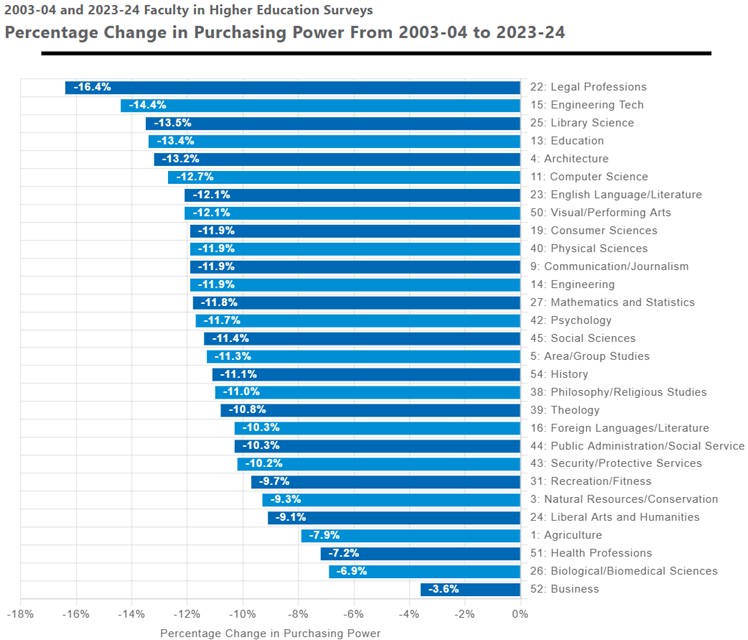
    • No discipline’s pay increases beat inflation. Although many disciplines appeared strong based on changes in size and salary over time, all disciplines reported median salaries in 2023-24 that were lower than inflation-adjusted salaries based on 2003-04 salary data. Overall, faculty in all disciplines have less purchasing power with their salaries in 2023-24 than they did in 2003-04.


    Read the full report and explore the data with interactive graphics.


    Source link

  • Provincial Budgets 2025-26 | HESA

    Provincial Budgets 2025-26 | HESA

    Ok everyone, all the provincial budgets are in and so it’s time for our annual look at what another round of irresponsible pan-partisan political leadership has wrought for our sector for the next twelve months.

    Figure 1 shows the province-by-province breakdown of this year’s budgets, showing the change in transfers to institutions in real dollars over 1 year and 5 years for each of the ten provinces. In most provinces, collecting this data is pretty easy—you just look at the Main Estimates. In Ontario it is more difficult because due to the Ministry of Finance’s crapulous incompetence, it is the one province in the country where Estimates do not appear on the day of the budget (it takes them several months to put out the detailed data; and while prior to 2018 the Ministry of Colleges and Universities was able to give out actual expenditure data on the day of the Budget, the Government no longer chooses to provide such information because shovel, manure, mushrooms, etc.). So in Ontario what you have to do is collect the previous year’s data, add the announced changes in expenditure, and then make some assumptions about the way funds are phased in (because the communications jackals who have taken over public budgeting in this province insist on phrasing spending as “$750 million over five years” to make numbers as big as possible, rather than explaining how the $750 million will be phased in on an annual basis). Which is all to say, these numbers are all pretty accurate except for Ontario, where there is a bit of a margin of error.

    Figure 1: 1-year and 5-year Changes to Budgeted Provincial Transfers to Institutions, Canada, 2025-26 Budget Year

    The one province that shows big change for 2025-26 is Prince Edward Island, which dropped a lot of money on UPEI this year in order to start a new medical school. Five other provinces (British Columbia, Alberta, Manitoba, Ontario, and Newfoundland and Labrador saw real increases (that is, increases greater than the rate of inflation) this year of between 1 and 4%. Four other provinces (Saskatchewan, Quebec, New Brunswick, and Nova Scotia) saw real declines of between 1% and 3%. Altogether, that combined nationally for real growth in provincial spending of about 0.9%.

    Over a five-year horizon, things are a bit different. The oil provinces—Alberta, Saskatchewan, and Newfoundland and Labrador—have all shown double digit declines in real expenditures (19%, 11%, and 18%, respectively), the “big two” (Quebec and Ontario) are down seven and six per cent respectively, while Nova Scotia and New Brunswick are down eight and two percent respectively. The only provinces that are up are Manitoba, where just before leaving office the Tories reversed a huge portion of their cuts of the previous eight years or so, British Columbia, which build a new med school at Simon Fraser and decided to give hefty wage increases to university and college staff (which did not, in the end, leave universities and college much better off—see Vancouver Island University for evidence), and the afore-mentioned PEI. Nationally, the drop in spending after inflation was 4%, and obviously would have been much higher without that anomalous BC result.

    So what does the overall picture look like nationally? Well, take a look at Figure 2. Basically, the picture is one of long-term stagnation.

    Figure 2: Total Budgeted Provincial Expenditures on Post-Secondary Education, 2006-07 to 2025-2025, in Billions of Constant 2025 dollars

    I suppose I should also update some charts I first made available earlier this year, looking at expenditures on post-secondary education as a percentage of total government expenditures, which I do below in Figure 3. Across the country, these percentages are down a long way over the past fifteen years, particularly in Alberta, which has gone from being by far the biggest spender in 2008 to being below the national average now.

    Figure 3: Budgeted Provincial Expenditures on Post-Secondary Education as a Percentage of Total Budgeted Provincial Expenditures, Canada and selected provinces, 2006-07 to 2025-26.

    Now, your brain might be whirring a bit trying to would out how Figures 2 and 3 can both be true. Overall spending is down only gently, but PSE expenditures as a percentage are crashing? It’s easy to explain, but not intuitive if you believe all the left-wing CBC nonsense about how governments are in austerity mode. This is nonsense: Canadian provincial governments are absolutely NOT in austerity mode. In most provinces, overall spending is wayyy up. It’s just that they are not choosing to spend any of that on postsecondary education. Since COVID, overall government expenditure is up 20% after inflation; since 2008-09, when post-secondary education peaked as a percentage of total expenditures, it’s up 59% after inflation.

    Figure 4: Real Change in Total Provincial Expenditures vs. Provincial Expenditures on Post-Secondary Education 2006-07 to 2025-26 (2006-07 = 100)

    Got it? Provinces are still spending. They just aren’t spending on postsecondary education.

    Anyways, just to finish things off, figure 5 shows changes in overall provincial spending on student assistance programs. It’s up a bit this year mainly because of Ontario. Unclear why there has been a rise, though I suspect it has something to do with the ongoing crappiness in the youth job market (something I will get back to in a blog next week) and the need for student aid to backfill.

    Figure 5: Total Budgeted Provincial Expenditures on Student Financial Assistance, Canada 2006-07 to 2025-26, in Billions of Constant 2025 Dollars

    So that’s your 2025-26 budget round up. Not as bad as some previous years but man, our sector is in a bit of a whole and just can’t get out of it. The message, as always, is: no one is coming to save us.

    Source link

  • What the experience of neurodivergent PhD students teaches us, and why it makes me angry

    What the experience of neurodivergent PhD students teaches us, and why it makes me angry

    by Inger Mewburn

    Recently, some colleagues and I released a paper about the experiences of neurodivergent PhD students. It’s a systematic review of the literature to date, which is currently under review, but available via pre-print here.

    Doing this paper was an exercise in mixed feelings. It was an absolute joy to work with my colleagues, who knew far more about this topic than me and taught me (finally!) how to do a proper systematic review using Covidence. Thanks Dr Diana TanDr Chris EdwardsAssociate Professor Kate SimpsonAssociate Professor Amanda A Webster and Professor Charlotte Brownlow (who got the band together in the first place).

    But reading each and every paper published about neurodivergent PhD students provoked strong feelings of rage and frustration. (These feelings only increased, with a tinge of fear added in, when I read of plans for the US health department to make a ‘list’ of autistic people?! Reading what is going on there is frankly terrifying – solidarity to all.) We all know what needs to be done to make research degrees more accessible. Make expectations explicit. Create flexible policies. Value diverse thinking styles. Implement Universal Design Principles… These suggestions appear in report after report, I’ve ranted on the blog here and here, yet real change remains frustratingly elusive. So why don’t these great ideas become reality? Here’s some thoughts on barriers that keep neurodivergent-friendly changes from taking hold.

    The myth of meritocracy

    Academia clings to the fiction that the current system rewards pure intellectual merit. Acknowledging the need for accessibility requires admitting that the playing field isn’t level. Many senior academics succeeded in the current system and genuinely believe “if I could do it, anyone can… if they work hard enough”. They are either 1) failing to recognise their neurotypical privilege, or 2) not acknowledging the cost of masking their own neurodivergence (I’ll get to this in a moment).

    I’ve talked to many academics about things we could do – like getting rid of the dissertation – but too many of us are secretly proud of our own trauma. The harshness of the PhD has been compared to a badge of honour that we wear proudly – and expect others to earn.

    Resource scarcity (real and perceived)

    Universities often respond to suggestions about increased accessibility measures with budget concerns. The vibe is often: “We’d love to offer more support, but who will pay for it?”. However, many accommodations (like flexible deadlines or allowing students to work remotely) cost little, or even nothing. Frequently, the real issue isn’t resources but priorities of the powerful. There’s no denying universities (in Australia, and elsewhere) are often cash strapped. The academic hunger games are real. However, in the fight for resources, power dynamics dictate who gets fed and who goes without.

    I wish we would just be honest about our choices – some people in universities still have huge travel budgets. The catering at some events is still pretty good. Some people seem to avoid every hiring freeze. There are consistent patterns in how resources are distributed. It’s the gaslighting that makes me angry. If we really want to, we can do most things. We have to want to do something about this.

    Administrative inertia

    Changing established processes in a university is like turning a battleship with a canoe paddle. Approval pathways are long and winding. For example, altering a single line in the research award rules at ANU requires approval from parliament (yes – the politicians actually have to get together and vote. Luckily we are not as dysfunctional in Australia as other places… yet). By the time a solution is implemented, the student who needed it has likely graduated – or dropped out. This creates a vicious cycle where the support staff, who see multiple generations of students suffer the same way, can get burned out and stop pushing for change.

    The individualisation of disability

    Universities tend to treat neurodivergence as an individual problem requiring individual accommodations rather than recognising systemic barriers. This puts the burden on students to disclose, request support, and advocate for themselves – precisely the executive function and communication challenges many neurodivergent students struggle with.

    It’s akin to building a university with only stairs, then offering individual students a piggyback ride instead of installing ramps. I’ve met plenty of people who simply get so exhausted they don’t bother applying for the accommodations they desperately need, and then end up dropping out anyway.

    Fear of lowering ‘standards’

    Perhaps the most insidious barrier is the mistaken belief that accommodations somehow “lower standards.” I’ve heard academics worrying that flexible deadlines will “give some students an unfair advantage” or that making expectations explicit somehow “spoon-feeds” students.

    The fear of “lowering standards” becomes even more puzzling when you look at how PhD requirements have inflated over time. Anyone who’s spent time in university archives knows that doctoral standards aren’t fixed – they’re constantly evolving. Pull a dissertation from the 1950s or 60s off the shelf and you’ll likely find something remarkably slim compared to today’s tomes. Many were essentially extended literature reviews with modest empirical components. Today, we expect multiple studies, theoretical innovations, methodological sophistication, and immediate publishability – all while completing within strict time limits on ever-shrinking funding.

    The standards haven’t just increased; they’ve multiplied. So when universities resist accommodations that might “compromise standards,” we should ask: which era’s standards are we protecting? Certainly not the ones under which most people supervising today had to meet. The irony is that by making the PhD more accessible to neurodivergent thinkers, we might actually be raising standards – allowing truly innovative minds to contribute rather than filtering them out through irrelevant barriers like arbitrary deadlines or neurotypical communication expectations. The real threat to academic standards isn’t accommodation – it’s the loss of brilliant, unconventional thinkers who could push knowledge boundaries in ways we haven’t yet imagined.

    Unexamined neurodiversity among supervisors

    Perhaps one of the most overlooked barriers is that many supervisors are themselves neurodivergent but don’t recognise it or acknowledge what’s going on with them! In fact, since starting this research, I’ve formed a private view that you almost can’t succeed in this profession without at least a little neurospicey.

    Academia tends to attract deep thinkers with intense focus on specific topics – traits often associated with autism (‘special interests’ anyone?). The contemporary university is constantly in crisis, which some people with ADHD can find provides the stimulation they need to get things done! Yet many supervisors have succeeded through decades of masking and compensating, often at great personal cost.

    The problem is not the neurodivergence or the supervisor – it’s how the unexamined neurodivergence becomes embedded in practice, underpinned by an expectation that their students should function exactly as they do, complete with the same struggles they’ve internalised as “normal.”

    I want to hold on to this idea for a moment, because maybe you recognise some of these supervisors:

    • The Hyperfocuser: Expects students to match their pattern of intense, extended work sessions. This supervisor regularly works through weekends on research “when inspiration strikes,” sending emails at 2am and expecting quick responses. They struggle to understand when students need breaks or maintain strict work boundaries, viewing it as “lack of passion.” Conveniently, they have ignored those couple of episodes of burn out, never considering their own work pattern might reflect ADHD or autistic hyper-focus, rather than superior work ethic.
    • The Process Pedant: Requires students to submit written work in highly specific formats with rigid attachment to particular reference styles, document formatting, and organisational structures. Gets disproportionately distressed by minor variations from their preferred system, focusing on these details over content, such that their feedback primarily addresses structural issues rather than ideas. I get more complaints about this than almost any other kind of supervision style – it’s so demoralising to be constantly corrected and not have someone genuinely engage with your work.
    • The Talker: Excels in spontaneous verbal feedback but rarely provides written comments. Expects students to take notes during rapid-fire conversational feedback, remembering all key points. They tend to tell you to do the same thing over and over, or forget what they have said and recommend something completely different next time. Can get mad when questioned over inconsistencies – suggesting you have a problem with listening. This supervisor never considers that their preference for verbal communication might reflect their own neurodivergent processing style, which isn’t universal. Couple this with a poor memory and the frustration of students reaches critical. (I confess, being a Talker is definitely my weakness as a supervisor – I warn my students in advance and make an effort to be open to criticism about it!).
    • The Context-Switching Avoider: Schedules all student meetings on a single day of the week, keeping other days “sacred” for uninterrupted research. Becomes noticeably agitated when asked to accommodate a meeting outside this structure, even for urgent matters. Instead of recognising their own need for predictable routines and difficulty with transitions (common in many forms of neurodivergence), they frame this as “proper time management” that students should always emulate. Students who have caring responsibilities suffer the most with this kind of inflexible relationship.
    • The Novelty-Chaser: Constantly introduces new theories, methodologies, or research directions in supervision meetings. Gets visibly excited about fresh perspectives and encourages students to incorporate them into already-developed projects. May send students a stream of articles or ideas completely tangential to their core research, expecting them to pivot accordingly. Never recognises that their difficulty maintaining focus on a single pathway to completion might reflect ADHD-related novelty-seeking. Students learn either 1) to chase butterflies and make little progress or 2) to nod politely at new suggestions while quietly continuing on their original track. The first kind of reaction can lead to a dangerous lack of progress, the second reaction can lead to real friction because, from the supervisor’s point of view, the student ‘never listens’. NO one is happy in these set ups, believe me.
    • The Theoretical Purist: Has devoted their career to a particular theoretical framework or methodology and expects all their students to work strictly within these boundaries. Dismisses alternative approaches as “methodologically unsound” or “lacking theoretical rigour” without substantive engagement. Becomes noticeably uncomfortable when students bring in cross-disciplinary perspectives, responding with increasingly rigid defences of their preferred approach. Fails to recognise their intense attachment to specific knowledge systems and resistance to integrating new perspectives may reflect autistic patterns of specialised interests, or even difficulty with cognitive flexibility. Students learn to frame all their ideas within the supervisor’s preferred language, even when doing so limits their research potential.

    Now that I know what I am looking for, I see these supervisory dynamics ALL THE TIME. Add in whatever dash of neuro-spiciness is going on with you and all kinds of misunderstandings and hurt feelings result … Again – the problem is not the neurodivergence of any one person – it’s the lack of self reflection, coupled with the power dynamics that can make things toxic.

    These barriers aren’t insurmountable, but honestly, after decades in this profession, I’m not holding my breath for institutional enlightenment. Universities move at the pace of bureaucracy after all.

    So what do we do? If you’re neurodivergent, find your people – that informal network who “get it” will save your sanity more than any official university policy. If you’re a supervisor, maybe take a good hard look at your own quirky work habits before deciding your student is “difficult.” And if you’re in university management, please, for the love of research, let’s work on not making neurodivergent students jump through flaming bureaucratic hoops to get basic support.

    The PhD doesn’t need to be a traumatic hazing ritual we inflict because “that’s how it was in my day.” It’s 2025. Time to admit that diverse brains make for better research. And for goodness sake, don’t put anyone on a damn list, ok?

    AI disclaimer: This post was developed with Claude from Anthropic because I’m so busy with the burning trash fire that is 2025 it would not have happened otherwise. I provided the concept, core ideas, detailed content, and personal viewpoint while Claude helped organise and refine the text. We iteratively revised the content together to ensure it maintained my voice and perspective. The final post represents my authentic thoughts and experiences, with Claude serving as an editorial assistant and sounding board.

    This blog was first published on Inger Mewburn’s  legendary website The Thesis Whisperer on 1 May 2025. It is reproduced with permission here.

    Professor Inger Mewburn is the Director of Researcher Development at The Australian National University where she oversees professional development workshops and programs for all ANU researchers. Aside from creating new posts on the Thesis Whisperer blog (www.thesiswhisperer.com), she writes scholarly papers and books about research education, with a special interest in post PhD employability, research communications and neurodivergence.

    Author: SRHE News Blog

    An international learned society, concerned with supporting research and researchers into Higher Education

    Source link

  • Experts Weigh In on “Everyone” Cheating in College

    Experts Weigh In on “Everyone” Cheating in College

    Is something in the water—or, more appropriately, in the algorithm? Cheating—while nothing new, even in the age of generative artificial intelligence—seems to be having a moment, from the New York magazine article about “everyone” ChatGPTing their way through college to Columbia University suspending a student who created an AI tool to cheat on “everything” and viral faculty social media posts like this one: “I just failed a student for submitting an AI-written research paper, and she sent me an obviously AI-written email apologizing, asking if there is anything she can do to improve her grade. We are through the looking-glass, folks.”

    It’s impossible to get a true read on the situation by virality alone, as the zeitgeist is self-amplifying. Case in point: The suspended Columbia student, Chungin “Roy” Lee is a main character in the New York magazine piece. Student self-reports of AI use may also be unreliable: According to Educause’s recent Students and Technology Report, some 43 percent of students surveyed said they do not use AI in their coursework; 5 percent said they use AI to generate material that they edit before submitting, and just 1 percent said they submit generated material without editing it.

    There are certainly students who do not use generative AI and students who question faculty use of AI—and myriad ways that students can use generative AI to support their learning and not cheat. But the student data paints a different picture than the one presidents, provosts, deans and other senior leaders did in a recent survey by the American Association of Colleges and Universities and Elon University: Some 59 percent said cheating has increased since generative AI tools have become widely available, with 21 percent noting a significant increase—and 54 percent do not think their institution’s faculty are effective in recognizing generative Al–created content.

    In Inside Higher Ed’s 2025 Survey of Campus Chief Technology/Information Officers, released earlier this month, no CTO said that generative AI has proven to be an extreme risk to academic integrity at their institution. But most—three in four—said that it has proven to be a moderate (59 percent) or significant (15 percent) risk. This is the first time the annual survey with Hanover Research asked how concerns about academic integrity have actually borne out: Last year, six in 10 CTOs expressed some degree of concern about the risk generative AI posed to academic integrity.

    Stephen Cicirelli, the lecturer of English at Saint Peter’s University whose “looking glass” post was liked 156,000 times in 24 hours last week, told Inside Higher Ed that cheating has “definitely” gotten more pervasive within the last semester. But whether it’s suddenly gotten worse or has been steadily growing since large language models were introduced to the masses in late 2022, one thing is clear: AI-assisted cheating is a problem, and it won’t get better on its own.

    So what can institutions do about it? Drawing on some additional insights from the CTO survey and advice from other experts, we’ve compiled a list of suggestions below. The expert insights, in particular, are varied. But a unifying theme is that cheating in the age of generative AI is as much a problem requiring intervention as it is a mirror—one reflecting larger challenges and opportunities within higher education.

    (Note: AI detection tools did not make this particular list. Even though they have fans among the faculty, who tend to point out that some tools are more accurate than others, such tools remain polarizing and not entirely foolproof. Similarly, banning generative AI in the classroom did not make the list, though this may still be a widespread practice: 52 percent of students in the Educause survey said that most or all of their instructors prohibit the use of AI.)

    Academic Integrity for Students

    The American Association of Colleges and Universities and Elon University this month released the 2025 Student Guide to Artificial Intelligence under a Creative Commons license. The guide covers AI ethics, academic integrity and AI, career plans for the AI age, and an AI toolbox. It encourages students to use AI responsibly, critically assess its influence and join conversations about its future. The guide’s seven core principles are:

    1. Know and follow your college’s rules
    2. Learn about AI
    3. Do the right thing
    4. Think beyond your major
    5. Commit to lifelong learning
    6. Prioritize privacy and security
    7. Cultivate your human abilities

    Connie Ledoux Book, president of Elon, told Inside Higher Ed that the university sought to make ethics a central part of the student guide, with campus AI integration discussions revealing student support for “open and transparent dialogue about the use of AI.” Students “also bear a great deal of responsibility,” she said. They “told us they don’t like it when their peers use AI to gain unfair advantages on assignments. They want faculty to be crystal clear in their syllabi about when and how AI tools can be used.”

    Now is a “defining moment for higher education leadership—not only to respond to AI, but to shape a future where academic integrity and technological innovation go hand in hand,” Book added. “Institutions must lead with clarity, consistency and care to prepare students for a world where ethical AI use is a professional expectation, not just a classroom rule.”

    Mirror Logic

    Lead from the top on AI. In Inside Higher Ed’s recent survey, just 11 percent of CTOs said their institution has a comprehensive AI strategy, and roughly one in three CTOs (35 percent) at least somewhat agreed that their institution is handling the rise of AI adeptly. The sample size for the survey is 108 CTOs—relatively small—but those who said their institution is handling the rise of AI adeptly were more likely than the group over all to say that senior leaders at their institution are engaged in AI discussions and that effective channels exist between IT and academic affairs for communication on AI policy and other issues (both 92 percent).

    Additionally, CTOs who said that generative AI had proven to be a low to nonexistent risk to academic integrity were more likely to report having some kind of institutionwide policy or policies governing the use of AI than were CTOs who reported a moderate or significant risk (81 percent versus 64 percent, respectively). Leading on AI can mean granting students institutional access to AI tools, the rollout of which often includes larger AI literacy efforts.

    (Re)define cheating. Lee Rainie, director of the Imagining the Digital Future Center at Elon, said, “The first thing to tackle is the very definition of cheating itself. What constitutes legitimate use of AI and what is out of bounds?” In the AAC&U and Elon survey that Rainie co-led, for example, “there was strong evidence that the definitional issues are not entirely resolved,” even among top academic administrators. Leaders didn’t always agree whether hypothetical scenarios described appropriate uses of AI or not: For one example—in which a student used AI to generate a detailed outline for a paper and then used the outline to write the paper—“the verdict was completely split,” Rainie said. Clearly, it’s “a perfect recipe for confusion and miscommunication.”

    Rainie’s additional action items, with implications for all areas of the institution:

    1. Create clear guidelines for appropriate and inappropriate use of AI throughout the university.
    2. Include in the academic code of conduct a “broad statement about the institution’s general position on AI and its place in teaching and learning,” allowing for a “spectrum” of faculty positions on AI.
    3. Promote faculty and student clarity as to the “rules of the road in assignments.”
    4. Establish “protocols of proof” that students can use to demonstrate they did the work.

    Rainie suggested that CTOs, in particular, might be useful regarding this last point, as such proof could include watermarking content, creating NFTs and more.

    Put it in the syllabus! (And in the institutional DNA.) Melik Khoury, president and CEO of Unity Environmental University in Maine, who’s publicly shared his thoughts on “leadership in an intelligent era of AI,” including how he uses generative AI, told Inside Higher Ed that “AI is not cheating. What is cheating is our unwillingness to rethink outdated assessment models while expecting students to operate in a completely transformed world. We are just beginning to tackle that ourselves, and it will take time. But at least we are starting from a position of ‘We need to adapt as an institution,’ and we are hiring learning designers to help our subject matter experts adapt to the future of learning.”

    As for students, Khoury said the university has been explicit “about what AI is capable of and what it doesn’t do as well or as reliably” and encourages them to recognize their “agency and responsibility.” Here’s an excerpt of language that Khoury said appears in every course syllabus:

    • “You are accountable for ensuring the accuracy of factual statements and citations produced by generative AI. Therefore, you should review and verify all such information prior to submitting any assignment.
    • “Remember that many assignments require you to use in-text citations to acknowledge the origin of ideas. It is your responsibility to include these citations and to verify their source and appropriateness.
    • “You are accountable for ensuring that all work submitted is free from plagiarism, including content generated with AI assistance.
    • “Do not list generative AI as a co-author of your work. You alone are responsible.”

    Additional policy language recommends that students:

    • Acknowledge use of generative AI for course submissions.
    • Disclose the full extent of how and where they used generative AI in the assignment.
    • Retain a complete transcript of generative AI usage (including source and date stamp).

    “We assume that students will use AI. We suggest constructive ways they might use it for certain tasks,” Khoury said. “But, significantly, we design tasks that cannot be satisfactorily completed without student engagement beyond producing a response or [just] finding the right answer—something that AI can do for them very easily.”

    In tandem with a larger cultural shift around our ideas about education, we need major changes to the way we do college.”

    —Emily Pitts Donahoe, associate director of instructional support in the Center for Excellence in Teaching and Learning and lecturer of writing and rhetoric at the University of Mississippi

    Design courses with and for AI. Keith Quesenberry, professor of marketing at Messiah University in Pennsylvania, said he thinks less about cheating, which can create an “adversarial me-versus-them dynamic,” and more about pedagogy. This has meant wrestling with a common criticism of higher education—that it’s not preparing students for the world of work in the age of AI—and the reality that no one’s quite sure what that future will look like. Quesenberry said he ended up spending all of last summer trying to figure out how “a marketer should and shouldn’t use AI,” creating and testing frameworks, ultimately vetting his own courses’ assignments: “I added detailed instructions for how and how not to use AI specifically for that assignment’s tasks or requirements. I also explain why, such as considering whether marketing materials can be copyrighted for your company or client. I give them guidance on how to cite their AI use.” He also created a specialized chat bot to which students can upload approved resources to act as an AI tutor.

    Quesenberry also talks to students about learning with AI “from the perspective of obtaining a job.” That is, students need a foundation of disciplinary knowledge on which to create AI prompts and judge output. And they can’t rely on generative AI to speak or think for them during interviews, networking and with clients.

    There are “a lot of professors quietly working very hard to integrate AI into their courses and programs that benefit their disciplines and students,” he adds. One thing that would help them, in Quesenberry’s view? Faculty institutional access to the most advanced AI tools.

    Give faculty time and training. Tricia Bertram Gallant, director of the academic integrity office and Triton Testing Center at the University of California, San Diego, and co-author of the new book The Opposite of Cheating: Teaching for Integrity in the Age of AI (University of Oklahoma Press), said that cheating part of human nature—and that faculty need time, training and support to “design educational environments that make cheating the exception and integrity the norm” in this new era of generative AI.

    Faculty “cannot be expected to rebuild the plane while flying it,” she said. “They need course release time to redesign that same course, or they need a summer stipend. They also need the help of those trained in pedagogy, assessment design and instructional design, as most faculty did not receive that training while completing their Ph.D.s.” Gallant also floated the idea of AI fellows, or disciplinary faculty peers who are trained on how to use generative AI in the classroom and then to “share, coach and mentor their peers.”

    Students, meanwhile, need training in AI literacy, “which includes how to determine if they’re using it ethically or unethically. Students are confused, and they’re also facing immense temptations and opportunities to cognitively offload to these tools,” Gallant added.

    Teach first-year students about AI literacy. Chris Ostro, an assistant teaching professor and instructional designer focused on AI at the University of Colorado at Boulder, offers professional development on his “mosaic approach” to writing in the classroom—which includes having students sign a standardized disclosure form about how and where they’ve used AI in their assignments. He told Inside Higher Ed that he’s redesigned his own first-year writing course to address AI literacy, but he is concerned about students across higher education who may never get such explicit instruction. For that reason, he thinks there should be mandatory first-year classes for all students about AI and ethics. “This could also serve as a level-setting opportunity,” he said, referring to “tech gaps,” or the effects of the larger digital divide on incoming students.

    Regarding student readiness, Ostro also said that most of the “unethical” AI use by students is “a form of self-treatment for the huge and pervasive learning deficits many students have from the pandemic.” One student he recently flagged for possible cheating, for example, had largely written an essay on her own but then ran it through a large language model, prompting it to make the paper more polished. This kind of use arguably reflects some students’ lack of confidence in their writing skills, not an outright desire to offload the difficult and necessary work of writing to think critically.

    Think about grading (and why students cheat in the first place). Emily Pitts Donahoe, associate director of instructional support in the Center for Excellence in Teaching and Learning and lecturer of writing and rhetoric at the University of Mississippi, co-wrote an essay two years ago with two students about why students cheat. They said much of it came down to an overemphasis on grades: “Students are more likely to engage in academic dishonesty when their focus, or the perceived focus of the class, is on grading.” The piece proposed the following solutions, inspired by the larger trend of ungrading:

    1. Allow students to reattempt or revise their work.
    2. Refocus on formative feedback to improve rather than summative feedback to evaluate.
    3. Incorporate self-assessment.

    Donahoe said last week, “I stand by every claim that we make in the 2023 piece—and it all feels heightened two years later.” The problems with AI misuse “have become more acute, and between this and the larger sociopolitical climate, instructors are reaching unsustainable levels of burnout. The actions we recommend at the end of the piece remain good starting points, but they are by no means solutions to the big, complex problem we’re facing.”

    Framing cheating as a structural issue, Donahoe said students have been “conditioned to see education as a transaction, a series of tokens to be exchanged for a credential, which can then be exchanged for a high-paying job—in an economy where such jobs are harder and harder to come by.” And it’s hard to fault students for that view, she continued, as they receive little messaging to the contrary.

    Like the problem, the solution set is structural, Donahoe explained: “In tandem with a larger cultural shift around our ideas about education, we need major changes to the way we do college. Smaller class sizes in which students and teachers can form real relationships; more time, training and support for instructors; fundamental changes to how we grade and how we think about grades; more public funding for education so that we can make these things happen.”

    With none of this apparently forthcoming, faculty can at least help reorient students’ ideas about school and try to “harness their motivation to learn.”

    Source link

  • Personalizing Network Events for College Student by Strengths

    Personalizing Network Events for College Student by Strengths

    One of the challenges for students entering the workforce is identifying how their experiences in and outside the classroom have prepared them for careers. A 2023 survey by Cengage found that one-third of recent graduates felt underqualified for entry-level roles, and only 41 percent believed their program taught them the skills needed for their first job.

    Focused career development opportunities that address unique learner populations, such as working or neurodiverse students, can help bridge the gap between lived experiences and their application to the world of jobs.

    Inside Higher Ed compiled various initiatives that increase career readiness for specific student populations.

    Neurodiverse Learners

    Beacon College in Leesburg, Fla., primarily serves students with learning disabilities, including ADHD and dyslexia. Last year the college established a career fair designed for these learners, which introduces them to employers looking to develop a neurodiverse talent workforce.

    Survey Says

    Just under half of college students believe their college or university should focus more on helping students find internships and job possibilities, according to a May 2024 Student Voice survey by Inside Higher Ed and Generation Lab.

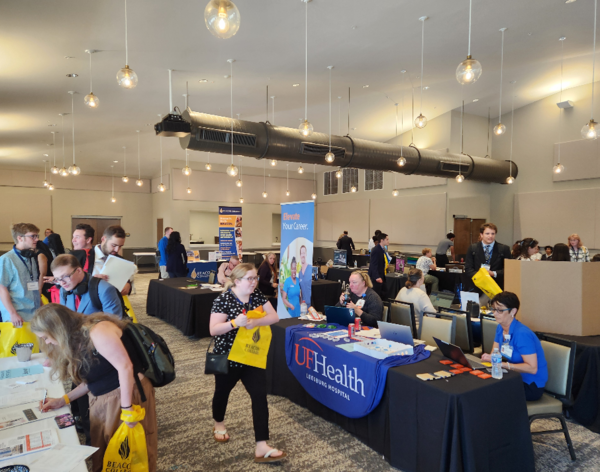
    This spring’s event, Internship Careers and Neurodiversity (ICAN), featured two dozen national and local employers. Success coaches were on site to support students and employers as they engaged with one another, and students could visit the Zen Den if they needed a quiet and private space to process.

    ICAN “is designed to remove barriers and reduce anxiety often associated with large-scale ‘convention center’ type events, so Beacon College can empower neurodivergent college students and help increase their participation in networking events elsewhere,” according to an April press release.

    Student Athletes

    Student athletes have packed schedules while they’re in season, making it difficult to balance athletics, coursework and extracurricular activities, which can sometimes push career development opportunities to the background.

    To help student athletes build their confidence in professional settings, Kennesaw State University created a “networking scrimmage” with employers so learners could practice introducing themselves, relay their academic and athletic accomplishments, and discuss career interests in a low-stakes environment, according to a university press release.

    Students also heard from three former student athletes who shared their stories of transitioning from sports into the workforce, as well as advice on how to navigate postcollege life.

    Adult Learners

    In 2023, the University of Phoenix created a digital tool that allows working adult learners to identify skills and goals that will guide them on their career journey.

    Students can access Career Navigator through the student portal. The tool allows them to build out demonstrated and self-attested skills and explore job features, including daily tasks and salary range, as well as identify skill gaps they may have when pursuing their desired career.

    Student Veterans

    After leaving military service, many veterans enroll in college to build career skills and gain further education, but connecting their military experience to civilian life can be a challenge.

    The University of Colorado, Denver, provides a one-year cohort program for student veterans, Boots to Suits, to aid their journey, providing personalized academic and career-development resources. Program participants receive job search strategies and career coaching, as well as advice on networking and building their LinkedIn profile and résumé.

    Major Programs

    While general career fairs and networking opportunities can give students visibility into employers or roles they may not otherwise have considered, tailored events can connect students of a particular discipline to employers looking for their expertise.

    Staff at Villanova University identified a problem at their career fairs: The number of employers looking for early-career civil engineers far overshadowed the number of students interested in such jobs. In response, staff created a new event specifically for civil engineering students, allowing employers to connect with potential interns earlier in their college career while also ensuring that students who were interested in other fields were able to engage with organizations that better fit their career goals.

    The University of Maryland hosts a Visual Arts Reverse Career and Internship Fair, a flipped model of the career fair in which employers visit a student’s table or booth to engage with their portfolio of work. This allows students to display graphic design, video production and immersive media skills in an engaging way that better reflects their learning and accomplishments.

    Do you have a career-focused intervention that might help others promote student success? Tell us about it.

    Source link

  • Our Debate Over Higher Ed Has Lost the Plot (opinion)

    Our Debate Over Higher Ed Has Lost the Plot (opinion)

    There is an endless war being waged against colleges and universities in this country, one unprecedented in our lifetimes. Not merely a war of words, it is one of deeds. Beginning with state-level efforts to ban “critical race theory” and “divisive concepts” from college classrooms and diversity, equity and inclusion initiatives from campuses, it has now grown into an obsessive preoccupation of federal policy.

    Broad executive orders have sought to ban concepts related to race, gender and identity on campus, using the leverage of withheld federal grants. Drastic and indiscriminate cuts have been made to university funding. International students have had their visas revoked on the basis of their political views. Attacks on nonpartisan university accreditors have mounted. And escalating demands that elite private research universities effectively place themselves in government receivership or lose further billions in federal dollars have thrown the sector into chaos.

    That is why I was honored to sign, and to help coordinate, last month’s letter from more than 600 college, university and scholarly society presidents in defense of our nation’s institutions of higher learning. The letter, which calls for “constructive engagement that improves our institutions and serves our republic,” also criticizes “the unprecedented government overreach and political interference now endangering” institutions of higher learning and warns that “the price of abridging the defining freedoms of American higher education will be paid by our students and our society.”

    I remain concerned that the problems colleges and universities face today go deeper than funding cuts and government threats. Indeed, our national debate over higher education has lost the plot entirely. Critics of higher education present the entire sector as an elitist, out-of-touch indoctrination factory for liberal orthodoxy, one that has replaced the great books of the Western canon with political claptrap. This charge has gained broad traction among the public. But not only is it untrue on the merits, it fundamentally misunderstands the purpose and mission of higher education. It asks the wrong question and delivers the wrong answer.

    If our sector is to regain the respect and appreciation of American society, we need to reorient the national conversation. We need to help people remember what it is that colleges and universities actually do—and why it matters.

    The American Association of Colleges and Universities, where I have been president since 2016, is a voice and a force for what we call liberal education. Let me be clear: teaching students to believe in liberal politics or conservative politics is the opposite of what “liberal education” means. Rather, the term, which predates modern political labels, refers to liberating the mind from received orthodoxies of all types.

    I agree with Margaret Mead—and with leaders across the political spectrum, from Barack Obama to Ron DeSantis—that students should be taught how to think, not what to think. A successful college education is measured not by what its graduates believe but by what they can conceive. It fires the imaginations of its students, helps them explore ideas and experiences different from their own, and trains them in habits of thought and mind that aid them in making their own meaning from the world. It provides them both with the practical skills they will need for their future employment and with the critical thinking tools that help them attain, and succeed in, their jobs of choice. By providing a forum and a method for open inquiry and intellectual freedom, and by exposing students and communities to new ideas and perspectives, it also helps to strengthen our democracy.

    This type of education does not happen by chance, from a hodgepodge of unconnected courses; it is part of a plan. For decades, AAC&U has served as a learning lab for a type of comprehensive undergraduate education that teaches students in a systematic way, over the course of a two-year or four-year degree, how to become effective thinkers and problem-solvers. We pioneered the concepts of high-impact practices, inclusive excellence and innovations in general education, learning outcomes and assessment, innovations that have been adopted by hundreds of campuses across the country, including many of our nearly 900 member institutions.

    Higher education should always try to do better at opening students’ minds; in fact, that commitment is at the core of my organization’s work. Taking criticism seriously is how colleges and universities innovate and improve. But that innovation cannot happen if the government steps in to ban or defund ideas it dislikes, taking away the academic freedom of faculty; if it strips university leadership of its autonomy to make decisions about what ideas are permitted or promoted on campus; or if it makes so many threats or cuts that professors and students become afraid to speak and think freely.

    The careful process of preparing students for democratic citizenship requires helping them understand the great multiplicity of people, cultures and beliefs that make up the world we live in. It is time for us to stop asking whether colleges and universities teach the “right” ideas and ask, instead, whether they teach students the skills they need to navigate our complex world. That approach would lead us away from culture wars and heavy-handed government restrictions and toward constructive engagement with the educational missions of colleges and universities so they can work together with government to improve our students’ educations.

    Lynn Pasquerella is president of the American Association of Colleges and Universities.

    Source link

  • Penn State Closure Plan Prompts Sharp Reactions

    Penn State Closure Plan Prompts Sharp Reactions

    As Pennsylvania State University’s Board of Trustees prepares to decide the fate of seven of its 19 Commonwealth Campuses where enrollment has collapsed over a decade, faculty, lawmakers and some board members are questioning the university’s commitment to the state and say administrators haven’t been transparent about their decision-making process.

    University administrators say the enrollment numbers alone don’t support keeping open the seven campuses slated to close. Several of those campuses have seen enrollment fall by more than 40 percent since fall 2014.

    Penn State’s Board of Trustees met last week in a private executive session but did not vote on the plan. They’re expected to do so Thursday.

    President Neeli Bendapudi has made the case for the closures, arguing such actions are necessary, as the university can no longer sustain all of its branch campuses financially amid severe enrollment declines. She proposed closing the Dubois, Fayette, Mont Alto, New Kensington, Shenango, Wilkes-Barre and York campuses. Those campuses enroll almost 3,200 students altogether, the largest of which is Penn State York with 703 students last fall. The smallest is Shenango, which enrolled 309 students in fall 2024.

    Now, as the proposal nears the finish line, its fate is up the air and Bendapudi is facing concerns about the process of reaching the seven names.

    A ‘Difficult But Necessary’ Plan

    University leadership began drawing up those plans in February after a difficult year for higher education across the Keystone State. Four universities in the state shut down (or ended degree programs, as in the case of the Pennsylvania Academy of the Fine Arts) in 2024. The closures were mostly brought on by enrollment challenges, though some were dogged by concerns about fiscal mismanagement.

    University administrators spent the last several months reviewing 12 campuses for possible closure before the list of seven leaked to media outlets last week.

    Officials in a 143-page document cast the plan as “difficult but necessary decisions to ensure its long-term sustainability, allowing for continued investment in student success and dynamic learning environments for years to come” amid plunging enrollment and broad demographic challenges.

    Officials argued that the seven campuses identified for closure “face overlapping challenges, including enrollment and financial decline, low housing occupancy, and significant maintenance backlog.” They added that “projected low enrollments pose challenges for creating the kind of robust on-campus student experience that is consistent with the Penn State brand” and would require significant investments, including $200 million for facilities alone.

    “I believe the recommendation balances our need to adapt to the changing needs of Pennsylvania with compassion for those these decisions affect, both within Penn State and across the commonwealth,” Bendapudi said in a statement when the plan was released.

    She added that there is a two-year timeline for closing campuses, so they wouldn’t shut down until the end of the spring 2027 semester.

    Now the plan heads to the 36-member Board of Trustees. However, some trustees have openly expressed their opposition to the proposal.

    Jay Paterno is one of several board members who have pushed back on the plan, writing an op-ed last month with four other trustees that argued Penn State should explore other options.

    In an interview with Inside Higher Ed, Paterno criticized the proposal as rushed.

    “We’ve been presented with two options. One is the status quo, which everybody knows is not viable and is kind of a straw man. The other option is to close all seven campuses,” he said.

    Given that the costs of operating those campuses comprise “less than half of 1 percent of our budget,” Paterno said the board should take more time to explore solutions. He argues that the university has not tried to leverage fundraising to support struggling Commonwealth Campuses and that the administration should slow the process down and reach out to potential donors.

    “We’d rather be a year late than a day early,” Paterno said.

    He also noted the decision to close campuses is not Penn State’s alone. The university is state-affiliated but not state-owned, which gives it a greater degree of autonomy than fully public institutions. But since the university receives some public funds, it must submit plans to close campuses to the Pennsylvania secretary of education, who must then approve the proposal.

    ‘A Betrayal’

    Faculty have concerns about job losses, what will become of rural student populations and an alleged lack of transparency in the closure process.

    One faculty member at Penn State Wilkes-Barre, speaking anonymously due to concerns about retribution, noted, “While most faculty saw this coming, it was heartbreaking to see it in writing.”

    They questioned Penn State’s support for its Commonwealth Campuses, arguing that “the decision to decrease funding” to those locations that serve in-state students sends a strong message about where Penn State places its priorities” while it invests heavily in its main campus. They also pointed to renovations at Beaver Stadium projected to cost $700 million.

    (That project is believed to be the most expensive renovation in the history of college athletics.)

    “The lack of shared governance, transparency, and respect for contributions of faculty to Penn State University makes it easy to see why unionization efforts among faculty are needed,” they wrote, highlighting ongoing efforts by the Penn State Faculty Alliance and SEIU 668 to unionize.

    Some state politicians have also panned the plan.

    State Senator Michele Brooks, a Republican who represents a district that includes the Shenango campus, told Inside Higher Ed in an emailed statement that she recently met with trustees, who conveyed to her and others “that they feel this has been a deeply flawed process.”

    She urged Penn State’s administration and governing board to re-evaluate the decision and to work “with communities on innovative ways to reinvest in these campuses and help them grow.”

    Republican state representative Charity Grimm Krupa, who serves a district that includes the Fayette campus slated for closure, accused Penn State of betraying its mission in a fiery statement.

    “Shutting down the Fayette campus isn’t about financial responsibility; it’s about walking away from the very students Penn State was created to serve,” Grimm Krupa said last week. “It’s a betrayal of the university’s land-grant mission and a slap in the face of rural communities. Abandoning this campus sends a clear message: if you’re not from a wealthy or urban area, Penn State doesn’t see you as worth the investment. That’s disgraceful, and I urge every trustee to vote no against these closures.”

    Source link

  • Three Questions for Coursera’s New CEO, Greg Hart

    Three Questions for Coursera’s New CEO, Greg Hart

    For many institutions of higher education (including the one I work for), Coursera is an important online learning partner. Therefore, it was a big deal when Coursera announced earlier this year that Greg Hart was taking over as CEO from Jeff Maggioncalda. This space seemed like a good place to begin to get to know Greg, and he graciously agreed to answer my questions.

    Q: You’ve spent the majority of your career at Amazon, so education is a new space for you. What do you want universities to know about how you’ll approach partnerships, and how will your background influence how you lead Coursera? 

    A: My background is rooted in building and scaling technology-driven businesses that serve millions of customers. At Amazon, I led the creation and launch of Alexa and later served as the global head of Prime Video. Those roles shaped how I think about innovation, long-term customer value and meaningful experiences at scale. While higher education is a new sector for me, there are clear parallels: At Amazon, we solved enduring customer problems through technology. That same principle applies at Coursera—learners are seeking flexible, high-quality and job-relevant education, often in moments that define the trajectory of their lives. Both our university and industry partners are working with us to meet these evolving needs with world-class learning content, enabled by our platform’s ability to deliver personalized learning experiences at scale.

    What makes this work especially meaningful is the higher stakes involved. We’re not just helping people shop or stream content—we’re helping them transform their lives through access to learning. That sense of purpose is what drew me to Coursera. I approach our university partnerships with deep respect for the role higher education plays in society, and I see my responsibility as ensuring Coursera is a trusted, effective and mission-aligned partner for institutions around the world.

    Q: Can you update us on Coursera’s business, focusing on the biggest growth drivers and challenges? How confident can universities be in Coursera’s long-term financial resilience as a strategic partner?

    A: Coursera is where the world comes to gain new skills and learn from the most trusted institutions. Content is the engine of our business and the foundation of our ecosystem. Today, we partner with more than 350 leading universities and companies, offering job-relevant content across a wide range of domains, including technology, business, AI and data science.

    This catalog has attracted more than 175 million learners globally, including more than seven million new registered learners in the first quarter of this year alone. Many learners come to Coursera directly through our platform, while a growing number access content through institutional settings via our enterprise offerings. This entire ecosystem is powered by a unified platform that enables our partners to reach a global audience at scale, leverage data to inform content strategy and skills recommendations and harness advanced AI tools to drive personalized learning and discovery.

    Since going public in 2021, we’ve operated as responsible stewards of our capital, balancing disciplined cost management with long-term investments in growing our business and advancing our mission. Coursera is in an extremely stable position financially: We are growing, we generate positive free cash flow, we have a very healthy balance sheet and we have no debt.

    In Q1 2025, we delivered $179 million in revenue, up 6 percent year over year on growth in our consumer and enterprise segments and generated over $25 million in free cash flow, marking our strongest quarter of cash performance to date. Based on this strong start, we now expect full-year 2025 revenue to be between $720–730 million, with annual adjusted EBITDA margin improvement of 100 basis points to 7 percent—an outlook that reflects both durable demand and growing operating leverage. As of March 31, 2025, we have approximately $748 million in unrestricted cash and no debt, giving us both the stability and flexibility to invest in platform innovation, expand our content ecosystem and continue supporting our partners and learners around the world.

    Q: Given your background in industry, do you see more value in partnerships and content from businesses, like industry microcredentials? How do colleges and degrees factor into your long-term vision?

    A: Coursera was founded in 2012 by two Stanford professors, Andrew Ng and Daphne Koller. Universities are, and will continue to be, central to Coursera’s mission and strategy—especially in an era shaped by generative AI, where enduring human skills and trusted credentials are more important than ever. University content is vital not only to degree programs, but also to our offerings for individuals, businesses and governments. Some of our most popular courses are from top university instructors—Jules White of Vanderbilt, Vic Strecher of Michigan, Laurie Santos of Yale and Sydney Finkelstein of Dartmouth.

    We do not view degrees and nondegree programs as competing priorities. Rather, we believe in building an interconnected ecosystem that gives learners the flexibility to start with entry-level microcredentials, build towards academic credit and ultimately stack into full degrees. Today, 90-plus entry-level professional certificates are offered by our industry partners, and a third of them carry credit recommendations, making them a natural on-ramp to higher education. Our degree portfolio has expanded to over 50 programs and remains a strategic component of our consumer offering.

    Source link

  • Globally Competitive? What International Students Are Really Experiencing in the UK 

    Globally Competitive? What International Students Are Really Experiencing in the UK 

    In recent years and months, the UK has seen considerable debate over immigration policy, with proposed changes that could make studying here less attractive for prospective students.  

    The Government’s new Immigration White Paper includes plans to cut the post-study Graduate Route visa to 18 months and impose new levies on universities. Against this backdrop, the Russell Group Students’ Unions (RGSU), in partnership with the UK Council for International Student Affairs (UKCISA) and with support from the All-Party Parliamentary Group (APPG) for International Students, launched Globally Competitive: A Report on the International Student Experience at a Parliamentary event on 14 May 2025. The report draws on surveys from nearly 5,000 international students at Russell Group universities (about 40% of the UK total), making it one of the most comprehensive studies of its kind. 

    A mixed picture of success and struggle 

    The report’s findings present a striking varied picture. On one hand, it reaffirms the UK’s position as a leading global study destination, with one in seven respondents stating the UK’s high-quality education and globally recognised universities were their main motivations for studying here. For three in four students, the UK was their first-choice destination. Students are also attracted by the shorter course lengths, multicultural environments and post-study work opportunities offered through the Graduate Route. 

    Alongside this positive narrative, the report reveals a deeply challenging reality for many students once they arrive. Half of the international students we surveyed reported struggling with poor mental health during their time here, a statistic that will resonate with academic and professional services staff who see students day in, day out.  

    Living costs are also having a direct impact on student wellbeing, with monthly expenses (excluding tuition fees) averaging £1,402 and rising to £1,635 for students in London. For many, studying in the UK means short- and medium-term financial hardship and consignment to long-term debt. Over 30 per cent of postgraduate taught students rely on bank loans or credit cards. One in five worries about money all the time. Those most affected by financial stress are also more likely to report poor mental health. 

    Despite these pressures, current visa rules prevent international students from pursuing freelance work or self-employment, even in areas where their skills are in high demand. These restrictions are not only impractical but risk undermining both the student experience and the UK’s wider economic priorities. 

    Barriers to belonging 

    Just as concerning are the social barriers many students face. One in three international students reported they had experienced racism while in the UK. While 94% reported feeling safe and welcome on campus, that sense of belonging often didn’t extend to the wider community, with only 73% stating they feel safe and welcome in the UK more generally. These experiences can leave lasting impacts and send the wrong message to future students weighing up their study options against other international destinations. 

    Ultimately, these findings highlight a simple reality: the UK remains a top choice, but we cannot take that status for granted. Negative public rhetoric, which sometimes labels international students as a ‘problem’, ignores evidence that they contribute billions to our economy, volunteer in our local communities and improve our universities’ teaching and contribute to our world-leading research. International students are our peers, colleagues and future leaders. Therefore, it’s important we balance any concerns about immigration with the fact that international students are part of our future. 

    A roadmap for reform 

    This report centres students’ experience of studying here and sets out a roadmap for meaningful change. At a national level, we are calling on the Government to: 

    • Freeze visa application fees and the Immigration Health Surcharge;
    • Allow greater flexibility in term-time work and permit self-employment and freelance work during study; and
    • Conduct a cross-departmental impact assessment on how immigration policies and public messaging affect the international student experience. 

    These policies are essential if we want to keep the UK globally competitive.  

    Shared responsibility across the sector 

    But change cannot come from Westminster alone. Universities and higher education sector bodies must also act. We’re asking universities to consider: 

    • Fixing international students’ tuition fees at the point of entry;
    • Providing equitable access to hardship funds with clear eligibility criteria;
    • Delivering culturally competent mental health support that truly meets students’ needs;
    • Call on employers and careers services to better understand the Graduate Route and provide more tailored advice and job opportunities for international students; and
    • Adopt UKCISA’s #WeAreInternational Student Charter as a framework to improve the international student experience. 

    Working together for a welcoming UK 

    Our report is a call to action. We invite government ministers, MPs and Peers, and university leaders to work with their students’ unions to engage with the report’s findings and work collaboratively on solutions. The APPG for International Students and UKCISA have helped amplify the student voice; now we ask on all stakeholders to join the conversation and implement evidence-based policies. 

    Source link