Category: Featured

  • Ripping up the rule book

    Ripping up the rule book

    On May 7, I was honoured to address an audience at Goodenough College in London, at the kind invitation of the master of The Worshipful Company of Educators, to talk on the topic of ‘educators opening doors to the world’.

    For those not familiar with Goodenough College, it is a remarkable community in Bloomsbury, central London, comprising 700 postgraduate students and their families from around 95 different countries, each studying at any one of London’s world-leading universities.

    When I stepped inside the doors of the College, I was instantly transported back to my own experience as a first-time post-doctoral researcher at the University of British Columbia (UBC) in Canada, when I found myself living in a very similar international community called St John’s College at the heart of the UBC campus.

    It was there that I saw first-hand just how important communities like these are for bringing people together from across the globe through education and providing a ‘home from home’ for overseas students and researchers. These communities allow friendships to form, ideas to thrive and inter-cultural understanding to arise.

    It is also that experience that has since driven my subsequent career, both in making and influencing higher education policy, to ensure that our universities and colleges continue serving as dynamic meeting points for the world.

    Breaking the rules

    When you work in policy, one of the first rules you learn is not to base policy on anecdote or personal experience. However, when it comes to something as positive and life changing as international education, I am a firm believer in ripping up the rule book.

    While not everyone is fortunate to have an international education experience of their own, every single one of us indirectly benefits from the international students around us – not least given that, in the UK, they bring in £41.9 billion to the economy per annual cohort.

    when it comes to something as positive and life changing as international education, I am a firm believer in ripping up the rule book

    These economic benefits are felt even more acutely by our universities and colleges, where international student fees have become a lifeline to financially-stretched institutions – both to make up for the rising shortfall in domestic funding and to cross-subsidise world-leading research.

    Yet, as all good educators know, international students are much more than big pound and dollar signs to our sector.

    In a global city like London, international student communities are reflective of the global workforce and the multi-cultural population around us. Having international students in our midst helps prepare local students for the realities of living and working in these diverse environments. It encourages them to think differently about the world, and they learn to appreciate different cultures, traditions and perspectives.

    The real winners

    There are also substantial soft power benefits to be had from our diverse international student inflows. Each year the Higher Education Policy Institute (HEPI) publishes a soft power index showing the tally of serving world leaders educated in UK universities. While some may see this as a ‘bit of fun’ over the summer when it’s traditionally published, it’s actually a really powerful signal of the strength of the UK’s educational brand.

    It is also a stark reminder of what is at stake if we start to use education to close doors to the world rather use it than to open them.

    As one international student, and member of Goodenough College, said to me over dinner on the evening I spoke: Today I might just be eating dinner here with other international students, but tomorrow we could be the ones doing deals together in politics or in business, and it is our countries that will be the real winners of this experience.”

    While policymakers across the Western world are fixated on finding ways to bring immigration down, when it comes to international education, perhaps they should pay more attention to the benefits that are had when international students return to their home countries with the skills, friendships and memories made during their overseas educational experiences. For, these are the things that from the foundations of closer business and trade relationships between different countries and enhance future diplomatic relations.

    The clock is ticking

    A very early read of the immigration white paper suggests UK universities may have dodged a bullet when it comes to major policy reform. While the post-study work entitlement may have been reduced to 18 months from two years, the UK still has a positive offer to sell to the world – and one that isn’t undermined by country-specific restrictions or provider-level caps as is the case elsewhere in the world. Gone too (for now at least) are any requirements for international graduates to meet certain salary thresholds should they wish to stay and work in the UK.

    We need to ensure policymakers are tackling the parts of the immigration system that are failing us, not those that are overwhelmingly helping us

    Of course, we need to take public concerns about immigration seriously and chart a sustainable path for the future. But we need to ensure policymakers are tackling the parts of the immigration system that are failing us, not those that are overwhelmingly helping us. This should be done through measures that strengthen the overall ecosystem, not ones that weaken it through reckless words and kneejerk reactions.

    Last month, the International Higher Education Commission (IHEC), for which I am proud to have served as a commissioner, set out a framework for success based on the three pillars of competitiveness, diversification and public trust. The challenge for all of us now is to find ways to move forward with this framework – and in the new context set out by the Immigration White Paper – to ensure we continue opening the doors to the world through our educational offer. The last thing we should do is close them down through the loss of any one of those important sides of the policy triangle.

    Source link

  • Everything in the immigration white paper for higher education

    Everything in the immigration white paper for higher education

    The Home Office immigration white paperRestoring control over the immigration system – has arrived, and there are some seriously consequential decisions for international students and the higher education sector.

    The graduate route will be cut from two years (for undergraduates and master’s students) to 18 months. A range of new measures that will make visa sponsorship duties more onerous for higher education providers are coming into effect. There are steps to attract “top scientific talent.”

    And most unexpectedly of all, the idea of introducing a levy on international student tuition fees is floated, “to be reinvested into the higher education and skills system.”

    Mood music

    For all that there are some serious, significant changes to student and graduate visas contained within the white paper, the last few years of policy turmoil has demonstrated that much of the impact of migration policy on student recruitment is determined by how changes are interpreted by prospective students weighing up their choices between different destination countries.

    After having spent a couple of months in office making more positive noises about international students – and repeatedly patting themselves on the back about it – Labour has since plunged back into the murky waters of “talking tough on migration”, with students a political football yet again. How much this resonates abroad, and with what tenor the press in key recruiting countries reports on all of this, will probably have the greatest overall effect on what follows for the sector.

    But the white paper itself is pretty bullish on international students – more so than we might have expected. There’s plenty of language that would have not looked out of place in a Conservative policy document, had Rishi Sunak not scrambled for an election instead of providing a proper response to the MAC review. So the Home Office tells us:

    In recent years, we have seen an increase in students staying in the UK following their studies. Alongside this, we have also seen an increase in sponsored study visas for lower-ranking education institutions.

    And that:

    We have also seen a series of problems involving misuse and exploitation of student visas, where visas are used as an entry point for living and working in the UK without any intention to complete the course, and increasing numbers of asylum claims from students at the end of their course, even though nothing substantive has changed in their home country while they have been in the UK.

    Home secretary Yvette Cooper’s introduction even tries to paint the last government as recklessly pro-international recruitment (our bolding):

    Immigration policy during the last Parliament replaced free movement with a free-market experiment which incentivised employers to freely recruit from abroad rather than train at home, allowed education institutions to pursue unlimited expansion of overseas students without proper checks in place, and directly encouraged the NHS and care organisations to bring in far more staff from abroad while still cutting support or training places in the UK.

    The Office for National Statistics’ recent finding that more than half of students arriving in 2020 still held leave after three years gets an airing – a point which those in the sector who have repeatedly been arguing that the vast majority of international students return home after graduating would do well to heed.

    We’d also note that the white paper’s observation that growth in international recruitment has been particularly pronounced in those institutions further down the international rankings (made up as they are in the main of research output and spurious reputation surveys) is particularly inane, and yet another of those examples of the Home Office weighing in on education policy and the size and shape of the sector. It has its roots in the last government’s response to the MAC review, but it’s profoundly depressing to see it taken forward as a stick to beat teaching-intensive universities with.

    The graduate route

    The post-study work visa’s reduction in length will likely generate the most headlines, at home and abroad. Drawing on a new piece of evaluation conducted last spring, the Home Office concludes that:

    Too many graduates allowed to stay in the UK following the successful completion of their studies are not moving into the graduate level roles for which the Graduate visa route was created.

    A survey of just under 3,000 visa holders saw only 30 per cent report being in “professional” occupations, with others either not giving a straightforward answer to the question or (31 per cent) being in occupations whose entry requirements are likely to be A level equivalent or lower.

    The build-up to the white paper’s publication was accompanied by a somewhat ludicrous debate over whether the (non-sponsored) graduate visa would somehow be limited to graduate-level work or salary – regardless of the fact that this would have meant turning it into a completely different visa with a heavy overlap with the skilled worker route.

    Instead, the government has concluded that it should be reduced to 18 months – it appears that this applies only to undergraduate and master’s students, who currently are entitled to two years, rather than PhDs.

    It’s not really spelled out how this new length has been arrived at – the charitable interpretation would be that this is sufficient time to allow graduates who are going to find graduate-level work to indeed find it, while those who are either unable to or were never really serious about doing so (in the government’s eyes) will be obliged to leave sooner.

    This Home Office’s statement of the problem is that “the intention behind the Graduate route was to support the economy.” No mention is made of enhancing the UK’s attractiveness as a study destination, which was also a strategic objective at the route’s launch, and part of the international education strategy. The government no longer seems to want to have this conversation.

    The survey that (in parts) provides the evidence base for the curtailment of the route also notes that 65 per cent of users said that gaining work experience was one of the most important reasons to engage in post-study work. But – as we’ve observed before – this function of the graduate route gets increasingly ignored. The Home Office frames all graduate route holders as needing to acquire graduate-level roles, as quickly as possible, and then disapproves of the contribution to net migration that this begets.

    Diving a bit deeper into the graduate route evaluation that is, in theory, the justification for the changes, we again see the Home Office continuing to divide up the sector in terms of Russell Group and non-Russell Group, despite the fact that DfE under Labour has discontinued this practice in school performance management.

    The majority of Graduate route users graduated from a non-Russell Group university (72%), while a quarter (26%) graduated from a Russell Group university.

    While this finding doesn’t get a mention in the white paper itself, it’s of a piece with the pronouncements elsewhere that too many students seem to be coming through those less prestigious universities for the Home Office’s liking.

    So what’s the upshot? Yet again, the impact modelling deployed in government to assess the effects of visa changes on the higher education sector is pretty pathetic. A student route evaluation published alongside the white paper sees 66 per cent of survey respondents say they were aware of the Graduate route (this gets us down to n = 1,265). Of these, 73 per cent said it influenced their decision. Of these, 29 per cent said they would not have come if it wasn’t available. Blithely multiplying these percentages together leads to an assumption (in the white paper’s technical annex) that 14 per cent of applicants would be put off if the graduate route were abolished.

    Of course, the Home Office didn’t ask about reducing it by six months – it’s almost as if this decision was thrashed out in Whitehall horse-trading rather than a pragmatic example of policy implementation. As they are lopping a quarter of the graduate route, they have – genuinely – divided 14 per cent by four to get 3.5 per cent. This would equate to around 12,000 students a year if by some stroke of dumb luck the assumption turned out to be true. But what really comes across is that they have no idea.

    For international students who are not put off, the result of shortening the route will be either to reduce the amount of time they have to accrue valuable work experience or – for those who are hoping to build a career in the UK – accelerated pressure on the job hunt. Institutions will need to get even more serious about advice, careers support, and evaluation. This is especially the case given all the other wholesale changes to work visas that the white paper detonates – students will need support in navigating a system that each year is a little different to how it was when they started thinking about where to apply.

    Compliance

    In a lengthy section entitled “responsible recruitment”, the white paper sets out some serious reforms to how UK Visas and Immigration (UKVI) will manage compliance among those higher education institutions sponsoring students. It’s argued that current thresholds are “too lenient” and “have left the route open to abuse and exploitation.”

    We saw promises to make compliance standards stricter in the last government’s response to the MAC review, so there is a sense that some of what’s proposed in the white paper has been held back over the autumn to be made public here. UKVI has already been subjecting certain institutions to enhanced scrutiny for the last few months – but what’s proposed here goes quite substantially beyond that, and could be extremely challenging for some (especially small) institutions.

    The current metrics used to determine whether a sponsoring higher education provider is fulfilling its duties are – via the annual basic compliance assessment, or BCA – having a visa refusal rate of less than 10 per cent, a course enrolment rate of at least 90 per cent, and a course completion rate of at least 85 per cent.

    The white paper reveals that all of these measures will be made five percentage points stricter. To get an indication of how substantive such changes would be, it is noted that:

    Data from the 2023–24 BCA suggests that 22 HEIs would not have met at least one of the tightened criteria set out in this paper. These institutions sponsored approximately 49,000 students while refusing 400 during their 12-month assessment period.

    The technical annex also assumes that, of these 22, five would not be able to become compliant and therefore lose sponsorship rights, for at least a year. It puts the impact at between 9,000 and 14,000 fewer student visa grants, given that some students will be squeezed out of the system, whereas other genuine applicants will find alternative study destinations. It’s very much a guesstimate though – but the vastly increased requirements will put enormous pressure on higher education institutions to play it extremely safe with recruitment and agent partnerships, and to subject applicants to even more rigorous checks.

    There’s more as well – UKVI will roll out new interventions for sponsors “close to failing metrics”, sign-up to the Agent Quality Framework will be mandated – a measure that has been proposed about a hundred times by this point, and the framework is already widely subscribed to – and a new RAG rating will be used to rate each sponsoring institution’s compliance. On this latter point, it’s mentioned that this will help the public assess institutions’ compliance, raising the intriguing possibility that we are about to get a lot more transparency from UKVI than was ever the case. And massively ramping up the pressure on universities (and, especially, smaller providers) to avoid falling foul of the rules.

    It’s also worth not losing sight of the impact on international students themselves of all this bearing down on compliance – a measurably more bureaucratic study experience and, if not well implemented by providers, one that reinforces a sense of unwelcomeness as they are repeatedly asked to jump through hoops that home students do not face.

    But probably the most important measure contained within the proposals – and, if implemented properly, an extremely welcome one – is obliging a provider who wants to request a larger CAS allocation to “demonstrate that they are considering local impacts when taking its decision on international recruitment.” There’s no further information on what this would look like, but housing must clearly be front and centre of the government’s thinking here – it’s something Yvette Cooper has mentioned on a number of occasions.

    Asylum claims

    In the run-up to the white paper’s publication, leaks to the press made it clear that one area where international higher education was in the Home Office’s crosshairs was over the proportion of asylum claims generated by those who had arrived in the UK on student visas – as we’ve recently written about on Wonkhe, this hit 16,000 in 2024, almost 15 per cent of all claims in the year.

    The white paper says that this number has been increasing “at pace”, and also reveals that the majority of the students claiming asylum “do so as they approach their visa expiry date” – a fact which is ascribed to students making claims to stay in the UK, rather than due to changes in their own country.

    It had been briefed to the media that applications for work and study visas by those deemed most likely to overstay and claim asylum would face higher rejection rates, through some of “pattern spotting” – a predictive measure that would inevitably face legal challenges, it should be noted. The white paper doesn’t, in fact, get too much into the detail here, rather setting out towards the end a “series of further measures” that will be explored.

    One of these seems likely to be the use of international students’ proof of funds as evidence that they should not be eligible for asylum. We also get reference to potential “financial measures, penalties and sanctions” for sponsoring institutions – which would include universities. Detail on all this is going to come at a later point.

    An international student levy?

    When the Australian government commissioned a wholesale review of higher education – the Accord – one of the ideas that generated most pushback from the sector was for a levy on international students. It came out of the Accord commission’s interim report – then education minister Jason Clare said it was analogous to a “sovereign wealth fund” for the sector, and could be spent on infrastructure or research.

    Australia’s research-intensives – the Group of Eight – called it a “damaging international student tax”. It was absent from the Accord’s final recommendations, replaced by a “futures fund” with joint contributions from universities and government. It still wasn’t popular and, like much of the Accord’s long-term thinking, there hasn’t been any sign of policymakers picking it up.

    And yet – completely out of the blue, something similar has cropped up in today’s white paper:

    The Government will explore introducing a levy on higher education provider income from international students, to be reinvested into the higher education and skills system. Further details will be set out in the Autumn Budget.

    The Home Office wants to stress that this is not a final policy position – indeed, it is not something that one government department could move forward with on its own. The technical annex gives the “illustrative” example of a six per cent levy on tuition (and also notes that it would likely be passed on to students in higher fees).

    A six per cent levy would generate something in the order of £570m, if we generously take into account the reductions in recruitment that the Home Office has modelled (the levy’s putative effects are transmogrified into assumptions about changes to student demand based on some work from London Economics that was only focused on students from the EU, but it’s not even worth getting into that).

    There’s no way to reliably say which universities would lose out in terms of paying the levy – the government appears to be assuming that the students that won’t now come are the ones that they don’t want to come, which would likely hit less prestigious providers with more international students. You might imagine that some part of the levy would have to be used to prop up otherwise struggling providers in deprived areas – as we would otherwise lose them.

    What that would amount to is a word we’ve not heard from any government for a good few years – redistribution. Though the idea of the sector as a single set of accounts is familiar among headline writers and UCU campaigners, in practice there’s been little deviation from the idea that the market is the fairest means to distribute resources (“the funding follows the student”) with the exception of a very small amount of funds for “world class” small and specialist providers.

    Of course, by mentioning that the levy would be spent on “higher education and skills” opens the door to the money going elsewhere in the tertiary space. And, as with the apprenticeship levy, there’s no guarantee that the funds would not be top-sliced by the Treasury. There is absolutely no doubt that such a system, in the event that it came to pass, would be the subject of policy instability for many subsequent years, with everyone and their dog coming up with tweaks, fiddles and overhauls in how it should best be deployed.

    We’ve noted that the Home Office vaguely intimates that the cost of the levy would be borne by students (via increased fees) rather than by higher education providers. This may well not be the case. The last decade has shown that providers will set the fees at the level where they think they can recruit, rather than with reference to cost of provision (or home fees). If fees could comfortably go up six per cent, then they already would have. So expect a serious lobbying effort from universities against any further plans to introduce this levy.

    There are also substantial issues around devolution here. International student fees are really not there for the Home Office to grab and claim that they are a reserved matter, in the way that visas are. Presumably what’s being considered here would apply England-only – unless the devolved governments suddenly think this is worth going along with.

    All the other stuff

    Given that higher education is so intimately interconnected with both the visa system and the labour market, there’s barely a page of the white paper that doesn’t have some degree of consequence for the sector. Here’s a rundown.

    Global talent: the one area where there is a commitment to increasing migration is “very high talent routes.” There is talk of simplifying the use of the global talent visa to recruit top scientific talent, as well as possibly doubling the number of overseas universities whose graduates qualify for the high potential individual work visa route. Eligibility here is based on international university rankings, and consequently is a complete mess.

    Student dependants: there will be a new English language requirement for all adult dependants, at A1 on the Common European Framework of Reference for Languages (CEFR). It’s also noted that the intention is to increase this over time.

    Short-term study visas: the government has already increased scrutiny of these visas for students coming on short (six to eleven month) English language courses, but there will also be a review of accreditation bodies, due to a very high refusal rate.

    Immigration skills charge: This charge for companies sponsoring those on skilled worker visas (currently £1,000 a year for medium or large sponsors) will be increased by 32 per cent. It’s one of those things that sounds good on paper – reinvesting visa fees into the skills system – but has never been implemented properly, with money just vanishing into the Treasury. In theory, that’s now going to change, with the spending review to announce “skills funding for priority sectors” paid for out of these funds.

    We should also note that higher education institutions are currently exempt from paying this charge for many categories of scientist, research managers and teaching professionals – so worth keeping an eye on the detail of the changes here when they do appear.

    The Labour Market Evidence Group: this body, which had previously been referred to as “the quad”, is to be made up of the industrial strategy advisory council, the Migration Advisory Committee (MAC), Skills England (and the devolved nations’ skills bodies, to the extent the government will properly involve them rather than dumping policy on them), and the DWP. We don’t learn much that wasn’t in the MAC’s annual report, but this group’s evidence will be used to inform workforce strategies for sectors that have high levels of overseas recruitment.

    The Immigration Salary List: this set of occupations eligible for discounts on skilled worker visa salary premiums is to be abolished. This was until recently known as the shortage occupation list, to give you a sense of how much churn successive governments have instituted in migration policy. Instead, the MAC is going to conduct a review of how discounts are used, with the result that the exact salary requirements for different jobs – which universities may want to recruit onto, or international graduates might want to progress to – are up in the air again. Currently those on student or graduate visas are entitled to a discount in the required salary for sponsorship.

    International education strategy refresh: Nope, no mention of this. The last we heard this was due for “early spring”, and presumably now the white paper has landed the DfE and the business department have a freer hand to get it launched.

    It’s hard to see how some of the original IES targets around diversification can persist, given the increased pressure on compliance (stay out of “risky” markets), potential plans to profile certain nationalities, and the fearmongering about students attending less prestigious institutions. A student number target feels a million miles away from how Labour is trying to position itself politically. And education export objectives, without any detail on what aspects on international activity the government is OK with increasing, are pretty meaningless. So what’s left to be in it?


    Source link

  • supporting-your-students-just-got-easier – The Cengage Blog

    supporting-your-students-just-got-easier – The Cengage Blog

    Reading Time: 2 minutes

    We know how much you do to support your students, and we want to make it easier for you to give them the help they need, when they need it. That’s why we’re releasing improvements to accommodations and extensions in WebAssign — so you can manage student requests efficiently and save time throughout your course.

    Let’s dive into what’s coming.

    Easily accommodate students who need extended time

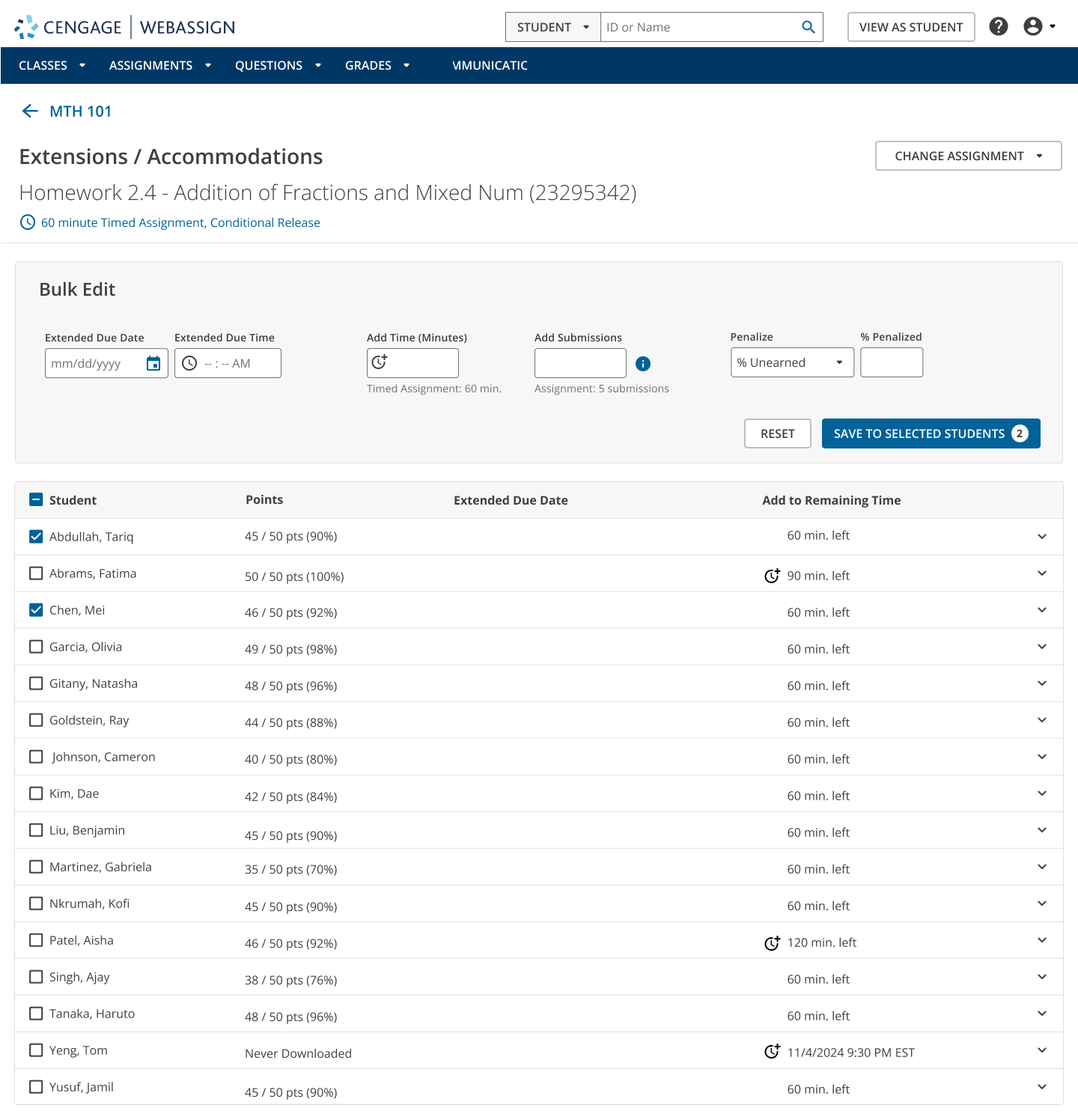
     It can be challenging to manage accommodation requests for extended time at the start of classes. We’re introducing a new feature that makes this process so much easier, allowing you to grant extra time to one or more students directly from your course roster.

    Once applied, this setting will ensure that students who need additional time automatically receive it on all timed assignments. There’s no need for repeated manual adjustments to individual assignments. This change makes it easier to support your students, while saving you time.

    Updates to WebAssign accommodations

    “These [upgrades] will improve the amount of time I currently spend managing WebAssign each term for hundreds of students. Reducing the number of clicks and tabs I need to open is a huge change. Bulk extensions are a significant advancement in my mind.” – Kathleen Koenig, University of Cincinnati

    Manage student requests with extension improvements

    But what if your students don’t have an accommodation, but need an extra 10 minutes or an extra day to work on their assignment?

    Students often request extensions, extra time, additional submissions or even early access to assignments. To help you manage these requests more efficiently, we’re redesigning the manual extensions process with a more user-friendly interface and added flexibility.

    With the new extension improvements, you’ll be able to:

    • Add extra time to timed assignments (for example: 10 more minutes).
    • Allow additional attempts on assignments.
    • Provide bulk extensions for multiple students or assignments.
    • Issue a penalty to students for any accommodation you made above.

    And later, you’ll be able to grant early access to assignments for specific students.


    Extensions and Accommodation in WebAssign.
    Updates to WebAssign accommodations and extensions

    More updates are on the way

    These updates to WebAssign accommodations and extensions are just the beginning. We’re committed to continuously improving your experience and will have even more enhancements coming in the next phase of extension updates. We encourage you to stay tuned for what’s to come.

    Ready to learn more about what else is new in WebAssign? Check out the latest upgrades in this video.

    Source link

  • As Enrollment Falls, Fewer Schools Close – The 74

    As Enrollment Falls, Fewer Schools Close – The 74

    The headlines are seemingly everywhere:

    Jackson Public Schools board votes to close 13 school buildings.”

    Denver Public Schools to close 7 schools, cut grades at 3 others despite heavy resistance.”

    The list is out: These are the SFUSD schools facing closure.” 

    Such reports can leave the impression that districts are rapidly closing schools in response to declining enrollment and families leaving for charters, private schools and homeschooling. 

    But the data tells a different story. 

    School closures have actually declined over the past decade, a period of financial instability that only increased in the aftermath of the pandemic, according to research from the Brookings Institution. 

    The analysis, shared exclusively with The 74, shows that in 2014-15, the closure rate — the share of schools nationwide that were open one year and closed the next — was 1.3%. In 2023-24, the rate was just .8%, up from .7% the year before.

    “I think it’s important for people to realize how rare school closures are,” said Sofoklis Goulas, a Brookings fellow and the study’s author. 

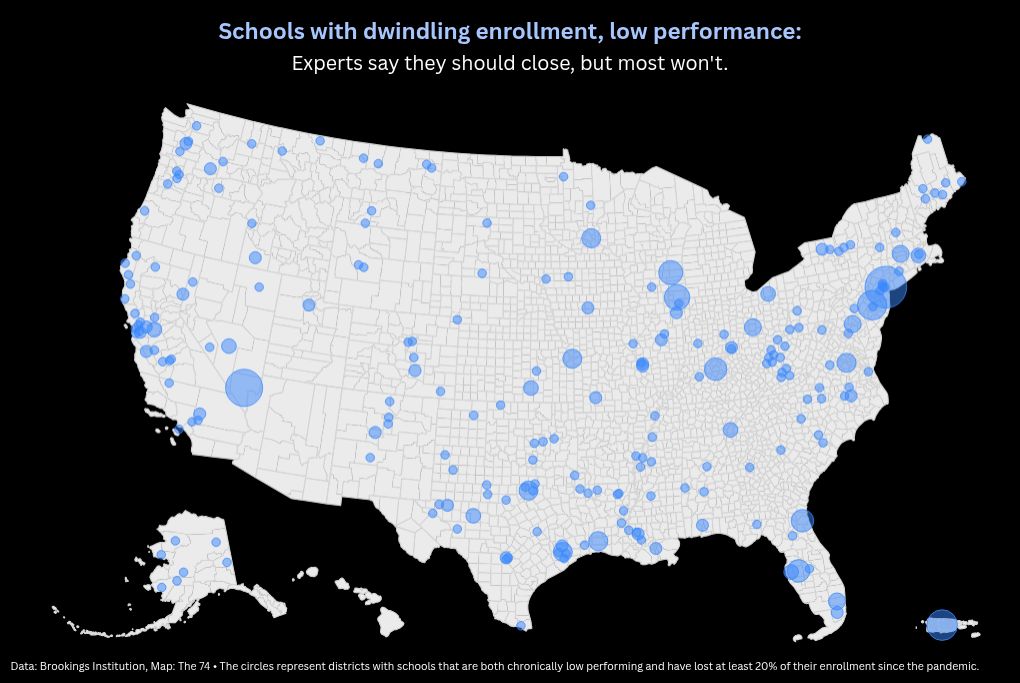
    Last fall, his research showed how schools that have lost at least 20% of their enrollment since the pandemic are more likely to be low-performing. The Clark County Public Schools, which includes Las Vegas, had the most schools on the list — 19 — but isn’t currently considering closures. In Philadelphia, with 12 schools in that category, district leaders are just beginning to discuss closures.

    When it released Goulas’s initial report, leaders of the conservative Thomas B. Fordham Institute argued that low-performing schools should be the first to close. But efforts to do so are often met with pushback from families, teachers and advocacy groups who argue that shutting down schools unfairly harms poor and minority students and contributes to neighborhood blight. Their pleas often push district leaders to retreat. Working in advocates’ favor, experts say, is the fact that many big district leaders are untested and have never had to navigate the emotionally charged waters of closing schools.

    “Closing a neighborhood school is probably one of the most difficult decisions a district’s board makes,” said Michael Fine, CEO of the Fiscal Crisis and Management Assistance Team, a California state agency that provides financial oversight to districts. “They are going to avoid that decision as long as they can and at all costs.” 

    Such examples aren’t hard to find:

    • Just weeks after announcing closures, the San Francisco district halted plans to shutter any schools this fall.
    • In September, outgoing Chicago Public Schools CEO Pedro Martinez pledged to put off school closures for another two years, even though state law allows the city to take action sooner. The district is in the process of absorbing five charter schools to keep them from closing. 
    • In October, Pittsburgh Public Schools recommended closing 14 schools; several others were set to be relocated and reconfigured. About a month later, Superintendent Wayne Walters hit pause, saying the district needed more “thoughtful planning” and community input.
    • Last May, the Seattle Public Schools announced it would shutter 20 elementary schools next school year in response to a $100 million-plus budget deficit. They later increased the number to 21. By October, the list had dwindled to four schools. Just before Thanksgiving, Superintendent Brent Jones withdrew the plan entirely. 

    “This decision allows us to clarify the process, deepen our understanding of the potential impacts, and thoughtfully determine our next steps,” Jones wrote to families. While the plan would have saved the district $5.5 million, he said, “These savings should not come at the cost of dividing our community.”

    map visualization

    Graham Hill Elementary in Seattle, which fifth grader Wren Alexander has attended since kindergarten, was initially on the list. The Title I school sits on top of a hill in a desirable area overlooking Lake Washington. But it also draws students from the lower-income, highly diverse Brighton Park neighborhood.

    Among Wren’s neighbors are students from Ethiopia, Vietnam and Guatemala. Wren, who moves on to middle school this fall, said she looks forward to visiting her former teachers and cried when she heard Graham Hill might close. She wanted her younger brother and sister to develop the same warm connection she had.

    “I don’t think I would be who I am if I didn’t go to the school,” she said.

    Wren Alexander and her little sister Nico, outside Graham Hill. (Courtesy of Tricia Alexander)

    Tricia Alexander, her mother, was among those who opposed the closures, participating in rallies outside the district’s administration building and before board meetings.

    “We were really loud,” said Alexander, who’s also part of Billion Dollar Bake Sale, an effort to advocate for more state education funding. She said there was “no real evidence” that closing schools would have solved the district’s budget woes. “In no way would kids win.”

    It’s a view shared by many school finance experts, who note that the bulk of school funding is tied up in salaries, not facility costs. Districts may save some money from closing schools, but unless coupled with staff reductions, it’s often not enough to make up for large budget shortfalls.  

    ‘So bad at this’

    If enrollment doesn’t pick up, experts say, leaders who delay closures will have to confront the same issues a year later or — perhaps even more likely — pass the problems on to their successors. 

    “If there continues to be fewer and fewer children …then that doesn’t get better,” said Brian Eschbacher, an enrollment consultant.  

    One Chicago high school, for example, had just 33 students last year. In Los Angeles, the nation’s second-largest district, 34 elementary schools have fewer than 200 students and 29 of those are using less than half of the building, according to a recent report. The share of U.S. students being educated outside of traditional schools also continues to increase, according to a forthcoming analysis Goulas conducted with researchers at Yale University. 

    “We don’t see a trajectory of enrollment recovery,” he said. “Things actually got worse in the most recently released data batch.”

    But such conditions haven’t stopped advocacy groups from campaigning against closures. One of them, the left-leaning Advancement Project, has joined with local groups in Denver and Pittsburgh to make a case against closures nationally. 

    “All children deserve to have a local, neighborhood public school in which they and their families have a say,” said Jessica Alcantara, senior attorney for the group’s Opportunity to Learn program. “It’s not just that school closures are hard on families. They harm the full education ecosystem that makes up a school — students, families, school staff and whole communities.”   

    Last May, Alcantara and other Advancement Project staff urged the U.S. Department of Education to treat school closures as a civil rights issue. Nine of the 10 schools the Denver district planned to close in 2022 had a majority Black or Hispanic student population. 

    The advocates argued that in cases of enrollment loss, run-down facilities and empty classrooms, there are alternatives to closing schools. They encourage communities to push for renovations and urge district leaders to use vacant spaces for STEM, arts or other programs that might attract families. Opponents of closures also say that districts sometimes underestimate how much of a building is used for non-classroom purposes like special education services, early-childhood programs and mental health. 

    Eschbacher’s assessment of why districts often back down from closing schools is more blunt. 

    “Districts are so bad at this,” he said. “If you just do a few things wrong, it could sink the whole effort.”

    For one, leaders often target schools with under 300 students for closure, appealing to parents that they can’t afford to staff them with arts programs, a school nurse or a librarian. 

    But those explanations sometimes fall flat.

    “Parents always say, ‘I wanted a small school. I know my teachers and they know my kid. And it’s right down the street,’” Eschbacher said. If they didn’t like their school, he added, they would have likely would have chosen a charter or some other option. 

    District officials also run into trouble if they try to spin the data. When Seattle officials talked about “right-sizing” the district, they pointed to the loss of 4,900 students since 2019-20. 

    But Albert Wong, a parent in the district and a lifelong Seattle resident, knew there was more to the story. Not only is the current enrollment higher than it was from 2000 to 2011, the pandemic-related decline seems to have leveled off. In a commentary, he argued that officials presented misleading data “to make current enrollment look exceptionally bad.”

    Graham Hill Elementary, fifth-grader Wren’s school, actually saw a slight increase in enrollment this year, including a new class for preschoolers with disabilities. And while Pittsburgh schools are projected to lose another 5,000 students over the next six years, enrollment this year held steady at about 18,400.

    To Eschbacher, the “burden of proof is always on the district” to make an airtight case for why students would be better off in larger schools. He has applauded the Denver-area Jeffco Public Schools, which has closed 21 schools since 2021, for having state demographers, not just district officials, explain population trends to families at community meetings.

    ‘It wasn’t realistic’

    Walters, Pittsburgh’s superintendent, can easily rattle off reasons why the district should rethink how it uses its buildings. Early last year, local news reports showed that almost half of the district’s schools were less than 50% full. 

    “We’ve lost about a fourth of our population, but we have not changed anything to our footprint,” he said. 

    Meanwhile, the average age of the district’s buildings is 90 years old, and many lack air-conditioning, forcing some schools to send students home in sweltering weather.

    But a consulting group’s proposal showed that Black and low-income students and those with disabilities would be disproportionately affected by the changes. Several advocacy groups drew attention to those disparities, calling  the effort “rushed.” 

    412 Justice, an advocacy group, is among the community organizations pushing for alternatives to school closures in Pittsburgh. (412 Justice)

    Walters agreed and put the plan on hold last fall, saying he lacked “robust” responses to parents’ tough questions about how schools would change for their kids.

    “It doesn’t mean that we don’t see a path forward,” he said. “But it wasn’t realistic that we would have those questions answered within the timeline that we’ve been given.”

    In March, parents pushed for another delay, causing the school board to postpone a vote on the next phase in the closure process.

    As the Jeffco district demonstrates, some school systems are following through with closures. The school board in nearby Denver unanimously voted in November to close seven schools and downsize three more. 

    But that’s after community protests pushed the district to put the brakes on a plan to close 19 schools in 2021. Advocates argued that families in low-income areas, who had been heavily impacted by the pandemic, would be most affected. Then the district only closed three in 2023, and now board members are considering a pause on closures for three years.

    School boards closing a dozen or more schools are often catching up with work their predecessors let pile up, said Goulas of Brookings. 

    “Closing a single school allows for easier placement of students and minimizes the political cost and community stress,” he said. “When a district releases a long list of schools to close, it likely indicates that they waited for conditions to improve, but this didn’t happen.”

    Angel Gober, executive director of 412 Justice — one of 16 organizations that called on the Pittsburgh district to drop its plan — acknowledged that their fight isn’t over.

    “I think we got a temporary blessing from God,” she said. But she wants the district to explore a host of alternatives, like community schools and corporate support, before it shutters and sells off buildings. “We do have very old infrastructure, and that is an equity issue. But can we try five things before we make a drastic decision to close schools for forever?”


    Get stories like these delivered straight to your inbox. Sign up for The 74 Newsletter


    Source link

  • Three-fourths of NSF funding cuts hit education

    Three-fourths of NSF funding cuts hit education

    The outlook for federal spending on education research continues to be grim. 

    That became clear last week with more cutbacks to education grants and mass firings at the National Science Foundation (NSF), the independent federal agency that supports both research and education in science, engineering and math.

    A fourth round of cutbacks took place on May 9. NSF observers were still trying to piece together the size and scope of this wave of destruction. A division focused on equity in education was eliminated and all its employees were fired. And the process for reviewing and approving future research grants was thrown into chaos with the elimination of division directors who were stripped of their powers.

    Meanwhile, there was more clarity surrounding a third round of cuts that took place a week earlier on May 2. That round terminated more than 330 grants, raising the total number of terminated grants to at least 1,379, according to Grant Watch, a new project launched to track the Trump administration’s termination of grants at scientific research agencies. All but two of the terminated grants in early May were in the education division, and mostly targeted efforts to promote equity by increasing the participation of women and Black and Hispanic students in STEM fields. The number of active grants by the Division of Equity for Excellence in STEM within the education directorate was slashed almost in half, from 902 research grants to 461.

    Related: Our free weekly newsletter alerts you to what research says about schools and classrooms.

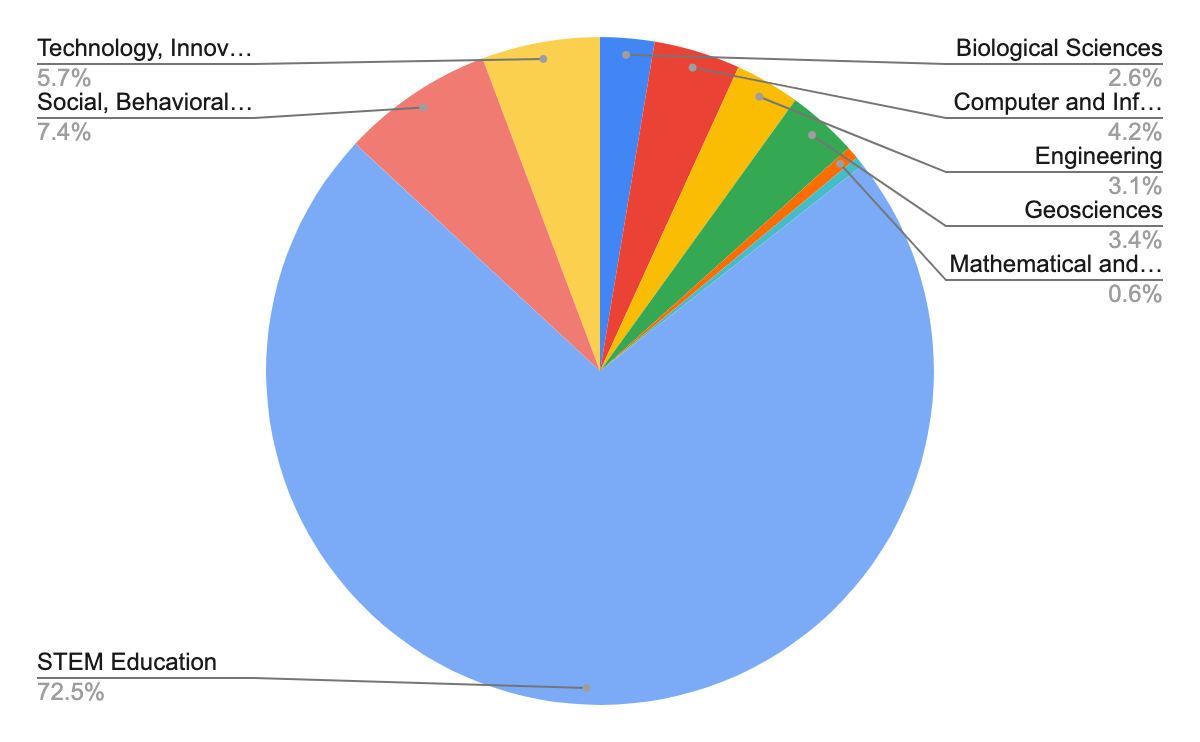
    Combined with two earlier rounds of NSF cuts at in April, education now accounts for more than half of the nearly 1,400 terminated grants and almost three-quarters of their $1 billion value. Those dollars will no longer flow to universities and research organizations. 

    Cuts to STEM education dominate NSF grant terminations

    Source: Grant Watch, May 7, 2025 https://grant-watch.us/nsf-summary-2025-05-07.html

    More than half the terminated grants…

    … and nearly three-quarters of their $1 billion value are in education 

    Data source: Grant Watch, May 7, 2025. Charts by Jill Barshay/The Hechinger Report

    The cuts are being felt across the nation. Grant Watch also created a map of the United States, showing that both red and blue states are losing federal research dollars. 

    Source: Grant Watch, May 7, 2025 

    It remains unclear exactly how NSF is choosing which grants to cancel and exactly who is making the decisions. Weekly waves of cuts began after the Department of Government Efficiency or DOGE entered NSF headquarters in mid April. Only 40 percent of the terminated grants were also in a database of 3,400 research grants compiled last year by Sen. Ted Cruz, a Texas Republican. Cruz characterized them as “questionable projects that promoted Diversity, Equity, and Inclusion (DEI) or advanced neo-Marxist class warfare propaganda.” Sixty percent were not on the Cruz list.

    Source: Grant Watch, May 7, 2025 

    Other NSF cuts also affect education. Earlier this year, NSF cut in half the number of new students that it would support through graduate school from 2,000 to 1,000. Universities are bracing to hear this summer if NSF will continue to support graduate students who are already a part of its graduate research fellowship program. 

    Related: Education research takes another hit in latest DOGE attack

    Developing story

    NSF watchers were still compiling a list of the research grants that were terminated on May 9, the date of the most recent fourth round of research cuts. It was unclear if any research grants to promote equity in STEM education remained active.

    The Division of Equity for Excellence in STEM, a unit of the Education Directorate, was “sunset,” according to a May 9 email sent to NSF employees and obtained by the Hechinger Report, and all of its employees were fired. According to the email, this “reduction in force” is slated to be completed by July 12. However, later on May 9, a federal judge in San Francisco temporarily blocked the Trump administration from implementing its “reduction in force” firings of federal employees at the NSF and 19 other agencies.

    Several congressionally mandated programs are housed within the eliminated equity division, including Louis Stokes Alliances for Minority Participation (LSAMP) and the Eddie Bernice Johnson initiative, which promotes STEM participation for students with disabilities.

    The process for reviewing and approving new grant awards was thrown into chaos with the elimination of all NSF division directors, a group of middle managers who were stripped of their powers on May 8. In addition, NSF slashed its ranks of its most senior executives and its visiting scientists, engineers and educators. That leaves many leadership positions at NSF uncertain, including the head of the entire education directorate.

    Legal update

    An initial hearing for a group of three legal cases by education researchers against the Department of Education is scheduled for May 16.  At the hearing, a federal judge in Washington, D.C., will hear arguments over whether the court should temporarily restore terminated research studies and data collections and bring back fired Education Department employees while it considers whether the Trump administration exceeded its executive authority. 

    A first hearing scheduled for May 9 was postponed. At the May 16 hearing, the court will hear two similar motions from two different cases: one filed by the Association for Education Finance and Policy (AEFP) and the Institute for Higher Education Policy (IHEP), and the other filed by National Academy of Education (NAEd) and the National Council on Measurement in Education (NCME). A third suit by the American Educational Research Association (AERA) and the Society for Research on Educational Effectiveness (SREE) was filed in federal court in Maryland and will not be part of the May 16 hearing.

    Contact staff writer Jill Barshay at 212-678-3595, jillbarshay.35 on Signal, or [email protected].

    This story about NSF education cuts was written by Jill Barshay and produced by The Hechinger Report, a nonprofit, independent news organization focused on inequality and innovation in education. Sign up for Proof Points and other Hechinger newsletters.

    The Hechinger Report provides in-depth, fact-based, unbiased reporting on education that is free to all readers. But that doesn’t mean it’s free to produce. Our work keeps educators and the public informed about pressing issues at schools and on campuses throughout the country. We tell the whole story, even when the details are inconvenient. Help us keep doing that.

    Join us today.

    Source link

  • A history lesson on Europe for Donald Trump

    A history lesson on Europe for Donald Trump

    “The European Union was formed in order to screw the United States, that’s the purpose of it.” So said U.S. President Donald Trump in February. He repeats this assertion whenever U.S.-European relations are a topic of debate.

    Trump voiced his distorted view of the EU in his first term in office and picked it up again in the first three months of his second term, which began on January 20 and featured the start of a U.S. tariff war which up-ended international trade and shook an alliance dating back to the end of World War II.

    What or who gave the U.S. president the idea that the EU was “formed to screw” the United States is something of a mystery. If he were a student in a history class, his professor would give him an F.

    Trump’s claim does injustice to an institution that won the Nobel Peace Prize in 2012 in recognition for having, over six decades, “contributed to the advancement of peace and reconciliation, democracy and human rights in Europe” as the Nobel committee put it.

    So, here is a brief guide to the creation of the EU, now the world’s largest trading bloc with a combined population of 448 million people, and the events that preceded its formal creation in 1952. 

    Next time you talk to Trump, feel free to brief him on it. 

    Staving off war

    With Germans still clearing the ruins of the world war Adolf Hitler had started in 1939, far-sighted statesmen began thinking of ways to prevent a repeat of a conflict that killed 85 million people. 

    The foundation of what became a 28-country bloc lay in the reconciliation between France and Germany. 

    In his speech announcing the Nobel Prize, the chairman of the Norwegian Nobel Committee, Thorbjorn Jagland, singled out then French Foreign Minister Robert Schuman for presenting a plan to form a coal and steel community with Germany despite the long animosity between the two nations; in the space of 70 years, France and Germany had waged three wars against each other. That was in May 1950. 

    As the Nobel chairman put it, the Schuman plan “laid the very foundation for European integration.”

    He added: “The reconciliation between Germany and France is probably the most dramatic example in history to show that war and conflict can be turned so rapidly into peace and cooperation.”

    From enemies into partners

    In years of negotiations, the coal and steel community, known as Montanunion in Germany, grew from two — France and Germany — to six with the addition of Italy, Belgium, the Netherlands and Luxembourg. The union was formalized with a treaty in Paris in 1951 and came into existence a year later. 

    The coal and steel community was the first step on a long road towards European integration. It was encouraged by the United States through a comprehensive and costly programme to rebuild war-shattered Europe.

    Known as the Marshall Plan, named after U.S. Secretary of State George C. Marshall, the programme provided $12 billion (the equivalent of more than $150 billion today) for the rebuilding of Western Europe. It was part of President Harry Truman’s policy of boosting democratic and capitalist economies in the devastated region.

    From the six-nation beginning, the process of European integration steadily gained momentum through successive treaties and expansions. Milestones included the creation of the European Economic Community and European Atomic Energy Community.

    In 1986, the Single European Act paved the way to an internal market without trade barriers, an aim achieved in 1992. Seven years later, integration tightened with the adoption of a common currency, the Euro. Used by 20 of the 27 member states, it accounts for about 20% of all international transactions.

    Brexiting out

    One nation that held out against the Euro was the United Kingdom. It would later withdraw from the EU entirely after the 2016 “Brexit” referendum led by politicians who claimed that rules made by the EU could infringe on British sovereignty. 

    Many economists at the time described Brexit as a self-inflicted wound and opinion polls now show that the majority of Britons regret having left the union.

    In decades of often arduous, detail-driven negotiations on European integration, including visa-free movement from one country to the other, no U.S. president ever saw the EU as a “foe” bent on “screwing” America. That is, until Donald Trump first won office in 2017 and then again in 2024.

    What bothers him is a trade imbalance; the EU sells more to the United States than the other way around; he has been particularly vocal about German cars imported into the United States.

    Early in his first term, the Wall Street Journal quoted him as complaining that “when you walk down Fifth Avenue (in New York), everybody has a Mercedes-Benz parked in front of his house. How many Chevrolets do you see in Germany? Not many, maybe none, you don’t see anything at all over there. It’s a one-way street.”

    This appears to be one of the reasons why Trump imposed a 25% tariff, or import duty, on foreign cars when he declared a global tariff war on April 2. 

    His tariff decisions, implemented by Executive Order rather than legislation, caused deep dismay around the world and upended not only trade relations but also cast doubt on the durability of what is usually termed the rules-based international order

    That refers to the rules and alliances set up, and long promoted by the United States. For a concise assessment of the state of this system, listen to the highest-ranking official of the European Union: “The West as we knew it no longer exists.”

    So said Ursula von der Leyen, president of the Brussels-based European Commission, the main executive body of the EU. Its top diplomat, Kaja Kallas, a former Prime Minister of Estonia, was even blunter: “The free world needs a new leader.”


    Questions to consider:

    1. Why was the European Union formed in the first place?

    2. How can trade serve to keep the peace?

    3. In what ways do nations benefit by partnering with other countries?


    Source link

  • Student-created book reviews inspire a global reading culture

    Student-created book reviews inspire a global reading culture

    Key points:

    When students become literacy influencers, reading transforms from a classroom task into a global conversation.

    When teens take the mic

    Recent studies show that reading for pleasure among teens is at an all-time low. According to the National Assessment of Educational Progress (NAEP), only 14 percent of U.S. students read for fun almost every day–down from 31 percent in 1984. In the UK, the National Literacy Trust reports that just 28 percent of children aged 8 to 18 said they enjoyed reading in their free time in 2023.

    With reading engagement in crisis, one group of teens decided to flip the narrative–by turning on their cameras. What began as a simple classroom project to encourage reading evolved into a movement that amplified student voices, built confidence, and connected learners across cultures.

    Rather than writing traditional essays or book reports, my students were invited to create short video book reviews of their favorite titles–books they genuinely loved, connected with, and wanted others to discover. The goal? To promote reading in the classroom and beyond. The result? A library of student-led recommendations that brought books–and readers–to life.

    Project overview: Reading, recording, and reaching the world

    As an ESL teacher, I’ve always looked for ways to make literacy feel meaningful and empowering, especially for students navigating a new language and culture. This video review project began with a simple idea: Let students choose a book they love, and instead of writing about it, speak about it. The assignment? Create a short, personal, and authentic video to recommend the book to classmates–and potentially, to viewers around the world.

    Students were given creative freedom to shape their presentations. Some used editing apps like Filmora9 or Canva, while others recorded in one take on a smartphone. I offered a basic outline–include the book’s title and author, explain why you loved it, and share who you’d recommend it to–but left room for personal flair.

    What surprised me most was how seriously students took the project. They weren’t just completing an assignment–they were crafting their voices, practicing communication skills, and taking pride in their ability to share something they loved in a second language.

    Student spotlights: Book reviews with heart, voice, and vision

    Each student’s video became more than a book recommendation–it was an expression of identity, creativity, and confidence. With a camera as their platform, they explored their favorite books and communicated their insights in authentic, impactful ways.

    Mariam ElZeftawy: The Fault in Our Stars by John Green
    Watch Miriam’s Video Review

    Mariam led the way with a polished and emotionally resonant video review of John Green’s The Fault in Our Stars. Using Filmora9, she edited her video to flow smoothly while keeping the focus on her heartfelt reflections. Mariam spoke with sincerity about the novel’s themes: love, illness, and the fragility of life. She communicated them in a way that was both thoughtful and relatable. Her work demonstrated not only strong literacy skills but also digital fluency and a growing sense of self-expression.

    Dana: Dear Tia by Maria Zaki
    Watch Dana’s Video Review

    In one of the most touching video reviews, Dana, a student who openly admits she’s not an avid reader, chose to spotlight “Dear Tia,” written by Maria Zaki, her best friend’s sister. The personal connection to the author didn’t just make her feel seen; it made the book feel more real, more urgent, and worth talking about. Dana’s honest reflection and warm delivery highlight how personal ties to literature can spark unexpected enthusiasm.

    Farah Badawi: Utopia by Ahmed Khaled Towfik
    Watch Farah’s Video Review

    Farah’s confident presentation introduced her classmates to Utopia, a dystopian novel by Egyptian author Ahmed Khaled Towfik. Through her review, she brought attention to Arabic literature, offering a perspective that is often underrepresented in classrooms. Farah’s choice reflected pride in her cultural identity, and her delivery was clear, persuasive, and engaging. Her video became more than a review–it was a form of cultural storytelling that invited her peers to expand their literary horizons.

    Rita Tamer: Frostblood
    Watch Rita’s Video Review

    Rita’s review of Frostblood, a fantasy novel by Elly Blake, stood out for its passionate tone and concise storytelling. She broke down the plot with clarity, highlighting the emotional journey of the protagonist while reflecting on themes like power, resilience, and identity. Rita’s straightforward approach and evident enthusiasm created a strong peer-to-peer connection, showing how even a simple, sincere review can spark curiosity and excitement about reading.

    Literacy skills in action

    Behind each of these videos lies a powerful range of literacy development. Students weren’t just reviewing books–they were analyzing themes, synthesizing ideas, making connections, and articulating their thoughts for an audience. By preparing for their recordings, students learned how to organize their ideas, revise their messages for clarity, and reflect on what made a story impactful to them personally.

    Speaking to a camera also encouraged students to practice intonation, pacing, and expression–key skills in both oral language development and public speaking. In multilingual classrooms, these skills are often overlooked in favor of silent writing tasks. But in this project, English Learners were front and center, using their voices–literally and figuratively–to take ownership of language in a way that felt authentic and empowering.

    Moreover, the integration of video tools meant students had to think critically about how they presented information visually. From editing with apps like Filmora9 to choosing appropriate backgrounds, they were not just absorbing content, they were producing and publishing it, embracing their role as creators in a digital world.

    Tips for teachers: Bringing book reviews to life

    This project was simple to implement and required little more than student creativity and access to a recording device. Here are a few tips for educators who want to try something similar:

    • Let students choose their own books: Engagement skyrockets when they care about what they’re reading.
    • Keep the structure flexible: A short outline helps, but students thrive when given room to speak naturally.
    • Offer tech tools as optional, not mandatory: Some students enjoyed using Filmora9 or Canva, while others used the camera app on their phone.
    • Focus on voice and message, not perfection: Encourage students to focus on authenticity over polish.
    • Create a classroom premiere day: Let students watch each other’s videos and celebrate their peers’ voices.

    Literacy is personal, public, and powerful

    This project proved what every educator already knows: When students are given the opportunity to express themselves in meaningful ways, they rise to the occasion. Through book reviews, my students weren’t just practicing reading comprehension, they were becoming speakers, storytellers, editors, and advocates for literacy.

    They reminded me and will continue to remind others that when young people talk about books in their own voices, with their personal stories woven into the narrative, something beautiful happens: Reading becomes contagious.

    Latest posts by eSchool Media Contributors (see all)

    Source link

  • What’s needed to strengthen career and college pathway commitments?

    What’s needed to strengthen career and college pathway commitments?

    This audio is auto-generated. Please let us know if you have feedback.

    WASHINGTON — The momentum for providing all students access to meaningful career and college pathways is growing, but hurdles such as funding, teacher training, reluctance to change and other factors stand in the way, said speakers at the National Pathways Summit on Thursday.

    Experiential learning about careers is what students, families and educators want. Industry leaders also want to employ workers with job skills and essential abilities like problem solving, collaboration and resilience, the speakers told the 300 summit attendees

    And these skills and abilities are not just desirable, but critical to the health of the economy, said Stanley Litow, chair of the National Pathways Initiative, a bipartisan federation of students and leaders from education, business, government, politics and advocacy organizations that promote promising K-12 and higher education career and college preparation programs.  

    “From the business community standpoint, there is an enormous amount of pressure in the labor market around the skills area,” said Litow, a former deputy schools chancellor for New York City Public Schools and former president of the IBM Foundation. He is currently a professor at Columbia University’s School of International and Public Affairs.

    Litow said that by 2030, over 70% of the new jobs created will require some form of postsecondary education, which includes credentials, apprenticeships, two-year and four-year degrees, and other continuing learning programs. 

    But to make career and college preparation successful for students and industries, the education and business communities need to partner to align their needs, Litow said. “We have to break down the barriers, we have to collaborate, we have to work together.”

    Successes and challenges

    Randi Weingarten, president of the American Federation of Teachers, and John B. King, Jr., chancellor of the State University of New York and a former U.S. education secretary, both noted that there’s a high level of agreement across the country that workforce preparation in K-12 and higher education is important. 

    They also pointed to several successful programs that are helping students gain the skills necessary for their chosen occupation. King, for example, highlighted the Real Life Rosies program at Mohawk Valley Community College in Utica, New York — a 12-week pre-apprenticeship program that helps women gain advanced manufacturing skills.

    But Weingarten and King also noted obstacles that are stunting students’ access to skill-based learning.

    For one, K-12 school systems “are really terrible at change,” Weingarten said, adding that they “only change when an accountability system changes. And so the problem is we have a really outdated accountability system.”

    Weingarten also said that school systems tend to be risk-averse. “People get blamed” if an initiative isn’t 100% successful, she said. That’s why school accountability systems need to be revised, “to give people permission to do something different.”

    King said one obstacle is that there’s a culture challenge. Some people think that a liberal arts education and career readiness preparation programs are in conflict with each other, he said. “Sometimes people react against talk of careers, because it seems that it is making education just about the job,” he said.

    King also said leaders from all industry sectors need to voice support for education and prioritize learning as an investment, as well as work on solutions to barriers. “We need the business community nudging people on both sides of the aisle to stand up for education and stand up for this vision we’ve been talking about today,” he said.

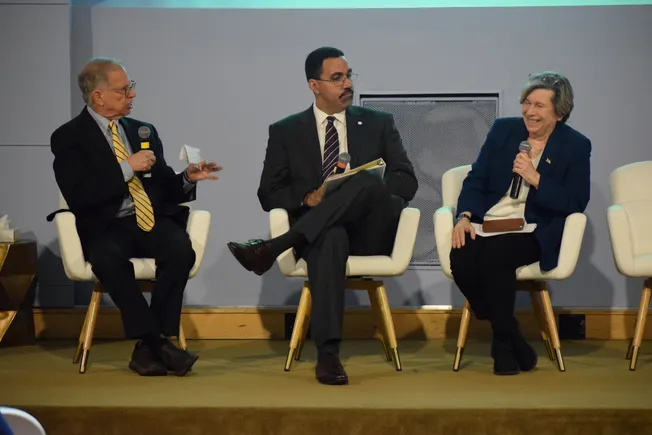
    Three people are seated at a table on a stage.

    Reo Pruiett, Rashid Ferrod Davis and Don Haddad speak about the P-TECH approach to connecting K-12 students with college and career experiences during a panel at the National Pathways Summit at Gallaudet University in Washington, D.C., on May 8, 2025.

    Permission granted by National Pathways Initiative


    Two diplomas by high school graduation

    Several speakers during another panel discussion highlighted one approach that is helping high school students graduate with both high school and associate degree diplomas while also gaining career skills and connections to potential employers through mentorships, paid internships, and other on-the-job experiences.

    The P-TECH 9-14 school model was created by IBM to encourage public-private partnerships to give high school students specific workplace skills while they earn both diplomas. The first P-TECH school was launched in New York City in 2011.

    Reo Pruiett, chief programs and engagement officer at Communities Foundation of Texas, focuses on improving K-12 and higher education outcomes. She calls the P-TECH approach “game changing.”

    She said the program has helped students gain upward economic mobility and has “demystified” the college experience for students while they are still being supported as high schoolers.

    “I think that’s one thing about P-TECH; It allows us to make sure our students are prepared to dream and not to just settle,” she said.

    Source link

  • Rurality Matters in Evaluating Transfer Outcomes (opinion)

    Rurality Matters in Evaluating Transfer Outcomes (opinion)

    Transfer enrollment rose by 4.4 percent this year, according to recent data from the National Student Clearinghouse Research Center. In total, transfers have grown by 8 percent since 2020, signaling a steady rebound from the sharp declines seen during the pandemic. That’s encouraging news for students seeking affordable, flexible pathways to a degree, as well as for institutions focused on expanding access and supporting completion.

    Less noticed, however, is just how much progress rural students are making. In fall 2023, rural community colleges experienced a 12.1 percent increase in students transferring to four-year institutions. This progress is even more impressive given the historic underinvestment in rural institutions and the well-documented barriers their students face on their path to a four-year degree.

    Many of the country’s small, rural institutions remain on the margins of transfer conversations, partnerships and policy priorities. Here in California, for instance 60 percent of the community colleges with the lowest transfer rates are rural. From low-income students in Appalachia to Latino learners in Texas’s Rio Grande Valley, rural colleges are lifelines for students facing barriers such as poverty, food and housing insecurity, and limited access to transportation and technology. Yet these institutions tend to lack the support, visibility and resources of larger community college systems. They often remain excluded from the design and implementation of transfer initiatives.

    Rural students bring tremendous talent, drive and potential to higher education. Many are the first in their families to attend college. They are often deeply rooted in their communities and, in many cases, seek to use their education to give back and contribute to their local economies.

    Transferring to a four-year institution can dramatically increase the lifetime earnings of these learners, expand their career paths and help meet the growing demand for a highly skilled workforce. Individuals with a bachelor’s degree earn, on average, nearly 35 percent more per year than those with only an associate degree. Four-year degrees open doors to career advancement, civic engagement and personal growth.

    Yet the systemic challenges rural community college students face—from more limited course offerings and degree options to long travel times to campuses to unreliable internet connections—require tailored support and intentional partnership. A one-size-fits-all approach to transfer doesn’t work when rural students are starting from a fundamentally different place than many of their peers.

    For example, rural colleges may not have the staff capacity to manage complex articulation agreements or advocate for their students in statewide transfer initiatives. Their advisers may juggle many roles, serving as counselors, career coaches and transfer liaisons all at once. Meanwhile, students themselves may be unaware of transfer opportunities or discouraged by long distances to four-year campuses, especially when those pathways demand sacrifices they can’t afford to make.

    The health of both our higher education ecosystem and our economy depends on ensuring that all students, regardless of ZIP code, can move easily between two-year and four-year institutions. If efforts to improve transfer overlook rural colleges, they risk deepening existing educational inequities and missing out on a significant segment of our nation’s talent pool.

    Organizations such as the Rural Community College Alliance shine a needed spotlight on how to best collaborate with rural institutions across the country to improve transfer outcomes and better support rural students’ success. Progress starts with listening and taking the time to understand the unique strengths and challenges of rural communities rather than imposing outside solutions.

    The policy landscape will need to evolve to support these efforts. This means increasing investment in rural higher education infrastructure, expanding funding for rural-serving institutions, and creating more flexible transfer frameworks that reflect the realities of rural learners, many of whom are working adults, members of the military, parents, or all of the above. Federal, state and higher education leaders should recognize rurality as a key lens through which to view improving student outcomes, on par with class or race.

    Transfer rates are rising, and more students are finding affordable on-ramps to bachelor’s degrees. But this progress is incomplete unless it reaches every corner of the country, including the small towns and rural communities that are home to millions of students. In a moment when more students are finally moving forward, we can’t afford to leave these learners behind. When rural students succeed, our entire nation benefits.

    Gerardo de los Santos is vice president for community college relations at National University.

    Source link