Category: Featured

  • Spanberger Calls on UVA to Pause President Search

    Spanberger Calls on UVA to Pause President Search

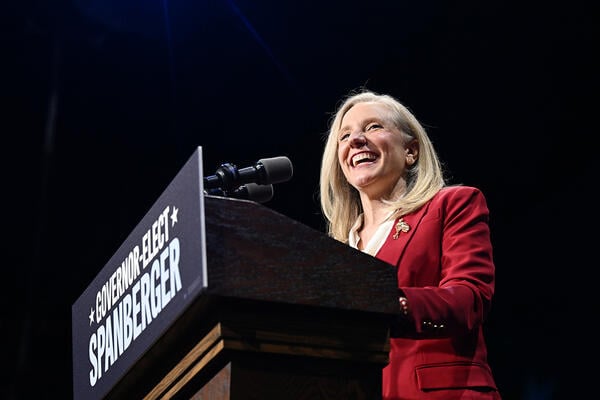
    Virginia governor-elect Abigail Spanberger has called on the University of Virginia to pause its presidential search until she takes office in January and appoints new members to the Board of Visitors.

    In a Wednesday letter to board leaders, Spanberger wrote that she was “deeply concerned” about recent developments at the state flagship, citing “the departure of President Jim Ryan as a result of federal overreach.” Ryan stepped down amid federal investigations into diversity, equity and inclusion practices at UVA. The board later reached an agreement with the U.S. Department of Justice to pause those investigations.

    Spanberger argued that the government’s interference “went unchallenged by the Board” and has “severely undermined” public confidence in its ability to “govern productively, transparently, and in the best interests of the University.”

    Spanberger also pointed to recent votes of no confidence in the board by both the UVA Faculty Senate and the Student Council. Given those concerns and the hobbled state of the board, which is missing multiple members after state Democrats blocked Republican governor Glenn Youngkin’s appointments, Spanberger called for a pause until her own picks are confirmed by the General Assembly.

    “The benefits of selecting a new president with a full, duly-constituted Board are clear,” the governor-elect wrote in her letter to board leaders. They include making the search process and decision credible and “removing any concern that the Board’s actions are illegitimate due to a lack of authority,” she wrote.

    So far, UVA has been noncommittal in its public response.

    “University leaders and the Board of Visitors are reviewing the letter and are ready to engage with the Governor-elect and to work alongside her and her team to advance the best interests of UVA and the Commonwealth,” spokesperson Brian Coy wrote to Inside Higher Ed by email.

    Spanberger is the latest state Democrat to clash with the UVA Board of Visitors, which is stocked with GOP donors and political figures. While politics have long been at play on Virginia’s boards, Youngkin’s appointments have represented a dramatic rightward shift, prompting pushback as Democrats have blocked recent nominations.

    (A legal battle over the state of those appointments is currently playing out; the Virginia Supreme Court heard oral arguments in the case last month but has yet to issue a decision.)

    Democrats have turned up the temperature on UVA in recent months, demanding answers about the agreement with DOJ and Ryan’s resignation and accused the board of giving in to “extortionate tactics.” Now, following an election that saw Democrats take the governor’s office and broaden their majority in the General Assembly, Spanberger will likely have political capital to reshape higher education at the state level as she sees fit—barring intervention from the federal government.

    Spanberger, the first woman elected governor of Virginia, is a UVA alumna.

    The governor-elect’s call to pause UVA’s presidential search prompted immediate pushback from the Jefferson Council, a conservative alumni group that has won influence with Youngkin, who appointed the group’s co-founder Bert Ellis to the board before removing him for his combative behavior.

    The organization argued in a statement that in 2022 a Democratic-appointed board “quietly extended” Ryan’s contract through 2028—even though it did not expire until 2025—without “Governor Youngkin having an opportunity to appoint one Board member.” They wrote that “the Board’s action was clearly intended to ensure Ryan’s tenure” beyond Youngkin’s term. (Governors in Virginia may not serve consecutive terms.)

    The group also defended the search committee and process.

    “In contrast, the current UVA presidential search committee, the most extensive and diverse in University history, was lawfully formed by the Board and has been operating since July 2025, working diligently through meetings and interviews. To suddenly ask the BOV to wait to choose a president is a bold act of political legerdemain representing a total historical double-standard,” the Jefferson Council wrote.

    However, faculty members have a different view of the search committee.

    In an Aug. 10 letter, the UVA chapter of the American Association of University Professors accused the board of shortchanging faculty by limiting their seats on the presidential search committee. The group wrote that the committee “is dominated by current and former members of the [Board of Visitors] and administrators,” with faculty members composing less than a quarter of the committee. Additionally, they noted that none of those members “were selected by the faculty.”

    Spanberger’s insistence that UVA pause its presidential search bears similarities to ways other governors have sought to influence leadership decisions before they took office, such as Jeff Landry in Louisiana. Shortly after his election in late 2023, the Republican governor called on the University of Louisiana system to hold off on hiring Rick Gallot, a former Democratic state lawmaker, as its next president.

    Landry said he wanted to make sure their visions for the system aligned. Ultimately, despite the pause, Gallot was hired as system president after meeting with Landry before he took office.


    Source link

  • The NO FAKES Act is a real threat to free expression

    The NO FAKES Act is a real threat to free expression

    Imagine a fourth-grade classroom in which the teacher uses AI to generate a video of Ronald Reagan explaining his Cold War strategy. It’s history in living color, and the students lean in, captivated. Now imagine that same teacher facing thousands of dollars in damages under the proposed NO FAKES Act because the video looks too real.

    That’s not sci-fi. It’s a risk baked into this bill. The NO FAKES Act, introduced this year in both the House and Senate, would create a new federal “digital replication right” letting people control the use of AI-generated versions of their voice or likeness. That means people can block others from sharing realistic, digitally created images of them. The right can extend for up to 70 years after the person’s death and is transferred to heirs. It also lets people sue those who share unauthorized “digital replicas,” as well as the companies that make such works possible.

    A “digital replica” is defined as a newly created, highly realistic representation “readily identifiable” as a person’s voice or likeness. That includes fully virtual recreations and real images or recordings that are materially altered. 

    The bill bans unauthorized public use or distribution of “digital replicas.” But almost all of the covered “replicas” are fully protected by the First Amendment, meaning Congress cannot legislate their suppression.

    Can someone own a voice? Breaking down the right of publicity.

    What to do if a company makes a copy of your voice and profits from it without your permission.


    Read More

    The bill does list exceptions for “bona fide” news, documentaries, historical works, biographical works, commentary, scholarship, satire, or parody. But there’s a catch. News is exempt only if the replica is the subject of, or materially relevant to, the story. At best, this means any story relating to, say, political deepfakes must be reviewed by an attorney to decide if the story is “bona fide” news and the deepfake is sufficiently relevant to include in the story itself. At worst, this means politicians and other public figures will start suing journalists and others who talk about newsworthy replicas of them, if they don’t like what the person had to say. 

    Even worse, the documentary, historical, and biographical exceptions vanish if the work creates a false impression that it’s “an authentic [work] in which the person actually participated.” That swallows the exception and makes any realistic recreations, like the fourth-grade example above, legally radioactive.

    The reach goes well beyond classrooms, too. Academics using recreated voices for research, documentarians patching gaps in archival footage, artists experimenting with digital media, or writers reenacting leaked authentic conversations could all face litigation. The exceptions are so narrowly drawn that they offer no real protection. And the risk doesn’t end with creators. Merely sharing a disputed clip can also invite a lawsuit.

    That’s a digital heckler’s veto whereby one complaint can erase lawful speech.

    The law also targets AI technology itself. Section 2(c)(2)(B) imposes liability on anyone who distributes a tool “primarily designed” to make digital replicas. That vague standard can easily ensnare open-source developers and small startups whose generative AI models sometimes output a voice or face that resembles a real person. 

    Then there’s the “notice-and-takedown” regime, modeled after the Digital Millennium Copyright Act. The bill requires online platforms to promptly remove or disable access to any alleged unauthorized “digital replica” once they receive a complaint, or risk losing legal immunity and facing penalties. In other words, platforms that don’t yank flagged content fast enough can be on the hook, which means they’ll likely delete first and ask questions never. That’s a digital heckler’s veto whereby one complaint can erase lawful speech.

    On paper, the NO FAKES Act just looks like a safeguard against misleading and nonconsensual deepfakes. In practice, it would give politicians, celebrities, and other public figures new leverage over how they’re portrayed in today’s media, and grant their families enduring control over how they can be portrayed in history.

    And let’s not forget that existing law already applies to digital replicas. Most states already recognize a right of publicity to police commercial uses of a person’s name, image, or likeness. Traditionally, that protection has been limited to overtly commercial contexts, such as advertising or merchandising. The NO FAKES Act breaks that guardrail, turning a narrow protection into a broad property right that threatens the First Amendment.

    Creativity cannot thrive under constant permission. New mediums shouldn’t mean new muzzles. 

    AI-generated expression, like all expression, can also be punished when it crosses into unprotected categories such as fraud or defamation. Beyond those limits, government restrictions on creative tools risks strangling the diversity of ideas and free speech makes possible. 

    Creativity cannot thrive under a constant need for permission. New mediums shouldn’t mean new muzzles. 

    Source link

  • IELTS apologises after technical issue leads to score changes

    IELTS apologises after technical issue leads to score changes

    • IELTS attributes the situation to a “technical issue” affecting some reading and listening components of its Academic and General Training tests.
    • Testing company says 99% of its tests in the relevant time period were unaffected by the bug and offers apologies and support to test-takers who received incorrect results.
    • Commentators point out the consequences of the score changes could be far-reaching.

    IELTS test-takers around the world have been informed that some results dating back to August 2023 were incorrect, and revised scores have now been issued.

    The incorrect test results are a result of a “technical issue” affecting a number of listening and reading components of some IELTS Academic and General Training tests. Most result corrections are upwards, with some downwards. The majority of test-takers saw changes in component scores, with some experiencing a 0.5 band score change too.

    “IELTS recently identified an issue that led to a small proportion of test-takers receiving incorrect results between August 2023 and September 2025,” the company said in a statement.

    “Over 99% of IELTS tests during this time period were unaffected and there are no continuing issues with current IELTS tests. We have contacted affected test-takers to provide updated results, to offer our sincere apologies, and to provide appropriate support. We have also contacted relevant recognising organisations.”

    The organisation maintained it has “strict quality control procedures” in place to protect the integrity of the millions of IELTS tests it administers each year and assured it has taken “all necessary steps” to prevent this issue from happening again.

    IELTS, co-owned by IDP, Cambridge University Press, and the British Council, has launched a help page addressing the issue. The page provides answers to frequently asked questions and guidance for affected candidates and organisations on next steps, including how to access revised scores.

    Affected test-takers are being offered refunds and free resits.

    Michael Goodine, owner of Test Resources in South Korea, and commentator on the testing industry, said the story highlights “how important it is for test makers to identify problems as quickly as possible so that test takers have sufficient time to protect their interests”.

    Goodine worries that those test-takers who originally received lower scores may have “missed out on life-changing academic and professional opportunities for which they needed a particular IELTS score”.

    The PIE contacted IELTS for comment.

    Goodine also has concerns that the technical issue may have prevented some candidates from meeting immigration or residency requirements.

    “It may be too late for some of these individuals to get back on track. I feel for those people,” he said.

    Testing companies serve as gatekeepers for academia and for immigration.
    Michael Goodine, Test Resources

    And he worries that candidates who received inflated scores may have found themselves struggling in academic settings.

    “Testing companies serve as gatekeepers for academia and for immigration. When they mess up, the consequences can be far-reaching and profound,” said Goodine.

    IELTS describes the issue as “an internal IELTS issue” and said it has completed a thorough investigation into the cause of the issue “to ensure no current or future test takers would be affected, and to rectify the issue for those impacted”.

    Source link

  • SNAP funding restored through next September

    SNAP funding restored through next September

    This audio is auto-generated. Please let us know if you have feedback.

    President Donald Trump on Wednesday signed into law funding legislation that ended the longest-ever government shutdown in U.S. history and funds SNAP and WIC until the end of September 2026.

    The bill extends current funding levels for most federal government operations through January 2026 and funds several agencies, including the U.S. Department of Agriculture, through the remainder of the federal government’s current fiscal year, which ends Sept. 30, 2026.

    The USDA funding includes $107.5 billion for SNAP — about 8% more than the program’s fiscal 2024 level. It also includes $8.2 billion for WIC, almost 8% more than the allotted amount for fiscal 2025. The measure also reimburses the contingency reserves for WIC and SNAP to account for expenditures during the government shutdown.

    The deal buys Congress time to hash out spending and brings more financial security to SNAP following a tumultuous battle during the shutdown over how to cover the food aid program with emergency funds.  

    The National Grocers Association and FMI — The Food Industry Association said in separate statements that the reopening of the government and fully restoring federal funding of SNAP provides stability for consumers receiving food assistance.

    “We are proud of the way our retailer and supplier members stepped up during this difficult time to support their communities through a variety of food and household product donation programs, discounted pricing and enhanced funding for neighborhood organizations,” FMI Chief Public Policy Officer Jennifer Hatcher said in a statement

    The most recent USDA data shows nearly 42 million people participated in SNAP and received an average of $188 in May. About 39% of SNAP recipients are children under the age of 18, according to the National Education Policy Center.

    Source link

  • Conversion therapy at the Supreme Court

    Conversion therapy at the Supreme Court

    FIRE’s Ronnie London and Conor Fitzpatrick join the
    show to discuss the Supreme Court’s oral argument in the conversion
    therapy case, the Pentagon’s new press rules, Indiana University’s
    censorship rampage, and where the situation stands with visa and
    green card holders who say things the feds don’t like.

    Timestamps:

    00:00 Intro

    01:19 Chiles v. Salazar, the conversion therapy
    case

    30:03 The Pentagon’s new press rules

    48:48 What the hell is going on at Indiana
    University?

    55:38 Feds boot noncitizens for Charlie Kirk
    speech

    01:05:02 Outro

    Enjoy listening to the podcast? Donate to FIRE today
    (https://www.thefire.org/) and
    get exclusive content like member webinars, special episodes, and
    more. If you became a FIRE Member
    through a donation to FIRE at thefire.org and would like access to
    Substack’s
    paid subscriber podcast feed, please email [email protected].

    Source link

  • Can gifted testing spot potential in young children?

    Can gifted testing spot potential in young children?

    by Sarah Carr, The Hechinger Report
    November 13, 2025

    In New Orleans, a few hundred dollars could once help a family buy a “gifted” designation for their preschooler.

    As an education reporter for the city’s Times-Picayune newspaper several years ago, I discovered that there was a two-tiered system for determining whether 3-year-olds met that mark, which, in New Orleans, entitled them to gifted-only prekindergarten programs at a few of the city’s most highly sought-after public schools.

    Families could sit on a lengthy waitlist and have their children tested at the district central office for free. Or they could pay the money for the private test. In 2008, the year that I wrote about the issue, only a few of the more than 100 children tested at the central office were deemed gifted; but dozens of privately tested kiddos — nearly all of them tested by the same psychologist for $300 — met the benchmark.

    Since working on that story, I’ve been interested in the use of intelligence testing for high-stakes decisions about educational access and opportunity — and the ways that money, insider knowledge and privilege can manipulate that process.

    But I knew less about what the research shows about a broader question: Should gifted-only programming for the youngest students exist at all and, if so, what form should it take? When New York City Mayor-elect Zohran Mamdani announced in October that he would end long-standing gifted programming for kindergartners (while preserving it for the older grades), I reached out to some leading researchers in search of answers to those questions. Read the story.


    More on gifted education

    Hechinger reporter Jill Barshay, who covers education research, has written several stories about different facets of gifted education, which she captured in a column earlier this month.

    In 2020, The Hechinger Report and NBC News produced a three-part series on the ways that gifted education has maintained segregation in American schools and efforts to diversify gifted classes. 

    More early childhood news

    Federal immigration agents pulled an infant teacher out of her classroom at a Chicago child care, pinning her arms behind her — and traumatizing the families who witnessed the incident, report Molly DeVore and Mack Liederman for Block Club Chicago.

    Growing numbers of child care workers are running for elected office, hoping to work directly on behalf of change and more support for a sector that desperately needs it, writes Rebecca Gale for The 74

    Colorado voters approved two sales tax levies to support child care providers and families with young children, reports Ann Schimke with Chalkbeat Colorado.

    Research quick take

    Contrary to perception, there’s little evidence that an increased academic focus in the early elementary years disadvantages boys, write researchers in a new working paper published by Brown University’s Annenberg Institute. The researchers, Megan Kuhfeld and Margaret Burchinal, examined growth in reading and math test scores for a sample of 12 million students at 22,000 schools between 2016 and 2025. They found that boys are surpassing girls in math by the end of elementary school, and that girls maintain an advantage in reading through fifth grade. 

    This story about gifted testing was produced by The Hechinger Report, a nonprofit, independent news organization focused on inequality and innovation in education. Sign up for the Hechinger newsletter.

    This <a target=”_blank” href=”https://hechingerreport.org/how-young-is-too-young-for-gifted-testing/”>article</a> first appeared on <a target=”_blank” href=”https://hechingerreport.org”>The Hechinger Report</a> and is republished here under a <a target=”_blank” href=”https://creativecommons.org/licenses/by-nc-nd/4.0/”>Creative Commons Attribution-NonCommercial-NoDerivatives 4.0 International License</a>.<img src=”https://i0.wp.com/hechingerreport.org/wp-content/uploads/2018/06/cropped-favicon.jpg?fit=150%2C150&amp;ssl=1″ style=”width:1em;height:1em;margin-left:10px;”>

    <img id=”republication-tracker-tool-source” src=”https://hechingerreport.org/?republication-pixel=true&post=113347&amp;ga4=G-03KPHXDF3H” style=”width:1px;height:1px;”><script> PARSELY = { autotrack: false, onload: function() { PARSELY.beacon.trackPageView({ url: “https://hechingerreport.org/how-young-is-too-young-for-gifted-testing/”, urlref: window.location.href }); } } </script> <script id=”parsely-cfg” src=”//cdn.parsely.com/keys/hechingerreport.org/p.js”></script>

    Source link

  • NEW HIGH: 3/4 of Americans say free speech is headed in the wrong direction

    NEW HIGH: 3/4 of Americans say free speech is headed in the wrong direction

    PHILADELPHIA, Nov. 13, 2025 — A new poll from the Foundation for Individual Rights and Expression finds that a record number of Americans now believe that freedom of speech in the country is headed in the wrong direction.

    The quarterly National Speech Index tracks changing attitudes toward free speech among the American public over time. Since its inception in January 2024, the NSI has asked respondents, “When it comes to whether people are able to freely express their views do you think things in America are heading in the RIGHT or WRONG direction?”

    A staggering 74% of Americans in the October edition of the NSI responded that things are headed in the wrong direction for free speech, compared to only 26% who believe things are headed in the right direction. This represents a 10-point jump since the previous July survey.

    Notably, drops in confidence across all political parties contributed to the record-levels of pessimism. From July of this year, Democrats who think things are heading in the right direction fell from 17% to 11%, Independents fell from 31% to 19%, and Republicans fell from 69% to 55%.

    “In the last three months, America watched as Charlie Kirk was murdered for simply debating on a college campus, followed immediately by a wave of censorship of those who opposed his views,” said FIRE Research Fellow & Polling Manager Nathan Honeycutt. “It’s no surprise that a record number of Americans of all parties now think that it’s a dire time for free speech in America.”

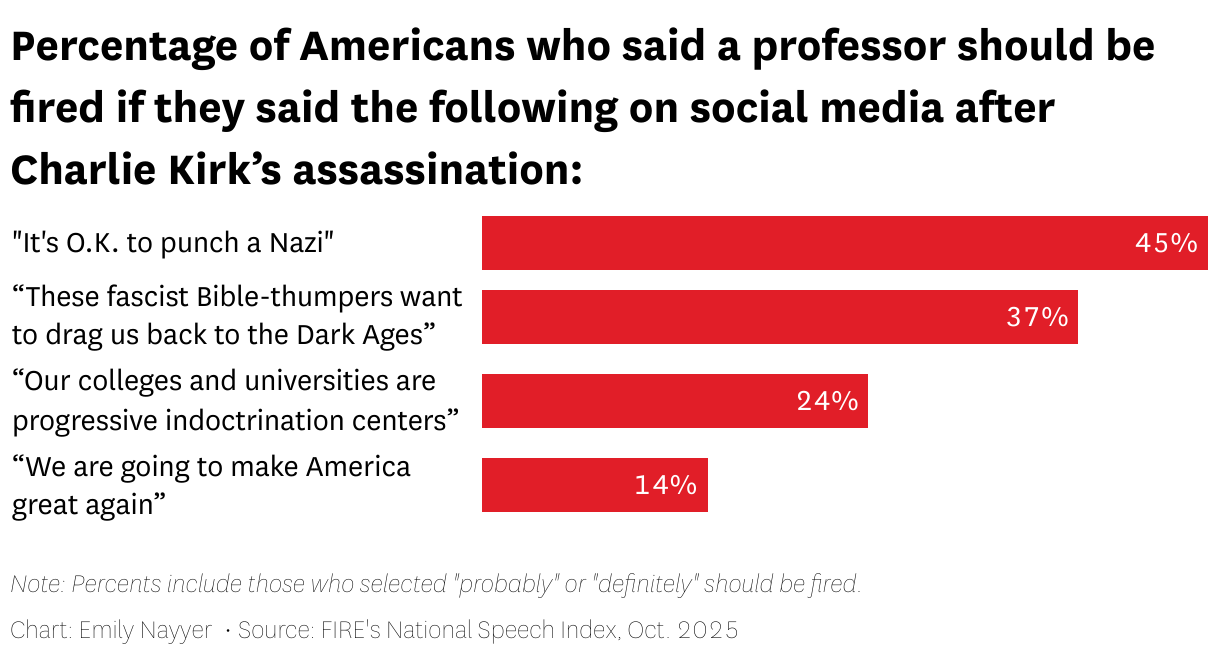
    To test support for academic freedom in the aftermath of the Kirk shooting, the October NSI also asked respondents about four politically charged — but constitutionally protected — remarks made by a professor on social media following the shooting. For each statement, majorities of Americans said the professor should not be fired. But their level of support varied by the statement, and substantial minorities in each case reported that the professor “probably” or “definitely” should be fired.

    • 45% say a professor who posted “It’s O.K. to punch a Nazi” should probably or definitely be fired from their job.
    • 37% say a professor who posted “These fascist Bible-thumpers want to drag us back to the Dark Ages” should probably or definitely be fired from their job.
    • 24% say a professor who posted “Our colleges and universities are progressive indoctrination centers” should probably or definitely be fired from their job.
    • 14% say that a professor who posted “We are going to make America great again” should probably or definitely be fired from their job.
    Percentage of Americans who said a professor should be fired if they said the following on social media after Charlie Kirk’s
assassination: (Bar Chart)

    “Americans were most divided on the statement supporting political violence, but it’s heartening that most Americans correctly backed academic freedom,” said FIRE Chief Research Advisor Sean Stevens. “On the other hand, it’s deeply concerning that we intentionally included some rather tame political statements — including the winning slogan of the last presidential election — and vocal minorities still called for the professor’s firing.”

    Overall, Americans view political violence as a problem across the ideological spectrum, with only modest differences in responses when asked about different ideologies. 57% of respondents said they agreed at least somewhat with the statement “Political violence is a problem among progressives.” But 56% said the same of conservatives, and 58% said they agreed at least somewhat that political violence was a problem across all political groups.

    “Americans seem to recognize that political violence isn’t a partisan problem — it’s a national one,” said Honeycutt. “Our polling suggests that the public is less interested in pointing fingers and more interested in fixing the toxic culture of hostility in our politics.”

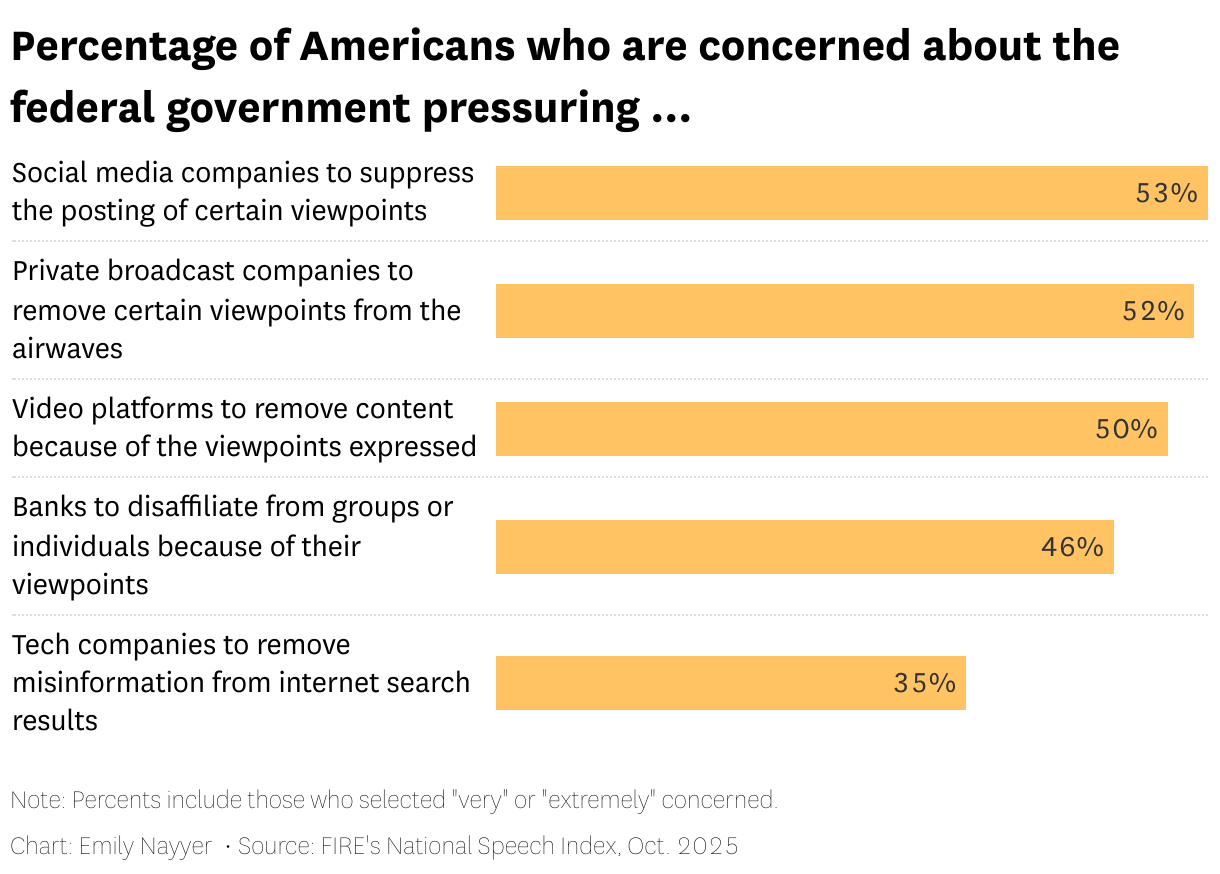
    FIRE also asked for the first time several questions about “jawboning,” the unconstitutional practice in which the government censors by pressuring private actors to silence speech. Around half of Americans said they were “very” or “extremely” concerned about the government pressuring social media companies (53%), video platforms (50%), or private broadcast companies (52%) to remove content based on the ideology expressed.

    Slightly less, 46%, said they were very or extremely concerned about the federal government pressuring banks to disaffiliate with groups or individuals because of their viewpoints, a practice also known as “debanking.” 35% said they were very or extremely concerned about the federal government pressuring tech companies to remove misinformation from internet search results.

    Percentage of Americans who are concerned about the federal government pressuring ... (Bar Chart)

    “Americans are deeply concerned about jawboning — and they’re right to be,” said FIRE Legislative Director Carolyn Iodice. “Both parties have been guilty in recent years of using government pressure to silence speech. This isn’t a partisan issue; it’s a constitutional one.”

    The National Speech Index is a quarterly poll designed by FIRE and conducted by the Dartmouth Polarization Research Lab to capture Americans’ views on freedom of speech and the First Amendment, and to track how Americans’ views change over time. The October 2025 National Speech Index sampled 1,000 Americans and was conducted from October 20 to 28. The survey’s margin of error is +/- 3.0%.


    The Foundation for Individual Rights and Expression (FIRE) is a nonpartisan, nonprofit organization dedicated to defending and sustaining the individual rights of all Americans to free speech and free thought — the most essential qualities of liberty. FIRE educates Americans about the importance of these inalienable rights, promotes a culture of respect for these rights, and provides the means to preserve them.

    The Polarization Research Lab (PRL) is a nonpartisan collaboration between faculty at Dartmouth College, Stanford University and the University of Pennsylvania. Its mission is to monitor and understand the causes and consequences of partisan animosity, support for democratic norm violations, and support for partisan violence in the American Public. With open and transparent data, it provides an objective assessment of the health of American democracy.

    CONTACT:

    Alex Griswold, Communications Campaign Manager, FIRE: 215-717-3473; [email protected]

    Source link

  • PhysicsWallah becomes first Indian edtech unicorn to go public

    PhysicsWallah becomes first Indian edtech unicorn to go public

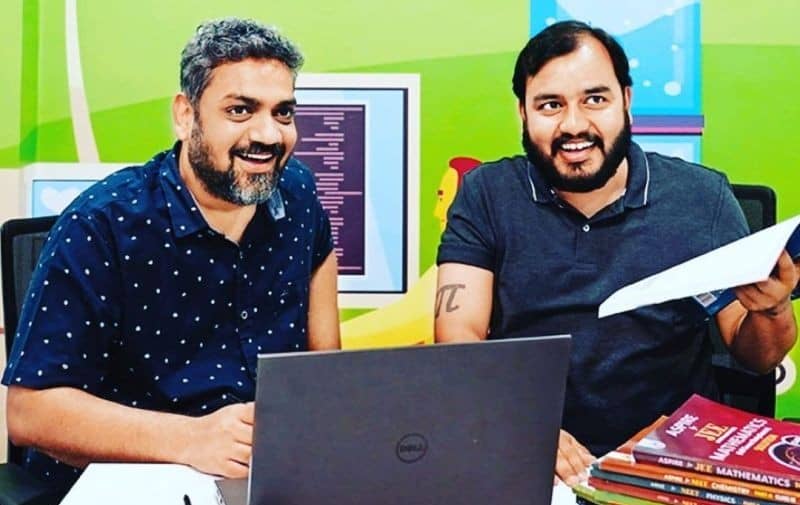
    Run by founders Alakh Pandey and Prateek Maheshwari, PhysicsWallah, which became a unicorn after surpassing a USD$1bn valuation, opened its public offering for subscription on November 11, with the bidding closing on November 13.

    The IPO, comprising a Rs 3,100 crore (USD$350m) fresh issue and a Rs 380 crore (USD$42.9m) offer-for-sale (OFS) by Pandey and Maheshwari, raised Rs 1,563 crore (USD$176.4m) from anchor investors at Rs 109 per share, a day before the issue opened.

    PhysicsWallah, known for its digital courses, physical centres, and hybrid programs, with a strong focus on India’s national-level engineering and medical exams as well as government exam prep, views the IPO as a key milestone.

    We plan to open at least 70 centres annually over the next three years, with around Rs 400 crore allocated for this
    Alakh Pandey, PhysicsWallah

    The stock market listing makes PhysicsWallah India’s first pure-play edtech company to go public. Pandey said the IPO proceeds would be largely used to expand offline centres and boost branding.

    “The first major expense after the IPO will be setting up new offline centres. This is our primary focus, as we plan to open at least 70 centres annually over the next three years, with around Rs 400 crore allocated for this,” stated Pandey, during a media briefing with reporters.

    “Another Rs 400 crore will be spent on our existing centres, covering lease and rental expenses. Around Rs 700 crore will go toward branding and event marketing over the next three years, with at least Rs 250 crore each year. Additionally, Rs 200 crore will be allocated for technology upgrade and server costs, and the remaining funds will be used for general expenses.”

    Backed by venture capital firms WestBridge Capital, Hornbill, and GSV Ventures, the company, strong in India’s tier-2 and tier-3 cities, sees the IPO as paving the way for further expansion in Karnataka, Kerala, Tamil Nadu, Gujarat, Odisha, and Northeast India.

    “Physics Wallah is an impactful organisation – from Tier 3 towns to villages, students everywhere are learning through our platform,” said Pandey.

    PhysicsWallah hitting Dalal Street, India’s equivalent of Wall Street and home to the Bombay Stock Exchange (BSE), comes at a time when some of the country’s biggest edtech competitors are seeing their businesses shrink.

    While Byju’s, once the world’s “most valued” edtech startup, is facing takeover bids amid bankruptcy proceedings and lawsuits over “alleged harm to its reputation”, Unacademy has seen a year-on-year decline in total revenue over the past two years, with Upgrad reportedly considering acquiring the company at roughly a tenth of its last valuation of USD$3.44bn.

    Though PhysicsWallah reported a 33% revenue jump to Rs 847 crore (USD$95.5m) in Q1FY26, its net losses widened to Rs 127 crore (USD$14.3m) due to a 39% rise in expenses.

    The company, however, has maintained that its revenue has grown 90% over the past two years and that it maintains a strong cash balance.

    “I want this company to be run with discipline, to grow responsibly, and to make it public in a way that benefits everyone. We are in a hyper-growth phase, and as we expand, we don’t want to slow down or fail to deliver. The IPO will also help us gain more trust and traction with parents.

    “Online education will continue to be our biggest focus – whether it’s a student in Grade 6 or a college or UPSC aspirant. We currently reach 42 lakh (over 4 million) students, mostly in test prep, but we are expanding into school education and board exams. Our aim is to make affordable education accessible across regions,” Pandey added.

    Despite initial optimism, reflected in domestic mutual funds taking up more than half of the allocation – indicating early institutional confidence – the demand in the public issue has remained lukewarm.

    The IPO got off to a slow start, with Day 1 subscription at just 7% and Day 2 improving slightly to 12%, falling well short of market expectations.

    By Day 3, the IPO reached 1.11x overall subscription, with the retail portion at 85%, non-institutional investors (NII) at 25%, qualified institutional buyers (QIBs) at 1.61x, and the employee portion subscribed 2.58x.

    The basis of allotment, which determines how many shares each investor will actually receive, is expected on November 14, with listing likely on November 18.

    Experts suggest that PhysicsWallah’s IPO, which saw muted subscription initially, signals broader caution for India’s edtech sector, which is facing declining market demand and revenue losses, with over 2,000 startups having shut down in the past five years.

    But it’s not just PhysicsWallah. More edtech companies are eyeing the IPO route, including Imarticus Learning, Upgrad, Eruditus, and other education-related firms like Simplilearn and Leverage Edu.

    Just recently, B2B education platform Crizac debuted on the Indian stock market, raising £74m in its IPO, with the listing expected to support the company’s expansion into new markets and services.

    With funding in the edtech space rising five-fold in H1 2025, as per reports, industry insiders expect the next 12-24 months to bring a handful of IPOs.

    “Edtech has gone through its ups and downs and has never been a very predictable sector. There are very few companies that can actually go public successfully,” Nikhil Barshikar, CEO and co-founder of Imarticus Learning, told The Entrepreneur in a recent interview.

    “But now, more companies are focusing on cutting unprofitable or unpredictable business segments. My gut feeling is that in the next 24 months, we will see at least five to 10 listings from the edtech vertical.”

    Source link

  • When life is bitter, don’t lose hope

    When life is bitter, don’t lose hope

    When life takes away your greatest support, it can feel as if the world is falling apart. For me, losing my father as a child was more than heartbreaking. It was a true test of strength. Yet in a world that often seemed bitter, the kindness of strangers and the power of personal dreams helped me rise above my sorrow and shape a future full of hope.

    My family and I live in the Eastern province of Rwanda. I was only five years old when one morning, my father packed his bag and left the house. He didn’t say where he was going and he never came back. Days turned into weeks, weeks into years, but there was no sign of him. No call. No letter. Nothing. 

    At first, I didn’t understand what was happening. I kept asking my mother, “When is Papa coming back?” But she would just smile sadly and say, “One day, maybe.”

    In her heart, she knew he was not coming back. 

    Life changed quickly after that. Without a father and without money, things became hard for the family. My mother, Catherine, had no job. She had never worked outside the home before. Now, she had to take care of me and my four siblings alone. 

    Struggling with little

    We had no house of our own. We moved from one place to another, staying with kind neighbors or sleeping in small, broken huts. During rainy nights, water would leak through the roof and we had to stay awake holding buckets. Sometimes, we didn’t even have enough food to eat. Many nights, we went to bed hungry. 

    My siblings were in high school at the time, but the family could not afford school fees anymore. One by one, they dropped out and stayed home. It was painful for me to watch them suffer. I loved them deeply and wanted a better life for all of them. 

    Despite everything, I stayed in school. My mother worked hard doing small jobs washing clothes, digging gardens or selling vegetables in the market. She never gave up. “You are our hope,” she would tell me. “Even if your father left, we must move forward.”

    I listened. I promised myself that no matter how hard life became, I would not give up. I wanted to finish school, go to university and one day help my family live a better life. 

    But it was not easy. 

    Help can come from surprising places.

    I often went to school with old shoes. I had no school bag only an old plastic bag to carry my books. I had no lunch and many times, I sat in class with an empty stomach. But still, I worked hard. I listened carefully, asked questions and always completed my homework, even if it meant studying by candlelight or by the dim light of a kerosene lamp. 

    Many teachers began to notice me. They saw that even though I had nothing, I had determination and a kind heart. One teacher gave me exercise books. Another helped pay part of my school fees. A neighbor who owned a small shop gave me a few snacks sometimes. A church group gave my mother food and clothes once in a while. 

    These acts of kindness kept me going. 

    I studied harder than anyone else and soon became the best performer in my class. Every year, I got top marks. My name was always on the honor list. At school, students looked up to me. But at home, things were still hard. My siblings had lost hope, but I kept believing in a better future. 

    After many years of struggle, I finally finished high school. I was the first in my family to do so. On the day I received my final results, my mother cried tears of joy. You did it, my son. You made me proud, she said, hugging me tightly.

    But my journey wasn’t over

    I had one more goal: to go to university. That meant more fees, laptop, more books, more challenges, but I didn’t stop. I applied for scholarships and after many rejections, I finally got accepted to a university with some financial support. 

    Now, I’m 22 years old. I’m in university, studying hard every day. I met with a kind person again, who gave me a place to sleep and dinner. Even though I have that support, I’m still facing challenges. I still lack proper shoes, clothes and transport money, but I keep going. My dream is to become a professional, get a good job first, then become self-employed and return home to support my mother and siblings. 

    I remind myself: “My father left us when I was just a child. We had no house, no food and no money. My siblings could not finish school. But I decided to fight. Kind people helped me and I stayed strong. Now I am at university. I will not stop until I help my family rise again.” 

    I hope my story will teach young people that even when life feels bitter and people let you down, you must not give up. Strength is not about having everything. It is about standing tall even when you have nothing. This is the reason why I’m writing my story. 

    Even when life is painful and people walk away from you, never lose hope. With hard work, faith and the help of kind people, you can still rise, succeed and help others do the same. 


    QUESTIONS TO CONSIDER:

    1. What was one thing the author promised himself when things got really hard for his family?

    2. In what ways did people help the author succeed?

    3. When have people helped you when you were having difficulty?

    Source link

  • What’s in the new Office for Students strategy?

    What’s in the new Office for Students strategy?

    The Office for Students began a consultation process on its 2025-30 strategy back in December 2024. Alongside the usual opportunities for written responses there have been a series of “feedback events” promoted specifically to higher education provider staff, FE college staff, and students and student representatives held early in 2025.

    In the past OfS has faced arguably justified criticism for failing to take sector feedback on proposals into account – but we should take heart that there are significant differences between what was originally proposed and what has just been finalised and published.

    Graphic design is our passion

    Most strikingly, we are presented with four new attitudes that we are told will “drive delivery of all our strategic goals in the interest of students” – to hammer the point home individual activities in the “roadmap” are labelled with coloured, hexagonal, markers where “a particular activity will exemplify certain attitudes”. We get:

    • Ambitious for all students from all backgrounds (an upward arrow in a pink hexagon)
    • Collaborative in pursuit of our priorities and in our stewardship of the sector (two stylised hands in the shape of a heart, yellow hexagon)
    • Vigilant about safeguarding public money and student fees (A pound-sign on a teal hexagonal background)
    • Vocal that higher education is a force for good, for individuals, communities and the country (a stylised face and soundwave on a purple hexagon)

    Where things get potentially confusing is that the three broadly unchanged strategic goals – quality (tick, yellow circle), sector resilience (shield, blue circle), student experience and support (someone carrying an iPad, red circle) – are underpinned both by the attitude and the concept of “equality of opportunity” (teal ourobouros arrow). The only change at this conceptual level is that “the wider student interest” is characterised as “experience and support”. Don’t worry – the subsections of these are the same as in the consultations

    Fundamentally, OfS’ design language is giving openness and transparency, with a side order of handholding through what amounts to a little bit of a grab-bag of a list of interventions. The list is pared down from the rather lengthy set of bullet points initially presented, and there are some notable changes.

    Quality

    In the quality section what has been added is an assurance that OfS will do this “in collaboration with students, institutions, and sector experts”, and a commitment to “celebrate and share examples of excellence wherever we find them”. These are of course balanced with the corresponding stick: “Where necessary, we will pursue investigation and enforcement, using the full range of our powers.” This comes alongside clarification that the new quality system would be build on, rather than alongside the TEF.

    What is gone is the Quality Risk Register. An eminently sensible addition to the OfS armoury of risk registers, the vibes from the consultation were that providers were concerned that it might become another arm of regulation rather than a helpful tool for critical reflection

    Also absent from the final strategy is any mention of exploring alignment with European quality standards, which featured in the consultation materials. Similarly, the consultation’s explicit commitment to bring transnational education into the integrated quality model has not been restated – it’s unclear whether this reflects a change in priority or simply different drafting choices.

    Students

    In the section on students, language about consumer rights is significantly softened, with much more on supporting students in understanding their rights and correspondingly less on seeking additional powers to intervene on these issues. Notably absent are the consultation’s specific commitments – the model student contract, plans for case-report publication, and reciprocal intelligence sharing. The roadmap leans heavily into general “empowerment” language rather than concrete regulatory tools. And, for some reason, language on working with the Office for the Independent Adjudicator has disappeared entirely.

    A tweak to language clarifies that OfS are no longer keen to regulate around extra-curricular activity – there will be “non-regulatory” approaches however.

    New here is a commitment to “highlight areas of concern or interest that may not be subject to direct regulation but which students tell us matter to them”. The idea here looks to be that OfS can support institutions to respond proactively working with sector agencies and other partners. It is pleasing to see a commitment to this kind of information sharing (I suspect this is where OIA has ended up) – though a commitment to continue to collect and publish data on the prevalence of sexual misconduct in the draft appears not to have made the final cut.

    Resilience

    The “navigation of an environment of increased financial and strategic risks” has been a key priority of OfS over most of the year since this strategy was published – and what’s welcome here is clearer drafting and a positive commitment to working with providers to improve planning for potential closures, and that OfS will “continue to work with the government to address the gaps in the system that mean that students cannot be adequately protected if their institution can no longer operate”.

    Governance – yes, OfS will not only consider an enhanced focus, it will strengthen its oversight on governance. That’s strategic action right there. Also OfS will “work with government on legislative solutions that would stop the flow of public money when we [OfS, DfE, SLC] have concerns about its intended use.”

    Also scaled back is the consultation’s programmatic approach to governance reform. Where the consultation linked governance capability explicitly to equality and experience outcomes, the final version frames this primarily as assurance and capability support rather than a reform agenda. The shift suggests OfS moving toward a lighter-touch, collaborative posture on governance rather than directive intervention.

    Regulation

    OfS will now “strive to deliver exemplary regulation”, and interestingly the language on data has shifted from securing “modern real-time data” to “embedding the principle collect once, use many times” and a pleasing promise to work with other regulators and agencies to avoid duplication.

    Two other consultation commitments have been quietly downgraded. The explicit language on working with Skills England to develop a shared view of higher education’s role in meeting regional and national skills needs has disappeared – odd given the government’s focus on this agenda. And while the Teaching Excellence Framework remains present, the consultation’s push to make TEF “more routine and more widespread” has been cooled – the final version steps back from any commitments on cadence or coverage.

    What’s missing within the text of the strategy, despite being in the consultation version, are the “I statements” – these are what Debbie McVitty characterised on Wonkhe as:

    intended to describe what achieving its strategic objectives will look and feel like for students, institutions, taxpayers and employers in a clear and accessible way, and are weighted towards students, as the “primary beneficiaries” of the proposed strategy.

    These have been published, but separately and with a few minor revisions. Quite what status they have is unclear:

    The ‘I statements’ are a distillation of our objectives, as set out in our strategy. They are not regulatory tools. We will not track the performance of universities and colleges against them directly.

    Source link