Category: Featured

  • McMahon Defends Harvard Cuts, Faces Grilling During CNBC Interview

    McMahon Defends Harvard Cuts, Faces Grilling During CNBC Interview

    Education Secretary Linda McMahon defended the Trump administration’s crackdown on Harvard University and other colleges during a contentious appearance Tuesday on CNBC’s Squawk Box as she faced questions about the government’s decision to freeze universities’ federal funding.

    Andrew Ross Sorkin and Joe Kernen, the morning talk show’s hosts, grilled McMahon during the 12-minute segment about whether freezing billions in grants and contracts was due to valid civil rights concerns or unjustified political and ideological standards; they suggested it was the latter. (Harvard sued Monday over the funding freeze, which followed the university’s decision to reject the Trump administration’s sweeping demands.)

    But McMahon reiterated that, for her, it was a matter of holding colleges accountable for antisemitism on campus—not an alleged liberal bias.

    “I made it very clear these are not First Amendment infractions; this is civil rights,” she said. “This is making sure that students on all campuses can come and learn and be safe.”

    Harvard argued in the lawsuit that some of the demands—like auditing faculty for viewpoint diversity—do not directly address antisemitism and infringe on the private institution’s First Amendment rights.

    Sorkin echoed Harvard’s argument during the interview and questioned McMahon about the lawsuit’s claims.

    “The question is whether viewpoint diversity is really about free speech,” he said. 

    In defense, McMahon said that “this letter [of demands] that was sent to Harvard was a point of negotiation … and it was really not a final offer.” She added that she hoped Harvard would come back to the table. (Trump officials told The New York Times that the April 11 letter was sent by mistake.)

    “We would like to be able to move forward with them and other universities,” she said.

    McMahon later reiterated her argument that this was a civil rights matter and said, “I think we’re on very solid grounds” regarding the lawsuit.

    But Kernen countered that requiring universities to hire conservative faculty members is just as bad as historically maintaining liberal ones, calling the act “thought control.”

    “It’s the other side of the same coin, isn’t it?” he said.

    McMahon said it’s fair to take a look at some faculty members.

    Near the end of the interview, Sorkin asked McMahon about her end goal if universities lose their federal funding and tax-exempt status. (The IRS is reportedly reviewing Harvard’s tax-exemption.)

    “We have not said that the tax exemption should be taken away, but I think it’s worth having a look at,” McMahon said. “I think the president has put all the tools on the table and we should have the ability to utilize all of those particular tools.”

    Source link

  • How to Ensure You’ll Never Be a Chair Again (opinion/humor)

    How to Ensure You’ll Never Be a Chair Again (opinion/humor)

    “First rule of leadership: Everything is your fault.”

    –from A Bug’s Life

    Congratulations! You have been elected or appointed or duped into serving as department chair, the role that everyone says is the hardest job on campus. Maybe that’s what attracted you to the position—you enjoy working days, nights and weekends on thorny issues that rarely have anything to do with creativity, inspiration or intellectualism. Perhaps you dreamed of having a positive impact on mentoring young faculty or garnering more respect and resources for your department from the upper administration.

    If you’ve spent more than a month on the job, your grandiose vision of being admired and maybe even beloved by the faculty, staff and students will have crashed on the jagged shores of “What have you done for me today?” reality. It’s time for Plan B. We provide a list of proven techniques to ensure you will never be asked to serve as chair again.

    Tip #1: Spend the bulk of your time on strategic planning.

    Strategic plans are the most important work you will do as chair; we all know these documents are constantly referred to. I have mine on laminated cards that I hand out to prospective donors and students and frequently read during coffee breaks.

    When writing these documents, create “word salads”— the more pseudo-intellectual the better. Consistent sprinkling of terms like “revolutionary,” “intellectual” and “equity” will strengthen the document. Violate George Orwell’s writing rules by always using a long word where a short one will do and using jargon in place of everyday English equivalents (e.g., “With courageous attention to principles of equity and fairness, we will innovatively co-create a multi-trans-disciplinary minor that relentlessly centers student success while concurrently providing a revenue stream to be utilized for upgrading the office furniture.”)

    Form subcommittees to do this work and make sure they meet over the summer—particularly if your faculty are on nine-month appointments. Task subcommittee members with creating these documents from scratch. Don’t spend time locating prior versions or drafting a potential plan as a starting point.

    Tell the subcommittees you are happy to meet with them when they need your input. Then decline every invitation to do so. Having them guess what you want as a final product will create lively conversation and allow them to bond over your obtuse directions.

    Tip #2: Run faculty meetings from hell.

    Use faculty meetings as an opportunity to read out newsy updates that could easily have been emailed. Or, even better, email each of these items individually AND read them out loud in faculty meetings. Remember that your faculty are not busy with their own research, teaching and service.

    When sensitive issues are on the agenda, make your position crystal clear and stress its superiority to any other strategy before calling for a vote. Then respond to questions from faculty according to how hard they’ve worked to curry favor with you. The faculty will soon learn that the meetings go much more smoothly without the distraction of other viewpoints or lively debate.

    Lastly, have faculty vote publicly on these decisions by simply raising their hands. Pre-tenure faculty will feel just as comfortable as full professors in sharing their votes. Similar comfort levels will be felt by those of differing races/ethnicities, cultural backgrounds and genders. If you as chair feel that a decision is straightforward, so will they.

    Tip #3: Avoid meeting with faculty to review their research trajectory.

    An annual report from each faculty member will provide more than enough information, saving you time from meeting with each of your faculty members in person. Pre-tenure faculty who are heading off in multiple, diverse directions to obtain funding, or who are giving up on grants after a first rejection, should face the consequences they deserve. We’ve all suffered through that time period, and so should they.

    In that spirit, avoid arranging for and supporting mentoring teams for new faculty. Or, if you have already assigned a new faculty member their mentor, assume that the pair is meeting regularly. New faculty will always feel comfortable reaching out to their busy, senior mentors whenever they have questions.

    Tip #4: Be an expert in everything.

    Departments are complex organizations and chairing them involves overseeing a swarm of areas including finances/budget, human resources, curriculum, teaching assignments, graduate student issues, computing support, etc. Wear as many hats as possible and be the expert on all of these topics. Do not delegate to staff, graduate program directors or associate chairs who may have expertise in these areas.

    Tip #5: Assign faculty as much service as possible.

    Faculty members are always trying to get away with less work—therefore, make a one-size-fits-all rule for assigning service and stick with it. In this spirit, confuse “equity” with “equality” and cut off any reference to diversity, equity and inclusion as social justice with the phrase, “you know, DEIJ, yadda yadda yadda.”

    Don’t count mentoring other faculty as service. In fact, don’t count any useful, impactful or innovative service if it happened outside one of your official committees. If it really was a clever idea, you would have already thought of it.

    When faculty ask for a break from a busy committee to focus on a major grant proposal or to develop a new course, remind them that when you were a faculty member, you were able to do both tasks while also serving as the business officer, graduate program director and teaching daily yoga classes for emeritus faculty.

    Tip #6: Be the dean’s messenger.

    You, as chair, are essentially the mouthpiece of the dean and the upper administration. Therefore, focus the bulk of your time on top-down initiatives. Do not canvass your faculty to see what they need for their own growth and success. And, if you instead take the rash step of creating a department-driven plan, be sure to enlist the dean’s advice on every step you take. Take care to assign the bulk of planning work to unproductive faculty who have taught the same course in the same way for 15 years and last received a major research grant before the year 2000.

    Lastly, encourage faculty to get to know the dean and other members of the upper administration. Then savagely punish them for any communication that does not go directly through you.

    Tip #7: Be an intrepid decision maker.

    When a decision from the chair is called for, don’t solicit thoughts from your faculty first. It looks stronger if you make your decision in isolation. Similarly, when faculty members ask you for things, say “no” to every request to show that you are strong and decisive. Or, say “yes” to the random “hallway ask” instead of considering that, if one faculty member has a need, so may another.

    Frequently remind your faculty that you are “data-driven” and demand that any request, no matter how minuscule, come with several pages of rationale that delineates costs to the penny, identifies exact sources of each dollar, and includes a comprehensive, multi-method analysis of return on investment. Then make a decision based on whether you are in a good or bad mood and whether the faculty request comes from one of your “favorites.”

    Tip #8: Respond immediately to student complaints about faculty.

    When you receive a complaint about a faculty member from a student, take action against that faculty member immediately. Remember that students are totally objective; there cannot be another side to the story. Let the associate dean handle things with the faculty member directly—or even better, the dean. Disregard the department bylaws that the faculty worked so hard to develop. Decisive action is better than adhering to agreed-upon guidelines. Don’t fulfill your role as the faculty member’s primary supervisor, certainly not one who has their best interests at heart.

    Tip #9: Let everyone know how busy and important you are.

    Say things like, “I remember when I was just a faculty member; it was so much easier than being chair.” Or, even better, “The previous chair did it wrong; back at my old school, we did it better.”

    Always refer to the dean, provost and the president by their first names. Then, if the faculty do the same, tell them they are being disrespectful.

    Tip #10: Have no life and put your research on hold.

    It’s crazy to think that you can keep your own lab going. Instead, spend the bulk of your time responding to emails. You’ll feel proud of your alacrity in immediately responding to the latest requests from the upper administration. Don’t carve out dedicated “meet with the chair coffee hours,” nor dedicated time to progress in your own work. You’ll easily pick up where you left off with your own research after your chair-hood!

    Finally, and most importantly, although you will never again be asked to serve as chair, you will be eminently qualified to be a dean. Prepare yourself now to be aggressively headhunted for open positions!

    Disclaimer: Any resemblance to specific chairs, present or past, is purely coincidental. No chairs were harmed in the making of this product.

    Lisa Chasan-Taber, Sc.D., is a professor and former chair of the Department of Biostatistics and Epidemiology at the University of Massachusetts Amherst.

    Barry Braun, Ph.D., is a professor and head of the Department of Health and Exercise Science at Colorado State University.


    Source link

  • U Rochester Ph.D. Students Strike for a Non-NLRB Election

    U Rochester Ph.D. Students Strike for a Non-NLRB Election

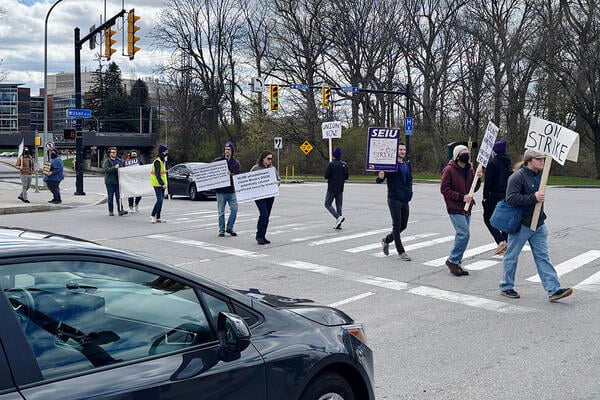
    University of Rochester Ph.D. student workers began striking this week to pressure the institution to agree to what they call a “fair union election.” And for the process to be fair, they say, it can’t be handled by the Trump-era National Labor Relations Board.

    “We don’t see any kind of path through the NLRB at present,” said George Elkind, a Ph.D. student on the proposed UR Graduate Labor Union’s organizing committee.

    The strike began Monday and continued Tuesday. Elkind said it’s unclear how many of the more than 1,400 students who would likely be represented by the union are withholding their labor. The walkout is another example of labor agitation continuing into the Trump era.

    Roughly a year ago, university officials and the union organizers began discussing plans for a private election, which both parties were amenable to. If they had reached an agreement, the NLRB—which usually handles unionization votes at private nonprofit institutions such as UR—wouldn’t have been involved.

    However, in February, after Donald Trump retook the presidency and fired a Democratic NLRB member and the agency’s general counsel, a university lawyer told student organizers that UR no longer wanted a private election, according to a document union members provided Inside Higher Ed. Instead, the lawyer wrote that they could pursue an election with the Trump-era NLRB.

    Scott Phillipson, president of SEIU 200United, a multi-university union that’s helping to organize the students, said UR officials “simply do not want these employees to have a union. That is what is going on here.”

    Phillipson said university officials were being disingenuous in suggesting the students use the NLRB.

    “They know it’s not an option,” he said. “But it’s a better public messaging, frankly, than ‘Just go away.’”

    An NLRB spokesperson told Inside Higher Ed Tuesday that the agency’s “regional offices are functioning as normal” and can run elections. But any appeals of election results would go to the actual board for which the agency is named. And since Trump ousted the Democratic board member, Gwynne Wilcox, and has left previous vacancies unfilled, the panel now doesn’t have the minimum required number of members to make decisions.

    If Trump eventually does appoint his own members to the board, allowing it to operate again, some union supporters worry the NLRB might use a grad student unionization case such as Rochester’s to overturn the 2016 Columbia University case precedent establishing that private nonprofit university grad workers can unionize through the NLRB.

    Student workers could continue to unionize at public universities in the states that allow such action, but those at private institutions would be left with no other path than to seek voluntary recognition from their universities.

    Elkind said UR officials know that the NLRB “is defunct—and would be hostile if it weren’t.” He said they want grad workers to go to the NLRB and risk a ruling decertifying grad unions at private universities nationwide. He called this “an extreme anti-labor position.”

    ‘Unprecedented Times’

    In an email, William A. Herbert, executive director of the National Center for the Study of Collective Bargaining in Higher Education and the Professions, said the strike “to compel the university to agree to a non-NLRB election is a sign of these unprecedented times.

    “There is a growing distrust and frustration among unions and their members with NLRB procedures and remedies, both of which are also under constitutional attacks by employers like SpaceX, Amazon, and the University of Southern California,” said Herbert, whose center is at Hunter College. “The firing of NLRB Board member Gwynne Wilcox and the reported removal of sensitive labor data from the NLRB by Department of Government Efficiency [DOGE] staff has further undermined confidence in the agency.”

    The university, which didn’t provide an interview Tuesday, hasn’t said it abandoned the move toward a private election because it thinks grad workers would lose in front of the Trump-era NLRB. UR has cited other reasons, including a December court decision involving Vanderbilt University grad workers’ attempt to unionize.

    NLRB policy required Vanderbilt to reveal names, job classifications and other information about student workers whom the union might represent. But more than 100 students objected to sharing that, and Vanderbilt sued the NLRB and one of its regional directors, arguing that requiring students to turn over the information would violate their privacy under the Family Educational Rights and Privacy Act (FERPA).

    A judge in the U.S. District Court for the Middle District of Tennessee ruled that Vanderbilt was likely right and granted a preliminary injunction blocking the NLRB requirements. A UR lawyer wrote that this made the university concerned about being “seen as facilitating the dissemination of potentially protected student data to a third party” if it went forward with the private election.

    But the lawyer went beyond the Vanderbilt case, saying that not requiring a prospective union to go through the NLRB would be a “significant deviation from the university’s typical practice.” He also noted the recent “sweeping and still unclear changes in the federal government’s support for the university’s missions,” adding that the Trump administration’s upheaval “includes a likely reduction in federal funding.”

    In an emailed statement Tuesday, a university spokesperson said “contingency plans are in place to ensure minimal disruption to our academic mission— including teaching and research activities—during a strike. In the event of prolonged strike activity, University officials are confident that the academic enterprise will continue as normal without interruption.”

    The spokesperson said “we are steadfast in the belief that entering into a private election agreement at this time is not in the best interests of the University community.”

    Source link

  • The Higher Ed CMO’s Commercial Case for Creativity

    The Higher Ed CMO’s Commercial Case for Creativity

    Legendary ad person Bill Bernbach once said, “If your advertising goes unnoticed, everything else is academic.” It’s not an understatement to say that managing higher ed brands has become increasingly complex. Marketers are forced to compete in a category that’s in flux—within a culture that questions its value—and improve effectiveness across marketing channels that have not only changed the way we consume content but also caused exponential growth in choice.

    Creativity continues to drive commercial value, however, investing in the intangible up front—with both time and resourcing—can prove to be difficult when budgets remain static. And yet, we know that:

    • We are exposed to upwards of 4,000 marketing messages a day.
    • Our audience reports that our marketing efforts look the same and that most entertainment and consumer brands produce content that lacks imagination.

    Without an investment in creativity—the vehicle for our big brand ideas—we risk our message getting lost, splintered and, worst case, ignored.

    For those managing higher education brands in our current media environment, the words of Paul Feldwick have never been more true: “If there is a choice to be made between efficiency and thinking big, you cannot afford to be efficient if you want to be famous.” And there’s quite a case building across a decade or so of data that shows just how an investment in creativity is an investment in the bottom line. Here are four that are applicable to higher education.

    Outside of brand size, creativity is the most important lever in profitability.

    Just as in the case of network theory, the rich get big. That also tends to play out among brands. However, creative quality can be an equalizer of sorts. According to Data2Decisions, the creative execution of your messages is the second most impactful driver of profitability after market/brand size. And while brand size has the greatest overall impact, creative quality remains the most powerful lever marketers can actively control.

    Ads that are perceived to be different are more likely to drive business outcomes.

    ​Research from Kantar’s Link database, as well as research from academia, indicates that ads that are perceived as different or unique are more likely to drive positive business outcomes. Per the database, the top one-third of ads that “make the brand seem really different” achieved a 90 percent lift in likelihood to drive short-term sales versus the bottom third.

    Emotion unlocks the key output that drives business outcomes.

    Starting with the IPA’s “The Link Between Creativity and Effectiveness” and subsequent industry research, there’s not only a through line between creative award-winning campaigns driving market share growth (11x) and top-box profit but intermediate metrics, such as word-of-mouth/social shares, and outputs, such as ad recall.

    The largest contributor to lift from advertising is the creative.

    Nielsen’s exploration of more than 500 Fast-Moving Consumer Goods (FMCG) brands showed that the most important component of a campaign (targeting, reach, brand, context, frequency and creative) was strong or quality creative. Similar patterns were found in the work done by the World Advertising Research Center and Kantar.

    If brand is the most valuable business tool and if we argue that brand exists in the minds of the consumer, or our favorite saying in higher education, “a brand is what your audience says when you aren’t in the room,” then it’s time to treat it as a commercial asset and invest accordingly. Whether it’s through internal resourcing or giving partners the time and space to commit to breakthrough ideas, a commitment to creativity isn’t just brave anymore—it’s related to the bottom line.

    Christopher Huebner is a director of strategy at SimpsonScarborough.

    Source link

  • Texas State Helps Students Bounce Back From 2.0 GPA

    Texas State Helps Students Bounce Back From 2.0 GPA

    As more colleges and universities consider initiatives, processes and policies to create a more student-focused campus, they are zeroing in on two areas of concern: academic probation and academic recovery.

    A growing body of research highlights the way negative life experiences and competing priorities impact students’ academic achievement, sometimes exerting a stronger influence than prior academic preparation.

    Texas State University has established a new initiative, Bobcats Bounce Back, to help students whose grades have fallen below a 2.0 learn self-efficacy, resiliency and strong study skills.

    The background: The university has a goal of increasing its first-year retention rate from 77 percent in 2012 to 85 percent by 2025, said Cynthia Hernandez, vice president for student success. Early on, officials recognized that the institution lacked a strong academic recovery program, so Hernandez and her team prioritized devising a proactive solution to reduce the number of students who fell into poor academic standing.

    Since 2009, the university’s policy has been that students who fall below a 2.0 cumulative GPA must meet with an academic adviser at least once a semester. The intervention has proven mostly successful, in that some students have moved back into good academic standing—though not everyone has, said Jason O’Brien, assistant director for academic engagement at Texas State.

    An analysis of institutional data revealed that students who improved their academic trajectory used support services at least once a month, or four times per term.

    “If students are [showing up], I know they’ve got the time and they’ve got a goal, they know what they’re working on,” O’Brien said. The challenge is getting each student to be proactive and engage early, not wait until the end of the semester, before finals.

    Using institutional data, Texas State leaders revamped academic probation requirements to encourage students to make at least four connections with support services each semester; those who don’t, receive personalized outreach.

    How it works: In the Bobcats Bounce Back program, students with a 2.0 GPA or lower are asked to participate in at least four support services, which could include success coaching, tutoring or a student success webinar. Students must meet with an academic adviser for at least one of their mandatory check-ins and they receive weekly communication from the office of academic engagement to encourage them to meet their goals.

    A few weeks into the term, O’Brien’s team runs a report that identifies students on academic probation who have yet to engage with a support office. Students who live off-campus receive communication from the academic engagement team and those in the residence halls receive outreach from their residence life director.

    “We’re not asking, ‘How are your classes going?’” O’Brien said. “We’re saying, ‘How are you doing? What’s going on in [your] life right now? Do you feel safe? Are you able to eat? Do you have any needs that aren’t met? Is your family OK?’ We’re trying to make sure that all of those basic needs, all that it takes to be a successful human is on track, and then from there we move on to, ‘OK, talk to me about classes.’”

    The aim is to be human-centered and conversational in order to learn from the student and bridge any gaps in services and resources the university can provide to promote student success.

    Sometimes this means helping students understand ways to correct their academic transcript, such as repeating a course or asking for an administrative withdrawal when relevant.

    “We make a lot of asset-based assumptions,” O’Brien said. “My assumption is that no student is choosing to fail a course; they are choosing to be successful in something else out of necessity,’” which could include prioritizing their health, caring for a family member or working extra hours to make ends meet. “What we want to do is find out about those early enough to prevent it from impacting a transcript.”

    The impact: During the inaugural program term in fall 2024, Bobcats Bounce Back supported 1,706 undergraduates; this term it is assisting 2,579 students. (Most academic recovery programs see higher rates of participation in the spring term because first-year students are most likely to face academic challenges in their first term, which can dramatically impact their GPA, O’Brien said).

    During fall 2024, Bobcats Bounce Back participants engaged, on average, with support resources 3.11 times, up 270 percent compared to students on academic probation in 2023 (who averaged .84 engagements). The university also saw a 3 percent increase in the number of students who regained good academic standing from fall 2023 to fall 2024, and a 7 percent decrease in academic suspensions.

    At the 12-week mark in spring 2025, average engagements among students on academic probation were up 74.8 percent, from 1.31 to 2.29.

    The data illustrates the program’s success so far, and O’Brien believes it’s due in part to their responsiveness to student needs. As the program has grown, more students are willing to seek out the office and engage. “They’re starting to have faith in us and ask for the support they need,” O’Brien said.

    Program participants also have an opportunity to submit a guided reflection, called a B3 Field Note, every four weeks to build their socioemotional skills. Each prompt is rooted in research-backed strategies to improve academic self-efficacy and engagement. O’Brien has been amazed at the thoughtful responses he’s seen thus far and plans to conduct a critical discourse analysis project to identify students who may need additional support based on their field note submissions.

    In the future, college leaders hope to target additional students who may be at-risk, but haven’t quite fallen below the 2.0 cumulative GPA threshold, a group Hernandez called the “murky middle.”

    If your student success program has a unique feature or twist, we’d like to know about it. Click here to submit.

    This article has been updated to clarify average engagement rates for program participants in fall 2024 and how that growth compared to the previous fall.

    Source link

  • Social capital and the degree awarding gap: spaces, places and relationships

    Social capital and the degree awarding gap: spaces, places and relationships

    • Amira Asantewa is Director of Programmes, Grit Breakthrough Programmes
    • Reuel Blair is Lead Diversity Programmes Coordinator at the Centre for Student and Community Engagement, Nottingham Trent University

    Progress on the Black-white degree awarding gap has gone into reverse.  Figures published by Higher Education Student Data (HESA) in autumn 2024 show that in 2022/23 the difference in the percentage of Black students and white students getting a first- or upper-second-class degree went up to 21.4 percentage points (pps) – from 19pps in 2021/22 and 17.6pps in 2020/21.

    Across the sector, institutions are responding. Access and Participation Plans have been signed off.  Work towards achieving Race Equality Charter marks is underway. Faculties and departments are decolonising curricula, diversifying assessment modes, tackling the lack of Black representation in the staff body and the postgraduate community.

    While there are debates about the way the sector analyses and addresses the awarding gap, what we do know is there is, as yet, little to say about what works in UK universities. However, evidence from our work with students of Black Heritage that suggests social capital is key.

    Black leaders

    It was back in 2019 that Nottingham Trent University and Grit Breakthrough Programmes co-designed with students the Black Leadership Programme (BLP) – a mix of community-building activities, mentoring, inspirational speakers and work with both employers and global institutions. Centrepiece workshops are delivered by Grit: breakthrough programmes.

    Six years on and an independent TASO-funded evaluation found strong statistical evidence of impact on final year grades and that these higher grades were likely to have been caused, not by increased academic engagement, but instead by increased motivation, social capital and sense of belonging. 

    This reinforced the findings of the independent evaluation of Grit’s Black Leaders and Students of Colour programme across seven universities, which suggested that students were able to apply skills and confidence from having expanded networks and engagement in new experiences, to their academic lives. And the students tell us what this looks like.

    Spaces for Black students

    Students talk about the importance of access to Black spaces. This space, this community, is a place where Black students are not, as Anike from Liverpool John Moores University puts it, ‘self-censoring to make myself palatable to white people.’ Instead, it is where ‘I can get into the conversations I always wanted to have, feel free to talk about what’s important to me.’

    Research describes how Black-affirming campus spaces are vital for Black student academic success and supporting Black student inclusion and well-being. Kwaku from Nottingham Trent University describes the value of ‘a space where there isn’t the weight of always being different. I want a space to connect with people, people who I can talk to about how I am feeling, what I am going though, and who I know would understand.’

    So social capital is also about belonging. Zelena from Bath Spa University describes wanting ‘to belong to a community of people we can all turn to, to draw strength from, to look up to and connect with.’

    Identity and representation

    It is about identity. Students tell us about the importance of ‘realising the value of my own upbringing, my heritage, my culture… that it is not something to be left behind or discarded… I want to explore and appreciate who I am and what I am.’ As Gemma from the University of Greenwich says, it’s about ‘finally claiming my identity. Becoming proud of being Black.’ University is a time for building a new independent life, figuring out who you really are and how your evolving identity fits in this new space. And there is a strong correlation between identities and deeper approaches to learning.

    It is about representation, both in the messaging about opportunities and in the ability of those delivering them to relate to the racial identity and cultural backgrounds of the students. Or, as Kane from Nottingham Trent University says, ‘it’s about how we have the right to be noticed, feel heard, to see that my voice, my opinion matters.’

    And social capital is also about wanting to make a difference, making a contribution. Afreya from the University of Manchester describes ‘helping other people who are feeling the same as I was. Going out of my way to be visible, showing how anyone just like me, can be successful.’

    Students are very clear about social capital: ‘I made friends from the programme. I’ve joined societies… I’ve been a course rep and a Student Ambassador… I’ve been part of a project supporting young Black learners in schools in the city…’

    They are very clear about its value: ‘It gave me strength… I’ve been relentless in seizing every opportunity available… I work more efficiently… harder and smarter… I feel that the university has an interest in nurturing Black talent and my growth and development.’

    So, alongside all the institutional plans, strategies and initiatives, there also have to be the spaces, places and relationships for Black students to be their full, authentic, very best selves and, just like their white peers, grow the social capital to thrive and succeed in their time at university and beyond.

    On 5th June at Nottingham Trent University, Grit Unleashed will take a deep dive into the university experience for Black students and Students of Colour across the UK in a day co-designed and co-delivered by student participants. For more details email [email protected]

    Source link

  • Another year, another teacher supply crisis…

    Another year, another teacher supply crisis…

    Today on the HEPI blog, John Cater revisits a quarter-century of teacher education policy to consider how we can solve the teacher supply crisis – read on below.

    And Amira Asantewa and Reuel Blair explore how growing social capital – not just academic engagement – is key to tackling the widening Black-white degree awarding gap in UK universities in a powerful reflection on identity, belonging and community. Read that piece here.

    • Dr. John Cater was Vice-Chancellor of Edge Hill University from 1993-2025 and member of the Board of the Teacher Training Agency and its successor body from 1999-2006.  He also chaired the Joint UUK/GuildHE Teacher Education Advisory Group (2013-2019) and is the author of HEPI Policy Paper 95, Whither Teacher Education and Training (2017).

    Twenty-five years ago, the attraction of teaching was on the wane, and universities’ enthusiasm for training teachers was sinking fast. The Evening Standard’s billboards screamed, ‘Schools in Crisis’ as the capital’s schools closed on Fridays or brought pupils in for just half-days because of a shortage of teachers.  

    Fast forward to 2025, and the recent National Foundation for Educational Research (NFER) publication, Teacher Labour Market in England 2025, has reached the newsstands, prompting the same headlines: ‘Schools in Crisis’.

    But two and a half decades ago, it was turned around.  A serious attempt to tackle teacher workloads (WAMG, the Workload Allocation Model Group) was put in place, with ‘guaranteed’ non-contact preparation time and a rapid increase in the number and responsibilities of teacher support workers ((Higher Level) Teaching Assistants).  And one of the most effective marketing campaigns, No-One Forgets a Good Teacher, was launched.

    These are more sceptical, more cynical times, and the challenges of teaching are well understood, but there are strategies which could ameliorate the current crisis.

    1. A Better Product. Teaching is a ‘present in person’ profession.  No class of thirty adolescents is going to be controlled, still less educated, by an unattended whiteboard.  But, particularly in secondary education, rolling up a teacher’s preparation time into a single day, even fortnightly, which could be worked from home, would make the profession more attractive to many.  And most school staffrooms need to move into the twenty-first century if they are to match working conditions in the wider world.
    2. Better Marketing.  Teaching is a vocation, and the opportunity to change lives and create life chances still resonates with many.  A focus on case studies (Tony Blair and Eric Anderson being amongst the best-remembered from the above campaign), moving from the abstract to the relatable, have proved effective in the past. 
    3. A Partnership Approach.  Too often, the relationship between the state and its agents and training providers has been driven by a contractual ‘purchaser/ provider’ model, characterised by mutual distrust.  Similarly, school and college participation in the renewal of the profession, for example, by offering placements and link tutors, has been discretionary and often wrapped in a cash nexus.  Some universities are also unnerved by the risk to brand and reputation inherent in the inspectorial process, particularly when teacher training consists of a very small proportion of their portfolio (a concern which can also relate to apprenticeship provision).  If scrutiny is accepted by all to be risk-based and proportionate, resource is released to focus on both areas of concern and the sharing of best practice.
    4. Supporting Teaching as well as Training.  Incentivising training has its merits, and the NFER Report does indicate a weak correlation between bursaries and the take-up of training places, but training is not teaching.  If you have to offer £27,000 to persuade someone to train, are you sending an implicit message about the desirability of the profession you may enter?  And, whilst starting salaries (now at least £30,000 per annum outside London) have improved, the financial incentives for taking increased responsibility are widely regarded as insufficiently attractive to keep teachers in the profession.
    5. Re-visit Repayments.  The lowering of the student loan repayment threshold to £25,000 in 2023 and the extension of the loan term penalises those in the lower-middle salary range – teachers, nurses, social workers – whilst those on higher salaries benefit from lower interest payments.  Simply in the interest of fairness, it needs re-visiting.
    6. Fee forgiveness. Teacher retention is an even bigger issue than teacher recruitment, with over a third of all entrants leaving the profession within five years.  London Economics and the Nuffield Foundation, amongst others, have repeatedly highlighted the limited cost of writing off outstanding student loans for those who provide a decade or more of service, a cost which would be eliminated fully when reduced recruitment and training costs and anticipated improvements in service quality are taken into account.  
    7. Key worker accommodation.  The demise of public sector housing and the lack of available and affordable rental accommodation has severely restricted teacher mobility and teacher supply, with particular challenges in high-cost locations (such as the Home Counties).  Part of the current Government’s drive to construct 1.5m new homes should place key worker housing close to the top of the priority list.

    In the aftermath of the Chancellor’s Spring Statement, the issue of productivity looms large.  A highly educated and committed workforce is integral to the future of the UK economy, and a ready supply of well-qualified, passionate teaching professionals is the building block on which that economy can thrive.

    Source link

  • OPINION: Policy changes sweeping the nation are harming our students. Educators must fight back

    OPINION: Policy changes sweeping the nation are harming our students. Educators must fight back

    Here’s a true story from North Carolina. Two elementary school children under the age of 10 waited for their parents to come home. We know they cleaned the dishes; the house was immaculate when someone finally came.

    The children did not attend school for a number of days. After three days, someone from their school reached out to a community member with concern for their well-being.

    While they were home alone instead of in school, the children made their own food and drank water. Their parents, who had been detained by ICE, had nurtured these skills of independence, so the children were not yet hungry or thirsty when someone finally came.

    Similar scenes are likely happening across the U.S. as President Trump aggressively steps up efforts to deport undocumented immigrants. The new policies sweeping the nation deeply affect and harm our children.

    Related: A lot goes on in classrooms from kindergarten to high school. Keep up with our free weekly newsletter on K-12 education.

    Teachers: This is the moment when we need to rise to the occasion, because children are being wronged in uncountable ways. Protections that allow them to express their gender identities are under threat. Their rights to learn their diverse histories and understand the value of their communities are being chipped away bit by bit.

    These threats, one at a time, layer after layer, amount to profound harm. So let us be especially vigilant.

    The responsibility to challenge these threats cannot fall solely on the shoulders of individual teachers. We must have systems in place that allow us to swiftly raise concerns about student well-being.

    Schools, districts, and states must provide resources and structures — like wellness checks, counseling and communication with community services — that allow us to act swiftly when the safety of our students is at risk.

    As public servants, we must live out our charge to protect and advocate for the children we serve by taking immediate action to ensure their safety in whatever ways we are able. That means actively noticing when students are missing and when they are struggling.

    Public education has long wrestled with the role of politics in schools. No matter how we answer questions about political content, educators have been unified in the goal of nurturing children’s thinking and flourishing.

    Our state constitution and many others’ declare that all children are entitled to a “sound basic education,” and our professional responsibilities extend to their safety. In North Carolina, the first category of the code of ethics for educators pertains to professional ethical commitments to students.

    To uphold these professional commitments, the educator “protects students from conditions within the educator’s control that circumvent learning or are detrimental to the health and safety of students.”

    This protection must be more than theoretical. When our students are at risk, we have our constitutional guarantees and ethical commitments.

    The brutal example of the children whose parents were taken away is one of many. We cannot fathom all that the children needed to know in order to survive those harrowing few days alone in their home. We do know they were ready.

    We can assume that perhaps they read their favorite books or calculated measurements while cooking themselves dinner, utilizing skills they learned in our classrooms. What we do know is that the knowledge taught to them by their families and community ensured their safety.

    The community member who ultimately went to check in on the missing students used a “safe word” — one that the children had been taught to listen for before ever opening their door to a stranger.

    The children did not open the door until that word was spoken. Hearing that word, they reportedly asked: “Are Mommy and Daddy OK? ICE?”

    These are the lessons young children are living by today. Safe words to protect themselves from adults who prey on their families. Skills of survival to hide at home, cooking and caring for themselves without seeking help from others if they find themselves alone.

    Related: Child care centers were off limits to immigration authorities. How that’s changed

    A protective silence now envelops all the children in the community where those parents were seized. An example has been made and now those in their community are hiding in fear or fleeing. The idea that this example is a model to be followed is a transgression of our ethical compact to care for these children, who are no longer in school, due to their fear, hiding with family members.

    Recognizing, acting on and speaking back to this injustice is precisely the sort of resistance and professionalism that binds our practice as educators. It is what we write of today.

    The children were ready. Educators need to be as well.

    We must use our voices to illuminate the harm being done to the children we know, honor and teach. Let us replace silences with spoken truths about their power and ours to survive and to resist; let us live out the expectation that public service must be enacted with humanity.

    We have a professional responsibility to not look away. This is not just a moral argument. We are their teachers, and we must ask: How will the students in my classroom survive? And how can we help them?

    Simona Goldin is a research professor in the Department of Public Policy at the University of North Carolina. Debi Khasnabis is a clinical professor at the University of Michigan’s Marsal School of Education.

    Contact the opinion editor at [email protected].

    This story about Trump administration policy changes and students was produced by The Hechinger Report, a nonprofit, independent news organization focused on inequality and innovation in education. Sign up for Hechinger’s weekly newsletter.

    The Hechinger Report provides in-depth, fact-based, unbiased reporting on education that is free to all readers. But that doesn’t mean it’s free to produce. Our work keeps educators and the public informed about pressing issues at schools and on campuses throughout the country. We tell the whole story, even when the details are inconvenient. Help us keep doing that.

    Join us today.

    Source link

  • AI as an Educational Ally: Innovative Strategies for Classroom Integration – Faculty Focus

    AI as an Educational Ally: Innovative Strategies for Classroom Integration – Faculty Focus

    Source link

  • Education Minister’s western Sydney seat to be test for Labor – Campus Review

    Education Minister’s western Sydney seat to be test for Labor – Campus Review

    Education Minister Jason Clare’s seat of Blaxland is considered safe, but the impacts of western Sydney’s “melting pot” population on this election remains to be seen.

    Please login below to view content or subscribe now.

    Membership Login

    Source link