Researchers across the country who had been awarded prestigious grants from the National Endowment for the Humanities recently learned that their awards had been canceled. As Department of Government Efficiency reductions sweep through critical government agencies, higher education has been a clear target—not only through cuts at federal agencies like the NEH, but also through pressure levied on institutions like Columbia and Harvard Universities and, horribly, through Immigration and Customs Enforcement detainments that seem to take aim at politically engaged scholars like Rümeysa Öztürk. This targeting builds on decades of disinvestment—underfunding, fewer faculty lines and program closures—that have left humanities education fragile, and therefore vulnerable.
But the arguments used to justify both the active dismantling and the long-term disinvestment fundamentally contradict each other. One argument imagines the humanities to be both powerful and dangerous, while the other sees humanities education as irrelevant and a waste of time. Both cannot simultaneously be true. The tension between them reveals the real driver: a pervasive fear of critical thought and the social change it may foster.
As a humanities scholar who works with institutions nationwide to develop meaningful, equitable programs in higher education, I’ve watched countless colleges and universities grapple with the implications of this fear. Over the past decade, the claim of irrelevance has been used to justify budget cuts and program closures. Last year, Boston University suspended doctoral admissions to the humanities and social sciences. In 2023, West Virginia University eliminated numerous humanities programs and faculty lines—the cuts included all of WVU’s foreign language degree programs—with many other institutions considering similar measures.
Those who support these actions tend to cite declining numbers of humanities majors as evidence that students don’t care about the subject matter, or that they think a humanities degree is a financial dead end. However, even the economic piece of this argument is not borne out by the data. Recent research from the American Academy of Arts and Sciences shows strong state-by-state employment trends for humanities graduates, with advanced degree holders earning a median salary of about $84,000. Their research shows that a remarkably high 87 percent of all humanities majors feel satisfied with their careers—and that percentage climbs to 91 percent for advanced degree holders.
The rhetoric may be false, but it is nonetheless dangerous. It is true that humanities majors are trending downward—but why? We know that students do care about humanities topics. Every instructor I talk to reports high levels of student engagement in humanities courses. It’s not lack of interest, or economic realities, but intentional disinvestment that erodes the humanities and leads to program closures. That disinvestment serves as a self-fulfilling prophecy, as students invariably notice which parts of the university landscape are prioritized; it’s visible in buildings, in classroom spaces and in faculty offices. Students may hear messages from parents or from the media that nudge them in other directions. The resulting decreased enrollment fuels legislative actions and budget cuts that undermine the potential of humanistic inquiry and education.
The other line of argument does not rest on the supposed irrelevance of the humanities, but rather their power—and in doing so, it negates the first argument. This is the logic that leads DOGE to demand that the NEH and other agencies stop funding projects that explore race and gender equity. It’s the logic that leads to the dismantling of the federal Department of Education. It’s the same logic that has led conservative groups like Moms for Liberty to try to get books about LGTBQ+ kids pulled from library shelves, that led state officials like Ron DeSantis to block the teaching of African American studies. Why bother to fight against these projects, books and courses if they don’t hold power? No: In these cases, critics know that exposure to the humanities has the potential to change our individual and collective thinking, to bring new perspectives into the light, and to loosen the hold of dominant perspectives on the social psyche. That, to many, is terrifying.
The results of these critiques are profoundly damaging. The NEH cuts—paired with similar cuts to the Institute of Museum and Library Services, where the entire staff has been placed on leave—threaten a whole generation of research and community-engaged practice and will leave us with a diminished cultural landscape and limited possibility to interpret what’s left. The Trump administration is already trying to control what is displayed in national museums, particularly those that highlight underrepresented artists. Local libraries and state humanities councils are losing critical operating funds. As books, art and culture disappear, we need scholars trained to ask why—but with humanities programs in shambles, who will be ready to do that work?
Our cultural heritage is our nation’s portrait; there is power in seeing oneself represented in books, art and music. This is especially true for people who are marginalized in many social structures; broadly representative books on library shelves can be a lifeline for queer kids, trans kids, immigrant kids. Kids with names that white teachers find hard to pronounce. Kids looking for affirmation that, yes, they’re OK. Removing titles because of characters that share these identities is an act of erasure, a way of saying, no, actually, you’re not welcome here. Given that trans kids already have alarming rates of suicidality, the stakes are unspeakably high.
The far right is correct about one thing: The humanities are powerful. It is through the humanities that we are fighting tooth and nail for democracy—which is why we must defend these institutions and the people who make them work. With a news cycle that is so rapid and confusing as to cause whiplash among even the most savvy readers, historians like Heather Cox Richardson and David M. Perry provide context that extends beyond our current time and place to help us collectively understand the patterns of the present moment—and, more importantly, to envision possible paths out. Artists provide solace and catharsis through pieces that express what words cannot, such as Chavis Mármol’s “Tesla Crushed by an Olmec Head,” which is exactly what it sounds like. These interventions matter deeply when our collective sense of reality is being threatened by outright lies from people at the highest levels of leadership.
What we’re seeing now are the results of a systematic and structural push that has been slowly unraveling the humanities ecosystem for decades. But it needs to stop. The NEH cuts, the threats to education, the book bans, the program closures—and the rhetoric that brings them about—foreclose opportunities for students and for society. We are in a moment that requires stronger nationwide investment in the humanities, not their diminishment. Former NEH chair Shelly Lowe—the first Native American to lead the organization, unceremoniously pushed out by President Trump in March—urged participants at last year’s National Humanities Conference to find hope in dark times by turning to poetry. Riffing on Seamus Heaney’s “The Cure at Troy,” she urged us to “believe that further shores exist, even if they are out of sight.” Art and culture provide avenues for expression, beauty, understanding and meaning—especially when our world feels like it’s crumbling.
The right knows the humanities are powerful; it’s time for the left to truly believe in that power, and to call out the hypocrisy driving the right-wing attacks on our shared cultural heritage.
Before Donald Trump retook office, advocates of a more demographically diverse U.S. professoriate were already criticizing existing hiring efforts as inadequate. One late-2022 paper in Nature Human Behaviour noted that, at recent rates, “higher education will never achieve demographic parity among tenure-track faculty.”
One example of the disparity: As of November 2023, only 8 percent of U.S. assistant professors were Black, according to the College and University Professional Association for Human Resources. That’s significantly less than Black representation in the U.S. population, currently estimated by the Census to be 13.7 percent. And the CUPA-HR data showed that the Black share of tenure-track and tenured professors decreases as rank increases—only 5 percent of associate professors and 3.6 percent of full professors were Black.
Efforts that institutions have made to racially diversify their faculties drew political backlash well before Trump regained the White House, with activists, organizations and some faculty criticizing university hiring practices and state legislatures passing laws banning affirmative action and/or diversity, equity and inclusion initiatives. The goal of a more representative faculty slipped further out of reach starting on Inauguration Day, when Trump issued executive orders targeting DEI, including what he dubbed “illegal DEI discrimination.”
His administration’s crusade has continued, including with a letter Friday demanding that Harvard University end all DEI initiatives, “implement merit-based hiring policies” and “cease all preferences based on race, color, religion, sex, or national origin throughout its hiring, promotion, compensation, and related practices.” (Harvard has refused to comply with Trump’s orders, which go far beyond hiring, and the federal government has frozen part of the university’s funding and threatened its tax-exempt status.)
Given the current political situation—not just nationally, but also among the growing number of states with DEI and/or affirmative action restrictions—how can higher ed institutions continue to diversify their faculties?
“I think that’s the question of the day: What’s lawful, what’s legal, what might subject an institution to investigation by the investigatory arms of the federal government?” said Paulette Granberry Russell, president and chief executive officer of the National Association of Diversity Officers in Higher Education, which is among the organizations suing over Trump’s anti-DEI executive orders.
“Is it purposeful that this administration has chosen ambiguity?” Granberry Russell asked. “Or left [us] to guess what they intend by ‘illegal DEI’? Is diversifying our campuses on its face illegal DEI?”
So far, the administration has not clarified where the line is. On Feb. 14, the U.S. Education Department published a Dear Colleague letter declaring that the department interprets the Supreme Court’s 2023 decision banning race-conscious admissions as applicable to other areas of higher ed, including hiring, promotion and compensation. That letter is facing legal challenges. The department later released a frequently-asked-questions document further explaining its position, but that guidance didn’t discuss hiring practices.
In response to a request for an interview and written questions, Harrison Fields, special assistant to the president and principal deputy press secretary, wrote in an email to Inside Higher Ed, “President Trump is working to Make Higher Education Great Again by ending unchecked anti-Semitism and ensuring federal taxpayer dollars do not fund higher education institutions’ support for dangerous racial discrimination or racially motivated violence. Any institution violating Title VI is, by law, ineligible for federal funding.” (Title VI bans discrimination based on, among other things, shared ancestry, including antisemitism.)
Madi Biedermann, deputy assistant secretary for communications at the U.S. Education Department, told Inside Higher Ed, “It is illegal to make decisions on the basis of race.”
She said the department isn’t providing any additional guidance at this point beyond the text of the executive orders, the Dear Colleague letter, the FAQ, Title VI of the Civil Rights Act of 1964 and the 2023 Supreme Court ruling.
Also, in an FAQ titled “What You Should Know About DEI-Related Discrimination at Work,” the U.S. Equal Employment Opportunity Commission writes that, under Title VII of the Civil Rights Act, DEI “practices may be unlawful if they involve an employer or other covered entity taking an employment action motivated—in whole or in part—by an employee’s or applicant’s race, sex, or another protected characteristic.” In addition, it says that Title VII’s protections aren’t just for minority groups.
Adrianna Kezar, a professor of higher education and director of the Pullias Center for Higher Education at the University of Southern California, said in an email that there isn’t “universal understanding” across campuses of the current hiring rules.
“In states like California (and others), affirmative action in hiring is illegal. In other states, it remains legal until the Trump dear colleague letter becomes the legal interpretation,” Kezar wrote. But she said some states “are already complying even though that has not become the law of the land.”
“Right now, everything is still murky,” she added.
Tres Cleveland, a partner at the Thompson Coburn law firm who represents higher education clients, said most of them are trying to stay “in the good graces of the Department of Education or other regulators, and it’s a challenge at this point.” Cleveland said the “rules of the road” are “changing almost daily.”
Damani White-Lewis, an assistant professor at the University of Pennsylvania Graduate School of Education, said, “There’s genuinely no consensus” on what’s barred under the Trump administration with regard to hiring that wasn’t prohibited before.
“I wanted to do a project of: If you asked, like, 10 different legal counsels, what sorts of answers would they come to and how did they make sense of them?” White-Lewis said. “Because that’s just how different folks are, and some are more conservative, some are a little more progressive on this issue.”
For colleges and universities, faculty diversification isn’t just an end in itself; studies have found positive benefits for students. So, what can institutions do to continue diversifying faculties? Experts pointed to fundamentals such as active recruiting, structured hiring processes and more.
Casting a Wide Net
While Granberry Russell of NADOHE criticized the Trump administration’s “ambiguity,” she said that actively seeking a diverse applicant pool still seems acceptable. In recruitment, she said, “you’re not making a decision; you’re just saying, ‘Apply for this position.’”
“There’s nothing, at least on its face, that would appear to prohibit recruitment efforts,” she said. (The Education Department has, however, targeted dozens of universities for allegedly supporting the PhD Project, which was accused of barring white or Asian prospective doctoral students from a recruitment conference.)
Kezar, at the University of Southern California, wrote in an email that while recruitment strategies still seem to be a viable way to attract diverse candidates, “some of the approaches that people have been relying on, they don’t feel comfortable with because they are being targeted.”
Granberry Russell echoed this concern, saying that, out of fear of investigations, “people are being very, very conservative in how they approach faculty searches.”
Denise Sekaquaptewa, director of the University of Michigan’s ADVANCE Program, a faculty diversity initiative, wrote in an email that “approaches which may still be viable” include disseminating job announcements “to outlets where [they] may reach a wide range of excellent candidates.”
White-Lewis, of the Penn Graduate School of Education, said there’s a “pervasive myth” that there aren’t enough graduate students of color to diversify faculties. He called it a “no-brainer” for institutions to invest in postdoctoral fellows and postdoctoral researchers—a stepping-stone to permanent faculty jobs.
“That’s a very perceivably neutral avenue of thinking about how we can increase opportunities for postdoctoral funding—given their crucial nature within not just medicine but other STEM fields as well, where postdocs are more pervasive,” White-Lewis said. “And that gives everybody more opportunities to research, write and publish and become more competitive for faculty jobs.”
He said he thinks postdoctoral programs “specifically devoted to minoritized hiring” will be difficult to continue. Multiple experts Inside Higher Ed interviewed suggested institutions should avoid saying in any faculty job advertisements that they’re specifically seeking to hire faculty of color or of a specific race.
“The devil is all in the details with this,” said Scott Goldschmidt, another higher ed specialist partner at Thompson Coburn. He said institutions have to weigh the risks of litigation and administrative action, especially when it comes to public job ads.
Goldschmidt said there are other hiring considerations that job ads could include that might lead to diverse hires, such as socioeconomic status and experience working with diverse populations. But he believes the Trump administration would also argue that such factors can’t be used as proxies for race. The hiring criteria should be narrowly tailored to the job, and the search and hiring process must be conducted in a race-neutral manner, Goldschmidt said.
“It has to be a truly open process,” he said. “The conditions there can’t be there to kind of serve as a way to unlawfully discriminate.”
White-Lewis suggested that faculty searches consider evaluating applicants’ experience with mentoring marginalized populations first. But that doesn’t mean their teaching and research records should be discounted.
“It’s very difficult to be a mentor if you don’t have research funding, right?” he said. “And so these things go hand in hand. What I’m suggesting is to make the evaluation of mentoring capabilities noteworthy instead of it being subsidiary.”
He also said that, when considering what positions to hire, administrators and faculty should think about how to align the department’s needs—in research, teaching and service—with areas where minoritized scholars are more represented.
“It’s not always just going after Indigenous studies or ethnic studies or Africana studies, because that clumps diversity within a few departments, but psychology, English, sociology, arts, even biology in terms of health disparities,” White-Lewis said. “Health disparity searches have been the thing that have historically driven faculty diversity in the sciences, and it can still continue because health disparities still exist.”
Some said using diversity statements in hiring is likely a no-go under the Trump administration, whose demands to Harvard included abolishing in hiring practices “all criteria, preferences, and practices” that “function as ideological litmus tests”—a common critique of diversity statements. Republican-controlled legislatures in multiple states have banned them.
“They’re dead,” said Musa al-Gharbi, a research fellow at Heterodox Academy and an assistant professor in Stony Brook University’s School of Communication and Journalism. He noted that even the University of California system has stepped away from them.
Furthermore, al-Gharbi said, “A lot of this stuff which is now rendered illegal … doesn’t really work well anyway. Some of the efforts that we take to promote diversity, equity and inclusion in higher ed actually create a hostile environment for the same people that we’re trying to include.”
He said that people of color and people from lower-income backgrounds are more likely to be socially conservative and religious than people who are currently better represented in academe, adding that “some of these diversity challenges around viewpoint diversity and demographic diversity are actually intimately interrelated.”
“But we also should nonetheless advocate for the goals of diversity and inclusion” and try to think up better alternatives, al-Gharbi said. Still, that’s hard when the Trump administration has basically “villainized,” “censored” and “demeaned” anything associated with DEI.
“This isn’t a smart bomb,” he said. “It’s a chain saw.”
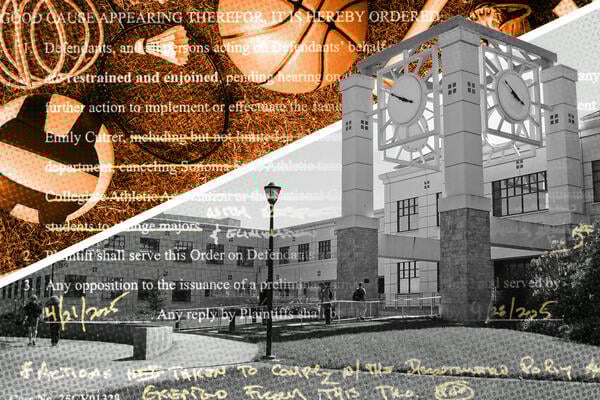
Cuts at Sonoma State University are on pause after a judge found leaders had not followed necessary procedures in winding down academic programs amid an ongoing budget crunch.
Sonoma County Judge Kenneth English ruled that the university sidestepped its own written policies when it announced plans to ax multiple academic programs; he issued a temporary restraining order to halt the process. According to university policies, Sonoma State is required to include the Academic Senate in decisions about program eliminations. But that allegedly didn’t happen, according to a lawsuit to stop the cuts filed on behalf of seven students.
Sonoma State has denied circumventing its own policies.
At the heart of the lawsuit is a fight over athletics, which Sonoma State plans to cut entirely. All seven plaintiffs played various sports at the university, which competes at the NCAA Division II level. However, the judge’s ruling did not halt the administration’s plans to eliminate athletics; the restraining order applied only to the academic programs for now.
It will remain in effect until May 1, the date of the next hearing in the case.
A Fight Over Cuts
In January, Sonoma State—part of the California State University system—announced sweeping cuts, citing a nearly $24 million budget deficit.
“The University has had a budget deficit for several years. It is attributable to a variety of factors—cost of personnel, annual price increases for supplies and utilities, inflation—but the main reason is enrollment,” Interim President Emily Cutrer wrote in an announcement.
She noted that enrollment at SSU had dropped by 38 percent since it peaked in 2015 at 9,408 students, according to federal data.
Sonoma State had already taken moves over the last two years to close its persistent budget gap, including offering buyouts and freezing hiring, among other measures. But those actions “are not enough,” Cutrer wrote. After making piecemeal cuts in prior years, she announced a plan to eliminate more than 20 academic programs, let 46 faculty contracts lapse and ax athletics.
But at least part of that plan is now on hold.
Legal counsel for the plaintiffs requested a temporary restraining order to stop the shutdown of programs, arguing that their clients “will suffer irreparable harm and the Decision will be unable to be reversed even after it is ultimately found to be unlawful, or if new Sonoma State leadership or the California legislature seek to reverse the decision,” according to an April 10 court filing.
David Seidel, an attorney representing the plaintiffs, who is also a graduate of Sonoma State, where he played soccer, told Inside Higher Ed that he was concerned about the abrupt nature of the planned program cuts, which he alleged were illegal and “extremely damaging” to students.
He added that multiple student athletes transferred to Sonoma State over the winter. If officials were aware that SSU planned to cut athletics, as they announced in January, he believes those students were lured by false promises to play for programs that may no longer exist.
“This is a failure of leadership,” Seidel said.
While he recognizes that the university may still move forward with the cuts, he wants to see the process restarted under new leadership and using the procedures SSU allegedly bypassed.
Seidel also plans to address concerns related to athletics at the May 1 hearing.
“The temporary restraining order does not affect athletics at this time. Of course, that’s still very much a live issue that we will be pursuing on May 1, and we’re seeking a preliminary junction on athletics as well. Sonoma State and [the California State University system] have passed very specific policies and regulations with respect to discontinuing academic programs,” Seidel said. “And it isn’t necessarily true that those also apply to athletics.”
In an email to Inside Higher Ed, SSU rejected the notion that it violated its own policies.
“SSU maintains that the university followed its established policies regarding academic discontinuation, including communicating with and considering feedback from all programs impacted by the proposed reductions,” SSU spokesperson Jeff Keating wrote. “Yesterday’s ruling set a later date when the court will more fully review the parties’ positions, including evidence from the university that SSU is complying with its academic discontinuation policy.”
Other Challenges
The court decision came amid an already challenging week for Sonoma State.
At a legislative forum on Monday, state lawmakers criticized Sonoma State’s plans to pull the university out of its fiscal crisis. Beyond the cuts, administrators have developed a blueprint known as Bridge to the Future, which aims to increase enrollment by 20 percent within the next five to seven years, launch new programs and carry out various other actions. But some lawmakers took issue with the plan, arguing it was too light on specifics.
Sonoma State’s recent financial woes have also been accompanied by leadership turnover.
Cutrer, the interim president, is Sonoma State’s third leader in as many years after both her predecessors were felled by scandal. In 2022, then-president Judy Sakaki resigned after she was accused of mishandling a sexual harassment scandal tied to her husband, Patrick McCallum, who was accused of acting inappropriately with several university employees. McCallum also defied a ban to stay off the Sonoma State campus while Sakaki was president.
Sonoma State’s next president, Mike Lee, retired abruptly last year after he was placed on administrative leave when he struck a deal with pro-Palestinian protesters to review contracts to consider divestment opportunities and agreed to an academic boycott of Israel. CSU officials accused Lee of insubordination in making the deal with protesters and ultimately walked back the agreement with students.
Personal well-being—particularly related to mental health—is one of the greatest threats to persistence among college students.
Forty percent of students say mental health has “a great deal” of impact on their ability to focus, learn and perform academically, according to a May 2024 Student Voice survey by Inside Higher Ed and Generation Lab. Additionally, 19 percent of respondents believe their physical health impacts their academic success a great deal.
Colleges and universities are responding to this growing need for support; a 2024 Inside Higher Ed survey of college presidents found that 70 percent of respondents had invested in wellness facilities or services to promote overall well-being among students in the past year.
But students aren’t entirely satisfied with the offerings on their campuses; only 46 percent of Student Voice respondents rated the quality of campus health and wellness services as good or excellent.
Inside Higher Ed compiled five examples of new support resources universities are offering to improve student well-being and, in turn, their retention and graduation. Many focus on students’ self-regulation through meditation and reflection, tools that can help them manage physical and socio-emotional health.
In a small room located in the Eugene McDermott Library and Center for Brain Health, students are encouraged to take “brain breaks,” or short, intentional pauses to prime themselves for more focused, deeper thinking.
The room can only be used by one person at a time, and visitors are encouraged to turn off devices and set aside reading materials during this break.
The SDSU, Imperial Valley, administration cut the ribbon on a new wellness and success center in March, creating dedicated space for counseling and health services—as well as career, veterans’, student success and retention services. The goal is to offer holistic support in a one-stop shop. Imperial Valley is a commuter campus, with student housing under construction, making these resources particularly helpful for those living and studying in the area.
Counseling center services include crisis intervention, assessment and short-term therapy. The health center provides low- or no-cost medical services including preventive care, immunizations and psychiatric treatments.
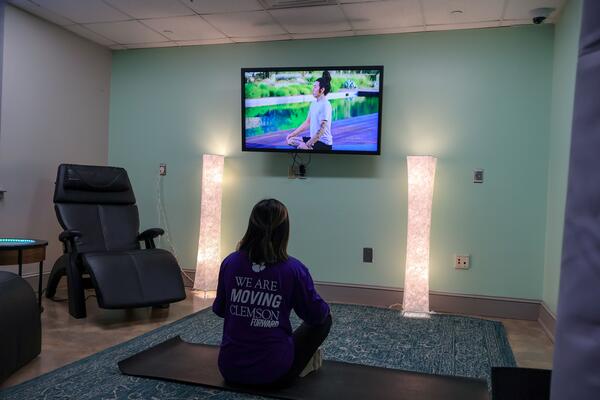
Clemson’s Fike Recreation Center is home to the Wellness Zone, a private room that an individual or group of students can reserve to engage in various activities. Created as a virtual fitness space, the room includes a touch-screen TV and zero-gravity chairs. Students can participate in self-paced yoga, stretching, mindfulness, breath work and meditation, as well as traditional exercises guided by an instructor on the TV.
IU repurposed an old sorority house on campus to centralize mental and physical health service offices, combining Student Wellness, Substance Use Intervention Services and the Collegiate Recovery Community offices under one roof.
In addition to staff offices, the new Wellness House also features reservable spaces for campus groups and four rooms where students can relax and meditate. Each room has a different theme and features; for example, the Fireplace Room is focused on studying and unwinding, whereas the Quiet Room has flexible seating such as beanbags and pillows for greater relaxation.
The goal is to provide an entry point for students who may be overwhelmed, potentially connecting them with relevant offices located in the Wellness House while they engage in other activities.
In 2021, Yale opened the doors to its Good Life Center, a space for unwinding and destressing; this year the university doubled the size of the space to accommodate more students.
The expansion includes five more themed rooms: the tree house, music room, game room, sensory room and balance room. Each offers wellness activities and features related to its theme, such as musical instruments, mini basketball hoops and sound-absorbing chairs.
The sensory room was designed in collaboration with Student Accessibility Services to provide specialized furniture and resources for students of all needs and abilities.
Do you have a wellness intervention that might help others promote student success? Tell us about it.
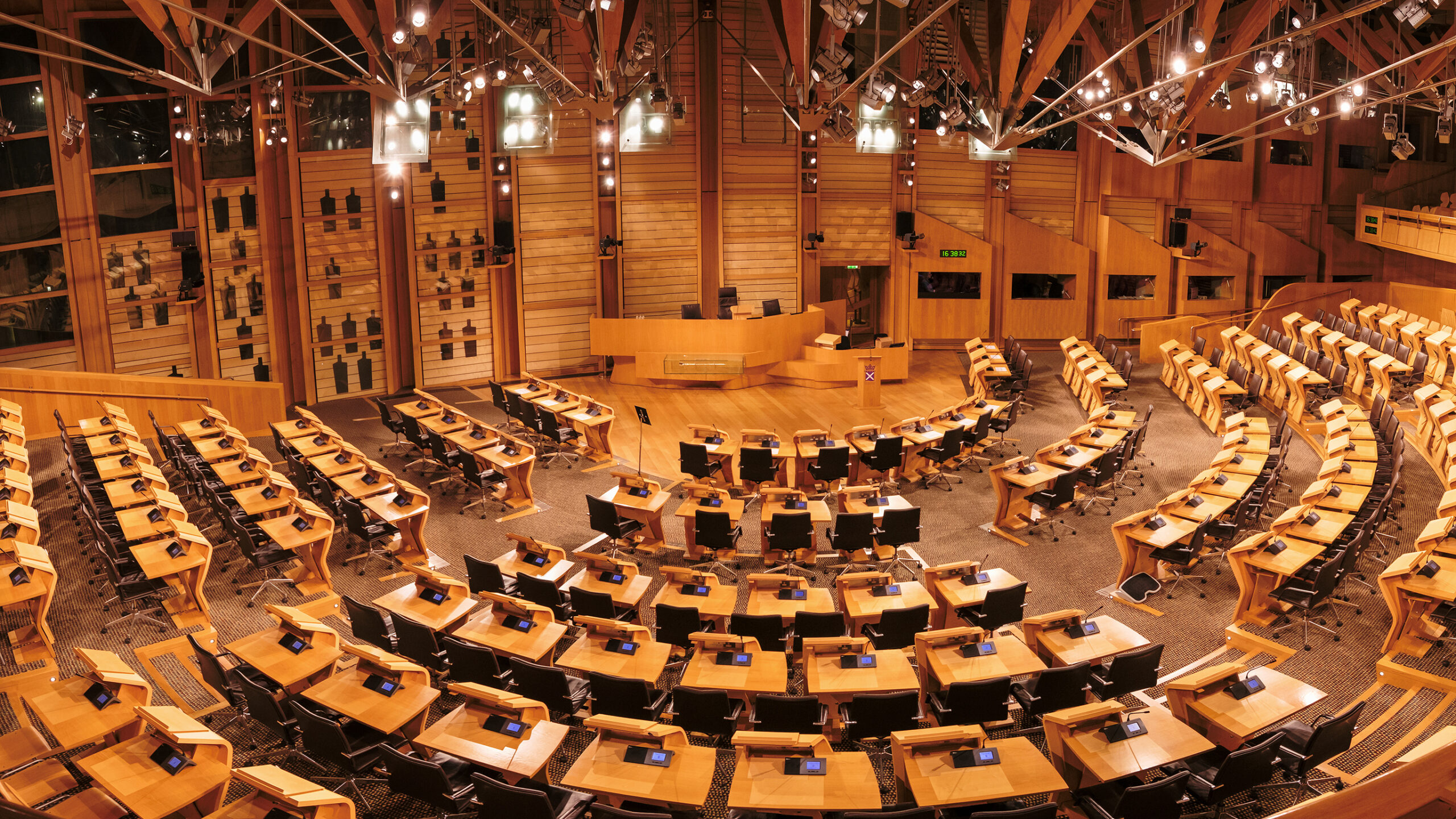
Not many university trustees or senior management teams have three hours spare at the moment. If they did, however, they would be well advised to watch last month’s Education Committee meeting of the Scottish Parliament regarding the University of Dundee.
Regardless of your views on select committees, it’s a timely reminder of how trustee boards and senior management teams need to communicate clearly and work with each other, especially, in circumstances where university finances and governance are also occupying Westminster select committee time, and making guest appearances on Radio 4’s Today programme.
I have written previously about the merits of a special administration for the higher education sector. I will not repeat those views, save in respect of trustee duties.
As outlined in the above, where a higher education provider is not incorporated as a company, the legal position on trustee duties and where the higher education provider is in financial difficulty is unclear.
In circumstances of financial distress, trustees could be facing potential personal liability, so a lack of clarity on legal duties is clearly wholly unsatisfactory in that situation.
Managing insolvency with special administration
One way to attempt to mitigate this situation is through a special administration regime. This could be along the lines of the further education process, would assist trustees of a provider in financial distress by making it clear that the Companies and Insolvency legislation would apply to all higher education providers, regardless of whether they are companies or not.
The trustees, like company directors, would then be aware of the rules of engagement, who should be given priority and how to mitigate the risks.
In addition, the position of students is not specifically protected in a financially distressed situation, above and beyond their status as creditors, in respect of any claims they might have, particularly if there is a market exit of a provider.
Special administration, again along the lines of the regime in the FE sector, would assist, by providing for a predominant duty to act in the best interest of students and would enable the trustees to put students at the forefront of their minds in a time of financial distress.
This supports trustees to focus on the interest of students in a financially distressed situation, and make it clear that acting in the best interests of creditors is secondary to avoiding or minimising disruption to the studies of existing students.
Protection as a charity
In a solvent situation, again, the companies legislation will not apply to a non-company, but, assuming that the HE provider is a charity, the charity legislation provides that the charity trustees have ultimate responsibility for the affairs of the charity.
They must also ensure that the charity is solvent and able to deliver its charitable purposes for the benefit of the public, which is where protection for students tends to come in, assuming that some or all of the charitable objects relate to students.
The duties of trustees come from the fiduciary nature of being a charity trustee, the legal and regulatory framework as well as the governing documents of the charity.
The Charity Commission sets out 6 key duties for charity trustees:
Ensuring the charity carries out its purposes for the public benefit
Comply with the charity’s governing document and the law
Act in the best interest of the charity
Manage the charity’s resources responsibly
Act with reasonable care and skill
Ensure the charity is accountable
The position is clearer where a charity HE provider is solvent, rather than in financial distress.
But whilst the lack of legal clarity for trustees is legally challenging, what the University of Dundee situation has demonstrated is the practical challenge of the management structures in higher education providers and charities.
Company vs charity
The structures of a charity are normally inverse to what you would have in a company. In a company, the board of directors would be both legally and practically responsible for the operations of the company, whether it was solvent or insolvent.
The board of directors would normally carve up management roles between them, or they may delegate some of those roles outside the board to employees, but they should, and generally do, ensure that non-directors report back to the board, with the directors making the final decisions.
With most higher education providers, the director equivalents are the trustees, who have ultimate responsibility for the actions of the HE providers, but are normally unpaid volunteers who see themselves more as non-executive directors. The trustees will usually delegate management responsibilities to a management team.
The fiduciary duty issue with that structure, is that the management team runs the risk of being the equivalent of de facto or shadow directors, to the extent that they are making the ultimate management decisions, with no substantive involvement from the trustees.
Under the Companies and Insolvency legislation, de facto and shadow directors can be equally liable, in both solvent and insolvent situations, as actual directors.
The management team members therefore need, to protect themselves from liability, to ensure that the executive decisions in respect of the higher education provider, are made by the trustees.
The trustees, on the other hand, need to ensure that they have proper oversight of the senior management team and, whilst enabling them to fulfil their roles, that they are aware of the executive decisions that the management team are proposing. Ultimately they are taking responsibility for those decisions so they can be accountable for them.
The problems arise, as was played out for all to see in glorious technicolour last month, when there is a breakdown of communication between the trustees and management team on the decisions being made and the consequences of those decisions.
Now, more than ever, trustees need to be completely up to speed on the decisions made so, in the very unlikely event that they appear in front of a select committee, they can fully explain and take responsibility for the decisions made and actions taken.
But what is the hidden impact of accent bias across UK HE? How does it influence students’ academic life, belonging and wellbeing?
The Hidden Impact
In our current research (Tomé Lourido & Snell, under review), we conducted an accent bias survey with over 600 students at a Russell Group University in the North of England. It showed that a significant number of students experience accent-based disadvantages that have a lasting negative impact on their academic life. Negative experiences were most frequently reported by students from the North of England, especially from working-class backgrounds, and students who did not grow up speaking English, especially from minoritised ethnic backgrounds. These include:
Being marked as different or inferior through negative evaluation, miscategorisation and frequent microaggressions, such as having their accent mimicked, mocked and commented on.
Facing barriers to academic engagement and success. Students from these groups report feeling that their contributions in academic settings are not valued because of their accent, which makes them reluctant to participate in class. Some feel pressured to change their accent, adding an additional cognitive burden to in-class participation. These students are disadvantaged because they miss opportunities to develop and refine their thinking through dialogue with others.
Impacts on wellbeing and career aspirations: Due to negative past experiences, some students internalise negative perceptions of their accent, affecting their confidence and wellbeing, and making them reluctant to take up new opportunities or follow certain career paths. This can have a knock-on effect on their mental health.
The accent-based disadvantages reported by students are not simply representative of wider societal prejudices; for many, the university context was unique in highlighting and amplifying these prejudices. Students also recognised that accent bias intersects with other forms of discrimination – class, race, ethnicity, gender, sexuality and disability – in complex ways. Thus, we argue that HEIs should turn an analytic lens on themselves and take action to tackle accent bias and related inequities.
From Awareness to Action: A Collaborative Approach
There is work to be done for all of us in HEIs to embrace a true multilingual and multicultural ethos and challenge the idea that there is an idealised type of university student. We must “de-normalise” the microaggressions against students with accents perceived as “regional” or “foreign” and ensure that students from all backgrounds are able to participate in the classroom without feeling out of place. We propose four areas of interdisciplinary and collaborative work across the organisation:
Raise awareness of accent bias and its negative consequences in collaboration with students and student unions. Create a communications campaign, provide targeted student and staff training, engage with career offices and employers.
Tackle accent-based inequities by adopting a good practice statement about linguistic diversity and incorporating action into Equity, Diversity and Inclusion (EDI) policy and practice. Include content on linguistic diversity and discrimination in relevant university policies (e.g. mutual respect), strategies, student communications, and training (e.g. induction).
Create a safe report and support route within existing systems for linguistic discrimination, bullying and harassment. Train staff supporting students, including personal tutors, on accent bias and its impact on academic life.
Evaluate the effect of accent bias on students’ success, belonging and wellbeing. Track linguistic diversity. Assess the success of initiatives.
Accent bias remains a largely unaddressed issue in large organisations. HEIs can play a pivotal role in leading a much-awaited societal change.
Addressing accent bias in Higher Education is about breaking down barriers to opportunity and creating an environment in which all students, regardless of their background, can succeed in their studies, secure jobs, and contribute positively to society. By doing so, HEIs will support the employability of their students, a key metric for prospective students when selecting a university, and contribute to economic growth and social mobility.
We encourage senior leaders to take proactive steps to tackle the negative consequences of accent bias and foster a more inclusive and equitable Higher Education system where students from all linguistic backgrounds can thrive.
What if colleges started applying to you instead of the other way around?
The anxiety-inducing college admissions game is changing. With declining birth rates and growing skepticism about the value of a degree, higher education is facing an enrollment cliff, set to hit hard in 2026. That’s 18 years after the Great Recession, when many American families stopped having babies.
As competition for students intensifies, more states desperate for workforce talent and schools dependent on tuition dollars are turning to direct admission – a system in which students receive college acceptance offers and scholarships before they even apply.
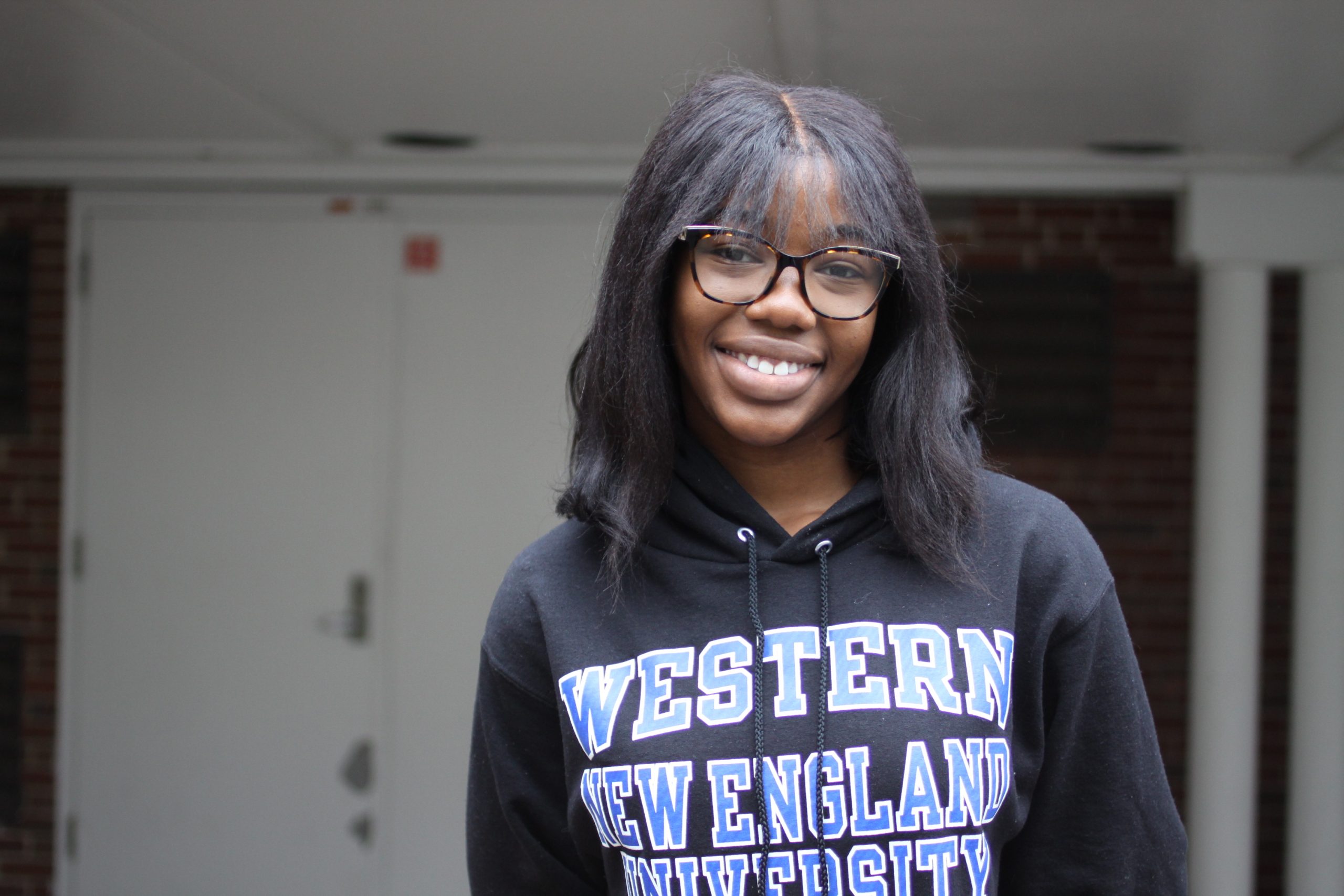
Marykate Agnes was directly admitted to Western New England University, and also got a significant amount of financial aid. Credit: Kirk Carapezza
In this episode, hosts Kirk Carapezza and Jon Marcus break down how we even got to the point at which the traditional college admission process required students to spend time and money with no guarantee of success. And they ask whether direct admission is the solution colleges and students need, or a Band-Aid on a bigger enrollment crisis.
In the basement of the Student Center at Western New England University in Springfield, Massachusetts, students play pool and ping pong. At a table in the back, Ndilei Lukulay is taking a break from her studies. She tells me her mother came to the U.S. from Sierra Leone. Growing up in Springfield, Lukulay felt nervous about applying to college.
[Ndilei Lukulay] I was definitely feeling the pressure of being that my mom is an immigrant. She’s very big on going to college and making sure that you get a good career and complete all your studies and so I didn’t know where to start and I was very stressed out about the whole thing.
[Kirk] Then this university in her hometown emailed to say she was admitted and would get a scholarship and she hadn’t even applied. So she was skeptical.
[Ndilei Lukulay] I was, like, is this a scam? Is this real?
[Kirk] It was real. Western New England, a private university with about 2,000 students, offered to admit her and more than 2,000 other students before they even applied. The university tells me the goal is to make college more accessible to low-income students, like Lukulay, who make up about a third of the school’s population.
This is called direct admission, and we’re seeing a lot more schools doing this as they confront a steep decline in the number of 18-year-olds, something economists call the demographic cliff. That’s going to mean a lot fewer college students — or potential customers.
[Jon] And, Kirk, schools in areas of the country like western Massachusetts are the hardest hit.
Here’s how it works. The college tells students they’d get in based on a handful of criteria, like their GPA or intended major. For students like Ndilei Lukulay, that means getting to skip writing essays, going to interviews, and getting letters of recommendation.
[Ndilei Lukulay] I think I received direct admissions offers from about 12 to 15 schools and I was actually very shocked. I just never heard anything about it and I’m like, is that easy?
[Jon] This is College Uncovered, a podcast pulling back the ivy to reveal how colleges really work. I’m Jon Marcus with the Hechinger Report. …
[Kirk] … and I’m Kirk Carapezza with GBH News. Colleges don’t want you to know how they operate, so GBH …
[Jon] … in collaboration with the Hechinger Report, is here to show you.
In this season, we’re standing on the precipice of the demographic cliff and exploring the changing higher education landscape. And one of the major changes is how people are getting into college. Applying to schools is really stressful. But what if all that went away and colleges applied to you?
Today on the show” Tag, You’re In!”
[Kirk] Direct admission is now used by hundreds of schools across the country. And more than a dozen state systems do this, too, including Oregon, Minnesota, and Connecticut. Idaho was the first state to create a direct admissions program.
[Jennifer Delaney] In Idaho, it was actually the president of the flagship who tried to apply to his own college and found it really hard.
[Kirk] Jennifer Delaney teaches higher ed policy at the University of California, Berkeley, and she studied the direct admissions program in Idaho, where every public institution in the state participates, as well as two private colleges.
[Jennifer Delaney] It was about how do we simplify, how do think about increasing, as a state, overall college enrollment. So every kid in a public high school in Idaho gets a letter. You’re either in everywhere in the state if your GPA is high enough, or you’re into all the open-access institutions, which is every community college plus two public four-years.
[Jon] This is a major shift, Kirk, in how colleges do business. For students, it helps ease the stress of the college search by letting them know they’re in before they even apply. For colleges desperate for students, it’s a way to fill their classroom.
[Kirk] Yeah, and for states, Jon, it’s a way to keep talent close to home and develop a more educated workforce. Susan Makowski is director of admission at Rider University in New Jersey. We heard from her in our first episode this season.
[Susan Makowski] The cliff is coming, so we just will have less students.
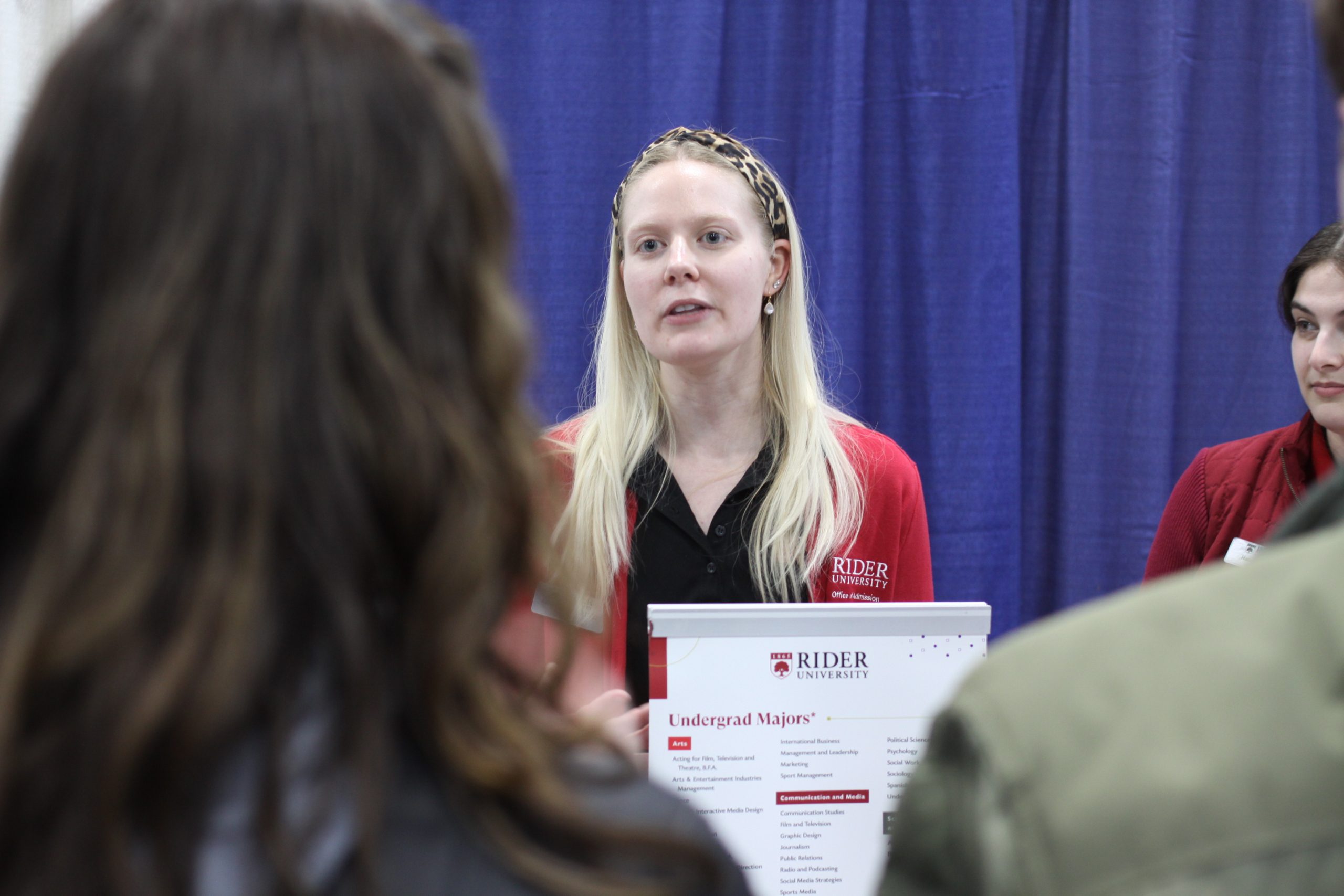
[Kirk] At a college fair in Edison, New Jersey, she told me Rider was already admitting nearly 80 percent of those who applied when it decided to offer direct admission to students who’ve uploaded their applications through the Common App. That’s a single application accepted by more than 1,000 schools. So somebody applying to the University of Michigan suddenly gets accepted to other schools, like Rider.
[Susan Makowski] These direct admission programs run the gamut of different ways that a student gets admitted. I may alert them that they look like a great fit for Rider, but they still need to decide — do they feel that way? Whereas the other options, really, I think, sometimes worry students. Like, is this real?
[Jon] Interesting. But does direct admission really help colleges like Rider boost enrollment? And what if a college tags you? We’ll have more on that in a moment, so stay tuned.
But first, how did we get to this point where the college admissions process requires students to spend a ton of time and money with no guarantee of success? And how did the whole process become so anxiety-inducing?
[Kirk] Well, Jon, it wasn’t always this way.
[Archival newsreel sound] There were a group of congressmen with long memories who were in the last war. They knew that when a man gets out of the Army or Navy or Marines, he’s worried most about a job, an education, and a home. And that’s why Congress, led by the president, passed the law, the Servicemen’s Readjustment Act of 1944, better known as the G.I. Bill of Rights.
[Kirk] Some quick history. After World War II, most of the students applying to college applied to a single school. And by the 1970s, it was maybe two schools. Today, one in three students applies to seven or more places. That shift has created a lot of uncertainty for colleges hoping to fill their seats and a lot anxiety for students and their families. To get a sense of why colleges push this system, I reached out to a long-time admissions insider.
[John Burdick] My name is John Burdick. I was, until 2023, the vice provost for enrollment at Cornell University in New York.
[Kirk] Burdick was in the game for nearly four decades. Since he left Cornell, he’s been working on international college access in Africa. So technically he’s still in the game. I asked him what drove us here?
[John Burdick] This is basically just a classic arms race. The more rejection letters we can send, the more prestige we have, the more likely people will be willing to spend money on our services. And then students follow along behind that by a year or so and say, ‘I don’t know that I’m going to get in there or the other nine, 10, 19 prestigious places that I am applying to. So I better apply to all of them.’
[Kirk] Burdick says everybody in the game has a perverse incentive — students to increase the number of applications they send, and colleges to increase the number of applications they get.
[John Burdick] Now the Ivies will by and large say, ‘Oh, we don’t want more applications. We’re already only admitting 5 percent and it’s terrible and we’d just as soon not see applications.’ They’re lying through their teeth. They would freak out if they suddenly weren’t among the most selective universities on the planet.
[Kirk] And on this planet, most colleges — 80% — admit more than half the students who apply. Still, selective or elite college admission drives the national narrative.
Jon, you’ve reported on the fact that it’s getting easier to get into college and with the demographic cliff coming it’ll only get easier at certain schools, right?
[Jon] Yeah, not at Princeton and Yale, but despite public perception, and for the first time in decades, acceptance rates at most colleges and universities are going up.
[Kirk] Where are acceptance rates going up the most?
[Jon] Well, Bucknell, George Washington, Marquette, Oberlin, Gonzaga, Brigham Young — the list goes on and on. These universities want you to think it’s impossible, or at least hard, to get in. But the fact is, on average, universities are admitting a larger proportion of their applicants than they did 20 years ago. In fact, the median acceptance rate at four-year universities was about 8 percentage points higher in 2022 than it was in 2012.
[Kirk] Many students think it’s increasingly hard to get into college, and they see the whole process as a mystery. Even as you gather up your transcripts and test scores and then add some final touches on your personal essays, the question remains: Exactly what happens after your application goes out into the unknown? At the college fair in New Jersey, I asked high school juniors Masiambou Saysay and Harmony Roundtree what they think happens behind closed doors.
[Masiambou Saysay] They just have a lot of applications, they’re like, declined, oh yeah, I don’t know.
[Harmony Roundtree] I feel like a big pile of letters being stacked on top of each other and you just gotta pick, yeah.
[Kirk] And what do you think it looks like?
[Harmony Roundtree] Hmm. Like, a million emails and then, like, three different computers
[Kirk] I got a glimpse into one of those computers and the black box that is the admissions process — the mystery of who gets in, the secrets of what really matters. After I reached out to a bunch of schools, the College of the Holy Cross in Worcester agreed to give me access and a behind-the-scenes look at the admissions processes. Full disclosure, Jon, I’m a graduate of Holy Cross.
[Jon] Oh, really, Kirk? You never mention it. So the only school that would let you in is the only school that would allow you to observe the process?
[Kirk] That’s pretty much how this went down. The college let me sit in on one early decision committee meeting. Behind closed doors, inside a tiny conference room, I saw how the process historically went down.
[Woman’s voice] Nice program, good testing.
[Man’s voice] Yeah, a lot to like.
[Woman’s voice] People like him?
[Kirk] What’s most surprising is how quickly the committee reviews the candidates, spending about two minutes on each before deciding whether to accept, hold, or deny. To speed things along, the committee uses a lot of jargon, like LBB — that’s ‘late blooming boy’ — and RJ for ‘rejection.’
[Woman’s voice] Academically has everything. I wonder if a counselor call might be enlightening.
[Woman’s voice] I mean, honestly, it sounds like maybe he could work on it or be cognizant of it. I mean I don’t know, and he’s strong academically, I think he’s okay.
[Man’s voice] I think his classmates would bring him down to reality.
[Jon] Kirk, that’s just one small private college. So to get a broader sense of the admissions landscape and how it’s changing, we reached out to Jeff Selingo.
[Kirk] Yes, Selingo teaches higher ed leadership at Arizona State University, and he’s author of the book Who Gets In and Why. For his research, he spent a year inside three college admissions offices at Emory in Atlanta, Davidson in North Carolina, and the University of Washington in Seattle. So I asked him, how did he end up at those schools?
[Jeff Selingo] In some ways, it’s a lot like admissions. I approached 24 schools and asked them to get inside their admissions process. And most said no. And only three said yes. So it’s kind of like I applied to 24 schools. I only got into three.
[Kirk] And what do you think people imagine it’s like inside a college admissions office and what’s it actually like?
[Jeff Selingo] First of all, I think they think that the admissions officers are spending a lot more time with college applications than they really are. Emory had something like 40,000 applications. And so as a result, they’re like looking at these applications sometimes in just a couple of minutes. Probably the most they would take with an application might be 12 or 13 minutes. And meanwhile, you know, these kids are putting their heart and soul into it for years.
[Kirk] Selingo says the biggest change in the college admissions game is the lack of signals around what it takes to get in. Schools that used to require test scores, for example, have gone test-optional since the pandemic.
[Jeff Selingo] You know, some colleges have gone back, But that lack of a signal, like, if I got a 1400 or 1300 on the SAT, I kind of knew where that would place me in a class and I would not even apply to most of these schools. But now with test optional, it gave me the opportunity to potentially apply and get in. And so every year now you see just increasing number of applications again to these highly selective schools. And then you hear stories, ‘Oh, I didn’t, you, know, my kid didn’t get in or my cousin didn’t get in,’ and so the following year, kids get really nervous. And what do they do? They apply to not only those same set of schools, but then they apply to five more at the same time. And so you just see this vicious circle that just keeps going around and around again, particularly around these top schools.
[Kirk] How do you think the demographic cliff and the shortage of 18-year-olds will change this game?
[Jeff Selingo] I think the competition for student is going to intensify. And so you’re seeing that already. You see programs like direct admission, where students are getting accepted to colleges without even applying. You’re going to see a lot more marketing to students even earlier than they do now, in terms of buying their names and sending them information. The other thing, though, is on the financial aid side. I think the discounts and the merit aid that [colleges] are going to give, I think they’re just going to lean even more into that. And you’re just going to see more and more money flowing to students to try to persuade them to come to school X instead of school Y.
[Kirk] How else are these colleges handling these seismic shifts, and what’s the tone inside of the admissions office now? Is there a sense of desperation?
[Jeff Selingo] It’s interesting around enrollment. Even though we’ve known this cliff has been coming forever, admissions is really, like, especially at most of these schools that are tuition dependent and are really enrollment driven, it’s about butts in seats tomorrow, not a year from now. So, I mean, they’re kind of short sighted. They haven’t been doing very much to prepare for this. No, they haven’t, because they basically think ‘I just need to, I need to make this class for next year. I need to come in on budget. I need to. Make enrollment.’ They’re not really worried about two years down the road.
[Kirk] You mentioned direct admission. What do you make of this trend, and do you think we’ll see more schools and states adopt it?
[Jeff Selingo] Oh, I think you will, because there’s something in admissions where everybody kind of follows the leader. I’m a little skeptical of direct admission. Well, what happens when more and more schools adopt direct admissions and suddenly, now, Kirk, you’re getting, instead of, like, one or two direct admissions offers, now you’re get eight or nine, right? Like, how does that really help you, at the end of the day, make a decision, or from the college’s point of view, know who’s really interested and who’s coming?
[Jon] So Jeff Selingo is pretty skeptical of direct admission. But does it help colleges boost enrollment?
[Kirk] Well, sometimes, says Jennifer Delaney. She’s the researcher we heard at the top of this episode who looked at the first-in-the-nation program in Idaho.
[Jennifer Delaney] It’s not always able to move the needle on the enrollment side of things.
[Kirk] Delaney’s research found direct admission helped to increase full-time undergrad enrollment by at least 4 percent, and it boosted in-state enrollment by at least 8 percent.
[Jennifer Delaney] Having a bird in the hand in Idaho meant that you stayed in Idaho for school, and you didn’t go out of state.
[Kirk] And what about low-income students?
[Jennifer Delaney] Admission isn’t enough. You’ve got to be admitted and be able to pay for it.
[Kirk] And that’s why more schools are adding direct financial aid offers up front, too.
[Jon] Kirk, to compete, more and more community and four-year colleges are offering — quote, unquote — free tuition. We have a whole episode about that called “The Real Cost of Free.” You can find it in our second season.
At Western New England University, Marykate Agnes says she accepted the direct admission offer, but not before she reached out to increase her financial aid award. Agnes was admitted through direct admission, and she also received generous financial
[Marykate Agnes] I got the $32,000 scholarship, then I got another $2,000 for early action, and then I asked for more money and I got it. So I think I’m paying around $10,000. I think that it’s just an awesome thing, and it takes stress off of the students.
[Jon] Agnes says she doesn’t worry about attending a less selective school.
[Marykate Agnes] I don’t think it reflects the value of the education at all. I mean, at the end of the semester, I have more work than my friends at more selective schools do, and it’s harder, more rigorous, and the professors are absolutely amazing, and it is so personable. And I think that’s what you’re not getting at the more selective schools.
[Kirk] All of this change is putting pressure on colleges to develop a strategy. That’s where people like Kathy Ruby come in. She works with colleges to shape financial aid strategies to help them compete with other schools for students.
[Kathy Ruby] It’s a competitive market, and it’s going to get more competitive depending on where you are and the type of institution you are. I think not all institutions will experience the cliff in the same way.
[Kirk] Ruby says families are more cost-conscious than ever. Students and parents are more averse to debt, so schools are trying to make themselves seem cheaper. The goal is to attract middle-income families who don’t qualify for federal and state but also don’t have the means to pay the full price.
[Kathy Ruby] Certainly institutions are starting to focus on what can we do for those middle students, because that also can often be a good place to build. But it can be more expensive for the institution, because there’s no federal dollars to help.
[Kirk] Schools are focusing on scholarships that are offered up front and meet more students’ financial needs. Ruby’s advice to students and families? Shape a college list with your reach, target and safety schools, but also understand what that means for you.
[Kathy Ruby] Because if you’re a very bright student and your likely schools might be actually still pretty selective and not offer much in the way of merit aid, you have to do your homework on understanding what the college actually offers. Use their website, use their net price calculator, talk to people.
[Jon] And, as we always say on this podcast, ask questions and understand what your financial aid package might look like, even if you can’t get an exact figure.
[Kirk] The reality is there are tons of solid schools and programs out there. So try not to worry so much about that bumper sticker on the back of your neighbor’s SUV. And remember, getting into those bumper-sticker schools is often not about you. It’s about the college’s agenda. Factors like building a class, budgets and yield. You know, whether a student will even enroll if they’re accepted. Students and parents have a lot to gain if they change their perspective on what really qualifies as a quote,unquote good college.
[Jon] That’s right, Kirk. It’s easy to think a degree from a selective institution is the best insurance policy you can buy for your kid’s future. And if they’re not accepted, they’ll end up on the wrong side of this country’s economic divide.
But as we approach the demographic cliff, in many ways, that is simply not true. For many students, it’s a buyer’s market now.
[Kirk] This is College Uncovered. I’m Kirk Carapezza from GBH. …
[Jon] … and I’m Jon Marcus from the Hechinger Report.
[Kirk] This episode was produced and written by Jon Marcus …
[Jon] … and Kirk Carapezza, and it was edited by Jonathan A. Davis.
Our executive editor is Jennifer McKim.
[Kirk] Our fact checker is Ryan Alderman.
Mixing and sound design by David Goodman and Gary Mott.
All of our music is by college bands. Our theme song and original music is by Left Roman out of MIT.
The demographic cliff was set to sound for us by James Trayford of the Institute of Cosmology and Gravitation at the University of Portsmouth in England.
Mei He is our project manager. And head of GBH Podcasts is Devin Maverick Robbins.
[Jon] College Uncovered is made possible by Lumina Foundation. It’s produced by GBH News and The Hechinger Report, and distributed by PRX.
Thanks so much for listening.
More information about the topics covered in this episode:
The Hechinger Report provides in-depth, fact-based, unbiased reporting on education that is free to all readers. But that doesn’t mean it’s free to produce. Our work keeps educators and the public informed about pressing issues at schools and on campuses throughout the country. We tell the whole story, even when the details are inconvenient. Help us keep doing that.
When this year’s legislative session launched in Idaho, early childhood experts and advocates were hopeful that the state, which has a shortage of child care, would invest more in early learning programs. Instead, lawmakers proposed what may be the most extreme effort yet to deregulate child care in America: The bill called for eliminating state required staff-to-child ratios altogether, instead allowing child care providers to set their own.
While the effort was met with fierce opposition in the state, it represents a trend gaining momentum in the country. Rather than investing in the struggling child care industry, more than a dozen states have proposed lowering the minimum age to work with children, easing education and training requirements, and raising group sizes and ratios. (Read my December story on this growing deregulation movement. I investigated such efforts in states including Kansas and Iowa.)
The deregulation measures come at a time when many early childhood programs face federal funding and staffing cuts. Head Start programs were hit by a federal funding freeze and struggled to draw down payments even after the Trump administration announced Head Start was exempt from the freeze. Then, earlier this month, the Trump administration closed five of the Administration for Children and Families’ (ACF) regional offices and placed staff from those offices on leave, threatening support for Head Start, which is overseen by ACF, as well as programs that receive federal child care subsidies. Last week, USA Today reported that President Donald Trump is considering a budget proposal that would eliminate funding for Head Start altogether.
At the state level, Idaho lawmakers are not the only ones to propose child care deregulation legislation this year. Minnesota lawmakers also issued similar proposals, including increasing family child care capacity limits and relaxing ratios in rural areas. Another bill in the state proposes lowering the age requirement of assistant teachers from 18 to 16. In Kansas, where a lawmaker proposed hiring 14-year-olds to help in child care classrooms in 2023, a new bill aims to reduce training requirements. An Indiana measure would loosen staff-to-child ratios based on the ratios set in neighboring states, and one in North Carolina would increase maximum group sizes for young children. And in Florida, lawmakers have called for an abbreviated inspection plan for some child care programs.
While deregulation is more common in red states, there have also been some recent efforts to invest in early learning programs that transcend the red-blue divide. In Georgia, Gov. Brian Kemp proposed an additional $14 million aimed at reducing preschool class sizes and $5.5 million to address issues with the state’s child care subsidy program for lower-income families. Indiana Gov. Mike Braun called for more spending to eliminate the state’s waitlist for child care subsidies. And South Carolina Gov. Henry McMaster proposed $20 million to continue a program that provides wage supplements to child care workers.
In Idaho, the deregulation legislation was eventually amended to loosen the state-mandated ratios — without eliminating them altogether. It also forbids municipalities from setting more stringent child care regulations than the state, something that was allowed in the past and allowed cities to set a “higher standard” for programs, said Martin Balben, director of strategic initiatives for the Idaho Association for the Education of Young Children.
“I think municipalities are still kind of reeling with how to confront that reality,” he said. “It remains to be seen how [they] are going to handle their lack of local control in this area moving forward.”
Experts say while deregulation is nothing new, the recent momentum is troubling. “We absolutely want to make sure that states are not rolling back their health and safety measures,” said Diane Girouard, state policy senior analyst at Child Care Aware of America. “We want to make sure that they’re not compromising children. … There are no quick fixes.”
This story about child care services was produced by The Hechinger Report, a nonprofit, independent news organization focused on inequality and innovation in education. Sign up for the Hechinger newsletter.
The Hechinger Report provides in-depth, fact-based, unbiased reporting on education that is free to all readers. But that doesn’t mean it’s free to produce. Our work keeps educators and the public informed about pressing issues at schools and on campuses throughout the country. We tell the whole story, even when the details are inconvenient. Help us keep doing that.
Most Americans would probably rather forget the Great Recession that began in 2007. But as long ago as it may seem, it triggered something that is about to become a big problem: Americans started having fewer babies, and the birth rate hasn’t recovered since.
That means a looming decline in the number if 18-year-olds. Since those are the traditional customers for universities and colleges, enrollment is projected to fall dramatically and campuses to close.
In this episode, we tell you the surprising benefits of this for students and their parents — and the scary prospects for the economy, which will suffer shortages of workers just as baby boomers retire.
Brody Scully is a high school student looking at colleges. “There’s a lot of pressure on me. I have to decide in these next two years that I’ve got to go to a specific college,” he says.
Come with us to a college fair where recruiters line up to compete for applicants, and hear from enrollment consultants, economists, and the president of a school that has already closed.
[Kirk] This is College Uncovered. I’m Kirk Carapezza.
[Jon] And I’m Jon Marcus. We’re going to start this brand-new season of the podcast by taking you back to a time most Americans would probably rather forget.
[Archival news footage] Monday, Sept. 15, 2008. Lehman Brothers files the largest bankruptcy in U.S. history, precipitating the global financial crisis. … The Dow tumbled more than 500 points.
[Jon] What we now call the Great Recession started in 2008, and it left the world’s economy reeling.
[Archival news footage] More than two million prime mortgages, traditional loans for people with good credit, are now delinquent.
[Jon] The Great Recession did a lot of damage at the time, but it also caused something else most people haven’t noticed, and that’s about to affect us all.
[Archival news footage] Birth rates in the USA have dropped to their lowest annual levels in three decades, falling for nearly every group of women. … It changed the game when it comes to job security, and it led many young adults to delay marriage and kids.
[Jon] People stop having babies during economic downturns. That was a major but almost unseen impact of the Great Recession 18 years ago. And that means we’re about to run out of 18-year-olds. This is being called the demographic cliff.
Hey Kirk, help me explain the deal with this demographic cliff.
[Kirk] Yeah, so the demographic cliff is this big dropoff that’s about to hit the number of traditional-age college students. And the reason experts call it a cliff is that the number of students is going to go down, like you’re tumbling down a mountain and it never comes back up, Jon.
[Jon] The demographic cliff is pretty much the focus of our new season of this podcast. There’s some surprising good news that we’ll tell you about for students and their families, and for the parents of prospective college students. But this demographic cliff is also a big, big problem in ways most Americans don’t realize yet, for colleges and universities — and for economy.
[Nicole Smith] We are looking ahead down the road to circumstances, dire circumstances where we just can’t fill the jobs that are opening up.
[Wes Butterfield] We are at the, I’m going to call it the crossroads. You know, we’re at the cross roads for many campuses where they’re going to have to think creatively.
[Rachel Sederberg] We’re going to see issues across every occupation and every industry. There is going to be no one spared of this pain.
[Jon] Those are the voices of some experts whose job it’s been to watch this coming crisis. Like the lookouts with binoculars on the deck of the Titanic.
[Telephone ringing] Pick up, you bastards!
Yes, what do you see?
Iceberg! Dead ahead!
[Jon] So forgive us for the mixed metaphors and come with us as we help you cross these icy seas and this pivotal crossroads. We’ll show you how the demographic cliff will affect you.
[Kirk] This is College Uncovered, from GBH News and The Hechinger Report, a podcast pulling back the ivy to reveal how colleges really work. I’m Kirk Carapezza with GBH. …
[Jon] And I’m Jon Marcus of The Hechinger Report.
[Kirk] Colleges don’t want you to know how they operate, so GBH …
[Jon] … in collaboration with The Hechinger Report is here to show you.
[Kirk] In our fourth season, we’ll be looking at the many dramatic ways that college is changing right now and what it all means for you. Today on the podcast: “The Demographic Cliff.”
[Sound from college fair] Hi, guys, welcome to the college fair. If you’d like a bag…
[Kirk] To get a sense of what the demographic cliff looks and sounds like on the ground, I went to a national college fair in Edison, New Jersey.
[Sound from college fair] Students, make sure you have your barcode ready so the colleges can scan your barcodes.
[Kirk] Inside a massive convention and exposition center in an industrial park, a bunch of juniors and their families anxiously waited in the lobby before passing through turnstiles, and then they mingled with college representatives.
[Sound from college fair] And do you have one of the scan cards so I can get your information?
[Kirk] It’s kind of like speed dating, with most of the colleges here selling themselves.
[Sound from college fair] What’s cool about it is that we’re currently building our brand new college of business building that’s a lot of these that will be the biggest academic building on campus, so honestly your degree is going to work tenfold by the time that you end up coming to FSU.
[Kirk] There’s rows and rows of colleges. In some of those rows, it seems like there are more colleges than students.
[Sound from college fair] And we’re 10 minutes from London Heathrow Airport as well, so for international students getting on is great.
[Kirk] After the initial rush, the crowd thins out and those turnstiles stop turning.
Welcome to a new era of college admissions.
As you come to a fair like this, what are you looking for exactly?
[Brody Scully] I’m looking for environmental sciences and eco-engineering.
[Kirk] Brody Scully is a junior from West Milford, New Jersey. He says he knows exactly what he wants in a college: someplace where he can be active and maybe ski, and someplace small.
[Brody Scully] Because I definitely learn where there’s probably a smaller group of people, so I’m looking for that.
[Kirk] Is it anxiety-inducing for you guys, going through this process?
[Brody Scully] I would say yeah, definitely, and, like, time intensive.
[Kirk] Why is it so stressful?
[Brody Scully] There’s a lot of pressure on me. I have to decide in these next two years that I’ve got to go to a specific college.
[Kirk] But Brody may be in luck, because in the college admissions game, he was born at the right time: in 2008, just as birth rates in the U.S. started to decline. Remember Jon, that means there will be fewer 18-year-olds applying to college over the next few years. And except at elite schools like Harvard or Stanford and a few dozen other most selective colleges, the odds of getting in are going up. Eight out of 10 applicants to public universities and 7 out of 10 at private colleges are accepted now. That’s nearly 8 percentage points higher than 10 years ago.
Brody was surprised and thrilled when I told him this. In fact, his eyes widened.
[Brody Scully] I’m not aware of that at all and I’m kind of happy now that you told me that.
[Kirk] As the fair winds down, college reps, some standing alone in the back of the convention center, keep smiling, making eye contact, and hoping for just one more student to come by.
I mean, the reality is, this is a competitive landscape for many colleges, and for students, it’s increasingly a buyer’s market.
Take Rider University, which is trying really hard to stand out in this sea of schools. Its reps are simply telling potential students what the school is all about. and where it is.
[Susan Makowski] It is a small private school in Lawrenceville, New Jersey, which is about 15 minutes south of Princeton.
[Kirk] Susan Makowski is director of admissions at Rider, and for the past 20 years, she’s helped organize this fair.
This seems like organized chaos.
[Susan Makowski] I think that’s a great way to describe it.
[Kirk] This year, there are about 300 schools here looking for applicants. Colleges pay about $700 just to rent a booth. They think it’s worth it for a chance to connect with some of the nearly 3,000 registered students. And, of course, to scan their barcodes so they can follow up with endless reminders and marketing materials.
[Sound from college fair] I think I’m all good, but I’m making some…
Do you have one of the scans?
Uh, yes I do.
[Kirk] This year, Makowski tells me, Rider University is trying something a little different.
[Susan Makowski] Tonight, to be honest, I’m in New Jersey school at a New Jersey fair. I bought two booths. That’s how I’m standing out physically tonight so that you see that I’m here, right? You can’t miss me.
[Kirk] So you expanded your footprint.
[Susan Makowski] Yes, I did.
[Kirk] You can’t just walk, you can’t blow by you.
[Susan Makowski] Right, but that’s a selfish thing that I’m choosing to do, because I want to make certain that I can capture as many students Who might not have heard of us or might be really interested in us
[Kirk] Looking ahead and over the demographic cliff, Makowski tells me she knows things are about to change with fewer applicants.
[Susan Makowski] I think that’s going to be a natural progression, simply because a cliff is coming.
[Jon] Kirk, the seeds of this problem for colleges were planted back in 2008.
[Archival news footage] It was a manic Monday in the financial markets. The Dow tumbled more than 500 points after…
[Wes Butterfield] We were in a fairly dark place. And, again, that’s impacting us today.
[Jon] That’s Wes Butterfield. He’s chief of consulting services at Ruffalo Noel Levitz, a consulting firm that helps colleges and universities recruit students.
[Wes Butterfield] Anytime we reach those types of points in our history, birth rates go down. People just simply stop having babies. People were concerned about whether or not they’d have the resources to be able to start a family. And so those numbers backed off, and it takes a while for us to get to a point where it truly begins to impact us.
[Jon] The decline in births that started 18 years ago is about to translate into fewer students coming out of high school and enrolling in college. By 2039, there will be 15 percent fewer 18-year-olds per year than there are now.
The effect of all of this that you and I report about the most, Kirk, is what it will do to colleges and universities. It comes on top of a decline in enrollment that’s already been happening over most of the last 10 years. People have been questioning whether college is worth the high cost, and a relatively strong labor market drew a lot of high school graduates straight into jobs. Emily Wadhwani keeps a close eye on this as a senior director at Fitch Ratings, where she’s the sector lead for education. Fitch rates the financial health of institutions.
[Emily Wadhwani] We’ve been seeing kind of a trending downward of demand in terms of enrollment, particularly on the undergraduate side. So this is definitely a longer trend that we’re seeing.
[Jon] The pandemic only made things worse. And now the demographic cliff is here.
[Emily Wadhwani] Where we are now climbing back out of this post-pandemic recovery period, we see the same challenges that schools were facing prior to the pandemic, only now it’s more pronounced because those demographic trends have only deteriorated since then.
[Jon] That’s why colleges have started closing. Fitch categorizes the outlook for the higher education sector as deteriorating. Kirk, you and I have been seeing that a lot lately on abandoned campuses of colleges that have closed.
[Bob Allen] This is sort of a movie-set college campus, and people say that as soon as they essentially walk in the front gate.
[Kirk] That’s Bob Allen. He was the last president of a 185-year-old Green Mountain College in Vermont before it closed in 2019. By the time I visited the campus, it looked more like a ghost town.
[Bob Allen] So, yeah, watch yourself on these. They aren’t, see normally all of this would have been cleaned up.
One of the advantages of a small school is that it really was like an extended family. I knew not all of the students by name, but I knew most, and they knew me. They called me Bob, which was what I would prefer.
[Kirk] To Allen’s right, the red brick dining hall and dorms. To his left, the empty swimming pool, a ghost-like symbol of dried-up enrollment.
[Bob Allen] Increasingly students want to go to schools in cities and not rural areas. Poultney is a very tiny Vermont town.
[Kirk] At the time, Allen told me he preferred to give tours like these when the college was still open.
[Bob Allen] It was a lot more fun when we had students, all right.
[Kirk] At its peak, Green Mountain had about 800 students. That was already pretty small. But by the end of the 2010s, there were only a little more than half that many left. So Allen and his board decided that the college had to close.
[Bob Allen] It’s the hardest thing I’ve ever had to do personally. I spent most of my career building businesses and to take a 185-year-old institution and have to shut it down was really tough.
The demographics are working against all colleges, but in particular, small rural colleges. It’s tough for surrounding towns when colleges close too. Our payroll just for the college alone was $6 million. It has to, in the end, have an economic impact on the town. You know, some of the businesses had closed even long before we made our announcement.
[Jon] Kirk, the demographic cliff means there will be a lot more colleges closing. Don’t take it from us. That’s the prediction of the Federal Reserve Bank of Philadelphia. Already, 21 colleges defaulted on their bonds last year, or were at risk of defaulting. That’s way up. Here’s Emily Wadhwani from Fitch.
[Emily Wadhwani] We’ve seen the closure rate accelerate over the last few years. We expect to see that continue for the next few years. That has tended to be smaller, private, liberal arts, sometimes religiously affiliated schools with perhaps less than a thousand students. I’m generalizing; there are a couple outliers there, but broadly speaking, those are the types of schools that we’ve seen close.
[Jon] That’s a pretty good list of the kinds of colleges that are in trouble, and consumers need to keep that in mind. No matter what schools you’re considering, you need to do more these days than look at their courses or the athletics program. You need to check out their finances.
[Emily Wadhwani] The second place I would look is the strength of fundraising, often an indicator of the level of wealth the university has — the capacity to fund scholarships and other aid packages, less reliance on tuition as a primary means of operating revenue.
[Jon] We’ve talked before in this podcast about how you can see if your college might be in financial trouble. And we’ll post the link to that in the show notes.
Now, it’s obviously a sad situation when colleges close, for their employees and students and alumni, and for the towns that depend on them. But, Kirk, there are a couple of bright spots if you’re currently a college student or the parent of a college student, or have a child who’s considering college.
[Kirk] Yeah, Jon, colleges teach this in Econ 101. It’s the simple law of supply and demand. As the number of students is falling, there’s less demand. And as demand goes down, two things are happening. First, most colleges are becoming easier to get into. And second, the price of tuition has actually started falling.
[Jon] Now, Kirk, let’s be clear: College is still expensive, and to make up for keeping tuition low, colleges with dorms and dining plans are raising the price of food and housing. But increases in tuition are finally dropping when adjusted for inflation, after decades of exceeding the cost of almost everything else that Americans spend money on.
[Kirk] Exactly, Jon. You’re also likely to be able to negotiate for more financial aid. We gave a lot of advice about this in the first episode of our second season, and we’ll link that in the show notes too.
[Jon] We’ll have a lot more to tell you about the dramatic changes in admission in our next episode. So check that out.
[Kirk] So that’s all pretty good news for future students and their families. But there’s more bad news. And not just for colleges, but for the economy and society. There will be fewer graduates coming out the other end with skills employers need, and fewer young people in general available to work in any kinds of jobs.
[Jon] Right, and all of that, Kirk, is coinciding with the tidal wave of baby boomers who will be retiring at the same time.
[Rachel Sederberg] We’re already well underway in this process where we saw vast retirements over the last few years.
[Jon] That’s Rachel Sederberg, a senior economist and director of research at the labor market analytics firm Lightcast. Ten-thousand baby boomers are turning 65 every day. And Sederberg says there just aren’t enough workers coming up behind these retiring baby boomers to fill the jobs they’re leaving.
[Rachel Sederberg] The generations that follow the baby boomers are simply smaller and cannot mathematically make up for that decline.
[Jon] These shortages are already happening, Kirk.
[Rachel Sederberg] We are losing people across every occupation and industry. So we’re going to need more workers across, and we don’t have enough of any kind.
[Kirk] Okay, to tie this all together for you, we reached out to the Georgetown University Center on Education and the Workforce. It studies the connection between higher education and the economy. Chief Economist Nicole Smith connected these dots for us.
[Nicole Smith] So if you’re a college president, one way to look at this is, you know, ‘I don’t have enough students.’ But as an economist, I’m also thinking of the impact on the economy. Young people and young labor and the labor force — it’s the lifeblood of our society.
[Kirk] Smith says the decline in the number of traditional-aged college students will affect much more than whether a bunch of colleges close.
[Nicole Smith] We just don’t have enough who are completing and going to college and finishing school at as fast a rate as the economy is creating jobs for people with college degrees.
[Kirk] She’s not just talking about bachelor’s degrees, but all kinds of education after high school, including in manufacturing and the trades.
[Nicole Smith] Seventy-two percent of all jobs over the next decade will require some type of education and training beyond high school. So even if you don’t need a full bachelor’s, we need something that’s beyond high school and everyone has to be prepared to go back to get that credential so that you are prepared for that particular job.
[Kirk] So we’re all going to be falling down the demographic cliff together. In some parts of the country, labor shortages are already well underway.
[Nicole Smith] Many communities are facing this already. Rural communities are already having problems filling vacancies for some of their medical fields. They’re offering all sorts of incentives for doctors to come and work in those locations. So we’re already there.
[Jon] Kirk, as our experts have said, this demographic cliff is a dramatic turning point for higher education and it comes alongside questions about the value of college and a general decline in the proportion of high school students who are bothering to go.
[Kirk] Right, Jon, and that’s on top of huge political pressure on colleges and universities under the Trump administration and massive funding cuts.
[Jon] Throughout this season of the podcast, we’ll be looking at the ramifications of this unprecedented moment in the history of higher education. We’ll tell you how admissions is changing, why men in particular aren’t going to college, and the many new ways that are popping up, other than college, to train people for the workforce. and there’s much more.
[Kirk] So keep listening to future episodes to hear more about what colleges and universities don’t teach you in class.
This is College Uncovered. I’m Kirk Carapezza from GBH.
[Jon] And I’m Jon Marcus from The Hechinger Report.
[Kirk] This episode was produced and written by Jon Marcus …
[Jon] … and Kirk Carapezza, and it was edited by Jonathan A. Davis. Our executive editor is Jennifer McKim.
[Kirk] Our fact-checker is Ryan Alderman
Mixing and sound design by David Goodman and Gary Mott. All of our music is by college bands. Our theme song and original music is by Left Roman out of MIT. We also used some music in this episode from the Stony Brook University Orchestra.
The demographic cliff was set to sound for us by James Trayford of the Institute of Cosmology and Gravitation at the University of Portsmouth in England.
Mei He is our project manager and head of GBH podcasts is Devin Maverick Robbins.
[Jon] College Uncovered is made possible by Lumina Foundation. It’s produced by GBH News and The Hechinger Report, and distributed by PRX.
Thanks so much for listening.
More information about the topics covered in this episode:
The Hechinger Report provides in-depth, fact-based, unbiased reporting on education that is free to all readers. But that doesn’t mean it’s free to produce. Our work keeps educators and the public informed about pressing issues at schools and on campuses throughout the country. We tell the whole story, even when the details are inconvenient. Help us keep doing that.
As higher education professionals, we encounter a wide spectrum of emotional responses to mathematics and statistics.
This could vary from mild apprehension to teary outbursts, and often, it can also lead to complete avoidance of the subjects, despite their value in achieving success both in university and after.
Behaviours such as procrastination can hinder student learning, and as such, it is imperative that students are taught to challenge these feelings.
An analogy that we have used is fear of spiders – we may be likely to avoid places that house spiders, and in the same way, students may procrastinate or completely avoid maths-related tasks due to their “discomfort”.
Additionally, cultural attitudes, gender, and past educational experiences can all influence how someone responds to mathematics.
The term “maths anxiety” is commonly used to describe any negative emotion related to mathematics. However, when viewing it from a psychological viewpoint, we argue that there needs to be a distinction made between clinical anxiety and general apprehension.
Most of us would feel worried if we were taking an exam that included mathematics or statistics – it is normal to feel some level of worry about being tested, and we can learn to manage this.
Clinical anxiety, on the other hand, is more extreme, and significantly impairs the ability to manage daily tasks – it requires psychological support. By conflating these experiences, we run the risk of over-medicalising a typical reaction to potentially challenging material, and we might miss opportunities to provide appropriate support, or to help students to self-regulate their emotions.
Various approaches have proven successful in our practices for dealing with worries.
What works
We’ve found that opening up the conversation about anxiety early on – creating a safe space where students can explore what it is, when it shows up, and how it affects them. With each new group, we try to start this discussion as soon as possible, framing it in broad terms to keep it inclusive and non-threatening. Students often respond well when asked to think about situations that make them feel nervous – things like sitting an exam, taking a driving test, or speaking in public.
From there, we invite them to notice the physical and emotional effects anxiety has on them. Common responses include sweating, shortness of breath, feeling jittery or nauseous, difficulty concentrating, or an urge to get away. These are usually sensations they’ve experienced before, even if they haven’t named them. When we approach it this way – shared, grounded in real life, and without judgement—it tends to normalise the conversation. We’re always conscious of the potential for some students to feel overwhelmed by the topic, so we stay attuned and pause when needed, signposting to further support if things get too heavy.
Asking students what they already do when they feel anxious helps too. Giving everyone a chance to reflect and share helps surface the small strategies – breathing deeply, taking a walk, positive self-talk – that they may not realise they’re using. It affirms that they do have tools, and that managing nerves is something within their control.
Simply asking students how they feel about using maths or statistics in their studies can also help. More often than not, a few will admit to feeling nervous – or even anxious – which opens the door to normalising those feelings. From there, we can connect the strategies they already use in other situations to the challenges they face with maths, helping them build a toolkit they can draw on when the pressure mounts.
Some strategies that students find helpful include mindful breathing, visualising a calming place, or even splashing cold water on the face to reset. Others involve filtering out negative messages that chip away at confidence, re-framing self-talk to be specific and encouraging – like swapping “I can’t do maths” for “I’ve learned before, I can learn again” – and, crucially, building skills and confidence through steady learning and practice.
There may, however, be cases where a student’s anxiety is not assuaged by employing these techniques, and a level of clinical anxiety may be suspected, requiring further support from counsellors or other professionals. In these cases, ensuring the students are guided, even taken, to access the relevant support services is key. This may lead to requests for reasonable adjustments as well as prescribed treatments, thus enabling the student to face the challenge and hopefully emerge successfully on the other side.
Prizes for all
Of course, these are all interventions that are useful for students who are struggling with worries about maths – but there are also things we can do to support all of our students. Some students will be struggling quietly; some will have other learning differences that might impact on their ability to learn maths, such as ADHD.
One approach we might consider is Universal Design for Learning, where we make learning accessible for all our diverse students, regardless of the specific issues that they might experience, or whether they tell us about those issues. Giving students choice in how they complete their assessments, allowing them access to resources or notes (open book) during test situations, and not imposing tight timescales on assessments can be one way to support students to achieve their best. Taking this approach also removes some of the administrative work involved in working out reasonable adjustments!
Sometimes there are professional requirements that mean that such adjustments are not possible (for example, calculating doses in nursing where achieving 100% is a requirement), but often it can be helpful to consider what we are assessing. Do we need to assess a student’s ability to solve a maths problem from memory and under time pressure, or do we want to know that they can solve a problem they may encounter in a typical graduate role when they might be able to search how to approach it?
Authentic assessment can be a useful tool for making maths learning and assessment less scary and more accessible.
Differentiating between a regular level of apprehension and clinical anxiety will help us to be better placed to implement strategies to support students and staff in succeeding on their mathematical or statistical journey. This can begin at the curriculum design and development stage, extending beyond our work with individual students.
Supportive relationships between learning development tutors, students and teaching staff enable us to implement tailored strategies for minimising maths anxiety. By working together, we can reframe maths learning to be seen as an opportunity for growth, and not something to fear.