Category: Featured

  • Key Takeaways From Higher Ed Free Speech Conference

    Key Takeaways From Higher Ed Free Speech Conference

    The University of California National Center for Free Speech and Civic Engagement held its annual virtual #SpeechMatters conference Thursday amid a speech environment that is vastly different and far more fraught than anyone could have imagined even a few months ago. The Trump administration is simultaneously punishing colleges for their failure to clamp down on pro-Palestinian protesters and detaining international students, in some cases for participating in those same protests.

    In her opening remarks, Michelle Deutchman, the center’s executive director, acknowledged as much: “Today we gather at a critical moment for higher education across the nation,” she said. “The role of colleges and universities in our democracy is being questioned. Trust in institutions is shifting. The impact of a historic national election and a year of campus protests continues to unfold.”

    The conference, which featured four panels and 15 speakers with expertise in free speech and higher education, covered not only campus speech but also the broader questions of trust in universities and the knowledge they produce. Here are five key takeaways from the event.

    1. College administrators can’t prevent the chilling effect President Trump’s actions are having on campuses.

    In one session, Deutchman asked Howard Gillman, chancellor at the University of California, Irvine, for 12 years, and Erwin Chemerinsky, dean of the UC Berkeley School of Law, how students can exercise their right to free speech despite the Trump administration’s crackdown on institutions and students alike for purported antisemitic speech.

    Gillman and Chemerinsky found a consensus—one that contradicts the widely held belief that universities should always be forums for political discussion: As long as Trump appears to be punishing individuals for constitutionally protected speech, now may not be the time to encourage students to speak out.

    “When you have an administration that has not yet been constrained by the courts sufficiently, it does create an environment where people might know they have, in theory, legal protections for the activities they engage in, but just because your activity may be protected doesn’t meant that you are not going to be put in a very complicated situation if the government does move forward,” Gillman said. “I don’t want to overstate the amount of reassurance that you can give. A chilling environment is a chilling environment.”

    Chemerinsky said it wasn’t tenable to assure students that he could protect them from the federal government. One student had asked him if the law school could prevent Immigration and Customs Enforcement officers from coming onto campus and detaining students, and Chemerinsky said he had to tell the student that wouldn’t be possible. (In February, Trump rolled back protections that stopped immigration enforcement actions from taking place in certain locations, including on college campuses.)

    “There’s a limit to what we can do to protect students. I don’t want to ever have students have the illusion that we can do more than we can,” he said.

    1. Rebuilding trust in higher ed requires a fundamental shift in culture.

    When discussing the lack of trust in higher education, Steven Mintz, a history professor at the University of Texas at Austin and a columnist for Inside Higher Ed, said the distrust exists not just between the government and colleges, or administrators and faculty, but at all levels of higher education. Students erode trust with faculty when they don’t put effort into their courses, he said. Faculty who care more about their own research and success than their students and institutions likewise fail to build trust with their students and peers. And administrators earn the faculty’s distrust by leaving them out of key decision-making processes.

    It’s all a result of Americans’ shifting view of higher education from a public good to a private one, he argued, with students as the consumers and administrators as the CEOs.

    “It is absolutely imperative that we rebuild trust within our campuses,” he said. “It’s not a matter of policy tweaks; it’s a matter of a fundamental cultural shift.”

    He noted that in his own classes at UT Austin, he has made an effort to help students undertake real-world projects, like building an educational webpage for a local museum. Such efforts position the student not as a consumer, but as a “partner and collaborator and creator of knowledge,” he said. And it shows communities that college instills in its students important skills—and isn’t always just an amorphous ivory tower.

    1. Fast turnover of college leaders is contributing to the lack of public trust.

    In the same panel about trust, multiple speakers touched on the fact that administrative turnover can be a major impediment to trust-building on campus.

    University presidents last, on average, just over five years on the job, which means that most students see at least one presidential turnover in their college career. Each new president must rebuild trust not only with the constituents on their own campus, but also with alumni, government officials, the local community and beyond.

    Short tenures also make it difficult for students and employees to buy in to key university initiatives, considering it’s not uncommon for a new president to scrap the previous administration’s projects in favor of new priorities.

    “Trust is about relationships … and you don’t build trust overnight. You build trust through listening. You build trust through showing up. You build trust through showing proof points. That’s how it happens. So, you can’t build trust when you’re a president that’s been there three months,” said Bobbie Laur, president of Campus Compact, a nonprofit focused on civic and community engagement in higher education. “Some of what we’re facing is the reality of the short tenure of leaders without the necessary support structures to support leaders right now.”

    Saanvi Arora, a UC Berkeley student and the executive director of the Youth Power Project, a nonprofit that encourages young people to participate in public policy, agreed, noting that she has met numerous college students who have no idea what their institution’s president looks like.

    “That’s a huge problem, if you’re not meeting with students directly, showing up to spaces where it really matters for students to see you there,” she said. “It really makes a difference and moves the needle.”

    1. Universities need to do more to stanch the spread of misinformation.

    Misinformation is pervasive in the current vitriolic political environment, according to a panel of experts, but so is anger and skepticism toward the very researchers who aim to better understand the phenomenon.

    Simone Chambers, chair of political science at UC Irvine, pointed out that research shows misinformation is more likely to circulate in right-wing communities. But that research is then called partisan, sometimes even by politicians themselves; mis- and disinformation experts who studied incorrect information ahead of the 2020 election earned intense ire from congressional Republicans, who accused them of censoring free speech and subpoenaed data about what was being marked as inaccurate information.

    That’s compounded by the perennial problem of most, if not all, academic research: Few people see it. Michael Wagner, who leads the Center for Communication and Civic Renewal at the University of Wisconsin at Madison, said that universities could make a greater effort to get the work of misinformation researchers into the public’s hands.

    Universities must do “a more aggressive job of promoting the work, even when it highlights partisan asymmetries, even when it highlights other kinds of things that might leave universities open to attack from those who don’t like the fact that universities exist,” said Wagner, who noted that his center has been subpoenaed by Congress. “[That] is something they need to do a better job of, to help the researchers who are trying to do this stuff get their work out there to folks so that they can engage with it and decide how they want to incorporate that information into how they live their lives.”

    1. More college leaders should stand up for higher education.

    Colleges have been capitulating to the Trump administration in everything from rolling back diversity, equity and inclusion programs to, in Columbia’s case, at least, agreeing to a list of the administration’s demands in the hopes of having its federal funding unfrozen.

    But a small number of college presidents—including Wesleyan University’s Michael Roth and Princeton University’s Christopher Eisgruber, who were both cited by panelists at the conference—have spoken forcefully against the Trump administration’s attacks on political speech, DEI and free scientific inquiry. In an op-ed in Slate about the arrest of Mahmoud Khalil, a Columbia University alumnus and pro-Palestinian activist who was detained a month ago by immigration officials, Roth wrote, “University presidents must speak out against this attempt to control the political culture of our campuses from the White House. Just as we should decry antisemitism and other forms of discrimination, we should insist that students and faculty have the right to make their voices heard about the issues of the day. Neutrality here is a betrayal of our academic mission.”

    Kristen Shahverdian, program director of campus free speech at PEN America, a free expression nonprofit, said she is glad she doesn’t have to be a part of any internal conversations about how a university under fire by the Trump administration will react. Still, she said, she wishes more higher education leaders would emulate Roth and Eisgruber and that the higher education sector as a whole could come together as a united front.

    “There’s probably multiple reasons why they’re able to speak out and others maybe can’t,” she said. “[But] we really need to push back, to hold on to the values of higher education, which include freedom of expression and academic freedom.”

    Source link

  • Fewer Students Engage in College Activities After COVID

    Fewer Students Engage in College Activities After COVID

    Higher education professionals have noted that today’s students are less engaged than previous classes. Many experts attribute this shift to the lack of socialization caused by COVID-19 stay-at-home orders. But according to a recently published study, students’ participation rates have been declining for the past decade.

    A March report from the Student Experience in the Research University (SERU) Consortium found that while student engagement in various on-campus activities—including academic, civic, career, extracurricular and research work—has trended upward since 2020, rates are still lower than they were in 2019.

    “The pandemic brought great disruption to [engagement] … and the narrative around is that, ‘Oh, things are back to normal. We’re operating normally.’ And it looks like, you know, on campuses, the pandemic has been forgotten … but in the data, in fact, we don’t see that,” said Igor Chirikov, senior researcher and SERU Consortium director.

    Methodology

    The report includes 10 years’ worth of survey and institutional data by the SERU Consortium, including 1.1 million student survey responses from 22 major research universities. The consortium is based at the Center for Studies in Higher Education at the University of California, Berkeley, and research was done in partnership with the University of Minnesota and the evaluation firm Etio.

    “Pre-pandemic” data is categorized as responses collected between 2016 and 2019, and “post-pandemic” data reaches 2023. Survey respondents were all students at R-1 residential universities with high retention and graduation rates (ranging from 82 to 94 percent).

    Overall declines: Researchers used the engagement indicators from 2018–19 as the reference point to mark the distinction between pre- and post-pandemic testing. All charts are focused on change, so they do not signify a decline in units (such as hours spent studying) but they do present an opportunity for comparison between indicators, Chirikov said.

    Most indicators of campus involvement have declined since the onset of COVID-19, with few recovering to pre-pandemic levels as of 2023.

    Academically, students reported significant differences in the amount of time studying in and outside of class, as well as in interacting with faculty members. Studying with peers also took a dip during the pandemic, but a relatively small one, which researchers said could be due to the shift to online and hybrid formats that created virtual study groups and other digital interactions.

    During the 2020–21 academic year, the share of students who indicated that their professor knew or had learned their name declined, as did their confidence that they knew a professor well enough to ask for a letter of recommendation for a job or graduate school. Both factors made slight improvement during the 2022–23 academic year, but they remain below pre-pandemic levels.

    The question about recommendation letters is one that interests Chirikov, particularly as universities are growing their enrollment and the student-faculty ratio increases. “I think that shows to what extent students have a person on campus, like a faculty member that knows them, that knows their work and can put in a good word for them,” he said.

    Participation in faculty-led research also dropped, from 25 percent of students in 2018–19 to 20 percent in 2022–23. Wealthy students were 50 percent more likely to assist in faculty research, compared to their low-income peers.

    “These are research universities, so part of their mission is to engage students in research and work in the lab, and we see, again, both declines and equity gaps in all this,” Chirikov said. “A lot of these opportunities are unpaid, and students coming from low-income families, they just cannot afford it. It’s becoming a luxury for rich kids.”

    Involvement in extracurricular activities, interestingly, increased during the 2020–21 academic year, which researchers theorize could be due to students seeking new ways to connect with their peers amid social distancing measures.

    “This indicator relies less on university infrastructure and opportunities; students worked themselves to restore that, to extend and create a different environment and spaces for communication and development friendship,” Chirikov said.

    The following year, extracurricular involvement declined to below pre-pandemic levels. Students committed fewer hours to student groups and were less likely to hold a leadership role.

    Since the pandemic, students have spent less time performing community service or volunteering and are less likely to have academic service-learning or community-based learning experiences.

    On-campus employment also took a hit—fewer students indicated they worked on campus during 2022–23 compared to 2018–19, and employed students reported working one fewer hour per week. In addition, a smaller number of students said they completed an internship, practicum or field experience, which aligns with national trends that show that students are having more difficulty securing internships. Conversely, off-campus employment rates increased after the pandemic, though the number of hours students work has dropped.

    Sowing Success

    Noting barriers to access or confusion among students over how to get plugged in on campus, some colleges and universities have created new programming to address participation gaps.

    • Goucher College created micro-experiences in service learning to allow learners to participate in small-scale or one-day projects, opening doors for students who are engaged in other spaces on campus.
    • The University of Miami offers a precollege webinar series to support incoming students who receive Federal Work-Study dollars in identifying and securing on-campus employment opportunities.
    • San Francisco State University, part of the California State University system, established an online hub for students to identify research and creative activities that may interest them, removing informational barriers to participation.
    • Virginia Commonwealth University encourages faculty members to hold open office hours that meet across disciplines to facilitate greater interaction between learners and professors.

    Across various engagement opportunities, college juniors and seniors were more likely to report participation, which could be tied to previous involvement before the COVID-19 pandemic, or an increased personal investment in achieving postgraduate success.

    All demographic factors were controlled, so a changing student population has no effect on the overall trends, Chirikov said.

    So what? Based on their findings, researchers recommend higher education revitalize engagement opportunities for students, particularly in the fields of research, community connections, student organization and career development programs.

    Federal cuts to research may further disrupt this trend, which Chirikov hypothesizes will differ according to discipline and funding losses.

    Additionally, institutions should address gaps in participation among different demographics, such as low-income and working-class students, who may experience financial and time deficits, Chirikov and his co-authors wrote.

    Researchers are currently unpacking 2024 data to see which of these trends have continued or if there were new changes, Chirikov said.

    We bet your colleague would like this article, too. Send them this link to subscribe to our newsletter on Student Success.

    Source link

  • University of Florida Signs Agreement With ICE

    University of Florida Signs Agreement With ICE

    The University of Florida has signed an agreement to partner with U.S. Immigration and Customs Enforcement to help crack down on undocumented students, according to The Independent Florida Alligator, a student publication.

    The Florida Phoenix confirmed the report with a UF spokesperson, who said the university had agreed to deputize campus police as immigration officers but did not provide more details.

    The news broke the day after UF students held a rally on campus to protest the arrest and self-deportation of a Colombian student whom ICE agents stopped in late March for driving with an expired registration.

    UF is not the first institution in the state to commit to working with ICE; Florida Atlantic University signed a similar agreement earlier this month.

    Source link

  • Navigating higher education in a changing landscape

    Navigating higher education in a changing landscape

    • Ahead of TASO’s annual conference, How to evaluate, on 29–30 April, Omar Khan, CEO of TASO (the Centre for Transforming Access and Student Outcomes in Higher Education) discusses the challenges facing higher education, particularly in the face of wider discussions around the value and purpose of higher education in the UK and beyond.

    We all know of the challenges facing higher education. The questions can feel existential: from the financial sustainability of institutions to the social consensus on the value and purpose of higher education itself.

    Without seeming pollyannish, I believe higher education can and must continue to argue for its value and purpose in these difficult times. There remains significant agreement that higher education brings value, for individuals as well as the economy, with reputational benefits for the UK internationally too. Similarly, there is broad consensus that addressing inequalities of participation as well as of the student experience is a priority. While we shouldn’t be complacent about the impact of criticism of ‘DEI’ (diversity, equity and inclusion) in the US, so far UK higher education has remained committed to the widening participation agenda and the sector has not been subject to sustained public attacks from the government.

    One reason that widening participation remains on the agenda is the legislative and regulatory environment. Significantly, for over a decade, the principle has been established that rising fees should be matched by a clear commitment to demonstrating improved access. As the sector will now know, in England this is delivered through providers submitting access and participation plans (APPs) to the Office for Students.

    A commitment to evaluation

    APPs are now also expected to have a clear commitment to evaluation. Unsurprisingly, given my role as CEO of the higher education What Works Centre TASO, I think this is a good thing. At TASO we’ve seen a significant improvement in the number and robustness of evaluations across the sector since our founding some five years ago.

    As we gather for our fourth annual conference (29–30 April), we will continue to support the sector on understanding the evidence base on inequalities in higher education. We do this in two main ways: through synthesising and commissioning research, and by producing more practical guidance for the sector to deliver effective evaluation themselves.

    A library of providers’ evaluations

    Recently, we’ve announced a key way we will bring this work together: the Higher Education Evaluation Library, or HEEL (like the rest of the sector, we too love an acronym), working in partnership with HEAT, the Higher Education Access Tracker, to deliver it. The library will bring together higher education evaluations in one place, which are otherwise published across the wide range of institutions across the sector.

    At our conference, we will continue our consultation with the sector about the library to ensure we understand and are responsive to how evaluators and others can best use this resource. Once we have consulted and worked with HEAT to develop the infrastructure for HEEL, and once providers upload their evaluations into this online library, we will produce regular digests summarising what we find. Ultimately, the goal or promise is that these digests will improve the evidence base, reduce duplication across the sector and improve outcomes for students.

    Navigating the financial landscape

    At TASO we are optimistic about the future of evaluation in the sector, not least as we have seen a wider cultural and institutional commitment to joint learning as well as to the value of equal opportunity and social mobility that motivates all of us to do this work. However, I want to recognise and to flag a serious concern that TASO (and no doubt many others) is seeing across the sector, that is, how the financial situation impacts widening participation activity.

    To effectively evaluate and assess whether activities improve outcomes for students, those activities need to be adequately resourced. We have heard evidence that redundancies and cost-cutting across the sector are impacting on the ability of staff to deliver these activities, as well as to evaluate them. This is in a context where child poverty is increasing, where inequalities in school attainment are rising, and where the higher education attainment gap between free school meal students and their more advantaged counterparts is at its widest at over 20.8 percentage points.

    A refocus on values and mission

    We recognise that times are tight, that tough decisions need to be made and that this has an impact on staff morale. At the same time, higher education must continue to prioritise its values and mission: a commitment to evidence as well as to equality and social mobility. Furthermore, at a time of increased public scepticism of how the sector is delivering on these aims, delivering for the most disadvantaged students becomes a matter of public support and democratic consensus.

    As we’ve spent the past decade building the foundations to better address inequalities in higher education, it’s vital we continue to work together to make the promise of higher education a reality for everyone who wants to access it, regardless of their background.

    While TASO is here to support the sector to do this, we cannot do this alone, and I want to recognise and thank all of those who do this important work day in and day out: senior leaders, evaluators, practitioners, third sector organisations, teachers, parents and of course student leaders and activists committed to ensuring better lives for themselves and their peers.

    Source link

  • Award-Winning Fundraising Campaigns: RNL and Our Campus Partners Receive Seven Gold Medals

    Award-Winning Fundraising Campaigns: RNL and Our Campus Partners Receive Seven Gold Medals

    RNL’s award-winning creative team wrote this post, sharing their insights on messaging and design. The team has won more than 100 advertising awards for fundraising campaigns.

    Fourteen entries. Fourteen awards. For the 40th Annual Educational Advertising Awards, RNL’s creative fundraising campaigns stood out, with every one of our entries winning in their categories. And half won gold!

    Being recognized by the largest educational advertising awards in the country speaks to RNL’s mastery of higher education fundraising best practices, as well as our creative team’s expertise and collaboration with our campus partners: the judges review for “creativity, marketing execution and message impact.” These campus partners range from West to East Coast, from small-but-mighty to multi-campus. The creative and fundraising tactics behind these seven award-winning campaigns are equally wide-ranging:

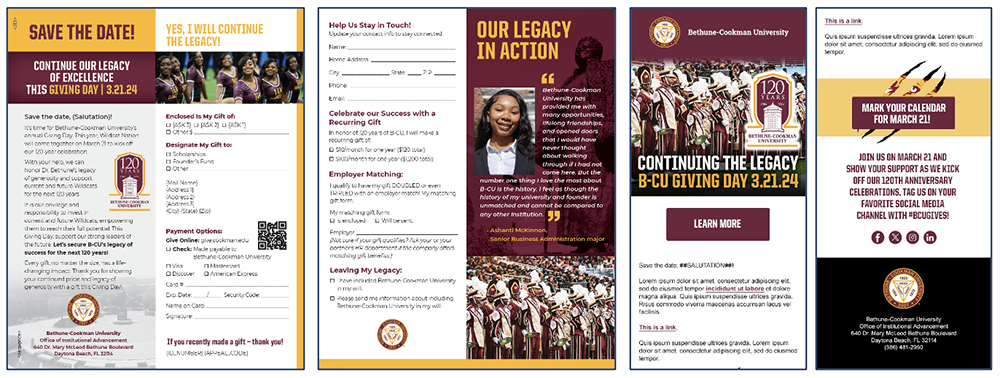
    Bethune-Cookman University: Giving Day Total Fund Raising/Development Campaign

    Bethune-Cookman University Giving Day mail and email campaign

    As an extension of Bethune-Cookman University’s advancement team, RNL developed Giving Day mail and emails inviting donors to honor Dr. Mary McLeod Bethune’s legacy. These eye-catching creative components showcased B-CU’s dynamic 120-year brand and emphasized the history of proud investments in Wildcat Nation.

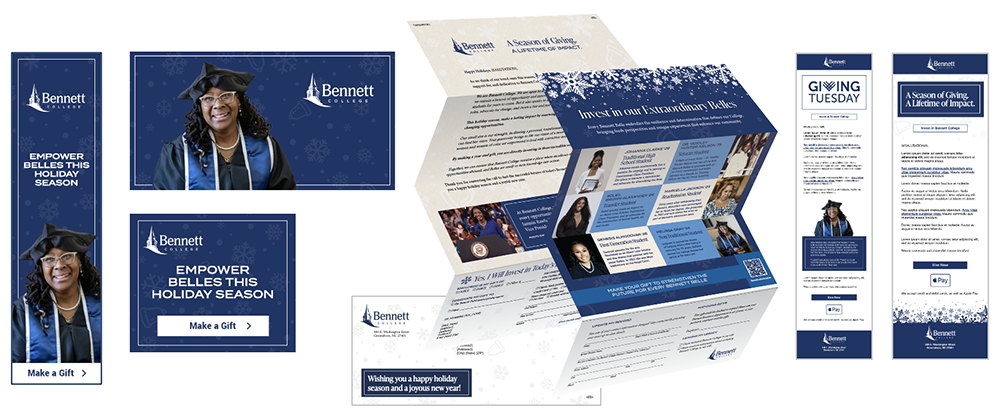
    Bennett College: CYE Total Fund Raising/Development Campaign

    Bennett College calendar year-end campaign for fundraising.Bennett College calendar year-end campaign for fundraising.

    Bennett College serves a broad variety of students, the diversity of which was highlighted in this calendar year-end campaign across mail, email and digital ads. The appeal warmly celebrated Bennett’s donors and alumnae to cultivate connection, while communicating donor impact by demonstrating how their investment in today’s Bennett Belles creates a more equitable future.

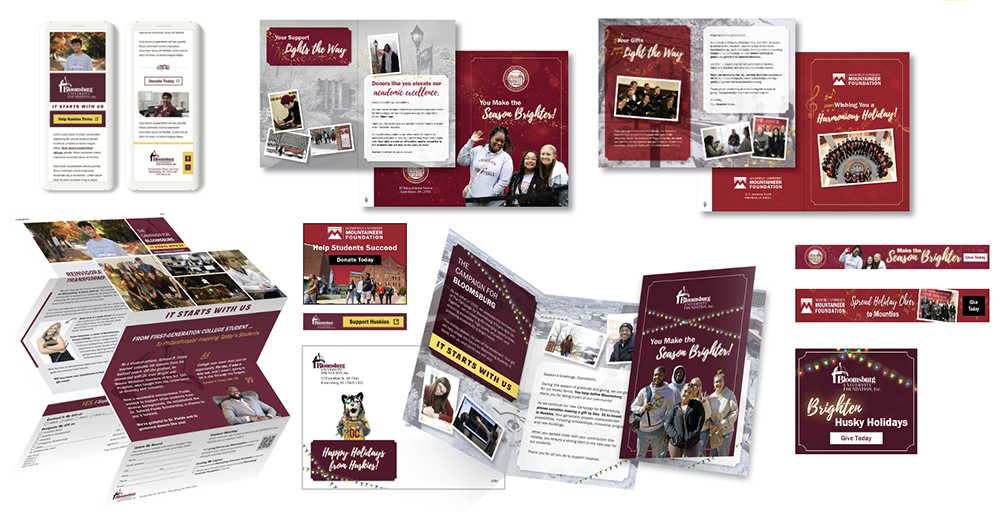
    Commonwealth University of Pennsylvania: End of Year Total Fund Raising/Development Campaign

    Commonwealth University of Pennsylvania year-end fundraising campaignCommonwealth University of Pennsylvania year-end fundraising campaign

    In RNL’s first year of partnering with Commonwealth University Foundation to solicit funds for three campuses—Bloomsburg, Lock Haven and Mansfield—RNL honed in on what makes each campus unique. For the Fall and Calendar Year-End appeals, our investigative writer identified feature stories to resonate with each unique audience while advancing each campus’s priority focus. Our design director created seasonal pieces, including holiday cards worthy of display and GivingTuesday 2024 designs with branding balanced between the campus and the global day of philanthropy.

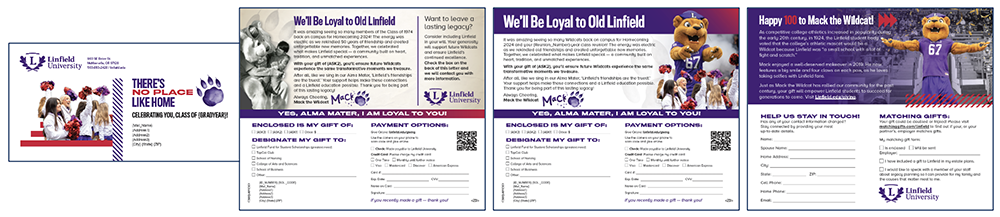
    Linfield University: Homecoming Special Event Campaign

    Linfield University homecoming fundraising appealLinfield University homecoming fundraising appeal

    In our third year of fundraising work with Linfield University, RNL helped develop the first Homecoming appeal of our partnership. Appealing to a 50-year reunion alumni segment, a vintage background texture and historic mascot photo inserted nostalgia. Our writer developed copy in the voice of Mack the Wildcat, and our designer created Mack’s signature from scratch, riding the energy of Homecoming to invite alumni support in a fun, engaging way.

    Wittenberg University: Calendar Year End Total Digital Marketing Program

    Wittenberg University Fundraising CampaignWittenberg University Fundraising Campaign

    The holidays are the most active time for fundraising, and RNL’s emails and digital ads for Wittenberg University pierced through the noise of the season. Leveraging Witt’s primary red and secondary teal colors, the campaign presents a strong, immediately recognizable brand while calling to mind Ohio winters with graphics and background photos from RNL’s Adobe stock account, expanding on the available assets and adding depth, texture and oodles of visual interest.

    West Virginia University: Donor Renewal Total Fund Raising/Development Campaign

    West Virginia University Donor AppealWest Virginia University Donor Appeal

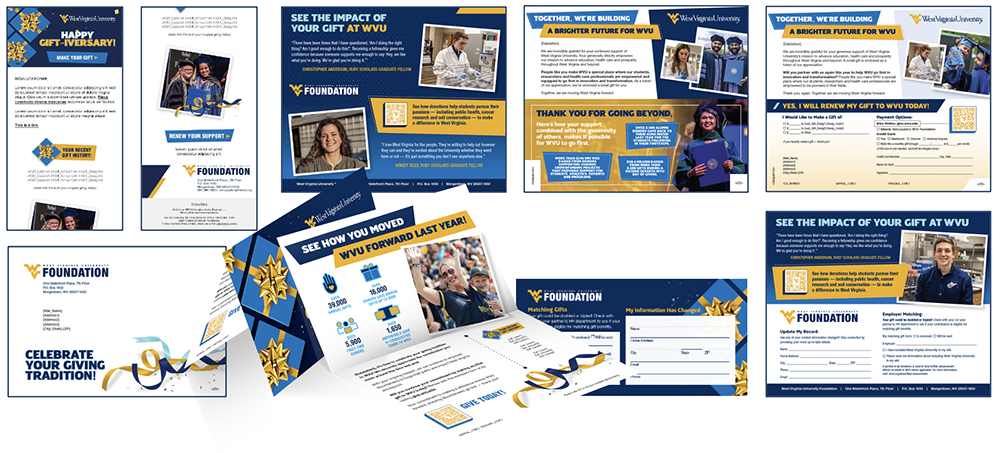
    Donors have been clear: Knowing how their generosity makes an impact increases their likelihood to continue investing in an institution. That’s exactly what these pieces did for West Virginia University’s donors. Through a mix of visually appealing quotes, facts and links to video stories, the WVU community saw how important their contribution is—and as a token of gratitude and an investment in retention, they received a window cling acknowledging their donor status for that year, which RNL has created with WVU annually since 2020.

    West Virginia University: FYE Direct Mail Appeal

    West Virginia University FYE donor campaignWest Virginia University FYE donor campaign

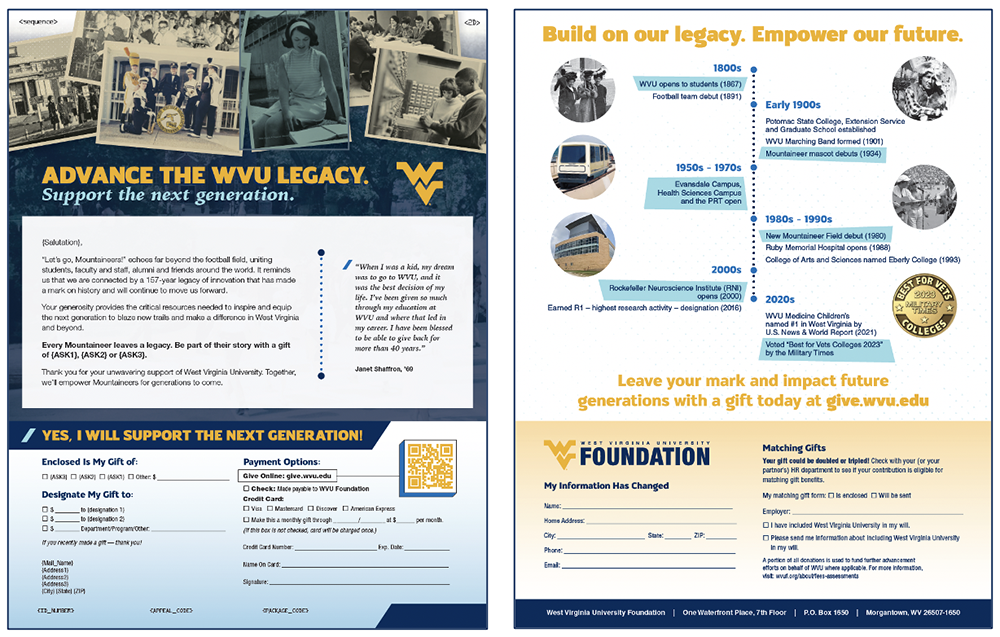
    During a time of transition, West Virginia University’s fiscal year end letter showcased how the university’s legacy set the stage for the future. With gradients and strategic placements, the RNL designer used bold brand colors to aesthetically balance the black-and-white photos and a timeline of historical milestones. With a broad audience spanning education, health care and community programs, the language and layout inclusively touches on a variety of key points to resonate with all.

    Ready for your award-winning fundraising campaign?

    RNL creates world-class fundraising campaigns for colleges, universities, healthcare institutions, and nonprofits. Find out how you can benefit from our award-winning creative, insightful analytics, and unparalleled fundraising expertise. Ask for a complimentary consultation.

    Request consultation

    Source link

  • Designing College Curricula for Student Success – Faculty Focus

    Designing College Curricula for Student Success – Faculty Focus

    Source link

  • Designing College Curricula for Student Success – Faculty Focus

    Designing College Curricula for Student Success – Faculty Focus

    Source link

  • Stewardship With Heart: Creative Ways to Show Donors You Care

    Stewardship With Heart: Creative Ways to Show Donors You Care

    What do you get when you add a stewardship crisis, two expert fundraisers, and a whole bunch of Valentine’s Day puns? RNL’s February webinar, of course! Earlier this year, RNL hosted an hour-long conversation featuring Miranda Fagley and Becca Widmer, where they unpacked their strategies for creating meaningful moments through stewardship.

    A tough heart-to-heart: The current state of the world

    With geopolitical conflict running rampant, a rocky economic state, and a rapidly shifting domestic political landscape, it’s no wonder donors are wary of the future. During this tough heart-to-heart, we unpacked the various factors that might make donors hesitate before opening their wallets in 2025, and took a deep-dive into how the state of the world is impacting our donors, and therefore impacting the state of philanthropy as we know it. From generational differences and the more dollars/fewer donors trend we have all experiences to evolving donor expectations, advancement leaders are facing unprecedented challenges as the goal-line seems to move every year.

    The heart of it all: A look at the donor data

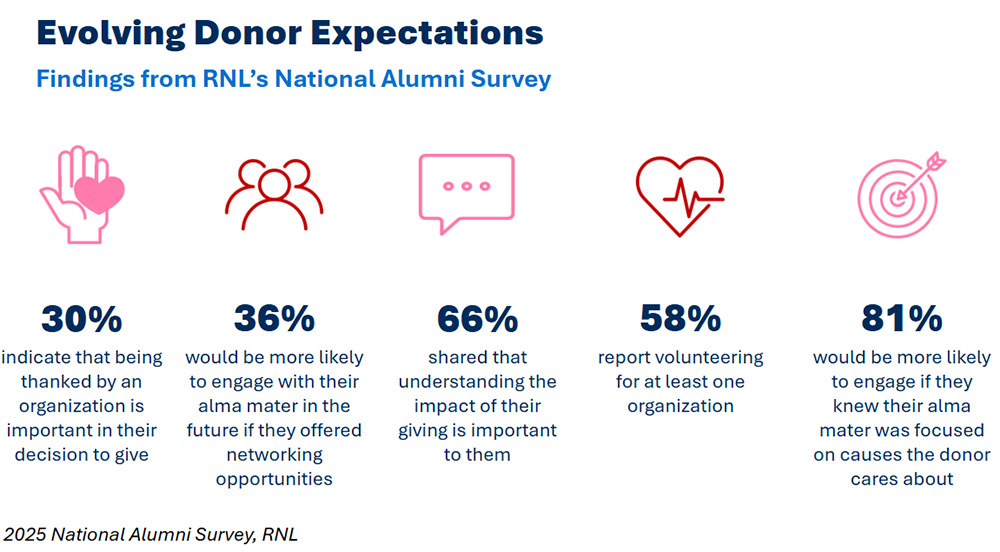
    Evolving Donor Expectations: stats from RNL's National Alumni Survey showing 30%​ of donors indicate that being thanked by an organization is important in their decision to give​

    Jumping into the “heart” of our conversation, we went straight to the source—donor expectations gleaned from RNL’s 2025 National Alumni Survey. We noticed a few alarming trends when comparing this donor expectation data with the 2024 Giving USA report, which analyzed giving trends when accounting for inflation across our sector. Total giving declined by 2.1% when adjusting for inflation and, while higher education saw a 6.7% increase in overall giving, even when accounting for inflation, donor numbers across the board were down. There is also an obvious mismatch between donor expectations and reality, as seen in our comparison of RNL’s 2024 Advancement Leaders Speak report with the 2025 National Alumni Survey. Take, for instance, the fact that 66% of donors indicated that understanding the impact of their giving is important to them. This becomes an issue when 43% of advancement leaders reported that their shops have difficulty communicating the impact of specific funds. Storytelling is the name of the game, and it is becoming clear that communicating impact is a key piece of the donor acquisition and retention puzzle.

    The broken hearts club: Under-stewarded donors

    Many advancement shops are unknowingly leaving a trail of broken-hearted donors in the wake of annual campaigns. Why is thoughtful stewardship important?

    1. Connecting donors to your mission and educating them on the impact of their giving is crucial to keeping donors interested in your priorities.
    2. Telling your story through a “thank you” is a great way to differentiate your cause and your need in comparison to other organizations in this increasingly noisy world.
    3. The simple act of reminding donors of your impact is a great way to retain donors and move them through your pipeline. The more you can encourage donors to see themselves in your mission and important work, the more likely you are to get them onboard as true donor-partners.

    On the flip-side, we unpacked that can happen if you don’t steward your donors well, including a shrinking pipeline, excessive spending when you do decide to attempt to reacquire them, and the loss of both short- and long-term revenue. Don’t be a heartbreaker!

    Uncovering donor love languages: Do you know your donors?

    Words of affirmation. Quality time. Acts of service. These are just a few love languages from Gary Chapman’s The Five Love Languages. Did you know donors have love languages too? It’s our job as mission-centric, donor-focused fundraisers to learn those love languages and lean into them through stewardship, relationship-building, and even solicitation.

    In our exploration of donor love languages, we unpacked the first level- generational differences. Hearts are broken generationally when we do not pay attention to context and communicated need. While not always “the answer,” generational segmentation and a slight shift of message can be a simple way to get to the “heart” of what a majority of your donors want and need from your stewardship outreach. And, as we continue to experience generational shifts and the great wealth transfer, leaning into generational values will become even more important to attracting and retaining donors.

    Another layer of love language exploration comes from you going straight to the source- your individual donors and what their giving history can tell you. We looked at one of RNL’s solutions for further discovering donor love languages, the RNL360, which offers an opportunity to dive into your database. By illustrating historic AND recent trends in giving and interaction, the RNL360 can provide you with a better understanding of giving and retention by donor type, an analysis of consistency and efficacy of your various giving channels (hello, smart investment in tools and campaigns!), and can help establish baseline metrics which can inform goal setting and future fundraising and engagement targets.

    We can theorize all day about what donor expectations are, but the purest source of truth is looking at donor data and asking donors to tell you what they want and need. That’s where RNL’s Market Research solution comes into play. A complementary component of the RNL360, this additional solution allows you to hear directly from your donors by way of a private, but not anonymous, survey administered by RNL, where you can learn more about your donors’ philanthropic priorities, communication preferences, and sense of connectedness.

    When it comes to effective stewardship and solicitation, knowledge is power.

    Engagement strategies with heart: RNL experts share their takes

    Our two experts shared their take on stewardship and engagement with heart, with overlapping themes of getting personal, telling your story, and taking the time to really listen to what donors are telling you they want to hear from you.

    Miranda’s take

    1. Get specific: steward in ways only YOU can.
    2. “Single” out your society members with a special ‘thank you.’
    3. Take the time to survey your donors- understand what you THINK will resonate and get feedback/confirmation from them.

    Becca’s take

    1. Put gratitude on repeat.
    2. Turn generosity to belonging.
    3. Keep impact front and center.
    4. Asking is omnichannel, so thanking should be too.

    Our main takeaways?

    1. Consider the landscape: context is everything
    2. Take a hard look at donor data:
    3. Understand the “why” behind stewarding annual donors: Tell. Your. Story.
    4. Get to know your donors’ love languages: ask your donors directly
    5. Steward in ways only YOU can: don’t be afraid to get a little wacky

    Want to learn more about the RNL360 and Market Research to uncover your donor love languages and steward more thoughtfully? Connect with an RNL fundraising expert today!

    Source link

  • The value of the classroom in building belonging for commuter students

    The value of the classroom in building belonging for commuter students

    As highlighted throughout the commuter student series, the significant increase in commuters across the sector is beginning to influence many institutional approaches.

    These approaches have been varied but have included projects like making space for commuter students on campuses so that they can maximise their time and comfortably immerse themselves in the university experience.

    However, against a backdrop of a cost-of-living crisis, a cost of learning crisis has taken hold. Given the complexities of commuter students’ lives and responsibilities and the increasing costs of commuting, the “sticky campus” model is not always a viable option as the shift to a more transactional approach is becoming more prevalent.

    What educators, student-facing colleagues and decision makers need to identify is how they ensure time on campus adds value to the commuter student experience.

    The classroom as central

    My PhD research focuses on the experiences of ethnic minority commuter students, and how they develop their identity and sense of belonging whilst at university.

    Much of the research has found that commuter students are more likely to be from ethnic minority backgrounds, have employed work and caring responsibilities and come from lower socio-economic backgrounds.

    Exploring the experiences of participants in my research has revealed how the experiences within the timetabled teaching classroom carries particular significance for commuter students.

    This intersectionality of characteristics further emphasises the heterogenous nature of commuter students, and that speaking to, and understanding the experiences of students will help to understand how we can ensure their university experience is the best it can be.

    Whilst ensuring all students develop the subject specific knowledge is considered to be top of the list of how we add value, ensuring the classroom provides a space for students to develop networks and their community is one of the ways the classroom environment can better support commuters.

    Commuter students are struggling to adapt to pedagogies and policies that are typically designed for students who have relocated. This has started to come to the fore in the responses from students who are perceiving significant value of their experience in the approaches adopted within the classroom.

    Findings from my research signify that a sense of belonging is felt by commuter students, both at a course and institutional level, and that sense of belonging is very much driven by the experiences they have in the classroom.

    Finding space to belong

    To develop this sense of belonging, students often mentioned the importance of space and time.

    They spoke about the need to have space and time within their timetabled session to catch up with peers, have the time to speak to academic and professional services teams face to face and to ensure that classroom activities link to the outcomes they are hoping to achieve. To assist in facilitating this, consideration around how taught sessions are delivered, building space into weekly module delivery to maximise the potential for students to get the most out of their time on campus can develop and help foster this sense of belonging and community.

    Commuters are constantly making cost-benefit calculations, tying with the transactional approach to education. And the richness of these connections, however short and sporadic, can provide valuable outcomes and develop this sense of community.

    Not participating in activities outside of the classroom is not perceived as negatively impacting on their experience, and nor does the act of commuting always limit their ability to engage in activities, but there is an opportunity cost that is often considered.

    Differing approaches amongst tutors can impact on the experience students encounter, and the findings from my research signify a correlation between those classroom encounters and the sense of belonging for commuter students.

    Identity searching

    The institutional identity is also particularly relevant given that the students who are commuting are likely to live within the region, and this further develops the potential affinity they have with their institution.

    My research speaks to the importance of commuter students’ feelings of “we are all getting the same experience and opportunity” in ensuring they are not left feeling disadvantaged.

    This is not to suggest that engaging in activities outside of the classroom are not of value to commuter students, the benefits of engaging in extra-curricular activities is often considerable to the majority of students. The holistic experience of being in university should, however, support in developing the capital of commuter students.

    The classroom should be a space where all students enjoy the learning opportunities that higher education offers, providing the platform on which the student experience is built.

    For commuter students in particular, this space and environment is becoming increasingly important in their overall journey.

    And if we are to ensure an equitable experience for all students, providing a classroom experience which not only focusses on subject content, but provides time and space for interaction and the building of individual identity and community can help support this journey.


    This blog is part of our series on commuter students. Click here to see the other articles in the series.

    Source link

  • Higher education postcard: UWE Bristol

    Higher education postcard: UWE Bristol

    Medieval England was full of guilds – chartered bodies often relating to a particular trade – which gave members rights.

    One such was the Society of Merchant Venturers in Bristol: although chartered in 1552, it traces its lineage back to the thirteenth century with mention of a guild of merchants in the city. The society had some sort of monopoly on maritime trade “beyond the seas”, which was clearly advantageous to the society’s members, and the society and Bristol prospered.

    In 1595 the society established a school for mariners’ children. Over the years this would have developed; and in 1894 it was re-founded as the Merchant Venturers’ Technical College, with very fine new buildings, including forced air heating and ventilation systems. The college burned down in October 1906 – “reduced to a mere shell”, in the words of the Western Daily Press.

    In 1909 University College Bristol received a royal charter, and became the University of Bristol. I’ll write about this another time, but for now, let’s note that the engineering section of the Merchant Venturers Technical College became part of the faculty of engineering of the university. This shows that it must have been of a reasonable standard; I wonder also if the fire, and the need to find new accommodation, played a part.

    After the second world war, responsibility for the college transferred to the local authority. The two sites it then occupied became two different colleges: the Bristol College of Commerce at Unity Street and the Bristol College of Technology at Ashley Down. On 31 August 1949, just above an article celebrating the possible return of clotted cream from Devon, the Western Daily Press noted that courses offered by the College of Commerce ranged “from shorthand to shipbroking, languages to librarianship, and export to general education.”

    Further change came in 1960, when the College of Technology split into two: the Bristol College of Science and Technology, and the Bristol Technical College. The former moved to Bath in 1965, becoming the University of Bath. And that is a story for another day.

    And now the era of the polytechnics was here, and Bristol Polytechnic was formed. The College of Commerce and the Technical College were joined in this by the West of England College of Art. And the technical college split one more time: the Brunel Technical College offered lower level programmes; the higher level activity became part of the polytechnic.

    As far as I can tell, this latter college had its roots in the Bristol Academy for the Promotion of the Fine Arts, which seemed to have admitted its first students in something like 1844, and was certainly involved in seeking tenders for a new building in 1855. It wasn’t one of the first government schools of design, although it appears to have been modelled on the same principles. In any event (and if I am wrong about this college, please do correct me in the comments!) it was by 1969 well established in Bower Ashton.

    The nascent polytechnic was spread over several sites in Bristol, and in 1970 plans were announced to develop a campus in Frenchay, at Coldharbour Lane. Over time much of the activity of the various campuses would move to Frenchay, but for now it was just plans: the campus opened in 1975.

    We now need to go down another historical byway: in 1976 two colleges of education were incorporated into the polytechnic. These were the Gloucester and Bristol Diocesan Training Institution for School Mistresses, founded in 1853 and latterly called St Matthias, and Redland College, an emergency teacher training college established in 1947. There’s an excellent brief history of St Matthias on the university’s website, including some great stories.

    In 1992 the polytechnic – along with all others – was given university status and became the University of the West of England. A familiar tale of rebuilding an campus consolidation took pace, with the St Matthias site ultimately closing; the aggregation of city centre sites into one city centre campus; the growth of activity at Frenchay, and the establishment of a campus in Swindon. In 2012 there was an ill-fated attempt to create a stadium to be used by Bristol Rovers and the university, but this came to nothing other than legal arguments with Sainsbury’s.

    UWE is now the thirteenth largest UK university by student numbers (2023–24 HESA data).

    And there we have the UWE story, or at least one telling of it. The Merchant Venturers Technical College is unique, I think, in having given rise to three different universities. And, as the Brunel Technical College still exists as part of the City of Bristol College, and as the City of Bristol College has a university centre, there’s always room for a fourth to be created.

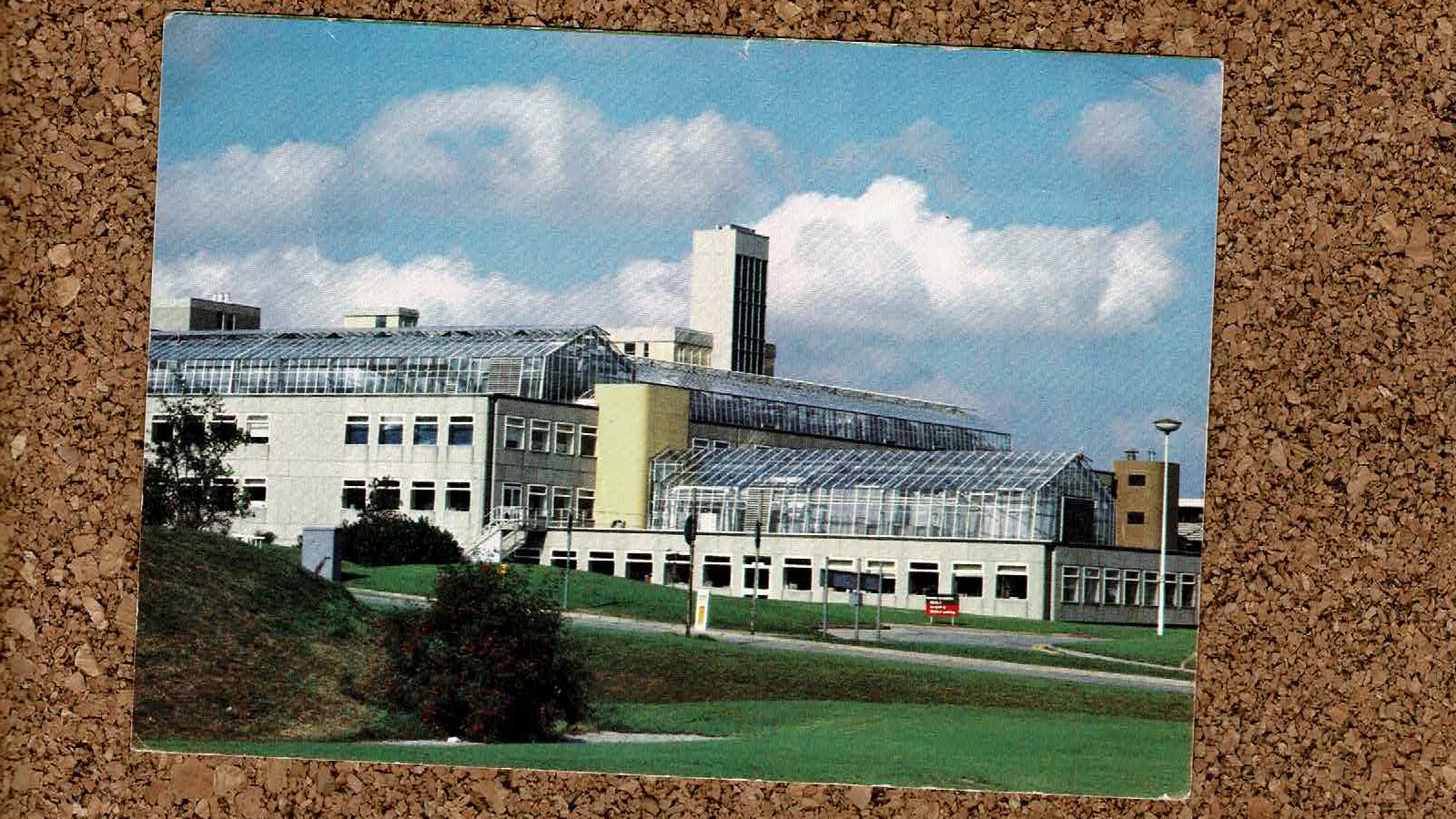
    The card was sent in 1988, addressed to David, c/o Mrs Williams, at St Martin de Porres school in Luton. David was Mario Morby’s father; Mario had cancer and was collecting postcards to try to get a world record. The LA Times has a good write up; happily it seems that Mario survived the cancer, and got into the Guinness Book of World Records.

    Here’s a jigsaw of today’s card for you to enjoy. And a bonus jigsaw of the St Matthias campus which is, frankly, quite challenging.

    Source link