Category: Featured

  • Building Bridges: Enhancing employability through practically-based higher education

    Building Bridges: Enhancing employability through practically-based higher education

    In the last few weeks we have heard the worrying news that the number of young people aged 16 to 24 not in education, employment or training (NEET) in the UK is close to one million. This is almost 300,000 higher than the same period in 2021 when the UK was contending with the scarred job market after Covid-19.

    The reasons for this trend are multi-faceted, including factors such as mental health issues and insecure and poor employment opportunities. However, in the face of a difficult and competitive job market, universities have their role to play in bridging this divide between higher education and the workplace.

    The need for innovative approaches to bridge this divide by enhancing graduate employability and addressing employer demands for work-ready graduates has never been more pressing. Recent research by the Edge Foundation, in collaboration with UCL’s Institute of Education, sheds light on the transformative potential of practically-based higher education models.

    The research took a case study approach using qualitative methods, looking at two post-92 higher education institutions in England, which included collecting empirical data using semi-structured interviews with a range of stakeholders from the two universities, including members of the senior leadership teams, teaching staff, other professionals and students. In this blog, I will go on to discuss some of the key findings from this research, including some of the challenges and opportunities for universities.

    Supporting employability through collaboration

    The creation of new staff roles has been pivotal in driving the employability agenda. These roles focus on developing opportunities such as placements, mentorships, and employer engagement, while traditional academic roles are evolving to integrate practical, work-focused elements. This holistic approach ensures that curricula are not only theoretical but also aligned with real-world applications.

    Industry partnerships play a crucial role in this effort. By involving industry advisors in curriculum design and creating spaces for students to engage directly with professionals through projects and networking, universities are building a meaningful ecosystem that bridges theory and practice. These collaborations enhance students’ employability and foster sustainable partnerships between education and industry.

    Creating effective learning spaces

    Diversifying learning spaces, both formal and informal, is important to ensure that students are not only taught subject-specific expertise but also equipped with the skills to effectively apply such knowledge in real-world contexts. From practical lab work and virtual simulations to client-facing projects and digital tools, these approaches provide students with hands-on, career-relevant skills. Broader assessment methods – like portfolio work, project-based evaluations, and even film development – align better with employer expectations, allowing students to showcase critical thinking, creativity and applied knowledge.

    Students highlighted how these methods built their confidence – often cited as a key attribute for career success. Exposure to professionals through guest lectures, career fairs and mentorship programmes was particularly impactful in empowering students to navigate the complexities of their future careers.

    In the case study universities, confidence building and the development of transferable skills were further integrated into the curriculum through interpreting and tailoring practice to the sector that is relevant to individual students. Therefore, all courses were developed and updated in line with students’ ‘pathway to professionalism’.

    Yet this is manifested differently for different disciplines to ensure it is relevant and closely links the theory to practice. For example, in the business school at one of the case study universities, students establish a LinkedIn profile and begin to form professional networks through it whilst at university.

    By contrast, the professional landscape exists very differently in arts and media, with professional networks being established in different ways. Students in arts are taught the skill of networking in person and conversational skills. Activities in this discipline have included practice dinner parties with the aim to collect others’ business cards. The activities in these two examples are vastly different, but both help build the social capital of the student, which has the most currency for their industry.

    The challenges and opportunities ahead

    While we witnessed in our case study universities a promising shift towards a practical and collaborative model, challenges remain. Employer engagement, for example, can be fragmented when universities rely on individual academic links without coordinated efforts. Listening to employers as equal partners and ensuring mutual benefit is critical for sustained collaboration.

    Universities must also balance top-down initiatives with bottom-up innovation, ensuring that work placements and experiences are meaningful and adaptable. Structured dialogue and collaboration between all stakeholders—students, educators and industry partners—are vital to refining these opportunities.

    A vision for the future

    As the job market evolves, the traditional academic model must adapt to meet the demands of employers and the aspirations of students. Practically-based HE models offer a pathway to achieving this balance, ensuring that graduates are not only knowledgeable but also work-ready. In today’s dynamic and rapidly changing workplace, employability is no longer confined to the domain of careers service teams. Instead, it has become a strategic priority embedded across all disciplines and interwoven into teaching and learning. The findings shed light on how universities are reimagining employability as a broader part of their agenda, through fostering collaborations and creating innovative pathways between academia and the workplace.

    Furthermore, this research explores how universities can integrate theory and practice to better prepare graduates for the workforce. By fostering collaboration between academia and industry, these models not only enhance employability but also empower students with the confidence and skills needed to thrive in a dynamic job market. As students pursue diverse goals through their education, universities are tasked with striking a balance between career-focused preparation and academic enrichment. By embedding employability throughout the curriculum and fostering collaboration across industries, higher education institutions can empower students with the skills, confidence, and connections they need to succeed.

    Source link

  • Can We Teach Talent? How Mindsets Can Foster Entrepreneurial Success – Faculty Focus

    Can We Teach Talent? How Mindsets Can Foster Entrepreneurial Success – Faculty Focus

    Source link

  • Can We Teach Talent? How Mindsets Can Foster Entrepreneurial Success – Faculty Focus

    Can We Teach Talent? How Mindsets Can Foster Entrepreneurial Success – Faculty Focus

    Source link

  • Building a public transport agenda for commuter students

    Building a public transport agenda for commuter students

    If you have been to Greater Manchester in the last few years, you will have noticed that more and more yellow buses have started to appear.

    The Bee Network fully launched across the region on the 5th January 2025 – the yellow bus takeover is now complete.

    When all buses in the region became a part of the Bee Network – the integrated transport network for Greater Manchester – this was a significant moment for the city’s devolution journey. It became the first place in England, outside of London, to have buses back under public control.

    One of the Greater Manchester Student Partnership’s (GMSP) priorities is to improve students’ experience of transport across the region, the launch of the Bee Network is a key opportunity to make that happen.

    Institutions often define commuters differently and in Greater Manchester we already have a large proportion of students “traditionally” commuting. However traditional residential students are living further away from campus due to rising costs and are more reliant on public transport to get to classes.

    The GMSP has been thinking about how we can use the Greater Manchester Combined Authorities’ powers to support commuter students in their widest of definitions.

    A backdrop of devolution

    Since the coalition government of the early 2010s, devolution has been growing and Greater Manchester and the West Midlands have been the guinea pigs of the plan.

    Putting buses back under public control was a large part of the devolution deals and settlements, with the Bus Service Act 2017 being introduced so regions can take back control of buses.

    For context, in the 1980s bus travel in the UK was deregulated – anyone with a licence and a bus could run any bus service they wanted. The act allows Metro Mayors and in the future local authorities to franchise bus services. In doing so they can set up routes, tickets and costs for bus operators to bid for.

    Andy Burnham, the mayor of Greater Manchester, got the ball rolling on this quickly.

    In the 2024 general election, Labour had promised more devolved powers for regional mayors that have already been elected. In December, the government announced the Better Buses Bill which will give more powers to local authorities to own their own bus companies.

    Students use buses to get around their city but commuter students are not just reliant on buses, they are also reliant on trams and trains and other forms of transport.

    Building a student city

    The new bus fare cap rising will be a further strain on student cost of living and inevitably impact on student engagement on campus – for traditional commuters and residential students. The benefits of a mayor and devolved transport powers mean that isn’t the case here, fares are staying put at £2.

    As of last month, if you “tap in” on the tram and the bus with your contactless card, it all falls under the same ticket.

    This again is welcomed by GMSP, but this does not reduce the price of students who have to travel on both modes of public transport.

    This improves accessibility but not necessarily affordability.

    If they take multiple journeys a week on both a tram and a bus, it will cost £41. There is currently no student rate on trams or on the “tap in” system that is about to be introduced.

    From December 2026 until December 2028, the Bee Network will gain control of eight major commuter train lines. Greater Manchester could then become the best city for student public transport in the country, but only if Transport for Greater Manchester (TfGM), universities and student unions work together.

    Busy making promises

    The GMSP has been advocating for cheaper, more reliable transport with the mayor and TfGM.

    In 2022, officers from GMSP wrote to the mayor asking for a £1.50 bus single for all students. The mayor responded by saying that although he wanted to do something like this, until he had full control on the Bee Network, that would not be possible.

    In the mayor’s 2024 mayoral election manifesto, he announced at a mayoral hustings for students that he was to introduce a 18-21 monthly half price bus pass, bringing down the cost from £80 to £40.

    This was welcomed by GMSP to an extent, but we recognised that a lot of students, especially commuter students, do not fall into this category. And termly student tickets that are already on offer would work out cheaper for most students anyway.

    Since the Bee Network fully launched, we have seen no sign of this offer appearing.

    Student transport agenda

    The big question is, how can the universities, student unions and transport authorities work together to make life better for commuter students?

    Whilst we’re lucky in Greater Manchester to have a forum to meet with and discuss things like patronage, pricing and safety, getting all partners into the room is not as easy.

    We have big plans to make Greater Manchester the best place to be a student, and to do that we need to think big with things like creating a student living and staying strategy for the city region.

    This would bring together all these partners to create a long-term strategy for students in the city region, with one of themes being transport. Having these three partners working together is key for the success of any long-term transport strategy in the region.

    TfGM holds a lot of the power, including data on patronage and which routes students are using the most. Universities hold influence and potential financial influence, which could be beneficial for introducing new routes and discounting prices for students.

    Universities have a lot of data about students, especially on where they live, and that information could be used to target key routes for commuter students. And student unions are important as the voice of students.

    One of the mayor’s key aims for students in Greater Manchester is retaining talent. An element of this is making the Greater Manchester universities more attractive for potential students from Greater Manchester. If you want to make local universities more desirable for commuter students, improving the reliability, access and price of transport would go a very long way.

    Whilst Greater Manchester has a unique opportunity to improve the commuter student experience, more devolution is on its way. In the meantime, the more connections and collaborations that exist between local authorities, universities, student unions and transport providers, the better.

    Collaboration is key to making these ideas a reality and in building transport strategies in university towns and cities, commuter students need to be at the heart of decision making.


    This blog is part of our series on commuter students. Click here to see the other articles in the series.

    Source link

  • HESA has published full student data for 2023–24

    HESA has published full student data for 2023–24

    The 2023-24 HESA student data release was delayed by three rather than six months this year.

    We’re clearly getting better at dealing with the output (and the associated errors) of data collected through the HESA Data Platform. While there are not as many identified issues as in last year’s cycle the list is long and occasionally unnerving.

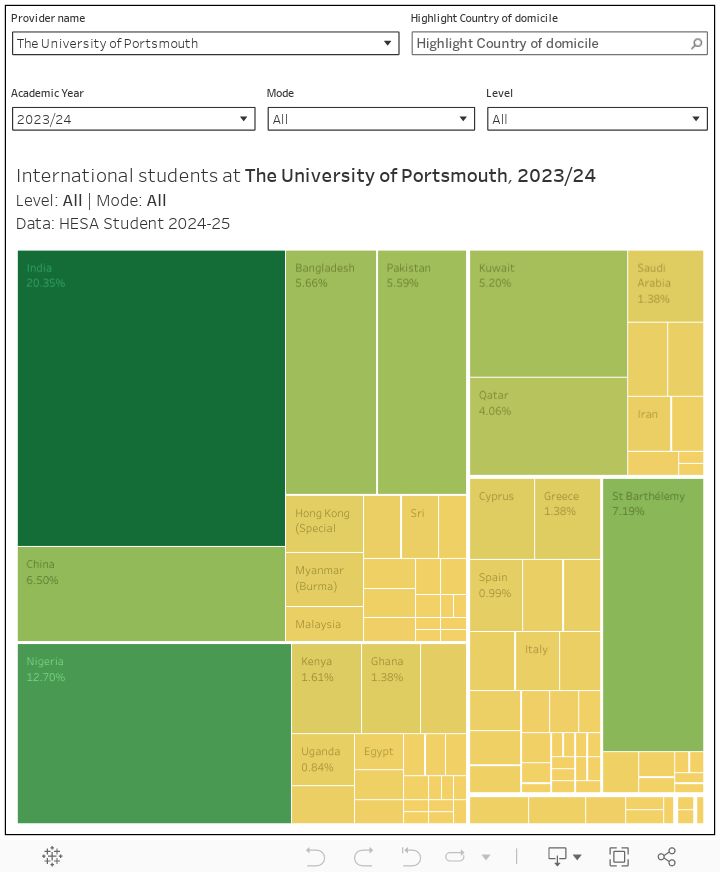
    Some represent a winding back from last year’s errors (we found 665 distance learning students at the University of Buckingham that should have been there last year), some are surprisingly big (the University of East London should have marked an extra 2,550 students as active), and some are just perplexing: the University of South Wales apparently doesn’t know where 1,570 students came from , the University of Portsmouth doesn’t actually have 470 students from the tiny Caribbean island of St Barthélemy.

    Access and participation

    It is surprising how little access and participation data, in the traditional sense, that HESA now publishes. We get an overview at sector level (the steady growth of undergraduate enrollments from the most deprived parts of England is notable and welcome), but there is nothing by provider level.

    [Full screen]

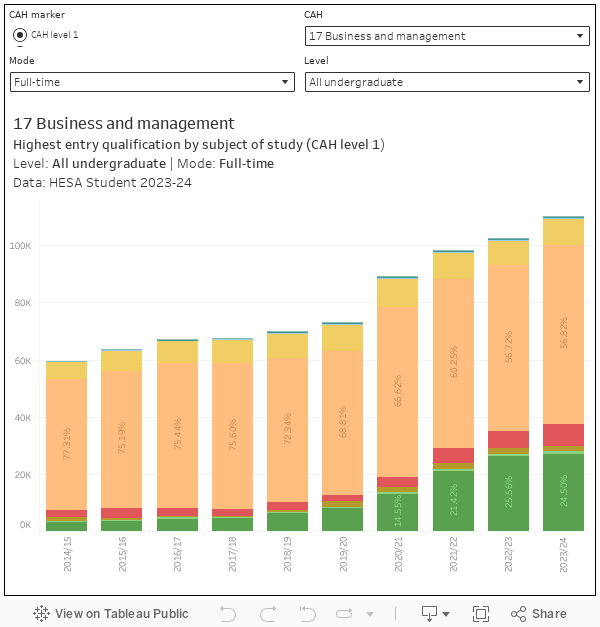
    One useful proxy for non-traditional students is entry qualifications. We get these by subject area – we learn that in 2025 a quarter of full time undergraduate business students do not have any formal qualifications at all.

    [Full screen]

    With the UK’s four regulators far from agreement as to what should be monitored to ensure that participation reflects potential rather than privilege, it’s not really worth HESA publishing a separate set of UK wide statistics. The closest we get is SEISA, which is now official statistics. I look forward to seeing SEISA applied to UK-domiciled students at individual providers, and published by HESA.

    Student characteristics

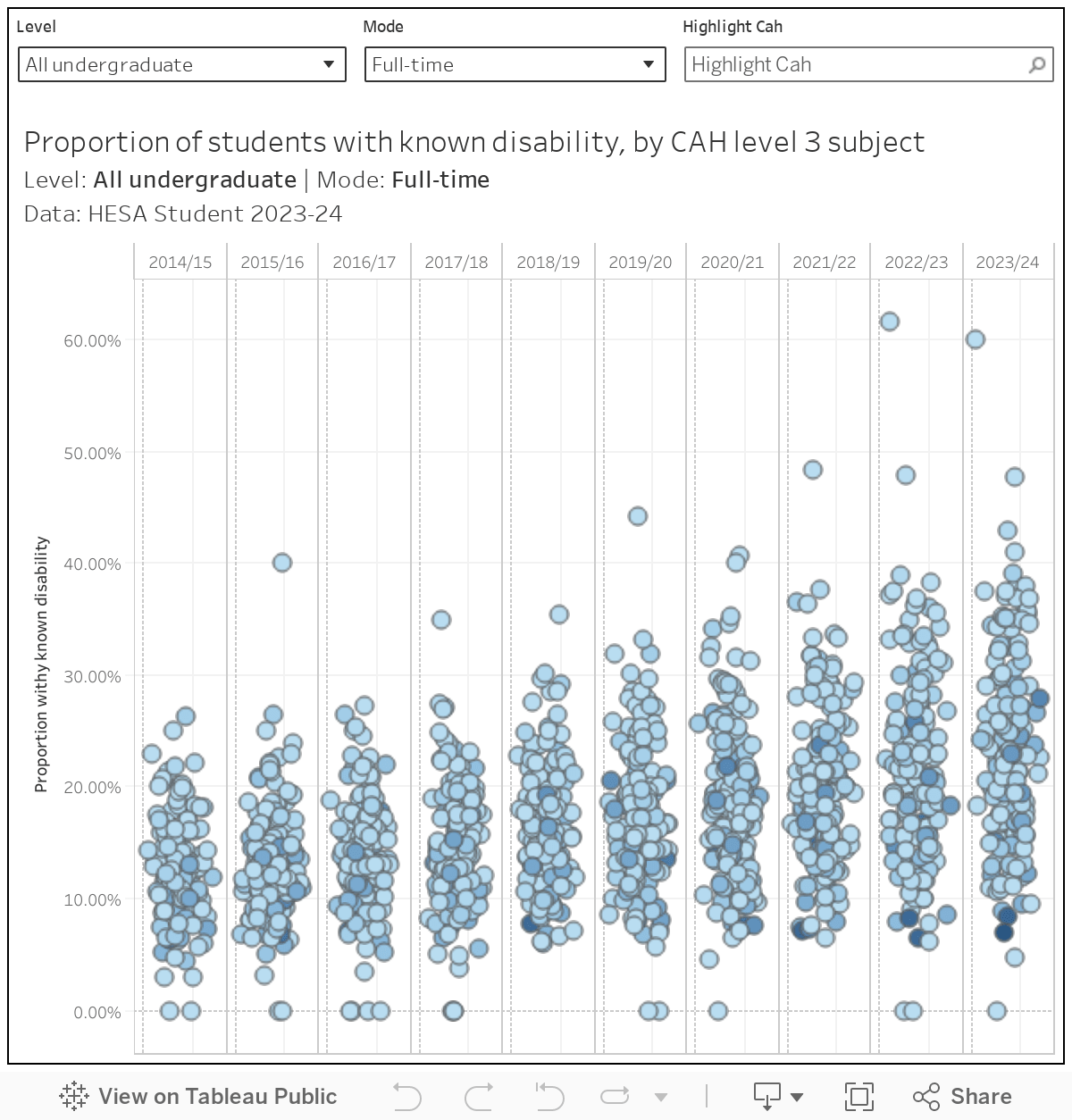
    We get by subject area data on disability (at a very general, “marker” – known disability – level) which I have plotted on a by year basis. The axis here is the proportion of students with a known disability – the colours show the total number of students. For me the story here is that creative subjects appear to attract students who disclose disabilities – art and creative writing in particular.

    [Full screen]

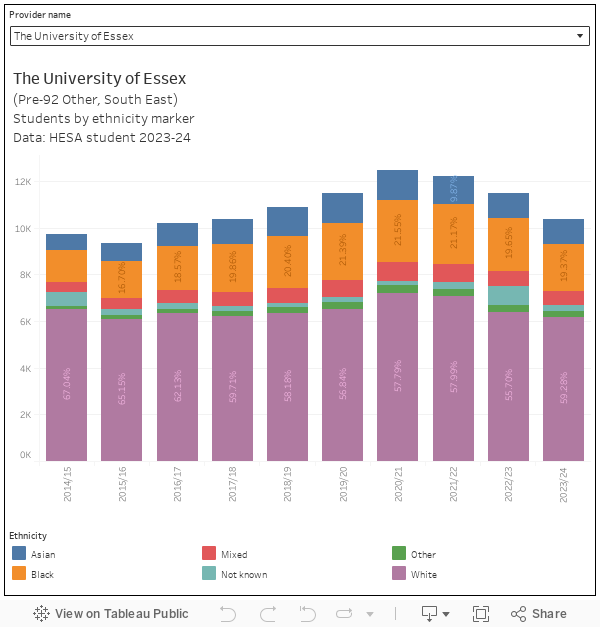
    I’ve also plotted ethnicity by provider, allowing you to see the ways in which the ethnic make up of providers has changed over time.

    [Full screen]

    Student domicile (UK)

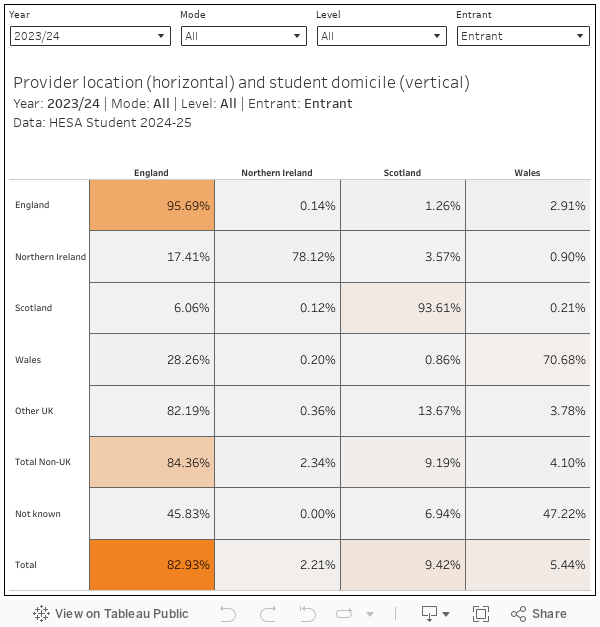
    UK higher education includes four regulated systems – one in each of the four nations. Although in the main students domiciled in a given nation study at providers based in that same nation, there is a small amount of cross-border recruitment.

    [Full screen]

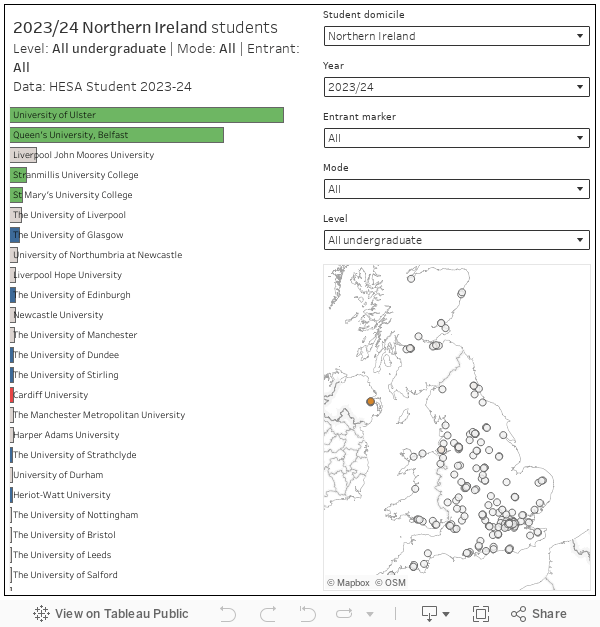
    Notably nearly three in ten Welsh students study at English providers, including more than a third of Welsh postgraduates. And two in ten Northern Irish students study in England. The concern is that if you move to study, you are less likely to move home – so governments in Wales and Northern Ireland (where there are student number controls) will be thinking carefully about the attractiveness and capacity of their respective systems to avoid a “brain drain”.

    Within these trends, particular providers have proven particularly efficient in cross-border recruitment. If you are a Northern Irish student studying in England chances are you are at Liverpool John Moores University, Liverpool, or Northumbria. If you are Welsh and studying in England your destination may well be UWE, Bristol, Chester – or again, Liverpool John Moores.

    There is a proximity effect – where students are crossing the border, they are likely to stay close to it – but also (if we look at Northern Ireland domiciled students looking at Glasgow or Newcastle) evidence of wider historic cultural links.

    [Full screen]

    Student domicile (international)

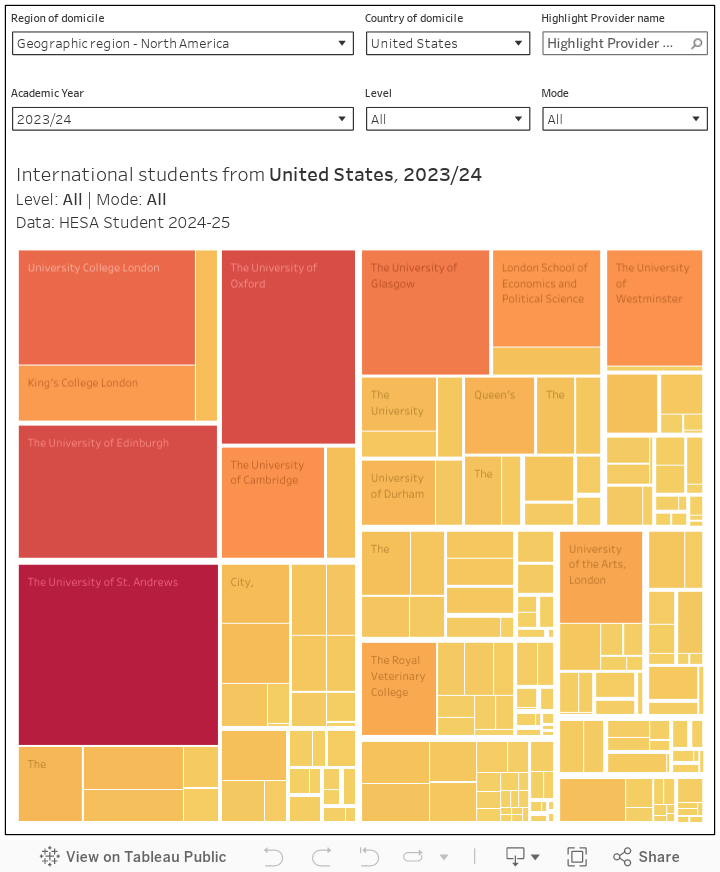
    Thinking about providers recruiting from Northern Ireland made me wonder about students from the Republic of Ireland – do we see similar links? As you might expect, the two larger providers in Northern Ireland recruit a significant share, but other winners include the University of Edinburgh and St Margaret’s. UCL has the biggest population among English providers.

    You can use this chart to look at where students from any country in the world end up when they study in the UK (I do insist you look at those St Barthélemy students – literally all at the University of Portsmouth apparently).

    [Full screen]

    An alternate view lets you look at the international population of your institution – the established pattern (China in the Russell Group, India elsewhere) still holds up.

    [Full screen]

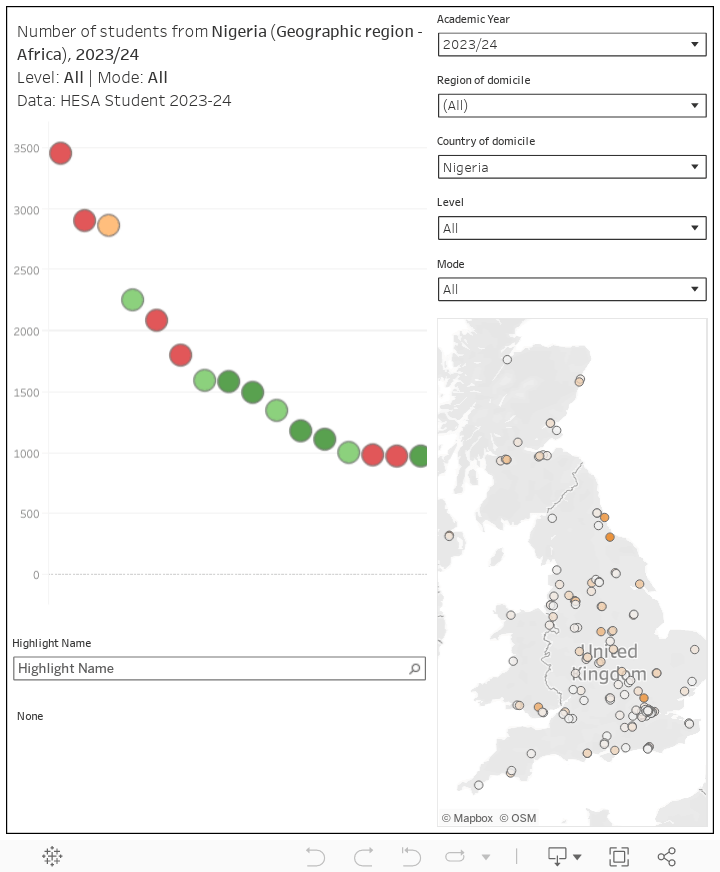
    What’s of interest to nervous institutional managers is the way international recruitment is changing over time. This is a more complicated dashboard that helps you see trends at individual providers for a given country, seen along with how your recruitment sits within the sector (mouse over an institution to activate the time series at the bottom.

    [Full screen]

    Source link

  • Podcast: Regret, ABA, provider collapse

    Podcast: Regret, ABA, provider collapse

    This week on the podcast we discuss new research on student regret, as a report from the University of Bristol reveals that while two-thirds of current undergraduates are happy with their choice of degree, it drops to less than half among recent graduates. Are improved advice and guidance really the answer?

    Plus we look at the collapse of the Advanced Business Academy (ABA) and its aftermath, as an Office for Students (OfS) investigation uncovers serious concerns about student placements and course delivery. And we examine new research on widening participation “cold spots” and the stark disparities in teachers’ expectations for students based on geography and school ratings.

    With Mary Curnock Cook, non-executive in education and edtech, Pete Quinn, inclusion consultant, Mack Marshall, Community and Policy Officer at Wonkhe and presented by Jim Dickinson, Associate Editor at Wonkhe.

    XXXXX

    Hindsight is a wonderful thing – but foresight is better

    When tuition fee payments are suspended, what happens to students left behind?

    25 unanswered questions about the collapse of ABA

    The UPP Foundation is launching a new inquiry into widening participation to support the government’s opportunity mission

    Students can make a real difference to educational opportunity in their regions through tutoring

    Source link

  • Thirty ways for DfE to deliver the manifesto and raise the standards of teaching

    Thirty ways for DfE to deliver the manifesto and raise the standards of teaching

    At some point we might get some actual higher education policy out of the Department for Education (DfE), rather then endless crackdowns on the “long tail” of the market.

    There’s rumours of a (next) TEF delay which we might assume ministers will take an interest in, and a signature manifesto commitment on “raising the standards of teaching” to deliver.

    It all raises the question – what should Labour’s agenda on teaching be? How might it realise it? What levers will it pull?

    Of course it’s the case that whatever the agenda, there’s a need for the right funding systems (for both students and providers) and regulatory architecture – and those will always dominate the discussion.

    But you’d like to think there were other things, too.

    Reinstate the QAA as the Designated Quality Body for England

    A nice and easy start – DfE should issue ministerial guidance directing the Office for Students (OfS) to re-designate the QAA as the primary quality assurance body. The QAA has long maintained international credibility and alignment with European standards – something England has steadily drifted away from since Brexit.

    It’s not just a technical concern – it threatens the international recognition of English qualifications at precisely the moment when global educational mobility is increasing. OfS has tried to go it alone on quality – the experiment has failed. No shame in admitting it.

    Re-establish periodic review and enhancement expectations

    DfE should direct OfS to develop requirements for periodic review through regulatory guidance, with funding for QAA to develop a new enhancement framework appropriate for England’s context.

    One of the quietest casualties of England’s regulatory experiment has been the loss of enhancement culture. Where periodic review encouraged reflection and improvement, the pendulum has swung decisively toward compliance and risk-management. England now lags behind Scotland, Wales, and Northern Ireland, where enhancement remains central to quality regimes. We now have a sector where teaching innovation happens despite, not because of, the regulatory framework. It could be different.

    Scrap the current TEF and implement subject-level TEF based solely on metrics

    First, abolish continuation as a metric that somehow represents “teaching quality”. We’re so good at it internationally that it’s starting to look like kidnapping, and seriously harms the sort of flexibility envisaged in the LLE or required from our breathtaking levels of decision regret.

    Then DfE should issue guidance to OfS to develop a revised, metrics-based TEF framework operating at subject level. As currently constituted, the TEF neither drives genuine improvement nor provides meaningful information to prospective students. A subject-level TEF grounded in robust metrics would offer more granular insights while slashing the cost and reducing the burden of institutional storytelling that has become the hallmark of the current approach.

    And it would prevent what is likely to be a key “misleading practice” issue under the DMCC act – a “TEF Gold” banner appearing over the door of a faculty whose metrics would suggest a requires improvement rating.

    Regulation for the struggling, enhancement for the thriving

    A simple distinction should be made in the approach to quality. For provision failing to meet minimum standards (below B3 thresholds), robust regulatory intervention through OfS remains appropriate. More boots on the ground if anything. However, for provision meeting or exceeding these standards, we need to shift from compliance-checking to enhancement-driven approaches led by the QAA.

    In other words, let OfS carry on its inspections against minimums when its thresholds aren’t met at subject, provider or subcontractual status level, and let quality assurance and enhancement via the QAA sit alongside it for everyone and everything else. Neat.

    Require publication of external examiner reports

    External examining is one of the oldest, most trusted mechanisms for maintaining academic standards in the UK and causing collaboration between universities – but it has become increasingly invisible. Reports are buried in back-office systems, rarely seen by students, and seldom discussed publicly.

    DfE should ask OfS to require the publication of external examiner reports, ideally with departmental responses. Visibility would encourage honest, critical engagement with standards, and bring students into the conversation about academic quality. After all, if someone outside the course is checking the quality, why shouldn’t those taking it see what they say?

    Establish targets and metrics for staff teaching training

    Universities are packed with subject experts, but expertise in a field doesn’t automatically translate to expertise in teaching it. The uneven distribution of pedagogical training and teaching qualifications means students experience wildly different teaching quality depending on their course, their institution, and sometimes just luck of the draw.

    OfS should be asked to introduce and publish metrics on staff development, making it clear which institutions invest in teaching capacity. Yes – an input measure! One that students actually want.

    Require compulsory module evaluations with visible results for loan-funded modules

    Every module of credit that accrues a loan charge should be accompanied by a compulsory evaluation, with results that students can see – including action taken in response to previous feedback. A “comply-or-explain” expectation would transform the granularity of information available to students making module choices under the Lifelong Loan Entitlement, and improve teaching. DfE should ask OfS to apply one.

    If students are paying for it (and increasingly borrowing for it), they deserve to know what they’re getting. Student reps can then work with the data and work with departments on problem-solving instead of being asked to supply feedback themselves.

    Reduce the number of subject benchmark statements

    The current proliferation of subject benchmark statements has created a rigid and prescriptive framework that stifles innovation and interdisciplinarity. If they were reduced and broadened, there would be more space for flexible curriculum design that responds to emerging fields and changing student needs. That’s about defining quality and standards in ways that encourage creativity and adaptation – rather than compliance and conformity. The EU is hurtling in this direction anyway – would be nice to… align at least. That should go in the ministerial direction letter too.

    Convene a partnership between NUS and SUs for national student-led teaching awards

    Student-led teaching awards have become an important feature at most universities, celebrating innovative and impactful teaching practice. But their impact remains localised, with limited opportunities to identify and share learning across the sector.

    A national event via a DfE-convened partnership would elevate the student voice in defining teaching excellence, create powerful incentives for innovation, be a good PR opportunity for the sector and the department, and offer a rich source of data on what works for students. It could even be held in 20 Great Smith St to drive down the cost.

    Direct OfS to mine NSS free text responses for insights

    The quantitative metrics of the National Student Survey tell only part of the story, and OfS is sat on a couple of decades of hidden intel – free text comments contain rich insights into student experiences that are currently underutilised.

    With appropriate anonymisation and ethical safeguards, comments could identify emerging concerns, highlight innovative practice, and provide a more nuanced understanding on good teaching that numbers alone cannot capture. Another one for the letter.

    Establish a clear definition of learning gain

    Despite extensive discussion about “learning gain,” there’s no clear consensus on how to define, measure, or evaluate it. The ambiguity undermines meaningful comparison and improvement – so establishing a clear, shared definition, focused not just on knowledge acquisition but on skill development, mindset shifts, and capability building means we’ll get a meaningful framework for universities to then further define for assessing educational value and building degree transcripts. “Dear Susan and Edward, we expect…”

    Establish a regulatory domain focused on “learning environment”

    Currently, various aspects of the learning environment – mental health support, physical spaces, digital infrastructure, library resources – are regulated through bafflingly disconnected processes. The fragmentation creates bureaucratic burden – despite this stuff being essential underpinners of good teaching and learning.

    Asking OfS to establish “learning environment” as a distinct integrated regulatory domain (like it is in most other countries in Europe) would mean a rounded approach – recognising how these elements interact to shape student experiences and outcomes, and clocking that a lot of good learning is self-directed. It would also allow for more proportionate, context-sensitive regulation while maintaining a focus on student needs and concerns.

    Establish a TASO equivalent for teaching enhancement

    England needs its own equivalent to Scotland’s Quality Enhancement Framework – a body akin to TASO (Transforming Access and Student Outcomes) that can convene national conversations, fund pilots, and broker communities of practice around teaching improvement.

    Maybe QAA gets to do it, maybe Advance HE. Maybe someone else. But it’s needed nationally, probably at subject level, and should involve students drawn from academic societies. Can’t DfE convene something? It should CETL for nothing less.

    Push for associate membership of European University Alliances

    Brexit has left UK higher education increasingly isolated from European teaching networks, particularly the European Universities Initiative. They are building the future of cross-border education – shared degrees, joint quality standards, collaborative innovation – while England watches from the sidelines. DfE should push for associate membership of these initiatives to ensure English universities (and their student leaders) are plugged into the networks where the most exciting teaching innovations are emerging.

    Implement DfE approval for franchising arrangements based on qualitative criteria

    DfE should establish a dedicated unit with oversight powers for franchising approvals, with clear guidance on acceptable quality thresholds – as friends in FE somewhere in Great Smith St do. The proliferation of “business/cities” subcontracted provision has created regulatory blind spots where quality can quietly deteriorate – so DfE should hold approval rights for these arrangements based on demonstrable need, track record and quality assurance, not just market opportunity.

    Apply the OfS fairness condition universally across the sector

    DfE should instruct OfS to implement its proposed new fairness condition without exemptions through clear ministerial guidance, requiring equal application regardless of provider type or history. If we’re not careful, we’ll focus regulatory attention on newer providers while established institutions escape scrutiny.

    If a student at Oxford experiences the same poor practice as one at a small private provider, shouldn’t they have the same protections? Fairness cannot be conditional based on institutional prestige or history – either students have rights to good teaching, or they don’t. They do.

    Establish university-level ombuds and a duty to learn from complaints

    DfE should fund a pilot programme for university-level ombuds, followed by regulatory requirements through OfS. The duty to learn from complaints would be implemented through revised regulatory conditions requiring public reporting of complaint outcomes and resulting changes. University-level ombuds – independent officers with investigatory powers and public reporting requirements – could transform how institutions respond to student concerns.

    Rather than treating complaints as irritants to be managed, they would become valuable sources of insight for improvement. OfS should also establish a duty for universities to publicly report on what they’ve learned from complaints and appeals (both uphelds and others), and how practice has changed as a result.

    Require OfS to respond to the National Student Survey each year

    DfE should issue ministerial guidance requiring OfS to produce an annual NSS response document with clear action points – identifying trends, highlighting innovative approaches, and using the data to inform regulatory priorities. Students take the time to respond to the NSS. It’s time the regulator did too. As if students score assessment and feedback badly every year and nothing is done!

    Strengthening student rights and voice

    For all the rhetoric about students as partners, their voice in institutional decision-making remains precarious. The regulatory framework mentions consultation more than it meaningfully embeds representation. Many still treat student engagement as a box-ticking exercise rather than a fundamental right.

    OfS should be told to enshrine stronger rights for students to influence decisions, the curriculum, know their rights, seek redress, and access minimum support for their representative bodies. And every provider should be required to support effective independent student organising (ie SUs) and support for students – not as an optional extra, but as a core expectation given students’ textbook vulnerability.

    Establish “access to the loan book” criteria to drive credit transfer

    England’s student finance system remains one of the major obstacles to student mobility. If you switch institutions, change course, or build credits in non-traditional settings like the workplace, transferring that credit remains difficult and under-rewarded.

    Tying access to student loan funding to a provider’s willingness to recognise credit means DfE could incentivise the sector towards a more flexible future where students have genuine mobility between institutions and learning contexts. Yeah, I know Oxford and Cambridge and a slice of the Russell Group would object. They can probably afford to go exempt.

    Task OfS with monitoring subject/module availability and facilitating collaboration

    The regulator should be asked to monitor subject and module availability – not just full course provision – and be given a duty to drive collaboration across the sector where gaps emerge. Medr has by its minister already. When competition constricts provision, regulation must enable collaboration.

    This might mean funding shared provision between institutions, brokering inter-university module access, or investing in digital platforms that let students study beyond the borders of their enrolled provider. Quality needs choice, and choice has to be protected in the architecture of the system.

    Enshrine the right to build credit across multiple institutions

    What if we enshrined the right for students to accrue credit across multiple higher education institutions? And a domestic mobility scheme – akin to Erasmus, but within the UK – could support students spending terms or modules at other universities, either physically or virtually, learning lessons about excellent teaching along the way. Jacqui would have to have a conversation with Heidi Alexander over the train fares, but it would be great – and we’ve seen it work in several European countries now.

    Allow students to accrue credit through employment and service learning

    Not all “teaching” is done by “teachers”. All students – undergraduate and postgraduate – should have the right to accrue up to 10 ECTS credits per year in recognised learning outside their main subject area, via employment or service learning. For postgraduates, this could extend to 15 ECTS. Whether working in a hospital, mentoring in a school, or delivering a community project, students should gain formal credit for skills developed through real-world application.

    That would reframe how we think about employability – not just as abstract skills development, but as validation of the meaningful, real-world work many students already juggle alongside their studies. It would also encourage universities to connect more deeply with their communities, valuing not just what students learn in the university, but what they contribute through it. The LLE should really be focussed on delivering flexibility in what’s there now, not spending hours figuring out how to stop fraud over single modules.

    Require credit-bearing student induction and transition support

    Every institution should be told to offer structured, credit-bearing induction and transition support – developing core competencies in academic integrity, independent study, and navigating support systems – to ensure that all students, regardless of their educational background, have the tools they need to succeed.

    And while graduate attributes are mapped in fine detail, the early-stage student journey is largely ignored. An embedded framework that builds progressively – with assessment points and optional modules on civic leadership, digital fluency, and self-directed learning – would connect coherently to broader goals around credit mobility and skills development.

    Introduce credit-bearing interdisciplinary “civic lab” modules

    DfE should establish a dedicated civic engagement fund with partners in DCMS to support development and implementation, alongside regulatory expectations for civic engagement through the curriculum. Credit-bearing, interdisciplinary “civic lab” modules across all degree programmes would allow students to apply their disciplinary knowledge to real-world problems while developing transferable skills.

    Develop competency-based academic transcripts

    Revisit Burgess and announce the end of the UK degree classification system. It’s harmful twaddle. A competency-based academic transcript would provide a more helpful picture of graduate capabilities, detailing specific skills, contributions, and attributes developed through their studies.

    It would offer employers and postgraduate admissions tutors a more granular view of student achievement, and would encourage universities to think more broadly about the skills and attributes they’re developing through their teaching. The degree should be about what’s interesting about that graduate, not whether they’re in one of four impossibly broad categories. Just announce it. See what happens.

    Embed inquiry-based learning into teaching quality expectations

    DfE should direct OfS and QAA to develop clear guidance on inquiry-based approaches in teaching, backed by targeted enhancement funding for curriculum development and staff training.

    At its heart, that’s about moving beyond compliance-driven education to something more transformative. We should embed inquiry-based learning into teaching quality expectations, requiring that all students, in all disciplines, experience modules built around active investigation rather than passive content delivery. Module evaluations should track the extent to which learning creates independence, reflection, and curiosity – not just satisfaction scores.

    Communicate NSS standards to students from the outset

    Currently, the National Student Survey functions primarily as a retrospective judgment tool – students reflect on their experiences only after they’ve happened. But the questions within the NSS implicitly define standards for good teaching, assessment, and support.

    If these were made explicit from the outset, students could work collaboratively with academics throughout their courses to realise these standards, rather than just offering critiques after the fact. Doing so would transform the NSS from a retrospective satisfaction measure to a developmental framework that drives ongoing improvement through partnership between students and staff, and empower students to articulate their expectations clearly and engage in constructive dialogue throughout their studies. Pop it in the letter.

    Extend the National Student Survey to postgraduate students

    The experiences of postgraduate students remain considerably less visible than those of undergraduates. Yet these students make up a significant proportion of the higher education population and face distinct challenges around supervision, research support, and career development.

    Extending the NSS to postgraduate taught and research students – with questions appropriately tailored to their contexts – would shine a light on these experiences and drive improvement in areas that are currently under-scrutinised.

    Implement an all-applicant entry survey via UCAS

    Universities currently receive minimal information about their incoming cohorts’ learning needs, preferences, and educational backgrounds – and without that, how can the teaching ever be excellent? It makes it difficult to tailor provision effectively or identify potential support needs early. A universal entry survey, administered through UCAS, would provide invaluable data on learning styles, academic concerns, skills gaps, and support requirements.

    With appropriate data protection safeguards, this information could be shared with providers to inform course planning, induction programmes, and support services. It would also allow for more personalised approaches to teaching and learning, so students receive the support they need from day one rather than waiting for problems to emerge.


    Source link

  • Higher education postcard: statuary | Wonkhe

    Higher education postcard: statuary | Wonkhe

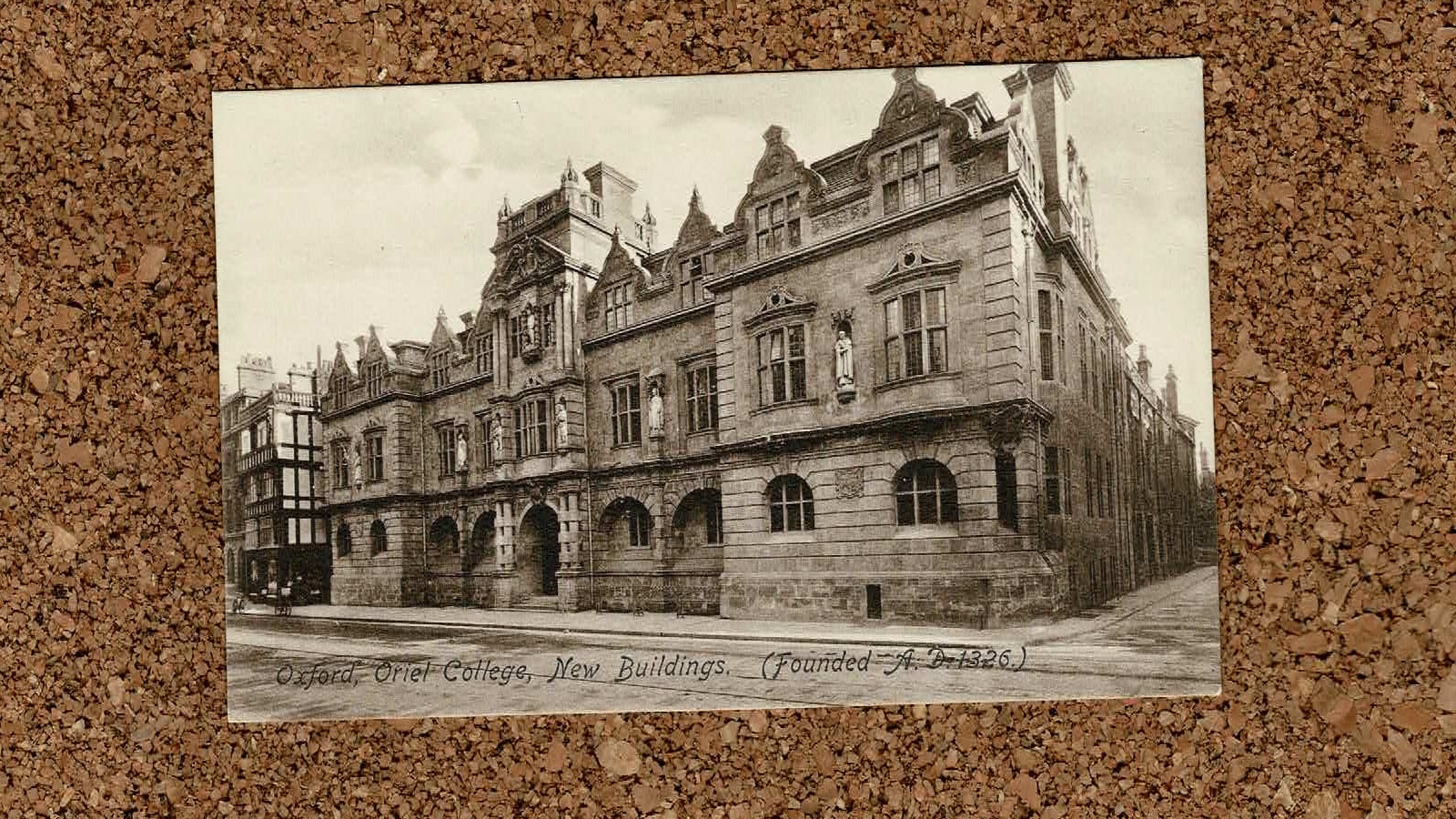
    Greetings from Oxford!

    Many – perhaps even most – universities have a statue or two. But few have a statute which is as troublesome as one of those belonging to Oriel College, Oxford. You can see the statue in question in the alcove directly above the door in the postcard – the one on its own at the top; not one of those along the first floor. And I bet by now you’ve guessed the statue. It’s of Cecil Rhodes: plutocrat, imperialist and, crucially for this post, alumnus of, and donor to, Oriel College, Oxford.

    You can see the statue a little better in this close-up from anther postcard. The Latin reads something like “from the generosity of Cecil Rhodes.” (It is also, apparently, a chronogram – the outsize capitals giving the date of construction, 1911, in Roman numerals. And it does, if you ignore the order and just add up all of the Ls, Ms, Is, Cs, Ds and Vs. There’s a really good site here to help.)

    Rhodes made money – a lot of it – from diamonds, and become politically powerful within the British southern African colonies. I’m not going to attempt a biography in this post; you can read here what Britannica has to say about him. He studied at Oxford between 1873 and 1881, the extended length of time not being explained by his gaining higher and higher degrees, but by his interrupting study to return regularly to South Africa.

    Rhodes became Prime Minister of the Cape Colony (as it was then known), and played critical roles in the British wars against the Zulu and against the Boer (he fomented the incident which led to the war against the Transvaal). He was an ardent imperialist: writing about the English, he said:

    I contend that we are the first race in the world, and that the more of the world we inhabit the better it is for the human race. I contend that every acre added to our territory means the birth of more of the English race who otherwise would not be brought into existence.

    Rhodes died young – aged 48 – and in his will left £100,000 to Oriel College (worth about £10.5 million today), a chunk of which was used for a new building on the High Street side of the college. Its the one in the postcard with the statutes. He also left money for other educational goals – for example, land in South Africa which became the campus for the University of Cape Town; and famously the Rhodes scholarships, which support students attending Oxford from the former British empire, and from Germany.

    In 2015, students at the University of Cape Town protested against a statue of Rhodes on campus. As this piece makes clear, the statue was the symbol, the protests had a broader target: the legacies of colonialism and racism within and beyond the university environment. The university’s council agreed with the protestors, and the statue was removed. Students 1, Rhodes 0. And a slogan – #RhodesMustFall – gained currency.

    In 2016, a focus of what had become a movement fell on Oxford. The Oxford Union debated and passed a motion in favour of the removal of the statue on Oriel college. In 2020 the matter surfaced again, with student protests in Oxford, and resolutions in favour of removing the statue from the undergraduate and postgraduate students of the college. Trickily for the college, the building – and hence the statues – were listed, so simply removing the statue was not possible. The college’s council agreed to hold an independent inquiry to make recommendations, and when the report was received in 2021, voted to seek to remove the statue. But, the environment was hostile, and it was clear that government, whose approval would be necessary, would not approve.

    The college has published a good explainer, which includes links to pieces by Professor William Beinart, Emeritus Rhodes Professor of Race Relations, outlining Rhodes’s legacy; and by Professor Nigel Biggar, Emeritus Regius Professor of Moral and Pastoral Theology, arguing that Beinart’s criticisms of Rhodes were overplayed.

    Now, the issue to me seems fairly simple. Did Rhodes’s actions lead to a state of affairs where if you have black or brown skin you were treated far worse than if you had white skin? The history of the twentieth century in southern Africa say clearly yes. Should we therefore be memorialising him? Reader, I invite you to answer this one for yourself.

    And that is how things currently sit. Whether under a different government permission to remove the statue might be given I do not know. Sculptor Antony Gormley suggested that the statue be turned to face the wall in shame – maybe that would be permitted? I do suspect, though, that we haven’t yet heard the last of this one.

    And here, as is customary, is a jigsaw of the postcard – enjoy!

    Source link

  • Researchers sue NIH over mass cuts to DEI grants

    Researchers sue NIH over mass cuts to DEI grants

    This audio is auto-generated. Please let us know if you have feedback.

    Dive Brief:

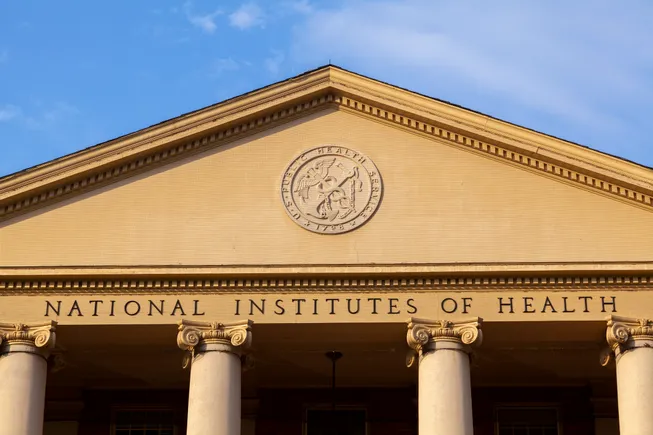
    • Researchers, unions and others sued the National Institutes of Health on Wednesday over the agency’s purge of diversity, equity and inclusion-related research activity that has resulted in lost grant funding and career opportunities. 
    • Plaintiffs, including dozens of academic scientists, alleged that the agency’s leaders, starting in February, “upended NIH’s enviable track record of rigor and excellence, launching a reckless and illegal purge to stamp out NIH-funded research that addresses topics and populations that they disfavor.”
    • They are asking a federal court to block NIH from enforcing its anti-DEI directives both in the short term and permanently and to restore grants to researchers that the agency has cut under the Trump administration. 

    Dive Insight:

    The complaint counts at least 678 research projects that have been terminated by NIH, some of them potentially by the Elon Musk-led Department of Government Efficiency rather than NIH staff. 

    The recently cut grants amount to over $2.4 billion, the lawsuit noted. Of that, $1.3 billion was already spent on projects “stopped midstream that is now wasted,” and $1.1 billion has been revoked.

    Plaintiffs argue that grant terminations “cut across diverse topics that NIH is statutorily required to research,” many of which involve life-threatening diseases. Specifically, they argue that NIH’s actions violate the Administrative Procedures Act and constitutional limits on executive branch authority, and are unconstitutionally vague. 

    In the lawsuit, filed in U.S. district court in Massachusetts, plaintiffs detailed how their lives, careers and potentially life-saving research have been thrown into turmoil by the NIH’s attack on DEI under President Donald Trump.

    Among them is a postdoctoral fellow at the University of New Mexico’s medical school who studies alcohol’s impact on Alzheimer’s risk. The researcher, the first in her family to graduate college, sought a grant created to help promising researchers from underrepresented backgrounds transition to tenure-track faculty positions. 

    According to the lawsuit, the researcher “satisfies the eligibility criteria for the program and invested months into assembling her application,” but NIH refused to consider it “solely because the program is designed to help diversify the profession.”

    Another plaintiff, a Ph.D. candidate at a private California university, had received a high score on a research funding application for a dissertation proposal that would have studied suicide prevention among LGBTQ+ youth experiencing homelessness. 

    But the candidate learned that new restrictions on LGBTQ-related research meant the NIH would not likely fund the project. The turn of events will harm the researcher’s “ability to progress through their PhD program,” the complaint said. 

    Others include a University of Michigan social work professor whose research focuses on sexual violence in minority communities. The NIH has cut at least six grants supporting her research because the agency said it “no longer effectuates agency priorities,” according to the complaint. 

    Setting the various cuts in motion was internal NIH guidance, most of it revealed by the news media and cited in the complaint, that directed agency staff to terminate and deny DEI-related grant proposals. One memo instructed NIH officials to “completely excise all DEI activities.”

    Staff guidance included research topics for grant terminations. One document forbade three research activity topics: China, DEI and transgender issues. A later document, the complaint alleges, effectively banned research grants around vaccine hesitancy and COVID-19.

    NIH did not immediately respond to a request for comment Thursday.

    The scale of impact by both DEI cuts and other funding chaos at NIH is broad, cutting across much of the higher ed world. The United Auto Workers, one of the plaintiffs, counts tens of thousands of members who depend on NIH grants for their work and training, according to the lawsuit. It also noted 18,000 full-time graduate students who received their primary federal funding support through NIH in 2022.

    Source link

  • Two tribal colleges have been allowed to rehire staff that had been cut by the federal government

    Two tribal colleges have been allowed to rehire staff that had been cut by the federal government

    After weeks of uncertainty, two tribal colleges have been told they can hire back all employees who were laid off as part of the Trump administration’s deep cuts across the federal workforce in February, part of a judge’s order restoring some federal employees whose positions were terminated.

    Haskell Indian Nations University in Kansas and Southwestern Indian Polytechnic Institute, widely known as SIPI, in New Mexico lost about 70 employees in mid-February amid widespread staffing cuts to federal agencies. While most of the nation’s 37 tribal colleges and universities are chartered by American Indian tribes, Haskell and SIPI are not associated with individual tribes and are run by the federal government.

    About 55 employees were laid off and 15 accepted offers to resign, according to a lawsuit filed last month by tribes and students. The colleges were forced to cancel or reconfigure a wide range of services, from sports and food service to financial aid and classes. In some cases, instructors were hired by other universities as adjuncts and then sent back to the tribal colleges to keep teaching.

    Related: Interested in more news about colleges and universities? Subscribe to our free biweekly higher education newsletter.

    It was not clear this week when and if the workers would return, whether the employees who resigned would also be offered their jobs back, or if the government would allow colleges to fill vacancies. Both colleges said some employees had turned down the offers.

    The Bureau of Indian Education, which runs the colleges, declined to answer questions except to confirm the laid-off workers would be offered jobs with back pay to comply with a judge’s order that the government reverse course on thousands of layoffs of probationary employees. But the agency also noted the jobs would be available “as the White House pursues its appeals process,” indicating possible turmoil if an appeals court reinstates the layoffs.

    Both colleges said the bureau also has refused to answer most of their questions.

    SIPI leaders were told last week that the positions were being restored, said Adam Begaye, chairman of the SIPI Board of Regents. The 270-student college lost 21 employees, he said, four of whom decided to take early retirement. All but one of the remaining 17 agreed to return, Begaye said.

    The chaos has been difficult for those employees, he said, and the college is providing counseling.

    “We want to make sure they have an easy adjustment, no matter what they’ve endured,” Begaye said.

    Related: How a tribe won a legal battle against the federal Bureau of Indian Education and still lost

    The chairman of Haskell’s Board of Regents, Dalton Henry, said he was unsure how many of the 50 lost employees were returning. Like SIPI, Haskell was forced after the layoffs to shift job responsibilities and increase the workload for instructors and others.

    Haskell was reviewed by accreditors in December, and Henry said he was worried how the turmoil would affect the process. Colleges and universities must be accredited to offer federal and state financial aid and participate in most other publicly funded programs.

    Henry declined to discuss his thoughts on the chaos, saying there was nothing the college could do about it.

    “Whatever guidance is provided, that’s what we have to adhere to,” he said. “It’s a concern. But at this point, it’s the federal government’s decision.”

    The Bureau of Indian Affairs declined to make the presidents of the two colleges available for interviews.

    Tribal colleges and universities were established to comply with treaties and the federal trust responsibility, legally binding agreements in which the United States promised to fund Indigenous education and other needs. But college leaders argue the country has violated those contracts by consistently failing to fund the schools adequately.

    In the federal lawsuit claiming the Haskell and SIPI cuts were illegal, students and tribes argued the Bureau of Indian Education has long understaffed the colleges. The agency’s “well-documented and persistent inadequacies in operating its schools range from fiscal mismanagement to failure to provide adequate education to inhospitable buildings,” plaintiffs claimed.

    Related: Tribal college campuses are falling apart. The U.S. hasn’t fulfilled its promise to fund the schools

    Sen. Jerry Moran and Rep. Tracey Mann, both Kansas Republicans, said before Trump took office that they plan to introduce a bill shifting Haskell from federal control to a congressional charter, which would protect the university from cuts across federal agencies such as the Bureau of Indian Education.

    “[F]or the last few years the university has been neglected and mismanaged by the Bureau of Indian Education,” Moran said in a written statement in December. “The bureau has failed to protect students, respond to my congressional inquiries or meet the basic infrastructure needs of the school.”

    The February cuts brought rare public visibility to tribal colleges, most of which are in remote locations. Trump’s executive orders spurred outrage from Indigenous communities and a flurry of national news attention.

    “We’re using this chaos as a blessing in disguise to make sure our family and friends in the community know what SIPI provides,” said Begaye, the SIPI board president.

    The uncertainty surrounding the colleges’ funding has left a lasting mark, said Ahniwake Rose, president and CEO of the American Indian Higher Education Consortium, which advocates for tribal colleges. But she added she was proud of how the schools have weathered the cuts.

    “Indian country is always one of the most resourceful and creative populations,” she said. “We’ve always made do with less. I think you saw resilience and creativity from Haskell and SIPI.”

    Contact editor Christina A. Samuels at 212-678-3635 or [email protected].

    This story about tribal colleges was produced by The Hechinger Report, a nonprofit, independent news organization focused on inequality and innovation in education. Sign up for the Hechinger newsletter.

    The Hechinger Report provides in-depth, fact-based, unbiased reporting on education that is free to all readers. But that doesn’t mean it’s free to produce. Our work keeps educators and the public informed about pressing issues at schools and on campuses throughout the country. We tell the whole story, even when the details are inconvenient. Help us keep doing that.

    Join us today.

    Source link