Category: Featured

  • 15 Must-Have Features of a Cloud Based LMS in Higher Education

    15 Must-Have Features of a Cloud Based LMS in Higher Education

    Higher education in 2025 will be about customized, data-driven, flexible learning opportunities rather than only classrooms and textbooks. These days, a cloud-based LMS system is not a luxury; rather, it is a must for universities trying to keep competitive, increase student involvement, and raise results.

    But among hundreds of sites available, how do you choose the best one? Supported by statistics and meant to enable institutions to flourish, let us explore the 15 must-have characteristics of a modern customisable LMS for universities.


    The 15 Must-Have Features for a Higher Education Learning Management System (LMS) in 2025


    1. Support for blended learning

    There is nowhere hybrid learning is headed. 73% of students, according to studies, would rather combine in-person and online instruction. To provide an immersive, adaptable experience, your LMS should easily combine digital materials with conventional classrooms.


    2. Learning with self- pace

    Students pick things up at varying rates. According to the Research Institute of America, a self-paced learning environment allows students to direct their development, therefore enhancing retention between 25 and 60%. Bonus—also Designed in-house tests and checkpoints help pupils stay on target.


    3. Tools for collaborative learning

    Better still is learning when done jointly. Especially crucial for Gen Z students, 85% of which favor group projects, peer assessments, and shared workspaces, platforms with these features promote involvement.


    4. Accessible mobile-friendly

    A mobile-optimized LMS is absolutely essential given students spend five to six hours every day on smartphones. Make sure students can access materials, turn in homework, and interact with peers—anywhere, at any moment.


    5. Evaluations driven by AI

    Why use outdated tasks? Student results are improved by adaptive examinations and performance-based assignments in modern LMSs. Pre-quiz adaptive study increased pass rates by 20%, according to research.

    Adjustive learning enhances academic performance in 59% and student engagement in 36%, according to study. Teachers can better identify knowledge gaps and personalize instruction to individual students by using these new technologies.​


    6. Adaptable evaluations

    There is no one-size-fits-all solution here. A strong learning management system should enable you to create customized tests and assignments that highlight each student’s unique advantages and disadvantages.


    7. Integration of course schedules

    Ensure professors and students stay on course. By automatically tracking missed lessons, impending tasks, and class progress, integrated schedules eliminate administrative burdens.


    8. More complex content administration

    Today’s content can be in many different formats, from YouTube videos to PDFs. There should be a variety of content types supported by your LMS so that teachers can design dynamic, multimedia-rich courses.


    9. Messaging boards and discussion notes

    In online courses, fifty-eight percent of students say they feel disconnected. Built-in forums and messaging tools help to build community and enable faculty and student real-time cooperation.


    10. Student tracking for development

    Track engaged and non-involved students in a jiffy! Detailed data on material availability, completion rates, and time spent per module let teachers act early to support difficult students.


    11. Performance Studies

    Performance goes beyond just marks. Dashboards displaying trends in student progress should be part of a strong LMS, therefore stressing areas needing work and increasing retention rates.


    12. Gamification

    Engagement leaps when education feels like a game. Leaderboards, badges, and awards on LMS systems help to increase student involvement by up to 89% hence transforming learning from a passive to an active process.


    13. Instantaneous reporting

    Give up searching frantically for information. Crucially for certification and institutional planning, your LMS should create fast, exportable reports on student performance, course progress, and engagement.


    14. Complete branding and customizing

    Why then do you look like everyone else? From logos to unique workflows, a top-notch LMS should represent the character of your university thereby guaranteeing a customized experience for staff and students.


    15. Distance learning support

    With 74% of students saying they would enroll in online programs even post-pandemic, distance learning support is here to stay. Remote classes are something a modern LMS has to support so that students from wherever may get top-notch instruction.


    The Impact of Predictive Analytics on Student Engagement

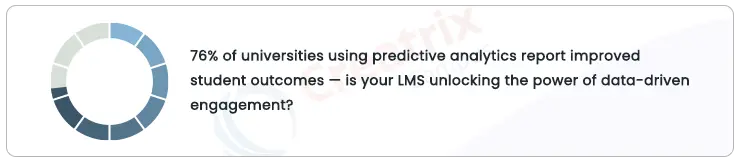
    Predictive analytics is changing higher education. According to a 2024 EDUCAUSE research, 76% of predictive analytics-using universities said their student results have improved Using data insights—tracking behavior, engagement, and performance—an LMS helps staff members intervene before students lag behind.


    predictive-analytics


    How to Choose the Right LMS for Your Institution

    Selecting an LMS goes beyond just filling up boxes. This brief checklist can help you make decisions:

    Scalability: Can your institution help it to flourish?

    Customizability: Does it fit your particular requirements? Customizing

    Integration: Will it flow naturally with your current systems?

    Support: Does the provider give consistent, continuous assistance?

    Analytics: Can it instantly monitor student involvement and performance?

    A cloud-based, customized LMS is about enabling student success rather than only course administration. Your institution can design an interesting, future-ready learning environment with the appropriate features, data insights, and flexibility.

    All set to change your college’s instruction? Start with a platform meant for future success—that of the students.


    Future-Ready Learning Begins with the Correct LMS

    Higher education in 2025 is about empowering student success with flexible, data-driven learning opportunities rather than about course management. More than just a platform, the appropriate cloud-based LMS solution transforms engagement, performance, and institutional growth.

    Ready to future-proof your university using a customisable LMS for those that satisfy all the necessary requirements? Discover how Creatrix Campus LMS enables organizations like yours to provide smarter, more connected learning—built for tomorrow, now. Connect with us now!

    Source link

  • Beyond Evaluation: Using Peer Observation to Strengthen Teaching Practices – Faculty Focus

    Beyond Evaluation: Using Peer Observation to Strengthen Teaching Practices – Faculty Focus

    Source link

  • Beyond Evaluation: Using Peer Observation to Strengthen Teaching Practices – Faculty Focus

    Beyond Evaluation: Using Peer Observation to Strengthen Teaching Practices – Faculty Focus

    Source link

  • How universities can use artificial intelligence to regain social license – Campus Review

    How universities can use artificial intelligence to regain social license – Campus Review

    Universities will need to prove to future students why university degrees are worth it in an artificial intelligence (AI) knowledge economy, speakers at Sydney’s latest generative AI meeting said.

    Please login below to view content or subscribe now.

    Membership Login

    Source link

  • Charles Darwin uni loses $200,000 US research funding – Campus Review

    Charles Darwin uni loses $200,000 US research funding – Campus Review

    A research contract valued at about $200,000 has been lost by Charles Darwin University (CDU) as a result of US President Donald Trump’s “America First” agenda.

    Please login below to view content or subscribe now.

    Membership Login

    Source link

  • 62% Jewish students, staff feel unsafe on campus: Survey – Campus Review

    62% Jewish students, staff feel unsafe on campus: Survey – Campus Review

    A survey of 550 university staff and students found six in 10 experienced antisemitic comments, and about the same felt unsafe on campus due to Israel-Gaza driven conflict in Australia.

    Please login below to view content or subscribe now.

    Membership Login

    Source link

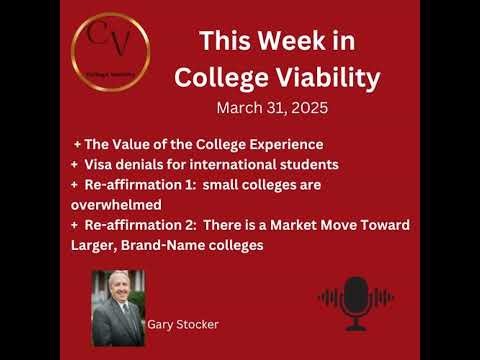
  • This Week In College Viability (Gary Stocker, TWICV)

    This Week In College Viability (Gary Stocker, TWICV)


    Higher Education Inquirer : This Week In College Viability (Gary Stocker, TWICV)


    This Week In College Viability (Gary Stocker, TWICV)

    College Viability provides a resource site for students, parents, community
    member, faculty and others to easily see the latest information on the
    financial health of private colleges.

    The College Viability App enables students, parents, leaders and others
    to compare the changes in a private colleges’ finances, enrollment, and
    outcomes over a period of 6 years. For families this information lets
    them make more informed decisions about their college choice — limiting
    the risk of choosing one whose financial results suggest viability
    concerns in the coming months and years.

    For higher education leaders, the App provides comparative data about
    competitors and potential merger or alliance partners.

    Source link

  • The Foreign Influence Registration Scheme has sector-specific implications

    The Foreign Influence Registration Scheme has sector-specific implications

    The Foreign Influence Registration Scheme (FIRS) emerged out of the National Security Act 2023.

    The idea was that, by way of the mandatory registration of activities broadly defined as involving “foreign influence” on the UK, both the UK’s political system and wider civil society would be made both more transparent and, in the case of certain countries’ actions, less of a national security risk.

    The government published light-touch draft guidance for FIRS in September 2023, promising further detail ahead of implementation – including sector-specific guidance for research, academia and higher education.

    FIRS trap

    Nothing happened for a while, and then following the general election news emerged of a delay to the scheme, seemingly tied up with the question of Labour’s (still ongoing) “China audit” and a (hotly contested) claim that guidance wasn’t ready to go live.

    One particular sticking point has become whether China would be put on the “enhanced tier” of the scheme, a development which would enormously increase the scrutiny faced by all organisations – including universities – involved in partnerships or collaborations with Chinese institutions. The Conservatives were rumoured to have been considering it while in power, and more recently Labour has reportedly been “resisting” such a move.

    Fast forward to today, and there is still no decision over China – but the government has laid draft regulations placing Russia and Iran on the enhanced tier, announced that FIRS will come into operation from 1 July, and published sector-specific guidance for academia and research.

    The additional wrinkle for higher education is that when the Department for Education announced that the Higher Education (Freedom of Speech) Act would go ahead in revised form, it decided that the overseas funding measures in section 9 would be “kept under review” while FIRS was implemented and the interaction between the two was assessed.

    Tiers for FIRS

    You will be glad to learn that FIRS is not “a register of foreign spies” – we even get a short section in a fact sheet to make this clear. It is, however, a register of arrangements – and the individual or power who makes an arrangement with a foreign power (or controlled entity) has to let the Home Office know.

    At heart, FIRS is structured around two tiers: the “political influence tier” and the “enhanced tier”. All countries – except the Republic of Ireland – will be put in one or the other. And the difference between the two is vast.

    Political influence is restricted to specific “directions” from other countries to influence the UK’s political domain. So this involves things like elections and referenda (perish the thought), ministerial or departmental decision-making, political parties’ activities, or the actions of parliamentarians (including in the devolved nations). There’s also the wider concept of influencing “public life”, which includes certain kinds of communications and the disbursement of money.

    Where the Secretary of State deems it necessary to keep the UK safe or protect its interests, they will designate a foreign power (or part thereof) as being subject to the “enhanced tier”. This additionally requires the wider registration of “arrangements to carry out activities at the direction of a foreign power”, or activities carried out in the UK by specified entities controlled by a foreign power. In this case there is the possibility of a tailored approach to address particular risks.

    At each level, the requirement is that you register the activities to be carried out, their nature, their purpose, any intended outcomes – plus start dates, end dates, and frequencies where relevant. Of course registration will include passing on details of who is carrying out the activities, and which foreign power is directing them. Some of this information will be published – but this will be limited to what is needed to achieve the transparency aims of FIRS. Personal details, information that would prejudice personal safety or national security, and commercially sensitive information will not be published.

    Designating a country as being subject to the enhanced tier requires parliamentary approval – and as above this is currently being sought for Iran and Russia. How about China? As will be clear when we turn to some examples below, this is the big question when it comes to FIRS for UK higher education – China being moved up into the advanced tier would greatly complicate all kinds of educational and research initiatives.

    The Conservatives in opposition are pushing strongly for it, though they never bit the bullet while in power. Speaking in the House of Commons today, security minister Dan Jarvis said:

    For reasons that I completely understand, the shadow Home Secretary asked about China. He will recall the remarks I made to this House on 4 March, where I was very clear that countries will be considered separately and decisions will be taken by this Government based on the evidence. I said then, as I say again now, that I will not speculate on which countries may or may not be specified in future. That is the right way to proceed, and I hope he understands that.

    It’s likely the question will continue to recur, every time an issue involving national security and China (or other countries) rears its heads – we should expect calls in Parliament and in the press for a country seen as a national security threat to be moved over to the enhanced tier.

    Direction and production

    For the purposes of FIRS, “direction” implies a power relationship – a contract or conditional payment on the one hand, coercion or the promise of future benefits on the other. So for our purposes a genuine collaboration, or a very generic request, would not count as direction. Neither is something “direction” simply because it is funded by a foreign power.

    The actual registration and publication will be done by a special unit within the Home Office. This will also be the means by which the Secretary of State can issue “information notices” to get more information, or remind you to register activity should you be doing something that it is felt you should tell the Home Office about.

    FIRS is an information gathering tool – it doesn’t restrict anyone’s ability to do anything in and of itself, it simply requires that activity is registered appropriately. And it only applies where you are directed by a foreign power – anything else you do or say on your own behalf is not covered by these requirements.

    At FIRS I was afraid

    The meat of the higher education and research guidance (framed oddly as the “academia and research sector”) is a series of 34 examples, illustrating where registration is required and where it would not be. There’s a potential impact in every area of university and related activity – but rather than go through every example here it would make sense to pick out a handful of points to illustrate some key impacts on research, teaching, and SUs – both for enhanced and political tiers. If this stuff is your job, or becomes your job, chances are you’ll be getting to know these examples very quickly anyway.

    Teaching and recruitment

    Let’s start at the beginning (example 1) – the education department of country A (not subject to the enhanced tier) wants to build a relationship with a UK university: the university gets more students via promotion and enticements within country A, but it also has to lobby the UK government about a short-term visa study programme for students from country A.

    Clearly this is registerable – there’s an arrangement with country A, it is directed, and requires the use of political influence.

    A lot of the concerns that led to the requirements that went into the Higher Education (Freedom of Speech) Act were about the potential for foreign powers to influence what is taught at universities. In example 6, a student from country G (enhanced tier) is studying a human rights course at a UK university, which includes material on the oppression of an ethnic group in country G by its government. The country G embassy contacts the students, and requires them to change course – threatening to force them to leave the UK if they don’t.

    Here it is the student that is obliged to register – they have been obliged, with coercion used, by a foreign power, to change their course. What’s not at all clear is what would convince said student that this would be a good idea, or what protections would be available to them when they reported their own government to UK authorities.

    But what about universities reporting back to an enhanced tier government on student behaviour? Examples 15, 16, and 17 all deal with reporting back to country V: we learn that a student reporting back on their progress, or a university reporting back on results, is not registerable. However, where the student is coerced into organising a protest about a speaker critical of country V, this is registerable (again, by the student).

    Elsewhere on the enhanced tier regulations, there’s been an important concession (following consultation responses) regarding scholarships, which are now exempt from being registered. And importantly, activities carried out wholly at overseas universities – such as transnational education – will not require registration either.

    A Swiss cheese of foreign influence

    The more tedious and public end of the free speech debate has been concerned with otherwise low-profile, little known, escaping the public attention student activity. Student societies, students getting together in their own time, and reasonable debate. Almost entirely absent from the public but not policy discourse has been the regulation of research activity. Put bluntly, the ways in which other countries influence research into lethal weapons has had less political attention than which culture issue The Telegraph is upset about this week.

    The new guidance provides that agents of specified foreign powers will have to register under the enhanced scheme where they are “undertaking a research project directed by a specified foreign power or specified foreign power-controlled entity.” As we learn from the Minister of State for Security Dan Jarvis the current specified countries under the enhanced tier are Iran and Russia.

    This means that individuals directed by Iran, Russia, and whoever else comes under the future ambit of the scheme, would be required to register that they are being directed by these states and declare they are undertaking state directed activity. Somehow, this seems extremely unlikely to capture the full range of state directed activity even with the threat of a five year custodial sentence.

    The scheme is narrowly applied and broadly defined as to avoid capturing a broad swathe of activities. Under the political tier

    Registration would only be required under the political tier if the research formed part of an intentional effort by a foreign power to influence the UK’s democracy, for example, a specific area of government policy.

    This is a really high bar to clear. As we learn further in the guidance activity which is funded and directed by a foreign power will not necessarily count as political influencing activity if researchers are free to arrive at their own recommendations. In other words, it is possible to influence the terms of the debate but not its conclusions and remain outside the scope of the scheme.

    One of the oddities of the regulation is that “activity is only registerable where carried out in the UK.” This would seem to mean that where there are campuses abroad which included UK researchers, researchers from other countries, and researchers who would be a specified power within the UK, activity would be outside of this scheme.

    The political influence tier of activity is designed to capture activities which are directly aimed toward parliamentary mechanisms and procedures. Aside from any debate on whether the specified countries are broad enough this means that political but not parliamentary political activities are not covered either. The guidance specifically states that

    …any published research which intended to influence a political process would not require registration under the political influence tier, if it was clear on the research report that it was completed as part of an arrangement with a foreign power.

    The scope of the research element of the scheme feels very narrow. The examples make clear that a UK provider would need to register under the political scheme where they are lobbying the UK government to further the interests of a foreign power as part of a funding arrangement. An individual would need to register under the political tier where they are acting as an intermediary for selling the technologies of a foreign power. And under the enhanced tier UK universities cannot rely on the ambiguity of a relationship and would seemingly have to register where there are future potential income opportunities.

    It is also made clear that just because activities clear these schemes they do not get a clean slate for other legislation like the National Security and Investment Act. As long as a provider is not taking funding from a foreign power, and especially specific foreign powers, to direct research, funding, and influencing outcomes, they should not be impacted by FIRS. This does not mean they will not be impacted by the bureaucracy of every other scheme.

    FIRS is helpful in setting an obvious floor for what is in scope but the ceiling is cavernous. There is significant latitude for influencing UK politics outside of parliamentary procedures and without directing research outcomes. The participants in the research ecosystem will on the one hand favour the flexibility but will rue the potential for being personally liable for another addition to an increasingly complicated web of international research rules.

    Societies, SUs and CSSAs

    One of the major concerns floating around the press coverage and the think tanks has been the activities of student societies on campus – specifically (but not exclusively), Chinese Students and Scholars Associations (CSSAs).

    Last year a Henry Jackson Society report, Studying Abroad to Serve China, alleged that CSSAs are closely tied to and influenced by the Chinese government, presenting themselves as cultural organisations while actually being integral to China’s “United Front Work” strategy.

    Meanwhile, the Telegraph has published allegations of Chinese students facing serious repercussions, including detention and interrogation in China, after participating in protests or making critical comments about the Chinese government while studying in the UK – which involve CSSAs locally and nationally.

    Like plenty of religious, political and sporting groups on campus, societies of this sort will say that they affiliate to a national body. Many rarely discuss or disclose the ways in which overt or covert control or influence may be placed on their activities.

    The sector-specific guidance covers “student bodies, societies or associations” – but there’s a problem. It appears from the guidance that Home Office officials think that student societies are legally separate bodies from their students’ union. But in the vast majority of cases, they have no separate legal personality – they are part of the SU. That matters because it impacts who has the legal duty to register.

    For example, in a section designed to reassure universities about their own liability to register, the guidance says:

    Where a registerable arrangement is made by a student society of a university: the society is required to register.

    And across three case studies discussing different types of activity, there’s the same issue. So where one describes a society being directed by the government of a country to sign a petition and campaign against a UK government decision, the guidance says:

    The student society is required to register as they are in an arrangement with the government of Country P (foreign power) from whom they receive funding (direction) to undertake campaigning activities to influence a government decision (political influence activities).

    But legally, in most universities the student society doesn’t exist. It’s a part of the SU – placing the onus on the SU to register – and so places duties on underfunded student activities staff to risk assess and probe the activities of societies in ways that many will object to.

    Separate guidance for charities then puts onerous duties on the trustees in the usual way.

    The upshot is that CSSAs – and any other international society undertaking activity of this sort – will soon clock that they themselves are under no legal duty to register. Universities will also take comfort in guidance that makes clear “societies” are separate and have their own reporting duties.

    The buck lands on the SU – who will be thinking hard about disproportionate scrutiny over a group of students that share protected characteristics, and who may object to their treatment by the SU to the university under OfS’ new harassment expectations.

    Not only will the SU not have experience of what amounts to a whole new type of complex risk assessment, it will all happen in a way that actually discourages joined-up risk assessment and sensible concern over the sorts of things the HJS and the Telegraph alleges. You really couldn’t make it up.

    If you believe the allegations that swirl around CSSAs, there are major student welfare concerns here – both for students who might be “under surveillance” from their colleagues, and for students who might be being coerced into watching others and reporting them. If you’re less sure that what the Telegraph or the HSJ say is widespread or even real, then there’s welfare and harassment concerns that surround poking around and applying heavy scrutiny to a particular group of students. And in England, the moment you start to think about potential interactions with free speech requirements and OfS’ new harassment requirements a headache ensues given both seem to cover SUs and societies without directly regulating them.

    If nothing else, the guidance repeatedly states that it’s not that the activity is per se illegal – and if not, is it “free speech within the law” or does the influence chill free speech, and so on and so on and so on.

    It would certainly seem like a good time to consider whether those straight-line cuts to the SU’s already tight budget are wise if junior staff are about to start to have to offer training on these complexities – and front out difficult conversations with those running international student societies.

    Upshots

    All of these new duties kick in on July 1st – so there’s very little time to understand the implications and get houses in order. The question on China and its tier allocation will be one to watch – the allegations are unlikely to go away.

    There are several “foreign influence” offences, including a failure to register a foreign influence arrangement, and carrying out political influence activity where the overarching arrangement is not registered and the person knows that the activity is being directed by a foreign principal. The maximum penalty for failure to comply with the requirements of the political influence tier is 2 years imprisonment – and the maximum penalty in the enhanced tier is 5 years imprisonment.

    If there are those who are carrying out what is currently covert activity who are under pressure to keep it that way – whether through incentives, or threats, or both, there is a real question about the way in which those individuals might evaluate that against any rules put in by a university (or so) in pursuit of the scheme.

    More broadly, it’s yet another thing in terms of regulatory burden – and another one of those things where a duty is being placed on a public authority to do what many would argue is not their job to do at all, that they’re not sufficiently funded to do, and have not even been properly consulted on.

    Source link

  • Hindsight is a wonderful thing – but foresight is better

    Hindsight is a wonderful thing – but foresight is better

    If students think that they’ve made the wrong choice – either of course, university or both – depending on how deep in they are, there’s often not much that can be done.

    That’s a problem – one that has appeared to be considerable in successive waves of the HEPI/Advance HE Student Academic Experience Survey, despite higher education policy in the last decade supposedly making it both easier to choose, and easier to switch.

    “Regret” in the SAES – measured by asking students if they had a second chance to start again, knowing what they know now, what they would do, has been running at between 35 and 42 per cent since 2018.

    The pandemic will have hit that – but it’s still a large proportion of (in this case) undergraduates given that most of them will be paying for those decisions for decades to come.

    To work out what to do about it, we’d need research on what lies behind the figures – and now a research collaboration between Bristol University, HEPI and Advance HE (along with a steering group including UCAS and UCL’s COSMO project) has produced some – all under the careful eye of former Office for Students CEO turned Professor of Practice in Higher Education Policy, Nicola Dandridge.

    Via two surveys, each of 2,000 students (one for students and graduates), The benefits of hindsight tells us only 2-3 per cent felt higher education was the wrong path altogether – it’s the choices within that that are the issue.

    Similar (enough) to the SAES, 65 per cent of undergraduates were happy with their institution and course choices. 10 per cent would study the same subject at a different university, 6 per cent would change courses at the same institution, 6 per cent would do both, and the rest would have preferred an apprenticeship, a gap year, or direct employment.

    If you’re thinking that that would improve post-graduation, there’s bad news – only 48 per cent of graduate respondents (aged 25-30) were happy with their original decisions, while 15 per cent would have chosen a different course at the same institution, 11 per cent the same course elsewhere, and 12 per cent both – with a further 8 per cent wishing they’d chosen an apprenticeship.

    Why? Students primarily cited “happiness” and better “fit” as reasons for wanting different choices, with 40 per cent acknowledging insufficient research. Graduates, unsurprisingly, were more concerned with career opportunities, with a similar percentage suggesting they needed better career guidance.

    Under the microscope there are two things – the structures and support for choice, and the structures and support for transfer. Neither come out well.

    I travelled each and every highway

    The report kicks off with some historical and international comparisons.

    A HEFCE report from 2016 surveyed graduates 3.5 years after graduation and found 32 per cent would have chosen a different subject, 21 per cent a different institution with ethnic minority graduates most likely to express choice regret.

    International surveys show varying levels of choice satisfaction – 83 per cent of Irish students and 73 per cent of Dutch students report they’d have chosen the same institution or program again.

    OfS analysis from 2021 suggested that less than 3 per cent transfer to different providers (with fewer than half transferring credits), and a 2016 DfE study said that 23 per cent of students who changed providers found the process difficult or very difficult. The data stopped being returned in September 2021 when DfE asked the OfS to stop in the interests of reducing burden.

    Anyway, the results. Among those who would have made different choices, 85 per cent say they would have made a significant difference in their lives, with regret increasing by year of study – 25 per cent of first-years versus 41 per cent of third-years.

    Satisfaction varied by region too – 74 per cent in Scotland vs. 64 per cent in England – as well as by subject, health related students were 10 points happier than social science students.

    For graduates, those employed in highly skilled occupations or pursuing further education reported greater satisfaction with their choices than those in less skilled positions or unemployed.

    You can read all of that, along with various other splits by region, stage and so on, in two ways – either a lot of regret isn’t about the course at all, or a lot of it is about the extent to which a student believed a course might set them up for the labour market, and then (at least a few years on), failed.

    Cracked up to be

    The focus group findings fill in some of the statistical blanks. Learning-related concerns were prominent – with students expressing disappointment about course content, teaching quality, and facilities. One lamented inadequate professional knowledge development:

    I found that the knowledge they had to offer, the experiences of the tutors themselves, and the actual equipment and facilities weren’t that great.

    Many noted discrepancies between university marketing and reality, with one observing:

    I think the way that it was sold is not quite exactly how it is now.

    Resource constraints were also cited, with one student describing how financial issues at their university led to their course being “gutted” with many modules eliminated.

    Career limitations emerged as another regret, particularly among STEM graduates struggling to find employment. One explained her degree’s narrow academic focus rather than industry-relevant skills, and cost of living concerns also featured, with one student regretting moving to Bristol, which they discovered was:

    …the second most expensive for rent outside of London.

    And as seen in studies on value for money (not least the one commissioned by Nicola Dandridge when OfS was set up), financial pressures intensified students’ critical assessment of their education:

    The fact that I’m so aware of the cost of it makes me think more critically.

    Much of that intensifies in the graduate results. Career limitations emerge as a dominant theme – with many lamenting overly specialized degrees that restrict employment options:

    I regret the course that I picked: it’s too specialised. It has limited where I can work – I can work on a children’s ward and nothing else.”

    Several pointed to insufficient internship opportunities as hindering their career progression. One theatre studies graduate wished that employability had been emphasised more – another regretted not completing a placement year.

    Making good choices

    On the assumption that getting the choice right to start with would have helped, for those in the regret camp, 41 per cent of undergraduates thought they should have researched more themselves.

    Students reported universities presenting misleading information at open days and in prospectuses, failing to provide detailed module information, and “putting on a show” that didn’t accurately reflect the actual experience.

    External pressures also significantly influenced regretted decisions with many students choosing subjects based on parental expectations rather than personal interests. Cultural expectations – particularly pronounced among Asian students – and social pressures prevented students from exploring alternatives.

    Preparing for exams whilst decision making also compromised decision quality – many selected “safer” universities based on predicted grades rather than aspirations. Timing was also a key factor in regretted decisions.

    Many wished they had taken gap years to gain clarity on their goals and undergraduates regretted looking “backwards” at subjects they enjoyed in school rather than “forwards” to potential careers. Graduates particularly lamented not understanding the labour market, wishing they better understood the importance of work experience and placements.

    Students who regretted their choices identified some things that could have helped – more transparent information about course content, better integrated career guidance, “taster courses” allowing students to experience subjects before committing, and targeted support for first-generation students.

    But 37 per cent of undergraduates and 21 per cent of graduates believed nothing would have enabled them to make different decisions – social, family, or educational influences overwhelming whatever agency they thought they should have had.

    I did what I had to do

    If students do get their choice wrong, one of the solutions – at least one promoted heavily in the last decade and the now largely abandoned duties given to the Office for Students in the Higher Education and Research Act 2017 – is transfer.

    And interestingly, the majority who regretted their choices would have transferred to another course or institution if possible – 59 per cent of undergraduates and 63 per cent of graduates.

    But multiple barriers prevented it – nearly half of undergraduates believed transferring wasn’t worth the effort and disruption. 52 per cent of graduates said a lack of information or support was their primary barrier, and many (38 per cent of graduates, 22 per cent of undergraduates) were completely unaware that transferring was an option.

    Additional barriers included financial concerns, poor timing (realizing too late), and family pressures.

    Students and graduates identified two major factors that would have enabled transfers – better information and guidance and financial support.

    Many also suggested early intervention systems – first-month “grace periods,” independent advisors, and regular check-ins with first-year students – to identify dissatisfaction before students became too established to transfer easily.

    But again, a significant minority (23 per cent undergraduates, 19 per cent graduates) believed nothing could have enabled them to transfer regardless of support offered.

    There’s some interesting demographic and characteristics splits. Students from lower participation areas reported their choices having greater consequences, higher proportions of private school students wished they attended different institutions for different courses, and Asian students were more influenced by university rankings but less by social media and career advisors.

    Worryingly disabled students showed significantly higher rates of regret and a stronger desire to transfer than the average. Focus group participants highlighted late diagnosis of neurodiversity, or a lack of disability support.

    I planned each charted course

    You do wonder whether, knowing what they know now, having looked at the results, the team would have chosen a different set of questions. What the results tell us is a lot that we already know – both about how students choose a course and university, and how they evaluate the value of that experience.

    If anything, the problem is the paradigm – the assumption in the hypothesis being that students either need to make the right choice first time, or that they need to be able to transfer if they don’t.

    Insofar as the research tests the central solutions to potential regret in both Students at the Heart of the System from 2011 and the OfS (F2) duty to facilitate transfer required via the Higher Education and Research Act 2017, it’s pretty clear that those solutions have failed.

    As such, we might expect the potential solutions on offer to at least contemplate something more radical than “do those things only better.”

    Sadly not. Students should conduct more comprehensive research earlier and consider gap years; schools should shift focus from university attendance to appropriate course/institution matching; graduate perspectives are to be incorporated into school career guidance; and universities are mildly exhorted to make sure that information is “accurate and realistic,” eradicating any “blur” with marketing and promotional material. Good luck with that.

    Meanwhile, work-related learning and the embedding of employability in the curriculum should be “scaled up in universities,” information and guidance should be available and accessible to students to support transfer arrangements, and consideration should be given to UCAS playing a “greater and more visible central coordinating function” in supporting students who wish to transfer.

    If none of that feels like it will shift the dial, that’s perhaps because there’s a dead-horse flogging aspect to them – coupled with nothing in the report that recognises the lack of incentives on universities to make much of that happen. It’s perhaps in the lone recommendation on the LLE that some better solutions might be found.

    I ate it up and spit it out

    Some of the material from students in the report looks at the balance between the theoretical and the practical, and some at (over) specialisation. Both point clearly to programme design, and flexibility within it – at just the point that providers are busy ripping choices and pathways out in favour of more efficient core module credit.

    As Jim noted in this piece on marketisation, it’s the opposite that students want – both in terms of majors and minors, and students being able to accrue credit for learning outside of their subject area through work and service.

    Clear signals to that end in the LLE would help – as would some actual rights in that space over credit transfer and accumulation. Providers that don’t want to play ball don’t have to be able to access the student finance system.

    We note, for example, that in Poland students have the actual right between 25 and 30 per cent of their credit as optional, non-core. In Latvia the minister is about to afford students the right to accrue credit across universities. In Austria, course reps have the right to input on and sign off on a programme’s electives before they are finalised for the year ahead, and in plenty of countries the right to accrue credit for learning via work and service is enshrined.

    More broadly, the lack of student rights in general in the UK – and the lack of a role for student organisations in promoting and enforcing them – is also a barrier. This kind of stuff isn’t going to happen by asking nicely. And the mis-selling thing is only going to change if, for example, OfS applies that new fairness condition to everyone, and strengthens students’ confidence to complain.

    Some of the material is about age – and I’m reminded that across the OECD, the UK has pretty much the youngest entrants and youngest Bachelor’s graduates. The first of those is about everyone in the system normalising a pause – the second is about a credit and student finance system that allows pauses, setbacks, reductions in study intensity and other wheezes that would prevent a student from thinking that they weren’t able to experience what they wanted through no fault of their own.

    Naturally, the stuff on costs needs tightening up – the woeful state of information that both encourages fiscal illusions and reduces any effort in getting those costs down – and the idea that rent or other participation costs can’t be properly researched at least at subject level through some of the national survey infrastructure that we have now is endlessly frustrating. The fact that the UK is one of the few countries in Europe where students have to keep paying their rent if they’ve dropped out means that bigger structural solutions are required.

    There are some ironies in the incentives currently hurled at universities that the report misses too. Anyone that thinks that regret, as described here, will improve while OfS is dangling damocles over continuation is naive; anyone that thinks that similar stats for PG would be improved when our “big sell” is getting a Master’s done in a year and UKVI looks down on changing course, is also kidding themselves. And a student finance system that continues to treat adults as dependent (the means test in the maintenance loan) almost guarantees that parents will hold more sway than their children.

    But as we talked about at The Secret Life of Students, reimagining what “full-time” study means in an era when most students must work to survive is arguably the most important task. If we force students to choose between earning, learning, and contributing, there’s going to be regret – over “fit” and happiness, work experience, skills acquisition and the inability to stop and think in general.

    Hindsight is a wonderful thing, but foresight is better. Unless central government sets itself the task of slowing down both the initial choice and the experience itself – supported by a framework of structural change and actual student agency – we expect that the relentless efficiency demanded of both students and their universities in a mass system will continue to overwhelm whatever OfS does on DiscoverUni or whatever providers think a lonely webpage is doing on the facilitation of transfer.

    Source link

  • Head Start, the federal child care program for low-income families, is turning 60 this year. Will it make it to 61?

    Head Start, the federal child care program for low-income families, is turning 60 this year. Will it make it to 61?

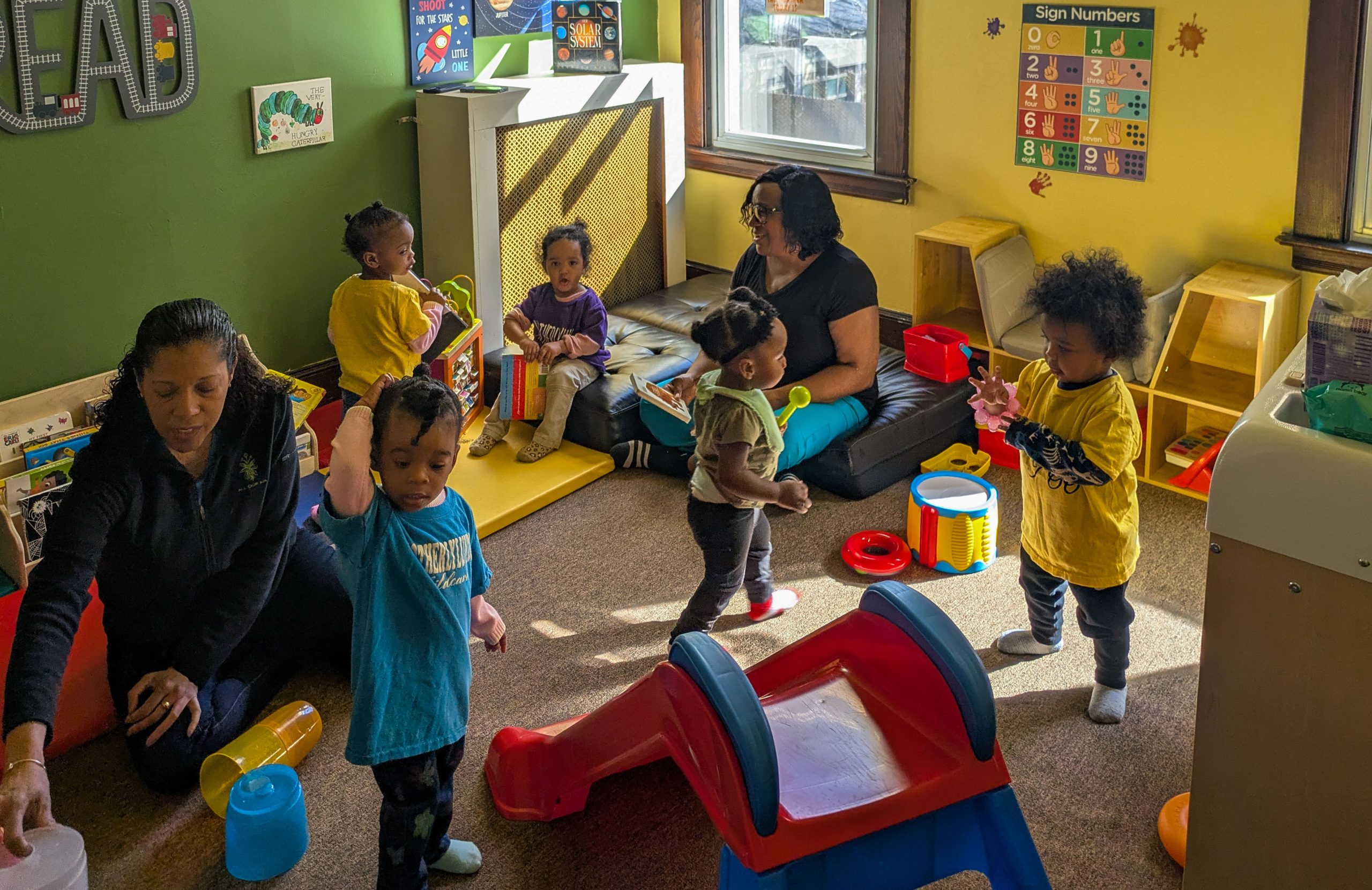
    NEW HAVEN, Conn. — Bright morning sun is streaming through her home’s windows as Sandra Dill reads a picture book about penguins to a room full of busy toddlers. While listening, the kids blow kisses, plop in a visitor’s lap, then get up to slide down a small slide.

    Dill has been running a family child care business from her home for 15 years, and every one of her 13 grandchildren has spent time here — currently it’s 20-month-old Nathaniel, who has a puff of curly hair and a gooey grin.

    “My older ones started to call it ‘grandma school,’” she said. Another one of her granddaughters, now a teenager, is returning this summer to help out.

    Four of Dill’s eight available slots are funded through Head Start. This is the federal-to-local program that funds child care and other support for the poorest families in America. (Regular Head Start serves children 3 to 5 years old; Early Head Start is for those under 3.) The program — which began right here in New Haven, Connecticut — is celebrating its 60th anniversary this year.

    It’s also never been so at risk: First a federal funding freeze hit providers, then a chunk of Head Start federal support staff were fired by the Department of Government Efficiency. On March 27, the Department of Health and Human Services announced it was cutting a further 10,000 jobs, and reorganizing the Administration for Children and Families, which administers Head Start. As of April 1, Head Start employees in five of the program’s 10 regions — Boston, New York, Chicago, San Francisco and Seattle — had reportedly been laid off, according to a LinkedIn post that day from Katie Hamm, a former official with the federal Administration for Children and Families. Hamm said there does not appear to be a transition plan laying out how Head Start programs in those regions will receive funding and support. Project 2025, the conservative policy handbook organized by the Heritage Foundation, which the Trump administration has been following closely, calls for eliminating Head Start altogether.

    “I think it’s terrible,” Dill said. “I just can’t imagine. It’s already not enough, and if this happens, it’s going to affect a lot of families that are already struggling.”

    Ed Zigler, the “father of Head Start,” was the son of immigrants from Poland. His father was a peddler and his mother plucked chickens to make a little money, according to Walter Gilliam, executive director of the University of Nebraska’s Buffett Early Childhood Institute, who counted Zigler as his closest mentor.

    When Zigler was a child, his family made its way to a settlement house in Kansas City, Missouri; these community-based charities offered a two-generation approach, caring for and educating children while also teaching English and job skills to parents and connecting families with medical care and housing help.

    “That made a huge impact on his and his family’s life,” Gilliam said.

    Related: Young children have unique needs and providing the right care can be a challenge. Our free early childhood education newsletter tracks the issues.

    As a young psychology professor at Yale, Zigler was hired as an advisor to President Lyndon Johnson to help design family programs for the federal War on Poverty. In creating Head Start, he turned to the same two-generation model he grew up with.

    To date, Head Start has served nearly 40 million children. In fiscal year 2023, the Head Start program was funded to serve 778,420 children. The program has always been underfunded: In 2020 Head Start served barely 1 in 10 eligible infants and toddlers and only half of eligible preschoolers. It’s limited to families making under the federal poverty level, which is just $31,200 for a family of four.

    The sand table at Dill’s child care is an opportunity to explore shapes, colors and textures. Credit: Anya Kamenetz for The Hechinger Report

    Still, for many of the families who do manage to make it through the doors, the program is life-changing.

    “Head Start is in every community in America,” said Cara Sklar, director of early & elementary education policy at the D.C.-based think tank New America. “It’s the original two-generation program, with wraparound support for kids. It’s really held up as a model of quality in early learning.”

    The “wraparound support” for Dill’s Early Head Start families is funded by the United Way of Greater New Haven, and comes via a network for family child care educators called All Our Kin. The network helps mothers enroll in community college and apply for housing subsidies. Dill has had mothers who lived in their cars and one who was living with her mother “six to a room,” she said. She also does regular home visits with families to talk about children’s development and support parents in goals like potty training.

    Thanks to Early Head Start, a nurse, a mental health consultant and a nutritionist all help Dill keep the kids healthy and safe. And the program also provides extra funds she can use to get back up and running if, for example, the furnace needs fixing.

    But Head Start is now facing funding challenges that go far beyond a broken furnace. “The past month has been harrowing for child care providers,” said Carolina Reyes, director of Arco Iris Bilingual Children’s Center, a preschool in Laurel, Maryland, that is a Head Start partner, and also a member of the nationwide advocacy group MomsRising. 

    The first blow to Head Start in this administration was President Donald Trump’s January 27 executive order calling for a federal funding freeze. Since Head Start is a direct federal-to-local grant program, even temporary interruptions in funding can cause programs to close their doors.

    “ Programs like mine operate on razor-thin margins,” said Reyes. “I don’t have any reserves to pull from if funding is delayed or slashed.”

    Related: Is Head Start a failure?

    While funding for most programs has resumed, Joel Ryan, the executive director of the Washington State Association of Head Start, said in a recent press conference that as late as the week of Feb. 17, one in four of his programs still had trouble accessing the Head Start payment website. 

    That same week of the 17th, almost 70 Head Start staffers were pink-slipped in the federal government’s sweep of “probationary” employees — about one-fifth of the program’s workforce. One laid-off employee, who didn’t want to give his name because he is still fighting his dismissal and fears reprisal, said he spent five years as a contractor before switching to full time this past summer, which accounted for his probationary status. He wore many hats at Head Start, doing data analytics, working with grant recipients and serving as a liaison for state partners.

    “They say we’re bloated; we could have used two more full-time people,” he said.

    The cuts, he feared, will lead to further delays in programs getting the payments they rely on, not to mention the oversight that keeps kids safe.

    “I come from the private sector. I will find another job,” he said. “The issue isn’t us, it’s the children and the families. We’ve got all these people in poverty who are getting screwed over by what’s happening.” 

    A third blow came on February 25, when the House passed a budget resolution calling for $880 billion in cuts to discretionary spending programs over the next decade, with Medicaid the prime target, along with the federal Supplemental Nutrition Assistance Program. Head Start families overwhelmingly rely on these safety net programs. The White House’s gutting of the Department of Education also threatens many services for preschoolers, especially those in special education. (This process, which maps out the next fiscal year, is separate from the recent vote to fund the government until Sept. 30.)

    “This is going from the precipice of disaster to decimating the system,” Sklar said. “All the parts that help families, from Head Start to child care to food to health care, are all being destabilized at once.”

    Gilliam said that threats to eliminate Head Start are nothing new. After designing the program during the Johnson administration, Zigler was appointed to run it under the presidency of Richard Nixon. “Some folks told him that his job was to destroy, essentially, the program that he had created,” Gilliam said.

    Related: In 2024, Head Start programs are still funded by a formula set in the 1970s

    Head Start advocates said the program has been able to fight off political challenges in the past because it is widely distributed geographically and has bipartisan support.

    “I agree that Project 2025 is a real threat to Head Start, as well as to other programs that we all care about,” said Ryan, with the Washington State Head Start association.

    “But I will say this: We have great research. We have great data. We have a great track record. We have a lot of bipartisan support in Congress. And we have parent power.”

    By coincidence, the week the House passed its budget resolution, a group of 150 Head Start parents were on Capitol Hill lobbying as part of a group called Start Early, and they met with many Republican senators.

    Tommy Sheridan, the deputy director of the National Head Start Association, struck an almost defiantly optimistic tone after the visit to lawmakers: “We still believe and have seen indicators that this administration is supportive of Head Start. And Congress as well.”

    NaMaree Cunningham and her twin sister turned two on the day of our visit. Credit: Anya Kamenetz for The Hechinger Report

    Another potential bright spot is the growth of child care support and funding on the state level. Elizabeth Groginsky is New Mexico’s first cabinet secretary for the state’s new Early Childhood Education & Care Department, and she said the pandemic woke a lot of people up to the importance of early care and education.

    “People began to understand the impact that child care has on children’s development, families’ ability to work, the overall economy,” Groginsky said.

    Since 2020, New Mexico has gone through a major expansion in home visits, child care and preschool. Vermont has made similar moves, and New York and Connecticut are heading in that direction as well. Even the deep-red state of Kentucky has expanded access.

    What all of these state-level programs have in common is that they are much more widely available to middle-class families, rather than tightly targeted to families in poverty, as Head Start still is. Historically, with programs like Medicare and Social Security, universal access has meant durable support.

    Now those states are contemplating stepping in further if the federal government drops the ball.

    “Because the state has made such an impressive commitment to child care, we’re potentially in a better spot than others,” said Janet McLaughlin, deputy commissioner for Vermont’s Department of Children and Families. And Groginsky, in New Mexico, said firmly, “The governor and the legislature — I don’t think we’ll let New Mexicans go without. They’ll find a way.”

    Support for this reporting was provided by the Better Life Lab at New America.

    Contact editor Christina Samuels at 212-678-3635 or [email protected].

    This story about Head Start was produced by The Hechinger Report, a nonprofit, independent news organization focused on inequality and innovation in education. Sign up for the Hechinger newsletter.

    The Hechinger Report provides in-depth, fact-based, unbiased reporting on education that is free to all readers. But that doesn’t mean it’s free to produce. Our work keeps educators and the public informed about pressing issues at schools and on campuses throughout the country. We tell the whole story, even when the details are inconvenient. Help us keep doing that.

    Join us today.

    Source link