Category: Featured

  • The Student Assistant: Through the Student Lens

    The Student Assistant: Through the Student Lens

    Reading Time: 4 minutes

    You first met our game-changing GenAI-powered Student Assistant in August 2024, and we’ve been keeping you up to date on all of the exciting developments ever since. We’ve told you how it helps personalize your students’ learning experience on a whole new level with content that’s specific to your course textbook — but now we want to show you how. 

    Let’s dive in and explore some visual examples of student interactions that demonstrate its full capabilities.

    Points students in the right direction  

    Do your students ever get stuck on how to begin working on a question or topic? Using the Student Assistant, students can ask for a solid jumping-off point to get the ball rolling in the right direction. They can also ask it to clarify points of confusion, so they can successfully progress through an assignment.  
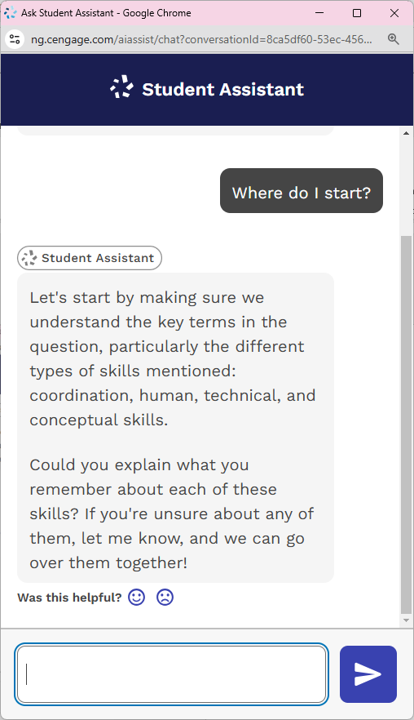
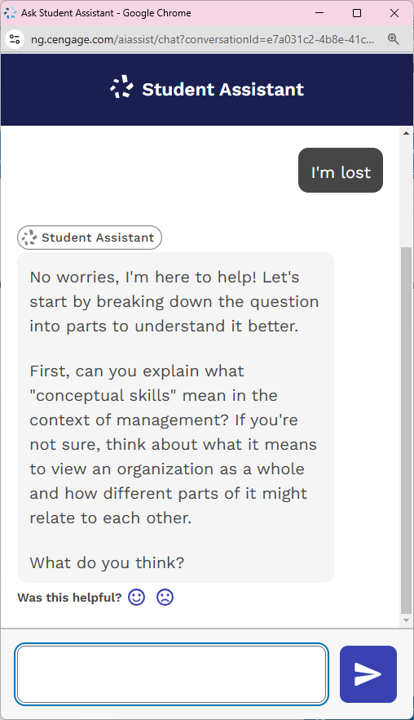
    Student Assistant tells student where to start by making sure they understand the key terms in the question.

    Student Assistant I'm lost prompt

    Promotes critical thinking and academic integrity 

    The Student Assistant guides students to help them identify the correct answer, without giving it away, promoting the development of critical thinking skills and putting emphasis on self-reliance. Students are also discouraged from simply guessing a correct answer and are asked to explain their logic behind a selection.
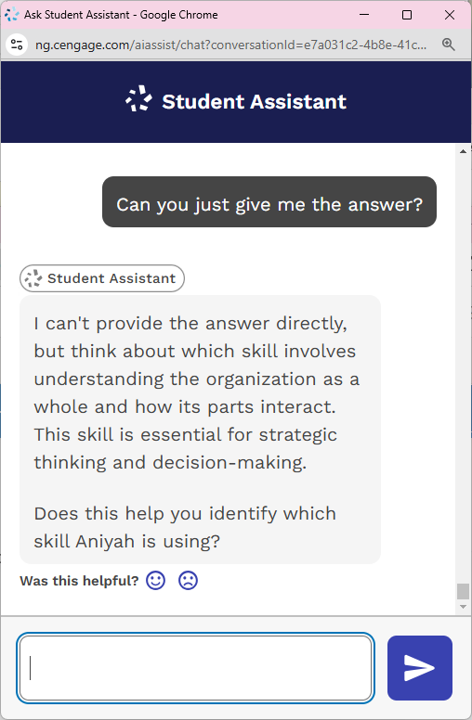
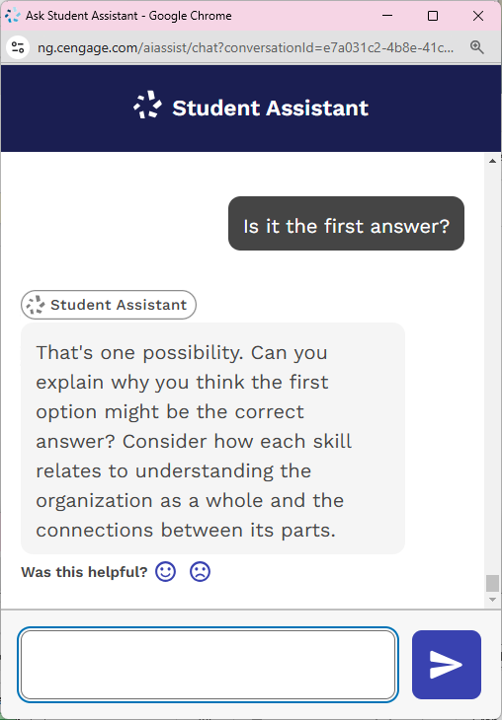
    Student asks the Student Assistant to just give them the answer, and the Student Assistant tells them they cannot provide answers directly. The Student Assistant Is it the first answer prompt.

    Simplifies complex topics 

    If students are struggling to comprehend what they’re learning, they can ask for topics to be elaborated on, rephrased or broken down. They can also ask for brief definitions of key terms. 
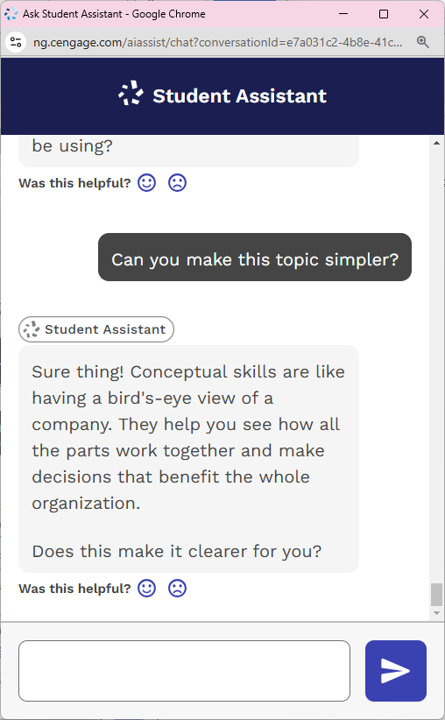
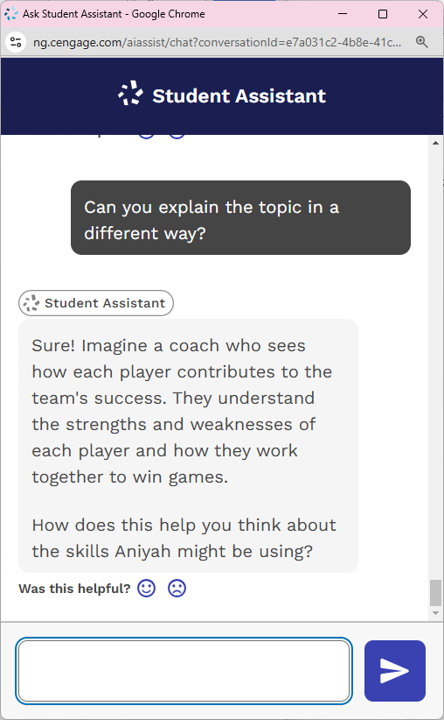
    Student asks the Student Assistant to make the topic simpler. Student Assistant provides simpler explanation. Student asks Student Assistant to explain topic in a different way. Student Assistant responds with a different explanation.

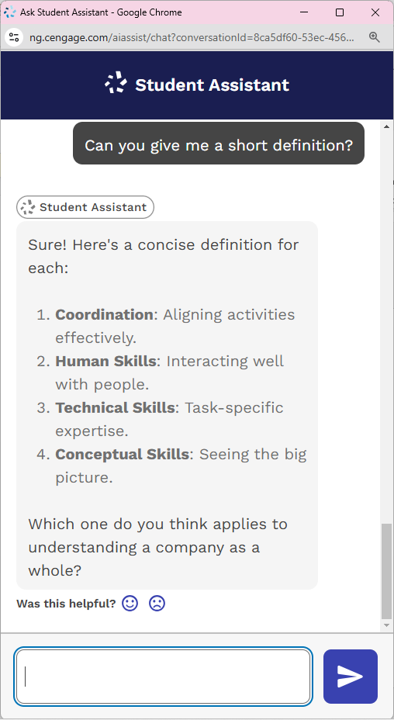
    Student asks Student Assistant to give a short definition. Student Assistant provides a concise definition for each term.

    Makes real-world connections 

    With the Student Assistant, students can ask for explanations of how topics they’re studying connect to real-world scenarios. It can generate discipline- and career-specific use-cases, helping students understand the relevancy of course content within the framework of their future careers.  
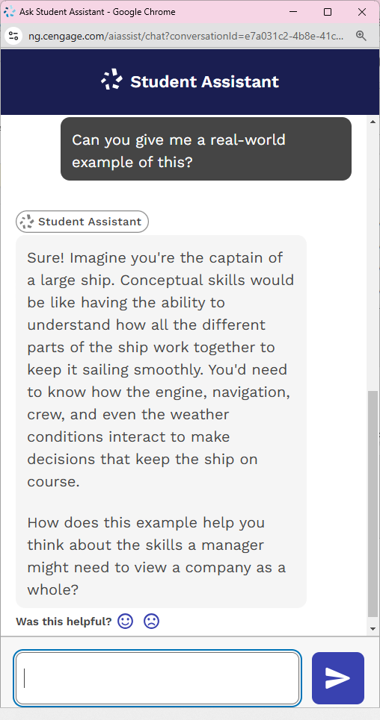
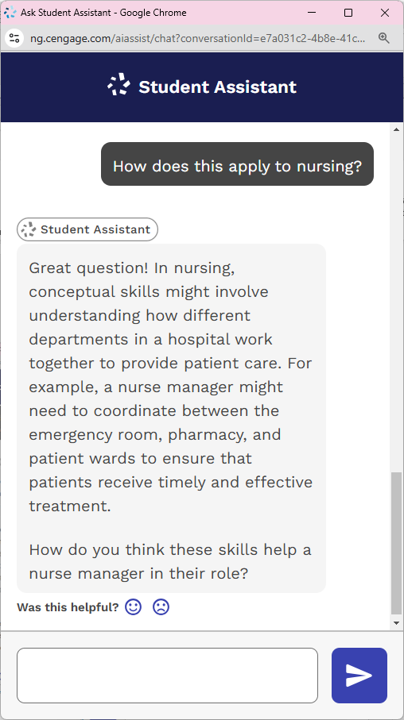
    Student asks the Student Assistant to give them a real-world example of topic. Student Assistant provides an example. Student asks the Student Assistant how topic applies to nursing? Student Assistant provides explanation.

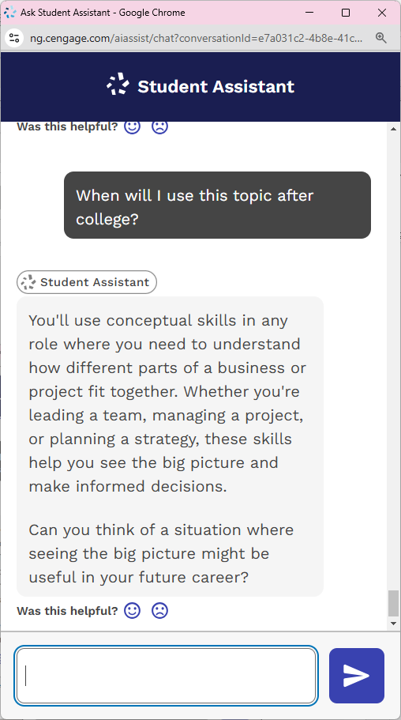
    Student asks the Student Assistant when they'll use this topic after college. Student Assistant provides a detailed explanation.

    Keeps students on track 

    Getting distracted during a task is something that can happen to the best of us, and students are no exception. If students ask to be shown external or entertaining web content, the Student Assistant will redirect and keep them focused on the assignment at hand. This tool will never provide or rely on external content.  
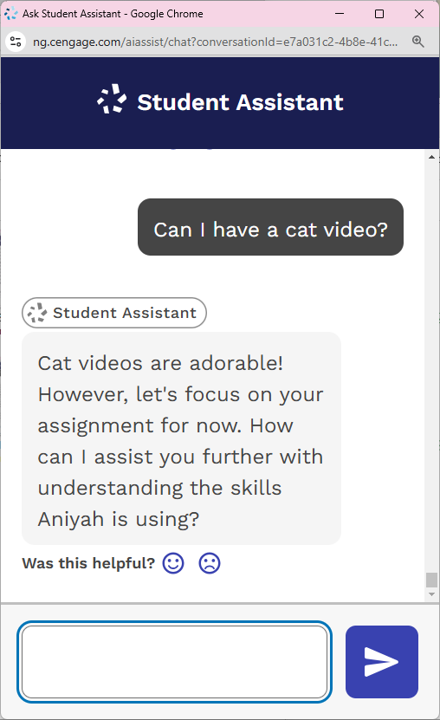
    Student asks the Student Assistant for a cat video. The Student Assistant redirects student back to assignment.

    Motivates and encourages

    The Student Assistant lets students know that it’s okay to struggle through an assignment by encouraging them with a positive, motivational tone. With positive reassurance from the Student Assistant, students can complete assignments with confidence.  
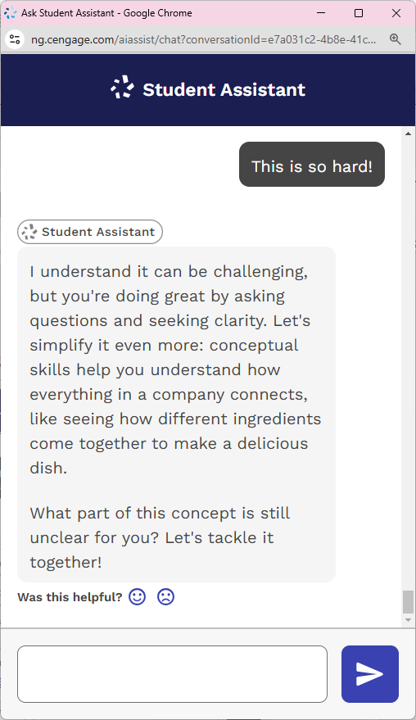
    Student tells the Student Assistant, this is so hard. The Student Assistant replies with encouragement and motivation.

    Reframes course content  

    When students aren’t making personal connections with course content, it can be easy for them to lose interest in the topic altogether. Students can ask for their course topics to be turned into an engaging story, helping them key into critical themes and ideas that they may have initially overlooked.  
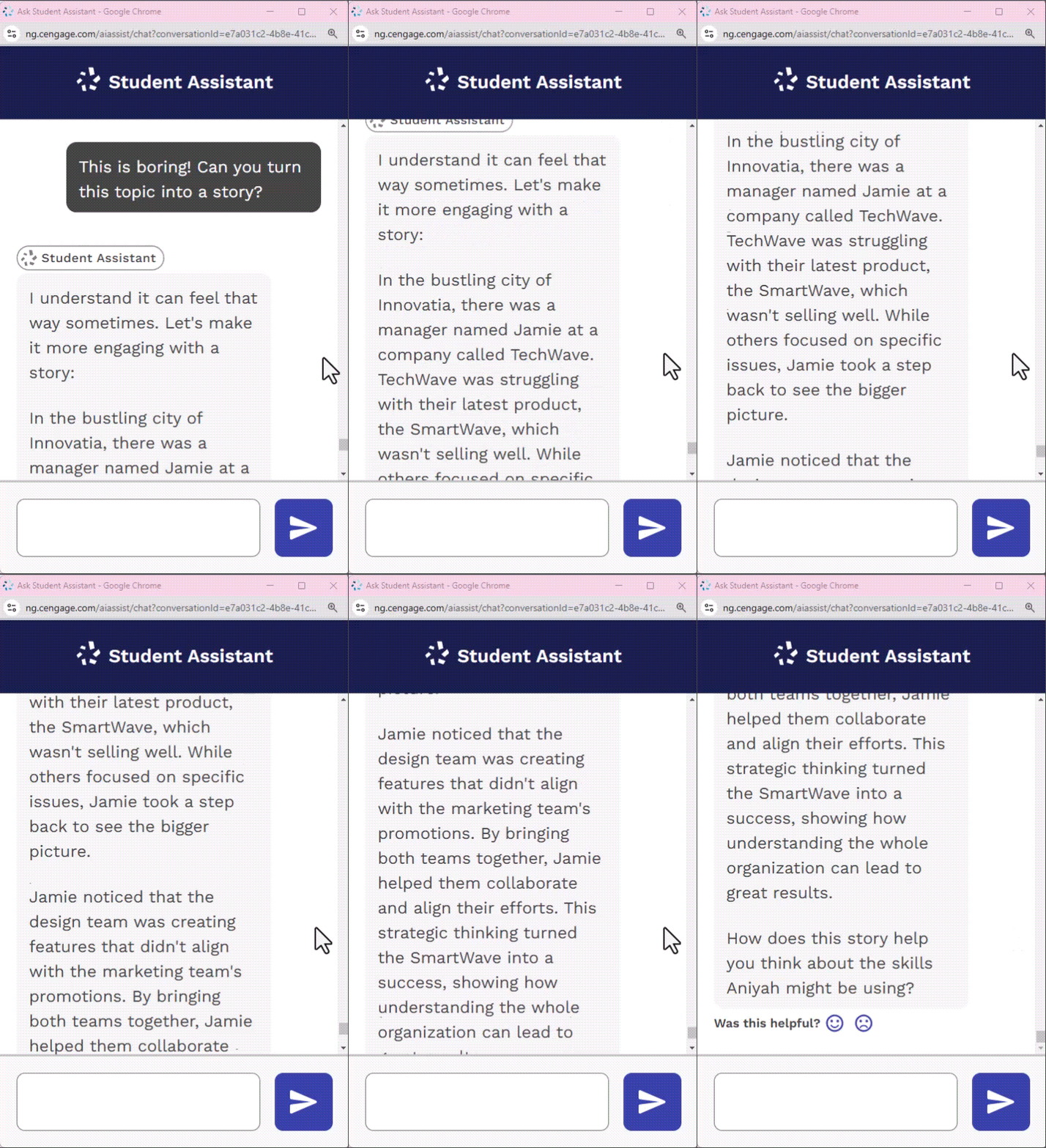
    Student asks Student Assistant to turn topic into a story. The Student Assistant provides a story.

    Can’t wait to begin using the Student Assistant in your courses? 

    The Student Assistant is currently available in beta with select titles, including “Anatomy & Physiology”, “CompTIA Network+ Guide to Networks” and “Economics.”  To get started, create a course with any of the titles available with the Student Assistant and start using it today. 

    We’re gearing up for more titles to feature the Student Assistant this fall. In the meantime, you can currently explore this tool’s capabilities, its current list of titles where it’s featured and AI at Cengage.   

     

    Source link

  • QS boss wins lifetime achievement award at PIE Live Europe 2025

    QS boss wins lifetime achievement award at PIE Live Europe 2025

    The PIE Live Europe, held between March 11-12 in central London, brought together leading figures in the international education sector. Delegates at the two-day conference heard key immigration updates, debated the future of the ELT sector and highlighted the value that international students bring to the UK.

    As the conference drew to a close, the winner of the event’s lifetime achievement award was revealed to be Nunzio Quacquarelli, who founded the global higher education and insights company QS in 1990.

    Famed for its university rankings, QS has expanded under Quacquarelli’s leadership to employ more than 900 people from over 30 countries.

    Quacqarelli said it was a “great feeling” to win the award, having been a supporter of The PIE since it was a “fledgeling business”.

    On what was next for QS, he added: “We’re really committed to providing trusted data and insights to the higher education sector and we really believe in the need for universities to transform, to adopt AI – so we’ve launched a responsible AI consortium with Imperial College.

    “And we really believe the need to deliver the emerging skills of the fifth industrial revolution, so we are developing huge amounts of insight on skills and occupations… to identify whatever skills are going to be demanded by employers of the future to guide curricular reform and university transformation.”

    You can watch his full interview in the video below.

    Source link

  • Higher Education Inquirer continues to follow IPO/sale of University of Phoenix

    Higher Education Inquirer continues to follow IPO/sale of University of Phoenix

    On March 6, 2025, Apollo and Vistria publicly announced a possible IPO or sale of the University of Phoenix.  These companies have been trying to sell the University of Phoenix since 2021, but there have been no takers. The owners claim the school is worth $1.5M to $1.7M, but we (and experts we know) are skeptical, given the financials we have seen so far. The University of Phoenix was previously on sale for about $500M-$700M but the University of Arkansas System, the State of Idaho, and apparently other colleges declined the offers. 

    The University of Phoenix offers subprime education to folks,
    historically targeting servicemembers, veterans, and people of color. While some students may profit from these robocollege credentials, one wonders what
    these workers actually learn. The current student-teacher ratio at the
    University of Phoenix, according to the US Department of Education, is
    132 to 1.   

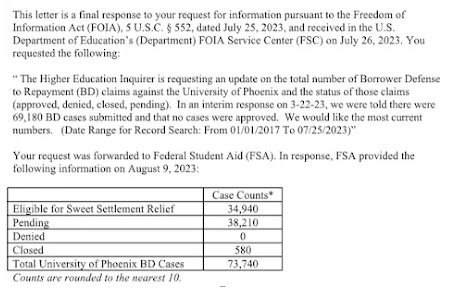
    In 2023 we made a Freedom of Action (FOIA) request to the US Department of Education (ED) to get Phoenix’s most recent audited financials. In March 2025, more than 20 months later, we were provided with a 35-page report, audited by Deloitte, with numbers from 2021 and 2022. 

    This month the Higher Education Inquirer followed up with a Freedom of Information request with the ED to obtain more up-to-date financial numbers for the University of Phoenix. We hope they will be responsive and timely enough to get the word out to the public.   

    Source link

  • Decoder: The Silence of America

    Decoder: The Silence of America

    Iconic photos from the Cold War cover the corridors of the Prague headquarters of Radio Free Europe and Radio Liberty, news networks created by the U.S. government to counter censorship and disinformation from the Soviet Union and their East European satellite nations during the Cold War.

    Images from 1989, the year communist rule melted away in more than a dozen countries, were reminders of earlier days when Radio Free Europe and Radio Liberty had broadcast news in Polish, Czech, Slovakian and the Baltic languages; those countries are now robust democracies as well as members of the European Union and NATO.

    Those historic photos jostle with more recent images from countries where human rights and democracy are not observed, including Russia, Belarus, Iran, Afghanistan and other nations across Central and South Asia. In total, the two networks broadcasted in 27 languages to 23 countries providing news coverage and cultural programming where free media doesn’t exist or is threatened.

    The journalists who broadcast there often do so at great risk. 

    Many are exiles unable to return to their own countries. Three of their journalists are currently jailed in Russian-occupied Crimea, Russia and Azerbaijan. The charges against them are viewed as politically motivated.

    Countering power with news

    On 14 March 2025, U.S. President Donald Trump signed an executive order which cut the funding for the U.S. Agency for Global Media, the parent agency of Radio Free Europe and Radio Liberty. It also cut the funding of Radio Free Asia and the Middle East Broadcasting Network, the Voice of America — the “official” voice of the United States — as well as Radio & Television Marti which broadcasts to Cuba.

    The funding cuts would effectively silence these networks. In response, Radio Free Europe and Radio Liberty filed a lawsuit in Washington, D.C. 18 March that argued that Congress has exclusive authority over federal spending and that cannot be altered by a presidential executive order. Voice of America Director Michael Abramowitz filed suit 26 March. 

    On March 27, the Trump administration announced it had restored the funding for Radio Free Europe and Radio Liberty. 

    Radio Free Europe and Radio Liberty came into being after the end of the second World War when Europe became a divided continent. While the wartime allies, including Britain and the United States, focused on rebuilding their economies after years of war, Soviet leader Joseph Stalin sent his army to occupy most of Eastern Europe. 

    Despite promises made at a meeting in the Crimea, known as the Yalta Conference, during the final months of the war in 1945, Stalin refused to allow free elections in East Germany, Romania, Bulgaria, Poland, Hungary and Czechoslovakia. 

    Neither were free elections held in the three Baltic countries — Estonia, Latvia and Lithuania — which the Soviet Union had annexed in 1940. The crushing of democratic rule in so many nations was characterised by British Prime Minister Winston Churchill as “an iron curtain” that had “descended across the continent.” 

    After years of fighting Nazi Germany, half of Europe was now ruled under a Soviet dictatorship.

    Containing communism

    The United States responded with a policy of ‘containment’ that aimed to halt the spread of communism without using soldiers and tanks. Radio Free Europe started broadcasting in 1950 followed by Radio Liberty in 1953. 

    With a system of transmitters pointing east, news programmes that countered the state propaganda were beamed to the countries in the Soviet bloc, eventually in 17 languages. These were tactics that came to be known as ‘soft power’.

    Based in Munich, Radio Free Europe and Radio Liberty, or RFE/RL as they became known, attracted dissidents who opposed the Soviet-imposed governments. Their audiences grew during the Cold War, despite threats of prosecution. 

    In addition to news, broadcasts covered music, sports and science. Banned literature written by dissidents who challenged the communist systems could be heard on RFE/RL. Czech dissident Vaclav Havel was one of those voices.

    The Berlin Wall tumbled down in November 1989. It was followed by the Velvet Revolution that overthrew the Czech government and installed as its president, the former political prisoner Haval. He invited RFE/RL to move their base from Munich to Prague. 

    “My confinement in prison might have lasted longer had it not been for the publicity I had through these two stations,” Haval said at the time. 

    An outcry in Europe and elsewhere

    The news that the Trump administration would shut down the radio networks spread quickly. Listeners, viewers and supporters who had lived through the Cold War years when only pro-government broadcasts were legal, shared their stories on social media:

    “In Romania, they [RFE] lightened communism with the hope of freedom.”

    “As a small girl, living under a communist regime in Poland, I remember my grandfather listening every night to Radio Free Europe, to get uncensored news from around the world, to get different opinions on the world’s affairs, and probably hoping that one day, he would live in a free world. It was illegal to listen to this Radio, and the quality was very poor, and yet, he would do it every night … ” 

    Polish Foreign Minister Radek Sikorski recalled how his father had listened to Radio Free Europe and Voice of America. “This is a great shame,” he wrote. “My grandfather was listening to RFE in Soviet-occupied Poland in 80s. It’s how we learned basic facts about our own countries because communist propaganda was so tightly controlled.”

    On 17 March the Czech Republic asked the foreign ministers of the European Union to support RFE/RL so the journalism could continue. 

    One diplomat who was in the meeting said that stopping RFE/RL’s broadcasts would “be a gift to Europe’s adversaries.” Already Russia’s state broadcaster, Russia Today, had tweeted that cutting the funding for RFE/RL was an “awesome decision by Trump.”

    When Vaclav Havel welcomed Radio Free Europe and Radio Liberty to Prague after democracy had been restored to Czechoslovakia, he said that having RFE/RL in the Czech capital was equivalent to having three NATO divisions. 

    The supporters of the networks are hoping that the soft power of free media is indeed able to pack a powerful punch for free media.

    Update to this story: As of 30 March, Radio Free Liberty has informed News Decoder that, while two weeks worth of funds have been received, the rest of U.S. government funding had not yet been restored. We will continue to update this story as we learn of further developments. 


    Three questions to consider:

    1. Why, during the Cold War, were radio broadcasts across closed borders one of the few ways people could receive news that was not controlled by the government?
    2. In what ways are people limited in accessing news, culture and music?
    3. In what ways might a free media be important in a democracy?


    Source link

  • Trump’s Growing Crackdown of Dissenters on Campus

    Trump’s Growing Crackdown of Dissenters on Campus

    In recent weeks, a growing number of international students and green card holders at prestigious universities, including Cornell, Columbia, Georgetown, and Tufts, have been arrested and detained by federal immigration authorities. These actions appear to be part of a broader crackdown on pro-Palestinian activism within U.S. academic institutions and against dissent in general.  

    Tufts University

    On March 26, 2025, Rumeysa Ozturk, a Turkish doctoral student at Tufts University, was detained by federal agents who revoked her student visa. Ozturk had co-authored an op-ed in the Tufts student newspaper condemning investments in companies linked to Israel and referring to the “Palestinian genocide” in Gaza. Her detention occurred as she was heading to an iftar dinner during Ramadan.

    Columbia University

    Earlier this month, Mahmoud Khalil, a lawful permanent resident and recent graduate of Columbia University, was arrested in his university housing. Khalil’s participation in pro-Palestinian protests led to allegations of supporting Hamas, resulting in the revocation of his green card. He is currently detained while challenging the deportation order.

    Subsequently, Yunseo Chung, a 21-year-old Columbia junior from South Korea holding a green card, was targeted for deportation due to her involvement in similar protests. A federal judge issued a temporary restraining order preventing her detention while she contests the deportation order.

    Georgetown University

    Badar Khan Suri, a Georgetown University postdoctoral fellow on a student visa, was detained on March 17, 2025, under accusations of spreading Hamas propaganda and promoting antisemitism. His attorney disputes these claims, suggesting that Suri is being targeted because of his Palestinian wife’s heritage and their perceived opposition to U.S. foreign policy.

    Cornell University

    Momodou Taal, a Cornell graduate student with dual British and Gambian citizenship, was instructed to surrender to ICE authorities on March 22, 2025. Taal’s legal team preemptively filed a lawsuit challenging the deportation order, citing concerns over potential surveillance and targeting due to his activism.

    These incidents have raised significant concerns among civil rights organizations, university officials, and international communities. Critics argue that the Trump administration’s actions infringe upon First Amendment rights and target individuals based on their political views. In response, legal challenges are underway, with courts issuing orders to halt certain deportations and detentions.

    As this situation develops, universities and advocacy groups continue to monitor and respond to the evolving landscape of immigration enforcement affecting international students and green card holders across the nation.

    Source link

  • Report details uneven AI use among teachers, principals

    Report details uneven AI use among teachers, principals

    Key points:

    English/language arts and science teachers were almost twice as likely to say they use AI tools compared to math teachers or elementary teachers of all subjects, according to a February 2025 survey from the RAND Corporation that delves into uneven AI adoption in schools.

    “As AI tools and products for educational purposes become more prevalent, studies should track their use among educators. Researchers could identify the particular needs AI is addressing in schools and–potentially–guide the development of AI products that better meet those needs. In addition, data on educator use of AI could help policymakers and practitioners consider disparities in that use and implications for equitable, high-quality instruction across the United States,” note authors Julia H. KaufmanAshley WooJoshua EaganSabrina Lee, and Emma B. Kassan.

    One-quarter of ELA, math, and science teachers used AI tools for instructional planning or teaching in the 2023–2024 school year. Nearly 60 percent of surveyed principals also reported using AI tools for their work in 2023-2024.

    Among the one-quarter of teachers nationally who reported using AI tools, 64 percent said that they used them for instructional planning only, whether for their ELA, math, or science instruction; only 11 percent said that they introduced them to students but did not do instructional planning with them; and 25 percent said that they did both.

    Although one-quarter of teachers overall reported using AI tools, the report’s authors observed differences in AI use by subject taught and some school characteristics. For instance, close to 40 percent of ELA or science teachers said they use AI, compared to 20 percent of general elementary education or math teachers. Teachers and principals in higher-poverty schools were less likely to report using AI tools relative to those in lower-poverty schools.

    Eighteen percent of principals reported that their schools or districts provided guidance on the use of AI by staff, teachers, or students. Yet, principals in the highest-poverty schools were about half as likely as principals in the lowest-poverty schools to report that guidance was provided (13 percent and 25 percent, respectively).

    Principals cited a lack of professional development for using AI tools or products (72 percent), concerns about data privacy (70 percent) and uncertainty about how AI can be used for their jobs (70 percent) as factors having a major or minor influence on their AI use.

    The report also offers recommendations for education stakeholders:

    1. All districts and schools should craft intentional strategies to support teachers’ AI use in ways that will most improve the quality of instruction and student learning.

    2. AI developers and decision-makers should consider what useful AI applications have the greatest potential to improve teaching and learning and how to make those applications available in high-poverty contexts.

    3. Researchers should work hand-in-hand with AI developers to study use cases and develop a body of evidence on effective AI applications for school leadership, teaching, and learning.

    Laura Ascione
    Latest posts by Laura Ascione (see all)

    Source link

  • Losing homeschool data Losing homeschool statistics

    Losing homeschool data Losing homeschool statistics

    The Trump administration says one of its primary goals in education is to expand school choice and put power back in the hands of parents. Yet it has killed the main way to track one of the most rapidly growing options — learning at home. 

    The Education Department began counting the number of homeschooled children in 1999, when fewer than 2 percent of students were educated this way. Homeschooling rose by 50 percent in the first decade of the 2000s and then leveled off at around 3 percent

    The most recent survey of families took place in 2023, and it would have been the first indication of the growth of homeschooling since the pandemic. The data collection was nearly finished and ready to be released to the public, but in February, Elon Musk’s Department of Government Efficiency (DOGE) terminated the contract for this data collection, which is part of the National Household Education Survey, along with 88 other education contracts. Then in March, the federal statisticians who oversee the data collection and could review the final figures were fired along with almost everyone else at the National Center for Education Statistics (NCES). As things stand now, this federal homeschool data is unlikely to ever be released. 

    Related: Our free weekly newsletter alerts you to what research says about schools and classrooms.

    “Work on these data files has stopped and there are no current plans for that work to continue,” said a spokesman for the American Institutes for Research, a nonprofit research organization that had held the contract to collect and analyze the data before DOGE canceled it. 

    The loss of this data upset both avid supporters and watchdogs of school choice, particularly now that some states are expanding their Education Savings Account (ESA) programs to transfer public funds directly to families who homeschool their children. Angela Watson, a prominent Johns Hopkins University researcher who runs the Homeschool Research Lab, called it a “massive loss.” Robert Maranto, a professor in the department of education reform at the University of Arkansas, said that in the past, the federal statistics have helped “dispel some of the myths” that homeschooling is “overwhelmingly white,” when, in fact, a more diverse population is learning this way. Maranto also serves as the editor of the Journal of School Choice. The most recent issue was devoted to homeschooling and about half the articles in it cited NCES reports, he said. 

    “There is a certain irony that a pro-school choice administration would cut objective data that might help increase acceptance of homeschooling,” said Maranto. 

    Related: Chaos and confusion as the statistics arm of the Education Department is reduced to a skeletal staff of 3

    It is unclear what will happen to the unreleased 2023 homeschooling data or if the Education Department will ever collect homeschool statistics in the future. 

    In response to questions about the fate of the homeschooling data, Education Department spokeswoman Madison Biedermann said that its research arm, the Institute of Education Sciences, is in possession of the data and that it is “reviewing how all its contractual activities can best be used to meet its statutory obligations.”

    Last September, the Education Department released some preliminary statistics from the 2023 survey. It noted a small increase in traditional homeschooling since 2019 but a large increase in the number of students who were enrolled in an online virtual school and learning from home full time. Together, more than 5 percent of U.S. students were learning at home in one of these two ways. Fewer than 4 percent were learning at home in 2019. 

    Source: National Center for Education Statistics, September 2024 media briefing slide.

    Researchers were keen to dig into the data to understand the different flavors of homeschooling, from online courses to microschools, which are tiny schools that often operate in private homes or places of worship. Researchers also want to understand why more parents are opting for homeschooling and which subjects they are directly teaching their children, all questions that are included in the parent survey conducted by the Education Department. 

    Related: Tracking Trump: His actions on education

    Tracking homeschooling is notoriously difficult. Families who choose this option can be distrustful of government, but this was one of the few surveys that homeschool advocates cited to document the growth in their numbers and they advised the writers of the federal survey on how to phrase questions. 

    Beginning in 2020, the U.S. Census Bureau also began collecting some data on homeschooling, but those statistics cannot be directly compared with the Education Department data and without a historical record, the census data is less useful, researchers said. It is also unclear if this census data will continue. Some states collect data on homeschooling, but researchers said they do it in different ways, making it impossible to compare homeschooling across states.

    Patrick Wolf, a professor of education policy who studies school choice at the University of Arkansas, was also dismayed by the loss of the Education Department’s statistics. 

    “A federal government agency has been collecting national statistics on education since 1867,” he said. “State and local policy makers and practitioners will be severely challenged in doing their work if they don’t have good data from the feds regarding public schooling, private schooling, and homeschooling. Sending education authority to the states only will work well if the federal government continues to collect and publish comprehensive data on schooling. Otherwise, state and local officials are being asked to fly blind.”

    Contact staff writer Jill Barshay at 212-678-3595, jillbarshay.35 on Signal, or [email protected].

    This story about homeschool statistics was written by Jill Barshay and produced by The Hechinger Report, a nonprofit, independent news organization focused on inequality and innovation in education. Sign up for Proof Points and other Hechinger newsletters.

    The Hechinger Report provides in-depth, fact-based, unbiased reporting on education that is free to all readers. But that doesn’t mean it’s free to produce. Our work keeps educators and the public informed about pressing issues at schools and on campuses throughout the country. We tell the whole story, even when the details are inconvenient. Help us keep doing that.

    Join us today.

    Source link

  • No Safe State: Former DEI Employee Says to Look for the Red Flags

    No Safe State: Former DEI Employee Says to Look for the Red Flags

    Dr. Nicole DelMastro-Jeffery, former executive director for the DEI and Belonging office and Title IX coordinator at Richland Community College.On January 21, one day after his inauguration, President Donald J. Trump signed an executive order he called “Ending Illegal Discrimination and Restoring Merit-Based Opportunity,” instructing federal agencies to end diversity, equity, and inclusion (DEI) practices and programs.

    The very next day, Dr. Nicole DelMastro-Jeffery, executive director for the DEI and Belonging office and Title IX coordinator at Richland Community College in Decatur, Illinois, was let go from her non-federal position.

    In a sense, DelMastro-Jeffery’s story is familiar. State legislatures across the country have introduced and passed laws curbing DEI at educational institutions, even before Trump issued his order. Since then, a growing number of DEI offices have either shuttered or reorganized, and DEI-focused employees have been dismissed or had their roles changed.

    But Illinois has no anti-DEI laws established, despite some competing bills introduced on the House and Senate floor. On February 7, State Sen. Andrew S. Chesney introduced SB2288, calling for the abolishment of DEI programs in departments of the state government. Conversely, on January 29, State Rep. Sonya M. Harper filed HR0077, a bill to affirm DEI programs in local, state, federal, educational and other institutions.

    According to DelMastro-Jeffery, in early 2024 when the Biden-Harris administration issued a new Dear Colleague letter which expanded Title IX for the further protection of women and transgender individuals, Richland moved toward implementing those changes. However, by December 2024, she said that Richland “quickly rolled back to the 2020 legislation.”

    “Ultimately,” she said, “Going back to 2020 legislative measures decreased protections, not only for transgender community members but women as well.”

    For DelMastro-Jeffery, the institutional waffling between Title IX regulations was a red flag, one that should be heeded by other DEI professionals and institutions working to preserve their DEI programs.

    “We have rarely considered the legal ramifications of separate laws and how their implementation and adjustments may in fact serve as awareness flags of next moves, like that of chess match players,” she said. “It is my belief that this federal injunction or swift rollback of expanded 2024 Title IX protections should have served as an immediate wakeup call to our DEI community.”

    DelMastro-Jeffery arrived at Richland fresh off an internship with the Biden-Harris administration. She said she was thrilled at the chance to apply all she had learned to a rural college environment. Her dismissal, she said, “felt like a triple backlash to both my former public service work, status as a woman of color in higher education, and DEI executive leader.”

    Paulette Granberry Russell, CEO and president of the National Association of Diversity Officers in Higher Education (NADOHE), said the attacks on DEI, including Trump’s order, have continued to demonize it, stripping all meaning from the acronym. She intentionally uses the words “diversity, equity, and inclusion,” instead of DEI.

    Paulette Granberry Russell, CEO and president of NADOHE.Paulette Granberry Russell, CEO and president of NADOHE.Granberry Russell said she is “disappointed by the failure of institutions that over-complied to the threats to diversity, equity, and inclusion efforts, rather than taking a stand to say these efforts are not divisive.”

    The misinformation disseminated through anti-DEI laws and orders have produced significant misunderstanding in the public sphere, “that somehow efforts associated with advancing diversity, equity, and inclusion is unlawful. That is not the case,” said Granberry Russell.

    “We’re seeing what I often refer to as a ‘chilling effect,’ where institutions are preemptively scaling back diversity, equity, and inclusion efforts due to political pressure or fear of litigation,” said Granberry Russell.

    NADOHE is the lead plaintiff in a federal lawsuit filed by Democracy Forward, a national legal organization of litigators, policy makers, regulators and public educators working to advance democracy. The suit was filed against the Trump Administration in early February calling Trump’s attack on DEI unconstitutional.

    Granberry Russell acknowledged that, since the legislation and executive order, many DEI officers and employees have lost their roles. But she does not know how many, as there is no national database tracking these changes.

    DelMastro-Jeffery said “this experience has illuminated, for me, the intersection between gender, leadership values, and the importance of pressing on.”

    She continued, “Amid the growing dismissal of DEI programming, now diluted to words on a website, we would be negligent to forget the value of diversity and how the world, including systems of education, thrives on it.”

    Richland leadership did not respond to requests for comment. Their website still hosts a page for Diversity, Equity, Inclusion, Belonging and Accessibility, which affirms these as a “core institutional value.”

    Source link

  • Does Your SIS for Student Recruitment Support These 11 Strategies?

    Does Your SIS for Student Recruitment Support These 11 Strategies?

    Running a large-scale institution calls for knowledge of the typical difficulties throughout the hiring process. The list is extensive; established student recruitment tactics assist in reaching enrollment targets, keeping up with the worldwide competition and international market, attracting and recruiting the proper mix of students, and so on.

    This blog from us seeks to RETHINK the way your admissions and recruiting process is now run. We have tried to specifically describe the student recruitment techniques that a Student Information System SIS is supposed to have, which will help your whole admissions and recruitment committee. Let us assist you with a better analysis.


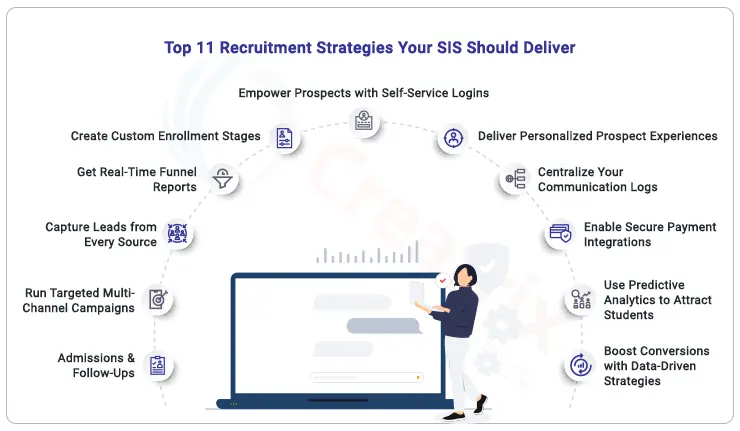
    How to improve student recruitment using an SIS. 11 powerful student recruitment strategies for your institution

    Your Student Information System (SIS) shouldn’t just store data — it should actively help you attract, engage, and convert students. From personalized outreach to faster application processing, the right SIS transforms recruitment from a numbers game into a smarter, student-first strategy.

    Student recruitment is evolving, and so are the strategies that drive success. A poll by The Guardian surveyed 70 UK university marketing teams and found that,

    57% of university marketing teams found open days to be their top recruitment tool.

    72% relied on external digital advertising.

    98% favored social media advertising.


    It’s clear — a one-size-fits-all approach won’t cut it anymore. To stay competitive, institutions need a well-rounded, data-driven recruitment strategy. Here’s a breakdown of 11 powerful SIS-supported strategies to help your institution attract, engage, and enroll more students.


    1. Try automating admissions & follow-ups for higher conversions with an integrated CRM


    How to Boost Your SIS for Student Recruitment with Smart Strategies


    CRM integrated into Admissions can be the first savior. We promise they have a suite of tools that are specifically tailored to the needs of your educational institute. An SIS integrated with CRM offers a targeted approach to your mundane admissions process. 

    At Creatrix Campus, we have a CRM in place that can likely enable institutions of all sizes to thrive in the competitive market while ensuring data is formed, tracked, processed, and analyzed to deliver a rich personal experience to students and other stakeholders alike.

    There are ways to nurture relationships with seamless lead generation and marketing capabilities. We are cloud-native and accessible across many devices.


    2. Run targeted, multi-channel campaigns

    Make sure your SIS supports digital, social media, institution, API, and other source lead capture. For quicker follow-up, all leads should direct themselves to one system and path to the correct counselors. Integration of a CRM helps to simplify this procedure.

    Potential update: To be competitive, think of mentioning automated campaigns driven by artificial intelligence.


    3. Capture leads from every channel — perfectly

    Options to capture student inquiries through multichannel including digital, social, institutions, APIs, and much more. Direct all these inquiries to a single place and direct them to the right lead owners or counselors for a timely connection. Trust us; a CRM can help you with this.


    4. Get funnel reports in real-time

    Your SIS should create funnel reports tracking leads at all levels, therefore enabling you to spot areas of congestion and make quick strategic changes. Comprehensive analytics make sure organizations may maximize their hiring plans for the next inflow.

    Potential update: Including predictive analytics or artificial intelligence advice here could improve this approach.


    5. Create custom enrollment stages 

    Every institution is different; your SIS should enable you to construct custom enrollment phases to suit your particular procedure. This guarantees that prospects pass the funnel without incident and helps to keep your pipeline orderly.

    Potential update: Could underline dynamic systems that change depending on student behavior or profile data.


    6. Use self-service logins to empower prospects

    Through one safe platform, let prospects build profiles, follow their application status, submit documentation, speak with counselors, and pay costs. It cuts administrative overhead and keeps them interested.


    7. Deliver personalized prospect experiences  

    Personalized interactions build relationships, and your SIS should support this. From inquiry to enrollment, ensure tailored messages, program recommendations, and helpful content reach the right prospect at the right time.

    Potential update: AI-driven personalization or behavioral tracking could elevate this further.


    8. Keep a centralized communication log 

    Automatic generation of offer letters with in-built templates, intimation of fee payment, request sent for missing documents, program orientation, etc.

    The tool you are using should generate, capture, and nurture leads across platforms, both online and in-person. At Creatrix Campus, you could set up personalised emails and communications to your prospects based on the inquiry made.


    9. Turn on Safe Payment Integration

    Make sure your SIS has integrated safe payment gates. Prospects can easily complete their applications and pay fees online; this helps to lower dropout rates and guarantees faster conversion.

    Potential update: Talk about adherence to PCI DSS and other worldwide payment standards for further confidence.


    10.  How predictive analytics helps universities attract students

    Want to stay one step ahead in student recruitment? Predictive analytics helps universities do just that — analyzing trends, student behaviours, and historical data to spot who’s most likely to enroll. It’s like having a crystal ball but smarter, helping you focus efforts on the right students at the right time.


    11. Data-driven enrollment strategies for better conversions 

    Why guess when data can lead the way? With advanced analytics, universities can track engagement, demographics, and even application patterns, fine-tuning their enrollment strategies to attract the right students and boost conversions effortlessly. 


    Know about Creatrix student recruitment strategies to adapt and grow

    Creatrix Campus’s Student Recruitment Software has opened new doors for several universities across the globe and added value to their recruiting efforts. If you wish to know the secret of how we do it, contact our team now.

    Source link

  • Sensors help building operators detect vaping

    Sensors help building operators detect vaping

    This audio is auto-generated. Please let us know if you have feedback.

    Facilities managers can use air quality sensors to detect vaping in restrooms and other areas in which video cameras can’t be used, says a video systems company that has released a sensor product. 

    “Sensors are ideal for monitoring sensitive areas … such as restrooms, locker rooms, health care facilities and secure storage areas,” Eagle Eye Networks says in an announcement

    The company touts the sensors as especially suitable for schools, where vaping isn’t allowed. 

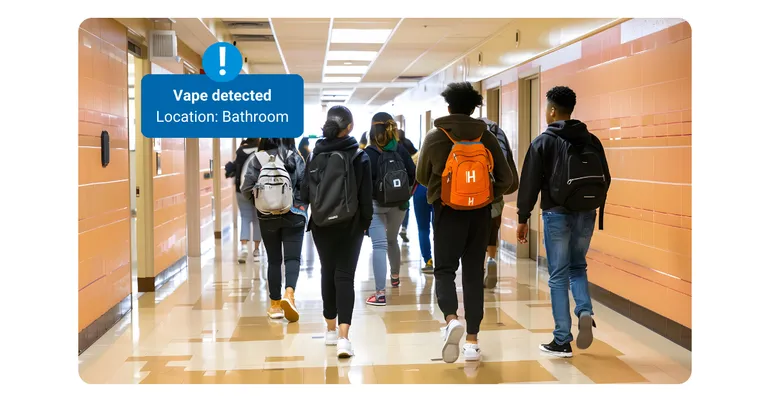
    The “sensors help school officials address vaping by detecting, alerting and providing … information about incidents while maintaining privacy,” the company says.

    The sensors integrate with the company’s flagship product, a cloud-based video management system. By combining the information provided by the sensors with information provided by video cameras outside of sensitive areas, officials can gain a more complete picture of unauthorized activity to determine if action is necessary, the company says. 

    air sensors

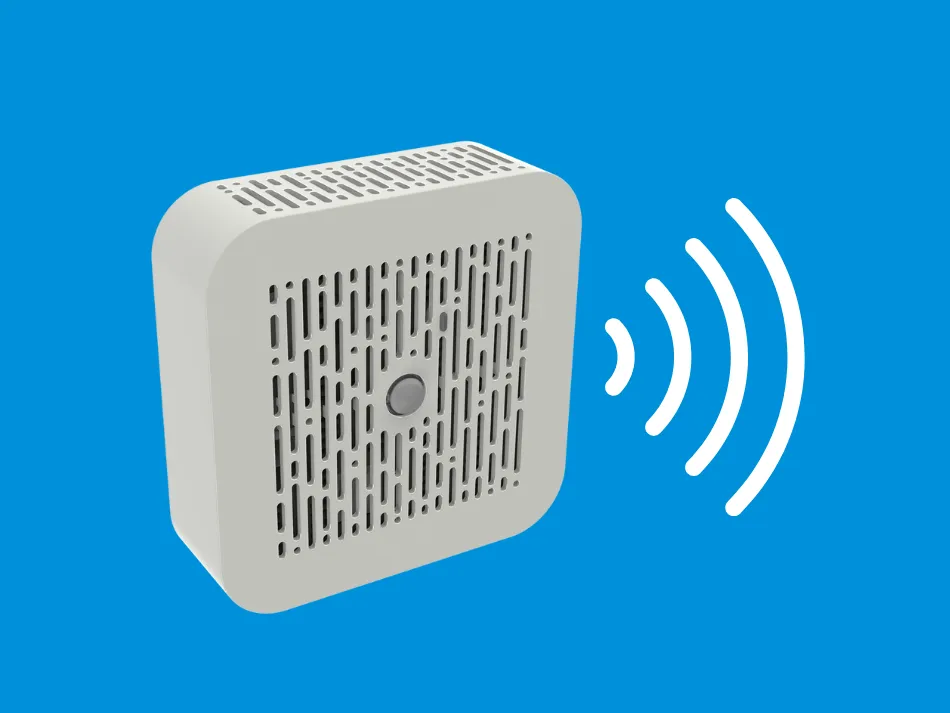
    The Eagle Eye Sensor, shown here, is capable of detecting vaping, noise, temperature and humidity in sensitive area like locker rooms and bathrooms, the company says.

    Courtesy of Eagle Eye Networks


    If a “sensor detects vape smoke in a school locker room, the system automatically triggers an alert,” the company says. “School authorities verify the event and gain additional information from security cameras located in hallways or outside of the locker room.”

    The sensors can be used in other contexts, the company says. They can track noise, temperature, humidity, and other factors that can impact indoor air quality, like volatile organic compounds, carbon monoxide, carbon dioxide and smoke. Other types of sensors can detect the presence of water, which can aid in detecting leaks, and whether doors are being left open. Alerting managers to open doors can help reduce energy use, especially in climate controlled locations like server rooms. 

    Mike Intag, managing partner at Gardient, a systems integration company, says he’s introducing the sensors to schools to help them control vaping, a “longstanding challenge in K-12 settings.” The sensors will also be used to monitor temperature, humidity and door use. “This advances our offering [to school clients] beyond security,” he said.

    Source link