Category: Featured

  • Trump signs order closing Education Department to ‘maximum extent appropriate’

    Trump signs order closing Education Department to ‘maximum extent appropriate’

    This audio is auto-generated. Please let us know if you have feedback.

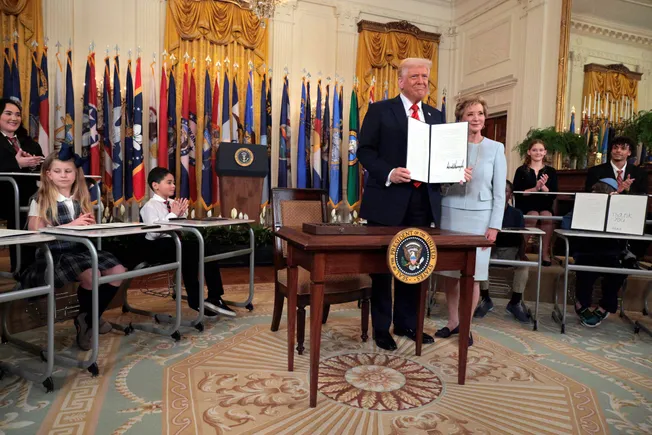
    President Donald Trump on Thursday afternoon ordered U.S. Secretary of Education Linda McMahon to “take all necessary steps to facilitate the closure of the Department of Education,” marking the boldest push from the president to shut down the agency since its establishment under the Carter administration over four decades ago. 

    Trump also said prior to the signing that he intends to disperse the department’s core functions — such as Pell Grants, Title I funding, and providing funding and resources for students with disabilities — to other parts of the government. 

    “They’re going to be preserved in full and redistributed to various other agencies and departments that will take very good care of them,” he said. “My administration will take all lawful steps to shut down the department. We’re going to shut it down and shut it down as quickly as possible.” 

    “It’s doing us no good,” he added. 

    The directive was originally expected to be released earlier this month. It comes less than two weeks after the Trump administration, under Education Secretary Linda McMahon’s leadership, abruptly cut the department’s workforce by half, shuttered over half of its civil rights enforcement offices, and fired all but a handful of National Center for Education Statistics employees. 

    The layoffs preceding the Thursday order impacted nearly 1,300 workers in addition to the nearly 600 employees who accepted “buyouts.”

    Trump has repeatedly and forcefully threatened to shut down the department since his first term in the White House, citing what he has called the agency’s “bloated budget” and a need to return education control to the states. His push to dismantle the department is in line with the 2024 Republican agenda, which included closing the department to “let the States run our educational system as it should be run.”

    In a Thursday speech, just prior to signing the order, Trump also cited low student test scores as reason to close the department. 

    “After 45 years, the United States spends more money in education by far than any other country, and spends, likewise, by far, more money per pupil than any country,” he said. “But yet we rank near the bottom of the list in terms of success. That’s where we are — like it or not — and we’ve been there for a long time.”

    Abolishing the 45-year-old agency altogether, however, requires a Senate supermajority of 60 votes. A similar proposal from conservatives in the House failed in 2023 when 60 House Republicans joined Democrats to defeat the measure.

    Given the current closely divided Congress, many have considered it a longshot that lawmakers would approve the department’s demise.  

    However, in his Thursday speech, Trump said he hopes Democrats would be onboard if the legislation to officially close the department eventually comes before Congressional lawmakers.

    What will be impacted?

    Although the administration technically needs Congressional action to close the department, the Thursday order tells McMahon to push its closures “to the maximum extent appropriate and permitted by law.”

    The agency is responsible for a slew of programs key to school and college operations, including conducting federal civil rights investigations, overseeing federal student financial aid, and enforcing regulations on Title IX and other education laws. It is in charge of large programs that schools depend on, like Title I, which sends aid to low-income school districts, and the Individuals with Disabilities Education Act that supports special education services.   

    Following the layoffs earlier this month, the department claimed its key functions, including overseeing COVID-19 pandemic relief, wouldn’t be impacted. 

    “Closing the Department does not mean cutting off funds from those who depend on them — we will continue to support K-12 students, students with special needs, college student borrowers, and others who rely on essential programs,” said McMahon in a statement praising the executive order on Thursday.

    Source link

  • Leading Your Institution in Times of Disruption and Uncertainty

    Leading Your Institution in Times of Disruption and Uncertainty

    Blog on higher education navigating turbulent waters: Image of a lighthouse in rough seass
    How can you illuminate a path to success in a turbulent environment?

    This last half decade has delivered unprecedented disruption for university leaders. The pandemic, economic uncertainty, greater need among students and families, and sweeping governmental changes have buffeted campuses of every size, type, and mission. As we move through 2025 and look at the landscape beyond, it’s clear that adaptability, resilience, and innovative thinking are crucial for successful university management.

    As my colleagues and I partner with university leaders on key areas such as strategic enrollment planning and working with university boards, we help leaders assess and address five key challenges that impact institutional sustainability. Addressing these areas strengthens fiscal health, campus alignment and collaboration, efficiency, and other challenges that are roadblocks to a campus achieving its full potential.

    Embracing Enterprise Risk Management

    There is one preliminary key strategy that has become especially vital for navigating uncertain times: Enterprise Risk Management (ERM). This approach replaces siloed risk management that dilutes campus resources and responses with a stronger, integrated perspective—allowing senior leaders and boards of trustees to gain a comprehensive view of potential threats and their interconnections. By implementing ERM, universities can develop more effective strategies for identifying, mitigating, and managing risks across all aspects of their operations.

    Addressing five key challenges

    Once you have embraced ERM, that can help guide your strategies and tactics in addressing these five key university challenges.

    1. Financial stability and funding

    With potential changes in federal funding and financial aid structures, universities must diversify their revenue streams and explore new partnerships. This may include collaborations with private industry, international organizations, and philanthropic entities to sustain critical academic research and support student access to education.

    Additionally and perhaps more urgently, leaders need to dive deep into financial aid budgets, leveraging strategies, funding sources, and how they tie to recruitment and admissions strategies. RNL is working closely with our partners to redesign models if/when funding sources disappear, ensuring that you can meet your enrollment goals and serve your mission amidst tremendous uncertainly regarding government sources of funding.

    2. Technological integration

    The rapid advancement of technology, particularly artificial intelligence, is disrupting traditional teaching and learning methods. University leaders must navigate this transformation by:

    • Investing in faculty training for AI integration
    • Updating curricula to reflect emerging technologies
    • Developing ethical guidelines for AI use in academia

    Along those lines, it is critical that institutions have an AI governance framework in place. However, few universities do. In our recent survey of marketing and recruitment practices for undergraduate students, only one out of 10 four-year institutions reported having an AI governance plan. With AI revolutionizing the college journey for students and families, you need to ensure you have a sound AI governance framework.

    3. Crisis preparedness

    From pandemics to natural disasters disrupting higher education, having a comprehensive crisis management plan is essential. This should include:

    • Regular scenario planning and contingency exercises
    • Clear communication protocols for all stakeholders
    • Ongoing training for staff and administrators

    Most institutions have the logistics of crisis management figured out: crisis captains, protocols, policies, and procedures. What they have not accommodated for in the midst of myriad external forces is the long-term impact of these singular events and ongoing circumstances on their communities—students, families, faculty, and staff. The mental health crisis in education is on the rise and now, more than ever, campuses need to lead with compassion and understanding to bring communities together. Ultimately, your institution needs to be able to anticipate potential crisis and be ready to adapt rapidly to ensure that students are cared for and their college experience can continue.

    4. Fostering a culture of innovation and adaptability

    Taking the optimal approach to technological changes and crisis preparedness requires cultivating a culture of continuous innovation. This involves:

    • Creating dedicated teams to explore new areas of innovation
    • Encouraging interdisciplinary collaboration
    • Promoting flexibility in learning paths and program offerings

    The higher education marketplace does not stand still, and universities therefore cannot afford to be set in their ways and be slow to adapt.

    5. Prioritizing stakeholder trust and communication

    Addressing these challenges and achieving goals in a period of disruption requires unity, transparency, and communication among key stakeholders. University leaders should:

    • Maintain open lines of communication with all stakeholders
    • Build trust through consistent and honest messaging
    • Engage in active listening to address concerns and gather feedback

    Difficult messages can be difficult to deliver, but more transparency and dialogue with stakeholders will increase collaboration and focus that will produce transformative results.

    Great university leadership is needed more than ever

    Managing a university during times of great disruption and uncertainty requires a delicate balance of strategic foresight, agile decision-making, and compassionate leadership. By embracing risk management, fostering innovation, and prioritizing clear communication, university leaders can navigate these challenging waters and emerge stronger, more resilient, and better equipped to fulfill their educational missions in an ever-changing world.

    As we face the future, it’s clear that the most successful universities will be those that can adapt quickly, leverage new technologies thoughtfully, and maintain an unwavering commitment to their core values and the communities they serve. My colleagues and I stand ready to help you face this future and achieve immediate and long-term success. Please reach out and we can arrange a convenient time to share our insights and what’s working for institution’s like yours.

    Source link

  • How 24/7 Technical Support Drives Student Success and Retention

    How 24/7 Technical Support Drives Student Success and Retention

    From speed-to-lead to 24/7 support: Meeting student needs in the digital age

    In our recent webinar, “The Importance of Speed to Lead in Meeting Your Enrollment Goals,” we highlighted how rapid, personalized responses to prospective students can significantly impact their perception of an institution’s quality and commitment. This principle of timely, relevant communication extends beyond the admissions process and into the heart of the student experience, particularly in online education. In this post, we’ll delve into how this same philosophy applies to technical support, forming a crucial component of student success and retention.

    The critical role of 24/7 technical support in online education

    Building on the speed-to-lead concept, the need for swift and effective technical support in online learning environments has become paramount. As we transition from initial student engagement to ongoing support, responsive assistance becomes even more critical. Let’s explore why timely technical support is essential and how it ties to student retention, institutional credibility, and mission fulfillment.

    The importance of quick response to technical needs

    Just as rapid responses to inquiries can influence a student’s decision to enroll, quick resolution of technical issues can determine a student’s ability to succeed in their coursework. Student satisfaction is closely tied to the quality of the overall experience institutions provide to students, including addressing technical issues and how the institution responds to the students as individuals when they have a concern. When students encounter technical barriers without immediate resolution, their frustration can lead to disengagement and even withdrawal from courses.

    The importance of swift technical support in higher education cannot be overstated, as exemplified by several leading institutions.

    • Penn State University’s IT Service Desk stands out with its comprehensive 24/7 technology support model. Utilizing a blend of 20 students and full-time staff members, they efficiently manage up to 600 daily requests during peak periods. This continuous operation throughout the year, pausing only for university holidays, ensures that the Penn State community receives timely assistance for diverse IT-related issues, from learning management systems to account access and new IT service implementations.
    • Arizona State University (ASU): ASU’s help center provides round-the-clock service for their large student body. They have 81 employees and 22 student representatives who offer 24/7 support for approximately 100,000 students, including both on-campus and online learners. The center serves as a comprehensive “front door” to the university, assisting with various inquiries beyond just technical issues.
    • The University of Central Florida (UCF) has adopted a strategic approach to technical support. By deploying technicians during high-demand hours, UCF effectively minimizes downtime for both students and faculty. This proactive strategy maintains the continuity of the learning process and demonstrates the institution’s commitment to student success.

    In instances where staffing may be limited, universities are increasingly turning to AI-powered solutions to meet the demand for immediate, round-the-clock support. For example, Thompson Rivers University has implemented a 24/7 chatbot support system. This AI-driven tool automates 83% of incoming chats to their Future Student department, providing instant responses outside of regular business hours. Moreover, a number of innovative platforms such as RNL’s Compass digital assistant provide AI-powered chatbots designed for higher education. These AI-powered assistants can seamlessly integrate with various campus systems, including SIS/ERP, ITSM, and LMS, to address a wide range of inquiries related to IT, admissions, financial aid, and more. By leveraging such technologies, institutions can significantly reduce support costs while ensuring students and faculty receive timely, personalized assistance at any hour.

    The case for a 24×7 support model

    A 24/7 support model aligns with the flexibility that online education promises. Students often engage with coursework outside traditional hours, making access to technical assistance at any time a necessity rather than a luxury. Institutions like Faith Christian School emphasize the importance of uninterrupted access to educational resources, which fosters independence and self-directed learning. Similarly, Google Cloud’s Student Success Services leverage virtual assistants to provide instant answers around the clock, freeing up staff for more personalized guidance.

    Moreover, research shows that institutions offering comprehensive support services see higher retention rates. RNL data show how targeted outreach and timely interventions can significantly improve student outcomes and graduation rates. By addressing technical issues promptly, universities not only retain students but also fulfill their mission of guiding them toward successful program completion.

    Perception of a well-equipped university

    The availability of 24/7 technical support is increasingly viewed as a marker of institutional quality. Students now expect seamless access to both academic content and support services when selecting a university. Institutions that fail to meet these expectations risk damaging their reputation and losing prospective students. RNL student satisfaction and priorities data shows that approximately two-thirds of students value institutions addressing their personal needs throughout the recruitment process, which can factor in their decision to enroll at the institution. Offering robust technical support signals that a university is technologically advanced and committed to providing an optimal learning environment.

    Enabling student success and institutional mission

    Timely technical support directly contributes to student success by removing barriers to learning. When students can focus on their studies without being derailed by technical difficulties, they are more likely to persist in their programs. This aligns with the broader mission of most universities: helping students succeed academically and graduate. Demonstrating the lived expression of institutional mission through 24/7 support for student services can enhance retention and overall well-being. By addressing both academic and non-academic challenges in real-time, universities create an ecosystem where students thrive.

    Conclusion: Timely support is critical to the online student experience

    From the initial point of contact through to graduation, the principle of timely, personalized support remains crucial. The importance of responding quickly to students’ technical needs is a natural extension of the speed-to-lead philosophy in enrollment management. A 24/7 support model not only ensures uninterrupted learning but also strengthens institutional credibility and fosters student retention. By prioritizing timely assistance across all aspects of the student journey, universities can live up to their mission of empowering students to succeed academically and graduate with confidence. As these examples illustrate, investing in comprehensive support systems is an investment in both student success and institutional sustainability.

    We’re here to help you navigate the technology you need to engage students and provide them with that 24/7 support. Reach out and we’ll set up a time to talk with an RNL enrollment technology expert.

    How can you leverage technology across the student lifecycle?

    With students expecting personalized attention 24/7, you need to be able to engage them at any point in the student lifecycle. Talk with our experts about how you can use the latest technology to create those connections to strengthen recruitment and retention.

    Ask for a complimentary consultation

    Source link

  • EEOC and DOJ Issue Technical Assistance Documents on Unlawful DEI-Related Discrimination

    EEOC and DOJ Issue Technical Assistance Documents on Unlawful DEI-Related Discrimination

    by CUPA-HR | March 20, 2025

    On March 19, the Equal Employment Opportunity Commission (EEOC) and Department of Justice (DOJ) released two technical assistance documents intended to educate “the public about unlawful discrimination related to ‘diversity, equity, and inclusion’ (DEI) in the workplace.” The two documents aim to inform the public about how civil rights rules and laws like Title VII of the Civil Rights Act of 1964 apply to employment policies, programs and practices, including those labeled or framed as “DEI.”

    Title VII prohibits employment discrimination based on protected characteristics, including race, color, religion, sex or national origin. As the agencies note in both documents, DEI is a broad term that is not defined under statute. The technical assistance explains that DEI practices may be unlawful if they involve an employer or other covered entity taking an employment action motivated in whole or in part by an employee’s race, sex, or other protected characteristic. The agencies emphasize that Title VII’s protections apply equally to all racial, ethnic, and national origin groups, as well as both sexes, and that unlawful discrimination may exist no matter which employees are harmed.

    Technical Assistance Document #1: The EEOC describes what DEI-related discrimination looks like.

    The first document, “What To Do If You Experience Discrimination Related to DEI at Work,” explains how DEI-related practices may manifest as discrimination under Title VII.

    • Title VII bars disparate treatment: Any employment action motivated in whole or in part by race, sex, or another protected characteristic that is taken in the context of the terms, conditions, or privileges of employment may be unlawful.*
    • Title VII prohibits limiting, segregating, and classifying: Any action taken that limits, segregates, or classifies employees based on race, sex, or other protected characteristics in a manner affecting their status or depriving them of employment opportunities may be unlawful. Examples of these practices include the establishment of workplace groups (employee resource groups or employee affinity groups) that limit membership to a protected group or groups, as well as the separation of employees into groups based on a protected characteristic when administering trainings or other privileges of employment. The document makes clear that the latter may still violate Title VII even if the separate groups receive the same training or programming content.
    • Title VII prohibits workplace harassment: Workplace harassment is illegal when it results in an adverse change to a term, condition, or privilege of employment, or it is so frequent or severe to reasonably be considered intimidating, hostile, or abusive. The document explains that DEI training may give rise to a hostile work environment claim and that harassment may occur when an employee is subject to unwelcome remarks or conduct based on protected characteristics.
    • Title VII prohibits employer retaliation: The agencies explain that reasonable opposition to a DEI training may constitute protected activity if the employee provides a fact-specific basis for their belief that the training violated Title VII, and that an employer may not retaliate if an employee participates in an EEOC investigation or files an EEOC charge.

    The document reaffirms that Title VII protects employees, potential and actual applicants, interns, and training program participants. It directs individuals who suspect to have experienced DEI-related discrimination to contact the EEOC “promptly” as claimants have 180 to 300 days to file a claim depending on whether a state or local agency enforces a law that prohibits employment discrimination on the same basis.

    Technical Assistance Document #2: The EEOC answers additional questions about DEI-related discrimination in the workplace.

    The second technical assistance document, titled “What You Should Know About DEI-Related Discrimination At Work,” expands upon the information provided in the technical assistance document discussed above and answers a number of additional questions on how Title VII intersects with DEI-related practices in the workplace.

    Notably, the document addresses questions surrounding employers’ DEI-related considerations of race, sex, and other protected characteristics when the protected characteristic wasn’t the “sole or deciding factor” for the employers’ action. The document states that “race or sex (or any other protected characteristic under Title VII) does not have to be the exclusive (sole) reason for an employment action or the ‘but-for’ (deciding) factor for the action” for there to be unlawful discrimination. Additionally, the agencies explain that workers only need to show “some injury” or “some harm” affecting their terms, conditions or privileges of employment to allege a colorable claim of discrimination under Title VII.

    The document also makes clear that an employer may not justify an employment action simply on the basis that they have a business necessity or interest in “diversity” as Title VII prohibits employers from using business necessity as a defense against intentional discrimination claims. Likewise, the agencies explain that “client or customer preference is not a defense to race or color discrimination” and that “basing employment decisions on the racial preferences of clients, customers, or coworkers constitutes intentional race discrimination.”

    CUPA-HR will continue to monitor for updates related to Title VII enforcement from the EEOC.


    *The terms and conditions of employment include: hiring; firing; promotion; demotion; compensation; fringe benefits; exclusion from training; exclusion from mentoring or sponsorship programs; exclusion from fellowships; selection for interviews (including placement on candidate slates).


    Source link

  • A Legacy That Will Not Be Erased

    A Legacy That Will Not Be Erased

    Dr. Mary Dana HintonMarch 12th would have been my mother’s 99th birthday. It surprises me every day that she’s not here to celebrate it. For her entire life, she was a vibrant testament to the value and the necessity of education for women.

    My mother believed in the promise that with an education, you could not only help yourself but also have an obligation to help those around you. She believed that all that stood between a woman and anything she wanted to achieve in this world was an education.

    As someone who was forbidden from getting an education, it became her life’s work to learn as much as she could on her own and to remind others – especially women – of the great privilege of an education.

    When I think of those lessons from my mother, I invariably think of her knees. My mother worked as a domestic for much of her life. For my entire childhood, I remember she would come home with her knees swollen to the size of grapefruits. Throughout her life, for her work and for her family, she cleaned floors on her hands and knees because that’s how you did that job with excellence. To my mother, your value was not determined by what job you did, but by the quality with which you completed the job.

    She expected the same level of excellence from me in school and would expect the same from me in my work today.  

    When I’m wearied by the work of being a college president, when I’m exhausted by the demands of this moment, when I’m tired of trying to think of another way to move our mission forward, I think of my mother’s knees. Those knees made sure I could get an education. Those knees that for 94 years held up a woman who had a complicated relationship with the United States given that as much of her life was spent in a segregated Jim Crow society as not. But those knees never dampened her belief in the promise of education, which was also a belief in the promise of democracy.

    As such, my mother would be irate that, among those on a long list, the word “women” is one that federal agencies are now discouraged from using or being asked to eliminate from official language. That, with the reduction of support for education, would have felt like a violation to her. An erasure of our shared humanity. She might have said that these choices are beyond puzzling, and the irony would not have been lost on her that this request arrived during this annual month designated to celebrate women’s history. 

    As I celebrate my mother, I also want to take a moment and honor what is a result of her legacy. Her deep and abiding belief in education has now become my deep and abiding belief in education, and I am so very proud of what my institution is able to offer women, not only on behalf of my institution and myself but on behalf of the work and commitment of my mother.

    While we mark this year’s celebration of Women’s History Month in America, I want to honor my mother, Susie Ann Hinton, and all the women who believe in and deserve an excellent education. They and their legacies will not be erased.

    Dr. Mary Dana Hinton is president of Hollins University, chair of the Council of Independent Colleges of Virginia and chair of the National Association of Independent Colleges and Universities.

    Source link

  • FIRE and civil liberties groups challenge ‘unconstitutional retaliation’ against Mahmoud Khalil

    FIRE and civil liberties groups challenge ‘unconstitutional retaliation’ against Mahmoud Khalil

    FIRE along with the National Coalition Against Censorship, The Rutherford Institute, PEN America, and First Amendment Lawyers Association today filed a “friend of the court” brief arguing that the jailing of Mahmoud Khalil violates the First Amendment. What follows is the brief’s summary of argument.


    America’s founding principle, core to who and what we are as a Nation, is that liberty comes not from the benevolent hand of a king, but is an inherent right of every man, woman, and child. That includes “the opportunity for free political discussion” as “a basic tenet of our constitutional democracy.” (Cox v. Louisiana). And “a function of free speech under our system of government is to invite dispute. It may indeed best serve its high purpose when it induces a condition of unrest, creates dissatisfaction with conditions as they are, or even stirs people to anger.” (Terminiello v. City of Chicago). For these reasons, along with all citizens, “freedom of speech and of press is accorded aliens residing in this country.” (Bridges v. Wixon).

    Secretary of State Marco Rubio, however, is attempting to deport a permanent resident, Mahmoud Khalil, not because the government claims he committed a crime or other deportable offense, but for the seemingly sole reason that his expression stirred the Trump administration to anger. The Secretary claims he can deport Mr. Khalil under a Cold War–era statute giving the secretary of state the power to deport anyone he “personally determines” is contrary to America’s “foreign policy interest.” And he argues this power extends even to deporting permanent residents for protected speech. It does not.

    The First Amendment’s protection for free speech trumps a federal statute. (United States v. Robel). Accepting Secretary Rubio’s position would irreparably damage free expression in the United States, particularly on college campuses. Foreign students would (with good reason) fear criticizing the American government during classroom debates, in term papers, and on social media, lest they risk deportation. That result is utterly incompatible with the longstanding recognition that “[t]he essentiality of freedom in the community of American universities is almost self-evident,” and that “students must always remain free to inquire, to study and to evaluate, to gain new maturity and understanding.” (Sweezy v. New Hampshire).

    Secretary Rubio claims (as do all censors) that this time is different, that the supposed repulsiveness of Mr. Khalil’s pro-Palestine (and, as Secretary Rubio alleges, pro-Hamas) views cannot be tolerated. But “if there is a bedrock principle underlying the First Amendment, it is that the government may not prohibit the expression of an idea simply because society finds the idea itself offensive.” (Texas v. Johnson) (holding the First Amendment protects burning the American flag in protest); see also (Snyder v. Phelps) (holding the First Amendment protects displaying “God Hates Fags” and “Thank God for Dead Soldiers” posters outside a military funeral).

    Allowing the Secretary of State to deport any non-citizen whose views, in his subjective judgment, are against America’s foreign policy interests places free expression in mortal peril. China’s Constitution, for example, provides that “when exercising their freedoms and rights, citizens . . . shall not undermine the interests of the state.” As China’s experience shows, allowing the government to step in as censor when it believes speech threatens the government’s interests is a loophole with infinite diameter. It has no place in America’s tradition of individual liberty.

    The only court to address the deportation provision Secretary Rubio relies upon to deport Mr. Khalil reached a similar conclusion, holding the law unconstitutional. As that court explained, “If the Constitution was adopted to protect individuals against anything, it was the abuses made possible through just this type of unbounded executive authority.” (Massieu v. Reno).

    The “First Amendment does not speak equivocally. It prohibits any law ‘abridging the freedom of speech, or of the press.’ It must be taken as a command of the broadest scope that explicit language, read in the context of a liberty-loving society, will allow.” (Bridges v. California) (invalidating criminal convictions, including of a non-citizen, based on protected speech). Our “liberty-loving society” does not permit deportation as a punishment solely based on expression the government disfavors. The Court should grant Mr. Khalil’s motion.

    Source link

  • FIRE and coalition partners file brief rebuking the U.S. government for attempting to deport Mahmoud Khalil for his protected speech

    FIRE and coalition partners file brief rebuking the U.S. government for attempting to deport Mahmoud Khalil for his protected speech

    WASHINGTON, March 20, 2025 — The Foundation for Individual Rights and Expression filed a brief Thursday with a clear message: Jailing people for their political expression betrays America’s commitment to free speech.

    FIRE’s brief — joined by a coalition of civil liberties groups — explains the First Amendment violations stemming from the Trump administration’s unconstitutional detention of and attempts to deport Mahmoud Khalil, a lawful permanent resident of the United States, for his expression. After 12 days in detention, the government still has not charged Khalil with a crime. 

    The “friend of the court” brief from FIRE, the National Coalition Against Censorship, the Rutherford Institute, PEN America, and the First Amendment Lawyers Association argues the Trump administration’s attempt to deport Khalil constitutes textbook viewpoint discrimination and retaliation in violation of the First Amendment.

    “Khalil’s arrest, which President Donald Trump heralded as the ‘first of many to come,’ is an affront to the First Amendment and the cherished American principle that the government may not punish people based on their opinions,” said Conor Fitzpatrick, FIRE supervising senior attorney.

    In its attempt to deport Khalil, the government has thus far focused solely on Khalil’s protected speech rather than charging him with criminal behavior. An administration official told The Free Press that the “allegation here is not that he was breaking the law,” and White House Press Secretary Karoline Leavitt said Khalil faces deportation because he was “siding with terrorists” and “distributed pro-Hamas propaganda flyers with the logo of Hamas.”

    The Supreme Court held in 1945 that non-citizens are entitled to full First Amendment protections. And those protections cover unpopular expression, especially when that expression is political speech. The Supreme Court held in its landmark Texas v. Johnson decision that “if there is a bedrock principle underlying the First Amendment, it is that the government may not prohibit the expression of an idea simply because society finds the idea itself offensive.”

    The administration is relying on a rarely used Cold War-era statute that empowers the secretary of state to deport a lawfully present non-citizen if the secretary determines their “presence or activities” has a “potentially serious” effect on America’s foreign policy. The administration claims that authority extends even to deporting green card holders for protected speech.

    FIRE disagrees. The statute is unconstitutionally vague and gives the secretary of state unfettered discretion to deport lawful permanent residents without giving them notice of what conduct triggers expulsion. Not only does the First Amendment trump a Cold War-era statute, but the sweeping authority the administration claims it confers “places free expression in mortal peril,” as FIRE’s brief argues.

    The brief also explains that the contours of the United States’ foreign policy are ever-changing and provide no meaningful guidance as to what opinions lawful permanent residents may or may not voice. If lawfully present non-citizens can be deported simply for endangering American “foreign policy,” the only sure way to avoid deportation is to self-censor and not voice any opinions. 

    “No one in the United States of America should fear a midnight knock on their door because they voiced an opinion the government doesn’t like,” Fitzpatrick said. “Accepting Secretary Rubio’s position would irreparably damage free expression in the United States.”

    FIRE’s brief analogized the administration’s approach to Article 51 of the Chinese Constitution, which warns that exercising “freedom” must not conflict with the “interests” of the government. “Allowing the government to step in as a censor when it believes free speech threatens the government’s interests is a loophole with an infinite diameter,” Fitzpatrick said. “It has no place in America’s tradition of individual liberty.”

    If Khalil’s deportation proceeds, the chilling effect will be profound for other international students who are presently studying at American universities. 

    “Other foreign college students will have good reason to fear criticizing the American government during classroom debates, in term papers, and on social media,” FIRE attorney Colin McDonell said. “Holding students engaged in basic political expression to different standards based on their citizenship status is poisonous to free speech on campus.”


    The Foundation for Individual Rights and Expression (FIRE) is a nonpartisan, nonprofit organization dedicated to defending and sustaining the individual rights of all Americans to free speech and free thought — the most essential qualities of liberty. FIRE educates Americans about the importance of these inalienable rights, promotes a culture of respect for these rights, and provides the means to preserve them.

    CONTACT:
    Karl de Vries, Director of Media Relations, FIRE: 215.717.3473 x335; [email protected]

    Source link

  • Can fiction help us get to the truth about climate change?

    Can fiction help us get to the truth about climate change?

    Truth in fiction

    That’s where fiction can come in. But most climate fiction presents gloomy scenarios: think the waterless world of Arrakis in Frank Herbert’s “Dune” series or our earth after a virus wiped out most of human life in Margaret Atwood’s “Oryx and Crake” trilogy.

    In contrast, Baden’s story showed more positive solutions. Her own research found that 98% of her readers changed their attitudes. A month after reading the story 60% of readers actually adopted a green alternative.

    She’s set to release “Murder in the Climate Assembly“, a fictional story about the ramifications of a murder that takes place in a citizens’ assembly on climate.

    Some media organizations are now including climate change awareness initiatives that use fictional examples into their marketing campaigns.

    Baden worked with BAFTA, the British Academy of Film and Television Arts, to create social media content that provided solutions with a tinge of humour. For example, they contrasted the carbon footprint of two popular characters from books and movies: James Bond who drives a gas guzzling sports car and has a walk-in wardrobe versus Jack Reacher who traveled by bus and shopped second-hand.

    Making environmentalism fun

    Pilot testing showed interesting results: “If we just presented the negative one like James Bond, some people laughed and thought it was funny, but a few people thought they were being a bit preached at and switched off,” Baden said. “Whereas when you kind of had both together with a bit of humor, that seemed to hit the right spot.”

    Pike agreed: “Comedy too allows us to let our guard down. When we open our mouth to laugh, our mind is open to learn.”

    When Pike was in Chile working on the PhD that led to her book she found that she loved the animated series “The Simpsons“. In 2008, one of the three TV channels played Simpsons episodes endlessly, she said. Simpsons creator Matt Groening intended his show to make people aware of environmental challenges and complications in ways that start conversations, she said.

    Context makes a difference too. “I read ecoactivist discourse in South America and it seemed so darn white and privileged,” Pike said. “If you read “Burning Rage of a Dying Planet” in a comfortable U.S. suburb, it’s one thing. If you read the same book in Chile, it feels different, almost too precious, definitely not the tone I would take in talking about ecology in South American countries.”

    The Center for Health Communication at Harvard University says that showing, not telling induces stronger emotional responses as visual imagery and helps our brains understand abstract and complex associations like those between climate and health.

    Connecting emotion to change

    Telling stories through books, plays or social media also help to create emotion, and change beliefs and behaviours. They may also reduce feelings of anxiety and depression that surface when bombarded with alarmist news about the climate crisis. Focusing on solutions is more effective.

    Pike said the way to get through the barrage of media messages and talk about the climate crisis is with honesty, independence and humour. “Acknowledge the hypocrisy and move on toward solutions,” Pike said. “A solution offers me a choice, agency, a chance to put up a sail and navigate to a goal.”

    Pike taught a class called “Environmental Reporting for a Hopeful Planet” in the spring 2024 semester. One assignment was “Forest Friday”: students were asked to read, watch or listen to examples of environmental storytelling.

    One week, the students were assigned a video of Rebecca Solnit. She’s a writer, historian and activist who has been examining hope and the unpredictability of change for more than two decades. In 2023 she co-edited an anthology called “It’s Not Too Late”, a guide for finding hope even while climate change-induced disasters continue. This is what one student said after they watched that video:

    “I felt reassured by her calmness and her endless lists of knowledge of times and places in which meaningful change has occurred. I think she makes many great points about the way that just because ideas don’t always get the opportunity to fully take shape they are still impactful on society as a whole.”

    So, what’s the best way to write about the climate crisis?

    “Read environmental writing and write,” Pike said. “Be so deeply curious about how ecology works, how nature and culture interact, how businesses and institutions works and their role in the climate crisis.”

    Ways to write effectively

    Having a community of people who also write about and care about the environment can also help. But most importantly, Pike said: “Work to tell a story well.”

    This means reading the publications which interest you and seeing if your story would be a good fit. Try different mediums. Take Dr. Seuss’ “The Lorax”. It’s a children’s book written in 1971 about a character who speaks for the trees as a business tycoon destroys the environment. The story encourages activism and involvement in making the situation better. In it the Lorax tells us: “Unless someone like you cares a whole awful lot, nothing is going to get better. It’s not.”

    More recently, there are films like “Flow“, which won an Academy Award for Best Animated Feature and was nominated for Best International Feature Film, and “The Wild Robot“, which was nominated for three Academy Awards including Best Animated Feature.

    In both, climate change is a world-building element; one showed a submerged Golden Gate Bridge, the other showed a flood of biblical proportions. But they’re both animated films, with cute animals coming together to save the world, reaching a younger audience who will grow up with climate change and its impacts.

    Creating a story that can make people think about our planet and how we can tackle climate change isn’t easy. Pike said it is worth persevering.

    “If you get tired, don’t give up,” Pike said. “Rest and get back to it when you can. We all plant seeds and it’s hard to say which ones will take.”


    Three questions to consider:

    1. What makes you switch off the news when a story about climate change comes on?
    2. What happens to our brain when we show, rather than tell, in our writing on climate change?
    3. What might you learn in a course like “Environmental Reporting for a Hopeful Planet?” 


    Source link

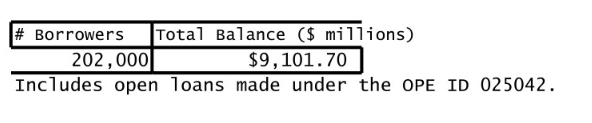
  • More than 200,000 former Walden University students owe more than $9 Billion

    More than 200,000 former Walden University students owe more than $9 Billion

    The Higher Education Inquirer has recently received a Freedom of Information (FOIA) response regarding student loan debt held by former Liberty University students.  The FOIA was 25-01941-F.  

    Source link

  • From Soviet Influence to Market Economy: Mongolia’s Higher Education Journey

    From Soviet Influence to Market Economy: Mongolia’s Higher Education Journey

    It’s been a while since we did an episode looking at the higher education system of a far-flung corner of the world. Recently I was perusing the pages of International Higher Education, a wonderful quarterly publication out of Boston College, and I saw a great little article about the challenges facing Mongolian higher education, and I knew this was something we had to cover on the podcast.

    Unless you spend a lot of time reading about the Chinggis Khan Empire, or in my case, watching the upper echelons of professional Sumo, my guess is you probably don’t think about Mongolia that often.

    As a state it’s only a little over a century old, a child of the disintegration of the Chinese empire, which found protection under the Soviet banner. Its fortunes, both as a country and as a higher education system, therefore, look a lot like those from the further flung stands of Central Asia — that is seriously under-resourced and heavily influenced by a Russian model, which splits teaching and research into two very different buckets.

    Today my guest is Dendev Badarch, a professor at the Mongolian University of Science and Technology in Ulan Bator, and one of the co-authors of that IHE article. He has an interesting take on the current situation in Mongolia and the likely keys to the system’s future success as the country moves towards upper-middle-income status and deals with the challenge of becoming a service economy.

    But enough for me. Let’s turn it over to Dendev. 


    The World of Higher Education Podcast
    Episode 3.24 | From Soviet Influence to Market Economy: Mongolia’s Higher Education Journey 

    Transcript

    Alex Usher (AU): Let’s start with a brief history of Mongolian higher education. You’re from the oldest university in the country, and the National University of Mongolia is only about 80 years old, founded in 1942, if I’m not mistaken. My guess is that, at the start, the system would have been heavily dependent on the Soviet model.

    How did higher education develop during the socialist period up to the late 1980s? Beyond training government cadres, what industries was it designed to support, and how quickly did Mongolian become the primary language of instruction?

    Badarch Dendev (BD): First of all, thank you very much for inviting me to this podcast. Yes, you are correct—the Mongolian higher education system was heavily influenced by the Soviet system. The first university, the National University of Mongolia, was established in 1942, and its curriculum, structure, and administration closely followed the Soviet model.

    To meet the needs of Mongolia’s planned economy, several small, specialized schools were established from the 1950s to the 1960s, including institutions for medical training, agriculture, teacher education, and polytechnic studies. These schools played a significant role in supplying specialists with the skills necessary to support the Mongolian economy.

    In its early years, instruction at the university was conducted in Russian. However, as more Mongolian specialists graduated with higher education degrees, Mongolian gradually became the primary language of instruction. By the 1960s, many courses—particularly in the social sciences and humanities—were being taught in Mongolian.

    AU: By the 1970s, Mongolia had a system that was producing professionals, and instruction was primarily in the Mongolian language. Then, at the end of the 1980s, there was a shift to a market economy, which must have had a profound impact on higher education. What were the biggest changes that occurred in that first decade of a market economy?

    BD:  The Democratic Revolution of 1989–1990 marked a historic transition in our country. We moved from a socialist one-party system to a multi-party democracy and a free-market economy. This shift led to significant changes in higher education.

    In response to the pressure from the new democratic system, the government, in my opinion, took three key steps.

    The first was significant changes to public institutions, reclassifying old public institutes as universities and giving them more authority. Mongolia faced economic difficulties at the time. Under socialism, higher education was fully funded by the government—covering tuition, student stipends, faculty salaries, and more. But after the transition to democracy, we faced a very difficult situation.

    Second, under socialism, all higher education institutions were public. With the reforms, the government allowed the establishment of private universities and colleges, which significantly increased access to higher education.

    The third major step was the adoption of Mongolia’s first higher education law. These three key steps taken by the government shaped Mongolia’s higher education system as it exists today.

    AU: What’s the division now between public and private higher education? In countries like China and Russia, maybe three-quarters of students are still in public universities, but there’s still a significant private or non-state sector that educates about a quarter of the students. Is that the case in Mongolia as well? How big is the private sector?

    BD: You see, when the government made the decision to establish private institutions, there was a boom—a surge of small private colleges that had no infrastructure, no proper teaching facilities, and not enough qualified faculty. At one point, there were almost 200 private colleges.

    But as of last year, the 2022–2023 academic year, we have 69 higher education institutions—19 public and 50 private.

    However, in terms of student numbers, 60 percent of students are in public universitiesbecause of reputation, infrastructure, and other factors. In total, Mongolia has about 145,000 students.

    AU: My understanding is that both public and private institutions rely heavily on tuition fees, and that tuition fees are quite high. Is that good for financial sustainability, or does it create risks for institutions?

    BD: Tuition fees are not high, but universities and higher education institutions depend almost entirely on tuition. About 90 percent of their income comes from tuition. There is no public funding—except for some government subsidies for students.

    AU: So, in that situation, it’s not really a question of whether a high dependence on tuition is bad. If there’s no public subsidy, it’s simply the only way to operate, right?

    BD: Yes. Exactly.

    AU: Badarch, another critical function of universities is research. How does Mongolia compare internationally in terms of scientific research? What are the successes, and what are the biggest barriers to developing a stronger research culture?

    BD: You know, from the beginning, Mongolian universities were primarily training institutions, not research institutions. But in the last 10 years, there has been significant investment in higher education, especially in public universities. For the first time, university professors have started publishing internationally. In fact, the five largest public universities now produce 65% of all internationally published research papers. However, in Mongolia, higher education and research have been separate from the start, following the Russian model.

    AU: You would have an Academy of Sciences?

    BD: Yes, research was traditionally conducted by the Academy of Sciences. But universities have received significant investment in research infrastructure. For example, the National University of Mongolia now has more than 40 research laboratories in fields like biology, environmental sciences, and even nuclear physics. The Mongolian University of Science and Technology has supercomputer laboratories and modern mechanical engineering facilities. In addition, we now have many graduates returning from foreign universities to work in Mongolian universities, and they are contributing to research.

    But there are still major challenges. Universities do not receive sufficient research funding because most of the research budget goes to the Academy of Sciences. There is very little collaboration with industry and almost no funding from the private sector. There are also no endowment funds or other financial support systems for university research.

    Another critical issue is the weak graduate programs. Almost 99% of graduate students are part-time—there are no full-time graduate students. This severely limits research output. Without strong graduate programs, research activity remains low. This is one of the biggest challenges for Mongolian universities.

    AU: A couple of years ago, a set of laws were passed aimed at increasing university autonomy—governance, leadership selection, those kinds of things. Do universities now have real independence, or does political influence remain a challenge? And what did the laws do to promote political independence?

    BD: Over the last three years, there were extensive discussions about the concept and details of these new laws. In July 2023, Parliament adopted a set of education laws. For the first time, these laws covered all levels of education as a single system, creating better interconnection between different stages of education. That is a very good sign.

    Second, for the first time, the law explicitly recognized academic freedom as a key principle of higher education, which is another positive step.

    The third important issue relates to governance. According to the law, if implemented correctly, universities should have independent governing boards. Another key aspect is the diversification of funding for universities, as well as strengthening university research. The law also states that public universities should receive government subsidies to help cover maintenance costs.

    I think these are the positive aspects of the new law. However, in reality, the implementation of these important measures has not yet happened. Political interference still exists, particularly in the selection of university directors and key leadership appointments.

    AU: We’ve talked a lot about the challenges in Mongolian higher education. What do you see as the opportunities? Where do you think the greatest improvements could happen in the next few years?

    BD: Yes, there are definitely opportunities. First, universities are expanding their cooperation with international communities, and they are learning a lot from these collaborations. Also, as I mentioned earlier, we have a new wave of young specialists and graduates from world-leading universities. We need to hire them. If we bring in these young professionals, give them opportunities to conduct research, teach, and help reform higher education institutions, we will see positive changes soon.

    Second, there is a major opportunity in digital technologies. If we use them smartly and correctly—things like AI, online learning, and MOOCs—then Mongolian universities can take a big step forward.

    But in order to take advantage of these opportunities, we need to ensure that the new laws are properly implemented.

    AU: If we think even further ahead, maybe to 2050, what do you think the system will look like? Will Mongolia have caught up with countries like China, Korea, or Japan? Do you think the system will have developed to the point where it can be considered alongside those peers?

    BD: You may know that the government has adopted the “Vision 2050” long-term strategic development plan. According to this plan, by 2050, Mongolia should have one of the leading universities in the region.

    I see two possible scenarios for the development of higher education in Mongolia by 2050—one optimistic and one pessimistic.

    Starting with the optimistic scenario: If we can reduce government and political interference in university governance and give universities full autonomy, that would be a big step forward. The government should also increase its support for universities, establish strong links with industry, and adopt models like the triple helix approach. Additionally, partnerships with leading international universities would help improve graduate programs.

    If these changes happen, Mongolia could develop strong higher education institutions. But right now, many of the most talented secondary school students are not choosing local universities—they are looking abroad for their education.

    The pessimistic scenario is that if things continue as they are today, universities will still exist, but they will lack freedom and independence. The issues we are currently facing—political interference, funding limitations, and weak institutional autonomy—will persist. That would be very unfortunate. However, I hope that we will see changes in government policy and that Mongolia will implement best practices from other higher education systems around the world.

    AU: Thank you so much for joining us today.

    BD: Thank you.

    AU: And before we go, I’d like to thank our excellent producers, Tiffany MacLennan and Sam Pufek, as well as our listeners, viewers, and readers for tuning in. If you have any questions or comments about today’s podcast, please don’t hesitate to contact us at [email protected]. If you’re worried about missing an episode of The World of Higher Education, why not subscribe to our YouTube channel? Go there today—don’t delay—never miss an episode!

    Join us next week when our guest will be Steven Mintz, a professor of history at the University of Texas at Austin. We’ll be discussing his new book, The Learning-Centered University. Bye for now.

    *This podcast transcript was generated using an AI transcription service with limited editing. Please forgive any errors made through this service. Please note, the views and opinions expressed in each episode are those of the individual contributors, and do not necessarily reflect those of the podcast host and team, or our sponsors.

    This episode is sponsored by Studiosity. Student success, at scale – with an evidence-based ROI of 4.4x return for universities and colleges. Because Studiosity is AI for Learning — not corrections – to develop critical thinking, agency, and retention — empowering educators with learning insight. For future-ready graduates — and for future-ready institutions. Learn more at studiosity.com.

    Source link