Category: Featured

  • How Oklahoma’s Superintendent Set Off a Holy War in Classrooms

    How Oklahoma’s Superintendent Set Off a Holy War in Classrooms

    NORMAN, Okla. — Sometimes, Jakob Topper teaches his Christian faith to his 6-year-old daughter using children’s Bible stories illustrated with teddy bears. Other days, he might use her kid-friendly Bible featuring Precious Moments figures as characters. One thing he knows for sure: The King James version is not on the reading list, given some of its adult themes of sexual assault and incest. 

    As a parent and a Baptist pastor, Topper opposes Oklahoma’s state superintendent of public instruction’s mandate to put a King James Version Bible in every grade 5–12 classroom. The father of three is also not keen on the state’s newly proposed social studies standards that would require biblical lessons starting in first grade. 

    “I want the Bible taught to my daughter, and I want to be the one who chooses how that’s done,” said Topper, who also has a 1-year-old and a 3-year-old and is pastor of NorthHaven Church in Norman, a university town. “If we’re talking about parental choice, that’s my choice. I don’t want it to be farmed out to anyone else.”

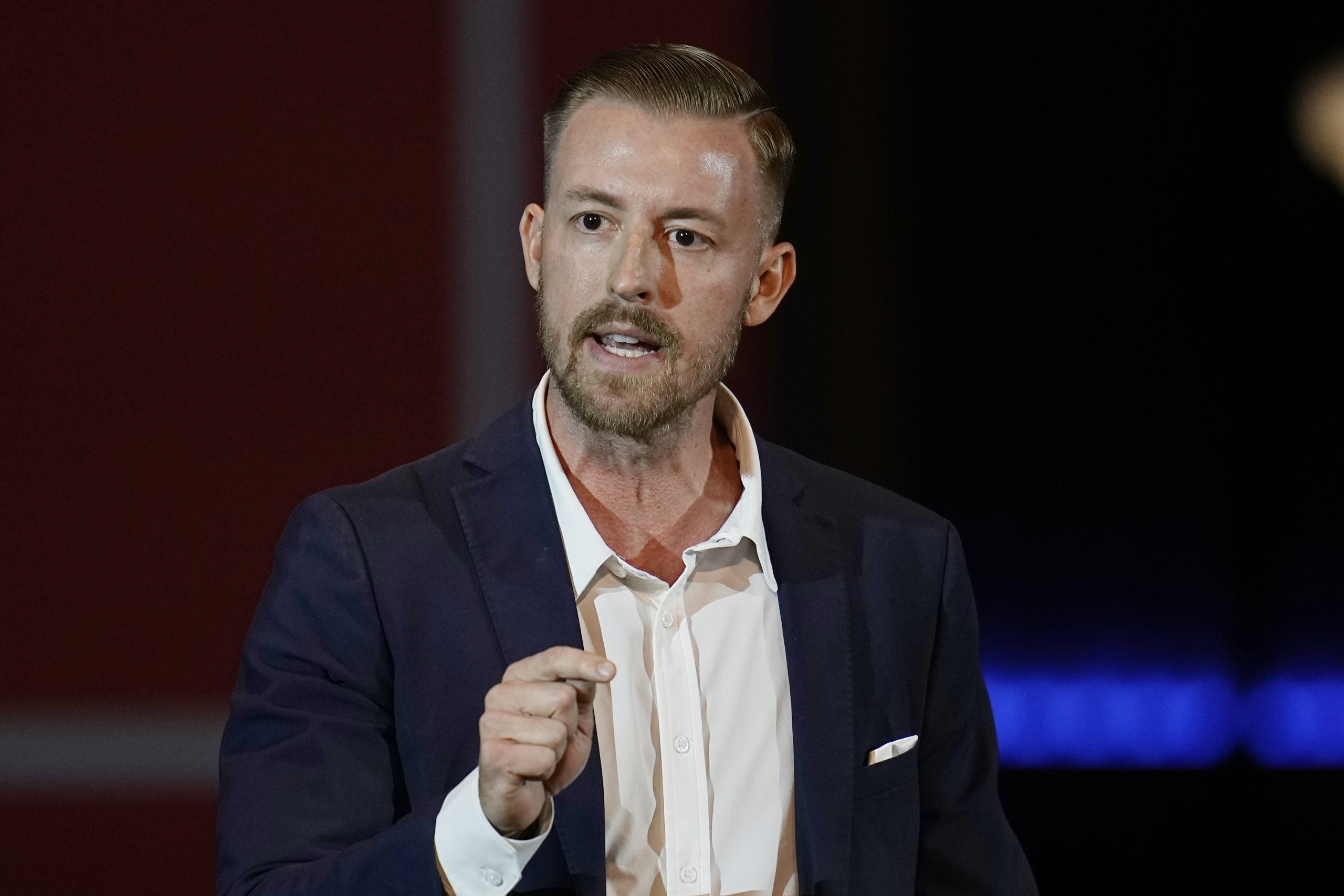
    Norman, a central Oklahoman city of about 130,000, is an epicenter of resistance to the Bible mandate that the state superintendent of public instruction, Ryan Walters, announced last June. Opposition here has come from pastors, religion professors, students, parents, teachers, school board members and the school district superintendent, among others. The prevailing philosophy among Norman residents, who are predominantly Christian, is that they do not want the state — and namely, Walters — mandating how children should be taught scriptures. They want their children to learn from holy books at home or in church. 

    Pastor Jakob Topper, of NorthHaven Church, says he prefers to teach his children about the Bible rather than placing that responsibility on teachers. Credit: Mike Simmons for The Hechinger Report

    Many residents see Walters’s pitch as a play for national attention, given his abundance of social media posts praising Donald Trump, who campaigned on returning prayer to schools and as president has established a White House Faith Office and a task force to root out “anti-Christian bias.” In September, Walters proposed spending $3 million to buy 55,000 copies of the Bible that has been endorsed by the president and for which he receives royalties. More recently, Walters — who in February clashed with his state’s governor for proposing that public schools track students’ immigration statuses — made media lists as a possible candidate for Trump’s education secretary. He was not picked. 

    But beyond Walter’s national aspirations, the Bible mandate also seems like an attempt at one-upmanship, with other states angling to infuse Christianity into public schools. Louisiana, for instance, is in a court battle over its push for Ten Commandments posters in schools. Texas fought off Democratic opposition to approve an optional Bible-infused curriculum and financial incentives for school districts that use the materials. A slew of states have passed or promoted similar measures, including ones allowing chaplains to act as counselors in schools. Unsurprisingly, Walters, too, has advocated for displaying the Ten Commandments in every classroom and also has backed the conversion of a private virtual Catholic school into a charter school; the Supreme Court plans to hear oral arguments on the case on April 30.  

    It goes without saying that Walters’s crusade is multifaceted. But fundamentally, all of his efforts amount to teaching the Bible “in inappropriate ways in public schools,” said Amanda Tyler, author of “How to End Christian Nationalism” and executive director of the Baptist Joint Committee for Religious Liberty, a Washington, DC–based organization of attorneys, ministers, and others who advocate for religious freedom. “He’s saying you can’t be a good American citizen if you don’t understand the Bible,” she added. “It’s this merger of American and Christian identities, the idea that only Christians are true Americans.” 

    On March 10, the Oklahoma Supreme Court dealt a blow to Walters’s plans: It issued a temporary stay prohibiting the state’s department of education from purchasing 55,000 Bibles with certain characteristics and from buying Bible-infused lessons and material for elementary schools. 

    The stay stems from a lawsuit led by Americans United for Separation of Church and State on behalf of 32 plaintiffs, including parents, clergy, students and teachers. The group, which is suing Walters, claims the Bible mandate violated the state’s prohibition against using state funds for religious purposes and the state’s own statutes allowing local district control over curriculum.

    As of now, until the court issues a final ruling, its decision marks a victory in Americans United’s attempt to stop Walters, said Alex Luchenitser, the organization’s associate legal director: “It protects the separation of church and state. It protects the religious freedom of students.” Speaking about the court’s stay, Walters, through spokeswoman Grace Kim, said in a statement: “The Bible has been a cornerstone of our nation’s history and education for generations. We will continue fighting to ensure students have access to this foundational text in the classroom.”
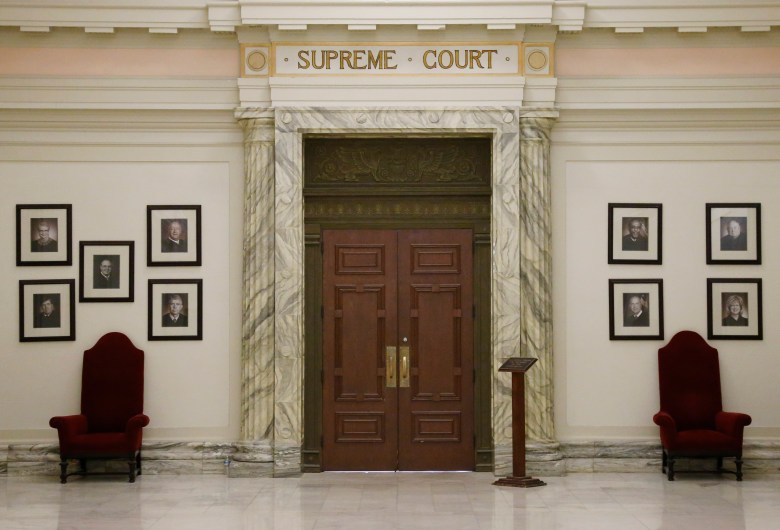
    Oklahoma Supreme Court, pictured in the state Capitol building, in March issued a stay that would prohibit the state education department from purchasing Bibles and Bible-infused lessons for elementary students. Credit: Sue Ogrocki/ Associated Press

    Meanwhile, Walters was also sued separately last summer by a parent in Locust Grove who contended the mandate violated the state and federal constitutions. The state education department has denied the claims of both suits and contended in legal briefs that using the Bible for its secular value does not violate the state’s constitution.

    Walters’s mandate has also sparked concern because of the proposed social studies standards that followed. The standards, which were initially released in December and would require legislative approval, mention the Bible and its historical impact more than 40 times. Several of the standards attempt to erroneously frame the Bible, and specifically the Ten Commandments, as the foundation of American law. Biblical scholars from the University of Oklahoma and elsewhere believe these standards promote the long-standing trope of Christian nationalism, which is premised in part on the false idea that the nation’s founding documents stemmed from the Bible. (The founders were Bible readers, but not necessarily fans of the same versions or holy texts in general. In fact, Thomas Jefferson cut up pages of the Bible to remove mention of miracles or the supernatural.)

    For example, Walters’s standards would require students in first grade to learn about David and Goliath, as well as Moses and the Ten Commandments, because the standards cite them as influences on the American colonists and others. Second graders would be asked to “identify stories from Christianity that influenced the American colonists, Founders, and culture, including the teachings of Jesus the Nazareth (e.g. the ‘Golden Rule,’ the Sermon on the Mount).” 

    Related: Inside the Christian legal campaign to return prayer to public schools

    “These new standards,” said a news release from the state department of education, “reflect what the people of Oklahoma — and all across America — have long been demanding of their public schools: a return to education curricula that upholds pro-family, pro-American values.” (Walters’s press office, despite repeated requests, did not make the state superintendent available for an interview.)

    Critics in Oklahoma and elsewhere see Walters’s Bible mandate as part of a broader Christian nationalist movement. “I think Oklahoma is the test case for the nation,” said Dawn Brockman, a Norman school board member.

    Walters, though, has been steadfast in his belief that the mandate is legal and critical for the education of Oklahomans. In the fall, after Americans United sued, Walters wrote on X: “The simple fact is that understanding how the Bible has impacted our nation, in its proper historical and literary context, was the norm in America until the 1960s and its removal has coincided with a precipitous decline in American schools.”

    But nothing is simple about the history of the Bible in America’s schools. When public schools started to open in the 1800s, some required regular Bible readings. From the beginning, that practice was controversial: Schools typically favored the King James Version, pitting Protestants against Catholics, and riots over school Bible readings broke out from the 1840s into the 1870s, said Mark Chancey, a professor of religious studies at Southern Methodist University in Dallas. By 1930, 36 states allowed Bible reading to be a requirement or an option, but another dozen banned such activities.

    A few decades later, a Pennsylvania family sued their school district for heeding the state’s 1949 law requiring the reading of 10 Bible verses and the recitation of prayers at the start of each school day. In 1963, just a year after a similar opinion, the Supreme Court ruled that requiring in-school Bible readings and prayers was unconstitutional. After those rulings, daily teaching from the Bible, for the most part, was halted, Chancey said, but backlash continued, with critics charging that removing prayer and Bible readings from schools had led to a decline in the morality of schoolchildren. 

    Related: Teachers struggle to teach the Holocaust without running afoul of new ‘divisive concepts’ laws

    In subsequent decades, the Supreme Court ruled against clergy-led prayer and prayer over the loudspeakers at football games in several school-related cases. But in a seeming reversal, in 2022, the high court ruled in favor of allowing a football coach to conduct midfield, postgame prayers, shifting the legal landscape. The majority’s opinion on the football coach’s prayer has prompted politicians and states to further test the limits of the separation of church and state. In February, lawmakers in Idaho and Texas even proposed measures to allow daily Bible readings in public schools again. 
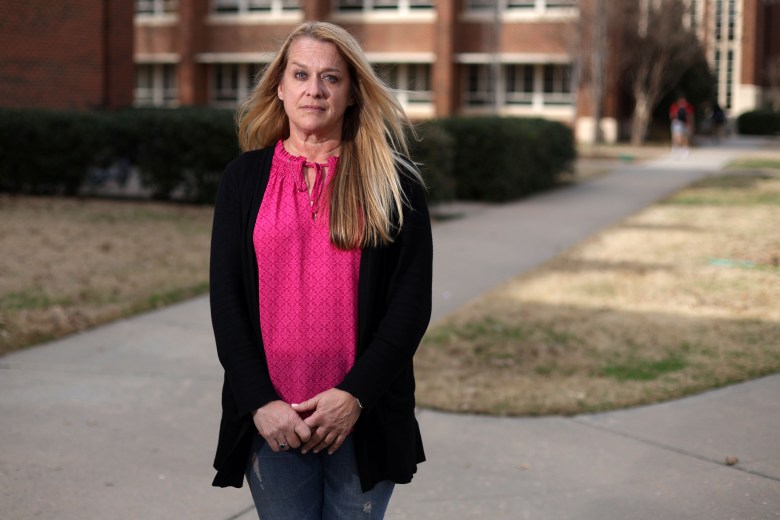
    Darcy Pippins, who teaches Spanish at Norman High School, said she doesn’t feel qualified to teach about the Bible. Credit: Mike Simmons for The Hechinger Report

    In Norman, many teachers reacted to news of the Bible mandate with concern and fear. Spanish teacher Darcy Pippins, who is in her 27th year at Norman High, said she sometimes teaches about Catholicism because it is the religion of the Spanish-speaking world. But putting a Bible in every classroom and teaching from it is different. “I just don’t feel comfortable,” said Pippins, also a parent. “I’m not qualified to teach and to incorporate the Bible into what I teach.’’ 

    Other teachers, said Brockman, the school board member, worried about professional repercussions were they not to follow the mandate, given that Walters had already targeted at least one Norman teacher in the past for objecting to bans on particular books. 

    Nick Migliorino, the public school system’s superintendent since 2017, was the first superintendent in the state to publicly oppose the Bible mandate. When asked about it in a July interview with a local paper, he responded: “I’m just going to cut to the chase on that. Norman Public Schools is not going to have Bibles in our classrooms, and we are not going to require our teachers to teach from the Bible.”

    Other superintendents followed, and by late July, at least 17 school district leaders said they had no plans to change curriculum in response to the Bible mandate, according to a report by StateImpact Oklahoma.

    In an interview at his district’s headquarters, Migliorino emphasized that his school system already teaches how different religions affect history. Bibles, he noted, are accessible to students through the library. Migliorino added that the state superintendent had no authority to make school districts follow the mandate and that it would result in pushing Christianity on students. 

    “It’s a captive audience, and that is not our role to push things onto kids,” he said. “Our role is to educate them and to create thinkers.”

    Oklahoma already has a 2010 measure allowing school districts to offer elective Bible classes and to give students the latitude to pick the biblical text they prefer to use. But unlike Walters’s mandate, it allows for different biblical perspectives, said Alan Levenson, chair of Judaic history at the University of Oklahoma and a biblical scholar. Even still, there has never been widespread interest in a Bible elective in Norman, said Jane Purcell, the school system’s social studies coordinator. Nor was there much interest in such a class when she taught in Florida. Since 2006, at least a dozen states have passed laws promoting elective Bible classes.

    This may be, in part, because educators worry about potential issues with teaching Bible courses, said Purcell: “It’s very easy for it to appear to be proselytizing.”

    Related: How one district has diversified its advanced math classes — without the controversy

    Walters, for his part, has not taken any of this pushback in stride. At a July 31 state board of education meeting, he lashed out against “rogue administrators” who opposed him, saying of the left: “They might be offended by it, but they cannot rewrite our history and lie to our kids.”

    After the public schools superintendent publicly rejected Walters’s mandate, community members and teachers in Norman expressed relief. Meg Moulton, a realtor and mother of three, came to a July board meeting to thank the superintendent in person. “I’m a Christian mama,” she said. “I love teaching my kids about God. I love going to church.” 

    But, she added, “Ryan Walters’s mandate makes it so that teachers and students who may not be Christians…[or] who may believe something different, are going to be essentially forced to learn something that they may not believe in.” 

    Students and others I met with at a popular Norman coffee shop said they were concerned about how Walters’s mandate could affect religious minorities, women, and members of the LGBTQ+ community. “What Ryan Walters is trying to push goes in line with a lot of trends of kind of pushing back against LGBTQ,” said Isandro Moreno, a 17-year-old senior at Norman High. 

    Phoebe Risch, a 17-year-old senior at Norman North, the town’s other public high school, said Walters’s mandate was part of what motivated her to restart her high school’s Young Democrats club and recruit roughly 30 members. Risch, already upset about her state’s readiness to ban abortion following the Supreme Court’s overturn of Roe v. Wade, fears that requiring Bible-based instruction could lead to the promotion of the idea that women are submissive. “As a young woman, the implications of implementing religion into our schools is a little scary,” she said, “especially because Oklahoma is already a very conservative state.”

    Among the half dozen teens attending a confirmation class in December at Oklahoma City Reform temple B’nai Israel, most opposed the mandate, except for one. She said she supported it as long as the classroom teacher was careful and encouraged critical thinking. 

    One teen recounted tearily how, during class the previous week, a friend had drawn a swastika on her paper as a taunt. “Stuff like that is so normalized,” she said. “It’s antisemitism. If that’s so normalized, normalizing Christianity further, it’s just worse.”
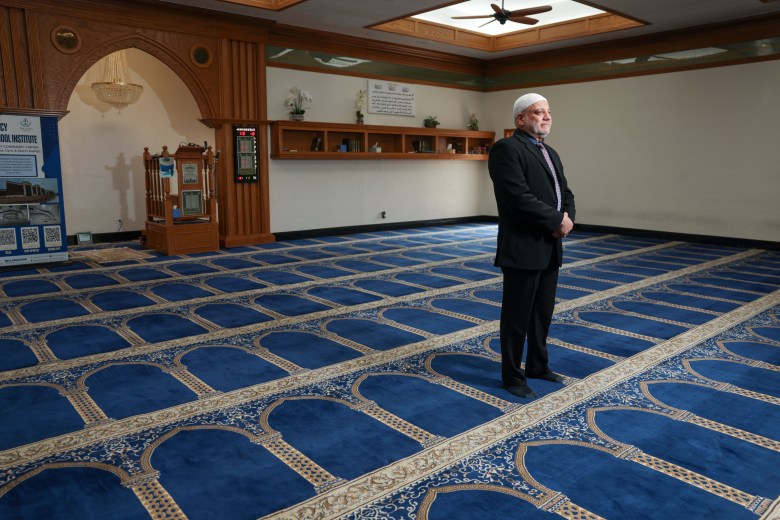
    Imad Enchassi, an imam who oversees an Oklahoma City mosque and also chairs the Islamic Studies department at Oklahoma City University, said he worries that Superintendent Ryan Walter’s policies will further isolate Muslim children. Credit: Mike Simmons for The Hechinger Report

    Imad Enchassi, an imam who oversees an Oklahoma City mosque and serves as chair of Islamic studies at Oklahoma City University, echoed similar fears for the Muslim community. “We’re already experiencing Islamophobia. Muslim kids who wear the headscarf already have been told they’re going to hell because they don’t believe in the Bible or they don’t believe in Jesus,” he said. “When curriculum mandates one religion over the other, that will further isolate our children.”

    Some Oklahomans, though, do support the mandate. And at one of the state board of education meetings where Walters touted it, three residents expressed support for the idea — during public comment — as did at least one board member. That board member said he thought biblical literacy was important, while other supporters see the Bible mandate as a way to instill morality in the public schools. Ann Jayne, a 62-year-old resident of Edmond, about 15 miles north of Oklahoma City, makes a point of letting Walters know on his Facebook page that she’s praying for him, because she believes public schools need to instill Christian values. “I think we need church in the state,” she said. “I don’t see a problem with God being back in the school. Nobody is forcing them to become a Christian.”

    Since last summer, Walters’s efforts to push Christianity have only become bolder. In mid-November, he announced the opening of the Office of Religious Liberty and Patriotism, which would, among other things, investigate alleged abuses against religious freedom and patriotic displays. Two days later, he announced that he was sending 500 Bibles to Advanced Placement government classes. He also emailed superintendents around the state with the order to show their students a one-minute-and-24-second video announcing the religious liberty office and praying for newly elected President Trump.

    At a Christmas parade in Norman in early December, some residents called the video embarrassing, with many superintendents, including Norman’s, having declined to show it. However, while many residents seem to abhor the Bible mandate, they do not agree on how religion should be handled in public life. Despite some religious diversity and some liberal leanings common in a university town, Norman skews religiously conservative. That dichotomy means many residents see the Bible as so sacrosanct that they don’t want it taught in schools, yet they see no problem with other Christian-oriented school activities.

    In some cases, residents like school board member Brockman, who is also a former teacher and lawyer with training on the First Amendment, have objected to school promotion of the religious aspects of Christmas. When she was a teacher at one of Norman’s two high schools, she asked to stop the playing of overtly religious Christmas songs in the halls during passing periods. She saw it as a “gentle reminder that the Supreme Court says we need to remain neutral on religion.” Her wish was granted. “They took it down with some consternation and played the Grinch in my honor.”

    Related: Teaching global warming in a charged political climate

    Residents have also quibbled over what to call the parade featuring Santa each December. Should it be called the Norman holiday or Christmas parade? It’s now known as the Norman Christmas Holiday Parade. In early December, the city’s mix of liberal and conservative influences shone through the glitz during the parade. The Knights of Columbus float had a sign that said “Merry CHRISTmas.” Norman’s Pride organization participated, with its human angels wearing wings lit up in rainbow colors.

    Tracey Langford, watching the parade from the back of her SUV, was dressed in a red stocking cap and a red sweatshirt that read “Santa, define good,” a jab at the fact that she is a lawyer who cares about legal definitions. To her, the Bible mandate is a clear violation of separation of church and state.“Every home here has a Bible…. We don’t need to spend a dollar to get a Bible in every classroom,” said Langford, a lawyer at the University of Oklahoma and a parent of a first grader in Norman schools and a 15-year-old in a private school. 

    Traci Jones, a parent of both a Norman sixth grader and fifth grader, likewise asked, “Who’s supposed to be teaching these kids the Bible? Is it just a random person? What if it’s an atheist or someone who has totally different beliefs than me?” As a nondenominational Christian, she added, “I think it’s wack to ask these poor teachers to teach that.”

    What happens next may ultimately be decided in a courtroom. There is no sign yet when final opinions may be issued in either lawsuit.

    State lawmakers at recent appropriation hearings said they were worried about the directive’s constitutionality, and in fact, in March, the Senate Appropriations’ Education Subcommittee  said it did not consider Walters’s $3 million request to purchase Bibles. The next day Walters announced he was launching a national campaign with a country singer to get Bibles donated to Oklahoma schools. (The legislature gets the final word on the Bible purchases, a line item in the education budget, and the standards, which the state board of education approved in late February.) Meanwhile, the fate of religion’s place in public schools on a national level likely will rest with the Supreme Court, with various lawsuits against state measures promoting Christianity making their way through the court system.  
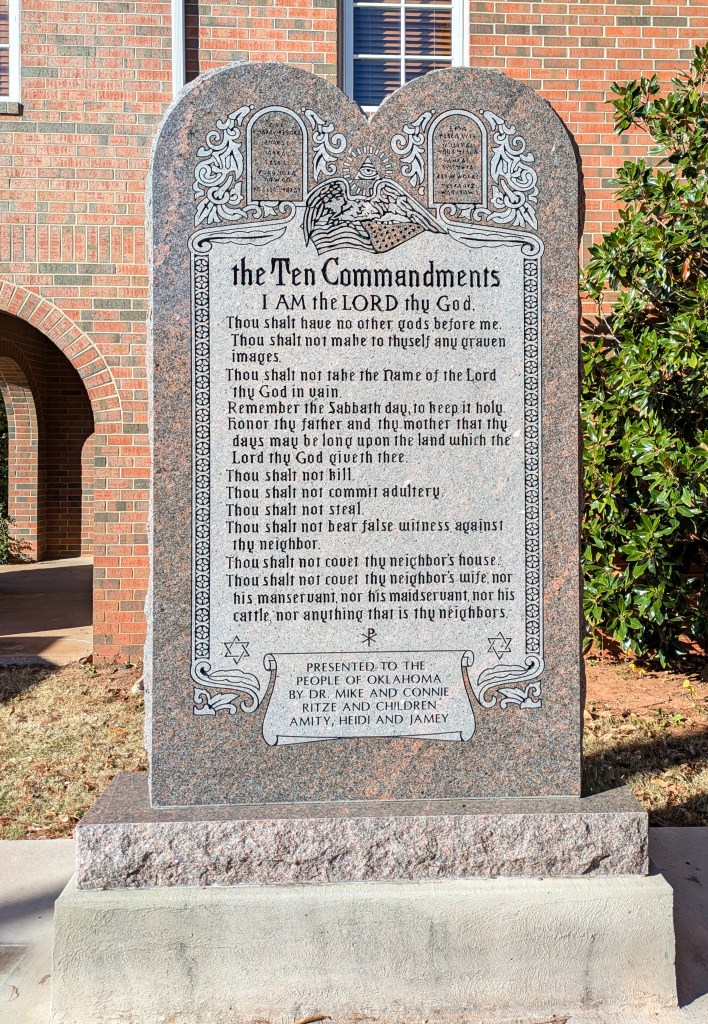
    A Ten Commandments monument that sat on Oklahoma State Capitol grounds until the state Supreme Court ruled its presence violated the separation of church and state. It now is at the headquarters of a conservative lobbying group. Credit: Linda K. Wertheimer for The Hechinger Report

    In Norman, Jakob Topper, Kyle Tubbs and other Baptist pastors I met with at the headquarters of a statewide Baptist church organization were increasingly aghast at Walters’s mixing of religion and politics. Rick Anthony, pastor of Grace Fellowship, a Baptist church, centered his November 17 sermon on such concerns. “Almost comically, we’ve heard this week about a video made that was ordered to be shown to all children in the public schools and then sent to their parents,” he said. “Our question is…where are our voices as our political leaders cozy up to faith leaders, all the while destroying our faith institutions?” 

    Kaily Tubbs, Tubbs’s wife and a fifth grade teacher in Norman schools, said the mandate conflicts with her personal belief on how faith should be handled in schools. She spoke also as a mother of a kindergartener and a third grader, both in Norman schools. “Our faith is really important to us,” she said. “I don’t want it to be used as a prop in a classroom.”

    Topper said that at his church, the majority of his congregation believes in separation of church and state. He said he is aware of the religious diversity that exists in his town, too, and has both Muslim and Jewish neighbors. Like Anthony, he spoke with his congregation about Walters’s mandate, though in an informal weeknight meeting at his church, rather than as part of a formal sermon. “I wish,” he said, “that Jesus was left out of schools and left for the religious realm.”

    Contact editor Caroline Preston at 212-870-8965, via Signal at CarolineP.83 or on email at [email protected].

    This story about Bibles in schools was produced by The Hechinger Report, a nonprofit, independent news organization focused on inequality and innovation in education. Sign up for the Hechinger newsletter.


    The Hechinger Report provides in-depth, fact-based, unbiased reporting on education that is free to all readers. But that doesn’t mean it’s free to produce. Our work keeps educators and the public informed about pressing issues at schools and on campuses throughout the country. We tell the whole story, even when the details are inconvenient. Help us keep doing that.

    Join us today.

    Source link

  • For Parenting Students, Campus Support Bolsters Outcomes

    For Parenting Students, Campus Support Bolsters Outcomes

    Title: Pillars of Support: Results from an Evaluation of the Parenting Students Project at Austin Community College

    Authors: May Helena Plumb and Paige-Erin Wheeler

    Source: Trellis Strategies

    A new report from Trellis Strategies evaluates the impact of the Parenting Students Project (PSP) at Austin Community College (ACC), highlighting the challenges student parents face and the program’s efforts to support them. Data show that students who are parents have high rates of financial and basic needs insecurity. In addition to the demands of being a student with parental responsibilities, these students are more likely to be working.

    As part of the United Way for Greater Austin’s PSP initiative, parenting students met monthly with each other, attended seminars about financial wellness and mental health, and received a $500 monthly stipend. Additionally, PSP participants received services in coordination with ACC, such as case managers and childcare scholarships.

    The report highlights the positive impact on participants’ academic progress, including a 95 percent term-to-term retention rate and an increased likelihood of taking nine credit hours per semester. A second area of impact was financial wellness, as increased financial stability lowered borrowing and alleviated transportation insecurity through a more flexible schedule. Third, PSP empowered parenting students to be better parents, as well as provided them with scholarships for childcare. Finally, PSP bolstered mental health through an increased sense of community and belonging.

    The report also identifies areas for growth and offers the following recommendations:

    1. Refine program requirements so that they best support student success. While credit requirements are helpful in moving students forward, parenting students still need some flexibility in enrollment intensity. A participant suggested scaling the number of credits taken to correspond to the stipend so that PSP support is not all or nothing. Participants also expressed a desire to choose some of the seminar topics.
    2. Consider areas of need. PSP participants indicated a desire for more flexible childcare options. Some also discussed other forms of support, such as housing resources, cooking classes, and diapers and toys for children. The needs will vary based on the group, so it is important to evaluate what students need.
    3. Address different needs for fathers. There was a large disparity between the share of fathers who participated in PSP and the percentage of student parents at ACC who are fathers. While student fathers are more likely to be married and have access to childcare, they are also more likely to have specific mental health challenges and to stop out of college.

    Click here for the full report.

    —Kara Seidel


    If you have any questions or comments about this blog post, please contact us.

    Source link

  • The FCC’s show trial against CBS is a political power play

    The FCC’s show trial against CBS is a political power play

    This article originally appeared in Reason on March 14, 2025


    The Federal Communications Commission is conducting an unseemly and unconstitutional spectacle, ostensibly to determine whether CBS violated its policy against “news distortion” by editing a “60 Minutes” interview with then-Vice President Kamala Harris. Its real purpose is to exercise raw partisan power.

    The FCC already knows CBS did not violate any rules and merely engaged in everyday journalism. And there is nothing to be learned from the over 8,000 comments and counting that have poured into the commission’s inbox. Many simply registered their like or dislike of the network and mainstream media in general, and many others were just unserious quips submitted to troll the regulators.

    But judging the merits of the “news distortion” allegation was never the point. The FCC staff already dismissed the complaint—filed by a partisan activist group—as fatally defective back in January. As outgoing FCC Chairwoman Jessica Rosenworcel explained, “The FCC should not be the President’s speech police. . . . The FCC should not be journalism’s censor-in-chief.” But one of Brendan Carr’s first acts as the new FCC chair in Donald Trump’s administration was to reinstate the complaint and call for public comments.

    Asking members of the public to “vote” on how they feel about a news organization’s editorial policies or whether they think the network violated FCC rules is both pointless and constitutionally infirm. In 1943, Justice Robert Jackson wrote that the right to free speech and a free press “may not be submitted to vote; they depend on the outcome of no elections.”

    The FCC’s reanimated proceeding lacks any legitimate regulatory rationale. But its realpolitik purpose is sadly transparent. This fishing expedition is designed to exert maximum political leverage on the CBS network at a time when Trump is engaged in preposterous litigation over the same “60 Minutes” broadcast, claiming CBS’ editing violates a Texas law against fraudulent commercial transactions. Adding to the pressure, Chairman Carr said he will consider the thousands of comments in this proceeding when evaluating whether to approve a merger of Skydance Media and CBS parent company Paramount Global worth billions of dollars.

    There is a name for what the FCC is doing in this proceeding: a show trial. When investigations become a performative exercise designed to further a political purpose, they forfeit any claim to legitimacy. 

    There is nothing here for the FCC to investigate. The complaint alleges that Harris gave a “word salad” response to a question about whether Israeli Prime Minister Benjamin Netanyahu was listening to the Biden administration and that CBS edited it to make her sound more articulate. One part of her responses was aired on “60 Minutes” and another part aired on “Face the Nation.”

    In short, CBS stands accused of committing journalism. Every day, from the smallest newspaper to the largest network, reporters and editors must make sense of and condense the information they collect—including quotes from politicians and other newsmakers—to tell their stories concisely and understandably. That task necessarily requires editing, including selecting what quotes to use. If the cockamamie theory underlying this FCC “investigation” had any merit, every newsroom in America would be a crime scene.

    That’s why the FCC in the past has never defined the editing process as “news distortion.” In fact, the commission made quite clear when it first articulated the news distortion policy in 1969 that “we do not mean the type of situation, frequently encountered, where a person quoted on a news program complains that he very clearly said something else.” It stressed, “We do not sit to review the broadcaster’s news judgment, the quality of his news and public affairs reporting, or his taste.”

    The commission understood that this very narrow approach is required to respect both the First Amendment and the Communications Act, which denies the FCC “the power of censorship.” As the FCC observed, “In this democracy, no Government agency can authenticate the news, or should try to do so.”

    There is a name for what the FCC is doing in this proceeding: a show trial. When investigations become a performative exercise designed to further a political purpose, they forfeit any claim to legitimacy. Show trials are intended to send a message, not just to their unfortunate victims, but to other would-be transgressors.

    FIRE calls out 60 Minutes investigation as ‘political stunt’ in comment to FCC

    News

    FIRE submitted a comment to the Federal Communications Commission about a complaint about a 60 Minutes interview with then Vice President Kamala Harris.


    Read More

    There is a dark and deadly history of such proceedings in authoritarian regimes around the world, ranging from Josef Stalin’s purges of perceived political opponents to China’s trials of “rioters and counterrevolutionaries” after the 1989 Tiananmen Square protests. Though less extreme in nature, during the Red Scare, the House Committee on Un-American Activities similarly staged show hearings where they pressured witnesses to name names while presuming guilt. The stakes of a sham FCC proceeding may differ, but the tactics and perversion of the rule of law are the same. 

    Somewhere along the way, the FCC’s current leadership abandoned that basic truth in exchange for political expediency. And in doing so, it is ignoring a unanimous holding from the Supreme Court just last term that threatening legal sanctions and other means of coercion to suppress disfavored speech violates the First Amendment. 

    The commission can begin to recover some dignity only by dropping this show trial immediately.

    Source link

  • Women’s History Month 2025: Moving Forward Together

    Women’s History Month 2025: Moving Forward Together

    Reading Time: 7 minutes

    During the month of March, we celebrate Women’s History Month. This year’s theme is “Moving Forward Together! Women Educating and Inspiring Generations.” And we can’t think of a better way to celebrate than by paying tribute to the remarkable women educators who are doing just that.

    We’re so proud to highlight some of our women faculty partners who are shaping the next generation of experts in fields like astronomy, automotive and math. Your commitment to educating and inspiring students doesn’t go unnoticed. While no words can truly capture the impact you make every day, this is our chance to show our gratitude (and give you the applause you deserve).


    Kim Zoldak is a Teaching Assistant Professor at Oklahoma State University. Whether she’s teaching introductory astronomy, astrophysics or physics courses, her passion for sharing the wonders of the universe always shines through. She’s more than just an expert — she’s a guide who sparks curiosity and helps students discover new perspectives and ideas.

    As the department’s dedicated teaching professor, Kim is always ready to jump in and teach whichever physics course is needed. So far, that’s included College Physics I & II and University Physics I. Kim’s journey to Oklahoma State started with a B.S. in meteorology from California University of Pennsylvania, followed by a Ph.D. in space and planetary sciences/astrophysics from the University of Arkansas. In addition to teaching, she oversees responsibilities for OSU’s Mendenhall Observatory. Above all, Kim believes that learning should be exciting and accessible to everyone. Her commitment to helping students grow — not just as learners but as thinkers — is what makes her an invaluable part of the OSU community and higher education.

    “As a female in a male-dominated area of the sciences, I think that I encourage other females to follow their passion in physics and astronomy simply by being their instructor in these courses. Every year I am seeing more and more women in my classes…When women see other women doing something that they thought was out of their reach — it gives them hope that they can do it too.” – Kim Zoldak

    Janalyn Kehm is the Department Chair in the School of Business & Computer Engineering Technology at Spartanburg Community College. Having taught at SCC since 2000, she’s devoted her career to shaping successful student outcomes and promoting meaningful collaboration with faculty members. In this role, she raises the bar, assessing learning needs within business and other courses, and working alongside faculty to develop quality curriculum. Before embarking on her decades-long career in higher education, she received her B.A degree in journalism – advertising/public relations from the University of South Carolina and her M.A degree in computer resource management from Webster University. But Janalyn didn’t stop there, continuing on to pursue her own educational growth by obtaining a Certificate of Graduate Studies in Higher Education Leadership from University of South Carolina and a DBA from California Southern University.

    Having been twice recognized by her peers and students with the Faculty of the Year award, she personifies exceptionalism in her field, creating remarkable connections with those she mentors and works with.

    After earning her B.S and M.S degrees in mathematics from Texas State University, Ellen Couvillion’s passion for the subject would lead her back there in the form of a teaching career. Now an Associate Professor of Instruction of Mathematics, she practices a growth mindset approach to teaching, prioritizing students’ individual learning needs and unique paths to development.

    In a nutshell, Ellen is a star educator, admired as a mentor by her students, and respected by her faculty peers who have an immense appreciation of her teaching contributions. She has won numerous awards, including the Service Excellence Award from the Department of Mathematics and the Favorite Professor Award, courtesy of the Alpha Chi National College Honor Society. Beyond teaching, Ellen immerses herself in every aspect of university life, serving as member, advisor and organizer of several committees, demonstrating her commitment to enhancing and shaping the campus community around her.

    Pam Schmelz is an Interim Dean for the School of Information Technology, School of Business,Pam Schmelz Logistics & Supply Chain and the Garatoni School of Entrepreneurship and Innovation at Ivy Tech Community College. With a lifelong passion for information technology, she’s earned several certifications, including CISSP (Certified Information Systems Security Professional), CCENT (Cisco Entry level Network Technician) and Amazon Cloud Practitioner, to name only a few. As a certified Quality Matters peer reviewer, she lends her critical expertise to the development of online courses, creating a quality learning experience for future generations of students.
    Being a consummate innovator with a fierce dedication to helping students thrive, Pam also started up the CyberAcademy at Muscatatuck Urban Training Center in Butlerville, IN. This intense and revolutionary program takes students through the AAS Cybersecurity program in a record-breaking 11 months, providing graduates with essential cybersecurity career skills, setting them for future success and elevating their levels of expertise to new heights.

    Samantha CandlerSamantha Candler is a General Motors World Class Technician with 18 years of experience in the automotive industry. As one of the few female World-Class Technicians and instructors nationwide, she’s no stranger when it comes to breaking down barriers. Her unwavering determination and immeasurable skillset speaks volumes. Before spending 10 years as a technician and 8 years as a GM ASEP Instructor, Samantha long had her sights set on making her mark in the field. Her passion for vehicles began in high school, leading her to achieve the highest level of GM technician training. As an automotive faculty member at Dallas College, she puts her immense knowledge into practice every day in the classroom, inspiring her students and undoubtedly setting an example for what heights they can reach and push beyond.

    Samantha would ultimately like to see more women enter the automotive industry, and believes that anyone with the determination to dive in and work hard can succeed. She considers herself fortunate to have worked in a dealership that allowed her the freedom to grow and thrive into the inspiration she is today.

    “Being a technician isn’t just about heavy lifting and getting greasy. Women bring unique strengths to automotive work — attention to detail, problem-solving, and adaptability— that are invaluable in today’s evolving automotive field…I’m proud and excited to be a part of the automotive transformation and to be training the next generation of technicians.” – Samantha Candler

    Jinhwa Lee is an Assistant Professor of Instruction of Mathematics at Ohio State University and anJinhwa Lee experienced educator. With a decade’s worth of experience teaching various mathematics courses, Jinhwa believes that all students can grow to become confident learners when given the right tools and individualized support. Her teaching philosophy centers on a common goal — helping students overcome their math anxiety. She wants students to find the fun and relevance within a subject she loves and believes is critical across multiple disciplines.
    As an educator, Jinhwa recognizes that her role is part of a much bigger picture. She’s proud to contribute to student development and hopes to inspire her learners to become future leaders in fields like economics, science and engineering.

    “…every student can excel with the right support.” – Jinhwa Lee

    Monica Hampton Monica Hampton is a retired cybersecurity officer, an Adjunct Professor of Cybersecurity and Criminal Justice and an Instructional Designer at Benedict College. Monica’s teaching experience stretches far beyond the higher ed classroom, having previously taught firearms and safety, as well as cybersecurity to law enforcement officers at national and local levels. She now brings personal field experience and real-world insights to her students, teaching undergraduate cybersecurity and criminal justice courses. Before entering the world of cybersecurity, she earned a B.A. degree in criminal justice from the University of Central Florida and an M.A. degree in computer resources and information management from Webster University. Monica took a comprehensive approach to her teaching role. Striving to gain proficiency in both instructional design and the application of rubrics, she obtained a Quality Matters (QM) certification for Applying the QM Rubric and Designing Your Online Course.
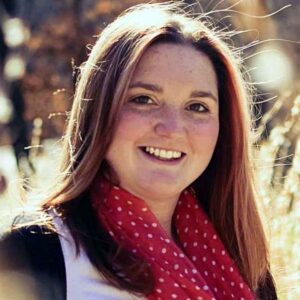
    Dr. EmmaLeigh Kirchner is an Associate Professor of Criminal Justice and Chair of the Social Justice &EmmaLeigh Kirchner Community Health Department at Mercyhurst University. Her experience spans across undergraduate, graduate and study abroad programs, where she teaches multiple courses, both online and in-person. Some of those courses include Methods and Social Science Statistics. Holding a Ph.D. in criminology from Indiana University of Pennsylvania, EmmaLeigh’s focus has been primarily within the higher ed sphere. Yet, she’s also a leading example of how to enact meaningful community-based change outside the classroom. She currently serves on the executive board for the Northeastern Association of Criminal Justice Sciences and is the faculty advisor of the Criminal Justice Association. EmmaLeigh’s various outreach efforts and contributions represent her resolution to make a difference.
     

    Thank you to all of our women faculty partners. You’ve made an incredible educational impact on not only your students and institutions, but on the future of higher education overall.


    Women’s History Month reminds us to recognize the incredible achievements and contributions made by women throughout our history.


    Source link

  • Whitman College – Edu Alliance Journal

    Whitman College – Edu Alliance Journal

    March 17, 2025, by Dean Hoke: This profile of Whitman College is the sixth in a series presenting small colleges throughout the United States.

    Background

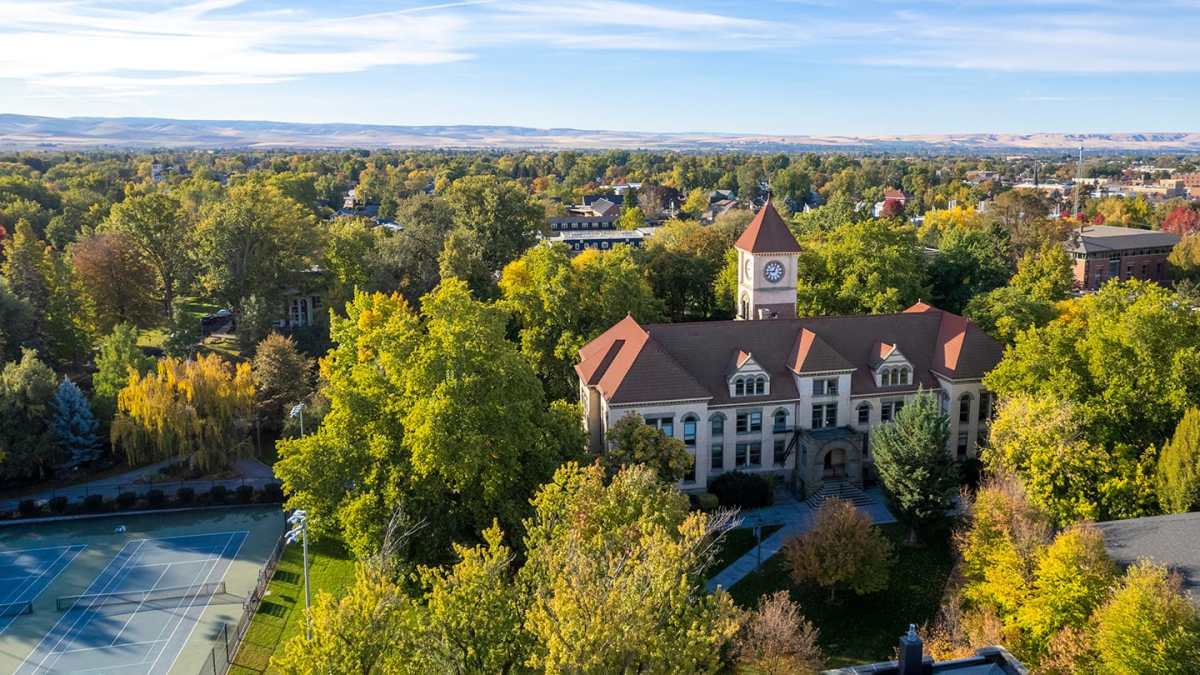
    Founded in 1859, Whitman College is a private liberal arts institution located in Walla Walla, Washington. Its 117-acre campus blends historic architecture with modern facilities, creating an inviting environment for academic pursuits and campus life. Originally established as a seminary, Whitman transitioned to a secular liberal arts institution in the early 1880s and has since garnered recognition for its academic rigor, liberal arts commitment, and tight-knit community.

    Whitman prides itself on a student-to-faculty ratio of 9:1, facilitating personalized education. Approximately 1,500 students from across the United States and internationally enroll at Whitman, attracted by its personalized instruction and strong emphasis on experiential learning.

    Curricula

    Whitman College offers over 45 majors and numerous minors spanning the arts, humanities, sciences, and social sciences. Popular disciplines include Environmental Studies, Political Science, Psychology, Economics, and Biology. The curriculum, deeply rooted in the traditional liberal arts, continues to evolve, notably introducing two new majors in Fall 2023: Brain, Behavior & Cognition (Neuroscience) and Ethics & Society, reflecting increasing student interest in neuroscience and applied ethics.

    One hallmark program at Whitman is Semester in the West, a unique field-based study experience where students engage directly with environmental and policy research across the American West. Additionally, Whitman’s Encounters Program forms a cornerstone of the first-year academic experience, promoting critical thinking and interdisciplinary learning.

    Graduate outcomes at Whitman are exceptional, with nearly 70% of alumni enrolling in graduate or professional programs within five years of graduation. The six-year graduation rate stands at an impressive 88%, among the highest for liberal arts colleges in the Pacific Northwest.

    Strengths

    • Strong Post-Graduate Outcomes: Over 91% of Whitman graduates secure employment or enroll in graduate programs within six months after graduation, highlighting the institution’s effectiveness in preparing students for professional success.
    • Experiential Learning: More than 80% of students participate in internships, research, or off-campus programs such as Semester in the West and the Whitman in China teaching fellowship, exemplifying Whitman’s commitment to hands-on learning experiences.
    • Prestigious Recognition: Whitman students consistently win competitive fellowships and awards, including Fulbright grants, Watson Fellowships, and NSF Fellowships. Since 2000, students have secured more than 600 awards.
    • Sustainability and Outdoor Leadership: Whitman’s Outdoor Program provides extensive opportunities for students to engage in activities like hiking, kayaking, skiing, and environmental stewardship, reflecting the institution’s emphasis on sustainability and outdoor leadership.
    • Financial Strength and Support: Despite its modest enrollment, Whitman maintains a substantial endowment nearing $800 million. This financial strength enables the college to offer robust financial aid packages, greatly reducing costs for middle-income families and improving access.

    Weaknesses

    • Geographic Isolation and Limited Visibility: Whitman’s location in Walla Walla presents both advantages and challenges. While the picturesque rural setting fosters a tight-knit community, the distance from major urban centers—roughly four hours from Seattle or Portland—can deter prospective students seeking metropolitan amenities. Consequently, Whitman must invest heavily in marketing and recruitment to attract students beyond the Pacific Northwest.
    • Dependence on Tuition Revenue: While Whitman is financially stable, its operating model remains heavily reliant on tuition, with endowment payouts currently covering around 40% of operational expenses. This reliance necessitates careful financial management and continued growth in the endowment.
    • Enrollment and Demographic Trends: Like many liberal arts colleges, Whitman faces a national decline in the traditional college-age population, coupled with increased competition for top-tier students. In response, Whitman has significantly expanded merit-based and need-based financial aid packages, currently averaging a tuition discount rate over 50%. To address demographic challenges, Whitman is actively broadening its applicant pool through partnerships with organizations such as the Posse Foundation and Matriculate.

    Economic Impact

    Whitman College is a significant economic driver in Walla Walla. It is among the largest employers in the region, accounting collectively for roughly 1,600 jobs in Walla Walla County​.

    Beyond direct employment, Whitman attracts thousands of students and visitors to the area each year, which boosts the local hospitality and retail sectors. Students spend on housing, groceries, dining, and entertainment in town, and their families visit for events like orientation, Family Weekend, and Commencement, filling hotels and restaurants​. The tourism bureau has even created guides for families visiting their “scholars” at Whitman, recognizing the economic benefit of college-related travel​.

    Whitman also fosters long-term regional economic growth through strategic partnerships. A key example is the Gateway Program, in collaboration with Walla Walla Community College, which encourages community college students—particularly first-generation and low-income students—to pursue four-year degrees at Whitman. These initiatives enhance local educational attainment and create a talent pipeline beneficial to the regional economy. Additionally, Whitman engages actively with the Confederated Tribes of the Umatilla Indian Reservation, supporting educational and cultural initiatives that enrich the local community.

    Enrollment Trends As of Fall 2024, Whitman enrollment is 1,561 students. Over the past decade, enrollment has slightly increased despite national declines in liberal arts college applications and the COVID crisis. To counteract demographic shifts, Whitman has expanded financial aid offerings and enhanced recruitment efforts in the Western U.S., international markets, and underrepresented student populations.

    Degrees Awarded by Major In the 2023 graduating class, ​Whitman College conferred degrees across various disciplines.

    Alumni

    Whitman College boasts a vibrant alumni network comprising over 18,000 graduates worldwide. Alumni connections are notably strong in the Pacific Northwest, California, and Washington, D.C., providing substantial networking opportunities through programs such as “Whitties Helping Whitties.” This network significantly aids in securing internships, job placements, and mentoring opportunities for current students.

    Notable Alumni

    • Adam West (Class of 1951) – Actor best known for portraying Batman in the 1960s television series.
    • William O. Douglas (Class of 1920) – U.S. Supreme Court Justice, serving from 1939 to 1975.
    • John W. Stanton (Class of 1977)- Chairman of the Board Trilogy Partners and majority owners of the Seattle Mariners.
    • Peter Adkison (Class of 1985) – Founder of Wizards of the Coast, publisher of Magic: The Gathering.
    • Dorothy Marie “Dottie” Metcalf-Lindenburger (Class of 1997) is a retired American astronaut. She was a high school science teacher when she was selected in 2004 as an educator mission specialist. 
    • Holly Brooks (Class 2004) – Winter Olympian in Nordic Skiing

    Endowment and Financial Standing

    As of 2024, Whitman College’s endowment is valued at nearly $800 million. While this places Whitman on solid financial footing, the college remains largely tuition-dependent. In the 2024–25 budget year, the endowment payout will cover over 40% of Whitman’s operating expenses, which significantly reduces reliance on tuition revenue.​

    Whitman College Endowment Growth:

    Whitman’s financial aid program has expanded in recent years, aiming to increase affordability and access for students from all economic backgrounds. Forbes 2023 Financial Health Evaluation gave Whitman a B+ grade and a financial grade of 3.345  out of 4.5. Whitman enters 2025 in a favorable financial position.​

    Why is Whitman College Important?

    • Academic Excellence: Whitman College maintains a challenging liberal arts curriculum that prepares students for a wide range of careers and graduate studies.
    • High Graduate Success Rates: With 91% of graduates employed or in graduate school within six months, Whitman produces competitive and well-rounded professionals.
    • Experiential Learning and Outdoor Leadership: Signature programs such as Semester in the West and the Outdoor Program allow students to engage in real-world learning.
    • Sustainability and Civic Engagement: Whitman plays a key role in environmental advocacy, sustainability, and community service.

    With its strong academic reputation, experiential learning opportunities, and commitment to sustainability, Whitman College remains a leading liberal arts institution in the Pacific Northwest.


    Dean Hoke is Managing Partner of Edu Alliance Group, a higher education consultancy, and a Senior Fellow with the Sagamore Institute. He formerly served as President/CEO of the American Association of University Administrators (AAUA). With decades of experience in higher education leadership, consulting, and institutional strategy, he brings a wealth of knowledge on small colleges’ challenges and opportunities. Dean, along with Kent Barnds, are co-hosts for the podcast series Small College America. 

    Source link

  • Federal Appeals Court Lifts Bar on DEI Executive Orders

    Federal Appeals Court Lifts Bar on DEI Executive Orders

    by CUPA-HR | March 17, 2025

    On March 14, the U.S. Court of Appeals for the 4th Circuit issued a decision allowing the Trump administration to enforce Executive Orders 14151 and 14173, both of which target “illegal … DEI preferences, mandates, policies, programs, and activities” in the public and private sectors and in federal contracts. The 4th Circuit’s decision effectively overrules a February 21 preliminary injunction issued in a U.S. District Court in Maryland that had blocked the administration from enforcing some provisions in the orders.

    As a reminder, orders 14151 and 14173 revoke prior executive orders, including Executive Order 11246, which required federal contractors to maintain affirmative action plans. Among other things, orders 14151 and 14173 also mandate that:

    • federal agencies include provisions in federal contracts requiring that contractors agree to comply with nondiscrimination laws and certify they do not operate any DEI programs that violate discrimination laws;
    • the Office of Management and Budget terminate all “‘diversity,’ ‘equity,’ ‘equitable decision-making,’ ‘equitable deployment of financial and technical assistance,’ ‘advancing equity,’ and like mandates, requirements, programs, or activities, as appropriate;” and
    • each agency “identify up to nine potential civil compliance investigations of publicly traded corporations, large non-profit corporations or associations, foundations with assets of 500 million dollars or more, State and local bar and medical associations, and institutions of higher education with endowments over 1 billion dollars.”

    CUPA-HR will continue to share further developments regarding the lawsuits challenging orders 14151 and 14173.


    Source link

  • 265,000 DeVry student loan debtors owe $5.2 Billion

    265,000 DeVry student loan debtors owe $5.2 Billion

    The Higher Education Inquirer has recently received a Freedom of Information (FOIA) response regarding student loan debt held by former DeVry University students.  The FOIA was 25-01942-F.  

    Source link

  • Should higher education be thinking in terms of evolution or transformation?

    Should higher education be thinking in terms of evolution or transformation?

    The pervasive sense that five years or a decade or 20 years hence the sector will look radically different might be an exciting topic for panel discussions but it’s not clear whether radical transformation is desirable – not least because the form that transformation might take remains far from clear.

    The drivers of change are well-rehearsed: while demand remains strong for higher education participation, as we’ll be exploring at our Secret Life of Students event this week, the traditional student experience is coming under intense pressure as students with diverse backgrounds, needs and aspirations try to wedge their lives into a fairly boilerplate model of higher education study. Most institutions don’t have the money to throw at additional services, or to carry the risks of innovating in how they structure their portfolio. Income from international students could go some way to smoothing out the rough edges but recent events have demonstrated the consequences of building a system on an income stream that’s so variable and subject to a change of direction in the political winds.

    The Westminster government’s current higher education policy agenda is a rag bag of “stuff we can all agree on” like access, quality, and civic engagement, and contextual mood music around industrial strategy, skills, devolution, and regional economic growth. Reading between the lines it seems there is a direction of travel towards a more coordinated regional post-18 offer broadly aligned to regional economic growth agendas, but against a punishing economic backdrop nobody’s very clear what this ought to look like, how deeply or broadly it should touch the general HE offer, or how it should happen.

    The lack of system-wide or even local coordination is a real worry, as individual institutions make decisions for sustainability and even survival that will have long term implications for the functioning of the system as a whole and the opportunities that are available to students. To give one example: colleges report that what they see as predatory behaviour by universities to try to scoop up the students that might more traditionally be seen in college-based higher education provision is placing that provision under significant strain.

    Choices for change

    Dealing with the immediate pressures on costs while also staring down the barrel of a call for reform is objectively a very difficult psychological space for higher education to be in. Everyone I speak to is desperate for more time in their day to reflect, digest, make sense, and plan. Something I often find useful when I find the world confusing (an alarmingly frequent occurrence) is some kind of model or map to help me structure my thoughts, especially when time is limited.

    I like putting one thing next to another thing and seeing what happens, and so for this case I put change actors on one continuum from individual institutions to multiple organisations in collaboration, and scale of change on the other, from evolution to revolution. I then tried to think of all the “change” activities that are either under way or are being mooted and assigned them to quadrants.

    I’ve taken a few things from this exercise.

    One is that I think it hugely unlikely that the sector will coalesce into one of the quadrants or even at the top or bottom of the model. I think we will see activity in all four quadrants depending on the context – and I think that policy should seek to support all four forms of change to give the sector the best chance of making a good fist of it. I have found arriving at this conclusion oddly freeing, as it stops the circular argument of advocating any single activity such as income diversification, or merger, or shared services, as a unified answer to the sector’s challenges. It is possible to argue, as we have at Wonkhe, that the policy environment could be more conducive to supporting radical forms of collaboration, without suggesting that all institutions must now hasten to adopt these forms if these do not serve wider missions and objectives. Likewise, it does not necessarily follow that introducing mechanisms to support collaboration would reduce competitive pressures in some parts of the sector or geographies, and the sector may collectively need to make its peace with that.

    Another is that it’s noticeable that the activity to the left in the “evolution” space is a much more “comfortable” space for higher education, in the sense that it’s possible to see it already in action and the sector knows how to do it, not that all the activities listed are necessarily things that are desirable in every case. There’s a question, then, about whether, IF substantial change is needed, it’s possible for the accumulation of practices in the evolution space to achieve it – or do we just end up with lots of random examples of interesting practice and not much that is fundamentally different. I instinctively think that policy should accept that the grain of sector practice runs in the direction of evolution rather than transformation, and seek to work with the sector on mapping critical paths towards the change that is desired rather than administering exogenous shocks to the system.

    Finally, I’d like to see what new ideas the sector could come up with in the right hand side of the diagram (especially the top right quadrant) – not necessarily to advocate for, but to help open up the conversation and ask meaningful questions of current practice. It’s quite easy to explain why all the ideas in the top right quadrant are unlikely to happen, so another way to come at that question is to ask whether there are other ideas that might be more plausible.

    Tone matters here though – for some that idea of transformation is something like a playground, where it’s fun to speculate about different possibilities and might spark some useful thinking. For others, it could carry a much more serious weight of strategic challenge and need to be approached accordingly as likely to have a material impact on people’s lives and working conditions. The stakes are much higher on this side of the evolution to transformation continuum, particularly where an institution is operating in the bottom right quadrant – the risks of failure are real.

    Source link

  • You can’t change the design of a plane while it’s in flight

    You can’t change the design of a plane while it’s in flight

    Just under a year ago now, I was doing a keynote on student rights for course reps at a conference organised by a students union.

    At the break, I was cornered by one of the delegates who’d been told that her school in the faculty of humanities had been earmarked for merger with another to “improve the student experience”.

    This was one of those reps that goes beyond popping up in meetings to raise concerns (that nobody in said meeting can fix) about timetabling or heating in the library – a second year rep that had helped organise events and ensure that new students feel what the old NSS once described as “part of a community of staff and students”.

    She, along with everyone else in the school, had been sent numerous emails full of euphemisms and non sequiturs about what would happen to her and her cohort as a result of the “exciting” proposals.

    She was worried about the standing of her subject and worried for the staff she’s been working alongside. But chief among her concerns was that nobody seemed to be able to confirm that the modules that her and her cohort had already chosen to study in their third year – many of which had been key in their decision to choose that course – would actually be available by the time they re-enrolled in September.

    She got back in touch last month to update me on what had happened. Obtaining information about what was going to happen had continued to be difficult throughout the spring – lecturers leading her chosen modules were either cagey or conspiratorial, suggesting it was somehow up to her to “save their jobs”.

    Yet when she’d attempted to press layers of management about whether her modules would actually run – in part to help her her decide whether switching to another university for her third year was something she should look into – she’d been told that her interventions were inappropriate, and that “she should leave trade unionism to UCU” and “trust the process”.

    She’d also been warned that optional modules were “not part of the student contract” – but that if there were changes, she’d be told in good time to enable her to make choices that would enable her to work towards her final award.

    Deadlines were looming and the stress of the third term was getting the better of her. Then over the summer she watched, one by one, each of the lecturers that led her chosen modules (other than the dissertation) announce on social media that they were leaving the university.

    The process not “complete”, emails to the school, the faculty and the central university either went unanswered or contained general reassurances similar to those already issued – the students’ union similarly unable to get official confirmation that module choices would be honoured. It was already too late to consider switching to a different university.

    Then three weeks before the autumn term started, the inevitable news came in. As she’d predicted, all but the dissertation – worth a third of her second year – were no longer on offer. What was a catalogue of sixteen 20 credit modules had been trimmed to just six, although there were four new ones – one that would enable her to “enhance her employability”, another that would enable her to write a longer dissertation, and two that had been approved for the English award that had previously been exclusive for students in the history department.

    The rep herself was plenty employable given her experience in the department, had no desire to deepen the stress of a longer dissertation when her chosen supervisor had left, and had no interest in the history modules on offer.

    On enquiring, she was informed (via a letter with more legalese than usual) that she had signed a set of terms of conditions that had said that “course content may evolve to reflect student feedback and industry and academic changes” and that that “may involve an update to elective modules”. She asked for detail on the student feedback or industry and academic changes that had led to none of her choices being available. She never got a reply – and her third year has been “awful”.

    She was also told that she could leave the university without penalty, although as the contract has been honoured, no compensation would be on offer or available.

    In the air

    Like trying to fix an aeroplane while in flight, it ought to be incredibly difficult to make cuts in expenditure while students are enrolled at a university.

    It is of course not the case that departmental, campus or even institutional closures will never occur. Higher education providers are autonomous institutions, and as such are entitled to make their own decisions about any future business model or viability of any particular course or subject.

    But students are making a considerable investment when they commit to a programme of study – investing their time, energy and money. It is important that they should be able to complete those studies, and that changes and closures do not adversely affect students and their ability to conclude their studies and obtain a degree.

    Those last two paragraphs aren’t mine – they’re from the Department for Education’s (DfE) own consultation on the formation of the Office for Students (OfS) and what would be contained in its regulatory framework.

    It noted that for prospective students, there are significant information asymmetries, and prospective students often make decisions with limited reliable information, which is why there was to be support for students to continue their studies if their provider can no longer deliver their course:

    The creative destruction witnessed in more traditional markets, though still a powerful and relevant tool, has the potential to carry greater cost.

    It promised that whilst OfS was to be a market regulator, it would also recognise the relationship between students and providers is about much more than a “rigid transaction”:

    Higher education goes far beyond the exchange of goods and services for money; students collaborate and co-create their experiences, often forming strong, personal relationships with staff and providers themselves.

    As a result:

    Students need to be protected as they make potentially life changing decisions about higher education… change cannot and will not be at the expense of deep, trust-based higher education experiences.

    So as providers went about their business running their “business”, five types of protection were to be on offer for students – which ironically I’d been explaining with a fairly straight bat in my talk to the reps.

    The first was financial – if your course doesn’t lead to a large salary you’ll have a decent chunk of your debt written off.

    For the rep in my DMs, salary was never a major driver – although since the DfE policy paper and the passage of the Higher Education and Research Act 2017, that protection has been neutered by extending the loan term to 40 years – most graduates will now pay back in full, with richer graduates relieved from funding that cushion via lower interest rates.

    The second was that sufficient information – mainly about past performance – would mean students chose the right course and university for them.

    Not all students make use of the tables and the data and or what used to be called the “Key Information Set”. For some it’s the weather on the Open Day and the vibes from the staff and ambassadors. But for this student, it very much had been about finding a course with modules on offer that she’d been passionate about when she got into reading as a kid – modules that were cut “to reflect student feedback and industry and academic changes”.

    If nothing else, the staff-student ratio that was touted when she’d selected the course back in 2021 was some distance from the ratio she ended up experiencing in her third year.

    The third was to make providers have a Student Protection Plan that was supposed to ensure the course and provider didn’t stop operating. That regime has proved to be utterly useless at dealing with both explosions (SPPs obviously won’t work if lots of providers are in trouble all at once) and implosions (where the course still runs but isn’t really the same course).

    When the rep in my DMs had asked about the protection plan, she’d been told that because her course wasn’t closing, she had no entitlement to avail herself of what were pretty weak protections anyway.

    The fourth was a strengthening of compliance with consumer protection law – summarised as “you’ll get what we promised”. A look at student contracts was promised in 2017, as it has then been repeatedly promised pretty much every year ever since. A look at her contract – especially the clauses giving the provider wide discretion to change or abolish pretty much anything marked up as “optional” – suggests that it is not compliant with consumer protection law. Still nothing gets done.

    And even if she had rights, those rights are almost impossible to enforce, promised progress in this area conspicuous by its absence.

    The fifth was transfer. It was supposed to become very easy to transfer university – so much so that OfS was required in HERA 2017 to monitor the availability of schemes for student transfers, monitor the extent to which the arrangements are utilised by students generally or students of a particular description, include in its annual report a summary of conclusions drawn by it from that monitoring, and facilitate, encourage, or promote awareness of the provision of arrangements for student transfers.

    If literally any of that has been done since this was published in 2021 (largely covering transfers before OfS was set up), then I’ve missed it.

    Sustainability priority

    A couple of weeks ago now on a call with students and their reps, I’m told that OfS officials explained in some detail the context behind the current financial woes facing the sector – the freeze in fees, the increases in costs, and the work that OfS is doing to monitor the finances of providers.

    I’m also told that OfS said that it had commenced a process of attempting to determine the impacts on the student experience of providers making savings, especially since OfS had started to put so much pressure on providers to make their numbers add up.

    This isn’t to argue that the staff undertaking that work aren’t doing their level best, or that it is somehow wrong for OfS to have commenced that exercise – but isn’t it all a little late?

    Just as during the pandemic, it appears to people like the rep in my DMs that the protections on offer to students don’t work. Even when people take time out to recognise that “giving students what they promised” is less an ideological, neoliberal drive towards consumerism and more about basic decency, it has often seemed that such protections are only really for the good times – and that in times like these, the top priority is to be solvent.

    Just compare the emphasis on financial sustainability versus the potential impacts on students in this insight brief from last May. Nestled amongst the acres of material on provider finances, there’s one paragraph that says this:

    Where universities and colleges are considering changes to secure their financial sustainability, they should consider their continued compliance with the OfS’s regulatory requirements, including maintaining high quality course delivery and protecting students’ interests. They must also ensure their ongoing compliance with consumer protection law.

    Doubtless the provider thinks that in the long-run, it did the right thing to secure its ongoing viability. Hopefully new students will get what it is that they’re promised on the thinner webpages that accompany the rep’s course, and fingers crossed that it all pans out for them.

    But for the student rep and those she represents, the introduction of fees and individual debt came with a deal – that while in the past pooled public funding meant courses and services were vulnerable to cuts, individual agreements were supposed to offer protection of the same sort when buying any other service.

    They weren’t supposed to have to put up with collective utilitarianism – but in many ways, that’s precisely what has happened. And ironically, the fact that is seemingly so easy to do what has been done to her and her cohort is almost certainly why the government has been so slow at doing anything financially that might have helped avoid having to make the decisions that have been made.

    She is no fool. Although she was never a full-time student leader, she understands how tough the country and the university’s finances are right now. But she and her students feel lied to, and badly let down – and no number of links to the OIA from me can convince her otherwise. She’s decided against doing a PGT – “in case it happens again”.

    Source link

  • The Old World Is Dying and the New One Is Struggling to Be Born

    The Old World Is Dying and the New One Is Struggling to Be Born

    Antonio Gramsci, the Italian Marxist philosopher and political theorist, famously wrote in his Prison Notebooks, “The old world is dying, and the new world struggles to be born: Now is the time of monsters.”

    This phrase speaks not only to Gramsci’s time, but to our own: when older sociopolitical and economic structures are collapsing, but no new stable order has yet emerged.

    In such transitional moments, Gramsci argued, uncertainty, instability and reactionary forces dominate, creating a breeding ground for extremism, authoritarianism and political “monsters”—figures or movements that thrive in times of disorder.

    For Gramsci, an interregnum refers to a period when the ruling class can no longer maintain its dominance, but the emerging class or system has not yet fully consolidated power. This results in a vacuum of authority, where competing forces—both progressive and regressive—struggle for control.

    In these moments the legitimacy of the old order erodes, but its institutions continue to function in a dysfunctional, decaying manner. New movements and ideologies arise, but they lack coherence, structure or the ability to fully replace the old system. Meanwhile, monstrous forces emerge—authoritarian leaders, reactionary movements and political opportunists who capitalize on the instability.

    Gramsci saw this dynamic playing out in early-20th-century Europe, where the decline of traditional aristocratic and capitalist structures, coupled with the failures of liberal democracy, gave rise to fascism and Stalinism. He viewed these as monsters—political mutations that emerged from the chaos of transition.

    Gramsci’s framework remains highly relevant today. The post–Cold War order—characterized by U.S. hegemony, economic globalization and liberal democracy—is unraveling, but a new, stable global system has not yet taken shape. In this vacuum, we are seeing:

    • The rise of authoritarian leaders (Putin, Xi, Erdoğan, Orbán, Trump) who exploit the failures of liberal democracy.
    • Resurgent nationalist and populist movements, fueled by economic stagnation, inequality and disillusionment with global institutions.
    • Economic disorder, as global supply chains, financial systems and labor markets undergo rapid disruption.
    • Technological and social transformations, including artificial intelligence–driven job displacement, misinformation and surveillance states.

    In short, we are in another Gramscian interregnum, where the old world is collapsing but the new one remains undefined. The critical question remains: What kind of order will emerge from this instability, and at what cost?

    The End of the Old Order and the Rise of an Interregnum of Monsters

    The post–World War II geopolitical order, defined by American-led capitalism and Soviet-led state socialism, effectively collapsed with the dissolution of the Soviet Union in 1991. Yet, nearly four decades later, a stable new order has failed to materialize. The world remains in a state of flux—an era of competing powers, ideological uncertainty, economic fragmentation and political instability.

    Slavoj Žižek’s characterization of our era as a time of “monsters” perfectly captures this interregnum, a period in which the old system has lost legitimacy but a new one has yet to take shape.

    The “monsters” in Žižek’s vision are not just metaphorical; they include:

    • The resurgence of authoritarianism manifest in Chinese assertiveness, Russian revisionism and democratic backsliding in many countries.
    • Economic disruptions evident in supply chain crises, inflation and the decline of global economic integration.
    • Technological transformations, including drones, AI, cyberwarfare and social media–driven political instability.
    • Unstable alliances and shifting power centers resulting from the U.S.-China rivalry, the decline of U.S. hegemony and the European Union’s internal struggles.

    This chaotic transition recalls other historical moments when an old international or regional order collapsed without an immediate replacement, creating instability, war and uncertainty.

    Historical Parallels: When an Old Order Dies, but No New Order Has Yet Emerged

    History is not a linear progression but a series of cycles, punctuated by moments of collapse and renewal. When dominant political, economic and ideological structures break down, they rarely give way immediately to a new, stable order.

    Instead, the period between the death of the old system and the emergence of the new is often chaotic, violent and unpredictable. When great empires, ruling ideologies or geopolitical structures collapse, they leave behind a vacuum. This vacuum is rarely filled by a single force but instead becomes a battleground of competing factions, ideologies and power struggles. Only through conflict, negotiation and time does a new order finally emerge. Let me briefly describe several historical examples of such moments of transition, each marked by political fragmentation, war and economic collapse before a more stable system eventually took hold.

    • The Fall of the Roman Empire and the Dark Ages (Fifth–Eighth centuries CE): The fall of the Western Roman Empire, traditionally dated to 476 CE, was one of the most profound civilizational collapses in history. For centuries, Rome had maintained political unity, trade networks, infrastructure and a legal system that stretched across Europe, North Africa and the Middle East. But as Rome’s central authority weakened, it became vulnerable to external invasions and internal decay. The final blow came when the Germanic chieftain Odoacer deposed the last Western Roman emperor, Romulus Augustulus, in 476 CE.

    However, the fall of Rome did not immediately give rise to a new political order. Instead, Europe entered a long period of fragmentation, instability and decline. The vast Roman infrastructure—roads, aqueducts, cities—began to deteriorate, trade networks collapsed and literacy declined. Warlords, petty kings and shifting barbarian kingdoms—Visigoths, Vandals, Ostrogoths and Franks—fought for dominance, carving up the former Roman provinces into competing territories.

    The Eastern Roman Empire (Byzantium) continued to exist, but it could not restore unity to the West. It took centuries before Europe stabilized under the feudal order, where landowning lords, bound by obligations of service and protection, became the dominant power structure. Meanwhile, the Catholic Church filled part of the power vacuum left by Rome, gradually emerging as a unifying institution across medieval Europe.

    The monsters of the era include warlords and barbarian kingdoms: Visigoths, Vandals and Ostrogoths carved up Roman territory through conquest and shifting alliances. And without a central government, Europe descended into a patchwork of feudal kingdoms, often engaged in constant warfare.

    • The Thirty Years’ War and the Birth of the Modern State (1618–1648): The Thirty Years’ War was one of the bloodiest and most devastating conflicts in European history, a war that erupted after the collapse of the Catholic-Protestant balance in the Holy Roman Empire. What began as a religious conflict between Catholic and Protestant states soon spiraled into a broader struggle for power involving nearly every major European state.

    For three decades, mercenary armies ravaged the continent, plundering cities and decimating populations. Entire regions of Germany were depopulated, with famine and disease killing millions. The political and economic devastation was so extreme that some regions took over a century to recover.

    Eventually, the Peace of Westphalia in 1648 ended the war and established a new political order based on sovereign states, setting the foundation for the modern nation-state system. The idea that rulers had the right to control their own territories without external interference—the principle of sovereignty—became the new international norm.

    The monsters of the era included:

    • Mercenary armies: Private military forces, loyal only to the highest bidder, wreaked havoc across Europe.
    • Militant religious factions: Fanatical Catholic and Protestant forces carried out massacres in the name of faith.
    • Warlords and opportunists: The war allowed ambitious nobles and military leaders to seize power in the chaos.
    • The French Revolution and the Napoleonic Wars (1789–1815): The French Revolution (1789–1799) shattered the old European order by overthrowing the monarchy, aristocracy and feudal privileges. However, rather than leading to a stable democratic government, France descended into a decade of internal purges, political terror and war.

    The Reign of Terror (1793–1794), led by Maximilien Robespierre and the Jacobins, saw thousands executed by the guillotine as the revolutionary government turned against itself. Meanwhile, the monarchies of Europe waged war to crush the revolution, fearing that its ideals would spread beyond France.

    Out of this chaos rose Napoleon Bonaparte, a military leader who transformed revolutionary France into a new empire that briefly dominated Europe. His conquests spread the principles of nationalism and legal reform but also brought bloody war. Only with the Congress of Vienna (1815) did Europe regain a measure of stability, restoring monarchies and attempting to balance power between nations.

    The monsters of the era included:

    • Revolutionary factions: Competing groups (Jacobins, Girondins) executed thousands in ideological purges.
    • Napoleon’s imperial vision: A charismatic leader who promised order, only to launch wars of conquest across Europe.
    • Mercenary armies: Warfare became a permanent state of existence, with shifting alliances.
    • The Aftermath of World War I and the Rise of Fascism (1919–1939): World War I (1914–1918) marked the beginning of the end of the age of empires, leading to the collapse of the Austro-Hungarian, Ottoman, German and Russian Empires. However, the war did not create a stable new order. Instead, the 1920s and 1930s saw economic depression, political instability and the rise of radical ideologies.

    The Treaty of Versailles (1919) imposed harsh economic reparations on Germany, fueling resentment, hyperinflation and nationalist extremism. Meanwhile, the Great Depression (1929) devastated economies worldwide, discrediting democratic governments and strengthening totalitarian movements. By the 1930s, fascist regimes had emerged in Italy, Germany, Spain and Japan, ultimately leading to World War II.

    The monsters of the era included:

    • Adolf Hitler and Benito Mussolini: Fascist leaders who exploited economic despair and nationalism to seize power.
    • Stalin’s purges: The Soviet Union’s totalitarian regime carried out mass executions and forced labor camps.
    • Militarist Japan: Japanese imperialists invaded China and Southeast Asia, committing atrocities on a massive scale.
    • The Post–Cold War Era and the War on Terror (1991–Present): The end of the Cold War in 1991 did not lead to universal peace. While the United States emerged as the dominant superpower, the global landscape became more unstable, with failed states, terrorism and regional wars filling the vacuum.

    Yugoslavia’s violent breakup led to genocide and ethnic cleansing. The Sept. 11 attacks triggered the U.S.-led War on Terror (2001–), which destabilized the Middle East. ISIS emerged from the ruins of Iraq and Syria, proving that power vacuums create new threats.

    The monsters of that era included extremist groups like Al-Qaeda, ISIS and other militant factions that thrived in collapsed states, and insurgencies and rogue states as failed governments allowed warlords and factions to seize power.

    Every historical interregnum has followed a pattern: collapse, chaos, monsters and eventually, stability. Today, we stand in another such moment—what emerges next remains uncertain.

    Our Present Moment: A New Interregnum, a New Time of Monsters

    History does not move in a straight line. It is instead marked by periods of stability, where dominant powers enforce a relatively predictable order and periods of transition, where old systems collapse but no new framework has yet taken hold. These interregnums—moments between the death of one order and the birth of another—are often the most dangerous and unpredictable in human history.

    Antonio Gramsci’s invocation of a “time of monsters” refers to the forces—political extremism, authoritarianism, war, economic collapse, technological upheaval—that emerge to fill the uncertainty and chaos left by the collapse of the old order.

    Like past historical interregnums, our world today is trapped in an unstable and dangerous limbo.

    The post–World War II order, which was largely defined by the Cold War’s bipolar structure, has now been gone for over three decades, but a stable replacement has yet to emerge. The unipolar world dominated by the United States after 1991 has weakened.

    We are witnessing the decline of U.S. hegemony, the rise of new powers like China and the fragmentation of global politics into multiple competing spheres of influence. In the midst of this transition, we are already seeing conflict, chaos and the resurgence of political forces that many had assumed had been relegated to the past.

    A new world order will eventually arise, but the crucial question remains: At what cost? If history is any guide, the period before the emergence of a new stable order is likely to be marked by war, social upheaval, economic instability and political extremism. The world we recognize today may be unrecognizable within a generation.

    A Fractured World: The Breakdown of Global Stability

    One of the defining features of interregnum periods is the dissolution of previous structures of power and authority. The last 30 years have seen:

    • The weakening of U.S. global leadership: After decades of post–Cold War dominance, the United States faces internal political instability, economic stagnation and diminishing global influence.
    • The rise of China as an alternative power: While not yet a global hegemon, China’s economic, military and technological rise directly challenges U.S. influence, particularly in Asia and Africa.
    • The return of revisionist states: Countries like Russia, Turkey and Iran seek to challenge, alter or overturn the international order and reshape their regional environments through military force and coercion, testing the limits of international norms.
    • The decline of global institutions: The United Nations, the World Trade Organization and other international bodies have been weakened, sidelined or ignored as major powers act unilaterally.

    Instead of one dominant global system, the world is now fragmenting into competing blocs, including:

    • A China-led economic and technological sphere, including much of Asia, parts of Africa and South America.
    • A U.S.-led bloc, still influential in Europe and parts of the Pacific but facing internal and external challenges.
    • A growing zone of instability, including much of the Middle East, sub-Saharan Africa and Central Asia, where states are collapsing and nonstate actors (militias, terrorist groups, warlords) are gaining power.

    These fractured realities mean that global cooperation—on everything from climate change to economic stability—has become harder than ever before.

    The Return of Nationalism, Populism and Authoritarianism

    When old orders collapse, people often turn to strongmen, radical ideologies and reactionary forces for answers. This is not new—the 1920s and 1930s saw the collapse of post–World War I democratic governments and the rise of fascism, communism and militarism. The same dynamic is unfolding today.

    • Right-wing nationalism is rising across the world, from Europe to India to the United States, driven by fears of economic decline, cultural change and political dysfunction.
    • Populist movements are destabilizing democracies, as leaders use rhetoric against elites, immigrants and globalization to build political power.
    • Authoritarian regimes are emboldened, seeing liberal democracies as weak and in decline. Russia’s invasion of Ukraine is the most striking example of this trend.
    • Polarization and political violence are increasing, as societies turn against themselves, fueled by disinformation and deep ideological divisions.

    Rather than a world moving toward greater democracy and cooperation, we are witnessing a reversal of the democratic gains of the 20th century, with more countries turning toward illiberalism, autocracy and repression.

    Economic Uncertainty and the Decline of Globalization

    Another feature of historical interregnums is economic instability, as old economic systems break down and new ones struggle to take shape. Today, we are seeing:

    • A shift away from globalization: Many nations are moving toward economic nationalism, erecting trade barriers and focusing on domestic production.
    • Massive debt crises and inflation: Governments across the world are struggling with unsustainable debt, leading to potential financial crises and the erosion of the middle class.
    • Technological displacement: Automation and technology-driven foreign competition are rapidly replacing traditional jobs, with millions of workers facing economic uncertainty.
    • The rise of alternative currencies and financial systems, including digital currencies that could further destabilize traditional financial institutions.

    The predictable economic order of the late 20th century—characterized by free trade, global markets and stable growth—is unraveling, creating opportunities for economic monsters like black-market economies, corporate monopolies and financial manipulation.

    The Role of Technology: AI, Misinformation and Surveillance States

    One of the most unprecedented factors of our modern interregnum is the power of technology to both stabilize and destabilize societies.

    AI-driven disinformation is undermining trust. Social media algorithms and AI-generated content make it easier than ever to spread propaganda, conspiracy theories and false information, eroding the shared reality necessary for democratic governance.

    Surveillance technology is empowering authoritarian states. Countries like China are perfecting digital authoritarianism, using facial recognition, AI and big data to monitor and control their populations.

    Cyberwarfare is replacing conventional warfare—Future conflicts may not be fought with tanks and missiles but with hacked infrastructure, financial system disruptions and AI-driven attacks.

    While technology has the potential to create solutions, it is currently being weaponized in ways that amplify chaos rather than order.

    A New Order Will Emerge—but at What Cost?

    Every historical interregnum has eventually given way to a new order, whether it was the birth of the nation-state system after the Thirty Years’ War, the formation of modern democracy after World War II or the collapse of communism leading to the globalized 1990s. But the transitions have rarely been peaceful.

    What will it take for a new world order to emerge? Three possibilities stand out:

    • A negotiated, stable transition: Major powers could collaborate to reshape international institutions, preventing catastrophic conflict. This is the most hopeful outcome.
    • A prolonged period of instability and fragmentation: The world could remain in political, economic and military chaos for decades before a new dominant system arises.
    • A major global conflict or crisis forces a new order: As in the aftermath of World Wars I and II, only after widespread destruction will nations work together to build something new.

    The ultimate question is: Will today’s leaders and institutions manage to shape a new order without the suffering and bloodshed that usually accompanies such transitions? Or are we doomed to repeat the violent cycles of history?

    Until that question is answered, we remain in a dangerous interregnum—a time of uncertainty, instability and monsters.

    Steven Mintz is professor of history at the University of Texas at Austin and recipient of the AAC&U’s 2025 President’s Award for Outstanding Contributions to Liberal Education.

    Source link