Category: Featured

  • Sam Altman’s AI Hype Is Familiar

    Sam Altman’s AI Hype Is Familiar

    I think Sam Altman is too young to have been influenced by Rolling Stone magazine, but I feel like he’s learned something about retconning previously expressed hype in order to make room for fresh amazement from how Rolling Stone treated the new albums of the 1980s and 1990s by the Rolling Stones.

    By that time, the Stones had established themselves as permanent rock royalty, but their music was undeniably less vital than their late-’60s, early-’70s heyday that produced all-time great work. Music tastes had changed, Mick and Keith were less interested in and less capable of breaking new ground, and so the work understandably suffered next to albums like Exile on Main Street or Sticky Fingers.

    Not according to Rolling Stone, which could be relied on to wax rhapsodically about whatever the boys had produced upon the album’s release, declaring it a return to greatness after a previous fallow period. Unfortunately, you can only return to greatness once, so when the next album would arrive, they had to retroactively downgrade the previous album that had been dubbed a near masterpiece.

    In 1983, Kurt Loder declared that Undercover “reassembles, in the manner of mature masters of every art, familiar elements into exciting new forms,” giving the album four and a half stars.

    Undercover had one minor hit, “Undercover of the Night,” which sounds like second-rate Duran Duran, and has Charlie Watts playing electronic drums, an absolute offense against all that is good and holy. The idea that it is a near-perfect album is, literally, insane.

    We move forward to 1989 and the Steel Wheels album, also given four and a half stars, this time by Anthony DeCurtis. The review opens with “Nothing reinvigorates Sixties icons like having something to prove. In the past few years the reverence typically shown both the Rolling Stones and Bob Dylan has worn perilously thin. The Stones’ last two albums, Undercover and Dirty Work—not to mention Mick Jagger’s solo recordings—ranged from bad to ordinary” (emphasis mine).

    It gets better. In 1994, Barbara O’Dair declared in her review of Voodoo Lounge, “Gone are the smooth moves, trend nods and lackluster songcraft of Dirty Work and Steel Wheels, the Rolling Stones’ last two studio discs. The band’s new album, Voodoo Lounge, is ragged and glorious, reveling in the quintessential rock & roll the Stones marked as their own some 30 years ago.”

    But this time it’s true, the Rolling Stones really are back!

    The popular explanation for all these rave reviews upon a new album’s release is that Rolling Stone editor Jann Wenner and Stones lead singer Mick Jagger were close friends. But even that friendship could not stand up against the fact that over time, it became clear that these albums were duds, and so each review had to retroactively throw the previous effort under the bus.

    Recently, on the platform I will only ever call Twitter, Sam Altman declared, “We trained a new model that is good at creative writing (not sure yet how/when it will get released). This is the first time I have been really struck by something written by AI.”

    This is a strange statement, given that Altman has been relentlessly hyping this technology since its first public appearance in 2022, expressing personal marvel at its smarts, its empathy and now its creativity. One would think he’s been struck repeatedly by what his models produce, but apparently not—this is the first time.

    Note that this model is not yet available for public consumption, so we cannot judge for ourselves if it is “good” at creative writing, except I am totally going to judge whether or not it is good at creative writing and say it isn’t.

    Despite being well established in the skeptic camp about this technology, I think anyone who reads More Than Words: How to Think About Writing in the Age of AI would come away seeing that I am quite open to experimentation and exploration of this technology where it has the potential to enhance, as opposed to substitute for, human capacities.

    But “creative writing” is clearly not an area in which large language models will excel, because I will go to my grave believing that the whole point of writing creatively is to attempt to capture the artistic intention of a single unique intelligence and then to share that intention with other unique intelligences. This challenge, which I have wrestled with over many, many hours of my life, is difficult, fascinating and very much worth doing even if the product of that wrestling never sees the light of day beyond the audience of the original author, which is something I’ve experienced rather often in my career.

    Large language models are not unique intelligences. They are highly sophisticated, technologically amazing pattern-matching machines that generate syntax as their outputs. There is no intention behind this generation, therefore there is no creativity at work. It is not writing, not as I understand it, and not as I value it.

    I know lots of people who are willing to argue about these things who will say that we’re in the midst of a “new” intelligence, blah blah blah. I’m happy for other people to wrestle with these thought experiments, but I know for a fact that the human experiences of reading and writing the creative work of other unique human intelligences is worth doing no matter what this technology—that cannot and never will work from an intentional place—is capable of.

    Look, I imagine some of my frustration is starting to leak through, and I do not wish to outright dismiss those with other perspectives, though I wonder about folks who are not capable of seeing past Altman’s relentless hucksterism by now.

    The thing is, thanks to More Than Words being in the world and having the opportunity to talk to lots of different people in lots of different contexts about what I have to say about writing in a world where large language models exist, it’s increasingly clear to me that in many cases, no one is asking for this stuff.

    If no one is asking for it, we certainly have no responsibility to give it the time of day when it does arrive just because it’s shiny, new or amazing at the surface level.

    The future is ours, not AI’s.

    Source link

  • Greater width and greater depth: changing higher education in an electronic age

    Greater width and greater depth: changing higher education in an electronic age

    • Ronald Barnett is (www.ronaldbarnett.co.uk), Emeritus Professor of Higher Education at the Institute of Education and President of the Philosophy and Theory of Higher Education Society.

    Chris Husbands’ latest HEPI blog is fine so far as it goes but, I suggest, it goes neither wide enough nor deep enough.  Yes, the world is changing, and higher education institutions have to change, but the analysis of ‘change’ has to encompass the whole world (have great width) and also to burrow down into the deep structures of a world in turbulent motion (and so have much depth).

    The current crisis in UK higher education – and especially in higher education in England – has to be set more fully in the context of massive global shifts that directly affect higher education. These are too many to enumerate entirely here, but they include:

    • A hyper-fast world: Theorists speak of cognitive capitalism, but we have already moved into a new stage of electronic capitalism (of which AI is but the most evident feature).
    • Volatile labour markets (disrupting the relationship between higher education and the world of work)
    • A fragmenting state of student being: now, their higher education is just part of an incredibly complex life and set of challenges with which students are confronted
    • Geo-political shifts affecting (and the reduction of) the internationalisation of higher education; and
    • An entirely new complex of human needs (physical, cognitive, social, political, environmental, and phenomenological) for learning to be part of life, ‘cradle-to-grave’. 

    In short, the world is fast-changing not only around higher education but in the depths of higher education in ways not yet fully appreciated.  It is a world that is going through multiple and unimagined transformations, transformations that are replete with conflicts and antagonisms that are both material and discursive. These changes are already having effects on higher education, especially on what it is to be a student.

    Now, students are increasingly part-time (whatever the formal designation of their programmes of study). Moreover, they play out their lives across multiple ecosystems – including the economy, social institutions, culture, the polity, the self, knowledge, learning, the digital environment, and Nature. In the context of these nine ever-moving ecosystems, what it is to be a student is now torn open, fragmented, and bewildering to many. 

    More still, many students of today will be alive in the 22nd century and will have to navigate an Earth, a world, that will exhibit many stages of anxiety-provoking and even possibly terrifying change. Sheer being itself is challenged under such circumstances and, more so, the very being of students. And we see all this in spades in (quite understandable) growing student anxiety and even suicide.

    In this context, and under these conditions, a model and an idea of higher education bequeathed to the world largely from early 19th century Europe (Germany and England) no longer matches the present and the future age for which students are destined.

    Crucially, here, we are confronted by profound changes that are not just institutional and material in that sense, but we are – and students are – confronted with unnoticed changes in the discourse of higher education.  Not just what it means to be a student but the very meaning of student is changing in front of us; yet largely unnoticed. (Is being a student a matter of dutifully acquiring skills for an AI world or is it to set up encampments so as actively to engage with and to be a troublesome presence in world-wide conflicts?)

    Fundamental here is the idea of higher education.  Fifty years ago, some remnants of the idea of the university from 19th century Europe could romantically be held onto. Ideas of reason, truth, student development, consciousness-raising, critical thinking and even emancipation were concepts that could be used without too much embarrassment.  But now, that discourse and the pedagogical goals and relationships that it stood for have almost entirely dissolved, overtaken and trivialised by talk of skills, work-readiness, employability, impact and of using but of being ‘critical’ of AI.

    It is a commonplace – not least in the higher education consultancies and think-tanks – to hear murmurings to the effect that institutions of higher education must change (and are insufficiently changing). Yes, most certainly.  And some signs of change are apparent. In England alone, we see talk of (but little concerted action on) life-long learning, formation of tertiary education as such, better higher education-further education connections, micro-credentials, ‘alternative providers’, shortened degrees, AI and recovering part-time higher education (disastrously virtually vanquished, regretted now by David Willetts, its progenitor).

    These are but some of the adjustments that the large and complex higher education can be seen to be making to the challenges of the age.  But it is piecemeal in a fundamental sense, namely that it is not being advanced on the basis of a broad and deep analysis of the problem situation. 

    Some say we need a new Robbins, and there is more to that idea than many realise. Robbins was a free-market economist, but the then general understanding as to what constituted a higher education and the balance of the Robbins committee, with a phalanx of heavy-weight educationalists, resulted in a progressive vision of higher education. Now, though, we need new levels of analysis and imaginative thinking. 

    Consider just one of the changes into which English higher education is stumbling, that of life-long learning and its associated idea of credit accumulation. Credit accumulation was first enunciated as an idea in English higher education in the 1980s through the Council for National Academic Awards (and there through the efforts especially of Norman Evans and Peter Toyne). But the idea of universities as a site where the formation of human beings for a life of never-ending inquiry, learning and self-formation has never seriously been pursued, either practically or theoretically. 

    Now, life-long learning is more urgent than ever, but the necessary depth and width of the matters it prompts are hardly to be seen or heard.  However, and as intimated, this matter is just one of a raft of interconnected and mega issues around post-school education today.

    As is said, there is no magic bullet here in such an interconnected world. Joined-up progress is essential, from UNESCO and suchlike to the teacher and class of students. The key is the individual institution of higher education, which now has a responsibility to become aware of its multiple ecosystem environment and work out a game-plan in each of the nine ecosystems identified above.

    At the heart of that ecosystem scanning has to be the individual student. Let this design process start from the bottom-up – the flourishing of the individual student living into the C22.  It would be a design process that tackles head-on what it is to live purposefully in a world of constant change, challenge and conflict and what might we hope for from university graduates against such a horizon.  Addressing and answering this double question within each university – for each university will have its own perspective – will amount to nothing less than a revolution in higher education.

    Source link

  • Course-Correcting Mid-Semester: A Three Question Feedback Survey – Faculty Focus

    Course-Correcting Mid-Semester: A Three Question Feedback Survey – Faculty Focus

    Source link

  • Games and their cheat codes can show universities how to unlock new purpose

    Games and their cheat codes can show universities how to unlock new purpose

    I was recently browsing Board Game Geek, an online forum for nerds who like tabletop games, and came across a thread entitled “anyone have a use for the University?”

    This contained a complaint about the board game Puerto Rico. In Puerto Rico, although the University is potentially a very powerful card, it’s considered too expensive and therefore not worth players’ investment – and I couldn’t help being struck by a resonance with real life higher education in the UK.

    Following the recent increase in tuition fees, reports of students perceiving university education as a poor investment of time and money have proliferated. As such, understanding and communicating the value of higher education has become an increasingly pressing concern.

    Value and metaphor

    In 2024, over 1,000 papers were published which mention the value of higher education, going over themes like economic gain, professional and academic experience, networking, “cultural capital”, and a sense of the value that higher education institutions offer to society in general. Authors explore how value is perceived differently by applicants, students, graduates, staff and the public, and by different demographic communities within these groups. Undoubtedly, the value of higher education is multifaceted and complex.

    A powerful way of understanding value is through metaphor. When we use a metaphor, we ascribe the value of one thing to another. For instance, universities are beacons of knowledge positions universities as guiding lights, illuminating the path to progress (or something).

    Some common metaphors ascribed to universities include: universities are innovators that drive progress and create new ideas; universities are catalysts for personal and societal transformation; and universities are providers which supply a skilled workforce to deliver economic growth.

    When metaphors are layered together, they become a narrative – a way of conveying greater meaning through interconnected symbols. Games, as a form of interactive storytelling, take this concept even further. They combine metaphors with player agency, allowing players to actively engage with and shape the narrative. In games, players don’t just passively observe metaphors at work; they inhabit and interact with them.

    The player of games

    Because games are dynamic, this means that universities appear in games only when they are actively doing something: acting on the simulation and changing the outcome for the player. Analysing these dynamics leads to some thought-provoking insights into how universities are perceived as acting on the real world, and therefore what value higher education holds in society.

    Our most familiar metaphors for universities are easily recognisable in games. For example, in strategy games such as Age of Empires, universities are innovators which generate “research points” which can be spent to unlock new things. In city-building games like Megapolis, universities are providers that give the player more resources in the form of workers. In Cities: Skylines, universities are catalysts for growth: once a citizen has attended university their home will be upgraded to higher building levels, and they can get better jobs, which in turn levels up their place of employment.

    To return to Puerto Rico: in the normal rules of the board game, players can “construct” a building (such as a factory or warehouse) but cannot use it until the next “mayor phase” is triggered, at which point they can be “staffed”, and its benefits can be used by the player thereafter. The university card grants the player the ability to both “construct” and “staff” new buildings instantly, without waiting. This significantly speeds up the gameplay for the owner of the card.

    When used in this way, the university card changes the mechanics of the game for the player who can use it.

    Puerto Rico is not alone in this. For example, in Struggle for Catan, the university card allows the possessor to buy future cards more easily by swapping one required resource for any other kind. This has such an unbalancing effect that it changes the game from that point onwards. As one Board Game Geek user puts it:

    When I play with my wife we ban the University to keep it a friendly game […] In a four player game everyone just gangs up on whoever gets the University.

    In both of these games, universities are cheat codes: “a secret password […] that makes something unusual happen, for example giving a player unusual abilities or allowing them to advance in the game.”

    Cheat codes are used by players to create exceptions to the standard game rules everyone else must abide by. Universities change the mechanics of the game and enable players to act in a way that would be otherwise impossible.

    Real-life cheat codes

    The idea of students using universities to gain an advantage is not new. When university strategies talk about “transforming students’ lives”, this is generally what they’re referring to. “Educational gain”, “cultural capital”, “graduate attributes”, and “personal development”, are all facets of the same sort of idea.

    However, I’d argue that using the metaphor of a “cheat code” forces us to see students as active players who are using their experiences agentically and strategically, rather than just passively receiving something. When a player uses a cheat code, they generally have an intention in mind. Using the game metaphor reminds us to see students as individual players, who are interested in developing their own palette of cheat codes for their own personal goals.

    If the value of a university experience for students is in developing and testing cheat codes, then we should be intentionally structuring higher education to teach the most effective “hacks”. As Mark Peace has argued on this site in the past, we mustn’t be complacent about the process by which students “catch” transferrable skills. We need to be much more intentional about how we scaffold the development of these cheat codes, and how we work collaboratively with students to identify the skills they want to build and create meaningful ways to help them develop their own toolbox of cheat codes.

    Without this, there is a real danger that we will return to the original scenario of this article, the forum post bemoaning the high-cost, low-return of the university card in Puerto Rico. We must guard against the “university card” being almost unplayable, because it is too expensive, not flexible enough, or too dated. The challenge to institutions is to ensure our provision is more like the university card in Struggle for Catan: truly game-breaking.

    Thinking about universities in terms of game design invites us to rethink the rules we’re playing by and imagine a world where some rules don’t apply. It’s a reminder that the narratives that shape higher education aren’t set in stone. Players have autonomy and can change the direction of the game. This might mean building a toolbox for life with students – and for us, it means taking a wider look at the system we’re part of. What would it look like to recover our agency and, as Edward Venning puts it on HEPI recently, “recover an assertive self-confidence”? For too long, universities have been stuck playing the game instead of changing the rules.

    Source link

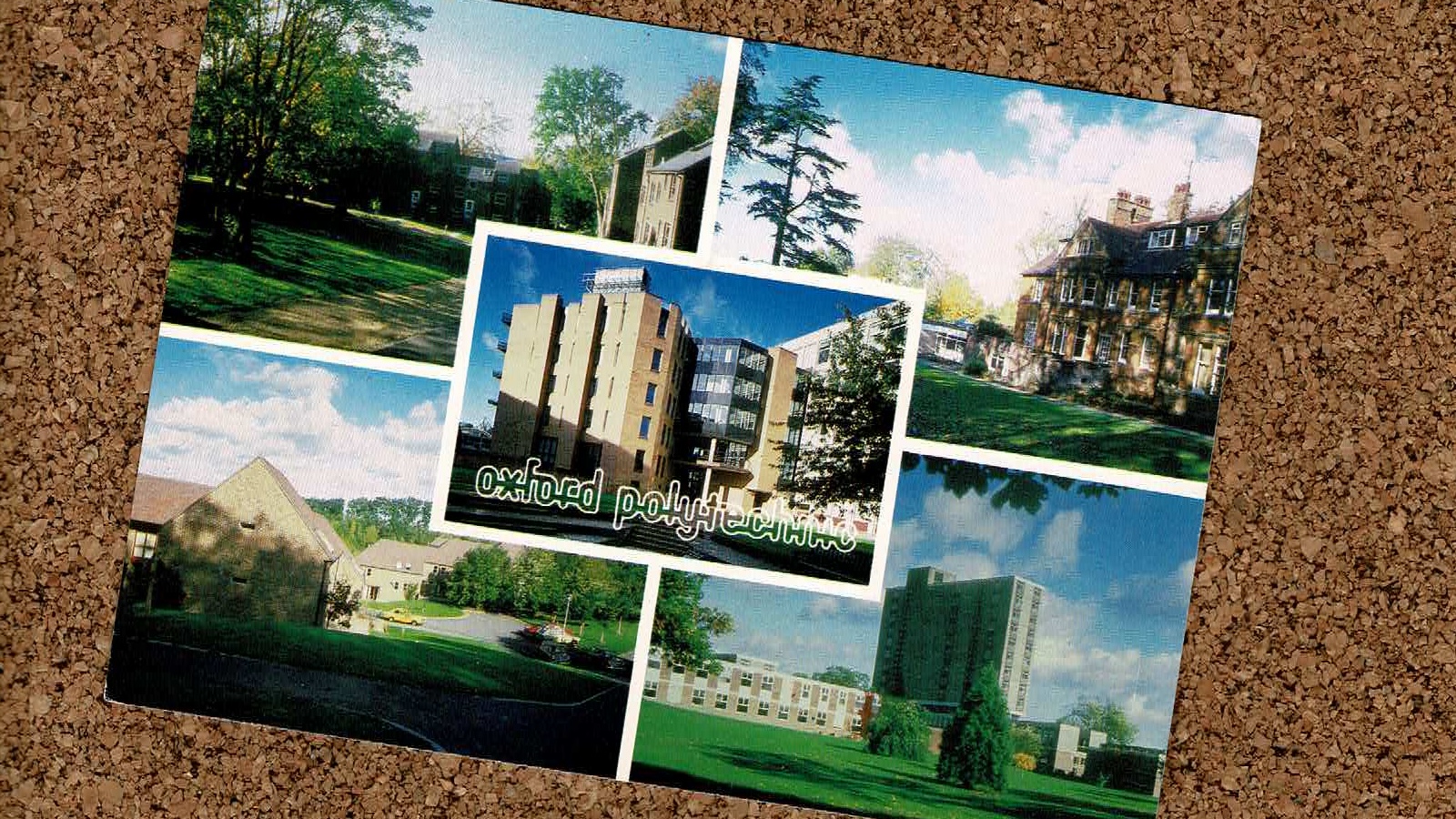
  • Higher education postcard: Oxford Brookes University

    Higher education postcard: Oxford Brookes University

    Greetings from Oxford!

    As reported in the Oxford Times, on 21 March 1865 – which by my count is very nearly 160 years ago – a meeting was held in Oxford. This led to the establishment of the Oxford School of Art, which opened its doors to students on 22 May that year.

    The initial curriculum included freehand drawing, shading in chalk, perspective and model drawing, figure drawing and anatomy, and painting in oil and watercolour. There were separate classes for men, women, and children under 15. Men and children paid two shillings a month (with discounts for larger periods paid up front); women paid four shillings per month. It isn’t clear to me why the fees were different, but as L P Hartley says, “the past is a foreign country; they do things differently there.”

    The school was initially housed on the ground floor of the Taylor Institute, a library for European languages within the University of Oxford. In 1868 or 1870 (sources differ) a school of science was added. But trouble was brewing. John Ruskin, who had recently been appointed as the Slade Professor of Fine Art at the university, did not approve of the way drawing was taught at the Oxford School of Art, and established the Ruskin School of Drawing to address this. The Ruskin School needed space, and so the School of Art and Science was moved to the basement of the Taylor Institute. The Ruskin School of Drawing is now, by the way, the Ruskin School of Art, and is the University of Oxford’s department of fine art. This tells you who won that argument in the long run!

    The move to the basement proved short lived. In 1888 chemistry labs in the Wesleyan school, Witney, were used by the school of science. In 1891 the school was taken over by the city council, following legislative changes enabling local authorities to fund education and to act as trustees, and was renamed the Oxford City Technical School. And in 1894 a new site, at St Ebbe’s in Oxford, was acquired for the school.

    The new site enabled growth in activities – so rapid that in 1899 the government Department of Art and Science declared it inadequate. Needless to say, the school remained on that site for another fifty years, albeit it also occupied other sites across the city.

    We now need to fast forward to 1928 and introduce a new character: John Henry Brookes.

    Brookes had trained as a silversmith, and was a part-time teacher of sculpture at the school. In 1928 he was appointed vice principal of the school of art (the schools of art and science were technically separate organisations); and in 1934 when the schools of art and science were formally merged to form the Schools of Technology, Art and Commerce, Brookes was appointed its first principal, and was to remain in that post until 1956.

    A pressing issue was accommodation, and in 1949 a 25 acre site in Headington was secured for the school. Planning permission was not granted until 1952, having been initially rejected in 1950, and it wasn’t until 1955 that the foundation stone for the new suite was laid. In 1952 a new name was also given: the school became the College of Technology, Art and Commerce. The Headington site was not formally opened until 1963, fourteen years after the site was acquired.

    In 1956 Brookes retired. His impact on the institution was clearly great. The college was once again renamed as the Oxford College of Technology; this and Brookes’ retirement were not, I believe, related events.

    In 1970 the college became Oxford Polytechnic and, in line with national policy which encouraged the amalgamation of smaller specialist colleges into more generalist institutions, it started to expand by incorporation. First came the Lady Spencer-Churchill College – this had been an emergency teacher training college, established in 1947. The Oxford School of Nursing joined in 1988; and in 1992 the Dorset House School of Occupational Therapy also joined the polytechnic. And also in 1992, the polytechnic became a university.

    Oxford Brookes University was the chosen name, in honour of John Henry Brookes. A few of the polytechnics had chosen names to commemorate local people – for example, Liverpool John Moores, Lanchester Polytechnic in Coventry – but I think Oxford Brookes is the only one named for a former principal. If you know different, please do say!

    In 1993 the university acquired Headington Hill Hall, formerly owned by Robert Maxwell, enabling an expansion of the Headington site. And in 2000 Westminster College, a methodist teacher training college, merged with the university.

    Being a university sharing a city with the University of Oxford can’t be easy: comparisons will mostly be tiresome. But here’s a surprising one: Oxford Brookes is arguably the best university in the UK at which to row (as in, propel a boat by oars, not argue) – see, for example, this report on the Henley regatta, 2023. Bet you didn’t know that!

    And here’s a jigsaw of the postcard, which I found more challenging than I expected.

    Happy 160th birthday, Oxford Brookes University!

    Source link

  • Free speech, graduates, student finance

    Free speech, graduates, student finance


    By submitting you agree to our terms and conditions

    Source link

  • University shouldn’t just postpone cliff edges for care experienced students

    University shouldn’t just postpone cliff edges for care experienced students

    A new report from TASO (Transforming Access and Outcomes for Students) shines a light on the barriers faced by those with experience of children’s social care entering and succeeding in higher education.

    The research points to a stark reality – inequitable access to higher education for care-experienced individuals, but also for a much larger group of people who have experienced children’s social care.

    Part of the problem is that support systems often hinge on rigid definitions like “care leaver,” leaving many students, who face similar challenges, without the help they need.

    When institutional policies fail to account for the diversity of these experiences, students are left to navigate higher education and life beyond it largely on their own.

    The report also suggests that while “care leavers” may have better access to support through Local Authorities (LAs) dedicated widening participation schemes, while those not neatly fitting into this category often fall through the cracks.

    But even if the definitions were fixed and there was more focus on “getting on” as well as getting in, what if higher education’s current offer isn’t enough to transform these students’ lives?

    Understanding diversity

    When the diversity of experience is overlooked, those needing support often miss out or don’t realise they’re entitled to it. Worse, support organisations sometimes view this diversity with suspicion.

    For example, the SLC’s rigid “estranged” or “in contact” policy fails to grasp complex family dynamics. Grey rocking – where abuse victims maintain minimal contact for safety – is ignored, leading to invasive social media monitoring and a profound lack of understanding of the complexities of family breakdowns.

    At the Unite Foundation, we provide free, year-round accommodation for care leavers and estranged students, improving outcomes by offering stability during studies and after graduation. The support gives graduates the breathing room to seek degree-relevant work instead of scrambling for immediate housing and employment.

    We understand that care and estrangement experiences vary widely. Some students enter care due to bereavement, maintain some family contact, or support younger siblings – highlighting how rigid policies fail to capture real-life complexities.

    A more nuanced approach is needed. I recently spoke with a vice chancellor who dismissed targeted support for estranged students, claiming most came from low-income, BTEC backgrounds, so existing support sufficed. But when I explained that many South Asian women – across all social classes – estrange themselves over arranged marriage disputes, he could not point to any existing support provisions that would reasonably address their needs.

    Recognising and addressing the diverse experiences of social care or estrangement is essential for creating a more equitable education system, and the TASO report helps highlight this need.

    Ongoing support

    The report makes clear that gaining access to university for those with experience of social care is only the first challenge – and there is a dire need to strengthen retention strategies.

    The authors reference a proposal previously suggested by the Social Market Foundation, where providers could receive an additional £1,000 for each care leaver they recruit. Tony Moss and I proposed a similar idea on Wonkhe a few years ago, arguing that care leavers should be included in the OfS student premium allocation formula.

    This would require some clarity around definitions and eligibility, but it would significantly help smaller and less financially robust institutions establish support systems for social care experienced students.

    And support schemes are effective. The University of York, for example, offers free accommodation to care-experienced students and has seen applications from such students triple. Similarly, the University of Cardiff acts as a legal guarantor for any student in need of one for a rental contract – without a single case of rent default in the past decade.

    An interesting aspect of the report highlights that the pathways to higher education for young people with experience in children’s social care often vary based on the type and timing of their experiences. In particular, it urges higher-tariff and more “prestigious” institutions to expand access to students from vocational pathways.

    Two years ago, while reviewing the UCAS Next Steps report, I noted that applicants from care-experienced backgrounds are 179 per cent more likely to apply for health and social care courses than their non-care-experienced peers.

    At the time, the Care-Experienced Graduates’ Decision-Making, Choices and Destinations Project offered some insight into this trend, explaining that a history in care often drives care-experienced people to altruistically pursue work such fields.

    Additionally, I suggested that the accessibility of these courses through Access to Higher Education Diplomas and the employment certainty they offer post-graduation could play significant roles.

    And I have also previously argued that care leavers have more direct contact with social workers, which exposes them to career trajectories of adults who influence them – similar to how children of lawyers are 17 times more likely to become lawyers than children of parents in other professions. So it all makes sense.

    Care-experienced people need to see all higher education options as viable – not just the ones their circumstances push them toward. If they gravitate to certain courses due to access, bursaries, community, or career pathways, we should replicate these benefits across other disciplines. TASO’s call for research-intensive universities to support care-experienced students from vocational pathways is a crucial step.

    Postponing the cliff-edge?

    Become’s End the Care Cliff report highlighted how care leavers face an abrupt transition to independence – often much earlier than peers who typically leave home around 24. This “care cliff” leaves many at risk of housing instability and homelessness, with care leavers nine times more likely to become homeless. While TASO’s recommendations help students avoid this cliff during university, what happens when support vanishes at graduation?

    The report noted that higher education can transform lives, but only if care leavers are supported to complete their degrees. But a degree alone doesn’t guarantee stability if old barriers reappear once institutional support ends.

    Social work – a field with a high representation of care-experienced students – suffers from high stress and low staff retention, with average careers lasting just five to nine years. This may reflect not just job stress but also the complex backgrounds of many staff.

    A 2022 UCAS report highlighted how support for care leavers often ends abruptly after graduation. Without ongoing help in early careers, the “care cliff” isn’t eliminated – just postponed.

    The TASO report also highlights the need for secure housing during university breaks, but the real challenge is post-graduation.

    Without family support, social care-experienced graduates often face unstable, high-cost housing that undermines career stability. While many peers live rent-free with parents, care-experienced graduates pay full rent on the same salary – assuming they’re even paid equally.

    Employers may exploit their financial inexperience, and hybrid working only widens this gap – given their living conditions often aren’t conducive to productivity.

    Beyond housing, these graduates face layered disadvantages. They’re more likely to be older, disabled, from minority backgrounds, or managing trauma-related health issues – often overlooked by employers.

    Many are also overrepresented in high-risk groups, including justice involvement and sex work, which can impact career prospects.

    Research then shows that early disadvantages persist into middle age, suggesting a need for long-term support. While the TASO report robustly addresses access and retention in higher education, it misses a crucial element – graduate careers.

    Providers should prepare social care-experienced students for the workforce. But a real focus on “getting on” must also involve pushing both central government and employers to understand their lived realities beyond graduation.

    If HE is serious about changing lives, it needs to work to eliminate the care cliff – not just delay it.

    Source link

  • Mental Health and Financial Barriers Threaten College Student Success (TimelyCare)

    Mental Health and Financial Barriers Threaten College Student Success (TimelyCare)

    Seven in 10 students have considered taking a break or dropping out.

    FORT WORTH, Texas, March 12, 2025
    /PRNewswire/ — Mental health struggles and financial pressures are
    jeopardizing college students’ ability to complete their education,
    according to a new study by TimelyCare, higher education’s most trusted virtual health and well-being provider,

    “Many students are slipping through the cracks due to unmet financial, academic, and emotional needs.”

    The
    survey, which gathered responses from 740 students attending two- and
    four-year colleges across the U.S., exposes significant barriers to
    student success and calls for specific action by educational
    institutions to address pressing concerns.

    Key Findings:

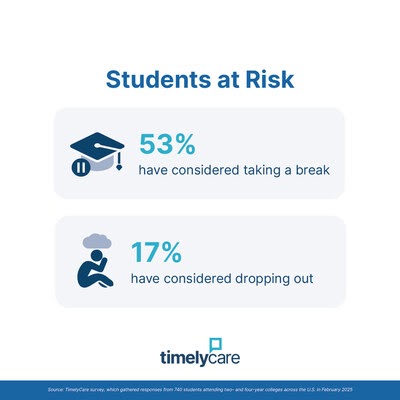
    Students at Risk of Stopping – More than half (53%) of current
    college and university students said they had considered taking a break
    from school, and 17% considered dropping out and not returning.

    Financial Strain – Nearly one-third (31%) of respondents cited
    financial strain as a primary reason for considering withdrawal.
    Additionally, a significant portion of students reported relying on a
    combination of financial aid, scholarships, and part-time or full-time
    work to cover costs.

    Success Barriers – An overwhelming 95% identified at least one
    obstacle impacting their success. Mental health (53%) and finances
    (49%) were the top challenges, followed by physical health (33%),
    academics (28%) and social belonging (26%).

    Gaps in Support Access – While 90% of students had used at
    least one school-provided resource such as academic advising, tutoring,
    or mental health counseling, issues like lack of awareness, inconvenient
    office hours, and inaccessible locations kept many from getting the
    needed help.

    Success Defined
    Students identified GPA, gaining knowledge,
    and graduating or completing their coursework as their top measures of
    success in line with a 2024 survey. Interestingly, non-traditional students placed graduating and gaining knowledge above GPA.

    “This study makes it crystal clear that many students are slipping
    through the cracks due to unmet financial, academic, and emotional
    needs,” said Nicole Guerrero Trevino,
    PhD, Vice President for Student Success, TimelyCare. “Our institutions
    must rise to the occasion to ensure no student is left behind.”

    What Can Be Done?
    In an open-ended question, students identified several ways institutions can better support their success, including:

    Promoting Awareness of Resources: Students called for more
    accessible and transparent communication about resources like tutoring,
    counseling, and career services.
    “Make a comprehensive list of all resources in one place.”
    “Talk about these services more openly. I didn’t know they existed when I needed them.”

    Tailoring Support for Non-Traditional and First-Generation Students: Develop
    targeted programs and policies, such as childcare options and
    evening/online classes, to support students balancing multiple roles.
    “Offer different hours for people who work full time during regular work hours.”

    Engaging Faculty and Staff: Train educators and advisors to proactively identify struggling students and provide personalized support.
    “Make
    it feel more normal that all students are impacted in some way and
    encourage all students to look into getting the help they need. It still
    feels almost taboo to seek out help in most situations.”

    Expanding Mental Health and Financial Well-Being Resources: Increase
    counseling availability, destigmatize mental health challenges, and
    offer virtual and flexible options for access. Streamline communication
    about scholarships, grants, and emergency funding while providing robust
    financial literacy resources.
    “Give access to virtual services or anonymous services”

    TimelyCare virtual success coaching
    supplements on-campus academic preparedness, career readiness, and
    financial wellness support with an integrated 1:1 care and coaching
    model.

    A complete list of questions and responses from the February 2025 survey may be found here. Click here to download a related infographic.

    About TimelyCare
    TimelyCare
    is the most trusted virtual health and well-being solution for learning
    communities, offering personalized, clinically proven care that fosters
    student success and delivers life-changing outcomes. With an unmatched
    range of service options on one seamless, easy-to-access platform,
    including mental health counseling, on-demand emotional support, medical
    care, psychiatric care, health coaching, success coaching, basic needs
    assistance, faculty and staff guidance, peer support and self-guided
    wellness tools, we extend the efforts of 400+ campus wellness teams,
    ensuring millions of students have direct, anytime access to our
    culturally competent and diverse care providers. Recognized as a
    Princeton Review Top 5 Need to Know Organization for Mental Health
    Awareness, TimelyCare drives measurable and meaningful improvements in
    depression and anxiety, empowering every student on their wellness
    journey while strengthening learning environments.

    Source link

  • USDA restores funding to University of Maine System

    USDA restores funding to University of Maine System

    In a quick reversal, the U.S. Department of Agriculture has restored funding to the University of Maine System after pausing it on Monday

    On Wednesday evening, U.S. Sen. Susan Collins, a Maine Republican, announced that USDA funding for UMS programs had resumed after she had consulted with the Trump administration. 

    “This USDA funding is critically important not only to the University of Maine, but to our farmers and loggers, as well as to the many people who work in Maine’s agriculture, aquaculture, and forestry industries,” Collins said in a statement.  

    UMS leaders learned of the funding restoration from Collins. System Chancellor Dannel Malloy and University of Maine President Joan Ferrini-Mundy said in a joint statement late Wednesday that the shutoff was an “unnecessary distraction from our essential education, research and extension activities.”

    Altogether, UMS has $63 million in active USDA grants — most of which goes to the flagship University of Maine campus in Orono, the system said. Of that, about $35 million is left to be paid out. The funding helps finance a wide array of programs, including agricultural research, the youth agricultural engagement program 4-H, and plant and tick disease testing. 

    The funding freeze came weeks after a tense public exchange between President Donald Trump and Maine Gov. Janet Mills, a Democrat. Trump threatened Mills on Feb. 21 with pulling all federal funding to the state if it did not comply with his executive order barring transgender women from K-12 and college sports teams aligning with their gender identity. 

    The day after the exchange, USDA announced a compliance review of the University of Maine under Title IX, which bars sex-based discrimination at federally funded education institutions. Meanwhile, the U.S. Department of Health and Human Services also announced a civil rights investigation into the state on Feb. 21, finding just four days later that its education department had violated Title IX. 

    UMS said it heard nothing from USDA between Feb. 26 and March 10, when the system learned via a forwarded email that USDA had temporarily cut off all funding. 

    UMS maintains that it is “fully compliant” with all state and federal laws as well as with updated NCAA rules. The college sports association changed its rules to adhere to Trump’s executive order the day after it was signed. 

    “At no point since USDA announced its Title IX compliance review on Feb. 22 has that Department, or any other party, alleged any violation by Maine’s public universities of Title IX or any other federal or state law,” UMS said in a release Wednesday.

    Source link

  • Trump administration silent on Muslim students’ civil rights

    Trump administration silent on Muslim students’ civil rights

    This audio is auto-generated. Please let us know if you have feedback.

    Millions in cuts to federal funding. Letters from the highest education official in the country expressing disappointment. Enforcement directives to immediately address a “backlog” of antisemitism complaints. 

    The U.S. Department of Education’s Office for Civil Rights has taken sudden and unprecedented actions in the past month highlighting its desire to protect Jewish students from discrimination. At the same time, no such imperative has been evident in investigations into or statements on Islamophobia on school or campus grounds.

    “This administration appears to be focused solely on responses to antisemitic incidents on campus,” said Jackie Gharapour Wernz, an education civil rights attorney who worked at OCR under the Obama and the first Trump administrations. “But schools need to be focused on both.” 

    ‘Lip service’ to protecting all as Muslim students are targeted

    The same civil rights law that protects Jewish students from antisemitism — Title VI of the Civil Rights Act — also protects Muslim students from Islamophobia. 

    Under the Biden administration, and especially in light of the Israel-Hamas war protests after Oct. 7, 2023, the Education Department repeatedly expressed to schools that they must protect Jewish, Muslim, Palestinian and Israeli students equally. 

    “Jewish students, Israeli students, Muslim students, Arab students, Palestinian students, and all other students who reside within our school communities have the right to learn in our nation’s schools free from discrimination,” Catherine Lhamon, assistant secretary for civil rights for the Education Department under the Biden administration, warned in a Dear Colleague letter in November 2023. 

    The Biden administration issued the letter amid what it called an “alarming rise” in both antisemitic and Islamophobic incidents at schools.

    Conversely, the Trump Education Department has made at least five announcements related to ending antisemitism in schools — none of which also expressed protections for students of Muslim, Arab or Palestinian backgrounds. 

    “They are centering Jewish students or others who are experiencing antisemitic behaviors, and they’re very clearly going after Palestinian and or Muslim students, as in the example at Columbia [University],” said Brett Sokolow, a Title VI and Title IX education civil rights expert who often works with school district administrators seeking to comply with federal regulations. “So while there’s some lip service to protecting all, I think the [Title VI] enforcement tool is going to be used primarily to the benefit of those who are experiencing antisemitism.” 

    Last week, the Trump administration cut $400 million in funding to Columbia University over what it called “inaction” in harassment of Jewish students, and warned of more cancellations to follow. Referring to anti-Israel protests that erupted on campuses over the Israel-Hamas war, the Education Department said “any college or university that allows illegal protests and repeatedly fails to protect students from anti-Semitic harassment on campus will be subject to the loss of federal funding.” 

    “This is only the beginning,” said Leo Terrell, senior counsel to the assistant attorney general for civil rights and head of the federal Joint Task Force to Combat Anti-Semitism, in a joint March 7 statement with the Education Department

    Just a few days later, Trump vehemently supported Immigration and Customs Enforcement’s arrest of prominent Palestinian activist Mahmoud Khalil, saying the move was the first of “many to come.” Khalil, a legal permanent resident of the United States and recent Columbia graduate, helped lead campus protests opposing the war in Gaza. 

    Addressing a ‘backlog’ of antisemitism complaints

    Israel-Hamas war protests erupted on higher education and K-12 campuses under the Biden administration. 

    As part of its broader effort to crack down on Title VI after Oct. 7, 2023, the Education Department’s OCR opened civil rights investigations into complaints of both Islamophobia and antisemitism. Its caseload had gotten so unwieldy that Lhamon and then-Education Secretary Miguel Cardona pleaded at the time with Congress for more funding to support investigative staff and address the high number of complaints. 

    Source link