Category: Featured

  • Real World Support

    Real World Support

    As students navigate an increasingly complex world defined by artificial intelligence, social media, and rapid technological change, the need for essential life skills has never been greater. A new curriculum called The Edge immerses students in real-life, complex scenarios that challenge them to think critically, collaborate effectively, and apply social-emotional learning (SEL) to everyday situations. Hear how educators are using these next-generation strategies in classrooms today.


    The computer-generated transcript is below:

    Kevin Hogan,
    Content Director, eSchool News
    This episode is brought to you by ascend now. Ascend now is an online education platform focused on providing personalized, academic and beyond academic coaching and mentoring to students aged 7 to 17. With a particular emphasis on fostering entrepreneurial skills and mindset by integrating entrepreneurship education into their curriculum. Aiming to normalize kid entrepreneurs through tailored programs and personalized learning paths. OK. Hello and welcome to this special edition of Innovations in Education, the podcast that explores how tech can enable districts to improve teaching and learning in their classrooms. I’m Kevin Hogan, content director for eSchool News. And I’m glad you found us. Believe it or not, it’s been five years this month that the world and schools shut down due to the COVID pandemic. Since then, so much has changed from student behavior to the way that schools respond to that behavior. Many through the use of social emotional learning, or SEL techniques. I had the pleasure to speak with Jesse Bushman. Jesse is the senior director of SEL at. Fayette Valley Community School District in Iowa about their efforts by using a new program called the. We also spoke with the creator of that curriculum, Devi Sahny. She’s the CEO and founder of Ascend now, now designed in collaboration with educators and aligned with the Castle Framework. The. The first curriculum to meet educators demands for high quality instructional materials for SEL and life skills readiness. The curriculum helps students cultivate communication, problem solving and self-awareness, as well as essential life skills like entrepreneurs. Negotiation, financial literacy and networking to boost their academic abilities. I think you’ll find their insights valuable. Have a listen. OK. Devi, Jesse, thanks so much for joining me today. Really appreciate it.

    Devi Sahny
    CEO and Founder, Ascend Now & The Edge
    I’m happy to be here. Thanks for having us.

    Kevin Hogan
    And as I was mentioning right before we started the recording here, I guess it’s hard to believe, but it’s five years ago to this month, it was actually Friday the 13th. Believe it or not that Jesse, I mean I know a lot of school districts, that’s when we. Into this great. Beta test in education with remote learning and COVID. Years. So tired of talking about it. However, it is still really kind of with us in the way that it has changed education and especially with the work that Jesse you do and Devi that you do that really took one of those acronyms I’ve always heard in education SEL, which was kind of like a nice to have probably for districts who might be kind of more well off than others. That would introduce that to where social emotional learning became front and Center for everybody in this. Group trauma together districts have spread apart. If they had the luxuries or the privileges to be able to set up remote right away. Most of the, if I recall correctly, in my conversations, most of those conversations involved around social emotional learning. You OK at home? How are you doing at home? People those first few months. No more worried about standardized testing, right? Everybody was worried. Just kind of keeping it all together. Jesse, we can get. Let me talk about that time for you in. In your district, in what you were doing in what SEL mean back then. And what does it mean? And Devi, I promise we’ll get into the news of the edge and how this all comes part and parcel.

    Jessie Bushman
    Senior Director SEL,
    North Fayette Valley Community School District,
    Yeah. You’re totally correct. At that time it was like scary. We’re all learning to adjust. The kids were learning to adjust to and as educators. That was our most important thing was to tune in with the kids. Sure, they were safe. Check in on how they were doing and as staff we did that together as well, so we would check in on each other. A lot of our first meetings were just talking about how everybody was doing. So coming back, it did change a lot of things kids were. And teachers were. So as a school, we had to change things.

    Kevin Hogan
    Yeah. And Devi, let’s get into the news a little. I mean, just here in January, now you’ve announced this new curriculum called The Edge. How have the past few years informed the work and the ultimate release of this new service? You’re providing.

    Devi Sahny
    Yeah. And and just to answer that first part of the question about COVID, I think COVID certainly transformed education for K12. In a lot of ways, I think in one way teachers overnight had to have this accelerated adoption of technology, some that was super helpful and integrated really easily and others that may have perhaps even. Slow down learning. I think teachers out of all stakeholders during Covic with the heroes, because overnight they had to change their delivery and immediately adapt. And I think that’s in a very entrepreneurial thing. One of the other big changes we saw through Covic was this increased emphasis on social emotional learning. Think there was a report. Brookings stating that nearly 40% of teachers report students struggling more with depression and anxiety than before. COVID and over 80% of those teachers still have students that are struggling with depression and anxiety. So I think the overemphasis of technology combined with an entirely new world landscape reframed this focus of, hey, we should maybe turn back the pendulum and focus on the important skills. And with AI and technology, everything is advancing. But certain skills like networking and grit and resilience and communication, they still remain incredibly important. And one of the reasons we decided to create the edge is we felt that students in their middle and high school years did not really feel those skills were learnable. They thought I’m either born with strong public speaking skills or I’m not. I’m either born. With a learning mentality and a strong mentality or I’m not and we wanted to break that belief and provide them with student friendly resources, but I think yeah, COVID certainly changed a lot and I think now more than ever SEL is critical the amount of times we hear. Teacher saying we don’t have time for essay and I always. Well, that’s actually going to reframe and support your your students to be ready for. But even the teachers need SEL. I mean, Jesse and I were just talking about one of her students who I think Jesse was saying, like, found purpose through essay.

    Jessie Bushman
    Yeah, we had a great conversation when we were working on a lesson. It would just like the light bulb went off, he and he said. Now have a purpose like. There’s a reason, like I understand why I need to learn this, because this is my future. And so it wasn’t just another thing to teach. At that moment, for him, this was like I need to learn this. Is life.

    Kevin Hogan
    Yeah, it seems to me with both you’re talking about two is the change in student behavior right? Of the experiences of the of the past couple years. One of the net positives, if you can call it that or a silver lining, whatever cliche you you wanna use. You’re describing a self-awareness that I still don’t think I have for myself. That said, students of that age and having gone through this experience, are aware of their learning journeys. Aware of where they might need to improve and also don’t kind of shrug it off as. This sort of like, well, that’s just for people with depression. Or that’s just for certain part of the kids in class, maybe who aren’t succeeding like, this really is beneficial for everybody, right?

    Devi Sahny
    Absolutely. And I think that when we talk about soft skills and we talk about Sela, lot of the resources that currently exist remain a bit outdated and they’re not student friendly and a lot of the teachers we’ve spoken to have said we’re using the same curriculum, that’s 50. Older. 30 years old to teach, you know, stress and anxiety, and it’s not as simple as just a deep breath. There’s more to it, and there’s more conversation involved. So one of the things we did when we created this program, the edge is we try to identify what the future skills are. How do we actually figure out what are those skills? And how are they learnt? Are they acquired? So we went on this crazy research experiment where we interviewed different stakeholders. We interviewed 500 educators from different demographics and socio economic backgrounds to ask them what are the scales you wish you could teach in your classroom but don’t have the resources for. Then we interviewed 500 students different ages in middle and high school to understand what skills they wish they could learn, and some really interesting responses. Like networking, which is one of our more. Skill. And then we interviewed about 200 chief learning officers from different Fortune 500 companies to ask them when you teach your employees in these higher Ed programs whether the skills you focus on. Then we cross reference that with HR and recruitment industry to understand what they hire for across sectors, whether that be education, technology, human resources, fin. We came up with a list of about 6000 schools. We then took that. We spoke with OECD World Economic. We’re actually one of the partners and I was at Davos recently in January speaking about this and we looked at the future of jobs report and we took all that data and all that research. To create our own framework which is called the Life readiness playbook by. Edge and this playbook is not necessarily, as you pointed out, Kevin, for students to get ready for an outcome like good grades or a university outcome or a good job, it’s actually just to have them ready for life. And these are skills that are lifelong. You know, I’m constantly working on my listing skills, my stress management skills. And the way that students can consume this content is pretty exciting. Like if a student wants to. Consume the content, grit the skill, grit they can learn from Michael Jordan. Not making his high school basketball team and the cool thing is the video format. It’s funny. Quirky. It’s engaging. But it still has all those learning outcomes tied to it, which is something, frankly, I wish I had when I was in middle high school.

    Kevin Hogan
    Yeah. Jesse, talk a little bit about what that means on a day-to-day basis for our listeners, our readers who are either running districts themselves or their principal of a school or even at the classroom level, I mean. These are great theoretical topics, but what? About science class between 10:30 and 12:30 on a Tuesday. How do these curricula? Do these topics kind of show themselves in the day-to-day of educating students?

    Jessie Bushman
    Well, I’m gonna step. Just one step and kind of explain how we. There. I think that’ll make a little bit more sense looking for something. We just know that we needed something to add for our students and looking for a curriculum we couldn’t find what we needed. They were not rigorous enough. Wasn’t the correct content. Not engaging for our students or didn’t have enough depth as as far as lessons to make it through a school year or to do a 612 model so. Once I saw the edge, the skies parted and I was like, this is exactly what we need. And so once we started teaching those things, we noticed that the students confidence changed. They became more confident in themselves in what they can do, looking forward to their futures. And so we had a lot less behaviors. So those started decreasing because. There was. We’ve also seen absentee change. Kids want to be at school, they want to be engaged. It’s great with our staff as well. Like you said, adults need this too. This is stuff for all of us. It’s been great teaching it because it’s a reminder myself as well on a lot of these skills that you don’t think. Every day.

    Kevin Hogan
    Yeah, especially when you look at again. I hate to go back to COVID, but there really was a significant chasm there in, I would say the soft skills versus the hard skills. But we we kind of focus on the on the reading and and the math scores that go down. I see it from my own kind of COVID kids here to see. Of having a person to person in person conversation with someone if they weren’t in school for 18 months between the time they were an eighth grader up to sophomore, they’re still struggling to recover on how to. Behave in person for for a lot of stuff, right? But maybe Devi, you could talk a little bit. I know that you you had this integrated school framework, you had this educator friendly design that you put these things together. What is your hope terms of turning those soft skilled potentials into real world accomplishments?

    Devi Sahny
    Yeah, I think that in the digital age and like you said, the students that were were most impacted during COVID. Many of them have lost what’s called human skills. Actually hate the term soft skills because I think soft and hard skills, but all human skills, right? Portions of soft skills have pieces of hard scales, etc. We actually focus on both soft and hard. But I would. That turning the pendulum back and saying how can we help these students develop self-confidence, self-awareness, resilience, grit through stories of themselves through activities, through gamified examples that will really take them forward into the real life. It’s funny that you say this because I gave a talk at one of the leading international schools and recently and I asked the students, I think it was about 200. I asked them who here is confident with the skill networking and is confident speaking to people they have never met before in person. And I have 200 students, maybe 3 raise their hands. Then I reframe that question. Said. Who here in this classroom is confident speaking to someone they haven’t met before online? Maybe 30 raised their hand. So there’s this confidence and this comfort with online communication that is so easy for students to accept. It’s interesting. I I I will say that sometimes I’m like that too, right? When I’m in person, meeting changes into zoom, I’m like, yeah. Like I don’t have to like wear anything. Know too too fancy. I can do it in my hoodie. There is a bit of that right and I think there there’s an honesty to that and I think that’s important. But I think the. The fear with this new generation is that the human skills are not getting practised at all. Again, very weird example which I’ll put in quotations. You may want to cut out, but some of our students, one of our students I’m speaking to recently, she’s 19 years old, she said to me, I have a boyfriend. I said, oh, great. Where did you meet him? She said no. We’ve been dating for a year, but I never met him in person.

    Kevin Hogan
    It’s amazing, yeah.

    Devi Sahny
    So it’s like is the world changing that way or is it, you know, the skills or what’s happening, right? But I think you know, Jesse’s been Jesse’s such an inspiring educator for this reason. Jesse’s smart enough to know that teachers themselves also need to work on their SEL. All do. Adults, professors, everyone and so in parallel. If teachers working on their SEL, they’re teaching students SEL. The students are teaching the teachers. And that’s such a beautiful process because. Learning can happen in any sort of. But that’s really our. My hope is to help students to fundamentally figure out who they are, their purpose, like Jesse’s student who figured out what made himself tick. The Edge is designed for students to figure out who they are, what their strengths are, what skills they’d like to work on and for. Kevin, I’ll be honest that the edge is designed as a one stop shop, easy to use resource that helps them use these skills in their classroom with no prep that gives them maybe 10 minutes extra with their, with their kids or their partner. That they don’t have to write a whole Lesson plan or learning sequence, right? And that’s important to us too, because they’re the heroes.

    Jessie Bushman
    That was a huge. Point that I fell in love with when I saw it is these are lessons that I can just pick up. I can pick it up, I can read it, and I can teach it, and it’s not something that’s going to be another thing on. Plate right now I have a lot of things on my plate, so when I’m able to pick it up, the slides are ready for a whole group. Very little needed. It also has the online component. It has all the pieces to it prepped and ready, so it’s not one more thing for me to have to do.

    Kevin Hogan
    Yeah, another aspect I know which is important for districts. Again, when it came to social emotional learning techniques in the past, you might have had that guy, usually a guy on the school board saying. Show me the results. Show me the data. Show me how this is actually been effective and don’t give me the squishy anecdotes. Me the the hard numbers. And I know that with the eggs, there are some real time analytic techniques that are connected with it.

    Devi Sahny
    Absolutely. So you as a teacher or a district can see how your students are performing across every. Personal development, communication, employability, skills, active citizenship and learning, and you can actually get a score to see how your students are progressing on a grade level. Age level. Student level. You can compare that data geographically so you can see what kids. In China or in Asia or Europe are doing compared to your students, at least those of our school partners that are working with us, we work with quite a few international schools too, like International School partnerships, Dulwich College, Xcl Cognita School, some of the American schools and so. Interesting to compare that data with some of the data in the US and to see how students. But overall, we’re seeing that a lot of students are like, wow, I didn’t know I could learn financial literacy. Didn’t know I could learn about. I didn’t know I could learn about entrepreneurship in such a friendly way, so that’s really important to us, but also to feed the schools with unique data to see where the holes and the gaps are, because as schools. Ton of things you have to, you know, kind of take care of chronic absenteeism, teacher retention, you know, school leadership. So many things involved. I mean this is really just designed to see how can we. And we also have a mental health teacher track coming up too, which I’m really excited about because that’s something that can really support the teachers.

    Kevin Hogan
    Yeah. And Jesse, to kind of to go back a little bit, give us a little bit of a day in the. I mean, are these seen as extracurricular activities that happen after the Bell ring in the afternoon or they are they tied into actual classes? Kind of give us the specifics there.

    Jessie Bushman
    Well, the one thing that I love about this curriculum is it’s super. So according to your school, you can adapt it and switch it to. However, it’s going to work best for you. We as a district started off with it in the special Ed program. Actually, and we needed a curriculum there 1st and looking at that then we saw the need like the rest of the kids need this information as well. Looking into putting it into advisory, that portion of time. A lot of times teachers are trying to fill that time with lessons themselves or create these types of lessons. So using it as universal gives the kids the the vocabulary, the information, and then we can use it all the way into special Ed. So it’s an intensive program as well. It’s very. That was huge for me that my students are going to have the same vocabulary from 6:00 to 12:00. In. Ed and special Ed.

    Kevin Hogan
    And it says to me that it’s pretty much teacher driven or educated driven. That fair to say.

    Jessie Bushman
    Yeah, it’s very engaging. All the material is very. And it’s very relevant to the kids. The kids can relate to it. Stuff that’s happening in their lives. The discussions. It’s not just role. It’s great discussions on actual problems in the world and tools that they can actually use right there in the classroom as well, so. They’re discussing things that are happening right around us.

    Kevin Hogan
    Excellent. Now I think we’ve gotten a really good sense of the state of play of where we are with social emotional learning. Now, if you are up in progressive schools or districts like Jesse’s, let’s talk about. Next steps, Devi, where do you see? This is just the edges that’s been launched here in January. What are your hopes to see your services as they continue to evolve over the next several months and and years?

    Devi Sahny
    Yeah. What we’re doing in parallel supporting districts now, 200 schools and total. So we just enter the US, but we already work with seven districts here as well as Georgetown University Summer School and two other summer schools in the process. But my hope really is that as we have all these amazing districts using us to take as much feedback and see how we can make this product as easy to use and helpful for teachers. One of the feedbacks we’ve gotten is we love this so much. You include a teacher mental health track. And mental health videos for teachers to help us do what we’re doing every single day. We have tracks that include entrepreneurship and internships. A lot of employability skills in college and career readiness, but we have two more tracks. Is called AI interpretation and another is graphic design in the making. So what happens in these tracks is the students can reapply the skills they were learning. But through an experience through something a different context where they can basically trans context, apply that skill again. So that’s really cool because at the end of the entrepreneurship track, there’s a Shark Tank for kids where they can compete, and the best business gets funding. Actually, that funding is funded by Ascend. Now, over the past seven years, actually we’ve. We funded student businesses as prize money essentially, and the internship track they can, you know, apply to different companies to apply for internships. So there’s a bit of that, but overall my hope is. Is that we have this next generation of future ready, SCL, smart skill, savvy students across the world that know themselves that find their own edge through essay. Because essay everywhere and to have 30 minutes a week in SEL. I don’t think that’s enough. You know, I really Don. So it’s a. It’s a good start, but we need to do better, so I think valuing the Selma as a society would be something that I would be very interested to see what happens in the next few years.

    Kevin Hogan
    Yeah. And Jesse will leave the last word with you about where your hopes to see this sort of work and how we can kind of continue to evolve and benefit your students.

    Jessie Bushman
    I’m just excited to see what they can do with their futures as we’re learning these skills and you see the light in their eyes and they’re able to you do the challenges and apply the skills that they’re learning in real life. Talking about networking, the challenges to go. And network and come back with three business cards. So we’re putting it right in their. And so when they’re learning, it guided with us, I mean, just excited to see what they’re going to be able to do in the future.

    Kevin Hogan
    Yeah. Well, once again, it’s a difficult topic and you add in COVID. It’s just always a tough conversation, but at the end of it I come out feeling better. Congratulations on your launch. Congratulations on on the work that you’re doing. Jesse at your district glass always seems half full. When I when I sit. With a few educators for 15 or 20 minutes this way, and here the the real work and the real successes you’re having. Thanks again for your time and for your insights.

    Devi Sahny
    Thanks so much Kevin for having us. We really appreciate it and love talking to you.

    Jessie Bushman
    Thank you.

    Kevin Hogan
    And that wraps up the special edition of Innovations in Education, which was brought to you by ascend. Now a US based education startup committed to increasing both college and career readiness for all students. For more information, you can find them on the web at buildmyedge.com.

    Kevin Hogan
    Latest posts by Kevin Hogan (see all)

    Source link

  • Encouraging Families to Promote Racial Identity and Pride in Black and Other Minoritized Children

    Encouraging Families to Promote Racial Identity and Pride in Black and Other Minoritized Children

    Dr. Donna Y. FordNow more than ever, race has become salient in politics, higher education, P-12, and the workforce, especially in this anti-DEI era. It is not uncommon for Black and other minoritized individuals to have feelings of anxiety about discussions around race, particularly for families (e.g., parents, caregivers, guardians, etc.). Having “the talk” about racism and bias has been a rite of passage for many Black children and youth in which their parents/caregivers have to discuss the intersection of race and U.S. societal issues such as how to interact with law enforcement because navigating these circumstances can easily lead to imprisonment or a life-or-death situation. Trauma is undeniable. 

    Keeping “the talk” at the forefront of this op-ed, it is imperative that families have the resources to properly discuss, show, and engage their children in active conversation about race relations so Black and other minoritized youth and families can respond appropriately, particularly in proactive ways. Moreover, families must continue to instill confidence and pride in racial identity. To set the tone, we are eager to share this Sesame Street video “Elijah Explains Race to His Son, Wes, and Elmo.”

    Children are Ready, Caregivers (and Educators) Must Be Too

    Here is an overview from Traci BaxleyResearch shows that children form race-related ideas long before they can verbalize about race and racism. It may surprise readers to know that racial awareness begins in infancy. Regardless of their age, all children get clues from their experiences (inside and outside of home) to make sense of the world. Therefore, early, intentional/proactive, honest, and age-appropriate conversations are important for promoting racial identity and pride. Here is a developmental look at children’s understanding.

    Infants show a preference for the faces of people from their own racial group as early as six months. Babies gaze longer and show happy expressions more frequently with people who look like them. Start early by introducing children to people who don’t look like them, and let children see pictures of people with a variety of skin tones and facial features.

    Toddlers use social cues such as body language and facial expressions to make sense of their world. They watch the way adults respond to differences in people and mimic our attitudes and racial biases without us even realizing it. As young as three, toddlers associate some racial groups with negative traits and use these associations to develop their own understanding about the world/environment around them. As caregivers, we need to be aware of our own biases and reactions to people whose skin color is different. Using books, videos, and music that highlight and celebrate differences.

    Preschoolers become even more aware of differences such as skin color and hair texture. They are increasingly observant of how others are similar and different from them. Toddlers compare and group/categorize people by race. Note that some children also begin to show a “pro-white” bias. Thus, they may begin to include or exclude playmates on the basis of race. Furthermore, minoritized children may associate White with wealth, power, and/or beauty.

    Dr. Erik M. HinesDr. Erik M. HinesKindergartners and first graders are beginning to notice that race is often a taboo topic – the proverbial elephant in the room. They may continue to include and exclude peers based on race. They are more aware of disturbing news, and they often ask questions about it. This is a timely opportunity to have meaningful conversations about race and racism.

    In summary, as soon as children can ask race-based questions and make comments, support their natural curiosity by answering them, even the most difficult ones.  Let them know that it’s fine/not wrong to notice skin color and to talk about race. We concur with Baxley that “the idea is to make differences normal and good!”  We are uncomfortable and not prepared, our children will notice, and experience discomfort. It will be difficult to promote racial understanding and pride, which is so needed for minoritized children in these turbulent times.

    A Final Word

    We are staunch advocates of appreciating Black culture and its legacy of innovation, education, and significant contributions to the history of the United States. Broaching race with children is imperative to ensure that they have the confidence and belief in themselves with no limitations to their talents, creativity, brilliance and genius. These conversations around race not only prepares our youth to thrive but it also normalizes how conversations on race can be proactive as opposed to reactive.

     Dr. Donna Y. Ford is Distinguished Professor of Education and Human Ecology at The Ohio State University.

    Dr. Erik M. Hines is Professor of Counseling in the College of Education and Human Development at George Mason University.

    Dr. Tanya J. Middleton is a Clinical Assistant Professor in the Department of Educational Studies at The Ohio State University. 

    Source link

  • Secretary of Education Linda McMahon Scheduled for ASU+GSV Summit, April 8, 2025

    Secretary of Education Linda McMahon Scheduled for ASU+GSV Summit, April 8, 2025

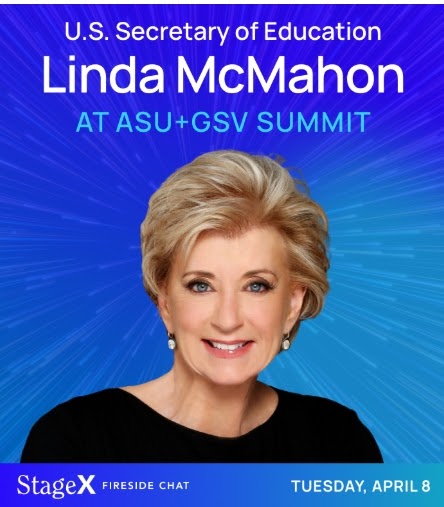
    On April 8, 2025, US Secretary of Education Linda McMahon will give a fireside chat at ASU+GSV, an edtech conference held in San Diego, California.  

    President Trump has tasked McMahon with dismantling the federal agency that oversees federally funded K-12 and higher education programs. In less than two weeks she has done just that.  

    Half of ED’s staff have already been fired or taken a payout, and the $1.7T student loan portfolio is likely to be transferred to the US Treasury. 

    There is no word yet on whether there will be demonstrators at the conference, but we expect some form of vocal nonviolent resistance.  AFT President Randi Weingarten is also scheduled to appear.  

    Source link

  • College Application Surge: Underrepresented Students Lead Growth in 2024-25 Admissions Cycle

    College Application Surge: Underrepresented Students Lead Growth in 2024-25 Admissions Cycle

    According to Common App’s latest “Deadline Update” report released Thursday, college applications for the 2024-25 admissions cycle continue to show strong growth, particularly among underrepresented and first-generation students.

    The report, which analyzes application data through March 1, 2025, reveals that 1,390,256 distinct first-year applicants submitted a total of 8,535,903 applications to 863 returning Common App member institutions—marking a 4% increase in applicants and a 6% increase in total applications compared to the same period last year.

    One of the most significant trends is the substantial growth among underrepresented minority applicants, which increased by 12% over last year. Specifically:

    • Latinx applicants rose by 13%
    • Black or African American applicants increased by 10%
    • The share of domestic applicants identifying as Black or African American grew from 13.3% to 14%
    • White applicants’ share of the applicant pool continued its long-term decline, dropping from 48.2% to 45.7%

    First-generation college students showed remarkable growth, with a 13% increase in applicants while continuing-generation applicants remained flat. Similarly, applicants eligible for Common App fee waivers increased by 9%, compared to just 2% for non-eligible students.

    Students from lower-income communities also made strong gains:

    • Applicants from ZIP codes with below-median household incomes increased by 8%
    • Applicants from above-median income ZIP codes grew by only 3%

    The report highlights several notable geographic patterns:

    • The Southwestern region experienced the fastest growth at 34%
    • Texas led state-level growth with a 37% increase in applicants
    • District of Columbia applicants grew by 18%
    • For the first time since 2019, domestic applicant growth (5%) outpaced international applicant growth, which declined by 1%

    Applications to public institutions grew at 10%, significantly outpacing the 2% growth rate for private institutions. Additionally, less selective institutions (those with admit rates above 25%) saw application growth of 6-7%, while the most selective institutions (admit rates below 25%) experienced the slowest growth at 4%.

    For the first time since the 2021-22 season, applicants reporting test scores (up 11%) outpaced those not reporting scores (down 1%). This reversal comes despite minimal change in the proportion of institutions requiring test scores (increasing only from 4% to 5% of member schools).

    This comprehensive report offers valuable insights into college application trends as institutions finalize their incoming classes for the 2025-26 academic year. A more detailed analysis is expected in August when Common App releases its full end-of-cycle report.

    Source link

  • A picture is worth a thousand words — unless a college district bans it

    A picture is worth a thousand words — unless a college district bans it

    As Chief Dan George of the Tsleil-Waututh Nation aptly noted, “What you do not know, you will fear. What one fears, one destroys.” Unfortunately, the Los Rios Community College District of greater Sacramento, California, has an overly restrictive policy that risks making this a grim reality.

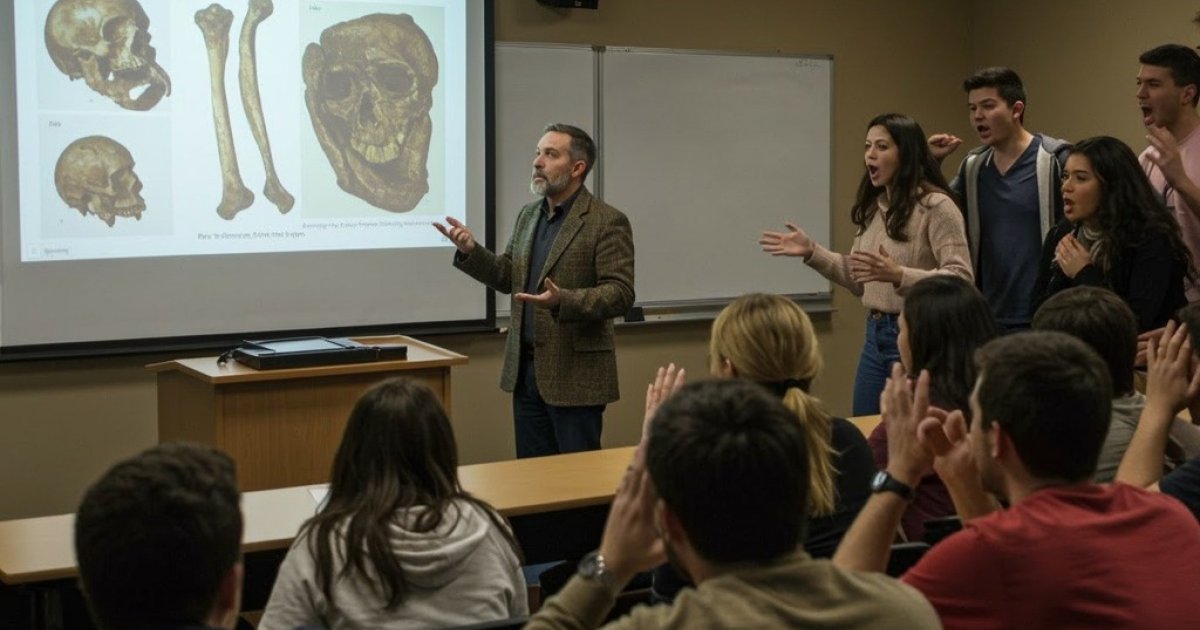
    In an effort to respect Native American remains, the district enacted a broad “moratorium” — essentially a complete ban — on faculty and students displaying “images and reproductions of Native American human remains.” Even if well-intentioned, this policy creates some predictably absurd results that severely limit educational opportunities and make professors think twice before signing up to teach Native American history.

    Sure, professors could dryly describe the objects in question rather than show their students images and replicas. But that approach is about as effective — and as likely to capture students’ attention — as merely describing the roundness of a globe or the wryness of Mona Lisa’s smile.

    Take, for instance, the near-complete skeleton of a teenage girl who researchers named Naia, and who died while cave diving for water about 13,000 years ago. Naia’s skeleton has much to teach students, but thanks to the district’s ban, educators are now prohibited from using similar images of incredible archeological finds.

    The First Amendment — which binds public colleges and districts like Los Rios — forbids such broad, content-based restraints on teachers instructing their students. 

    Courts have repeatedly held that the First Amendment protects faculty expression that is “related to scholarship or teaching” or “germane to the classroom subject matter,” including showing photographs that are relevant to the course material. Even more fundamentally, the First Amendment protects the display and communication of photos, videos, and recordings, provided there is no issue with intellectual property rights. But in LRCCD’s blatant overreach, the district doesn’t even try to make an argument about copyright protections.

    What is left is an unconstitutional policy that drastically dulls the learning process. Sure, professors could dryly describe the objects in question rather than show their students images and replicas. But that approach is about as effective — and as likely to capture students’ attention — as merely describing the roundness of a globe or the wryness of Mona Lisa’s smile. Visuals are a vital learning aid, and a blanket ban on educational images is a disaster for academic freedom and student learning.

    While it’s tempting to justify a ban as showing respect for Native American tribes, shunning these images is a funny way to show respect. Universities can best show respect by teaching about Native American cultural heritage using images and replicas. In any case, the government’s desire to show respect to a minority group doesn’t allow it to ban speech about that group.

    Nor can the district justify the policy by appealing to the federal Native American Graves Protection and Repatriation Act or its California counterpart, which deal with the identification and repatriation of Native American remains or cultural items — not images or replicas. To its credit, Los Rios admits as much, even if it confusingly claims that the moratorium is “part of the District’s compliance” with NAGPRA. 

    Fortunately, there have been calls for reform. After we wrote to the district about this issue in August and yet again in October, the district Academic Senate released the draft of a new policy that leaves replicas and images out of any bureaucratic review process. FIRE attorney Daniel Ortner helped along this process by testifying in favor of the draft before the DAS. 

    But there’s a major roadblock holding up this promising new policy: FIRE was recently informed by Cosumnes River College Academic Senate President Jacob Velasquez that the district won’t change its existing policy until it gets the go-ahead from the district’s tribal partners. In other words, the ban on images and replicas is here to stay unless the district and its partners change their minds. 

    FIRE recently wrote to the district a third time, calling for an end to this speech-stifling policy. Until it listens, it’s lights out for free speech and academic freedom at the Los Rios Community College District.

    Source link

  • Do fixed borders guarantee peace?

    Do fixed borders guarantee peace?

    The crumbling of the Soviet Union brought bloodshed. I remember covering clashes in Kyrgyzstan’s Osh province in 1990 between ethnic Kyrgyz, who were mainly animal herders, and ethnic Uzbek, who were mainly farmers, with very different needs and interests.

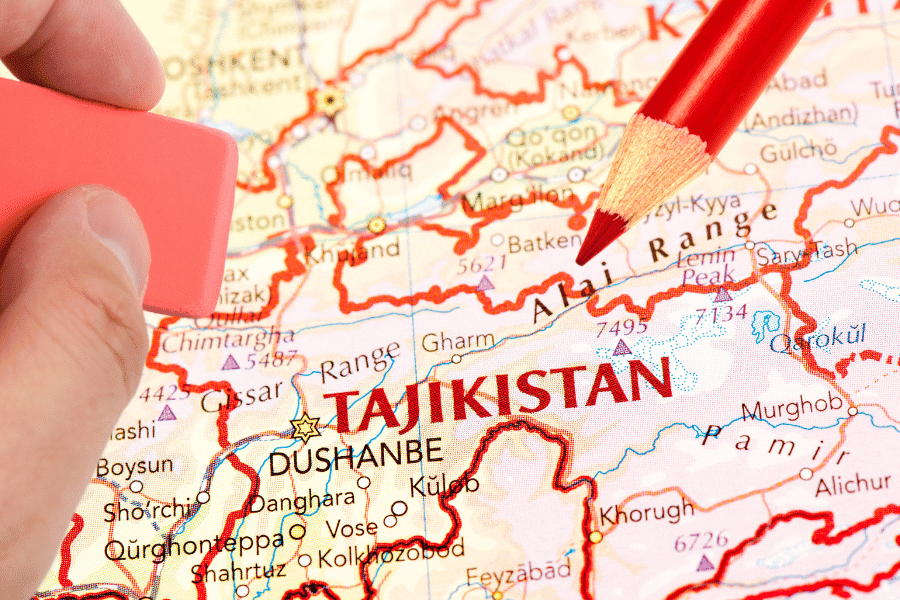
    Since then, disputes over grazing and water rights have also boiled over along the borders of Kyrgyzstan’s Batken region and Tajikistan’s Sughd region. In autumn 2022, in the worst fighting over the border since the fall of the Soviet Union, dozens were killed and thousands forced from their homes.

    It was after this that the leaders of Kyrgyzstan and Tajikistan started working on new demarcation lines. Now, after successful diplomacy to deal with the root cause of the problem, the two nations have agreed to shift their borders.

    “Negotiations have reached the final point and can be discussed openly,” Kamchybek Tashiev, head of Kyrgyzstan’s secret service, told the Kyrgyz parliament in March. “After parliamentary consideration, our presidents will sign the ratification.”

    Under the deal, Kyrgyzstan and Tajikistan will swap small areas of land and make better arrangements to share water resources. A number of disputed roads will be declared “neutral” and made available to both nations, according to the Defense Post.

    Which all goes to show that to secure friendship and good neighbourly relations, you sometimes have to define your boundaries.

    Recommended reading: “Prisoners of Geography” by Tim Marshall, an excellent account of how geography affects history and politics.


    Questions to consider:

    1. Why might there be disputes over borders?
    2. Why does the world generally agree that existing borders should remain untouched?
    3. What does the case of Kyrgyzstan and Tajikistan tell us about changing borders?

    Source link

  • The Dark Legacy of Elite University Medical Centers

    The Dark Legacy of Elite University Medical Centers


    (Image: Mass General is Harvard University Medical School’s teaching hospital.)  


    For decades, America’s elite university medical centers have been the epitome of healthcare research and innovation, providing world-class treatment, education, and cutting-edge medical advancements. Yet, beneath this polished surface lies a troubling legacy of medical exploitation, systemic inequality, and profound injustice—one that disproportionately impacts marginalized communities. While the focus has often been on racial disparities, this issue is not solely about race; it is also deeply entangled with class. In recent years, books like Medical Apartheid by Harriet Washington have illuminated the history of medical abuse, but they also serve as a reminder that inequality in healthcare goes far beyond race and touches upon the economic and social circumstances of individuals.

    The term Medical Apartheid, as coined by Harriet Washington, refers to the systemic and institutionalized exploitation of Black Americans in medical research and healthcare. Washington’s work examines the history of Black Americans as both victims of medical experimentation and subjects of discriminatory practices that have left deep scars within the healthcare system. Yet, the complex interplay between race and class means that many poor or economically disadvantaged individuals, regardless of race, have also faced neglect and exploitation within these prestigious medical institutions. The legacy of inequality within elite university medical centers, therefore, is not limited to race but is also an issue of class disparity, where wealthier individuals are more likely to receive proper care and access to cutting-edge treatments while the poor are relegated to substandard care.

    Historical examples of exploitation and abuse in medical centers are well-documented in Washington’s work, and contemporary lawsuits and investigations reveal that these systemic problems still persist. Poor patients, especially those from marginalized racial backgrounds, are often viewed as expendable research subjects. The lawsuit underscores the intersectionality of race and class, arguing that these patients’ socio-economic status exacerbates their vulnerability to medical exploitation, making it easier for institutions to treat them as less than human, especially when they lack the resources or power to contest medical practices.

    One of the most critical components of this issue is the stark contrast in healthcare access between the wealthy and the poor. While elite university medical centers boast state-of-the-art facilities, cutting-edge treatments, and renowned researchers, these resources are often not equally accessible to all. Wealthier patients are more likely to have the financial means to receive the best care, not just because of their ability to pay but because they are more likely to be referred to these prestigious centers. Conversely, low-income patients, especially those without insurance or with inadequate insurance, are often forced into overcrowded public hospitals or community clinics that are underfunded, understaffed, and unable to provide the level of care available at elite institutions.

    The issue of class inequality within medical care is evident in several key areas. For instance, studies have shown that low-income patients, regardless of race, are less likely to receive timely and appropriate medical care. A 2019 report from the National Academy of Medicine found that low-income patients are often dismissed by healthcare professionals who underestimate the severity of their symptoms or assume they are less knowledgeable about their own health. In addition, patients from lower socio-economic backgrounds are more likely to experience medical debt, which can lead to long-term financial struggles and prevent them from seeking care in the future.

    Moreover, class plays a significant role in the underrepresentation of poor individuals in medical research, which is often conducted at elite university medical centers. Historically, clinical trials have excluded low-income participants, leaving them without access to potentially life-saving treatments or advancements. Wealthier individuals, on the other hand, are more likely to be invited to participate in research studies, ensuring they benefit from the very innovations and breakthroughs that these institutions claim to provide.

    Class-based disparities are also reflected in the inequities in medical professions. The road to becoming a physician or researcher in these elite institutions is often paved with significant economic barriers. Medical students from low-income backgrounds face steep financial challenges, which can hinder their ability to gain acceptance into prestigious medical schools or pursue advanced research opportunities. Even when low-income students do manage to enter these programs, they often face biases and discrimination in clinical settings, where their abilities are unfairly questioned, and their economic status may prevent them from fully participating in research or other educational opportunities.

    Yet, the inequities within these institutions don’t stop at the patients. Behind the scenes, workers at elite university medical centers, particularly those from working-class and marginalized backgrounds, face their own form of exploitation. These medical centers are not only spaces of high medical achievement but also sites of labor stratification, where workers in lower-paying roles are largely people of color and often immigrants. Support staff—such as janitors, food service workers, custodians, and administrative assistants—are often invisible but essential to the functioning of these hospitals and research institutions. These workers face long hours, poor working conditions, and low wages, all while contributing to the daily operations of elite medical centers. Many of these workers, employed through third-party contractors, lack benefits, job security, or protections, leaving them vulnerable to exploitation.

    Custodial workers, who are often exposed to hazardous chemicals and physically demanding work, may struggle to make ends meet, despite playing a crucial role in maintaining the hospital environment. Similarly, food service workers—many of whom are Black, Latinx, or immigrant—also work in demanding conditions for low wages. These workers frequently face job insecurity and are not given the same recognition or compensation as the high-ranking physicians, researchers, or administrators in these centers.

    At the same time, the stratification in these institutions extends beyond support staff. Medical researchers, residents, and postdoctoral fellows—often young, early-career individuals, many from working-class backgrounds or communities of color—are similarly subjected to precarious working conditions. These individuals perform much of the vital research that drives innovation at these centers, yet they often face exploitative working hours, low pay, and job insecurity. They are the backbone of the institution’s research output but frequently face barriers to advancement and recognition.

    The higher ranks of these institutions—senior doctors, professors, and researchers—enjoy financial rewards, job security, and prestige, while those at the lower rungs continue to experience instability and exploitation. This division, which mirrors the economic and racial hierarchies of broader society, reinforces the very class-based inequalities these medical centers are meant to address.

    In recent years, some progress has been made in addressing these inequalities. Many elite universities have implemented diversity and inclusion programs aimed at increasing access for underrepresented minority and low-income students in medical schools. Some institutions have also begun to emphasize the importance of cultural competence in training medical professionals, acknowledging the need to recognize and understand both racial and economic disparities in healthcare.

    However, critics argue that these efforts, while important, are often superficial and fail to address the root causes of inequality. The institutional focus on “diversity” and “inclusion” often overlooks the more significant structural issues, such as the affordability of education, the class-based access to healthcare, and the economic barriers that continue to undermine the ability of disadvantaged individuals to receive quality care.

    In addition to acknowledging racial inequality, it is crucial to tackle the broader issue of class within the healthcare system. The disproportionate number of Black and low-income individuals suffering from poor healthcare outcomes is a direct result of a system that privileges wealth and status over human dignity. To begin addressing these issues, we need to move beyond token diversity initiatives and work toward policy reforms that focus on economic access, insurance coverage, and the equitable distribution of medical resources.

    Scholars like Harriet Washington, whose work documents the intersection of race, class, and healthcare inequality, continue to play a pivotal role in bringing attention to these systemic injustices. Washington’s book Medical Apartheid serves as a historical record but also as a call to action for creating a healthcare system that genuinely serves all people, regardless of race or socio-economic status. The fight for healthcare equity must, therefore, be a dual one—against both racial and class-based disparities that have long plagued our medical institutions.

    The story of Henrietta Lacks, as told in The Immortal Life of Henrietta Lacks by Rebecca Skloot, exemplifies the longstanding exploitation of marginalized individuals in elite university medical centers. The case of Lacks, whose cells were taken without consent by researchers at Johns Hopkins University, brings to light both the historical abuse of Black bodies and the profit-driven nature of academic medical research. Johns Hopkins, one of the most prestigious medical centers in the world, has been complicit in the kind of exploitation and neglect that these institutions are often criticized for—issues that disproportionately affect not only Black Americans but also economically disadvantaged individuals.

    The Black Panther Party’s healthcare activism, as chronicled by Alondra Nelson in Body and Soul, also directly challenges elite medical institutions’ failure to provide adequate care for Black and low-income communities. Nelson’s work reflects how, even today, these institutions are often slow to address the systemic issues of health disparities that activists like the Panthers fought against.

    Recent lawsuits against elite medical centers further underscore the importance of holding these institutions accountable for their role in perpetuating medical exploitation and inequality. In An American Sickness by Elisabeth Rosenthal, the commercialization of healthcare is explored, highlighting how university hospitals and medical centers often prioritize profits over patient care, leaving low-income and marginalized groups with limited access to treatment. Rosenthal’s work highlights the role these institutions play in a larger system that disproportionately benefits wealthier patients while neglecting the most vulnerable.

    A Global Comparison: Countries with Better Health Outcomes

    While the United States struggles with systemic healthcare disparities, other nations have shown that equitable healthcare outcomes are possible when class and race are not barriers to care. Nations with universal healthcare systems, such as those in Canada, the United Kingdom, and many Scandinavian countries, consistently rank higher in overall health outcomes compared to the U.S.

    For instance, Canada’s single-payer system ensures that all citizens have access to healthcare, regardless of their income. This system reduces the financial burdens that often lead to delays in care or avoidance of treatment due to costs. According to the World Health Organization, Canada has better health outcomes on a variety of metrics, including life expectancy and infant mortality, compared to the U.S., where medical costs often lead to unequal access to care.

    Similarly, the United Kingdom’s National Health Service (NHS) provides healthcare free at the point of use for all citizens. Despite challenges such as funding constraints and wait times, the NHS has been successful in ensuring that healthcare is a right, not a privilege. The U.K. consistently ranks higher than the U.S. in terms of access to care, health outcomes, and overall public health.

    Nordic countries, such as Norway and Sweden, also exemplify how universal healthcare can lead to better outcomes. These countries invest heavily in public health and preventative care, ensuring that even their most marginalized citizens receive the necessary medical services. The result is a population with some of the highest life expectancies and lowest rates of chronic diseases in the world.

    These nations show that, while access to healthcare is a critical issue in the U.S., the challenge is not a lack of innovation or capability. Instead, it is the systemic barriers—both racial and economic—that persist in elite medical centers, undermining the potential for universal health equity. The U.S. could learn from these nations by adopting policies that reduce economic inequality in healthcare access and focusing on preventative care and public health strategies that serve all people equally.

    Ultimately, the dark legacy of elite university medical centers is not something that can be erased, but it is something that must be acknowledged. Only by confronting this painful history, alongside addressing class-based disparities, can we begin to build a more just and equitable healthcare system—one that serves everyone, regardless of race, background, or socio-economic status. Until this happens, the distrust and skepticism that many marginalized communities feel toward these institutions will continue to shape the landscape of American healthcare. The path forward requires a concerted effort to address both racial and class-based inequities that have defined these institutions for far too long. The U.S. can, and must, strive for healthcare outcomes akin to those seen in nations that have built systems prioritizing equity and fairness—systems that put human dignity over profit.

    Source link

  • Connecting Universities in a Divided World: International Association of Universities’ Mission

    Connecting Universities in a Divided World: International Association of Universities’ Mission

    There are a lot of transnational associations of universities out there. Some are meant to advance specific political goals, like the European Universities Association. Others exist simply to support their members without engaging in lobbying or political work, such as the African Association of Universities, whose former president, Ernest Aryeetey, was a guest on the show last year.

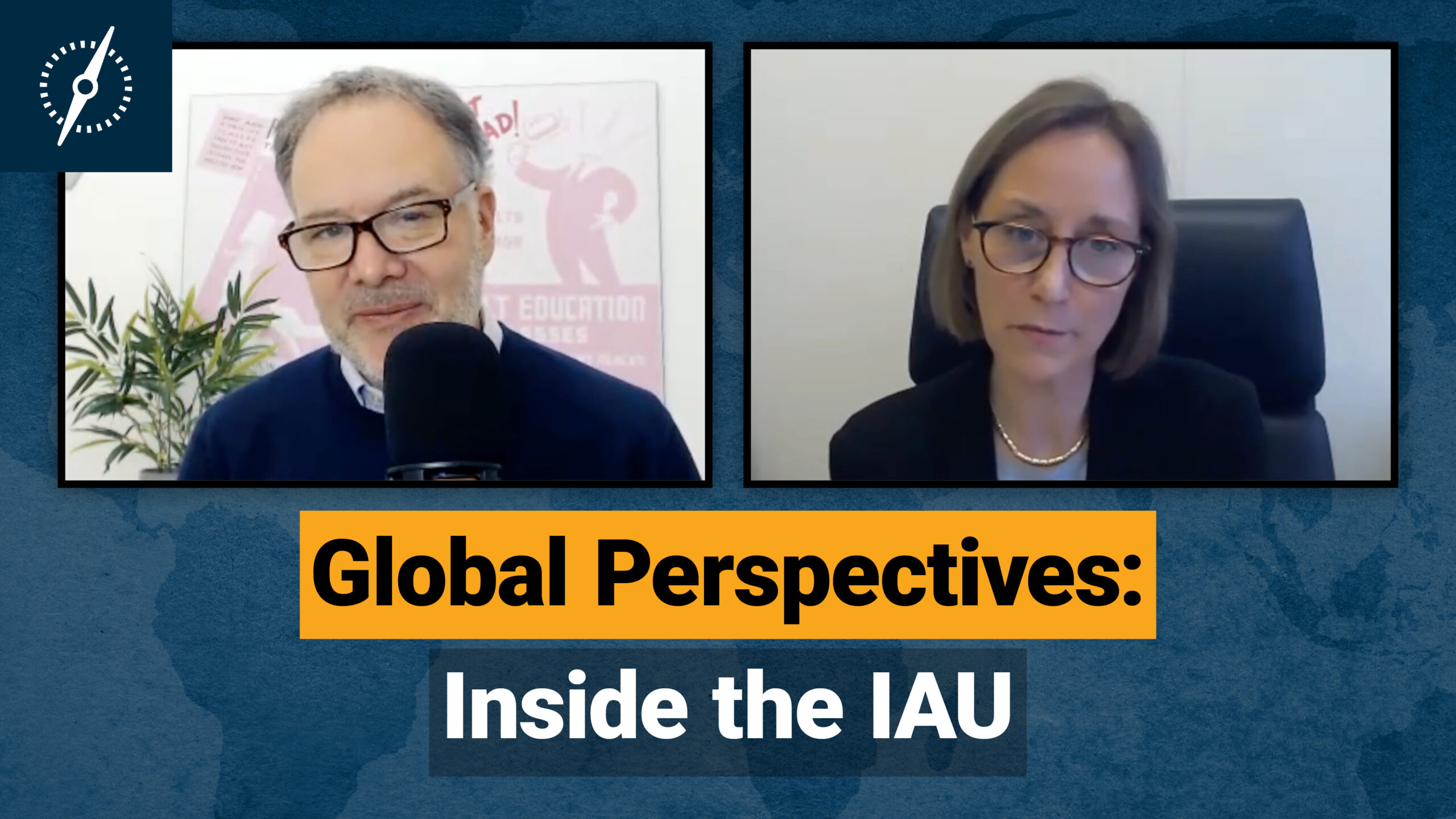
    But the oldest of all these associations is the International Association of Universities (IAU), based in Paris and created by UNESCO in 1950. I had the pleasure of attending their annual meeting in Tokyo last November—a unique opportunity to see global higher education, in all its glorious diversity, reflected in a single room.

    While I was there, I asked their Secretary-General, Hilligje Van’t Land, to join us on the show. Graciously, she agreed, leading to today’s podcast.

    My chat with Hilligje revolved mainly around two issues. First, the state of global higher education—spoiler: it’s been better. And second, the challenges of maintaining an association across a membership spanning over 100 countries.

    How do you keep an organization relevant across institutions with such different capacity levels, facing such different problems in vastly different external environments? And at the global level, can universities even be considered a single community?

    Hilligje, who has one of the most interesting vantage points in global higher education, brings sharp insights to these big questions. And so, without further ado, let’s turn it over to Hilligje.


    The World of Higher Education Podcast
    Episode 3.23 | Connecting Universities in a Divided World: International Association of Universities’ Mission 

    Transcript

    Alex Usher (AU): Hilligje, I’m not sure all our viewers, listeners, or readers are familiar with the history of the International Association of Universities. I know it was founded in 1950, but how has it evolved since then? And what does your membership look like geographically?

    Hilligje Van’t Land (HVL): Yes, well, my name is indeed HVL, and I’m the Secretary-General of this wonderful organization, the International Association of Universities.

    As you mentioned, it was founded in 1950 under the auspices of UNESCO, and its secretariat is based in Paris. I point that out because it’s one of the most common questions I get—where are you based?

    At the same time, we represent a truly global higher education community, with universities from 130 countries across five continents.

    How has it evolved over time? In the beginning, the association was largely led by universities from the Global North, working to rebuild the world after World War II on a foundation of shared values—values that would help create peace among people through higher education. And today, that vision still underpins much of what we do. Our goal is to bring together voices from around the world to collaboratively shape a collective vision of what universities can stand for, ultimately helping societies develop toward something better.

    So what does our membership look like? We have 600 engaged members who contribute financially to the association, and it’s an incredibly diverse group of universities spanning all five continents. That diversity is central to our mission—not just representing one group, but bringing together many perspectives.

    AU: We often think of university associations in terms of rectors’ conferences, where their primary job is to lobby—whether at a national level or through organizations like the European Universities Association. The International Association of Universities (IAU) obviously doesn’t have that kind of function. So is it more about universities speaking to each other? What exactly is its role in the global higher education ecosystem? Who is it speaking to beyond just its membership?

    HVL: That’s a very good question—sorry if my English stumbles sometimes!

    Indeed, we are a truly global association of universities, but without a specific regional or local resonance. For example, the European Universities Association engages with the European Commission, the Arab Association of Universities works closely with ministries across the Arab world, and American universities are involved in national-level associations that influence policy, like the Association of American Universities (AAU). In Africa, university associations work closely with the African Union.

    Our role is to bring these voices together, encouraging universities to collaborate globally in ways that contribute to transforming the world. From where we sit, we advocate to the United Nations and UNESCO, influencing policy decisions within global agenda-setting bodies affiliated with UNESCO.

    Right now, we are approaching the end of the UN Agenda 2030. A new global agenda will have to be developed because we are far from achieving the current goals. Yet, those goals have played a crucial role in bringing universities together around essential topics. As we look ahead, universities worldwide will help shape this next agenda, ensuring higher education continues to be a key driver of global progress.

    AU: One thing that struck me when I attended your meeting in Tokyo last November—an amazing gathering, by the way—was how difficult it must be to create an institutional agenda that speaks to universities from such different parts of the world. How can I put it? Institutions in Australia, Indonesia, and Somalia—where I think you even had a delegate from Somaliland—are all dealing with vastly different domestic challenges. Given that universities are so deeply embedded in their national contexts, how do you find themes that resonate across all of them? How do you create a common agenda that works for everyone?

    HVL: It’s both a challenge and an opportunity, Alex.

    When institutions are deeply embedded in their national dynamics, it can be difficult to see beyond them. But without looking outward, how can they truly make the case for what they do? Staying in an echo chamber or only engaging in national-level discussions limits the ability to develop informed policies. That’s why bringing in diverse voices from the global higher education community is so important—it enriches conversations at institutional, national, and regional levels.

    The agenda we co-develop with our board is then put to the IAU membership every four years for discussion at the global level. Are these the right topics to focus on? Yes or no? From there, a strategy is developed, and universities engage by seizing opportunities for responsible and meaningful internationalization.

    For example, universities rally around themes like fair and inclusive leadership, the role of higher education in sustainable development, and, since COVID, the global conversation on digital transformation in higher education. A major focus now is open science and AI—how do these shape the future of universities?

    And while institutions may come from Somaliland, Ghana, Colombia, Reykjavik, or Paris, they often grapple with similar questions. University rectors and policymakers worldwide are asking themselves the same things. By facilitating global leadership meetings, we create spaces where these shared concerns resonate and where new perspectives can emerge.

    AU: You’ve mentioned the three big areas that IAU works in—sustainability, internationalization, and digital transformation. You also have those large surveys and studies that go out every couple of years. How do you engage institutions in these areas? What are universities doing in each of these three areas with IAU, and what are they getting out of it?

    HVL: Fair and inclusive internationalization—one of the key topics that resonates strongly, even within the name International Association of Universities—translates into at least 10 different ways for universities to engage.

    For example, just yesterday, we hosted a webinar on what responsible internationalization means today. Does it mean closing borders and fencing off countries that are perceived as threats to our intellectual work? Or, on the contrary, is responsible internationalization an opportunity to connect universities globally around key topics and foster international research collaborations? These collaborations are critical for addressing global challenges like climate change and crises in their many forms.

    So, these discussions are one way we engage institutions. We also offer a service called HEIAS (Higher Education Internationalization Strategies Advisory Service), which helps universities refine their internationalization approaches.

    Additionally, we maintain a network of internationalization associations, including NAFSA in the U.S., EAIE in Europe, and the African Association for Internationalization. By bringing these voices together, we co-develop statements that universities can adopt, ensuring that key topics remain at the forefront of global discussions.

    On sustainability, we created the Global Cluster on Higher Education and Research for Sustainable Development. This initiative invites universities worldwide to champion specific Sustainable Development Goals (SDGs) while ensuring their projects remain interconnected. The goal is not to work in silos but to collaborate and co-create solutions to pressing challenges—whether water issues, gender inequality, or unsustainable urban development.

    These efforts lead to research projects, joint initiatives, and meaningful impact across the global higher education community.

    AU: Hilligje, you held that meeting in Tokyo last November, which I mentioned earlier. What do you think were some of the main takeaways from that event? What did you learn about how universities are coping with the challenges of the 2020s?

    HVL: The 2020s—universities are coping with everything that comes their way, I would say.

    One of the major takeaways was something you might not expect: the theme itself—University Values for the Future in a Changing World. When planning the conference, we had many discussions with the program committee. People said, We need to talk about AI. We need to talk about sustainability. We have to discuss the financial sustainability of universities because that’s what institutions are struggling with.

    And I said—many organizations are already tackling these topics specifically. Let’s focus on values. Where do values stand today? What values do we need to cultivate to build a meaningful, impactful higher education system for the future?

    As you saw at the conference, we had an unusually large group of university leaders attending—more than in previous years. We brought together leadership from universities worldwide to discuss the values they stand for, each from their own unique perspectives.

    What this told me is that IAU has a unique opportunity to rally around topics that other organizations aren’t addressing. And these conversations are essential.

    We received a lot of feedback—messages and even letters—from participants saying these discussions were eye-opening. They allowed universities to develop new collaborations, whether by inviting each other to campuses or by looking at institutional challenges through a different lens.

    So the key takeaway? These conversations are crucial if we want to shape the future of higher education differently. Of course, IAU will continue to address the pressing issues on universities’ daily agendas, but leaders are also craving more space for these deeper discussions—discussions that are vital yet often overlooked.

    AU: At the meeting, one session in particular stood out to me—the one led by Fanta Aw from NAFSA in the United States. A lot of participants from North America, Australia, and other OECD countries came in very concerned about university values, feeling that they were under threat. This was just a week or two after the U.S. elections, so people were thinking about issues like that, as well as the rise of movements like Alternative für Deutschland in Germany and what these political shifts could mean for universities.

    What struck me, though, was the response from universities in other parts of the world—particularly in Asia and Africa. It wasn’t outright pushback, but more of a gentle chiding. Their message was, We live with these challenges all the time. From IAU’s perspective, that’s just another example of how institutions come from vastly different contexts. How do you bridge these experiences within IAU? How do you ensure that both perspectives are heard?

    HVL: Well, those perspectives were very much present on that panel, and the discussion continued long after the session ended.

    It’s important to recognize that these challenges aren’t confined to a single region or a divide between so-called “developed” and “developing” countries. In fact, I’d like to discard that terminology altogether—many of the countries we traditionally label as developing have advanced in ways that often surpass others.

    The key takeaway is that these conversations are essential. Just because one university or country is newly experiencing pressures from policymakers, threats to academic freedom, or restrictions on institutional autonomy doesn’t mean these issues are new globally. For some institutions, this is an everyday reality.

    But these challenges must be debated openly. If the future of higher education is one without institutional autonomy and academic freedom, what kind of education system are we building? What happens if governments dictate which topics can be discussed on campus, replace rectors at will, or shut down academic departments based on political agendas?

    These issues need to be confronted head-on. From these discussions, the conversation must be taken further—to the United Nations, to UNESCO policymaking forums, and to global decision-makers. If we don’t address them now, the future could be even bleaker than it already appears in many parts of the world.

    AU: A couple of weeks ago, we had American author Ben Wildavsky on the show. Of course, he wrote The Great Brain Race 15 years ago, and we invited him to discuss that book because it presented such an optimistic view of higher education—one where globalization would bring everyone closer together.

    But looking around the world today, I find myself questioning the future of globalization and internationalization. IAU is deeply tied to a version of internationalization—maybe not the one Ben was promoting, but still a vision of global academic collaboration. If globalization really does roll back over the next four or five years, what do you see as IAU’s role?

    HVL: Globalization is a complex phenomenon, with many facets—and it’s often questioned because it brings challenges alongside opportunities. Increasingly, it also comes with fear.

    What IAU fosters, however, is global cooperation. Cooperation starts at the institutional level, extends to national and regional levels, and then reaches the global stage. But cooperation is never a given—it must be nurtured carefully, strategically, and consistently.

    Just yesterday, during our Futures of Higher Education webinar series—which now includes 75 recorded sessions available on our website—we hosted Ayesha Maikundi, the new Vice Chancellor of the University of Abuja. She was asked about responsible internationalization and what globalization means today.

    She raised an important point: We send the best and brightest into the world, but they rarely come back. Some return as expats, contributing to higher education in their home countries occasionally, but not in a sustained way. The challenge of brain drain remains significant.

    While brain gain and brain circulation are often discussed—though, of course, brains don’t literally circulate on their own—the real issue is ensuring meaningful global academic connections. Different models have been used over time, but we need to continuously rethink how we facilitate these exchanges.

    For example, not every system is easy to engage with—Nigeria, as Ayesha noted, presents logistical challenges. But beyond that, there are many places around the world that remain overlooked, not because they lack value, but because we fail to recognize them as worthy academic destinations.

    That’s why global collaboration and mobility must be continuously worked on—strategically, deliberately, and persistently—to strengthen the international higher education ecosystem.

    AU: Beyond issues like globalization and state intrusion into university decision-making, from your vantage point, what are the other major trends shaping higher education globally today? Are we seeing a convergence of concerns at the university level? In other words, are institutions becoming more similar—more isomorphic, so to speak? Or, at a global level, are we seeing more diversification among institutions?

    HVL: Universities are institutions with many, many faces.

    There are certainly harmonization processes underway in different parts of the world. In Europe, for instance, you have the European Higher Education Area and the Bologna Process, along with ministerial meetings aimed at creating greater alignment among institutions.

    But the goal isn’t to make every university the same. In Europe, the aim is to embrace diversity while fostering better dialogue and collaboration across institutions. A similar trend is slowly emerging in Asia as well.

    Now, if you look at the United States—it’s technically one country, but in reality, it has so many states, so many systems, and so many different kinds of universities within those systems. That diversity is significant.

    This is why, right from IAU’s founding in 1950, we began developing the World Higher Education Database. At the time, it included just 50 universities. Today, we track and document over 21,000 institutions worldwide, mapping entire higher education systems in order to foster better understanding and appreciation of their differences.

    In the end, this work also feeds into UNESCO’s Global Convention on the Recognition of Higher Education Qualifications, which aims to improve system compatibility. Harmonization is important in the sense that it allows students and scholars to navigate different systems more easily and become true global citizens.

    If systems are entirely disconnected—with different academic calendars, study periods, and structures—it creates barriers. So yes, harmonization is happening, but there is no one-size-fits-all model. Universities will remain distinct, and that’s the beauty of it.

    AU: So, maintaining harmonization while preserving diversity—that could be one of the major global trends over the next 15 to 20 years. How do you see IAU evolving over the next 10 to 15 years as sustainability, internationalization, and digital transformation continue to accelerate? Will you stick with these three focus areas, or do you anticipate new priorities emerging? And will new ways for institutions to collaborate globally develop as well?

    HVL: I’m convinced that this will remain a movable feast, to borrow a phrase—because universities are never static. Their interests and priorities evolve over time.

    We host International Conferences annually, but every four years, we hold a General Conference where we elect a new board and bring together the global higher education community to define our next strategic plan.

    Right now, we have four priority areas—though leadership is a major focus as well. These priorities may shift over time, as they have in the past. While the core mission remains, new challenges continue to emerge.

    For instance, we need to address the massification of higher education, as more people around the world seek university degrees. We must also consider the commodification of higher education, which is becoming an increasing concern. At the same time, there is a strong push for skills-based education, which we try to balance by advocating for the continued importance of the humanities.

    Another tension that remains unresolved is collaboration versus competition—how universities navigate national interests while engaging in global partnerships. The rise of digital education also raises new questions about what it means to be a university in a rapidly changing world.

    In terms of IAU’s membership, we currently have 600 institutions that financially support our vision and mission. But many more universities align with our values and participate in our initiatives.

    Looking ahead 10 years, where do I see IAU? Well, in an ideal world, I’d love to see 21,000 universities as members—creating a truly global dialogue, not just about the future of higher education, but about how universities shape society itself.

    Because ultimately, we’re not just looking inward—we’re asking what universities contribute to the world.

    AU: Hilligje, thank you so much for joining us today.

    HVL: You’re welcome.AU: And before we wrap up, I’d like to thank our excellent producers, Tiffany MacLennan and Sam Pufek, as well as you—our viewers, readers, and listeners—for tuning in. If you have any questions or comments about today’s episode, please reach out to us at [email protected]. And don’t forget to subscribe to our YouTube channel so you never miss an episode of The World of Higher Education. Join us next week when our guest will be Dendev Badarch, a professor at the Mongolian University of Science and Technology. He’ll be with us to discuss the future of higher education in Mongolia. Bye for now.

    *This podcast transcript was generated using an AI transcription service with limited editing. Please forgive any errors made through this service. Please note, the views and opinions expressed in each episode are those of the individual contributors, and do not necessarily reflect those of the podcast host and team, or our sponsors.

    This episode is sponsored by Studiosity. Student success, at scale – with an evidence-based ROI of 4.4x return for universities and colleges. Because Studiosity is AI for Learning — not corrections – to develop critical thinking, agency, and retention — empowering educators with learning insight. For future-ready graduates — and for future-ready institutions. Learn more at studiosity.com.

    Source link

  • U.S. Department of Education slashes staff

    U.S. Department of Education slashes staff

    This story was originally published by Chalkbeat. Sign up for their newsletters at ckbe.at/newsletters.

    The U.S. Department of Education announced March 11 that it’s cutting its workforce nearly in half–a move that Education Secretary Linda McMahon said is a first step toward eliminating the department.

    Roughly a third of staff will lose their jobs through a “reduction in force,” the department said in a press release. Combined with voluntary buyouts, the Education Department will have just under 2,200 employees by the end of the month, compared with 4,133 when President Donald Trump took office with promises to shutter the department.

    The layoffs represent a significant escalation of Trump’s efforts to reduce the department’s role in education, which is mostly run by states and school districts. Already, the administration has canceled hundreds of millions of dollars in grants and contracts that paid for education research, technical assistance to states and school districts, and teacher training programs.

    Affected staff will be placed on administrative leave starting March 21, the department said. Ahead of the announcement, workers were told to leave the office by 6 p.m. Tuesday and that the office would remain closed until Thursday “for security reasons.” McMahon later said this was standard corporate process when layoffs occur.

    “Today’s reduction in force reflects the Department of Education’s commitment to efficiency, accountability, and ensuring that resources are directed where they matter most: to students, parents, and teachers,” McMahon said in a press release. “I appreciate the work of the dedicated public servants and their contributions to the Department. This is a significant step toward restoring the greatness of the United States education system.”

    The Education Department administers major federal funding programs such as Title I, which provides extra money to high-poverty schools, and the Individuals with Disabilities Education Act, or IDEA, which supports special education. It also investigates civil rights complaints and oversees an accountability system that pushes states to identify low-performing schools and provide them with additional resources.

    Exactly how the layoffs will affect specific programs was not immediately clear. A former Education Department staffer, who spoke with Chalkbeat on the condition of anonymity because they were not authorized to disclose the information, said the entire Office for Civil Rights teams based in Philadelphia, Chicago, San Francisco, Cleveland, Boston and New York were let go. That represents half of regional civil rights offices.

    The department said all divisions are affected but did not describe specific positions that were eliminated. In the press release, department officials said all functions required by law will continue.

    Only Congress can eliminate the department, but such deep cuts could leave the department a shell of its former self.

    Appearing on “The Ingraham Angle” on Fox News shortly after the layoffs were announced, McMahon said Trump had given her a clear mandate to shutter the department. She said she would work with Congress to do that. Immediately cutting these positions would help the federal government send more money to the states, she said.

    “I said ‘OK we have to identify where the bloat is, where the bureaucracy is, and we’re going to start there,’ McMahon said. “We need to make sure that that money does get to the states.”

    Trump is expected to sign an executive order to start the process of eliminating the department, but has not yet done so. Conservatives say that for decades the department has failed to adequately address low academic performance and is a bloated bureaucracy.

    On Fox, McMahon reassured viewers that programs such as IDEA would still be funded through congressional appropriations. Asked what IDEA stood for, McMahon responded, “I’m not sure I can tell you exactly what it stands for except that it’s programs for disabled needs. It’s my fifth day on the job, and I’m really trying to learn quickly.”

    Conservative state school chiefs said in a letter to McMahon last month that they need more flexibility in how to use federal money, rather than following complex rules that ensure specific funding streams benefit certain student groups.

    Public education advocates fear that if money flows unrestricted to states, there’s no guarantee it will help the most vulnerable students. Even without an executive order, they worry that administrative changes could affect the department’s ability to perform basic functions.

    Randi Weingarten, president of the American Federation of Teachers, condemned the layoffs.

    “Denuding an agency so it cannot function effectively is the most cowardly way of dismantling it,” she said in a statement. “The massive reduction in force at the Education Department is an attack on opportunity that will gut the agency and its ability to support students, throwing federal education programs into chaos across the country.”

    Sheria Smith, president of the American Federation of Government Employee Local 252, which represents 2,800 Education Department employees, said the union will fight back against the layoffs and against what she called a misinformation campaign about the department’s work.

    “We must ask our fellow Americans: do you want your and your children’s rights enforced in school? Do you want your children to have the ability to play sports in their school districts? Do you need financial aid for college? Are you a fellow civil servant that relies on student loan forgiveness? Does your school district offset property taxes with federal funding?” she said in a statement.

    “If yes, then you rely on the Department of Education, and the services you rely on and the employees who support them are under attack.”

    Shortly after she was confirmed, McMahon sent a message to Education Department staff describing a “final mission” that would affect staffing, budgets, and agency operations.

    Department staff were given one-time offers of up to $25,000 to retire or resign in advance of a “very significant reduction in force.” More than 500 employees took some form of buy out.

    Another 1,300 employees are losing their jobs through the reduction in force, McMahon announced.

    Employees who are laid off will be paid through June 9.

    This story has been updated to include comments from Linda McMahon on Fox News, reaction to the layoffs, and additional information about affected offices.

    Chalkbeat is a nonprofit news site covering educational change in public schools.

    For more on education policy, visit eSN’s Educational Leadership hub.

    Latest posts by eSchool Media Contributors (see all)

    Source link

  • Half of OCR eliminated after Trump Education Department layoffs

    Half of OCR eliminated after Trump Education Department layoffs

    This audio is auto-generated. Please let us know if you have feedback.

    The U.S. Department of Education has let go of hundreds of its employees charged with protecting the civil rights of students and educators. The agency also shuttered seven of its 12 civil rights enforcement offices, according to former department employees.

    Offices in Chicago, Philadelphia, New York City, Dallas, San Francisco, Boston and Cleveland have been closed. Those in Atlanta, Denver, Kansas City and Seattle remain open, as well as the OCR headquarters in Washington, D.C. 

    In total, the seven closed offices of the Education Department’s Office for Civil Rights oversaw half of the nation’s states, impacting nearly 60,000 public schools and over 30 million K-12 students.

    Those fired include scores of civil rights attorneys, according to an internal memo from the American Federation of Government Employees Local 252. The union represents nearly 1,000 of the roughly 1,300 Education Department employees laid off Tuesday evening as part of the Trump administration’s sweeping effort to gut the department, including at least 240 OCR staff.

    More than 6,000 investigations impacted

    “The Department of Education has turned its back on civil rights in schools,” said Catherine Lhamon, who led OCR under the Biden administration. “It’s not possible to resolve cases… effectively with fewer than half the investigative staff that the office had had two days ago” 

    The agency’s civil rights enforcement arm is responsible for implementing protections for all students, including underserved students. It is tasked with ensuring that, among others, students with disabilities, students from all racial backgrounds, and sexual assault survivors have equal access to education. 

    Doing so requires investigations of alleged civil rights violations and compliance reviews of school systems that sometimes take years — even with all 12 offices operating and fully staffed. The offices that were closed were in charge of many of those cases. 

    “You’re talking about cases being in the middle of mediation right now,” said Victoria DeLano, who worked for the Atlanta office as an equal opportunity specialist prior to her termination. 

    The cases OCR settles with schools and universities often set the tone for civil rights policies and practices in schools nationwide. The seven offices shuttered had over 6,000 open investigations as of Jan. 14, according to OCR’s website that was last updated under the Biden administration.

    With the abrupt closures and layoffs, however, much of that is up in the air.

    “I can’t even comprehend it — the fallout that this is going to have,” said DeLano.

    Offices close as complaints climb

    In the past few years, the office’s caseload had been steadily climbing. In fiscal year 2023, the office received 19,201 complaints, representing a 2% increase from 2022 and nearly triple the number of complaints in 2009.

    Prior to the new administration and its sweeping layoffs, each OCR investigative staff was juggling a caseload of about 50 complaints, which Lhamon already considered “untenable.” In fact, the high number of cases and slim number of investigators at the time had prompted former Education Secretary Miguel Cardona to request more funding from Congress, which would have helped hire additional OCR staff. 

    In contrast, the Trump administration has cited a desire to reduce the Education Department’s budget as part of the reason driving the sweeping layoffs.

    Some of those cut as part of President Donald Trump and Education Secretary Linda McMahon’s effort to “end bureaucratic bloat” were onboarded just months before being fired without notice, according to DeLano, who was hired in December under the former administration and then terminated in February. 

    DeLano realized she was out of a job after being locked out of her government laptop, and she only received a formal notice of termination after six days of being denied access.

    “It was done just completely heartless,” DeLano said. “I cannot believe that 50% of OCR is gone.”

    The massive cuts come after the administration told OCR staff to hit pause on its open investigations, and — instead of addressing public complaints — directed its resources to addressing the president’s priorities, like scaling back Title IX to exclude LGBTQ+ rights. Following a Feb. 5 executive order barring transgender women from playing on sports teams aligning with their gender identities, the Education Department launched multiple investigations into athletic associations, colleges and schools over their sports policies.

    Source link