On February 28, the Department of Labor (DOL) filed an appeal in Flint Avenue, LLC v. U.S. Department of Labor, which previously led a district court to strike down the agency’s overtime final rule set forth under the Biden administration. The action is the second pending appeal from DOL with respect to cases involving the Biden administration’s overtime rule and may be acting as a placeholder to provide time for the Trump administration to determine how they want to move forward with the Biden administration’s overtime rule.
Background
As a reminder, the Biden administration’s final rule implemented a phase-in approach to increasing the minimum salary threshold under the Fair Labor Standards Act (FLSA) overtime regulations. Specifically, the rule increased the minimum salary threshold, effective July 1, 2024, from the previous level of $684 per week ($35,568 per year) to a new level at $844 per week ($43,888 per year). This first increase used the same methodology set by the first Trump administration’s 2019 overtime rule to determine the new salary threshold level. The rule also aimed to increase the threshold a second time effective January 1, 2025; however, the Biden overtime rule was struck down in federal court before the second increase could take effect. This increase would have changed the minimum salary threshold again to $1,128 per week ($58,656 per year). Finally, the rule adopted automatic updates to the minimum salary threshold that would occur every three years.
Shortly after the Biden overtime rule was published, lawsuits were filed challenging the final rule. These lawsuits resulted in two district court orders to vacate the final rule. On November 15, 2024, a federal judge in the Eastern District Court of Texas ruled to vacate the Biden administration’s FLSA overtime final rule in State of Texas v. U.S. Department of Labor. Similarly, on December 30, 2024, another federal judge in the Northern District Court of Texas ruled to vacate the Biden administration’s overtime rule in Flint Avenue, LLC. Both rulings vacated all components of the rule, meaning both the July and January salary thresholds set under the final rule were no longer in effect and automatic updates to the minimum salary threshold would not take place.
DOL’s Appeals
Soon after the federal judge ruled in the State of Texas case, the Biden administration’s DOL filed an appeal. The appeal was filed in the 5th U.S. Circuit Court of Appeals, where it remained through the presidential transition. On February 24, the Department of Labor under the Trump administration requested an extension to file its opening brief in the State of Texas appeal. The 5th Circuit Court agreed to the extension, allowing for opening briefs to be filed by May 6, 2025.
Soon after, on February 28, DOL filed its second appeal to the 5th Circuit Court in the Flint Avenue case. Both actions may be intended to give time to newly confirmed Labor Secretary Lori Chavez-DeRemer to settle into her new role and determine how the Trump administration will move forward with litigation and the Biden administration’s rulemaking.
CUPA-HR will continue to keep members apprised of legal updates regarding the overtime regulations.
Our most recent research into the working lives of faculty gave us some interesting takeaways about higher education’s relationship with AI. While every faculty member’s thoughts about AI differ and no two experiences are the same, the general trend we’ve seen is that faculty have moved from fear to acceptance. A good deal of faculty were initially concerned about AI’s arrival on campus. This concern was amplified by a perceived rise in AI-enabled cheating and plagiarism among students. Despite that, many faculty have come to accept that AI is here to stay. Some have developed working strategies to ensure that they and their students know the boundaries of AI usage in the classroom.
Early-adopting educators aren’t just navigating around AI. They have embraced and integrated it into their working lives. Some have learned to use AI tools to save time and make their working lives easier. In fact, over half of instructors reported that they wanted to use AI for administrative tasks and 10% were already doing so. (Find the highlights here.) As more faculty are seeing the potential in AI, that number has likely risen. So, in what ways are faculty already using AI to lighten the load of professional life? Here are three use-cases we learned about from education professionals:
AI to jumpstart ideas and conversations
“Give me a list of 10 German pop songs that contain irregular verbs.”
“Summarize the five most contentious legal battles happening in U.S. media law today.”
“Create a set of flashcards that review the diagnostic procedure and standard treatment protocol for asthma.”
The possibilities (and the prompts!) are endless. AI is well-placed to assist with idea generation, conversation-starters and lesson materials for educators on any topic. It’s worth noting that AI tends to prove most helpful as a starting point for teaching and learning fodder, rather than for providing fully-baked responses and ideas. Those who expect the latter may be disappointed, as the quality of AI results can vary widely depending on the topic. Educators can and should, of course, always be the final determinants and reviewers of the accuracy of anything shared in class.
AI to differentiate instruction
Faculty have told us that they spend a hefty proportion (around 28%) of their time on course preparation. Differentiating instruction for the various learning styles and levels in any given class constitutes a big part of that prep work. A particular lesson may land well with a struggling student, but might feel monotonous for an advanced student who has already mastered the material. To that end, some faculty are using AI to readily differentiate lesson plans. For example, an English literature instructor might enter a prompt like, “I need two versions of a lesson plan about ‘The Canterbury Tales;’ one for fluent English speakers and one for emergent English speakers.” This simple step can save faculty hours of manual lesson plan differentiation.
An instructor in Kansas shared with Cengage their plans to let AI help in this area, “I plan to use AI to evaluate students’ knowledge levels and learning abilities and create personalized training content. For example, AI will assess all the students at the beginning of the semester and divide them into ‘math-strong’ and ‘math-weak’ groups based on their mathematical aptitude, and then automatically assign math-related materials, readings and lecture notes to help the ‘math-weak’ students.”
When used in this way, AI can be a powerful tool that gives students of all backgrounds an equal edge in understanding and retaining difficult information.
AI to provide feedback
Reviewing the work of dozens or hundreds of students and finding common threads and weak spots is tedious work, and seems an obvious area for a little algorithmic assistance.
Again, faculty should remain in control of the feedback they provide to students. After all, students fully expect faculty members to review and critique their work authentically. However, using AI to more deeply understand areas where a student’s logic may be consistently flawed, or types of work on which they repeatedly make mistakes, can be a game-changer, both for educators and students.
An instructor in Iowa told Cengage, “I don’t want to automate my feedback completely, but having AI suggest areas of exigence in students’ work, or supply me with feedback options based on my own past feedback, could be useful.”
Some faculty may even choose to have students ask AI for feedback themselves as part of a critical thinking or review exercise. Ethan and Lilach Mollick of the Wharton School of the University of Pennsylvania share in an Harvard Business Publishing Education article, “Though AI-generated feedback cannot replicate the grounded knowledge that teachers have about their students, it can be given quickly and at scale and it can help students consider their work from an outside perspective. Students can then evaluate the feedback, decide what they want to incorporate, and continue to iterate on their drafts.”
AI is not a “fix-all” for the administrative side of higher education. However, many faculty members are gaining an advantage and getting some time back by using it as something of a virtual assistant.
Are you using AI in the classroom?
In a future piece, we’ll share 3 more ways in which faculty are using AI to make their working lives easier. In the meantime, you can fully explore our research here:
The Education Reporting Collaborative, a coalition of eight newsrooms, is investigating the unintended consequences of AI-powered surveillance at schools. Members of the Collaborative are AL.com, The Associated Press, The Christian Science Monitor, The Dallas Morning News, The Hechinger Report, Idaho Education News, The Post and Courier in South Carolina, and The Seattle Times.
One student asked a search engine, “Why does my boyfriend hit me?” Another threatened suicide in an email to an unrequited love. A gay teen opened up in an online diary about struggles with homophobic parents, writing they just wanted to be themselves.
In each case and thousands of others, surveillance software powered by artificial intelligence immediately alerted Vancouver Public Schools staff in Washington state.
Vancouver and many other districts around the country have turned to technology to monitor school-issued devices 24/7 for any signs of danger as they grapple with a student mental health crisis and the threat of shootings.
The goal is to keep children safe, but these tools raise serious questions about privacy and security – as proven when Seattle Times and Associated Press reporters inadvertently received access to almost 3,500 sensitive, unredacted student documents through a records request about the district’s surveillance technology.
The released documents show students use these laptops for more than just schoolwork; they are coping with angst in their personal lives.
Tim Reiland, 42, center, the parent of daughter Zoe Reiland, 17, right, and Anakin Reiland, 15, photographed in Clinton, Miss., Monday, March 10, 2025, said he had no idea their previous schools, in Oklahoma, were using surveillance technology to monitor the students. (AP Photo/Rogelio V. Solis)
Students wrote about depression, heartbreak, suicide, addiction, bullying and eating disorders. There are poems, college essays and excerpts from role-play sessions with AI chatbots.
Vancouver school staff and anyone else with links to the files could read everything. Firewalls or passwords didn’t protect the documents, and student names were not redacted, which cybersecurity experts warned was a massive security risk.
The monitoring tools often helped counselors reach out to students who might have otherwise struggled in silence. But the Vancouver case is a stark reminder of surveillance technology’s unintended consequences in American schools.
In some cases, the technology has outed LGBTQ+ children and eroded trust between students and school staff, while failing to keep schools completely safe.
Gaggle, the company that developed the software that tracks Vancouver schools students’ online activity, believes not monitoring children is like letting them loose on “a digital playground without fences or recess monitors,” CEO and founder Jeff Patterson said.
Roughly 1,500 school districts nationwide use Gaggle’s software to track the online activity of approximately 6 million students. It’s one of many companies, like GoGuardian and Securly, that promise to keep kids safe through AI-assisted web surveillance.
Vancouver schools apologized for releasing the documents. Still, the district emphasizes Gaggle is necessary to protect students’ well-being.
“I don’t think we could ever put a price on protecting students,” said Andy Meyer, principal of Vancouver’s Skyview High School. “Anytime we learn of something like that and we can intervene, we feel that is very positive.”
Dacia Foster, a parent in the district, commended the efforts to keep students safe but worries about privacy violations.
“That’s not good at all,” Foster said after learning the district inadvertently released the records. “But what are my options? What do I do? Pull my kid out of school?”
Foster says she’d be upset if her daughter’s private information was compromised.
“At the same time,” she said, “I would like to avoid a school shooting or suicide.”
Gaggle uses a machine learning algorithm to scan what students search or write online via a school-issued laptop or tablet 24 hours a day, or whenever they log into their school account on a personal device. The latest contract Vancouver signed, in summer 2024, shows a price of $328,036 for three school years – approximately the cost of employing one extra counselor.
The algorithm detects potential indicators of problems like bullying, self-harm, suicide or school violence and then sends a screenshot to human reviewers. If Gaggle employees confirm the issue might be serious, the company alerts the school. In cases of imminent danger, Gaggle calls school officials directly. In rare instances where no one answers, Gaggle may contact law enforcement for a welfare check.
A Vancouver school counselor who requested anonymity out of fear of retaliation said they receive three or four student Gaggle alerts per month. In about half the cases, the district contacts parents immediately.
“A lot of times, families don’t know. We open that door for that help,” the counselor said. Gaggle is “good for catching suicide and self-harm, but students find a workaround once they know they are getting flagged.”
Related: Have you had experience with school surveillance tech? Tell us about it
Seattle Times and AP reporters saw what kind of writing set off Gaggle’s alerts after requesting information about the type of content flagged. Gaggle saved screenshots of activity that set off each alert, and school officials accidentally provided links to them, not realizing they weren’t protected by a password.
After learning about the records inadvertently released to reporters, Gaggle updated its system. Now, after 72 hours, only those logged into a Gaggle account can view the screenshots. Gaggle said this feature was already in the works but had not yet been rolled out to every customer.
The company says the links must be accessible without a login during those 72 hours so emergency contacts—who often receive these alerts late at night on their phones—can respond quickly.
In Vancouver, the monitoring technology flagged more than 1,000 documents for suicide and nearly 800 for threats of violence. While many alerts were serious, many others turned out to be false alarms, like a student essay about the importance of consent or a goofy chat between friends.
Foster’s daughter Bryn, a Vancouver School of Arts and Academics sophomore, was one such false alarm. She was called into the principal’s office after writing a short story featuring a scene with mildly violent imagery.
“I’m glad they’re being safe about it, but I also think it can be a bit much,” Bryn said.
School officials maintain alerts are warranted even in less severe cases or false alarms, ensuring potential issues are addressed promptly.
“It allows me the opportunity to meet with a student I maybe haven’t met before and build that relationship,” said Chele Pierce, a Skyview High School counselor.
Between October 2023 and October 2024, nearly 2,200 students, about 10% of the district’s enrollment, were the subject of a Gaggle alert. At the Vancouver School of Arts and Academics, where Bryn is a student, about 1 in 4 students had communications that triggered a Gaggle alert.
While schools continue to use surveillance technology, its long-term effects on student safety are unclear. There’s no independent research showing it measurably lowers student suicide rates or reduces violence.
A 2023 RAND study found only “scant evidence” of either benefits or risks from AI surveillance, concluding: “No research to date has comprehensively examined how these programs affect youth suicide prevention.”
“If you don’t have the right number of mental health counselors, issuing more alerts is not actually going to improve suicide prevention,” said report co-author Benjamin Boudreaux, an AI ethics researcher.
In the screenshots released by Vancouver schools, at least six students were potentially outed to school officials after writing about being gay, trans or struggling with gender dysphoria.
LGBTQ+ students are more likely than their peers to suffer from depression and suicidal thoughts, and turn to the internet for support.
“We know that gay youth, especially those in more isolated environments, absolutely use the internet as a life preserver,” said Katy Pearce, a University of Washington professor who researches technology in authoritarian states.
In one screenshot, a Vancouver high schooler wrote in a Google survey form they’d been subject to trans slurs and racist bullying. Who created this survey is unclear, but the person behind it had falsely promised confidentiality: “I am not a mandated reporter, please tell me the whole truth.”
When North Carolina’s Durham Public Schools piloted Gaggle in 2021, surveys showed most staff members found it helpful.
But community members raised concerns. An LGBTQ+ advocate reported to the Board of Education that a Gaggle alert about self-harm had led to a student being outed to their family, who were not supportive.
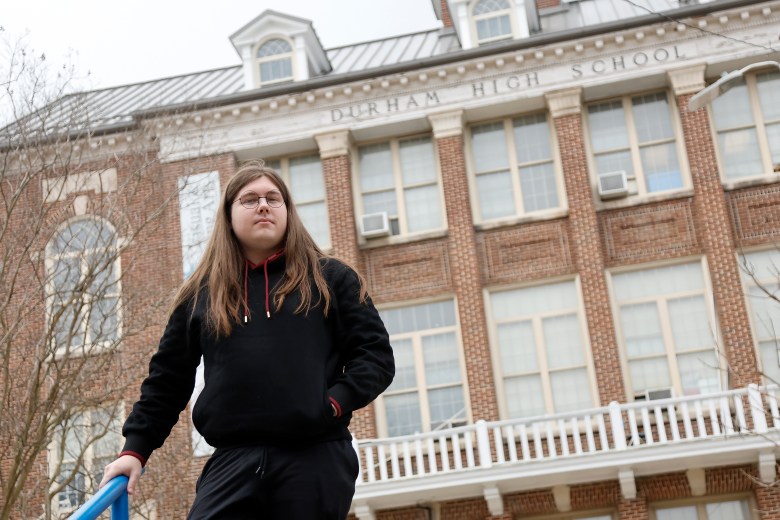
Glenn Thompson, a Durham School of the Arts graduate, poses in front of the school in Durham, N.C., Monday, March 10, 2025. (AP Photo/Karl DeBlaker)
Glenn Thompson, a Durham School of the Arts graduate, spoke up at a board meeting during his senior year. One of his teachers promised a student confidentiality for an assignment related to mental health. A classmate was then “blindsided” when Gaggle alerted school officials about something private they’d disclosed. Thompson said no one in the class, including the teacher, knew the school was piloting Gaggle.
“You can’t just (surveil) people and not tell them. That’s a horrible breach of security and trust,” said Thompson, now a college student, in an interview.
After hearing about these experiences, the Durham Board of Education voted to stop using Gaggle in 2023. The district ultimately decided it was not worth the risk of outing students or eroding relationships with adults.
The debate over privacy and security is complicated, and parents are often unaware it’s even an issue. Pearce, the University of Washington professor, doesn’t remember reading about Securly, the surveillance software Seattle Public Schools uses, when she signed the district’s responsible use form before her son received a school laptop.
Even when families learn about school surveillance, they may be unable to opt out. Owasso Public Schools in Oklahoma has used Gaggle since 2016 to monitor students outside of class.
For years, Tim Reiland, the parent of two teenagers, had no idea the district was using Gaggle. He found out only after asking if his daughter could bring her personal laptop to school instead of being forced to use a district one because of privacy concerns.
The district refused Reiland’s request.
When his daughter, Zoe, found out about Gaggle, she says she felt so “freaked out” that she stopped Googling anything personal on her Chromebook, even questions about her menstrual period. She didn’t want to get called into the office for “searching up lady parts.”
“I was too scared to be curious,” she said.
School officials say they don’t track metrics measuring the technology’s efficacy but believe it has saved lives.
Yet technology alone doesn’t create a safe space for all students. In 2024, a nonbinary teenager at Owasso High School named Nex Benedict died by suicide after relentless bullying from classmates. A subsequent U.S. Department of Education Office for Civil Rights investigation found the district responded with “deliberate indifference” to some families’ reports of sexual harassment, mainly in the form of homophobic bullying.
During the 2023-24 school year, the Owasso schools received close to 1,000 Gaggle alerts, including 168 alerts for harassment and 281 for suicide.
When asked why bullying remained a problem despite surveillance, Russell Thornton, the district’s executive director of technology responded: “This is one tool used by administrators. Obviously, one tool is not going to solve the world’s problems and bullying.”
Despite the risks, surveillance technology can help teachers intervene before a tragedy.
A middle school student in the Seattle-area Highline School District who was potentially being trafficked used Gaggle to communicate with campus staff, said former superintendent Susan Enfield.
“They knew that the staff member was reading what they were writing,” Enfield said. “It was, in essence, that student’s way of asking for help.”
Still, developmental psychology research shows it is vital for teens to have private spaces online to explore their thoughts and seek support.
“The idea that kids are constantly under surveillance by adults — I think that would make it hard to develop a private life, a space to make mistakes, a space to go through hard feelings without adults jumping in,” said Boudreaux, the AI ethics researcher.
Gaggle’s Patterson says school-issued devices are not the appropriate place for unlimited self-exploration. If that exploration takes a dark turn, such as making a threat, “the school’s going to be held liable,” he said. “If you’re looking for that open free expression, it really can’t happen on the school system’s computers.”
Claire Bryan is an education reporter for The Seattle Times. Sharon Lurye is an education data reporter for The Associated Press.
Contact Hechinger managing editor Caroline Preston at 212-870-8965, on Signal at CarolineP.83 or via email at [email protected].
This story about AI-powered surveillance at schools was produced by the Education Reporting Collaborative, a coalition of eight newsrooms that includes AL.com, The Associated Press, The Christian Science Monitor, The Dallas Morning News, The Hechinger Report, Idaho Education News, The Post and Courier in South Carolina, and The Seattle Times.
The Hechinger Report provides in-depth, fact-based, unbiased reporting on education that is free to all readers. But that doesn’t mean it’s free to produce. Our work keeps educators and the public informed about pressing issues at schools and on campuses throughout the country. We tell the whole story, even when the details are inconvenient. Help us keep doing that.
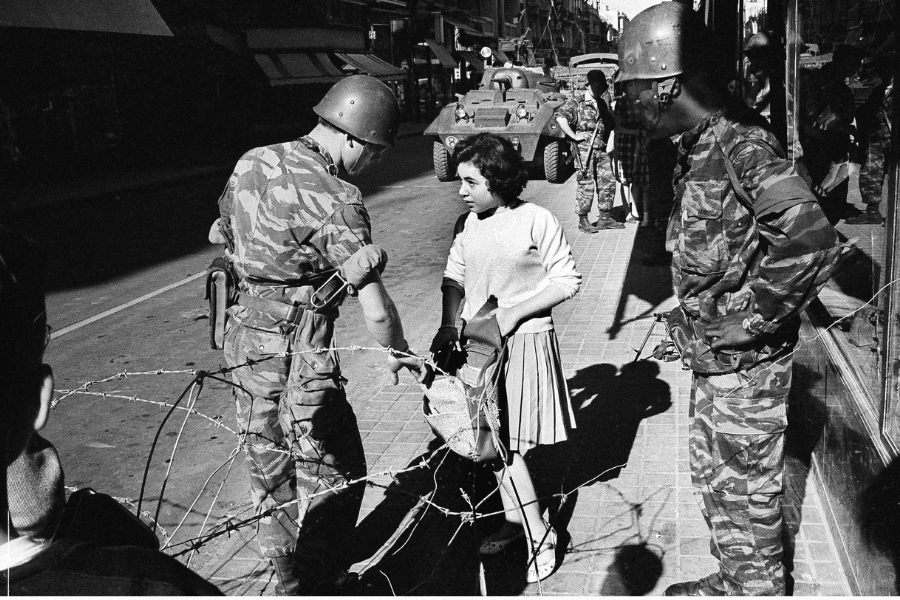
The captives were taken to a centre where masked Algerian informers picked out suspected rebels. “Those were detained, interrogated, with a lot of violence. The rest were released.”
Worse followed. Kihn was on guard duty when he first saw a suspect being tortured with electricity from a hand-cranked generator. “It was unbearable. The man was yelling, jerking around. I had tears in my eyes,” he said, his eyes filling again as he re-lived the moment.
When he was discharged, no one in his village wanted to hear his war stories, so for decades he clammed up. But memories, nightmares and panic attacks kept tormenting him. When he was 70, a film-maker cajoled him into an interview. He later wrote a book and found a measure of relief.
Kihn, disgusted by his experiences, would not touch his military pension. Instead, he and some other former soldiers send the money to local NGOs in Algeria.
“What we need is recognition of the truth,” he said. “Yes, we were criminals in Algeria.”
France has tried to turn the page, but the past will not die.
It took France until 1999 to recognise formally that its struggle in Algeria had been a “war,” even though it had mobilised up to two million conscripts for “operations to restore order” against the independence-seeking fighters of the Front de Libération Nationale (FLN).
The French campaign led to widespread torture, the forced displacement of two million civilians to cut the FLN from its rural base and countless summary executions and “disappearances.”
The FLN was ruthless, too, terrorising French and Algerian civilians and eliminating its political rivals and eventually factions within its own ranks.
The conflict, which brought violence to both sides of the Mediterranean, exposed deep divisions within France, toppled the country’s Fourth Republic and raised the spectre of civil war.
After President Charles de Gaulle set Algeria on course for independence with a 1961 referendum, some French die-hards formed the Organisation de l’Armée Secrète (OAS), an armed group that mounted bomb attacks and assassinations, including at least one attempt to kill the French leader.
OAS members eventually benefited from sweeping post-war amnesties. France sought to draw a veil and forget, but the past refused to die.
Keeping the past alive
Suzy Simon-Nicaise, 67, who heads one of the main associations of pieds-noirs, is determined to preserve a particular vision of the lost world of French Algeria, its culture, history and lifestyle.
In her memory, it was a cosmopolitan place where Europeans mixed freely with Muslims based on mutual respect, where the French colonists had promoted development from the ground up.
France, she concedes, may have committed some “not very glorious” deeds early on in its conquest of Algeria. “But Algeria did some things that were just as unbearable, if not more so,” she said.
At a memorial event in Perpignan, Simon-Nicaise, wearing a dress as bright as her red hair, recounted a massacre of pieds-noirs in the mainly European city of Oran on July 5, 1962, the day Algeria became independent.
She said 700 to 1,200 people were killed that day while French troops, in their barracks since the ceasefire in March, stood by with orders not to intervene. An exact toll has never been established. Macron, in his address to the pieds-noirs this year, said “hundreds” had died.
Simon-Nicaise’s family had planned to stay on after independence, but an Algerian friend working with her father warned them to leave urgently, advice driven home by a French official who told her father that his name was on an FLN death-list. The family raced to the port with four suitcases.
Around 800,000 pieds-noirs, the vast majority of the Europeans living in Algeria, also voted with their feet, believing their only choice was “la valise ou le cercueil (the suitcase or the coffin).”
The French government had not anticipated such an exodus, and the flood of new arrivals met a chaotic and chilly reception.
“We were treated worse than foreigners,” Simon-Nicaise said, recalling how she, then five, and her family were put up in a holiday village. “My family was crying, and everyone else was dancing the twist.”
Later, her family had to share a cramped, squalid apartment with another family in Le Havre. Simon-Nicaise went to school there, where she heard a classmate declare: “Don’t talk to her. She’s a dirty pied-noir.”
France’s rejected allies in Algeria
If the pieds-noirs were mostly unwelcome in France, the harkis — Algerians who had served with the French military — were doubly so. De Gaulle had rejected any idea of taking them in, effectively abandoning tens of thousands of men and their families to FLN vengeance.
Nevertheless, up to 90,000 harkis made it to France, many helped by their French commanders. They were consigned to grim army camps behind barbed wire, most of them for many years.
“There were no toilets, one washbasin for 10 families,” said Abdelkrim Sid, who was six on arrival and spent the next 15 years with his sprawling family in isolated camps.
His father, like many other harkis, was later put to work in forestry settlements on the minimum wage but never fully integrated into the wider economy.
“My father was a spahi (cavalryman). He really believed in France,” said Sid at the bleak Rivesaltes camp near Perpignan.
In Rivesaltes, a museum now commemorates successive waves of inmates dumped there from 1939 onwards, among them refugees from the Spanish civil war, Gypsies and Jews interned by the wartime Vichy régime, German prisoners of war and then harkis.
Sid, a burly retired truck-driver, says he can’t forget how shamefully the harkis were treated in the camps, which he likened to pens for animals. “It was as if we had the plague.”
Troubled identity
The war deeply marked the Algerian diaspora, swelled by migration that also drew in Moroccans and Tunisians whose labour was in demand as the French economy revived after World War Two.
North Africans today make up the bulk of France’s estimated 5-6 million Muslim citizens, roughly 8% of its total population, the biggest ratio in any European country.
France, which prides itself on its principle of laïcité, which makes the secular state neutral towards religion, has found it difficult to come to terms with its Muslim minority. The complex relationship is made no easier by mutual mistrust that has lingered since the colonial venture in Algeria.
Magyd Cherfi has tried hard to integrate in his native France, with outward success as a musician and songwriter, a devotee of French literature and an author in his own right.
Yet as he explained at a café in a mostly Arab quarter of Toulouse, the city where he grew up, he has never felt fully accepted as French. Ironically, he knows that many in the deprived milieu of his childhood resent him as a traitor to his origins.
“It’s as if being French is a mountaintop. You climb and climb, and it’s never far enough,” he said.
“In the street, they ask, ‘Oh, where are you from?’ That means you are not French, because if you are, no one asks that question.”
Cherfi’s father, a building worker, fled to France after four of his brothers were killed fighting in the maquis, or underground, during the Algeria war. “He only told us fragments of what happened then, about bad things the French did to his family, girls raped, cousins killed, imprisoned, tortured.”
So Cherfi grew up with an uneasy sense of difference from his French chums because France had been the enemy in Algeria. Yet when his parents decided to stay in France, when he was about 15, they told him, “You must respect the French. They give us work. They feed us.”
He admires much of what France offers, notably freedom and secularism, but says it fails to honour its own principles when it comes to its non-white citizens.
“That’s the big rip-off of the republic. France is unable to build a narrative that is anything other than exclusively white. We barely exist in French history,” he said.
“So France is still sausages, accordions, traditions, villages, and now, with millions of Muslims here, you feel they cling to this even more. So it’s quick, get out the accordions!”
Questions to consider:
• What was Algeria’s relationship to France before it gained independence in 1962?
• How were the post-war experiences of the pieds-noirs and harkis similar and different?
• Why do you think it took until 1999 for France to recognize the conflict over Algeria as a war?
• What would you do to improve the integration of France’s Arab/African-origin citizens?
Native American student enrollment has been on the decline for the past decade, dropping 40 percent between 2010 and 2021, a loss of tens of thousands of students. Of the 15.4 million undergraduate students enrolled in fall 2021, only 107,000 were American Indian or Alaska Native, according to the National Center for Education Statistics.
Researchers argue that the small population is not as small as it seems, however, due in part to federal practices of collecting data on Native populations, according to a new report from the Brookings Institute, the Institute for Higher Education Policy and the Urban Institute.
Federal measures of race and ethnicity in postsecondary education data undercount the total population of Native American students, in part due to insufficient sampling, lack of data on tribal affiliation and aggregation practices that erase Native identities, researchers wrote.
“For too long, Native American students have been severely undercounted in federal higher education data, with estimates suggesting that up to 80 percent are classified as a different race or ethnicity,” Kim Dancy, director of research and policy at IHEP, told Inside Higher Ed. “This chronic data collection failure renders Native students invisible in federal data systems and prevents clear assessments of the resources necessary to support student success.”
In May 2024, the federal government announced new standards for collecting data on American Indian and Alaska Native (AI/AN) populations, which would improve the inclusivity and accuracy of data for students from these groups.
The Obama administration introduced similar changes in 2016, but they were never implemented under the first Trump administration in 2017. Researchers worry a similar pattern may follow under the second Trump administration.
“The second Trump Administration has demonstrated reluctance to prioritize data transparency, which could further jeopardize these efforts and stall progress,” Dancy said. “Without strong implementation of these standards, Native students will continue to be overlooked in federal policy decisions.”
“It is critical that the Trump administration allow the revised SPD 15 standards to remain in effect, and for officials at ED and elsewhere throughout government to implement the standards in a way that provides Native American students and communities with the same high-quality data that all Americans should be able to access,” report authors wrote.
Data Analysis at Risk
The Education Department has canceled dozens of contracts in recent weeks, tied to the Trump administration’s Department of Government Efficiency. Many of these contracts related to student data analysis in both K-12 and postsecondary education.
State of play: Degree attainment for Native Americans is bleak, according to data presently available. Twenty-six percent of Native American adults in the U.S. hold an associate degree or higher, and only 16 percent hold a bachelor’s degree or higher, according to 2024 data from the U.S. Census Bureau. In comparison, bachelor’s degree attainment by all other races is higher: 20 percent for Latino, 25 percent for Black, 38 percent for multiracial, 40 percent for white and 61 percent for Asian American students.
Of the 58 percent of American Indian/Alaska Native students who enrolled in higher education beginning in 2009, over half (55 percent) didn’t earn a credential. In 2023, the National Student Clearinghouse Research Center reported six-year completion rates had fallen two percentage points among Native Americans, to 47.5 percent—21 percentage points lower than their white peers and 27 percentage points lower than Asian students in the 2016 cohort.
Data collection is not the only barrier to Native student representation and completion in higher education, researchers wrote, “but until data on Native American students are more accurate, accessible, and meaningful, it will prove difficult to address these issues,” which include affordability, disparities in access and retention, and a lack of culturally informed wraparound services.
Digging into data: Data collection at the U.S. Department of Education has several problems that disadvantage Native students more than other groups, according to the report. Native student data is often “topcoded” as Hispanic or Latino, essentially erasing Native student identities, filed under “more than one race” without further detail, or coded without tribal affiliation or citizenship.
While topcoding students as Latino or Hispanic or categorizing learners as more than one race applies to all racial categories, Native American individuals are categorized this way at a higher rate than any other major group, which diminishes their representation.
Additionally, ED independently makes decisions to not disaggregate or provide detailed data on racial and ethnic subgroups, such as topcoding Latino or Hispanic students, that is not modeled at other federal agencies, such as the Census Bureau and the Bureau of Labor Statistics.
The last time the Office of Management and Budget revised data-reporting processes for colleges and universities, which allowed individuals to identify as more than one racial group, final implementation took place in the 2010–11 academic year.
In the decade and a half since, Native American student enrollment has declined, and researchers say, “The limitations of ED’s student data made it challenging to discern whether this decline represented an actual change in enrollment trends or was due to the new reporting practices’ undercounting of Native college students.”
A lack of data impacts institutions, tribes and others tracking student outcomes, reducing opportunities to support learners, and the challenges may perpetuate continued misperceptions of Native students’ journeys through higher education.
New policies: In 2024, OMB created new federal standards around collecting data on race and ethnicity that would enhance data collection when it comes to Native populations. Federal agencies are required to create plans for implementation by September 2025 and be in full compliance by March 2029, leaving the Trump administration responsible for implementation of the revised standards.
OMB outlined three approaches for agencies on how they might consider presentation of aggregated data on multiracial populations:
Alone or in combination, which includes students who identify with more than one racial or ethnic group in all reporting categories.
Most frequent multiple responses, reporting on as many combinations of race and ethnicity as possible that meet population thresholds.
Combined multiracial or multiethnic respondents into a single category.
This third option would be most harmful to Native students, because it would perpetuate undercounts, researchers caution, and therefore policymakers should avoid it.
Moving forward, report authors recommend ED and Congress collect and publish disaggregated data on Native American students, partner with tribal governments to increase data transparency and provide guidance and resources to institutions to improve their quality of data.
“We encourage the Education Department to continue seeking input from Native communities, including voices that have been historically excluded from policy-development efforts,” Dancy said. “Accurate data alone won’t eliminate the structural inequities Native students face. But without the data, we cannot begin to dismantle the inequities.”
Get more content like this directly to your inbox every weekday morning. Subscribe here.
A friend recently argued compellingly that two major gaps in the Harris campaign strategy affected voter turnout and engagement: a reluctance to acknowledge policy shortcomings and a failure to address the specific needs of men, particularly working-class men and those in communities of color. These gaps represent missed opportunities to connect with voters who feel overlooked and underserved.
Many noncollege men today are navigating economic hardship and social isolation, grappling with precarious work and shifting social expectations. In a world that often emphasizes adaptability and academic success, the message they hear is clear: They should have worked harder, been more flexible or chosen a different path.
Yet this message can feel dismissive—more moralizing and patronizing than empathetic—ignoring the broader economic and structural challenges these men face. The decline of jobs in traditional industries, limited access to meaningful work and a diminished sense of purpose have fostered a profound sense of alienation where mainstream political narratives simply don’t resonate.
Broader cultural shifts compound these issues. Traditional male roles have eroded, leaving many men feeling marginalized and uncertain, struggling to navigate changing gender expectations. Many also experience personal isolation, strained relationships and limited social support, adding to a sense of being stuck without clear solutions.
While the Harris campaign frequently highlighted issues affecting women and promoted family-centered policies, it lacked a narrative that could directly address working-class men’s distinct challenges. The focus was often on broad achievements and visions rather than a targeted response to the real, often invisible, struggles these men face.
As my friend put this, “With her (proper) advocacy for reproductive rights, Harris already had the women’s vote, and the hard-core Democratic base are never-Trumpers whom they wouldn’t lose, no matter what else her campaign said. But instead of talking concrete policies that address where she was about to lose large numbers of (potentially persuadable) voters, Harris and her proxies talked about ‘joy’ and ‘helping the guy sitting next to you’—in short, to remain polite and appeal to upper-middle class tastes.”
By overlooking a direct appeal to men dealing with economic, social and personal challenges, the campaign missed a critical opportunity to engage with and support a population that increasingly feels unseen and left behind.
The erosion of traditional male roles—breadwinner, family leader, protector—has left many men grappling with identity, isolation and a profound sense of purpose. As society evolves, these long-standing markers of masculinity have lost relevance, especially for working-class men who once found dignity and respect in roles that aligned with hard work, family provision and community involvement.
Now, as economic and cultural shifts reshape these roles, many men are struggling to find a path forward, a reality that not only affects them but impacts the broader social fabric.
This identity crisis reflects a broader issue: As traditional definitions of masculinity are increasingly challenged, men are left with fewer frameworks for meaningful contributions to family, work and community. The fading emphasis on male-led provision and protection has led to a vacuum where isolation and frustration often take root. Without clear societal pathways that respect both historical contributions and evolving social needs, men can feel left behind, unsure of how to participate in a society that often seems to have moved beyond their previous roles.
To address this crisis, society must reimagine male roles in ways that offer respect, purpose and connection. Only by acknowledging the disintegration of traditional frameworks and creating new, healthier pathways can we guide men toward meaningful identities. This means valuing male contributions not only in economic terms but also in terms of their relational and communal roles. Reintegration into family, work and community as valued members demands that we redefine what it means to be a man in today’s world—placing dignity, contribution and connection at the forefront.
In an era where masculinity itself is under re-evaluation, it’s essential to shape new definitions that honor both the past and present. Men today need roles that allow them to thrive within evolving social landscapes, where they can build connections and be respected for contributions beyond traditional parameters. Only by doing so can we address the underlying causes of alienation, providing men with a renewed sense of purpose in a society that, with the right approach, can benefit immensely from their reimagined roles.
Addressing the challenges that many men face is not about overlooking or minimizing the very real struggles women continue to confront. Recognizing one group’s needs does not diminish the other’s; rather, it broadens our capacity to understand and support everyone more fully. Just as society benefits when women’s voices are heard, it also strengthens when we address the unique struggles that many men experience in today’s world. This inclusive approach allows us to tackle challenges holistically, building a society that values and supports each person’s dignity, purpose and place.
The alienation felt by many men today reflects a profound shift in the economic, demographic and cultural landscape of American life. These changes have created a reality for a large group of men—often isolated, lonely, frustrated and angry. In this demographic, men frequently find themselves without the traditional anchors of family, stable friendships or secure employment. As society has evolved, these men increasingly feel disrespected or dismissed, disconnected from the structures that once provided support, identity and a sense of purpose.
The economic landscape for men, particularly those without a college degree, has changed dramatically over the last few decades. The decline of traditional industries, such as manufacturing, construction and mining, has resulted in the disappearance of millions of stable, well-paying jobs. These industries were not only sources of economic stability but also providers of identity and community. For many men, especially those who entered the workforce in the 1980s and 1990s, job loss has meant not just an economic setback but a disruption in their sense of self-worth and purpose.
As these traditional industries shrank, the economy pivoted to sectors like technology, health care and the service industry—fields that often emphasize educational attainment, interpersonal skills and adaptability. Many men who once relied on stable blue-collar jobs have struggled to transition to these new fields, either due to a lack of qualifications or because the roles simply don’t align with the values and identities they were raised with. As a result, these men experience economic precarity, often living paycheck to paycheck, juggling temporary or part-time work without benefits, or relying on the gig economy, which lacks the long-term stability they might have expected earlier in life.
The rise of “kinless America” has compounded the problem of economic insecurity, leading to a broader crisis of social disconnection. In the United States, rates of marriage have declined significantly and divorce rates remain high. For men, divorce and separation often mean loss of regular contact with children, limited social networks and, sometimes, an emotional isolation that they struggle to overcome.
Marriage and family life once provided social stability, companionship and a sense of purpose. Without these connections, many men find themselves living alone or in shared, temporary arrangements, removed from the grounding influence of family. For those who are also economically disadvantaged, the struggle to form new partnerships or social networks can be insurmountable, leaving them largely kinless and isolated.
This demographic shift affects friendships, too. Research shows that men, more than women, often depend on their partners to maintain social ties and that they struggle to form friendships as adults. As such, unpartnered men frequently end up in a kind of social desert, with few meaningful connections to rely on for emotional support or companionship.
Cultural shifts have further deepened this sense of alienation. Over recent decades, there has been a growing emphasis on individual achievement and self-realization, sometimes at the expense of communal identity and traditional values. While this shift has empowered many, it has also led to the devaluation of certain traditional roles that many men historically occupied. Traits associated with traditional masculinity, such as stoicism, physical labor or even traditional provider roles, are sometimes framed as outdated or even “toxic,” leaving some men feeling that their core values and sense of identity are now stigmatized.
Furthermore, as cultural narratives around gender have evolved, men who do not or cannot align with these new expectations often feel marginalized or invisible. Messages around the importance of academic achievement and professional success can leave those who have struggled to meet these expectations feeling dismissed or left behind.
Adding to this sense of disrespect is the rise of social media and a culture of comparison, where it can feel as though one’s successes or failures are on display for public scrutiny. Men who feel they don’t measure up may withdraw even further, reinforcing their isolation and frustration. For those experiencing economic precarity or relationship struggles, these messages compound an existing sense of inadequacy.
These changes have left many men feeling disconnected from their families, their communities and their traditional roles. For many working-class men, in particular, these economic and social shifts can lead to a crisis of identity, with few alternative sources of meaning or recognition to replace the roles they once filled. Lacking the dignity they once found in hard but honorable work, many now worry they are being dismissed as “losers” or that their labor is undervalued.
This shift often translates into feelings of anger, shame and frustration. Without clear avenues for expressing or resolving these feelings, some men may withdraw, becoming more isolated and resentful.
The isolation, loneliness and frustration felt by these men manifest in various ways, including higher rates of mental health issues, substance abuse and even suicide. Data shows that men, particularly middle-aged men, have some of the highest rates of suicide in the United States, and they are also disproportionately affected by the opioid crisis. Lacking strong social support systems, they often fall through the cracks of mental health and social services, either because they lack the resources or because they feel stigmatized in seeking help.
Politically, this alienation can drive disenchantment with mainstream narratives and established institutions. Many feel overlooked or even disrespected by a society they perceive as indifferent to their struggles. As a result, some turn to populist figures who channel their frustrations, adopting hypermasculine postures that seem to defy what they view as a culture overly critical of traditional masculinity. They are often receptive to leaders who emphasize strength, defiance of convention and a willingness to challenge norms—qualities that appear to stand in opposition to the mainstream culture they feel has rejected or devalued them. Political rhetoric that champions the “forgotten man” resonates deeply with these individuals, promising to restore the dignity and respect they feel has been taken from them.
Gender antagonism has surged due to a complex mix of economic, social and cultural changes that have disrupted traditional roles, heightened insecurities and polarized public discourse.
With the decline of traditionally male-dominated industries and growth in service sectors, many men face economic insecurity, disrupting the breadwinner role that historically provided identity and respect. Meanwhile, women’s increased workforce participation challenges traditional male roles, creating frustration and resentment as economic stability and established identities shift.
As expectations for equal partnerships grow, many men raised with conventional norms feel unprepared for these shifts. New dynamics around independence and equity can fuel misunderstandings, alienation and resentment, especially when traditional gender expectations clash with modern relationship ideals.
Increased awareness of issues like misogyny and toxic masculinity has led to critiques that some men feel unfairly target their identities. Misunderstandings around terms like “toxic masculinity” can foster defensiveness, as positive models for masculinity are often lacking in these discussions.
Social media amplifies divisive, adversarial portrayals of gender, reinforcing stereotypes and fostering resentment. Gender issues have also become politicized, making nuanced conversations difficult and polarizing gender dynamics further.
Traditional gender roles are evolving quickly, leading to identity crises as qualities like stoicism or assertiveness are redefined. Without inclusive pathways to navigate these changes, many feel insecure or alienated, fueling tension.
Social isolation, especially among men, has intensified, with limited support systems leading to loneliness and resentment. Emphasis on victimhood narratives also fuels a “competition of grievances,” as men’s economic and social struggles seem to compete with women’s issues, leading to mutual resentment.
What is the path forward?
To address the rising sense of alienation among American men and reduce gender antagonism, we need practical solutions that validate their experiences, offer purpose and foster constructive engagement. This isn’t solely about economic or demographic shifts; it requires holistic policies and social initiatives that support men’s economic stability, familial roles and community involvement without condescension.
Economic stability and accessible upskilling. Policies that support well-paying, stable jobs, especially in trades and skilled labor, can help restore pride and purpose. Expanding accessible training—through apprenticeships, vocational programs and targeted certifications—can revitalize pathways to economic self-sufficiency and respect. Higher education, particularly community colleges, can play a vital role, but they must adopt practical, flexible models that allow working men and women to balance existing responsibilities with upskilling opportunities. Here are some strategies:
Employer partnerships for on-the-job training: Colleges can work with local industries to design programs that meet workforce needs and offer on-site training, allowing employees to earn while they learn.
Affordable, results-oriented programs: Expanding low-cost programs that focus on high-demand skills provides a clear incentive for workers to invest their time, with direct connections to jobs, salary increases and career advancement.
Mentorship and career support: Programs that connect students with mentors who have successfully upskilled can offer both guidance and motivation, especially for those hesitant about returning to school.
Enhanced job placement and counseling services: Colleges can offer support in aligning new skills with market demands, ensuring students can quickly apply their skills to new roles or promotions.
Skills-based certifications in growth sectors: Short-term certifications in fields like cybersecurity, skilled trades and advanced manufacturing can appeal to workers by providing clear pathways to better jobs.
Higher education must provide clear, realistic pathways to secure employment, with affordable, high-quality vocational training and credentialing programs that align tightly with job market needs.
Supporting fathers and family involvement. Fostering men’s roles as fathers, particularly those separated from their children, is essential. Legal reforms that promote equitable custody arrangements, along with targeted support for single fathers, can help men stay actively involved in family life. Programs offering parental counseling and father-centered parenting classes can restore purpose and fulfillment, reducing feelings of alienation from loved ones.
Building community and combating isolation. To address social isolation, we need community spaces where men can forge friendships and feel connected. Initiatives centered on shared activities—such as sports leagues, volunteer groups or veterans’ organizations—offer valuable opportunities for camaraderie, helping men form supportive networks and reinforcing a sense of belonging and social cohesion.
Recognizing and celebrating men’s contributions. Society benefits from recognizing men’s contributions through mentorship, craftsmanship, coaching and community leadership. Programs that emphasize these roles and celebrate male contributions can help men find renewed purpose in positive, community-oriented activities. Acknowledging these contributions adds value to society without diminishing other forms of progress.
Addressing gender antagonism with understanding. Reducing gender antagonism requires an approach that acknowledges the unique challenges men and women face without casting all men as insensitive or prone to toxic traits. Public discourse should address specific actions or attitudes within their contexts rather than implying these are inherent in all men. Media portrayals that reinforce negative stereotypes about masculinity need to be challenged. Inclusive narratives that recognize both men’s and women’s struggles and contributions foster empathy, helping bridge divides rather than deepen them.
Embracing shared human values. Many core values—compassion, respect, integrity, resilience—are universal. Shifting our focus from gendered virtues to shared human qualities can foster unity and mutual respect, emphasizing individual strengths over rigid gender norms.
The erosion of traditional male roles has left many men feeling adrift, disconnected from the sources of pride and identity that once defined them. Only by acknowledging these challenges and investing in creative solutions that restore economic stability, respect, connection, meaning and purpose can we create a healthier, more balanced and respectful society for all.
Steven Mintz is professor of history at the University of Texas at Austin and the author, most recently, of The Learning-Centered University: Making College a More Developmental, Transformational and Equitable Experience.
Since Hamas attacked Israel on Oct. 7, 2023, triggering a brutal retaliatory war in Gaza, at least 140 colleges and universities have adopted statements of institutional neutrality—up from just eight prior to the attacks, according to a new reportfrom Heterodox Academy, a nonprofit advocacy group seeking to promote viewpoint diversity on college campuses.
The vast majority of institutions—97 percent—cited the values of “community and inclusion” to justify their embrace of statement neutrality. “Free speech and academic freedom” and “public trust” were each referenced as a rationale by 88 percent of institutions; 64 percent attributed the move to “balancing rights and responsibilities.”
Of the institutions that have adopted neutrality statements since 2023, 78 percent are public and 22 percent private. Governing boards drove the change at 68 percent of the public institutions; at more than a quarter of those—including in Indiana, Utah and North Carolina—state legislatures mandated the shift. At private institutions, presidents and faculty were much more likely than governing boards to instigate the push for institutional neutrality.
“The rapid adoption of institutional statement neutrality policies marks a major shift in how colleges and universities engage with broader societal debates,” the Heterodox report reads. “Statement neutrality not only empowers students, faculty, and staff to engage in robust debate, it also reinforces the critical values of seeking truth and generating knowledge rather than advocating for partisan political positions. In an era of declining public confidence in higher education, these policies represent a critical step toward restoring universities as trusted spaces for free inquiry and intellectual growth.”
Since OpenAI first released ChatGPT in November 2022, early adopters have been informing the public that artificial intelligence will shake up the world of work, with everything from recruitment to retirement left unrecognizable. Ever more cautious than the private sector, higher ed has been slow to respond to AI technologies. Such caution has opened a divide within the academy, with the debate often positioned as AI optimism versus pessimism—a narrow aperture that leaves little room for realistic discussion about how AI is shaping student experience.
In relation to graduate outcomes (simply put, where students end up after completing their degrees, with a general focus on careers and employability), universities are about to grapple with the initial wave of graduates seriously impacted by AI. The Class of 2025 will be the first to have widespread access to large language models (LLMs) for the majority of their student lives. If, as we have been repeatedly told, we believe that AI will be the “great leveler” for students by transforming their access to learning, then it follows that graduate outcomes will be significantly impacted. Most importantly, we should expect to see more students entering careers that meaningfully engage with their studies.
The reality on the ground presents a stark difference. Many professionals working in career advice and guidance are struggling with the opposite effect: Rather than acting as the great leveler, AI tools are only deepening existing divides.
Trust Issues: Student Overreliance on AI Tools
Much has been said about educators’ ability to trust student work in a post-LLM landscape. Yet, when it comes to student outcomes, a more pressing concern is students’ trust in AI tools. As international studies show, a broad range of sectors is already placing too much faith in AI, failing to put proper checks and balances in place. If businesses beholden to regulatory bodies and investors are left vulnerable, then time-poor students seeking out quick-fix solutions are faring worse.
This is reflected in what we are seeing on the ground. We were both schoolteachers when ChatGPT launched and both now work in student employability. As is common, the issues we first witnessed in the school system are now being borne out in higher ed: Students often implicitly trust that AI will perform tasks better than they are able to. This means graduates are using AI to write CVs, cover letters and other digital documentation without first understanding why such documentation is needed. Although we are seeing a generally higher (albeit more generic) caliber of writing, when students are pressed to expand upon their answers, they struggle to do so. Overreliance on AI tools is deskilling students by preventing them from understanding the purpose of their writing, thereby creating a split between what a candidate looks like on paper and how they present in real life. Students can only mask a lack of skills for so long.
Such a skills gap is tangible when working with students. Those who already present high levels of critical thinking and independence can use AI tools in an agile manner, writing more effective prompts before tailoring and enhancing answers. Conversely, those who struggle with literacy are often unable to properly evaluate how appropriate the answers provided by AI are.
What we are seeing is high-performing students using AI to generate more effective results, outpacing their peers and further entrenching the divide. Without intervention, the schoolchildren who couldn’t answer comprehensions questions such as “What does this word mean?” about their own AI-generated homework are set to become the graduates left marooned at interview where they can no longer hide behind writing. The pandemic has already drawn economic battle lines for students in terms of learning loss, attainment and the very awarding of student grades—if we are not vigilant, inequitable AI use is set to become a further barrier to entry for those from disadvantaged backgrounds.
Across many institutions, higher education career advice and guidance is poorly equipped to deal with such changes, still often rooted in an outdated model that is focused on traditional job markets and the presumption that students will follow a “one degree, one career” trajectory, when the reality is most students do not follow linear career progression. Without swift and effective changes that respond to how AI is disrupting students’ career journeys, we are unable to make targeted interventions that reflect the job market and therefore make a meaningful impact.
Nonetheless, such changes are where higher education career advice and guidance services can make the greatest impact. If we hope to continue leveling the playing field for students who face barriers to entry, we must tackle AI head-on by teaching students to use tools responsibly and critically, not in a general sense, but specifically to improve their career readiness.
Equally, career plans could be forward-thinking and linked to the careers created by AI, using market data to focus on which industries will grow. By evaluating student need on our campuses and responding to the movements of the current job market, we can create tailored training that allows students to successfully transition from higher education into a graduate-level career.
If we fail to achieve this and blindly accept platitudes around AI improving equity, we risk deepening structural imbalances among students that uphold long-standing issues in graduate outcomes.
Sean Richardson is a former educator and now the employability resources manager at London South Bank University.
Paul Redford is a former teacher, now working to equip young people with employability skills in television and media.
For a moment, best-selling novelist Julia Alvarez sounded abashed. She was being interviewed by National Public Radio’s Scott Simon on April 4, 2020, about her new novel, Afterlife.
“I’ve got to say this, too, Scott, it feels kind of weird to be talking about my novel, and somehow promoting it, at a time like this,” she explained. “I feel like it just doesn’t quite feel right, because, you know, it’s not business as usual.”
“But you know,” Simon responded, “reading your novel this week gave me great pleasure. I think there’s no reason for you to feel that there’s something unusual in this. You’ve created a splendid work of art that can give comfort to people now, and I’m glad you can talk about it. I think people need to hear that, too.”
This brief exchange almost perfectly encapsulates the public insecurity many felt about discussing the value of the humanities in a moment of global medical calamity. To discuss fiction, poetry, painting and music under the shadow of mass death threatened to make discussants appear dilettantish at best, and insensitive snobs at worst.
But that perception did not match reality during the COVID-19 pandemic. We all read books, found new music to enjoy, watched TV and streaming movies, and communicated widely about how the humanities provided succor and catharsis during a time of enormous emotional stress. Our social media feeds and group texts throughout 2020 and 2021 were filled with recommendations to others about the movies, books and music we enjoyed.
But today, those conversations are largely forgotten. Public discourse around the COVID-19 pandemic now revolves around public health decision-making, scientific arguments about vaccines and the origins of the virus, and other debatable propositions. Remembrance of what actually happened—that is, our daily habits and activities under lockdown—is rarely chronicled in detail. Everyone wants to move on.
Yet such intentional amnesia obscures the ways the humanities got us through those difficult months.
The truth is the humanities—that is, the use of creativity and imagination, in questioning the human condition—remained absolutely central to our collective survival. The evidence, though difficult to measure in quantitative metrics, exists in the atmospheric ways that humanities media continually provided relief and distraction when scientific answers were still unknown and we all felt threatened by an unknown future.
With the fifth anniversary of the start of the COVID-19 pandemic upon us, we are undoubtedly going to hear much about Operation Warp Speed, the Wuhan Institute of Virology and other scientific and medical legacies.
We’ll hear much less about the humanities and the role they played.
The problem is we’re loath to label Netflix, YouTube, podcasts and other technological marvels as humanities media. Instead, we talk about how new technologies distract, mislead and misinform us. We do not remember how we reached for them in the search for comfort in a time of true existential crisis, and the vital role they played in social cohesion.
There’s been a lot written about the crisis in the humanities. There’s been far less written about the humanities during a crisis. And that’s a mistake, because as we move further past 2020–2021, we will all likely forget when the power and vitality of the creative arts helped keep us grounded, sane, curious and, if necessary, distracted.
The very invisibility today of what occurred then needs to be illuminated. Even at the time—as evidenced by Julia Alvarez’s reservations about talking about her novel—it seemed almost embarrassing to celebrate witty scenes from Broadway plays, to choreograph interpretative dances or jot down lines of poetic observation. Yet moments of sublime, thoughtful, philosophical and engaging artistry arose everywhere.
How many people today recall the brilliant daily updates provided by Dr. Craig Smith, the chief of surgery at Columbia University Irving Medical Center? Smith continually quoted Emily Dickinson, Mark Twain, Rudyard Kipling, Bertrand Russell, T. S. Eliot and others for inspiration in his daily updates. The Wall Street Journal labeled Smith “the pandemic’s most powerful writer” while noting the “elegant, almost poetic” prose of his daily dispatches. Smith often relied on poetry to express the inexpressible, and many Americans eagerly read his work—not just to be informed, but to also be comforted emotionally. Smith understood the enormity of the existential confrontation that faced every American in 2020, and so employed his knowledge of the humanities to help others comprehend the incomprehensible. His artistry as a writer provided an enormous public service.
That’s precisely what Scott Simon was telling Julia Alvarez. She had nothing to apologize for, and, in fact, her artistic achievement in an unprecedented era of doubt, anxiety and uncertainty was a gift that would be gratefully received and appreciated.
A major problem with the humanities is that so much of its success will always remain invisible to the audiences that consume it. We are primed to take for granted the artistic process, now that AI can mimic it. History videos and podcasts remain available anytime, and ebooks can be downloaded so easily. We can see the Mona Lisa at any moment. Many of the world’s greatest artworks, and the most beautiful song performances, can be found instantly. It’s a miracle unimaginable to earlier generations, but it also paradoxically devalues the time, effort and creativity that inspired such beauty.
Debates about how to make the humanities more visible and relevant arise often. Some argue that the humanities should emphasize the analytics and metrics concerning job development and career preparation, or comparative salary growth over the course of a career. Others counsel the embrace of new avenues of promotion and marketing. But the first step needs to be simple recognition. We must make immediately clear—without obfuscatory language or elevated rhetoric—the impact of the humanities in the present and in the near past.
When the pandemic threatened the stability of the world, the answers people sought were primarily medical and scientific. But intertwined with anger and impatience in that moment was a yearning for meaning far more spiritual than empirical. As our regular routines of time and space became unsettled, and communication and interactivity more ambiguous, the need to explore the essence of what it means to be human naturally arose. People became creative, trying out new baking recipes, teaching themselves to play guitar or piano, or drawing sketches or drafting poetry. This was not simple escapism—it was engagement with our imaginations.
We also wondered about the future of humankind. We might not have called our ruminations, prayers, thoughtfulness, curiosity and questioning “philosophy,” but that’s what we were practicing. Those moments got many of us through when daily anxiety threatened existential desperation.
That the humanities sustained us through the pandemic is undeniable. The evidence is everywhere: We just need to see it, remember it and celebrate it. When a global primal moment of fear exploded—seemingly out of nowhere—to take control over our lives, it was fiction, movies, poetry, art, philosophy and music that moved us forward into the future. It was not solely the vaccines.
That’s history. And now it’s memory, too. The key question is whether humanities scholars understand these great achievements and will make them more widely known.
Michael J. Socolow is a professor in the Department of Communication and Journalism at the University of Maine and formerly served as director of U Maine’s McGillicuddy Humanities Center from 2020 to 2022.
Last September, the Prime Minister announced a “rebalancing” of funding from the apprenticeship levy (shortly to become the Growth and Skills Levy). Employers’ ability to use the funds for postgraduate-level apprenticeships would be restricted in the hope of shoring up lower levels.
The government’s thinking arises from a belief that employers are taking advantage of apprenticeship levy funding to upskill mostly existing, mostly relatively seasoned staff with MBAs and similarly expensive qualifications. At worst, some employers may be using a claw-back of their levy (which is paid by employers at 0.5% of annual wage bills that exceed £3 million) to give training perks to middle managers.
This activity may not only be offsetting those employers’ own training budgets such that the levy isn’t increasing the overall funding available, but in the process, it is also undermining what the government would prefer, namely that the money is used to address concerns about young people leaving school without more basic levels of employability.
The Government has a point. In 2021/22, nearly half of all Level 6 and 7 apprenticeships were in ‘Business, Administration & Law’. But the employers concerned (often professional services firms, accountants and legal services) may have a point too. They may feel their commercial interests are better served (and more economic activity is generated) by training up current employees who have high demonstrable potential rather than recruiting low-level apprentices who may be less reliable, loyal or productive in the longer term. After all, they might argue, businesses don’t exist to do the government’s job of workforce planning or social engineering.
In the second decade of this century many policy papers punningly declared that they were laying out a ‘2020 vision’. One such document in 2015 laid out the Cameron Government’s reform of English apprenticeships which heralded the introduction of the Apprenticeship Levy in 2017.
This new tax – sorry, ‘levy’ – would, it was envisioned, align skills supply with skill needs and provide a superhighway of progression for apprentices while simultaneously promoting wider access and higher standards.
Given that employers recruit their apprentices and, unlike universities, they are not subject to any fair access requirements, opportunities have tended to follow traditional patterns of advantage.
Most of the fall in apprenticeships is accounted for by the 72% collapse of intermediate apprenticeships (equivalent to Level 2, ie. GCSEs), while higher apprenticeships (equivalent to Level 4 and above) have been the only part of the market to see an expansion – by nearly three times, such that they now make up more than a third of the (albeit lower) total.
There is no reason to suppose that excluding Level 7 apprenticeships from the funding system will suddenly make lower levels more attractive to employers. While it is true that the funding is drawn from the same pool, they are not seen as alternatives by employers: the Business Administration & Law sector is not likely to start offering intermediate apprenticeships to 16-year-old school leavers because they can’t offset their levy by training qualified professionals.
Rather it is in other sectors, where engagement in apprenticeships has been minimal, that the government wants to see the growth. For those employers, the fact that someone else may have been using their apprenticeship levy to fund an MBA was never stopping them from creating more junior opportunities.
What’s been stopping them is the red tape involved in setting up and running apprenticeships, the costs and inconvenience (such as the time of other staff to recruit, manage and train apprentices), and the limited perceived benefits.
Not only is defunding Level 7 apprenticeships not likely to solve the problems in the apprenticeship market, there is also a danger that babies (training that is critical to address skills gaps) might get thrown out with the bathwater (those MBAs which the government thinks should not be publicly subsidised).
Level 7 apprenticeships in engineering are vital for up-skilling (and re-skilling), which is critical for the challenges outlined in the government’s industrial strategy, such as in defence, advanced manufacturing, clean energy industries, and digital & technologies (particularly AI).
Engineering is a highly dynamic sector with an ageing population of skilled professionals. Even if we can meet the profound challenges of providing sufficient new engineers into the labour market, keeping them there and maintaining their level of expertise will rely on increasing the availability of – and demand for – a combination of in-work training and education at the highest level.
Achieving Level 7 qualifications in engineering (which are often instrumental in professional recognition) is generally too expensive for individuals to embark on at their own cost and, given the competitive demand for skilled labour in the context of shortages, employers are fearful that if they invest heavily in these staff they may be poached by competitors. This is a prime example of where a low-cost intervention by government can have large-scale impact.
In other words, Level 7 apprenticeships in engineering are strategically critical. My understanding is that they are similarly vital in certain other sectors such as health.
The government is right to ensure Growth & Skills Levy funds are spent as effectively as possible, but that will require a nuanced appraisal of what is working and what isn’t as well as a recognition that a slash and burn of waste won’t necessarily promote growth where the government wants it.