Category: Featured

  • DOGE fails to accurately disclose contract and program cuts

    DOGE fails to accurately disclose contract and program cuts

    As part of his administration’s broad push for government transparency, on Feb. 18 President Donald Trump ordered all federal agencies to publicize “to the maximum extent permitted by law” the complete details of every program, contract or grant they terminated.

    “The American people have seen their tax dollars used to fund the passion projects of unelected bureaucrats rather than to advance the national interest,” Trump wrote in the memo, tilted “Radical Transparency About Wasteful Spending.” “[They] have a right to see how the Federal Government has wasted their hard-earned wages.”

    Immediately after receiving a copy of the order, Inside Higher Ed reached out to the Department of Education and requested a comprehensive list of any and all such cuts, as well as explanations for why each contract was terminated. But two weeks later, the Education Department has yet to respond, and neither the department nor the staff it has partnered with from Elon Musk’s Department of Government Efficiency have publicly released any more information about the terminated contracts and grants.

    In fact, DOGE—the agency leading the crusade of cuts—has continuously made edits to the “Wall of Receipts,” where it was supposedly outlining the cuts that have been made. Late Sunday night, the group deleted hundreds of contracts it had previously claimed to cancel, The New York Times first reported and Inside Higher Ed confirmed.

    “It’s absolutely hypocrisy,” said Antoinette Flores, director of higher education accountability and quality at New America, a left-leaning think tank. “It feels like we’re all being gaslit. I don’t know why they are saying they want to be transparent without being transparent.”

    For weeks, higher education leaders, policy experts and advocates have raised concerns as the department terminated more than 100 assorted grants and research contracts. Combined, the cuts are purportedly valued at nearly $1.9 billion, according to the department, and will affect a swath of institutions, including the department’s largest research arm as well as regional labs and external nonprofits that collaborated with local officials to improve learner outcomes. Combined, the cuts will dramatically impact the data available to researchers and policymakers focused on improving teaching and learning strategies, experts say.

    Education scholars are worried that the cuts will leave state officials and college administrators with little evidence on which to base their strategies for student success and academic return on investment. One professor went as far as to say that the cuts are “an assault on the U.S.’s education data infrastructure.”

    And though the Trump administration has flaunted its transparency and glorified DOGE’s website as a prime example of their success in providing public records, policy experts on both sides of the political aisle say the collective contract value displayed is an overestimate. Calculating savings is more nuanced than just listing a contract’s maximum potential value, they say—and even if they saved money, some of the terminated programs were congressionally mandated.

    Over all, the sudden nature of the cuts, combined with the questionable accuracy of reported savings and a lack of further transparency, have left higher education advocacy groups deeply concerned.

    “The cuts that happened recently are going to have far-reaching impacts, and those impacts could really be long term unless some rapid action is taken,” said Mamie Voight, president of the Institute for Higher Education Policy, a national nonprofit that campaigns for college access and student success. “This information is useful and essential to help policymakers steward taxpayer dollars responsibly.”

    “To eliminate data, evidence and research is working in opposition to efficiency,” she later added.

    The department did not respond to requests for comment on Voight’s and Flores’s criticisms.

    A Data ‘Mismatch’

    For many in higher ed, the executive actions Trump has taken since January raise questions about executive overreach and government transparency. But Nat Malkus, deputy director of education policy studies at the American Enterprise Institute, a right-leaning think tank, said, “It’s not a matter of deception” or even simply a question of transparency.

    Instead, he said, “The question is, what’s the quality of the transparency? And what can we make of it?”

    In a recent analysis, titled “Running Down DOGE’s Department of Education Receipts,” Malkus compared a leaked list of the 89 terminated Institute of Education Sciences contracts, along with detailed data from USASpending.gov, to those DOGE had posted on its website. He said he found major inconsistencies, or a “mismatch” in how they defined the purported contract value.

    He also noted that though the “Wall of Receipts” has two separate tabs, one listing a contract’s value and another listing its savings, it displays the overall contract value first. The agency also declines to explain the difference between value and savings or how it calculates either.

    As is the case with contract values, DOGE has been inconsistent in how it calculates savings. But what the agency most often displays to the public is how much a contract could theoretically cost if all options and add-ons are utilized—known as the potential total—minus the amount the government had currently agreed to spend by the end of the contract, or the total obligation. So in other words, Malkus said, DOGE is sharing how much the government could save if it were to continue the contract and receive the promised deliverables without adding any extra bells and whistles.

    But that’s not what DOGE has done. Instead, it has terminated the contracts, and the Education Department won’t receive the final product it was paying for.

    To best represent savings in that scenario, Malkus said, DOGE would calculate the difference between how much the government had agreed to spend by the end of the contract—the total obligation—and how much the government has already spent, or the total outlay.

    “It’s weird because DOGE is publishing one set of savings that I don’t think actually makes sense to anybody, and they’re ignoring savings that they actually are conceivably getting,” Malkus said. “There are some good reasons that they might choose to do that. But DOGE would do well to explain what these dollars are, because right now, no one can tell.”

    Malkus first spoke with Inside Higher Ed on Friday. But since then, the DOGE database has changed. Malkus said Tuesday that some of the initial trends in the way DOGE appeared to be calculating savings are no longer present and he has yet to find a new, even semiconsistent formula for how DOGE is calculating savings.

    “The pace of change on DOGE’s numbers is dizzying even for someone like me who works at analyzing these receipts,” Malkus said. “Each week there have been changes to the number of contracts and within contracts the values and savings that DOGE is publishing. It’s hard to know if they are trying to get this right, because it’s impossible to find a consistent trail.”

    I don’t attribute it to a desire to falsely advertise transparency and not deliver on it. I just think they need to do a much better job in the execution.”

    —Nat Malkus

    And even if there were a consistent, uniform formula for how DOGE officials are calculating efficiency, in some cases they still choose to highlight overall contract value rather than the direct savings. For example, a DOGE social media post about the Institute of Education Sciences cuts noted the contracts were worth $881 million in total.

    “So are the actual savings equal to that implied? No, they are not,” Malkus said. “They are far, far less than that amount, somewhere around 25 percent of the total.”

    The agency’s website doesn’t detail the team’s methodology or offer any explanation about why the cuts were made. Malkus believes this lack of clarification reflects the Trump administration’s effort to make notable cuts quickly. He added that while he doesn’t agree with every cut made, he understands and supports the “aggressiveness” of Trump and Musk’s approach.

    “If they don’t move quickly, then there’s commissions, and then you have to go to the secretary, and they have interminable meetings and everything gets slowed down,” he said. “So one of their priorities is to move fast, and they don’t mind breaking things in the process.”

    From Malkus’s perspective, the inconsistencies in how each cut is documented, the many edits that have been made to the DOGE database and the lack of explanation for each cut isn’t a matter of “malice or dishonesty,” but rather “mistakes.”

    “I don’t think their savings are a clear estimation of what taxpayers are actually saving. But I don’t attribute it to a desire to falsely advertise transparency and not deliver on it. I just think they need to do a much better job in the execution,” he said.

    A ‘Disregard for the Law’

    Flores from New America conducted similar research and, like Malkus, found that the DOGE data doesn’t add up and exaggerates the savings. However, she had different views on the cause and effects of the agency’s aggressive, mistake-riddled approach.

    “It’s like taking a wrecking ball to important government services,” she said. “If you’re trying to be efficient, you should take into consideration how far along is a contract? How much have we spent on this? Are we getting anything for the investment we’ve made?”

    The Trump administration has broadly explained its cuts as a response to the “liberal ideology” of diversity, equity and inclusion and an effort to increase efficiency. But to Flores, they target anything but “waste, fraud and abuse.”

    “The reason why the Trump administration says it wants to eliminate the Department of Education is because you don’t see improvement in student performance,” she said. “But if you want to improve student performance, you need to understand what is happening on the ground with students and evidence-based research on how to help students improve.”

    And many of the studies affected by the contract cuts were nearly completed, she said. They were projects on which the agency had already spent hundreds of millions of dollars. So by cutting them now, the department loses the data and wastes taxpayer funds.

    It’s absolutely hypocrisy. It feels like we’re all being gaslit.”

    —Antoinette Flores

    “I’ve talked to some researchers who worked at one of the organizations that had their contracts cut, and they said all work has to stop,” she said. “No matter how close it was to being finished, it just has to stop.”

    Flores also noted that some of the studies terminated via contract cuts—particularly the National Postsecondary Student Aid Study—are congressionally mandated, so ending them is unconstitutional.

    “The people making these cuts don’t necessarily understand the math. They don’t necessarily understand the contracts or the purpose of them, and there’s a disregard for the law,” she said.

    Voight from IHEP agreed, describing projects like NPSAS as “core data sets that the field relies upon.”

    “Lawmakers often turn to these types of longitudinal and sample studies to answer questions that they have as they’re trying to build policies. And states turn to this type of information to help them benchmark how they’re faring against national numbers,” she said. “So these studies themselves are a really, really devastating loss.”

    Even some contracts that weren’t cut will suffer consequences, Voight noted. For example, though the Statewide Longitudinal Data Systems grant program has so far been shielded from outright termination, she said, it didn’t come away entirely unscathed. The data systems rely on key information from a program called Common Education Data Standards, which was slashed; without CEDS, the grant program won’t be nearly as effective.

    “The cuts have actually been misunderstanding the interrelationships between many of these different products,” Voight said.

    Over all, she believes the Department of Education, and specifically IES, are not the best places for efficiency cuts. The $807.6 million budget for the Institute of Education Sciences in fiscal year 2024 is just “a drop in the bucket” compared with the amount spent on other research and development groups, like the $4.1 billion given to the Defense Advanced Research Projects Agency the same year.

    “To think about how to build efficiencies is certainly not a bad question to ask. But IES is already such a lean operation, and the way that they are trying to build evidence is critical,” she said. “So we should really be focusing on investment in our education research infrastructure and taking a strategic approach to any changes that are going to be made.”


    Source link

  • Not all campus cuts last month were driven by Trump

    Not all campus cuts last month were driven by Trump

    February was a tumultuous month for higher education as President Donald Trump’s agenda began to take shape. His barrage of executive actions threatened federal funding and created uncertainty for colleges, prompting some to freeze hiring and others to pause graduate school admissions.

    Even wealthy institutions like the Massachusetts Institute of Technology and Stanford University enacted hiring freezes last month, while Northwestern University paused both hiring and compensation increases, in addition to other moves.

    Some institutions were more severely affected by the Trump cuts than others. Federally run tribal colleges like Haskell Indian Nations University and Southwestern Indian Polytechnic Institute lost multiple staff members as the Office of Personnel Management laid off many probationary employees.

    But the cuts below are not tied to Trump—at least not directly.

    The latest installment of Inside Higher Ed’s monthly roundup of personnel and program cuts at colleges finds those changes largely propelled by financial issues tied to the usual suspects: declining enrollment and rising operational costs.

    Catholic University of America

    Facing a $30 million structural deficit, the Washington, D.C.-based institution has eliminated 16 positions in the Center for Academic and Career Success and is transitioning to a faculty advising model.

    The position of vice president for student affairs was also cut, and CUA has launched a voluntary faculty separation program for full-time faculty with 10 or more years of service, according to an email from President Peter Kilpatrick that was obtained by Inside Higher Ed.

    A reorganization of CUA’s colleges is also planned.

    “While the specific form of these changes continues to evolve through consultation, the need for substantive reorganization and consolidation is certain,” Kilpatrick wrote in an email to campus.

    One former employee, speaking on condition of anonymity, questioned the rationale behind cuts to advising. They told Inside Higher Ed that faculty are already overworked and underpaid and expressed concern about advising responsibilities, which they believe were better left to the ousted advisers.

    CUA confirmed 16 job cuts within the Center for Academic and Career Success to Inside Higher Ed but did not address other personnel reductions.

    Western Washington University

    Officials at the public four-year institution in Bellingham have expanded a plan to lay off employees.

    Initially, the university planned to cut 55 jobs, but that has now grown to 74, Cascadia Daily reported. Three dozen of those 74 positions targeted for elimination are currently vacant.

    The cuts are in response to an $18 million budget deficit. WWU has thus far shaved off $13 million, but the remaining $5 million means that even more cuts could be on the horizon.

    “At this time, we are still working to identify reductions for the remaining $5 million gap. While we are making significant reductions now, our financial position will continue to evolve based on state funding and enrollment trends. More changes may be necessary, and we will provide updates as soon as decisions are made,” officials wrote on a frequently asked questions page.

    Columbia-Greene Community College

    Grappling with financial challenges, the college in Hudson, N.Y., laid off 17 employees late last month as part of a sustainability plan, The Daily Gazette reported.

    Additionally, 11 tenured faculty members accepted retirement incentives.

    A college spokesperson declined to provide specifics, calling the layoffs a human resources matter, but told the newspaper that affected positions include faculty, staff and administrators.

    Spring Hill College

    Six majors and nine faculty members are on the way out at the private, Catholic college in Alabama, which dropped academic programs and cut jobs as part of budget cuts, WKRG reported.

    The TV station reported that enrollment dropped by almost 25 percent in recent years, from 1,200 before the coronavirus pandemic to 920 currently, though numbers are trending up for this fall.

    The majors cut were biochemistry, chemistry, history, philosophy, secondary education and studio art. A studio art minor was also eliminated.

    Tuskegee University

    An unspecified number of employees have been laid off at Tuskegee University, WSFA reported.

    The private, historically Black university in Alabama declined to specify the number of layoffs, but the TV station reported that employees told them the job cuts arrived abruptly—giving them little time to clean out their desks—and affected personnel in the university’s veterinary program.

    “Tuskegee University is always exploring opportunities to provide a stellar academic experience for our students,” university officials said in a statement. “Staffing adjustments are part of that process. These adjustments did not include academic leadership and are minimal in number.”

    Our Lady of the Lake University

    Amid a “realignment” process, the private, Catholic institution in San Antonio plans to cut academic programs and faculty jobs, though specific details have not been released, Texas Public Radio reported.

    “As part of the realignment process, some academic programs will be discontinued and we will modify some academic programs,” university officials wrote on a frequently asked questions page about the coming changes. “We will also reduce some full-time and part-time faculty positions. Some programs have had dwindling interest from students, to the point where they are no longer viable as stand-alone degree plans. Others are trending in that direction.”

    The university cited the need to boost enrollment, following recent declines. Though not mentioned on the FAQ page, OLLU has also faced significant legal expenses in recent years due to a 2022 data breach that affected nearly 42,000 employees and resulted in a settlement.

    Franklin & Marshall College

    Cuts are coming this spring to the private liberal arts college in Pennsylvania, LancasterOnline reported.

    Franklin & Marshall president Barbara Altmann wrote in a message to employees that the move was “one piece of a strategic financial sustainability plan.” She added that the college has already made various efforts to trim expenses, including by eliminating vacant positions.

    Job cuts are expected in April, though an exact number has not been specified publicly.

    “Although the plan is not yet finalized, we are evaluating potential cuts to provide more stability for the entire community going forward. This plan will need to include a reduction in workforce, meaning the strategic elimination of some employee positions, rather than relying on attrition,” Altmann wrote in an email published by LancasterOnline.

    Southern Illinois University–Edwardsville

    Due to a budget deficit of more than $10 million, cuts are expected to both academic programs and jobs at Southern Illinois University–Edwardsville, The St. Louis-Post Dispatch reported.

    In an email to campus, Chancellor James Minor wrote that the university “is not in a financial crisis” but has “long-standing structural imbalances in our budget that must be addressed.”

    That plan will include possible changes to academic programs, early retirement incentives and the “consolidation, reduction or elimination of some positions,” according to Minor’s email. Early retirement incentives will be rolled out this spring.

    Minor did not specify a timeline for job and program cuts or a target number of reductions.

    Source link

  • OpenAI invests $50M in higher ed research

    OpenAI invests $50M in higher ed research

    OpenAI announced Tuesday that it’s investing $50 million to start up NextGenAI, a new research consortium of 15 institutions that will be “dedicated to using AI to accelerate research breakthroughs and transform education.”

    The consortium, which includes 13 universities, is designed to “catalyze progress at a rate faster than any one institution would alone,” the company said in a news release.

    “The field of AI wouldn’t be where it is today without decades of work in the academic community. Continued collaboration is essential to build AI that benefits everyone,” Brad Lightcap, chief operating officer of OpenAI, said in the news release. “NextGenAI will accelerate research progress and catalyze a new generation of institutions equipped to harness the transformative power of AI.”

    The company, which launched ChatGPT in late 2022, will give each of the consortium’s 15 institutions—including Boston Children’s Hospital and the Boston Public Library—millions in funding for research and access to computational resources as part of an effort “to support students, educators, and researchers advancing the frontiers of knowledge.” 

    Institutional initiatives supported by NextGenAI vary widely but will include projects focused on AI literacy, advancing medical research, expanding access to scholarly resources and enhancing teaching and learning. 

    The universities in the NextGenAI consortium are: 

    • California Institute of Technology
    • California State University system
    • Duke University
    • University of Georgia
    • Harvard University
    • Howard University
    • Massachusetts Institute of Technology
    • University of Michigan
    • University of Mississippi
    • Ohio State University
    • University of Oxford (U.K.)
    • Sciences Po (France)
    • Texas A&M University

    Source link

  • Building inclusive research cultures– How can we rise above EDI cynicism?

    Building inclusive research cultures– How can we rise above EDI cynicism?

    • Dr Elizabeth Morrow is Research Consultant, Senior Research Fellow Royal College of Surgeons in Ireland, & Public Contributor to the Shared Commitment to Public Involvement on behalf of National Institute for Health and Care Research.
    • Professor Tushna Vandrevala is Professor of Health Psychology, Kingston University.
    • Professor Fiona Ross CBE is Professor Emerita Health and Social Care Kingston University, Deputy Chair Westminster University Court of Governors & Trustee Great Ormond Street Hospital Charity.

    Commitment and Motivation for Inclusive Research

    The commitment to inclusivity in UK research cultures and practices will endure despite political shifts abroad and continue to thrive. Rooted in ethical and moral imperatives, inclusivity is fundamentally the right approach. Moreover, extensive evidence from sources such as The Lancet, UNESCO and WHO highlights the far-reaching benefits of inclusive research practices across sectors like healthcare and global development. These findings demonstrate that inclusivity not only enhances research quality but also fosters more equitable outcomes.

    We define ‘inclusive research’ as the intentional engagement of diverse voices, communities, perspectives, and experiences throughout the research process. This encompasses not only who conducts the research but also how it is governed, funded, and integrated into broader systems, such as policy and practice.

    Beyond higher education, corporate leaders have increasingly embraced inclusivity. Research by McKinsey & Company shows that companies in the top quartile for gender diversity are 25% more likely to outperform their peers in profitability, while those leading in ethnic diversity are 36% more likely to do so. This clear link between inclusivity, innovation, and financial success reinforces the value of diverse teams in driving competitive advantage. Similarly, Egon Zehnder’s Global Board Diversity Tracker highlights how diverse leadership enhances corporate governance and decision-making, leading to superior financial performance and fostering innovation.

    Inclusion in research is a global priority as research systems worldwide have taken a ‘participative turn’ to address uncertainty and seek solutions to complex challenges such as Sustainable Development Goals. From climate change to the ethical and societal implications of Artificial Intelligence (AI), inclusive research is a track that ensures that diverse perspectives shape solutions that are effective, fair and socially responsible.

    Take the example of AI and gender bias – evidence shows that women are frequently not included in technology research and are underrepresented in data sets. This creates algorithms that are biased and can have negative consequences of sensitivity, authenticity, or uptake of AI-enabled interventions by women. Similar biases in AI have been found for other groups who are often overlooked because of their age, gender, sexuality, disability, or ethnicity, for example.

    Accelerating Inclusion in UK Research

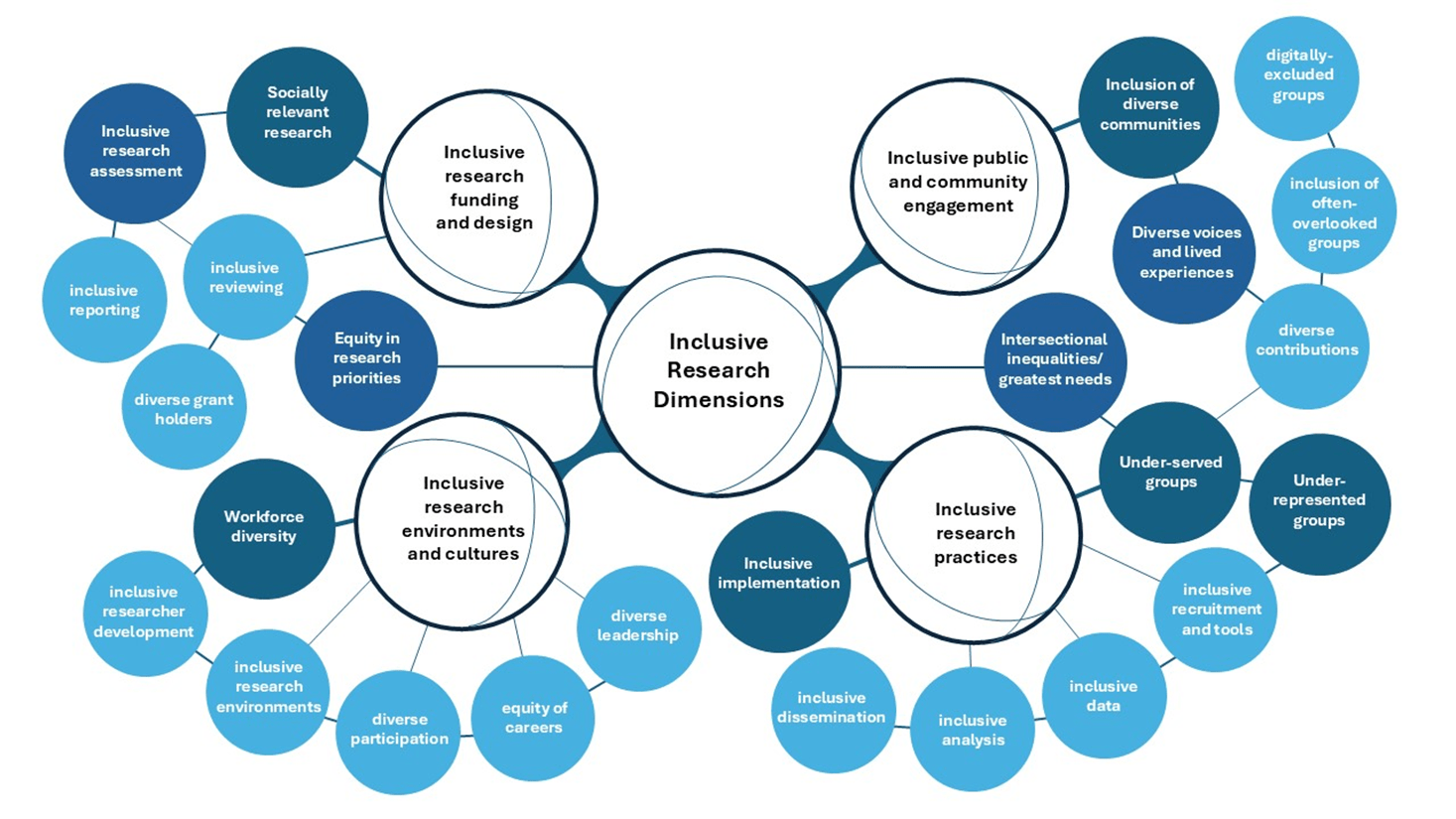
    A recent horizon scan of concepts related to the UK research inclusion landscape indicates domains in which inclusive research is being developed and implemented, illustrated by Figure 1.

    Inclusion is being accelerated by the Research Excellence Framework (REF) 2029, with a stronger focus on assessing People, Culture, and Environment (PCE). REF 2029 emphasises the integration of EDI considerations across research institutions, with a focus on creating equitable and supportive cultures for researchers, participants and communities. The indicators and measures of inclusion that will be developed and used are important because they can encourage diversity of perspectives, knowledge, skills and worldviews into research processes and institutions, thereby increasing relevance and improved outcomes. All units of assessment and panels involved in the REF process will have guidance from the People and Diversity Advisory Panel and the Research Diversity Advisory Panel. This means that inclusion will develop in both the culture of research institutions and the practices that shape research assessment.

    The National Institute for Health Research, which is the largest funder of health and social care research, has pioneered inclusion for over 30 years and prioritises inclusion in its operating principles (see NIHR Research Inclusion Strategy 2022-2027). NIHR’s new requirements for Research Inclusion (RI) will be a powerful lever to address inequalities in health and care. NIHR now requires all its domestic commissioned research to address RI at the proposal stage, actively involve appropriate publics, learn from them and use this learning to inform impact strategies and practices.

    Given the learning across various domains, we ask: How can the broader UK system share knowledge and learn from the setbacks and successes in inclusion, rather than continually reinventing the wheel? By creating space in the system between research funders and institutions to share best practices, such as the Research Culture Enablers Network, we can accelerate progress and contribute to scaling up inclusive research across professional groups and disciplines. There are numerous examples of inclusive innovation, engaged research, and inclusive impact across disciplines and fields that could be shared to accelerate inclusion.

    Developing Shared Language and Inclusive Approaches

    Approaches to building inclusive cultures in research often come with passion and commitment from opinion leaders and change agents. As often happens when levering change, a technical language evolves that can become complex and, therefore, inaccessible to others. For example, acronyms like RI can apply to research inclusion, research integrity and responsible innovation. Furthermore, community-driven research, public and community engagement, and Patient and Public Involvement (PPI) have become synonymous with inclusive research, and such participation is an important driver of inclusion.

    The language and practices associated with inclusive research vary by discipline to reflect different contexts and goals. This can confuse rather than clarify and form barriers that possibly get in the way of trust and more effective inclusion strategies and practices. We ask: How can we establish shared understanding, methods of participation, accountability pathways and mechanisms that will promote inclusion in the different and dynamic contexts of UK research?

    With over 20 years of experience in the fields of inclusion and equity, like other researchers, we have found that interdisciplinary collaboration, participatory methods, co-production, and co-design offer valuable insights by listening to and engaging with publics and communities on their own terms and territory. An inclusive approach has deepened our understanding and provided new perspectives on framing, methodological development, and the critical interpretation of research.

    Final reflection

    Key questions to overcome EDI cynicism are: How can we deepen our understanding and integration of intersectionality, inclusive methods, open research, cultural competency, power dynamics, and equity considerations throughout research processes, institutions, and systems? There is always more to learn and this can be facilitated by inclusive research cultures.

    Figure 1. Inclusive Research Dimensions

    Source link

  • Will Trump’s “anti-wokeism” change DEI in Australian universities?

    Will Trump’s “anti-wokeism” change DEI in Australian universities?

    United States President Donald Trump’s first six weeks of his second term has been defined by 76 executive orders, the disestablishment of the national education department and establishment of the Department of Government Efficiency (DOGE).

    One of the most controversial executive orders, which is a written directive signed by a president that orders immediate governmental action, was titled “Ending Radical And Wasteful Government DEI Programs And Preferencing,” signed on President Trump’s first day back in office on January 20, 2025.

    He directed all federal DEI staff be placed on paid leave and, eventually, laid off. He has also signed another Executive Order, titled “Ending Illegal Discrimination and Restoring Merit-Based Opportunity.”

    DEI stands for diversity, equity and inclusion, and refers to programs and committees that help people from underrepresented backgrounds (women, Indigenous, Black, for instance) get into, and stay in, jobs or courses those people wouldn’t traditionally participate in. It is largely similar to the strategy of the Australian Universities Accord.

    President Trump has also cut funding to schools and universities that do not cancel DEI programs. He labelled the programs “radical,” “wasteful” and said they demonstrate “immense public waste and shameful discrimination.”

    The full effects of these Executive Orders and DEI changes are yet to be seen because decisions regarding DEI will ultimately be made by the court.

    However, private companies in the US have walked away from internal DEI programs, including Meta (which has worked closely with Trump as of late), Google (which provides some services to the US government), Pepsi, Disney and multiple prominent banks.

    There has been no significant walk away from DEI in Australian private companies, and many universities continue to discuss how to bolster and “future-proof” internal DEI programs.

    Australia’s ambassador to the US from 2020 to 2023, Arthur Sinodinos, told the Universities Australia Solutions Summit last week that institutions are best off making decisions “based off their objectives,” but should enact genuine change, not just tick diversity boxes.

    Arthur Sinodinos said DEI should be about achieving true diversity rather than ticking boxes. Picture: Sam Ruttyn

    “My view on DEI is that [universities should] start from a posture that they want to make the best use of all the talent and resources available to them,” he said.

    “If you’re also interested in trying to expand the reach of higher education to groups that might otherwise be disadvantaged, you have to find ways to do that, but in a way that also addresses the genuine issue.

    “I think access to higher education is still important for a country like Australia, which has to make – given its population – the best use of the resources it’s got.

    “The argument that you can just leave it to the market, the meritocracy will still be there [is wrong]. Frankly, in the market, some people start with a head start with with inbuilt advantages.”

    President Trump’s former White House chief of staff Mick Mulvaney, who was also on the panel at the UA summit, said he thinks DEI programs in the US have gone “too far to one side.”

    Former Trump White House chief of staff Mick Mulvaney said he thinks DEI has gone “too far” in the US. Picture: UA

    “One of the reasons you’re seeing the pushback against it in my country is that it went too far to one side. I don’t know where it is in this country, but at some point it may go too far, and the pushback will come.”

    He also explained why this Trump term is already more action-packed than his first was at this time: the President expected to win in November, 2024, but not in 2016.

    “Not only did [Trump] expect to win, [his team has] been working for four years on what they would do when they won,” he said.

    “What are we gonna do the first day? The first week, the first month, the first 100 days? Which is why we’re seeing all these executive orders. It’s actually four years worth of planning coming forward.”

    Mr Mulvaney said he thinks DEI could survive if its reasoning for existing is communicated in a tailored way.

    He said Trump’s administration is receptive to initiatives that improve efficiency, productivity and merit.

    “You could have a program that is good on on the climate, [for example,] but that’s not your selling pitch. That doesn’t register with the person you’re talking to,” he explained.

    Related stories: “Unis are not Centrelink offices”: Coalition’s pitch to university leaders | Q&A: Bill Shorten talks VC pay cuts and politics in HE | Report card: Accord recommendations 12 months on

    “You have to learn how to speak the language of the person you’re talking to. Don’t change what you’re doing, perhaps just simply change how you explain it.”

    UA chief executive Luke Sheehy was asked after his National Press Club address last Wednesday whether he thinks an “anti-woke” sentiment will affect how universities function.

    Luke Sheehy’s membership body discussed the impact of “Trump 2.0” at last week’s conference. Picture: UA

    “Obviously there’s a major disruption that’s happened in America with Trump 2.0 … One of the things we’ve learned is, once articulated in a certain way, positive sentiment skyrockets for universities,” he responded.

    “If you offer a simple proposition: we have 4,000 fewer teachers than we need today ,and universities are the only way to get those skilled workers into the workforce to support young people; we need 132,000 more nurses, etc.

    “Then remove yourself from what happens on the front pages of newspapers and what occupies political pundits, and think about what the real Australian people need and want from the university sector.

    “My hope is that the more we talk about the important role of universities and our core mission in education and research, the more Australians, irrespective of whether or not they went to university or not, they see the value for us as part of our future.”

    The university sector’s declining “social license” has been a major topic of discussion of late for university leaders.

    There is a growing sentiment that universities, and the knowledge economy, needs to “show” society why they’re worth the funding and enrolments.

    “We always have more work to do. In an era where there is declining trust in institutions, I think it’s really important that universities invest in themselves in terms of how they engage with their communities,” Mr Sheehy continued.

    Source link

  • How universities can fix health workforce shortages

    How universities can fix health workforce shortages

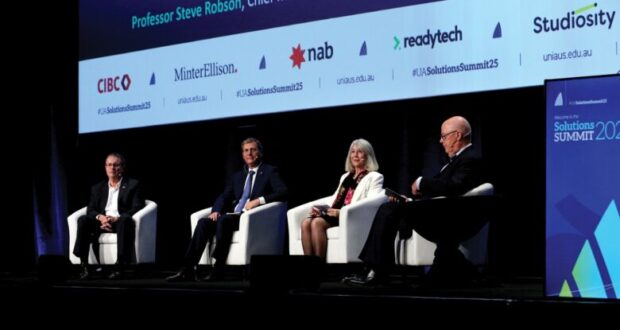
    A panel of experts discuss the health workforce crisis at the UA Solutions Summit 2025. Picture: UA

    Three Australian healthcare experts last week told universities how to solve the biggest challenges and possible solutions to a number of issues.

    Please login below to view content or subscribe now.

    Membership Login

    Source link

  • Supporting commuter students with the right information

    Supporting commuter students with the right information

    Commuter student support takes different forms, from student lounges to travel bursaries.

    However, when it comes to something as simple as the information that universities provide to prospective students and current students, it remains stubbornly focused on traditional, residential students.

    As a result, commuters make untenable choices at the applicant stage, find student life difficult to navigate and feel a profound lack of belonging, throughout their student experience.

    Getting it right at the start is as important as throughout.

    What information is out there

    In our research, which we are currently preparing for publication, we talked to commuter students and uncovered the practical impacts of a lack of information. Students suggested that their choice of institution, choice of course and the choice either to commute or relocate may have been different, if they had known about the personal, financial and educational impacts of commuting.

    They didn’t just talk about travel information – bus routes, train times, car parking – which is still important and largely missing from university webpages and prospectuses. They focused more on their need for information to help them to navigate life as a student who commutes.

    Commuter students told us that this absence of information suggested to them that universities don’t see commuters, leading them to feel that they don’t belong and they don’t matter.

    The hidden curriculum

    Our findings suggest that commuters need information in two areas, “rules of the game” and “sense of belonging.”

    These are the terms developed by Dr Katharine Hubbard and colleagues to describe the two domains of the “hidden curriculum” that universities must make explicit, if non-traditional students are to succeed at university.

    Our research sought to address this hidden curriculum for commuter students by developing best practice guidance for information that universities should provide to support commuters in their choices, transition and day-to-day university experience.

    We randomly selected 30 universities from the 147 institutions currently registered in the UK. We entered their website and searched “commuter students.”

    We downloaded and assessed the content and utility of the first four search results and then used Google search to find “university name commuter students” and followed the same method.

    We found that the hidden curriculum for commuters is very real. Very few institutions have information for commuter students. Very few have information available to students pre-application, to enable an informed decision and very few have information specifically to support commuters.

    Those that do, tend to focus on commuters in the negative, discouraging travel to university, in a sustainability context and framing commuting as a challenge and encouraging relocation to halls of residence.

    Getting it right

    But there are universities that are getting it right. Our research identified some best practices.

    Some institutions provide information about being a commuter at every stage of the student lifecycle and for every student touchpoint. Ideally, including a commuter student equivalent for all information, advice and guidance that is provided.

    This is especially important whenever students are making a choice – of institution, course, module, accommodation – and whenever you are providing a service – extra-curricular activities, support and other resources. Not only will this enable informed choice, it will increase the visibility of commuters, which will enhance their sense of belonging.

    It’s also important to be clear about learning and teaching, to enable commuter students to make informed decisions about how possible it is to succeed as a commuter. For example, is attendance mandatory for all taught sessions? How many days a week will students be timetabled to attend and when will they know? Do students have to be able to physically access the library? Do you provide on-commute learning options?

    Institutions should also ensure that information for commuters is easy to find and take a joined-up approach. We found that the best information for students was content like blogs written by commuters chronicling a day in their life, presenting “life hacks” or linking students to a commuter community. These were available via student societies, or the students’ union, which often aren’t linked to from the institution’s webpages.

    Information should be “student first.” For example, ensure that travel information is available to support commuters to access their learning, rather than information about sustainability, or to discourage driving. Most of the travel information that we reviewed was abrasive in its tone, highlighting the inaccessibility of campus to car drivers and focusing on promoting modes that commuters shouldn’t use – this is noble, but it isn’t useful and it adds to the feeling that commuters are not welcome.

    Another example is, rather than linking to your Access and Participation Plan as evidence that you consider the needs of commuters, interpret this and talk directly to them.

    Finally, most of the information that we reviewed highlighted the problematic nature of commuting – but it can be a positive choice. Information provided by students, for students, was especially effective in promoting the benefits of commuting, supporting students to navigate life as a commuter, from a practical and emotional perspective.

    Providing commuters with more honest information about the multiple costs and benefits of being a commuter student, at every stage of the student lifecycle, alongside practical support to help them to overcome these, will support students to succeed. It demonstrates, through information alone, that students are welcome and that they belong.


    This blog is part of our series on commuter students, click here to read more.

    Source link

  • Advice from Indigenous students to Indigenous students

    Advice from Indigenous students to Indigenous students

    Navigating student life, especially when entering university or tertiary education for the first time, is no easy feat.

    Students are often dealing with newfound independence, more travel, gruelling schedules, and a shift in priorities, all while trying to develop new skills and knowledge.

    Finding support and motivation during this time is essential, but it means different things to different people.

    In my role as chief executive of Aurora Education Foundation, I work with a number of Indigenous scholars who are studying at some of the world’s most prestigious universities.

    Recently, I asked three of them to share what had helped them get to where they are now and what advice they had for other students just starting their educational journey.

    Lean on your loved ones

    Warumungu woman Mady Wills is currently completing a Master of Science in Developmental Psychology and Psychopathology at King’s College London, with a Roberta Sykes Scholarship.

    Mady said the support she received from her loved ones was invaluable along her journey, but almost equally, the doubt she received from others around her motivated her to achieve her best.

    “Reflecting on my educational journey so far, I have a huge amount of gratitude for the support I have received along the way. It hasn’t always been easy, and I have faced moments of doubt – both my own and from others – that challenged my commitment to my dreams,” she said.

    “But sometimes when people doubt you, question you, or make you second guess your dreams, it can actually be the most powerful motivator.

    The journey (whatever this looks like, be it career, high school, TAFE or Uni) is not meant to be a smooth one, and it’s important to remember that encouragement doesn’t always come in the form of praise. Sometimes, scepticism fuels resilience.

    “For me, each challenge, doubt or difficult moment strengthened my determination to work harder, to prove my capabilities, and to demonstrate what is possible. All I would say to anyone even considering taking this step – submitting that scholarship application or researching that course abroad – do it.”

    Build stamina

    For Wardandi Noongar woman Danielle Kampers, developing stamina was key to her success. Danielle is studying a Master of Science in Oceanography at the Scripps Institute of Oceanography at the University of California, San Diego, with a Roberta Sykes Scholarship.

    Danielle said one piece of advice about cultivating stamina and resilience changed her outlook on her education journey and set her up with the tools she needed to succeed.

    “When I started my science degree it filled me with enthusiasm to address significant challenges in marine environments and explore the wonders of scientific inquiry,” she said.

    “One piece of advice that stayed with me was the importance of ‘stamina’ – it’s crucial for a fulfilling and productive career in science. Cultivate resilience, manage stress effectively, stay flexible, maintain a positive outlook even during tough times and the rest will work out for itself.

    “Additionally, don’t hesitate to ask for help when needed, support and kindness are passed along and often come back around when you need it most.”

    Focus on what you can control

    Warumungu man Ethan Taylor, who is currently studying at the University of Oxford to complete a Doctor of Philosophy in Politics, with a Roberta Sykes Scholarship, said that while hurdles are bound to happen on any journey, remaining focused on your goal was most important.

    “I would encourage other aspiring Indigenous scholars to stay driven and focus on what’s in their control. If something doesn’t work out, that’s okay – keep moving,” he said.

    “Hard work will never guarantee you success in academic or scholarly pursuit, but it will certainly put you in the best position to be successful.

    “If you’re a humanities or social science student like me, keep focussing on the fundamentals of scholarship in this area: reading and writing. Keep reading widely in your field and keep eliciting feedback in your writing.

    “Keep thinking and developing your ideas, even in the face of apparent rejection or failure. At the end of the day, by mastering these fundamentals and learning how to articulate yourself better, you’ll end up becoming someone who can’t be ignored or overlooked.”

    Leila Smith is the founder and chief executive of the Aurora Education Foundation.

    Source link

  • CSUDH announces alternate funding sources for Work-Study

    CSUDH announces alternate funding sources for Work-Study

    On Feb. 25, California State University, Dominguez Hills, communicated to campus employers that the university had utilized nearly all of its Federal Work-Study (FWS) funds for the current school year. The notice was amplified by this article, which incorrectly stated that the campus was terminating student employees.

    CSUDH is fully committed to ensuring our FWS students receive the amount they expected to be awarded. Administrators have identified alternate funding sources to compensate these students, including university scholarship and grant funds for those who qualify, as well as discretionary funding where needed.

    This will be a complex task, due to the different situations each student employee and department are in. For now, the university is asking that departments postpone any employment-related decisions for affected student workers until financial aid staff provide further details.

    Going forward, CSUDH is implementing new internal controls over FWS hiring and tracking to address anticipated high demand for FWS. We will also be hosting FWS trainings to support employers and timekeepers who will be hiring and managing FWS.

    CSUDH deeply appreciates the patience and collaboration of our campus community while we work to resolve this matter quickly and equitably for all impacted students.

    Sincerely,

    Lilly McKibbin
    Media Relations Specialist
    California State University, Dominguez Hills

    Source link

  • The case against impartial university teaching

    The case against impartial university teaching

    “I don’t share my political or religious perspectives at work; I never have”, asserted my experienced professorial colleague over an informal coffee. “A bit of shame, but kind of admirable, right?”, I thought.

    I recalled a politics lecturer during my time as an undergraduate, who, like seemingly most of that generation of academics (1990s-00s), believed in impartiality and explicitly stated his liberal neutrality when presenting challenging topics: may the best arguments win. The problem was that through reading his online bio and finding his works in the library, one could very quickly discern his political and philosophical leanings!

    When I began teaching philosophy at the same university a few years later, I too attempted to feign neutrality; neither sharing my political nor religious leanings, nor ethnic or cultural heritage. It wasn’t the done thing. Autobiography and self-disclosure had no place in the philosophy seminar room.

    I’ve since thawed. I’m now leaning far more towards disclosure than when I started teaching. I long held neutral impartiality as the gold standard of instruction, whereby challenging – and perhaps controversial – topics were discussed, but the educator held the space for students to explore perspectives, without sharing their own. This, while often the received wisdom, and certainly well-intentioned, is, I now reflect, limited.

    For an academic to be teaching on a module, especially if they’ve created it, means they’re very likely to be published in that field of inquiry. Engaged students will find such materials, understand their lecturer’s perspectives, and recognise when they’re playing devil’s advocate in sessions. Furthermore, given that we teach face to face, and not in confession booths, the visibility of us as lecturers often speaks volumes; students will make an array of assumptions. For example, if in a session led by the university’s chaplain, it’s safe for students to assume that they’re a member of the Church of England.

    Kelly’s heuristic quartet

    There is a case to be argued for “committed impartiality” as per Social Scientist Thomas Kelly’s (1986) heuristic quartet:

    • Exclusive neutrality: The educator takes a neutral position and eschews any potentially controversial issues; i.e. appropriate in a school context, but too reductive for HE.
    • Exclusive partiality: The educator takes a biased position; i.e. traditionally a big no no. Think here of educators who use their classes to enact their activism.
    • Neutral impartiality: The educator is impartial and neutral, encouraging students to explore controversial issues; i.e. the gold standard of HE instruction based on received wisdom.
    • Committed impartiality: The educator takes a biased position while also being impartial; i.e. seen with scepticism by those who practise neutral impartiality. This is a potentially slippery slope into exclusive partiality.

    While referring principally to the teaching of “controversial” topics in school education, I think the quartet can be helpfully adapted to fit the context of contemporary HE teaching in the social sciences and humanities. Kelly claimed that owing to its contradictory position, “committed impartiality” is the most defensible course of action for educators to engage in teaching controversial issues. This is because it requires the educator to put their cards on the table and encourage debate without claiming an unbiased standpoint.

    Wading

    When discussing loaded issues such as race, sexuality and religious perspectives, perhaps this is where the received wisdom about steadfastly refusing to disclose shines through and avoids the – especially contemporary – quagmire of a shallow form of identity politics and virtue signalling that can sometimes turn into a form of oppression Olympics? The “disclosure dilemma” is, of course, ultimately a personal, context bound one.

    In the context of schools, the issue of disclosure is much more vexed, given that teachers are effectively agents of the state who have a moral duty to avoid prosletysing given the power dynamic of the classroom (I recall the example during COvid-19 of a teacher in Nottinghamshire getting national attention for encouraging students to write letters of frustration to the then PM).

    While school curricula are obviously created by groups of individuals with political agendas, in HE we too have areas of expertise, interest, and passion. In an increasingly regulatory framework, the dissemination of our darlings is bound by legislation such as the Equality Act (2010), and The Higher Education Freedom of Speech Act (2023). Furthermore, to adhere to these acts within a localised context, my employer has a university dignity policy, mission statements, and, within my department, enacts the Chatham House Rule. We also provide trigger warnings to create inclusive learning environments.

    Tightrope

    This discussion has implications for those in the social sciences, especially those who deal, like I do, with explicitly political content (I recognise that the personal is also the political). Of course, navigating the tightrope between committed impartiality and exclusive partiality is tricky. The received wisdom is valuable insofar as it helps the educator to avoid this balancing act. But when the educator has a specialism that speaks to a political issue of the day, it is arguably upon them to do so. For example, in March 2023 I was teaching a session for final year UG students on migration in the context of international education when the Gary Lineker “issue” kicked off. I had a well-informed perspective on that issue, and it linked neatly to the scheduled taught content that day. It’s fair to say that I teetered on that tightrope between committed impartiality and exclusive partiality!

    The challenge is not about self-censorship in the service of an apparently noble ideal of neutral impartiality, but enacting personal commitment and setting the groundwork for civic debate. Deciding to disclose may have the intended learning outcome of rapport building, modelling particular behaviours or perspectives, humanising oneself, normalising situations, or problematising a set of affairs; it’s about practising the messy craft of educating, and being open to self-transformation.

    Risk aversion

    I’m sure others could make equally compelling cases for different positions within, and outside of, Kelly’s heuristic quartet. I think a primary driver behind neutrality is, rather than a noble but impossible quest for untainted discourse, perhaps one of nervousness; nervousness of being seen as doctrinaire or unduly influencing students’ perspectives?

    Overall, the disclosing instructor must consider their visibility in terms of gender, age, physical presence, professional titles etc. that starkly reinforce a power imbalance between student and academic, aka judge, jury and executioner in terms of grades and longer-term prospects. Where the stakes are high boldness of speech, disclosing personal leanings in a learning environment are worth the risk.

    Source link