Category: Featured

  • The Curriculum and Assessment Review

    The Curriculum and Assessment Review

    Author:
    Professor Sir Chris Husbands

    Published:

    This blog was kindly authored by Professor Sir Chris Husbands, who is a Director of Higher Futures and a HEPI Trustee. He was previously the Vice-Chancellor of Sheffield Hallam University.

    The Final Report of the Curriculum and Assessment Review led by Becky Francis has been published.  At 196 pages, with 16 pages of recommendations, it is a long and complex document – long and complex enough for early commentary to find quite different things in it.  The Daily Telegraph headline was ‘five year olds to learn climate change under Labour’ (a Bad Thing).  The Guardian headline was that the curriculum “should focus less on exams and more on life skills” (a Good Thing). The Times was more neutral, picking up on “more diversity — and fewer exams at GCSE” (which could be Bad Things or Good Things).  The report’s length and attention to analytical detail (there are 478 footnotes and what is by comparison a brief analytical annex of 37 pages) make it difficult to summarise.  But so do the granularity of the recommendations, which include such recommendations as that the Government reviews “how the PE Key Stage 1 to 4 Programmes of Study refer to Dance, including whether they are sufficiently specific” (p 106), or that it “makes minor refinements to the Geography Programmes of Study” (p 83).  The detail and granularity are consistent with Becky Francis’s repeated statement that her review would be “evolutionary not revolutionary”, and there is enough here to keep curriculum leaders in schools and assessment policy wonks in awarding bodies busy for a very long time. But they make it difficult to see the underlying ideas.

    But underlying ideas are there.  From the perspective of higher education policy, there are probably three.  The first is commitment to evolution rather than revolution. The school curriculum in five years’ time will not be unrecognisable from now.  It will continue to be a subject-based, knowledge-led curriculum.  Some of the more egregious aspects of the Gove reforms of a decade ago – the obsession with formal teaching of technical grammar such as ‘fronted adverbials’ (p 75), the overloading of history programmes of study (p 85) and the obsession with pre-twentieth century literature (p79) — are abandoned. There is greater emphasis on diversity and inclusion “so that all young people can see themselves represented” in what they learn (p 10). The review is conservative on assessment. The burden of assessment at 16 is to be reduced, suggesting that a reduction of 10% in GCSE examinations is feasible to increase time for teaching (p 135), but not changed in its overall form. Government “[should] continue to employ the principle that non-exam assessment should be used only when it is the only valid way to assess essential elements of a subject” (pp 138, 193), because “externally set and marked exams remain the fairest and most reliable method of assessment” (p 136).

    This rebalancing, with less prescription, greater clarity between what is statutory and what is advisory and the reduced volume of GCSE (but not, unless I have missed it, A-level) assessment is the key to a second underlying idea which is an attempt to enhance teacher agency.  This is cautious.  The report is strong on pupil entitlement: this is a “national curriculum … for all our children and young people” (p180), which obviously means that it should apply to academies as well as local authority maintained schools, and that it should apply to all learners, not least because “learners with the lowest GCSE attainment (particularly grades 1 or 2) have fundamental knowledge gaps that extend to earlier key stages” (p163). But the report also recognises that any curriculum depends on those who teach it, and it recommends that the overhaul of programmes of study “involve… teachers in the testing and design of Programmes of Study as part of the drafting process” (p54). In all curriculum reform, the balance between prescription and latitude, between entitlement and flexibility is difficult.  The report creates more space for teachers to make choices, but it retains a strong prescriptive core, and in some cases extends that: under current arrangements, Religious Education, although compulsory is outside the national curriculum.  Francis wants the content brought into national requirements, and there will be hard fought arguments about RE.

    The third key idea is about the 16-19 curriculum.  The review stresses the key importance of level 3 learning and qualifications in “shaping life chances and supporting our economy” (p31), and it is sensibly less clear-cut than the interim report appeared to be on the differentiation between academic and vocational pathways at 16-19.  Arguably, the report is agnostic about which Level 3 pathway students pursue, providing that more do access level 3.  The report recommends abandoning the English Baccalaureate performance measure on the evidential grounds that “whilst well-intentioned [it has] not achieved” its goal and has “to some degree unnecessarily constrained students’ choices” (p10).  The EBacc will be largely unmourned, except by its ministerial architects. The Review’s strong focus on progression is critical and may be its most important feature in the long term. Francis “thinks it is important that as many learners as possible who have achieved level 2 (five GCSEs at grade 4 or above or the equivalent) should be supported to study at level 3” (p141).  This is obviously important for HE and is consistent with the Prime Minister’s Labour Party conference commitment to expand access to tertiary education. The Review unsurprisingly endorses the new ‘V-level’ qualification, although T-levels and V-levels refer to concepts (technology, vocational education) which are not levels of study.  The Review remains committed to T-levels, and was probably required to be, but its evidence here on take-up (just 3% of learners, p141) is a reminder about just how far there is to go to establish T-levels.  But the fundamental point is that the future of widening participation at all levels of tertiary education depends on improving progression from level 2 to level 3.

    The Curriculum Review is a frustrating document to read.  It is complex, thorough in its analysis of evidence and has clearly been hemmed in by policy priorities in several directions.  It is dogged and detailed, well-meaning and intelligent, realistic about the world as it is and cautious about radical change.  It offers a nip here, a tuck there and a tweak in other places. Arguably, this is Starmerism in the form of education policy.  Natalie Perera, CEO of the Education Policy Institute, which I chair, called it “a broadly sensible direction of travel” and that is right. The initial reaction of the Opposition that the review rates “learning about climate change as more important than learning to read and write” is clearly absurd.

    Many of the Review recommendations are for government and others to do further work. That means that the real impact of the Review depends less on the recommendations themselves than on the combination of political will and strategic implementation to make things happen.  The government’s immediate response, which has been to accept some of the recommendations, suggests that there is scope for a good deal of frustration as thinking turns to implementation.  Higher education academics and institutions care a lot about the ways that the compulsory education system prepares young people for entry to higher education – even if that is not its main function.  What they get from the review is a largely recognisable curriculum landscape, conservatism about assessment approaches, a national entitlement to a more modernised and flexible curriculum, and, above all, a strong focus on pathways into post-16 study.
    Source link

  • Hyper Credentialism and the Neoliberal College Meltdown (Glen McGhee and Dahn Shaulis)

    Hyper Credentialism and the Neoliberal College Meltdown (Glen McGhee and Dahn Shaulis)

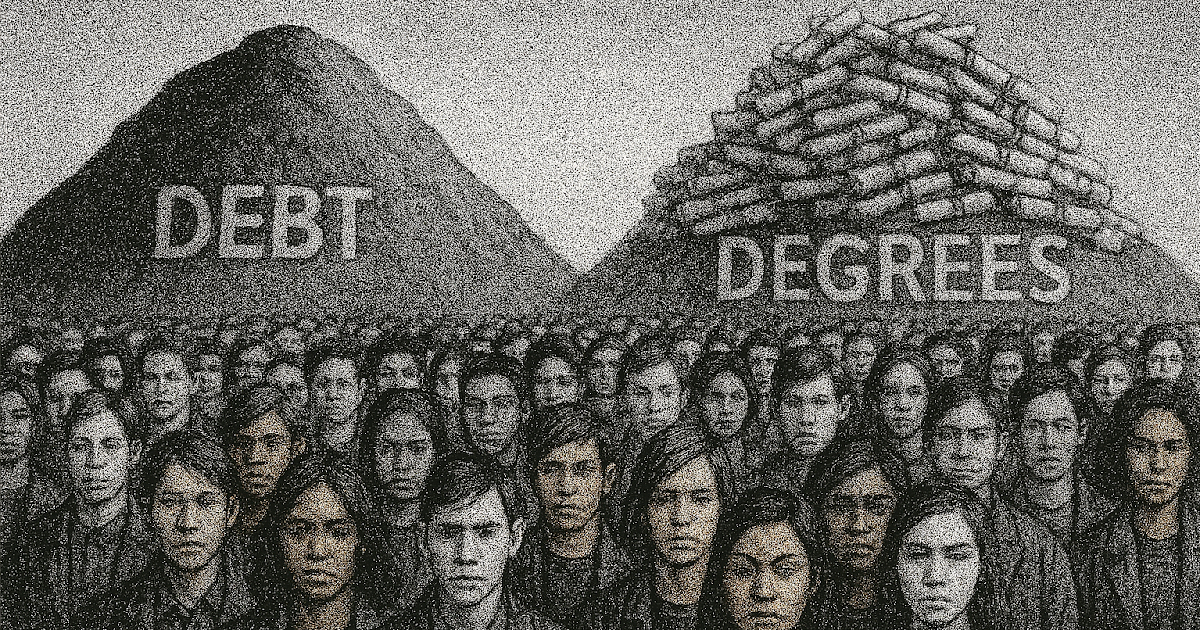
    In the neoliberal era, higher education has become less a public good and more a marketplace of promises. The ideology of “lifelong learning” has been weaponized into an endless treadmill of hyper-credentialism — a cycle in which students, workers, and institutions are trapped in perpetual pursuit of new degrees, certificates, and micro-badges.

    From Education to Signaling

    Once, a college degree was seen as a path to citizenship and critical thought. Today, it’s a market signal — and an increasingly weak one. The bachelor’s degree no longer guarantees stable employment, so the system produces ever-more credentials: master’s programs, micro-certificates, “badges,” and other digital tokens of employability.

    This shift doesn’t solve economic precarity — it monetizes it. Workers internalize the blame for their own stagnating wages, believing that the next credential will finally make them “market ready.” Employers, meanwhile, use credential inflation to justify low pay and increased screening, outsourcing the costs of training onto individuals.

    A Perfect Fit for Neoliberalism


    Hyper-credentialism is not a side effect; it’s a feature of the neoliberal education economy. It supports four pillars of the model:

    Privatization and Profit Extraction – Public funding declines while students pay more. Each new credential creates a new revenue stream for universities, online program managers (OPMs), and ed-tech corporations.

    Individual Responsibility – The structural causes of unemployment or underemployment are reframed as personal failures. “You just need to upskill.”

    Debt Dependency – Students and workers finance their “reskilling” through federal loans and employer-linked programs, feeding the student-debt industry and its servicers.

    Market Saturation and Collapse – As more credentials flood the market, each becomes less valuable. Institutions respond by creating even more credentials, accelerating the meltdown.

    The Education-Finance Complex

    The rise of hyper-credentialism is inseparable from the growth of the education-finance complex — a web of universities, private lenders, servicers, and Wall Street investors.
    Firms like 2U, Coursera, and Guild Education sell the illusion of “access” while extracting rents from students and institutions alike. University administrators, pressured by enrollment declines, partner with these firms to chase new markets — often by spinning up online master’s programs with poor outcomes.

    The result is a debt-driven ecosystem that thrives even as public confidence collapses. The fewer good jobs there are, the more desperate people become to buy new credentials. The meltdown feeds itself.

    Winners and Losers

    Winners: Ed-tech executives, university administrators, debt servicers, and the politicians who promote “lifelong learning” as a substitute for wage growth or labor rights.

    Losers: Students, adjunct faculty, working-class families, and the public universities hollowed out by austerity and privatization.

    The rhetoric of “upskilling” and “personal growth” masks a grim reality: a transfer of wealth from individuals to financialized institutions under the guise of opportunity.

    A System That Can’t Redeem Itself

    As enrollment declines and public trust erodes, the industry doubles down on micro-credentials and “stackable” pathways — small fixes to a structural crisis. Each badge, each certificate, is sold as a ticket back into the middle class. Yet every new credential devalues the old, producing diminishing returns for everyone except those selling the product.

    Hyper-credentialism thus becomes both the symptom and the accelerant of the college meltdown. It sustains the illusion of mobility in a collapsing system, ensuring that the blame never reaches the architects of austerity, privatization, and financialization.

    Sources and Further Reading

    Brown, Wendy. Undoing the Demos: Neoliberalism’s Stealth Revolution.

    Giroux, Henry. Neoliberalism’s War on Higher Education.

    Cottom, Tressie McMillan. Lower Ed: The Troubling Rise of For-Profit Colleges in the New Economy.

    The Higher Education Inquirer archives on the college meltdown, OPMs, and the debt economy.

    Source link

  • Should research be free for all?

    Should research be free for all?

    In the past, Gitanjali Yadav, like many other Indian researchers, would have used illegal online libraries to access academic journal articles. Now a new initiative by the Indian government brings hope as a legal alternative, delivering free article access to researchers across India.

    While Yadav benefits from the new scheme, it has brought her new challenges.

    Despite being one of the world’s top scientific research countries, many Indian universities don’t have enough funding for researchers to read the papers they need. 

    The Indian government sought to solve this issue with the One Nation One Subscription (ONOS) scheme. ONOS gives public Indian academic institutions free access to academic journals.

    But just as soon as the government gave access, they also took it away. Following the ONOS launch, another important website for reading academic articles was shut down. 

    Previously Sci-Hub, an illegal academic library, was the one-stop shop to read and download academic literature. Many Indian academics relied on it to access articles behind paywalls. But now the platform has been banned, leaving many Indian academics, and their research, without options. 

    A researcher at the National Institute of Plant Genome Research, Yadav downloads and analyzes thousands of academic articles for her research. Now, her attempts to access these articles on a mass scale have led to blocks by publishers even though her institution has subscriptions. 

    Why access matters

    Researchers worry that ONOS will not be able to replace Sci-Hub effectively, and that this will lead to downstream effects in conducting research. 

    India’s access problems raise a bigger question: can countries in the Global South compete in science when they don’t have the same access to information as richer countries? 

    Obtaining academic articles isn’t always simple. Similar to checking a book out from a library, you can only read an article if it is held in a library’s collection. Access to research papers is given through universities and academic institutions. 

    Academic journal subscriptions and publishing fees are estimated to earn $10 billion annually in the United States alone. The average cost of an annual subscription to a single journal by an Indian institution is around $1,300, though journals are often sold together in packages. The costs of these packages can vary, but a large Indian institution could expect to pay $50,000 for one year’s access, making the fee unaffordable for many Indian institutions. 

    Meanwhile, the researchers who provide articles and provide peer review for the journals are unpaid for their work

    Paywall problems

    Without access through their university, many academic articles are kept behind paywalls. Researchers can pay to read a paper, but fees average around $50 for a single article, and Indian universities can’t pay for all the journals they need. 

    “You’re somebody working in an Indian laboratory,” said Peter Murray-Rust, Cambridge researcher and well-known advocate for Open Access science. “What are you going to do? You’re going to pirate it.” 

    Launched in 2011, Sci-Hub changed Indian research by allowing anyone to illegally read articles for free, even if the articles were behind paywalls. 

    One fan was Jonny Coates, the executive director of Rippling Ideas, an organization that advocates for open access to scholarly works. “There are some people who tell you, actually, what Sci-Hub’s done is it solved the access problem,” he said.

    At its peak, Sci-Hub provided access to over 81 million research articles. For academics in India, many started downloading articles illegally. The country downloaded over 5 million articles from Sci-Hub in 2017 alone. 

    Is ONOS a game changer?

    Comments from hundreds of Indian researchers can be found thanking Alexandra Elkyban, Sci-Hub’s founder, online: “The website Sci-Hub you have developed is like an oasis in the desert for people like me,” wrote Indian researcher Keshav Moharir. “God bless you.”

    Now the platform is banned, and the Indian research scene is changing. The Indian ban on Sci-Hub follows a 2020 lawsuit filed by major academic publishers like Elsevier and Wiley

    When the Indian government launched the $715 million ONOS initiative earlier this year it was heralded as a solution to the access problem because it gave eligible public institutions free access to 13,000 academic journals.

    The announcement was met with much excitement: cutting-edge research could now be pursued without financial barriers. Researchers from small institutions were enthusiastic that they could finally access the resources previously limited to top tier universities. Indian Prime Minister Narendra Modi described it as a “game-changer for Indian academia and for youth empowerment,” in an X post. 

    But ONOS has also faced criticism from researchers. For those offered ONOS, more than half are still waiting to use the platform, and it’s unclear why they remain without access. At the same time, ONOS also only covers a small portion of the some 40,000 academic journals worldwide, limiting access to specialized publications that can be important for researchers. And there are logistical challenges, highlighted by Yardav’s difficulties. 

    Private universities, meanwhile, are left without ONOS or Sci-Hub. And some say it will be difficult for them to conduct research going forward.  

    Beyond India 

    India’s challenges show a bigger problem in the Global South. In contrast to institutions in high-income countries, those in the Global South have less money and fewer legal ways to read papers. That means that Global South countries are less likely to be able to read paywalled papers and include them in their own research. And because of this, their research may not be as strong or influential

    Lack of access can also influence what type of research gets done. A recent study by researchers at NYU Abu Dhabi on paywalls and scientific data concluded that paywalls can compound disparities between who gets access and who doesn’t and who ends up contributing to the global production of knowledge.

    One researcher from Ghana quoted in the study noted that the availability of papers could affect which projects he recommends to his students. 

    Murray-Rust said that being able to read the body of research is so essential for conducting good science, that in many cases, piracy becomes a standard practice.

    Whether government-led schemes can replace grassroots alternatives like Sci-Hub effectively is yet to be seen. 

    Researchers like Yadav fear that ONOS will end up being more symbolic rather than a real change for India’s research community. For now, India’s academic community finds itself in a difficult phase of transition. 


    Questions to consider:

    1. Why does it cost money to access some research studies?

    2. Who should fund scholarly research?

    3. If you put a lot of time and money into conducting a research study, would you give away the results for free? Why or why not?


    Source link

  • Winners of the Best Personal Academic Websites Contest 2025

    Winners of the Best Personal Academic Websites Contest 2025

    Congratulations to the winners of the 2025 Best Personal Academic Websites Contest hosted by Jennifer van Alstyne, Brittany Trinh, and Ian Li. This contest celebrates great examples of academic websites from people in Higher Education.

    About the Awards

    Congratulations to this year’s award winning academic websites!

    Hi there, I’m Jennifer van Alstyne. This is our 3rd Best Personal Academic Websites Contest. This page celebrates the 2025 award winners. We hope their websites help inspire people around the world to create space for themselves online. Please share these award winning websites with a friend you think should have a website too.

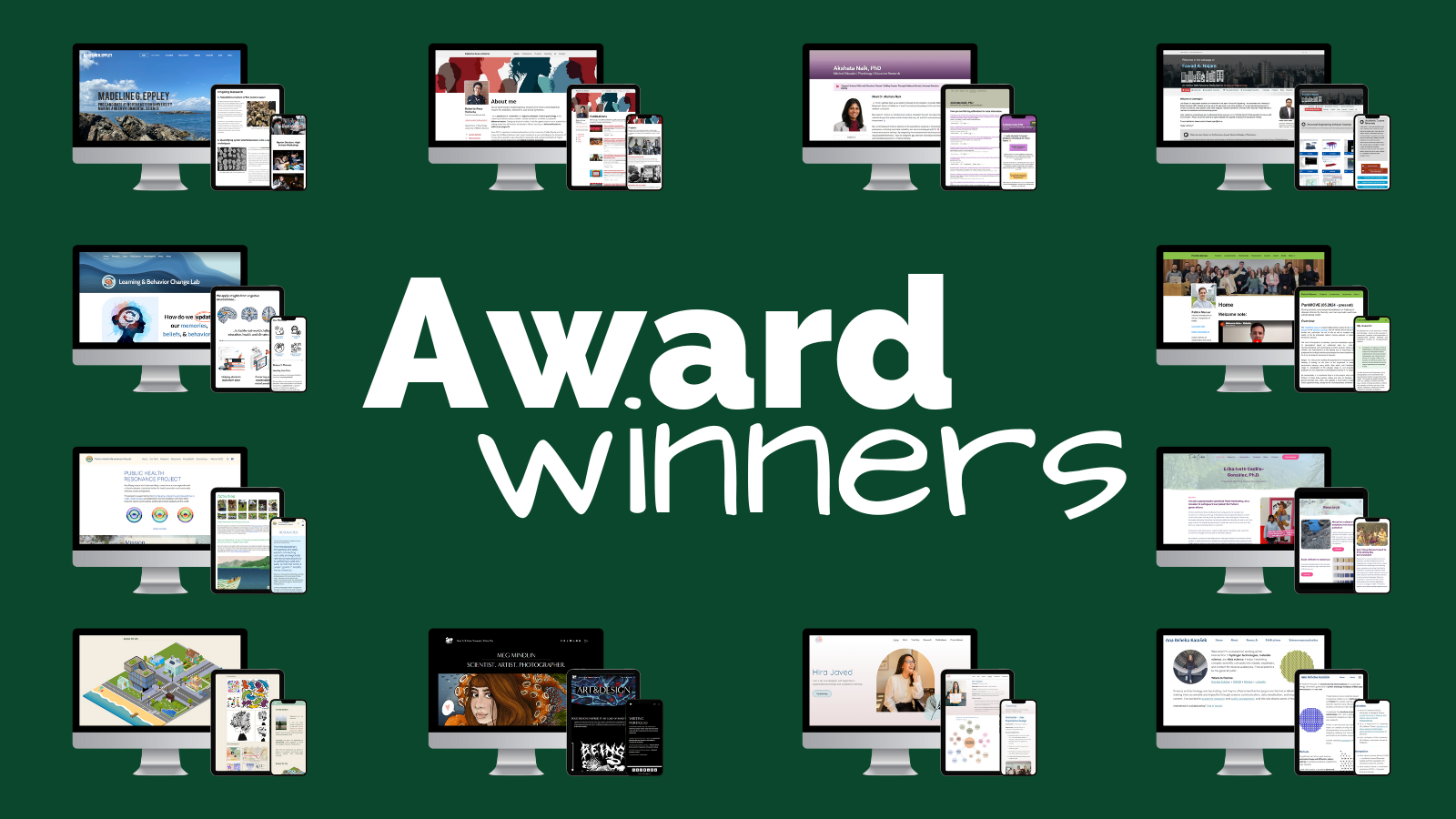
    There are 12 award winners in this year’s contest. In a year we’ve had more entries than ever before, these academic website stood out. Each of the award winners in this year’s contest received a perfect score from the judges.

    While their websites may grow and change with them over time, these award winning academic websites deserve to be celebrated for the work they’re already doing to share their story. Thank you.

    Best wishes,
    Your Contest Co-Hosts

    Jennifer van Alstyne of The Social Academic
    Brittany Trinh of the Beyond Your Science Podcast
    Ian Li, PhD of Owlstown

    What you’ll find on this page

    Check out the award winning websites

    Read what inspired people to create their website

    Find what the judges thought

    Resources to help you create a website of your own

    Subscribe for when the contest re-opens in 2026

    To each person who entered their website into the Contest, thank you. Thank you for creating that space for yourself online. Thank you for being open to sharing it with people. I’m so glad your website is in the world.

    Would you like feedback from the judges on your website? We’re happy to share our thoughts with you if you’d find it helpful. Each person who entered the 2025 contest can request feedback from the judges. Email Jennifer van Alstyne at [email protected]

    The Best Personal Academic Websites Contest was open for entries from April 22, 2025 and closed on August 15, 2025. It will reopen for entries in 2026.

    Want to hear about next year’s contest? Subscribe to The Social Academic.

    2025 award winners of the personal academic websites contest hosted by Jennifer van Alstyne of The Social Academic. On this graphic are 12 award winning websites from this year's entries.

    Madeline Eppley and Dr. Roberta Rosa Valtorta (tied)

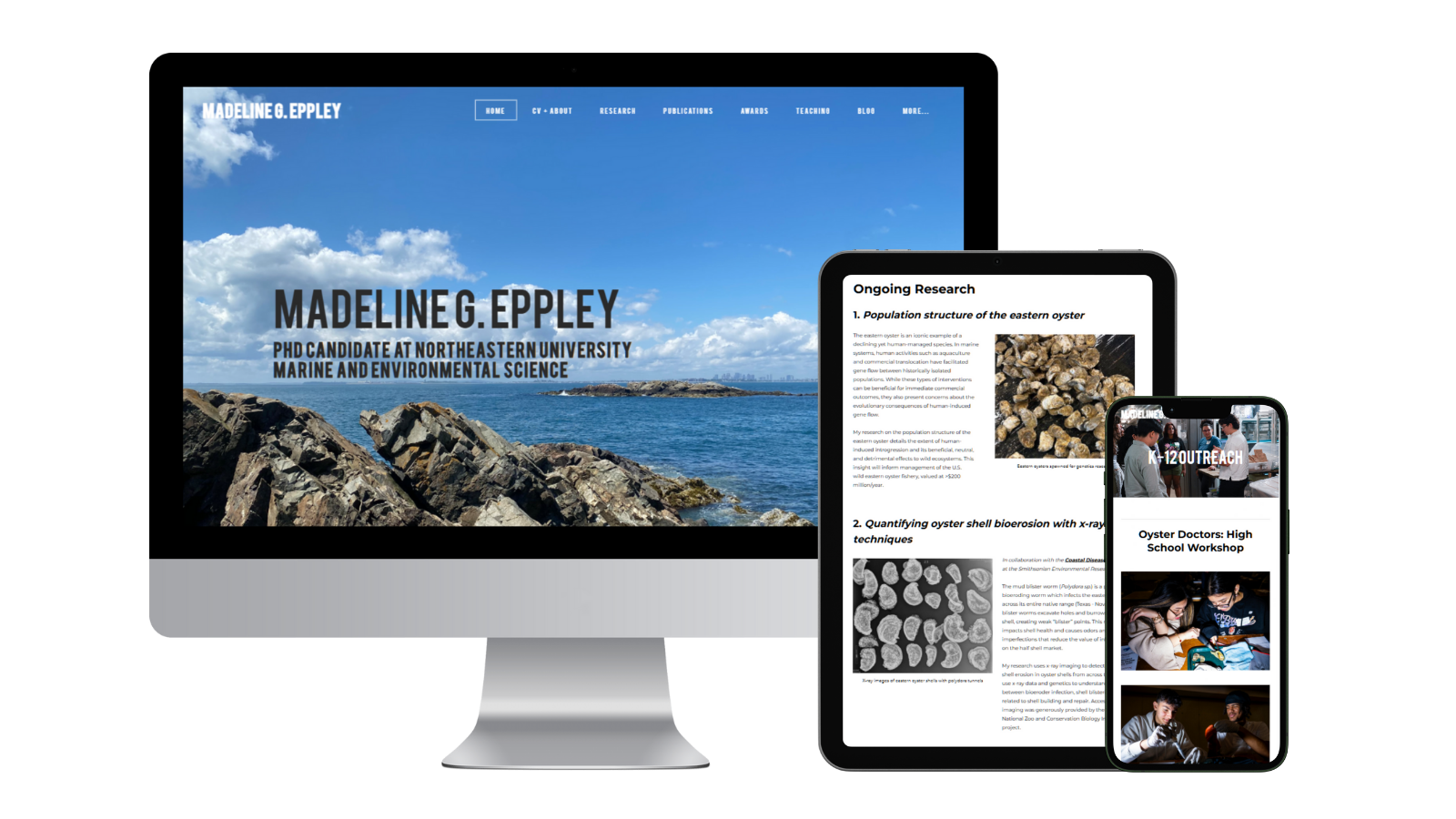
    Madeline Eppley Website on Desktop (homepage), Tablet (Research page), and Mobile (Outreach page) screens
    https://www.madeline-eppley.com/

    Madeline Eppley

    “I made my website because I feel there is a substantial gap in science communication training for graduate students and the broader field of biology. I graduated undergrad in 2020 when a lot of networking and resources went virtual. During this really pivotal stage in my career development, I needed to develop better digital presence and science communication skills to keep pace with the rising importance of networking in virtual academic spaces (e.g. virtual conferences and social media). Through this process, I ended up finding my current PhD position on social media, and also built a digital network that made me feel more connected to the science community online.”

    —Madeline Eppley

    Notes from the judges

    Jennifer van Alstyne: A visually engaging story-rich website. I hope Madeline’s website inspires people to take more photos because it makes such a difference. For instance, there’s a lot of content on this website, but it doesn’t feel overwhelming. While the top menu is initially hard to read, when I start scrolling there’s contrast. I like how Madeline’s research page shares ongoing research and completed research.

    Brittany Trinh: I love Eppley’s website, from the bio to all the photos of the field research. On the homepage, Eppley makes her passion for research and science communication clear, as well as her future goals. The research page explains the importance and impact for each research project and specifies which projects are ongoing or completed. Looking at her website, I am now inspired to go update my own website and incorporate more science in it! 

    Ian Li: Eppley’s website is well-organized and provides a lot of details on what inspires her work and the results of her research. She also describes her outreach to college and high school students. Her blog has lots of stories about her research and experience on the field.

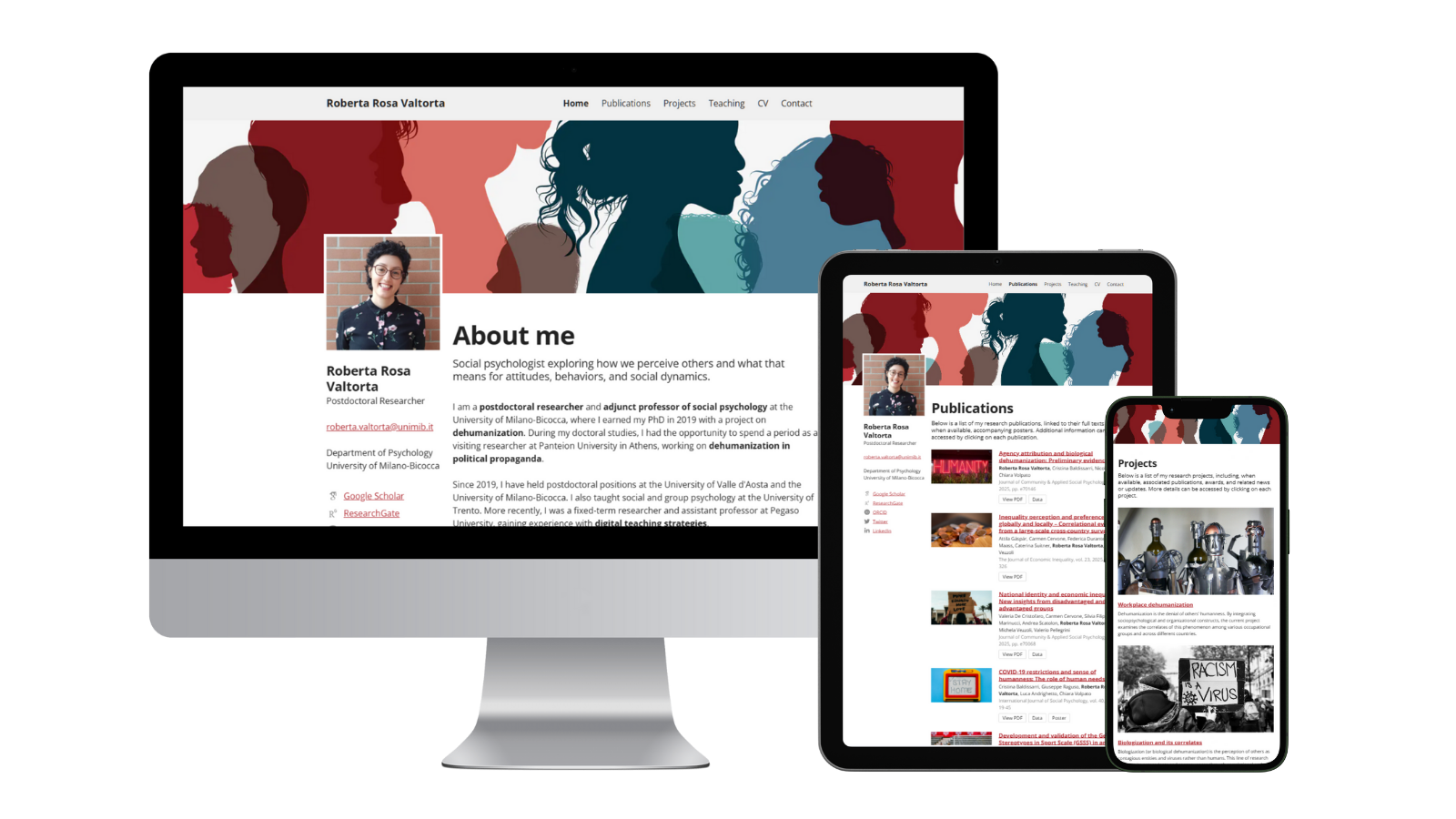
    Dr. Roberta Rosa Valtorta Website on Desktop (homepage), Tablet (Publications page), and Mobile (Projects page) screens
    https://robertavaltorta.research.st/

    Dr. Roberta Rosa Valtorta

    “I created my personal academic website for several reasons. First, to have one central place where all my work, publications, and projects are collected, making it easier for potential collaborators and anyone interested in my research to find accurate, up-to-date information. Second, to maintain control over my online presence, so that people searching for me don’t just find scattered pieces of information in different places. And finally, for a more personal reason: research can sometimes test self-esteem due to its competitiveness and constant pressure. Having a space where everything I have done is brought together helps me remember who I am, my roots, and the progress I have made.”

    —Dr. Roberta Rosa Valtorta

    Notes from the judges

    Jennifer van Alstyne: A thoughtful use of space on an Owlstown website. Dr. Valtorta has an expansive portfolio of publications, projects, and teaching. This website also shares teaching values, such as ways courses contribute to the United Nations Sustainable Development Goals (SDGs). From downloadable syllabi to accessible data, this is a great academic website example.

    Brittany Trinh: Valtorta’s website is great example of what you can do with an Owlstown website! The project pages include an overview, related awards, and related publications, which makes it easier to understand the impact of the research. The teaching pages provide a summary about the classes taught so we can understand the topics covered and importance of the course.

    Ian Li: This is such a great example of an academic website. It is well-organized. Projects are described with related publications, Publications and courses are summarized well. Her intro describes her passion for her research and points to the development of her work. She also shares a blog that is regularly updated. She also provides information in both English and Italian, which widens the reach of her work.

    Back to the list of award winners

    Owlstown Website Award

    Dr. Akshata Naik

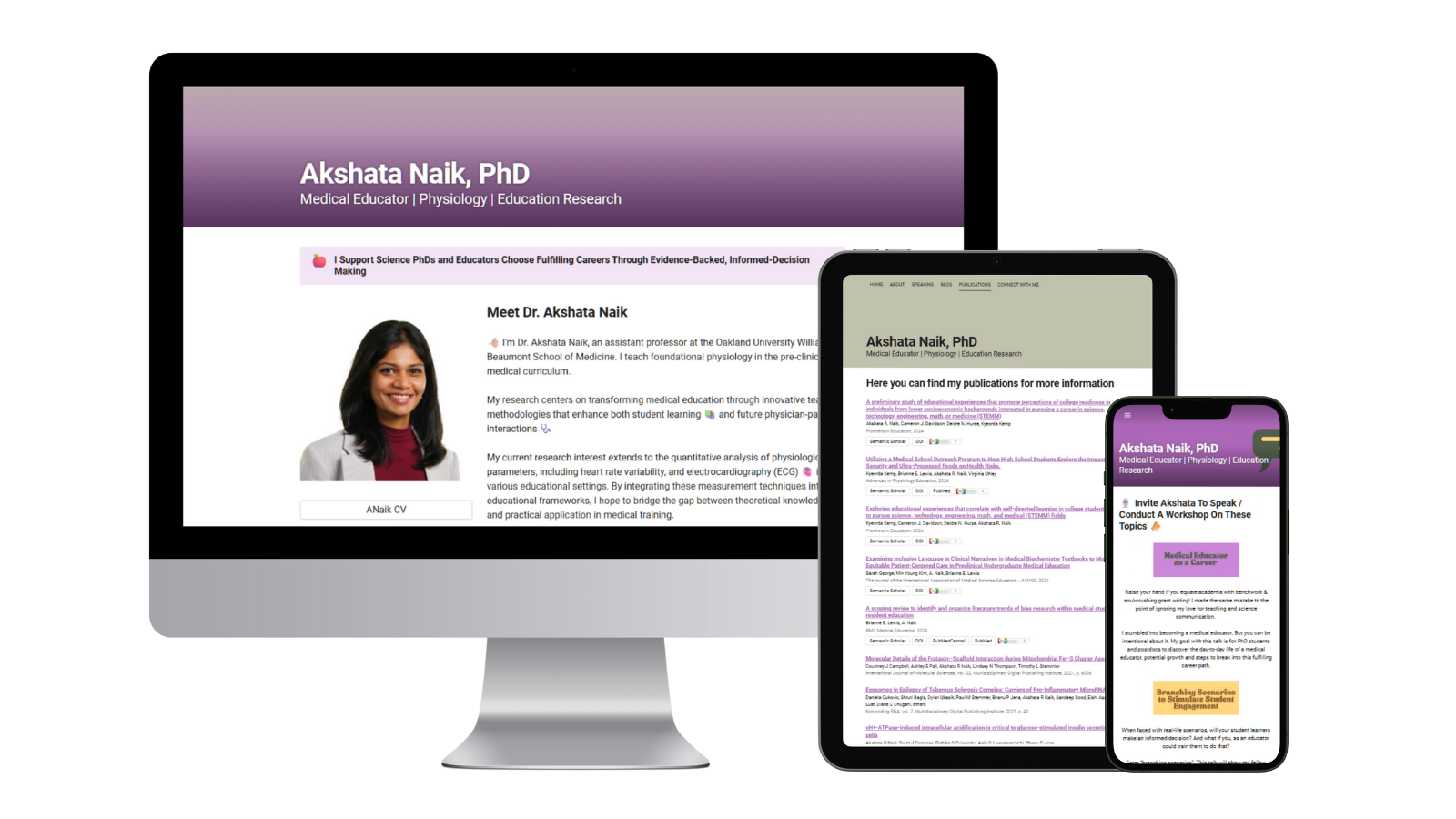
    Akshata Naik Website on Desktop (homepage), tablet (publications page) and mobile (speaking page) screens
    https://www.anaikowl.com/

    Dr. Akshata Naik

    “I thrive on creativity! Science communication, teaching and new research ideas keep me going. So I wanted to create an online space to portray my work for networking with folks similar to my interests, and importantly serving the broader community via outreach. And being an academician is a good enough reason for building a digital presence as it strategically aligns with my tenure and promotion goals by amplifying the impact of my work beyond traditional boundaries.”

    —Dr. Akshata Naik

    Notes from the judges

    Jennifer van Alstyne: I get such a sense of personality from an Owlstown website. This is great. Publications with abstracts make a difference. The buttons, like ‘Get to know me’ stand out as a lovely way to be approachable. The ‘Generated using Canva AI’ disclosure on an image on the blog feels thoughtful (and like the kind of information people appreciate even if they don’t use AI art themselves). The use of emojis in the middle of sentences isn’t ideal for accessibility, and is something I’d recommend revising.

    Brittany Trinh: Naik does a great job on her Owlstown website sharing what she does and why she does it. My favorite page is her Speaking page because it highlights the different talks she has and shares more of her story.

    Ian Li: Naik’s website is a great example of an Owlstown website. It’s very organized with information about herself, her publications, and her speaking engagements. She also shares a blog.

    Dr. Fawad Ahmed Najam

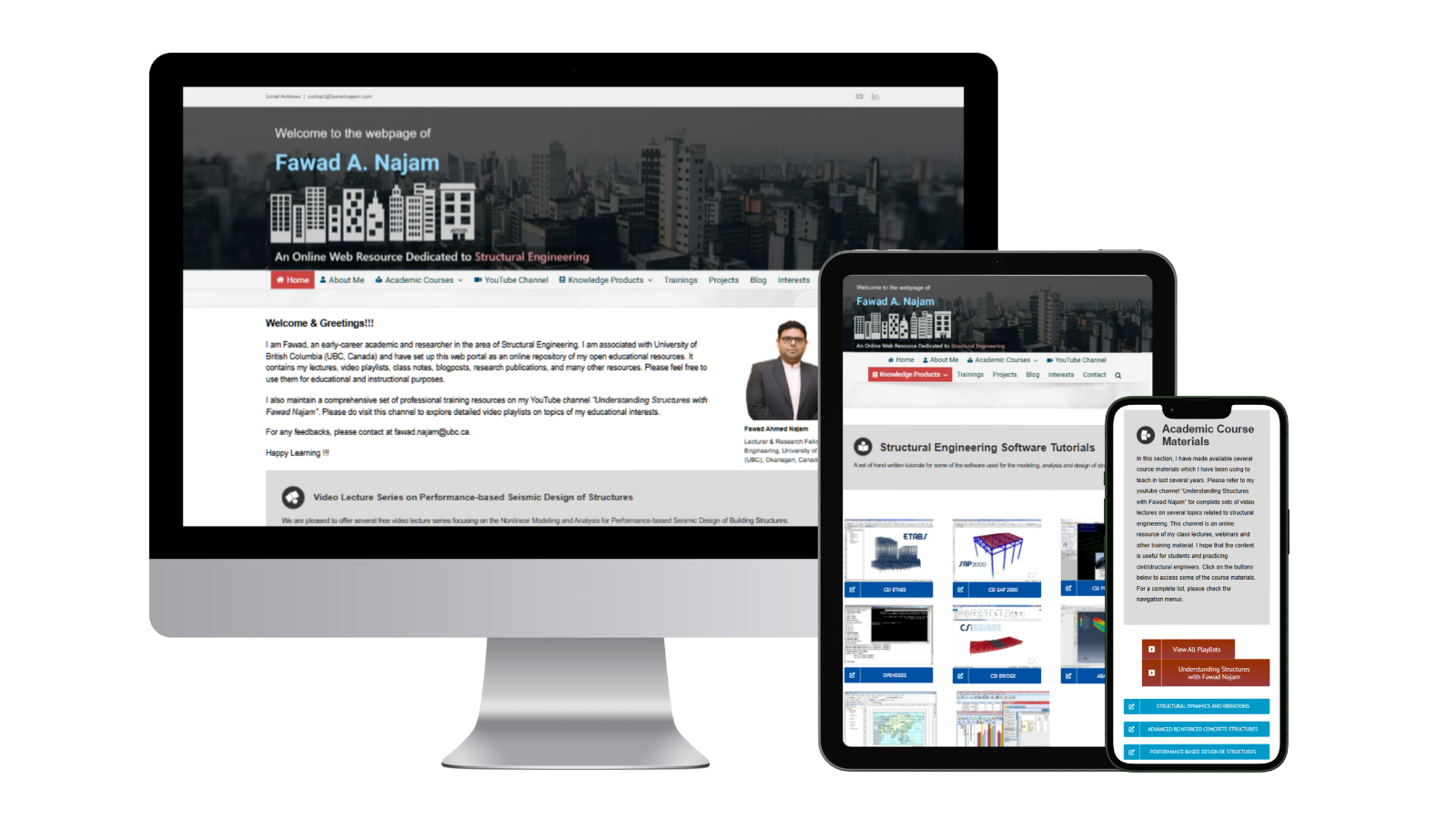
    Fawad Ahmed Najam Website on desktop (homepage), tablet (Tutorials page), and mobile (academic courses page) screens
    https://fawadnajam.com/

    Dr. Fawad Ahmed Najam

    “I am an educator in the field of structural and earthquake engineering. I originally created my website to make structural and earthquake engineering concepts more accessible to my students, fellow educators, and professionals. My goal was to share open educational resources, interactive tools, and practical examples (I use in classroom) with a wider audience. Knowing that it is making a difference and inspiring others means a lot to me.”

    —Dr. Fawad Ahmed Najam

    Notes from the judges

    Jennifer van Alstyne: A wealth of resources made accessible through this online space and good organization. While I don’t love the rotating icons for accessibility, every page of this website has videos, articles, blogs, and data to help people. I hope this website inspires people to consider: what do I already have that can help my students I’m open to sharing online?

    Brittany Trinh: Najam’s website is jam-packed with resources for his courses. His website is well organized and the content is probably super helpful to his students and others who are interested in structural engineering!

    Ian Li: If you want to learn about structural engineering, Najam’s website is the place to go. It is well-organized and has pages for course materials, YouTube videos, links to publications and resources.

    Back to the list of award winners

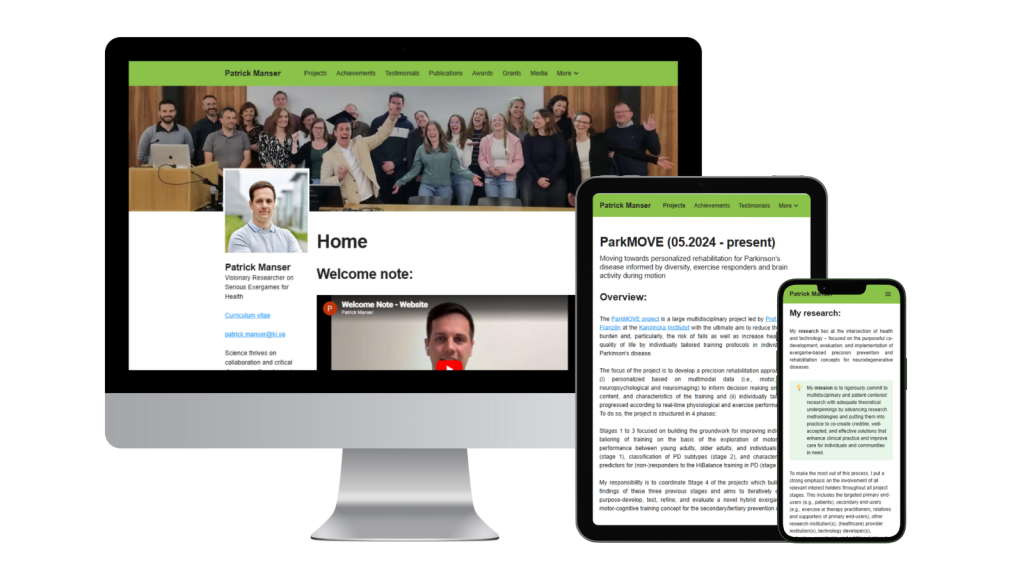
    Dr. Patrick Manser

    Patrick Manser website on Desktop (homepage), tablet (research project page), and mobile (homepage) screens
    https://www.patrick-manser.com/

    Dr. Patrick Manser

    “I created my personal academic website to make my collaborative research more accessible, with the aim of fostering transparency, promoting interdisciplinary dialogue, and broadening the dissemination of knowledge. By sharing my work openly, I hope to spark new connections and collaborative efforts that not only advance science but also translate research into meaningful improvements in healthcare and community-based health promotion.”

    —Dr. Patrick Manser

    Notes from the judges

    Jennifer van Alstyne: What a great welcome note video! I love it. That stood out because it was simple and invites folks to explore areas of the website. I felt like if I didn’t explore anywhere else, the video shared what, why and invited folks to get in touch. This website has far more on it than expected. While it’s mostly text-based with few visuals, it’s clear, easy to read, and well organized. I hope this website inspires people to consider video. Ooh, and requesting testimonials for their website too.

    Brittany Trinh: Manser’s website is very extensive regarding his research and how it has been highlighted in media. Additionally, he includes many stats regarding his academic contributions in many different areas such as awards, grants, peer review, and more. 

    Ian Li: Manser’s website is full of information on his research work: publications, courses taught, media, grants, etc. He also provides short descriptions for every item, so you have an introduction to the item. It’s a great example of how an academic website can serve as a portfolio.

    Back to the list of award winners

    Best Research Lab or Group Website

    Dr. Allie Sinclair and Dr. Tetine Sentell (tied)

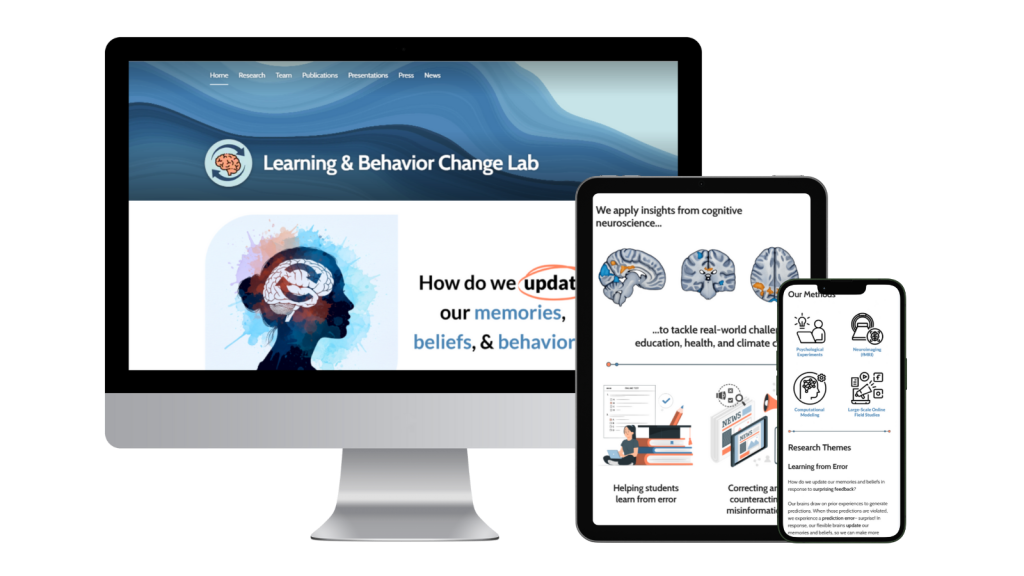
    Dr. Allie Sinclair | Learning & Behavior Change Lab website on desktop, tablet, and mobile screens
    https://www.sinclairlab-rice.com/

    Dr. Allie Sinclair | Learning & Behavior Change Lab

    “I was excited to make this website for my new lab, as I’ll be starting a faculty position at Rice University next year. I’ve spent many years dreaming of starting my own lab, although the exact vision has evolved over time. Now that the official website is ready, it finally feels real! I was motivated to create a fun and informative website this summer because I will be recruiting people to join my lab over the next year. I made the website with Owlstown, which made it easy to build and customize. I especially appreciated the features geared toward academics, like searching PubMed to find your publications and adding Altmetric badges.”

    —Dr. Allie Sinclair

    Notes from the judges

    Jennifer van Alstyne: Scroll down the homepage of this website and you have a great sense of what their research is about. Words, graphics, and illustration shares the story, and we’re then invited to explore the research and team. Folks are getting so creative with their Owlstown sites. I like the illustrations. There’s a lot of info for folks who are considering joining the lab which shares it’s recruiting for Fall 2026. Cats, Lara Croft and Moxie the cats have their own space on the team page. Yes. I’m so into this.

    Brittany Trinh: This is one of the best stylized Owlstown websites that I’ve seen. I love the cohesion of the color schemes in the visuals. I liked how they organized the research areas into three separate topics and had a link to the related publications. The publications page has the filter function so we can find papers related to a specific topic more easily.

    Ian Li: This is a great example of a lab website. You get a comprehensive understanding of what the lab does. Research projects are summarized and linked to relevant papers. There’s also links to media appearances and collaborators. Plus, the website is beautifully done with graphics and well-chosen colors.

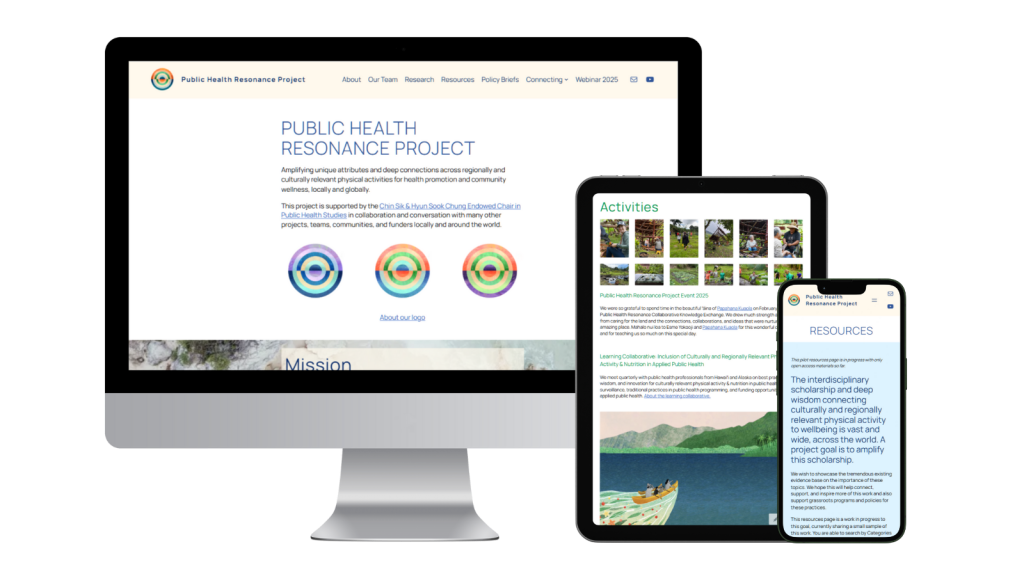
    Dr. Tetine Sentell Public Health Resonance Project Website on Desktop, Tablet, and mobile screens
    https://phresonance.com/

    Dr. Tetine Sentell | Public Health Resonance Project

    “Our interdisciplinary public health research collaboration is working together to help build the evidence base for regionally and culturally relevant physical activity for public health promotion. This work is designed to help connect and build this evidence base for public health promotion to produce actionable results for individuals, advocates, and communities to improve health outcomes and health equity. We wanted a beautiful and well-organized website to share information to support this goal. We plan to keep building on this website as the project continues and have been grateful to Jennifer van Alstyne for her support to make this possible!”

    —Dr. Tetine Sentell

    Notes from the judges

    Jennifer van Alstyne designed this website. She did not judge this entry.

    Brittany Trinh: This website is very well organized on their research page. Additionally, I love the use of real photos of the group in action in the field or at different events. It adds a personal flair to the website that makes it unique!

    Ian Li: This website is a great example of a lab website. It has full descriptions of lab members, research projects, lab activities, and outreach. It shares links to media and conference appearances. You get a detailed picture of what the lab does.

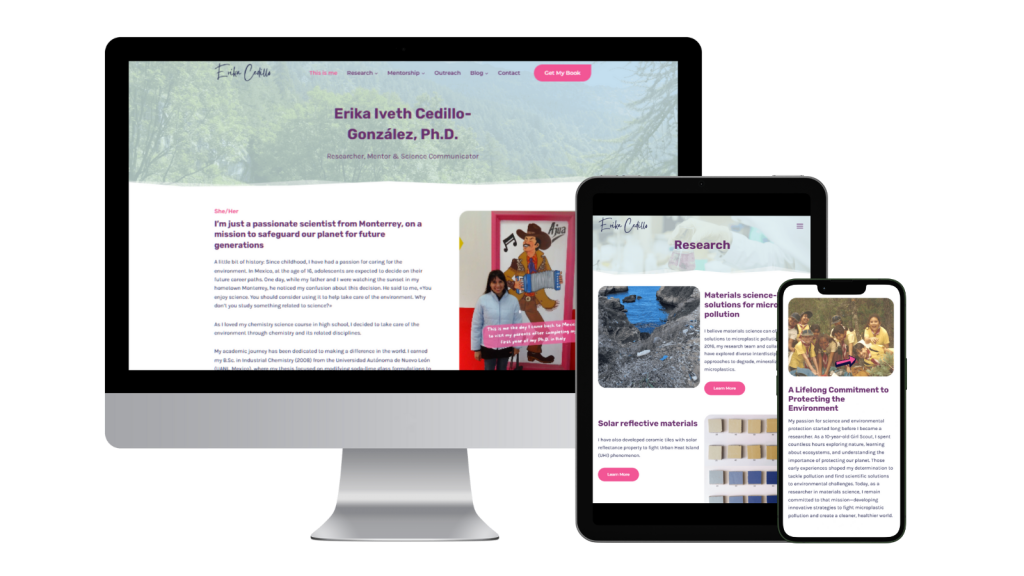
    Dr. Erika Iveth Cedillo-González

    https://erikacedillo.com/

    Dr. Erika Iveth Cedillo-González

    “I built my academic website to share what university profiles never did: my passion for research, my path as a mentor, and my dedication to protecting our planet. I believe each person in Academia carries a unique and inspiring journey that led them to science. A personal academic website offers the perfect space to share such story and remind others that research is also deeply human.”

    —Dr. Erika Iveth Cedillo-González

    Notes from the judges

    Jennifer van Alstyne: Personal and professional with pops of color. This website shares Dr. Erika Iveth Cedillo-González’ passion for science. It has science communication that invites the general public to learn and engage. There’s clarity not only on what the research is about, but how it impacts people. Accessible communication without sacrificing the science, in this website you get both.

    Brittany Trinh: I love how Cedillo tells her story of how she became a scientist and how it informs her research right from the start on her homepage. I also love that she has a blog for the Spanish-speaking ECR community, which serves as a resource and ties into her purpose and mission.

    Ian Li: The story of Cedillo’s work really comes together on this website. Her bio shows what inspires Cedillo, then her research shows how inspiration resulted in findings, then her outreach shows how she spreads her research to the broader community.

    Back to the list of award winners

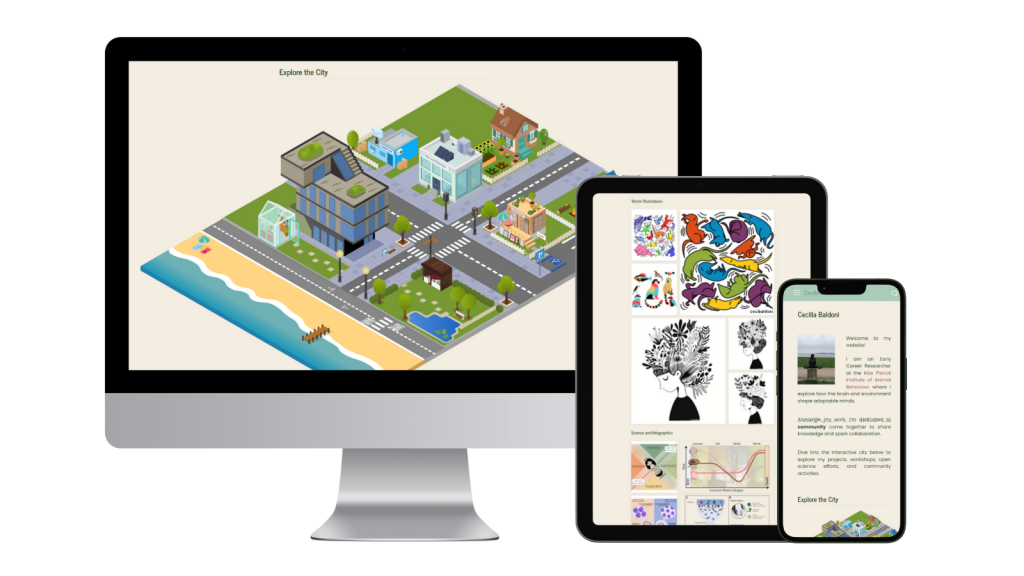
    Dr. Cecilia Baldoni

    Cecilia Baldoni GitHub website on desktop, tablet, and mobile screens
    https://cecibaldoni.github.io/

    Dr. Cecilia Baldoni

    “I was looking for a new fun way to express my creativity, and learn new ways to code and use version control!”

    —Dr. Cecilia Baldoni

    Notes from the judges

    Jennifer van Alstyne: Wow. I love the homepage interactivity. The blog post on Sketchnoting was great and the photos had captions. The Shrews page was visually engaging. I wish the text were a bit bigger (it felt like a lot of negative space on the text side). I’m obsessed with the Projects > Illustrations page. What a cute title page for their dissertation! Go explore this website. I hope it helps you imagine what’s possible for sharing your story too.

    Brittany Trinh: My favorite page is the Shrews webpage. As you scroll down the story and research unfold, and it’s a very unique way to share their research findings.

    Ian Li: The website has a bunch of interesting interactive elements. The Shrew’s page is a great example of how research can be presented in an interactive manner which elevates the understanding of the work. Baldoni also shares her slides which are viewable directly on the browser. Also, the city-like navigation on the front page.

    Back to the list of award winners

    Best Use of Art / Visuals

    Meg Mindlin

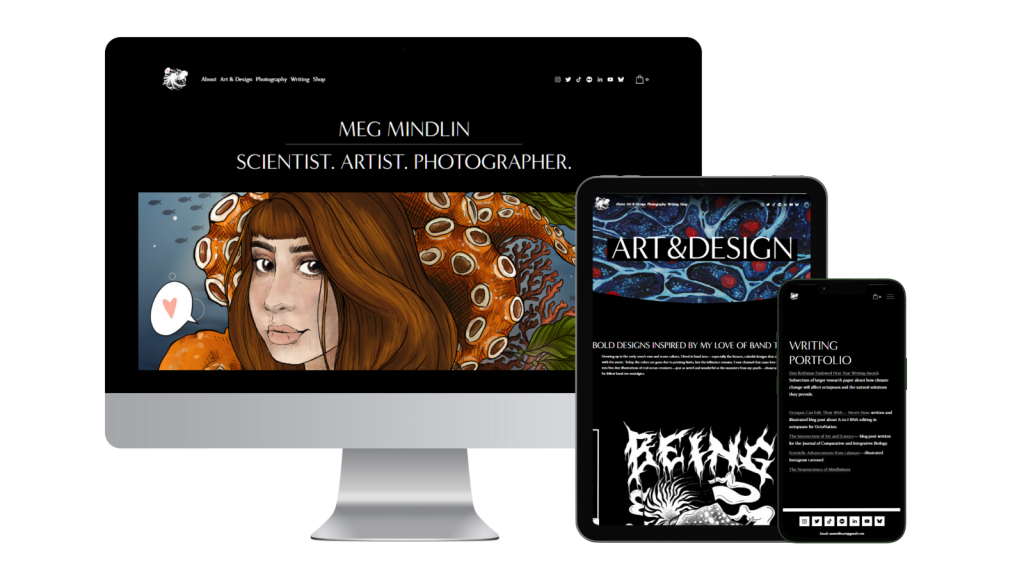
    Meg Mindlin graduate student website on desktop, tablet, and mobile screens
    https://www.megmindlin.com/

    Meg Mindlin

    “I’ve always had a website for my art portfolio, and as I was about to enter the real world, post graduate school, I saw no reason to not also utilize my website for my scientific endeavors. Especially with a budding career as a science communicator.”

    —Meg Mindlin

    Notes from the judges

    Jennifer van Alstyne did not judge Meg Mindlin’s website for this contest.

    Brittany Trinh: I love this website so much! It is a great example of how to incorporate your science and entrepreneurial ventures, while tying it together with your personal story! It is now my inspiration to update my own website.

    Ian Li: The illustrations and photography on this website are awesome. It’s a great example of visual communication of science.

    Hira Javed

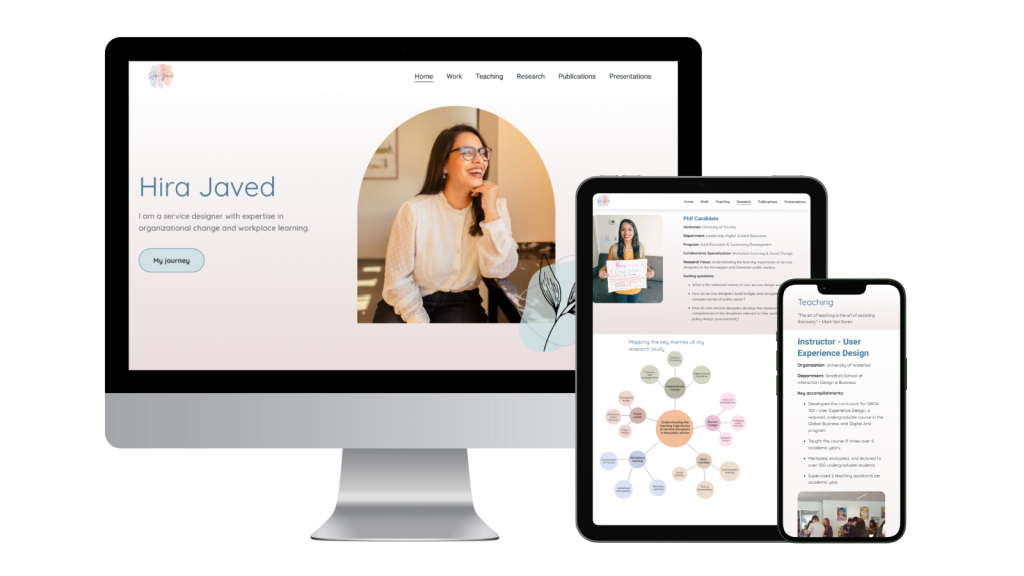
    Hira Javid phd student website on desktop, tablet, and mobile screens
    http://www.hirajaved.com

    Hira Javed

    “I made this website to tell the story of my non-linear, multidisciplinary career trajectory. It was an excellent reflective exercise for me.”

    —Hira Javed

    Notes from the judges

    Jennifer van Alstyne: This felt like a great portfolio website. A professional, resume-esque website without apology. I love that. The graphics are informative, visually engaging, and are thoughtful uses of color throughout the website. I wish that the My Journey section were built into the website rather than graphics. This section is beautiful, but the graphics make it less accessible. A favorite part of this website is the Presentations page where there’s a photo from each conference or event. That’s the dream.

    Brittany Trinh: I love the color palette and cohesion between the illustrations. I also like how Javed’s resume is color-coded and organized- it’s a creative way to showcase your experience, which you can only do on a website, and not in your resume.

    Ian Li: The coordination of the colors between the background, fonts, and graphical elements is really well done. The design serves the presentation of the Javed’s research projects, teaching, and presentations.

    Back to the list of award winners

    Dr. Ana Rebeka Kamšek

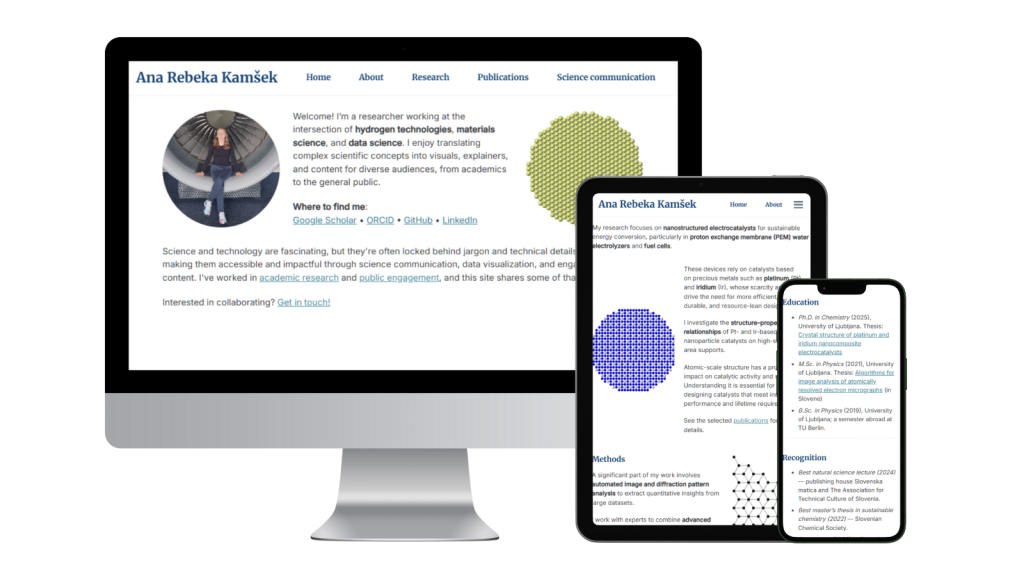
    Ana Rebeka Kamšek science communication website on desktop, tablet, and mobile screens
    https://kamsekar.github.io/

    Dr. Ana Rebeka Kamšek

    “As a researcher interested in science outreach, I noticed my work was spread across platforms. People who searched for my scientific papers rarely saw what I wrote for the public, and the mix of English and Slovenian further split my audience. I wanted a home where visitors could find everything I’m proud of, regardless of language or format. A personal website felt right, and the Best Personal Academic Websites Contest nudged me to make it happen.”

    —Dr. Ana Rebeka Kamšek

    Notes from the judges

    Jennifer van Alstyne: Dr. Ana Rebeka Kamšek starts her website by sharing her value “I believe in making them accessible and impactful through science communication, data visualization, and engaging digital content.” This website does exactly that. You don’t need a huge website to share your story. A few figures, photos, with thoughtful text that considers what to say and how to share it.

    Brittany Trinh: I like that Kamsek’s publications page includes a short overview and takeaway from the papers, instead of relying just on the abstract. Additionally, the papers, related news highlights, and codes are linked for easy access.

    Ian Li: I really liked that Kamsek grouped her papers and described the relevance of each grouping. She also listed the related papers and linked to them. This made it easier to understand her work in context. She did something similar in the Science Communication page.

    Back to the list of award winners

    Thank you!

    Congratulations again to the award winners. We appreciate you.

    Don’t miss next year’s contest when it opens. Subscribe to The Social Academic blog.

    The form above subscribes you to new posts published on The Social Academic blog.
    Want emails from Jennifer on building your online presence? Subscribe to her email list.
    Looking for the podcast? Subscribe on Spotify.
    Prefer to watch videos? Subscribe on YouTube.

    The Best Personal Academic Websites Contest is brought to you by Jennifer van Alstyne, Brittany Trinh, and Ian Li.

    Source link

  • How college leaders can own the narrative about a major restructuring

    How college leaders can own the narrative about a major restructuring

    This audio is auto-generated. Please let us know if you have feedback.

    Ricardo Azziz has held numerous executive positions in higher education and led the merger that resulted in Georgia Regents University, now Augusta University. He is principal at Strategic Partnerships in Higher Education, or SPH, Consulting Group.

    He writes the regular Merger Watch opinion series on corporate restructuring in higher education.

    In today’s higher education environment, colleges often must be part of a bigger enterprise to either survive or grow.  This calls for greater and more radical major institutional restructuring, such as mergers, acquisitions or even closures. 

    Much rests on the college leaders who — willingly or not — undertake these initiatives. 

    In a recent book I coauthored with other higher education experts, we interviewed some 50 or so leaders who had undertaken, successfully or not, major institutional restructuring. Most of those leaders, as well as others with whom my colleagues and I work, voice concerns about being able to lead in higher education again. 

    Would anybody hire them after the initiative had succeeded or, worse, had failed? The answer to that question depends on the narrative that builds around the leader and the restructuring they undertook. 

    A headshot image of Ricardo Azziz

    Ricardo Azziz

    Permission granted by Ricardo Azziz


    Major changes at a college or university are always met with resistance. Whether the merger was successful or not —and that will take years to determine — many campus stakeholders will be angry and happy to turn to the media, often accusing leaders of selling out the college, not caring about its history or being poor negotiators.  Those comments will in turn color the perspective of any subsequent hiring committee, particularly scaring off its faculty members.

    In speaking with college leaders and observing recent news, I have been struck by the ability of some of them to present a positive narrative of their experiences in leading major restructuring. For example, Joseph Chillo, who led the 2019 closure of Newbury College, and Marcheta Evans, who helped lead the merger of Bloomfield College with Montclair State University, have both been able to highlight the necessity of these difficult decisions in a thoughtful, humble and compassionate manner. 

    However, it was also obvious that many leaders are less able to craft a positive narrative of the restructuring and their involvement. These examples summarize the various perspectives I’ve observed as leaders share their experiences: 

    The victim: “I was pushed to do this despite the great risk to my career.”

    The knowing but ignored leader: “I was pushed to do this despite the great risk to my career and the fact that I told them it was a bad idea.”

    The resistance fighter: “I was pushed to do this, and I told them it was a bad idea, so I resisted in as many ways as I could, despite the great risk to my career.”

    The good soldier: “Regardless of my views on the initiative, I diligently followed orders and undertook the initiative.”

    The unwilling hero: “I was tasked with the initiative and undertook it diligently, despite the great risk to my career.”

    The distant leader: “I was part of the initiative but was somewhat removed from or had a limited role in what was happening.” 

    The (overly) enthusiastic leader: “I took on the initiative, as I saw only positives to its undertaking.”  

    The servant leader: “I was part of the initiative, understood its importance and risks and undertook it, as was my responsibility.”

    The growing leader: “I was part of the initiative, understood its importance and risks, and undertook it, as was my responsibility, and have learned much about what we did right and, more importantly, what we did wrong.”

    In fact, leaders involved in restructuring should only embrace the last two narratives — and perhaps only the last one. Those perspectives present their role with a degree of humility, recognizing that they must assume the responsibility for making difficult decisions for their students and community but also acknowledging that they have continued to learn from the experience. 

    Leaders are indelibly tied to any major restructuring they’ve overseen — these initiatives become part of their professional and life stories. A narrative will be crafted around an initiative that impacts heritage, history, community and the future as much as a major college restructuring does. Leaders can choose to actively and diligently manage that narrative — or others will craft it for them. 

    How can college leaders build a positive narrative when undertaking major restructuring? Here is a six-step plan:

    Be prepared: Have a clear narrative about the initiative and your role in it. Make it short, to the point and practiced. 

    Be consistent: Ensure you present your narrative consistently, regardless of the audience.

    Be positive: While some initiatives will succeed and others will fail, it is important to remain positive about why you needed to explore the initiative, as well as the continuing need for proactive and future-oriented action in today’s higher ed environment — for the sake of our students and our internal and external communities. 

    Be humble: Be clear that you have learned much when undertaking the initiative and that you believe successful leadership is about continued growth and addressing any mistakes responsibly.

    Source link

  • More parents are homeschooling–and turning to podcasts for syllabus support

    More parents are homeschooling–and turning to podcasts for syllabus support

    Key points:

    A revolution quietly underway in American education: the rise of homeschooling. In the past decade, there’s been a 61 percent increase in homeschool students across the United States, making it the fastest growing form of education in the country. You might not have noticed (I didn’t, at first), because only about 6 percent of students are homeschooled nationally. But that number is nearly double what it was just two years ago.

    Then I noticed something that made me take a closer look closer to home. At Starglow Media, the podcast company I founded in 2023, nearly 20 percent of our listenership comes from homeschool families. That substantially overindexes against the national population. In other words, podcasts were particularly popular in the homeschool community.

    I was curious, for my business and in general. We make podcasts for kids (and their parents)  without any specific content for homeschool families. Why was audio resonating so well with this audience? I did some digging, and the answers surprised me.

    First, I wanted to find out why homeschooling was booming. According to the Washington Post, the explosive growth is consistent across “every measurable line of politics, geography, and demographics.” Experts have offered multiple explanations. Some families started homeschooling during COVID and never went back, others want greater say in what their children learn. Some families feel their kids are safer from violence and discrimination at home, others think it’s a better environment for children with disabilities. All these reasons collectively suggest a broader motivation: people are dissatisfied with the traditional education system and are taking it into their own hands.

    None of these factors, however, explained why podcasts were popular among homeschool families. So I decided to ask the question myself. I reached out to some Starglow listeners in the Starglow community to hear what about the format was appealing to them. Three main themes emerged.

    Many people told me that podcasts are uniquely well-suited to address educational hurdles facing homeschool families. When you’re a homeschool parent, it can be difficult to navigate all the resources that inform lesson planning while ensuring that the content is age- and subject-appropriate. Parents have found podcasts to be an intuitive way to elevate their curricula. They can search for subjects, filter by age group, and trust that the content is suitable for their kids. Ads on the network add another layer of value–because parents can trust the content, they tend to trust further educational materials promoted via the same channels. Simply put, the podcast ecosystem offers a reliable means to supplement lesson plans.

    They also offer a clear financial benefit. Homeschooling can be expensive, especially in STEM, but the majority of states don’t offer government subsidies for homeschool education. Podcasts have proven to be a cost-effective way to supplement at-home learning modules. Parents appreciate that it’s free to listen.

    Lastly–and this came up in nearly every conversation–they fit in well to homeschool life. Routine is a critical part of any educational context, and podcasts are useful anchors in the school day. Parents can easily pair podcasts with lessons at any point in their day, whether it’s a current events primer paired with a news podcast over breakfast or a specific episode of “Who Smarted” (our most popular educational podcast) about how snow forms worked into a science lesson. In this way, podcasts are becoming an integral part of family life in the homeschool community. Educational content like “Who Smarted” or an age-appropriate audiobook of “Moby Dick” may be the gateway, but families tend to co-listen throughout the day, whether it’s to KidsNuz over coffee or a Koala Moon story at night.

    What does all this mean? Homeschooling is growing, and with it is the need for flexible, affordable, and trustworthy educational content. To meet that demand, families are turning to audio, which offers age-appropriate solutions that can be worked into family life through regular co-listening.

    I expect that the homeschool movement will continue to grow, because new formats and strategies are offering families new opportunities. That’s good news, because we need innovation in education right now. Test scores are falling, literacy is in decline, and school absenteeism hasn’t fully bounced back from the pandemic. The homeschool surge is just one indicator of our increased dissatisfaction with the status quo. If we want to course correct, we all need to embrace new resources, podcasts or otherwise, to enhance education at home and in the classroom. New media has the potential to transform how people teach–we should embrace the opportunity.

    Latest posts by eSchool Media Contributors (see all)

    Source link

  • Student Success Leaders Worry About Affordability, AI, DEI

    Student Success Leaders Worry About Affordability, AI, DEI

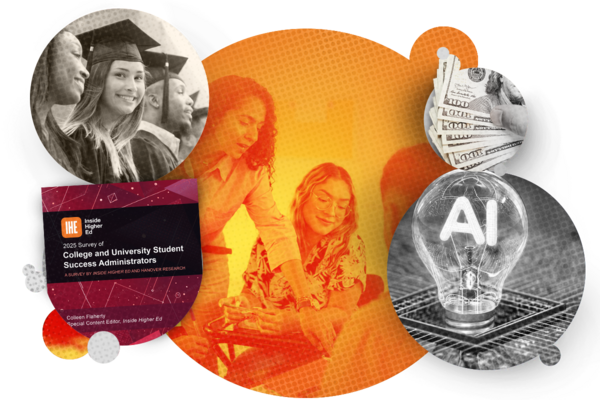
    After yet another rocky year for higher education, student success administrators retain high confidence in their institution’s core mission: Some 95 percent rate the quality of undergraduate education delivered as good or excellent, according to Inside Higher Ed’s second annual Survey of College and University Student Success Administrators with Hanover Research.

    About the Survey

    On Wednesday, Dec. 10, at 2 p.m. Eastern, Inside Higher Ed will present a free webcast to discuss the results of the 2025 Survey of College and University Student Success Administrators. Please register here—and plan on bringing your questions about student success going into 2026.

    This survey was conducted Aug. 20–Oct. 6 with Hanover Research. Respondents number 204 student success leaders, most of whom work in student affairs at the executive level at public and private nonprofit institutions. The survey’s margin of error is plus or minus seven percentage points. A copy of the free report can be downloaded here.

    This independent editorial survey was made possible by support from the Gates Foundation and Studiosity.

    Most student success administrators (85 percent) also report strong feelings of connection to students served, and nearly as many say they’re satisfied in their roles. Yet leaders continue to worry about the forces holding students back. Selecting up to three options from a longer list, administrators cite mental health challenges (51 percent describe this as a top challenge), financial constraints (49 percent) and lack of adequate preparation before college (48 percent) as the top barriers to student success at their institution. Community college leaders are disproportionately concerned about students needing to work while enrolled (67 percent).

    Just about half of all administrators believe their institution is highly responsive to student needs for flexibility, such as in times of personal or academic crises.

    A larger share of respondents, 61 percent, believe their institution is highly effective in prioritizing student success. Just 35 percent say it’s highly effective in using student success data to drive decisions, however. Both of these figures are similar to last year’s survey, meaning the gap between aspiration and data-driven change remains.

    Student affairs leaders who responded to NASPA’s own annual Top Issues in Student Affairs survey this year flagged “using dashboards and other data communication tools to help senior administrators translate data into actionable insights for decision-making” as a top issue for institutions, behind only “protecting the institution against cyberattacks” and “navigating political and legislative pressures affecting institutional policies and practices.”

    Colleges can certainly do more to harness the extraordinary number of student data points available to them every day. But Amelia Parnell, NASPA’s president, told Inside Higher Ed that she’d give student success leaders “a little more credit” for their use of data—especially the qualitative kind.

    “We need both quantitative data to see scale and impact and qualitative data to understand the nuances,” including around learning and engagement, she said. “I think professionals have quite a bit of qualitative context about students’ experiences because they spend a lot of time connecting directly with them.”

    Other top areas of concern for student success administrators include affordability, artificial intelligence and policy impacts on campus life, finds Inside Higher Ed’s survey.

    Affordability and Value

    A third of student success administrators say that their trust in higher education has waned in recent years, and many point to concerns about affordability (64 percent) and long-term value of a degree (62 percent) as top drivers of declining public confidence. Leaders also highlight tighter alignment between academic programs and career pathways as a key lever for rebuilding trust.

    About six in 10 respondents are highly confident that their institution is actively working to keep costs affordable, with public institution leaders especially likely to say so (69 percent versus 49 percent of private nonprofit peers).

    But just 11 percent of leaders think students at their institution clearly understand the total cost of attendance, beyond tuition. They raise similar concerns about students’ awareness and understanding of emergency funding resources at their institution.

    In Inside Higher Ed’s main Student Voice survey this year, just 27 percent of students said they understand the total cost of attendance fully and can budget appropriately. More than three in five didn’t know if their college offers emergency aid. Yet 61 percent of student success administrators say this kind of help is available at their institution.

    Some additional context—and evidence of misalignment between student experience and administrator perception: In Inside Higher Ed’s 2025 Survey of College and University Chief Business Officers, most CBOs (88 percent) said that their institution is transparent about the full, net cost of attendance, including tuition discounts and counting fees and other expenses—though just 42 percent said this of colleges and universities as a whole. Most CBOs also said that their institution’s net price is sufficiently affordable.

    Parnell of NASPA noted that financial aid “is but one part of the cost of attendance discussion for some students.” But she added that financial aid offers represent an opportunity for colleges to improve clarity and transparency around total cost—something the National Association of Student Financial Aid Administrators and others have urged.

    Preparing Students for an AI Future

    Just 2 percent of student success leaders say their institution is very effective in helping students understand how, when and whether to use generative artificial intelligence in academic settings. On promoting academic integrity, specifically, 77 percent endorse educating students about ethical AI use rather than emphasizing punitive measures. Faculty and staff development and efforts to standardize use policies also rank high.

    In the Student Voice survey, just 13 percent of students said they didn’t know when, how and whether to use generative AI for coursework—but most of the remainder attributed their knowledge to individual faculty efforts rather than broader institutional ones.

    Student success administrators also describe a gap between the extent to which high-impact teaching practices, such as those endorsed by the American Association of Colleges and Universities, are highly encouraged at their institution and widely adopted (65 percent versus 36 percent, respectively). And while 87 percent agree that students graduate from their college ready to succeed in today’s job market, half (51 percent) believe their institution should focus more on helping students find paid internships and other experiential learning opportunities.

    Tawnya Means, an innovation consultant who recently joined Bowling Green State University and its Schmidthorst College of Business as a strategic innovation and AI adviser, said that all three of these concerns—lack of institutional guidance on AI, high-impact teaching practices and other opportunities for experiential learning and internships—are connected.

    “Schools treating AI as a catalyst for pedagogical redesign are simultaneously increasing high-impact practices and preparing students for AI-augmented careers,” she said. And institutions doing this well are using some common strategies: making faculty development about pedagogy, not just “AI compliance,” and designing assignments where AI supports real learning. Unpacking the latter point, Means praised approaches that are experiential, teach discipline-specific or contextual AI use versus abstract rules, and mirror actual workplaces.

    While business schools have long understood the power of “messy real-world case studies,” Means said they’re ripe for use across undergraduate education in the generative AI era and “resist simple AI shortcuts.”

    Parnell suggested on-campus employment as yet another way to provide “work experience and support students in their learning journey.”

    On AI specifically, Asim Ali, executive director of the Biggio Center for the Enhancement of Teaching and Learning at Auburn University, who’s worked with many institutions on faculty development, said the “biggest gap I see is not engaging students in the process.”

    At Auburn, he said, student government leaders have taken a “focused interest directly in shaping how we support GenAI learning.” And in discussions between student leaders and faculty, “both groups emphasized that students must also take responsibility for learning the ethics and appropriate use of GenAI.”

    The biggest gap I see is not engaging students in the process.”

    —Asim Ali, executive director of the Biggio Center for the Enhancement of Teaching and Learning at Auburn University

    Financial worries and uncertainty about the future top the list of students’ postcollege stressors, as ranked by student success administrators. And just a quarter of these leaders say their institution makes postgraduate outcomes are easily accessible.

    Policy Impacts and Campus Climate

    Almost all leaders say students feel welcomed, valued and supported on their campuses, and 87 percent say their institution is doing a good or excellent job promoting a positive campus climate. Yet regional differences emerge: Leaders in the South are somewhat less likely than peers elsewhere to say their institution is highly effective in encouraging diverse perspectives among students.

    Nearly two in three leaders (62 percent) say recent federal restrictions on diversity, equity and inclusion initiatives have negatively impacted students, and the rate is higher among public institution leaders than their private nonprofit peers.

    In the Student Voice survey, 48 percent of students said such changes had negatively impacted their college experience or that of peers; most of the remainder saw no change, rather than a positive one.

    Most administrators also believe new student aid policies, such as those included in the One Big Beautiful Bill Act, will limit access to college rather than expand it. And many already report moderate (39 percent) or significant (29 percent) declines in international student enrollments tied to recent federal actions, such as visa appointment restrictions and targeted actions at specific institutions.

    Leaders estimate that 40 percent of students participate in no extracurricular activities, a figure that rises to 67 percent among community college administrators. Respondents are mostly like to say involvement would increase if students saw a clear connection between activities and their career goals.

    For institutions struggling to get students in involved, Parnell highlighted the importance of effectively communicating and delivering available activities to students: Are any activities at community colleges, which serve many working students, available after 5 p.m., for example, she asked?

    Source link

  • International Graduate Student Enrollment Drops

    International Graduate Student Enrollment Drops

    Photo illustration by Justin Morrison/Inside Higher Ed | skynesher/E+/Getty Images

    Federal actions to limit immigration have affected many international students’ decision to enroll at U.S. colleges and universities this fall, with several institutions reporting dramatic declines in international student enrollment.

    New data from the Department of Homeland Security from the Student Exchange and Visitor Information System for October shows an overall 1 percent decline of all international students in the U.S. SEVIS data includes all students on F-1 and M-1 visas, including those enrolled in primary and secondary school, language training, flight school, and other vocational programs.

    According to DHS data, bachelor’s degree enrollment among international students is down 1 percent from October 2024 to October 2025; master’s degree enrollment is down 2 percent, as well. Associate degree programs have 7 percent more international students in October 2025 than the year prior, and international doctoral students are up 2 percent.

    Campus-level data paints a more dramatic picture; an Inside Higher Ed analysis of self-reported graduate international student enrollment numbers from nine colleges and universities finds an average year-over-year decline of 29 percent.

    Some groups, including NAFSA, the association for international educators, have published predictions of how international student enrollment would impact colleges’ enrollment and financial health. NAFSA expected to see a 15 percent decline across the sector and greater drops for master’s degree programs.

    “Master’s [programs] have been very hit. And in addition to master’s being hit, programs like computer sciences and STEM in particular have been mostly affected,” NAFSA CEO Fanta Aw said in a Sept. 19 interview with Inside Higher Ed.

    At the University of Wisconsin at Madison, for example, master’s degree enrollment dropped 22 percent from fall 2024. Ph.D. program enrollment declined only 1 percent compared to the year prior, according to university data.

    While more selective or elite institutions have mostly weathered enrollment declines among undergraduate international students—reporting little or no change to their enrollment numbers this fall—Aw says graduate student enrollment is down everywhere.

    The University of Pennsylvania’s Wharton School of Business, for example, reported that international students made up 26 percent of its incoming master’s in business administration class, down five percentage points from the year prior, as reported by Poets and Quants (Poets and Quants is also owned by Times Higher Education, Inside Higher Ed’s parent company). At Duke’s Fuqua School of Business, 47 percent of the incoming class in 2024 hailed from other nations, but that figure dropped to 38 percent this fall.

    Because master’s degrees are shorter programs than undergraduate ones, averaging two years, Aw anticipates universities to see even more dramatic declines from 2024 in fall 2026.

    “The current environment is still too uncertain for [graduate] students to even consider potentially applying,” Aw said. “You cannot have enrollment if they’re not even applying.”

    Of colleges in the data set, Northwest Missouri State University reported the greatest year-over-year decline in graduate student enrollment, falling from 557 international students in fall 2024 to 125 in fall 2025. In April, Northwest Missouri State reported that 43 of its international students had their SEVIS statuses revoked; 38 of them were on optional practical training.

    At that time, Northwest Missouri State encouraged students who lost their SEVIS status to depart the U.S. immediately “to avoid accruing unlawful presence,” according to a memo from President Lance Tatum published by Fox 4 Kansas City. The university declined to comment for this piece.

    Nationwide, international students make up 22 percent of all full-time graduate students, according to Integrated Postsecondary Education Data System data. International students often pay higher tuition rates compared to their domestic peers, and some colleges rely on international students to boost graduate program enrollment.

    The dramatic changes in enrollment numbers are having budgetary impacts on some colleges.

    At Georgetown University, foreign graduate student enrollment dropped 20 percent, which was expected but steeper than anticipated, according to a memo from interim university president Robert M. Groves. In April, Georgetown cut $100 million from its budget due to loss of federal research dollars and international student revenue, and Groves said more cuts may be needed in December.

    DePaul University in Chicago saw a 63 percent year-over-year decline in new graduate students from other nations—a sharp drop that administrators, similarly, did not anticipate in this year’s budget.

    As more colleges solidify their fall enrollment numbers, the sectorwide decline in foreign students has become more clear.

    Inside Higher Ed’s initial data found colleges reported, on average, a 13 percent decrease in international student enrollment. The median year-over-year change was a 9 percent drop.

    Small colleges saw significant changes. Bethany Lutheran College in Minnesota, with a total head count of 900 students, reported a 50 percent growth in international students. At the other end, the University of Hartford in Connecticut lost half of its international students, only expecting 50 instead of 100 this fall.

    Community colleges are also feeling the loss of international students. Bellevue College in Washington State, a leading destination for international students in the two-year sector, reported a 56 percent year-over-year decline in enrollment.

    Southeast Missouri State reported a 63 percent decline in international students, with 494 individuals unable to secure visas, according to a university statement.

    Source link

  • Former Texas A&M President Received $3.5M Exit Package

    Former Texas A&M President Received $3.5M Exit Package

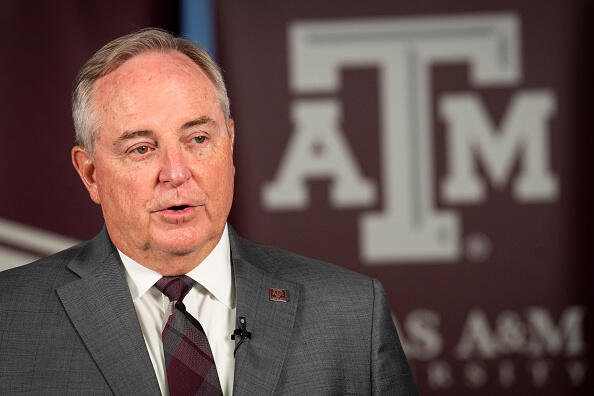
    When former Texas A&M University president Mark Welsh stepped down suddenly in September amid a swirling academic freedom controversy, he received an exit package of more than $3.5 million, according to public records obtained by The Texas Tribune.

    Welsh, who became president in 2023 after his predecessor, Kathy Banks, stepped down following a controversy of her own, pressed the Texas A&M System Board of Trustees to pay out the remainder of his contract through December 2028, according to recently unearthed records. He earned a $1.1 million base salary with annual retention and housing bonuses of $150,000 each.

    Welsh was one of several Texas A&M employees felled by controversy after a conservative state lawmaker accused the university of pushing “leftist DEI and transgender indoctrination” following an exchange between a student and a professor caught on video. In that video, the student objected to a professor’s statement that there are more than two genders. The incident, which the student captured, took place in a children’s literature class.

    Welsh initially defended the professor in a conversation with the student but later backtracked, removing the professor and two administrators from their duties over their handling of the issue. 

    He argued that the incident was not about academic freedom but rather “academic responsibility” and that “the [College of Arts and Sciences] continued to teach content that was inconsistent with the published course description for another course this fall,” prompting his actions.

    Despite his reversal, demands for Welsh to resign prevailed.

    Source link

  • Higher Ed Must Take Action on Immigration Policy (opinion)

    Higher Ed Must Take Action on Immigration Policy (opinion)

    Under the current administration, we have witnessed a dangerous cascade of immigration policies and actions. These developments are impacting our students, employees, campuses and communities in real time, imperiling the future of our colleges and universities.

    It’s time for us in higher education to pull the fire alarm. Pulling the fire alarm does not mean panic. This is a call to respond, mobilize and act.

    Why Collective Action Is Urgent Now

    In recent months, the short- and long-term damage of the administration’s immigration actions has come into sharper focus, requiring significant action.

    • Prospective international student confidence in pursuing their studies in the U.S. has declined dramatically as a result of the administration’s actions. New international student enrollments are already down more than 10 percent this fall for many institutions—and considerably more for some—with analysts projecting more intense declines in future years.
    • The administration is actively taking away in-state tuition and financial aid access for undocumented students in a growing number of states and threatening specific institutions because of their support for undocumented students.
    • Reports of immigration enforcement on and around campuses are increasing, with more institutions grappling with how to respond to fear and anxiety in their communities and how to support students, family members and employees who are caught up in mass enforcement actions.
    • Humanitarian parolees and temporary protected status holders are losing their protections and work authorization, making them vulnerable targets for deportation.

    Campuses are already feeling the impact of these developments—but the economic consequences and implications for U.S. productivity and innovation are far broader. A new National Foundation for American Policy study estimates that the current administration’s immigration policies targeting undocumented, lawfully immigrant and international populations would reduce the number of workers in the U.S. by 6.8 million by 2028, and 15.7 million by 2035, lowering the annual rate of economic growth by nearly one-third.

    A recent paper on “brain freeze” projects that the U.S. will experience significant adverse economic and innovation impacts due to the declines in international students and researchers. The loss of any portion of the immigrant-origin and international students on our campuses, who together now make up close to 40 percent of all students in higher education, would be devastating for many institutions, local economies and states across the country.

    What Can We Do Together?

    Since January, colleges and universities have been responding to policies that adversely impact immigrant, international, refugee and other noncitizen campus members. At the Presidents’ Alliance on Higher Education and Immigration, we have collaborated with campuses to analyze emerging policies and develop effective responses, producing resources on immigration enforcement on campus, registration requirements for noncitizens and issues related to international students, as well as guidance on funding and tuition equity policies to support Dreamers and on ways to support students and other campus members who may be detained or deported.

    We now need to take it to the next level. Colleges, universities and the associations that represent them need to coordinate consistently to mobilize in response to the immigration-related threats impacting our campuses.

    Support Litigation

    Higher education groups, associations and institutions are engaging in litigation on many fronts. While it might seem overwhelming to challenge this administration’s dubious—and, as many legal experts and courts have concluded, unlawful—immigration policy actions, we need to connect the dots and explain the harm to judges who have the power to halt implementation and call out the administration for its constitutional violations.

    Public institutions in states with Democratic attorneys general can help to make the case to their AGs about the importance of joining these efforts. Some ways higher education institutions can support litigation include:

    • Serving as a named plaintiff. While associations representing colleges and universities, including the Presidents’ Alliance, the Association of Independent Colleges and Universities in Massachusetts, and the Association of American Universities, have shown that they are ready to stand as named plaintiffs in legal challenges related to immigration, we will need more associations and institutions ready to support such litigation. Litigation is one way to interrupt intersecting policy actions that amplify the myriad threats facing immigrant and international communities and establish a record of opposition to potentially unlawful action.
    • Submitting a declaration. Institutions can play a vital role when they submit declarations to support legal challenges. These fact-based documents describe the concrete harms an institution is experiencing and provide crucial evidence that strengthens the overall case.
    • Joining an amicus brief. When campuses join amicus briefs, they demonstrate coordination and solidarity within the higher education sector. For example, last spring, when the American Association of University Professors challenged the administration’s unlawful visa revocations alleging an ideological deportation policy, 86 institutions and organizations joined the Presidents’ Alliance on an amicus brief that highlighted the importance of protecting international and noncitizen students’ and scholars’ freedom of speech. And, this week, 37 institutions and organizations joined us in an amicus brief that demonstrated the importance of tuition-equity policies for Dreamers.

    Speak Out

    Institutions and associations need to work more closely together to support one another and to communicate the damage of harmful immigration policies. During this administration, public and private institutions are more measured and constrained—by boards, state policies and structures and campus politics—in what they say and do publicly. We know that fear of retribution and the potential collateral damage to other campus constituencies informs decision-making. Many institutional leaders with whom I speak are seeking to do what is strategically effective and are weighing multiple priorities and competing commitments.

    What we know now is that not speaking out does not preclude an institution from becoming a target, and many campus constituencies are already being harmed. So, the strategic calculus is changing, and there may be more to be gained in speaking out. Here are some effective ways to speak out:

    • Affirming one for all, all for one. University of Nevada, Reno, president Brian Sandoval, a former Republican governor of Nevada, swiftly responded to the Department of Justice’s attacks on UNR’s support for undocumented students, stating clearly that UNR’s services were lawful and that supporting all students’ success is core to the higher education mission. The Presidents’ Alliance and TheDream.US issued public statements of support, reaffirming the importance of higher education supporting Dreamers and the success of all students. When individual institutions speak out, they often affirm our common mission, and we, in turn, can reaffirm theirs.
    • Supporting associational statements. Associations are playing an important role in convening institutional leaders and leading on statements. We must continue to lean on each other and on associations. Statements organized by the American Association of Colleges and Universities and the American Council on Education on the proposed compact for higher education make our sector’s stances clear. Institutions and associations that can join such statements should continue to do so.
    • Educating and engaging. Institutional leaders and board members can spread accurate, positive messages about immigrant and international students, shifting the narrative through commentaries such as Arizona State University president Michael Crow’s op-ed on the importance of international students.

    Join in Coalition Building

    For collective action to work, we need to build out dedicated spaces for higher education institutions to come together and coordinate. This call to action does not mitigate the need and usefulness for the private conversations that institutional leaders have on their campuses, in their states, on the Hill and with the current administration. While a good number of us may need to stay in more quiet spaces, now is also the time when each of us needs to consider what more we can do together.

    • Join us in coalition-building. Building and hosting immigration-specific coordinating groups and strategy sessions has been a focus for us at the Presidents’ Alliance. It has proven productive for developing relationships with other sectors and building buy-in across regional contexts. We invite you to join us in our work to build common ground across the political spectrum and to advocate for forward-looking, common sense immigration reform.
    • Strengthen your coordination. Institutions must prepare to navigate evolving policies. Strengthening coordination will help campuses understand new developments quickly while avoiding pre-emptive or overcompliance. It will help institutions know what they can do when they need to move swiftly to respond to immigration enforcement or policy actions that may have immediate consequences.

    When we sound the alarm, we call others to take action alongside us. The time for urgent response is here. Together, higher education can take coordinated steps to defend our institutions and community members.

    Miriam Feldblum is the co-founder, president and CEO of the nonpartisan, nonprofit Presidents’ Alliance on Higher Education and Immigration.

    Source link