Category: Featured

  • Federal Agencies Issue Proposed Rule on Pay Equity and Transparency for Federal Contractors – CUPA-HR

    Federal Agencies Issue Proposed Rule on Pay Equity and Transparency for Federal Contractors – CUPA-HR

    by CUPA-HR | February 14, 2024

    On January 30, the Department of Defense, General Services Administration, and NASA issued a proposed rule to amend the Federal Acquisition Regulation (FAR) to create a salary history ban and require pay transparency during the hiring process for federal contractors and subcontractors. The proposed rule aligns with the Biden administration’s 2022 Executive Order, “Advancing Economy, Efficiency, and Effectiveness in Federal Contracting by Promoting Pay Equity and Transparency.”

    According to the proposed rule, the FAR would be amended to implement a government-wide policy that would:

    1. prohibit contractors and subcontractors from seeking and considering job applicants’ previous compensation when making employment decisions about personnel working on or in connection with a government contract (“salary history ban”); and
    2. require these contractors and subcontractors to disclose on job announcements the compensation to be offered (“compensation disclosure” or “pay transparency”).

    The proposed rule comes as many states and localities have recently implemented salary history bans and pay transparency laws. As the Notice of Proposed Rulemaking notes, 21 states, 22 localities, and Washington, D.C., have put bans into place that prohibit employers from asking job applicants for their salary, and 10 states have pay transparency laws in place, with several other states working toward implementing such laws.

    The agencies have provided a 70-day comment period for the proposed rule, closing on April 1. Stakeholders are invited to submit comments on their support for or opposition to the provisions of the proposed rule. CUPA-HR will monitor for additional updates on this proposed rule and other policy initiatives at the federal level as they relate to pay transparency and salary history bans.


    Source link

  • HR and the Courts — February 2024 – CUPA-HR

    HR and the Courts — February 2024 – CUPA-HR

    by CUPA-HR | February 14, 2024

    Each month, CUPA-HR General Counsel Ira Shepard provides an overview of several labor and employment law cases and regulatory actions with implications for the higher ed workplace. Here’s the latest from Ira.

    Basketball Players Are Employees of Dartmouth, NLRB Concludes—Union Vote Scheduled for March 5

    Student-athletes on the Dartmouth College men’s basketball team will vote March 5 on whether to join a union in an election supervised by the National Labor Relations Board. The applicable NLRB regional director issued a decision on February 5, holding that the basketball players are employees of Dartmouth, as the institution provides compensation to the athletes and exerts control over them (NLRB Reg’l Dir., No. 01-RC-325633, 2/5/24, 2/9/24).

    The basketball players filed a petition to be represented by the Service Employees International Union, Local 560, in September. Dartmouth has indicated that it will appeal the regional director’s decision to the full NLRB after the March 5 election.

    The regional director decided that the basketball players meet the definition of employees under the National Labor Relations Act because “Dartmouth has the right to control the work performed by the Dartmouth men’s basketball team.” The regional director further held that the athletes receive compensation in the form of equipment totaling nearly $3,000 an athlete per season, tickets to events, and travel and lodging from the institution.

    This is the first time that the NLRB has ruled that student-athletes are employees under the NLRA. In 2014, the NLRB declined to take jurisdiction over Northwestern University football players in denying an election in that case. The regional director in the Dartmouth case concluded that nothing in the Northwestern case precluded a later decision that student-athletes are employees under the NLRA.

    This issue is also being litigated by the NLRB on the West Coast in unfair labor practice proceedings alleging that student-athlete basketball and football players have been improperly classified as students and not employees of the University of Southern California, the NCAA and the PAC-12 Conference.

    SpaceX Challenges Constitutionality of NLRA

    SpaceX filed a formal complaint in federal district court in response to a complaint the NLRB issued. The NLRB’s complaint concerned SpaceX firing eight employees over a letter they filed within the company’s internal distribution network. The letter called into question SpaceX CEO Elon Musk’s public comments and called for the organization to distance itself from Musk. The employees were fired, and the NLRB issued a complaint alleging that they were fired in violation of the NLRA as a result of engaging in concerted activities protected by the NLRA.

    SpaceX alleges that the NLRA is unconstitutional because it violates the separation of powers and deprives the employer the right to a jury trial (Space Exploration Technologies v. NLRB et al (Case No. 1:24:00001 S.D. Tx. 1/4/24)). The lawsuit specifically alleges that the NLRB’s structure of requiring complaints to be heard and initially adjudicated by administrative law judges, with appeal rights to the NLRB and eventually to the U.S. Court of Appeals, deprives employers their right to a jury trial. SpaceX alleges that the NLRB’s administrative structure violates its Sixth Amendment right to a jury trial on criminal matters.

    NLRB Seeks to Bring More Higher Ed Religious Institutions Under Its Jurisdiction

    In a recent hearing over a case primarily involving whether the NLRB should have jurisdiction over student-athletes, the NLRB attorneys also asked the administrative law judge (ALJ) to reverse the Trump-era, 2020 decision in the Bethany College case, which broadly exempted religiously affiliated, non-profit, higher ed institutions that hold themselves out publicly as religious institutions.

    The NLRB attorneys argued that the Bethany case was wrongfully decided and that the ALJ should return to the NLRB’s prior rule laid down in the Pacific Lutheran case. Under the Pacific Lutheran decision, religious higher ed institutions are exempt from NLRB jurisdiction only if the faculty members perform religious functions in addition to lay teaching responsibilities.

    Appeals Court Revives Professor’s Claim That Termination Violated His Contract Without Due Process

    The 5th U.S. Circuit Court of Appeals (covering Louisiana, Mississippi and Texas) reversed a lower court’s dismissal of a tenured biology professor’s contract violation claim stemming from his termination. The appeals court ruled that the trial court erred in concluding that the Jackson State University professor’s claim was barred by the statute of limitations. The professor was terminated for alleged unauthorized research, which stemmed from his use of unauthorized undergraduate students to assist in his research involving the use of human urine.

    The professor was suspended in 2015. The department chair concluded in mid-2015 that he would recommend the professor’s termination based on the reports he heard. In 2018, the faculty personnel committee sided with the professor, but the university president rejected the committee’s reinstatement recommendation in 2018. In March 2019, the board of the Mississippi Institutions of Higher Learning (IHL) terminated the professor per the university president’s decision. The professor sued in 2022, and the trial court dismissed on three-year statute-of-limitations grounds. The appeals court reversed, holding that the IHL decision, which was the final termination decision, was when the statute of limitations would start running and therefore the lawsuit was filed within the three-year statute of limitations and can go forward.

    EEOC on Alert for Workplace Discrimination Resulting From Israel-Hamas War

    At her first press event as the Equal Employment Opportunity Commission’s new general counsel, Karla Gilbride indicated that the EEOC has received reports from workers and advocacy organizations representing the Jewish, Muslim and Arab communities of an increase in workplace discrimination against protected groups resulting from the Israel-Hamas war. The EEOC has signaled interest in pursuing domestic workplace discrimination that may result from “local, national or global events.” The general counsel indicated that it is a priority in the agency’s strategic enforcement plan to be responsive in this area.

    Gilbride concluded, “We’re reviewing that data to get a better handle on whether we at EEOC are recognizing an uptick in discrimination on the basis of religion or national origin affecting Jewish, Muslim and Arab communities or people who might be perceived as belonging to those communities even if they did not actually belong to those communities.” The general counsel indicated that global events in the past, such as 9/11, have led to an increase in domestic workplace discrimination.

    Employee at University of Michigan at Dearborn Has First Amendment, Free Speech Right to Speak to Press

    The 6th Circuit U.S. Court of Appeals (covering Kentucky, Michigan, Ohio and Tennessee) rejected the University of Michigan at Dearborn’s defense of sovereign immunity and allowed a university employee’s claim of First Amendment speech retaliation to proceed (Ashford v. Univ of Michigan (6th Cir., No. 22-02057, 1/9/24)). The appeals court held that the employee’s speaking to the press about the university’s “mishandling” of a student’s sex harassment complaint against a professor was a matter of public concern. Further, this matter was not part of the employee’s job responsibilities or duties. The court held that the employee was speaking as a private citizen on a matter of public concern and is therefore allowing the employee’s request that his 10-day suspension be expunged to move forward.

    The employee is also requesting an injunction against the university barring future retaliation for speech he might engage in. According to the lawsuit, the plaintiff alleged that the local campus police mishandled a student’s sex harassment complaint. The plaintiff alleged that he raised his concerns internally with his supervisor and with campus security before speaking with the press. The employee also alleges that the newspaper came to him for comment and initiated the process, which led to his statement. The court reiterated that the plaintiff was not speaking to further his official duties but was speaking as a private citizen.

    Yale Professor Sues, Claiming Sex Discrimination Against Males

    A federal trial court recently ruled that a Yale University medical school professor’s claim of gender discrimination can proceed to trial. The claims of discrimination result from the university’s additional decision to remove the professor’s endowed chair designation, sometime subsequent to the university’s initial punishment for his sex harassment transgressions (Simons v. Yale University (2024 BL 15344, D. Conn., No. 3:19-cv-01547, 1/17/24)).

    The professor alleged that only men are subject to multiple punishments for the same infraction. The court ruled that losing an honorific title could be an adverse job action even if pay was not reduced in that action. The court concluded that the plaintiff had previously been punished in multiple ways concerning the incident, including losing his positions as chief of the section of cardiovascular medicine and director of the university’s cardiovascular research center.


    Source link

  • Three Virtual Offerings to Spark Joy and Encourage Self-Care This Valentine’s Day – CUPA-HR

    Three Virtual Offerings to Spark Joy and Encourage Self-Care This Valentine’s Day – CUPA-HR

    by Julie Burrell | February 13, 2024

    Even though it’s not mentioned in the job description, stress management is no doubt a daily part of your life in higher ed HR. Prioritizing well-being is also at the forefront of strategies to retain and recruit talent. CUPA-HR has found that 56% of higher ed employees are at least somewhat likely to look for a new position in the coming year, and the strongest predictors of retention are factors related to job satisfaction and well-being.

    You know that attentiveness to mental and physical health helps you and your team thrive, but it may be difficult to find the time and budget to make wellness a daily practice. This Valentine’s Day is an opportunity to treat yourself and your team to the gift of well-being by scheduling time to participate in Well-Being in Higher Education, a week-long virtual event. From February 26 to March 1, CUPA-HR will join with 20+ higher ed associations to help you deepen your knowledge of well-being on your campus and offer moments of connection across the higher ed community.

    CUPA-HR-sponsored sessions include:

    • An Integrated Approach to Fostering Workplace Well-Being
    • Managing Anxiety and Stress in the Workplace
    • Staff Well-Being: Its Role in Creating a Healthy Campus

    You may also want to check out these related CUPA-HR resources:

    Is saying “yes” your love language? Do you struggle to say no even when you don’t have the bandwidth? Learn how to say no with confidence in one of our most popular webinars of 2023, Managing Stress and Self-Care: “No” Is a Complete Sentence, which offers practical tools for minimizing stress and leads participants in creating a self-care plan.

    Help stave off burnout by practicing the skill of resilience. While it may seem like some people are naturally more resilient than others, resilience is a learned skill you can develop and practice in your work and personal life. Learn how in this webinar and accompanying Higher Ed HR Magazine article.


    Source link

  • Teaching Skills are Durable Skills with AI –

    Teaching Skills are Durable Skills with AI –

    I recently gave a keynote on AI at the durable skills-themed D2L Ignite conference in Orlando. I took the following positions:

    • Durable skills, unlike so many educational buzzwords, is a genuine civilizational shift that requires our urgent attention. AI does not cause it. It just made the change obvious.
    • AI genuinely will cause profound and unforeseeable changes to the way we live. I gave a highly personal example to make this point vivid.
    • Teaching skills are durable skills that translate quite well to the AI world.
    • Other skills, such as those required to design and test solutions to complex humans, are durable skills.

    As usual, I tried to cram an hour-long talk into 45 minutes, so I rushed some parts and left a few dots unconnected. In this post, I’ll the video and restate the elements of the third bullet point to ensure they’re clear. I’m putting the video at the bottom of the post because I’m hoping you’ll read it before watching the talk and keeping the post short because the idea that you’ll both read a blog post and watch a 45-minute talk is expecting a lot.

    To be clear, I’m not arguing that teaching skills are durable skills because generative AI works like the human mind. It doesn’t. I’ll briefly explain why each teaching skill I discuss transfers to AI. The reasons are different from point to point.

    Here are the skills:

    • Scaffolding: In education, scaffolding is rooted in Vygotsky’s notion of the Zone of Proximal Development (ZPD). We’re helping students stretch beyond what they could learn on their own by providing them with temporary supports or building blocks, progressively removing the support as we go. With AI, we focus the model on the right pieces by providing context and examples. It knows a lot, but it needs context. So, to get good results, we remind it of basic concepts it already knows, similarly to how we teach students of the basic concepts they need to solve complex problems. As with human students, we feed it more complex pieces to put together until it is thinking the way we need it to. The AI has something akin to the ZPD in the sense that it doesn’t always need scaffolding. Some things it can figure out on its own. Other things it can’t figure out even with help. Even though the reasons are entirely different, we get better results when we act as if the AI has a ZPD and apply scaffolding when we find ourselves working within that zone.
    • Formative assessments: Much is made of the fact that the AI is a black box. Little is made of the fact that the human mind is also a black box. We don’t know what students understand. In fact, good teachers probe continuously, in part because we are constantly trying to get a read on what the student understands and because students change. They learn. AIs don’t learn in the same way that students do, but they can change over time. ChatGPT is better at understanding some things than it was six months ago. And some of those improvements aren’t obvious. We have to design probes to test.
    • Worked examples: This one is crucial and goes beyond using generative AIs to actually building or fine-tuning models. With students, we show them how to solve a problem: here’s the question, here’s the answer, and here’s how we got from the question to the answer. If we’re making full use of this technique, we’ll show students a series of subtly but importantly different worked examples so that they can learn nuances. With AI, whether we are writing a prompt or constructing a training data set, the ideal input is a series of examples where we say to the machine, here is the input, here is the desired output, and here is an annotation explaining why this is good output. Particularly with model training, we want to provide a series of subtly but meaningfully different examples so that it can learn to differentiate.
    • Writing: To do almost anything with generative AI, you must be a good, clear, precise writer. We stress out about ChatGPT causing the loss of writing skills, forgetting that the majority of interactions most people have with the technology is, in fact, through writing. And better writing gets better answers or, if you’re training a model, better input data.

    That’s the short but (hopefully) clear version of the third part of the talk.

    The example I use for the second part of my talk is how ChatGPT helped me cope with the stream of medical information I was receiving about my little sister, who recently suffered a life-threatening brain hemorrhage. I recorded this video on my iPhone with no intention of sharing it with anyone but my close family. My sister is a teacher. I wanted to show her how the story of her struggle is helping other educators (and to show her a little bit of what I do for a living, which I have trouble explaining). I told her story to the D2L conference audience with her husband’s permission and with no intention of taking it further. I have been urged by a few people who were there that day to share it more widely. And so, with the blessing of my brother-in-law, I am publishing it. (My sister, by the way, is making amazing progress in her recovery. I hope she will be able to watch the video herself soon.) If you watch it and find it valuable, please comment below. She will find it meaningful to know that her story is helping other educators.

    This is for you, Sharon.

    D2L Rise Orlando 2024 Keynote on Durable Skills and Artificial Intelligence: https://youtu.be/ufwEElHcZAs


    Source link

  • IHEC Blog a project by David Comp: Rest in Peace Ruth

    IHEC Blog a project by David Comp: Rest in Peace Ruth

    Since February 2007, International Higher Education Consulting Blog has provided timely news and informational pieces, predominately from a U.S. perspective, that are of interest to both the international education and public diplomacy communities. From time to time, International Higher Education Consulting Blog will post thought provoking pieces to challenge readers and to encourage comment and professional dialogue.

    Source link

  • 10 Budget-Friendly Meal Prep Ideas For Busy College Students

    10 Budget-Friendly Meal Prep Ideas For Busy College Students


    10 Budget-Friendly Meal Prep Ideas For Busy College Students


    Source link

  • What HR Should Know About Tenure and Academic Freedom – CUPA-HR

    What HR Should Know About Tenure and Academic Freedom – CUPA-HR

    by Julie Burrell | February 6, 2024

    From an HR perspective, faculty positions can often look very different from other professional and staff roles on campus, especially when it comes to those faculty on the tenure track. But as HR’s role in academic staffing expands, it’s critical to understand tenure and its role in supporting academic freedom, says Joerg Tiede, the director of the department of research and public policy with the American Association of University Professors (AAUP). In his recent CUPA-HR webinar, Tenure: Past, Present and Future, Tiede explains the nuances of tenure and academic freedom through an HR lens. Here are some key takeaways.

    Tenure and Academic Freedom

    Tenure

    Tenure is an “indefinite appointment that can be terminated only for cause or under extraordinary circumstances such as financial exigency and program discontinuation,” according to the AAUP.

    Tiede notes that this simple definition is often surprising to many in higher ed, because tenure frequently comes with other advantages, such as sabbatical or the ability to vote for or hold a position in faculty senate. But these other benefits are often part of an institution’s culture or a faculty member’s contract, rather than inherent to tenure itself.

    Academic Freedom

    Tiede stresses that tenure exists not as an individual perk, but to protect academic freedom. The AAUP defines academic freedom as “the freedom of a teacher or researcher in higher education to investigate and discuss the issues in his or her academic field, and to teach or publish findings without interference from political figures, boards of trustees, donors, or other entities.” The concept of academic freedom applies to faculty members’ speech and writing on campus as teachers and advisors, in their research, and in their “intramural speech” (e.g., institutional governance) and “extramural speech” (e.g., when speaking as a citizen).

    The AAUP’s 1940 Statement of Principles on Academic Freedom and Tenure is the most widely adopted description of both academic freedom and tenure at institutions of higher education.

    Non-Tenure-Track Faculty

    Not all professors have or are eligible for tenure, including non-tenure-track faculty who may work full time as salaried employees with benefits but are not eligible for tenure. An example of this kind of faculty may be someone whose job functions involve instruction rather than a mix of instruction and research. Other non-tenure-track faculty include adjuncts, who are paid per course and typically do not have a benefits package. The breakdown of who is eligible for tenure differs by institution, with some institutions not having a tenure system at all. See the AAUP’s data on the academic workforce.

    The Future of Tenure and Academic Freedom

    “Tenure is indispensable to the success of an institution,” says Tiede. This is because academic freedom not only strengthens individual institutions by protecting the teaching and research of faculty, but also upholds the public good. The AAUP’s FAQs on academic freedom states: “Those teaching and researching in higher education need academic freedom because the knowledge produced and disseminated in colleges and universities is critical for the development of society and for the health of a democracy, an idea often expressed by the phrase ‘for the common good’ or ‘for the public good.’” In theory, tenure shields faculty from political or religious agendas. It also protects tenured faculty who work in areas that are or may become controversial.

    Tiede notes that academic freedom would be made secure with more broadly inclusive tenure policies. One way this can be accomplished is by converting non-tenure-track positions into tenure-track positions, with the AAUP recommending “only minor changes in job description.” In particular, the conversion of teaching-focused positions from non-tenure-track to tenure-track is recommended. Though tenure is often tied to research accomplishments, Tiede and the AAUP do not view this as inherent to the definition of tenure.

    A more inclusive tenure process also includes reviewing for implicit bias. In breaking down who is tenured or on the tenure track, CUPA-HR has found that more women faculty are represented in non-tenure-track roles than in tenure-track roles. Moreover, with each increase in rank, the proportions of women faculty and faculty of color decrease for both tenure-track and non-tenure-track faculty. Taken together, this means that women are over-represented in the lowest-paying and lowest-ranking positions.

    Who gets tenured also has implications for pay equity. Faculty pay raises are commonly tied to promotion and tenure, which is often the only time faculty see a significant increase in their salary. When there is bias in promoting women and faculty of color to successive ranks, this results in career earnings gaps.

    Additional Resources

    Watch Tiede’s webinar, Tenure: Past, Present and Future, which covers the origins and history of tenure and answers HR-specific questions, like whether academic freedom applies to provocative posts on social media and how best to nurture a merit-based culture within a tenure system.

    CUPA-HR’s Toolkit on Academic Freedom contains real-world examples of academic freedom policies at various institutions.

    In Opening Doors for Strategic Partnerships With Academic Leadership, Gonzaga University’s HR pros explain how they cultivated the relationship between HR and the campus community, including leveraging the power of HR champions on their campus.

    Check out CUPA-HR’s e-learning courses, including Boot Camp, which offers a higher ed perspective on essential HR topics, and Understanding Higher Education, which is designed to help all employees be more effective in their roles by developing a deeper understanding of institutional structure and culture.

    Ways to support an increasingly contingent faculty workforce are explored in the article The Way Forward: Envisioning New Faculty Models for a Changing Professoriate. The focus is on The Delphi Project, part of the University of Southern California’s Pullias Center for Higher Education, which explores how non-tenure-track faculty working conditions are tied to student success.


    Source link

  • Department of Education Moves Forward With Title IX Final Rule – CUPA-HR

    Department of Education Moves Forward With Title IX Final Rule – CUPA-HR

    by CUPA-HR | February 5, 2024

    On February 2, 2024, the Department of Education (ED) sent its highly anticipated Title IX final rule to the White House Office of Information and Regulatory Affairs (OIRA) for review. OIRA review is the final step before the Title IX rule is published. While ED’s final rule is being reviewed, the public is not provided with any specific details on changes to the proposed rule. However, interested stakeholders can request a meeting with the administrator while a rule is under review.

    The Department of Education introduced a Title IX proposed rule in June 2022, under which the department proposed to replace the Trump administration’s 2020 Title IX rule and establish expanded protections against sex-based discrimination to cover sexual orientation, gender identity, and pregnancy or related conditions. CUPA-HR submitted comments in response to the proposed rule, in which we brought attention to the possible impact the proposed regulations could have on how higher education institutions address employment discrimination.

    The Department of Education has been reviewing the 240,000 submitted comments in response to the Title IX proposed rule since the comment period closed in September 2022. The final rule was initially included in the Fall 2022 Regulatory Agenda with a target release date in May 2023, but the department had to further delay that timeline to ensure all comments submitted in response to the proposed rule were reviewed and addressed in the final rule. Most recently, ED indicated a March 2024 release of the final rule in the Fall 2023 Regulatory Agenda.

    OIRA reviews typically last between 30-60 days, though the agency has up to 90 days to review the rule before it is released to the public. As such, the final rule could be released as soon as early March, possibly meeting the Fall 2023 Regulatory Agenda’s target date.

    Once the final rule is published, CUPA-HR will hold a webinar presented by Title IX experts. In the meantime, CUPA-HR will keep members apprised of additional updates on the Title IX final rule, including when the review is completed and the rule is published.


    Source link

  • First-year student diversity in American colleges and universities, 2018-2022

    First-year student diversity in American colleges and universities, 2018-2022

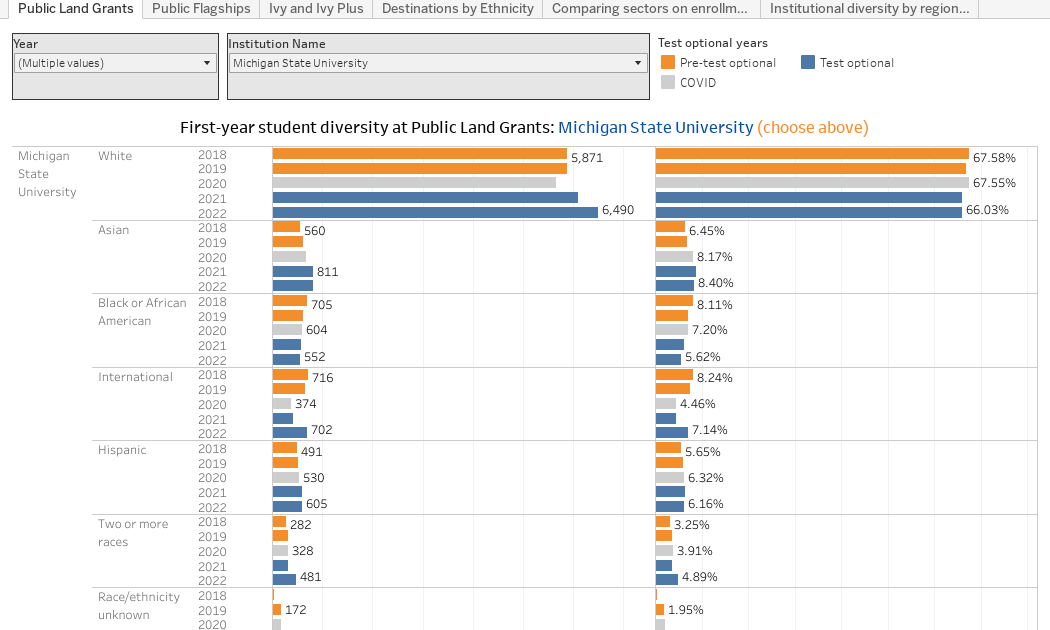
    I started this visualization to show how first-year classes at the highly rejective colleges had changed since COVID-19 forced them all to go to a test-optional approach for the Fall of 2021.  But it sort of took on a life of its own after that, as big, beefy data sets often do.

    The original point was to help discount the conventional wisdom, which is propped up by a limited, old study of a small set of colleges that showed test-optional policies didn’t affect diversity.  I did this post last year, after just one year of data made it fairly clear they did at the institutions that had the luxury of selecting and shaping their class. 

    This year I took it a little farther.  The views, using the tabs across the top, show the same trends (now going to 2022) for Public Land Grants, Public Flagships, the Ivy and Ivy+ Institutions.  In each case, choose one using the control.

    Note that I had colored the years by national trends: 2018 and 2019 are pre-test optional, gray is COVID, and blue is post-test optional.  This is not to say that any individual college selected either required tests or went test-optional in those years, but rather shows the national trend.  And remember these show enrolling students, not admitted students, which is why gray is critical; we know COVID changed a lot of plans, and thus 2020 may be an anomalous year. 

    The fourth view shows where students of any selected ethnicity enroll (again, use the dropdown box at the top to make a selection); the fifth view breaks out ethnicity by sector; and the final view allows you to look at diversity by sector and region (to avoid comparing diversity in Idaho, California, and Mississippi, for instance, three states with very different racial and ethnic makeups.)

    On all views, hovering over a data point explains what you’re seeing.

    If you work at a college or university, or for a private company that uses this data in your work, and want to support my time and effort, as well as software and web hosting costs, you can do that by buying me a coffee, here. Note that I won’t accept contributions from students, parents, or high school counselors, or from any company that wants to do business with my employer.

    And, as always, let me know what jumps out at you here. 

    Source link

  • DHS Announces First Phase of Final H-1B Modernization Rule – CUPA-HR

    DHS Announces First Phase of Final H-1B Modernization Rule – CUPA-HR

    by CUPA-HR | February 1, 2024

    On January 30, 2024, the Department of Homeland Security (DHS) announced a final rule to implement a new beneficiary-centric selection process for H-1B registrations. This rule, which also introduces start date flexibility for certain H-1B cap-subject petitions and additional integrity measures, is scheduled for publication in the Federal Register on February 2, 2024, and will become effective 30 days later.

    The rule does not finalize all the provisions in the H-1B Modernization Proposal from last October. Notably absent are changes to the definitions of H-1B specialty occupation, policies of deference to prior adjudications, and modifications to cap-gap protection, among others. DHS has indicated plans to publish a separate final rule to address these remaining aspects from October’s proposed rule.

    Summary of Key Changes

    • Beneficiary-Centric Selection Process. The final rule introduces a change in the H-1B registration selection process. Instead of a registration-based lottery system, DHS will now implement a beneficiary-centric approach. This means that each foreign worker (beneficiary) will be entered into the selection process once, irrespective of the number of registrations submitted on their behalf. This change is designed to offer a fairer, more equitable system and reduce the potential for manipulation.
    • Start Date Flexibility. The final rule provides more flexibility for the employment start dates in H-1B cap-subject petitions. Employers will now be allowed to file petitions with start dates that are after October 1 of the relevant fiscal year. This aligns with current DHS policy and removes previous restrictions, offering more convenience for employers and beneficiaries.
    • Enhanced Integrity Measures. Under the final rule, DHS codifies its ability to deny or revoke H-1B petitions in cases where the underlying registration contains a false attestation or is otherwise invalid. Additionally, the rule stipulates that DHS may deny or revoke the approval of an H-1B petition if issues arise with the H-1B cap registration fee, such as if the fee is declined, not reconciled, disputed, or deemed invalid after submission.

    With the final rule, DHS not only introduces key adjustments to the H-1B visa process but also sets the stage for efficiency enhancements. Starting February 28, 2024, USCIS will launch an online filing option for Forms I-129, Petition for a Nonimmigrant Worker, and Form I-907, Request for Premium Processing Service.

    In addition, USCIS will launch new organizational accounts in its online platform on February 28. These accounts are designed to enable collaboration within organizations and their legal representatives on H-1B registrations, petitions, and associated premium processing requests. While some details about this new account system and the e-filing function have been provided, USCIS is expected to release more comprehensive information in the coming weeks.


    Source link