Each month, CUPA-HR General Counsel Ira Shepard provides an overview of several labor and employment law cases and regulatory actions with implications for the higher ed workplace. Here’s the latest from Ira.
NLRB Issues a Formal Complaint Alleging College Football and Basketball Players Are Employees and Can Petition to Unionize
The NLRB regional director in Los Angeles issued a long-awaited formal complaint alleging that the NCAA, Pac-12, and The University of Southern California all violated the National Labor Relations Act (NLRA) when they refused to treat college basketball and football players as employees under the NLRA. The regional director agreed with the legal conclusion the NLRB general counsel made last December and issued a formal complaint against the three parties. The NLRB regional director is alleging that all three entities are joint employers of these athletes and violated the NLRA by misclassifying them as “non-employee student athletes” (Univ. of Southern California (NLRB Reg Dir Case No. 31-CA-290326, complaint issued 5/18/23)).
If the NLRB ultimately prevails on all counts, the outcome could lead to unionization of college basketball and football players at both public and private college and universities in the U.S. While the NLRB has no jurisdiction over public institutions, it does have jurisdiction over the private NCAA and various private athletic conferences it alleges are joint employers of these athletes. Needless to say, this will be a heavily contested and lengthy litigation event.
U.S. Supreme Court Holds That Unions Can Be Held Liable in State Court for Intentional Destruction of Employer Property During a Strike
In an 8-1 decision, the U.S. Supreme Court held that the Teamsters Union could be held liable for intentional destruction of employer property during a strike and that the victimized employer could sue the union in state court alleging such intentional infliction of damages (Glacier Northwest Inc. v. Teamsters Local 174 (U.S. No. 21-1449, 6/1/23)). The case had been dismissed under the long-held Supreme Court decision in the Garmon case, holding that the National Labor Relations Act (NLRA) preempted state court litigation against labor unions.
The Supreme Court created a narrow exception to Garmon’s federal preemption, holding that, “far from taking reasonable precautions to mitigate foreseeable danger to employer property … the union executed the strike designed to compromise the safety of the employer’s trucks and product.” The court concluded that such union conduct is not even arguably protected by the NLRA.
Here the union called a strike of concrete truck drivers and intentionally instructed the drivers to return their trucks, loaded with concrete, to the employer rather than complete the delivery. This resulted in the concrete hardening in the trucks, leading to the destruction of trucks and concrete product.”
EEOC Publishes Updated Guidance on the End of the COVID-19 Public Health Emergency
On May 15, the EEOC updated its technical assistance entitled “What You Should Know About COVID-19 and the ADA, the Rehabilitation Act, and Other EEO Laws.” The updated guidance covers a variety of issues related to the end of the public health emergency. While the publication notes that some pandemic-related reasonable accommodations may cease, accommodations for employees with long COVID may continue to be necessary. The guidance contains tips to help employers avoid COVID-related harassment of applicants or employees who need to take precautions because of a disability.
University Prevails on First Amendment Grounds in Defamation Action Brought by Former Professor
A Louisiana state appeals court dismissed a defamation action brought by a former professor against the university as a result of the student newspaper publishing allegedly defamatory statements concerning the professor. The student newspaper articles concerned racism allegations. The court of appeals dismissed the case, holding that the newspaper articles constituted speech on matters of public interest protected by the First Amendment. The court also noted that the articles concerned “a high profile individual” (Duhe v. Loyola University of New Orleans (La. Ct. App. 5th Cir. No. 22-C-292, 5/30/23)).
State-Based Initiatives Restricting or Banning DEI Policies Have Passed or Are in the Legislative Pipeline in More Than 12 States — State-Based Legal Challenges Likely to Ensue
Florida and North Dakota have become the first states to restrict DEI programs and/or training at public higher ed institutions. Arizona, Tennessee and more than 12 other states are considering such measures. It is likely that these initiatives will be subject to continuing litigation in multiple states. Faculty unions at some public, state-based systems may argue that these restrictions violate existing collective-bargaining provisions. The state of the law in this area is rapidly changing and subject to different turns depending on how different state courts deal with these issues prospectively. We will continue to follow state law developments and will keep CUPA-HR members apprised in this monthly column.
University Defeats Transgender Detective’s Sex Bias, Promotion Lawsuit — Failure to Identify a Similarly Situated Non-Protected-Class Employee
A judge in the U.S. District Court for the Southern District of Florida recently dismissed a Title VII claim filed by a transgender detective alleging sex discrimination under Title VII for failure of the university to promote. The federal judge dismissed the case, concluding that the plaintiff failed to identify a similarly situated non-protected-class employee who was treated more favorably (Ponce v. Florida Atlantic University Board of Trustees (2023 BL 162924, S.D. Fla. No. 9:22-cv-81546, 5/12/23)).
The judge dismissed the lawsuit without prejudice to the plaintiff refiling the lawsuit to appropriately allege a similarly situated non-protected-class employee who was treated more favorably.
State Laws Requiring Pay Ranges to be Part of Job Postings and Ads Are Growing
New York, California, Washington and Colorado have already enacted laws requiring pay ranges to be listed in job postings and ads. Specifics should be discussed with local counsel in those jurisdictions.
Illinois, Michigan, Oregon, New Jersey, Connecticut, Rhode Island, Massachusetts and Hawaii have bills either pending in the state legislature or before the governor awaiting signature. Specifics vary by state, but the trend is to force employers to be more transparent in job postings and ads.
Public University Registered to Do Business Out of State Is Subject to Out-of-State Sex-Harassment Litigation — Sovereign Immunity Defense Rejected
The U.S. Supreme Court has denied the petition by a public university located in Alabama to appeal the divided decision of the North Carolina Supreme Court which allowed the university to be subject to a sex-harassment suit filed in North Carolina (Troy University V. Farmer (U.S. No. 22-787, cert denied, 5/30/23)).
The Supreme Court denied the university’s appeal of the adverse decision of the North Carolina Supreme Court, which held that the university’s registration to do business in North Carolina and its operation of an office for commercial activities in Fayetteville, North Carolina, was enough to subject it to the jurisdiction of the North Carolina courts. Specifically, the North Carolina court held that the agreement that the university signed, which allowed it to do business in the state, contained an agreement to sue and be sued in the state. The North Carolina court held that this waived the university’s sovereign immunity.
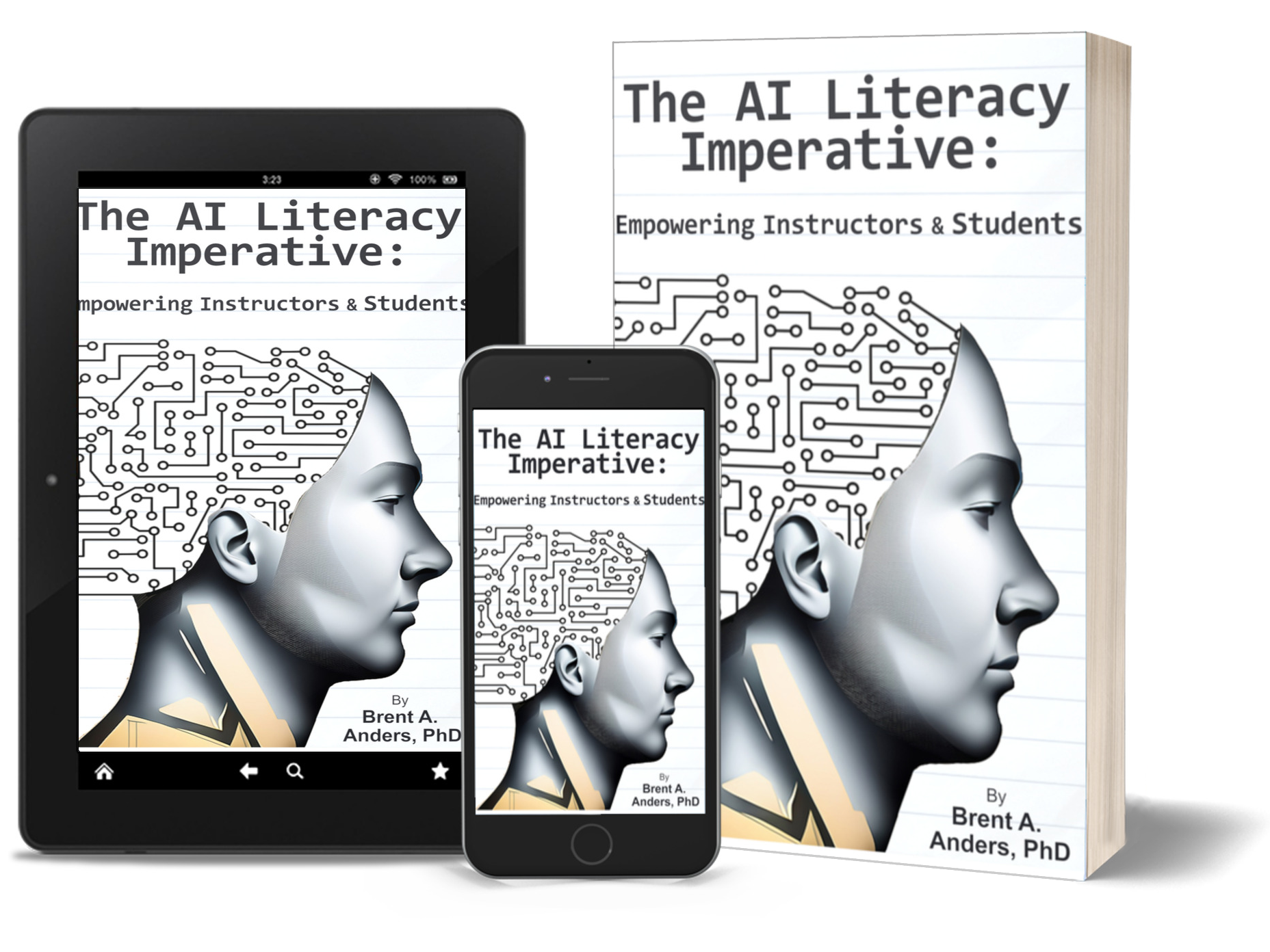
This is my new book that I am very excited about because I think that it can really help a lot of people, especially instructors (at all levels) and students. It is vital and truly an imperative that we in academia help develop AI Literacy. Available on Amazon as an ebook, paperback, or hardback: https://www.amazon.com/AI-Literacy-Imperative-Empowering-Instructors/dp/B0C51RLPCG
BOOK DESCRIPTION:
The AI Literacy Imperative: Empowering Instructors & Students” is a seminal work that delves into the critical need for everyone to have AI Literacy in modern society, especially in academia. The book explains how educators must have a deep understanding of the key aspects of AI literacy: Awareness, Capability, Knowledge, and Critical Thinking, to effectively teach this vital skill to students.
Drawing upon extensive research and practical experience, author Brent A. Anders, PhD. presents a comprehensive guide for instructors to integrate AI literacy into their curriculum. By exploring the fundamental concepts and applications of AI, this book empowers educators to equip their students with the skills necessary for success in both their professional and personal lives in our new AI integrated society.
Throughout the book, a deep understanding of the complexities of AI and its implications for society are demonstrated. Through a rigorous exploration of the latest research and pedagogical considerations, the book provides educators with a clear roadmap for teaching AI literacy in a way that is understandable, manageable, motivational, and upholds academic integrity.
“The AI Literacy Imperative: Empowering Instructors & Students” is a must-read for educators, students, instructional designers, librarians, researchers, and everyone else. By providing a comprehensive and easy-to-understand guide on the main components of AI literacy, covering everything from overreliance, writing assignments with AI, deepfakes, ethical considerations, future possibilities, and much more in-between, this book helps everyone better understand AI, use it more effectively in education, and help create a better AI integrated.
On May 26, the Department of Education published a blog post stating that the release of the anticipated Title IX final rule will be delayed until at least October 2023. The final rule was previously targeted in the Fall 2022 Regulatory Agenda for May 2023.
In the blog post, the department states that they need additional time to review the 240,000 comments they received in response to the Title IX proposed rule that was issued in July 2022. The department said that the 240,000 comments are nearly twice the number of comments the department received during the Trump administration’s Title IX rulemaking process, which included the release of a proposed rule in November 2018 and the subsequent final rule in May 2020. The department added that the new target date of October 2023 will be reflected in the upcoming Spring 2023 Regulatory Agenda, which will likely be released in the next month.
As a reminder, the Biden administration’s Title IX rulemaking rolls back the Trump administration’s 2020 regulations, specifically with respect to its grievance procedures, while simultaneously expanding protections against sex-based discrimination to cover sexual orientation, gender identity, and pregnancy or related conditions. CUPA-HR filed comments in September 2022 in response to the NPRM, in which we brought attention to the possible impact the proposed regulations could have on how higher education institutions address employment discrimination.
In addition to the Title IX rulemaking, the blog post also states that the final rule on transgender student eligibility in athletic programs under Title IX will also be delayed until at least October 2023. Released on April 6, the proposed rule establishes that schools that receive federal funding would not be permitted to adopt or apply a one-size-fits-all ban on transgender students participating on teams consistent with their gender identity and would instead allow schools the flexibility to develop team eligibility criteria that serves important educational objectives, such as fairness in competition and preventing sports-related injuries.
CUPA-HR will continue to monitor for updates on the Title IX final rule.
Julia started Wise Investigator to help researchers get funding for their research
I had this picture of what getting research funding looks like in my head. I had sought small grants and travel funding in grad school. But never the big funding proposals my online presence clients write. I know that research funding might be integral to your career. It may also be something you’ve never attempted before, and has recently become a goal for you.
I learned so much about getting your research funded the 1st time I met Dr. Julia Barzyk.
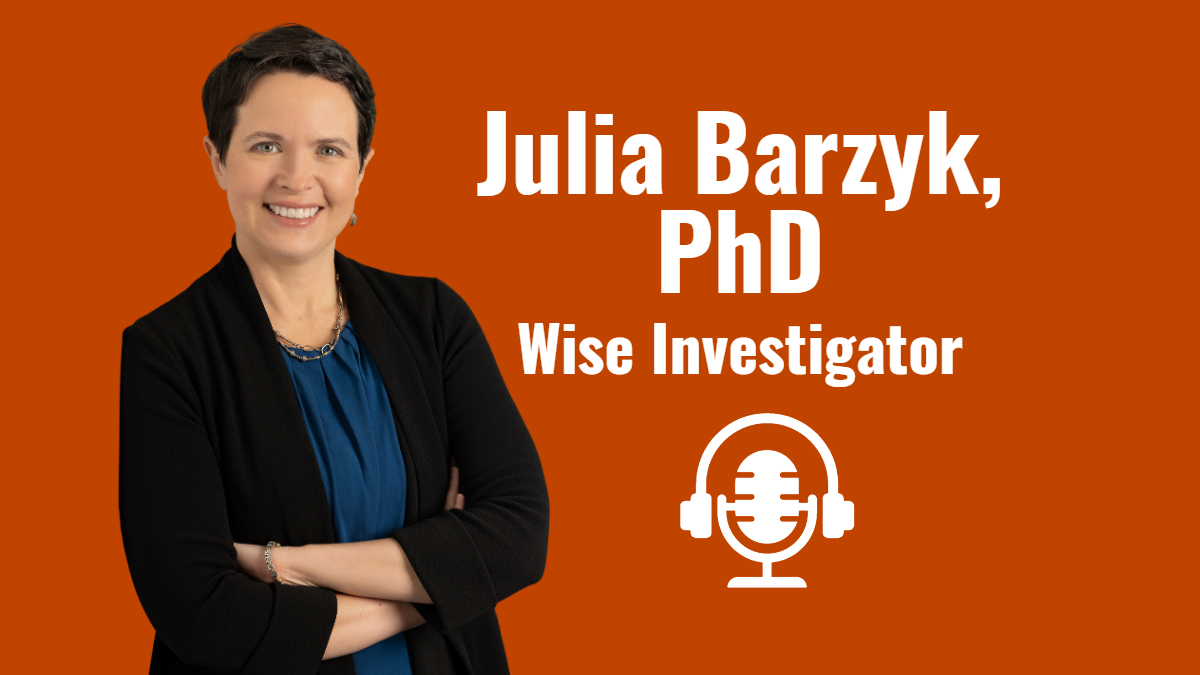
After 10 years at a major United States funding organization, geoscientist Dr. Julia Barzyk left to start Wise Investigator. She helps Principal Investigators (PIs) get funding for their research to grow their careers.
I’m delighted to feature Julia here on The Social Academic. Let’s uncover some of the hidden curriculum together to get your research funded.
Jennifer: Hello, everyone. I am Jennifer van Alstyne. Welcome to The Social Academic. Today, I’m talking with Dr. Julia Barzyk of the Wise Investigator LLC. We’re gonna be talking about research funding.
Save this for later, because you’re gonna wanna come back to it.
Julia, I’m so glad you joined us today. Would you please introduce yourself?
Julia: Thanks, Jennifer.
I’m Julia Barzyk. I’m speaking to you from my home in Durham, North Carolina. I spent most of my career as a geoscientist.
Right now I’m working full-time helping university researchers get funding for their research, and by doing so, grow their careers more generally.
Jennifer: Why is this something that’s important to you? Why did you decide to do this full-time?
Julia: I’m gonna tell you a little bit about my responsibilities that I had in the position that I was in prior to what I’m doing now, because I think that answers a good bit of the question.
“I’m a geoscientist. I spent many years working at a major United States funding organization managing a portfolio of research in geoscience and civil engineering.”
These are projects that researchers at universities, otherwise known as professors, or principal investigators, or PIs, are performing on university campuses. They’re conducting their research with these funds, they’re supporting students with these funds, and they’re supporting themselves in terms of some salary with these funds.
My duties involved going out into the academic and the scientific community and letting people know about the opportunities through the organization I was with.
I had a lot of interactions with people as part of this outreach. Then we would have conversations that would go to the actual research topics that people were interested in pursuing, discuss and refine those topics.
Some of these people would then submit proposals. I was in charge of managing the proposal evaluation process. I directed that by sending these out for review, getting the comments from those evaluators, synthesizing all of that, and making recommendations on what was gonna be funded.
Some of these proposals were funded, and after that, I followed the work. I managed certain aspects of it. I was also responsible for connecting those university researchers with government scientists and engineers who wanted to collaborate with them. The government only has the capacity that it has in its labs with the staff that it has, and so they can extend that capacity by partnering with extramural researchers, otherwise known as university researchers.
The reason why I went into all of that was because as I was going through this process, year after year…
“I realized that the vast majority of these PIs, or professors, that I was working with were not prepared to know how to engage to their full advantage with this process.”
Generally, the advice that they’re given and the support that they’re given centers around the preparation of the proposal itself. Now, proposal preparation is very important, so I don’t wanna diminish that. This is one of those things where you’ve gotta check all the boxes. So I’m not saying don’t worry about the proposal. Get all of the support that you can on the proposal is my advice to anyone.
But, all those other steps that I described were aspects of the process that principal investigators didn’t even really know existed. By learning about the broader process, they can have a lot more success and not waste time writing proposals for an opportunity that may not even be a great fit because it’s a huge effort to write that proposal. Even if someone is not interested in funding your work, I feel like you would much rather know that before you put in those dozens of hours on writing a proposal. I decided the best way I could fix the situation was to resign from that position to dedicate myself fully to doing what I’m doing now, which is teaching this hidden curriculum to these principal investigators (PIs).
Jennifer: Tell me a little bit more about this hidden curriculum. It sounds like universities are providing some support for researchers, especially when it comes to preparing that proposal, but there’s a lot of things that researchers don’t know about that process.
Can you give me an example of some part of the hidden curriculum that your work supports?
Julia: Just one example of all of these pieces of information that piece together to form this hidden curriculum is when you’re interacting with someone from one of these organizations, is it a community-driven organization like National Science Foundation, or is it a mission-driven organization like something maybe with the Department of Defense?
Because while they’re both gonna be supporting basic research and they may also be supporting more applied research, that is just one thing that can really help guide somebody’s understanding and decisions and the questions they ask and the way they pursue that opportunity because there may be more that an organization wants to get out of a relationship with an investigator than only supporting the science or the research itself.
These are the kinds of things I talk about with clients so they can kind of wrap their heads around the bigger picture and then know how to use that to their advantage and know where the best places for them to engage are or the best places for them to say, “I’m gonna pass on that.”
Jennifer: Yeah, actually, just the word that you said, “relationship,” like it’s an ongoing relationship. It’s not just a proposal that’s going to be funded or not funded, it’s a longer journey.
That’s something that I did not recognize when I was still applying for research funds. I am so happy that someone like you exists because universities just aren’t providing the kind of support that researchers actually need to launch themselves into the world into this more funded reality. I want that for researchers. And so I’m so glad that we’re talking today.
Now, one thing that I wanted to ask you about specifically was a LinkedIn video that you had posted in the last couple of weeks. And you talked about how important it is to ask open-ended questions when you first connect with someone at a funding agency. Can you tell me a little bit more about that?
Julia: The short answer is that there are so many opportunities and by that I mean funding opportunities that are available that any one representative will know about. Even if this person at the funding organization is responsible primarily for one program or one opportunity, they are going to know about many, many other opportunities within their organization and even at other organizations.
At the same time, the researcher is going to have many different ideas for research that they would like to pursue. They may go into a conversation thinking, “Oh, I think this topic would be a good fit for this opportunity based on something I read.”
But if you go in with that narrow focus, you could get a “no” or even if you got a “yes,” you could still be missing out on more information.
It’s the open-ended conversation is for both parties to say kind of, here’s an overview of the opportunities and someone to say, here’s an overview of my interests and what I do. And even beyond the research topic, are they engaged with the community? Are there other aspects of what they do that are important and could be relevant to that funder? But with a yes or no question, you may not get to that.
Jennifer: Oh, that’s fascinating. So it really is a conversation starter. And it’s because both of you as the person submitting the proposal and the research funder are able to bring information to that conversation that can help you both get closer to your goals. I really like that. I really have never thought about it this way before.
Can I ask, do you get pushback from people who are coming to work with you? Are they like, wait, this is how it works? Like, I had no idea. Is there a lot of shock?
Julia: Really, their reaction is really one of relief. Because it’s like they know that there’s more to the picture. Because these are very bright people. And they’ve seen aspects of this manifest here and there. But to have somebody put all of those pieces together, it does provide a relief.
It’s not so much that they’re shocked, but that it’s like, “Oh, okay, now I see it.” And then once you see it, it’s one of those things you don’t really unsee it.
And that’s why we talk about a kind of a transformation because once you know this stuff, you know it, you don’t have to relearn it. You just really are getting to that next stage of your career where the relationship building is important and not in a way, sometimes people would have a feeling of, oh, if it’s a relationship, you know, that can go the wrong way.
If you have a closed network and you’re calling on the same people for opportunities all the time, it’s not letting other people into that circle, into those opportunities. And that’s the way we don’t wanna go where people say, “Oh, it’s an old boys club,” or something like that.
At the same time, we all are building relationships with each other. So we wanna take the positive and the good and the productive aspects of building relationships and sharing opportunities, not the kind of relationship building that closes the opportunities for other people.
Jennifer: I like that. When we first met, one of the things that I pointed out was how much I liked your bookcase behind you. I really like all the things that are on your bookcase and it tells me something about you. You actually talked about how that was like a conscious decision, isn’t that right?
Julia: Yeah, I think definitely you want to, if we’re talking about the remote-first environment, you really want to be setting yourself up with the tools that you need, with the environment that makes you feel good.
That way, when you have an opportunity to be on a podcast, or to have a meeting with a potential collaborator or a client that you can just get right to it. Just like if you met in a coffee shop and you were just set. You got your cup of tea or got your cup of coffee and you sat down and you got right to it.
And so that’s something that’s overlooked, especially now. I mean, if we’re talking about the funding environment, where I believe we can consider the funding environment or the funding landscape to be remote-first. I feel like a lot of professors, they definitely had to adapt to a lot with the pandemic and teaching on Zoom. Fortunately, they’ve really restarted the campus life environment and that’s wonderful. But it could be the case that they start thinking, “Oh, I’m back here all in real life again and I have this dynamic environment in my lab, in my building, in my office.”
“But the funding environment, I believe we should think about that as remote first. I think everybody should set themselves up to be able to thrive in that remote environment.”
Jennifer: I love that, remote-first. That’s definitely a new idea for a lot of researchers. I mean, at least when I talk to the professors who I work with on their online presence, a lot of them say, “I don’t network online. I network in person when I’m at conferences. I network at these in-person events,” but when you think about research funding as a remote-first environment, it means that you also need to reconsider how you are able to and want to network. I really love that you brought that insight to us.
Jennifer: Now, the professors that I work with at least have anxiety about talking about their work, about talking about their research online. And I really help them with that process and build their confidence.
Why is that helpful for research funders to see? Why is having an online presence helpful for people who are actually funding that research?
Julia: First of all, the most practical reason would be just to be findable. If you have something online that has some ability to show up in a search engine and a LinkedIn page is good for that because search engines like that, website can be optimized to show up in a search engine. And that’s a way that when people at a funding organization are looking for experts…
And of course we think, “Oh, they’re looking at me so I can review proposals. Well, that’s more work.” And that is true. They may be looking for you so that you can hopefully do some work for them, or let’s just say for the community. And that’s something that comes to mind first.
But there are other reasons why people in the government or at funding organizations will be looking for experts:
to serve on a panel
to serve on a committee
to speak at a workshop
or participate in a workshop
And so you do want to be findable. Then maybe you’re findable and that does lead being fundable.
Then beyond that, you do wanna stay top of mind. That’s a spaced repetition type thing. It’s that if you keep seeing somebody, then when you are in a conversation with a colleague, I need an expert in this, or who could I talk to about that? That’s the person that’s going to pop to mind as well as building this know, like, and trust, which is important for relationships, especially in the virtual environment.
Beyond that, I would say it moves into being supporting inclusivity, because like I was saying before, I definitely know that people at these organizations want to bring out and bring new people into the conversation. They can do that most easily if people are findable.
“Beyond that, moving into can it bring you any kind of advantage to a proposal, to a funding decision? Well, decisions are going to be made based on strict evaluation criteria. And that’s the way that they should be made. That said, I think very much a picture is worth a thousand words in this case.”
Julia: Because when you are writing a proposal, there is either a strict page limit on the project description, or there’s an effective page limit because evaluators don’t want to read, more than a certain number of pages.
But if you can show that you’ve engaged in the community, people know that about you because there’s some information that demonstrates that, be it photos, or a press release, or something like that on the internet they may have seen. Then it’s demonstrating, “Oh, this person has done this community-based work that they’re talking about doing in the proposal.” Or, “Oh, we’re really hoping that these researchers could maybe collaborate with some of our government scientists and engineers. Here is some evidence that they did that in years past with another group of collaborators.”
These are things that anyone can demonstrate about themselves online. It kind of proves the point more than just writing a few sentences saying, “Oh, we’ve got these great ideas. We promise we’re gonna do all this stuff.”
Jennifer: I love that. It’s like more social proof, more engaging places that those research funders can explore about you. Now, I am curious. Let’s say I’m a researcher who’s ready to start finding some research funding. Where do I start? It sounds like it’s not with the proposal. I need to have a conversation. So where do I start?
Julia: The first place to start would be to go to, and now I’m gonna speak mostly about federal government opportunities, but it would be to go to Grants.gov and to search by keyword for funding opportunities that you may be able to submit to. You’re gonna see a lot of stuff come up from all different agencies and organizations. It’s a lot to start working your way through.
If you’re at a university, your institution may have, or probably does have a subscription to commercial tools that will help you do these kinds of searches too. I would say, sure, do that. And that’s something most people think to do because they know that that’s available. That’s kind of what I’m calling like a bottom-up approach.
They should also be doing a top-down, which is to actually go to the websites of these various organizations. It’s time-consuming and it’s cumbersome because many of these websites are not easy to navigate. Some of them may say clearly, oh, “Find funding” or “Grants”, and you can go there. And even if you go there, you may get a little tripped out because it may be kind of a dead end or something. But if you’re persistent, try to find it on the website because then you’re getting the big picture view of what is this organization broadly.
“What you wanna do is when you’re going top-down or going from the bottom up is look for the names of actual people. These are your program officers, or program directors, program managers, technical points of contact that could be called or other points of contact. And you want to reach out to them because there is so much information out there.”
Julia: There is no hope. I mean, I don’t mean to sound too pessimistic, but there’s very little hope of being able to sort through it all on your own. And you don’t wanna find yourself behind your computer, just scrolling PDF after PDF hundreds of pages of this stuff, trying to think where your research could fit when it’s a much better option to
send the email
a video call
an audio call
Get on the phone with someone who works at one of these organizations and ask them “What would be the best opportunity for me?” Have that back and forth conversation. I encourage people to reach out because I worked with many of these folks for many years and they are friendly people.
Their email inboxes do get very full. So if you don’t get a response at first, just write back, but they wanna hear from you and they want to help you. I promise that. So don’t hesitate to reach out.
Jennifer: I love that. They wanna hear from you and they want to help you and follow up if you don’t hear back because they do wanna hear from you. That’s so important for people to know. Thank you for sharing that.
Wise Investigator, a program for researchers like you
Jennifer: Tell me more about your program. I wanna hear all about it because I think some people listening are gonna wanna join.
Julia: When we start out in this 10-week program, which they’re able to participate in by asynchronously in terms of watching some recorded classes, but then also each week have a one-on-one meeting with me so that we can then talk about how they’re getting their materials and their situation aligned with the material that we’re focusing on that week, if that makes sense. They do have some assignments week to week and we go over that each week so they get that one-on-one feedback and support.
We start off talking about a research vision and getting clear on that. And that aligns with the focus on the online presence and really up-leveling that because your online presence should be guided by your overall career and even life vision.
From there, we break down the mechanics of the funding process. And that’s some of the stuff I was talking about when we started the call about what are actually all of the steps that occur for something to go from a conversation to a funded research project and then after, what happens after it’s funded. By pulling back the curtain on this, then that really helps clients start to see, “Oh, how can I help move this process forward? How can I be a more active participant in these various steps and build these win-win-win relationships?”
“It should be a win for the person performing the research or the Principal Investigator, a win for the individual that you’re working with, that program officer, and a win for the broader organization.”
Julia: By learning what goes on behind the scenes, that helps support achieving these outcomes.
From there, we go into framing research questions effectively. This is something that it’s pretty spotty in terms of, some faculty have had some training in this previously, but many of them have had no training in it whatsoever.
This is very much an iterative process in terms of looking at their ideas. They get ideas out on paper and we iterate on that to get those framed in a way that’s going to be most advantageous for them to be able to present this material to a general audience, to an audience of scientists who are maybe not in their specialty, but just have general technical knowledge. And then of course, they still have to explain it down in the weeds to the technical experts who will eventually do the evaluations on the proposal.
From there, we talk about the approaches of actually getting in contact with these program officers so that they can have the most productive conversations possible. That really provides a lot of relief for clients because that’s something that they hear a lot, kind of like what I was just saying about, just talk to them, just reach out, just talk to them. And they don’t necessarily know, “Well, what should I say in the email? How should I start the conversation?” And so we go over all of that and I provide that information, which is helps people get started on those conversations.
Jennifer: Oh, this feels like such a supportive process. I really like that. What is the thing that you say people are getting most from your work together?
Julia: You know, it’s been interesting that the feedback that I’ve gotten in terms of what has been most valuable has really varied from client to client. Some of them definitely, that framing of the research question where people have said, “No one has ever sat down with me and gone through this before.” And these are people who are Assistant Professor positions at top programs and they’ve accomplished so much in their careers, yet they never had that helping hand to just take the time to work through a one-page document and pull out the parts that are kind of most important and need to be emphasized and reorder them and draw out the impact. That’s an exercise that many of them have never been through before.
Others have appreciated the fact that this provides a broader framework for them to approach the entire process. And many of them have really had a reaction that they weren’t expecting to have about how good they felt about starting that online presence.
In fact, one of my clients, just six weeks into working with me, using what she learned in the program, and it wasn’t even something that I had coached her to do specifically, but she took the information she was learning, she hadn’t finished the program, but she came in and said that she had actually gotten additional funding just by sending an email.
So while you’re not going to get a $300,000 reward by asking for it in an email, and that’s not the way we want things to run, she had a situation where she was able to take some beautiful photos that had been taken of her working with a student in the lab, attach those with the description of the progress that she had made to an internal funding body within her organization, and said, “Hey, look at this, look at this great work.” And they said, “Yeah, just here’s the funding to support this person over the summer,” just like that.
Those are those quick wins, which of course it’s great to get that support for the summer. But also just how she was beaming with excitement to say, “Oh yeah, it doesn’t always have to be so hard because now I know I should just ask for it, and I’ve got these great photos, and I know what to say on the email.” And that’s a quick win. So that’s a really great outcome.
Jennifer: Oh, that made me feel so warm, I love that, like an email with photos of her working with the students. That’s great.
Julia, it has been wonderful to talk with you about Wise Investigator and your program and all of the amazing work that you’re doing. How can people keep in touch with you after this call?
I think you understand just how much of a privilege it is to work with the clients that we work with because we work with such talented people. I don’t know if a person can really take credit for a gift of talent, but they can take credit for the hard work and dedication on top of the talent that these folks put in.
We’re so fortunate here in the United States that we have people coming from all over the world to continue their studies here and make lives here, and not only to do the research that they’re doing, which is what I support them with, but the contribution they make in teaching, which is enormous.
I’m just inspired by my clients every day, and just a shout out to them because that’s why I’m doing this. I’m here to serve them. I just wanted to give them the credit they deserve for all of the hard work they’ve done to get to the point that they’re at, and what I’m able to do with them is really a small, give them a small helping hand just to get to this mid-career stage after all of the years and years that they have put in. It’s a privilege to be able to do that.
Jennifer: Thank you so much for joining me on The Social Academic. This has been a conversation with Dr. Julia Barzyk of Wise Investigator. Be sure to subscribe so you don’t miss the next interview.
Julia Barzyk founded Wise Investigator LLC to help U.S.-based university researchers get funded so they can grow their careers with the intention and resources they need to thrive. Prior to starting Wise Investigator, she managed a portfolio of basic research in geoscience and civil engineering at the U.S. Army Research Office. She received her Ph.D. in Geophysical Sciences from the University of Chicago. Julia lives in Durham, North Carolina, with her husband and two teenagers.
In the latest development on Julie Su’s contentious nomination for secretary of the Department of Labor (DOL), Sen. Joe Manchin (D-WV) appears unlikely to vote in favor of Su when her nomination reaches a floor vote in the Senate. Recent news reported that Manchin may be seeking alternative candidates for the position, though no names have been publicly revealed at this time. Given the current 51-49 Democratic majority in the Senate, however, Manchin’s potential opposition means Democrats cannot afford to lose any additional support for the nomination.
The odds may be further stacked against Su as Sens. Krysten Sinema (I-AZ) and Jon Tester (D-MT) have yet to reveal whether they will support Su’s nomination. Although Manchin, Sinema and Tester all caucus with Democrats, they face reelection in 2024 in Republican-leaning states, leaving them in a precarious position as Republicans are seemingly united in opposing Su.
Nomination Hearing and Committee Vote
On April 19, the Senate Health, Education, Labor, and Pensions (HELP) Committee held a hearing on Su’s nomination to serve as secretary of labor. During the hearing, Republicans and Democrats discussed Su’s performance as the secretary of California’s Labor and Workforce Development Agency (LWDA), including her involvement in the agency’s handling of COVID-19-related unemployment insurance payments. Republicans on the committee pointed to the widespread COVID-19 unemployment insurance (UI) fraud paid out by the state. On the other side of the aisle, Democrats defended Su’s record. With regard to the UI fraud, Democrats held that California’s statistics were low in comparison to other states.
The hearing also focused on several key labor and employment issues that Su will work on as secretary of labor. On the topic of independent contractor classification, Republicans again focused on Su’s work at the LWDA, calling attention to her role in California’s Assembly Bill 5 law. The law establishes an ABC test, which is a three-pronged test used to classify workers as either employees or independent contractors. Republicans expressed concerns over whether Su would try to implement an ABC test through DOL regulations. In response, Democrats clarified that the ABC test is not included in the DOL’s new proposed rulemaking and that the DOL has previously stated that it lacks the legal authority to implement this test for classifying independent contractors.
Another issue area raised by Republicans was that of joint employment. Although her support for the joint employment standard was questioned, Ranking Member Bill Cassidy (R-LA) testified that Su has committed to not pursue changes to the joint employer standard if she is confirmed. Su said she understands the importance of the franchising model, stating that there is no plan currently on DOL’s fall or upcoming spring regulatory agenda to change the standard. Notably, she did not say whether there would be a rulemaking on the joint employer issue after the upcoming spring regulatory agenda.
A week after the hearing, the Senate HELP Committee voted to move Julie Su’s nomination to serve as secretary of labor out of committee and to a full Senate floor vote. The committee vote was divided along party lines, with 11 Democrats voting in favor and 10 Republicans voting against her nomination, foreshadowing the trouble she may face to be confirmed by the full Senate.
Next Steps
Given Manchin’s likely opposition and the narrowly divided Senate, Su’s confirmation as secretary of labor by the full Senate is still uncertain. If Sinema or Tester also commits to opposing Su, Su will likely not have the votes to be confirmed. As a result, Senate Majority Leader Chuck Schumer (D-NY) has yet to announce when the vote on Su’s nomination will hit the Senate floor.
In the meantime, Su will continue to serve as the acting secretary of labor in the absence of a person confirmed into that position. As a reminder, there are no limitations on the functions of an acting secretary, leaving Su with full authority over the DOL while her nomination is pending. That being said, anticipated rulemakings from DOL, such as the FLSA overtime rule and the independent contractor classification rule, may be held back from publication as a result of Su’s drawn-out nomination process.
CUPA-HR will keep members apprised of any major personnel or regulatory updates from DOL.
Over the past year, lawmakers have taken an increased interest in establishing and expanding upon benefits and protections for paid leave and pregnant workers. As a result, Congress passed two bills granting workplace protections to pregnant and nursing mothers at the end of 2022, while considering new federal proposals for paid family and medical leave. This post details some of the recent actions taken by lawmakers toward a federal paid-leave policy, as well as updates from federal agencies on the enforcement of the Pregnant Workers Fairness Act (PWFA) and the Providing Urgent Maternal Protections (PUMP) for Nursing Mothers Act.
Bipartisan Working Group on Paid Leave
In April, a group of bipartisan lawmakers in the House of Representatives established the Bipartisan Paid Family Leave Working Group, the goal of which “is to create a bipartisan paid family leave policy that supports American families and businesses.” The group consists of three Republicans — Reps. Stephanie Bice (R-OK), Julia Letlow (R-LA) and Mariannette Miller-Meeks (R-IA) — and three Democrats — Reps. Chrissy Houlahan (D-PA), Colin Allred (D-TX) and Haley Stevens (D-MI).
In a letter establishing the working group, the lawmakers expressed their intention to explore both state and federal policies that already exist with the goal of creating an established paid-leave policy. The letter discusses both the successes and areas to improve of the Family and Medical Leave Act, and it states that there is a bipartisan consensus that paid leave is an issue that needs to become law.
FAMILY Act
On May 17, Sen. Kirsten Gillibrand (D-NY) and Rep. Rosa DeLauro (D-CT) reintroduced the FAMILY Act, which would grant up to 12 weeks of paid leave for employees at companies of all sizes through funds collected by payroll taxes paid by both employees and employers. The FAMILY Act was first introduced in 2013, but the most recent bill expands upon previous text by creating a progressive scale for wage replacement during the time off. Under the bill, the lowest paid workers would be eligible to receive up to 85 percent of their wages during their time off, while the average full-time worker would receive approximately two-thirds of their wages. Additionally, the bill extends coverage to include time off taken to address personal incidents with domestic violence, stalking and/or sexual assault.
While most Democrats have championed the FAMILY Act as their preferred proposal for paid leave, the bill is unlikely to gain Republican support and will therefore not pass the House during this Congress. Republicans have previously opposed the bill, arguing against the proposed tax increases as well as potential burdens employers may face as a result of a paid-leave mandate. Instead, Republicans who have shown interest in advancing paid-leave policies have considered programs allowing individuals to borrow from their Social Security funds, incentivizing the creation of a private insurance system for leave pay, and providing tax credits to pay for time off.
PUMP for Nursing Mothers Act
On May 18, the Department of Labor Wage and Hour Division (WHD) issued a Field Assistance Bulletin (FAB) with enforcement information and public guidance for the PUMP for Nursing Mothers Act. The law went into effect on April 28, after being included in the Consolidated Appropriations Act of 2023 year-end legislation to fund the federal government.
As a reminder, the PUMP for Nursing Mothers Act amends the Fair Labor Standards Act (FLSA) to expand access to breastfeeding accommodations in the workplace for lactating employees and builds on existing protections in the 2010 Break Time for Nursing Mothers Provision by broadening breastfeeding accommodations and workplace protections. Specifically, the bill ensures reasonable time and space for working individuals to pump in their workplaces as well as remedies for employer violations of the act.
The FAB provides details on the requirements for reasonable space and break time, compensation, and employer posting of FLSA requirements as provided under the PUMP for Nursing Mothers Act. Employers and field staff alike may use the FAB document as a resource to understand compliance with the act as enforced by WHD.
Pregnant Workers Fairness Act
Alongside the PUMP for Nursing Mothers Act, the PWFA was also signed into law under the Consolidated Appropriations Act of 2023. The effective date of the PWFA is June 27, and the Equal Employment Opportunity Commission (EEOC) was expected to issue proposed regulations on how best to govern and enforce the PWFA by then.
As of May, however, the EEOC has yet to release any proposed regulations, and it seems likely that the agency will not be able to issue a proposed rule by the June 27 date. The commission currently has two Democratic and two Republican commissioners, and given the need for a majority of commissioners to vote to advance a rulemaking, the agency is unable to move proposed rules forward because commissioners are split along party lines. Through the legislation, Congress has allowed the EEOC through the end of 2023 to finalize a rulemaking on the PWFA, which may or may not be achieved, depending on whether the Senate is able to confirm Kalpana Kotagal as the third Democratic appointee on the commission. In lieu of the proposed rulemaking, the EEOC has issued guidance on the law through an FAQ webpage addressing the protections granted under the law, which stakeholders may use as they wait for the official regulations.
CUPA-HR continues to monitor any developments related to these proposals and laws and will keep members apprised of any policy updates related to paid leave and protections for pregnant and nursing workers.
From developing supervisor competencies to transforming HR operations, human resources teams and HR practitioners across the country are doing great work every day.
CUPA-HR’s regional Higher Education HR Awards program recognizes some of the best and brightest in higher ed HR and honors HR professionals who have given their time and talents to the association.
Here are this year’s regional award recipients:
HR Excellence Award
This award honors transformative HR work in higher education and recognizes a team that has provided HR leadership resulting in significant and ongoing organizational change within its institution.
Office of Human Resources, Towson University (Eastern Region)
Towson University has had a partnership with Humanim, a nonprofit community workforce-development program, for many years. However, the pandemic created challenges that threatened to derail the partnership and the program. TU’s office of human resources, along with other anchor institutions, worked with Humanim to move parts of the program online, including virtual mock interviews, information sessions and panel discussions. Despite turnover created by the pandemic, the TU HR team was determined to maintain its relationship with Humanim and continue to provide employment opportunities to Baltimore residents. As TU’s top provider of quality temporary candidates for the university’s administrative functions, Humanim was also essential to the university during pandemic. For their outstanding work, CUPA-HR has contributed $1,000 to Towson University.
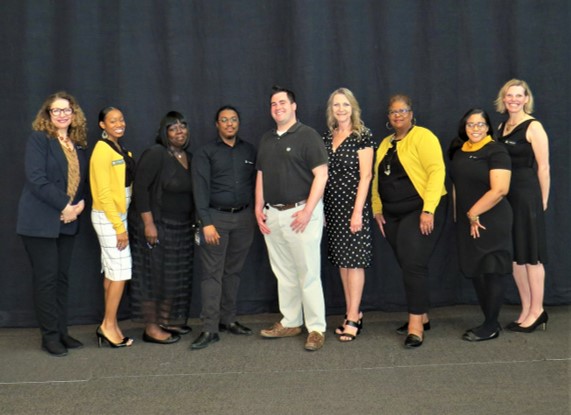
Human Resources, Grand Valley State University (Midwest Region)
In February 2022, Grand Valley State University’s HR team began implementing a total transformation of their operations, shifting from a 60-year-old compliance-driven approach to HR to an HR business partner approach. This change resulted in the creation of a “one-stop shop,” where HR services could be delivered more efficiently and consistently across all campus departments. The team also moved to improve efficiency by merging payroll, HR administration and technology, and benefits into a total rewards unit. And in the fall of 2022, HR established a formal talent management unit to organize and advance talent efforts. With these changes, HR is well positioned to unify and transform the university’s organizational culture. For their outstanding work, CUPA-HR has contributed $1,000 to Grand Valley State University.
Culture Team, Utah Valley University (Western Region)
Recognizing a need for a better leadership experience for supervisors on their campus, Utah Valley University’s culture team set out to create a set of standardized leadership competencies that would help ensure that they were hiring the right people, communicating clear expectations during onboarding, providing leadership resources through training, and allowing supervisors to receive feedback. The Leadership Competency Experience, based on six leadership competencies and the university’s core values, established a standardized method of hiring, onboarding, training and feedback processing intended to cultivate effective leadership at all levels. Two years in, the program has made a significant impact on the quality of supervisors being hired and the training and support they receive, and the number of employee relations cases and volume of turnover due to bad supervision have decreased sharply. In fact, it has been so successful that in July 2022 the team released the Staff Competency Experience. For this impressive achievement, CUPA-HR has contributed $1,000 to Utah Valley University.
Higher Ed HR Rock Star Award
This award recognizes an individual who is serving in the first five years of a higher education HR career who has already made a significant impact.
Miranda Arjona, Rollins College (Southern Region)
From day one, Miranda Arjona, assistant director of human resources at Rollins College, has impressed colleagues with her positive outlook, creativity, willingness to learn and helpful attitude. Whether she’s building relationships within the HR team or leading a service excellence subcommittee, Miranda is focused on strengthening connections and making a difference. When she was asked to temporarily assist in student affairs to help manage contact tracing and consulting during the pandemic, she did so with her typical positivity and commitment to the task. Just as seamlessly, she transitioned back to her talent management role with the same mindset and tenacity. Her commitment to being a relationship-builder has not only served Rollins but also the higher ed HR community. She has been a speaker at two local HR events, and she is currently serving as president-elect of the CUPA-HR Florida Chapter.
Lyndon Huling, University of California-Davis (Western Region)
Lyndon Huling, manager of leadership recruitment, temporary staffing and diversity services at UC Davis, routinely taps his broad intergenerational and cross-cultural campus connections in his work, making him an exceptionally effective leader. His commitment to reimagining HR and recruitment best practices through a DEI lens shows in the strategies he’s developed and the innovative programs he’s been instrumental in establishing. Among other projects, he has co-sponsored and delivered transformative Race Matters workshops that create a safe space to learn and discuss race at work, which he has shared through presentations at regional and national CUPA-HR conferences. Through his work to create and share resources, Lyndon has demonstrated himself to be a passionate, progressive leader in higher ed HR.
Chapter Excellence Awards
These regional awards recognize chapters that are making a significant impact through their commitment to CUPA-HR and to the higher ed HR community. They work to achieve this through financial responsibility, commitment to CUPA-HR chapter guiding principles, cultivation of strong leadership, and development of creative networking and professional development opportunities.
This year’s Chapter Excellence regional recipients are:
The CUPA-HR Michigan Chapter (Midwest Region)
The CUPA-HR Kentucky Chapter (Southern Region)
The CUPA-HR Northern and Central California Chapter (Western Region)
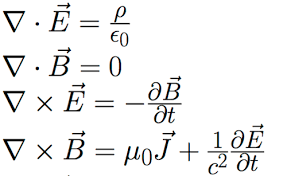
In Maxwell’s mathematical formulation of electromagnetism, he defined light as a propagating electromagnetic wave created by the interaction of its electric and magnetic fields
While Einstein in his General Theory of Relativity defined the forces associated with gravity in terms of a geometric curvature or spatial displacement in space-time caused by its energy density.
Additionally, he showed that it was directed along the radius of the curvature in the two-dimensional plane that was parallel to it.
Therefore, to explain how Maxwells equations can be defined in terms of a space-time environment one must show how both the observable and mathematical properties of an electromagnetic: such as why its wave properties are created by the interaction of its electric and magnetic fields and why polarized light has a perpendicular orientation in terms of the geometry of space time.
Additionally, one must also show why its electrical and magnetic components are in phase, it’s the only form of energy that can move at the speed of light along with the defining the reason why it always appears as a photon when observed or interacts with its environment in terms of that same geometry.
As was just mentioned gravity’s force vector is along the radius of one of dimensional plains of three-dimensional space. However, that does not mean the other two plains of three-dimensional space cannot contribute to energy content of space.
The fact that light is polarized supports that assumption because it allows one to understand the mechanism responsible for its perpendicular orientation in terms light waves moving on the different dimensional plains that are perpendicular to each other.
However, one ALSO allow one to explain both the observations and Maxwell equations in terms of the dimensional prosperity of space if one assumes the electrical and magnetic are components of light are propagated by spatial displacements created by an energy wave moving on the surface of one of those two-dimensional plains.
(This assumption is supported by Einstein suggestion that spatial displacements in one of the three-dimensional plains of three-dimensional space is responsible for gravitational energy.
One can understand the mechanism responsible by using the analogy of how a wave on the two-dimensional surface of water causes a point on that surface to become displaced or rise above or below the equilibrium point that existed before the wave was present.
The science of wave mechanics tells us a force would be developed by those displacements which would result in the elevated and depressed portions of the water moving towards or becoming “attracted” to each other and the surface of the water.
Similarly, an energy wave on the “surface” on one of the two spatial dimensions that are perpendicular to the axis of gravitational forces would cause a point on that “surface” to become displaced or rise above and below the equilibrium point that existed before the wave was present.
Therefore, classical wave mechanics, if extrapolated to the properties of two of the three spatial dimensions of our universe that are perpendicular the one responsible for gravity tells us a force will be developed by the differential displacements of energy wave which will result in its elevated and depressed portions moving towards or become “attracted” to each other as the wave moves through space.
This would define the causality of the attractive electrical fields associated with an electromagnetic wave in terms of a force caused by the alternating displacements of a wave moving with respect to time on a “surface” of the two spatial dimensions which are perpendicular to the axis of gravitational forces.
However, it also provides a classical mechanism for understanding why similar electrical fields repel each other. This is because observations of waves show there is a direct relationship between the magnitude of a displacement in its “surface” to the magnitude of the force resisting that displacement.
Similarly, the magnitude of multiple displacements in a “surface” of a two-dimensional plain in space-time will be greater than that caused by a single one. Therefore, they will repel each other because the magnitude of the force resisting the displacement will be greater than it would be for a single one.
One can also derive the magnetic component of an electromagnetic wave in terms of the horizontal force developed along the axis that is perpendicular to the displacement caused by its peaks and troughs associated with the electric fields.
This would be analogous to how the perpendicular displacement of a mountain generates a horizontal force on the surface of the earth, which pulls matter horizontally towards the apex of that displacement.
This also explain why the electrical and magnetic fields of an electromagnetic wave are in phase or maximum at the same time in terms of the geometric properties of space time defined by Einstein
However, it also provides an explanation for why electromagnetic waves can transmit energy through space at the speed of light.
The observations and the science of wave mechanics tell us waves move energy through water, causing it to move in a circular motion therefore it does not actually travel with waves. In other words, waves transmit energy, not water, across the ocean and if not obstructed by anything, they have the potential to travel across an entire ocean basin.
Similarly, an electromagnetic wave will cause the geometry of space time to move in a circular motion and therefore the geometric components of space Einstein associated with mass do not move with respect to its velocity vector. Additionally, if not obstructed by anything, they have the potential to travel across an entire universe to the velocity of light.
As was just shown the speed of a wave on water is defined in part by the rate at which its particles interact.
Therefore, the speed of light would depend on the rate at which the electrical and magnetic components interact.
Therefore, its velocity is constant in free space with no obstacles to its motion because the rate at which its electrical and magnetic components interact is constant.
However, to understand how and why an electromagnetic wave evolves into photon one must connect its evolution to that environment.
One can accomplish this by using the science of wave mechanics and the properties of space-time as define by Einstein.
For example, an electromagnetic wave is observed to move continuously through space and time unless it is prevented from doing so by someone or something interacting with it. This would result in its energy being confined to three-dimensional space. The science of wave mechanics tells us the three-dimensional “walls” of this confinement will result in its energy being reflected back on itself thereby creating a resonant or standing wave in three-dimensional space. This would cause its wave energy to be concentrated at the point in space were a particle would be found.
Additionally, wave mechanics also tells us the energy of a resonant system, such as a standing wave can only take on the discrete or quantized values associated with its fundamental or a harmonic of its fundamental frequency.
This explains why an electromagnetic wave if it is prevented from moving through space-time either by being observed or encountering an object is reduced or “Collapses” to a form a standing wave that would define the quantized energy Quantum Mechanics associates with a particle.
However, this also provides a Classical mechanism in terms of Einstein theories for defining one of the core principals Quantum Mechanics in that when field properties light and all other forms of energy are prevented from moving through space either by being observed or encountering an object that energy will become quantized in the form of a particle.
This shows how one can define all of the mathematical of Maxwells equation in terms of the physical properties of space time
On May 4, 2023, U.S. Immigration and Customs Enforcement (ICE) announced it will provide employers with 30 days to reach compliance with Form I-9 requirements after the COVID-19 flexibilities sunset on July 31, 2023. Employers will now have until August 30, 2023, to complete all required physical inspections of identity and employment-eligibility documents. This extension aims to ease the transition for employers who have been using the temporary flexibilities throughout the pandemic.
Background
In March 2020, ICE introduced the temporary flexibilities in response to the COVID-19 pandemic, allowing employers to review employees’ identity and employment authorization documents remotely, rather than in person. This virtual inspection was to be followed by a physical examination within three business days after normal operations resumed. The flexibilities were extended several times, with the most recent extension set to expire on July 31, 2023.
During the pandemic, employers with employees taking physical-proximity precautions were allowed to temporarily defer physical examination of employees’ identity and employment authorization documents. Remote examination methods, such as video link, fax or email, were permitted, with “COVID-19” entered as the reason for the physical-examination delay in the Section 2 Additional Information field on the Form I-9. Once the employees’ documents were physically examined, employers would add “documents physically examined” with the date of examination to Section 2 or Section 3 of the Form I-9, as appropriate.
The recent announcement clarifies that employers have until August 30, 2023, to perform all required physical examinations of identity and employment-eligibility documents for individuals hired on or after March 20, 2020, who have received only a virtual or remote examination under the flexibilities.
What’s Next
On August 18, 2022, ICE issued a proposed rule to allow alternative procedures for examining identity and employment-eligibility documents. CUPA-HR submitted comments to ICE encouraging it to move forward expediently and ensure that a remote review process remains available for all employers. The public comment period closed on October 17, 2022, and DHS is currently reviewing the comments. While the Fall 2022 Regulatory Agenda had forecast a final rule to be issued in May 2023, ICE’s announcement indicates a final rule will be issued later this year.
Each month, CUPA-HR General Counsel Ira Shepard provides an overview of several labor and employment law cases and regulatory actions with implications for the higher ed workplace. Here’s the latest from Ira.
Court of Appeals Denies a Teacher’s Religious Accommodation Request to Be Excused From Student Pronoun Rule
A divided 7th U.S. Circuit Court of Appeals (covering Illinois, Wisconsin and Indiana) denied a Christian teacher’s request for a religious accommodation to be excused from the school district’s student pronoun rule, which required teachers to address students by the name and pronoun of their choice. Kluge v. Brownsburg Community School Corp. (7th Cir. No. 21-2475, 4/7/23). The Justice Department filed an amicus brief in support of the school district’s denial of the accommodation. The teacher requested an accommodation from the student pronoun rule, claiming that it violated his religious beliefs. The teacher requested that he be allowed as a religious accommodation to address all students in his classroom by last names only.
The two-judge majority concluded, over the dissent of one judge, that the accommodation request constituted an undue hardship for the school district. The court ruled that granting the accommodation would disrupt the learning environment and disturb both students and faculty.
The teacher has asked the full 7th Circuit to rehear and rule on the 2-to-1, three-judge decision. The 7th Circuit decided on April 27, 2023, to await full circuit court review until after the Supreme Court rules on a similar case regarding the scope of the employer-hardship provisions on deciding a request for a religion-based accommodation. The case pending before the Supreme Court is Groff v. DeJoy, argued before the Supreme Court on April 19, 2023.
Survey Concludes That Workers in Office Spend 25% More Time on Mentoring and Other Job-Development Activities, Compared to When They Work Remotely
In-office workers spend 25% more time on mentoring and career-development activities than when the same workers work remotely from home. In its 4/10/23 Daily Labor Report, Bloomberg published a poll completed by WFH Research, which compiled results from a survey of 2400 adult workers who were able to work from home and the office. The survey compared the workers’ in-office mentoring, formal training, and career development time to the time they spent on those activities when they worked remotely from home.
In the same Daily Labor Report, Bloomberg referenced a Commentator study that found that workers who have more face-to-face interaction with managers are promoted at a higher rate. The Commentator concluded that, “Employees’ social interactions with their mangers can be beneficial to their careers.”
Complaints Filed Under Federal Civil Rights Act of 1866 Are Subject to the Four-Year Federal Statute of Limitations, Not State-Based Statute of Limitations
The 4th U.S. Circuit Court of Appeals (covering Maryland, Virginia, West Virginia, North Carolina and South Carolina) recently ruled that Section 1981 complaints of discrimination filed under the Civil Rights Act of 1866 as amended are subject to the applicable federal four-year statute of limitations. The appeals court rejected the defendant’s assertion that the complaint was subject to the shorter three-year North Carolina statute of limitations on wrongful termination claims, even though the complaint was brought in North Carolina. The court concluded that the complaint was brought solely under the federal statute so the federal statute of limitations applied. The case was Chambers v. North Carolina Department of Justice et, al (4th Cir. No. 22-01629, 4/17/23).
This case will likely have implications for Section 1981 complaints of discrimination filed against state-based public institutions of higher Education.
NLRB Imposes Expanded Remedies Against Employers Found to Have Egregiously or Repeatedly Violated Their Duty to Bargain in Union Negotiations
In a case involving a meat processor found to have repeatedly violated its duty to bargain in good faith with its union, the NLRB has issued a ruling that it would impose at least the following enhanced remedies against the offending employer and future similar employers. The enhanced remedies include reimbursement of the union’s bargaining expenses and lost pay to employees who sat in on bargaining sessions in which the employer bargained in bad faith. The case is Noah’s Ark Processors (N.L.R.B. Case # 14-CA-255658, 4/20/23).
In addition, the order requires a reading of unfair labor practice notice and explanation of employee rights by the company’s CEO or by an NLRB staffer in the presence of the company’s CEO, a mailing of the notice to employees homes, the signing of the notice by a company official, publishing of the notice at local news outlets that have broad circulation and local appeal, and authorization of NLRB staffers to visit the employer facility to assess compliance and posting requirements. These remedies will have application to private colleges and universities, which are subject to NLRB jurisdiction.
Federal Court Dismisses Claim of Religious Discrimination Following Termination of University Employee for Violation of COVID Safety Policies
A federal district court for New Jersey dismissed an employee’s claim of religious discrimination, filed under Title VII of the Civil Rights Act, following the university’s termination of the employee for refusing to follow the university’s mandatory COVID safety policies. The federal district court judge dismissed the claim that the employee was unlawfully terminated for failing to follow the university’s mandatory COVID safety policies, because the employee failed to identify a sincere religious belief that prevented the employee from complying with the safety policies. The case was McKinley v. Princeton University (3:22-cv-05069, Fed D Ct N.J. 4/28/23). The safety policies included wearing a mask, asymptomatic contact testing, and collecting saliva samples from asymptomatic employees.
The court in its eight-page decision dismissing the case granted the plaintiff leave to refile to correct the failure to identify a sincerely held religious belief.
Split Jury Verdict Results in $1.4 Million in Damages Awarded to a Professor Claiming Retaliation in the Denial to Re-Review Her Tenure Denial
While a federal court jury rejected five of plaintiff’s claims of sex discrimination and parental status in the university’s denial of her tenure, it did award the professor a verdict on her claim that the denial of re-review of her tenure denial was in retaliation of her past charges of discrimination. The federal court judge affirmed the jury verdict, which resulted in awarding the plaintiff $1.4 million in damages. The case was Veikos v. Trustees of the University of Pennsylvania (E.D. Pa. 2:20-cv-04408, judgement entered 5/2/23).
The federal judge rejected the university’s claim that the professor failed to properly mitigate her back-pay and front pay damages.










 Human Resources, Grand Valley State University (Midwest Region)
 Miranda Arjona, Rollins College (Southern Region)