On March 22, National Labor Relations Board (NLRB) General Counsel Jennifer Abruzzo issued a memo to all field offices with guidance on the Board’s recent decision in McLaren Macomb, in which the Board decided that employers cannot offer employees severance agreements that require employees to waive rights under the National Labor Relations Act (NLRA), such as confidentiality and non-disparagement requirements. According to the NLRB’s press release, the memo is to be used as guidance to assist field offices responding to inquiries from workers, employers, labor unions and the public about implications stemming from McLaren Macomb.
The memo offers guidance on the decision’s scope and effect of the McLaren Macomb decision. In the memo, Abruzzo stated that the decision has retroactive application, and she directed employers who may have previously offered severance agreements with “overly broad” non-disparagement or confidentiality provisions to contact employees to advise them that such provisions are now void and will not be enforced. Abruzzo also clarified that confidentiality clauses that are “narrowly tailored” to restricting dissemination of proprietary information or trade secrets may still be lawful “based on legitimate business justifications,” and that non-disparagement clauses that are limited to “employee statements about the employer that meet the definition of defamation as being maliciously untrue (…) may be found lawful.”
With respect to supervisors, Abruzzo specified that supervisors are not generally protected by the NLRA, but she added that they are protected from retaliation if they refuse to offer a severance agreement with broad non-disparagement or confidentiality provisions to their employees.
As a reminder, CUPA-HR will be hosting a webinar on the McLaren Macomb decision Thursday, March 30 at 1:00 p.m. ET. The webinar will cover the McLaren Macomb decision and this subsequent memo, and presenters will discuss how the decision may fundamentally change how and when colleges and universities may use confidentiality and non-disparagement provisions. Registration is required for participation, but free to all CUPA-HR members.
When you write a book, it’s lasting. It’s sharable. Your book is findable online which for professors that means you can help more people with your research, teaching, and the things you care about most. I’m delighted to share this featured interview with you.
Dr. Jane Joann Jones is a book coach for minoritized women professors. She left the tenure track 8 years ago to help you confidently write your book.
Jane says, “You’ve done this research. It’s really meaningful to you. And you wanna see it out in the world.” If you want a book, I want you to have a book! I hope this interview resonates with you.
Welcome to The Social Academic blog and podcast. We’re also on YouTube! I’m Jennifer van Alstyne (@HigherEdPR). Here we talk about managing your online presence as a professor. You can build skills to have a strong digital footprint to share your research and teaching online. And I’m here to help you.
In this interview, Dr. Jane Jones and I talk about
Meet Dr. Jane Jones
Jennifer: Welcome to The Social Academic. Today I’m talking with Dr. Jane Jones of Up In Consulting.
We’re gonna be talking about books. So, authors, please listen up. This one is for you. Dr. Jane Jones, would you please introduce yourself?
Jane: Sure. My name is Jane Jones. I am a New Yorker and I am a book writing coach. I came to book writing after I left my tenure track job. I was an Assistant Professor of Sociology. That’s where I have my PhD, in sociology.
I started out as a developmental editor and then transitioned into coaching. The business I have now is a book coaching business where I work with women in academia who are writing books in humanities and social sciences. I help them get those books done through a combination of developmental editing, coaching, and project management support.
Jennifer: I love that. Now, can I ask, what do you like most about coaching? Why do you like working with people on their books?
Jane: Oh my goodness, there are a lot of reasons actually. I really do love coaching.
One thing that stands out with the coaching side is how much academics already know, but have been socialized to believe they don’t know. Especially women.
Jennifer: Ooh. Especially women. Okay.
Jane: Especially women. Especially Black women, other women of color, They’ve been taught not to trust their own knowledge.
Jennifer: Mm.
Jane: And through coaching, a lot of what I focus on, is helping people realize that you already know a lot about your topic. You already have a lot of expertise. You don’t always have to defer to other scholars, to your dissertation advisor, especially when you’re writing your book. You no longer have to answer to your dissertation advisor. And that you have a lot of the skills already.
To be sure, there are a lot of things that we aren’t taught about publishing. There is a big hidden curriculum around book writing. And exposing that hidden curriculum is very important, while also reinforcing people’s trust in their own knowledge. Being able to do both of those two things at the same time, I think is the most important part of the coaching relationship for me.
What are universities not teaching you about book writing?
Jennifer: I love that because my next question was what are universities kind of not teaching you, right? What are universities not teaching, especially minoritized faculty, about writing books?
It sounds like people do have more knowledge than they’re able to process, maybe admit, or accept of themselves. Can you tell me a little bit more about that? Where is that difference between how much we know and how much we really need support?
Jane: I always joke that there’s no Publishing 101. There’s no Book Writing 101.That course is not taught in grad school. I mean, for that matter, Article Writing 101 isn’t either. Those aren’t taught in grad school.
Where people have a lot of knowledge is in their subject matter. In the data you have collected, all of the literature, you’ve read, how you make sense of the literature. People are experts there. You’ve spent your whole graduate career…Because I work with people at all stages of their career from Assistant Professor to Full Professor. You’ve accumulated so much data, number one. And you have so much knowledge. Right? So that is there.
But in terms of questions like, “Well, how is a book different than a dissertation?”
You know, “Structurally, what do I put in my book that wasn’t in the dissertation?”
Or, you know, “How do I create the through line in my book?”
You know, these really, kind of tactical questions about how do I actually do the writing of this type of manuscript? Which is different than an article, and is different than a grant proposal. They’ve never been taught that.
Even though they have all of the information, they don’t know how to get it on paper in a way that is going to be legible for our reader. That’s where the work happens. That’s what we do, and that’s what universities don’t teach people how to do.
Sometimes it’s because people just don’t know how to teach it. It’s kind of like, you write your book for yourself. For many people who write their first book, and if you’re a first book author watching this, if someone comes and asks you what you did, you might be like, “I don’t remember. I just got that done. I was on a tenure timeline, and I put my head down, and I wrote.” And maybe I had a book manuscript workshop. Or, you know, like, I had good friends, or a supportive mentor who read it and gave me feedback. And I wrote, got feedback, wrote, got feedback, and that was it. And then the book was done, right? That doesn’t mean you can then teach that process to somebody else.
So being able to be a little bit on the outside of the process as developmental editor, and with the other developmental editors, you know, who work in the program with me, being on the outside of that process and saying, you know, there are some common things. There are some things that all books have in common. And we’re gonna teach you how to implement and how to learn that craft, the things that are common about the craft of book writing.
We work with people across disciplines. We’re ‘discipline agnostic’ as we like to say. You know, from art historians to people who are more on the side of doing quantitative, big survey research, but writing books. We run the gamut. But even within that, there are things people have in common in their books and in their trials of writing, you know? The experiences they’re having, trying to make enough time to write the book, feeling imposter syndrome, not knowing what to do with feedback, being worried about approaching an acquisitions editor. You know, going back to the hidden curriculum, not knowing how to talk to an acquisitions editor and feeling very intimidated. Those are all things that we help them with that I think aren’t really being talked to them in other places.
People might be exchanging information informally. They’re like, “Oh, my friend published here. They said the editor is really nice.” Or, “They said the editor is really hands-on or not hands-on. So I have this informal knowledge, but I don’t know how to craft an email to an acquisitions editor. Or, strike up a conversation with them at a conference. And I feel very worried to do that.” You know, “I don’t know how to describe my book in one or two sentences so that I could talk to somebody about it at a conference and not spend 10 minutes talking about my book. Which, ultimately I will be, but I don’t have that sharp, quick summary.” Those are things that we help them with, because it could feel very disempowering when you don’t know how to do that.
Again, you have all this great information, but, if you don’t know how to talk to an acquisitions editor, how are you gonna have a book? If you don’t know how to craft a chapter, how are you gonna have a book.
Minoritized women in the academy do more service and mentoring
Jennifer: These are skills that professors can learn. These are skills that are learnable and that you can develop, but because they’re not taught by universities and the people who have experience in them maybe don’t know how to teach these skills, it is amazing that you and your team are there to support them. I’m so happy about that.
And I’m also happy that you work with minoritized faculty, with women. Why is that important to you?
Jane: It’s really important! I just want to go back to one thing, the people who have written books and don’t necessarily know how to teach it. I would add additionally, and kind of looping this into working with women and minoritized faculty is, like, they don’t often have the time to teach somebody elsehow to write a book.
It’s a time consuming process. A book is a multi-year process and people add mentoring like, “I’ll read a chapter for you and give you feedback.” But for someone to give them that structured support over time, faculty are having to publish themselves. They have to do their own service committees, they have their own families. Again, that doesn’t mean that they don’t offer help, but it means that they may not have the time or capacity to give that systematic type of help we do.
I think that’s especially pronounced for women and minoritized faculty because they often have an extra service load. They do more service. We know that statistically. They do more service. They’re doing more care-taking outside of work. Right?
There isn’t always that easy transmission of knowledge from a senior faculty member to a junior faculty member because they’re just as pressed as anybody else. And so are the junior faculty! And we don’t only work with junior faculty, but the majority of our clients are.
They have the same issues like extra service, students who want their mentorship because they’re the only Black person in the department. They’re only person who studies race. They’re the only person who does X research. So they have students who want their mentoring. And all of this creates extra commitments for them.
One thing that we focus on in coaching is helping people prioritize their books when there’s a lot of other things going on. Teaching that craft of writing, but also saying, like, “Hey, this book is really important to you for a lot of reasons. Like, professionally take a tenure promotion. But also because you’ve done this research, it’s really meaningful to you, and you wanna see it out in the world. How do we help you make sure that it stays top of mind?” What do we do to support people so that the book can stay top of mind.
Jennifer: I love that. I feel like my work is really aligned with that actually, because I’m really helping professors and researchers talk about the research and the teaching that they do on online. That way more people can have conversations, so that they can have more collaboration, so that they can get more research funding.
But most of the people that I work with have a lot of anxiety talking about themselves. Do you find that your authors have anxiety talking about their books?
Jane: Yeah. (laughs) Yeah. Definitely. And I think that the work you’re doing is so important, ’cause, in my opinion, if you write a book, don’t you want people to read it?
Like, you want it out in the world. Like, you wanna be in conversation with other people. You want people to read it, but you also want to talk to people about it.
Jennifer: Right, yeah. Yeah. Even, the ability to have someone on your team, be that kind of support, not just when you start writing the book, but through the whole process. That’s such an amazing idea that we can’t necessarily get through a mentorship position at your university. Especially if no one is in your field. I love that that support system is there.
It also gives authors an opportunity to have someone that they can talk with about their book. Some of the authors that I work with, I ask, “Who do you talk about your book with?”
And their answer is, “No one. Once I stopped working with my editor, I don’t talk with my colleagues. I don’t talk with my family. I don’t talk with my friends. My book came out seven years ago and I never talk about it.”
That really strikes me as something that I think that, people who work with you, they’re talking about their book. And thinking about it in much larger ways. Because it’s really introspective, and being introspective is hard. I love that you help people with that process and actually understand their motivations for why they’re doing it, who they’re helping. It’s amazing.
Jane: Yeah. Thank you. I think that another part that’s really important is that my programs are group programs.
Jennifer: Ooh.
Jane: And that’s on purpose. Because like you said, it is very introspective. For some people, the solitude, the solitary work, they like it. They’re like, “I like writing solitary. I like being alone with my thoughts.” And that’s great.
Some people are like, “It’s isolating, and I don’t like it, and I feel very alone in the process.” Being with people who are at a similar stage as them, and when I say stage, I don’t mean career-wise, I mean stage of the book. Because people come in, and they’re all at a similar stage of writing, so they’re all kind of going through it together.
“I’m trying to figure out the overarching argument of this book,” or, “I’m writing two of my empirical chapters, the two of my body chapters.” There’s a feeling of, “We’re in it together.”
I spoke to a former client the other day, and she was in Elevate a year ago maybe, and she said, “Our Elevate group still meets on Mondays and Thursdays on Zoom, and we still write together.”
Jennifer: I love that.
Jane: I was like, “Oh, my goodness.” I didn’t even know that they did that. And she’s like, “We kept the time and whoever can make it comes on Mondays and Thursdays and we meet.” Just having that community of people who are in it with you and are like, “I’ve seen you from when you started this book and you weren’t sure what it was about. And now you’re here and we’re just seeing each other’s process and giving each other support that way.”
It’s just awesome because we don’t get a lot of that in academia. We have to be very intentional about cultivating it. It doesn’t just show up for us.
Being able to provide that space where you have peers so you can be like, “I tried that too, and this is what happened when I tried it. “You know, or, “I went through that experience and I came out and I was, like, ‘I did it, and you could do it too.’”
Jennifer: I did it and you can do it too. Just hearing those two sentences, they’re so short. But, it just makes such a difference, especially to the women and minoritized faculty that you most want to help.
Jane: Yeah. I mean just seeing that. ‘Cause you get into it and you’re like, “I don’t know if I’m ever gonna be done with this book.” (Jane laughs). People definitely have that thought,
“I don’t know if I’m gonna be able to finish this.”
“I’ve been avoiding it.”
“I haven’t been working on my book, because I’ve been scared.”
“I got some feedback that put me into a tailspin.”
“I became overwhelmed with other commitments and I feel some shame about it.
“I feel so embarrassed.”
Jennifer: Hmm.
Jane: And reminding them that it happens. It’s disappointing that it happens, but it doesn’t mean something’s wrong with you. I was normalizing it and seeing when I did one-on-one, one thing that always happened was people would tell me something, I’d be like, “Oh, that’s really common.”
And they’d be like, “It is?”
And I’d be like, “Yeah, I have other clients who have experienced that.”
And they’re like, “They have?”
Jennifer: (Laughs). Yeah
Jane: So being able to put everyone in the group and be like, “Look, you’re all having this experience.” You are not uniquely incompetent in some way. This is something that happens to a lot of people. Just because we aren’t talking about it on Twitter, doesn’t mean it didn’t happen.
Jennifer: You know, I like when it is talked about on Twitter. I like when people talk about their struggles with writing on Twitter. Because I cheer them on. I’m like, “If you struggle with your writing, you get back to it, even if it’s a year later, two years later, 10 years later, I don’t care. Because I will remember that you were vulnerable and open about something you were going through. And I wanna cheer you on and I wanna hear about things when they’re not so good too.” So I really like vulnerability.
I love that people have a safe space to do that in your program. But I also encourage people, if you’re struggling with something, being open about it on social media can help spark new ideas, tools, and resources that you can use. But also new collaborations and ideas that could help spurn your research in another way. I mean, there’s just so much possibility besides hearing from other people, “Yes. I went through that too.” So yeah, I like that idea of being open about it.
Jane: Yeah, to be open about it! You know, it’s interesting. We gravitate to what is other people’s achievements and our failures, right? So, you finish a chapter and you’re like, “Yeah, but it’s not as good as I thought it would be.” Or, “Yeah, but it took me two months longer than I thought it would.” There’s always a diminishing.
Jennifer: Mm.
Jane: And convert on the flip side, they talk about other people who are like, “Well, that person finished their chapter so much faster than I did.” Or, “That person, you know, did this.” And it’s like, well, maybe they did. Maybe you don’t know the whole story. But it’s interesting, in our brains we kind of put everyone else as, “Well, they did it better or faster than I did. And when I did it, it was a mess.” And to coach around that and be like what is the story you are telling about your progress? And, is that story serving you? Because often it’s not. Saying, “I wrote my chapter, but…” And then using some type of diminishing, diminishing it in some way, how is that helping you?
Jennifer: Hmm.
Jane: Why would we emphasize that part of the story? What does it accomplish? It doesn’t accomplish anything besides making you feel like crap. It doesn’t accomplish anything. It doesn’t make you write faster. You can’t go back in time.(Jennifer laughs) You can’t go back in time and write the chapter faster.
Jennifer: Yeah, yeah.
Jane: So why would we talk about it so much? But we do, because sometimes we’re like, “Well, I don’t wanna seem arrogant.” Or, “It’s because I don’t believe that this is worthy of celebrating because it didn’t happen the exact way I wanted it to.” So where are the opportunities to kind of neutralize some of that language, so that people aren’t…
Jennifer: But you can find positives in it, right? Like, maybe that extra time gave you opportunity to realize something new. Maybe it was good that you didn’t write it as fast as you thought you might have been able to. There’s so much self-talk that can be negative that can be harmful for ourselves.
Jane: Yeah, there’s a lot of negative self-talk. Yeah.
Jennifer: Yeah. – I’ve definitely done that. I’m a creative writer and I’ve totally done that to my own. I didn’t write that fast enough or I didn’t write as much as so-and-so, yeah. It’s never helpful. It’s never helpful.
Jane: Yeah. Yeah. It’s like our running critic. And sometimes, it’s something my coach always says, “We can’t always get the critic to completely go away. We can put them in the backseat of the car, and be like, ‘You go back there. You’re not driving this car anymore. You’re not even in the back seat, but, like, the third row.’” (Jennifer laughs) You know, “We’re putting you back there. Like, I recognize that I may not be at a point where I can get rid of you, but I’m not going to give you authority over this ride. You don’t have the wheel. You’re back there.”
Jennifer: Still in the car, right? Can’t kick it out entirely. I mean, sometimes we can’t get control over it.
Jane: Still in the car. Like, you realize, you’re not wrong for having these thoughts. Like, they’re natural. And we’ve also been socialized to believe it’s not rigorous enough. It’s not fast enough. Publish or perish. There’s a lot of socialization at hand that is part of the reason why people have these thoughts.
As a coach it would be irresponsible for me to go in and just be like, “Oh no, you shouldn’t think any of this ever again.” Because as a sociologist, I know how strong the socialization is. As a coach I know that just makes you feel bad about having the thought. Then you feel bad because you didn’t write fast enough according to your standard. Then you feel bad that you’re judging yourself. And then you just feel doubly bad. So it’s like, “Okay, let’s just, like, take it back.”
Jennifer: Get out of that spiral.
Jane: Yeah. Let’s get out of the spiral. And, it’s okay that you had that thought. It’s okay that you feel bad. We don’t want you to feel bad indefinitely.
Jennifer: Hmm. I like that. We don’t want you to feel bad indefinitely.
Jennifer: Tell me more about Elevate. Who should join?
Jane: Everyone. I’m just kidding. (Jane and Jennifer laugh).
Jennifer: You said that people in the cohort are all in a similar place writing their book. When is it right to join your program Elevate?
Jane: Okay, so Elevate is a group editing and coaching program. We have a curriculum that we walk you through the
craft of writing a book
project management behind writing a book
mindset issues behind writing a book.
So much of what slows us down is our own thoughts. Like, “I’m not ready to write this.” “I don’t know what decision to make.” “So and so said this about my chapter, so I’m going to feel bad about it and just ignore it.” “I’m gonna avoid. I don’t wanna look at the feedback, so I’m just gonna avoid it.”
Those are the three domains we work in the craft of writing, project management, and mindset. We do that through a curriculum. We have lessons the same way you would in any course. We have editorial feedback, so you submit your writing for feedback twice a month.
And we have a lot of mindset coaching that I coach people hard, (Jennifer laughs) which I think is what most Elevate alumni would say. Like, “Jane really coaches us. Like, she really pushes us.”
Jennifer: Right.
Jane: I push you in a way that not like, “Write your book faster, write your book faster,” but rather, “Let’s get to the bottom of why you’re having these feelings about your book. Let’s get to it and figure it out,” type of coaching.
Because we’re academics, we’re in our brains so much. When it gets into having emotions, we’re, like, “Oh, no, we’re rational. We can’t really think about that.”
I used to be that person too. Oh, no.(Jennifer laughs) I hate that, all that emotion stuff. That’s not gonna work for me. Well, I kind of need to confront it, because you and your book are gonna be together for a very long time.
Like you were saying, like, as you write it and then after you write it, it’s not going anywhere. You should figure out how to enjoy it. To find pleasure in the process of writing it and be excited about it.
It’s just like any other thing. You’re not gonna be excited about your book 24 hours a day, but you wanna get to a point where you’re more excited and motivated than you are demoralized and stressed.
Jennifer: Hmm, mm-hm.
Jane: In the program, we go 24 weeks. We go through those three themes one by one. People who join, all women, they’re normally at a stage in their book where they are figuring out the big overarching picture of the book and the structure of the book.
Some people come in and they haven’t written a lot yet. They have all of their data collected, most of their literature read. You might need to go back and collect a little bit more data, but, we want you to really be past that stage. Some people come in and they haven’t written a lot.
Some people come in and they’ve written a lot and they’re just like, “I’ve been writing and writing, but I still don’t have a really clear through line,” or, “I still don’t know my argument.” And that’s fine, because people’s processes are different. Some people like to get a lot of words on paper and then go back and kind of orient themselves.
We advocate you creating the foundation first and then building your house. (Jennifer laughs) So people normally come in when they want that support. What we do first is teach people how to write your book overview, how to write your book’s framework and then create an outline for the entire book. And then they start writing chapters.
Normally within the program you can come out with a couple of chapter drafts if you have the time to commit, and you will know what your book is about, how you’re going to write it. You know how it’s going to unfold over time. And then you get to work.
Jennifer: You have a plan in place. You have the mindset that you need to make that plan actually done, like, to get your book done. I love that.
Jane: Yeah, yeah.
Jennifer: Oh, if people want more support, you help them with that too. Like, beyond writing their book, is that correct?
Jane: We focus on books, but we have an alumni program for Elevate. We don’t expect anyone to write a book in six months. (Jennifer and Jane laugh). That is not what we do. We do not make pie in the sky promises.
We have an alumni program and people often come back and do the alumni program, which is another six months. There we really focus on more now you’ve done a lot of the deep work, the deep thinking in Elevate. Now we are helping you get a lot of words on paper. People are doing the writing and getting the body chapters, I call them ‘the empirical chapters.’ But I know people also have ‘theory chapters,’ so I don’t want anyone to be like, “What about the theory chapter?”
We focus on getting chapters done or revising because some people will take Elevate, go off for a little while and work independently, and then come back and be like, “I have a couple of chapters done.” And we’re like, “Great, let’s start revising them.”
Jennifer: I’m glad I asked you about that because I felt like there might be some people who are like, “Oh, I need a little bit more help than that. Is there an option?” I’m glad that there’s an alumni program that supports you with continuing that process. That’s amazing.
What else should people know or consider about Elevate? Because your new cohort is opening up again soon.
Jane: Yeah, so we accept people who are writing first, second, third books. I think initially when we ran the program, it was very much for people who were transforming dissertations into books. And we have gotten a substantial number of people who are writing second books, which are a different challenge because you don’t have that scaffolding of the dissertation. Even if your first book is dramatically different from the dissertation, which many are, the book is not a revised dissertation. It is like a caterpillar to butterfly.
But the second book just poses different challenges, and we support people who are writing their second book, their third book, because that foundational work of creating the overview, the framework, the outline, you need to do that every time. It’s not like you write the first book and you’re like, “Well I’m an expert on book writing now, so I don’t need any help.” That’s not how it works. (Jennifer laughs). And even experts get support.
So it’s not a matter that it’s a remedial type of program. That’s not what it is. It’s not, for, “Oh the people who don’t know how to write books.” No, it’s for people who wanna write books with supportive community, expert editorial feedback and coaching to help them write the book with less stress, a better support system, a clear foundation for the book. So that they can make progress with more ease.
Writing a book is a complicated thing. It should be because you’re dealing with complicated ideas and all sorts of interesting data. And it’s not easy. But there can be more clarity and momentum in the process than what there currently is for a lot of people.
Jennifer: I think that this is such a wonderful gift that you can give to yourself, especially if this is, like, your second, third, or fourth book. Like, why not make this time easier and better?
Jane: The majority of the people who work with us pay through their universities. We have a significant number of people, and some people pay out of pocket. We have people who are like, “I wanna make this investment because my book’s important to me and I don’t wanna twiddle my thumbs…”
Jennifer: (Laughs). Good. So if you are listening to this, if you’re watching us on YouTube or reading the blog, know that this is a program that’s there to support you and that you can pay for it out of pocket or you can request funds from your university. I hope that you sign up for the wait list.
Jane: You can apply for Elevate. The application is just an application. It’s not a commitment to join the program. We look at your application, because one thing about the program is that we wanna make sure that you’re a good fit for the program.
We also wanna make sure the program’s a good fit for you. If we think that you’re not at the right stage, if there’s something about your research that we feel that we can’t support you…For instance, we had someone who’s writing a memoir and we’re like, “We don’t really edit a lot of memoirs.” If we feel like the program is not a good fit for you, we will tell you because we only want people in it who can commit and who we can help.
That is the point of going in and applying and possibly talking to me about the process if you have a lot of questions, that we wanna make sure that it works for everyone. Because it’s a big commitment. And also, a book is a big deal. If you’re gonna get support, you wanna make sure you’re getting the right support at the right time.
Instagram Live about finding your book audience on social media
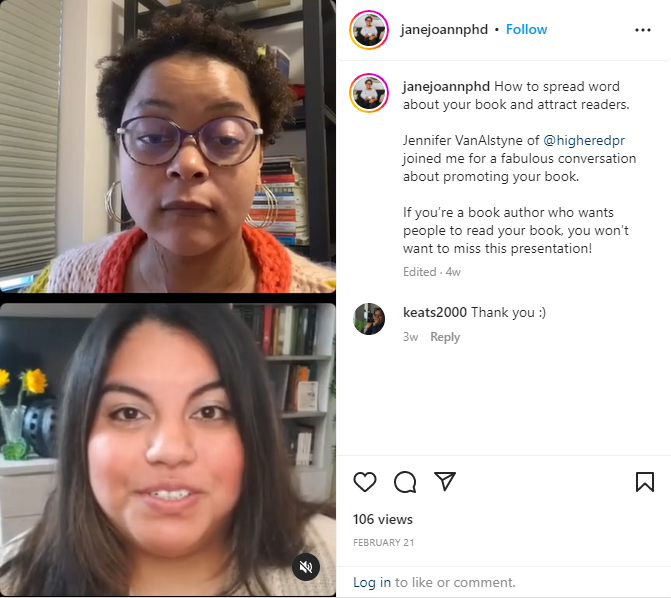
Jennifer: I love that. Thank you so much for joining me for this interview, and for everyone listening, I do wanna let you know that Jane and I did an Instagram Live where we talked about your book audience versus platform.
Thank you so much for watching this episode of The Social Academic! And thank you so much, Dr. Jane Jones, for joining me.
Jane Joann Jones is an academic book coach who helps minoritized scholars get the feedback & support they need to confidently write their books. Jane strives to be the coach she wished for when she was on the tenure track.
In her eight years as an editor and coach, Jane has successfully helped dozens of academic authors create and execute a writing plan and ultimately write their books, confidently. Her clients have published with presses including Oxford, Princeton, Bloomsbury, University of Chicago, Stanford, Duke, and UNC. Through her work, Jane has restored minoritized academics’ faith in their writing abilities and their place in the academic world.
When she’s not challenging the status quo in academia, you can find Jane sipping a craft bourbon, on the rocks, while experimenting with a new cooking recipe. She also enjoys visiting museums for only one hour, devouring cooking shows, and impromptu dance parties to the tunes of Lizzo and Queen Bey. If you happen to be strolling through her New York neighborhood, you might see her at Lucille’s, her local café, drinking an oat milk latté with a raspberry donut and a good book.
BLOOMINGTON, Ind. – March 21, 2023 — Dean Hoke, of Bloomington, Indiana, has been chosen to serve as the next President and Chief Executive Officer of the American Association of University Administrators (AAUA), currently based in Glen Mills, Pennsylvania. His appointment is effective July 1st when the current President & CEO, Dan L. King will retire after nineteen years of service in that position.
A highly successful and internationally recognized higher education administrator, Mr. Hoke first affiliated with the Higher Colleges of Technology in the United Arab Emirates in 2009 as Head of Marketing and Institutional Development; that experience was followed by four years at Khalifa University with the UAE Advanced Network for Research and Education. In 2014 he became Co-Founder in a new educational management consulting firm, Edu Alliance Ltd. based in the UAE; three years later Edu Alliance Group opened its US office in Bloomington serving as the Managing Partner.
Mr. Hoke has extensive experience in the fields of higher education, marketing, communications and e-Learning. He has held a number of senior higher education administrative positions; and co-founded the Connected Learning Network, a provider of online educational services for educational institutions. In the field of broadcasting he served as an executive and CEO of four public broadcasting stations, and executive vice president of a cable network. He currently serves on the Advisory Board of the School of Education of Franklin University in Ohio and is a member of the Advisory Board of Higher Education Digest. He recently served as president-elect for the United States Distance Learning Association and chaired the Global Partnership Committee.
Mr. Hoke currently produces and co-hosts the podcast series Higher Ed Without Borders. He holds a B.A. degree from Urbana University and an M.S. degree from the University of Louisville. He also completed the Executive Management Program at The Wharton School of the University of Pennsylvania.
AAUA Board of Directors chairperson William Hill, assistant dean of the College of Education at Wayne State University, said, “Mr. Hoke is, without a doubt, the best person to step up and take over the executive administration of this organization. His background and his wide range of experiences will be useful. Moreso, his enthusiasm for leading AAUA to new programming ventures which should lead to expanded membership is contagious!”
When interviewed, Mr. Hoke remarked, “It is a great honor to be selected as the AAUA’s next President and CEO. I am grateful to the Board for their unanimous support and to Dan King, who has led the organization for several years.”
He continued, “AAUA sees a high percentage of administrators leaving the higher education profession. They are frustrated over the lack of opportunities for advancement, work challenges, and readily available professional development. The AAUA board of directors and I will work with our membership to build new and innovative professional development programs and services which will address a higher level of training and increase retention of our higher education administrator colleagues.”
Departing chief executive, Dan King remarked, “I had planned to leave my AAUA responsibilities over two years ago but my departure was delayed by the COVID pandemic. The delay turned out to be fortuitous because it was during this time that I developed a closer professional tie with Mr. Hoke and was able to recruit his candidacy for this position. AAUA is ready for new direction, and Mr. Hoke has the perfect combination of personality, vision and enthusiasm to lead it to new heights. I look forward to watching the association improve and grow.”
On February 21, the National Labor Relations Board (NLRB) issued its decision in McLaren Macomb deciding that employers cannot offer employees severance agreements that require employees to waive rights under the National Labor Relations Act (NLRA), such as confidentiality and non-disparagement requirements.
The Board explained in its press release on the decision that if an employer offers a severance agreement with a provision that requires the employees to broadly give up their rights under the Act, the employer violates the NLRA. The simple offering of the agreement “is itself an attempt to deter employees from exercising their statutory rights, at a time when employees may feel they must give up their rights in order to get the benefits provided in the agreement.” NLRB Chair Lauren McFerran said “It’s long been understood by the Board and the courts that employers cannot ask individual employees to choose between receiving benefits and exercising their rights under the National Labor Relations Act.”
McFerran issued the decision alongside NLRB Democratic Members Gwynne Wilcox and David Prouty, while Republican Board Member Marvin Kaplan dissented. The decision reverses two Trump-era NLRB decisions, Baylor University Medical Center and IGT d/b/a International Game Technology. Both of these decisions determined severance agreements with confidentiality and non-disparagement provisions not unlawful in and of themselves.
Importantly, this decision does not apply to public sector employees as the NLRB only has statutory jurisdiction over private sector employees. Additionally, the ruling does not apply to employees in supervisory or managerial positions.
CUPA-HR will hold a webinar on this rulemaking and its potential impact on higher ed institutions on March 30, 2023 at 1:00 p.m. ET. Registration is required for participation, but free to all CUPA-HR members. To register, please visit the event’s web page.
Each month, CUPA-HR General Counsel Ira Shepard provides an overview of several labor and employment law cases and regulatory actions with implications for the higher ed workplace. Here’s the latest from Ira.
Court of Appeals May Narrow LBGTQ Rights Under Title VII
The 5th U.S. Circuit Court of Appeals (covering Texas, Louisiana and Mississippi) recently heard oral argument over a U.S. District Court judge’s ruling that private businesses may assert a religious exemption to bias claims brought by LBGTQ workers under federal anti-discrimination statutes. The trial court had granted summary judgment that religious employers objecting to dress codes, bathroom policies or hiring of LBGTQ employees are protected by the First Amendment (Braidwood Management v. EEOC (5th Cir. No 22-10145, oral ARG 2/7/23).
If the trial court decision is upheld, it would blunt the reach of the recent Supreme Court decision in Bostock v. Clayton County, which held that LBGTQ workers can sue employers for job discrimination under Title VII based on gender identity or sexual orientation. The plaintiffs in the case are a Texas based healthcare provider and a Church. We will follow developments in this case.
Qualifying Temporary Workers Granted Pay-Parity Rights Equal to Full-Time Employees Under New Jersey State Statute
New Jersey-based employers will have to grant certain temporary employees hired in the state pay and benefits equal to what the employer pays full-time direct-hire employees. The new law, recently signed by the governor (effective 180 days after the 2/7/23 signing), creates a “bill of rights” for many temporary employees and applies to specific New Jersey employers. The law applies only to the manufacturing, warehousing and logistics, food service, construction, building security and maintenance, cleaning, and landscaping industries. The statute does not cover healthcare workers, business and finance professionals, salespeople, and information security and technology staff. The statute does apply to temporary staffing agencies.
New Jersey is joining California, Illinois and Massachusetts in adopting a statute protecting temporary employees. However, the New Jersey statute goes a step further than the other states in requiring pay and benefits equivalent to similarly situated full time employees in the industries and areas described above.
Offensive Music in Workplace Brings Sex Harassment/Hostile Environment Litigation
Bloomberg reports multiple filings of sex harassment, hostile work environment lawsuits based on claims that offensive music being played in the workplace creates a sexually hostile work environment. The multiple litigation filings involve manufacturing and warehouse employees. The employees are complaining that obscene and misogynistic rap music was continually played in the workplace over the objection of the complaining employees. The complaints allege that managers and other employees regularly played vulgar music and ignored the complaints and objections of offended employees. The allegations state that allowing the music to continue created a sexually hostile work environment, which is actionable under Title VII.
Employers can avoid such litigation by establishing and enforcing policies that forbid sexually or racially offensive content in the workplace.
Tenured Public School Teacher’s Termination for Unprofessional Social Media Posts Reversed — Court Holds Tenure Entitled Her to a Warning and Opportunity to Remedy
A tenured Illinois public school history teacher who was terminated after posting publicly available “unprofessional” and “disrespectful” social media posts had her termination reversed by an Illinois appellate court. The termination had been affirmed by the trial court. The teacher claimed not to realize that her posts were public as opposed to being distributed only to “friends” on Facebook.
Among other posts, the teacher shared a Facebook post from a group called Bored Teachers which stated, “I can think of no better form of birth control than to have people observe my class for a day.” In another post she described a student’s parents as “clearly crazy” and “nuts.” The teacher was terminated for making unprofessional remarks about students on Facebook. The head of HR testified that the plaintiff was not remorseful and thought the posts were therapeutic.
The Illinois appellate court concluded that the plaintiff’s posts were “clearly foolish” and “unprofessional.” Nonetheless the appellate court concluded that the Illinois state statute afforded tenured teachers the right to warning and a chance to remedy their transgressions (Kelleher v. Illinois State Board of Education (Ill App. Ct. 1st Dist. No. 1-22-0058, Order 2/14/23)).
EEOC Commissioner Charges at Record High
EEOC commissioner charges for fiscal 2022 jumped to a record high of 22, up from just 3 in the previous year and the highest number since records have been kept on annual commissioner charges. A commissioner charge is one filed by an EEOC commissioner raising a potential legal issue. The vast majority of EEOC charges are filed by alleged victims.
Commentators point out that the commissioner charge increase is likely due to a partisan block of action at the EEOC. Under the Biden administration, the EEOC had a Democrat chair and a Republican majority of members (three Republicans, two Democrats) until November 2022. Currently, the commission has a Democrat chair and a vacant seat, leaving it with two Democrat members and two Republican members. The filling of the open commission seat is still on hold due to blockage of the nomination process in Congress.
OFCCP Rescinds Trump Administration Religious Carve-Out Allowing Federal Contractors to Ignore Anti-Discrimination Obligations Based on Faith
The OFCCP announced new regulations on February 28, 2023, rescinding the Trump administration regulations allowing government contractors to ignore certain anti-discrimination obligations based on their faith. The new regulations bring back the prior standard, which had been in place for nearly two decades, and do not allow the defense. The new regulations will be published shortly and effective 30 days after publication. The Trump administration rule, which will be revoked, faced continued opposition from civil rights groups and LBGTQ advocates. This rule applies to the OFCCP enforcement of antidiscrimination rules under Executive Order 11246, applicable to all federal government contractors.
A few weeks ago, I had the pleasure of presenting for an Undergraduate Research Group at my university. When they initially asked me about presenting about visual presentations, I had to think back to the numerous presentations that I have been fortunate to facilitate all over America.
Then, I thought about the items that I wish I would have had on site when I saw the place where I needed to place my poster. So, I decided to make a “Poster Presentation Survival Kit”. This kit contains: masking tape, t-pins, white out, sharpie markers, and cuticle clippers (to serve as scissors for your poster (just in case)).
The presentation was well received and they asked for a copy. I was very impressed with this group and their questions focused on research and the presentation process. We also had a great conversation about presenting information that has not yet been published.
Here’s the presentation:
Here are some additional resources. Thanks UNC, UC Davis, and Bucknell!
Enjoy! Please let me know if you have any questions.
On March 16, the Department of Labor’s Wage and Hour Division (WHD) will present a webinar titled “The PUMP for Nursing Mothers Act: What Advocates and Employers Need to Know.” The free webinar is intended to provide resources and tools to assist employees who wish to continue breastfeeding after returning to work and to help employers understand their responsibilities under the law.
In December 2022, the PUMP for Nursing Mothers Act was enacted into law through the Consolidated Appropriations Act of 2023. The bill amends the Fair Labor Standards Act (FLSA) to expand access to breastfeeding accommodations in the workplace for lactating employees and builds on existing protections in the 2010 Break Time for Nursing Mothers Provision by broadening breastfeeding accommodations and workplace protections. In the new law, protections are expanded to include salaried employees exempt from overtime pay requirements under the FLSA as well as other categories of employees currently exempt from such protections, such as teachers, nurses and farmworkers. It also clarifies that break time provided under this bill is considered compensable hours worked so long as the worker is not completely relieved of duty during such breaks, and it ensures remedies for nursing mothers for employer violations of the bill.
Following the passage of the Act, on February 9, WHD issued Field Assistance Bulletin No. 2023-1, “Telework Under the Fair Labor Standards Act and Family and Medical Leave Act.” This bulletin provides guidance for WHD field staff on how to apply protections under the FLSA that provide reasonable break time for nursing employees to express milk while teleworking, among other clarifications. The bulletin explicitly refers to the passage of the PUMP for Nursing Mothers Act and its expanded coverage to more employees, and it may be discussed during the upcoming webinar.
The webinar will be held on Thursday, March 16 at 2:00 p.m. ET. The webinar is free to the public, and participants can register to attend online. CUPA-HR’s government relations team will attend the webinar and keep members apprised of any significant updates related to the PUMP for Nursing Mothers Act.
One thing that I have recently become very interested in is – “stay interviews”.
These types of interviews are very beneficial because they determine which factors keep a current employee engaged and which ones do not.
Think about it. Why do you decide to remain at your current job? What would entice you to leave? Perhaps a better offer?
This information is perfect for employers and who wish to attract millennials to their workplace.
Stay interviews are informal conversations
What to ask in a stay interview
Ask what would make your employee leave
How managers can stay accountable
Question 1 – What do you look forward to each day when you commute to work?
Question 2 -What are you learning here, and what do you want to learn?
Question 3 – Why do you stay here?
Question 4 – When is the last time you thought about leaving us, and what prompted it?
Question 5 – What can I do to make your job better for you?
This is especially important for rural workplaces where they struggle to attract and retain employees. It is especially difficult for rural employers. Let’s support them in any possible way we can.
Now, I do not have any direct reports at this time, but I have had a wealth of organizational leadership experiences throughout my 20 years in higher education. As a employee, i would not like to answer these questions. I would suggest that leaders determine which questions are most appropriate for their teams.
We do not want these “stay interviews” to be the first interview on a short journey to an “exit interview”.
In the comment box, let us know which questions you would add and which questions you would delete.
When it comes to representation and pay equity for women and people of color in the higher education workforce, colleges and universities have frequently struggled to make meaningful progress. Through several new interactive graphics representing years of research, CUPA-HR shines a light on the progress that has been made and the disparities that persist. These graphics represent data from CUPA-HR’s four signature higher ed workforce surveys — Administrators, Faculty, Professionals, and Staff — through 2022.
Administrators
While the proportion of people of color in higher ed administrator positions has grown steadily over the last 10 years, these increases have not kept pace with the rate at which minorities are obtaining graduate degrees. In 2022, people of color made up 18.2 percent of administrators, up from 12.9 percent in 2012.
The data also show that pay gaps for women administrators of all races/ethnicities are consistent across the past 10 years and notably wide. Pay inequity is particularly egregious for women administrators of color (with the exception of Asian women). Men of color, on the other hand, have been paid salaries equitable to or greater than those of White men in recent years.
The Administrators in Higher Education Survey collects data on administrator positions that manage a higher ed institution or a division within it.
There are two notable findings in faculty composition. First, more women are represented in non-tenure-track than in tenure-track faculty. Second, for each tenure status and with each increase in rank, the proportions of women and faculty of color decrease. This means that women are over-represented in the lowest-paying and lowest-ranking positions. This remains the case despite the fact that the proportion of women and faculty of color have increased slightly at each rank over the past five years.
Pay gaps for women faculty, regardless of tenure status or rank, continue to persist, particularly at the rank of professor. These gaps are most notable for women of color. Pay gaps at other ranks have narrowed over time, particularly for tenure-track faculty. Importantly, the factor that most impacts faculty pay is promotion to a higher rank. Often, the only significant increases in salary happen with these promotions. These data show that the only group that has greater representation with each increase in rank is that of White male faculty, and this pattern has persisted over time.
The Faculty in Higher Education Survey collects data on tenure-track faculty positions and non-tenure-track teaching faculty positions.
Women’s representation has increased across all professionals’ positions since 2017, and in 2022, women represented more than 60 percent of higher ed professionals. This change is due to slight increases in representation of women of color since 2017. In 2022, representation of people of color was 24 percent overall, with the highest percentage among human resources professionals (34 percent) and diversity and equal opportunity professionals (33 percent).
In 2022, women were consistently paid less than White men, a pattern that has worsened since 2017. However, men of color were paid more equitably in 2022 compared to previous years.
The Professionals in Higher Education Survey collects data on positions in specific functional areas in higher ed institutions, such as academic or student services, that usually require a baccalaureate degree.
Staff employees have a higher representation of people of color than any other higher ed employee group. This is notable in that these are the lowest-paying positions in higher ed. In 2022, women of color represented about 19 percent of all higher ed staff, and men of color represented about 13 percent of all higher ed staff. These numbers have increased since 2017, though modestly. Skilled craft employees were the least racially diverse group, as 80 percent were White men, a finding that has persisted across the past six years. Notably, skilled craft staff are among the highest-paid staff positions.
Since 2017, women in staff positions have been paid consistently and considerably less than White men in staff positions, a pattern that has worsened over time, particularly for women in office and clerical positions. Men of color were paid more equitably in 2022 when compared to 2017.
The Staff in Higher Education Survey collects data on positions that are generally non-exempt and do not require a college degree.
CUPA-HR is the recognized authority on compensation surveys for higher education, with its workforce surveys designed by higher ed HR professionals for higher ed HR professionals and other campus leaders. CUPA-HR has been collecting data on the higher ed workforce for more than 50 years, and we maintain one of the largest workforce databases in existence. CUPA-HR also publishes numerous research publications and interactive graphics highlighting trends and issues around higher ed workforce planning, pay equity, representation of women and racial/ethnic minorities and more. Learn more about CUPA-HR research.
On February 17, the Department of Education’s Office for Civil Rights (OCR) issued three resource documents on Title IX compliance for school athletic programs. The first resource document covers support for equal opportunity in school athletic programs generally, while the other two cover Title IX and athletic opportunities at K-12 schools and colleges and universities separately.
According to the OCR, these documents were designed “to help students, parents, coaches, athletic directors and school officials evaluate whether a school is meeting its legal duty to provide equal athletic opportunity regardless of sex,” and they provide examples of situations that may mean a school is not complying with Title IX requirements. The guidance does not make any changes to existing enforcement procedures for the OCR, rather, it is intended to be used by institutions to ensure that their existing protocols and programs are compliant with Title IX.
Supporting Equal Opportunity in School Athletic Programs
The first resource document reiterates Title IX’s prohibition of discrimination on the basis of sex in education programs and activities, including athletic programs, that receive federal funds. It states that Title IX requires schools to effectively accommodate the athletic interests and abilities of their students regardless of sex, and provide equal opportunity in the benefits, opportunities and treatment provided for their athletic teams. It also clarifies that Title IX requires colleges and universities to not discriminate on the basis of sex in the provision of any athletic scholarships or financial assistance to students.
The resource document included four examples of situations that may surface Title IX concerns at colleges and universities, which are listed below:
The men’s teams at a college receives new athletic apparel and gear each year, while the women’s teams must use old apparel and purchase some of their own equipment.
Across its entire athletic program, a college awards disproportionately more athletic financial assistance to men than women.
A university provides funds for its coaches to recruit athletes for its men’s football and basketball teams because it considers those teams to be “flagship sports.” It provides no funds for coaches to recruit women athletes. As a result, the school has difficulty attracting women to participate in its athletic program.
Women are underrepresented in a university’s athletic program compared to their representation in the student body. The university would have to offer 54 additional spots for its women students on existing or new teams for women to have substantially proportionate athletic participation opportunities. Women have expressed an interest in having more teams, and there are women students participating in club sports for which there are no varsity teams. Those club sports include lacrosse, water polo, ice hockey and bowling — all of which have intercollegiate competitions available and are sanctioned by the athletic governing body the university belongs to. Yet, the university has not added a women’s team for many years.
Title IX and Athletic Opportunities in Colleges and Universities
The resource document designed specifically for institutions of higher education dives deeper into background information on Title IX, as well as ways that students, coaches, athletic directors and school officials can evaluate a school’s athletic program and whether it’s meeting its legal requirements to provide equal athletic opportunity. With respect to the evaluation, the document guides readers with questions and examples of Title IX compliance with respect to the benefits, opportunities and treatment for men’s and women’s teams; athletic scholarships and financial assistance, and meeting students’ athletics interests and abilities.
Benefits, Opportunities and Treatment for Men’s and Women’s Teams
With respect to equivalent benefits, opportunities and treatment for men’s and women’s teams, the resource document lists several questions about an institution’s attempts to provide equal opportunities to both men and women student-athletes. These questions surround the following topics:
Equipment and supplies
Scheduling games and practice time
Travel and daily allowances
Coaching
Academic tutors
Locker rooms, fields, courts and other facilities for practice and competition
Medical and training facilities and services
Housing and dining services
Publicity
Recruitment
The resource document explicitly states that if any of the questions listed under these topics is answered as a “no,” it may indicate a possible Title IX violation.
Athletic Scholarships and Financial Assistance
The document also creates questions that may be used to assess a school’s provision of scholarships and athletic financial assistance. The questions help guide users to measure the percentage of women and men participants at their institution and the percentage of scholarship awards provided to women and men, and it lists questions and examples to help compare these percentages. These questions may again point to disparities among programs that could be potential violations of Title IX, but the OCR states that it “will take into account all legitimate, non-discriminatory reasons for disparities provided by the school” if there are disparities present between percentages awarded to men’s and women’s programs.
Meeting Students’ Athletic Interests and Capabilities
The resource document refers to the “three-part test” that institutions may use to demonstrate that all Title IX legal requirements are being fulfilled. Schools are only required to use one of three options to show compliance with Title IX, which are detailed in the document and briefly listed below:
Option 1: Substantial Proportionality — This option looks to whether the percentage of women and men participants on athletic teams are about the same as, or “substantially proportionate” to, the percentage of women and men enrolled as full-time undergraduates at your school.
Option 2: History and Continuing Practice — This option looks to whether your school can show it has a history and continuing (i.e. present) practice of expanding its athletic program to respond to the interests and abilities of women, if women have been underrepresented, or if men have been underrepresented.
Option 3: Interests and Abilities of Students — This option asks whether your school can show that — despite the disproportionality — it is otherwise meeting the interests and abilities of the underrepresented sex.
The resource document states that following longstanding practice for showing Title IX compliance — if an institution is unable to use any of the three options to show compliance with Title IX — may not be meeting legal requirements to provide equal opportunity to participate in athletics based on sex under Title IX.
Options for Filing Complaints for Title IX Violations
Both the general support and higher education-specific documents end their guidance with ways in which students, parents, employees and others in the school community may file Title IX complaints through their school’s grievance procedures if they believe their institution is not providing equal athletic opportunity based on sex. The documents first turn readers to their institution’s Title IX coordinator, but also provides the option to file a complaint online with the OCR. It also clarifies that anyone is able to file complaints with the OCR, which may include individuals outside of the school community.
CUPA-HR will continue to monitor for any updates to Title IX compliance and will keep members apprised of any updates with respect to Title IX law and regulations.