Category: Featured

  • 10 Keys to Building an Incredible Brand for Academics LIVE EVENT

    10 Keys to Building an Incredible Brand for Academics LIVE EVENT

    I’m teaming up with Dr. Sheena Howard to bring you a live VIP event for academics. You’re invited!

    EVENT: 10 Keys to Building an Incredible Brand as an Academic

    • Increase your confidence
    • Make 5x your investment
    • Waste far less time because you have an actionable plan
    • 5+ free tools to help you implement what you learn
    • 3+ downloadable PDFs
    • Grow your following by at least 25%

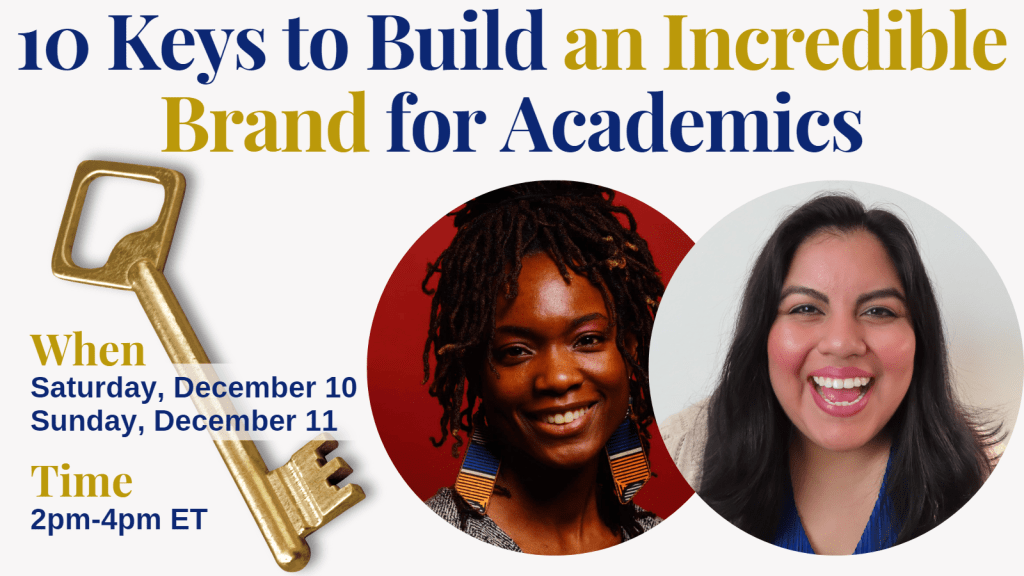
    Date: December 10 or December 11

    Time: 2-4pm Eastern Time

    Where: Virtual (on Zoom)

    Can’t make it live? A replay will be sent to you.

    This event is complete. Thank you for coming!

    A dream team collaboration event

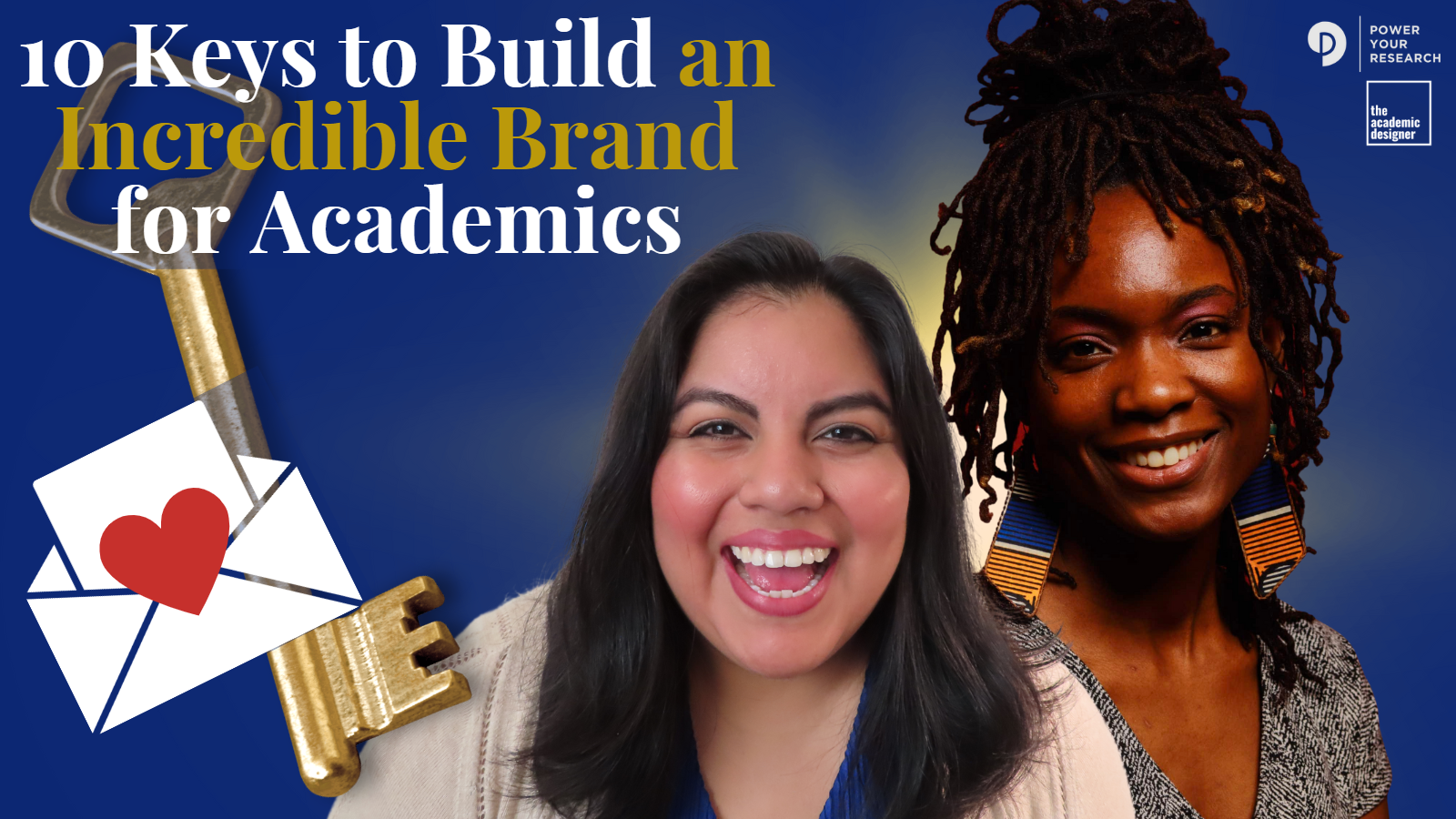
    10 Keys to Build an Incredible Brand for Academics, a graphic with a large key and photos of Dr. Sheena Howard and Jennifer van Alstyne smiling. When: Saturday, December 10 and Sunday, December 11 from 2-4pm Eastern Time.

    I’m Jennifer van Alstyne. When I started building my brand, I wanted to create the academic life that I wanted. Not the life my advisors or mentors wanted for me. My online presence helped me take that step. Now I help professors build an online presence their research deserves. So that they feel more confident, help more people, and build their scholarly community online.

    I’m so excited to team up with the incredible Dr. Sheena Howard. She’s an expert at helping professors get the media attention they deserve. She’s all about building your visibility, authority, and income with Power Your Research.

    This event has ended. It was on December 10 and December 11, 2022.

    We can’t wait to see you at 10 Keys to Building an Incredible Brand for Academics, our live virtual event.

    This event is for all people with an advanced degree (like a master’s or doctorate). This event is for you whether you’re in or out of the academy.

    Topics covered will include but are not limited to

    • Best free resources to get high-level media coverage right away.
    • Getting clarity on what building your brand looks like for you.
    • Building an incredible website that stands out.
    • Social media plan and strategy for the busy academic.
    • Building a 6-figure brand by leveraging your academic credentials, whether you are in or out of academe.

    This event only happens once a year. You don’t want to miss it.

    Get tickets for 10 Keys to Build an Incredible Brand for Academics today. Limited seats are available.

    This event is complete. It was on December 10 and December 11, 2022. Thank you for attending, we were so happy to help inspire you. This event only happens once a year. If you’re interested in attending next year, email me at [email protected]

    Gifts and Holiday Guides and Advice Articles The Social Academic

    Source link

  • Higher Ed Without Borders Now Available on Audio and Video – Edu Alliance Journal

    Higher Ed Without Borders Now Available on Audio and Video – Edu Alliance Journal

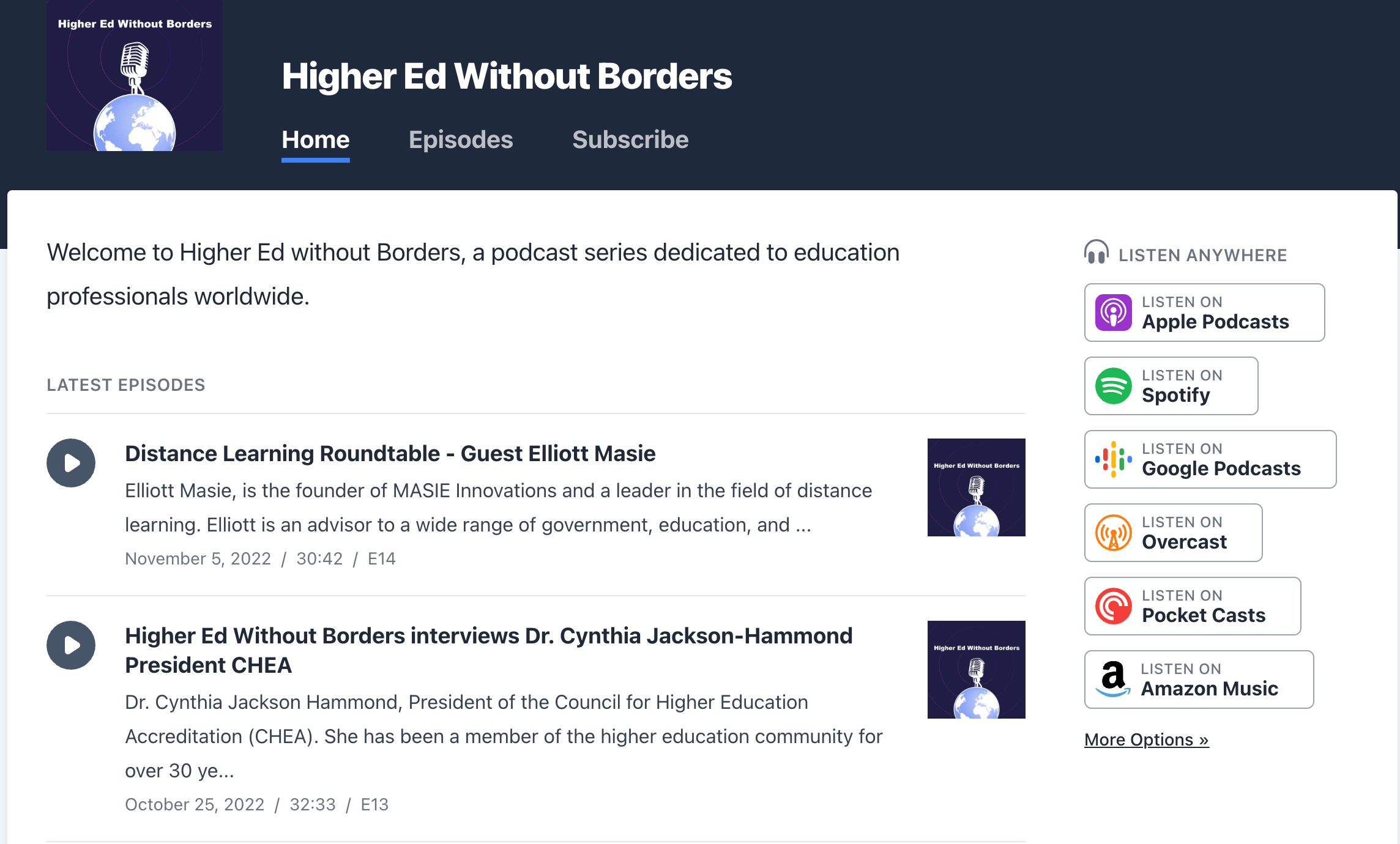
    As we enter the holiday season, we recommend you tune in to  Higher Ed Without Borders. We now have the 2022 audio podcast season available, including 14 complete episodes. In addition, we have created five video highlight programs on our YouTube Channel. The series is a production of Edu Alliance.

    Also, we are proud to announce that in December and January, five new episodes are being produced.  Our last episode for the 2022 season will be with Dr. Chris Howard, Executive Vice President and COO of Arizona State University.

    In January 2023, Dean Hoke and Tom Davisson will co-host a four-part mini-series titled Small College America. Scheduled guests will be:
    Dr. Barry Ryan, President of Woodbury University, California
    Ryan Smith, President, University of Rio Grande, Ohio
    Dr. Stefanie Niles, President of Cottey College, Missouri
    Dr. Janelle Vanasse, President of Alaska Pacific University, Alaska  

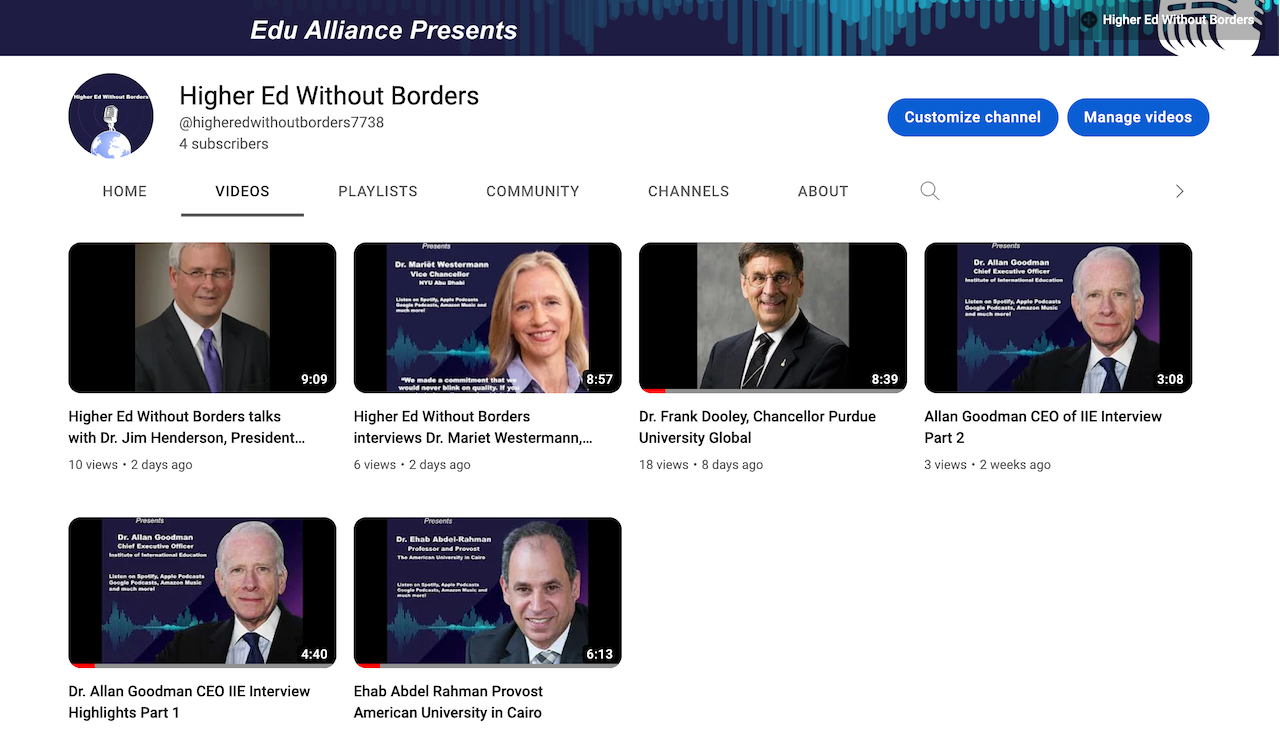
    The YouTube series currently has 6 video highlights, with more to come. They include:
    Dr. Ehab Abdel Rahman, Provost of The American University in Cairo
    Dr. Allan Goodman, Chief Executive Officer of the Institute of International Education Part 1
    Dr. Allan Goodman, Chief Executive Officer of the Institute of International Education Part 2
    Dr. Jim Henderson, President of the University of Louisiana System
    Dr. Mariët Westermann, Vice-Chancellor of New York University, Abu Dhabi
    Dr. Frank Dooley, Chancellor of Purdue University Global

    Guest for the 2022 season includes:
    Elliott Masie, founder of MASIE Innovations 
    Dr. Cynthia Jackson Hammond, President of the Council for Higher Education Accreditation
    Dr. Peter Wells. Chief of the Section for Higher Education at UNESCO, Paris
    Dr. Samantha Alvis, Senior Advisor for Higher Education for USAID 
    Dr. Matthew Wilson, Dean, and President of Temple University Japan Campus
    Dr. Tarek Sobh, President of Lawrence Technological University
    Dr. Tony Chan, President of King Abdullah University of Science and Technology in Saudi Arabia 
    Dr. Gil Latz, Vice Provost for Global Strategies and International Affairs, The Ohio State University
    Dr. Mariët Westermann, Vice-Chancellor of New York University, Abu Dhabi
    Dr. Jim Henderson, President of the University of Louisiana System
    Dr. Allan Goodman, Chief Executive Officer of the Institute of International Education
    Dr. Frank Dooley, Chancellor of Purdue University Global
    Dr. Ehab Abdel Rahman, Provost of The American University in Cairo

    Feel free to let us know if you have any questions or comments. Happy Holiday Season to you and your loved ones.

    Dean Hoke and Dr. Senthil Nathan
    Edu Alliance Group and Co-Hosts of Higher Ed Without Borders
    [email protected]
    [email protected]

    Source link

  • CUPA-HR Sends Letter to Congress Asking for DACA Protections – CUPA-HR

    CUPA-HR Sends Letter to Congress Asking for DACA Protections – CUPA-HR

    by CUPA-HR | November 22, 2022

    On November 17, CUPA-HR joined the American Council on Education (ACE) and over 60 other higher education associations in sending a letter to House of Representatives and Senate leadership urging Congress to pass permanent protections for the Deferred Action for Childhood Arrivals (DACA) program after recent court decisions have left the status of the program in limbo.

    On October 5, the U.S. Court of Appeals for the Fifth Circuit unanimously upheld a 2021 ruling by the lower Court in the Southern District of Texas that enjoined the DACA program and vacated the 2012 Department of Homeland Security (DHS) memorandum that originally established the program. The Fifth Circuit agreed with the lower court’s finding that the promulgation and enforcement of the DACA memorandum violated the Administrative Procedure Act but noted that the Biden administration had finalized a new DACA regulation in August, leading the Appeals Court to send the case back to the Texas District Court to consider the legality of the August rulemaking. On October 14, however, the Texas District Court ruled against the final rule, arguing that the existing injunction blocking the 2012 memorandum also covered the new final rule.

    As a result of these rulings, the DHS is blocked from accepting new applications for the DACA program, but the agency is permitted to continue renewing existing protections to current DACA beneficiaries. DHS Secretary Alejandro Mayorkas issued a statement in response to the Texas Court’s decision saying “It is clearer than ever that only the passage of legislation will give full protection and a well-deserved path to citizenship for DACA recipients. I urge Congress to swiftly pass legislation to provide permanent protection to the hundreds of thousands of Dreamers who call the United States home.”

    ACE’s letter states the urgency with which Congress needs to act to ensure protections are granted to DACA recipients. The letter specifically asks Congress to pass legislation to provide DACA protections to current and future beneficiaries before the 117th Congress ends January 3, 2023.

    CUPA-HR will keep members apprised of any updates on the status of the DACA program.


    Source link

  • A Common Mistake Academics Make With Their Personal Websites

    A Common Mistake Academics Make With Their Personal Websites

    How often is your name mentioned on your website? For some academics, the answer is 0. I’ve looked at hundreds of personal faculty and scientist websites. A common mistake people make is forgetting to include your name.

    Hi, I’m Jennifer van Alstyne. Welcome to The Social Academic, a blog about your digital presence in HigherEd.

    The form above subscribes you to new posts published on The Social Academic blog.
    Want emails from Jennifer about building your online presence? Subscribe to her email list.
    Looking for the podcast? Subscribe on Spotify.
    Prefer to watch videos? Subscribe on YouTube.

    Does your website show up when someone Googles your name?

    An overhead view of a person working on a laptop. They have the Google Search page pulled up and are starting to type in their search query.

    When you type your full name into Google, does your website show up on the 1st page of results? A personal website should show up high in Google Search results because it often has the information people are most looking for.

    But your website won’t appear in search results if you’ve forgotten to include your name. This is a common mistake for academics who make their own website.

    Why do academics make this mistake? They work hard to create a website to better share their research. Self-promotion often feels strange for professors and researchers. It might feel wrong or unnatural. Because of this, you might have forgotten to include your own name on your website.

    The people who make this mistake often include their name in their

    But they then forget to include it on other pages of their website like in their bio, and on their Research or Publications pages. Have you forgotten to include your name?

    The form above subscribes you to new posts published on The Social Academic blog.
    Want emails from Jennifer about building your online presence? Subscribe to her email list.
    Looking for the podcast? Subscribe on Spotify.
    Prefer to watch videos? Subscribe on YouTube.

    Scavenger Hunt! Find your name on your website

    An open laptop with the word Website written on the screen with a bunch of arrows pointing to the right.

    A good way to see if your name appears on your website is by searching your site in Google.

    To do this, type this into the search bar: site:YourDomainName.com Your Name

    For example: site:JenniferVanAlstyne.com Jennifer van Alstyne

    When I perform this search, it shows that my name appears on most pages of my personal website. Try a search like this to see how often your name appears.

    If you find your name doesn’t appear much on your website, this is an easy change you can make to your website to improve how people find it. Any small change to improve your personal website is a good thing!

    Best of luck with your website project. Want professional help with your website project? I’d love to help.

    Including your name on your website is a best practice for SEO

    Scrabble letters that spell out 'S' 'E' and 'O' stand facing the camera on a shelf. SEO is an acronym for search engine optimization.

    Search engine optimization is a method for improving, or optimizing your website to rank better in search results. In this case, the keyword people are searching for online is your name when they want to find information about you.

    Discover how search engine optimization (SEO) can help your website in my YouTube live with Patrick Wareing.

    Personal Website How To’s The Social Academic

    Source link

  • 4 Considerations for Using Salary Data to Inform Compensation Decisions – CUPA-HR

    4 Considerations for Using Salary Data to Inform Compensation Decisions – CUPA-HR

    by Missy Kline | November 15, 2022

    Editor’s note: This blog post, originally published in April 2019, has been updated with additional resources and related content.

    Salary benchmarking is not one-size-fits-all — especially when you’re looking at groups as varied as administrators, professionals, staff and faculty on a college or university campus that is unique in its combination of Carnegie class, affiliation, regional location and mission. The question, then, is how to tailor your benchmarking efforts to take these variables into account and choose data that is appropriate to your unique needs.

    Here are four considerations to help you make the best use of salary data for compensation budget planning for your faculty and staff:

    1) Which institutions should your institution’s salaries be benchmarked against? Making the right comparisons — using position-specific data and carefully selected peers — can make all the difference when planning salaries that will make your institution competitive in the labor market. When you use CUPA-HR’s DataOnDemand, you can narrow down peer institutions by one or several institution-level criteria such as affiliation (public, private indephttp://cupahr.org/surveys/dataondemand/endent or private religious), Carnegie classification, enrollment size, geographic region, total expenses or other characteristics. Remember, balance is key: a larger comparison group gets you more robust data for comparison, but you must also make sure you are comparing to the right types of institutions that make sense for your goals.

    2) Not all faculty are the same. Tenure track faculty, non-tenure track teaching faculty, non-tenure track research faculty and adjunct faculty may each require unique compensation strategies, as do faculty members from different disciplines and ranks. Will the same salary increase help retain both tenured and non-tenured faculty? Does collective bargaining impact salary targets for some, but not all, of these faculty sub-groups? Are there unique, fast-growing, or in-demand departments/disciplines that require a separate strategy?

    3) Keep in mind that administrator salaries are broadly competitive. Like faculty, many administrative positions in higher ed are competitive at a national level. Often, institutions seek administrators with experience at other institutions of a similar size or mission, and with this experience and mobility comes an expectation of a competitive salary. As higher ed moves toward a “business model” where innovative leadership strategies are displacing more traditional shared governance models, finding administrators with the appropriate skills and expertise is becoming increasingly competitive, not only within higher education but sometimes against the broader executive employment market.

    4) Employment competition varies for staff and professionals. Many non-exempt staff are hired from within local labor markets, and therefore other institutions or companies in your state or local Metropolitan Statistical Area might be a better salary comparison than a nationwide set of peer institutions. Exempt or professional staff, however, may be more limited to competition from the higher ed sector, perhaps on a state or regional level. In addition, changes brought about by the pandemic (e.g., remote work opportunities, a desire to relocate) have made many professional positions more globally competitive. Are your institution’s salaries for these employees appropriately scoped for the market in which you need to compete?


    Additional Articles and Resources

    How One College Is Using Salary Data to Ensure Pay Equity and Market-Par Compensation

    Compensation Programs/Plans, Executive Compensation in Higher EdEqual Pay Act (CUPA-HR Toolkits)

    Working in a Fish Bowl: How One Community College System Navigated a Compensation Study in a Transparent Environment (Higher Ed HR Magazine)


    Source link

  • 3 Ways To Take New Photos For Your Website

    3 Ways To Take New Photos For Your Website

    You want a new photo of yourself for your personal website. What’s the best way to take new photos? Here are 3 ways for you to get beautiful photos for your website.

    Hi! I’m Jennifer van Alstyne. Welcome to my blog about understanding your digital footprint in research and Higher Education. I help professors have an amazing online presence through my company The Academic Designer LLC. I empower academics to feel confident when showing up online.

    The form above subscribes you to new posts published on The Social Academic blog.
    Want emails from Jennifer about building your online presence? Subscribe to her email list.
    Looking for the podcast? Subscribe on Spotify.
    Prefer to watch videos? Subscribe on YouTube.

    Listen to the podcast

    Take a selfie

    A woman wearing a hijab and a green sweater holds her phone and smiles at the camera while taking a selfie photo.

    A selfie is a photo that you take of yourself. You can use selfies on your personal website! The most popular way to take a selfie is with your phone camera. You can use the front camera of your phone, but you’ll take higher quality photos if you use the rear camera.

    Look for a space with good lighting. You may find great natural lighting outside in the last hour before sunset. Or, if you’re an early riser (unlike me), try just before sunrise. Photographers call these periods the ‘golden hour’ because the light can be perfect.

    Avoid a distracting background in your photo. When in doubt, you can take a photo against a neutral background like a wall. Then you can edit the photo to remove the background like I did for the selfie above.

    Use a cleaning cloth to gently wipe the camera lens clean before you start your photo shoot.

    Try holding the phone at different angles (slightly higher, slightly lower). You can also hold the phone out to your side and turn your head towards it. Don’t forget to smile.

    Your phone camera may have settings to help you take a better selfie. For instance, there may be a portrait mode. Or, an option to take a wide selfie.

    You can use your phone’s self-timer setting to take hands-free and full body selfies. You may want to prop up your phone using books. You could also invest in an inexpensive tripod or selfie stick.

    A black and white dog wearing blue sunglasses lays on its back on the grass taking a selfie photo with a phone in holds with its paw.

    Devices For Taking Selfies

    1. Mobile phone
    2. Camera
    3. High resolution web cam

    Other Tools To Help

    • Selfie stick
    • Tripod
    • Remote
    • Ring light
    • Books, a box, or other items to prop up your phone

    Ask a friend or family member

    A man holds a phone taking a photo of his friend who is smiling. They are in Los Angeles. The Hollywood sign is visible in the background, but unreadable because the background of the photo is very blurry.

    One of the best ways to get a new photo of yourself for your website is to ask a friend or family member to help.

    If you have a friend who is good at taking photos, great! You may not. That’s OK. What’s more important is that you have someone with you that you feel comfortable with.

    Set expectations by letting them know it may take a bit of time. That you want to try out different poses (or locations). Ask them to try taking photos at different angles. Try watching a YouTube video together about creative portrait photos with a phone.

    My best tip is to ask your friend to take photos holding the phone vertically and horizontally. That gives you flexibility with what you use the photos for.

    It’s possible that this photo shoot may not result in the photos you want. So don’t put too much pressure on your friend. Do encourage them to take lots of photos so you can choose the best ones. If you find photos you like in the set, ask your friend if they’d like to be credited as photographer when you share the photo online.

    The form above subscribes you to new posts published on The Social Academic blog.
    Want emails from Jennifer about building your online presence? Subscribe to her email list.
    Looking for the podcast? Subscribe on Spotify.
    Prefer to watch videos? Subscribe on YouTube.

    Hire a professional photographer

    Photography and video production studio with a yellow chair, plant, and pink backdrop. There are large lights on tripods.

    Hiring a professional portrait photographer is the best option. The mistake you want to avoid is asking for a headshot when booking your photo shoot.

    Professional photographers have the gear, skills, and experience to take your new website photos. If you can afford a professional photo shoot, it’s your best option. You want to hire an experienced local photographer.

    You may have a place to take your photos in mind. Professionals often include 1 location in your package, or shoot in their studio. Be sure to ask for their recommendations.

    Photographs are the intellectual property of the photographer. You’ll need to sign a contract or licensing agreement for permission to use the photos. Help ensure you get the right license by sharing how you want to use your photos when booking your shoot. Most photographers have professional liability insurance.

    You’re looking for a portrait photographer, not a headshot photographer. Be clear about how many photos you’re looking for, as your photographer may offer a ‘brand photo shoot’ or a ‘website photo package.’

    Portrait photographers can ranges from $100-$400/hour in the United States. Local Facebook groups are often an effective way to find recommendations for photographers in your area.

    Here are 3 ways to get new photos for your personal website

    A graphic for 'New Photos For Your Website' with tips including take a selfie, ask a friend for help, and hire a professional photographer. On the graphic are a cutout of a Sony professional camera, the backs of 2 cell phone cameras, and a selfie photo of Jennifer van Alstyne smiling.

    The form above subscribes you to new posts published on The Social Academic blog.
    Want emails from Jennifer about building your online presence? Subscribe to her email list.
    Looking for the podcast? Subscribe on Spotify.
    Prefer to watch videos? Subscribe on YouTube.

    My name is Jennifer van Alstyne. I’ve been helping professors make beautiful personal websites to share their research since 2018. I’d love to help you!

    Let’s talk on a no pressure Zoom call about working with me on your online presence and website.

    Personal Website How To’s The Social Academic

    Source link

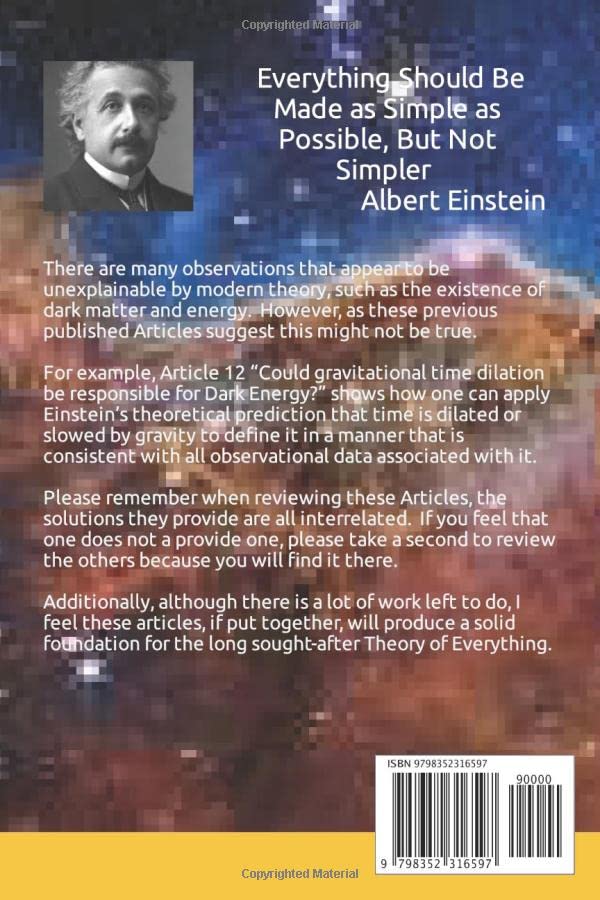
  • A fan of Einstein’s work? This is the book for you.

    A fan of Einstein’s work? This is the book for you.

    Please follow and like us:

    While new technological advancements grace humankind every day, it is astonishing that some long-gone scientists have produced research that is very much relevant today. As new research about the universe comes to light, we see that research done years ago is being proven right. One of these brilliant scientists that have stood the test of time is the great Albert Einstein. Unbelievable as it may be, the studies and theories put forth and born from his exceptional mind are still aiding scientists of today to understand the world better.

    Thus, his work holds imperative value and should be studied even today. Maybe that is why it was a great idea for Jeffrey O’Callaghan to write a book about it.

    Ever since I picked up “Einstein’s Explanation of the Unexplainable,” I’ve been completely engrossed and enraptured. While I always had a great admiration for Einstein and his work, I never really understood it on a fundamental level. This book helped me do just that. I must give credit where it’s due, of course. The author does a great job of explaining theories that would otherwise go above my head.

    The book is filled with the theories and works of Einstein’s life. But… they’re explained in a way that makes it easy for just about anyone to understand. That means you don’t need to be an expert in the field to grasp the concepts. You can just be curious or want to know more.

    For example, let’s discuss one of the topics mentioned in the book that captured my attention. In the very first article of the book titled, “Do the Laws of Physics Break Down in a Black Hole?”, he talks about one of the most important theories that have plagued many a scientist back in the day. This, of course, is the theory of general relativity.

    Black holes pose a concern because they are enormously large and incredibly remote. Our ability to see their backsides is obstructed, and the signals coming from that side are weak. This makes it challenging to explain and nearly impossible to observe the swirling, extremely hot materials pouring into them (the accretion disc).

    When Einstein first explained his theory of general relativity, it was considered extremely outlandish. What is the theory? Gravitational lensing is a phenomenon that amplifies light and causes it to move along a different trajectory than it might otherwise, each of which is caused by the distortion of space and time that large objects like black holes cause.

    The English astronomer Arthur Eddington and colleagues made the first recorded observations of this phenomenon during a full solar eclipse in 1919, which propelled Einstein and his untested hypothesis to notoriety. Normally, stars stay in one spot in the night sky, whereas during the eclipse, those that were behind the Sun looked to have moved because the Sun’s gravity altered the path that their light took to reach earth.

    In this chapter, he also answers the question posed in the chapter title itself, but I’ll leave that for you to discover.

    Later Jeff


    Amazon Barns and Noble Ebay

    Amazon     Barns and Noble     Ebay


    Please follow and like us:

    Source link

  • HR and the Courts – November 2022 – CUPA-HR

    HR and the Courts – November 2022 – CUPA-HR

    by CUPA-HR | November 8, 2022

    Each month, CUPA-HR General Counsel Ira Shepard provides an overview of several labor and employment law cases and regulatory actions with implications for the higher ed workplace. Here’s the latest from Ira.

    EEOC Disavows Publicly-Expressed Views of Former General Counsel Regarding Abortion Travel Issues 

    The Equal Employment Opportunity Commission (EEOC) took the rare step of publicly disavowing the views expressed by its former general counsel who was appointed during the Trump administration and replaced during the Biden administration. The EEOC stated on October 31, 2022 that its former general counsel expressed her personal views, not that of the agency, when she warned that employers providing travel assistance to employees seeking an abortion but not for other procedures might be sued by the EEOC. Nonetheless, this is a developing area of the law and counsel should be consulted on these issues.

    Supreme Court Hears Oral Argument Over Continuation of Affirmative Action In College Admissions

    The Supreme Court heard oral argument over the continuation of Affirmative Action in college admissions on October 31, 2022 in Students for Fair Admissions (SFFA) v. Harvard and Students for Fair Admissions (SSFA) v. University of North Carolina (UNC). The first major Supreme Court decision involving Affirmative Action in college admissions occurred in 1978 in University of California v. Bakke. In Bakke, a divided Supreme Court approved the University of California’s Affirmative Action plan with four justices ruling in favor of the plan and four justices ruling that the Affirmative Action plan violated the constitution. The remaining solo opinion of Justice Lewis Powell coupled with the four votes in favor of Affirmative Action became the precedent. Justice Powell concluded that a race-conscious admissions program could theoretically satisfy constitutional strict scrutiny by being narrowly tailored to promote a diverse student body.

    In 2003, a majority of the Supreme Court endorsed Justice Powell’s solo opinion in Grutter v. Bollinger when Justice Sandra Day O’Connor added in the majority opinion that the Court expects that such policies will no longer be necessary in 25 years.

    The Supreme Court set aside two hours to hear oral argument in two lawsuits brought by the SFFA, an anti-Affirmative Action group, against Harvard University and the University of North Carolina. The SFFA wants the Supreme Court to overturn Justice Powell’s solo opinion in the Bakke case and end consideration of race in college admissions. The group argues among other things that current Affirmative Actions policies routinely discriminate against Asian Americans who do not receive racial preferences. Both colleges deny that Affirmative Action policies discriminate against Asian Americans.

    To complicate matters further, both cases were coupled for oral argument, but were uncoupled and heard separately because Justice Ketanji Brown Jackson recused herself for the Harvard case because of past work on Harvard’s Board of Overseers.

    Supreme Court Considers Long-Standing Preemption of State Laws Barring Employer State-Based Claims of Destruction of Property During Labor Disputes

    The Supreme Court will also reconsider this term its 60-year-old decision in San Diego Building Trades v. Garmon (commonly referred to as the Garmon Preemption Doctrine), in a case in which an employer is seeking to sue a teamsters local union alleging common law state claims of intentional destruction of property during a labor dispute and commencement of a strike (Glacier Northwest Inc. v. International Brotherhood of Teamsters, Local 174 (US No. 21-1449)). The Supreme Court ruled in the Garmon case that the federal National Labor Relations Act (NLRA) preempts and therefore prohibits all state court lawsuits against unions, concluding that an employer’s sole remedy is subject to the provisions of the NLRA, and that sole remedy for relief is up to the National Labor Relations Board (NLRB).

    In the case at hand, the Washington State Supreme Court dismissed an employer’s common law lawsuit against Teamster Local Union No. 174 for intentional destruction of property holding that under Garmon preemption the employer’s sole remedy is before the NLRB, which does not grant property damages to employers so harmed. The employer in the case alleged that its teamster union drivers returned the employers ready mix concrete trucks fully loaded with concrete to the yard prior to leaving on strike with the concrete in the trucks ready to harden and therefore destroyed the trucks. The teamsters claimed that they left the trucks running so that they could be unloaded safely.

    Some commentators conclude that if the Supreme Court alters Garmon broadly and allows such lawsuits to proceed, it could trigger a new and effective employer weapon in holding union’s liable for economic consequences of strikes and other actions taken during labor disputes. Those commentators also point out that if the Supreme Court broadly limits preemption, it could lead to conservative-leaning states to enact legislation restricting union conduct during strikes.

    California Joins Growing List of States Expanding Paid Leave Benefits

    California’s recent enactment of paid leave protections requiring employers to provide employees with paid leave to care for individuals who are not legal relatives joins the growing list of states regulating this area of employee benefits. So far, 11 states and the District of Columbia have enacted paid leave programs. Five of those states (Colorado, Connecticut, New Jersey, Oregon and Washington) allow employees to use those benefits to take care of non-relatives designated as “akin to family.”

    Nationwide, this is leading to a unique patchwork of requirements depending on where the employee is employed. Research should be conducted in your local jurisdiction to guide your institution on the breadth and application of possible city and/or state requirements. In addition, remote work in another state may also alter which state’s laws applies.

    U.S. Court of Appeals to Address Whether Sovereign Immunity Exempts State University From Federal Whistleblower Wrongful Discharge Claims

    The U.S. Court of Appeals for the 4th Circuit (covering Maryland, Virginia, West Virginia, North Carolina and South Carolina) will address whether Maryland state sovereign immunity applies to Morgan State University and Maryland State University in a case involving federal whistleblower wrongful discharge claims by the university’s former director of broadcast operations (Williams v. Morgan State University (4th Cir., Case no 21-01918, 10/13/22)).

    The plaintiff complained that the university mishandled a debate between Baltimore mayoral candidates and that she was ultimately discharged because she claimed that the mishandling may have violated the Federal Hatch Act and Federal Communications Commission regulations. The federal trial court dismissed the plaintiff’s federal claims, holding that while Maryland had waived sovereign immunity with respect to state tort claims, it did not do so regarding federal claims. The Court of Appeals has taken the unusual position of asking the Maryland State Court of Appeals whether the state has waived sovereign immunity with regard to federal tort claims.

    The plaintiff also added a federal whistleblower claim that the university’s dean and other professors were intentionally inflating expense numbers to federal and state agencies to “pad the university’s funding.”

    NLRB Returns to In-Person Manual Union Elections to Replace Mail-In Ballots Mandated During COVID-19 Pandemic

    In-person voting at employer premises in NLRB-supervised union elections is returning as the primary method of voting as the NLRB modifies the rules that it enacted during the onset of the COVID-19 pandemic, which lead to a great increase in mail-in voting. Nearly 75 percent of the 3,185 NLRB-supervised elections, which were conducted since the start of 2020 during the pandemic, were conducted by mail according to Bloomberg BNA. Unions prevailed in 76 percent of the mail-in elections as opposed to prevailing in 68 percent of the in-person elections. Employers generally prefer in-person manual elections because of the NLRB rules, which ensure secrecy, avoid electioneering around voting areas and arguably prevent voter fraud coercion.

    Employer groups argue that there is greater turn out during in-person manual voting. Unions claim that employers have an unfair advantage at in-person, manual voting because the election takes place on the employer’s “home turf.”


    Source link