Thank you to all who attended the CUPA-HR Annual Conference and Expo in person and virtually last week! It was wonderful to welcome new (300+ first-timers!) and familiar faces and to learn about successful projects and initiatives from higher ed peers at institutions across the country.
For those who weren’t able to attend, here’s some food for thought from our three outstanding keynote speakers:
Stand-Out Leadership — Opening keynote Sara Ross applied her passion for brain science to a key element of stand-out leadership: accountability. Ross explained that employees would rather have leaders who hold themselves accountable for their actions than perfect leaders. One way HR professionals can be stand-out leaders and hold themselves accountable is by using Ross’s SLOW strategy when responding to critical situations on campus. The SLOW strategy helps us respond in a way that is reflective of the positive impact we want to make in our roles as HR leaders.
S – Stop. Intercept your emotional reaction. Our brains are designed to process emotions first and logic second. By pausing and checking in with your emotions before responding to a situation, you prevent adding more fuel to the fire.
L – Language. Check your body language. No really, look in the mirror! Pay attention to how you are presenting yourself. People are honed in on your body language, so you must make sure your body language is aligned with your message.
O – Oxygenate. Consciously slow your breathing to push back on your fight-or-flight instincts. Research shows that slowing down for as little as two minutes and deepening your breath can decrease the amount of cortisol in your system by up to 20 percent, which is essential when responding to an already stressful situation.
W – Wonder. Step outside your perspective and challenge yourself by thinking from someone else’s perspective. This simple practice helps reset our sensitivity and tap into empathy.
How to Citizen — Sunday’s keynote speaker, Baratunde Thurston, spoke about how racial injustices during the summer of 2020 motivated him to launch his podcast, “How To Citizen With Baratunde.” He challenged the audience to think about the word “citizen” as a verb rather than a noun. “Citizen” as a noun can carry divisive and exclusive undertones, but as a verb, it gives us something to do to improve our society. According to Thurston, there are four principles that serve as the foundation of how to “citizen.” The four principles are showing up and participating; investing in relationships with yourself and others; understanding power and what we give our power to; and to do all of these things to benefit our collective selves, not just our individual selves. What specific ways can you begin to “citizen” at your institution?
Reinvent HR — The take-home message from David Ulrich’s energizing talk about reinventing HR is that HR is not about HR, but about creating value for stakeholders inside and outside the organization (students, family, employers, community, alumni) so that our institutions and communities can succeed. Here are five ways HR can lead in this area: 1) Empower the next generation by making sure people feel better about themselves following their interaction with a leader, 2) Shape the future by establishing a compelling vision/mission, 3) Engage today’s talent by living the Es (empathy, emotion, energy, experience), 4) Make things happen by delivering on promises and creating a positive work environment, and 5) Invest in yourself so you can invest in others.
Don’t Forget! Conference attendees can watch the sessions they missed or re-watch their favorites on demand. Recordings of our keynotes and livestreamed concurrent sessions are available for viewing in the desktop conference platform and the app.
Be sure to save the dates for our Spring Conference, April 23-25 in Boston, and our 2023 Annual Conference, taking place October 1-3 in New Orleans! Registration details coming soon.
As the 2022 midterm election nears, Congress has turned its focus to campaigning and essentially halted legislative action until after the election. Despite the lack of activity from Congress, federal agencies have continued to push forward with anticipated regulatory actions in the labor and employment policy area. This blog post details some of the regulatory activity CUPA-HR is currently monitoring, as well as a stalled nomination for a top position at the Department of Labor (DOL).
NLRB Joint Employer Rule
On September 7, the National Labor Relations Board (NLRB) issued a notice of proposed rulemaking (NPRM) on the joint employer standard. Generally speaking, the NPRM proposes to expand joint employer status to entities with indirect or reserved control over essential terms and conditions of employment.
The NPRM establishes joint employer status of two or more employers if they “share or co-determine those matters governing employees’ essential terms and conditions of employment,” such as wages, benefits and other compensation, work and scheduling, hiring and discharge, discipline, workplace health and safety, supervision, assignment and work rules. According to the NLRB’s press release, the Board “proposes to consider both direct evidence of control and evidence of reserved and/or indirect control over these essential terms and conditions of employment when analyzing joint-employer status.”
Comments in response to the proposal were originally due November 7, but after stakeholders requested an extension to the filing deadline the Board extended the comment period to December 7.
Independent Contractor Rule
On October 13, the DOL published an NPRM to rescind the current method for determining independent contractor status under the Fair Labor Standards Act. The current test finalized by the Trump administration in 2021 has two core factors of control and investment with three additional factors (integration, skill and permanency) that are relevant only if those core factors are in disagreement. The Biden rule proposes a return to a “totality-of-the-circumstances analysis” of multiple factors in an economic reality test, including the following six factors, which are equally weighted with no core provisions:
The extent to which the work is integral to the employer’s business;
The worker’s opportunity for profit or loss depending on managerial skill;
The investments made by the worker and the employer;
The worker’s use of skill and initiative;
The permanency of the work relationship; and
The degree of control exercised or retained by the employer control.
Comments in response to the NPRM are due November 28.
Jessica Looman Nomination
On September 13, the Senate Health, Education, Labor and Pensions (HELP) Committee held a hearing on the nomination of Jessica Looman to serve as Administrator of the DOL’s Wage and Hour Division (WHD). Looman was officially nominated for the position in July 2022, months after Biden’s previous nominee David Weil failed to receive 50 votes to clear the Senate floor and become the WHD Administrator.
Looman has not yet had a committee vote to move her nomination to a full Senate floor vote. It is unclear when a Senate HELP vote will take place, but is likely to come after the election in November. Regardless of the timing on a vote, Looman continues to carry out the WHD’s rulemaking agenda in her current role as the Principal Deputy Administrator.
CUPA-HR will keep members apprised of any updates relating to the rulemakings and nomination discussed above.
How do you get the news media to care about your research? Dr. Sheena Howard helps academics who want a larger media presence. She’s been featured in ABC, PBS, BBC, NPR, NBC, The L.A. Times, The New York Times, and The Washington Post.
We talk about gaining visibility for your research. And the income you can make as an authority from things like speaking engagements! We even get into how much to charge when you speak. What should a PhD charge for a 60 minute talk? The minimum is probably more than you think.
Dr. Sheena Howard is a Professor of Communication at Rider University. She won an Eisner Award for her book, Black Comics: Politics of Race and Representation. She is founder of the Power Your Research program. See full bio.
Meet Dr. Sheena Howard
Jennifer: Hello, everyone! Welcome to The Social Academic. I’m so excited for this interview today.
I’m speaking with Dr. Sheena Howard, a Professor of Communication. And she’s an expert at helping academics really find the media attention that they deserve. So, Sheena, I’m so excited that you’ve joined me today.
Would you mind introducing yourself for everyone?
Sheena: Sure, I’m happy to be here. A big fan of your work, Jennifer.
My name is Dr. Sheena Howard. I am the founder of Power Your Research, an academic branding company. I’m also a full professor and an author.
Jennifer: Not only are you an author, you’re an award-winning author. I’m so impressed with the amount of research that you’ve been able to produce and you’re also helping these people in so many different ways!
Can you tell me a little bit more about your research?
Sheena: My writing career started out as an academic. I did my dissertation on gender and race in comics like: comic books, comic strips, superheroes. That’s what my dissertation was on. Also, looking at African-American communication dynamics in Black comics.
Since then, I’ve been publishing fiction, non-fiction. I write comic books and graphic novels.
“All of my work is there to really inspire people to challenge the status quo, stand up for themselves, and to feel empowered when they are in situations where they feel like they need to sort of speak truth to power or just stand up for themselves.”
Jennifer: Oh, that’s really interesting! I recently got your book Why Wakanda Matters: What Black Panther Reveals About Psychology, Identity, and Communication. Your chapter was just fascinating to me. I hadn’t really thought about Black Panther in that kind of deep understanding of how people are communicating, how people are making decisions. I was just fascinated. I’m so excited for the new movie that’s coming out. I can’t wait to re-watch both of them now that I have your book.
Sheena: Yes.
Jennifer: One of those things that was really interesting to me is how much media attention you’ve been able to get for your comic research. I loved your appearance in Milestone Generations on HBO. I’d love to hear a little bit about how gaining media attention for your research has impacted you.
Sheena: Yeah. There’s a lot of research out there that shows that when you get media coverage and visibility it actually brings more people to your academic research articles. I know these things sound separate where academics are publishing in academic journals, and those things tend to only be read by academics.
But when you start branching out to get media coverage on NPR, BBC, all of the places you may have seen me—It actually translates into more academics citing your work, using your work. It also helps you to reach the people, the everyday people who are not in academe.
That has always been super important to me. I want to help and change the lives of people who are not in Higher Ed, who are not in the academic space. But who are actually the people that I research, and write about, and for.
Jennifer: Hmm. That’s something that so many people don’t consider, much less taking steps to even approach that.
How much should PhDs charge for a talk or speaking engagement?
Jennifer: I know one of the reasons why some women professors especially are hoping to get more media attention is because they want to speak more about their research. They want to actually bring in some money from speaking fees. I know you have amazing advice for this.
What’s your advice for women PhDs who are looking to speak more about their research?
Sheena: When you have a PhD, or even a master’s degree, being in Higher Ed for so long in that way, especially if you are a faculty member, or want to be a faculty member…It makes us forget that our work actually has value outside of Higher Ed. By the time you get a PhD, in your mind, unfortunately for a lot of us the only thing we can do is be a professor, is to be a faculty member.
In my academic branding program I’m helping people to understand that no matter what your PhD is in, you have value outside of Higher Ed. That translates into speaking engagements because a lot of academics are asked to speak for free. Or, are asked to do a 1 hour talk for $500 or $1000. And when people do that, especially women right? When women with academic credentials do speaking engagements at those low rates, it’s actually a disservice to everybody with a PhD who is interested in doing speaking engagements.
Because it happens so often, and is so prevalent. Particularly universities and institutions think that it’s okay and normal to ask someone with a PhD to do a speaking engagement for $500 and $1000.
I’m really doing the work to empower people not to accept those rates. Because we’re in our own world, in silos, we think we have to accept those rates. Particularly for women. We like to tell ourselves, “Well I need to do these free ones, and I need to do these speaking engagements for $500 because I have to build up my speaking career. But that is not true. You already have a PhD. You’ve already defended a dissertation. You are already a subject matter expert, more so than someone that doesn’t have a PhD. And people without academic credentials are charging $10,000 for 1 hour talks. And they are not even subject matter experts in the traditional educational way.
Jennifer: We’re talking about a really big difference from what many—especially academic women—are accepting for their speaking fees (an honorarium of maybe $500 to $1000) and what other people are getting paid for their speaking fees (up to $10,000). Maybe even more depending on the talk. That’s a huge range.
What do you recommend for women? What even is a speaking fee that might be acceptable for PhDs?
Sheena: “I teach people that your speaking rate is $3500 if you have a master’s degree or a PhD for a 1 hour talk. It’s $3500. And you shouldn’t be paying to travel there so that $3500 is just the speaking fee.”
Because you have to think about the hours that you’re spending preparing the 1 hour talk. And then the talking that you have to do after you come off stage.
$3500 for a 1 hour talk is not unreasonable. It might sound unreasonable to a listener who has been only doing speaking engagements for that low rate. But I can assure you that your male counterparts are charging more than $500 or $1000 for a talk.
A lot of this is psychological. Because if you just say, “Yes,” then you’re always going to be offered $500 or $1000. Sometimes it’s as simple as responding with an email saying, “I am so honored that you reached out to me. I would love to speak at your institution. But, my speaking engagement rate is $3,500.”
Jennifer: I love that! It sounds like a simple email thanking them for the invitation and setting your rate (regardless of what they offered you) is the next move. And that’s something that’s so scary for so many people.
I mostly work with academics who are not already looking for this kind of really big paid speaking engagement rate. Or, they haven’t done it before. So if I mentioned it to them, “Oh, you should get in touch with Dr. Sheena Howard if you want to do more speaking and media things. She’s an expert in that! But your minimum rate should be $3500.” I mean their minds are just blown. It’s just a totally new concept for so many people.
And many universities too. I think you’re so right when universities get the positive reinforcement that that is the fee people are willing to accept, they are more likely to offer it to you whether they have a bigger budget or not.
Sheena: Exactly.
Jennifer: So setting your own rate is how to protect yourself and ensure that you’re getting paid for the quality work that you’re doing:
Stop doing free talks for exposure by setting boundaries
Sheena: Right. This is why I say most of this is psychological, because a lot of times the academic will convince themselves that, “Well I don’t know. This High-End University asked me to speak. And I’ll be getting exposure.”
“No. You’re not going to get exposure. You’re not going to get a return on that investment. You’re literally only going to get what they’re paying you.”
Sometimes you have to tell them, “Hey, I suggest you come back to me once you have a chance to connect with other student organizations so you can put your budgets together.” I’ve had to tell people that and a lot of times, magically, all of a sudden they find the money.
But the point is, when you have boundaries right? Because setting your rate, not just changing the rate based on who’s asking you, means you have to have boundaries. When you have boundaries, the ball is in your court. Because if they come back and say, we really don’t have $3,500 in our budget. Well then now you get to decide.
I would say don’t do it. But now at least you get to decide. Because the best leverage you have is to walk away.
Jennifer: Right! Walking away is always an option.
One of the things that I love about what you share on LinkedIn and on Twitter, is that it is a decision-making process. Choosing whether to do that free talk, or not, is a decision-making process. You have a number of steps that you go through to decide whether it’s something that you’re open to, things like
Having a past connection with the organization
Being able to reach the public
Helping more people
You have things that you’re looking for, that you will get out of the talk instead of money. I think that that’s really important too. Like, it is okay to take a free talk. But you want to think about
How it’s going to help you
How it’s going to help other people
How it’s going to look like in your schedule
What’s going to work for you
I just love everything you share about it.
Sheena: That’s right. I do teach people part of your boundaries is actually having a checklist of when you will do a speaking engagement for free.
But you shouldn’t be wavering from that checklist. If your checklist has 4 things on it, right? I’ll do a free speaking engagement if it meets X, Y, Z criteria…it has to meet all those criteria for you to do it for free. If it doesn’t, you can’t do it for free. I walk people through a criteria around doing a speaking engagement for free to determine if you should be doing that or not.
Jennifer: I love how much you’re talking about setting boundaries for yourself. Was that something that was hard for you when you first started speaking? Or, did that come naturally?
Sheena: When I talk about building a brand, you’re essentially building a business. Because you’re making money off of leveraging your academic credentials. That money goes into your business pot, not your personal pot. Because you are the business and you can’t run a successful business if you don’t have boundaries. Right?
I run my coaching program. If I just change my coaching schedule based off of everybody else’s schedule, I wouldn’t have a coaching program. Right? This is my schedule. This is when I’m available for coaching calls. I’m not going outside of that. Otherwise, I wouldn’t have a business to run because it would be completely out of control.
It’s the same thing when we’re thinking about speaking engagements to be quite honest. You can’t really build your brand successfully and leverage your academic credentials successfully if you’re trying to financially protect your future. If you don’t have boundaries.
And yes, I had to learn that because I wouldn’t be where I am with my two businesses if I didn’t. You have to take the emotion out of boundaries. These are the parameters and that’s it.
Jennifer: Now not only are those the parameters but like that’s how you make it work with your lifestyle: with being a Professor, with actually having two businesses. It wouldn’t work unless you kept those boundaries.
Sheena: Oh my God. Jennifer, that is so true. I am a single mom. I am a full Professor at a university. I run two businesses.
I have to have boundaries to make all of this work. Yeah. I mean it’s just so important.
Jennifer: Now we’ve talked a little bit about speaking engagements and how having that kind of online presence and being found by the media can help get more attention to your research.
What makes up your online presence?
Sheena: One thing that’s really important is to know when your name is mentioned anywhere on the internet.
Now they have paid tools where you can monitor when you’re mentioned. I don’t use any of those paid tools. I just use Google Alerts. All different versions of my name are in Google Alerts—Sheena Howard, Dr Sheena Howard, Sheena Howard PhD, like all different versions are in Google Alerts.
This is really important because sometimes the media will quote me in things that I didn’t even know they were quoting me in. Or, I didn’t know the article was out. But I get it immediately when my name is mentioned. This is important in having a digital footprint, a digital presence. To just even know what is out there about you because you need to be intentional about your digital space.
The other thing is your personal website.
I teach people you need to own your virtual real estate. Your stuff online is real estate. You literally can make money off of it. And you need to think about your online presence as literally the equity that you’re building in your house.
When you have your website, you should own your name. So SheenaCHoward.com, I should own that URL. DrSheenaHoward.com, I should own that URL.
If you don’t own your name right now in the virtual space, in terms of buying that URL which you can do for like $15 a year on like GoDaddy or something like that. You need to go and buy all those different versions of your name. That makes up your digital footprint as well, just owning your virtual real estate.
Your website should have good SEO [Search Engine Optimization]. When someone types in like “black comics,” I want my name to come up. It will, if anybody’s listening to this they type in “black comics,” something about me is going to come up on the 1st or 2nd page of Google Search results.
But also when someone types in my name, I want my website to come up because I’m controlling my brand to some extent. This is what I want people to know about me when they type in my name. Not some random video that I did 10 years ago.
Your website is definitely something that makes up your brand. And then everything that people are saying about you, like reviews: Google reviews, all of those public places where people can leave reviews about you, your business, your work makes up your digital footprint, your online presence.
Jennifer: I love that you talk about it like real estate. I speak with so many professors that have maybe been given space on their University website to create a page, or they use a page that has been given to them by Humanities Commons, or another organization. It’s different than owning your own space, than having complete control over a website and a domain that you own.
I love what you said about comparing it to owning real estate and really investing in having control over your own name. Thank you for sharing that.
Sheena: Yeah, for sure. It’s about ownership because it’s kind of like your website is hosted by wherever it’s hosted by. And obviously you don’t own that company, but you own it more than you own your Instagram page, or your Facebook page, or your or your Twitter page. Right? You can directly be in contact with people. You can track your traffic to your website. You can send them to your mailing list.
If something happens with any of these platforms you still can be in direct communication with the people that are your fans and followers and that kind of thing.
Jennifer: I love that because you’re really talking about people who are trying to make those kind of longer term connections, inviting people to their website.
A lot of the people that I work with have never really thought about the audiences for their website before. They’re just thinking of other academics, or other researchers at that point when they first reach me. So that’s really normal if you’ve never thought about it before. That’s normal.
However, your website will reach so many more people. And it does invite more people, and media, and other researchers of course. But also the public, to explore your work. Owning that real estate is not just inviting people to your research, it’s inviting people to learn more about you as a person and see how your work can help them. I really enjoyed that comparison to real estate. That’s great.
Why you want a larger media presence for your work
Jennifer: You’ve created the Power Your Research program because you want to help academics have a larger media presence, to get real recognition for their work. Why should academics want that?
Sheena: There’s two reasons why I created Power Your Research. The 1st is because unfortunately a lot of people with PhDs are living paycheck to paycheck. Or, they’re not getting the income that they want to be getting from their universities. So you have people with PhDs who can’t even break into academe, because at this point getting a tenure track position is almost like making it to the NFL, if we’re being honest.
Then, we have people who are on tenure tracks, or who have tenure, who now all of a sudden they realize, “Oh my goodness, there is a pay ceiling to this once I get tenure, I got to go for Full.” And Full [Professor] is the highest promotion that you can get. You’re just not going to make any more money for the rest of your career because you’re a Full Professor. What a lot of people will do is they’ll go the administration route because they want to make more money, not necessarily because that’s what they want to do.
I created the Power Your Research program to empower people. To say, “Hey, look. You can make more money building your brand than any university or institution can ever pay you anyway.” If you have tenure you might as well do that because your work can leave an impact on people. You can reach more people. You can really do the things that you want your work to do.
If you’re not on a tenure track, and you’re one of these PhDs or people with master’s degrees that are not even in Higher Ed, you can leverage your academic credentials to make six figures and more.
That’s the 1st reason why I created the program: to empower people to own their academic credentials in their career.
The 2nd reason why I created Power Your Research is because with these free tools that we have out here, unfortunately, educators and academics are not the ones with the microphones reaching everybody. And they are the subject matter experts.
There are people who are very good at digital media, good at using these tools, who are not subject matter experts who have the microphone and are reaching millions of people.
I personally believe that society is better when the subject matter experts have the microphone. And have the visibility and media coverage to reach more people. Because they’ve done the academic and educational work. They should also be the ones out there on the forefront.
Those are the two reasons why I created Power Your Research for my academics and educators.
Jennifer: I love it! Oh that sounds amazing. I think there’s so many women who are listening right now that are like, “Oh, I need six figures. That sounds like the program for me.”
Can you tell people a little bit about what to expect from the program? Like who should reach out and actually book a call with you to talk about this.
Because more people should be in this program and get that expertise to actually communicate and get the money that they deserve.
Sheena: Yeah, so there are kind of two buckets of people in the program. There’s people who, have PhDs, some people have master’s degrees, who are not like working as faculty members. But they might have a small business that they just started and they’re trying to get lead generation and just trying to figure it out. Maybe they have a different full-time job, they’re trying to figure it out.
The other bucket of people are people who are on tenure track positions or who are tenured, who are the people that we just spoke about, where they’re like, “Hey, there’s a pay ceiling.” They’re feeling unfulfilled in Higher Ed. They’re looking for the next thing. They want to make more money. They’re living paycheck to paycheck, or not making the income that they want to make.
Basically anybody with academic credentials, I can teach you how to leverage those so that you can own your future, and protect your future, and build equity in your brand.
Being an academic expert in a documentary
Milestone Generations (2022) was released recently on HBO. It is a documentary that asks, “Where are the Black superheros?” exploring the history of Milestone Media hosted by Method Man.
Jennifer: You’ve done it for yourself. You really are an expert who’s been on all of the national outlets, and in documentaries, on TV shows.
What was it like being in Milestone Generations? I know you’ve been on other TV spots before, but that was the one that just came out and I watched it.
Sheena: Oh, thank you.
Yeah, that was that cool. It’s always awesome to kind of get recognition like that, in my opinion. Because I get to reach more people. I get to help more people.
It was amazing. I got to go to New York. I was on set. It was during COVID, so we had to do multiple COVID-19 tests. But it was amazing.
It was a big honor and, to be honest, I worked hard to be able to get positioning like that without spending money on a publicist. I don’t pay publicists.
I do this all on my own by just really honing in on the things that I teach academics to do around leveraging their brand. And I’m focused. I’m just focused.
Once you get the media coverage and visibility, and you’re consistent for a period of time, you don’t have to pitch yourself anymore because you already have the online presence. When someone types in “black comics” or whatever, something about me is gonna come up. And so I’ll be able to kind of get to the top of the list of experts that can talk about black comics, the comic space, that kind of thing.
Anybody can do that with their educational backgrounds. This is really what I want people to understand. Anybody can get to that place, just a period of time that you have to do a specific set of activities until you can kind of sit back and kind of enjoy the fruits of your labor.
Jennifer: You just mentioned something that I’d like to ask about. Because I think a bunch of people are maybe going to have this question.
Sheena: Yeah.
Jennifer: Can you hire a publicist? And if so, how much does it cost? You teach people how to do it themselves, but hiring a publicist probably sounds more attractive to some people. So what does that actually look like? I think it’s really expensive, right?
Sheena: Hiring a publicist sounds more attractive because people actually have a misconception about what publicists do. I actually did a live video on this the other day.
“People think they’re going to hire a publicist, the publicist is going to do all the work for them. They’re going to put their content out there, they’re going to run their social medias, they’re going to get them media spots. That is not what a publicist is there for.”
You have to provide the publicist with the content. You need to come to the publicist with something for the publicist to put out into the world. A publicist doesn’t just work with you and then call up The New York Times and be like, “Hey, I got a client.” You have to be the publicist for things.
You have to work with the publicist for at least 3-6 months before you see any results because they have to build up to getting you that media coverage and visibility. But they also have to have something to build upon.
A publicist is like $3,000-$5,000 a month.
You’re not gonna see results for a while. You’ll probably get a couple of media spots. But you will have no idea what your brand is, who you’re trying to reach, or any of that.
I want to be clear that publicists are not scams or anything like what people might be thinking. Publicists are actually really good at their job, so they have to have something to work with.
I used a publicist one time. And I might use a publicist in the future. But there’s a very specific way you should go about this so that you’re not paying $3,000 to $5,000 a month. The 1st is to build your brand on your own. Have something for the publicist to build off of. So do the work.
The second is if there’s a high-end media outlet that you want to be on…Let’s take me for example. I was on The Breakfast Club, it’s a very high-end podcast known worldwide. You see politicians go on there all the time.
I did the work on that. I got in contact with Charlamagne tha God, who is the host, on my own. I got him to follow me on Twitter. Eventually, after about 6-8 months, I got the email address of the producer. I emailed the producer on my own. Then at that point, I hired a publicist to just go into the end zone and lead the rest of the way because that was high-end.
Instead of me having to pay $3,000 to $5,000 a month, I could pay a little bit less for a shorter period of time. Because I just wanted the publicist to really do that one thing. So, that’s a different way to go about getting a publicist. Save yourself some money.
But I mean for all the places I’ve been, I have not had a publicist with me—ABC, Good Morning America, Digital BBC, NPR—that was all me working working the systems that I teach.
Jennifer: Amazing! Well for everyone who’s listening, Power Your Research, is the program that’s going to teach you how to do that. You get to work with Dr. Sheena Howard and learn how to really control your own media. And reach out to people and actually make those connections yourself.
Dr. Howard, is there anything else you’d like to discuss before we wrap up?
Sheena: I want to say since I did mention the publicist that I worked with for a little bit, shout out to Sam Mattingly, the publicist that I did work with a few years ago. She was amazing, and believed in me, and believed in my mission, and believed in my message. But I came to her with things for her to use to promote my brand. I had been promoting my brand for years before I reached out to her for that limited period of time. Shout out to her.
Hopefully your listeners found this valuable. Hopefully there are some things in there they can take and implement right now. That is my goal: to empower all of my academics and educators.
Jennifer: Well thank you so much for coming on the show, Dr. Howard. Thank you so much!
Sheena C. Howard, is a Professor of Communication. She is an award-winning author, filmmaker, and scholar. In 2014, Sheena became the first Black woman to win an Eisner Award for her first book, Black Comics: Politics of Race and Representation. She is also the author of several critically acclaimed books and comics books on a range of topics. Sheena is a writer and image activist, with a passion for telling stories, through various mediums, that encourage audiences to consider narratives that are different than their own.
In 2014, Sheena published Black Queer Identity Matrix and Critical Articulations of Race, Gender and Sexual Orientation. Sheena is the author/editor of the award-winning book, Encyclopedia of Black Comics and the cowriter of the comic book Superb, about a teenage superhero with Down Syndrome. In 2016, through her company Nerdworks, LLC, Sheena directed, produced and wrote the documentary Remixing Colorblind, which explores the ways the educational system shapes our perception of race and “others.”
Think about a time you were recognized by a colleague for a job well done. Whether it was a grand gesture or a small act of recognition, chances are the personal shoutout put some pep in your step. Positive recognition in any form is a sure mood booster and helps move campus well-being in the right direction.
In a recent CUPA-HR webinar, Refuel, Invest and Inspire Campus Well-Being, presenters from Kansas State University (K-State) shared a unique way of recognizing teams and departments on campus: the Braggin’ Wagon.
The Braggin’ Wagon was developed by K-State’s Staley School of Leadership, which has a strong partnership with HR. The decorative travelling wagon is filled with treats, candy, small toys and other fun items for the receiving team to enjoy. Once the wagon is delivered to a department, it is up to that department to restock the wagon and deliver it to another department in order to keep the recognition going.
This simple yet powerful way of recognizing campus employees serves a double purpose — it adds an element of fun to the work day for the team being recognized (who doesn’t love getting a surprise treat in the middle of a work day?), and it also gives the team passing on the wagon an opportunity to get out of the office for some exercise and take a mental break in the work day.
“When K-State resumed in-person work, it was important to put the emphasis on our employees and the solid work they were doing to make a difference. The Braggin’ Wagon was a way for departments to recognize other university partners who contributed to their work in a positive way,” says Shanna Legleiter, associate vice president of human capital services at K-State.
With the Braggin’ Wagon as inspiration, what are some other creative ways HR can shine a spotlight on employees who work hard to keep campus operations running smoothly? Are there campus partnerships that can be formed to bring ideas for recognition to life? Don’t be afraid to think outside of the box when it comes to recognition opportunities!
This quote caught my eye in the Gainesville Sun today. It is about, Ben Sasse, the likely new president of UF, and faculty opposition: “I think many of my colleagues feel that his academic credentials are not where we would have wanted them to be.”
I’ve deleted the name of the person quoted because that quote is representative of law professors speak. They say things that mean nothing or, put differently, allow for total deniability while at the same time stirring the pot ever so gently. It’s the reason I was always an outsider in the Ivory Tower.
The statement, and that of law professors’ generally, reminds of a something John Cage said, “I have nothing to say and I am saying it.”
For example, note the speaker only “thinks” this could be the case. This leaves room to say, if asked to defend the statement, “It’s only what I thought or the impression I had. I could be wrong.”And then there is the word “many.” What is “many?” Is it 12? Could be. Is it a majority? Maybe, maybe not.
This reminds me of what I call faculty trolling. For example, say you think someone up for tenure does not deserve it but you are too much of a wuss to say it. You go office to office and say, “I have heard that some people are concerned about Joe’s (the candidate) scholarship.” Not you, of course, unless the person you are talking to says someone like “Yes, I too was wondering about this.” If that is the response, the troller has has hit pay dirt and gets a movement started without ever actually taking a position. If the answer is “I have not heard anything about that.” The troller moves on to the next office.
And could someone tell me what “where we would have wanted them to be” means. How about, “are not satisfactory” What on earth does “where we would have wanted them to be” actually say. “We would have/” Would have what? In a different universe? On Mars?
But wait. In the same passage the writer does use the word “we” which includes “I.” So it could say “I wish his credentials were better.” The problem is nearly everyone wishes everything were better. I wish my car got better mileage but what it gets is fine. I wish my dinner was better last night but it was fine. Wishing for better or wanting better is saying nothing.
So what would my quote have been of the Sun had asked me? “I can’t speak for everyone but his academic credentials make him unfit. In addition, he is obviously the product of a rigged search that was guaranteed to produce a candidate to the liking of our right wing, mean spirited Governor.”
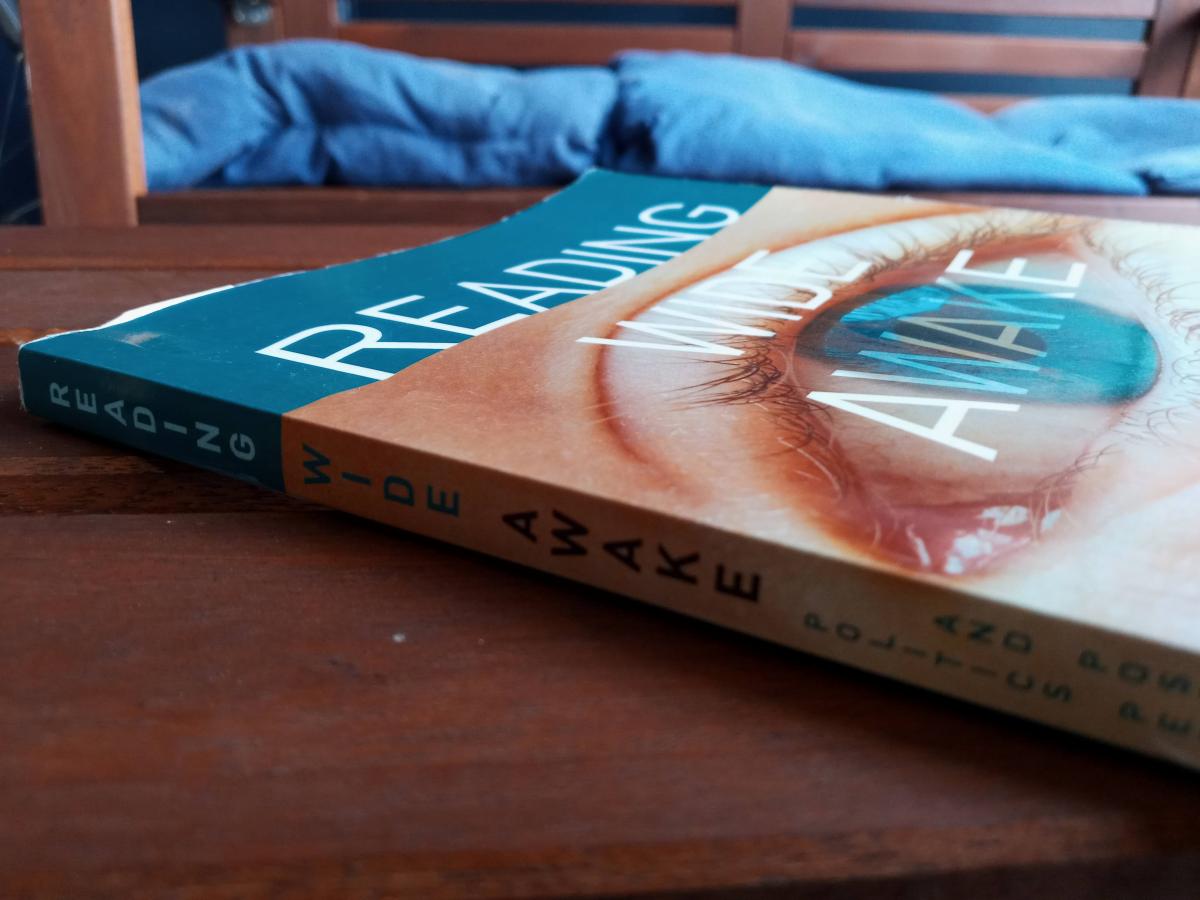
CORRIGAN: Is there anything else you’d like to share about reading, teaching, or Reading Wide Awake that I haven’t asked you?
SHANNON: I’ll start here. Reading Wide Awake examines reading as flexible practices of personal and social agency necessary for the continuous remaking of ourselves and democracy in and across changing times and contexts. By telling stories of my reading social objects (including printed texts) in everyday life, I invite readers to awaken to the ways these ‘texts’ work for and against their interests and the promises of democracy. By analyzing my reading experiences critically, I demonstrate how to take up these practices and why they are vital to acting in and on the world. I hope I wrote with some intelligence and humor.
This short book is organized according to paraphrased questions that people asked me across the first forty of my now fifty years as an educator: Why read? What is text? How do texts work? Where is meaning? Isn’t reading out of date? Can reading like this get me in trouble? Do regular people read like this? Fifteen years prior to this book, I offered a different structure in text, lies & videotape, a book about whose stories get told in and out of school. That text began with a reading of my junior high principal enforcing “school integrity” with a ping pong ball down my pant leg and a wooden paddle on my backside. My (our) reading practices are always in-the-making, and I’m only five years away from the next installment!
CORRIGAN: In Reading Wide Awake, you seem to use the words “read” and “reading” loosely and expansively—to mean not just looking at written texts but more broadly seeing, recognizing, understanding, or thinking about the world. I’m wondering, how do you define “reading” and why use the word “reading” instead of something broader like “thinking”?
SHANNON: Originally, my choice of the term reading was purely tactical. If seeing, recognizing, understanding, thinking, assessing, and acting in and about the world through the production of social things can be separated from the term reading, then they can be excluded from school curricula. If they are inseparable moments of reading, then they remain basic skills (See Herb Kohl’s pre-TikTok Basic Skills – 1982). My route to this realization maps my development as a critically pragmatic reader with a sociological imagination. That is, the choice stemmed from reading personal experiences (my problem?) and eventually recognizing that they are actually social issues produced and maintained through the texts of powerful discourses in and out of schools (K-20).
By the early 1970s when I was a history graduate student, Americans had been lied to about the Bay of Pigs, Tet Offensive, and bombing of Cambodia; two Kennedys, Malcolm X, Salvador Allende, Fred Hampton and Martin Luther King assassinations; the “collapse” of Students for a Democratic Society and the Black Panthers; and the Angela Davis and the Chicago 7 trials. Official and mainstream representations of these events across time and media led to Richard Nixon being elected and re-elected with an agenda to win the cold war militarily and to bring law and order back to American streets. I lost faith in the path I had chosen at the end of college to become a historian of societal outsiders, which I believed would help more people to develop their “sociological imaginations” (C. Wright Mills), overcoming the “repressive tolerance of a one-dimensional society” (Herbert Marcuse), and thus, freeing their minds to rationally pursue the truth (J. S. Mill). Although certainly necessary, more historically accurate information (reconstructed history books) about the neglected in society no longer seemed adequate. Rather I thought what would be vital, but lacking, was the habitual practice of accessing, interpreting, assessing, and acting upon daily information, artifacts, and events to secure the original promises of liberal democracy. To me, that practice was the act of reading which could be extended and spread through public schooling. I joined the Teacher Corp and set my sights on the first R.
Despite the economic, racial, cultural, and religious diversity among the families of my first class of kindergarten students, the school district supplied me with the DISTAR Language and Reading program and required me to “teach reading” by following the scripts in its teacher’s manual for a specified amount of time daily. The authors of DISTAR assumed that my students had little or no prior experience with reading, phonological or syntactic command of English, or interest in learning to read or in the world around them. They argued their approach was scientifically based. Lessons consisted of small groups articulating phonemes in unison with me. When those articulations were “mastered”, I was to point to manipulated letter symbols arranged randomly on a page in the teacher’s manual and groups were to produce the corresponding sounds (pretending that English has one-to-one letter to sound correspondence). When mastered, I was to point to a symbol to elicit the assigned sound from all, and then, run my finger to another symbol to “make a syllable or blend” as students slurred the first with second phoneme. Eventually, we all graduated to words, phrases, short sentences, and sentence strings (called stories).
All materials were black print on off white newsprint with no illustrations. To ensure that parents participated in these reading instructions, students were to bring home half-sheet “student copies” of the stories to demonstrate their mastery of reading. Standardization through teacher and student fidelity to the program assumptions and scripts were presented as the keys to success in reading, in school, and in life. There were no expected discussions of the meaning of the program’s texts or the practices encouraged in or outside of the classroom. When the students finished the last DISTAR lessons, they and I began the daily lessons supplied in commercially prepared reading materials, (called basals), following more loosely scripted lessons as we worked our way through anthologies, workbooks, worksheets, and criterion reference tests across grades 1 through 6. This defined learning “to read at school.”
Because the remainder of the kindergarten curriculum was not prescribed except by name of subjects, the students and I had time to discuss their lives outside of school, their interests, habits, family traditions, ideas about how the world works, media use (TV and radio)….Later, I came to recognize these discussions as examples of what William James meant by “pluralism:” there will always be different perspectives and interpretations of any idea, event or artifact – all work in some situations and none are superior in all. We used these talks and their surroundings to read their worlds to consider how people use symbols to make meaning and get things done. While emphasizing the “why” of reading, we engaged in the “how”, attending to salient features (color, size, position) in images and things and studying phonics by recognizing and using Sylvia Ashton Warner’s Key Words techniques (Zoo), examples from Septima Clark’s and Beatrice Robinson’s Freedom Schools (“What’s a good a word? Amendment”), local store signs (Red and White), and learning to recognize everyone’s printed name (from Abby to Zimbalist) posted on their cubbies and supply boxes. To varying degrees, all participated in what Allan Luke and Peter Freebody would later call the four-resource model of reading – code cracking, meaning making, determine use and effects of genre, and social analyses – without any of us knowing these labels.
I found willing confederates among the music, art, and gym teachers to help us study how sounds, images, and bodies can be used symbolically to represent our intentions to mean. We called this “reading”, and because I lived in the neighborhood and looped with many of these students through the primary grades (K-3), I had time to demonstrate how this reading blended with their family members’ reading outside of school. By our third year together, we had convinced our building administrator that DISTAR was not appropriate for our community; unfortunately, my fellow teachers chose to replace DISTAR with a single K-6 set of commercial reading materials (with significant amounts of promised free components and staff development promised by their publishers) for reading instruction at our school. That “other stuff” that we employed daily as reading, while not necessarily harmful, was considered “beside the point”. Those practices, you see, were not essentials in an elementary school curriculum…
I finished my four-year commitment to shepherd those students and families through the primary grades and enrolled at the University of Minnesota (then famous for its reading research program) to try to understand how my colleagues’ decision could make sense. The best outcome of that move was that I read my first-day schedule incorrectly, went to the wrong office, and met Kathleen (I’m married to Kathleen). Another outcome was that I began to develop an understanding of reading at school. My first course – History of Research on Reading – assigned titles such as The Psychology and Pedagogy of Reading (Huey, 1908), Reading as Reasoning (Thorndike, 1917), Remembering (Barlett 1932), Literature as Exploration (Rosenblatt, 1933)….These texts and my peers’ discussion of them taught me that my interpretation of reading was not wrong or beside the point because reading was information processing, not ever mastered or easily transferred among situations or tasks, colored by cultural attitudes and personal habits, and involved emotions as well as reason.
Buoyed with those insights, I used the intellectual tools I brought with me to class (Marxism/critical theory) and began to develop new ones (pragmatism – old, new, American and French – Richard Bernstein) to understand my experiences with past colleagues (and continued experiences in and around reading education over 40 years). Marxism directed me toward analyses of the social relations embedded in those commercially prepared basals. Critical theory honed my attention to how power was/is used in reading education (in at least the U. S.). The pragmatists pointed toward the language school personnel use to represent and reflect upon their interests and experiences while teaching reading, and then, to follow the consequences of their acting on those reflections. I concluded initially that three hegemonic discourses (science, business, and the state) speak through school personnel’s words and actions (Broken Promises, 1988). I’ve tracked the consequences of those discourses over time (e.g., Reading Against Democracy, 2007; Closer Readings of the Common Core, 2013; and Reading Poverty in America, 2014).*
You can read current consequences of the continued power of those three discourses in the recent struggles over the definitions of reading and reading instruction as it played out in the New York Times this spring – insisting reading is a psychological, not a set of social, cultural, and historical practices; treating reading instruction as a market and reading as human capital, not creative, contextualized, human endeavors; and mandating guidelines for schools and teachers to overcome social and economic inequalities, not social problems in need of collective democratic solutions.
For example, the New YorkTimes reported that the COVID pandemic resulted in a “reading crisis” across the country as systematic reading lessons moved online render the lessons to be parents’ responsibility (Jonathan Wolfe). Reflecting on his struggles with learning to read at school, the new mayor of New York City mandated that city teachers be “trained” to use phonics-based commercial reading programs to teach reading in order to overcome the crisis (Lola Fadulu). Ten days later, a Times reporter described how Columbia University professor Lucy Calkins “retreated” from meaning centered lesson to a more sound oriented position in her commercial materials (which occupies one quarter of the US market for reading education) (Dana Goldstein).
*I address a history of counter-discourses in The Struggle to Continue, 1990; Progressive Reading Instruction in America, 2017.
CORRIGAN: Throughout the middle chapters of the book you discuss reading specific types of social texts (like NPR and Google Maps), and you also present a more general theory of reading (regarding sociological competence, sociological imagination, pluralism, etc.). In other words, these chapters take up the somewhat traditional matters related to reading: texts, ideas, the life of the mind. But all of that appears bookended with two case studies from “real life,” a less traditional concern for reading: one case is about the fate of a canyon wilderness area and the other is about a dying town being revitalized and the questions are about what to do and what is being done in each situation that affects real lives of real people and environments. Through this bookending, the reading life gets anchored in the life of action—even activism—such that reading is not just about thinking and feeling but also about doing. Can you elaborate on that?
SHANNON: Bear with me…I find it not useful to consider ideas separately from actions because we must experiment to adapt to continuously changing physical and social environments. That need to adapt, to experiment, induces our ideas; not the other way around. Wide-awake reading is an array adaptation practices – ways for Americans to enhance our “self-evident” right to participate as peers with all others in the making of democratic social life. Perhaps, that is what could be meant by reading as activism – wide awake readers refuse to cede that right to others and exercise ‘intelligent action.’ I didn’t make this up – see quotes below – listed in chronological order, not the order of my ‘discovery’ of these authors (Marx, Foucault, Dewey, Emerson).
Emerson: Circles 1841
In nature every moment is new; the past is always swallowed and forgotten; the coming only is sacred. Nothing is secure but life, transition, the energizing spirit. No love can be bound by oath or covenant to secure it against a higher love. No truth so sublime but it may be trivial to-morrow in the light of new thoughts. People wish to be settled; only as far as they are unsettled is there any hope for them.
I am only an experimenter. Do not set the least value on what I do, or the least discredit on what I do not, as if I pretended to settle anything as true or false. I unsettle all things. No facts are to me sacred; none are profane; I simply experiment, an endless seeker, with no Past at my back.
Marx: Eleventh Thesis on Feuerbach, 1888
The philosophers have only interpreted the world in various ways; the point, however, is to change it.
Dewey: Democracy and Education (1916)
We can definitely foresee results only as we make careful scrutiny of present conditions, and the importance of the outcome supplies the motive for observations. The more adequate our observations, the more varied is the scene of conditions and obstructions that presents itself, and the more numerous are the alternatives between which choice may be made. In turn, the more numerous the recognized possibilities of the situation, or alternatives of action, the more meaning does the chosen activity possess, and the more flexibly controllable it is.
Foucault: “On the Genealogy of Ethics’ (1983)
My point is not that everything is bad, but that everything is dangerous, which is not exactly the same as bad. If everything is dangerous, then we always have something to do. So my position leads not to apathy but to a hyper- and pessimistic activism. I think that the ethico-political choice we have to make every day is to determine which is the main danger.
Human agency begins in the deep and critical reading of the present conditions in our attempts to adapt to continuously changing environments. Marx directs Emerson’s experimenters to collective action within their historical contexts, and toward equality; Dewey engages experimenters in intelligent actions to address social problems to move closer to the realization of the promises of democracy; and Foucault warns experimenters that consequences of all alternatives are dangerous, at least to some group(s), regardless of experimenters’ aims. He rejects cynicism and passivity, setting individual and collective daily agendas to decide and act on the main dangers.
CORRIGAN: In Reading Wide Awake, you connect reading to an embrace of such values as democracy, dissensus, difference, pluralism. The idea is that reading can enable and motivate readers to genuinely dialogue with those who are different and who hold different values, beliefs, opinions. But Reading Wide Awake came out in 2011, a few years before what appeared to me to be a remarkable intensification of conflict, fake news, and bad faith arguments in the United States—the Trump era. Has your hope for the possibilities of collaboration, dissensus, and dialogue changed since?
SHANNON: My short answer is “no.” If anything, the last decade has made me more committed to those values, and I thank you for considering that “reading wide awake” could serve as a tool in the on-going “real utopian project” of the making of democracy for these times. Many share your interpretation (although they vary in readings of the problem): Zolan Kanno-Youngs and Michael D. Shear, Sarah Vowell, Max Fisher.
Liberal democracy is not a thing or a template to be applied; rather, it is a method for identifying and solving the common problems of securing the rights of life and pursuit of happiness for all, across time and contexts. According to John Dewey, “The democratic faith in equality is the faith that each individual shall have the chance and opportunity to contribute whatever he is capable of contributing, and that the value of his contribution be decided by its place and function in the organized total of similar contributions: —not on the basis of prior status of any kind whatever.”
For the individual, democracy means having a share in directing the activities of the group – participatory parity; for the group, democracy demands the development and maintenance of social arrangements enabling the liberation of the potentials of each individual member. Those are unmet promises made in the second sentence of The Declaration of Independence. Democratic patriots are keepers of that faith, acting to ensure that this country lives up to those principles within and across its borders. I am a patriot.
Other patriots and I read the texts and contexts to name, resist, dismantle barriers to democratic possibilities and to develop and maintain social arrangements which would enable greater participatory party among all groups and individuals. Even among patriots, however, conflict is likely because we begin our searches for just social arrangements from differing historical positions, and therefore, while we share at least a rhetorical goal, our interests and strategies will differ necessarily. Chantel Mouffe (2018) argues “in a democratic polity, conflict and confrontation, far from being a sign of imperfection, indicate that democracy is alive and inhabited by pluralism.” What we patriots need then are ways to keep that agonism from becoming antagonism. Many imply that it might already be too late for dissensus – a process of identifying differences and locating these differences in relation to each other, leading to collective explanations of how people differ, where their differences come from, and whether they can live and work together with these differences. However, unless individuals and groups have given up entirely on democratic faith, I believe dissensus is possible and necessary to build coalitions among disparate groups to continue the search for and reality of democratic social arrangements.
If we engage in real utopian projects for liberal democracy within pluralistic societies, then patriots must engage in practices of dissensus to support others and ourselves as we sort through our repertoires of social discourses to find points of, at least temporary, agreement. Dissensus affords the possibility(ies) for coalitions to form around specific goals and strategies to act intelligently toward the promises of democracy. As Eric Olin Wright (2010) explained, these projects are utopian because we are thinking about alternatives that embody our deepest aspirations for a just society, and each is real because we continue to experiment with and deliberate within our associated ways of living as we struggle toward the just (and flexible) social arrangements across contexts and time. Reading wide awake can alert us to the ways power works through the “texts” of our lives, enabling us patriots to tame the harm caused by barriers to participatory parity, to erode those barriers through our actions, and to experiment toward just social arrangements. Keep the democratic faith!
CORRIGAN: Since you are on one hand a college professor and on the other hand a scholar who studies K12 education and a teacher who teaches (future) K12 teachers, it seems you have an unique view into both worlds: education in college and education before college. Traditionally and unfortunately, there has been, at least in my experience, little exchange of pedagogy across that line. But I think there are things we could learn from some cross pollination. So in that spirit, I’m curious if you might comment on what commonalities and what differences you see between what we ought to be teaching about reading before college compared to in college.
SHANNON: Most texts I encounter are institutionally produced to teach me who I am, what I should know, value, and do. Unfortunately for me, but certainly by design, they are intended to position me as a consumer, not a producer. Government, business, media news and entertainment, church, science, sports, and other institutions teach me not only to consume goods and services, but also, to swallow expert opinion, idealized representations of the past, and the spectacle of celebrity and success, as if their texts were representations of the way things are and should be. I am to receive from others and not create for myself and contribute with others; I am free to choose among, but not to determine, alternatives. These institutional texts leave little space for me to think outside their intended parameters or to imagine what they left unstated. Their intentions are not my personal problems alone; they are social issues affecting many if not all. These texts, most texts, intend to teach us that civic life is complex and boring, we’re not smart enough to understand or change it, and therefore, we should seek only comfort and security for ourselves and family. These lessons are dangerous for our individual and collective identities and agencies, and I believe, main dangers for the health of our pluralistic democracy.
Except for middle school/junior high, I’ve taught at every level from preschool to doctoral study. (I am afraid of tweens and early adolescents for reasons obvious to anyone who has personal knowledge of this age group.) Reading the texts of my teaching experiences tells me that schools participate in limiting the potential power of reading through decisions surrounding the social arrangements of school curricula and pedagogy. From my first encounter with official reading instruction as a teacher (and a student in the 50s) to the assigned reading list for the History of Reading Research which began my focused study of reading, to my assignment to teach a course on reading and teaching to 300 or more students each semester, schooling has undersold readings’ personal, social, and civic potential. The result, I fear, is that school teaches our students that they are consumers of social life, and not active, equal participants in its continuous making. So my comment to preK-25 teachers about reading is a question (an on-going inquiry really). How can we tame and erode the intentions behind school texts in order to disrupt the production of ‘sleepy’ readers, to develop the social arrangements of our classes, engaging all our students in reading wide awake; and to encourage participatory parity in the making of pluralistic democracies in and out of school?
My recommendation is to trust our students, to see them as interesting and interested, to arrange our courses and readings to enable participatory parity across the differences they bring to class, to seek real reasons for them to engage in dissensus, and to act on their new knowledge and convictions through the discourses we represent.
I’ll share one effort to address this question. During the decade before I retired, I worked with others to reorganize our university’s K-12 reading specialist certification coursework. We sought to add secondary discourses to our students’ repertoires so that they could choose to critique, tame, and erode the typical specialist habitus. Specialists are assigned officially to support students at any grade level who have been labeled as struggling to learn to read and write at school. By law and tradition, these public-school programs are typically organized around assumptions that during their cognitive development of the reading process to date, strugglers have failed to learn one or more code-breaking skills and/or mechanical strategies for extracting meaning from passages – that is their cognitive development of the reading process is incomplete for the demands of their schooling. Specialists are to repair these failures by diagnosing and remediating these problems, bringing students to mastery through scientifically-based reading instruction, and then, to send repaired students back to regular classes able to complete reading assignments. Often, specialists are taught to focus primarily on the how to read and to devote less or little attention to: why read; how texts work; why and how struggling students should assess texts’ intentions; or how struggling students make sense of (all types of) texts outside of school. If these typical reading specialist assumptions, practices, and absences brought the desired consequences, then perhaps, all these explicit and implicit lessons would be warranted. However, beyond the immediate contexts of those lessons, desired outcomes have been scarce – even by their gold standard measure, annual reading test scores. *
Our efforts were complicated by the accreditation processes legally and professionally required for all specialized certification courses. We could not just “do as we pleased.” We proposed our changes as a design experiment with the expected outcome of specialists with competence and imagination. We were approved with “some” concern from the state and some accolades from the profession. Our graduates would be competent (all would pass the state certification licensing exam for reading specialists and be recommended by practicing specialists based on a practicum experience) and imaginative (able to design and act upon social arrangements for learning to read that are not yet, but could be, if specialist focused on the roles for reading in the development of self and democracy). Our assumption for the experiment was that if the specialist could see themselves as reading agents – participants as peers with all others in the decisions of reading programs – they could demonstrate that agency for their students and negotiate/develop social arrangements in their classroom that immersed their students in participatory parity of its social life.
This is getting long and you’re probably now sorry you asked. I’ll be brief. We tripled our teaching workloads to develop three discourses for reading specialists: cognitive, socio-cultural, and political – creating three identity kits of how to speak, think, value and act accordingly across issues of pluralism, policy, scientific warrants, curriculum, and pedagogy. We arranged students in groups of at least three, encouraging the members to deliberate over meanings and likely consequences of their readings of the social things of reading specialists (e.g., cultural differences of experiences, ability grouping, technical reports, time scheduling, state mandates, book chapters, room arrangements, journal articles, pedagogical strategies, tests and assessment procedures, parents/guardians…). Whole class discussions became purposeful exercises of dissensus – always with obligation to move forward toward our state obligation to enter schools to demonstrate reading specialist competence (equipped with multiple discourses with which to read the intentions behind existing school texts), and then, to use our individual and collective imaginations to design, construct, and implement the social arrangements we thought most likely to support our first through eighth grade struggling students as wide-awake readers. From the first course to the tenth, university instructors and school supervisors worked to communicate to each cohort of university students that we expected them to be successful and we were there to support them.
Early in our efforts to remake the reading specialist courses, the students and the instructors decided that a museum was most likely to enable us to develop social arrangements that would afford struggling students the opportunity and support to develop wide awake reading. (There are ten museums on campus of various sizes and budgets.) Each university student cohort began its courses with severe doubts that such students were capable to produce exhibits individually and a museum collectively based solely on their readings and actions. Before the final imagination practicum, we worked collectively to develop our students’ language to discuss, if not believe, that a museum was possible. Doubling down on the university instructors’ belief that our (now) Teachers and their Curators could and would indeed engage actively in the inquiries and production, we scheduled a grand opening for the museum on the last day of practicum.
Following John Dewey’s (1938) notion that the realization of any ideal must be based on experience, Teachers organized practicums’ social arrangements to reduce, if not eliminate, barriers to each Curator’s participation as a peer in the design, construction, and presentation of multimodal museum exhibits on a central topic (e.g., habitats, transportation, weather). Prior to the practicum, neither Teachers nor Curators were experts concerning museums or the central topic, although each brought differing amounts of experience with each. They would learn both together. Teachers provided support for Curators as they read to become experts on the topic (“What do you know about . . . ? How do you know that? What would you like to learn about? Would you like help with that?”), and then, write and with the assistance of a resident community artist create multimodal texts to represent their new knowledge for the expected visitors to the museum (“What caught your interest in the museum we visited? How was it interesting? What would you like to write and show about your new knowledge? Would you like help with that?”).
Scores of family members, university personnel, and former participants visited the two-hour museum opening each year. We never had to defend our goals and methods to visitors, parents or Curators because our practice-based events (process and product) trumped the evidence-based practices that Curators (and their parents/guardians) experienced at school. Although the thick school folders that accompany Curators label them as autistic, behind, ELL, learning disabled, dyslexic, or ADHD, every Curator demonstrated her/his/their literate competence by producing and presenting (proudly) an exhibit situated prominently within the museum (two university classrooms and a connecting hallway). And every Teacher showed some signs of reading wide awake. Here’s an excerpt of Teacher Joshua’s final report on Curator Tim.
What does Tim need? It depends:
If you read his folder….
If you watch him during independent reading,…
If you sit next to him and listen to him read a book you picked for him….
But if you work with him on his model train, then….
The first three “ifs” suggest that Tim can’t read well enough to engage in inquiry, and therefore, he needs preliminary skill lessons before you start. The last one shows you that you don’t know Tim or his capabilities unless you let him participate (2014).
* Despite a century of reading research and billions of dollars invested annually in reading education, students from low income families (Carnoy & Rothstein, 2013)— confounded by race (Vigor, 2011), immigrant status (Swartz & Stiefel, 2011) and segregated location (Burdkick-Will et al., 2011)—continue to “struggle” with school literacy. Although some schools have made modest improvements (Rowan, 2011), the overall income achievement gap has increased by 40% since the Reagan Administration (Reardon, 2011).
CORRIGAN: You stress in Reading Wide Awake that you’re still learning how to read. So what have you learned since writing this book?
SHANNON: In 2017, Penn State offered the ARod-deal to all employees of a certain age and length of employment. We had lived in the Happy Valley since 1990. I qualified, took the year’s salary to not come back (the NY Yankees offered this deal to Alex Rodriguez to induce his retirement), and began to write an operetta entitled ‘Bourne in the USA’ (while trying vainly to read ‘flow offense’ during noon basketball games). I’m working on a third draft, learning how to read many genres of musical theater in front of and behind the curtain as well as popular music at the turn of the 19th century and symbols of American social, economic, intellectual, and political history between the depression of ’93 and the end of WWI. It continues to be a thrilling, and humbling experience. When I admit to others what I’m doing “these days”, they often ask: “How are you prepared?” “Who’s Bourne?” “Why now?” “What will Bruce say?”
I have played in a garage band since 1966 (The Root Beer Beaver), appeared in several musicals as a high school student (portraying a sailor in the South Pacific, a Jet, and Conrad Birdie), and maintained a dozen or so pages of decades-old notes on Randolph Bourne. I have formal training in neither music nor theater. When Kathleen and I visit theaters now, we are becoming “wide awake” to ways in which all involved work collectively to produce that play on that “stage” in these times to teach the audience who we are, what we should know and value, and what we should do. In State College, NYC and the Twin Cities, these lessons have changed our theatering experiences, making us attentive differently than my pre-Bourne afternoons and evenings.
I declare that I’m a playwright in the making who is sampling the melodies from popular songs of Bourne’s times, rewriting lyrics to “teach” audiences Bourne’s democracy faith, and drawing images of staging for each scene, both acts, and the whole play. This is shorthand for the new ways I’m reading: new technologies, musical notation, emotional effects of auditory, physical, and visual symbols, historical presentism, lyricism across time, and technical, kinesthetic, physical, and aesthetic practices and objects of musical theater. Keeps me busy.
I picked Bourne as a subject because his life offers remarkable examples of reading wide awake and the challenges of patriotism. Bourne was a social critic and essayist who died in 1918 at the age of 32. I “discovered” Bourne (and began my notes) while reading about John Dewey and the counter-hegemonic discourse of progressive education (unassigned, but necessary texts for that first course in the UMN doctoral program). Bourne was Dewey’s student at Columbia University and wrote two books on education (and another concerning youth culture). I reconnected with Bourne when I read Jeremy McCarter’s 2017 New Yorker piece “The Critic Who Refuted Trump’s World View, in 1916.” McCarter called Bourne, the “Anti-Trump” for Bourne’s essay “Trans-National America” (published in The Atlantic Monthly). Jennifer Ratner-Rosenhagen devoted three pages to that essay in her 2021 book American Intellectual History: A Very Short Introduction (Thomas Jefferson gets two pages and Dewey none in the 130 pages of prose). Between 1911 and 1918, Bourne wrote over 1400 essays that were published in regional and national magazines (e.g., Columbia Review, The Atlantic Monthly, The New Republic, The Masses, The Dial, Seven Arts).
In its current form, the operetta has two acts. I’ve structured the first around Bourne’s writing of his first national publication “The Handicapped by One of Their Own” (The Atlantic Monthly, 1914). The attending physician misused forceps during Bourne’s birth, changing the shape of his head and altering his breathing, voice, and hearing. At four, Bourne contracted spinal tuberculosis, which over three years curved his spine and limited his gate and height. The Atlantic publisher asked Bourne to write an autobiographical piece to explain his life “struggles.” That essay is often cited as a founding manifesto of the disability rights movement in America. It ends: “Do not take the world too seriously, nor let too many social conventions oppress you. Keep sweet your sense of humor, and above all do not let any morbid feelings of inferiority creep into your soul.”
Floyd Dell’s obituary for Bourne (1919) frames the second act, highlighting Bourne’s participation in the bohemian culture of Greenwich Village, his “Trans-National America” argument for cosmopolitanism over melting pot assimilation to adopted Anglo Saxon cultural expectations, and his vanguard leadership of the anti-war movement (See Twilight of Idols, 1917). In the latter, Bourne explained that Americans couldn’t “make the world safe for democracy” by suppressing it at home or through military force abroad. Bourne’s positions proved unpopular with business and the state, and Bourne died of the Spanish Flu penniless and sleeping on his fiancee’s divan. As Dell (1919) explained:
“There are few avenues of expression for protest, however sane and far-seeing, against the mood of a nation in arms; and one by one, most of these were closed to him as he went on speaking out his thought. It is one of the more subtly tragic aspects of his death, a misfortune not only to a fecund mind that needed free utterance, but to a country which is nearly starved for thought, that he should in these last years have been doomed to silence.”
Oh, and I anticipate Springsteen and E Street will play the opening bars of the overture…
On October 11, the Department of Homeland Security (DHS) announced a further extension of the flexibilities on Form I-9 compliance requirements that have been in place since the onset of the COVID-19 pandemic. The guidance was set to expire October 31, but has now been extended through July 31, 2023.
The guidance will continue to allow for remote inspection of Form I-9 documents in situations where employees work exclusively in a remote setting due to COVID-19-related precautions. For employees who physically report to work at a company location on any regular, consistent or predictable basis, employers are required to use standard I-9 procedures.
On August 18, the DHS published a Notice of Proposed Rulemaking which would create a framework under which the Secretary would be authorized to extend the flexibilities on a more permanent basis. Given the length of time the rulemaking process takes, CUPA-HR is grateful for the DHS’s extension of the Form I-9 flexibilities.
Allanté Whitmore, PhD started the Blk + In Grad School podcast on her phone, a podcast created to encourage and inspire people of color in grad school. It’s since grown to over 160 episodes with a new season on the way.
Discover Allanté’s journey as a podcast producer and host. It’s all in this featured interview on The Social Academic blog.
Meet Allanté
Jennifer: Hi, everyone. This is Jennifer van Alstyne. Welcome to The Social Academic featured interview series.
Today, I’m speaking with Dr. Allanté Whitmore. We’re gonna be talking about podcasting, which is something a lot of you have been interested in. I’m excited for you to be here today.
Would you please introduce yourself? Just let everyone know who you are?
Allanté: Absolutely. Jennifer, thank you so much for having me on the podcast. We’ve been internet buddies for years now which is kind of amazing. So excited to be here.
So hi, everybody, my name’s Allanté Whitmore, PhD. I recently completed a joint PhD in Civil Engineering and Engineering and Public Policy at Carnegie Mellon University where I studied autonomous vehicle policy research.
On the weekends, and in the wee hours of the night, I built a podcast and community called Blk + In Grad School. There I chronicle my experience as a black woman pursuing a PhD in Engineering. I also interview other graduate students and early career professionals about their graduate experience. With the whole hope of
Motivating
Inspiring
Providing tips and tricks
Mindset shifts
for graduate students to get through their journey.
Jennifer: Oh, I love that. What a good podcast topic. It’s also gonna help so many people. It’s one of those things that those resources are gonna be valuable to people again and again for years to come.
Allanté started a podcast to create the resource she needed in grad school
Jennifer: What inspired you to start a podcast?
Allanté: Yeah, absolutely. Honestly, my own experience through grad school.
Prior to going to Carnegie Mellon, I finished my master’s at the University of Illinois at Urbana-Champaign. And I did undergrad at North Carolina Agricultural Technical State University which is a historically black college [HBCU].
The transition between my undergraduate experience and grad school was very jarring.
A lot of people maybe assumed because I moved from an HBCU to a predominantly white institution…the academic rigor was the same.
It was the social pieces and some of that kind of hidden curriculum around how one navigates themselves as a graduate student that I really wasn’t knowledgeable about.
I really stumbled through my 1st graduate school experience. I didn’t know I was supposed to show up to Friday coffee to connect with my professors. I wasn’t really involved or engaged in a way that was beneficial to me as someone who’s aspiring a profession and career.
When I left, I finished my master’s, I went and worked in Detroit at the McNair Scholars Program at Wayne State University. I led that program. If you’re not familiar with McNair Scholars, it’s a program that helps 1st generation low income students go to graduate school. There, I got all this professional training around grad school readiness and retention in graduate school.
Coupled with my own experience in my professional training, I just felt when I decided to go back to graduate school…There was so much I wished someone told me that had nothing to do with the technical or academic skills we need to be successful. I think a lot of us have that already.
It’s just like, oh yeah
You’re supposed to go to Friday coffee.
This is how you manage a meeting with your advisor.
Here’s how you kind of work through those stickier situations where we may not have a safe space to ask those questions at our university.
That is how Blk + In Grad School started. The whole idea was what I wish someone told me. The research I wish I had when I started back in 2012.
Jennifer: Oh, I love that. It sounds like what you went through in your experiences helped inspire you to create this beneficial resource for everyone who is going through it now. And who may be advising students who are also going through this journey.
You said earlier, ‘hidden curriculum.’ In grad school, especially if you’re not from an academic family, if your parents aren’t PhDs. Especially if you’re from a low income household…There are these kinds of hidden curriculum things that no one’s gonna tell you unless someone like you creates resources around it. I love that you’re welcoming that community and starting that conversation for so many people across the country.
Jennifer: Now how did you get started podcasting? A lot of people are like, ‘Oh yeah, I wanna have a podcast.’ But what was the process for you like when you were getting started and hitting the ground running?
Allanté: Oh yeah, absolutely. Now, I would not recommend my path [laughs].
Jennifer: That’s good to know too.
Allanté: This was 5 years ago. Okay? When you could start things on your phone. I swear y’all, for those listening, I literally grabbed my phone and put the mic as close to my mouth. If you go back to like the first 10 episodes they’re terrible because it’s literally me on my blow up mattress because I didn’t have a bed yet. I had just moved to Pennsylvania.
I maybe did a little bit of light editing on my computer. But it was literally stream of consciousness. That’s how I started Blk + In Grad School.
Then I upgraded to my computer. The next 20 episodes are me huffing into the computer.
Then I finally invested in a mic and the quality improved.
I started to invest in editing and started to think about crafting stories.
I started interviewing people around the 20th episode as well. I was like, “Oh, this could be really good to bring in more perspectives, more experiences.” It was a very organic growth that happened from the start.
I would not recommend starting with your phone anymore. We have really great inexpensive mics that you can get started.
Jennifer: That’s so cool that it really was this project and you’re like, ‘I’m gonna do it. Even if it’s on my blow up mattress with my phone in my hand. I’m going to create this.’
Allanté: Oh gosh. Another transparency moment for me: I actually hate writing. Right? [Jennifer laughs.]
I’m an engineer. I’m an engineer through and through where I wrote quite literally what was exactly needed to get this PhD. And technical writing is way different than creative writing. I definitely feel more comfortable writing for research.
In my life prior to being in graduate school, I’ve done a number of entrepreneurial pursuits. One of them was a blog. Hated it.
Tried vlogging, hated it. I wasn’t able to keep up with it.
And so what I love about podcasting is that I was able to be consistent. It was low pressure for me as someone who’s kind of on the go. Even now, I just left the gym. I have a hat on. Like, Jennifer looks beautiful. Eyebrows done, lipstick. I put lipgloss on and got here. And podcasting takes that pressure away from me.
Jennifer: It does.
Allanté: Yeah, so I can create consistently. And I’m not really worried about the visual…I love podcasts. I kind of started to realize the power of podcasting and having someone in your ears. And the intimate moment of listening to someone else’s thoughts or hearing their perspective.
It just felt like a very natural fit because I had tried other forms. They weren’t really for me. And in this one, I was able to make stick.
Jennifer: Yeah. So your podcast listener yourself. And you tried blogging and didn’t enjoy it.
I really like the things you said about how it allowed you to really be consistent. That is so important when we’re creating something new. When we’re creating this kind of new project that is going to take an unknown amount of time.
Really, when we’re starting out, that idea of consistency is something that a lot of people don’t think about.
And when professors tend to approach me and they’re like, ‘I wanna start a blog. You know, I’m excited about this.” And I talk with them a little bit about some of the things that go into it. And how much work they might have to do in order to get things up and running. And they’re like, ‘Oh my gosh, I had no idea.’
Finding a budget for a podcast editor
Jennifer: Was there anything that was really surprising about the podcasting process that you learned once you kind of got into it?
Allanté: In my 2nd year of my program, I moved into a cheaper apartment because I really was enjoying Blk + In Grad School. I knew I needed to be able to put a little money towards it. As a grad student I was earning nothing. But I was like, ‘Okay, I can now carve out $100-$200 a month toward an editor.’ That was the 1st thing I invested in to take that off my plate.
It’s very time consuming and I’m grateful to my [podcast] editor who’s like one of my best friends, Stephanie. I’m also very fortunate to have a best friend who is an editor, right?
Jennifer: That’s wonderful.
Allanté: Yes! I’m very grateful for her. I told her, ‘Hey, I’m doing this project. Here’s what I can afford right now.’ And as Blk + In Grad School grew, I was able to do some increases in her pay. She was also a very supportive person.
You can look in at Fiverr, you can look in at Upwork. You can do a bunch of things to delegate if you know there’s a piece of the process that you simply don’t wanna do. Or, that you don’t have the time to do.
Editing was the piece that I think I very quickly realized this is a time suck for me. That it would actually harm or decrease my productivity or consistency if I’m the person responsible for editing.
Jennifer: That is so smart. It’s really nice that you figured out the piece of that puzzle where if you send this off and get some help with it, that’s what’s gonna allow you to actually produce more. And put more energy, the kind of energy you want into this project.
I love that you chose to change your lifestyle in order to actually put more energy into this and more finances too.
A lot of people don’t realize that some money may have to go into the kind of upkeep or creation of a project like this. I really appreciate your transparency with that.
Allanté: Absolutely.
How starting a podcast has impacted Allanté‘s life
Jennifer: Now, you must have made that decision because it was impacting you in some greater way.
I’m curious, what kind of impact has the podcast had on your life? Or, your online community?
Allanté: So many amazing things have come from Blk + In Grad School. I genuinely was just creating something I wish existed. Right?
From that I have had speaking engagements at universities across the country, which is really exciting. Especially during the pandemic, I was able to do a lot since it was virtual.
Jennifer: That’s great!
Allanté: Yeah, it blew my mind. Right?
I’ve done campaigns. I’ve dabbled in the influencer space as a result of Blk + In Grad School, representing the graduate lifestyle to an extent.
Jennifer: Oooh.
Allanté: It’s very interesting.
I don’t fully take on the identity of an ‘influencer.’ It feels awkward. But the reality is that it’s a stream of income that has been helpful.
Especially when I was finishing up my PhD in the last like year or so. It was really like, ‘Okay, this is actually bringing in income,’ sponsorships.
Lastly, my community. In 2019, I started The Scholar Circle. It’s a community for folks in grad school. It’s an accountability and coworking community. We meet 3 times a week for a total of roughly 8 hours over those 3 sessions. We work together. We get things done.
In the membership community, there are a host of resources to help you through your graduate journey. That also became a piece that I didn’t anticipate growing. I will also be honest, that was very hard to grow. That took time. And even still, it takes time to readjust and attract new people. That is a task, but it’s a labor of love.
All of these different things have kind of cropped up.
There’s just like so many different kinds of new streams of income that helped me support the podcast so I didn’t have to be the one putting the money into it.
Jennifer: Oh, that’s amazing. So, you’ve created streams of income that are associated with the content that you create, this podcast. And that helps you support the creation of the podcast.
Allanté: That’s right.
Jennifer: If The Scholar Circle, that kind of co-working and accountability sounds great to you, check that out.
Jennifer: One thing that I love about your Instagram and your online presence is that community feel is really there as well. When you’re talking about how you are picking up some sponsored and campaigns for some influencer type things that makes total sense to me. Because the audience that is already following you, the people that are connected with you, they wanna see more content about grad school.
They wanna see more of that lifestyle and what you were going through as well. I love that you were a great representative for them and that companies were able to work with you for that kind of thing.
Allanté: Yeah, thank you. I mean that totally came left field. [Jennifer laughs.] And it’s still so funny nowadays because I realize it is a lucrative option. And recognizing that Blk + In Grad School is also very niche.
There’s a really interesting balancing act that happens there. It’s been very helpful. It’s like, ‘Okay, now I actually have a substantial amount of money I can support. Now I can get more resources. I can now pay someone to help me with The Scholar Circle.
So it all goes back into serving the community. I’m grateful for it.
But I also don’t wanna start spamming the community, right? So there’s like a balance.
Jennifer: Yeah, right.
Allanté: Exactly.
Jennifer: There is a balance. And I’ve never seen anything that looks even remotely like SPAM from your accounts.
Allanté: Yeah. [Laughs.]
Jennifer: You’re always so thoughtful with the content that you share. And actually you’re a great example when I’m talking to other grad students about what they might wanna post on Instagram. I often direct them to your account. I say, “There’s all sorts of things you can do. You can help people. You can talk about your own experiences. And this isn’t a great example for you to check out.”
So I love your Instagram. And oh my gosh, spammy? Definitely not [laughs].
Allanté: I started that the Grad School Success Summit the 1st year of the podcast. That was the event I used to help attract people to Blk + In Grad School.
Not just current grad students, but also other folks in the academic content creation space. That’s how I think I first reached out to you, Jennifer, was to be a speaker.
Jennifer: That’s right. That’s totally right.
Allanté: Yeah. It was really a way for me to kind of tap into the community of content creators who we are supporting the same community.
But then also let new people know ‘Hey, there’s this resource available. You know, it might vibe with you.’ If not, I always share a bunch of other resources that might be a better fit.
This year was the 5th Summit which blows my mind.
Jennifer: Wow! 5 years. I mean that’s really amazing.
Allanté: Thank you. It blows my mind. That is definitely the staple event I have every single year. It’s always helpful in building my email list. That’s my main email list building activity for the year. I really enjoy it.
Those 3 days are intense but really, really fun.
Jennifer: They’re fun. It sounds like it’s something that helps build your list. That helps more people learn about Blk + In Grad School and The Scholar Circle.
How does it help the community? What is the Grad School Success Summit? And who should go to it?
Allanté: I think everyone has the academic skills. I’m really not super concerned with folks having the academic skills. I think if you got into grad school, you’ve got them.
But it’s the social bit. It’s the financial wellness. It’s the emotional wellness. Physical wellness. Creating a personal brand. Right? Building community. All of those other pieces of the grad school experience that universities don’t feel fully responsible for.
I feel like we try our best to create an environment where you can get some tips. You can get some information. Some resources and motivation around any of those topics so you’re a more well rounded graduate student. Not just a brain, you know, doing research day in and day out. And doing homework. And doing readings.
So helping grad students think about what do they want their year to look like? Beyond their academic goals. And how they’re gonna take care of themselves to carry them out is really the impetus behind the Summit.
Jennifer: I love that.
Is there somewhere people can watch the replays if they missed this year’s Summit?
Jennifer: Well I’d love to hear what you’re up to now. Congratulations on finishing your PhD.
Allanté: Thank you.
Jennifer: I know that you’re in a new job. So I’d love to hear a little about it.
Allanté: Yeah, absolutely.
So, I have left academia. That was honestly so stressful to actually admit on the internet. I don’t know why.
I just feel like there’s this assumption, even my own inner feeling that we’re supposed to go onto a tenure track position.
I had a really great opportunity at a national energy security organization. We look at transportation policy as it relates to reducing our dependence on oil. I am now the Director of the Autonomous Vehicle Policy Research Center there.
Jennifer: Exciting!
Allanté: It’s really exciting! Yeah! It’s really exciting work. I get to do exactly what I’ve always wanted to do, which is stand between technical folks (so automakers in this particular expertise I’ve built) and policy makers to communicate what’s happening on that side. See what’s happening with policy. To help create policy. And my emphasis on equity informed policies, so how do we make sure that things are good for everybody.
Jennifer: So that they’re accessible.
Allanté: Yeah, yeah. It’s exciting.
Jennifer: I love that! Now, since you were kind of anxious about talking about it online, what kind of reaction did you get to announcing you were leaving academia?
Allanté: All resounding ‘Good for you’s [laughs].
Jennifer: Yay! [Claps.] So if you’re also leaving academia, or thinking about it, it is okay to talk about online. A lot of people are gonna cheer you on.
Allanté: Yeah, that’s right. That’s right.
There are some folks who were like, “Oh, I think you would have made a great professor.” And it doesn’t mean that part of my life is absolutely not an option, right? But yeah.
Mostly we get it. It’s hard out here.
Finishing grad school after the peak of the pandemic, so the academic job market was something I just wasn’t really in a place to even do at the time. I was like, ‘I just wanna figure things out if I need to. But I’m very [emphasis] happy with my position.
Jennifer: It sounds like you’re exactly where you wanna be. Right in that place with policy and the automakers themselves. So that’s so cool.
TikTok is Allanté’s favorite social media platform
Jennifer: One thing that I wanted to be sure to ask you about is what is your favorite social media platform? You do have a big online presence. You’ve got multiple websites. You’ve got your Instagram, your YouTube. Which is your favorite?
Allanté: TikTok! [Laughs.] Where I’m not at.
[Jennifer: laughing loudly] That’s so funny! Why do you like TikTok so much?
Allanté: I love TikTok. I have a very irreverent sense of humor and I feel like TikTok is full of all of the, like, just wild and kind of wacky stuff. I thoroughly enjoy that.
Jennifer: It fits your personality.
Allanté: Yeah, yeah. There’s things on there. I’d create a page…But I enjoy consuming TikTok. I haven’t gotten to where I wanna contribute too much.
Jennifer: Well you’re a creator in a lot of different areas. You don’t need to create on every platform. Especially the ones you enjoy consuming the most. [Allanté nods her head.]
That’s really fun to hear about when you have so many social media platforms.
Keeping her online presence updated
Jennifer: How do you manage all of that? Like you have multiple websites. You got the social media. That’s a lot to keep track of.
I have a pretty good system with the podcast. Right now, the podcast isn’t on YouTube. I only have like the Summit on YouTube. When I first started, I did a couple of webinars. So they’re there.
My YouTube is pretty tame. That keeps it very manageable for me where I’m only adding 6 new videos a year for those 3 days that we have the Summit.
Jennifer: Nice.
Allanté: Now as far as the websites, everything from the podcast goes to the website. Once I create a podcast episode through my podcast provider, I then link everything: the show notes, all of that. I’m pretty much just repurposing all of that written content and putting it into a blog post on the website. That keeps it very easy to maintain and pretty low maintenance.
Now the social media piece, that’s where probably the bulk of my content creation energy goes. Because you have to create things all the time.
I more recently took a break because I was writing my dissertation. Honestly, so much life has happened since I finished my PhD. Even like us recording is getting me back into the groove of content creation.
Jennifer: Right.
Allanté: What that looked like before was, ‘Okay, I have this episode that’s gonna go out. I only need 2 more pieces of content around the post with the podcast every week. So that’s kind of how I managed it and kept it very low maintenance for me. Like, I can create 2 more pieces of content.
Jennifer: It sounds like you have a good system.
Allanté: Yeah, I do. Thanks.
Jennifer: I like that your system is all based around the podcast. And figuring out what needs to be shared, where it needs to be shared, and when. Right? That’s the multiple posts part. But it sounds like you have a system in place.
I love that you took a break during your dissertation. And even afterwards. Taking a break from social media is so important, especially for our mental health and well-being. It’s great that you shared that as well.
Jennifer: Now, is there anything else that you’d like to add that you wanna be sure to talk about during this interview? I’m having so much fun.
Allanté: I know! Me too.
Only thing I’d say, for anyone who is starting out. The advice I give everyone, and this is what I did when I started the podcast…
Before you go live, create 5-10 pieces of content.
Jennifer: Oooh. Why?
Allanté: 1: you’re practicing the consistency of creating the content and making it a part of your schedule. Even if that means you’re sitting and bashing it. It’s like, ‘Okay, this is how long it takes me to make 5-10 episodes. Or 5-10 videos. 5-10 blog posts, whatever.
Then you can schedule those anchor pieces of content over those 10 weeks, 5 weeks, what have you. If it’s every other week, now you’ve got 20 weeks worth of content if it’s biweekly that you’re producing content.
You get to kind of mess up too. Those very 1st episodes, I don’t listen to. Because they’re not great! But, I got to figure out so much with those first few episodes. Then I could reassess and create some direction. And decide if I like it.
I think all of those bits are really important, 1: with building an audience, and 2: figuring out what works for you and your flow. And making sure you can stay committed to something you said you were going to do.
Jennifer: You have to like it. Right? It’s a big project. It takes a lot of energy and maybe even some finances if you want to get into it. So liking it is important [laughs].
And I’m glad you had a topic you were passionate about. And that you put all this energy into. Because you created something amazing.
Jennifer: What is next for Blk + In Grad School? Will there be a new season?
Allanté: Yeah! Literally, I recorded an episode yesterday. It’s so exciting. I definitely wanna hit 200 episodes. We’re at 165 right now. So I know the goal right now is okay, hit 200. And then we will reassess again.
[Allanté and Jennifer laugh.]
Allanté: But I’m definitely wanting to serve the community. I’m open to what that looks like. I think there might be time for a new voice. There might be time for a different approach. I’m really open to what’s needed from me.
And also balancing my life post-grad school. Right? My time is different. I actually travel a lot for work. Figuring that out has been really interesting.
Jennifer: You’ve changed your lifestyle to work with this podcast. And now you’re even maybe changing the podcast to fit with your lifestyle. And what the community is hoping for in the future.
Thank you so much for talking with me today. Dr. Allanté Whitmore, this has been a joy! We’ve been internet buddies for a few years now.
Allanté: Yeah!
Jennifer: I’ve been involved with the Grad School Success Summit. And so I’m so excited that you came on The Social Academic today.
Allanté: Oh, so happy to be here, Jennifer! Like literally means the world to me.
And make sure you link your session from the Summit in the show notes.
Jennifer: Oh! Good idea. I wouldn’t have even thought of that. But I did talk about social media and how to talk about yourself online in grad school. So I’ll link that below as well. Thanks so much!
Allanté Whitmore, PhD(@BlkInGradSchool) is a proud Detroit native. She earned her bachelors in biological engineering at North Carolina Agricultural & Technical State University, and her masters’ in biological and agricultural engineering at the University of Illinois at Urbana-Champaign. She earned a joint PhD in Civil Engineering and Engineering and Public Policy from Carnegie Mellon University in 2022.
Allanté’s research focused on uncovering the environmental and social implications of autonomous vehicle technology. She used computer modeling to test different ways in which shared autonomous vehicles and shuttles might be used in public transit systems, with the aims of improving transit access and equity in public transit systems and reducing the transportation sector’s contribution to emissions. Allanté is now the Director of autonomous vehicle policy research at a transportation policy research organization. She continues to create knowledge to inform future policy on shared mobility that ensures physical and environmentally equitable access to transportation.
In her free time, Allanté hosts a podcast, Blk + In Grad School where she chronicles her experience getting her PhD, providing encouragement and tools for women and people of color to successfully navigate the graduate-education journey.
Connect with Allanté on Instagram, Twitter, and TikTok @BlkInGradSchool.
Each month, CUPA-HR General Counsel Ira Shepard provides an overview of several labor and employment law cases and regulatory actions with implications for the higher ed workplace. Here’s the latest from Ira.
University’s Internal Investigation of Pay Equity Claims Protected By Attorney-Client Privilege — EEOC Fails In Attempt to Require Disclosure of Documents
A federal district court judge recently rejected the Equal Employment Opportunity Commission (EEOC)’s demand that a university turn over 54 documents related to an internal investigation the university conducted by inside and outside counsel concerning pay equity claims made by an athletic department employee who claimed she was paid approximately $37,000 less annually than a similarly situated male employee. The court rejected the EEOC’s argument that the investigation was conducted by the institution’s EEO office and did not involve seeking legal advice (Equal Employment Opportunity Commission v. George Washington University (2022 BL 308648, D.D.C., No. 1:17-cv-01978. 9/1/22)). The court ruled that the investigation and all related documents are protected by the attorney-client privilege.
The court concluded that the university did not waive privilege by asserting good faith compliance with federal law as a defense to the EEOC’s claim for punitive damages. The court added that the university does not intend to use the documents in question in proving the good faith defense.
Failure to Renew a Coach’s Discretionary Contract May Be an Actionable Adverse Employment Action Subject to a Title IX Retaliatory Termination Claim
The Ninth Circuit Court of Appeals (covering California, Oregon, Washington, Arizona, Montana, Idaho, Nevada, Alaska and Hawaii) recently ruled that failure to renew a golf coach’s contract may be an adverse employment action subject to a Title IX retaliation claim (Macintyre v. Carroll College (9th Cir., No. 21- 35642, 9/8/22)). The plaintiff was hired as an assistant golf coach in 2006, promoted to head golf coach in 2007 and appointed associate athletic director in 2013. His contract was subject to renewal at the discretion of the college.
The plaintiff became aware of what he thought was an improper disparity in the amount the college spent on men’s versus women’s athletic programs. He concluded that the college was out of compliance with applicable Title IX mandates. He alleges that after raising these issues with the interim athletic director and the Title IX coordinator he received negative performance reviews for the first time. He filed a grievance alleging discrimination. In settling the matter, he was given a two-year contract to be head golf coach. At the end of the two-year period his contract was not renewed. His current action alleges that the non-renewal was in retaliation for his raising Title IX concerns.
The court, in ruling that the case should go forward, concluded that this non-renewal might be an adverse employment action and might deter employees from reporting discrimination.
California Appeals Court Rules That Remote Work Due to COVID-19 Can Broaden Where Employees May Sue for Job Bias
A California appellate court recently ruled that the COVID-19 pandemic and technological advances have changed the way people work. The court went on to hold that the venue provisions of the California Fair Employment and Housing Act were meant to remove barriers for suing for job discrimination. Therefore, the “modern reality” of work means that an employee who was fired while on pregnancy leave at her home in Los Angeles County can sue there rather than in Orange County where the employer was located (Malloy v. SuperiorCourt of Los Angeles County ( 2022 BL 330038 Cal. St. App 2nd Dist, 9/19/22)).
The court concluded that allowing remote workers to sue where they worked or would have worked effectuates the purposes of the Act. The case involved a demand by the plaintiff’s employer that she return to the physical office after her pregnancy leave had ended. After the plaintiff was fired for not coming back to work, the plaintiff sued under the California statute for pregnancy and sex discrimination and sex harassment, interference with her family and medical leave rights, and retaliation for trying to exercise her family and medical leave rights. The plaintiff also included a claim for wrongful termination in violation of public policy.
California Moves Toward Requiring Employers to Prove Impairment Before Terminating an Employee for Cannabis Use
In another California development which may spread to other states, the governor signed a new law which goes into effect on January 1, 2024 that prohibits employers from discriminating against employees who use cannabis during off-duty hours. Commentators conclude that this gives California employers 15 months to develop an accurate test on whether an employee is impaired at the job after smoking marijuana or consuming cannabis-infused snacks before firing them or otherwise disciplining an employee for marijuana use. The dilemma is that scientists conclude that there is currently no accurate test that determines impairment form using marijuana or cannabis products.
Cosmetology Students and School Both Win Partial Summary Judgement on Claims That Students Should Be Paid For Work Completed as Part of School-Supervised Job Training
A federal court in Michigan ruled in favor on summary judgement on some of the claims brought by cosmetology students that they should be paid for work performed as part of their course obligations to engage in supervised on-the-job training. The cosmetology school also won partial summary judgement regarding some of the tasks for which the student made wage claims (Eberline v. Douglas J. Holdings, Inc. (2022 BL 332583, E.D. Mich. Partial Summary Judgement 9/22/22)).
The court divided the student tasks for which pay was claimed into three categories, namely client services, janitorial tasks and retail sales. The court held that there was no genuine dispute of facts on who was the primary beneficiary of client services tasks, ruling that the students were the primary beneficiary in this area, therefore granting partial summary judgement to the school. Similarly, the court ruled that there was no genuine dispute of facts on who was the primary beneficiary of janitorial tasks, ruling that the school was the primary beneficiary, therefore granting partial summary judgement to the students. Finally, the court ruled that there is a genuine dispute of facts on who is the primary beneficiary of retail sales tasks, thus ruling that this area must be given to a jury to decide.
In the wake of the Great Resignation and talent recruitment challenges, heavy workloads have led to stress and burnout for some employees. One way higher ed HR pros can help identify sources of stress and mitigate burnout is by considering employees’ work environments. Are invisible pressures placed on employees, causing team members to downplay or hide their concerns about heavy workloads, or can employees be honest about their concerns and feel comfortable bringing their whole selves to work each day? How would employees describe the atmosphere where they work? Are levity and humor weaved into the workday, or is the lack of levity contributing to feelings of being overwhelmed?
In the recent CUPA-HR virtual workshop, How to Manage Unmanageable Workloads, presenter Jennifer Moss explained how building psychological safety and bringing the fun back to work can reduce the impact of overwork and burnout. So what is psychological safety, and how can HR integrate it and the elements of fun and play into the workplace?
Increase Psychological Safety
“Psychological safety is the ability to reveal one’s true self and opinions without fear that doing so will lead to negative repercussions in terms of reputation, career, status or relationships with others,” explains Why Psychological Safety Matters Now More Than Ever, an article in the Spring 2021 issue of Higher Ed HR Magazine. Teams with high psychological safety see more open conversations between team members and managers about their work. They feel comfortable sharing honestly because they know they won’t be punished simply for doing so.
Read the article to learn how HR pros can elevate psychological safety in the workplace by attending to systems and structures, supporting employees to forge connections, and fostering a learning orientation.
Bring Back the Fun
Although HR has much serious work to do, leaders can look for opportunities to incorporate fun, where appropriate. The application of fun and play has been shown to reduce stress and feelings of burnout while also improving creativity and productivity in working environments. Having fun at work has shown to have a positive impact on employee morale, engagement and camaraderie, all of which collectively have an influence on an organization’s culture. Here are some ideas to bring back the fun and stimulate play in the workplace.
Encourage Humor
Similar to incorporating more fun into the workplace, there are also plenty of benefits to weaving humor into the workplace. This element of work is sometimes considered non-essential but has many emotional and physical benefits that make us happier and healthier at work. Humor builds trust in relationships; a culture where it’s okay to admit failure; and happier, healthier employees. Learn how to conduct a humor audit to analyze where your workplace humor went right and ways to use it more effectively.





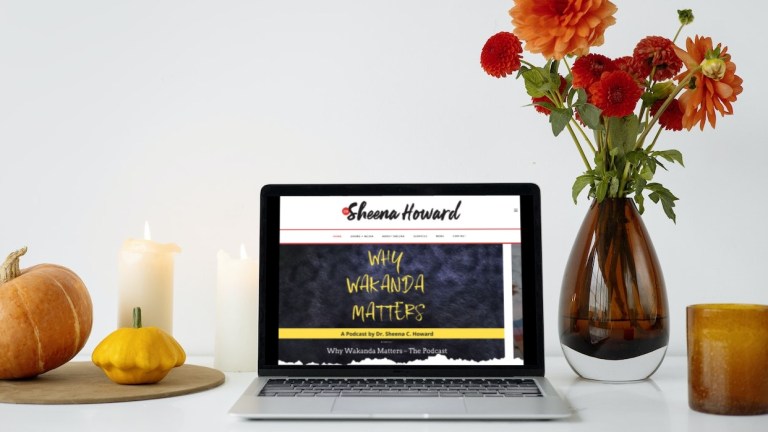
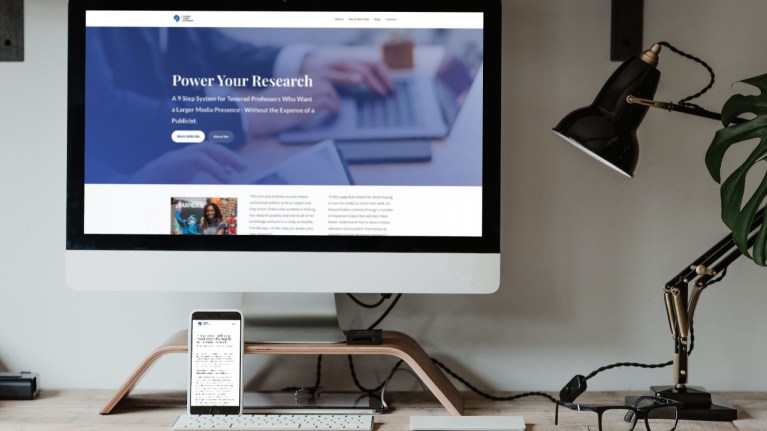
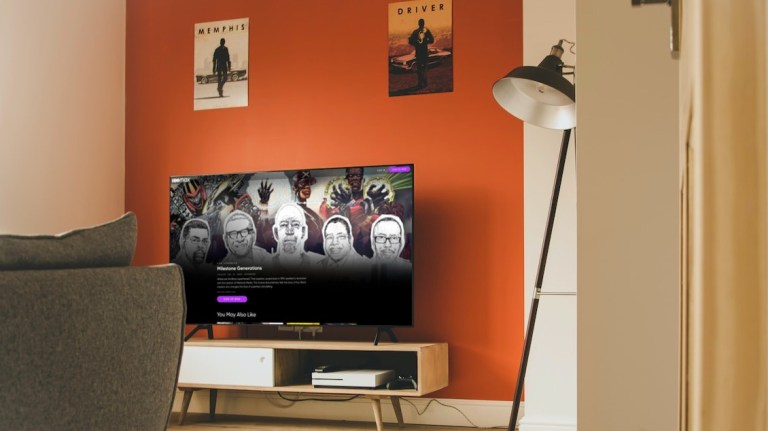

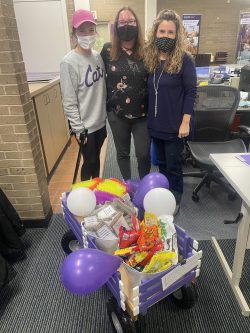
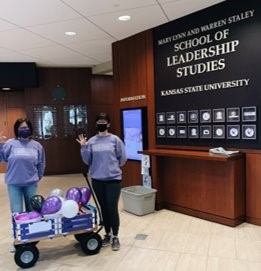 The Braggin’ Wagon was developed by K-State’s Staley School of Leadership, which has a strong partnership with HR. The decorative travelling wagon is filled with treats, candy, small toys and other fun items for the receiving team to enjoy. Once the wagon is delivered to a department, it is up to that department to restock the wagon and deliver it to another department in order to keep the recognition going.
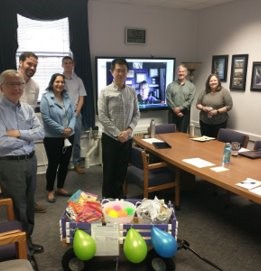 “When K-State resumed in-person work, it was important to put the emphasis on our employees and the solid work they were doing to make a difference. The Braggin’ Wagon was a way for departments to recognize other university partners who contributed to their work in a positive way,” says Shanna Legleiter, associate vice president of human capital services at K-State.