Category: Featured

  • Student loans: what counts as expenditure in national accounts

    Student loans: what counts as expenditure in national accounts

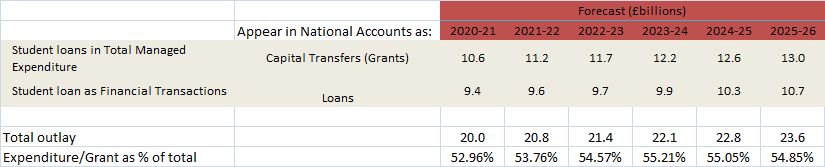
    Economic & Fiscal Outlook, Office for Budgetary Responsibility (March 2021), adapted from Tables 3.14 & 3.26

    I have constructed the table above from forecasts for Total Managed Expenditure and Financial Transactions taken from the Office for Budgetary Responsibility’s latest publication (it accompanied Wednesday’s Budget).

    It shows how newly issued student loans are now split into two components for the purposes of presentation in the National Accounts. The portion of loans that are expected to be repaid are classed as “financial transactions”, while the portion expected to be written off is recorded as capital expenditure. The latter scores in “public sector investment”, which was adopted as a new fiscal target prior to the pandemic (net investment cannot exceed 3% of national income), though the rules are currently under review.

    We can see that student loan outlay is expected to reach £20billion in the year to March 2021, rising to £23.6billion in five years’ time.
    The majority of new outlay is now expected to be written off and that share rises over the forecast period.
    By 2025/26 repayments on all existing loans are projected to re000000000000000ach nearly £5billion per year. (This figure has improved since the sale programme for post-2012 loans was abandoned, since the treasury now gets the receipts that would have gone to private purchasers).

    As mentioned in recent posts on here, the Department for Education only currently has an allocation of £4billion to cover the capital transfer / grant element of new loans and so it has to be granted large additional budgetary supplements each year. This situation has dragged on as the planned spending review has been postponed. We can now expect developments in the Autumn.



    Source link

  • New contingent liability recorded against student loan sales

    New contingent liability recorded against student loan sales

    Last week’s Supplementary Estimates contained another note of interest for student loans.

    Under “Note K: Contingent Liabilities” (p. 90) we find that a fifth contingent liability has been added to those associated with the now abandoned sale of student loans.

    The sale of student loans necessitated warranties and indemnities to secure interest and obtain value
    for money from investors. These contingent liabilities are in respect of:

    e) New EU Securitisation Regulations (Possible CL [contingent liability] in due course). UKGI [UK Government and Investment] are seeking legal counsel to review the implications of new EU securitisation reporting requirements from 2019. Credit granting criteria are being assessed for student loans which may generate legal challenge and we will continue to work with UKGI to update as more information and analysis becomes available.

    If any reader can explain what the issues may be here, I would be very grateful.

    The original four contingent liabilities are discussed here. These, along with the fifth, are still classed as “unquantifiable”.
    There were also issues around whether the Special Purpose Vehicles for the securitisations were sufficiently independent of government so as to constitute a genuine sale (and thereby transfer the loans off the government’s balance sheet).

    The wording above though suggests that the lack of “credit” checks on student loans may be the issue.


    Source link

  • EdTech for International Education via the Gateway International Group

    EdTech for International Education via the Gateway International Group

    The Gateway International Group just launched a compilation of EdTech companies/platforms for International Education. Compiled and edited by Erin Niday and Tony Ogden, this compilation has the goal of highlighting those EdTech platforms that have the potential to transform next generational international learning and engagement. You can learn more at https://gatewayinternational.org/edtech/.

    Note: I’m an affiliate of the Gateway International Group but receive no compensation for this post.

    Source link

  • DfE gets over £13.5billion extra for 2020/21 loan impairments

    DfE gets over £13.5billion extra for 2020/21 loan impairments

    The UK government published its “supplementary estimates” for 2020/21 yesterday. These allocate additional budgetary resources to departments.

    Education has been given an extra £13.531 billion to cover the estimated losses on student loans issued in the year (April 2020-March 2021) and the likely downwards revisions to the value of already existing loans. The department had an original allowance of roughly £4billion, but was determined by the last comprehensive spending review and had not been revised since Theresa May’s decision to increase the loan repayment threshold in 2017.

    Last year, an additional £12billion was granted and most was used. (These allocations are not additional cash, but the formal recognition that the cash issued in the form of loans is going to generate much lower returns than originally anticipated).

    The estimated non-repayment on new loans was thought to be in the region of 55%. That is, for every £ loaned, the treasury expected the equivalent of c. 45p in return: in 2019/20, £17.6billion of new loans were issued, but only around £8billion in net present value is projected to be repaid. (Note that this percentage figure – “the RAB” – is often confused with a measure of how many borrowers ultimately clear their loan balances, i.e. those who repay the equivalent of 100p or more).

    When the new higher fees came in, the loss on loans was projected to be in the region of 30p in the £. That is, 70p would be repaid. A raft of policy changes and modelling errors along with the impact of austerity on graduate earnings has dramatically increased the costs; recent accounting changes have meant that those costs now show up in the headline figures that count. (The loan scheme was never designed to be self-financing, but no one set out to develop a scheme with this current level of subsidy. The £4billion in the original budget for 2020/21 reflects the much earlier aim of “incentivising” the department responsible for loans to get the estimated non-repayment closer to 30-35%).

    The pandemic has made things a lot worse for earnings and livelihoods. But the HE sector has in recent months also been positioned to take a hit when the chancellor looks to review spending in the Autumn. The obvious place to look is initial outlay and so I would expect to a clamp down on undergraduate fee levels (without any offsetting increase in tuition grant).


    Source link

  • Learn more about the Upcoming Forum on Education Abroad Annual Conference and Register #ForumEA21

    Learn more about the Upcoming Forum on Education Abroad Annual Conference and Register #ForumEA21

    Learn more about the upcoming Forum on Education Abroad annual conference and register at https://forumea.org/training-events/annual-conference/general-info-2/ #ForumEA21

    Note: I’ve been invited to attend the Forum on Education Abroad annual conference and will be tweeting and posting to IHEC Blog‘s Facebook page during the conference as well as doing an end of conference summary blog post.


    Source link

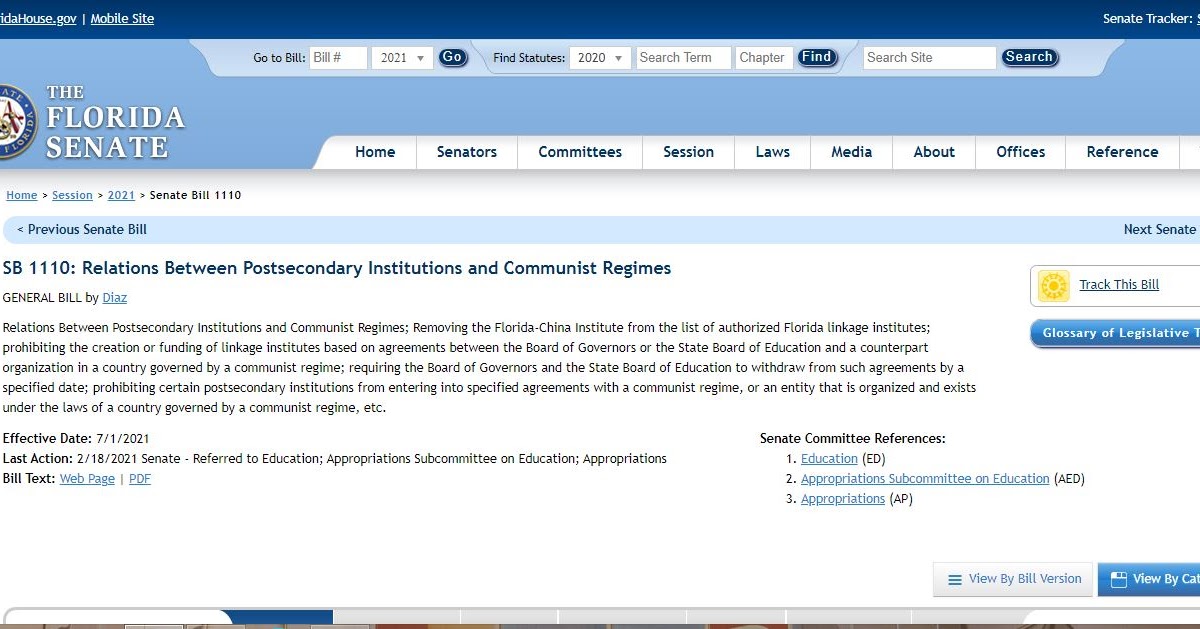
  • IHEC Blog a project by David Comp: The Florida Senate

    IHEC Blog a project by David Comp: The Florida Senate

    Since February 2007, International Higher Education Consulting Blog has provided timely news and informational pieces, predominately from a U.S. perspective, that are of interest to both the international education and public diplomacy communities. From time to time, International Higher Education Consulting Blog will post thought provoking pieces to challenge readers and to encourage comment and professional dialogue.

    Source link

  • IHEC Blog a project by David Comp: Gateway Leadership Institute

    IHEC Blog a project by David Comp: Gateway Leadership Institute

    The Spring 2021 Gateway Leadership Institute will appeal to those international education professionals and related higher education experts who are interested in developing new knowledge and skills needed to shape the next generation of international higher education. Through a combination of webinars, workshops, and coaching, the Institute engages participants in an exploration of new directions in educational technology. Working in small teams, participants will be assigned to a specific EdTech company and will work on a realistic challenge over the course of the Institute. The Institute facilitators are Drs. Rosa Almoguera and George F. Kacenga. 

    Participation is now only US$125. Apply by Saturday, February 20th. Learn more and apply here.

    Note: I’m an affiliate of the Gateway International Group but receive no compensation for this post. For the first Gateway Leadership Institute I served as a volunteer mentor. I’m posting to support this Gateway International Group endeavor.

    Source link

  • The Best Outcome of my Study Abroad Experience!

    The Best Outcome of my Study Abroad Experience!

    30 years ago today my wife and I started our relationship with a late night/early morning kiss on a street corner in Valladolid, Spain after going out to the clubs! We were on the same study abroad program and our relationship is the best outcome of our study abroad experience! 

    Here we are on top of the Alcázar de Segovia

    Source link

  • Contacting Currently Enrolled Students Who Have Not Registered for the Upcoming Semester

    Contacting Currently Enrolled Students Who Have Not Registered for the Upcoming Semester

    At this time of the semester, many people are wondering if students who attended last semester will attend this semester. Yes, I have been there before! 

    So, I decided to create email and text campaigns to help remind/nudge students to register for the upcoming semester. This EVEN works during the first week of class as well. Think about the students who left the semester with an “A” or “B” grade point average and never enrolled in the subsequent semester – you need to reach them!

    Purpose of the Campaign: Contacting Currently Enrolled Students Who Have Not Registered for the Upcoming Semester

    Problem: Many college students need several reminders to register for the next semester.

    Time of Year: October/November & March/April

    Timeframe of the Campaign: Four Weeks

    Target Group: Students

    Step 1 – During the first week of the campaign, send a text message to the students who are enrolled this semester, but who are not enrolled for the subsequent semester. 

    Sample Text Message – Are you planning to come back for the spring? Reply Y (Yes), M (Maybe), H (Holds), or S (Need to Schedule. Appt).

    Step 2 – During the second week of the campaign, remove the students who have already registered. Then, send another text message to the students who are enrolled this semester, but who are not enrolled for the subsequent semester. 

    Sample Text Message – Classes are filling up fast! Are you returning to [Name of University] for the Fall? Text – Y (Yes), M (Maybe), N (No), ? (Questions), H (Holds). – [Name of Administrator that Many Students Know.

    Step 3 – During the third week of the campaign, have the faculty and academic advisors call the students in their department or college who have not registered.

    Step 4 – During the fourth week of the campaign, have the faculty contact the students who have not re-enrolled in the subsequent semester. 

    Step 5 – Assessment – Examine the number of students who were not registered before the campaign, then measure the students who registered each week until the end of the fourth week. pre-campaign 

    Additional Comments: When the students reply, you can begin tagging the students on Microsoft Excel or through the Student Success Technology with the following tags.

    Y – Tag – Will Register in [Next Semester – Semester and Year]

    M – Tag – May Enroll in  [Next Semester – Semester and Year]

    N – Tag – Not Returning in [Next Semester – Semester and Year]

    If you have any questions about this campaign, please contact me – [Your Name]or [email address].

    Remember to order copies for your team as well!

    Thanks for visiting! 


    Sincerely,


    Dr. Jennifer T. Edwards
    Higher Education Speaker and Researcher


    My Social Media Channels!
    Remember to Follow Me on Twitter! @drjtedwards
    I Always Post Higher Education Videos on YouTube
    Find Me on Instagram
    Engage with Me on Facebook!
    Watch My Videos on Twitter Live – http://www.periscope.com/drjtedwards/
    Email Me! I am PR Friendly! – [email protected]
    My Research Interests: Customer Service and Social Media, Higher Education Retention, and Millennials at Work


    Source link