This prepared statement was delivered before the U.S. Senate Committee on Commerce, Science, and Transportation on Oct. 29, 2025.
Chairman Cruz, Ranking Member Cantwell, and honorable members of the Committee,
Good morning, and thank you for the opportunity to testify today. My name is Will Creeley, and I am the legal director of FIRE — the Foundation for Individual Rights and Expression, a nonpartisan nonprofit dedicated to defending the rights of all Americans to free speech and free thought, the essential qualities of liberty.
I’ve spent nearly 20 years defending the First Amendment rights of speakers from every point on the ideological spectrum. At FIRE, we have one rule: If speech is protected, we’ll defend it.
Typically, the censorship we fight is straightforward: The government punishes a speaker for saying things the government doesn’t like. That’s a classic First Amendment violation, a fastball down the middle. Unfortunately, that kind of textbook censorship isn’t the only way government actors silence disfavored or dissenting speech.
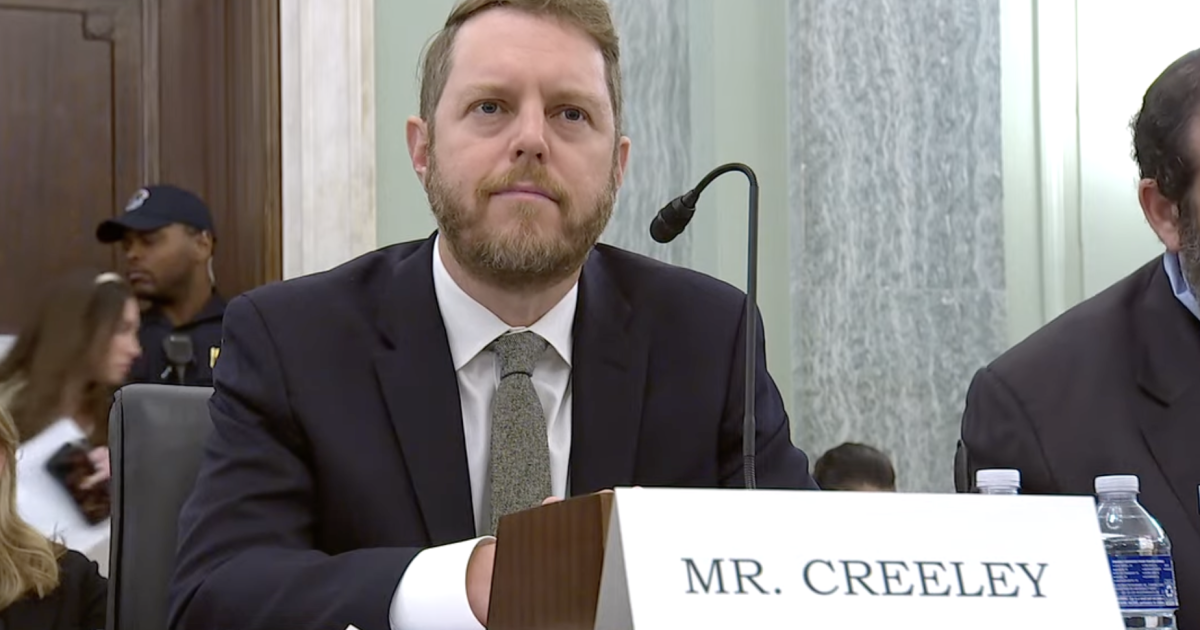
FIRE Legal Director Will Creeley testifies before the Senate Commerce Committee on Oct. 29, 2025.
Far too often, government officials from both sides of the partisan divide engage in “jawboning” — that is, they abuse the actual or perceived power of their office to threaten, bully, or coerce others into censoring speech. This indirect censorship violates the First Amendment just as surely as direct suppression.
What is jawboning? And does it violate the First Amendment?
Indirect government censorship is still government censorship — and it must be stopped.
This isn’t new law. The First Amendment’s prohibition against coerced censorship dates back decades, to the Supreme Court’s 1963 ruling in Bantam Books v. Sullivan. In that case, the Court confronted a Rhode Island state commission that sent threatening letters, “phrased virtually as orders,” to booksellers distributing “objectionable” titles — with follow-up visits from police, to ensure the message had been received.
The Court held the commission’s “operation was in fact a scheme of state censorship effectuated by extra-legal sanctions; they acted as an agency not to advise but to suppress.” And in the decades since, courts have consistently heeded Bantam Books’ call to “look through forms to the substance” of censorship, and to remain vigilant against both formal and informal schemes to silence speech.
But government officials regularly abuse their power to silence others, so the lesson of Bantam Books bears repeating. And in deciding National Rifle Association of America v. Vullo last year, the Supreme Court unanimously and emphatically reaffirmed it.
In Vullo, New York State officials punished the NRA for its views on gun rights by threatening regulatory enforcement against insurance companies that did business with the group and offering leniency to those who stopped. New York’s backdoor censorship was successful — and unlawful.
This regulatory carrot-and-stick approach was designed to chill speech, and the Court reiterated that “a government official cannot do indirectly what she is barred from doing directly: A government official cannot coerce a private party to punish or suppress disfavored speech on her behalf.”
A government official cannot do indirectly what she is barred from doing directly.
To be sure, the government may speak for itself, and the public has an interest in hearing from it. But it may not wield that power to censor. As Judge Richard Posner put it: The government is “entitled to what it wants to say — but only within limits.” Under no circumstances may our public servants “employ threats to squelch the free speech of private citizens.”
So the law is clear: Government actors cannot silence a speaker by threatening “we can do this the easy way or we can do this the hard way,” as the chairman of the Federal Communications Commission did last month. Nevertheless, recent examples of jawboning abound: against private broadcasters, private universities, private social media platforms, and more. The First Amendment does not abide mob tactics.
Despite the clarity of the law, fighting back against jawboning is difficult. Targeted speakers can’t sue federal officials for monetary damages for First Amendment violations, removing a powerful deterrent. And as a practical matter, informal censorship is often invisible to those silenced.
That’s particularly true in the context of social media platforms, as demonstrated by another recent Supreme Court case, Murthy v. Missouri.
Jawboning betrays our national commitment to freedom of expression.
Murthy involved coercive demands by Biden administration officials to social media platforms about posts related to Covid-19, vaccines, elections, and other subjects, resulting in the suppression of speech the administration opposed. But the Court held the plaintiffs lacked standing to sue, because the causal link between their deleted posts and the administration’s pressure wasn’t sufficiently clear.
Murthy illustrates a severe information disparity: Users whose speech is suppressed have no way to know if government actors put their thumb on the scale. Only the government and the platforms have that knowledge, and usually neither want to share it.
That’s why FIRE authored model legislation that would require the government to disclose communications between federal agencies and social media companies regarding content published on its platform, with limited exceptions. But transparency is not enough. Federal officials must be meaningfully deterred from jawboning, and held accountable when they do.
Jawboning betrays our national commitment to freedom of expression. Congress should take action to stop it.
Thank you for your time. I welcome your questions.
This prepared statement was delivered before the U.S. Senate Committee on Commerce, Science, and Transportation on Oct. 29, 2025.
Chairman Cruz, Ranking Member Cantwell, and honorable members of the Committee,
Good morning, and thank you for the opportunity to testify today. My name is Will Creeley, and I am the legal director of FIRE — the Foundation for Individual Rights and Expression, a nonpartisan nonprofit dedicated to defending the rights of all Americans to free speech and free thought, the essential qualities of liberty.
I’ve spent nearly 20 years defending the First Amendment rights of speakers from every point on the ideological spectrum. At FIRE, we have one rule: If speech is protected, we’ll defend it.
Typically, the censorship we fight is straightforward: The government punishes a speaker for saying things the government doesn’t like. That’s a classic First Amendment violation, a fastball down the middle. Unfortunately, that kind of textbook censorship isn’t the only way government actors silence disfavored or dissenting speech.
Far too often, government officials from both sides of the partisan divide engage in “jawboning” — that is, they abuse the actual or perceived power of their office to threaten, bully, or coerce others into censoring speech. This indirect censorship violates the First Amendment just as surely as direct suppression.
What is jawboning? And does it violate the First Amendment?
Indirect government censorship is still government censorship — and it must be stopped.
This isn’t new law. The First Amendment’s prohibition against coerced censorship dates back decades, to the Supreme Court’s 1963 ruling in Bantam Books v. Sullivan. In that case, the Court confronted a Rhode Island state commission that sent threatening letters, “phrased virtually as orders,” to booksellers distributing “objectionable” titles — with follow-up visits from police, to ensure the message had been received.
The Court held the commission’s “operation was in fact a scheme of state censorship effectuated by extra-legal sanctions; they acted as an agency not to advise but to suppress.” And in the decades since, courts have consistently heeded Bantam Books’ call to “look through forms to the substance” of censorship, and to remain vigilant against both formal and informal schemes to silence speech.
But government officials regularly abuse their power to silence others, so the lesson of Bantam Books bears repeating. And in deciding National Rifle Association of America v. Vullo last year, the Supreme Court unanimously and emphatically reaffirmed it.
In Vullo, New York State officials punished the NRA for its views on gun rights by threatening regulatory enforcement against insurance companies that did business with the group and offering leniency to those who stopped. New York’s backdoor censorship was successful — and unlawful.
This regulatory carrot-and-stick approach was designed to chill speech, and the Court reiterated that “a government official cannot do indirectly what she is barred from doing directly: A government official cannot coerce a private party to punish or suppress disfavored speech on her behalf.”
A government official cannot do indirectly what she is barred from doing directly.
To be sure, the government may speak for itself, and the public has an interest in hearing from it. But it may not wield that power to censor. As Judge Richard Posner put it: The government is “entitled to what it wants to say — but only within limits.” Under no circumstances may our public servants “employ threats to squelch the free speech of private citizens.”
So the law is clear: Government actors cannot silence a speaker by threatening “we can do this the easy way or we can do this the hard way,” as the chairman of the Federal Communications Commission did last month. Nevertheless, recent examples of jawboning abound: against private broadcasters, private universities, private social media platforms, and more. The First Amendment does not abide mob tactics.
Despite the clarity of the law, fighting back against jawboning is difficult. Targeted speakers can’t sue federal officials for monetary damages for First Amendment violations, removing a powerful deterrent. And as a practical matter, informal censorship is often invisible to those silenced.
That’s particularly true in the context of social media platforms, as demonstrated by another recent Supreme Court case, Murthy v. Missouri.
Jawboning betrays our national commitment to freedom of expression.
Murthy involved coercive demands by Biden administration officials to social media platforms about posts related to Covid-19, vaccines, elections, and other subjects, resulting in the suppression of speech the administration opposed. But the Court held the plaintiffs lacked standing to sue, because the causal link between their deleted posts and the administration’s pressure wasn’t sufficiently clear.
Murthy illustrates a severe information disparity: Users whose speech is suppressed have no way to know if government actors put their thumb on the scale. Only the government and the platforms have that knowledge, and usually neither want to share it.
That’s why FIRE authored model legislation that would require the government to disclose communications between federal agencies and social media companies regarding content published on its platform, with limited exceptions. But transparency is not enough. Federal officials must be meaningfully deterred from jawboning, and held accountable when they do.
Jawboning betrays our national commitment to freedom of expression. Congress should take action to stop it.
Thank you for your time. I welcome your questions.
But then the same thing could be happening now to the heads of news organizations who then subsequently pull back their journalists from various news beats. Since those news organizations are the ones who report news, would we ever know that was happening?
The reality is that artificial intelligence could kill journalism without replacing it, leaving people without information they can rely on. When there are no reliable, credible sources of news, rumors spread and take on a life of their own. People panic and riot and revolt based on fears born from misinformation. Lawlessness prevails.
Do algorithms have all the answers?
Right now, entire news organizations are disappearing. The Brookings report found that last year some 2.5 local news outlets folded every week in the United States. Data collected by researcher Amy Watson in August 2023 found that in the UK, each year over a 10-year period ending 2022, more news outlets closed than were launched.
CNN reported in June 2023 that Germany’s biggest news organization, Bild, was laying off 20% of its employees, replacing them with artificial intelligence.
But ChatGPT had this to say: “ Rather than viewing AI as a threat, journalists can leverage technology to enhance their work. Automated tools can assist with tasks such as data analysis, fact-checking and content distribution, freeing up time for reporters to focus on more complex and impactful storytelling.”
One of News Decoder’s many human correspondents, Tom Heneghan, spoke to students on this topic in November and expressed some optimism.
“It will take away a lot of the drudge work, the donkey work that journalists have to do,” Heneghan said. “It’s amazing how much work is done by somebody at a much higher level than what is actually needed.”
Working with artificial intelligence
Once those tasks are automated, the journalist can pursue more substantive stories, Heneghan said. Plus the evolving sophistication of things like deep fake technology will make tasks like fact-checking and verification more important. “
That’s going to come up more and more,” Heneghan said. “What artificial intelligence takes away may actually create some other jobs.”
So here’s the thing: We wouldn’t have to fear AI eliminating the crucial role of journalism — informing the public with accurate information, reporting from multiple perspectives so that minority voices are heard and uncovering corruption, exploitation and oppression — if the businesses that controlled the purse strings of journalism were committed to its public service functions.
I then asked ChatGPT this question: Are media corporations driven solely by money?
It concluded: “While financial considerations undoubtedly influence the actions of media corporations, they are not the sole driving force behind their decisions.” It went on: “A complex interplay of financial goals, societal responsibilities and individual values shapes the behavior of these entities.
Understanding this multifaceted nature is essential for accurately assessing the role and impact of media corporations in modern society.” I found that reassuring, until I glanced at the disclaimer at the bottom of the AI’s page:
ChatGPT can make mistakes. Consider checking important information.
Questions to consider:
1. What is an essential role of journalism in society?
2. What did both the ChatGPT app and the human correspondent seem to agree on in this article?
3. What, if anything, worries you about artifiical intelligence and how you get your information?
In today’s fiercely competitive higher education landscape, enrollment leaders are being asked to do more with less. That means more inquiries, more conversions, and more starts, all while working with fewer resources and a shrinking pool of students actively seeking traditional degree paths.
What separates the institutions that are growing from those that are treading water? In my experience, it’s the willingness to question the status quo. The leaders seeing results are the ones taking a hard look at internal processes and policies and making bold decisions to remove what’s in the way of progress.
The urgency to remove enrollment barriers
Many institutions face enrollment plateaus not because they lack student interest, but because of self-imposed friction. Burdensome application requirements, slow review cycles, and legacy processes that haven’t evolved with changing student expectations can all stand in the way of progress.
Students today expect seamless, responsive experiences. They compare your enrollment process not only to peer institutions but also to the intuitive digital experiences they encounter every day. If your application process is full of red tape or requires too many steps, students will disengage and likely move on to a more accessible option.
Colleges and universities that want to stay competitive need to start clearing the path. By taking the time to understand how your enrollment process actually operates and identifying where students tend to get stuck, you can make meaningful changes that increase both efficiency and enrollment success.
Start with a map: Uncovering friction through process review
The first step to solving an enrollment slowdown is understanding where it’s happening. That’s where process mapping comes in.
At Collegis, we partner with institutions to conduct comprehensive process assessments. We document and analyze every step of the applicant journey, from inquiry through registration, to uncover inconsistencies, delays, and points of friction that may be limiting your enrollment funnel. We often find that a student’s experience varies widely depending on who they interact with or when they enter the process, revealing a need for greater consistency and coordination.
In many cases, we find students getting stuck at multiple points across the enrollment journey, starting with the application itself. Lengthy or confusing questions, lack of helpful guidance, and irrelevant fields can all create unnecessary complexity early on. Students may also encounter inconsistent or impersonal communication, making it unclear what to expect next or where they stand in the process.
Further down the funnel, delays often occur during application review, sometimes taking a week or more due to internal handoffs or manual processes. In some cases, applications sit idle because there’s no system in place to move files forward or flag them for outreach. These gaps add up, slowing momentum and causing potential students to disengage.
When you can see the entire process visualized, it becomes easier to ask the right questions:
Is the application process intuitive and easy to navigate, or are we introducing unnecessary complexity?
Are there clear next steps and calls to action for students at each stage?
Do students receive consistent, timely communication that reflects where they are in the journey?
Is the messaging and cadence of our marketing and operational emails aligned with what students hear from admissions counselors?
Are there opportunities to streamline handoffs, automate manual steps, or standardize the process to ensure every student receives a cohesive experience?
Process mapping isn’t just a troubleshooting exercise. It’s a strategic investment in institutional agility and student-centered design. Institutions that complete this type of review often uncover both quick wins and opportunities for deeper transformation.
Ready for a Smarter Way Forward?
Higher ed is hard — but you don’t have to figure it out alone. We can help you transform challenges into opportunities.
Rethink the rules: Policies that reduce friction and drive results
Some of the most impactful improvements we’ve seen don’t require major investments or cutting-edge technologies. More often, they come from rethinking the policies that shape your admissions process and how those policies either support or hinder the student experience.
When we conduct policy reviews with our partner institutions, we often find that some admissions requirements add more complexity than value. It’s crucial to determine whether each requirement is truly essential to making an informed admissions decision. By removing or refining requirements that no longer serve a clear purpose (such as excessive documentation or overly rigid review criteria) institutions can streamline internal workflows and reduce avoidable delays. These targeted adjustments not only improve operational efficiency but also create a more accessible and student-centered experience.
Impact in action: Practical examples of enrollment transformation
These are not just hypothetical improvements. We’ve worked directly with institutions to implement these strategies and have seen the tangible impact they can deliver. Here are a few real-world examples that show how practical adjustments have translated into measurable results:
Waiving letters of recommendation for applicants who meet a defined GPA threshold. This eliminates a common bottleneck while maintaining admissions rigor.
Simplifying transcript requirements by only requesting documentation that includes a conferred degree and any prerequisite coursework required for program entry. Additional transcripts are collected later if necessary, which speeds up the initial review process.
Automating workflows that trigger application reviews as soon as all checklist items are complete. This ensures students move through the process without unnecessary delays.
Setting up notifications to ensure timely engagement. For example, alerts can be set when a new inquiry or applicant hasn’t received contact from an admissions counselor within 24 hours, or when application reviews are taking longer than expected.
These types of changes create a more efficient, student-centered process that helps institutions convert interest into enrollment more effectively.
Don’t just tweak the process, transform it
If your institution is still relying on outdated processes and rigid policies, now is the time to reevaluate. The enrollment environment is only becoming more competitive. But with the right changes, your institution can become more efficient, more agile, and more appealing to today’s students.
This isn’t about cutting corners or lowering standards. It’s about rethinking how your process serves students. Process mapping helps uncover ways to simplify steps, ensure consistency, and build trust through clear communication and meaningful staff connections. The result is an experience that’s more efficient, more personal, and better aligned with your institution’s goals.
Let’s break the bottleneck together
A process mapping assessment is a powerful starting point. At Collegis, we go beyond identifying issues. We work side by side with our partners to solve them. Our approach is collaborative, our recommendations are practical, and our focus is always on impact.
If your institution is ready to accelerate enrollment growth, strengthen internal operations, and deliver a more consistent and personalized experience for your students, let’s talk.
Innovation Starts Here
Higher ed is evolving — don’t get left behind. Explore how Collegis can help your institution thrive.
Jim Callinan leads enrollment strategy and operational excellence at Collegis Education, where he partners with higher education institutions to design and deploy data-informed admissions and student-journey models. With nearly 20 years of higher education experience, Jim brings deep expertise in aligning cross-functional teams across technology, marketing, analytics, enrollment, and student success to drive growth, streamline operations, and elevate the student and staff experience. His collaborative approach helps institutions align strategy, process, and performance to achieve sustainable success.
Florida governor Ron DeSantis on Wednesday ordered the state’s public universities “to pull the plug on the use of these H-1B visas in our universities.” In doing so, the Republican appeared to call for his state to go further than President Trump in restricting entry of these foreign employees—an issue that has divided prominent conservatives.
Since fiscal year 2022, Florida public universities have employed nearly 2,000 people via the H-1B program—nearly half at the University of Florida. The program is capped at 85,000 new visas a year, but colleges, universities and some other organizations aren’t subject to that cap. In the first three quarters of 2025, nearly 16,800 visas were approved for employees at colleges and universities; 395 of the visas were for jobs at Florida’s public universities. Universities use the program to hire faculty, doctors and researchers and argue it’s required to meet needs in health care, engineering and other areas.
Last month, Trump announced a $100,000 application fee for H-1B visas. U.S. Citizenship and Immigration Services says the fee will apply to new H-1B petitions filed on or after Sept. 21 and must be paid before the petition is filed. It said there could be exceptions from the fee in an “extraordinarily rare circumstance” in which the Homeland Security secretary determines a foreigner’s presence in the U.S. “is in the national interest.”
Lawsuits have been filed over the fee, and higher ed associations and institutions have spoken out in opposition. The Trump administration says employers are abusing the program to avoid hiring Americans.
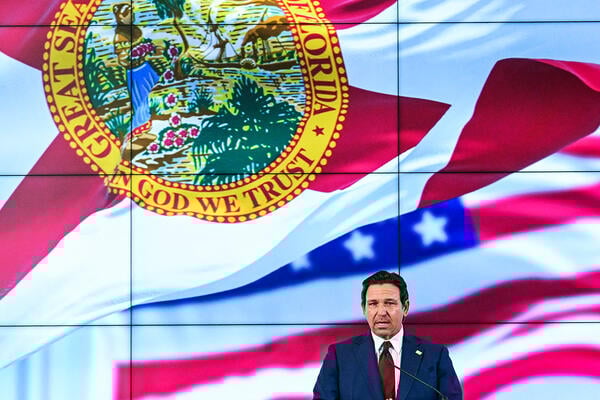
In a speech at the University of South Florida on Wednesday, DeSantis called on the state board governing public universities to “pull the plug” on H-1B visa employees. He didn’t mention any exceptions.
If this the ban happens, it would be another example of a red state going further than the Republican-controlled federal government in restricting public higher ed institutions. In states such as Texas and Ohio, GOP politicians have exceeded Trump in regulating curricula and restricting faculty rights. Before Trump retook office, DeSantis put Florida on the leading edge of the conservative overhaul of higher ed, from cracking down on what he called “woke” education to putting allies in charge of universities—a playbook other states have followed.
It’s unclear, however, whether the Florida Board of Governors, which oversees the state’s public universities but not it’s public colleges, will follow DeSantis’s directive. Fourteen of the board’s 17 members are appointed by the governor and confirmed by the state Senate.
It’s also unclear what his directive specifically means; a news release the governor’s office issued Wednesday didn’t, unlike his speech, go as far as suggesting an end to all H-1B visa employees at public universities.
But neither the State University System of Florida nor the governor’s office provided more details in response to Inside Higher Ed’s questions about DeSantis’s intent. A news release from the governor’s office said DeSantis directed the board to “crack down on H-1B Visa abuse in higher education” but didn’t repeat the governor’s apparent call to end H-1B employment completely.
University of Florida interim president Donald Landry spoke at the press conference after DeSantis and mentioned his institution was called out.
“It’s a complex issue, and we can chat,” Landry said, to laughs from the audience. He did list one benefit, saying H-1Bs are mainly used at UF to hire new faculty from the international student population.
“Occasionally, some bright light might be good enough for the faculty, and then we will try and retain the person into whom we have invested so much,” he said.
UF is conducting its own review of the H-1B program, he added. “We know that H-1B is not handled in a pristine fashion, even in academia,” he said.
Robert Cassanello, president of the United Faculty of Florida union and a tenured associate history professor at the University of Central Florida, suggested that banning H-1B visa holders would be illegal.
“You can’t discriminate against someone based on foreign birth,” Cassanello said. “My big question coming away from this is: Where’s the authority?”
‘Do It’ With Florida Residents
In his speech, DeSantis started his criticism of the H-1B program from a national perspective. He said, “Tech companies will fire Americans and hire H-1B at a discount, and they’re basically indentured servants … They’re indentured to the company, so the company can basically pay them low.”
He then turned to Florida universities, appearing to read from a list of positions occupied by H-1B holders at unnamed institutions. (His office didn’t provide the list Wednesday.)
After mentioning a public policy professor from China, DeSantis said, “Why do we need to bring someone from China to talk about public policy?” Later—apparently looking at information on another H-1B holder—he exclaimed, “Wuhan, China!”
Although DeSantis’s complaints focused on supposed international scholars from China, he didn’t spare those from other countries.
“Assistant swim coach from Spain, on an H-1B visa—are you kidding me, we can’t produce an assistant swim coach in this country?” he said. He then turned to the Middle East.
“Clinical assistant professor from the West Bank, clinical assistant professor from supposed Palestine,” he said. “Is that just social justice that they’re doing? And that’s University of Florida.”
“We need to make sure our citizens here in Florida are first in line for job opportunities,” DeSantis said. But he also suggested he doesn’t fully know why universities are hiring H-1B workers.
“I guess there’s probably reasons why it ends up being this way,” DeSantis said. “But I think it’s a poor reflection on some of the decisions that some of these universities have made that they’re trying to say they need an H-1B visa to do some of these jobs … We can do it with our residents in Florida, or with Americans, and if we can’t do it then—man—we need to really look deeply about what is going on.”
Sarah Spreitzer, vice president and chief of staff for government relations at the American Council on Education, said DeSantis’s move would limit universities’ ability to hire the best researchers.
“It’s going to have an enormous impact, obviously, on Florida institutions,” Spreitzer said.
Cassanello, who said his union includes some H-1B holders, called DeSantis’s speech a “xenophobic and nativist diatribe.”
“He’s a nativist, he’s anti-immigrant and so he’s coming to these decisions based on no facts,” Cassanello said. He also said DeSantis opposed diversity, equity and inclusion programs by arguing they were anti-meritocratic, but now, “all of a sudden, he’s willing to throw out meritocracy.”
“He’s using fear of people of color and fear of immigrants to sort of impose his will on the running of our public colleges and universities,” Cassanello said. He said the speech represents “a further attack from DeSantis and our state political leaders on the autonomy of our public colleges and universities.”
As a high school STEM teacher at Baldwin Preparatory Academy, I often ask myself: How can we make classroom learning more meaningful for our students? In today’s rapidly evolving world, preparing learners for the future isn’t about gathering academic knowledge. It is also about helping all learners explore potential careers and develop the future-ready skills that will support success in the “real world” beyond graduation.
One way to bring those two goals together is by drawing a clear connection between what is learned in the classroom and future careers. In fact, research from the Education Insights Report shows that a whopping 87 percent of high school students believe that career connections make school engaging–and as we all know, deeper student engagement leads to improved academic growth.
I’ve tried a lot of different tactics to get kids engaged in careers over my 9 years of teaching. Here are my current top recommendations:
Internship opportunities As many educators know, hands-on learning is effective for students. The same goes for learning about careers. Internship opportunities give students a way to practice a career by doing the job.
I advise students to contact local businesses about internships during the school year and summer. Looking local is a wonderful way to make connections, learn an industry, and practice career skills–all while gaining professional experience.
Tallo is another good internship resource because it’s a digital network of internships across a range of industries and internship types. With everything managed in Tallo, it’s easy for high school students to find and get real-world work experience relevant to school learning and career goals. For educators, this resource is helpful because it provides pathways for students to gain employable skills and transition into the workforce or higher education.
Career events In-person career events where students get to meet individuals in industries they are interested in are a great way for students to explore future careers. One initiative that stands out is the upcoming Futures Fair by Discovery Education. Futures Fair is a free virtual event on November 5, 2025, to inspire and equip students for career success.
Held over a series of 30-minute virtual sessions, students meet with professionals from various industries sharing an overview of their job, industry, and the path they took to achieve it. Organizations participating in the Futures Fair are 3M, ASME, Clayco, CVS Health, Drug Enforcement Administration, Genentech, Hartford, Honda, Honeywell, Illumina, LIV Golf, Meta, Norton, Nucor, Polar Bears International, Prologis, The Home Depot, Verizon, and Warner Bros. Discovery.
Students will see how the future-ready skills they are learning today are used in a range of careers. These virtual sessions will be accompanied by standards-aligned, hands-on student learning tasks designed to reinforce the skills outlined by industry presenters.
CTE Connections All students at Baldwin Preparatory Academy participate in a career and technical education pathway of their choosing, taking 6-9 career specific credits, and obtaining an industry-recognized credential over the course of their secondary education. As a STEM teacher, I like to connect with my CTE and core subject colleagues to learn about the latest innovations in their space. Then I connect those innovations to my classroom instruction so that all students get the benefit of learning about new career paths.
For example, my industry partners advise me about the trending career clusters that are experiencing significant growth in job demand. These are industries like cybersecurity, energy, and data science. With this insight, I looked for relevant reads or classroom activities related to one of those clusters. Then, I shared the resources back with my CTE and core team so there’s an easy through line for the students.
As educators, our role extends beyond teaching content–we’re shaping futures. Events like Futures Fair and other career readiness programs help students see the relevance of their learning and give them the confidence to pursue their goals. With resources like these, we can help make career readiness meaningful, engaging, and empowering for every student.
Jessica Stanford, RN, Baldwin Preparatory Academy
Jessica Stanford, RN, is a Health Science Instructor at Baldwin Preparatory Academy. Jessica has been a Registered Nurse for 20 years, and a health science instructor in career and technical education since 2017. She is passionate about using secondary education to harness natural curiosity and cultivating that into interest and effort toward an educational pathway that young people can pursue before high school graduation. Jessica believes that students can make great strides in planning, networking, and experiences that will catapult them into a career and lifelong success.
Latest posts by eSchool Media Contributors (see all)
Nearly three dozen higher education organizations are urging U.S. Homeland Security Secretary Kristi Noem to exempt colleges from the new $100,000 fee for H-1B visa petitions, arguing in an Oct. 23 letter that these employees do work “crucial to the U.S. economy.”
President Donald Trump caught the higher education sector by surprise when he announced the large fee last month. Large research universities heavily rely on the H-1B visa program to hire international scholars.
Ted Mitchell, president of the American Council on Education, said in the Thursday letter that colleges’ H-1B workers educate domestic students for “high-demand occupations, conduct essential research, provide critical patient care, and support the core infrastructure of our universities.”
Dive Insight:
Trump shocked the higher ed world sector on Sept. 19 when he declared that new petitions for H-1B visas must come with a $100,000 payment to be processed. Yet colleges were left unsure which of their workers would be impacted amid scant details on the new policy and mixed messages from administration officials. The federal government is facing at least two lawsuits over the fee.
In the days and weeks since the fee was announced, the Trump administration has released additional information about the new policy. Just last week, U.S. Citizenship and Immigration Services released guidance that said the new fee wouldn’t apply to visa holders inside the country who are requesting a change of status or extension of stay — potentially exempting international students who recently graduated and have H1-B sponsorship.
Mitchell’s letter asked Noem to confirm that the new USCIS guidance includes those on F-1 or J-1 visas — both of which cover international students — converting to H-1B status. He also asked if the government would return the $100,000 fee if a petition is denied and how USCIS would process H-1B applications in a timely manner given the new requirements.
The letter points out that the proclamation included language that allows DHS to issue exemptions for workers if government officials deem hiring them is in the nation’s interest and doesn’t pose a security risk.
“The continuing education of our postsecondary students is in the national interest of the United States,” Mitchell wrote.
He cited recent CUPA-HR data showing that 7 in 10 faculty on H-1B visas in the U.S. are in tenured or tenure-track positions, with the largest shares in business, engineering and health disciplines.
Mitchell contended that exempting colleges from the new fee would be similar to the higher education sector’s current exemption from the cap on H-1B visas, which are awarded via a lottery process. The cap limits annual H-1B visa awards to 65,000 workers, with an additional 20,000 for international students who finished U.S. graduate programs.
Congress exempted higher education from the cap in recognition “of the special role that institutions of higher education play in hiring H-1Bs on our campuses,” Mitchell wrote.
ACE also took issue with a recent proposal that would change how the lottery system works. Under the new proposal from USCIS, visas for higher-wage applicants would be given more priority.
Mitchell urged USCIS to withdraw the rule in a public comment submitted Friday on behalf of ACE and 19 other higher education groups. He argued the change would harm international enrollment, as foreign students entering the workforce after completing their degrees at U.S. institutions would have much lower access to the H-1B visa program.
“A central reason for the excellence of our postsecondary institutions is their ability to attract and enroll talented, motivated, and curious students, whether born in this country or abroad,” Mitchell wrote. “This proposed rule will limit the ability of our institutions to recruit and retain these students, especially those that wish to remain in the United States.”
A growing share of colleges and universities are embedding artificial intelligence tools and AI literacy into the curriculum with the intent of aiding student success. A 2025 Inside Higher Ed survey of college provosts found that nearly 30 percent of respondents have reviewed curriculum to ensure that it will prepare students for AI in the workplace, and an additional 63 percent say they have plans to review curriculum for this purpose.
In the latest episode of Voices of Student Success, host Ashley Mowreader speaks with Shlomo Argamon, associate provost for artificial intelligence at Touro, to discuss the university policy for AI in the classroom, the need for faculty and staff development around AI, and the risks of gamification of education.
An edited version of the podcast appears below.
Q: How are you all at Touro thinking about AI? Where is AI integrated into your campus?
Shlomo Argamon, associate provost for artificial intelligence at Touro University
A: When we talk about the campus of Touro, we actually have 18 or 19 different campuses around the country and a couple even internationally. So we’re a very large and very diverse organization, which does affect how we think about AI and how we think about issues of the governance and development of our programs.
That said, we think about AI primarily as a new kind of interactive technology, which is best seen as assistive to human endeavors. We want to teach our students both how to use AI effectively in what they do, how to understand and properly mitigate and deal with the risks of using AI improperly, but above all, to always think about AI in a human context.
When we think about integrating AI for projects, initiatives, organizations, what have you, we need to first think about the human processes that are going to be supported by AI and then how AI can best support those processes while mitigating the inevitable risks. That’s really our guiding philosophy, and that’s true in all the ways we’re teaching students about AI, whether we’re teaching students specifically, deeply technical [subjects], preparing them for AI-centric careers or preparing them to use AI in whatever other careers they may pursue.
Q: When it comes to teaching about AI, what is the commitment you all make to students? Is it something you see as a competency that all students need to gain or something that is decided by the faculty?
A: We are implementing a combination—a top-down and a bottom-up approach.
One thing that is very clear is that every discipline, and in fact, every course and faculty member, will have different needs and different constraints, as well as competencies around AI that are relevant to that particular field, to that particular topic. We also believe there’s nobody that knows the right way to teach about AI, or to implement AI, or to develop AI competencies in your students.
We need to encourage and incentivize all our faculty to be as creative as possible in thinking about the right ways to teach their students about AI, how to use it, how not to use it, etc.
So No. 1 is, we’re encouraging all of our faculty at all levels to be thinking and developing their own ideas about how to do this. That said, we also believe very firmly that all students, all of our graduates, need to have certain fundamental competencies in the area of AI. And the way that we’re doing this is by integrating AI throughout our general education curriculum for undergraduates.
Ultimately, we believe that most, if not all, of our general education courses will include some sort of module about AI, teaching students specifically about the AI-relevant competencies that are relevant to those particular topics that they’re learning, whether it’s writing, reading skills, presentations, math, science, history, the different kinds of cognition and skills that you learn in different fields. What are the AI competencies that are relevant to that, and to have them learning that.
So No. 1, they’re learning it not all at once. And also, very importantly, it’s not isolated from the topics, from the disciplines that they’re learning, but it’s integrated within them so that they see it as … part of writing is knowing how to use AI in writing and also knowing how not to. Part of learning history is knowing how to use AI for historical research and reasoning and knowing how not to use it, etc. So we’re integrating that within our general education curriculum.
Beyond that, we also have specific courses in various AI skills, both at the undergraduate [and] at the graduate level, many of which are designed for nontechnical students to help them learn the skills that they need.
Q: Because Touro is such a large university and it’s got graduate programs, online programs, undergraduate programs, I was really surprised that there is an institutional AI policy.
A lot of colleges and universities have really grappled with, how do we institutionalize our approach to AI? And some leaders have kind of opted out of the conversation and said, “We’re going to leave it to the faculty.” I wonder if we could talk about the AI policy development and what role you played in that process, and how that’s the overarching, guiding vision when it comes to thinking about students using and engaging with AI?
A: That’s a question that we have struggled with, as all academic leaders, as you mentioned, struggle with this very question.
Our approach is to create policy at the institutional level that provides only the necessary guardrails and guidance that then enables each of our schools, departments and individual faculty members to implement the correct solutions for them in their particular areas, within this guidance and these guardrails so that it’s done safely and so that we know that it’s going, over all, in a positive and also institutionally consistent direction to some extent.
In addition, one of the main functions of my office is to provide support to the schools, departments and especially the faculty members to make this transition and to develop what they need.
It’s an enormous burden on faculty members to shift, not just to add AI content to their classes, if they do so, but to shift the way that we teach, the way that we do assessments. The way that we relate to our students, even, has to shift, to change, and it creates a burden on them.
It’s a process to develop resources, to develop ways of doing this. I and the people that work in our office, we have regular office hours to talk to faculty, to work with them. One of the most important things that we do, and we spend a lot of time and effort on this, is training for our faculty, for our staff on AI, on using AI, on teaching about AI, on the risks of AI, on mitigating those risks, how to think about AI—all of these things. It all comes down to making sure that our faculty and staff, they are the university, and they’re the ones who are going to make all of this a success, and it’s up to us to give them the tools that they need to make this a success.
I would say that while in many questions, there are no right or wrong answers, there are different perspectives and different opinions. I think that there is one right answer to “What does a university need to do institutionally to ensure success at dealing with the challenge of AI?” It’s to support and train the faculty and staff, who are the ones who are going to make whatever the university does a success or a failure.
Q: Speaking of faculty, there was a university faculty innovation grant program that sponsored faculty to take on projects using AI in the classroom. Can you talk a little bit about that and how that’s been working on campus?
A: We have an external donor who donated funds so that we were able to award nearly 100 faculty innovation challenge grants for developing methods of integrating AI into teaching.
Faculty members applied and did development work over the summer, and they’re now implementing in their fall courses right now. We’re right now going through the initial set of faculty reports on their projects, and we have projects from all over the university in all different disciplines and many different approaches to looking at how to use AI.
At the beginning of next spring, we’re going to have a conference workshop to bring everybody together so we can share all of the different ways that people try to do this. Some experiments, I’m sure, will not have worked, but that’s also incredibly important information, because what we’re seeking to do [is], we’re seeking to help our students, but we’re also seeking to learn what works, what doesn’t work and how to move forward.
Again, this goes back to our philosophy that we want to unleash the expertise, intelligence, creativity of our faculty—not top down to say, “We have an AI initiatives. This is what you need to be doing”—but, instead, “Here’s something new. We’ll give you the tools, we’ll give you the support. We’ll give you the funding to make something happen, make interesting things happen, make good things for your students happen, and then let’s talk about it and see how it worked, and keep learning and keep growing.”
Q: I was looking at the list of faculty innovation grants, and I saw that there were a few other simulations. There was one for educators helping with classroom simulations. There was one with patient interactions for medical training. It seems like there’s a lot of different AI simulations happening in different courses. I wonder if we can talk about the use of AI for experiential learning and why that’s such a benefit to students.
A: Ever since there’s been education, there’s been this kind of distinction between book learning and real-world learning, experiential learning and so forth. There have always been those who have questioned the value of a college education because you’re just learning what’s in the books and you don’t really know how things really work, and that criticism has some validity.
But what we’re trying to do and what AI allows us to do [is], it allows us and our students to have more and more varied experiences of the kinds of things they’re trying to learn and to practice what they’re doing, and then to get feedback on a much broader level than we could do before. Certainly, whenever you had a course in say, public speaking, students would get up, do some public speaking, get feedback and proceed. Now with AI, students can practice in their dorm rooms over and over and over again and get direct feedback; that feedback and those experiences can be made available then to the faculty member, who can then give the students more direct and more human or concentrated or expert feedback on their performance based on this, and it just scales.
In the medical field, this is where it’s hugely, hugely important. There’s a long-standing institution in medical education called the standardized patient. Traditionally it’s a human actor who learns to act as a patient, and they’re given the profile of what disorders they’re supposed to have and how they’re supposed to act, and then students can practice, whether they’re diagnostic skills, whether they’re questions of student care and bedside manner, and then get expert feedback.
We now have, to a large extent, AI systems that can do this, whether it’s interactive in a text-based simulation, voice-based simulation. We also have robotic mannequins that the students can work with that are AI-powered with AI doing conversation. Then they can be doing physical exams on the mannequins that are simulating different kinds of conditions, and again, this gives the possibility of really just scaling up this kind of experiential learning. Another kind of AI that has been found useful in a number of our programs, particularly in our business program, are AI systems that watch people give presentations and can give you real-time feedback, and that works quite well.
Q: These are interesting initiatives, because it cuts out the middleman of needing a third party or maybe a peer to help the student practice the experience. But in some ways, does it gamify it too much? Is it too much like video games for students? How have you found that these are realistic enough to prepare students?
A: That is indeed a risk, and one that we need to watch. As in nearly everything that we’re doing, there are risks that need to be managed and cannot be solved. We need to be constantly alert and watching for these risks and ensuring that we don’t overstep one boundary or another.
When you talk about the gamification, or the video game nature of this, the artificial nature of it, there are really two pieces to it. One piece is the fact that there is no mannequin that exists, at least today, that can really simulate what it’s like to examine a human being and how the human being might react.
AI chatbots, as good as they are, will not now and in the near, foreseeable future, at least, be able to simulate human interactions quite accurately. So there’s always going to be a gap. What we need to do, as with other kinds of education, you read a book, the book is not going to be perfect. Your understanding of the book is not going to be perfect. There has to be an iterative process of learning. We have to have more realistic simulations, different kinds of simulations, so the students can, in a sense, mentally triangulate their different experiences to learn to do things better. That’s one piece of it.
The other piece, when you say gamification, there’s the risk that it turns into “I’m trying to do something to stimulate getting the reward or the response here or there.” And there’s a small but, I think, growing research literature on gamification of education, where if you gamify a little bit too much, it becomes more like a slot machine, and you’re learning to maneuver the machine to give you the dopamine hits or whatever, rather than really learning the content of what you’re doing. The only solution to that is for us to always be aware of what we’re doing and how it’s affecting our students and to adjust what we’re doing to avoid this risk.
This goes back to one of the key points: Our whole philosophy of this is to always look at the technology and the tools, whether AI or anything else, as embedded within a larger human context. The key here is understanding when we implement some educational experience for students, whether it involves AI or technology or not, it’s always creating incentives for the students to behave in a certain way. What are those incentives, and are those incentives aligned with the educational objectives that we have for the students? That’s the question that we always need to be asking ourselves and also observing, because with AI, we don’t entirely know what those incentives are until we see what happens. So we’re constantly learning and trying to figure this out as we go.
If I could just comment on that peer-to-peer simulation: Medical students poking each other or social work students interviewing each other for a social work kind of exam has another important learning component, because the student that is being operated upon is learning what it’s like to be in the other shoes, what it’s like to be the patient, what it’s like to be the object of investigation by the professional. And empathy is an incredibly important thing, and understanding what it’s like for them helps the students to learn, if done properly, to do it better and to have the appropriate sort of relationship with their patients.
Q: You also mentioned these simulations give the faculty insight into how the student is performing. I wonder if we can talk about that; how is that real-time feedback helpful, not only for the student but for the professor?
A: Now, one thing that needs to be said is that it’s very difficult, often, to understand where all of your students are in the learning process, what specifically they need. We can be deluged by data, if we so choose, that may confuse more than enlighten.
That said, the data that come out of these systems can definitely be quite useful. One example is there are some writing assistance programs, Grammarly and their ilk, that can provide the exact provenance of writing assignments to the faculty, so it can show the faculty exactly how something was composed. Which parts did they write first? Which parts did they write second? Maybe they outlined it, then they revised this and they changed this, and then they cut and pasted it from somewhere else and then edited.
All of those kinds of things that gives the faculty member much more detailed information about the student’s process, which can enable the faculty to give the students much more precise and useful feedback on their own learning. What do they perhaps need to be doing differently? What are they doing well? And so forth. Because then you’re not just looking at a final paper or even at a couple of drafts and trying to infer what the student was doing so that you can give them feedback, but you can actually see that more or less in real time.
That’s the sort of thing where the data can be very useful. And again, I apologize if I sound like a broken record. It all goes back to the human aspect of this, and to use data that helps the faculty member to see the individual student with their own individual ways of thinking, ways of behaving, ways of incorporating knowledge, to be able to relate to them more as an individual.
Briefly and parenthetically, one of the great hopes that we have for integrating AI into the educational process is that AI can help to take away many of the bureaucratic and other burdens that faculty are burdened with, and free them and enable them in different ways to enhance their human relationship with their students, so that we can get back to the core of education. Which really, I believe, is the transfer of knowledge and understanding through a human relationship between teacher and student.
It’s not what might be termed the “jug metaphor” for education, where I, the faculty member, have a jug full of knowledge, and I’m going to pour it into your brain, but rather, I’m going to develop a relationship with you, and through this relationship, you are going to be transformed, in some sense.
Q: This could be a whole other podcast topic, but I want to touch on this briefly. There is a risk sometimes when students are using AI-powered tools and faculty are using AI-powered tools that it is the AI engaging with itself and not necessarily the faculty with the students. When you talk about allowing AI to lift administrative burdens or ensure that faculty can connect with students, how can we make sure that it’s not robot to robot but really person to person?
A: That’s a huge and a very important topic, and one which I wish that I had a straightforward and direct and simple answer for. This is one of those risks that has to be mitigated and managed actively and continually.
One of the things that we emphasize in all our trainings for faculty and staff and all our educational modules for students about AI is the importance of the AI assisting you, rather than you assisting the AI. If the AI produces some content for you, it has to be within a process in which you’re not just reviewing it for correctness, but you’re producing the content where it’s helping you to do so in some sense.
That’s a little bit vague, because it plays out differently in different situations, and that’s the case for faculty members who are producing a syllabus or using AI to produce other content for the courses to make sure that it’s content that they are producing with AI. Same thing for the students using AI.
For example, our institutional AI policy having to do with academic honesty and integrity, is, I believe, groundbreaking in the sense that our default policy for courses that don’t have a specific policy regarding the use of AI in that course—by next spring, all courses must have a specific policy—is that AI is allowed to be used by students for a very wide variety of tasks on their assignments.
You can’t use AI to simply do your assignment for you. That is forbidden. The key is the work has to be the work of the student, but AI can be used to assist. Through establishing this as a default policy—which faculty, department chairs, deans have wide latitude to define more or less restrictive policies with specific carve-outs, simply because every field is different and the needs are different—the default and the basic attitude is, AI is a tool. You need to learn to use it well and responsibly, whatever you do.
Q: I wanted to talk about the future of AI at the university. Are there any new initiatives you should tell our listeners about? How are you all thinking about continuing to develop AI as a teaching and learning tool?
A: It’s hard for me to talk about specific initiatives, because what we’re doing is we believe that it’s AI within higher education particularly, but I think in general as well, it’s fundamentally a start-up economy in the sense that nobody, and I mean nobody, knows what to do with it, how to deal with it, how does it work? How does it not work?
Therefore, our attitude is that we want to have it run as many experiments as we can, to try as many different things as we can, different ways of teaching students, different ways of using AI to teach. Whether it’s through simulations, content creation, some sort of AI teaching assistants working with faculty members, whether it’s faculty members coming up with very creative assignments for students that enable them to learn the subject matter more deeply by AI assisting them to do very difficult tasks, perhaps, or tasks that require great creativity, or something like that.
The sky is the limit, and we want all of our faculty to experiment and develop. We’re seeking to create that within the institution. Touro is a wonderful institution for that, because we already have the basic institutional culture for this, to have an entrepreneurial culture within the university. So the university as a whole is an entrepreneurial ecosystem for experimenting and developing ways of teaching about and with and through AI.
The Trump administration reportedly froze nearly $6 billion in grants and contracts, but most of that has since been restored.
Photo illustration by Justin Morrison/Inside Higher Ed | arlutz73 and Wolterk/iStock/Getty Images
Thanks to a series of settlements and court orders, some universities that had their grants frozen by the Trump administration earlier this year have seen that funding restored.
But others are still trying to unfreeze the grants and learn more about why they were suspended in the first place.
Since March, the Trump administration has said that it put nearly $6 billion on hold at nine universities. Three universities—Columbia, Penn and Brown—cut deals with the administration to restore the funding, while the University of California, Los Angeles, and Harvard got the money back via court orders. The fate of the remaining four freezes—at Duke, Cornell, Northwestern and Princeton Universities—remains uncertain.
Princeton has seen about half of its frozen grants restored, President Christopher Eisgruber told the alumni magazine in late August. Roughly $200 million was put on hold initially.
Eisgruber said Princeton never learned why the funds were frozen, beyond media reports that connected it to concerns over antisemitism on campus. A Princeton spokesperson confirmed the magazine’s report but declined to share more details about the status of the remaining grants.
At Northwestern, the Trump administration reportedly froze about $790 million in early April, though officials said at the time they never received formal notification about why the funds were put on hold. Since then, Northwestern officials have said they are working to restore the grants—a process that apparently hasn’t gone smoothly.
Northwestern University interim president Henry Bienen toldThe Daily Northwestern in an Oct. 17 interview that “a negotiation really requires two parties, at least, and at the present time, there’s not been anybody on the other end of the line.”
As the freeze persists, Northwestern has said it will continue to support researchers’ “essential funding needs” at least through the end of the calendar year. Bienen told the student newspaper that supporting the research costs $30 million to $40 million a month.
The university has laid off more than 400 employees and instituted other measures to cut costs, though officials said those moves were driven by more than just the funding freeze.
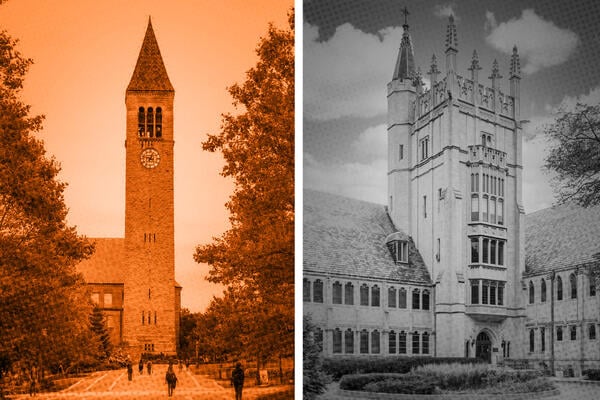
Cornell University is also in talks with the administration to find a solution to the freeze. However, President Michael Kotlikoff recently shared new information about the impact of the freeze that calls into question the Trump administration’s figures.
Trump officials told media outlets in April that they froze more than $1 billion at Cornell. But Kotlikoff said last week in his State of the University address that Cornell is actually facing about $250 million in canceled or unpaid research funds. (The university’s research expenditures totaled $1.6 billion in the 2023–24 academic year.)
Like Northwestern and Princeton, Cornell hasn’t received a formal letter about the freeze, though media reports suggested that the administration froze the grants “because of concerns around antisemitism following pro-Palestinian activities on campus beginning in fall of 2023,” Kotlikoff said.
Following news stories about the freeze, Kotlikoff said the university “started receiving stop-work orders ‘by direction of the White House’: halting research on everything from better tests for tick-borne diseases, to pediatric heart assist pumps, to ultrafast lasers for national defense, to AI optimization for blood transfusion delivery. At the same time, many other research grants, while not officially canceled, stopped being paid.” (About $74 million of the $250 million is in unpaid bills, he said.)
Kotlikoff added that Cornell has been talking with the federal government for six months “to identify their concerns, provide evidence to address them, and return to a productive partnership.” In August, Bloombergreported that the White House wanted to reach a $100 million settlement with Cornell.
But Kotlikoff also criticized the administration for not using established legal processes to investigate potential civil rights violations, echoing a point expertshavemade for months.
“I want to be clear that there are established procedures in place for the government to handle such concerns,” he said in his State of the University address. “Accusations of discrimination should be supported by, and adjudicated on the basis of, facts. This has not happened.”
Kotlikoff, who was appointed president in March, made clear in his address to the Board of Trustees and university alumni that Cornell won’t agree to give up control of admissions or curricular decisions, among other things.
“We will not agree to allow the government to dictate our institution’s policies, or how to enforce them,” he said. “And we will never abandon our commitment to be an institution where any person can find instruction in any study.”
The administration has also said it froze about $108 million at Duke University, but neither Duke nor the National Institutes of Health responded to Inside Higher Ed’s request for an update.