Category: Featured

  • Winners of the 2022 Best Personal Academic Websites Contest

    Winners of the 2022 Best Personal Academic Websites Contest

    We’re excited to recognize the hard work these people have put into their personal academic websites. They are examples to learn from. Explore the winners of the 2022 Best Personal Academic Websites Contest, and discover what prompted each of them to take the leap.

    Update: It’s official. We’ll be back for another contest in early 2025! Jennifer, Brittany, and Ian look forward to your entry next year. View the 2023 award winning websites.

    The Best Personal Academic Websites Contest is brought to you by Jennifer van Alstyne, Brittany Trinh, and Ian Li.

    About the contest
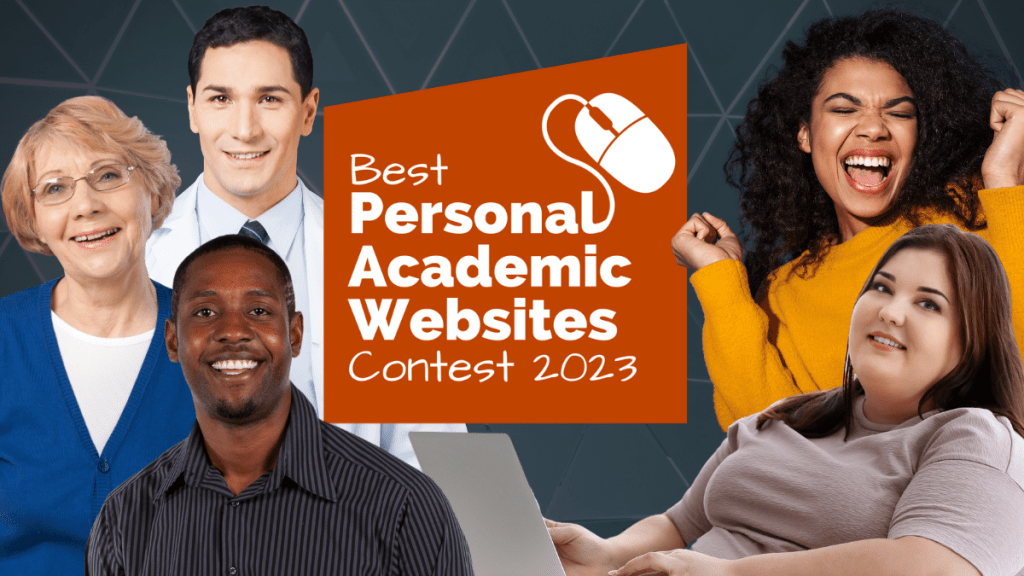
    Best Personal Academic Websites Contest 2022 Graphic with 5 people looking excited to have entered to win. Not awardees.

    The Best Personal Academic Websites Contest was open from October 10 through November 2, 2022. Entries were free. The contest recognizes the best personal websites of

    • Faculty
    • Professors
    • Scientists
    • Postdocs
    • Grad students
    • Independent researchers

    Our goal was to award your hard work. And create a resource that can be shared to inspire academics like you to make their own website. These are great examples of personal websites, with notes from the judges.
    Jump to our free resources to help you make your own website.

    2022 Winners

    2022 Award Categories

    • Overall Best Personal Academic Website (tied, top 3)
    • Best Owlstown (tied, top 2)
    • Best Google Site
    • Best Storytelling
    • Best Portfolio
    • Best Blog
    • Best Academic Entrepreneur

    Overall Best Personal Academic Website Award

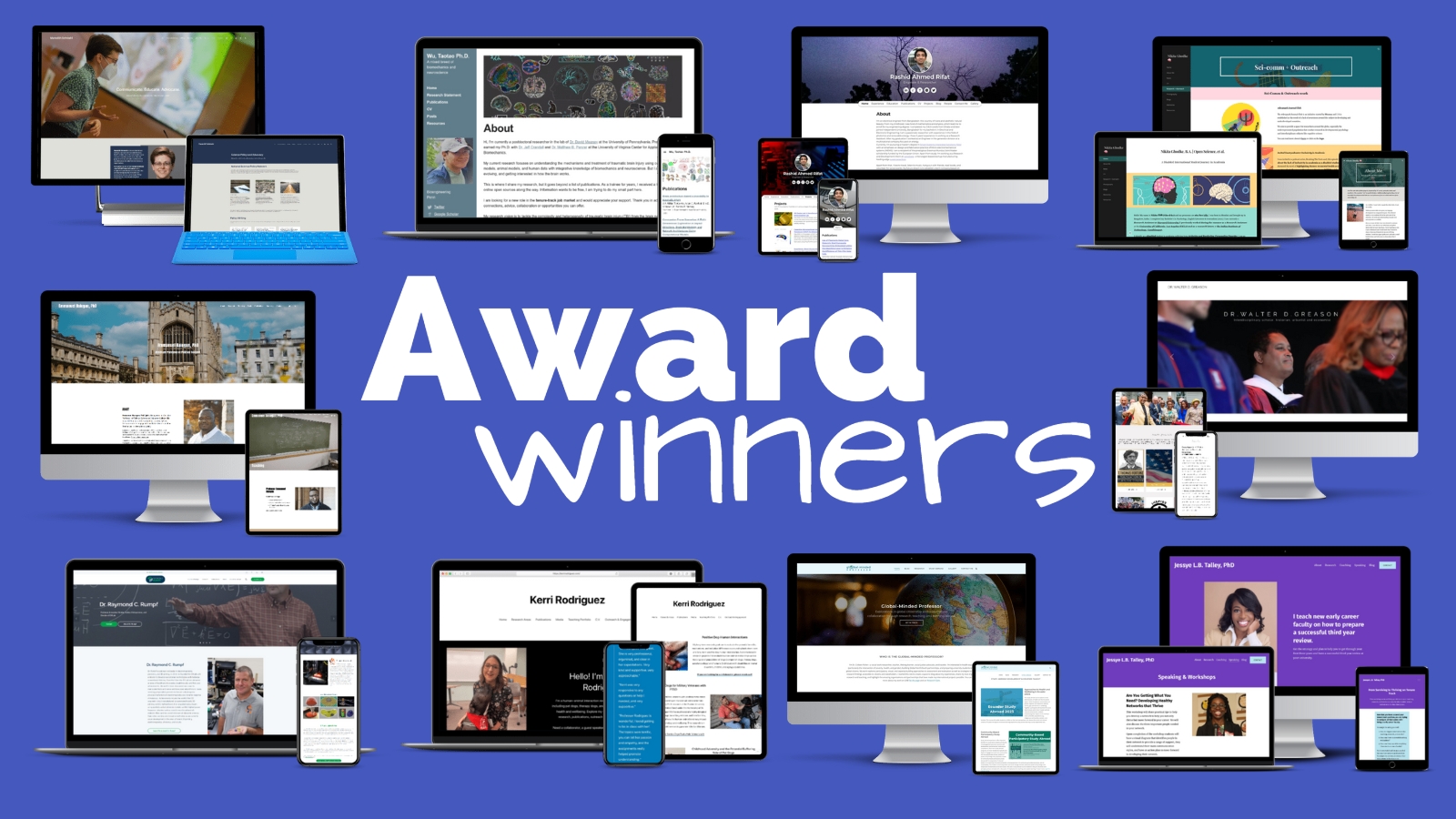
    The top 3 websites tied in score. We are celebrating overall top 3 websites from Meredith Schmehl, Dr. Emmanuel Balogun, and Dr. Raymond C. Rumpf. Congratulations!

    Your websites excelled in every judged category (Website Content, Website Design and Organization, About You, Portfolio, Contact Info). You are the best examples of personal academic websites.

    Meredith Schmehl
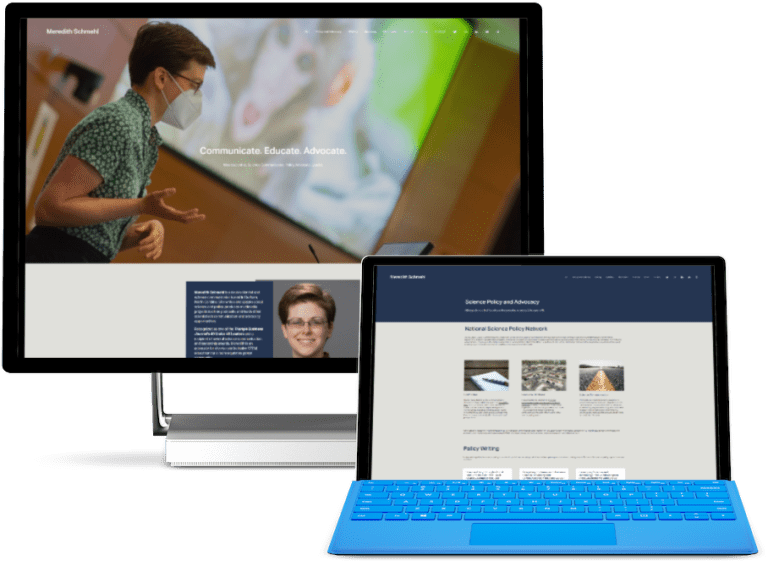
    A screenshot of Dr. Meredith Schmel's personal website

    Meredith Schmehl is the sole creator of her website. She says, “I made a website to showcase my work both in the lab and in my community. My website allows me to connect all of my professional interests in a single platform to share my accomplishments and values with a wide audience.”

    Notes from the Judges

    Brittany Trinh: Schmehl’s website is effective with the homepage along, as well as the entire website as a whole website. Not only does her portfolio list their work, she also provides a clear description of what it is, and other awards/recognition related to that work.

    Jennifer van Alstyne: Friendly, personable, and communicative. Meredith took time to share the details of her talks and writing in an accessible way. I love that you get a short abstract with the article. You can also learn about The Gastronauts Podcast and Meredith’s work with the National Science Policy Network on her website.

    Dr. Ian Li: Meredith’s website is a great example of a comprehensive academic website. She presents the breadth of her work from her research, science writing, and advocacy. In each project, she provides a clear summary and points to resources to get more details about them.

    Dr. Emmanuel Balogun
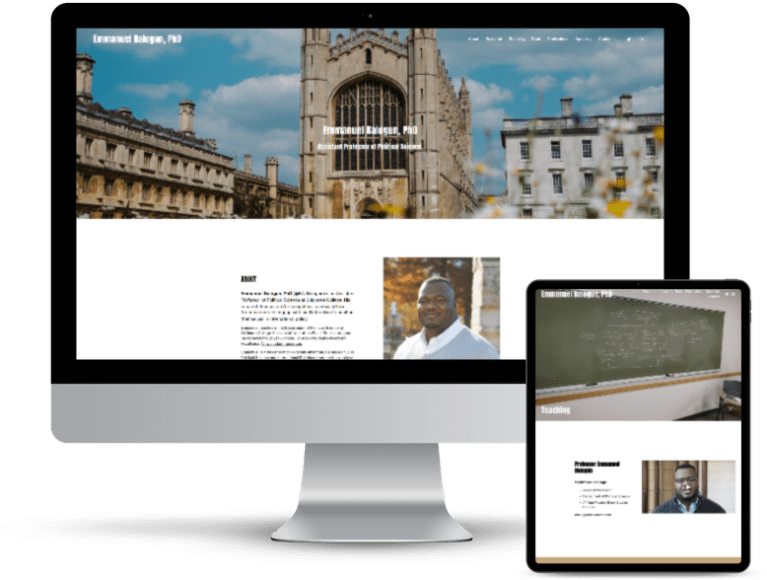
    A screenshot of Dr. Emmanuel Balogun's website on desktop and tablet screens.

    Dr. Emmanuel Balogun wants to acknowledge the help of Jennifer van Alstyne of The Academic Designer LLC who developed the strategic website plan. And, Ryann Russ of Iggy + Stella Creative Studio who designed the website.

    Dr. Balogun says, “I made a website to communicate my research and expertise to an audience beyond academia and to make it easier for my colleagues, students, and professional contacts to reach me. I also wanted to increase my online presence in a more approachable way.”

    Notes from the Judges

    Jennifer did not judge Dr. Balogun’s website for this contest.

    Brittany Trinh: My favorite part about Dr. Balogun’s website is the Teaching page, which includes descriptions of courses taught, along with sample syllabi and assignments. There are also pages to important links for students, such as letter of recommendation (LOR) worksheet, internship list, and scheduling office hours. The LOR worksheet breaks down what the student should provide for the professor, making it easier for the students to advocate for themselves and easier for Dr. Balogun to organize and write the LORs.

    Dr. Ian Li:  Dr. Balogun’s website is a great example of how an academic website can help share a wide array of information from one’s academic work and beyond. Dr. Balogun shares various artifacts from his research publications, classes, media appearances, and presentations. He also shares resources that students can use for internships and research opportunities.

    Dr. Raymond C. Rumpf
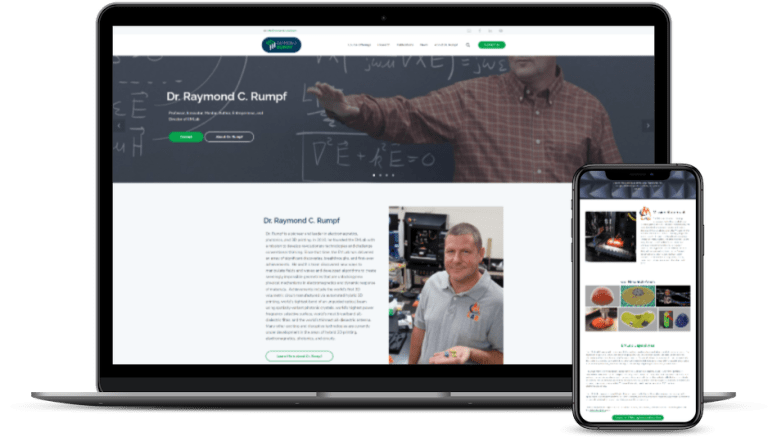
    A screenshot of Dr. Raymond Rumpf's personal academic website.

    Dr. Raymond C. Rumpf wants to acknowledge that “the primary person responsible for the conceptualization, creation, organization, graphic design, photography, and administration of my website is Kristin S. Rumpf of KSR Digital Designs. She came up with the web design, the logo, and did the custom coding to create the website I wanted. She has constructed websites for my two other businesses as well.”

    Dr. Rumpf says, “I decided to create a website to consolidate all the information about my work and research into one place that I had complete control over. I wanted to be able to highlight my research, provide links to my learning resources, and promote my books, online courses, and journal articles that were outside what would be allowed by my university.”

    Notes from the Judges

    Brittany Trinh: Dr. Rumpf’s website is both informative and visually compelling. It does a great job of fulfilling 3 goals – making academic resources freely accessible, providing information about his research lab, and promoting his online courses, EMPossible. I also love the logo design, which cleverly incorporates the letters EM, as in “electromagnetic,” into his personal brand as well.

    Jennifer van Alstyne: This felt like a well-thought out comprehensive archive. With great visuals and detailed research descriptions, Dr. Rumpf makes it easy to explore his website. A great use of a blog as a News section.

    Dr. Ian Li: Dr. Rumpf’s website is a treasure trove of information. It has information about his research, lab, and courses. The website is well-designed to easily navigate the huge amount of information on the site.

    Best Owlstown Website Award

    Owlstown is a website builder for academics created by Dr. Ian Li. Make and maintain your academic website in minutes. We are excited to award the Owlstown websites with the highest scores, Dr. Taotao Wu and Rashid Ahmed Rifat. Congratulations!

    Dr. Taotao Wu
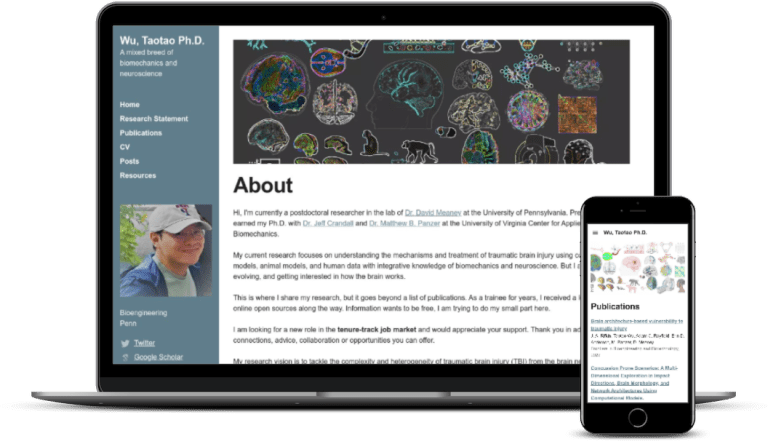
    A screenshot of Wu, Taotao, PhD's website on Owlstown

    Dr. Taotao Wu wants to appreciate “Ian from Owlstown for creating such a convenient platform for the community.”

    Dr. Wu says, “I have always been thinking about building my academic website to communicate science, not just because I am on the job market but also because information should be free. As a trainee for years, I received a lot of help from online open source. I am trying to do small part here.”

    Notes from the Judges

    Ian did not judge Dr. Wu’s website for this contest.

    Brittany Trinh: I like how Dr. Wu leverages his About section to clearly state his intention (finding a tenure-track position). In addition, he provides his research vision, which may appeal to potential employers and future colleagues.

    Jennifer van Alstyne: Dr. Wu takes the extra step of adding abstracts to each of his publications. He makes his research on Traumatic Brain Injury (TBI) approachable with the headline: “Understanding the networked brain through its injury” on his Research page. I like how Dr. Wu creates pages for his presentations which you can contact him about.

    Rashid Ahmed Rifat
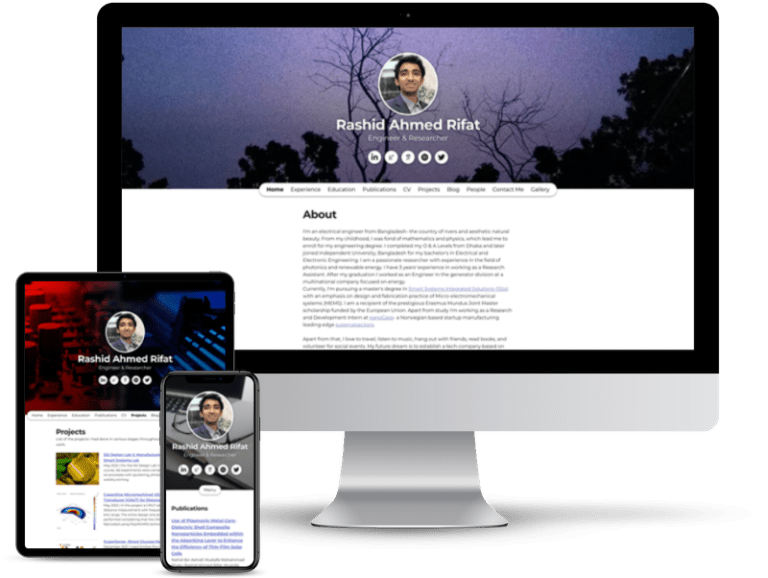
    Rashid Ahmed Rifat's website on desktop screen, tablet, and mobile.

    Notes from the Judges

    Ian did not judge Rashid’s website for this contest.

    Brittany Trinh: Rifat’s project pages are well utilized. Not only does he provides an abstract of the project, but also includes relevant documents, figures, and slides to show his technical communication abilities.

    Jennifer van Alstyne: Rashid’s bio is approachable. It shares his hopes for his research, and how he wants to make change in the future. With abstracts for his publications, Rashid’s website is an approachable resource. A great example of how you can create a portfolio of research projects on your website.

    Best Google Site Award

    We’re excited to present the Best Google Site award to Nikita Ghodke. Congratulations!

    Nikita Ghodke
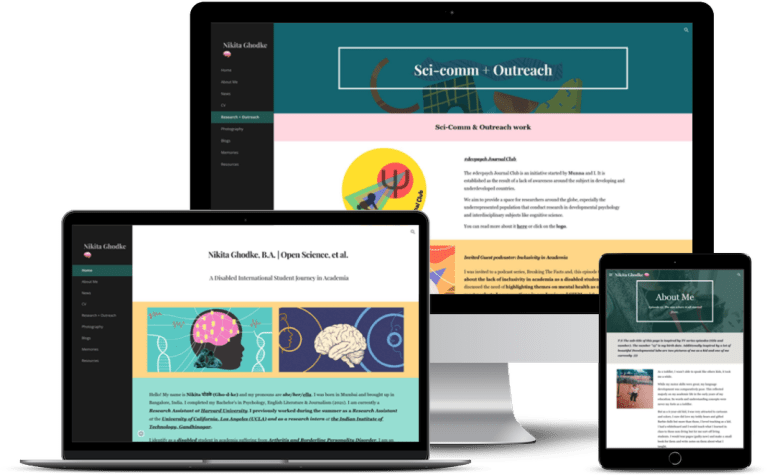
    Nikita Ghodke's personal academic website on desktop, laptop, and tablet screens

    Nikita Ghodke made her website “on my own from scratch.” She says, “Making an academic website is important, especially as an International disabled student. My biggest motivation for creating one was for reaching out with resources to the underrepresented populations. I always wanted to create more representations in academia that can tailor a story of me as a person which isn’t just limited to my professional interests but also includes other parts of my life that play an important role in my career.”

    Notes from the Judges

    Brittany Trinh: Ghodke’s website shows that it’s not about the tools or platform you use, but the thought that you put in it. Her website is on Google Sites, which is a free platform.

    Jennifer van Alstyne: Nikita tells the story of her research with engaging visuals and photos. I especially like her Science Communication & Outreach page. Nikita shares her photography on her website; I encourage more academics to share their personal interests on their website.

    Dr. Ian Li: Nikita shares a lot of information about her journey through academia through blog posts, slide presentations, podcast interviews. She also shares resources to help others with their academic careers.

    Best Storytelling Award

    Telling your story is powerful and memorable. We’re excited to award the Best Storytelling Award to Dr. Kerri Rodriguez! Congratulations.

    Dr. Kerri Rodriguez
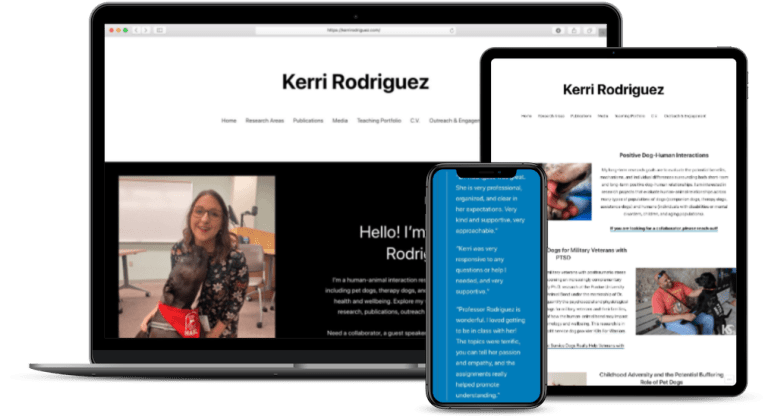
    Dr. Kerri Rodriguez's website on laptop, tablet, and mobile screens.

    Dr. Kerri Rodriguez made her own website on WordPress. She says, “I originally created an academic website because I thought I had to, but my website quickly transformed into a valuable resource for me to share my research in a fun and engaging way. It also has tremendously helped with networking and being on the job market!”

    Notes from the Judges

    Brittany Trinh: I particularly liked Dr. Rodriguez’s research page, which provides clear and brief descriptions of the focus of her research, related links to work she wanted to highlight, as well as many cute photos of dogs, which is relevant to her research, throughout her website. In addition, the media page makes it easy to find the articles where she has been featured.

    Jennifer van Alstyne: Dr. Rodriguez is so friendly in the GIF on her website. A cute dog? People will find this very approachable. The homepage is detailed without being overwhelming, and helps visitors navigate the site. I love how the Research page also invites people to reach out for collaborations and read her articles.

    Dr. Ian Li: Dr. Rodriguez’s website weaves a cohesive story about her passion for human-animal interaction, which spans across her research, teaching, and advocacy. Her website is a great example of how an academic website can go above-and-beyond a list of publications.

    Best Portfolio Award

    How do you showcase all the work you do on a personal website? By creating engaging pages for people to explore. We’re excited to award the Best Portfolio Award to Dr. Walter Greason. Congratulations!

    Dr. Walter Greason
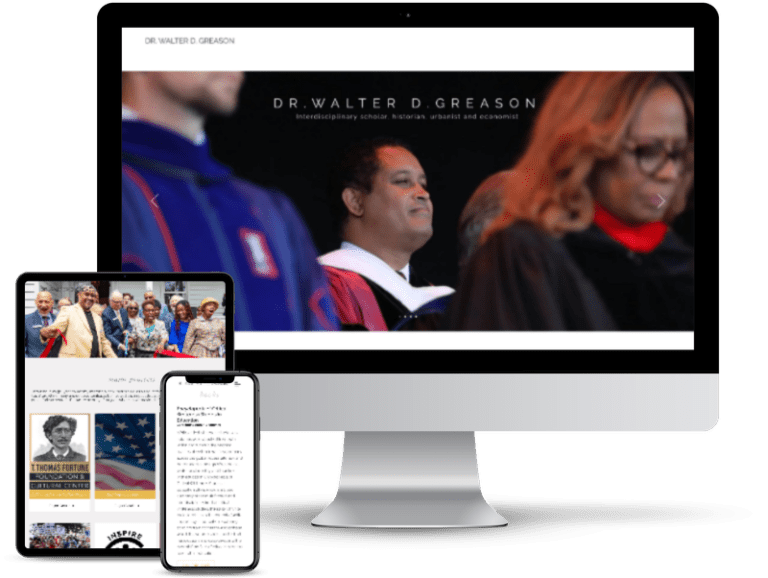
    Dr. Walter Greason's personal website on desktop, tablet, and mobile screens.

    Notes from the Judges

    Brittany Trinh: Dr. Greason’s website shares his portfolio by featuring them all on a Project page. He provides a great example of how to leverage your project portfolio because he highlights specific projects by giving them individual pages. In each project, he provides historical significance to give further context of the impact of their work.

    Jennifer van Alstyne: Dr. Greason had a challenge fitting his many areas of research onto one website. Well done! A bio that helps people explore further. A page focused on program services. The portfolio pages on this website are visually engaging and not overwhelming. This website is an example for all in how to invite people to get involved.

    Dr. Ian Li: Dr. Greason’s project page is a great example of providing summaries of projects to introduce them to a wider audience. He describes each project and explains why they are important and their impact.

    Best Blog Award

    Having a blog on your website is a big project. We’re excited to award Dr. Colleen Fisher the Best Blog Award for The Global Minded Professor.

    Dr. Colleen Fisher
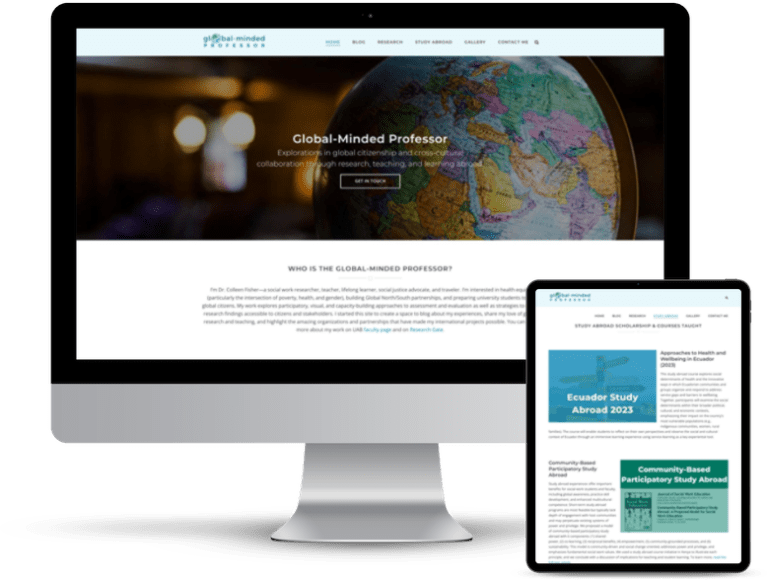
    Dr. Colleen Fisher's website The Global Minded Professor on desktop and tablet screens.

    Dr. Colleen Fisher wants to acknowledge “the wonderful website designer who helped me bring my vision for this site to life! Her name is KC Pushpa.”

    Dr. Fisher says, “I had been thinking about the benefits of an academic website for some time, thanks in part to compelling blogs like The Academic Designer! I finally took the leap to create my site in 2021 when I was preparing for my Fulbright to India and realized I wanted a space to blog about that experience.”

    Notes from the Judges

    Brittany Trinh: Global Minded Professor’s website includes 3 blogs – one that is current and two that are upcoming. It provides a clear description of what to expect in the blog. In their India blog posts, they include their own perspective and amazing photos. The blog posts are organized well with section headings and written clearly and concisely.  Their blog post have been updated recently and they engage with their readers in the comments sections.

    Jennifer van Alstyne: Dr. Fisher’s website shares her love of global research and teaching. Rich with images from her travels, The Global Minded Professor website includes a photo blog from her Fulbright in India. Her Research page answers questions like “What’s the problem?” and “What did we want to find out?” which invite deeper exploration in Dr. Fisher’s research.

    Dr. Ian Li: Dr. Fisher has an extensive blog on her academic work in India. In her blog posts, she writes about her research and the different places that she visited. She also has 2 upcoming blogs for her trips to Ecuador and Kenya.

    Best Academic Entrepreneur Website Award

    Some of the amazing people who leave academia become entrepreneurs. We’re excited to give the Best Academic Entrepreneur Award to Dr. Jessye L.B. Talley. Congratulations!

    Dr. Jessye L.B. Talley
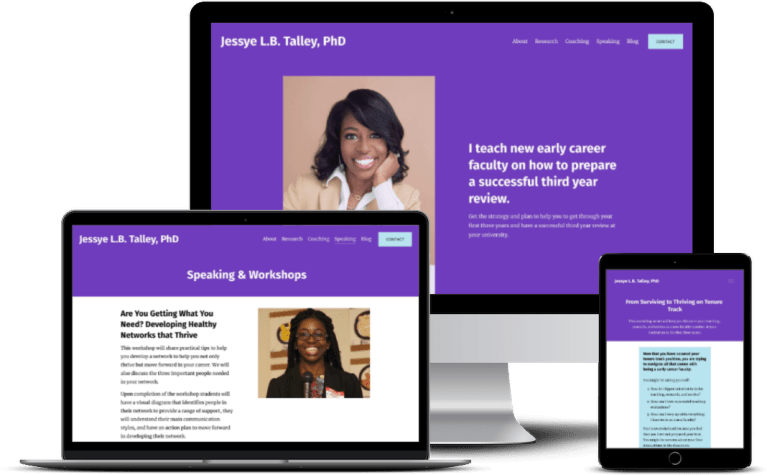
    Dr. Jessye L.B. Talley's personal academic website on desktop, laptop, and tablet screens.

    Dr. Jessye L.B. Talley wants to acknoweldge website designer Brittany Trinh Creative and photographer Stacey Gardin.

    Dr. Talley says, “I created my website to have a way for me to have my own space to connect with the academic community and not be tied to social media. It was also a way for me to share about my experiences and resources to help other academics on their journey.”

    Notes from the Judges

    Brittany did not judge Dr. Talley’s website for this contest.

    Dr. Ian Li: Dr. Talley’s website is well-designed with a modern layout and great use of visuals. In addition to descriptions of her research, she describes her coaching and workshop services, so you understand how they can help with your goals. She also shares several resources on her blog.

    Jennifer van Alstyne: Bright! Memorable. Dr. Talley’s website is inviting for early career faculty who benefit from her services. With professional photography, streamlined copy, and an easy-to-navigate menu, this website is a great example.

    Thank you!

    Congratulations to our award winners.

    A big thank you to all our contest entrants. We’re so lucky to have you inspiring the world. Your website has been added to The Academic Gallery on Owlstown. Thank you for being an amazing example. A website is a big project. You should be proud of sharing who you are and what you do with the world.

    We created this contest to help as many people as possible. I hope these personal website examples encourage you to make your own website! Some of our award winners did-it-themselves, others hired help. They all made their personal website work for them. You can too. Please bookmark this page. Share it with your friends. Make your website a reality. And don’t feel like it needs to be “finished” to hit publish. Keep scrolling for free resources to create your website.

    Brittany, Ian, and Jennifer would like to thank our non-profit partner for the Best Personal Academic Websites Contest 2022.
    STEM Advocacy Institute (SAi) logo

    STEM Advocacy Institute (SAi) is a Boston based incubator that is making it easier for social entrepreneurs to launch new programs and tools that connect people to science via public science engagement, science communication, and informal science learning.

    Finally, we’d like to thank our friends for helping share this event. Including but not limited to

    Did you help us share the contest during the entry period? Please email [email protected]. We’d love thank you here!

    7 free resources for creating your own personal academic website

    Our goal is to help as many people as possible. Here are free resources from Ian Li of Owlstown, Brittany Trinh Creative, and The Academic Designer LLC to help you make your website. Please share with your friends.

    An open laptop that reads "Website" with arrows pointing this way. Next to the laptop are books held up by a bookend of a person holding up t he books.
    Best Personal Academic Website Hosts Graphic: WordPress .com or Reclaim Hosting, Squarespace, Google Sites, Owlstown
    Personal Websites Articles
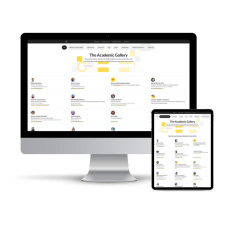
    Screenshots of The Academic Gallery from Owlstown on a desktop monitor and tablet screen

    Not sure where to get started with your online presence? Start here, with my free training for academics.

    The form above subscribes you to new posts published on The Social Academic blog.
    Want emails from Jennifer about building your online presence? Subscribe to her email list.
    Looking for the podcast? Subscribe on Spotify.
    Prefer to watch videos? Subscribe on YouTube.

    Contest Guides and Advice Articles Personal Website How To’s
    Source link

  • Why Do So Few American Students Study Abroad? – Edu Alliance Journal

    Why Do So Few American Students Study Abroad? – Edu Alliance Journal

    Why is that a problem?

    December 5, 2022 by Dean Hoke: In the newest edition of the 2022 Open Doors Report, US university’s international student enrollment shows encouraging signs. International students coming to the United States are reported at 948,519, which nears the pre-pandemic level. However, the number of Americans studying abroad in 2020-21 was 14,549 compared to 162,633 in 2019-20 and the high watermark of 350,000 in 2018-19.

    The chart below shows how long US students study overseas.

    Of the 350,000 students in 2018-19 who studied overseas, the majority either studied abroad for a summer or a short term.

    What is the profile of the American student who studies abroad?

    The number of US students who study abroad represents only 2.7% of the American university students who attend four-year and above institutions. Students who study abroad tend to be juniors or seniors in undergraduate school, female, Caucasian, have financial means, and study in Europe.

    What countries have the largest number of students studying abroad?

    T.I.M.E. Association, located in France, conducted a study in 2021 of UNESCO mobility data which reported 5.6 million international students worldwide to determine the top countries with the most outgoing students studying in another country. They looked at the “long-term mobility of students to complete a whole study cycle and acquire a degree (Bachelor, Master or PhD) abroad. The top countries university students leave to study abroad are:

    • China – 993,367
    • India – 375,055
    • Germany – 122,538
    • Viet Nam – 108.527
    • South Korea – 101,774
    • France – 99,488
    • United States – 84,349 (long-term studies)

    Students from other countries study abroad primarily due to the:

    • Future Employment Opportunities, be it at home or abroad
    • Quality of institution and program
    • Meet a diverse range of people
    • Study and learn differently
    • Self-reliance and being on your own
    • Meeting new friends and lifelong networking
    • Seeing your culture from a different point of view

    How important are students studying abroad to the business community as future employees?

    Businesses worldwide are putting a higher emphasis on international experience. Most big and small companies are trying to attract business and partnerships with international partners.  In a 2014 survey titled U.S. Business Needs for Employees with International Expertise, 800 executives in US companies were surveyed to identify the demand for corporate employees with international competence, including international skills and/or knowledge of foreign languages and world areas. The results of the 2014 survey call for a continuing need for international business education in the US, with increased emphasis on intercultural communication, foreign language skills, and international experience. The 800 represented a broad cross-section of Industries and the number of employees.

    Some interesting facts come out:

    • 39% failed to fully exploit international business opportunities due to insufficient internationally competent personnel in the past five years
    • 39% have no foreign offices, and all international operations are handled in the US
    • 43% state that overall business would increase a great deal if more international expertise were available on staff
    • 60% state that an appreciation for cross-cultural differences is of great importance for professional staff, followed by Understanding country legal and government requirements (59%) and understanding of local markets and business practices (58%)
    • 83% state their company will place a greater emphasis on international competence among management and employees over the next ten years

    Additional studies support that studying abroad helps employers and helps students get jobs. In 2016, The Institute for the International Education of Students (IES), founded in 1950, conducted a comprehensive survey of 1205 of its alumni. 

    Here are the key points from the study:

    • 93% who entered the workforce were employed within six months
    • 89% of those who entered graduate school earned admissions in their first or second-choice school
    • 50% felt that their IES Abroad Program experience helped them to get this first job

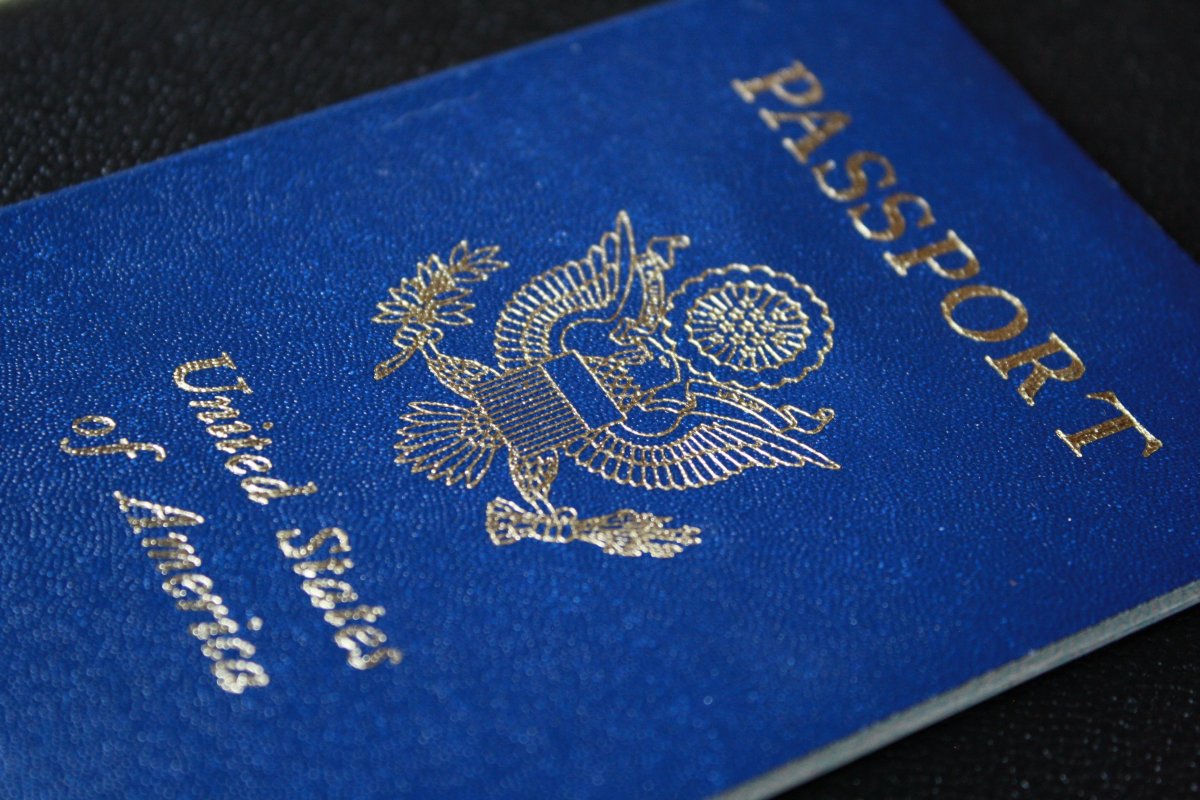
    The American Passport Project

    How can we encourage and support students to study abroad?

    In a recent interview with Higher Ed Without Borders  (in which I am a co-host), we asked Dr. Allan Goodman, CEO of the IIE, about a new program they established in 2021 titled The American Passport Project. Dr. Goodman commented that studying abroad is one of the best ways that students can acquire global skills and create personal and professional opportunities. Furthermore, it’s a part of IIE’s mission to increase participation and diversity in studying abroad and extend these benefits to all students regardless of socioeconomic status.  However, students of limited financial means find it more difficult to participate in studying abroad due to financial hurdles, which could bar them from moving forward.

    The American Passport Project plans to have enabled 10,000 students to be awarded passports by the end of this decade. IIE will help 1,000 college students obtain U.S. passports annually by awarding funds to 40 U.S. colleges and universities in the IIE Network. Each institution will identify 25 of its first-year students who are eligible for Pell grants. Eligibility will be limited to first-year students to ensure that they have ample time remaining in their college career and receive guidance from their advisors to map out a study abroad plan. Competitive institutions will demonstrate grant need, support obtained, and impact on study abroad participation.

    First Year Results

    • In the inaugural year, nearly 200 institutions applied for the grant to support students obtaining U.S. passports. These institutions informed IIE of the various ways they could utilize the grant to support targeted student populations.
    • Forty institutions were selected, and more than 50% of institutions chosen represent minority-serving student populations (HBCU, HSI, MSI) or are community colleges.
    • Nearly 50% of U.S. states are represented (33% South, 32% Midwest, 25% Northeast, and 10% West).
    • The majority are expanding their diversity, equity, access, and inclusion efforts by targeting these top 4 student populations: students with demonstrated financial need, racial/ethnic minorities, students who have never traveled abroad, and first-generation students.

    In a follow-up interview with Lindsay Calvert, IIE’s lead for the Passport Project, I asked about the program’s status and the number of students approved by IIE as of November 2022.

    • One thousand one hundred twenty-two students have been nominated by their awarding institutions and approved by IIE to be supported with the IIE-granted funds to help them obtain their U.S. passport and engage them in study abroad planning.
      • 778 students from the first cohort
    • 344 from the second cohort)
    • Some institutions can quickly able to identify, nominate, and confirm students. Others have been challenged with their outreach and recruitment, so this process can span over a year to fulfill the goal of 25 students per campus.
    • Since the Passport Project aims to support first-year students, they anticipate them to study abroad in the 2023/24 academic year and subsequent years of their undergraduate term.

    The Senator Paul Simon Study Abroad Program

    In November 2022, The Senator Paul Simon Study Abroad Program Act of 2022 , was introduced by U.S. Senators Dick Durbin (D-Ill.) and Roger Wicker (R-Miss.) and U.S. Representatives Cheri Bustos (D-Ill.) and John Katko (R-N.Y.) The act seeks to expand access to study abroad for U.S. college students by enhancing the State Department’s Increase and Diversify Education Abroad for U.S. Students (IDEAS) program and formally renaming it as the “Senator Paul Simon Study Abroad Program.” Inspired by the vision of the late Sen. Paul Simon (D–Ill.) and the recommendations of the congressionally-appointed Commission on the Abraham Lincoln Study Abroad Fellowship Program, the legislation would advance four national goals:   

    1. One million U.S. college students will study abroad annually for credit
    2. Study abroad participants will more closely represent the demographics of the undergraduate population in terms of gender, ethnicity, students with disabilities, income level, and field of study
    3. A significantly greater proportion of study abroad will occur in nontraditional destinations outside Western Europe  
    4. Higher education institutions will make studying abroad a critical component of a quality higher education

    U.S. higher education institutions could apply for federal grants, individually or in a consortium, to help them institute programs that would move the country toward achieving these objectives. 

    Conclusion

    I have long wondered why so few Americans go overseas to study, even for a summer. Aren’t they seeing the benefits that students from other countries see? Are they not aware that by studying abroad, they increase their chances of graduation and employment? Perhaps most university students are unaware of studying overseas or believe they can’t afford the cost or cannot give up a part-time job to be away for the summer.

    Organizations like IIE are helping address increasing study abroad opportunities with its American Passport Program by emphasizing minorities and non-elite schools. The proposed Simon bill also helps address the issue and pushes for a million students to study abroad, but it remains to be seen if it will pass. It will take bi-partisan support and a higher public profile to get through the upcoming Congress. Last and not least are higher education institutions themselves. While the larger state institutions and elite privates have programs and resources to help promote study abroad, that is not necessarily the case with thousands of other colleges and universities. While most schools have international affairs offices, they need more personnel and budget to adequately promote or financially support students. Their priority in fundraising for such programs is lower than other needs.

    We need businesses that will benefit from these students and federal and state governments to help promote and partially subsidize. If companies and governments want to compete for an increasing share of international business successfully, they need employees who have spent time abroad.


    Dean Hoke is Co-Founder and Managing Partner Edu Alliance a higher education consulting firm located in Bloomington, Indiana and Abu Dhabi, United Arab Emirates. Dean received his Bachelor of Arts degree from Urbana University in Ohio, his Master of Science from The University of Louisville, and a graduate of the Wharton School of Business Executive Management program. Since 1975 Dean has worked in the higher education and broadcasting industry, serving in senior leadership roles specializing in international education, marketing, communications, partnerships, and online learning.

    He currently serves as Chairperson Elect of the American Association of University Administrators , Advisory Board of the School of Education, Franklin University and is Co-Host of the Podcast series Higher Ed Without Borders  and Distance Learning Roundtable. Dean is actively engaged in consulting projects in international education, branding, business intelligence, and online learning leading projects in the United States, the Middle East, Africa, and Asia. Dean resides in Bloomington, Indiana

    Source link

  • 10 Keys to Building an Incredible Brand for Academics LIVE EVENT

    10 Keys to Building an Incredible Brand for Academics LIVE EVENT

    I’m teaming up with Dr. Sheena Howard to bring you a live VIP event for academics. You’re invited!

    EVENT: 10 Keys to Building an Incredible Brand as an Academic

    • Increase your confidence
    • Make 5x your investment
    • Waste far less time because you have an actionable plan
    • 5+ free tools to help you implement what you learn
    • 3+ downloadable PDFs
    • Grow your following by at least 25%

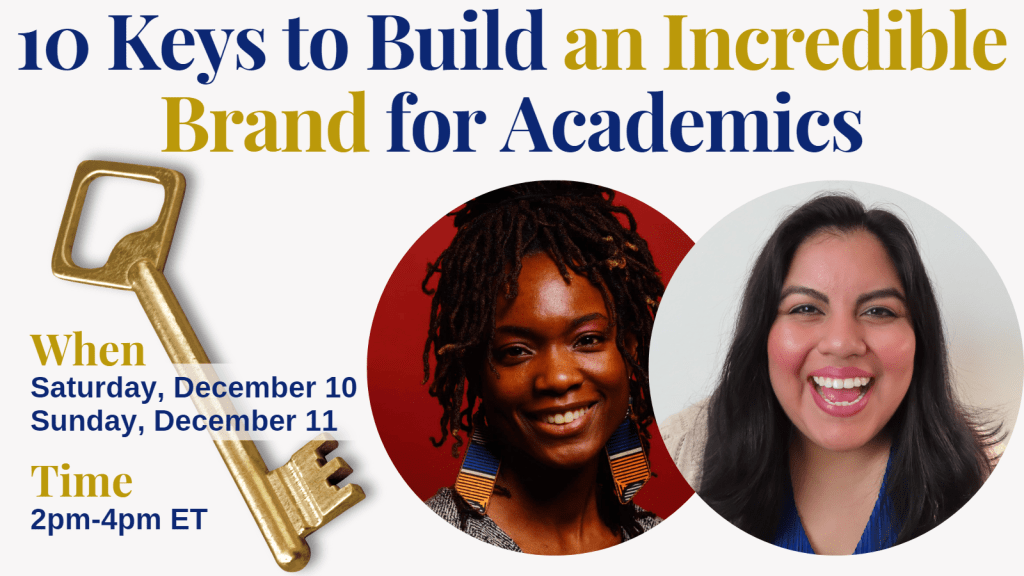
    Date: December 10 or December 11

    Time: 2-4pm Eastern Time

    Where: Virtual (on Zoom)

    Can’t make it live? A replay will be sent to you.

    This event is complete. Thank you for coming!

    A dream team collaboration event

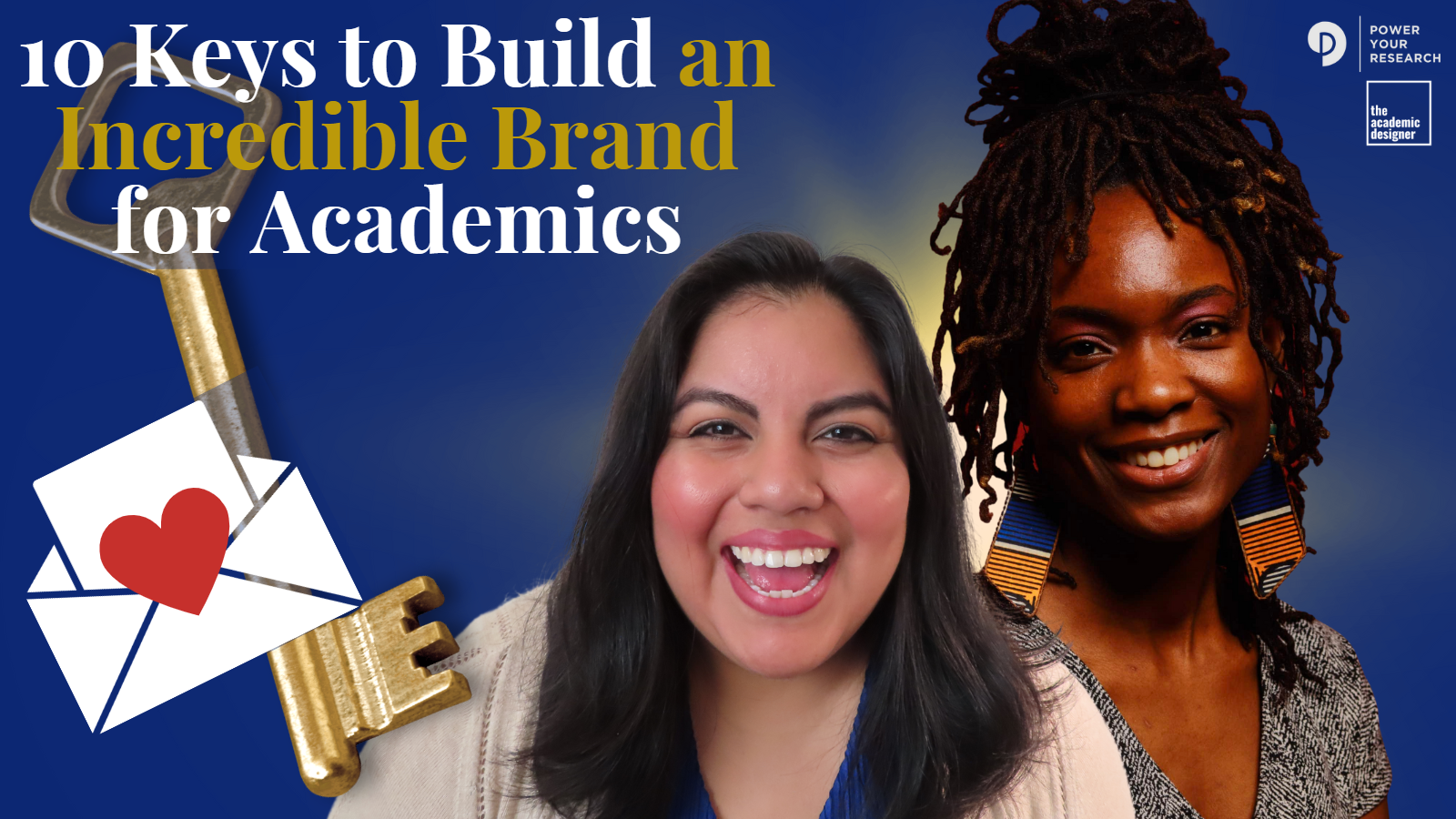
    10 Keys to Build an Incredible Brand for Academics, a graphic with a large key and photos of Dr. Sheena Howard and Jennifer van Alstyne smiling. When: Saturday, December 10 and Sunday, December 11 from 2-4pm Eastern Time.

    I’m Jennifer van Alstyne. When I started building my brand, I wanted to create the academic life that I wanted. Not the life my advisors or mentors wanted for me. My online presence helped me take that step. Now I help professors build an online presence their research deserves. So that they feel more confident, help more people, and build their scholarly community online.

    I’m so excited to team up with the incredible Dr. Sheena Howard. She’s an expert at helping professors get the media attention they deserve. She’s all about building your visibility, authority, and income with Power Your Research.

    This event has ended. It was on December 10 and December 11, 2022.

    We can’t wait to see you at 10 Keys to Building an Incredible Brand for Academics, our live virtual event.

    This event is for all people with an advanced degree (like a master’s or doctorate). This event is for you whether you’re in or out of the academy.

    Topics covered will include but are not limited to

    • Best free resources to get high-level media coverage right away.
    • Getting clarity on what building your brand looks like for you.
    • Building an incredible website that stands out.
    • Social media plan and strategy for the busy academic.
    • Building a 6-figure brand by leveraging your academic credentials, whether you are in or out of academe.

    This event only happens once a year. You don’t want to miss it.

    Get tickets for 10 Keys to Build an Incredible Brand for Academics today. Limited seats are available.

    This event is complete. It was on December 10 and December 11, 2022. Thank you for attending, we were so happy to help inspire you. This event only happens once a year. If you’re interested in attending next year, email me at [email protected]

    Gifts and Holiday Guides and Advice Articles The Social Academic

    Source link

  • Higher Ed Without Borders Now Available on Audio and Video – Edu Alliance Journal

    Higher Ed Without Borders Now Available on Audio and Video – Edu Alliance Journal

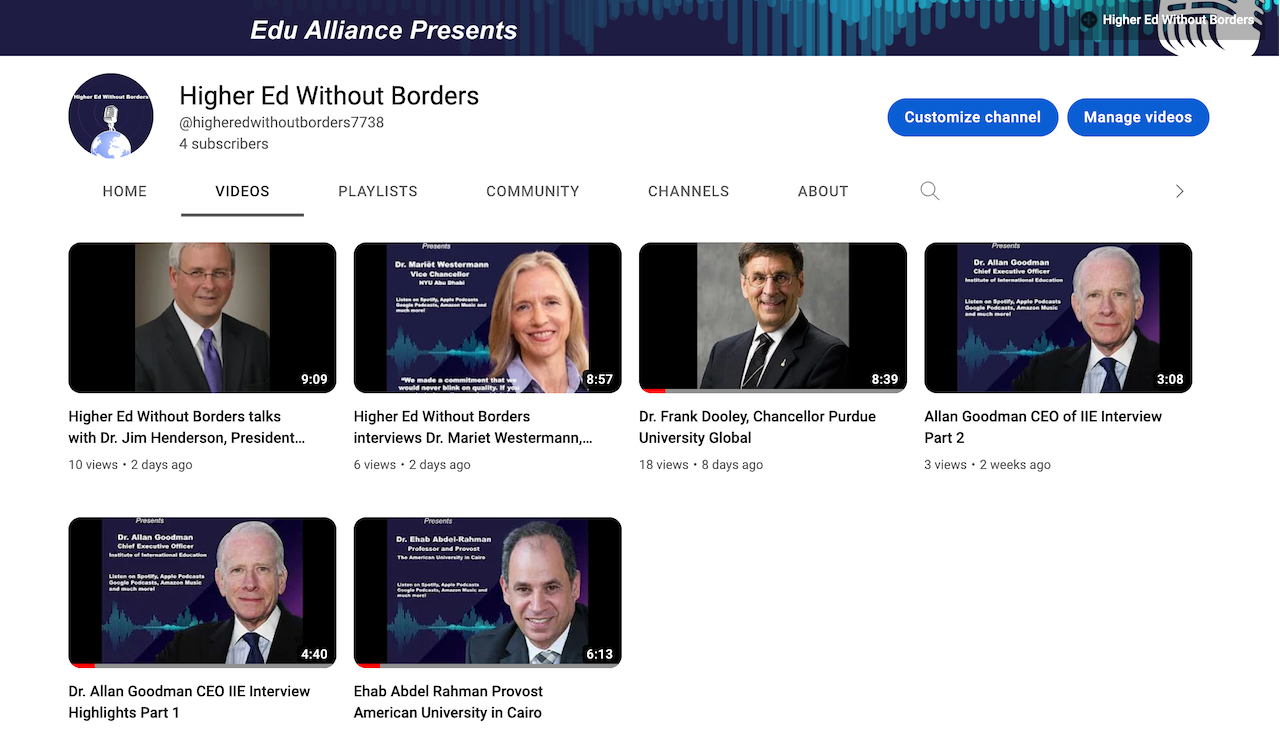
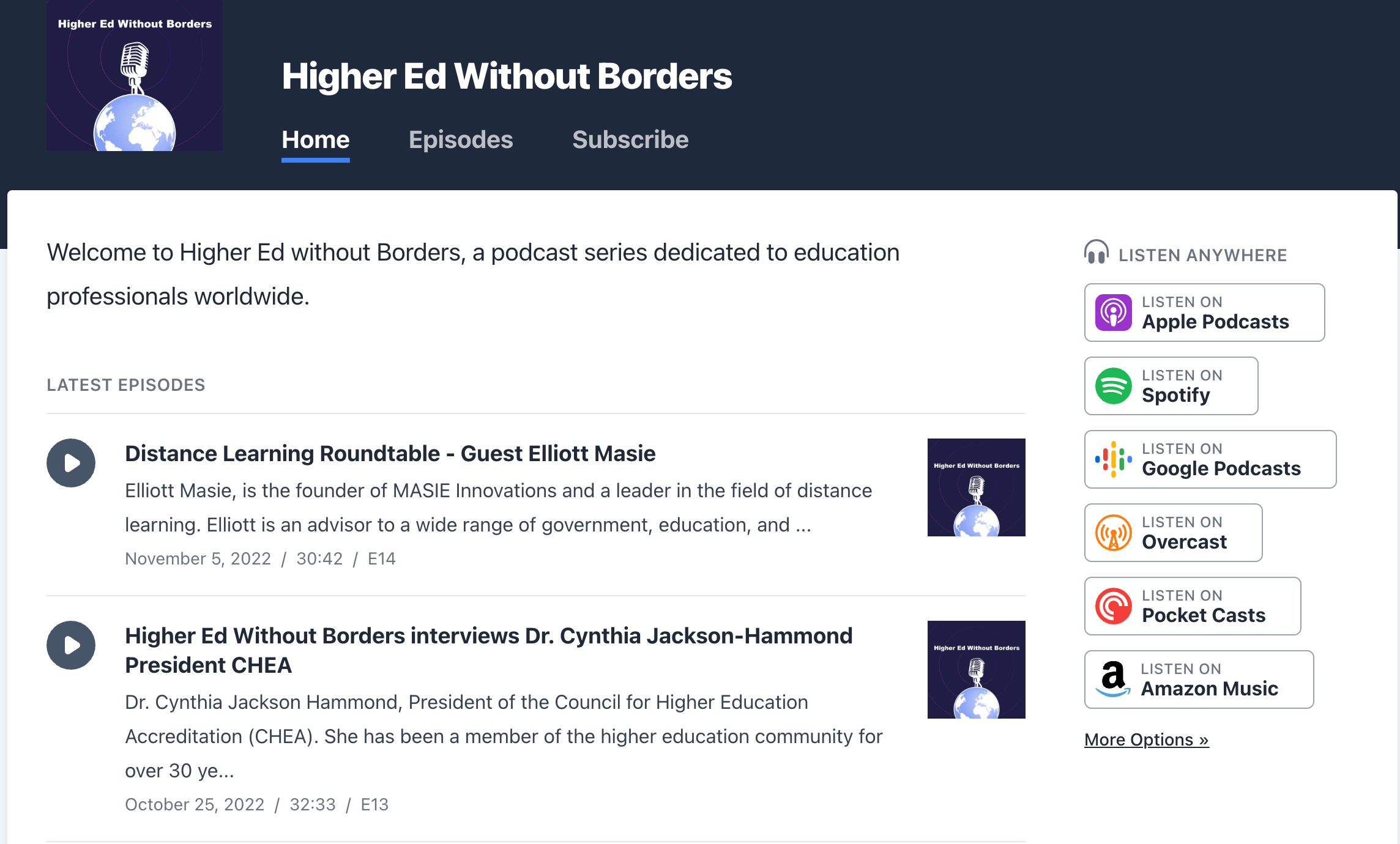
    As we enter the holiday season, we recommend you tune in to  Higher Ed Without Borders. We now have the 2022 audio podcast season available, including 14 complete episodes. In addition, we have created five video highlight programs on our YouTube Channel. The series is a production of Edu Alliance.

    Also, we are proud to announce that in December and January, five new episodes are being produced.  Our last episode for the 2022 season will be with Dr. Chris Howard, Executive Vice President and COO of Arizona State University.

    In January 2023, Dean Hoke and Tom Davisson will co-host a four-part mini-series titled Small College America. Scheduled guests will be:
    Dr. Barry Ryan, President of Woodbury University, California
    Ryan Smith, President, University of Rio Grande, Ohio
    Dr. Stefanie Niles, President of Cottey College, Missouri
    Dr. Janelle Vanasse, President of Alaska Pacific University, Alaska  

    The YouTube series currently has 6 video highlights, with more to come. They include:
    Dr. Ehab Abdel Rahman, Provost of The American University in Cairo
    Dr. Allan Goodman, Chief Executive Officer of the Institute of International Education Part 1
    Dr. Allan Goodman, Chief Executive Officer of the Institute of International Education Part 2
    Dr. Jim Henderson, President of the University of Louisiana System
    Dr. Mariët Westermann, Vice-Chancellor of New York University, Abu Dhabi
    Dr. Frank Dooley, Chancellor of Purdue University Global

    Guest for the 2022 season includes:
    Elliott Masie, founder of MASIE Innovations 
    Dr. Cynthia Jackson Hammond, President of the Council for Higher Education Accreditation
    Dr. Peter Wells. Chief of the Section for Higher Education at UNESCO, Paris
    Dr. Samantha Alvis, Senior Advisor for Higher Education for USAID 
    Dr. Matthew Wilson, Dean, and President of Temple University Japan Campus
    Dr. Tarek Sobh, President of Lawrence Technological University
    Dr. Tony Chan, President of King Abdullah University of Science and Technology in Saudi Arabia 
    Dr. Gil Latz, Vice Provost for Global Strategies and International Affairs, The Ohio State University
    Dr. Mariët Westermann, Vice-Chancellor of New York University, Abu Dhabi
    Dr. Jim Henderson, President of the University of Louisiana System
    Dr. Allan Goodman, Chief Executive Officer of the Institute of International Education
    Dr. Frank Dooley, Chancellor of Purdue University Global
    Dr. Ehab Abdel Rahman, Provost of The American University in Cairo

    Feel free to let us know if you have any questions or comments. Happy Holiday Season to you and your loved ones.

    Dean Hoke and Dr. Senthil Nathan
    Edu Alliance Group and Co-Hosts of Higher Ed Without Borders
    [email protected]
    [email protected]

    Source link

  • CUPA-HR Sends Letter to Congress Asking for DACA Protections – CUPA-HR

    CUPA-HR Sends Letter to Congress Asking for DACA Protections – CUPA-HR

    by CUPA-HR | November 22, 2022

    On November 17, CUPA-HR joined the American Council on Education (ACE) and over 60 other higher education associations in sending a letter to House of Representatives and Senate leadership urging Congress to pass permanent protections for the Deferred Action for Childhood Arrivals (DACA) program after recent court decisions have left the status of the program in limbo.

    On October 5, the U.S. Court of Appeals for the Fifth Circuit unanimously upheld a 2021 ruling by the lower Court in the Southern District of Texas that enjoined the DACA program and vacated the 2012 Department of Homeland Security (DHS) memorandum that originally established the program. The Fifth Circuit agreed with the lower court’s finding that the promulgation and enforcement of the DACA memorandum violated the Administrative Procedure Act but noted that the Biden administration had finalized a new DACA regulation in August, leading the Appeals Court to send the case back to the Texas District Court to consider the legality of the August rulemaking. On October 14, however, the Texas District Court ruled against the final rule, arguing that the existing injunction blocking the 2012 memorandum also covered the new final rule.

    As a result of these rulings, the DHS is blocked from accepting new applications for the DACA program, but the agency is permitted to continue renewing existing protections to current DACA beneficiaries. DHS Secretary Alejandro Mayorkas issued a statement in response to the Texas Court’s decision saying “It is clearer than ever that only the passage of legislation will give full protection and a well-deserved path to citizenship for DACA recipients. I urge Congress to swiftly pass legislation to provide permanent protection to the hundreds of thousands of Dreamers who call the United States home.”

    ACE’s letter states the urgency with which Congress needs to act to ensure protections are granted to DACA recipients. The letter specifically asks Congress to pass legislation to provide DACA protections to current and future beneficiaries before the 117th Congress ends January 3, 2023.

    CUPA-HR will keep members apprised of any updates on the status of the DACA program.


    Source link

  • A Common Mistake Academics Make With Their Personal Websites

    A Common Mistake Academics Make With Their Personal Websites

    How often is your name mentioned on your website? For some academics, the answer is 0. I’ve looked at hundreds of personal faculty and scientist websites. A common mistake people make is forgetting to include your name.

    Hi, I’m Jennifer van Alstyne. Welcome to The Social Academic, a blog about your digital presence in HigherEd.

    The form above subscribes you to new posts published on The Social Academic blog.
    Want emails from Jennifer about building your online presence? Subscribe to her email list.
    Looking for the podcast? Subscribe on Spotify.
    Prefer to watch videos? Subscribe on YouTube.

    Does your website show up when someone Googles your name?

    An overhead view of a person working on a laptop. They have the Google Search page pulled up and are starting to type in their search query.

    When you type your full name into Google, does your website show up on the 1st page of results? A personal website should show up high in Google Search results because it often has the information people are most looking for.

    But your website won’t appear in search results if you’ve forgotten to include your name. This is a common mistake for academics who make their own website.

    Why do academics make this mistake? They work hard to create a website to better share their research. Self-promotion often feels strange for professors and researchers. It might feel wrong or unnatural. Because of this, you might have forgotten to include your own name on your website.

    The people who make this mistake often include their name in their

    But they then forget to include it on other pages of their website like in their bio, and on their Research or Publications pages. Have you forgotten to include your name?

    The form above subscribes you to new posts published on The Social Academic blog.
    Want emails from Jennifer about building your online presence? Subscribe to her email list.
    Looking for the podcast? Subscribe on Spotify.
    Prefer to watch videos? Subscribe on YouTube.

    Scavenger Hunt! Find your name on your website

    An open laptop with the word Website written on the screen with a bunch of arrows pointing to the right.

    A good way to see if your name appears on your website is by searching your site in Google.

    To do this, type this into the search bar: site:YourDomainName.com Your Name

    For example: site:JenniferVanAlstyne.com Jennifer van Alstyne

    When I perform this search, it shows that my name appears on most pages of my personal website. Try a search like this to see how often your name appears.

    If you find your name doesn’t appear much on your website, this is an easy change you can make to your website to improve how people find it. Any small change to improve your personal website is a good thing!

    Best of luck with your website project. Want professional help with your website project? I’d love to help.

    Including your name on your website is a best practice for SEO

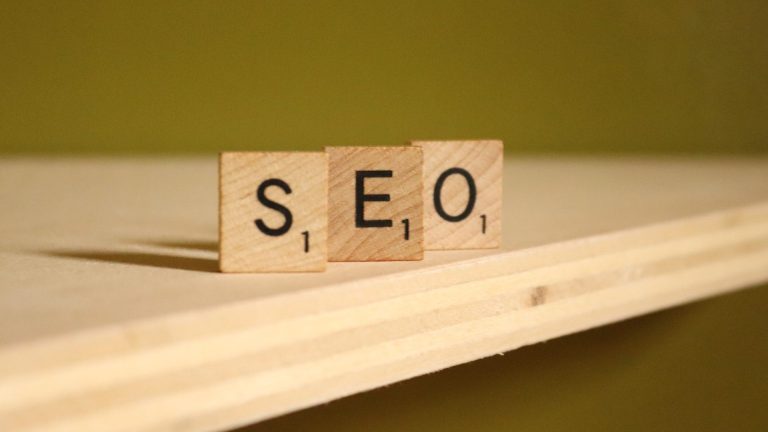
    Scrabble letters that spell out 'S' 'E' and 'O' stand facing the camera on a shelf. SEO is an acronym for search engine optimization.

    Search engine optimization is a method for improving, or optimizing your website to rank better in search results. In this case, the keyword people are searching for online is your name when they want to find information about you.

    Discover how search engine optimization (SEO) can help your website in my YouTube live with Patrick Wareing.

    Personal Website How To’s The Social Academic
    Source link

  • 4 Considerations for Using Salary Data to Inform Compensation Decisions – CUPA-HR

    4 Considerations for Using Salary Data to Inform Compensation Decisions – CUPA-HR

    by Missy Kline | November 15, 2022

    Editor’s note: This blog post, originally published in April 2019, has been updated with additional resources and related content.

    Salary benchmarking is not one-size-fits-all — especially when you’re looking at groups as varied as administrators, professionals, staff and faculty on a college or university campus that is unique in its combination of Carnegie class, affiliation, regional location and mission. The question, then, is how to tailor your benchmarking efforts to take these variables into account and choose data that is appropriate to your unique needs.

    Here are four considerations to help you make the best use of salary data for compensation budget planning for your faculty and staff:

    1) Which institutions should your institution’s salaries be benchmarked against? Making the right comparisons — using position-specific data and carefully selected peers — can make all the difference when planning salaries that will make your institution competitive in the labor market. When you use CUPA-HR’s DataOnDemand, you can narrow down peer institutions by one or several institution-level criteria such as affiliation (public, private indephttp://cupahr.org/surveys/dataondemand/endent or private religious), Carnegie classification, enrollment size, geographic region, total expenses or other characteristics. Remember, balance is key: a larger comparison group gets you more robust data for comparison, but you must also make sure you are comparing to the right types of institutions that make sense for your goals.

    2) Not all faculty are the same. Tenure track faculty, non-tenure track teaching faculty, non-tenure track research faculty and adjunct faculty may each require unique compensation strategies, as do faculty members from different disciplines and ranks. Will the same salary increase help retain both tenured and non-tenured faculty? Does collective bargaining impact salary targets for some, but not all, of these faculty sub-groups? Are there unique, fast-growing, or in-demand departments/disciplines that require a separate strategy?

    3) Keep in mind that administrator salaries are broadly competitive. Like faculty, many administrative positions in higher ed are competitive at a national level. Often, institutions seek administrators with experience at other institutions of a similar size or mission, and with this experience and mobility comes an expectation of a competitive salary. As higher ed moves toward a “business model” where innovative leadership strategies are displacing more traditional shared governance models, finding administrators with the appropriate skills and expertise is becoming increasingly competitive, not only within higher education but sometimes against the broader executive employment market.

    4) Employment competition varies for staff and professionals. Many non-exempt staff are hired from within local labor markets, and therefore other institutions or companies in your state or local Metropolitan Statistical Area might be a better salary comparison than a nationwide set of peer institutions. Exempt or professional staff, however, may be more limited to competition from the higher ed sector, perhaps on a state or regional level. In addition, changes brought about by the pandemic (e.g., remote work opportunities, a desire to relocate) have made many professional positions more globally competitive. Are your institution’s salaries for these employees appropriately scoped for the market in which you need to compete?


    Additional Articles and Resources

    How One College Is Using Salary Data to Ensure Pay Equity and Market-Par Compensation

    Compensation Programs/Plans, Executive Compensation in Higher EdEqual Pay Act (CUPA-HR Toolkits)

    Working in a Fish Bowl: How One Community College System Navigated a Compensation Study in a Transparent Environment (Higher Ed HR Magazine)


    Source link

  • 3 Ways To Take New Photos For Your Website

    3 Ways To Take New Photos For Your Website

    You want a new photo of yourself for your personal website. What’s the best way to take new photos? Here are 3 ways for you to get beautiful photos for your website.

    Hi! I’m Jennifer van Alstyne. Welcome to my blog about understanding your digital footprint in research and Higher Education. I help professors have an amazing online presence through my company The Academic Designer LLC. I empower academics to feel confident when showing up online.

    The form above subscribes you to new posts published on The Social Academic blog.
    Want emails from Jennifer about building your online presence? Subscribe to her email list.
    Looking for the podcast? Subscribe on Spotify.
    Prefer to watch videos? Subscribe on YouTube.

    Listen to the podcast

    Take a selfie

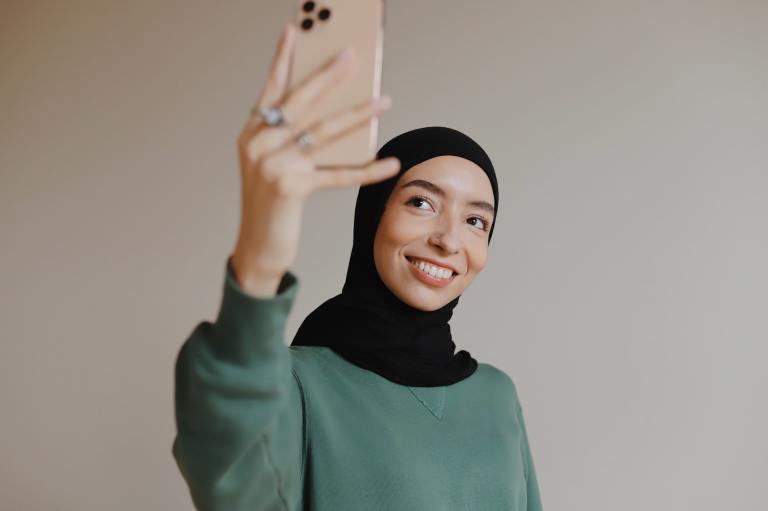
    A woman wearing a hijab and a green sweater holds her phone and smiles at the camera while taking a selfie photo.

    A selfie is a photo that you take of yourself. You can use selfies on your personal website! The most popular way to take a selfie is with your phone camera. You can use the front camera of your phone, but you’ll take higher quality photos if you use the rear camera.

    Look for a space with good lighting. You may find great natural lighting outside in the last hour before sunset. Or, if you’re an early riser (unlike me), try just before sunrise. Photographers call these periods the ‘golden hour’ because the light can be perfect.

    Avoid a distracting background in your photo. When in doubt, you can take a photo against a neutral background like a wall. Then you can edit the photo to remove the background like I did for the selfie above.

    Use a cleaning cloth to gently wipe the camera lens clean before you start your photo shoot.

    Try holding the phone at different angles (slightly higher, slightly lower). You can also hold the phone out to your side and turn your head towards it. Don’t forget to smile.

    Your phone camera may have settings to help you take a better selfie. For instance, there may be a portrait mode. Or, an option to take a wide selfie.

    You can use your phone’s self-timer setting to take hands-free and full body selfies. You may want to prop up your phone using books. You could also invest in an inexpensive tripod or selfie stick.

    A black and white dog wearing blue sunglasses lays on its back on the grass taking a selfie photo with a phone in holds with its paw.

    Devices For Taking Selfies

    1. Mobile phone
    2. Camera
    3. High resolution web cam

    Other Tools To Help

    • Selfie stick
    • Tripod
    • Remote
    • Ring light
    • Books, a box, or other items to prop up your phone

    Ask a friend or family member

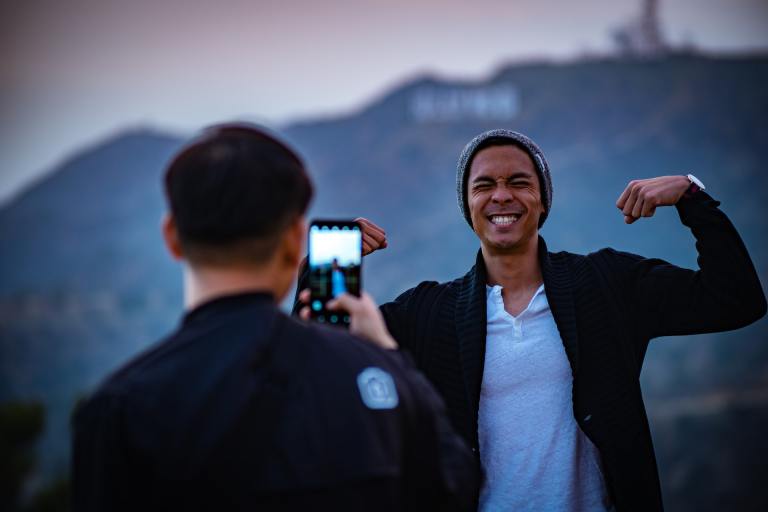
    A man holds a phone taking a photo of his friend who is smiling. They are in Los Angeles. The Hollywood sign is visible in the background, but unreadable because the background of the photo is very blurry.

    One of the best ways to get a new photo of yourself for your website is to ask a friend or family member to help.

    If you have a friend who is good at taking photos, great! You may not. That’s OK. What’s more important is that you have someone with you that you feel comfortable with.

    Set expectations by letting them know it may take a bit of time. That you want to try out different poses (or locations). Ask them to try taking photos at different angles. Try watching a YouTube video together about creative portrait photos with a phone.

    My best tip is to ask your friend to take photos holding the phone vertically and horizontally. That gives you flexibility with what you use the photos for.

    It’s possible that this photo shoot may not result in the photos you want. So don’t put too much pressure on your friend. Do encourage them to take lots of photos so you can choose the best ones. If you find photos you like in the set, ask your friend if they’d like to be credited as photographer when you share the photo online.

    The form above subscribes you to new posts published on The Social Academic blog.
    Want emails from Jennifer about building your online presence? Subscribe to her email list.
    Looking for the podcast? Subscribe on Spotify.
    Prefer to watch videos? Subscribe on YouTube.

    Hire a professional photographer

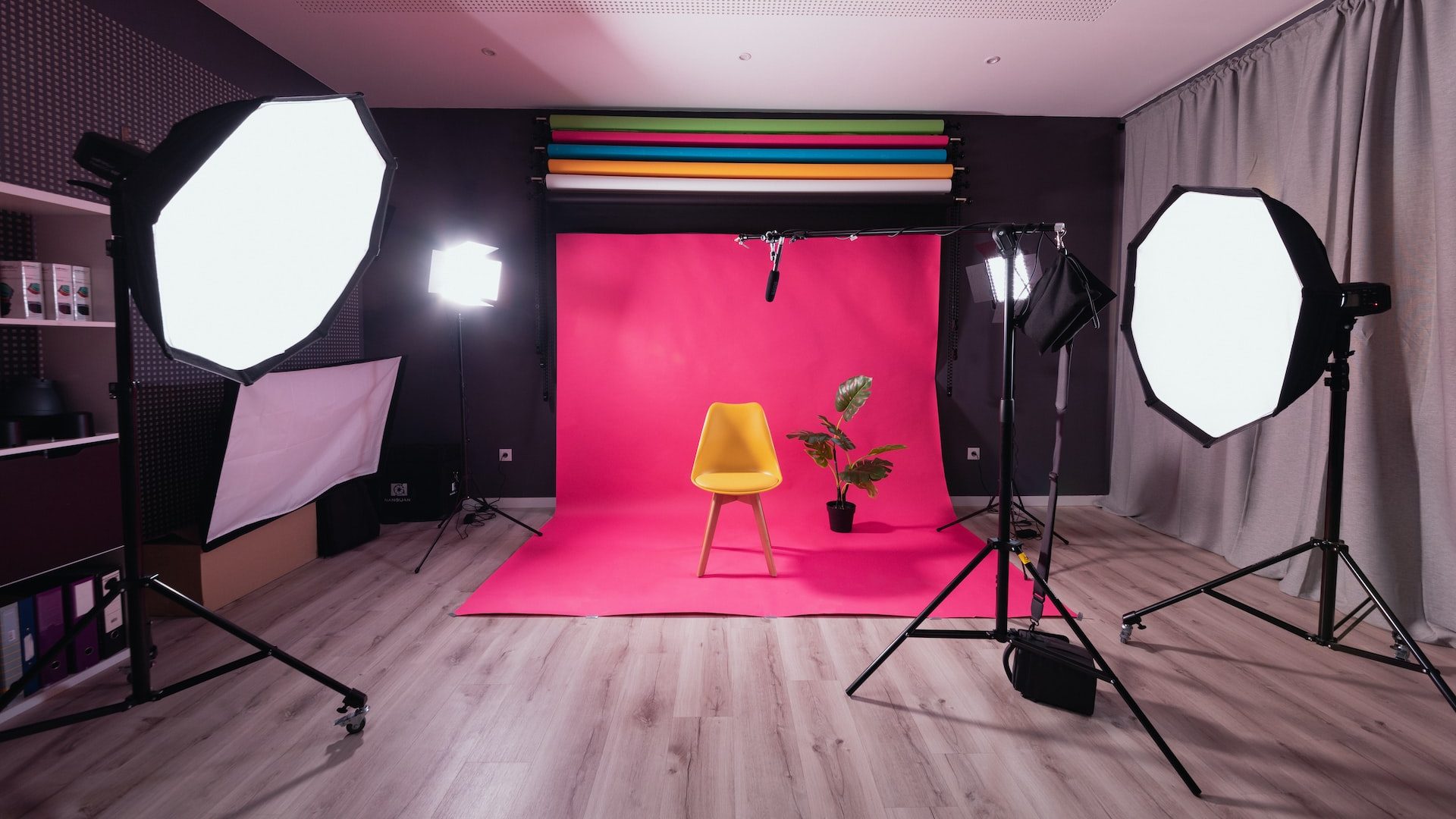
    Photography and video production studio with a yellow chair, plant, and pink backdrop. There are large lights on tripods.

    Hiring a professional portrait photographer is the best option. The mistake you want to avoid is asking for a headshot when booking your photo shoot.

    Professional photographers have the gear, skills, and experience to take your new website photos. If you can afford a professional photo shoot, it’s your best option. You want to hire an experienced local photographer.

    You may have a place to take your photos in mind. Professionals often include 1 location in your package, or shoot in their studio. Be sure to ask for their recommendations.

    Photographs are the intellectual property of the photographer. You’ll need to sign a contract or licensing agreement for permission to use the photos. Help ensure you get the right license by sharing how you want to use your photos when booking your shoot. Most photographers have professional liability insurance.

    You’re looking for a portrait photographer, not a headshot photographer. Be clear about how many photos you’re looking for, as your photographer may offer a ‘brand photo shoot’ or a ‘website photo package.’

    Portrait photographers can ranges from $100-$400/hour in the United States. Local Facebook groups are often an effective way to find recommendations for photographers in your area.

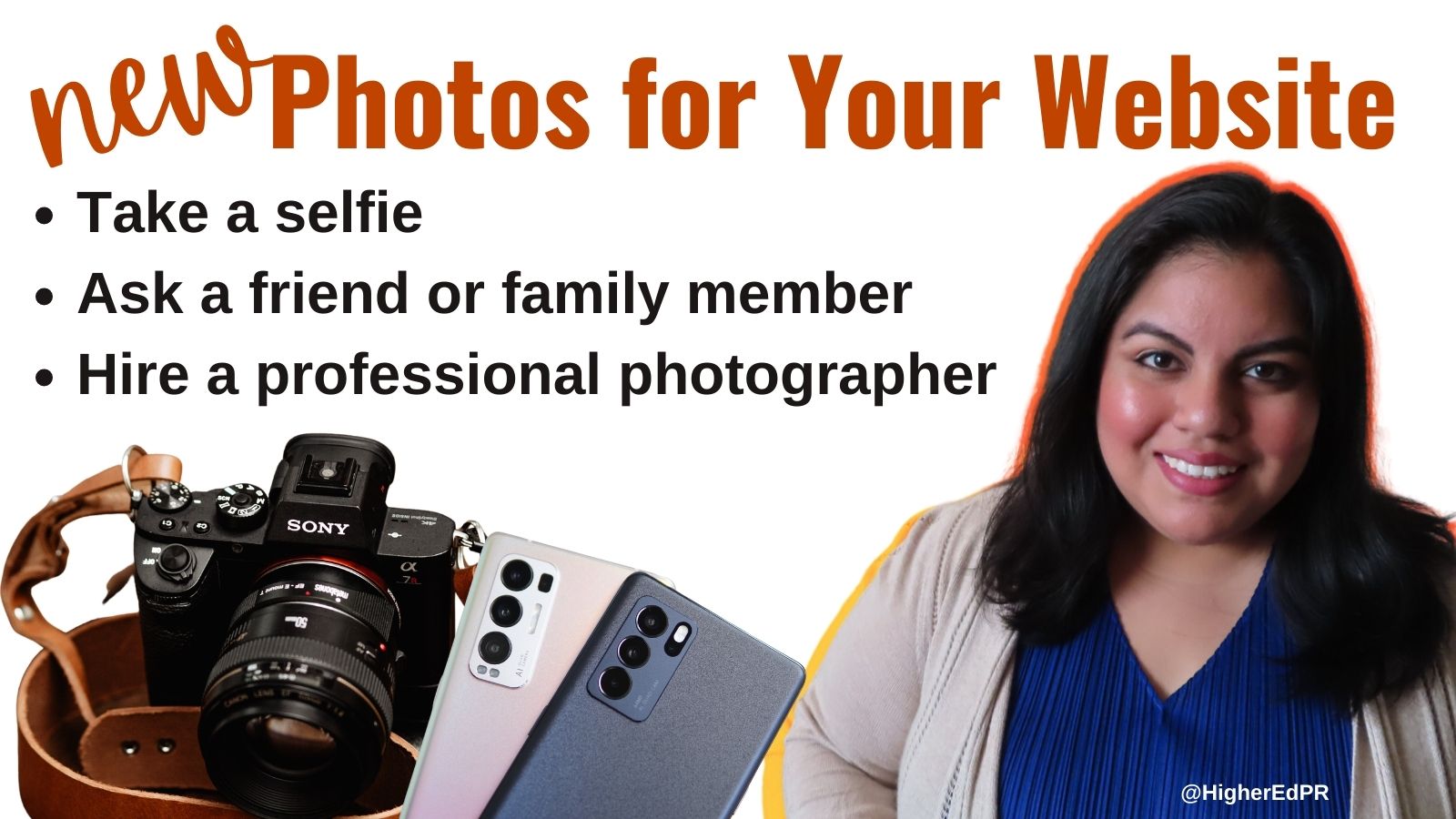
    Here are 3 ways to get new photos for your personal website

    A graphic for 'New Photos For Your Website' with tips including take a selfie, ask a friend for help, and hire a professional photographer. On the graphic are a cutout of a Sony professional camera, the backs of 2 cell phone cameras, and a selfie photo of Jennifer van Alstyne smiling.

    The form above subscribes you to new posts published on The Social Academic blog.
    Want emails from Jennifer about building your online presence? Subscribe to her email list.
    Looking for the podcast? Subscribe on Spotify.
    Prefer to watch videos? Subscribe on YouTube.

    My name is Jennifer van Alstyne. I’ve been helping professors make beautiful personal websites to share their research since 2018. I’d love to help you!

    Let’s talk on a no pressure Zoom call about working with me on your online presence and website.

    Personal Website How To’s The Social Academic
    Source link