Category: Featured

  • What does the post-16 education and skills white paper say about access and participation?

    What does the post-16 education and skills white paper say about access and participation?

    Author:
    Charlotte Armstrong

    Published:

    This blog was authored by Charlotte Armstrong, Policy Manager at HEPI.

    It is the second blog in HEPI’s series responding to the post-16 education and skills white paper. You can find the first blog here.

    Despite the post-16 education and skills white paper devoting an entire sub-section to ‘Improving Access and Participation’, the genuine challenges facing students receive minimal attention. The skills agenda within the Government is so strong that the paper frames students, and the student experience, in terms of their potential future contribution to the economy and regional growth. This results in little attempt to understand and address the student experience and the very real challenges that students are currently facing.

    A shift to the skills agenda

    The Lifelong Learning Entitlement (LLE) takes up several bullet points within this section of the paper. In fact, the decision to categorise the LLE under the heading of access provides an interesting insight into the Government’s broader approach to access and participation. Considering the LLE as a subsection of this initiative reframes the focus of access from entrance to higher education to employment outcomes and progression throughout a person’s life. This shift is an idea repeated throughout the white paper that dovetails with the Government’s skills agenda. It indicates that the Government views higher education as a means to add future value to the economy and a tool through which its Industrial Strategy can be furthered. This approach leaves little room for those subjects and disciplines that fall outside the strategy, let alone for learning for its own sake.

    Both modular LLE courses and the newly announced maintenance grants (as announced within the white paper, and previously at the Labour Party Conference) are available only to those studying courses that link to the Government’s wider Industrial Strategy. As may be easily guessed, this results in a list of subjects that largely dovetail with the science and technology sectors – arts and humanities subjects don’t get a look in. Tying maintenance grants to the study of pre-approved science subjects risks disincentivising students from low-income backgrounds from pursuing arts and humanities subjects – potentially entrenching bias and elitism within this sector, as well as furthering the narrative of ‘Mickey Mouse degrees’. As the costs of studying at university continue to rise, some prospective students will struggle to justify studying the subject of their choice if it means losing out on access to maintenance grants. Many of these excluded subjects are already in crisis – as the HEPI / Duolingo report The Language Crisis: Arresting Decline demonstrates, undergraduate enrolments in ‘Language & Area Studies’ have decreased by 20% in five years. Disincentivising students from taking these courses will surely only deepen this crisis further.

    These criticisms do not mean the LLE and the reintroduction of maintenance grants are bad policies. The latter is a particularly welcome development that has long been campaigned for by HEPI and the National Union of Students. However, the limited nature of their current form limits the positive impact they could otherwise have. While there is no current clarification on the precise threshold that will be placed on access to maintenance grants, the Government’s lack of movement on the parental income thresholds within the student finance system likely means only a very small number of students will be eligible.

    When first announcing this policy at the Labour Party conference, Education Secretary Bridget Phillipson claimed that the reintroduction of maintenance grants would ensure students spent their time at university ‘learning or training, not working every hour God sends’. This perhaps suggests that maintenance grants will be available in addition to, not instead of, the maintenance loan for those eligible students, although we keenly await the detail which will be outlined by the Chancellor in the upcoming Budget. However, this doesn’t solve the deepening financial crisis facing a large number of students in higher education – many of whom simply will not be eligible for the new maintenance grants.

    HEPI’s research into the Minimum Income Standard for Students highlights how the current maximum maintenance loan covers just half of the costs faced by freshers. Furthermore, the parental income threshold for eligibility for the maximum loan is currently so out of touch that a student from a household with a single parent earning just above the minimum wage will not be eligible for the maximum loan. The Government has sought to highlight that maintenance loans will increase in line with forecast inflation for every academic year, but this is merely a continuation of the current policy and will not address the financial crisis that many students face. Plus, forecast inflation tends to be lower than actual inflation. Similarly, the promise that care leavers will automatically become eligible to receive the maximum rate of loan is also a reiteration of a policy already in place. Care leavers (and estranged students) are classified as independent and therefore are eligible for the maximum loan. To reiterate, this maximum loan covers only half of the costs these students will face while at university.

    Postgraduate access

    The inclusion of postgraduate access in the white paper is a welcome addition – and an unsurprising one when considering how this white paper has framed access in terms of career progression and skills. However, once more, the inclusion of postgraduate students within access goals falls short due to a failure to address the root causes of the widening crises for home postgraduate students in England. Postgraduate taught tuition fees now exceed the maximum postgraduate loan – meaning that a student has used up their entire loan before even considering their cost of living.

    Instead of engaging with this, the paper encourages providers to include postgraduate study in their Access and Participation Plans (APP). This is, in itself, a positive development; however, without addressing the financial barriers faced by many prospective postgraduate students, this inclusion will have very limited impact.

    The access and participation section of the post-16 education and skills white paper provides an insight into how this Government conceives of these issues. However, the focus on students as future employees paints a worrying picture of a Government that is more concerned with next steps than with higher education itself.

    Source link

  • Young men are increasingly lonely and isolated. Could reading more to boys be the answer?

    Young men are increasingly lonely and isolated. Could reading more to boys be the answer?

    by JT Torres, The Hechinger Report
    October 28, 2025

    Young men in America today are feeling lonely and socially isolated. They are not going to college, entering the workplace or going on dates as often as young men did in prior generations.

    In my years teaching literacy, I’ve watched the lines on two graphs move in opposite directions: male loneliness climbs as male reading and writing scores drop. Are these trends correlated, and if so, can reading help address loneliness?

    Diminished friendships, reduced economic opportunities and the substitution of online interactions for face-to-face connections seem to particularly impact young men.

    Some 25 percent of U.S. men aged 15-34 felt lonely “a lot of the previous day,” compared to 18 percent of women in the same age group, a recent Gallup survey found. The same survey found that U.S. men are lonelier than their international counterparts.

    Overlaying this epidemic of loneliness is a literacy crisis that continues to deepen, evidenced by sharp declines in the 2024 NAEP results. Only 35 percent of high school seniors now read at or above proficiency, with reading scores 10 points lower than they were in 1992. The numbers reflect not just skill deficits but broader cultural shifts.

    Related: A lot goes on in classrooms from kindergarten to high school. Keep up with our free weekly newsletter on K-12 education.

    In the UK, a country with similar male loneliness rates, just 41 percent of parents with children under five read frequently to them, down from 64 percent in 2012, a 2024 Harper Collins UK survey found. The survey revealed even sharper reading drops for boys: Less than one-third from birth through the age of 2 were read to daily, compared to 44 percent of girls. Meanwhile, the number of American adolescent boys who read for fun has dropped to a historic low.

    Literacy instruction has not kept up with changes in the literacy landscape, and is failing to help students connect, think carefully and resist manipulation. Traditional reading and argument, for instance, have been dramatically replaced by memes and misinformation that spreads faster than anyone can correct it. Public discourse has become inflammatory rather than inquisitive, with half-quotes from podcasters and political pundits lobbed like verbal grenades.

    These two trends have serious social costs, and may reinforce each other. Data show, for example, that as young men fall behind in education, they become increasingly attracted to conspiratorial thinking and political radicalization.

    Combining a lack of critical reading skills and habits with an unsatisfied need to bond, to connect and to belong results in an emotional feedback loop, driving young men into spaces designed to persuade or recruit rather than inform.

    Related: Behind the latest dismal NAEP scores

    Thus, while it is tempting to treat literacy and male loneliness as separate issues, research demonstrating the social benefits of reading to children offers interesting connective tissue. Neuroscience research confirms, for example, that reading aloud activates brain regions associated with both language processing and social bonding. Respondents to an international survey described reading as a method for maintaining social connection.

    Young boys need these benefits at this very moment.

    That is why I strongly believe that one simple way we can and should address these trends is to inspire interest in reading among boys.

    Parents, teachers, guardians, siblings and anyone who takes care of children should read to and with them. Longstanding cultural norms reward girls for reading but not boys. Literacy needs to be framed not as a gendered expectation or duty but as a relational ritual.

    Schools need to do more than prepare students for literacy tests; they should create formal spaces to enjoy reading, including book clubs, intergenerational reading groups and classes which show that reading is not a solitary grind but a communal act. The solution I propose is fairly cheap, carries no risk and is backed by evidence: Treat reading as the most important social experience children can have.

    JT Torres is director of the Harte Center for Teaching and Learning at Washington and Lee University.

    Contact the opinion editor at [email protected].

    This story about male reading and loneliness was produced by The Hechinger Report, a nonprofit, independent news organization focused on inequality and innovation in education. Sign up for Hechinger’s weekly newsletter.

    This <a target=”_blank” href=”https://hechingerreport.org/opinion-young-men-are-increasingly-lonely-isolated-and-reading-less/”>article</a> first appeared on <a target=”_blank” href=”https://hechingerreport.org”>The Hechinger Report</a> and is republished here under a <a target=”_blank” href=”https://creativecommons.org/licenses/by-nc-nd/4.0/”>Creative Commons Attribution-NonCommercial-NoDerivatives 4.0 International License</a>.<img src=”https://i0.wp.com/hechingerreport.org/wp-content/uploads/2018/06/cropped-favicon.jpg?fit=150%2C150&amp;ssl=1″ style=”width:1em;height:1em;margin-left:10px;”>

    <img id=”republication-tracker-tool-source” src=”https://hechingerreport.org/?republication-pixel=true&post=113065&amp;ga4=G-03KPHXDF3H” style=”width:1px;height:1px;”><script> PARSELY = { autotrack: false, onload: function() { PARSELY.beacon.trackPageView({ url: “https://hechingerreport.org/opinion-young-men-are-increasingly-lonely-isolated-and-reading-less/”, urlref: window.location.href }); } } </script> <script id=”parsely-cfg” src=”//cdn.parsely.com/keys/hechingerreport.org/p.js”></script>

    Source link

  • Only radical thinking will deliver the integrated tertiary system the country needs

    Only radical thinking will deliver the integrated tertiary system the country needs

    The post-16 white paper was an opportunity to radically enable an education and skills ecosystem that is built around the industrial strategy, and that has real resonance with place.

    The idea that skills exist in an entirely different space to education is just wrongheaded. The opportunity comes, however, when we can see a real connection, both in principle and in practice, between further and higher education: a tertiary system that can serve students, employers and society.

    Significant foundations are already in place with the Lifelong Learning Entitlement providing sharp focus within the higher education sector and apprenticeships, now well established, and well regarded across both HE and FE. Yet we still have the clear problem that schools, FE, teaching in HE, research and knowledge transfer are fragmented across the DfE and other associated sector bodies.

    Sum of the parts

    The policy framework needs to be supported by a major and radical rethink of how the parts fit together so we can truly unlock the combined transformational power of education and innovation to raise aspirations, opportunity, attainment, and ultimately, living standards. This could require a tertiary commission of the likes of Diamond and Hazelkorn in the Welsh system in the mid-2010’s.

    Such a commission could produce bold thinking on the scale of the academies movement in schools over the last 25 years. The encouragement to bring groups of schools together has resulted in challenge, but also significant opportunity. We have seen the creation of some excellent FE college groups following an area-based review around a decade ago. The first major coming together of HE institutions is in train with Greenwich and Kent. We have seen limited pilot FE/HE mergers. Now feels like the right time for blue sky thinking that enables the best of all of those activities in a structured and purposeful way that is primarily focused on the benefits to learning and national productivity rather than simply financial necessity.

    Creating opportunities for HE, FE and schools to come together not only in partnerships, but in structural ways will enable the innovation that will create tangible change in local and regional communities. All parts of the education ecosystem face ever-increasing financial challenge. If an FE college and a university wished to offer shared services, then there would need to be competitive tender for the purposes of best value. This sounds sensible except the cost of running such a process is high. If those institutions are part of the same group, then it can be done so much more efficiently.

    FE colleges are embedded in their place and even more connected to local communities. The ability to reach into more disadvantaged communities and to take the HE classroom from the traditional university setting, is a distinct benefit. The growth in private, for-profit HE provision is often because it has a great ability to reach into specific communities. The power of FE/HE collaboration into those same communities would bring both choice and exciting possibility.

    While in theory FE and HE can merge through a section 28 application to the Secretary of State, the reality is that any activity to this point has been marginal and driven by motivation other than enhanced skills provision. If the DfE were to enable, and indeed drive, such collaboration they could create both financial efficiencies and a much greater and more coordinated offer to employers and learners.

    The industrial strategy and the growth in devolved responsibility for skills create interesting new opportunities but we must find ways that avoid a new decade of confusion for employers and learners. The announcement of new vocational qualifications, Technical Excellence Colleges and the like are to be welcomed but must be more than headlines. Learners and employers alike need to be able to see pathways and support for their lifelong skills and learning needs.

    Path to integration

    The full integration of FE and HE could create powerful regional and place-based education and skills offers. Adding in schools and creating education trusts that straddle all levels means that employers could benefit from integrated offers, less bureaucracy and clear, accelerated pathways.

    So now is the moment to develop Integrated Skills and Education Trusts (ISET): entities that sit within broad groups and benefit from the efficiencies of scale but maintaining local provision. Taking the best of FE, understanding skills and local needs and the best of HE and actively enabling them to come together.

    Our experience at Coventry, working closely and collaboratively with several FE partners, is that the barriers thrown up within the DfE are in stark and clear contrast to the policy statements of ministers and, indeed, of the Prime Minister. The post-16 white paper will only lead to real change if the policy and the “plumbing” align. The call has to be to think with ambition and to encourage and enable action that serves learners, employers and communities with an education and skills offer that is fit for the next generation.

    Source link

  • Everyone cares until someone asks for a statute

    Everyone cares until someone asks for a statute

    Parliament will soon return to the question of a statutory duty of care in higher education, because the first debate did not deliver the clarity or action that was needed.

    The Post-16 education and skills white paper flags the issue – noting that a new Higher Education Student Support Champion will work to address the recommendations from the National Review into Higher Education Student Suicides.

    More than three university students in England and Wales die by suicide every week. The duty to protect students from reasonably foreseeable harm is long overdue. Voluntary measures and optional good practice are no substitute for a clear legal duty.

    The first parliamentary debate on this issue, held in 2023, left a crucial question unanswered – what does “duty of care” actually mean, and why do so many people believe universities already have one?

    Every conversation about “duty of care” in higher education eventually runs into confusion. Some say universities already have one. Others insist they don’t. Both sound right – and both can’t be wrong. The problem is that “duty of care” means very different things depending on who’s speaking.

    For families, it’s a promise of protection. For universities, it’s a matter of professional judgment. For lawyers, it’s a term of art – a legal threshold that decides whether the law even applies when harm occurs. But there’s a simple way to make sense of it – by borrowing a shape from soil science.

    So as MPs prepare to revisit the issue, here I’ve set out a way to understand the debate in visual form – through what I’ve called the Legal Duty of Care Triangle. It shows, at a glance, why legal definitions, government policy, and public expectation have drifted so far apart – and why that gap matters now more than ever.

    The concept

    A ternary diagram is a triangular graph used to represent systems with three components that sum to a constant, typically 100 per cent. While traditionally employed in the physical sciences – in chemistry, geology or soil classification – to show compositional data, it can also be a powerful conceptual model for non-scientific problems.

    By using the three corners of a triangle to represent three competing factors, we can visualise the balance between them and the resulting outcome.

    The same idea can explain the legal concept of duty of care. Imagine a triangle whose corners are labelled “making things worse,” “doing nothing,” and “making things better.” Every decision, omission or intervention made by an institution can be plotted somewhere within that space. The position tells you what kind of care – or lack of care – is at play, and whether the law of negligence currently recognises it.

    Acts, omissions and the Tindall judgment

    The distinction between acts and omissions runs through English law. Courts are willing to impose liability for acts that cause harm, but rarely for failures to act, even when the need for intervention was obvious.

    The Supreme Court reaffirmed this in Tindall v Chief Constable of Thames Valley Police [2024] UKSC 44, describing the difference between “making things worse” and “failing to make things better.” The law punishes the first but usually overlooks the second, unless a “special relationship” creates a specific obligation to act.

    That single distinction explains why so many student cases – including Abrahart v University of Bristol (Court of Appeal, 2024) – fail to establish a general duty of care. The courts accept that mistakes were made, and even that harm was foreseeable, but can decline to impose liability by characterising the university’s failings as “pure omissions”, not actions that “made things worse.”

    In the conceptual model, the three corners of the triangle represent three strategic approaches an institution might take when faced with foreseeable risk:

    • Making things better – Proactive action. Taking reasonable and timely steps to prevent foreseeable harm. This might include implementing sound procedures, addressing emerging risks, and responding appropriately when warning signs are clear.
    • Making things worse – Negligent action. Acts or decisions that foreseeably create or aggravate harm — for example, ignoring evidence, mishandling complaints, or enforcing policies that intensify vulnerability or risk.
    • Doing nothing – Passive inaction. A failure to act when an institution knows, or ought reasonably to know, that intervention is required. Courts are generally reluctant to impose broad affirmative duties, but complete inaction in the face of foreseeable harm can potentially still give rise to liability under existing legal frameworks such as negligence or equality law.

    The triangle shows how these behaviours relate to one another.

    • At the bottom left lies making things worse – acts of commission that cause harm.
    • At the bottom right, doing nothing – omissions or institutional inertia.
    • At the top, making things better – protective, preventive steps taken with reasonable care.

    The law, as it stands, occupies mainly the lower portion of the triangle. It is most comfortable along the base, where harmful acts are distinguished from mere inaction. The upper space – proactive prevention – sits largely outside the common-law field.

    Cause, not prevent

    One organisation sits in a particularly revealing place on the triangle – Universities UK (UUK).

    Unlike the Department for Education or the courts, UUK has consistently described universities as already having a common law “general duty of care.” At first glance, that sounds like agreement with campaigners – but it isn’t.

    What UUK actually means is a general duty not to cause harm through acts or omissions. It’s a subtle but crucial difference. It is referring to a reactive duty – one concerned with causation of harm, not prevention of reasonably foreseeable harm.

    For example, if an institution takes a clear and identifiable act — such as issuing incorrect information, mishandling a process, or withdrawing essential support — and that conduct foreseeably causes or worsens harm, the law may treat the situation as one of direct causation.

    If the institution then fails to correct or mitigate the error once aware of it, that omission becomes part of the same chain of causation.In such cases, the duty extends to omissions only when they form part of that chain, not where the institution simply fails to prevent a wider or unrelated risk..

    In legal terms, this remains a negative duty (to avoid causing harm), not a positive duty (to take steps to prevent it). It recognises that omissions can sometimes “cause” harm where there’s a direct link, but it doesn’t impose any obligation to foresee and prevent it.

    That distinction between cause and prevent defines UUK’s unique position. It sits within the existing boundaries of common law because it focuses on reactive duties — those that arise only when harm has already been caused.

    This is the source of much public confusion: UUK uses the language of care to describe a legal concept concerned solely with causation.

    The result is a comforting vocabulary that sounds protective but, in practice, stops at the point of legal liability.

    When UUK says that universities already have a duty of care, it means a duty not to make things worse, rather than a duty to make things better. The same words – but different worlds.

    Responsibility without liability

    The original petition did not ask for improved guidance or voluntary measures. It called for a statutory legal duty of care – a clearly defined obligation in law requiring universities to take reasonable steps to protect students from foreseeable harm.

    Yet when the government issued its 2023 petition response, it appeared to suggest that such a duty already existed. The statement claimed that universities “already have a general duty of care to not cause harm to their students” and “are expected to act reasonably to protect the health, safety and welfare of their students”. Language that sounded legal but was not.

    At that stage, the Department for Education (DfE) was describing something closer to an ethical or moral responsibility – a general expectation that institutions should act responsibly – while borrowing the vocabulary of law. It gave the public the reassurance of legal certainty without any of its substance. The explicit legal framing emerged only later.

    In response to a Parliamentary Question tabled shortly before the Westminster Hall debate, Minister Robert Halfon used the phrase “law of negligence.”

    This was the first time the Department had explicitly tied its earlier petition response to that legal doctrine, implying that it had always referred to common-law principles. From that point onward, this became the Department’s preferred line – not as clarification, but as post-hoc justification.

    Then, in early 2025, Janet Daby MP, Minister for Children, Families and Wellbeing in the Department for Education (DfE). appeared to reset the conversation. In a Parliamentary Question response she acknowledged that a duty of care may arise in certain circumstances, but that this would be a matter for the courts to determine. This was a noticeable change in tone – a more candid admission that no general legal duty exists and that the issue remains legally unsettled.

    Her statement offered welcome clarity after years of obfuscation, though it still stopped short of committing the Department to legislative reform.

    The same careful phrasing was subsequently used in a formal letter from the Department dated 16 July 2025, confirming that this “reset” had become its official position:

    A duty of care in higher education may arise in certain circumstances. Such circumstances would be a matter for the courts to decide… The common law allows flexibility, without the potential rigidity that may arise from codifying a statutory duty.

    The evolution reveals rhetorical movement but positional continuity.

    The Department has, in reality, always occupied the same place – outside the legal boundary of the triangle, in the zone of responsibility without liability. What changed was not the position itself but the language used to describe it.

    The 2023 response disguised that position through legal-sounding reassurance; the 2025 reset finally admitted what had been true all along — that no general legal duty exists and that the matter rests with the courts. In other words, DfE continues to speak of care, support and best practice, but refuses to define those commitments in law.

    When the risk is radicalisation, the government imposes a statutory Prevent Duty, but when the risk is harm to students, it hides behind the flexibility of common law.

    The real world

    Once the triangle exists, it becomes possible to plot where each actor sits – and, crucially, what that reveals about how they understand “duty of care.”

    At the bottom centre sit the courts, which define the legal floor of responsibility. Their judgments focus on causation, proximity, and foreseeability – deciding whether an act or omission was sufficiently connected to the harm suffered to give rise to a duty.

    They don’t occupy either corner of the base because they navigate between them – recognising liability for acts that make things worse, but rarely for omissions that cause or contribute to the problem, or simply fail to make things better.

    Their position therefore represents the balancing point of the common law – the threshold where duty ends and moral expectation begins.

    Along that same base lies UUK, which has translated the courts’ caution into sector orthodoxy. UUK’s “general duty not to cause harm” adopts the courts’ reasoning as a policy principle – treating the lower boundary of the triangle as the full extent of universities’ obligations. In effect, the courts define the boundary, and UUK defends it.

    Moving rightwards along the base, universities sit midway between the courts and the “doing nothing” corner, invoking autonomy and professional judgment to argue that support and intervention are matters of discretion rather than law.

    Then just outside that edge sits the Department for Education, which talks in moral terms of “responsibility” and “care” but refuses to anchor those ideas in law. It operates in the space of responsibility without liability.

    Above them all, beyond the apex marked “making things better,” lies public expectation – the belief that institutions should act to prevent foreseeable harm, not merely avoid causing it.

    This moral position sits outside the present legal framework but defines the social direction of travel.

    Between these two levels – between the courts’ current legal boundary and the moral high ground of public expectation – lies the proposed statutory duty of care.

    It would still sit along the base axis of law, midway between making things worse and doing nothing, but it would rise vertically within the triangle – recognising that the law must not only avoid harm but also act to prevent it where reasonably foreseeable, just as Parliament has already required through the Prevent Duty.

    In that sense, a statutory duty would lift the legal threshold upward, not outward – retaining the structure of the common law but extending its reach to address public expectation.

    The triangle naturally narrows as it rises. In legal terms, that tapering reflects how rarely the courts recognise proactive duties. A statutory duty of care would not alter the shape of the triangle but would raise the level at which the law operates, making what is now exceptional – acting to prevent harm – part of the ordinary standard of care.

    Drawing the line

    The Legal Duty of Care Triangle is not just a visual aid, it’s a question. Every dot on it represents a choice about where responsibility should sit – inside or outside the field of law.

    Parliament now faces that same choice. The forthcoming debate is not about whether universities should care for their students – everyone agrees they should. It is about whether that care should be accountable.

    Placing the point inside the triangle would mean recognising a statutory legal duty of care – a defined obligation that lifts the existing common-law threshold so that institutions must take reasonable steps to prevent foreseeable harm. It would introduce a clear standard of accountability, giving students and families a route to justice when that standard is not met.

    Placing the point outside the triangle leaves the status quo intact – a landscape of guidance, codes, and voluntary commitments that sound caring but lack consequence when breached. It maintains responsibility without liability – expectation without enforcement.

    That is the question before Parliament. Where should the point be placed? Inside the triangle, where care carries accountability – or outside, where it does not?

    The triangle invites everyone – not just lawyers or policymakers – to think about where they believe accountability should begin. It is less about identifying where universities are and more about asking where they should be in terms of legal accountability.

    For a university that sees its role purely as educational delivery, the point may hover near the base – within the comfort zone of “doing nothing” unless compelled. But that is the vending machine model of higher education – inputs go in, outputs come out, but no awareness or responsibility exists between the two.

    When things go wrong, the machine insists it functioned as designed – and no one accepts responsibility for the harm that results.

    For institutions that recognise their wider duty to protect students from reasonably foreseeable harm, the point moves upward, toward “making things better.”

    The purpose of our campaign is not to redraw the triangle but to raise the floor – bringing the baseline of law closer to where most people assume it already stands.

    A statutory duty of care would not expand the triangle. It would ensure that its foundation reflects modern expectations of safety, fairness, and accountability in higher education.

    What that duty would look like in practice – the mechanisms, policies, and safeguards that would follow are arguments for another day.

    The purpose here is simpler – to define the space where that conversation must take place – inside the triangle, where duty carries accountability.


    Source link

  • $1.2B Fine, Nix Trans Athlete Wins, More

    $1.2B Fine, Nix Trans Athlete Wins, More

    Juliana Yamada/Los Angeles Times/Getty Images

    The details of the Trump administration’s demands on the University of California, Los Angeles—in addition to the previously reported $1.2 billion payout the federal government asked for—have finally been revealed. A lawsuit by UC faculty unions forced the higher ed system to release a copy of a draft resolution agreement, shedding light on the terms UC was first faced with nearly three months ago.

    The Trump administration has demanded, among other things, that UCLA not enroll “foreign students likely to engage in anti-Western, anti-American, or antisemitic disruptions or harassment.” In the same paragraph, the proposed resolution agreement says UCLA would have to “socialize international students to the norms of a campus dedicated to free inquiry and open debate.”

    The federal government also demanded that UCLA ban overnight campus demonstrations and mandate that masked campus protesters reveal their identities when asked.

    Multiple provisions aim to limit transgender individuals’ rights. The document demands that UCLA’s medical school and affiliated hospitals stop “performing hormonal interventions and ‘transgender’ surgeries” on anyone under 18; stop allowing transgender women to play on women’s sports teams; strip records, awards and other recognition from transgender women athletes; and send personal apologies to the cisgender women who placed lower than trans athletes.

    California voters banned affirmative action in public education nearly 30 years ago, but the demand letter suggests the Trump administration doesn’t think UCLA has complied. It would require UCLA to bar providing “information about candidates’ race, sex, ethnicity, or other protected characteristics to faculty or other UCLA personnel with decision-making authority over hiring, retention, promotion or tenure.”

    Other provisions target affirmative action in hiring and student admissions, including a line that says, “UCLA shall discontinue race- and ethnicity-based scholarships.” The proposed agreement says “proxies used to effectuate race-based or sex-based outcomes” aren’t allowed in selecting for fellowship programs and also bans the use of such undefined proxies in hiring and admissions.

    The document’s release comes after UC said in early August that it would negotiate with the federal government, citing the estimated $584 million in funding that at least three different federal agencies had announced they were suspending. That funding freeze followed a July 29 letter to UC from the Department of Justice, which said its months-long investigations across the system had so far concluded that in its response to a pro-Palestinian protest encampment in spring 2024, UCLA violated the equal protection clause of the 14th Amendment and Title VI of the Civil Rights Act of 1964.

    It was yet another example of the Trump administration accusing a selective university of tolerating antisemitism and cutting off hundreds of millions of federal dollars. But, unlike Harvard and Columbia Universities, UCLA is a public institution, and its targeting by the federal government represents an expansion of the administration’s campaign to overhaul higher ed.

    Last week, the University of Virginia became the first known public institution to settle with the administration over discrimination allegations. That settlement didn’t require a payout, but among other things, UVA committed to not use proxies for race; to end all diversity, equity and inclusion programming; and to prohibit trans athletes from participating in sports.

    Media earlier reported some of the administration’s demands on UCLA, but university officials didn’t make the details public until Friday, when a lawsuit by the UCLA Faculty Association and Council of UC Faculty Associations forced them to.

    “Accession to these demands would be to undermine everything that has made the UC the successful engine of social mobility and economic might that it has been for our state,” Anna Markowitz, president of the UCLA Faculty Association, wrote in an email. “It will harm undergraduate learning opportunities, and hamper UC’s ability to be a scholarly leader on the international stage. It enshrines ideology at the heart of the institution rather than decades of empirical and scholarly understanding. We stand against this extortion effort.”

    Markowitz said the “UCLA FA and CUCFA have stood with our union colleagues in calling for no negotiations since the beginning.” The university administration “is under intense federal pressure,” she said, and she urged them to resist—“particularly because other faculty legal action has resulted in the restoration of nearly all of the temporarily suspended federal grants.”

    Indeed, Stett Holbrook, a UC spokesperson, wrote in an email to Inside Higher Ed Monday that “as for terminated federal research funds, that figure is in the tens of millions”—a far cry from the August estimate of $584 million.

    He provided a statement saying, “UC has been clear it must evaluate its response to the administration’s settlement proposal that, like all settlement communications, is confidential. As stated previously, the proposed $1.2 billion settlement payment alone would derail work that saves lives, grows our economy, and fortifies our national security. UC remains committed to protecting the mission, governance, and academic freedom of the University.”

    White House and DOJ officials didn’t respond to requests for interviews Monday or answer written questions.

    Source link

  • Private New York colleges get $50M in state financing for capital projects

    Private New York colleges get $50M in state financing for capital projects

    This audio is auto-generated. Please let us know if you have feedback.

    Dive Brief:

    • New York is contributing $49 million in capital grants to 35 of the state’s private nonprofit colleges to help fund upgrades to facilities, build new labs and research spaces, and invest in new technology and equipment. 
    • The state’s Higher Education Capital Matching Grant Program — led by a three-person board composed of political appointees — last week awarded grants ranging from tens of thousands of dollars to $5 million, New York Gov. Kathy Hochul announced on Friday.
    • Under the 20-year-old program, eligible colleges must invest $3 of their own money for every $1 of public funds. The next round of applications for projects is set to open in mid-December.

    Dive Insight:

    Since 2005, HECap has directed $369.8 million in state funding toward over 300 projects at private nonprofit colleges in New York, the governor’s office said. 

    The program makes the state a financial partner for private colleges, many of which were established well before the 1948 creation of the State University of New York system. 

    After a more than yearlong application process, the state’s HECap Board approved the latest round of projects at an Oct. 20 meeting. Colleges can use the funds to design, acquire, build, rebuild, renovate or equip buildings. Selected projects are meant to support a college’s academic offerings or student life, as well as to drive economic development in the state.

    These projects stand for our ongoing commitment to keeping New York at the forefront of education and economic opportunity,” Hochul said in a Friday statement

    The current round of combined public and institutional funds represents a $195 million capital investment in independent higher education facilities, according to Hochul’s office. 

    The grants cover a wide range of amounts to nearly three dozen institutions, including:

    • $1.8 million to Albert Einstein College of Medicine for renovations to a commons area and recreation center. 
    • $5 million to Clarkson University for the first phase of renovations to an engineering and science complex.
    • $69,800 to Maria College to purchase and install technological equipment. 
    • $1.8 million to Cornell University to build a large classroom space in a library.
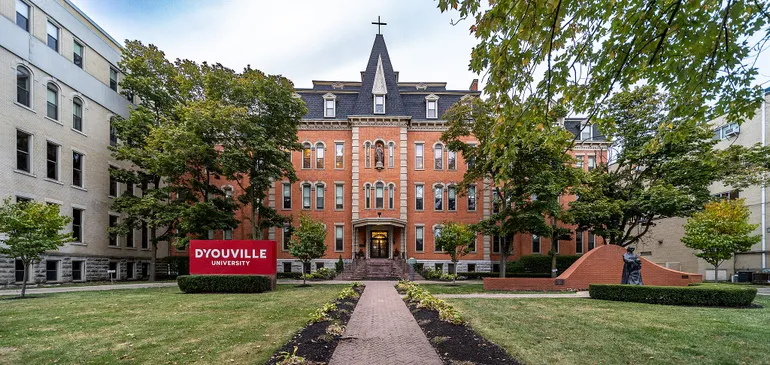
    • $5 million to D’Youville University for renovations to a facility supporting its osteopathic medicine college. 
    • $5 million to Hobart and William Smith Colleges for construction of a new science building and renovation of three adjacent facilities.
    • $1.8 million to the Rochester Institute of Technology to upgrade its electrical infrastructure. 
    • $1.6 million to Sarah Lawrence College to create an experiential learning center.

    New York’s continued public financing of capital projects comes while colleges across the country wrestle with sizable backlogs of deferred maintenance and facilities needs, many left over from the pandemic era as institutions put off those investments.

    Last year, analysts with Moody’s Investor Service estimated a “hidden liability” of deferred maintenance needs at colleges potentially amounting to nearly $1 trillion — and just among the roughly 500 institutions Moody’s rated at the time. 

    Rising costs, high interest rates and financial pressures can make those needs all the more difficult to meet.

    Few have the necessary resources and credit strength to sustain the higher amounts needed to tackle the full extent of their infrastructure needs,” Moody’s analysts said in their report. Colleges that can’t afford upgrades face recruitment risks in enrollment and staff talent as buildings continue to deteriorate. 

    The backlog of projects is so large that capital spending increases on existing facilities have served only to slow the growth of unmet need, according to a report earlier this year from the building intelligence firm Gordian.

    Source link

  • FIRE SURVEY: Colleagues and faculty unions fail to defend scholars targeted for speech

    FIRE SURVEY: Colleagues and faculty unions fail to defend scholars targeted for speech

    “I was afraid to leave my home for several weeks. I was afraid for the safety of my children. I received death threats.”

    “I was vomiting throughout the day, couldn’t eat, was having constant panic attacks, couldn’t be around people or leave the house . . .”

    “I was getting violent threats via email every day . . . The police were doing daily drive-bys because so many people threatened me with violence.”

    PHILADELPHIA, Oct. 28, 2025 — These are just some of the harrowing first-person accounts collected by the Foundation for Individual Rights and Expression in “Sanctioned Scholars: The Price of Speaking Freely in Today’s Academy,” a new survey of scholars who have been targeted for any protected speech since the beginning of the decade.

    “Cancellation campaigns are often wrapped in the language of preventing ‘emotional harm,’” said FIRE’s Manager of Polling and Analytics Nathan Honeycutt. “But our survey shows that it’s the mobs themselves that inflict lasting mental anguish on academics, many of whom still suffer the consequences long after the controversy subsided.”

    FIRE reached out to the over 600 academics listed in its Scholars Under Fire database who were sanctioned or targeted between 2020 and 2024, of whom 209 completed our survey. (FIRE’s survey was conducted before the Sept. 10 assassination of Charlie Kirk, which was followed by nearly a hundred scholars being targeted, over a dozen fired, and 2025 emerging as a new record high.)

    Nearly all (94%) who participated in the survey described the impact of their experience as negative. Roughly two-thirds (65%) experienced emotional distress, and significant chunks reported facing harrowing social setbacks, such as being shunned at work (40%) or lost professional relationships (47%) and friendships (33%).

    For some, the consequences were severe. About a quarter of the scholars who completed the survey reported that they sought psychological counseling (27%), and 1 in 5 lost their jobs entirely (20%).

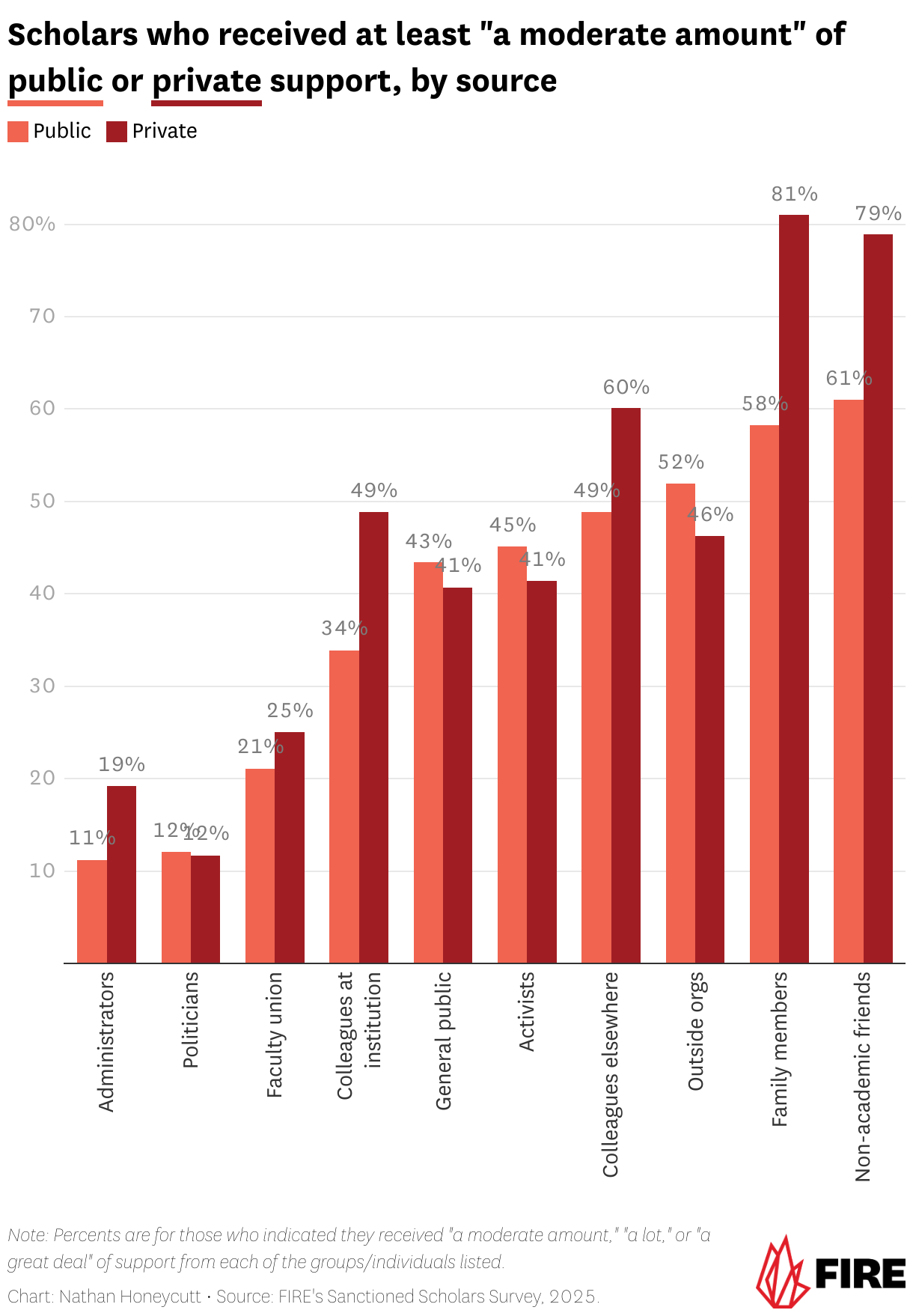
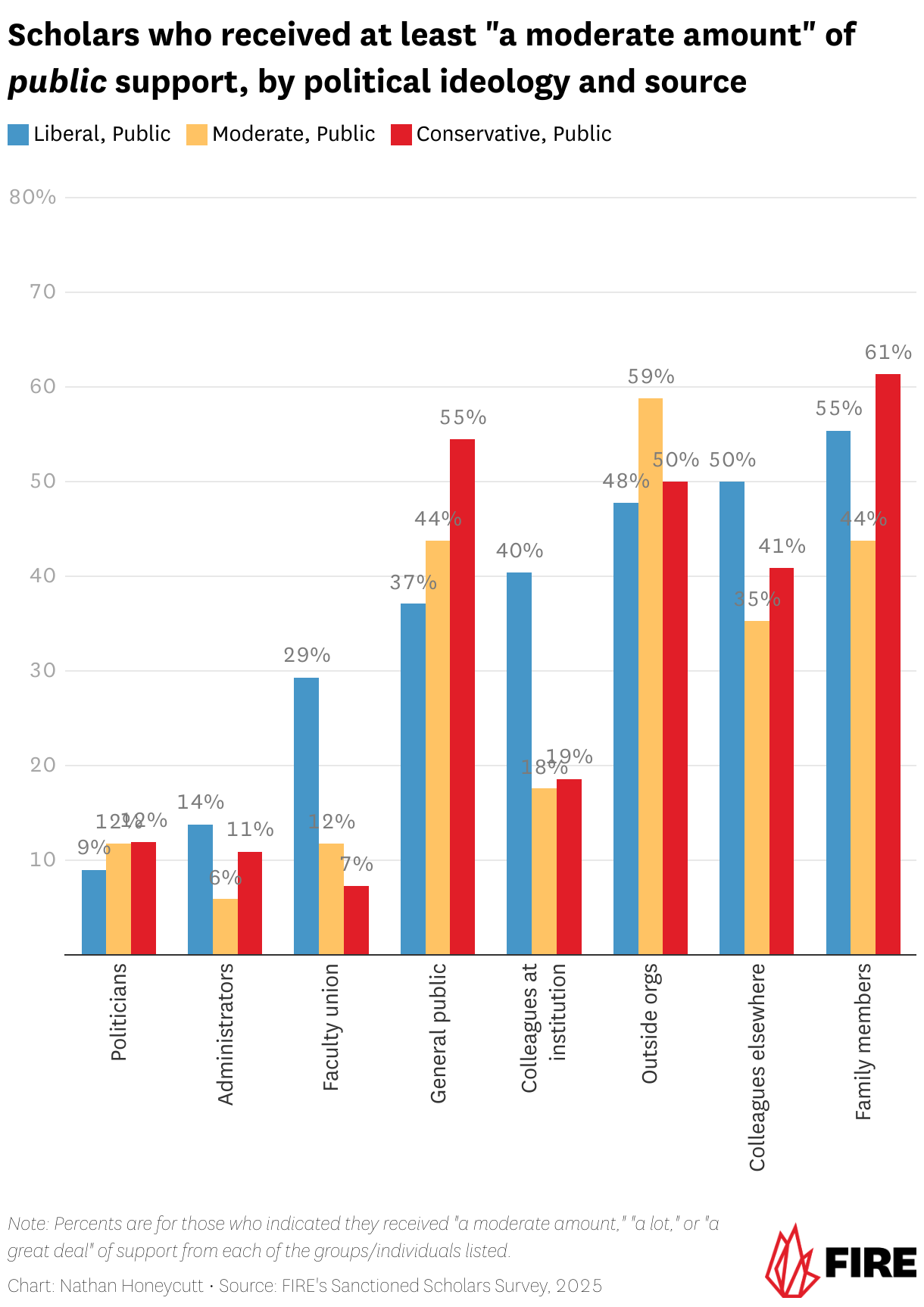
    Nearly all institutions of higher learning promise academic freedom and free speech rights to their scholars. But many of the targeted scholars reported that they received no support from precisely the institutions and individuals who were supposed to have their backs in moments of crisis and controversy. Only 21% reported that they received at least a moderate amount of  public support of their faculty union, for example, and a paltry 11% reported that they received public support from administrators.

    Tellingly, colleagues felt more comfortable supporting the targeted scholars privately rather than publicly. Just under half of scholars received at least a moderate amount of private support from colleagues (49%), but only about a third (34%) received their support publicly.

    Grouped column chart

    In their open-ended responses to FIRE’s survey, many scholars reported that this was their deepest wound: the public silence and abandonment by their peers. “My biggest disappointment was in the cowardice of other faculty who refused to do anything public on my behalf,” one professor wrote.

    “Free speech advocates have long argued that acts of censorship don’t just silence one person,” said Honeycutt. “They chill the speech of anyone who agrees with them, and even those who disagree but are too cowed to defend their right to speak. Our report shows that the academy urgently needs courageous faculty willing to stand up for their colleagues, even when doing so is difficult or unpopular.”

    FIRE’s report also found a noticeable partisan gap in the level of public support reported by scholars. Larger proportions of conservative than liberal faculty reported that they received support from the general public (55% vs. 37%). But far fewer than their liberal peers reported that they received public support from their faculty union (7% vs. 29%) or their university colleagues (19% vs. 40%).

    Grouped column chart

    “Support for academic freedom should never depend on the views being expressed, but our survey shows that’s exactly what’s happening,” said FIRE Research Advisor Sean Stevens. “If faculty unions and institutions of higher learning won’t stand by scholars in their moments of crisis, they can’t claim to stand for free speech and inquiry.”

    The Scholars Under Fire survey was fielded from Jan. 15 to April 15, 2025. A total of 635 scholars were invited to participate in this study, and 209 participated. The scholars recruited were individuals listed in FIRE’s Scholars Under Fire Database because they experienced a sanction or sanction attempt between 2020 and 2024. Participation in the survey was anonymous to encourage candid responses without fear of personal consequence, and to allow participants to speak more freely about their experiences.


    The Foundation for Individual Rights and Expression (FIRE) is a nonpartisan, nonprofit organization dedicated to defending and sustaining the individual rights of all Americans to free speech and free thought—the most essential qualities of liberty. FIRE recognizes that colleges and universities play a vital role in preserving free thought within a free society. To this end, we place a special emphasis on defending the individual rights of students and faculty members on our nation’s campuses, including freedom of speech, freedom of association, due process, legal equality, religious liberty, and sanctity of conscience.

    CONTACT:

    Alex Griswold, Communications Campaign Manager, FIRE: 215-717-3473; [email protected]

    Source link

  • Clear and Present Danger – A history of free speech

    Clear and Present Danger – A history of free speech

    Why have kings, emperors, and governments killed and imprisoned people to shut them up? And why have countless people risked death and imprisonment to express their beliefs? Jacob Mchangama guides you through the history of free speech from the trial of Socrates to the Great Firewall.
    Stay up to date with Clear and Present Danger on the show’s website at freespeechhistory.com

    Source link

  • ACE’s Ted Mitchell to Join ACUE-Led Fireside Chat

    ACE’s Ted Mitchell to Join ACUE-Led Fireside Chat

    ACE President Ted Mitchell will join Andrew Hermalyn, Association of College and University Educators (ACUE) CEO, for a fireside chat on evidence-based strategies that help higher education leaders navigate disruption and safeguard student success.

    , to be held Oct. 29 at 3pm ET, will highlight approaches that build institutional resilience, advance student outcomes, and reinforce the value of higher education.

    Earlier this month, ACE and ACUE reaffirmed their to drive transformative change in faculty development and elevate teaching excellence across higher education.

    Register for the event , and learn more about ACE and ACUE’s collaboration .


    If you have any questions or comments about this blog post, please contact us.

    Source link

  • Higher Education Inquirer : The College Meltdown: A Retrospective

    Higher Education Inquirer : The College Meltdown: A Retrospective

    (In 2017, we collaborated with Crush the Street on a video describing the College Meltdown.)  

    “Education is not merely a credentialing system; it is a humanizing act that fosters connection, purpose, and community.”


    Origins

    The College Meltdown began in the early 2010s as a blog chronicling the slow collapse of U.S. higher education. Rising tuition, mounting student debt, and corporatization were visible signs, but the deeper crisis was structural: the erosion of public accountability and mission.

    By 2015, the warning signs were unmistakable to us. On some campuses, student spaces were closed to host corporate “best practices” conferences. At many schools, adjunct instructors carried the bulk of teaching responsibilities, often without benefits, while administrators celebrated innovation. Higher education was quietly being reshaped to benefit corporations over students and communities — a true meltdown.


    Patterns of the Meltdown

    Enrollment in U.S. colleges began declining as early as 2011, reflecting broader demographic shifts: fewer children entering the system and a growing population of older adults. Small colleges, community colleges, and regional public universities were hardest hit, while flagship institutions consolidated wealth and prestige.

    Corporate intermediaries known as Online Program Managers (OPMs) managed recruitment, marketing, and course design, taking large portions of tuition while universities retained risk. Fully automated robocolleges emerged, relying on AI-driven templates, predictive analytics, and outsourced grading. While efficient, these systems dehumanized education: students became data points, faculty became monitors, and mentorship disappeared.

    “Robocolleges and AI-driven systems reduce humans to data points — an education stripped of connection is no education at all.”


    Feeding the AI Beast

    As part of our effort to reclaim knowledge and influence public discourse, we actively contributed to Wikipedia. Over the years, we made more than 12,000 edits on higher education topics, ensuring accurate documentation of predatory practices, adjunct labor, OPMs, and corporatization. These edits both informed the public and, inadvertently, fed the AI beast — large language models and AI systems that scrape Wikipedia for training data now reflect our work, amplifying it in ways we could never have predicted.

    “By documenting higher education rigorously, we shaped both public knowledge and the datasets powering AI systems — turning transparency into a tool of influence.”


    Anxiety, Anomie, and Alienation

    The College Meltdown documented the mental health toll of these transformations. Rising anxiety, feelings of anomie, and widespread alienation were linked to AI reliance, dehumanized classrooms, insecure faculty labor, and societal pressures. Students felt like credential seekers; faculty suffered burnout.

    “Addressing the psychological and social effects of dehumanized education is essential for ethical recovery.”


    Trump, Anti-Intellectualism, and Fear in the Era of Neoliberalism

    The project also addressed the broader political and social climate. The Trump era brought rising anti-intellectualism, skepticism toward expertise, and a celebration of market logic over civic and moral education. For many, it was an era of fear: fear of surveillance, fear of litigation, fear of being marginalized in a rapidly corporatized, AI-driven educational system. Neoliberal policies exacerbated these pressures, emphasizing privatization, metrics, and competition over community and care.

    “Living under Trump-era neoliberalism, with AI monitoring, corporate oversight, and mass surveillance, education became a space of anxiety as much as learning.”


    Quality of Life and the Call for Rehumanization

    Education should serve human well-being, not just revenue. The blog emphasized Quality of Life and advocated for Rehumanization — restoring mentorship, personal connection, and ethical engagement.

    “Rehumanization is not a luxury; it is the foundation of meaningful learning.”


    FOIA Requests and Whistleblowers

    From the start, The College Meltdown relied on evidence-based reporting. FOIA (Freedom of Information Act) requests were used to obtain internal communications, budgets, and regulatory filings, shining light on opaque practices. Whistleblowers, including adjunct faculty and staff at universities and OPMs, provided firsthand testimony of misconduct, financial malfeasance, and educational dehumanization. Their courage was central to the project’s mission of transparency and accountability.

    “Insider testimony and public records revealed the hidden forces reshaping higher education, from corporate influence to predatory practices.”


    Historical Sociology: Understanding the Systemic Collapse

    The importance of historical sociology cannot be overstated in analyzing the decline of higher education. By examining the evolution of educational systems, we can identify patterns of inequality, the concentration of power, and the commodification of knowledge. Historical sociology provides the tools to understand how past decisions and structures have led to the current crisis.

    “Historical sociology reveals, defines, and formulates patterns of social development, helping us understand the systemic forces at play in education.”


    Naming Bad Actors: Accountability and Reform

    A critical aspect of The College Meltdown was the emphasis on naming bad actors — identifying and holding accountable those responsible for the exploitation and degradation of higher education. This included:

    • University Administrators: Prioritizing profit over pedagogy.

    • Corporate Entities: OPMs profiting at the expense of educational quality.

    • Political Figures and Ultraconservatives: Promoting policies that undermined public education and anti-intellectualism.

    “Holding bad actors accountable is essential for meaningful reform and the restoration of education’s ethical purpose.”


    Existential Aspects of Climate Change

    The blog also examined the existential dimensions of climate change. Students and faculty face a dual challenge: preparing for uncertain futures while witnessing environmental degradation accelerate. Higher education itself is implicated, both as a contributor through consumption and as a forum for solutions. The looming climate crisis intensifies anxiety, alienation, and the urgency for ethical, human-centered education.

    “Climate change makes the stakes of education existential: our survival, our knowledge, and our moral responsibility are intertwined.”


    Mass Speculation and Financialization

    Another critical theme explored was mass speculation and financialization. The expansion of student debt markets, tuition-backed bonds, and corporate investments in higher education transformed students into financial instruments. These speculative dynamics mirrored broader economic instability, creating both a moral and systemic crisis for the educational sector.

    “When education becomes a commodity for speculation, learning, mentorship, and ethical development are subordinated to profit and risk metrics.”


    Coverage of Protests and Nonviolent Resistance

    The College Meltdown documented student and faculty resistance: tuition protests, adjunct labor actions, and campaigns against predatory OPM arrangements. Nonviolent action was central: teach-ins, sit-ins, and organized campaigns demonstrated moral authority and communal solidarity in the face of systemic pressures, litigation, and corporate intimidation.


    Collaboration and Resistance

    Glen McGhee provided exceptional guidance, connecting insights on systemic collapse, inequality, and credential inflation. Guest authors contributed across disciplines and movements, making the blog a living archive of accountability and solidarity:

    Guest Contributors:

    Bryan Alexander, Ann Bowers, James Michael Brodie, Randall Collins, Garrett Fitzgerald, Erica Gallagher, Henry Giroux, David Halperin, Bill Harrington, Phil Hill, Robert Jensen, Hank Kalet, Neil Kraus, the LACCD Whistleblower, Wendy Lynne Lee, Annelise Orleck, Robert Kelchen, Debbi Potts, Jack Metzger, Derek Newton, Gary Roth, Mark Salisbury, Gary Stocker, Harry Targ, Heidi Weber, Richard Wolff, and Helena Worthen.


    Lessons from the Meltdown

    The crisis was systemic. Technology amplified inequality. Corporate higher education rebranded rather than reformed. Adjunctification and labor precarity became normalized. Communities of color and working-class students suffered disproportionately.

    Dehumanization emerged as a central theme. AI, automation, and robocolleges prioritized efficiency over mentorship, data over dialogue, and systems over human relationships. Rising anxiety, anomie, and alienation reflected the human toll.

    “Rehumanization, mentorship, community, transparency, ethical accountability, and ecological awareness are essential to restore meaningful higher education.”


    Looking Forward

    As higher education entered the Trump era, its future remained uncertain. Students, faculty, and communities faced fear under neoliberal policies, AI-driven monitoring, mass surveillance, litigation pressures, ultraconservative influence, climate crises, and financial speculation. Will universities reclaim their role as public goods, or continue as commodified services? The College Meltdown stands as a testament to those who resisted dehumanization and anti-intellectualism. It also calls for Quality of Life, ethical practice, mental well-being, environmental responsibility, and Rehumanization, ensuring education serves the whole person, not just the bottom line. 


    Sources and References

    • Washington, Harriet A. Medical Apartheid. Doubleday, 2006.

    • Rosenthal, Elisabeth. An American Sickness. Penguin, 2017.

    • Skloot, Rebecca. The Immortal Life of Henrietta Lacks. Crown, 2010.

    • Nelson, Alondra. Body and Soul. University of Minnesota Press, 2011.

    • Paucek, Chip. “2U and the Growth of OPMs.” EdSurge, 2021. link

    • Ravitch, Diane. The Death and Life of the Great American School System. Basic Books, 2010.

    • Alexander, Bryan. Academia Next. Johns Hopkins University Press, 2020.

    • U.S. Department of Education. “Closed School Information.” 2016–2020. link

    • Federal Reserve Bank of New York. Student Debt Statistics, 2024. link

    • Wayback Machine Archive of College Meltdown Blog: link

    Source link