Category: Featured

  • Google Docs and Barcode Scanning – ProfHacker

    Google Docs and Barcode Scanning – ProfHacker

    That’s right. Our favorite citation and research organization tool now integrates into Google Docs. With a click of a button, put the correctly formatted citation right where you want or need it. Now, just one person doesn’t have to be responsible for Works Cited on a collaborative document easily!

    And, if you are using a device with iOS, you can now add books to your Zotero library by simply scanning the barcode. There is an intermediate step, which is to install the Apple Shortcut App on your device (I have to check that app out, too, because it looks cool). The above linked blog post from Zotero explains it all.

    I don’t have much more to add other than, MAGIC!


    Source link

  • PhD Horizons Careers Conference | Research student careers blog

    PhD Horizons Careers Conference | Research student careers blog

    If you weren’t able to attend the PhD Horizons careers conference on 6th June, notes and recordings from the sessions are now available at the link below.  You can hear from PhD graduates who have entered careers from government research to medical writing to freelance composing to financial risk – and many more.  Find out about the jobs and how the graduates are using the skills they gained during their PhD.

    PhD Horizons notes and recordings


    Source link

  • 10 Reasons to Go Digital with Your Course Materials – Eric Stoller

    10 Reasons to Go Digital with Your Course Materials – Eric Stoller


    When I was a college student, there were times when I skipped out on buying a required textbook for a course. Finances were always tight, so I tried to balance my checkbook with buying actual books. Even then, textbooks weren’t cheap. Today, students are paying more and more for their higher education experience. If a university can find ways to make attending college more affordable, accessible, and “high-tech/high-touch”, well, it’s not really an option, it’s a necessity.

    Today’s technology makes it easy to distill course materials into digital formats and enhances them as a result.  Colleges and universities are quickly shifting from books to bytes to improve the student experience and boost course outcomes.

    Here are 10 reasons why your university should go digital with its course materials:

    1. Affordability: This may seem like an obvious reason to move to digital delivery of course materials. Students will end up paying less for digital course materials. From production to shipping, textbooks require a lot of costly infrastructure. Digital materials eliminate these costs and pass the savings on to students.
    2. A better experience for students with disabilities. Unlike print books, modern eTextbooks can be accessible “out of the box.”  When eTextbooks include features such alternative text descriptions of visuals and content that can be used with assistive technology, students can start reading right away, without waiting for a disability services department to create a file.
    3. Learning Analytics and Digital Integration: Can you remember when a physical book connected to a digital learning system? It’s just not possible. However, with digital course materials, integration with the campus LMS/VLE is possible. Plus, with learning analytics built in, digital materials can help support at-risk learners who may need additional assistance.
    4. Recruitment: Digital course materials might not seem like they give universities a recruitment edge, but in an increasingly competitive enrollment landscape, everything helps. Students seek modern solutions for their educational experience. For bring-your-own-device (BYOD) campuses and institutions that provide technology platforms for students, digital course materials hit the sweet spot. They create more affordances for student success and showcase a university experience that is effectively using the latest technologies.
    5. Multi-Platform Capability: The ability to view course materials on a variety of devices represents a huge advantage for digital course materials. If a student needs to read a chapter while on the go, odds are, they will be able to access it on whichever device they have with them. Also, it’s a good bet that no one misses having a backpack filled with textbooks.
    6. Seamless Group Work: University campuses are filled with versatile seating and project workspaces. You can’t project a textbook onto a large screen, but you can with digital course content. It’s simply a matter of either plugging in or wirelessly beaming content to a screen. It makes group work and collaboration a much easier task. 
    7. Always Current: Have you ever tried to update a textbook? Editions come and go, each one costing more than the last. With digital course materials, content is as up to date as possible and it doesn’t cost students more for this “always current” content. Who wants a used book when you can have a new digital version? 
    8. Instant Access: No longer do students have to search for the lowest price option or wait until after term starts. Instant access to digital materials, through programs such as Pearson Inclusive Access and others, ensures all students are ready to learn on the first day of class, not the third week. It’s as easy as logging into the university system, selecting the appropriate course, and downloading the material to a compatible device.
    9. Interactivity: Textbooks have been surpassed in form, function, and capability. Digital course materials allow authors the opportunity to embed audio and video into their work. This makes for a much more interactive and “real” experience for students. 
    10. Retention: Anything that a college or university can do to assist students with their academic success is a good thing. Digital course materials aid and enhance an institution’s ability to improve their overall retention rates and bolster student success with all of the supportive elements in this list. 

    What would you add to this list?

    Digital course materials are not the future for higher education; they’re the present. It’s only a matter of time before your institution goes digital for student success.


    This post was sponsored by Pearson as part of a higher education influencers collaboration.


    Source link

  • Webinar on scientific publishing | Research student careers blog

    Webinar on scientific publishing | Research student careers blog

    Spotted this earlier today on LinkedIn.  We don’t have anyone from scientific publishing coming to speak at our PhD Horizons Careers Conference on 6th June (www.bit.ly/phdhorizons) so check out the webinar below if you think it may be an interesting career for you.

    PhDs & Postdocs – learn more about editorial and publishing roles Nature Research (Publishing). Webinar 30th May.    Register here: go.nature.com/2rhTZmO

    Source link

  • Inside an Expanding EdTech Company – EdTech Digest

    Inside an Expanding EdTech Company – EdTech Digest

    Why the CEO of a pioneering firm assembled a brand-new leadership team.  

    PANEL DISCUSSION | moderated by Victor Rivero

    Jamie Candee is relentless in her pursuit to put the educator first in everything that her online teaching and learning company does.

    So it follows that Jamie, recently featured as one of the Top 100 Influencers in EdTech by EdTech Digest, would expand her executive team with industry experts and educators:

    Marcus Lingenfelter, Senior VP of Strategic Initiatives and Partnerships;

    Karen Barton, Ph.D., Senior VP of Research and Design;

    Jason Scherschligt, VP of Product Strategy and Experience; and

    Christy Spivey, VP of Curriculum and Assessment Development

    …join her company, Edmentum, as it experiences strong growth and demand for partnerships with educators across the globe.

    (pictured above, from left: Marcus, Karen, Jason, Christy)   

    Built on 50 years of experience in education, the company’s solutions currently support educators and students in more than 40,000 schools nationwide.

    “I am beyond ecstatic to welcome all of our new executive team members,” says Jamie.

    “Our team has been trailblazers in education technology, and we are just getting started. As we enter a new chapter, we have assembled the right team to better serve educators worldwide,” she says.

    In this panel-in-print, we get up close with the individuals on her newly expanded team to get a better idea of the people leading the technology, and how their mindset and their approach will be key components of their future success.

    They have a lot to say.

    At a later point, we’ll follow up to see how they’ve done—and where they’re headed next.

    For now, enjoy an enlightening conversation.

    As former teachers, why do you think it’s important to have an educator’s perspective in the edtech business?

    Karen Barton: Educators, students, and their contexts vary, and sometimes vary in ways designers may not have anticipated, even in ways that may have unintentional outcomes. Understanding the contexts in which any solution is being utilized is critical to ensuring the solution best meets the needs of the educators and learners.

    Christy Spivey: The most important thing we can do is listen to educators and what they need. Any decision that is made for a new product must be made with the best interest of the teacher in mind. That’s a philosophy we embrace at Edmentum. What we need to do is extend that to having great empathy for educators and build programs that delight them and allow them to have a better connection to improving learning for their students.

    What was the biggest lesson you learned from your previous positions that will inform your current work?

    Karen Barton: 3 things: 1) The interactions we have with one another matter. They matter because when those interactions are positive, there is engagement, trust, joy, and success in our work, in the educators we serve, and in our personal lives and communities. 2) Data is only as powerful as our collection of it and should not be limited by the modeling paradigms of the past. And, 3) we should understand that even the best designs, methods, and intentions may not be aligned with the way in which educators leverage our solutions. As such, we should be sure to focus on what educators and learners really need – first – and work to meet those needs with flexibility, innovation, and usefulness.

    Marcus Lingenfelter: No significant challenges are overcome by any one individual, organization, or governmental entity – ergo, strategic partnerships are critical to mission success. Consider the partners enlisted to put American Neil Armstrong on the moon. Competing aerospace companies Boeing, Northrop Grumman, and Lockheed Martin aligned their unique capabilities to the demanding requirements to realize technological and engineering capabilities previously regarded as science fiction. Education’s challenges today are equally daunting and require a similar approach that aligns interests and capabilities of multiple organizations to ensure mission success. That mission – student success!

    Jason Scherschligt: Many times in my career I’ve been reminded of the value of observing and understanding the challenges of those who use your product. If you want to lead a product, you need to get out of your office and experience what your users experience. Educators work in complex environments with a unique set of demands and pressures. I want our product teams to obsess over the needs of educators. Getting to know educators in their natural environment is the best way to do that.

    Christy Spivey: Most of my career has been spent in Education. First as a classroom teacher and then at Edmentum. Over the years, I have worked with many educators and school districts, and all of them have one thing in common – needing more time to help students achieve their goals. With this experience, I am excited to continue to work with educators to make sure that everything we create exceeds educators’ and students’ expectations. 


    MarcusMarcus Lingenfelter, Edmentum’s newly-appointed Senior Vice President of Strategic Initiatives and Partnerships, has two decades of leadership experience in postsecondary education including campus roles at the University of Virginia and Penn State University along with cabinet-level positions at Widener University and Harrisburg University of Science and Technology. He previously served as Senior Vice President of Advancement for the National Math and Science Initiative (NMSI) – the non-profit established to dramatically improve math and science educational outcomes for the country.


    What would you say is the biggest need for educators today?

    Karen: Empowerment – the freedom to meet the needs of their learners in a variety of ways; and the training and support to ensure they are equipped to do so. 

    Christy: Educators need to feel supported and to have their voices heard. If we can provide educators with tools and data that give them the information they need to maximize their time with their students, then we are supporting teachers in a way that gives them the ability to use their talents in the classroom.

    Why should educators feel optimistic about the future of education technology?

    Marcus: Education technology, when properly deployed, has the ability to put a highly effective state-certified teacher in front of every student regardless of location or personal circumstances. Whether it is reaching students located in exceptionally rural parts of the country where teachers can’t be recruited or into the urban centers that experience high teacher turnover rates, technology has the ability to positively impact some of education’s most intractable challenges. Therefore, educators concerned about equity and access for all students should feel tremendous optimism about what the present and future hold for impacting student outcomes via education technology.

    Jason: Several trends in technology and culture are converging in ways that will help educators and students succeed. These include big data sets and powerful analytics, which will help us understand the outcomes produced by our instruction and assessment, and new interactive capabilities, like virtual and augmented reality, which will enable teachers to provide really creative and engaging learning experiences. At our company, we won’t chase technology for sizzle, but apply it on a solid base of research to genuinely help teachers teach and students learn. 

    What trends in education have you most excited?  

    Karen: I’m most excited about the shift away from a sole focus on state summative tests and a focus on supporting educators in collecting evidence through multiple and varied measures and meeting the needs of all learners.

    Christy: I’m really excited about the focus on equity and access in education today. We live in a time where the power of technology should be providing access to all kinds of instruction for all student populations. There’s no reason we shouldn’t be fighting as edtech professionals to ensure every student has access to this technology. I’m also excited about the discussions around new ways to assess student learning. If we really want to know how students learn, then we need to rethink how we assess that knowledge. 


    Karen

    Karen Barton, Ph.D. joins Edmentum as the Senior Vice President of Research and Design, bringing 20 years of experience in education to the role. She previously served as Vice President of Learning Analytics at Discovery Education and most recently as Vice President of Assessment Solutions at NWEA. In her new role, Karen will lead Edmentum’s research, academic program design, and psychometric efforts, with a focus on ensuring every Edmentum program is valid, reliable, endorsed by educators, and produces positive student outcomes.


    What is technology’s role in education?  

    Karen: To support educators in providing engaging and accessible material to all students, freeing their preparation time to focus on needs of individual students (not just prepping material for the whole class), and providing data, recommendations, and relevant content for each student – where they are in their learning journey and what they need to move forward. For students to have access to greater experiences and learning in the medium of their future, and exposure to digital opportunities (careers, access to information, working digitally, etc.). 

    Jason: I think it’s fundamentally augmentative. You can never take people out of education, because the entire enterprise of education is intended to help people become more capable and societies become stronger. So, technology in education exists to help teachers and students thrive, rather than to replace anyone. 

    What four trends in the coming years are edtech “trends to watch”, ones that will require some shaping and leadership? Name and define the trend, and describe briefly the sort of leadership that may be required to navigate it. 

    Karen:

    • Innovations in data modeling to expand our understanding of student learning, strategies, and needs.
    • Collaborative problem solving to build skills necessary for working in teams in career and even in college courses.
    • Adaptive learning, that is, not only adapting assessments but adapting recommendations of instruction. This should incorporate rich models of data and learning. It will be important for these systems to incorporate educator and student perspectives relative to learning needs.
    • Tighter integration of assessment and learning, where assessments close to the classroom become part of the larger system of assessments connected to state-level assessments and accountability. Ensuring the purposes and usefulness of classroom based assessments do not lose their value and meaning when put into an accountability context will be critical.

    Jason:

    These four really come to mind:

    • Really granular competency-based education (CBE), where every morsel of learning and assessment is closely aligned to specific standards and outcomes.
    • Adaptive learning, where we use artificial intelligence to deliver the right kind of instruction at the right time for the student.
    • Gamification, where the psychology of motivation and competition are applied to enable learning.
    • This one’s a bit of a personal interest, but technology applied to teaching the arts and humanities. Historically, edtech has emphasized math and hard sciences, where right and wrong answers might be easy to calculate, but I’m especially interested in watching how technology is applied to more nebulous and complex artifacts like poems and plays and paintings and history.

    JasonJason Scherschligt joins Edmentum as Vice President of Product Strategy and Experience. He brings more than 18 years of experience leading innovative product management and user experience approaches in organizations like the Star Tribune, Capella University, Jostens and GoKart Labs. Jason will focus on designing and managing industry changing, captivating education products that truly empower educators, engage students, and provide education leadership with the insights they need to develop and maintain education programs that create access, equity, engagement, and positive learning outcomes.


    What is the responsibility of a more established company such as yours to the edtech space? What makes you say that? 

    Marcus: As the nation’s original distance learning platform (PLATO), Edmentum most certainly has a responsibility to lead. However, such leadership is not just in the “edtech space” per se, but rather for helping all our education partners realize positive student learning outcomes for the benefit of all concerned. The challenges facing our communities – local and global – are significant and require everyone to lift their gaze to get the bigger perspective and then act responsibly, in collaboration with others, to solve the problems.

    Christy: For any edtech company, there is a big responsibility to make sure that all programs and solutions we provide really have the educator in mind. We can only do that if we work with educators directly and listen to what they need. We also have a responsibility to use technology to bring more access and equity to student learning. At our company, we want to be at the forefront of pushing for innovative and proven programs that work for all students and educators. 


    ChristyChristy Spivey assumes the role of Vice President of Curriculum and Assessment Development for Edmentum. During her tenure, Christy has served in a variety of roles shaping the company’s curriculum development strategy. Embracing her experience in the classroom, she ensures educators are involved in every step of Edmentum’s design and development to provide programs that meet the needs of educators everywhere. Christy leads a team of deeply committed curriculum and assessment designers focused on creating a new paradigm in differentiated instruction, blended learning, and active learning models.


    Anything else you might care to add or emphasize, any parting words of edtech-relevant wisdom, or commentary about the future of edtech?

    Karen: Educational technology has the potential to revolutionize our education systems – from primary through university and career training, and how we teach, train, learn and collaborate, and to bring societal balance. To do so, we need to attend to building platforms, data, content, and assessments that balance our attention across the diversities of learners and contexts, and work to address the discomfort of change that comes with progress – change that will require edtech companies to attend to legislation around the educational systems that govern educational models, as well as to be very cognizant and intentional around data privacy.

    Jason: I often think about Marc Andreesen’s aphorism that software is eating the world: almost every interaction or transaction we conduct somehow involves software, and that includes educational experiences. We can’t escape that, but we can shape it. Education remains humanity’s best hope for its future, and I’m excited that we get to shape how teachers apply software to enable student achievement.

    Christy: Today’s students should be going to school and interacting with technology in the same way they do in their social lives and time outside of school. We have a responsibility to support educators who want to make technology a seamless part of their instruction to engage students in learning. We need to have empathy for the complexity of teaching and learning and find ways to make both easier for students and educators.

    Victor Rivero is the Editor-in-Chief of EdTech Digest. Write to: [email protected]

    Source link

  • Re-examining Concept, Targets and Outcome – GlobalHigherEd

    Re-examining Concept, Targets and Outcome – GlobalHigherEd

    Editor’s note: This guest entry, also available on Inside Higher Ed, has been kindly contributed by Professor Dato’ Dr Morshidi Sirat. Morshidi was the former Director-General of Higher Education Malaysia, and is now Director of the Commonwealth Tertiary Education Facility (CTEF) based at Universiti Sains Malaysia, Penang. Morshidi is also a Senior Research Fellow at the National Higher Education Research Institute (IPPTN), Universiti Sains Malaysia. Given Morshidi’s expertise and experience in higher education policy, he is often engaged in consultancy work on higher education policy in Malaysia, then Association of Southeast Asian Region (ASEAN) and the South Pacific Island States.

    This entry is based on recent work in ASEAN and South Pacific Island States, specifically to address confusion between international education and the internationalisation of education in many emerging and developing higher education systems. In many systems, these terms are used interchangeably. This entry is an attempt to re-examine international education as a concept and a strategy for both international understanding and economic development as implemented in Malaysia. Arguably, lessons learnt should provide guidance for Malaysia’s international education beyond 2020, especially with respect to the manner in which Malaysia’s citizens “engage with others in this globalised and yet highly divisive world.” Kris Olds

    ~~~~~~~~~~~~~~~~~~~~~~~


    Malaysia’s International Education by 2020 and Beyond:

    Re-examining Concept, Targets and Outcome

    Morshidi Sirat

    Preamble

    It is important to address international education in this era of globalisation and unsettling geopolitical issues, in particular on Malaysia’s response to preparing Malaysians for future global and regional scenarios. Anyone that studies international development dynamics from the ‘people perspective’ as opposed to the ‘economic and neo-liberalism perspective’ will almost immediately agree that we are in dire need of international and intercultural understanding as we try to deal with longstanding and more importantly, emerging geopolitical issues. As such, international education is not merely about the dynamics of flows in terms of the numbers of students, scholars, and/or programs between countries. More importantly, it is about qualitative impact, in particular about the content of international education and related programs. It must be emphasized that “in any educational program, of any educational system, for any educational process and under any educational material”, the aims and objectives of international education must be communicated in order to realise international understanding among nations (Juan Ignacio Martínez de Morentin de Goñi, 2004: 94).

    With this as a preamble and context, we can then proceed to re-examine international education as a concept and as a strategy for both international understanding and economic development as implemented in Malaysia.

    Introduction

    With globalisation, many terms connected with the “international” are loosely defined and liberally adopted in policy circles particularly in the formulation of strategic planning directions on education and higher education. These policy documents and the people behind these policy documents are equally guilty of adopting terms and terminologies without proper definition, contextualisation and correct usage of these terms. Thus, in our attempt to trace and assess the progress of international education in Malaysia to-date it is important at the outset to provide a working definition of ‘international education’. But more importantly, it is pertinent for us to establish whether, at the time of target setting for the so-called international education in 2007 (for the National Higher Education Strategic Plan Phase 1), the Economic Transformation Plan (ETP) and in 2013 (in the case of the Malaysia Education Blueprint), did we conceptualise and operationalise the term ‘international education’ as it should be conceptualised and operationalised? Moving on from issues and questions which I have raised earlier, this entry will begin with a deliberation on the term ‘international education’, detailing the aims and objectives of international education. Subsequently, a working definition is adopted in order to assess where Malaysia is in terms of international education. Following that, the ‘international education’ element in the Malaysia Education Blueprint and the National Higher Education Strategic Plan (NHESP) will be highlighted and the implementation of international education rated. A statement of “where we are” and “where we should be heading” will be offered for further consideration and deliberation based on the Malaysia Education Blueprint, 2015-2025 (Higher Education).

    What is International Education?

    Admittedly, the term ‘international education’ has yet to acquire a single, consistent meaning. The reason for the uncertainty, confusion and disagreement lies partly in the many interpretations of the term ‘international education’. As James (2005:314) notes, further confusion arises because the word ‘international’ itself is equally ambiguous as not all things regarded as international are in essence international. To understand the meaning of international education, we need to explicate the term in terms of aims and objectives.

    Epstein (1994: 918) describes ‘international education’ as fostering “an international orientation in knowledge and attitudes and, among other initiatives, brings together students, teachers, and scholars from different nations to learn about and from each other. In other words, “All educative efforts that aim at fostering an international orientation in knowledge and attitudes” (Huse´n and Postlethwaite, 1985: 260) and seek “to build bridges between countries” (McKenzie, 1998: 244) fit this idea of international education. Arum (1987) divides international education into three parts: (1) international studies (including all studies involving the teaching or research of foreign areas and their languages); (2) international educational exchange (involving American students and faculty studying, teaching, and doing research abroad and foreign faculty and students studying, teaching, and doing research in the United States); and (3) technical assistance (involving American faculty and staff working to develop institutions and human resources abroad, primarily in Third World countries).

    The justification for international education can be approached from two directions: a ‘top-down’ approach considers addressing global and national needs, and a ‘bottom-up’ approach, that is the development of the individual. These approaches are not mutually exclusive (James, 2005: 315). Thomas (1996: 24), writing on the development of an International Education System, asserts that ‘education is uniquely placed to provide lasting solutions to the major problems facing world society’, problems which transcend political borders (Gellar, 1996).

    The Mission and Aims of International Education

    Belle-Isle (1986) states that the “mission of international education is to respond to the intellectual and emotional needs of the children of the world, bearing in mind the intellectual and cultural mobility not only of the individual but . . . most of all, of thought”.

    The aims of international education are related to developing ‘international understanding’ for ‘global citizenship’, and the knowledge, attitudes and skills of ‘international-mindedness’ and ‘world-mindedness’ (Hayden and Thompson, 1995a, 1995b; Schwindt, 2003; YAIDA, 2007). Admittedly, none of the aims of modern ‘international education’ are exclusively international (James, 2005: 324). Therefore, and in a post-9/11 world, the term ‘internationalist’ may no longer be sufficient to describe the values espoused by the movement; it might be time to transcend ideas based on nation-states (Sarup, 1996; in Gunesch, 2004). Gunesch (2004) proposes ‘cosmopolitanism’ as an alternative name for the outcome intended of ‘international education’ (Mattern, 1991). While the aims of international education are laudable, it is misleading to relate them to internationalism, for they extend beyond differences in nationality (James, 2005: 323). Peterson (1987) asserts that international education seeks instead to produce what might be termed ‘cosmopolitan locals’, who have a national identity, understand others better, seek to co-operate and have friends across frontiers. That cosmopolitan is “familiar with many different countries and cultures” and “free from national prejudices”. OED (2004) indicates the potential limitations of the cosmopolitanism, in associating prejudices with nations. But, it is preferable as a term to ‘international’ in the sense that it does transcend purely nation-based associations.

    Towards a Working Definition

    Any working definition for international education should appropriately address the issue of “global interconnectedness that characterizes the contemporary world, and point to a form of international understanding required by the citizen of the future that must comprise some understanding of the world perceived as a whole.”

    UNESCO experts have developed conceptual approaches to international education that resulted in an operational definition being adopted by UNESCO (1974). I must emphasize here that we are more interested in a working definition and not an academic definition. UNESCO’s effort may be considered as the only large-scale effort to provide a working definition of the term “international education” by a widely recognized international educational body. The definition, agreed at UNESCO General Conference level, combined the elements of international understanding, cooperation and peace with the range of focal points of international education under the overall rubric of “education for international understanding”. UNESCO (1974: 2) outlines the following relevant educational objectives for international education:

    • a curriculum with a global perspective
    • understanding and respect for other peoples and cultures
    • human rights and obligations
    • communication skills
    • awareness of human interdependence
    • necessity for international solidarity
    • engagement by the individual in the local, national and global scale

    Malaysia’s International Education

    At this juncture, let us pose some pertinent questions: To what extent is international education important in the educational process and the education system in Malaysia? Personally, I like to think it should be important as “There is nothing that is more effective than having nations-states and people break down barriers between themselves.” In fact, in this highly globalised and inter-connected world it is imperative that we understand other cultures, languages, institutions, and traditions. More so, in today’s globalized world, Malaysian students and in fact students of ASEAN need more international experience. For Malaysia, foreign students enrich our campuses and our culture, and they return home with new ideas and ways to strengthen the relationship between countries. But interestingly, since the early 1990s, the market place and international education have become intertwined and international education has and continues to be seen as an engine for growth (see http://www.nxtbook.com/naylor/IIEB/IIEB0114/index.php – /38). Let us not mention the contribution of international students to the Malaysia economy at this juncture as I want to focus on aspects or issues that are beyond the monetary in this entry. That is, I want to focus on to what extent Malaysia has been successful in leveraging international education as a vital part of 21st century diplomacy. Admittedly, we send undergraduates, graduate students, administrators, faculty, and researchers on short and long-term programs abroad but what is more important and pertinent question to ask is: what are the impacts of our programs on students and scholars from abroad in Malaysian education system? Another question that beg some answers: Malaysia education institutions are implementing internationalisation-related activities such as international student mobility, but are these institutions themselves internationalised in its leadership, governance and management arrangement, curriculum content and pedagogy?

    The National Higher Education Strategic Plan, 2020 (NHESP), while adopting UNESCO’s operational definition for international education, could not be regarded as intending to progress the comprehensive aims and objectives of international education. This strategic planning document addresses the internationalisation of higher education and not international education. The NHESP fleetingly touched on the aims and objectives of international education by way of the benefits of international exposure and experience. For instance, while a “curriculum with a global perspective” is embedded in many courses offered by Malaysian universities, this is targeted at international student enrolment and recruitment or providing exposure to local students with limited global citizenship or international understanding objective. At best, these are offered at the “exposure level”. Promoting the establishment of Malaysian branches of foreign universities in Malaysia is widely regarded by policy makers as one element of international education. However, the introduction of the Malaysia’s Global Reach component in phase two of the implementation of the NHESP, 2011-2015 is an attempt to insert amendment to what is incomplete from the perspective of international education. Malaysia’s Global Reach was introduced with international education for 21st century diplomacy in mind.

    If we examined international education from more recent government documents, in particular the recently launched Malaysia Education Blueprint, 2013-2025, it is stated that:

    “…it is …imperative that Malaysia compares its education system

    against international benchmarks. This is to ensure that

    Malaysia is keeping pace with international educational

    development.” (Ministry of Education, 2013: 3-5).

    Our reading of this important document is that the emphasis is on “international educational development” and not “development in international education.” The international education element of the Blueprint is the International Baccalaureate (IB) programme, which is designed to develop inquiring, knowledgeable and caring young people who help to create a better and more peaceful world through intercultural understanding and respect (international education), are offered only in two Fully Residential Schools in Malaysia) (Ministry of Education, 2013:4-6).

    At another level, the International Schools, which use international curriculum such as the British, American, Australian, Canadian, or International Baccalaureate programmes, sourced their teachers from abroad. In terms of enrolment, data as of 30 June 2011 shows that 18% of Malaysian students in private education options are enrolled in international schools nationwide (Ministry of Education, 2013:7-11).

    With a very restricted notion or definition of international education, based on the NHESP and re-emphasized in the Malaysia Education Blueprint, 2013-2025, the Performance Management Delivery Unit, and Prime Minister’s Department (PEMANDU) subsequently identified prioritised segments of the education system to drive the economic growth of the nation, namely:

    • Basic Education (primary and secondary), with Entry Point Project (EPP) identifying the private sector as playing an important role in improving basic education in terms of the provision of international education, as well as in the training and upskilling of teachers.
    • Technical and Vocational Education and Training (TVET), with EPP 12: Championing Malaysia’s International Education Brand aims to position Malaysia as a regional hub of choice in the global education network. This will include marketing vocational training to international students. This EPP’s goal is to transform a foreign student’s experience in Malaysia into one that is comparable to that in Australia, the United Kingdom and the United States. Thus, targets are set as Gross National Income (GNI) by 2020 (mil) RM2, 787.7 and 152,672 -projected jobs by 2020.

    The prioritised segments identified above complement the regional education hub, which is the thrust for the NHESP. For the Malaysia Education Blueprint, 2015-2025 (Higher Education), the notion of international education was not conceptualised in the context of achieving UNESCO’s aims and objectives of international education as opposed to internationalisation of higher education and its monetary aspect to the Malaysian economy. In this Blueprint, the shifts on “Holistic, Entrepreneurial and Balanced Graduates’ and ‘Global prominence’ are conceived primarily in terms of monetary return and institutional reputation. There is no direct and clear statement in the Malaysia Education Blueprint, 2015-2025 (Higher Education), with respect to UNESCO (1974) guidelines on international education and the outcome for the students in a highly interconnected but at the same time highly divisive world. What can we improve upon in the next 15 years, is to present the idea of international education beyond the notion that international education is about “engine of growth for the national economy”. Arguably, we need to re-orientate our efforts towards international understanding, citizenship and (mutual rather than soft power) diplomacy (Knight, 2014).

    Conclusion

    The term international education has yet to acquire a single, consistent meaning. But the manner in which Malaysia interprets and uses this concept/term in the context of economic development need some reflection and re-examination. We may achieve the targets set for 2020 in terms of international student enrolment in our education system, but what about the real aims and objectives of international education, which is to realise international understanding among nations. We need to seriously examine whether the aims and objectives of international education are effectively embedded in Malaysia’s (i) educational program, (ii) educational system, (ii) educational process and (iv) educational material.” There is a need to reassess Malaysia’s commitment towards creating the goals of international mindedness and ‘international understanding’ beyond 2020 and in the context of the Transformasi Nasional 2050 or National Transformation 2050 (TN50). In the case of Malaysia, where economic development is of top priority, we need to seriously think in terms of the economic impetus for better intercultural understanding. Nothing much could move forward in the Malaysian context unless and until there are clear economic impetus for any initiatives coming out of the higher education institutions. We need to re-look at this economic premise if we are to emerge as a nation of ‘global prominence” with respect to the manner our citizen engage with others in this globalised and yet highly divisive world.

    References

    ARUM, S. ‘International Education: What Is It? A Taxonomy of International Education of U.S. Universities.’ CIEE Occasional Papers on International Educational Exchange, 1987, 23, 5–22.

    BELLE-ISLE, R. (1986) ‘Learning for a new humanism’. International Schools Journal 11 Springs: 27–30.

    EPSTEIN, E.H. (1994). Comparative and International Education: Overview and Historical Development. In: Torsten Husén and T. Neville Postlethwaite, eds., International Encyclopaedia of Education (p.918–923). Oxford: Pergamon Press.

    GELLAR, C.A. (1996) ‘Educating for world citizenship’ International Schools Journal 16(1): 5–7.

    GUNESCH, K. (2004) ‘Education for cosmopolitism? Cosmopolitanism as a personal cultural identity model for and within international education’. Journal of Research in International Education 3: 251–75.

    HAYDEN, M.C. AND THOMP SON, J. J. (1995a) ‘International Education: The crossing of frontiers’. International Schools Journal 15(1): 13–20.

    HAYDEN, M.C. AND THOMP SON, J. J. (1995b) ‘International Schools and International Education: A relationship reviewed’. Oxford Review of Education 21(3): 327–45

    HUSE´ N, T. AND POSTLETHWAITE , T.N. (1985) The International Encyclopaedia of Education. Oxford: Pergamon.

    JAMES, KIERAN. (2005). ‘International education: The concept, and its relationship to intercultural education Journal of Research in International Education’, December 2005; vol. 4, 3: pp. 313-332. Available at: http://jri.sagepub.com/content/4/3/313.full.pdf+html

    JUAN IGNACIO MARTÍNEZ DE MORENTIN DE GOÑI. (2004). What is International Education? UNESCO Answers. San Sebastian: UNESCO Centre. Available at: http://unesdoc.unesco.org/images/0013/001385/138578e.pdf

    KNIGHT, JANE. (2014). ‘The limits of soft power in higher education’. University World News, 31 January 2014 Issue No:305.

    MINISTRY OF EDUCATION (2013.) Malaysia Education Blueprint, 2013-2025. Putrajaya: Ministry of Education.

    OED (2004). The Concise Oxford English Dictionary, 11th edn. Oxford: Oxford University Press.

    PETERSON, A.D.C. (1987). Schools across Frontiers: the Story of the International Baccalaureate and the United World Colleges. Chicago, IL: Open Court.

    MATTERN, W.G. (1991). ‘Random ruminations on the curriculum of the international school’, in P.L. Jonietz and D. Harris (eds) World Yearbook of Education 1991: International Schools and International Education, pp. 209–16. London: Kogan Page.

    McKENZI E , M. (1998). ‘Going, going, gone . . . global!’, in M.C. Hayden and J.J. Thompson (eds) International Education: Principles and Practice, pp. 242–52. London: Kogan Page.

    SARUP, M. (1996). Identity, Culture and the Postmodern World. Edinburgh: Edinburgh University Press.

    SCHWINDT, E . (2003). ‘The development of a model for international education with special reference to the role of host country nationals’. Journal of Research in International Education 2(1): 67–81.

    THOMAS , P. (1998). ‘Education for peace: The cornerstone of international education’, in M.C. Hayden and J.J. Thompson (eds) International Education: Principles and Practice, pp. 103–18. London: Kogan Page.

    UNESCO (1974). Recommendations Concerning Education for International Understanding, Co-operation and Peace and Education Relating to Human Rights and Fundamental Freedoms: adopted by the General Conference at its eighteenth session in Paris, November, 1974. UNESCO, Paris.

    YAIDA PUSUSILTHORN (2007). International Mindedness among Expatriate Teachers in Bangkok Patana School. MA Thesis. Language Institute, Thammasat University, Bangkok. Feb. available at: http://digi.library.tu.ac.th/thesis/lg/0262/01TITLE.pdf


    Source link

  • Deep Internationalization & Infrastructure – GlobalHigherEd

    Deep Internationalization & Infrastructure – GlobalHigherEd

    Note: this entry is also available via Inside Higher Ed here.

    ~~~~~~

    Over the last several years, it has been interesting to see the development of some new and relatively deep collaborative models of institutional (or ‘commercial,’ using GATS parlance) presence in territories outside of universities’ main campuses. These new models tend to be research- and graduate or professional education-oriented, with relatively strong interdisciplinary inclinations. Some examples include:

    These new models are formal joint ventures (in full, or in a significant way) vs stand-alone branch campuses; they involve significant medium-term commitment and investment; they are associated with the development of new purpose-designed buildings and broader institutional infrastructure; they involve the creation of new governance and organizational structures; they involve a concerted effort to produce innovative forms of new knowledge, impact, and sometimes service; and they are located in global cities.

    While there are 250+ branch campuses around the world, including somewhat similar models (e.g., the campuses at Education City in Qatar), as well as dozens of international university research ventures (IURVs), the above developments are not as singularly research-oriented as those described by the Georgia Tech team several of us engaged with at a 2016 workshop on IURVs. Rather, the above examples differ from typical branch campuses and IURVs given their graduate/professional education focus, their intertwined research and education agendas, and especially the de jure nature of the joint venture structure that exists on multiple levels.

    Why has this relatively deep form of internationalization emerged and fueled the development of new forms of higher ed infrastructure? It’s certainly the opposite of the ‘ghost MOU’ approach to internationalization where symbolic representations of internationalization are signed but lead to little but the creation of document after document buried in international unit filing cabinets.

    For some ideas on thinking through the complex nature of deep internationalization associated with these developments, I think it’s worth turning to Gabriel Hawawini‘s recent book The Internationalization of Higher Education and Business Schools: A Critical Review (Springer, 2016). Hawawini is a professor of finance and former dean of INSEAD (2000-2006). He is the key architect of INSEAD’s highly successful transformation into a genuine international business school via a strategic planning process that spurred on INSEAD to refashion its organizational structure in a manner that led to to the development of commercial presence in Asia (in Singapore) and the Middle East (in Abu Dhabi). Now while INSEAD did not adopt the above joint venture via physical infrastructure model, the thought process behind their multi-campus model is still relevant, hence my argument that leaders and analysts interested in options for deep internationalization strategies should read Hawawini’s book. I also referred to aspects his argument in a recent course I taught on Cities, Universities and the Development Process and found that the framework Hawawini developed is clear and coherent to those new to the internationalization of higher education debate. Of course his is a business school-derived perspective but it’s a remarkably clear headed one that can be usefully used to foment debate and decision making regardless of the nature of the higher education institution as it is derived out of an actual (vs hypothetical) strategic planning process that led to positive and sustainable outcomes for INSEAD (and Singapore). And it’s a book that, despite the title, is more about the internationalization of higher education institutions than business schools.

    What I like about Hawawini’s argument is that he wears an institutional political economy hat when thinking about internationalization of higher education. By this I mean he is cognizant of the role of different types of firms and states, as well as variable state-society-economy relations, in shaping the modern knowledge economy. This is a geographically uneven economy, and a very urban one (a theme raised last week in an interesting article by Emily Badger in the New York Times). Given this, and given Hawawini’s role as a higher education decision-maker and leader, he confronts what this evolving context means for higher education institutions that are grappling with the internationalization challenge.

    In this short book, Hawawini first outlines what he defines as internationalization (p. 5):

    Internationalization is an ongoing process of change whose objective is to integrate the institution and its key stakeholders (its students and faculty) into the emerging global knowledge economy.

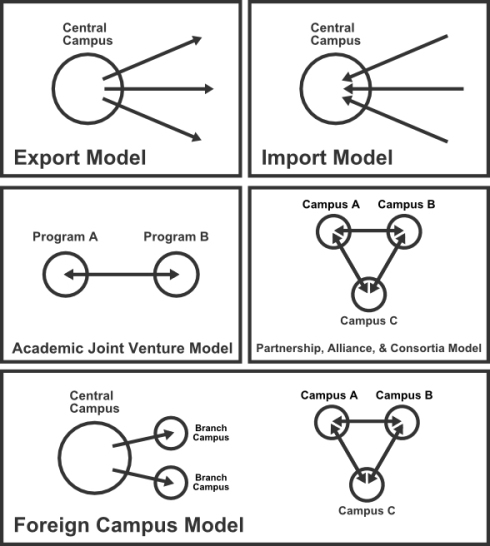
    Note the integrative element to this definition, as well as the ’emerging’ dimension to the global economy. Hawawini then discusses the academic and economic motives for internationalization, and as well as the obstacles shaping how the internationalization of higher education can be realized. He then moves on to delineate the organizational model options to realize internationalization. These options can be visualized (see below from a 2014 MOOC I taught with Susan L. Robertson) which helps, I find, when facilitating debate with diverse audiences (from students through to council/board members) about the critically important relationship between motives (why internationalize), mechanisms (how to internationalize), and structural change (how to institutionalize internationalization).

    Further to the above models, Hawawini makes the critically important point that the dominant model (the Import model) adopted by most Western universities, including public research universities, is becoming increasingly problematic with respect to the production of regionally and globally relevant knowledge, not to mention educational programming. Why? Economic growth, infrastructure, global production/value chains, and so on are binding together cities and regions, with some regions (e.g., Pacific Asia, the Gulf) developing as much more important and powerful spaces in their own right. Thus the creation of solely- or jointly-developed institutional infrastructure in key nodal cities is required to adequately understand what is happening within these regions, how cities and regions are being bound together, and what is needed to develop and circulate relevant forms of knowledge. As Hawawini puts it (pp. 25-26):

    An alternative view is that the global economy is being transformed into an increasingly complex network of interconnected but different economic areas each of which is endowed with the capacity to innovate and create knowledge. According to this multipolar view of the world, knowledge is increasingly being dispersed throughout the globe. In this case learning from the world becomes an imperative, particularly for research-driven higher education institutions. This is why higher education institutions should be present abroad: they need to acquire that dispersed knowledge and meld it together to create new ideas and more advanced knowledge.

    Shifts in the spatial structure of economic activity, as well as in emerging growth patterns, are creating new regional economic geographies and political economies and if this is the case, sitting back and resting upon past laurels is not enough IF a university seeks to become a “truly global institution” (p. 76). Committed and aspiring global institutions need to refashion their organizational structures to ensure they can realize their visions and generate an impact. This is, arguably, a key part of the rationale for why four of these eight institutions (Technion, Tsinghua, Duke, Imperial College) have taken the big step and allocated considerable time, effort and resources to developing a formal institutional presence in the cities of New York, Seattle and Singapore. Each university needs to be located within these cities and each has contributed to the development of the infrastructure (broadly defined) needed to become more regionally and globally relevant. They are, as Hawawini puts it, internationalizing “to learn from the world” in order to “create knowledge” in an increasingly “multipolar world.”

    While Gabriel Hawawini’s book does have many strengths, I recommend that it be read in conjunction with other books and articles that focus on particular geographies and sectors. For example, in my Cities, Universities and the Development Process course I assigned Aihwa Ong’s excellent book Fungible Life: Experiment in the Asian City of Life (Duke University Press, 2016) which focuses on Singapore and the leading edges of bioscience. As the book description states:

    In Fungible Life Aihwa Ong explores the dynamic world of cutting-edge bioscience research, offering critical insights into the complex ways Asian bioscientific worlds and cosmopolitan sciences are entangled in a tropical environment brimming with the threat of emergent diseases. At biomedical centers in Singapore and China scientists map genetic variants, disease risks, and biomarkers, mobilizing ethnicized “Asian” bodies and health data for genomic research. Their differentiation between Chinese, Indian, and Malay DNA makes fungible Singapore’s ethnic-stratified databases that come to “represent” majority populations in Asia. By deploying genomic science as a public good, researchers reconfigure the relationships between objects, peoples, and spaces, thus rendering “Asia” itself as a shifting entity. In Ong’s analysis, Asia emerges as a richly layered mode of entanglements, where the population’s genetic pasts, anxieties and hopes, shared genetic weaknesses, and embattled genetic futures intersect. Furthermore, her illustration of the contrasting methods and goals of the Biopolis biomedical center in Singapore and BGI Genomics in China raises questions about the future direction of cosmopolitan science in Asia and beyond.

    Ong’s book is a deep dive in the complex role of the state, universities, firms, research stars, and knowledge about genetics in shaping the development of Singapore, in particular, as a key space in the development of scientific knowledge. After reading it you can better understand why universities like Duke and Imperial College seek (and need) to have a formal institutional presence in Singapore, and in association with key national partner universities like NUS and NTU. The Ong book, thus, provides insights on the geographical-, historical-, and sectoral -specific developments that these universities are currently navigating.  The Ong book has its weaknesses, but this is not the space for this discussion.

    Clearly not all universities have the ambition, connections, stature, and resources to refashion their organizational structures to help enable deep internationalization. This is, of course, fine. As Hawawini puts it (pp. 76):

    I have sketched out the contours of the truly global higher education institution and argued that any attempt to transform an existing higher education institution into a truly global one is unlikely to succeed because of historical and organizational barriers rather than insufficient resources or a dearth of leadership. …

    In the light of this conclusion, I believe that most higher education institutions should refrain from claiming their aim is to become truly global institutions.

    He argues that “most higher education institutions are firmly grounded in their local and regional environments” and given this it is illogical to seriously pursue the kind of development initiative evident in the case of, for example, Duke-NUS Medical School in Singapore. There are plenty of alternative mechanisms, including student/staff/faculty exchanges, partnerships, and curricular transformations (internationalizing the curriculum & internationalization at home). For the ambitious or curious, though, it’s worth reflecting on these experiments in deep internationalization via the development of outward-facing forms of city-based infrastructure.

    Kris Olds

    Source link

  • Budgets Are Declarations of Belief

    Budgets Are Declarations of Belief

    Blogger side note: Sometimes if you procrastinate on a blog post long enough, you get to write the original post and the follow up post all in one go.
    So…that’s fun.

    Why Is No One Else Excited About This?

    I seem to really like doing a part of my job that my coworkers and peers in other districts seem to dread.  I am a first year administrator, the Director of Educational Technology in Alisal Union School District; I am also originating the position.  Budgeting and budget projections have become a thing I like doing.  To me there are so many positive and intellectually engaging things here.

    It’s like a puzzle where what I want to accomplish and what I can (theoretically) accomplish come together and I have to make the pieces fit.  I like puzzles and problem-solving.  We’ve been asked to do 3 years of projections and in each year we have to cut by 10%, by the end of 2019 – 20, it will have been reduced by 30%.

    So this seemed like a critical but interesting challenge.  It was also a gut-check moment: What do I really believe my students and teachers need, and how am I am going to put resources into that when resources are diminishing?  But on an emotional level, budget projections and action planning, especially around edtech, are what one of my favorite authors, Sarah Vowell, describes as a “snowball moment.”

    Yes, budgets carry real effects and mean choices, impacts, and sacrifices. These are not always fun. But, to me, when you’re doing the projections, the harder parts have yet to happen.  The plan hasn’t met reality yet; the mistaken suppositions haven’t come to light, errors and emergencies have yet to happen.  Budgets, despite all the constraints and must-dos they are required to have, are a votive list in which we as leaders say, “this is what we believe in; this is what we are going to support; this is what we promise to do!”

    Who wouldn’t be excited by that?

    I didn’t realize I was kind of alone in this mindset this until I had a conversation like this with a fellow director before a school board meeting.

    HIM: You have a good day?
    ME: Yeah! Me and my team spent the afternoon doing our 3-year projections with those cuts we were asked to put in!
    HIM: (groans) Ugh, budgets.  You seem excited by that.
    ME: Yeah, I think we got a really good plan…(dawning realization) Wait, you don’t like doing that?
    HIM: No.  I hate budget projections.  In fact, you’re the only one I know who has ever said they liked doing this…especially during [budget] cuts.

    I am, however, undeterred.  As an administrator, I don’t have a lesson plan anymore.  I have an action plan and it’s accompanying budget.  These are a statements of what I know in my bones to be the best solutions for our students and teachers to become fluent in 21st century learning and teaching, and ultimately to become engaged citizens of the connected world.

    Being a leader, I now get to do everything in my professional power to execute, to make those solutions a reality. ¡Ándale pues!

    The Follow Up – Round 2: Is It Still Fun?

    In California right now, we’re not exactly having hard times, but we’re heading into what looks like a few years of budget reduction.  This is because STRS (State Teachers Retirement System) and PERS (Public Employees Retirement System) contribution rates are going up, and will continue to go up as far as the 19- 20 school year.  So even if our budgets are leveling off, the mandated costs of those items is going up dramatically.  For me this involved a couple of complications.

    We have a new fiscal director who pointed out that we’d been making some errors in our budgeting practices.  While we were putting in our salary costs for stipends and timesheets–“supplemental salary” (which make up a large portion of my professional development budget), we’d been leaving off the associated benefit costs. We were accounting for paying our folks their extra income, but we didn’t realize that the extra money that goes into retirement and medical for them ALSO had to come out of those budgets.
    You know, the budgets we’d spent all that time cutting by 10% year over year.

    If the first one was an interesting puzzle and a gut check this was kind of a body blow.  In real numbers, this was an additional 2% in 17 – 18, 3.5% in 18 – 19, and 5% in 19 – 20 in cuts that I had to find, while maintaining all the beliefs and hopes for efficacy I talked about above.  The absolute dollars were the same, but how much of them I was going to be able use went down each year.

    When you have to do this, it’s just you and the spreadsheet and the math.  There is no negotiating, no pleading; like Shakira’s hips, numbers don’t lie. You’re either within the limit, or you keep finding cuts.  But I wanted to be a leader, and this was a leadership moment.  And I don’t mean to be too melodramatic, but when you’re trying to build a program, there’s a lot of attachment to it.

    I admit this time I was less eager.  This time, “stuff got real.”  It’s not that I didn’t take it seriously before, I absolutely did. But it was a thing I thought I was done with for a while.  I still viewed it as an engaging puzzle, but this time was more serious, somehow. The deadline was closer, the amounts higher, but I still didn’t dread it.

    “Like” is maybe not the right word for how I felt about it, but positive definitely is.  I wouldn’t have wanted anyone else to do it.  My ardor was not reduced in any way.  I know my professional convictions; I know what I think is the right path in edtech. If anything the creative constraints got tighter and I wanted to do it more.

    This budget is my promise to my team, and the teachers and students of this district, “This is how we’ll prepare you for the future of education.” Why wouldn’t I be excited about making and keeping that promise?
    #StillExcitedAboutThis

    Source link