Category: Featured

  • Focus Friday: October 24 | HESA

    Focus Friday: October 24 | HESA

    Hi everyone,

    Tiffany here.

    A quick reminder that there is a Focus Friday session today (October 24) from 12:30-1:30pm Eastern on International Student Enrolment.

    I’ll be joined by Victor Tomiczek (Director of International Recruitment and Global Partnerships at Cape Breton University) and Eric Simard (Director of Fanshawe International and former Director of International Recruitment and Market Development at Fanshawe College). We’ll be discussing past, current, and expected future trends in international student recruitment, enrolment, and engagement.

    If you haven’t registered yet, it’s not too late. Register here.

    Looking Back

    Two weeks ago, we gathered for a conversation that hit close to home: What does the student experience look and feel like today?

    I was joined by three people who live and breathe these questions every day: Wasiimah Joomun (Canadian Alliance of Student Associations, a federal student advocacy organization for college, university and polytechnic students), Brendan Roberts (Students Nova Scotia), a provincial level student advocacy organization for university and college students), and Olamipo Ogunnote (Ontario Student Voices, a provincial advocacy organization for college students). Together, they painted a vivid picture of how students are navigating post-secondary life in 2025. What we heard was both sobering and hopeful.

    Wasiimah reminded us that the purpose of post-secondary has shifted. Students aren’t coming to explore anymore; they’re coming to survive. “We’ve turned education from a space of discovery into a checklist for employability,” she said. Costs are rising, pressures are mounting, and the system is asking students to thrive in conditions it wasn’t built to support. “Students are no longer exploring their interests; they’re trying to match what the labour market needs” she said.

    Brendan spoke about the ripple effects of affordability on mental health and belonging. From housing, food, transportation, all of it weighs heavily. “You can’t build a community for someone,” he said, “but you can give them the tools to foster it themselves.” Students need the chance, and support, to create their own networks, not just attend the ones we design for them.

    Olami brought the conversation to Ontario’s college sector, where students are juggling work, caregiving, and coursework, often all in the same day. He shared the story of one student finishing an eight-hour shift, racing home to her kids, and starting her assignment at midnight. “Resilience,” Olami said, “shouldn’t be about surviving hardship. It should be about thriving with opportunity.” Olami added to the piece on community with a great comment that has stuck with me since our conversation, “real community doesn’t come from infographics, it comes from matching the reality of students’ lives.”

    Across all three perspectives, the thread was clear: affordability touches everything. Forty percent of students skip meals. One in four struggle to pay rent. One in five use food banks. Four percent have experienced homelessness. Students are still choosing education, but they’re not sure if their institutions and their governments through investment are choosing them back.

    And yet, there’s optimism. Students still believe in the value of learning. They want to help shape institutions that see them not only as learners, but as people with families, jobs, and ambitions that stretch far beyond the classroom.

    You can catch the full conversation here: https://www.youtube.com/watch?v=ywcHrBEwA-M.

    Looking Ahead

    On the next Focus Friday, we will be covering the hottest topic of that week: the Federal Budget. What happens, what it means, and what the early reactions to it are. That conversation happens on November 7th, and registration is already open (see below, in a big green box).

    In the meantime, keep sharing your ideas in the registration form or reach out anytime at [email protected].

    I’m looking forward to seeing many of you this afternoon, and again in two weeks.

    Cheers,

    Tiff
    Source link

  • PLAN YOUR ACTION NOW (Todd Wolfson, AAUP/AFT)

    PLAN YOUR ACTION NOW (Todd Wolfson, AAUP/AFT)

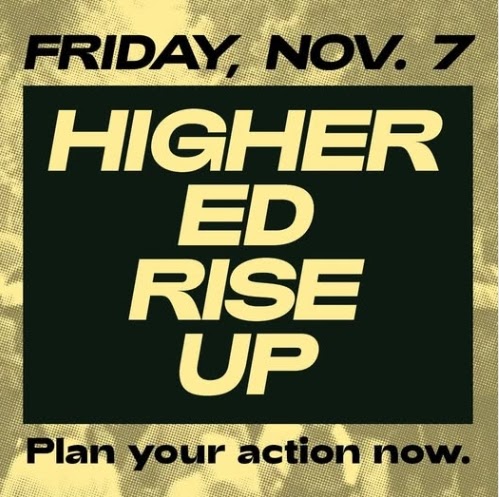
    Faculty, students and staff are joining together throughout the country to defend and advance higher education. Plan your action now and register it here: https://docs.google.com/…/1bhu9QLt1…/viewform…

    This event is in collaboration with studentsriseup.org

    Students Rise Up (Project Rise Up) is a plan to organize millions of students to disrupt business as usual and force our schools and our political system to finally work for us.

    Right now, billionaires and fascists are attacking our schools because they know that student protest could bring them down. Our power is that we outnumber them. If working people and students unite to use our power of disruption and non-cooperation, we can crack the foundations of their power.

    It all starts on November 7th, 2025 with walkouts and protests at hundreds of schools around the country. Join us.

    Source link

  • Funding technology initiatives in uncertain times

    Funding technology initiatives in uncertain times

    Key points:

    Recent policy shifts have caused significant uncertainty in K-12 education funding, especially for technology initiatives. It’s no longer business as usual. Schools can’t rely on the same federal operating funds they’ve traditionally used to purchase technology or support innovation. This unpredictability has pushed school districts to explore creative, nontraditional ways to fund technology initiatives. To succeed, it’s important to understand how to approach these funding opportunities strategically.

    How to find funding

    Despite the challenges, there are still many grants available to support education initiatives and technology projects. Start with an online search using key terms related to your project–for example, “virtual reality,” “virtual field trips,” or “career and technical education.”

    Explore national organizations like the Bill & Melinda Gates Foundation or Project Tomorrow and consider potential local funding sources. Local organizations such as Rotary or Kiwanis clubs can be powerful allies in helping to fund projects. The local library and city or county government may also offer grants or partnership opportunities. Schools should also reach out to locally-headquartered businesses, many of which have community outreach or corporate social responsibility goals that align with supporting local education.

    Colleges and universities are another valuable resource. They may be conducting research that aligns with your school’s technology project. Building relationships with these institutions and organizations can put your school “in the right place at the right time” when new funding opportunities arise.

    Strategies to win the grant

    Once potential funding sources are identified, the next step is crafting a compelling proposal. Consider the following strategies to strengthen your application.

    1. Focus on the “how and why,” not just the “what.” If your school is seeking funds to buy hardware, don’t simply say, “Here’s what we want to buy.” Instead, frame it as, “Here’s how this project will improve student learning and why it matters.” Funders want to see the impact their support will have on outcomes. The more clearly a proposal connects technology to learning gains, the stronger it will be.

    2. Highlight the research. Use evidence to validate your project’s value. For example, if a school plans to purchase virtual reality headsets, cite studies showing that VR improves knowledge retention, engagement, and comprehension compared to traditional instruction. Demonstrating that the technology is research-backed helps funders feel confident in their investment.

    3. Paint a picture. Bring the project to life. Describe what students will experience and how they’ll benefit. For example: “When students put on the headset, they aren’t just reading about ancient civilizations, they’re walking through them.” Vivid descriptions help reviewers visualize the impact and believe in your vision.

    Eight questions to consider when applying for a grant

    Use these guiding questions to sharpen your proposal and ensure a strong foundation for implementation and long-term success.

    1. What is the goal? Clearly define what students will be able to do as a result of the project. Use action-orientated language: “Students will be able to…”
    2. Is the technology effective? Support your proposal with evidence such as whitepapers, case studies, or research that can demonstrate proven impact.
    3. How will the technology impact these specific students? Emphasize what makes your school or district unique, whether it’s serving a rural, urban, or high-poverty community and how this technology addresses those specific needs.
    4. What is the scope of the application? Specify whether the project involves elementary school, secondary school, or a specific subject or program like a STEM lab.
    5. How will success be measured? Too often schools reach the end of a project without a plan to track results. Plan your evaluation from the start. Track key metrics such as attendance, disciplinary data, academic performance, or engagement surveys, both before and after implementation to demonstrate results.
    6. What are your budgetary needs? Include all associated costs, including professional development and substitute coverage for teacher training.
    7. What happens after the grant is over? If you plan to use the technology for multiple years, apply for a multi-year grant rather than assuming future funding will appear. Sustainability is key.
    8. How will success be celebrated and communicated to stakeholders? Share results with the community and stakeholders. Host events recognizing teachers, students, and partners. Invite local media and highlight your funding partners–they’re not just donors, but partners in student success.

    Moving forward with confidence

    Education funding will likely remain uncertain in the years ahead. However, by being intentional about where to look for funds, how to frame proposals, and how to measure and share impact, schools can continue to implement innovative technology initiatives that elevate teaching and learning.

    Latest posts by eSchool Media Contributors (see all)

    Source link

  • Will US science survive and thrive, or fade away?

    Will US science survive and thrive, or fade away?

    by Paul Temple

    When Robert Oppenheimer graduated from Harvard in 1925, young American scientists wanting to work with the world’s best researchers crossed the Atlantic as a matter of course. As a theoretical physicist, Oppenheimer’s choice was between Germany, particularly Göttingen and Leipzig, and England, particularly Cambridge. If you’ve seen the movie, you’ll know that Cambridge didn’t work out for him, so in 1926 he went to work with Max Born, one of the leading figures in quantum mechanics, at Göttingen, receiving his doctorate there just a year later. His timing was good: within a few years from the Nazi seizure of power in 1933, attacks on academics, Jewish and otherwise, and then of course the Second World War, had destroyed what was perhaps the world’s most important university system. Let us note that academic structures, depending on relatively small numbers of intellectual leaders, usually able to move elsewhere, are fragile creations.

    I used to give a lecture about the role of universities in driving economic development, with particular reference to scientific and technological advances. Part of this lecture covered the role of US universities in supporting national economic progress, starting with the Land Grant Acts (beginning in 1862, in the middle of the Civil War for heaven’s sake!), through which the federal government funded the creation of universities in the new states of the west; going on to examine support for university research in the Second World War, of which the Manhattan Project was only a part; followed by the 1945 report by Vannevar Bush, Science – the endless frontier, which provided the rationale for continued government support for university research. The Cold War was then the context for further large-scale federal funding, not just in science and technology but in social science also, spin-offs from which produced the internet, biotech, Silicon Valley, and a whole range of other advanced industries. So, my lecture concluded, look at what a century-and-a-half of government investment in university-derived knowledge gets you: if not quite a new society, then one changed out of all recognition – and, mostly, for the better.

    The currently-ongoing attack by the Trump administration on American universities seems to have overlooked the historical background just sketched out. My “didn’t it work out just fine?” lecture now needs a certain amount of revision: it is almost describing a lost world.

    President Trump and his MAGA movement, says Nathan Heller writing in The New Yorker this March, sees American universities as his main enemies in the culture wars on which his political survival depends. Before he became Trump’s Vice-President, JD Vance in a 2021 speech entitled “The Universities are the enemy” set out a plan to “aggressively attack the universities in this country” (New York Times, 3 June 2025). University leaderships seem to have been unprepared for this unprecedented assault, despite ample warning. (A case where Trump and his allies needed to be taken both literally and seriously.) Early 2025 campus pro-Palestinian protests then conveniently handed the Trump administration the casus belli to justify acting against leading universities, further helped by clumsy footwork on the part of university leaderships who seem largely not to have rested their cases on the very high freedom of speech bar set by the First Amendment, meaning that, for example, anti-Semitic speech (naturally, physical attacks would be a different matter) would be lawful under Supreme Court rulings, however much they personally may have deplored it. Instead, university presidents allowed themselves to be presented as apologists for Hamas. (Needless to say, demands that free speech should be protected at all costs does not apply in the Trump/Vance world to speech supporting causes of which they disapprove.)

    American universities have never faced a situation remotely like this. As one Harvard law professor quoted in the New Yorker piece remarks, the Trump attacks are about the future of “higher education in the United States, and whether it is going to survive and thrive, or fade away”. If you consider that parallels with Germany in 1933 are far-fetched, please explain why.

    SRHE Fellow Dr Paul Temple is Honorary Associate Professor in the Centre for Higher Education Studies, UCL Institute of Education.

    Author: SRHE News Blog

    An international learned society, concerned with supporting research and researchers into Higher Education

    Source link

  • A week of media literacy across the globe

    A week of media literacy across the globe

    From 24 to 31 October, the world marks Global Media and Information Literacy Week, an annual event first launched by UNESCO in 2011 as a way for organizations around the world to share ideas and explore innovative ways to promote media and information literacy for all. This year’s theme is Minds Over AI — MIL in Digital Spaces. 

    To join in the global conversation, over the next week News Decoder will present a series of articles that look at media literacy in different ways.

    Today, we give you links to articles we’ve published over the past year on topics that range from fact-checking and information verification to the power of social media and the good and bad of artificial intelligence. 

    Source link

  • 10 ways to strengthen family-school partnerships and support learning

    10 ways to strengthen family-school partnerships and support learning

    This audio is auto-generated. Please let us know if you have feedback.

    Clear family-school communications and robust supports for students with learning differences are just a few ways education systems can improve family-school connections to support student outcomes, nonprofit Learning Heroes said in a report released Tuesday.

    One of the biggest barriers to family-school partnerships is what the report calls a “perception gap,” or when families believe their child is performing at higher academic levels than what’s really occurring. 

    In fact, about 88% of parents in a 2023 survey said they thought their child was at or above grade level in math and reading. In reality, the actual share of children performing at this level is closer to 30%, as shown by 8th grade performance on the 2024 National Assessment of Educational Progress.

    Although parents carry significant influence over their child’s education, they can’t help fix a problem they don’t know exists, the report said.

    “Parents today have unprecedented voice and choice in their children’s education, yet, too often, lack the information to make confident, informed decisions,” said Bibb Hubbard, founder and CEO of Learning Heroes, in a Tuesday statement. 

    The organization used 10 years of research on family-school partnerships to inform best practices that improve these relationships with the aim of driving student success.

    “With a decade of insights from parents, students, teachers, and principals, we have a clearer roadmap for creating schools and communities that work in true partnership with families and help every child thrive,” Hubbard said.

    The Learning Heroes report offered these 10 suggestions for strengthening family-school partnerships.  

    Give parents accurate information on student performance

    When parents know their child needs support, they are more likely to seek academic supports, such as tutoring and summer math or reading programs. They are also more likely to prioritize school attendance. 

    The report highlights state-level efforts in Texas, Arkansas and Virginia to provide parents videos, tools, and guides to bolster understanding of student grades and test scores. This also allows for comparisons with students across the state to help parents gauge their child’s college or career readiness.

    Share multiple points of learning data

    Results from annual state tests and other standardized or formative assessments can give families a fuller picture of their child’s strengths and needs.

    Some 79% of parents said their children earn Bs and better, the report said, leading most parents to think their child is performing on grade level. However, report cards can include factors other than academic achievement, such as classroom participation, effort and completion of assignments, that don’t necessarily comport with grade-level performance. 

    “As it stands, too many report cards are still sending false signals, and many families, trusting the information they’ve been given, simply aren’t aware that their students may be behind,” the report said.

    Provide parents access to information

    Ensuring parents are aware of their child’s progress — not just through a quarterly report card, but through conversations with teachers and other means — can help parents take action to help their child improve.

    Allow teachers time to connect with parents

    Schools should prioritize parent-teacher teams by safeguarding the time teachers need to communicate with parents, as well as needed preparation time. One example is to allow one-to-one conversations between parents and teachers at back to school nights.

    For instance, Prodeo Academy, a charter network in the Twin Cities area of Minnesota, serving about 1,000 students, prioritized candid conversations, data-sharing and family-teacher conferences during the 2023-24 school year. These activities resulted in a notable increase among parents who recognized their child wasn’t working at grade level, the report said.

    Avoid family engagement as a standalone goal

    Integrating family engagement into overall school strategies for attendance, literacy and math achievement and other priorities will help educators and parents connect this effort to overall school outcomes. 

    For example, home visits can improve attendance, and student action plans created jointly by teachers and parents could help boost achievement.

    Provide pathways to postsecondary success

    Whether students attend college or go right into the workplace after high school graduation, schools should guide parents and students about the opportunities available. Access to Advanced Placement courses, dual enrollment, career awareness experiences and career and technical education can all help students discover their passions and start planning for their futures.

    Source link

  • Test yourself on the past week’s K-12 news

    Test yourself on the past week’s K-12 news

    This audio is auto-generated. Please let us know if you have feedback.

    How well did you keep up with this week’s developments in K-12 education? To find out, take our five-question quiz below. Then, share your score by tagging us on social media with #K12DivePopQuiz.

    Source link

  • 70% of Americans say feds shouldn’t control admissions, curriculum

    70% of Americans say feds shouldn’t control admissions, curriculum

    This audio is auto-generated. Please let us know if you have feedback.

    Dive Brief: 

    • Most polled Americans, 70%, disagreed that the federal government should control “admissions, faculty hiring, and curriculum at U.S. colleges and universities to ensure they do not teach inappropriate material,” according to a survey released Wednesday by the Public Religion Research Institute. 
    • The majority of Americans across political parties — 84% of Democrats, 75% of independents and 58% of Republicans — disagreed with federal control over these elements of college operations. 
    • The poll’s results come as the Trump administration seeks to exert control over college workings, including in its recent offer of priority for federal research funding in exchange for making sweeping policy changes aligned with the government’s priorities. 

    Dive Insight: 

    The poll from the nonpartisan PRRI isn’t the first survey to suggest that large swaths of Americans disagree with the Trump administration’s approach to higher education policy. 

    Slightly more than half of Americans, 56%, said they disapproved of how President Donald Trump was handling higher education-related issues, a May poll from The Associated Press and NORC at the University of Chicago found. 

    However, the AP-NORC poll found a stark political divide, with 90% of Democrats disapproving of Trump’s approach and 83% of Republicans approving of it. 

    More specifically, 73% of Democrats said at the time that they disapproved of the withholding of colleges’ federal funds for not complying with the government’s political goals. Conversely, 51% of Republicans approved of that approach. 

    Another poll — this one of Jewish Americans conducted by Ipsos and researchers from the University of Rochester and the University of California —  found in September that 58% said they disagree with the Trump administration pausing or canceling vast sums of federal research funding to Harvard University and the University of California, Los Angeles.

    In both cases, the Trump administration has accused the universities of not doing enough to address antisemitism on campus and demanded sweeping policy changes. However, federal judges have largely blocked the government’s attempted suspension of their research funding. 

    In the Ipsos poll, 72% of Jewish Americans said they were concerned about antisemitism on college campuses. But the same share said they believed the Trump administration was “using antisemitism as an excuse to penalize and tax college campuses.” 

    The Trump administration has so far cut deals with four colleges: three Ivy League institutions and, most recently, the University of Virginia, the first public institution to strike such an agreement. 

    More deals could be coming down the pike. 

    Earlier this month, the Trump administration offered priority research funding to nine colleges if they signed a compact dictating certain policies impacting their tuition, admissions and academics. Those provisions spanned from adopting a five-year tuition freeze to potentially dissolving campus units that “purposefully punish” and “belittle” conservative ideas. 

    While most of the colleges rejected the compact, Trump appeared to open up the deal to any interested institution. Additionally, two of the initial nine colleges — the University of Texas at Austin and Vanderbilt University — haven’t yet said publicly if they will sign or reject the compact. 

    Vanderbilt Chancellor Daniel Diermeier said he would provide feedback on the compact, adding that he looked forward to “continuing the conversation,” according to The Vanderbilt Hustler

    Meanwhile, UT-Austin officials have been silent on the compact lately, though the chair of the UT System initially said it was “honored” its flagship received the proposal.

    Source link

  • The changing rhythm of international student payments

    The changing rhythm of international student payments

    International education was growing. The United States hosted over 1.1 million international students in 2023/24, an all-time high and up 7% on the previous period. Graduate enrolments and OPT participation also reached record levels.

    However, due to an unpredictable macro-environment, forecasts indicate that the US could expect a decrease of up to 40% in new international student enrolments this year, resulting in a potential loss of USD$7 billion to the US economy.

    At the same time, budgets are tight. The loss of international student revenue can affect institutions in the U.S. Along with these losses, there are cuts in federal grants, with over 4,000 grants reduced to fewer than 600 institutions across the 50 states.

    The result is an education sector that needs reliable revenue and an improved student financial experience.

    Why instalments are becoming the default

    Students are funding their degrees from multiple sources while managing the rising costs of living. In TouchNet’s 2025 Student Financial Experience Report, 55 percent of US students juggle three or more funding sources, 82 percent say financial tasks require moderate to high effort, and half of the international students surveyed stated that positive payment experiences with institutions had a positive effect on them.

    That illustrates the importance of offering students flexible, self-service tools. By streamlining payment processes, offering alternative payment methods, and, most importantly, providing payment flexibility, those financial tasks that cause students stress can be alleviated. In turn, those positive experiences will lead to better-engaged students, who can worry about their financial standings a little bit less.  

    Apart from providing financial security and a positive experience to students, payment plans are crucial to an institution’s survival. International students contributed an estimated USD$43.8bn to the US economy in 2023/24. Protecting that value means eliminating friction from the invoicing, payment, and reconciliation processes across borders and currencies.

    From annual to monthly payments: what institutions gain

    Moving from one or two large value annual due dates to monthly, quarterly, or term-aligned schedules spreads risk for students in a turbulent macroeconomic environment and smooths cash flow for institutions.

    That shift helps students plan around scholarship disbursements, loans, family support, and part-time work, while giving bursar teams earlier visibility of potential issues.

    The outcome is higher on-time payment rates, fewer past-due balances, and a better student experience.

    What to demand from a payments partner

    If you are rethinking fee schedules, the partner you choose matters.

    • Look for providers that offer multiple payment options for annual payments and instalment payments. Whether it’s credit or debit cards, bank transfers, or alternative regional payment methods, ensure that the provider you choose offers a wide range of payment options.

      This way, students who need to pay you can complete the financial transaction in the most convenient way for them. A bonus is when the provider uses local payment rails to complete the transaction, helping you benefit from reduced intermediary fees.

    • Seek partners that can provide complete visibility of payments for both students and institutions. This will help to reduce your admin time. By maintaining a comprehensive record of student payment history, you can easily verify a student’s financial standing without having to search through paperwork.

      On the other hand, students and parents (or anyone paying the tuition) can view the status of their payments, balances, sign up for payment plans, and check their standings without needing to raise support tickets.

    • Make sure a prospective provider can facilitate fast refunds and handle automated reconciliation. Linking in with the full record of payment history, any provider you onboard should be able to initiate refunds promptly and return funds to the originating account. Not only is that required from a regulatory standpoint, but with the rise in education payment-related fraud, it may save you multiple thousands of dollars in the long run.

      Furthermore, if a student drops out of their course six months into their first year and has made seven payments for their tuition, it should be a simple process to refund them any amount they’re due. Choose a provider with capabilities to do so to save your team headaches.    

    How TransferMate helps you make monthly instalments work

    TransferMate’s education solutions were built for the new reality we’re living through. Providing choice across instalments and payment methods is at the forefront of our platform, and is specifically designed to meet institutional control requirements and student expectations.

    Here’s what you can expect from our integration:

    • Multiple instalment options out of the box: Offer students monthly schedules that they can opt into. Plans can be paid for across multiple cards, bank transfers, or local payment methods, with clear due-date reminders.
    • Recurring card payments for student housing: Students can sign up once for automated recurring card payments on their housing fees. This reduces missed payments, lowers the administrative load for teams, and provides students with predictable outgoings throughout the year.
    • API Client Dashboards: Finance and student accounts teams with embedded solutions from TransferMate can see payment histories and statuses per student, country, currency, or programme. This surfaces issues earlier and supports more innovative outreach to at-risk cohorts. As analytics deepen, you can monitor instalment adoption and on-time performance by segment.
    • Virtual Accounts and refunds: With our Global Account solution, you can accept and hold funds in multiple currencies, route payments over local rails, and issue refunds quickly without breaking reconciliation. And as a plus, you can convert currencies and make payments in those local currencies for any inter-campus requirements, scholarship, or guest lecturer fees.
    • Beneficiary Portal: Through our beneficiary portal, users can invite students, agents, and research partners to provide their bank details aligned to your reference fields (such as student ID, program code, etc). Instead of your team collecting sensitive bank details via email or phone, you can invite the beneficiary with a secure portal link, allowing them to complete the form in minutes. This results in fewer data errors, fewer returns, and faster payment processing for scholarship, bursary, commission, or refund payments.
    • Compliance and transparency. TransferMate operates the largest globally licensed fintech payments infrastructure, featuring end-to-end tracking that allows students and institutions to see when funds are sent and received. As we own our infrastructure, we offer preferential foreign exchange rates and zero transaction fees. Clients save real time and money, with one institution having increased the college’s revenue by about 3%, purely on the savings made on bank and credit card charges.

    The strategy that pays back

    The plain facts are simple, even if it is a hard truth to swallow.

    Institutions do not control the macro environment.

    But what you do control is how easy it is for students to enrol and pay. The sector is moving from annual lump sums to monthly and quarterly instalments because it improves affordability, supports retention, and strengthens cash flow.

    Being part of that movement is as easy as reaching out to a payments partner and getting started.

    Want to learn more about how TransferMate configures instalment options for your institution? Get in touch with our team today.

    About the author: Thomas Butler is head of education at TransferMate, driving innovation in payment solutions for the education sector. He leads teams focused on developing seamless, secure systems that simplify how institutions, platforms, and students send and receive international payments. Under his guidance, TransferMate powers collections in over 140 currencies across more than 200 countries, with fully regulated infrastructure and integrations via APIs, white-label platforms, and embedded solutions. Thomas works with both educational institutions and software partners to reduce bank fees, improve FX rates, automate reconciliation, cut administration, and enhance transparency, all to improve the payment experience and financial operations in education globally.

    Source link

  • Oral Exams and “MTV Unplugged”

    Oral Exams and “MTV Unplugged”

    Oral exams are making a comeback, and I’m mostly here for it.

    A few weeks ago, we had a faculty professional development day on campus. One of the sessions was devoted to faculty greatest hits, defined loosely as teaching techniques that people are proud of and were willing to share with their colleagues. The session was terrific over all, but the one I haven’t been able to stop thinking about was from a professor who decided to fight AI-enabled cheating by giving oral exams.

    For context, the class in which he started using oral exams was conducted over Zoom. That made it particularly difficult to prevent students from accessing unauthorized sources during tests. When the apparent cheating hit a level he hadn’t seen before, he resorted to oral exams to force students to rely only on themselves.

    He reported that the exams took about 15 minutes per student, so with a relatively small class, the logistics weren’t prohibitive. As he told it, it became clear quickly which students had mastered the material and which were just lost.

    Oral exams aren’t exactly a new technology, but they have a new appeal. Readers of a certain generation may remember MTV Unplugged. It was a concert show in which performers had to use only nonelectric instruments. Stripped of synthesizers and Auto-Tune, some musicians thrived and some really struggled. (I remember my roommates and I laughing ourselves silly at Duran Duran’s effort on Unplugged. By contrast, Nirvana’s was so good that the performance came out later as an album.)

    Oral exams are similar; when the student doesn’t have any of the usual crutches, you get a cleaner sense of what they actually know. Now that the illicit crutches are ubiquitous, forcing students to unplug is more useful than ever.

    I’ll admit breaking into a cold sweat at the memory of my own oral exams in grad school, but those were long, high-stakes and conducted by a group. In retrospect, though, part of what made that so difficult was that I’d never had an oral exam up to that point. I hadn’t had any practice. And if I’m being honest, the professors hadn’t had much practice, either. That was a hell of a time to start.

    From the administrative side, I can imagine a few potential concerns with oral exams. I’m hoping that my wise and worldly readers can help.

    The first and most basic one is that most of us don’t have much experience designing oral exams. I’ve never seen a workshop on design principles for orals. (They may exist, but I’ve never seen or heard of one.) To be fair, most of us were never taught how to construct written exams, either, but at least most of us have experience there. In the absence of serious attention to ways to construct oral exams, I’d have a concern about validity.

    The second is about grade appeals. If the exam is lost to history, how does a student reasonably contest a grade? I don’t mean to encourage appeals, but there needs to be some way for a student to press a case when they feel wronged. Presumably the exams could be recorded, but there, too, we’d need serious and enforced rules governing access to the recording and when it would need to be deleted.

    Finally, there’s a basic issue of stage fright. A student freezing up could be clueless, or they could be paralyzed with fear. It would be a shame to fail a student who actually knows their stuff because they got nervous and went into vapor lock. Presumably this issue would fade if oral exams became a lot more common, but the first wave is likely to run into this one repeatedly. Test anxiety is bad enough for written exams; combine it with stage fright and some capable students will struggle.

    Still, none of these strike me as dispositive.

    Wise and worldly readers, have you found ways to ensure that oral exams are well designed? How do you handle recording? And what do you do about student stage fright? I’d love to hear at deandad (at) gmail (dot) com. Thanks!

    Source link