Category: finances

  • A government running out of road still sets the economic weather for higher education

    A government running out of road still sets the economic weather for higher education

    For a party that it’s become fashionable to criticise for failing to have prepared for power, Labour has in fact set an awful lot of ambitious policy machinery into motion over the last 16 months.

    There’s barely been a month go by without some large-scale reform to how the country is governed, organised, and understood as a sum of diverse parts and competing pressures, and we’ve had our work cut out thinking through the implications of each for the higher education sector: from devolution to industrial strategy, from health reform to an explicit tying together of skills and migration (which has barely got started yet), from a new communities strategy to belatedly moving skills policy to the Department for Work and Pensions.

    Whatever your views on the merits and mechanics of these, and the many other initiatives that different departments have launched, they are all downright interesting – and pose a plethora of questions for how higher education fits in and demonstrates value.

    But all need time. The overall ambitions of devolution are still on their starting blocks as councils pitch their ideas for new geographies; the industrial strategy was explicitly badged as bearing fruit in 2035; the NHS workforce plan that should really have been alongside the 10-year health plan has been delayed to the spring – and so on and so on. No-one involved in pulling together all these long-term reforms did so under the assumption that all the pieces would be in place within one parliamentary term.

    Yet here we now are, with the commentariat consensus being that both Keir Starmer and Rachel Reeves are toast, and public sentiment pointing emphatically in that direction as well – though this is not to say the party cannot regain momentum under a new leader. The sector is already asking questions about how to prepare for a Reform government (as discussed in the most recent instalment of our new HE Influence newsletter, I should mention).

    The post-16 white paper presented a somewhat upbeat vision of what the government would like higher education’s role to feel like across the country, but was weaker on any kind of immediate reform, proposing instead that traditionally glacial changes to research funding, a piece-by-piece strengthening of the Office for Students’ remit, and putting FE, HE and business in the same room would do much of the heavy lifting, given time and goodwill.

    All this feels like a recipe for the sector to retreat to more comfortable home territory over the next few years, fighting battles over the international student levy, the size of teaching grants, and the shape of the REF, and gradually giving up on pushing for a central role in the government’s overall vision for the country, given the increasing probability that dreams like a planned and unswerving industrial strategy will all be swept away in 2029.

    Quite what’s to be done about all this is a question for another day – with the Budget looming on Wednesday, and admittedly still three and a half years in office remaining for Labour, the other thing that’s worth reflecting on is quite how much the choices the Chancellor makes around tax, public spending, debt, and general macroeconomics will determine the success – or otherwise – of higher education institutions in England over the next few years. These big tickets items all impact the sector deeply, however much the temptation might be to throw one’s hands up in the air, snipe about a “tax” on overseas recruitment, and start looking at what opposition parties can be convinced of.

    Labour on labour

    There’s a pretty strong case to be made for the most consequential policy decision for universities since Labour came to power being the decision to hike employer national insurance contributions in last autumn’s budget. Clearly it has cost universities a small fortune, and the move also sucked up a sizeable slice of the government’s various funding “boosts” for schools and FE colleges – and the NHS and elsewhere – leaving less putative generosity to go around.

    But perhaps most importantly of all, the ENICs rise has decimated the labour market for young people – in the court of public opinion at least – by making new hires and part-time workers more expensive, all while AI is supposedly making them obsolete.

    The result is that university graduates – and the institutions ever more judged on those graduates’ success – are seen to be in a right old state. The Guardian was the latest to take a run at this last week, with tales of qualified grads banging their heads against the job application wall, accompanied by analysis from the paper demonstrating that almost half of all jobs lost since Labour came to power were among the under-25s. Down in the small print we see that this is driven almost entirely via reduced employment of 16- and 17-year-olds, but the vibes aren’t good, even if less hyperbolic analysis from the likes of the Institute of Student Employers and Prospects Luminate paints merely a concerning, rather than cataclysmic, picture.

    The sad fact is that, longer term, this deluge of negative publicity about the value of a degree – alongside a necessary tailing off of the supposed “graduate premium” as a viable sector talking point as the minimum wage heads ever up – will inevitably move from being fodder for anti-HE journalists to actually driving changes in young people’s decision-making (even if a tight jobs market in the short-term often pushes graduates back towards postgraduate study) and scar the sector’s ability to make its case for its value.

    The result is that keeping a watchful eye on Labour’s economic moves around the costs associated with employment – both on Wednesday and beyond – has become a matter of some importance for higher education. Further increases in the national living wage over the next few years, lower-profile changes to business taxation, and even wildcards like any surprise revenue-raising changes to the growth and skills levy, all hold the possibility of making this problem worse. All while leading to higher costs for universities and making it harder for students to work alongside their studies, despite this being ever more necessary.

    Pound in pocket

    Rachel Reeves finally taking the plunge with an income tax rise, as a good proportion of the Labour backbenches were calling for, seems to have definitively fallen off the table for the Budget – with a handful of consequences worth noting for the sector.

    First, it will almost certainly mean that future spring and autumn statements will be equally fraught, as the Treasury fails to leave clear blue water between its spending plans and its spending rules. By not maintaining a sensible “headroom”, public finances will remain permanently at the mercy of external shocks and OBR downgrades, and we’ll probably be back here in less than six months’ time wondering what levers will need to be pulled. At least at some point in the Parliament, said levers will end up being haircuts to departmental budgets rather than new taxes or further borrowing.

    Following on from this, the use of a basket of smaller revenue-raising measures to partially fill the gap left by not raising income tax increases the likelihood that this shortfall gets filled by employment-related measures – that is, all the issues we’ve been over above, which have serious consequences for universities as large employers who are not quite in the public sector (as may be the case this week if rumoured changes to salary sacrifice rules go ahead).

    And the other effect that an income tax rise would have achieved, which the “smorgasbord” approach will not to the same extent, is bringing down inflation.

    Inflation is arguably the most serious financial threat that higher education institutions face. Even if many within the sector, both in internal conversations and public pronouncements, are often quite happy to let audiences believe that measures like the dependants ban are what’s most responsible for blowing a hole in HE finances, the fundamentals weren’t sound even before the post-pandemic recruitment glut.

    While tuition fees and maintenance loans in England (and, at least for one year, Wales) are now linked to inflation, or more precisely to inflation forecasts – Office for Budget Responsibility predictions on Wednesday will set the levels for 2026–27 – the idea of any measures to compensate for all the shortfalls baked in over several years of rocketing price rises appears to have been permanently nixed.

    And it’s worth bearing in mind that the index link does not mean that either student maintenance or teaching funding will actually keep pace with inflation in the coming years. For one thing, OBR forecasts have repeatedly underestimated inflation, and there’s no corrective mechanism in the system. For student maintenance, even if predictions come true, other features of the system mean that the average, rather than maximum, maintenance loan continues to be worth less each year.

    For teaching funding, it’s important to stress that Labour has in no way committed to keeping the overall package inflation-proofed. While tuition fees are the major part here, other elements such as high-cost subject funding took a real-terms tumble this year, and no-one is predicting that the reforming the Strategic Priorities Grant means upward movement on how much it’s worth – the reverse is far likelier, given DfE’s commitments elsewhere.

    University staff have had a decade or more of below inflation pay rises, and there doesn’t seem any serious capacity or appetite among higher education employers to do fundamental work here – the year-on-year squabbles will continue, and high levels of inflation over the coming years will eat further into staff remuneration and the attractiveness of higher education careers.

    And inflation-linked rises in tuition fees will also change applicant behaviour. One thing we’ll start getting a sense of on Wednesday will be the likelihood of when fees will cross the (supposedly) psychologically important barrier of £10,000. Back in March, the OBR was expecting RPIX to run at 2.7 per cent in Q1 2027, and 2.8 per cent in Q1 2028, which would lead to tuition fee caps of around £9,790 in 2026–27 and around £10,065 in 2027–28. We won’t know for certain until autumn 2026, but the picture will start to come into focus.

    Now the significance of fees being materially above, rather than roughly equal to, £10k is perhaps overstated. But DfE isn’t really sure – it has reportedly commissioned modelling on how students will respond to rises, but the results aren’t due until the spring.

    All in all, there’s a whole host of reasons why Budget decisions and their effect on inflation, as well as the OBR forecasts themselves, have become heavily intertwined with the future behaviour and wellbeing of higher education staff and students.

    Gilt trips

    Perhaps the most overlooked publication of the last few years for really understanding how the Treasury thinks about higher education is the Institute for Fiscal Studies analysis of how the interplay between interest rates and Treasury gilts affect the cost of student loans.

    In a nutshell, it costs far more for the government to borrow than it used to (the 15-year gilt yield has continued to rise since the IFS did its sums in January 2024), and so it’s very reluctant to allow for too much expansion in the student loan book – it’s a far cry from when the broad strokes of student finance were put in place by the coalition government, and this was basically thought of as free money.

    This goes a long way to explain why the government is so reticent to use the student loan book in any radical way – and thus we see things like a real-terms freeze in tuition fees being presented as if it’s an almost saint-like act of generosity to the sector, or the foundering of DfE’s tepid-but-probably-genuine desire to properly boost maintenance loans.

    We’re waiting for the specifics (hopefully) of maintenance grant implementation on Wednesday, but the cost of government borrowing feels like it has played a role in the last year of behind-the-scenes policy deliberations here. In the run-up to last autumn’s Budget, there was plenty of speculation, and government nods to the press, about the potential for movement on the overall maintenance package and grants in particular. Clearly the battle with the Treasury was lost, and DfE was told to come up with an alternate source of funding – hence the international student levy. What we don’t yet know is to what extent grants will replace, rather than supplement, loans – if what we see is a switch from one to the other, the expense to the public purse of borrowing is a likely primary driver, especially given the hidden costs associated with annual tuition fee rises. While the sector isn’t really getting any more money in real terms, this isn’t to say that the government’s finances are not being stretched by indexing fees.

    What this all means is that, unfortunately, the sector needs to keep an eye on the gilts market. The supposed flip-flop on raising income tax has already done some damage here, and the government repeatedly needing to borrow more than it expected to is another issue. There’s a wider question of perceived government competence around balancing the books that drives behaviour too – confidence is in short supply as it is, and it will get worse if the Starmer era implodes. This all equates to longer-term uncertainty about the use of the student loan book.

    Even if you’ve given up on the Labour government in its current form, and are pinning hopes on a future government being more receptive to calls for support and investment in both universities and students, Number 10 and the current Treasury team are still setting the economic weather. While much of the sector will be waiting for the moment Rachel Reeves stops speaking on Wednesday to see the fee levy policy paper – assuming there is one, and the can doesn’t get kicked – there are many reasons to think the wider public finances are a much more important determinant of the future of higher education. And it’s one that isn’t painting a particularly cheery picture at the moment.


    Source link

  • The higher education sector needs an honest broker to support structural change

    The higher education sector needs an honest broker to support structural change

    Of all the current headwinds faced by the higher education sector, one of the most challenging is a lack of expertise and experience in the area of structural change.

    In an environment where radical collaboration and merger are increasingly seen – rightly or wrongly – as a solution to the sector’s financial challenges, the expertise needed to broker and execute a successful merger or other collaboration seems to be patchy.

    As, arguably, are the somewhat different competences required to steward the longer term strategic integration of two or more distinct institutions, each with their own teaching and research portfolios and cultures. The answer to the question “who has done this before?” can only be answered in the affirmative by a handful of people.

    This issue was acknowledged in Mills & Reeve’s joint report with Wonkhe Connect More with the following insight from a one of the heads of institution we interviewed:

    We all have a skills matrix for boards and for courts and for councils. I think, increasingly, that needs to reflect people who’ve got some expertise and some background in this space…I don’t think there are many vice chancellors who would necessarily have the skills, the knowledge, and the background. Really, this is new territory, potentially, for us, it’s new turf.

    Of course, it wasn’t always thus. One of the ironies of the current dearth of experience is that large numbers of providers are themselves the product of historic mergers and collaborations. Taking the long view, the history of many providers is a complex genealogy, a narrative of mergers past and more recent.

    In part, the steady decline in institutional experience of these things was the natural result of a relatively benign financial environment. It’s easy to forget in the current climate but the period of low inflation and cheap borrowing meant that, at an institutional level, there was little impetus to challenge the operating model and, of course, the introduction of a marketised funding model meant that competition, rather than collaboration, was very much the order of the day.

    That marketised model was also accompanied by a marked shift in approach from the regulator. While HEFCE adopted a relatively low-key approach to mergers and collaboration – generally leaving the impetus to come together to institutions themselves – it did publish guidance on mergers and had a collaboration and restructuring fund to assist institutions to explore and implement structural change.

    Crucially, HEFCE was widely accepted to be a neutral broker who would help facilitate institutions coming together – and it had the funding to help smooth the path. By contrast, OfS, in its response to a question from the House of Lords Industry and Regulators Committee, made it clear that it does not consider itself to have “the remit, powers or funding to intervene to prevent closure or to facilitate mergers or acquisitions.”

    Skills gap

    Where, then, does that leave providers? Typically, there is a reliance on the institution’s executive team, in particular, the vice chancellor, to steer the merger. But most higher education executives are not from the business world with experience in mergers and to a significant degree they have a conflict of interest. There is also a need to continue with their day jobs and manage business as usual in case the merger doesn’t happen.

    The next most obvious port of call is to look for expertise among their own governing bodies, and, specifically, their external members. After all, one of the main motivations of having lay external members is to draw upon their expertise and to fill gaps which (understandably enough) exist within the skill sets of senior management teams and the institution more widely.

    The problem, however, is that merger and radical collaboration require a very particular set of skills. It’s very easy for universities to get starry-eyed about a governor just because they happen to be an investment banker, an accountant, or have experience of public sector mergers in the NHS, for example. But the skills required in a university merger or a complex debt restructuring are very specific and even a governing body which is well-stocked with members from across different professional services and backgrounds cannot assume that its trustees have the requisite expertise to drive forward a merger of two institutions.

    Of course, an institution can buy in a certain level of expertise. But what perhaps can’t always be replicated by professional advice are the experience and war stories of those who have lived and breathed mergers and collaborations from the inside – particularly from the education and adjacent sectors. In Mills & Reeve’s joint report with KPMG UK – Radical collaboration: a playbook – we drew out some of those lived experiences in the form of case studies. However, written case studies need to be seasoned with real-life personal experience. What is really needed when scoping a potential merger or other kind of radical collaboration is access to a “hive mind” of critical friends.

    An HE Commissioner model

    Other sectors have taken a strategic approach to developing this expertise. The Further Education Commissioner is the most obvious parallel. Between 2015 and 2019 the FE sector saw 57 mergers, three federations, three joint FE and HE institutions and 23 academy conversions. If most of UK higher education no longer has institutional memory of mergers, FE has it in bucket loads.

    The FE Commissioner and their team offer a range of services to FE colleges – ranging from informal chats and financial health checks, through to more formal invention assessments. Their team – a mix of former leaders and finance professionals from within the sector – have genuinely seen and done it all before. Higher education deserves the same deep pool of knowledge to draw on, especially if the worst case scenario of institutional insolvency and/or disorderly market exit is to be avoided.

    For this to work successfully in HE there would need to be some level of funding and a decision as to whether a commissioner’s role might sit within DfE or OfS. Our sense – particularly given the size and complexity of universities and the involvement of key stakeholders such as banks and private placement bondholders – is that there will still be a large role played by private sector consultants, lawyers, and accountants. However, there is room for a more collegiate level of engagement from DfE and OfS than arguably exists at present.

    As well as pooling expertise on how to collaborate, placing an HE commissioner role on a formal footing might also allow it to broker conversations between providers seeking to work together more closely – something which, in our experience, is done very hesitantly at present, both because of the fear of breaching competition rules and, more generally, because every potential collaboration partner is, in a very real sense, also a competitor.

    What can’t be underestimated is how urgently this function is needed. Providers are capable of doing this alone, as recent examples such as the Anglia Ruskin/Writtle and St George’s/City mergers testify. However, how much better for the long-term future of the sector it would surely be if providers had ready access to some critical friends and some “protected” spaces to have conversations about how best to achieve and implement forms of radical collaboration.

    This article is published in association with Mills & Reeve. 

    Source link

  • The risk of opening a legislative backdoor into the sector’s pocket

    The risk of opening a legislative backdoor into the sector’s pocket

    It’s 2029. The international student fee levy is finally in place, after a complicated legislative passage, further consultation, and squabbles over implementation.

    Still riding high in the polls, though with an eye to accusations of unfunded spending commitments, Reform’s manifesto promises to jack up the levy to 40 per cent, explicitly labelling it a lever to cut net migration and unsurprisingly deaf to its effects on university balance sheets (as well as to arguments that this could in fact reduce the overall take – they have modelling which says it won’t).

    After all, the primary legislation to operationalise the government top-slice of universities’ student income leaves the exact amount of the levy to the discretion of the Secretary of State. It will be a relatively simple laying of regulations to have the new percentage in place by autumn.

    Scratch that – it’s 2032. The Conservatives are back in power (somehow). The industrial strategy has been binned, and with it the underpinnings of the “priority subject areas” that have determined which students and which courses are eligible for maintenance grants. With the pretext that those who benefit from higher education should in later life foot the bill – and the entirely accurate observation that whether maintenance is in the form of of grant or loan doesn’t actually affect whether students are “working every hour God sends” to support themselves while studying – the Conservative government decides to end the confusing patchwork of targeted grants it has inherited and (once again) shift student support over to maintenance loans. (Oh and the levy income will instead be used to plug the growing apprenticeship overspend.)

    Now when the act passed there was nothing that made a cast-iron link between grants and the fee levy – indeed, there’s not a single mention of how the funds should be spent on the face of the bill, because that’s not the kind of thing you can practically legislate for. Backbenchers flagged this, ministers said it was a commitment and they would stick to it, and Labour’s majority held up.

    This hypothetical Tory Treasury is still antsy about expanding the loan book – gilts are still high, the era of rock-bottom interest rates seems a distant memory – and the price of raising borrowing for maintenance is the announcement of a multi-year freeze on tuition fees. Here we go again.

    How about this one: it’s halfway through Labour’s second term in office, and it’s becoming clear that the modular LLE hasn’t really taken off. The demand for several thousand pounds of plan 5 loan debt in return for a short course has, shockingly, not materialised. As happened with the pilot exercise, DfE tries to tempt learners in with student support grants, rather than chunked up maintenance loans. When this doesn’t bear much fruit, as with the modular acceleration programme the next play is to entirely waive tuition fees for technical courses, just deducting them from LLE entitlement instead.

    Despite low demand, the need to keep finding little pots of cash to spend for the incentivising of modular provision has stretched DfE’s willingness to let too much of the levy income go towards maintenance grants for full degrees (especially as, to the surprise of few, the department was never intending to allocate the whole haul to maintenance grants).

    Maybe there’s a damning National Audit Office report. Maybe there are anecdotal reports of spotty financial controls and agents encouraging students onto certain newly launched courses to get access to lump sums of maintenance, rather than for genuine study. With an eye on the next election and the 10-year NHS workforce plan’s final year looming, the thought pops up – wouldn’t it be politically expedient to just bring back grants for nursing students rather than fiddling around with all these industrial strategy bits and pieces?

    Final one. It’s 2038 or something, and the Office for National Statistics is finally approaching the end of its review of the classification of higher education in the national accounts which it began in 2017. To be fair to the beleaguered stats body, each UK nation has either made large changes to its higher education system in the interim, or announced wholesale reviews which have then not led to much change, leading to one pause after another. Finally though, the ONS is in a position to weigh up all the dimensions of the government’s oversight and control of the English higher education sector, which now includes the ability to skim off a set percentage of all international student income – and decides on classification within the public sector.

    All the sector submissions and parliamentary interventions which tried to advocate against the levy on these very grounds – the scare stories of controls on borrowing, limits on senior staff pay, and changes to how accounts are managed – are vindicated. (However, as Julian Gravatt has pointed out in the definitive article on the topic, the government of the day then carefully takes steps to address just enough of the specifics of the ONS’ decision and thus move universities back out of the public sector. It doesn’t want to lose out on the income the levy brings, so instead it makes changes elsewhere, to regulation perhaps, or pensions. It’s all a bit of a mess.)

    Through the trapdoor

    However the government decides to legislate for the fee levy – it might be a standalone bill, or wrapped up in a larger HE Act – it’s going to be a complicated process. Labour backbenchers have been expressing concerns since it was first mooted, but the grafting on of maintenance grants means that it will be harder for MPs to vote against.

    The sector has largely marshalled two arguments against it: that it will enormously destabilise finances, and that it’s unfair and risky to further cross-subsidise home students with international income. On the first, it’s clear that the government is not convinced that there isn’t a bit more to be squeezed, especially as it has seen much of the sector impose year after year of inflation-busting increases to overseas fee sticker prices – it’s probably no surprise that the white paper modelling saw the cost of the levy passed on, even though some universities will be unable to achieve this in practice. It’s still a sensible argument to make, though until we see to what extent the government is slow-rolling a wider package of tuition fee increases it’s hard to know whether it can gain traction.

    Equally, the argument about cross-subsidy is proving and will continue to prove ineffective, given that DfE has hinted its intention to claim that this helps higher education make the case for international student recruitment to the wider public on exactly those grounds.

    But there’s a larger, longer-term case to be made to ministers and parliamentarians, that considers the enormous unintended consequences and political risks that prising open HE balance sheets in this way will enable. Once the backdoor has been installed, it’s there for hostile actors to take advantage of, and for user error to compound the problems. It is verging on a certainty that the legislation will neither restrict the level the levy is set at nor ringfence how its takings are used.

    Now the announcement has been made it’s almost certainly too late, but the need for the government to legislate to make this a reality points to missed opportunities around cooperation on access – a sector-owned and co-funded pot of money for student support and, yes, redistribution would have been far more effective at staying out of the political fray. This levy will be square in the middle of it, for many years to come.

    Source link

  • The Shrinking Research University Business Model

    The Shrinking Research University Business Model

    For most of the past 30 or so years, big Canadian universities have all been working off more or less the same business model: find areas where you can make big profits and use those profits to make yourself more research-intensive.

    That’s it. That’s the whole model.

    International students? Big profit centres. Professional programs? You better believe those are money-makers. Undergraduate studies – well, they might not make that much money in toto but holy moly first-year students are taken advantage of quite hideously to subsidize other activities, most notably research-intensity.

    Just to be clear, when I talk about “research-intensity”, I am not really talking about laboratories or physical infrastructure. I am talking about the entire financial superstructure that allows profs to teach 2 courses per semester and to be paid at rates which are comparable to those at (generally better-funded) large public research universities in the US. It’s about compensation, staffing complements, the whole shebang – everything that allows our institutions to compete internationally for research talent. Governments don’t pay enough, directly, for institutions to do that. So, universities have found ways to offer new products, or re-arrange the products they offer, in such a way as to support these goals of competitive hiring.

    Small universities do not have quite the same imperatives with respect to research, but this business model affects them nonetheless. To the extent that they wish to compete for staff with the research-intensive institutions, they have to pay higher salaries as well. Maybe the most extreme outcome of that arms race occurred at Laurentian, whose financial collapse was at least in part due to the university implicitly trying to align itself to U15 universities’ pay scales rather than, say, the pay scale at Lakehead (unions, which like to write ambitious pay “comparables” into institutional collective agreements, are obviously also a factor here).

    Anyways, the issue is that for one reason or another, governments have been chipping away at these various sources of profit that have been used to cross-subsidize research-intensity. The situation with international students is an obvious one, but this is happening in other ways too. Professional master’s degrees are not generating the returns they used to as private universities, both foreign and domestic, begin to compete, particularly in the business sector. (A non-trivial part of the reason that Queen’s found itself in financial difficulty last year was because its business school didn’t turn a profit for the first time in years. I don’t know the ins and outs of this, but I would be surprised if Northeastern’s aggressive push into Toronto wasn’t eating some of its executive education business). 

    Provincial governments – some of them, anyway – are also setting up colleges to compete with universities in a number of areas for undergraduate students. In Ontario, that has been going on for 20-25 years, but in other places like Nova Scotia it is just beginning. Some on the university side complain about these programs, primarily in polytechnics, being preferred by government because they are “cheap”, but they rarely get into specifics about quality. One reason college programs are often better on a per-dollar measure? The colleges aren’t building in a surplus to pay for research-intensity – this is precisely what allows them to do revolutionary things like not stuffing 300 first-year students in a single classroom.  

    In brief then: the feds have taken away a huge source of cross-subsidy. Provinces, to varying degrees (most prominently in Ontario), have been introducing competition to chip-away at other sources of surplus that allowed universities to cross-subsidize research intensity. Together, these two processes are putting the long-standing business model of big Canadian universities at risk.

    The whole issue of cross-subsidization raises two policy questions which are not often discussed in polite company – in Canada, at least. The first has to do with cross-subsidization and whether it is the correct policy or not. I suspect there is a strong majority among higher education’s interested public that think it probably is a good policy; we just don’t know for sure because the policy emerged, as so many Canadian policies do, through a process of extreme passive-aggressiveness. Institutions were mad at governments for not directly funding what they wanted to do, so they went off and did their own thing. Governments, grateful not to be harassed for money, said nothing, which institutions took for approval whereas in fact it was just (temporary) non-disapproval. 

    (I should add here – precisely because of all the passive-aggressiveness – it is not 100% clear to me the extent to which provincial governments understand the implications of introducing competition. When they allow new private or college degree programs, they likely think “we are improving options for students” not “I wonder how this might degrade the ability of institutions to conduct research”. And, of course, the reason they don’t think that is precisely because Canadians achieve everything through passive-aggression rather than open policy debates which might illuminate choices and trade-offs. Yay, us.)

    The second policy question – which we really never ever raise – is whether or not research-intensity, as it is practiced in Canadian universities, is worth subsidizing in the first place. I know, you’re all reading that in shock and horror because what is a university if it is not about research? Well, that’s a pretty partial view, and historically, a pretty recent one.  Even among the U15, there are several institutions whose commitment to being big research enterprises is less than 40 years old. And, of course, we already have plenty of universities (e.g. the Maple League) where research simply isn’t a focus – what’s to say the current balance of research-intensive to non-research-intensive universities is the correct one?

    Now add the following thought: if the country clearly doesn’t think that university research matters because the knowledge economy doesn’t matter and we should all be out there hewing wood and drawing water, and if the federal government not only chops the budget 2024 promises on research but then also cuts deeply into existing budgets, what compelling policy reason is there to keep arranging our universities the way we do?  Why not get off the cross-subsidization treadmill and think of ways of spending money on actually improving undergraduate education (which the sector always claims to be doing, but isn’t much, really).

    I am not, of course, advocating this as a course of policy. But given the way both the politics of research universities and the economics of their business models are heading, we might need to start discussing this stuff. Maybe even openly, for a change.

    Source link

  • What works for supporting student access and success when there’s no money?

    What works for supporting student access and success when there’s no money?

    In 2021 AdvanceHE published our literature review which set out to demonstrate significant impact in access, retention, attainment and progression from 2016–21.

    Our aim was to help institutional decision making and improve student success outcomes. This literature has helped to develop intervention strategies in Access and Participation Plans. But the HE world has changed since review and publication.

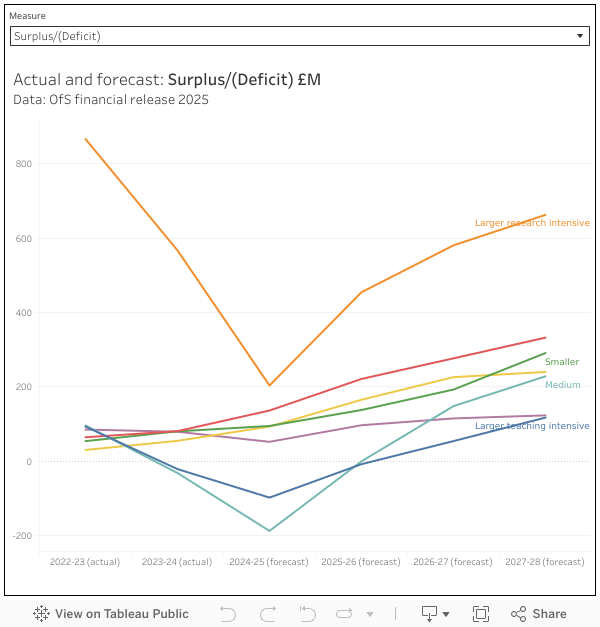
    Recent sector data for England showed that 43 per cent of higher education providers sampled by the Office for Students (OfS) were forecasting a deficit for 2024–25 and concluded that:

    Many institutions have ongoing cost reduction programmes to help underpin their financial sustainability. Some are reducing the number of courses they offer, while others are selling assets that are no longer needed.

    All the while, institutions are, quite rightly, under pressure to maintain and enhance student success.

    The findings of our 2021 review represent a time, not so long ago, when interventions could be designed and tested without the theorising and evaluation now prescribed by OfS. We presented a suite of options to encourage innovation and experimentation. Decision making now feels somewhat different. Many institutions will be asking “what works now, as we find ourselves in a period of financial challenge and uncertainty?”

    Mattering still matters

    The overarching theme of “mattering” (France and Finney 2009, among others) was apparent in the interventions we analysed in the 2021 review. At its simplest, this is interventions or approaches which demonstrate to students that their university cares about them; that they matter. This can be manifest in the interactions they have with staff, with systems and processes, with each other; with the approaches to teaching that are adopted; with the messages (implicit and explicit) that the institution communicates.

    Arguably, a core aspect of mattering is “free” in terms of hard cash – us showing students that we care about them, their experience, and their progress, for staff to have a friendly approach, a regular check in, and meaningful and genuine dialogue with students. Such interactions may well carry an emotional cost however, and how staff are feeling – whether they feel that they matter to the institution – could impact on morale and potentially make this more difficult. We should also be mindful of the gendered labour that can be evident when teaching academics are encouraged to pick up more “pastoral” care of students; in research-intensive institutions, this may be more apparent when a greater proportion of female staff are employed on teaching focused contracts.

    In our original review we found that there were clear relationships between each student outcome area – access, retention, attainment and progression – and some interventions had impact on more than one outcome. Here are five of our examples, within the overarching theme of mattering, which remind the sector of this impact evidence whilst illustrating developments in thinking and implementation.

    Five impactful practices

    Interventions which provide financial aid or assistance to students pre and post entry were evidenced as impactful in the 2016-2021 literature. We remember the necessity of providing financial aid for students during Covid, with the government even providing additional funding for students in need. In the current financial climate, the provision of extra funding may feel like a dream for many institutions. Cost reduction pressures may mean that reducing sizable student support budgets are an easy short-term win to balance the books.

    In fact late last year, Jim Dickinson predicted just this as the first wave APPs referenced a likely decline in financial support. As evaluative data has shown, hardship funding is used by students to fund the cost of living. When money is tight, an alternative approach is to apply targeted aid where there is evidence of known disadvantage. Historically the sector has not been great at targeting, but it has become a necessity. Preventing student withdrawal has never been more important.

    We also noted that early interventions delivered pre-entry and during transition and induction were particularly effective. The sector has positioned early and foundational experiences of students as crucial for many years. When discussions about cost effectiveness look to models of student support, targeting investment in the early years of study, rather than universally applied, could have the highest impact. Continuation metrics (year one to year two retention) again drive this thinking, with discrete interventions being the simplest to evaluate but perhaps the most costly to resource. Billy Wong’s new evidence exploring an online transition module and associated continuation impact is a pertinent example of upfront design costs (creation), low delivery costs (online), and good impact (continuation).

    Another potentially low cost intervention is the design of early “low stakes” assessment opportunities that give students the chance to have early successes and early helpful feedback which, if well designed, can support students feeling that they matter. These types of assessments can support student resilience and increase the likelihood of them continuing their studies, as well as providing the institution with timely learner analytics regarding who may be in need of extra support (a key flag for potential at-risk students being non-completion of assessments). This itself is a cost saving measure as it enables the prioritisation of intervention and resource where the need is likely to be greatest.

    Pedagogically driven interventions were shown in our review to have an impact across student outcome areas. This included the purposeful design of the student’s curriculum to impact on student learning, attainment, and future progression. Many institutions are embarking on large scale curriculum change with an efficiency (and student experience/outcomes) lens. Thinking long term enough to avoid future change, yet attending to short term needs is a constant battle, as is retaining conversations of values and pedagogy.

    How we teach is perhaps one of the most powerful and “cost-free” mechanisms available, given many students may prioritise what time they can spend on campus towards attending taught sessions. An extremely common concern expressed by new (and not so new) lecturers and GTAs when encouraged to interact with students in their teaching is “But what if I get asked a question that I don’t know the answer to?” Without development and support, this fear (along with an understandable assumption that their role is to “transmit” knowledge) often results in a retreat to didactic, content heavy approaches, a safe space for the expert in the room.

    But participative sessions that embed inclusive teaching, relational and compassionate pedagogies, that create a sense of community in the classroom where contributions are valued and encouraged, where students get to know each other and us – all such approaches can show students that they matter and support their experience and their success.

    We also found that interventions which provided personal support and guidance for students impacted positively on student outcomes. One to one support can be impactful but costly. Adaptations in delivery or approach, for example, small group rather than individual sessions and models of peer support are worth exploring in a resource sensitive environment. Embedding personal and academic support within course delivery and operating an effective referral system for students when needed, is another way to get the most out of existing resources.

    Finally, the effective use of learner analytics was a common theme in our review of impact. Certainly, the proactive use of data to support the identification of student need/risk makes good moral and financial sense. However, large scale investment might be necessary to realise longer term financial gains. This might be an extension of existing infrastructure or as Peck, McCarthy and Shaw recently suggested, HE institutions might turn to AI to play a major role in recognising students who are vulnerable or in distress.

    Confronting the hidden costs

    These financial dilemmas may feel uncomfortable; someone ultimately gains less (loses out?) in a targeted approach to enhancing student success. Equality of opportunity and outcome gaps alongside financial transparency should be at the forefront of difficult decisions (use equality legislation on positive action to underpin targeting decisions as needed). Evaluation, and learning from the findings, become even more important in the context of scarce resources. While quick decisions to realise financial savings may seem attractive, a critical eye on the what works evidence base is essential to have long term impact.

    Beyond our AHE review, TASO has a useful evidence toolkit which notes cost alongside assumed impact and the strength of the evidence. As an example, the provision of information, advice and guidance and work experience are cited as low cost (one star), with high-ish impact (two stars). This evidence base only references specific evidence types (namely causal/type three evidence). The series of evidence-based frameworks (such as Student Success, Employability, Inclusive Practice) from AdvanceHE are alternative reference points.

    The caveat to all of the above is that new approaches carry a staff development cost. In fact, all of the “low cost” interventions and approaches cited need investment in the development and support of academic staff. We are often supported by brilliant teams of learning designers and educational developers, but they cannot do all this heavy lifting on their own given the scale of the task ahead. As significant challenges like AI ask us to fundamentally rethink our purpose as educators in higher education, perhaps staff development is what we should be investing in now more than ever?

    Source link

  • What’s coming for higher education in the spending review?

    What’s coming for higher education in the spending review?

    The breadth of what we expect from the public sector is such that expertise needs to be distributed around the civil service.

    There are numerous costly initiatives, allocations, and activities fueled by state spending – all of them have advocates and skeptics, and hidden pitfalls and tensions.

    Even if there was a single brain that had a grasp of everything, how would that person weigh up the costs and benefits of spending on lifesaving drugs against maintaining housing benefits? Or expanding school breakfast clubs against meaningful support for public libraries? Or properly maintaining research infrastructure against properly maintaining flood defences?

    A spending review is an exercise in compromise – a search for the least worst answer – that almost by design disappoints nearly everyone. If there’s good news in one area of spending, there is pain coming elsewhere.

    Where did spending reviews come from?

    The idea of taking the time every few years to gather together all current public sector spending demands and assess the possibilities for savings feels like it has been around for ever.

    In fact, the first multi-year spending review took place as recently as 1998.

    Before this, UK spending and taxation was decided based on prevailing economic conditions – leading to accusations of short-termism in government thinking. After all it is difficult to plan sustainable programmes of spending with only one year of funding confirmed.

    The first multi-year comprehensive spending review was a Gordon Brown innovation – coming off the back of two years with public sector finance (politically) constrained by the previous government’s last year of allocations, it represented (in the language of the time) an opportunity for a newish Labour government to demonstrate ongoing “prudence”.

    As Brown put it:

    By looking not just at what government spends but at what government does, the review has identified the modernisation and savings that are essential. The first innovation of the Comprehensive Spending Review is to move from the short-termism of the annual cycle and to draw up public expenditure plans not on a one year basis but on a three year basis. And the review‘s second conclusion is that all new resources should be conditional on the implementation of essential reforms, money but only in return for modernisation

    Labour stuck a pattern of three year reviews throughout their last period of office – including another comprehensive spending review in 2007. Under Conservative-led administrations the pattern became more irregular (largely for reasons of political expediency, but also to respond to one off events like the Covid-19 pandemic). The last spending review was in 2021 – three governments (and three Prime Ministers) ago.

    How a spending review works

    The specifics may vary, but the review is a series of conversations conducted by the treasury (usually under the auspices of the Chief Secretary to the Treasury) and each department. Starting with officials modelling the impact of broad-brush cuts at various levels and arguing about what constitutes the work their department is required to do (the ambit) and what (for non-zero based spending reviews) the baseline funding should be, the process ends with ministers taking the argument directly to the treasury – or overhead to the prime minister and via carefully placed stories in the press.

    Eventually – the key date this year was as recent as late May – ministers and the Chancellor will come to a final agreement over what will be allocated and what, in broad terms, it will be spent on.

    Those who have been closely involved tend not to be enamoured of the process – former DfE adviser Sam Freedman recently described it as “demented” and “not a good or strategic way to make decisions about government spending”.

    In 2024

    The current iteration kicked off straight after the 2024 election, with the first part of it announced by Rachel Reeves alongside the autumn budget. Alongside some punchy political lines (that “£22bn black hole” for one) she confirmed the overall envelope for the spending review:

    Day to day spending from 2024-25 onwards will grow by 1.5 per cent in real terms, and total departmental spending, including capital spending, will grow by 1.7 per cent in real terms.

    We also got some broad promises on education spending – an extra £300m for further education, a £2.3bn increase in the schools core budget and a reform of special educational needs provision. However, the Institute for Fiscal Studies is warning that given other promises, most notably on defence and health, “unprotected” DfE recurrent spending (which would include spending on higher education) is likely to fall by around 3 per cent over the three years the review covers – and significant schools and FE spending (which the government is likely to want to protect) also appears within that bucket.

    Higher education is by no means alone in facing a very tight multi-year settlement – but it suffers in terms of public salience. While, thanks to the efforts of universities and trade unions, there is a general consensus that the sector is struggling it is neither as totemic (NHS, schools, defence) or visible (local services, adult skills, social care) as the recipients of other public spending. There’s been a lot of work done in making the arguments for investment, but these arguments are never going to be as strong as they need to be.

    That’s (flat) capital

    What Reeves appears to be promoting in the run up to the review is the availability of capital. Traditionally, spending reviews have only addressed departmental expenditure limits (DEL) – recurrent funding that can reasonably be controlled by the department in question – involving capital spending only really started in 2020 and 2021. Changes to, for example, eligibility rules for benefits can also have an impact on recurrent annual managed expenditure (AME) and spending reviews have moved further in that direction in recent times.

    Capital is more traditionally allocated and spent in fiscal events – it makes for big numbers and eyecatching infrastructure investments and doesn’t usually form a part of the spending reviews, but it was always in scope for 2024 to set capital budgets for at least five years.

    And the big sector-focused news has been about research and development funding. While by no means all R&D funding goes to universities, a substantial proportion will end up there – and the news that the overall allocation for R&D will keep pace with inflation until 2029-30 is undoubtedly good in the context of a very tight overall recurrent settlement. As my colleague James Coe sets out elsewhere on Wonkhe, there are other calls on R&D beyond the traditional UKRI allocations (though we know UKRI allocations will be broadly stable this year): there are calls for increased spending in defence research, there will be small (£30m to each current mayoral strategic authority) regional allocations, and there will likely be funding streams attached to each of the government’s missions.

    Recall also, the manifesto promise of ten-year funding settlements for some research activity. Five years of flat (inflation-compensated) funding represents exactly the kind of stable and predictable income that some parts of the sector have been asking for – if there are people unhappy with that, promising stability for ten years isn’t going to feel much different.

    Teaching funding

    Fans of the national accounts will know that the majority of funding allocated to teaching in higher education (the student loan outlay) is, in fact, AME capital. There has been some initial hope that the portion that isn’t (the recurrent DEL that is allocated via the grant letter to the Office for Students) would form a part of the long promised review of funding – but this looks less likely than a commitment to continue inflationary fee-cap uplifts alongside measures to improve efficiency in spending (rooting out fraudulent applications and suchlike, promoting shared services).

    The parallel is with funding for 16-19 students – an extra £190m will push per-student funding up an inflation-busting 5.9 per cent next year, to £5,105. The recurrent funding simply isn’t there to do anything like that for direct higher education funding, but using an increase in capital spending offers a release valve via the tuition fee loan mechanisms.

    Fee increases would be unpopular (a tax on aspiration, if you like) with young people and their parents. The temptation would be to favourably tweak the conditions of repayment, and there may be some headroom here – if you recall last year’s earnest and sporadically understood talk around PSNFL in the fiscal rules, one of the upshots was that loans count as assets, and the more loans we have the more (in the short-to-medium term at least) assets we have. While this could fuel a further expansion of the sector, the current policy weather suggests that this flexibility could instead be used to offer young people a better loan deal.

    On the day

    While a multi-year spending review is an exercise in demonstrating the long term planning capacity of a government, the event itself has to interface with the short-term news cycles. There needs to be some good news in there – and the pre-announced transport capital, R&D capital, and above-inflation settlement for health are part of that.

    Good news could also take the form of announcing popular savings. Very few people will be disappointed in cuts to bureaucracy (at least in the short term, people do tend to become very upset when waiting times rise and services become less effective) and measures to address fraud. Here we’ve already heard a lot of mood music around fraud within the higher education funding system – the very high profile case of Oxford Business College suggests that ministers see the opportunity to better manage the current allocations of funding, and there is a consultation response ready to drop. We’d assumed this would come alongside the promised white paper, but I wouldn’t be surprised to see at least headline proposals sneak out earlier.

    Finally we have the broader favourite that is “efficiency” savings. Universities have been very engaged with this agenda ever since the HE Reform letter – the conjunction of the Universities UK report, the release of TRAC data (slightly delayed over last year), and the spending review may not be entirely coincidental.

    Source link

  • Universities UK’s new era of collaboration

    Universities UK’s new era of collaboration

    The first major report of Universities UK’s transformation and efficiency taskforce – Towards a new era of collaboration – is a milestone in the ongoing national debate about unlocking maximum value from state investment in the higher education system.

    Though “transformation and efficiency” is the headline, the focus of the group has largely been on collaboration – ways in which universities and other providers can work together, and ways in which government and regulators can make it easier for this to happen.

    The drive for transformation came slowly at first and then all at once. The financial pressures on the sector – arising from Covid recovery, uneven patterns of student recruitment, rising pensions costs and erosion of the unit of resource for undergraduate tuition – are long standing (remember then chief of staff Sue Gray’s “shitlist” for the new government which featured the financial collapse of a large university?)

    Why and how

    The election of a new Labour government prompted the publication of the Universities UK Blueprint which hoped for a shift in relations between government and the sector based on effort on both sides to address the structural challenges facing higher education, of which a taskforce on transformation was one recommendation.

    Even at the point of the formation of the taskforce, led by former University of the Arts London vice chancellor Nigel Carrington, there was a degree of scepticism about how feasible the promised “new era of collaboration” might be. Wonkhe and Mills & Reeve’s Only Connect report on the opportunities for cooperation in the English sector found an appetite in principle among university leadership for new models for collaboration, along with a sense that the cultural and regulatory barriers were so significant as to make meaningful exploration of those opportunities unlikely.

    The taskforce, through a series of in-depth interviews with stakeholders, and detailed work with sector organisations, professional bodies and external experts, has therefore made an enormous stride forward in setting out the potential for system-wide change.

    The case for change

    There is a genre of departmental spending review submission called the “bleeding stumps” report, wherein civil servants offer up apocalyptic and or foolish ways in which spending constraints can be overcome – ex-DfE adviser Sam Freedman loves to tell the story of a pre-spending review report that suggested that pupils could attend school either in the morning or the afternoon.

    What Universities UK has produced is pretty much the diametric opposite of this approach. While recognising the dwindling availability of cash, the impact of these circumstances is set out via the results of a survey conducted in May of this year. While this is pretty bleak reading – 55 per cent of universities are consolidating courses (94 per cent would consider in the next three years), 25 per cent have seen compulsory staff redundancies already (up 14 percentage points on last year) and 36 per cent are cutting student support services (77 per cent would consider) – it comes across neither as sensationalist nor overblown to reflect the way the sector is having to change.

    The “would consider in next three years” column will be of most concern to the government, even beyond DfE: 79 per cent would consider cutting academic research activity, 71 per cent would be looking at cutting civic and local growth activity. To be clear this is based on a survey completed by 57 providers, so while it does show a concerning direction of travel you couldn’t expect a precise picture of what is happening on the ground everywhere.

    One interesting nugget within this section is a call for sector stewardship – with OfS focusing on teaching through a market-based regulatory lens, and Research England acting as a research council UUK argues that no single body has an eye on the health of the sector as a whole with the ability to intervene where action is needed. The declining value of tuition fee income and other state support is part of the issue, but a rise in the number of providers and what is described as “an increasingly competitive environment” has played a part in many of the pressures universities are facing. As consultees told the taskforce:

    the focus had shifted too far to the individual student or institution, even where that created conflict with wider national interests, including disadvantaging activity that could benefit economic objectives and wider society but may not translate into student demand, such as the provision of highly specialised skills to meet the needs of certain industries or the protection of universities playing important civic roles in parts of the country with higher levels of disadvantage.

    Opportunities and actions

    The taskforce’s findings are neatly split across seven “opportunities”, each with associated actions for university leaders, Universities UK itself, other organisations, and government:

    1. Pursuing innovative collaborative structures
    2. Sharing more services and infrastructure
    3. Leveraging sector buying power
    4. Supporting digital transformation
    5. Adopting a common approach to assessing efficiency and benchmarking costs
    6. Developing leadership skills in those mandated to deliver change and further improving governance
    7. Developing the current regulatory environment and supportive structures to help collaboration and transformation to go further, faster

    Each is also supported by case studies (drawing primarily on existing work in the UK higher education sector, though the net is occasionally cast further afield) and indications of appetite from consultation respondees.

    Collaboration and sharing

    The case for university collaboration in the UK has been made with increasing frequency as the financial squeeze starts to make itself felt in profound ways. That said, there has been little tangible activity – the report points to longstanding structures such as the University of London federation, existing networks of research collaborations, and strategic working with local stakeholders. The taskforce adds the multi-academy trust-esque group structures employed by the (HE and FE) University of the Highlands and (cross sector) London South Bank to the list., and there is a nod to the world of sharing expensive research infrastructure too.

    A third strand covers the sharing of infrastructure and services – major examples here include UCAS and the Jisc Janet network, alongside more specialist activity like Uniac on auditing services (further examples are worth digging into via the recent Jisc/KPMG report).

    Though the big newsworthy two-become-one moments exemplified by ARU Writtle may be few and far between, what comes across powerfully is just how much of this stuff is going one, and the potential that exists to do more. One of the big gaps is expertise and understanding – tackling the legal, technical, and process aspects of joint working is not for the faint of heart and if this is the direction of travel both specialist staff and institutional leaders need to be clear and up to date on how this works. There’s scope for detailed advice and guidance (that the taskforce itself will produce) alongside an ongoing support function at Universities UK – we need regulatory tweaks to allow for innovation in organisational forms too.

    The bigger asks are for a transformation fund, and specific advice from the Competition and Markets Authority (CMA) on what would constitute a breach of competition law in this space. The latter appears to be in progress – there was an encouraging blog post from CMA at the end of last week. The cost of transformation (ie investing in the infrastructure and systems that can enable efficiency) could, the taskforce suggests, arrive in a straightforward way by allowing universities to access a “small portion” of the existing £3.25bn Transformation Fund available to the public sector.

    Spending and benchmarking

    Taken as a whole, the higher education sector spends £20.1bn on operating expenses each year – much of the non-pay end of this happens via procurement processes at individual institutions. The cumulative impact of all this spending can often enable the sector to get a better deal, but this needs to be coordinated across multiple providers for the benefits to kick in. Initiatives like the UK University Purchasing Consortia and Jisc’s procurement on behalf of the sector are unlocking big, existing, savings – the report suggests savings of £116m via UKUPC, and £138m for the Jisc activity – taking maximum advantage of these proven schemes could drive further savings.

    But there is potential to unlock even more – the work of the taskforce indicates that there is both scope and appetite for this kind of collaborative spending in information technology (ask your IT department, the cost of software licenses and cloud-based solutions are spiralling) and estates (bear in mind the maintenance backlog that the precarious financial environment has led to).

    Another angle is making it easier to understand when your university is spending over the odds. Finance teams are very keen on benchmarking spending with comparable institutions – why should it cost more to do fundamental stuff than at the university down the road? – but it is difficult to access reliable and comparable data. There’s a suggestion that an Association of the Heads of University Administration (AHUA) organisational efficiency maturity model (basically best practice on understanding and reporting spending) could help get the sector on the same page, and that UUK could drive a more collaborative approach to sharing and using this data to drive savings.

    Digital transformation

    There’s any number of promises that the latest and greatest software can save your university time and money, but your IT director will tell you that such promises take substantial time and money to realise. The rise of large language model generative tools has unlocked another round of wild claims, and both institutional leaders and IT and administrative specialists are being asked to evaluate spending even more to make these efficiencies a reality. There’s so many questions – not least around whether your shiny new system will work with the systems and processes you already use.

    The trouble is, understanding and implementing this stuff takes time and expertise at both specialist and leadership levels – and both are at a premium in higher education. Jisc is already supporting 24 providers in understanding and benchmarking their digital transformation maturity – helping, in essence, to understand where further help may be needed. There’s also a need to actively and meaningfully involve senior leaders, and to understand the digital competencies of staff and students. The taskforce calls for a wider roll-out of this maturity model, and for Jisc and UCISA to promote shared standards around software and processes.

    Regulation and leadership

    The need for an advancement in leadership skills runs throughout the taskforce report. Transformations like the ones advocated require competencies and knowledge that go far beyond business as usual, and correspondingly more is being asked of senior staff and governors – all of which comes alongside a more onerous (and fast-moving) regulatory regime that requires its own expanding set of skills.

    The report is supportive of the current Committee of University Chairs (CUC) initiative to review university governance (via updating its current code for governors), and Universities UK proposes to facilitate ongoing and sector-led improvement activity.

    There’s immediate stuff that can be done on cost pressures – there’s a specific ask of government on relaxing the rules that require some universities to enroll all staff onto the increasingly expensive teacher’s pension scheme (TPS), and a more general suggestions that the government avoid putting additional costs on the sector such as introducing new and unfunded expectations, or inventing new levies.

    There is clearly scope to address the regulatory burden placed on the sector – one easy win would be to address the barriers to collaboration. Recent regulatory activity (particularly in England) has focused on individual providers – the recent shift in the OfS remit to consider the wider health of the sector offers scope to reestablish the idea of a “custodian” of the sector that could deliver on the long-term goals set all levels of government and by wider civic society.

    What’s next?

    This report marks the end of the first phase of Universities UK work on transformation and efficiency. Phase two will create an oversight group to keep an eye on the various asks from sector agencies and monitor both progress and impact. This is not in any sense a political report – though it is clearly politically useful – and it is clear that both UUK and the sector are in this for the long haul.

    More broadly the report stands as another signal to government that the sector is prepared to go further and faster on transformation and collaboration that has previously been the case – but there is a clear desire for a reciprocal “vision” or plan from government around which the sector can do, ideally backed up with some investment in that vision.

    The rather dour communications that have so far issued from DfE on HE reform and funding suggest that the government is not yet prepared to give the sector a full-throated endorsement, but there is scope for that to change following next week’s spending review and the publication of the post 16 education and skills and HE reform white paper this summer.

    Economic circumstances notwithstanding the policy agenda in the next few months will set a course for HE for the rest of this parliament and beyond – it would be a real own-goal not to seize the opportunity to work with the sector to get things onto a firmer footing.

    Source link

  • What the latest HESA data tells us about university finances

    What the latest HESA data tells us about university finances

    The headlines from the 2023-24 annual financial returns were already pretty well known back in January.

    Even if you didn’t see Wonkhe’s analysis at the time (or the very similar Telegraph analysis in early May), you’d have been well aware that things have not been looking great for the UK’s universities and other higher education providers for a while now, and that a disquieting number of these are running deficits and/or making swingeing cuts.

    What the release of the full HESA Finance open data allows us to do is to peer even deeper into what was going on last academic year, and start making sense of the way in which providers are responding to these ongoing and worsening pressures. In particular, I want to focus in on expenditure in this analysis – it has become more expensive to do just about everything in higher education, and although the point around the inadequacy of fee and research income has been well and frequently made there has been less focus on just how much more money it costs to do anything.

    Not all universities

    The analysis is necessarily incomplete. The May release deals with providers who have a conventional (for higher education) financial year – one that matches the traditional academic year and runs through to the end of August. As the sector has become more diverse the variety of financial years in operation have grown. Traditional large universities have stayed with the status quo – but the variation means that we can’t talk about the entire sector in the same way as we used to, and you should bear this in mind when looking at aggregate 2023-24 data.

    A large number of providers did not manage to make a submission on time. Delays in getting auditor sign off (either because there was an audit capacity problem due to large numbers of local authorities having complex financial problems, or because universities themselves were having said complex financial problems) mean that we are down 18 sets of accounts. A glance down the list shows a few names known to be struggling (including one that has closed and one that has very publicly received a state bailout).

    So full data for the Dartington Hall Trust, PHBS-UK, Coventry University, Leeds Trinity University, Middlesex University, Spurgeon’s College, the University of West London, The University of Kent, University of Sussex, the Royal Central School of Speech and Drama, The Salvation Army, The London School of Jewish Studies, Plymouth Marjon University, the British Academy of Jewellery Limited, Multiverse Group Limited, the London School of Architecture, The Engineering and Design Institute London (TEDI) and the University of Dundee will be following some time in autumn 2025.

    Bad and basic

    HESA’s Key Financial Indicators (KFIs) are familiar and well-documented, and would usually be the first place you would go to get a sense of the overall financial health of a particular university.

    I’m a fan of net liquidity days (a measure showing the number of days a university could run for in the absence of any further income). Anything below a month (31 days) makes me sit up and take notice – when you exclude the pension adjustment (basically money that a university never had and would never need to find – it’s an actuarial nicety linked to to the unique way USS is configured) there’s 10 large-ish universities in that boat including some fairly well known names.

    [Full screen]

    Just choose your indicator of interest in the KFI box and mouse over a mark in the chart to see a time series for the provider of your choice. You can find a provider using the highlighter – and if you want to look at an earlier year on the top chart there’s a filter to let you do that. I’ve filtered out some smaller providers by default as the KFIs are less applicable there, but you can add them back in using the “group” filter.

    I’d also recommend a look at external borrowing as a percentage of total (annual) income – there are some providers in the sector that are very highly leveraged who would both struggle to borrow additional funds at a reasonable rate and are likely to have substantial repayments and stringent covenants that severely constrain the strategic choices they can make.

    Balance board

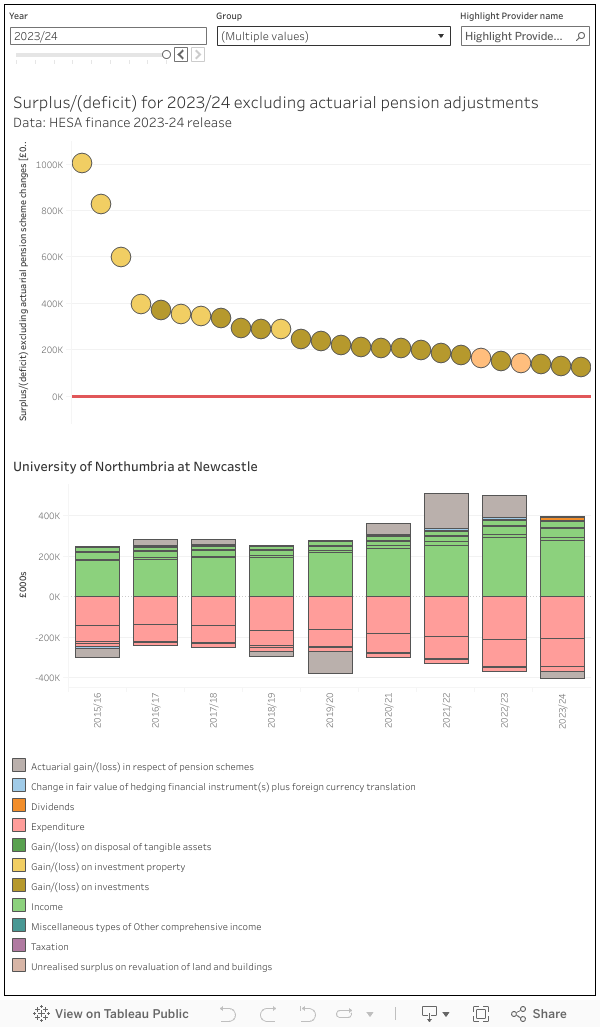
    This next chart lets you see the fundamentals of your university’s balance sheet – with a ranking by overall surplus and deficit at the top. There are 29 largeish providers who reported a deficit (excluding the pension adjustments again) in 2023-24, with the majority being the kind of smaller modern providers that train large parts of our public sector workforce. These are the kind of universities who are unlikely to have substantial initial income beyond tuition fees, but will still have a significant cost base to sustain (usually staffing costs and the wider estates and overheads that make the university work).

    [Full screen]

    This one works in a pretty similar way to the chart above – mousing over a provider mark on the main surplus/deficit ranking lets you see a simplified balance sheet. The colours show the headline categories, but these are split into more useful indications of what income or expenditure relates to. Again, by default and for ease of reading I have filtered out smaller providers but you could add them in using the “group” filter. For definitions of the terms used HESA has a very useful set of notes below table 1 (from which this visualisation is derived)

    There’s very little discretionary spend within the year – everything pretty much relates to actually paying staff, actually staying in regulatory compliance, and actually keeping the lights on and the campus standing: all things with a direct link to the student experience. For this reason, universities have in the past been more keen to maximise income than bear down on costs although the severity and scope of the current pressure means that cuts that students will notice are becoming a lot more common.

    What universities spend money on

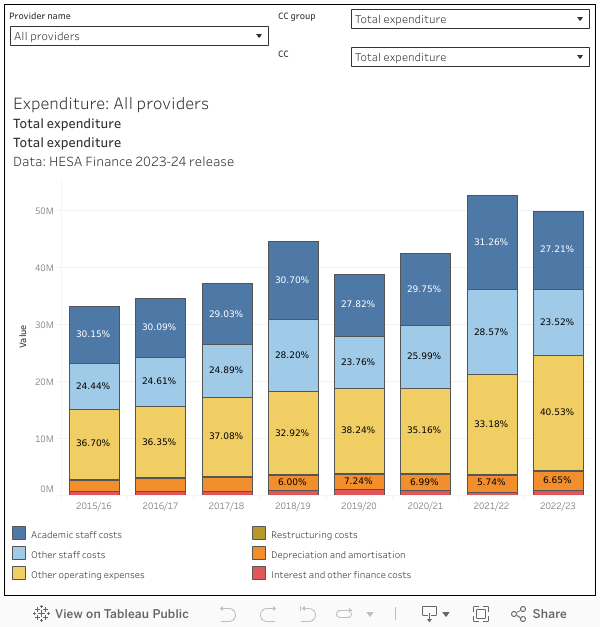
    As a rule of thumb, about half of university expenditure is on staff costs (salaries, pensions, overheads). These costs rise slowly but relatively predictably over time, which is why the increase in National Insurance contributions (which we will see reflected in next year’s accounts) came as such an unwelcome surprise.

    But the real pressure so far has been on the non-staff non-finance costs – which have risen from below 40 per cent a decade ago to rapidly approach 50 per cent this year (note that these figures are not directly comparable, but the year to date includes most larger providers, and the addition of the smaller providers in the regular totals for other years will not change things much).

    What are “other costs”? Put all thoughts of shiny new buildings from your mind (as we will see these are paid for with capital, and only show up in recurrent budgets as finance costs) – once again, we are talking about the niceties of there being power, sewage, wifi, printer paper, and properly maintained buildings and equipment. The combination of inflationary increases and a rise in the cost of raw materials and logistics as a result of the absolute state of the world right now.

    [Full screen]

    Though this first chart defaults to overall expenditure you can use it to drill down as far as individual academic cost centres using the “cc group” and “cc filters”. Select your provider of interest (“All providers” shows the entire sector up to 2022-23, “All providers (year to date)” shows everything we know about for 2023-24. It’s worth being aware that these are original not restated accounts so there may be some minor discrepancies with the balance sheets (which are based on restated numbers).

    The other thing we can learn from table 8 is how university spending is and has been split proportionally between cost centres. Among academic subject areas, one big story has been the rise in spending in business and management – these don’t map cleanly to departments on the ground, but the intention to ready your business school for the hoped-for boom in MBA provision is very apparent.

    [Full screen]

    That’s capital

    I promised I’d get back to new builds (and large refurbishment/maintenance projects) and here we are. Spending is categorised as capital expenditure when it contributes to the development of an asset that will realise value over multiple financial years. In the world of universities spend is generally either on buildings (the estate more generally) or equipment (all the fancy kit you need to do teaching and research).

    What’s interesting about the HESA data here is that we can learn a lot about the source of this capital – it’s fairly clear for instance that the big boom in borrowing when OfS deregulated everything in 2019-20 has long since passed. “Other external sources” (which includes things like donations and bequests) are playing an increasingly big part in some university capital programmes, but the main source remains “internal funds” drawn from surpluses realised in the recurrent budget. These now constitute more than 60 per cent of all capital spend – by contrast external borrowing is less than ten per cent (a record low in the OfS era)

    [Full screen]

    What’s next?

    As my colleague Debbie McVitty has already outlined on the site, the Office for Students chose the same day to publish their own analysis of this crop of financial statements plus an interim update giving a clearer picture of the current year alongside projections for the next few.

    Rather than sharing any real attempt to understand what is going on around the campuses of England, the OfS generally uses these occasions to complain that actors within a complex and competitive market are unable to spontaneously generate a plausible aggregate recruitment prediction. It’s almost as if everyone believes that the expansion plans they have very carefully made using the best available data and committed money to will actually work.

    The pattern with these tends to be that next year (the one people know most about) will be terrible, but future years will gradually improve as awesome plans (see above) start to pay off. And this iteration, even with the extra in year data which contributes to a particularly bad 2025-26 picture, is no exception to this.

    While the HESA data allows for an analysis of individual provider circumstances, the release from OfS covers large groups of providers – mixing in both successful and struggling versions of a “large research intensive” or “medium” provider in a generally unhelpful way.

    [Full screen]

    To be clear, the regulator understands that different providers (though outwardly similar) may have different financial pressures. It just doesn’t want to talk in public about which problems are where, and how it intends to help.

    Source link

  • We are living through the legacy of unrestrained borrowing

    We are living through the legacy of unrestrained borrowing

    On 1 January 2018 the Office for Students took over the regulation of higher education in England from its predecessor (the Higher Education Funding Council for England (HEFCE)).

    One little discussed impact of this change was an avalanche of university borrowing that has dramatically shifted the priorities and risk profile of English higher education.

    Terms and conditions

    As late as the 2017 memorandum of assurance and accountability between HEFCE and higher education providers, the regulator had the right of veto over university financial commitments over a certain level. If you wanted to borrow money, and you were talking “serious money” in relation to the size of your provider, the regulator needed to sign it off.

    That year written approval was required where total financial commitments exceeded six times the average adjusted net operating cashflow (ANOC) from July – or where the provider was assessed as being “at higher risk”. The year before, it was required when borrowing crept above five times the (six year) average EBITDA. And back in 2006 it was required for borrowing over 4 per cent of income.

    The levels may have shifted over the years but the principles remained the same – to ensure that providers in receipt of public funds offered value for money, and were fully responsible for the use of these funds. These broader requirements were set out in detail:

    HEIs must apply the following principles when entering into any financial commitments:

    a. The risks and affordability of any new on- and off-balance sheet financial commitments must be properly considered.

    b. Financial commitments must be consistent with the HEI’s strategic plan, financial strategy and treasury management policy.

    c. The source of any repayment of a financial commitment must be clearly identified and agreed by the governing body at the point of entering that commitment.

    d. Planned financial commitments must represent value for money.

    e. The risk of triggering immediate default through failure to meet a condition of a financial commitment should be monitored and actively managed

    At some point during the transition from HEFCE to OfS, all this was scrapped.

    The missing consultation

    If “at some point” sounds uncharacteristically vague that’s because the decision was murky even by higher education policy standards. The requirement was in the 2017 memorandum – it wasn’t in the OfS 2018 “terms and conditions” of funding, or any of the registration or information requirements, or the regulatory framework. The shift was never consulted on, it wasn’t in the Green or White paper, it was never discussed in parliament. It just kind of happened.

    In Wales, there are still requirements to get borrowing above a threshold signed off based on the 2017 Financial Management Code – however your (individual provider) threshold is built into the formulae of your financial forecast template. Thresholds are never published, but Medr may occasionally drop you a note to tell you what yours is. Which is nice.

    In Scotland things are (slightly) more straightforward: there is a threshold over which SFC’s formal consent is required. It’s not a concrete figure but a calculation to determine whether the total annualised cost of the borrowing exceeds 4 per cent of total income (according to a university’s last audited statements) or would exceed by 4 percent the estimated total income for the year in which the borrowing begins – whichever one is the lower.

    As things currently stand in England the explanatory sections on the D conditions of registration set up definitions of financial viability and sustainability. Viability is the interesting one here – for OfS purposes it means there is no reason to suppose the provider is at a “material risk of insolvency” (being unable to pay debts as they fall due) for the next three years. This clarifies that OfS does expect to know about borrowing (“have regard to” in fact) – and even suggests OfS would expect to be able to speak directly to lenders:

    It will be for the provider to ensure that the OfS is fully informed as to its financial facilities, and it will be expected to consent to the OfS making direct enquiry of the finance provider if requested to do so. The OfS may draw inferences from a failure to provide such consent.

    This approach to university borrowing can also be seen in the transition provisions that existed as OfS effectively carried on as HEFCE while it began to register existing providers – a commentary to the required audited data included the need for universities to include information on:

    Whether the provider is planning to take any loans from a bank, shareholders, directors or anyone else and, if so, information about these plans (how much is it planning to borrow, when will this be taken out, when will it be paid back, what will it be used for) and whether it will affect the provider’s viability or sustainability.

    A very good year

    This shift did not go unnoticed by universities, so 2017-2018 became a bumper year for university borrowing – with banks, private funds, and the bond markets all displaying an appetite for access to (then) underleveraged, secure, and low risk UK higher education.

    The 2017 HEFCE financial health publication noted that:

    At the end of July 2017, the sector reported borrowing of £9.9 billion (equivalent to 33.1 per cent of income). This is £980 million higher than the level reported at the end of 2015-16, which was £8.9 billion (30.7 per cent of income).

    By 2018 OfS as reporting that borrowing would reach £12bn by “year 2” (2017-18).

    At the end of Year 2, the sector reported aggregate borrowing of £12.0 billion (equivalent to 36.8 per cent of income), a 21 per cent rise of £2.1 billion compared to Year 1. Forecasts show that borrowing is projected to continue to rise in absolute terms over the four forecast years, reaching £13.3 billion by the end of Year 6.

    In the last quote, “year 6” is 2021-22 – the projection of aggregate borrowing was (as usual) on the low side. That year’s financial health report pegged it as just over £14bn.

    OfS, of course, could have decided to apply specific conditions of registration if it was concerned about borrowing at a particular provider. It still gets information on what universities are borrowing, and on what they plan to borrow in future, via the annual financial return (and there have already been rumblings about an increase in the amount and frequency of provided data). It could have stepped in to moderate the boom in borrowing since it took regulatory control of the sector – it did not.

    The morning after

    But the time of plenty has clearly passed – affordable finance is simply harder to come by, and the terms of existing borrowing (set during a more confident era) have often been renegotiated. The 2024-25 aggregate external borrowing is projected to be £13.3bn, and this for a much larger sector. And even the sector’s own (generally optimistic) forecasts suggest that it will drop further in years to come.

    This is very much the hangover after the party. The easy money simply isn’t there for the sector to borrow – all that remains is the improvements it paid for (hopefully in useful, tangible, things like estates and infrastructure), the repayments, and the interest.

    You can see that in the data (Based on what I know about what has happened so far I don’t think this includes stuff like bonds, so the figures are illustrative rather than precise) – the big peak in unsecured loans was in 2017-18, the academic year that restrictions came off (the smaller peak in 2020-21 represents the government backed Covid loans).

    [Full screen]

    You can also see a peak in repayments in 2018-19: clearly many providers decided that with the brakes off, the easiest way to proceed was with short-term revolving credit. More worryingly for sector finances, interest repayments remain at 2018-19 levels even though borrowing has declined sharply – an impact of a rise in interest rates following a long period of near zero inflation.

    A legacy of loans

    In essence some of the blame for the current financial crisis faced by the sector can be attributed to this little-scrutinised decision to remove borrowing safeguards. Though estates (especially) benefited from this gold rush, the entry of UK universities into the world of private placements and bonds has left a legacy that will take decades (and hundreds of millions of pounds cut off the top of sector finances, and increasingly arduous restrictions on university activity within covenants) to reckon with.

    And these controls on university activity hit in numerous ways. As Philip Augar’s review noted, way back in 2019:

    Universities’ expansion has been partly funded through debt and financial arrangements known as ‘sale and leaseback’. The former includes bond issues and bank borrowing; the latter involves universities selling student accommodation for cash upfront, sometimes committing to provide specified numbers of rent-paying students to the new owner.

    A failure to meet challenging recruitment targets has a multiplier effect if you factor lender requirements into the equation.

    Was the removal of controls over borrowing the single most important regulatory act of the modern era? For those able to raise money in this way, it supported huge improvements in university estates and infrastructure. It provided the capacity that has underpinned recent growth – though not as much growth as we saw in the 90s and 00s, when a far greater proportion of capital came from the state.

    It’s at least arguable that for many larger and better known providers the amount of indirect control over their actions that has been ceded to investors via covenants linked to borrowing. has driven the dash for growth at all costs. If you’ve worked in a university during this period and feel like things have changed, this could be why.

    And it gets worse if you think about the aggregated risk across the whole sector – not least because the arms race of expansion forced the majority of the sector to seek private finance at roughly the same time. The numbers in the chart above are indicative – but even so show a sizable liability that could have a huge impact on the way providers behave. It’s the roots of the sector-wide dash for growth that the regulators have expressed concern about – but thus far the impression has been given that it is just empire building. It is survival.

    The next few years

    There is no easy fix. Though I think most of us believe that the government would step in in the event of provider failure – to protect the student interest certainly, and possibly to protect the local interest – what would happen to outstanding debts across multiple providers in these circumstances is less clear. It is entirely likely that a loan becoming due for full payment due to a breach in covenant conditions would itself be the cause of provider failure.

    In the bad old days, when the government was a significant source of both capital and recurrent funding for most universities in England, there was a thing called exchequer interest – a complicated and little-discussed aspect of public funding that means that assets purchased with public funds should revert at least in part back to the public. Exchequer interest as a consideration for capital investment has largely been replaced by lender interest – in the event of a provider collapsing large parts of abandoned campuses (which, of course, have been paid for by public funds in the sense that it is income from fees that has funded repayments) would revert to lenders.

    These buildings and this equipment would immediately lose a lot of value, which is one reason why lenders like to renegotiate rather than repossess. If you think about it, a large teaching block in the middle of a thriving campus is a clear asset – without the campus it is a liability that needs to be repurposed and maintained.

    So if you ever see the government stepping in to save an anchor institution, recall that private finance has an interest in seeing campuses continuing to throng with students. It’s a funny way to preserve the future of the sector, but we live in peculiar times.

    Source link

  • An early look at 2023–24 financial returns shows providers working hard to balance the books

    An early look at 2023–24 financial returns shows providers working hard to balance the books

    In most larger UK providers of higher education, the 2023–24 financial year ended on 31 July 2024.

    Five months and two weeks after this date (so, on or before 14 January 2025) providers are obliged to have published (and communicated to regulators) audited financial statements for that year.

    I’ve got a list of 160 large, well known, providers of higher education who should, by now, have made this disclosure – 43 of them are yet to do so. Of the 117 that have, just 15 (under 13 per cent) posted a deficit for that financial year (to be fair, this includes eight providers in Wales, where the deadline – for bilingual accounts – is the end of the month). This was as of the data of publication, there’s been a few more been discovered since then and I have added some to the charts below.

    If you’ve been aware of individual providers, mission groups, representative bodies, trade unions, regulators, and politicians coming together to make the case that the sector is severely underfunded this may surprise you. If you work in an institution that is curtailing courses, making staff redundant, and undergoing the latest in a long series of cost-cutting exercises, the knowledge that your university has posted a surplus may make you angry.

    But these results are not surprising, and a surplus should not make you angry (there are plenty of other reasons to be angry…) Understanding what an annual account is for, what a surplus is, why a university will pull out all of the stops to post a surplus, and what are the more alarming underpinning signals that we should be aware of will help you understand why we have what – on the face of it – feels like a counter-intuitive position in university finances.

    Why are so many results missing?

    There’s a range of reasons why a provider may submit accounts late – those who are yet to publish will already be deep in conversation with regulators about the issues that may have caused what is, technically, a breach of a regulatory condition. In England, this is registration condition E3. which is underpinned by the accounts direction.

    If you are expecting regulators to get busy issuing fines or sanctions for late submissions – you should pause. There’s a huge problem with public sector audit capacity in the UK – the big players have discrete teams that move on an annual cycle between higher education, NHS, and local government audit. You don’t need to have read too much into public finances to know that our councils are under serious pressure right now – and this pressure results in audit delays, hitting the same teams who will be acting as external university auditors.

    That’s one key source of delay. The other would be the complexities within university annual accounts, and university finances more generally, that offer any number of reasons why the audit signoff might happen later than hoped.

    To be clear, very few of these reasons are going to be cheerful ones. If a provider has yet to publish its accounts because they have not signed off their accounts, it is likely to be engaging with external auditors about the conditions under which they will sign off accounts.

    To give one example of what might happen – a university has an outstanding loan with a covenant attached to it based on financial performance (say, a certain level of growth each year). In 2023–24, it did not reach this target, so needs to renegotiate the covenant, which may make repayments harder (or spread out over a longer period). The auditor will need to wait until this is settled before it signs off the accounts – technically if you are in breach of covenant the whole debt is repayable immediately, something which would make you fail your going concern test.

    We’ve covered covenants on the site before – a lender of whatever sort will offer finance at an attractive rate provided certain conditions are met. These can include things like use of investment (did you actually build the new business school you borrowed money to build?), growth (in terms of finances or student numbers), ESG (are you doing good things as regards environment, society, and governance?) and good standing (are you in trouble with the regulator?) – but at a fundamental level will require a sense that your business is financially viable. If covenant conditions are breached lenders will be keen to help if they hear in advance, but your cost of borrowing (the interest rate charged, bluntly) will rise. And you will find it harder to raise finance in future.

    This is an environment where it is already hard to raise finance – and in establishing new borrowing, or new revolving credit (kind of like an overdraft facility) many universities will end up paying more than in previous years. This all needs to be shown in the accounts.

    Going concern

    When your auditor signs off your accounts, you would very much hope that it will agree that they represent a “going concern” – simply put, that in most plausible scenarios you will have enough money to cover your costs during the next 12 months. If your auditor disagrees that you are a going concern you are in serious trouble – all of the 117 sets of accounts I have read so far have been agreed on a going concern basis.

    This designation tells everyone from regulators to lenders to other stakeholders that your business is viable for the next year – and comes into force on the day your accounts are signed off by the university and external auditor. This is nearly always for a specific technical reason – additional information that is needed in order to make the determination. For some late publications, it is possible that the delay is a deliberate plan to make the designation last as far into the following financial years as possible. This year (2024–25) is even more bleak than last year – anything that keeps finance cheaper (or available!) for longer will be helpful.

    Breaking even and beyond

    So your provider had a surplus last year – that’s good right? It means it took in more money than it spent? Up to a point.

    In 2023–24 we got the very welcome news that Universities Superannuation Scheme (USS) has been revalued and contributions reduced for both members and employers. From the annual accounts perspective, this will have lowered staff costs (very often one of the most significant costs, if not the most significant cost, for most) in USS institutions. Conversely, the increase in Teachers Pension Scheme (TPS) contributions will have substantially raised costs in institutions required by law (yes, really!) to offer that scheme to staff.

    That’s some of the movement in staff costs. However, for USS, the value of future contributions to the current calculated scheme debt (which is shared among all active employers in the scheme) has also fallen. Indeed, as the scheme is currently in surplus, it shows as income rather than expenditure This is not money that the university actually has available to spend, but the drop shows out in staff costs – though most affected separate this out into a separate line it also shows up in the overall surplus or deficit (to be clear this is the accounting rules, there’s no subterfuge here: if you are interested in why I can only point you to BUFDG’s magisterial “Accounting for Pensions” guidelines).

    For this reason, many USS providers show a much healthier balance than accurately reflects a surplus they can actually spend or invest. This gives them the appearance of having performed as a group much better than TPS institutions, where the increase in contributions has made it more expensive to employ staff.

    Here I show the level of reported surplus(deficit) after tax, both with and without the USS valuation effect. Removing the impact of valuation puts 35 providers (including big names like Hull, Birmingham, and York) in deficit based on financial statements published so far.

    [Full screen]

    And here I show underlying changes in staff costs (without the USS valuation effect). This is the raw spend on employing staff, including pay and pensions contributions. A drop could indicate that economies have been sought – employing fewer staff, employing different (cheaper) staff, or changes in terms and conditions. But it also indicates underlying changes in TPS contributions (up) or USS contributions (down) with respect to current employees on those schemes.

    [Full screen]

    Charts updated 11am 27 January to remove a handful of discrepancies.

    Fee income

    For most universities the main outgoing is staff costs, and the main source of income is tuition fees. Much has been made of the dwindling spending power of home undergraduate fees because of a failure to uprate with inflation, but this line in the accounts also includes unregulated fees – most notably international fees and postgraduate fees. The full name of the line in the accounts is “tuition fees and educational contracts”, so if your provider does a lot of bespoke work for employers this will also show up here.

    Both of these areas of provision have seen significant expansion in many providers over recent years – and the signs are that 2023–24 was another data point aligned with this trend for postgraduate provision. For this reason, the total amount of fee income has risen in a lot of cases, and when we get provider level UCAS data shortly it will make it clear that just how much of this is due to unregulated fees. International fees are another matter, and again we need the UCAS end of cycle data to unpick it, but it appears from visa applications and acceptances that from some countries (China, for example) demand has remained stable, while for others (Nigeria, India) demand has fallen.

    Here I show fee income for the past two years, and the difference. This is total fee income, and does not discriminate between types of fees.

    [Full screen]

    One very important thing to bear in mind is that these are figures for the financial year, and represent fees relating to that year rather than the total amount of fees per student enrolled. For example, if a student started in January (an increasingly common start point for some courses at some institutions) you will only see the proportion of fees that had been paid by 31 July shown in the accounts. If you teach a lot of nursing students who start at non-traditional times of the year this will have a notable impact, as will a failure to recruit as many international students as you had hoped to do in January 2024 (though this will also show up in next year’s accounts).

    And it is also worth bearing in mind that income from fees paid with respect to students registered at the provider but studying somewhere else via an academic partnership, or involved in a franchise arrangement (something that has seen a lot of growth in some providers) shows up in this budget line.

    Other movements

    Quite a number of providers have drawn down investments or made use of unrestricted reserves. This is very much as you would expect, these are very much “rainy day” provisions and even if it is not actually raining now the storm clouds are gathering. Using money like this is a big step though – you can only spend it once, and the decision to spend it needs to link to plans not to need to spend it in the near future. So even if your balance looks healthy, a shift like this speaks eloquently of the kinds of cost-saving measures (up to and including course closures and staff redundancy) that you may currently see happening around you.

    Similarly, a provider may choose to sell assets – usually buildings – that it does not have an immediate or future use for. The costs of running and maintaining a building can quickly add up – a decision to sell releases the capital and can also cut running costs. Other providers choose to hang on to buildings (perhaps as assets that can be sold in future) but drastically cut maintenance and running costs for this reason. Again, you can (of course) only sell a building once, and a longer term maintenance pause can make it very expensive to put your estates back into use. I should note that the overall condition of university estates is not great and is declining (as you can read in the AUDE Estates Management Report) , precisely because providers have already started doing stuff like this. If the heating seems to be struggling, if the window doesn’t open, that’s why.

    In some cases we have seen decisions to pause capital programmes – not borrowing money and not building buildings as was previously planned. Here, the university makes an on-paper saving equivalent to the cost of finance if it was going to borrow money, or frees up reserves for other uses if it was using its own funds. Capital programmes don’t just include buildings – perhaps investment in software (the kind of big enterprise systems that make it possible to run your university) has been paused, and you are left struggling with outdated or unsuitable finance, admissions, or student record systems.

    Where we are talking about pausing building programmes it is important to remember that these exist to facilitate expansion or strategic plans for growth. The “shiny new building” is often perceived as a vice chancellor’s vanity project – in reality that new business school and the recruitment it makes possible may represent the university’s best hope of growing home fee income faster than inflation.

    What’s next?

    We see financial information substantially after the financial year ends – and for most larger providers this comes alongside the submission of an annual financial return to their regulator. We know for instance that the Office for Students is now looking at ways of getting in year data in areas where it has significant concerns, but financial data (by dint of it being checked carefully and audited) is generally historic in nature.

    For this reason what is happening on your campus right now is something that only your finance department has any hope of understanding, and there may be unexpected pressures currently driving strategy that are not shown (or even hinted at) in last years’ accounts. Your colleagues in finance and planning teams are working hard to forecast the end of year result, to calculate the KFIs (Key Financial Indicators) that others rely on, and to plan for the issues that could arise in the 2025 audit. The finance business partners or faculty accountants – or whatever name they have where you work – will be gathering information, exploring and explaining scenarios, and anticipating pressures that may require a change in financial strategy.

    The data I have presented here is drawn from published accounts – the data submitted to regulators that eventually ends up on HESA may be modified and resubmitted as understanding and situations change – for this reason come the early summer figures might look very different than what are presented here (I should also add I have transcribed these by hand – for which service you should absolutely buy me a pint) – so although I have done my best I may have made transcription errors which I will gladly and speedily correct.

    However scary your university accounts may be, I would caution that the next set (2024–25 financial year) will be even more scary. The point at which the home undergraduate fee increase in England kicks in for those eligible to charge it (2025–26) feels a long way off, and we have the rise in National Insurance Contributions (due April 2025) to contend with before then.

    There are a small but significant number of large providers looking at an unplanned deficit for 2024–25, as you might expect they will already be in contact with their regulator and their bank. Stay safe out there.

    If you are interested in institutional finances, I must insist that you read the superb BUFDG publication “Understanding University Finance” – it is both the most readable and the most comprehensive explanation of annual university accounts you will find.

    Source link