Category: football

  • School Specialty and College Football Playoff Foundation Celebrate Impact Across Schools Nationwide

    School Specialty and College Football Playoff Foundation Celebrate Impact Across Schools Nationwide

    New media center at North Dade Middle School marks milestone in initiative revitalizing learning environments to benefit the entire learning community

    GREENVILLE, WI– November 21, 2025 – School Specialty and the College Football Playoff (CFP) Foundation today announced the completion of a media center makeover at North Dade Middle School, marking the 100th learning space transformed in collaboration with the Extra Yard Makeover initiative. As a part of their nationwide effort to enhance learning environments for students and educators alike, the two organizations have now invested over $5 million into reinvigorating classrooms across the country.

    Miami will host the 2026 College Football Playoff National Championship in January, and as part of its legacy work in the community, the CFP Foundation has committed to delivering more than 30 Extra Yard Makeovers alongside School Specialty to revitalize innovation spaces across schools in Miami-Dade, Broward and Palm Beach counties. With this latest round of makeovers, the CFP Foundation will have helped enrich learning environments in every Miami-Dade middle school.

    “Changing our middle school libraries into modern learning spaces has had a tremendous impact on engagement and learning outcomes,” said Dr. Jose L. Dotres, Superintendent of Miami-Dade County Public Schools. “In addition to renovation, the transformation is an investment in our teachers, our students and our future. These new innovative spaces support hands-on learning for students of today and tomorrow, so they can develop greater curiosity for learning and lifelong skills.”

    These makeovers transform static spaces into flourishing learning environments, providing upgrades like flexible furniture, technology, supplies and even fresh paint or murals. Each school receives the School Specialty proprietary Projects by Design experience, which includes comprehensive consultations to determine the type of space that best supports students, educators and the broader school community. Past rooms made over include STEM labs, broadcast classrooms, libraries, media centers, makerspace rooms, teachers lounges, wellness spaces, sensory rooms, multi-purpose rooms, an esports room and a mariachi room.

    “The transformation of our media center is truly invaluable to our students and staff,” said Nicole Fama, Executive Director at Phalen Leadership Academies, which received a makeover in 2024. “We are profoundly grateful to the College Football Playoff Foundation and School Specialty for this investment. Before the media center, we lacked a space that truly fostered community. Now, everything happens here—from senior breakfasts and college athlete signing days to family game nights and teacher appreciation events. It has become the heart of our community, a space we didn’t realize we needed until it was here.”

    These makeovers serve to benefit both students and teachers, allowing schools to improve their offerings, inspire innovation and modern learning, and directly counter some of the top issues in education today.

    “Addressing teacher burnout and maximizing student engagement starts with the physical environment,” said Jeremy Westbrooks, Director of Strategic Account Development at School Specialty. “The physical classroom is an educator’s primary tool, and by modernizing these spaces, the CFP Foundation and School Specialty are delivering a critical resource that empowers teachers to stay focused on their students’ growth and long-term success.”

    “We’re proud to work alongside School Specialty to bring these meaningful makeover projects to life,” said Britton Banowsky, Executive Director College Football Playoff Foundation. “Their expertise in the design of the spaces and incredible generosity make it possible for us to turn vision into impact for teachers and students.”

    In addition to the CFP Foundation and School Specialty, these makeovers have been supported over the years by Bowl Games, Conference partners, Sponsors and host committees of each College Football Playoff National Championship. To date, makeovers have taken place in 18 states across 58 counties.

    To learn more about the College Playoff Foundation’s Extra Yard Makeover initiative, click here.

    To learn more about School Specialty, click here.

    About School Specialty, LLC 

    With a 60-year legacy, School Specialty is a leading provider of comprehensive learning environment solutions for the infant-K12 education marketplace in the U.S. and Canada. This includes essential classroom supplies, furniture and design services, educational technology, sensory spaces featuring Snoezelen, science curriculum, learning resources, professional development, and more. School Specialty believes every student can flourish in an environment where they are engaged and inspired to learn and grow. In support of this vision to transform more than classrooms, the company applies its unmatched team of education strategists and designs, manufactures, and distributes a broad assortment of name-brand and proprietary products. For more information, go to SchoolSpecialty.com.

    About the College Football Playoff Foundation

    The College Football Playoff (CFP) Foundation is the 501(c)3 non-profit organization serving as the community engagement arm of the College Football Playoff and works in partnership with institutions of higher education, sports organizations, corporations and non-profits to support educators and improve student outcomes. The purpose of the CFP Foundation lies in supporting PK-12 education by elevating the teaching profession. The CFP Foundation inspires and empowers educators by focusing its work in four areas: recognition, resources, recruitment and retention, and professional development. To learn more, visit cfp-foundation.org and follow Extra Yard for Teachers (@CFPExtraYard) on social media.

    Media Contact
    Jon Kannenberg
    [email protected]

    eSchool News Staff
    Latest posts by eSchool News Staff (see all)

    Source link

  • The universal language of football

    The universal language of football

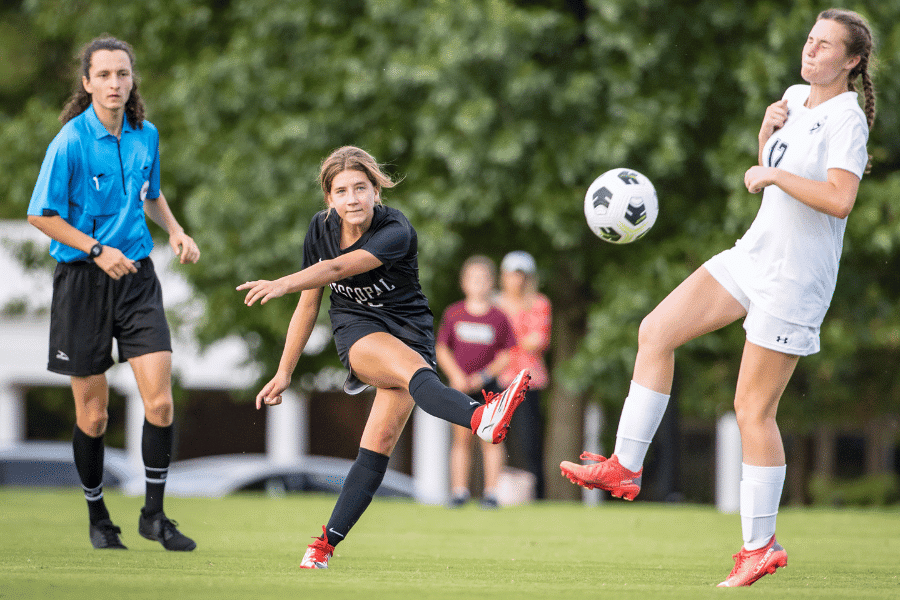
    We were split into two teams scrimmaging against each other. The boys I play with are competitive so there was the usual light trash talking, jersey pulling and agile foot skills. 

    We were playing friendly rules with no corner kicks. My teammate, Gugu, was fouled in the makeshift goalie box and dramatically fell to the ground yelling for a penalty kick. 

    None of us expected the coach to listen to him, but surprisingly he gave it to our team on the condition that I take the kick. All the players lined up around the box as I prepared to shoot, choosing to aim for the bottom right corner. 

    Two things you should know: First this is in Italy and I’m an American teenager who speaks little Italian. Second, I’m the only girl on the team.

    The coach blew the whistle. I confidently ran, kicking the ball with all my strength. It went soaring over the crossbar into the fence behind. I wanted to crawl into a hole and hide. 

    A lifelong love of sports

    Sports have been a part of my life for as long as I can remember. As soon as I learned to walk, my parents introduced me to swimming (after all, 71% of earth’s surface is water). They had me learn tennis to hone my hand-eye coordination, ballet to cultivate “grace” and finally soccer to channel my boundless energy. 

    Ballet was the first to go. I was asked to leave for being too much of a distraction (it’s not my fault the class was boring and repetitive). Swimming followed when the early practices and relentless cycle of toxic comparison drained it of joy. Tennis, while never officially abandoned, became more of a casual hobby, a skill I maintained with occasional matches. 

    But soccer? Soccer was different. It endured. Not just for me, but for my siblings as well. My older brother and younger siblings all share a similar love for the sport.

    My football career began at six years old with my recreational team, Purple Thunder, where the post-game refreshments — orange slices and chocolate milk — mattered more than the outcome of the game. 

    Next came Academy, where I was paired with a “special buddy” (one of the older kids) to help me focus and follow directions. By eight, I advanced to the competitive world of travel soccer — a commitment that has defined half of my life. Over the past eight years, I’ve played on various teams, with different coaches, in several leagues and have witnessed the growing intensity of competition as more pressure is placed on each player.

    Soccer bridges divides across borders.

    Soccer has taken me across the country and around the world. I’ve played soccer in Denmark, Sweden and Germany against local girls’ teams in those countries. Soccer is now a cornerstone of my identity.

    When the external factors of my life changed as I grew and I matured, soccer remained the one constant. 

    During the pandemic, I found solace in dribbling by myself in my basement and backyard. When I moved to boarding school, leaving behind my family and home, my high school soccer team became my anchor. 

    Despite all the stress I endured through these changes, my love for the game only deepened as I experienced the unique camaraderie of a team composed of players from all over the world, united by our shared passion for soccer and desire to win. 

    I cried when my favorite coach left for another job, cried again, then confronted a different coach who left me off the roster for games. I cried when a teammate lost her brother. 

    Sports transcends the field.

    Soccer is more than a game. It’s an art, an outlet. And a team is more than just a group of players: it’s a community, a support system that celebrates your successes and lifts you up when you fall. In those eight years, I believed I had encountered every type of soccer environment imaginable — until I arrived in Italy. 

    So I could play here, the extracurricular coordinator at my study abroad school called on Gianni, a host parent who works for the local soccer club, Viterbese. 

    Equal parts nervous and excited, I met Gianni and told him about my soccer experience — travel for eight years, high school varsity for two — and what I’m looking for — consistent, high level practices to keep me in shape. 

    He suggests two teams I could play with, but both are boys’ teams, and I choose one. We decide I will go to the team’s practice on Monday and he even offers me a ride. 

    The second he leaves, my spiraling begins as my brain conjures up all the worst possible scenarios. Monday arrives and I can’t decide whether to be filled with dread or excited to finally play. 

    At the field, the boys are already huddled with the coach. Now I’ll stand out even more. I get my cleats on and join the circle, suffering through an awkward introduction with the coach, then we begin.

    It’s been four months now since that moment, and I’ve gone to every practice I could. I was nervous at first, especially after Gianni stopped coming and I was left to navigate it on my own. But during the drills on the first day, I quickly realized I’d been overthinking it. They weren’t a team of young Messis and Ronaldos, just regular teenage boys. 

    There are many ways to communicate.

    While I’d played against teams that didn’t speak English before, practicing alongside them and becoming part of their team was an entirely new experience. 

    Learning a new language is a year-long journey, and I take it one day at a time. So while I’ve built up a solid repertoire of Italian words and calcio (soccer) vocabulary, I’ve discovered other ways to communicate — through the game itself.

    Words aren’t always necessary to understand my teammates’ personalities. I can learn plenty from how they play. Whether they prefer to dribble or pass, take the shot or let someone else score, arrive early to practice, talk over the coach, yell at teammates or tug on someone’s jersey, these small choices on the field speak volumes about a person’s true character. 

    Playing soccer here has been living proof that actions truly speak louder than words and that sports have a unique ability to connect people. As a 16-year-old girl from Northern Virginia, I’ve formed a connection with 15-year-old Italian boys from a small city north of Rome. 

    It’s also a reminder that no matter how experienced or “well-versed” you think you are in a passion, there are always more opportunities to grow — if you’re willing to take the leap. I’ve embarrassed myself countless times, as I did trying to make that penalty shot after Gugu was fouled. I’ve lost the ball, missed shots, stumbled over Italian. I once even forgot my cleats. 

    But despite the awkward moments, I wouldn’t trade this experience for anything.


    Three questions to consider:

    1. How did the author manage to communicate with her teammates without knowing the language they spoke?
    2. What does the author mean by soccer being more than a sport?
    3. What sport or hobby are you passionate about and are there people who share that passion?


    Source link