Category: franchising

  • Subcontractual higher education beyond the headlines

    Subcontractual higher education beyond the headlines

    We’ve written a lot about subcontractual provision on Wonkhe, and it is fair to say that very little of it has been positive.

    What’s repeatedly hit the headlines, here and elsewhere, are the providers that teach large numbers of students in circumstances that have sparked concerns about teaching quality, academic standards, and indeed financial probity or even ethics.

    There are a fair number of students that are getting a very bad deal out of subcontractual agreements and, although we’ve been screaming about this for several years, it is good to finally see the beginnings of some action.

    Student number tools

    The long-awaited release of OfS data is not perfect – there’s lots that we’d love to see that does not appear to have been delivered. One of these is proper student numbers: it should be possible to see data on how many students are studying at each subcontracted provider at the last census point.

    Instead, we are scrabbling around with denominators and suppressions trying to build a picture of this part of the sector that is both heavily caveated and three years out of date. This isn’t good enough.

    And it is a shame. Because as well as the horror show, the data we do have offers a glimpse of a little known corner of higher education that arguably deserves to be celebrated.

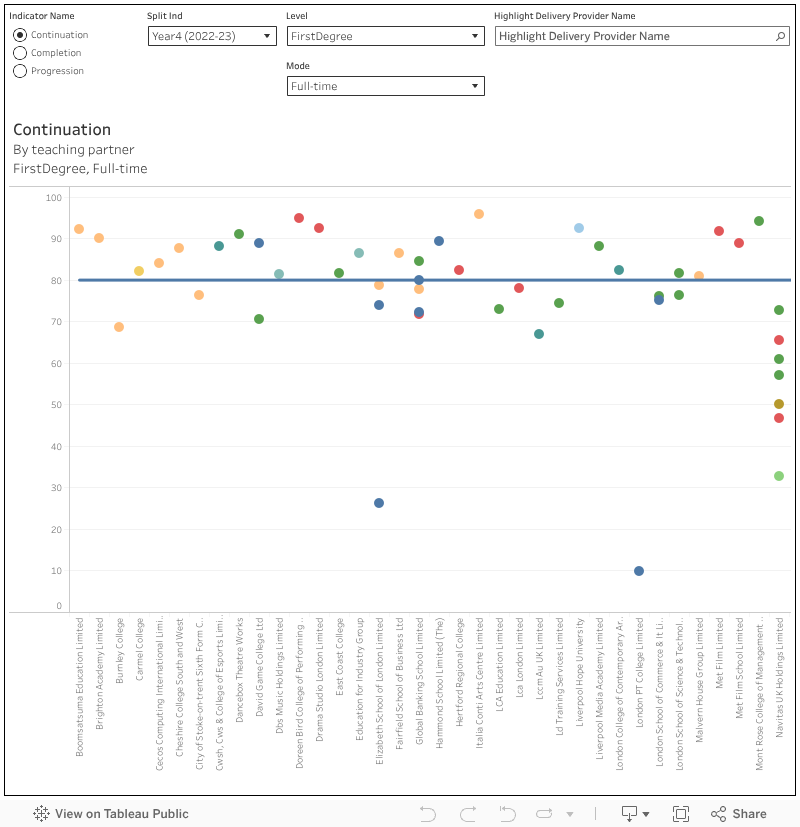
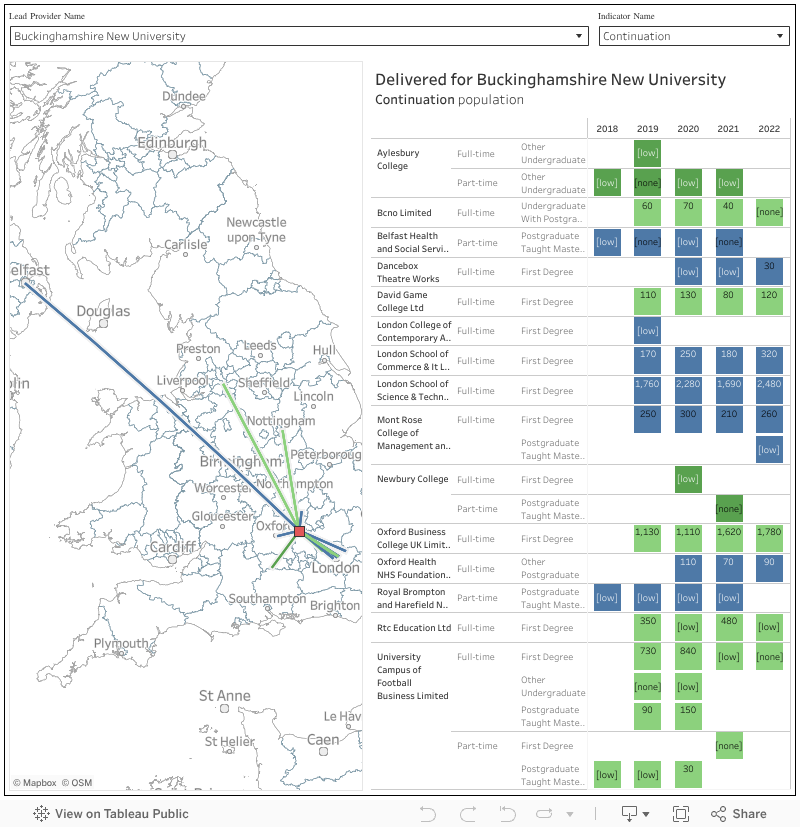
    I’ve developed some new visualisations to help you explore the data – these add substantial new features to what I have previously published. Both these dashboards work in broadly the same way – the first allows you to examine relationships at delivery providers, the second at lead providers. You choose your provider of interest at the top left, which shows the various relationships on a map on the left hand side. On the right you can see denominator numbers for each year of data – you can use the filter at the top right to see information about the total number of students who might be continuing, completing, or progressing in a given year.

    Each row on the right hand side shows a combination of provider (lead provider on the first dashboard, delivery provider on the second), mode, and level – with denominators and suppression codes available in the coloured squares on the right. The suppression codes are as follows:

    • [DQ]: information suppressed due to low data quality from the 2022-23 collection
    • [low]: There are more than 2 but fewer than 23 students in the denominator
    • [none]: There are 2 students or fewer in the denominator
    • [DP]: Data redacted for reasons of data protection
    • [DPL]: Data redacted for reasons of data protection (very low numbers,
    • [DPH]: Data redacted for reasons of data protection (within 2 of the denominator)
    • [RR] below threshold response rate (for progression)
    • [BK] no benchmarks (the benchmark includes at least 50 per cent of the provider’s students)

    You can see available indicators (including upper and lower confidence intervals at 95%), benchmarks, and numeric thresholds by mousing over one of the coloured squares. The filled circle is the indicator, the outline diamond is the benchmark, and the cross is the threshold.
    [Full screen]

    [Full screen]

    A typology

    It’s worth noting the range of providers that are subcontracted to deliver higher education for others. There were an astonishing 681 of these between 2014 and 2022.

    A third of those active in delivering provision for others (227) are registered with the Office for Students in their own right. Fifty-nine of these are recognisable as universities or other established higher education providers – including 14 in the Russell Group.

    Why would that happen? In some cases, a provider may not have had the degree awarding powers necessary for research degrees, so would partner with another university to deliver particular courses. In other cases, the peculiarities of this data mean that apprenticeship arrangements are shown with the university partner. There’s also some examples of two universities working together to deliver a single programme.

    We also find many examples of longstanding collaborations between universities and teaching organisations in the arts. Numerous independent schools of dance, drama, and music have offered higher education qualifications with the support of a university – the Bird School’s relationship with the Doreen Bird College of Performing Arts began in 1997. Italia Conti used to have an arrangement with the University of East London, it now works with the University of Chichester.

    There are 135 organisations delivering apprenticeships in a relationship with an OfS-registered higher education provider. Universities often offer end point assessment and administrative support to employers and others who offer apprenticeships between level 4 and level 7.

    Two large providers – Navitas and QA – offer foundation courses and accredited year one courses for international students at UK universities: QA also offers a range of programmes aimed at home undergraduates. We could also add Into as a smaller example. This dataset probably isn’t the best place to see this (QA is shown as multiple, linked, organisations) but this is a huge area of provision

    Seventy-four subcontracted providers are schools, or school centred initial teacher training (SCITT) organisations. As teacher training has gradually moved closer to the classroom and away from the lecture hall, many schools offer opportunities to gain the industry-standard Postgraduate Certificate in Education (PGCE), which is the main route to qualified teacher status. A PGCE is a postgraduate qualification and is thus only awarded by organisations with postgraduate degree awarding powers.

    In total there are 144 providers subcontracted to deliver PGCE (initial teacher training) courses, primarily schools, local councils, and further education colleges (FECs). There are 166 FECs involved in subcontracted delivery – and this extends far beyond teacher training. Most large FECs have a university centre or similar, offering a range of foundation and undergraduate courses often (but not always) in vocational subjects. The Newcastle College Group used its experience of delivering postgraduate taught masters courses for Canterbury Christ Church University to successfully apply for postgraduate degree awarding powers – the first FEC to do so.

    We find 23 NHS organisations represented within the data. Any provider delivering medical, medical related, or healthcare subjects will have a relationship with one or more NHS foundation trust – as a means to offer student placements, and bring clinical expertise into teaching. This is generally an accreditation requirement. But in many cases, the relationship extends to the university awarding credit or qualifications for the learning and training that NHS staff do. The Oxford Health NHS Foundation Trust works with multiple providers (the University of Oxford, Oxford Brookes University, and Buckinghamshire New University), to offer postgraduate apprenticeships in clinical and non-clinical roles.

    Nine police organisations (either constabularies or police and crime commissioners) have subcontractual relationships with registered higher education providers. Teesside University works with the Chief Constable of Cleveland to offer an undergraduate apprenticeship for prospective police officers.

    All three of the UKs armed forces have subcontractual relationships with higher education providers. The British Army currently works with the University of Reading to offer undergraduate and postgraduate degrees in leadership and strategic studies – in the past it has offered a range of qualifications from Bournemouth University. Kingston University has a relationship with the Royal Navy, currently offering an MSc in Technology (Maritime Operations) undertaken entirely in the workplace.

    Ecosystem

    When I talk to people about franchise and partnership arrangements, most (perhaps thinking of the examples that make the mainstream press) ask me whether it would not be easier to simply ban such arrangements. After all, it is very difficult to see any benefit from the possibly fraudulent and often low quality behavior that is plastered all over The Times on a regular basis.

    As I think the data demonstrates, a straight-ahead ban would be hugely damaging – swathes of national priorities and achievements (from NHS staff development, to offering higher education in “cold spots”, to the quality of performances on London’s West End) would be adversely affected. But the same could be said for increases in regulatory overheads.

    There are a handful of very large providers (I’d start with Global Banking School, Elizabeth School of London, Navitas, QA, Into, London School of Science and Technology, and a few others – and from the data you’d have included Oxford Business Colleges) that are, effectively, university-like in size and scope. It is very difficult to understand why these are not registered providers given the scale of their operations (GBS, Into, and Navitas already are) and this does seem to be the right direction of travel.

    There are a clutch of medium-sized delivery providers, often in a single long-standing relationship with a higher education institution. Often, these are nano-specialisms, particularly in the creative arts or in locally important industries. In many of these cases oversight on quality and standards from the lead provider has been proven over a number of years to work well – and there seems little benefit to changing this arrangement. I would hope for this group – as is likely to happen for the FECs, SCITTs, NHS, police, and armed forces – that a change to regulatory oversight only happens where there is an issue identified.

    There is also a long tail of very small arrangements, often linked to apprenticeships (and regulated accordingly). For others at this end of the scale it is difficult to imagine OfS having the time or the capacity to regulate, so almost by default oversight remains with the lead partners. I know I say this in nearly every article, but at this end it feels like we need some kind of regular review of the way quality processes work for external providers within lead providers – we need to be sure lead providers are able to do what can be a very difficult job and do it well.


    Source link

  • How higher education became a get rich quick scheme

    How higher education became a get rich quick scheme

    Sometimes, the problem with both media coverage and regulation is that critique of a part of the sector taints it all.

    When ministers or media outlets find sharp practice in recruitment or failings in student support, everything from OfS Insight Briefs to Sunday Times splashes can feel like the whole class being kept in for lunch when you weren’t making any noise.

    So has been the case for franchising. A specific group of universities has been subcontracting out to a specific group of private colleges in recent years – a group which has rightly picked up attention from the media, the National Audit Office (NAO), the Public Accounts Committee (PAC), the Office for Students (OfS), the Student Loans Company (SLC) and the Department for Education (DfE).

    Independent HE, for example, have argued elsewhere on the site that while they strongly support a tougher regime around franchising, the proposed approach of requiring only larger providers (300+ students) to register would be insufficient – missing many bad actors while creating administrative bottlenecks and failing to hold lead providers properly accountable for their partners. Instead, they advocate for universal basic registration for all teaching providers.

    Now, following last week’s long-awaited publication of data on subcontractual partnerships from OfS, we’re pretty confident that it’s possible to isolate and identify a specific subset of undergraduate providers in the English sector.

    Its defining characteristics are that its providers are privately owned, are (very much) for-profit, deliver non-specialist courses principally in Business and Management, and have been (very) rapidly expanding in recent years.

    Last year OfS said that in some cases there has been an “exponential growth” in student numbers in subcontractual partnerships over the last few years, with some lead providers now teaching more students through these arrangements than directly on their own campuses.

    It said that among other potential concerns, this raises questions about the direction of travel for the lead provider’s own strategic identity, aims and objectives.

    Our definition of a specific sub-sector is not perfect. There are a number of providers whose wholly-owned or directly-delivered satellite campus operations share some of those characteristics. Student numbers have not been formally published, and as ever there is lag in the data in general.

    In 2023-24, OfS’ student characteristics data dashboard shows that there were 101,950 students enrolled overall on subcontracted Business and Management courses – up from just 5,630 a decade ago.

    And if we derive from full-time, first degree continuation statistics, aggregate where companies are owned by the same parent, and attach those characteristics to partnerships where the entrant population was 100 or more in 2023-24, we can see 16 providers that enrolled over 40,000 FT FD entrants in 2022.

    Below threshold

    Aggregating both multiple providers in a group, and this sub set in general, is not an exact science. For each partnership between a university and private college, OfS has only published a denominator population rounded to 5 – which makes precision impossible. But we can estimate this sub group’s outcomes “performance” by implying a numerator from the percentages, and recompiling the numbers.

    The result is not stellar. In OfS’ press release to accompany the data, we learned that 77 per cent of FT FD subcontracted students continued courses into a second year, compared to 88 per cent in the sector as a whole. Against a regulatory minimum of 80 per cent, this group of providers averaged just 70 per cent.

    We learned that 74 per cent of subcontracted students completed their course, compared to 87 per cent for the sector as a whole and a regulatory minimum of 75 per cent. This subgroup scored just 70 per cent.

    The further out that a metric is from when students start, the longer it takes to pick up results – a real regulatory issue in a subsector that is expanding so rapidly. But when we look at progression to a graduate job or further study, it’s 71 per cent for the sector as a whole, 57 per cent of subcontracted students, and just 53 per cent of this subsector – against a regulatory minimum of 60 per cent.

    These providers are almost certainly inflating the sector’s performance on access – especially for those who are doing the franchising-to – access and participation stats are not (yet) split by partnership. But they are also dragging down the sector’s performance on outcomes, and giving subcontracting a bad name – all three of the key metrics would likely be above threshold if this group was removed.

    More importantly, if we follow OfS’ logic on outcomes and thresholds – that the figures are signals of whether students have the potential to succeed on the course, and receive good teaching and support through their studies – the group has been expanding yet failing.

    One area, though, where the group is not failing, is on financial performance.

    Healthy profits

    In 2023, the Russell Group estimated that in 2022/23, English universities on average supplemented the cost of educating each UK undergraduate student by £2,500 per year, with all subjects now making a loss on average.

    Not so much here in this sub sector. Because most of the 18 providers are not on the OfS register, the format (and even visibility) of annual accounts is uneven. Financial years and levels of disclosure differ, some are showing on Companies House as posting accounts late, and in many cases some of the income from fees moves up into a parent company in a way that prevents proper transparency.

    But on the basis that the bulk of their income is tuition fees after any franchising fee retained by the university passing on the SLC money that it gets, and assuming that “cost of sales” usually covers the provision of education rather than administrative expenses that are often dominated by acquisition costs, we can calculate a gross profit for the latest year that figures are available for.

    Below that line often huge dividends, director remuneration, domestic agent fees and the costs of renting space or borrowing from a parent co deflate the final profit figures. But in gross terms, notwithstanding that some of the group were micro-entities and exempt at last accounts publication, the group in scope posted gross profits of £504m on an income of £815m.

    Company Period end Turnover (£) Gross profit (£) Note
    Cecos Computing International Limited 31 Mar 2024 £ 20,269,818 £ 9,916,813
    Elizabeth School of London Limited 31 Aug 2024 £ 74,947,093 £ 46,856,529
    Fairfield School of Business Ltd 31 Aug 2024 £ 10,463,430 £ 7,254,024
    Global Banking School Limited 29 Feb 2024 £ 233,566,242 £ 128,068,724
    LCA (Education LTD + London LTD) 31 Dec 2024 £ 70,068,058 £ 36,388,054
    Ld Training Services Limited 31 Aug 2024 £ 10,185,134 £ 9,460,083
    London College of Contemporary Arts Ltd 31 May 2024 £ 25,360,932 £ 17,223,552
    London PT College Limited Not disclosed in abridged filings
    London School of Commerce & IT Limited 31 Mar 2024 £ 6,385,138 £ 3,434,817
    London School of Science & Technology Limited 30 Jun 2024 (15months) £ 83,771,009 £ 62,903,105 Group figures as filed
    Mont Rose College of Management and Sciences Limited 31 Aug 2024 £ 9,904,941 £ 8,489,293
    Navitas UK Holdings Limited (group) 30 Jun 2024 £ 57,222,133 £ 27,004,304
    Oxford Business College UK Limited 31 Aug 2023 £ 49,734,100 £ 31,030,795
    QAHE (LM+NU+UR) Limited 31 May 2024 £ 60,800,000 £ 34,400,000
    St. Piran’s School (GB) Limited 31 Dec 2024 £ 72,470,964 £ 59,211,778
    UK College of Business and Computing Ltd 31 Jul 2024 £ 18,032,506 £ 14,196,396
    Waltham International College Limited 31 Jul 2024 £ 12,127,614 £ 8,118,100
    TOTAL £ 815,309,112 £ 503,956,367

    Figures like that should push any sensible policymaker into windfall tax territory – or at the very least taking some of that profit and using it to relieve students burdened by a lifetime of debt of some of the balance. But more broadly, perhaps policymakers should take a step back and ask whether what’s being facilitated here should be.

    Avoiding scandals

    Ever since I was sent a photo back in 2022 of a domestic agent’s pull-up banner in a London shopping centre inviting students to claim their £15,000 in maintenance support, we’ve been trying to get to the bottom of what’s been happening with franchising.

    There’s a compelling reason for that. Franchising scandals over the last decade caused huge reputational damage for the sector and created an enormous regulatory distraction. When HEFCE and the Department for Education were spending their time devising ways to crack down on sharp practice, they weren’t focusing on improving the sector. The opportunity costs of franchising scandals are significant.

    We could see what was coming – a repeat of the problem. The Office for Students, already stretched, would end up spending much of its time attempting to regulate the rapid expansion. There was real danger of further reputational damage for the sector.

    What we’ve found are highly litigious providers, and real difficulty in getting the data we needed. We wanted to see who these rapidly expanding private companies were – companies specialising in “widening access” students, and lead providers appearing in graphs showing students claiming maintenance loans without fee loans.

    And from a student perspective, one of the issues has long been that if they want to find out what the outcomes would be like, they can’t really tell.

    This matters because almost all higher education advertising says “here’s what this has been like in the past, and so here’s what might happen to you.” The big problem was that when they apply to those providers, they are often told about the franchising provider’s outcomes – not the franchisee provider’s. They hear about the university’s figures for business studies, but can’t see the actual provider’s numbers.

    Franchise partners change frequently, and course names change often. The historical data needed to support statistics on Discover Uni simply aren’t available. Given that providers often have franchising deals with multiple universities, it can’t be unreasonable to ask how well these colleges perform on continuation, completion and graduate employment – especially when so much advertising focuses on careers and improving life chances, while obscuring debt.

    In OfS’ words:

    This [data] will be useful for prospective students, lead providers responsible for registering the students, and institutions responsible for teaching students on these courses.

    Even if the regulation was tightened, the incentives for the latter two of the parties on that list may be too strong to ever aspire beyond minimums. And for students – who have characteristics that are least frequently associated with an “informed actors in a choice market” ideal, even OfS’ data doesn’t show each of the franchised-to providers in aggregate.

    Why?

    This leaves us with a simple question. If the problem is non-specialist franchised provision – which certainly appears to be the case – why is the Department for Education funding it?

    It’s not provision that’s otherwise unavailable. It’s not serving some niche that doesn’t already exist. Students with talent, drive and aspiration would still access traditional universities. Students unsuitable for full-time study would pursue other routes. Students who need more support would have more money spent on them if it wasn’t being delivered to the bottom line in profit.

    This is, lest we forget, a part of the sector where expectations on harassment and sexual misconduct, or free speech, or charter work on mental health or fair admissions, are established only in part and often only in theory – and where student protection in the event of course, campus or provider closure is even thinner than it is elsewhere. Why are these risks concentrated on some of the least advantaged students in the sector?

    There are now real risks in contraction. Already some of the providers on the list have closed campuses and shuttered courses. Have reportable events been made? Are students being compensated for any breach of contract? And what happens if any of these companies just collapse – when the lead provider is often hundreds of miles away? These are tasks the government needs to take on.

    There are risks to allowing franchising, risks to allowing private providers to access the loan book, and risks to having no student number caps. In the last decade, the view was that the potential rewards were greater than risks. But notwithstanding the need to contract with care, it simply cannot be true that the world would be worse if these providers didn’t exist.

    Many things could be done. We’ve made proposals over on the Post-18 Project on different ways to regulate and restrict what’s happening here that draw on valuable lessons from colleagues in FE. But at the simple core, it comes down to this – why does DfE think it’s worth the risk to keep open the student loan book to private providers through franchise agreements for non-specialist subject higher education?

    The faster the government changes course, the faster all of us can turn our attention to improving higher education’s contribution to society and economic growth – rather than chasing around owners of colleges who, collectively, are getting rich off outcomes which OfS says are unacceptably poor.

    Source link

  • Outcomes data for subcontracted provision

    Outcomes data for subcontracted provision

    In 2022–23 there were around 260 full time first degree students, registered to a well-known provider and taught via a subcontractual arrangement, that had a continuation rate of just 9.8 per cent: so of those 260 students, just 25 or so actually continued on to their second year.

    Whatever you think about franchising opening up higher education to new groups, or allowing established universities the flexibility to react to fast-changing demand or skills needs, none of that actually happens if more than 90 per cent of the registered population doesn’t continue with their course.

    It’s because of issues like this that we (and others) have been badgering the Office for Students to produce outcomes data for students taught via subcontractual arrangements (franchises and partnerships) at a level of granularity that shows each individual subcontractual partner.

    And finally, after a small pilot last year, we have the data.

    Regulating subcontractual relationships

    If anything it feels a little late – there are now two overlapping proposals on the table to regulate this end of the higher education marketplace:

    • A Department of Education consultation suggests that every delivery partner that has more than 300 higher education students would need to register with the Office for Students (unless it is regulated elsewhere)
    • And an Office for Students consultation suggests that every registering partner with more than 100 higher education students taught via subcontractual arrangements will be subject to a new condition of registration (E8)

    Both sets of plans address, in their own way, the current reality that the only direct regulatory control available over students studying via these arrangements is via the quality assurance systems within the registering (lead) partners. This is an arrangement left over from previous quality regimes, where the nation spent time and money to assure itself that all providers had robust quality assurance systems that were being routinely followed.

    In an age of dashboard-driven regulation, the fact that we have not been able to easily disaggregate the outcomes of subcontractual students has meant that it has not been possible to regulate this corner of the sector – we’ve seen rapid growth of this kind of provision under the Office for Students’ watch and oversight (to be frank) has just not been up to the job.

    Data considerations

    Incredibly, it wasn’t even the case that the regulator had this data but chose not to publish it. OfS has genuinely had to design this data collection from scratch in order to get reliable information – many institutions expressed concern about the quality of data they might be getting from their academic partners (which should have been a red flag, really).

    So what we get is basically an extension of the B3 dashboards where students in the existing “partnership” population are assigned to one of an astonishing 681 partner providers alongside their lead provider. We’d assume that each of these specific populations has data across the three B3 (continuation, completion, progression) indicators – in practice many of these are suppressed for the usual OfS reasons of low student numbers and (in the case of progression) low Graduate Outcomes response rates.

    Where we do get indicator values we also see benchmarks and the usual numeric thresholds – the former indicating what OfS might expect to see given the student population, the latter being the line beneath which the regulator might feel inclined to get stuck into some regulating.

    One thing we can’t really do with the data – although we wanted to – is treat each subcontractual provider as if it was a main provider and derive an overall indicator for it. Because many subcontractual providers have relationships (and students) from numerous lead providers, we start to get to some reasonably sized institutions. Two – Global Banking School and the Elizabeth School London – appear to have more than 5,000 higher education students: GBS is around the same size as the University of Bradford, the Elizabeth School is comparable to Liverpool Hope University.

    Size and shape

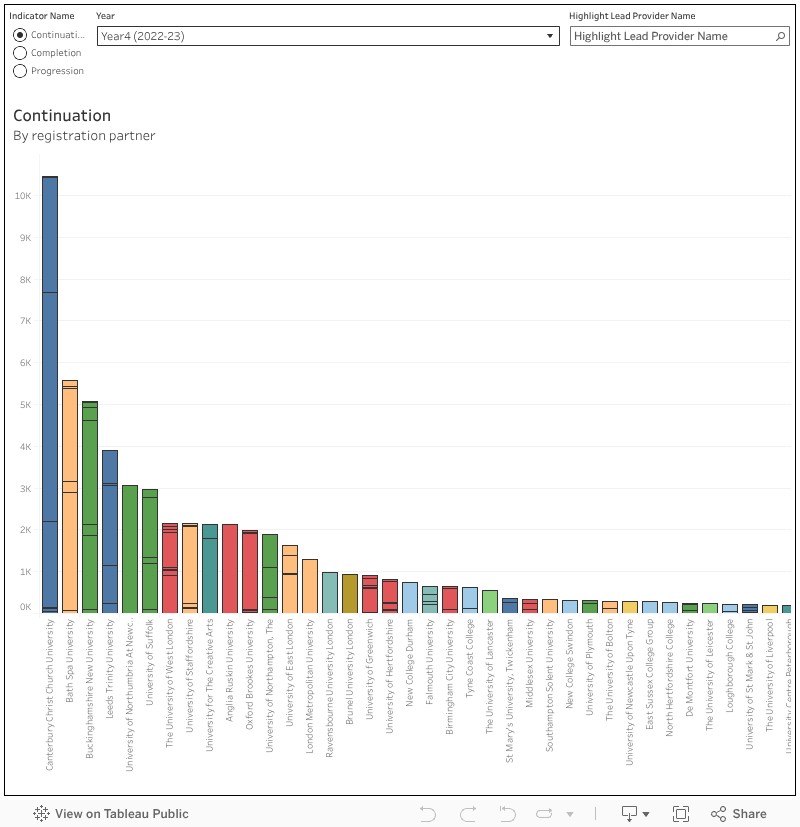
    How big these providers are is a good place to start. We don’t actually get formal student numbers for these places – but we can derive a reasonable approximation from the denominator (population size) for one of the three indicators available. I tend to use continuation as it gives me the most recent (2022–23) year of data.

    [Full screen]

    The charts showing numbers of students are based on the denominators (populations) for one of the three indicators – by default I use continuation as it is more likely to reflect recent (2022–23) numbers. Because both the OfS and DfE consultations talk about all HE students there are no filters for mode or level.

    For each chart you can select a year of interest (I’ve chosen the most recent year by default) or the overall indicator (which, like on the main dashboards is synthetic over four years) If you change the indicator you may have to change the year. I’ve not included any indications of error – these are small numbers and the possible error is wide so any responsible regulator would have to do more investigating before stepping in to regulate.

    Recall that the DfE proposal is that institutions with more than 300 higher education students would have to register with OfS if they are not regulated in another way (as a school, FE college, or local authority, for instance). I make that 26 with more than 300 students, a small number of which appear to be regulated as an FE college.

    You can also see which lead providers are involved with each delivery partner – there are several that have relationships with multiple universities. It is instructive to compare outcomes data within a delivery partner – clearly differences in quality assurance and course design do have an impact, suggesting that the “naive university hoodwinked by low quality franchise partner” narrative, if it has any truth to it at all, is not universally true.

    [Full screen]

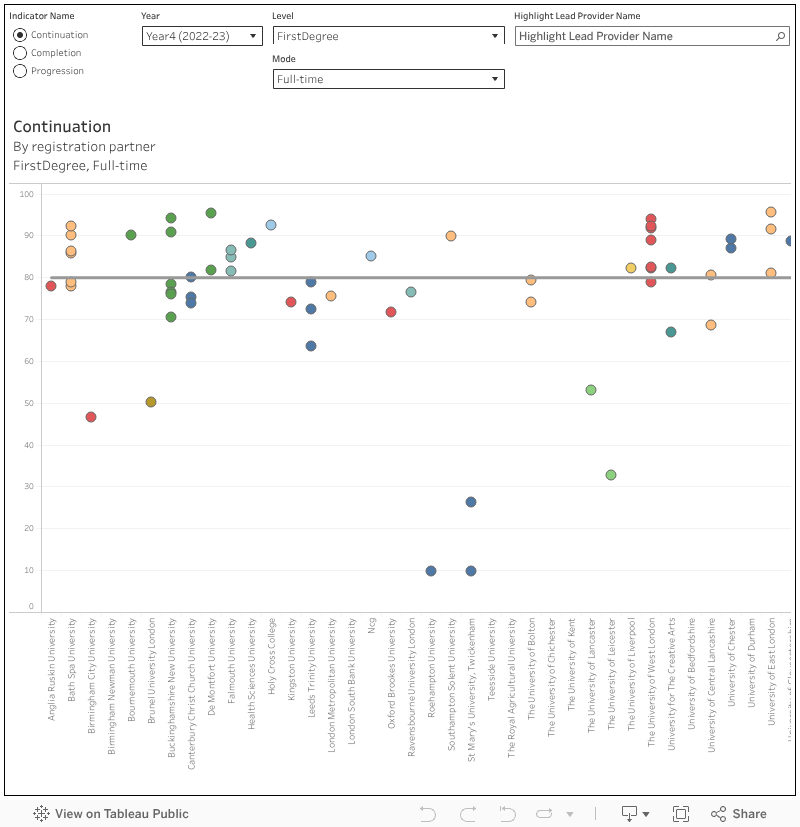
    The charts showing the actual outcomes are filtered by mode and level as you would expect. Note that not all levels are available for each mode of study.

    This chart brings in filters for level and mode – there are different indicators, benchmarks, and thresholds for each combination of these factors. Again, there is data suppression (low numbers and responses) going on, so you won’t see every single aspect of every single relationship in detail.

    That said, what we do see is a very mixed bag. Quite a lot of provision sits below the threshold line, though there are also some examples of very good outcomes – often at smaller, specialist, creative arts colleges.

    Registration

    I’ve flipped those two charts to allow us to look at the exposure of registered universities to this part of the market. The overall sizes in recent years at some providers won’t be of any surprise to those who have been following this story – a handful of universities have grown substantially as a result of a strategic decision to engage in multiple academic partnerships.

    [Full screen]

    Canterbury Christ Church University, Bath Spa University, Buckinghamshire New University, and Leeds Trinity University have always been the big four in this market. But of the 84 registered providers engaged in partnerships, I count 44 that met the 100 student threshold for the new condition of registration B3 had it applied in 2022–23.

    Looking at the outcomes measures suggests that what is happening across multiple partners is not offering wide variation in performance, although there will always be teaching provider, subject, and population variation. It is striking that places with a lot of different partners tend to get reasonable results – lower indicator values tend to be found at places running just one or two relationships, so it does feel like some work on improving external quality assurance and validation would be of some help.

    [Full screen]

    To be clear, this is data from a few years ago (the most recent available data is from 2022–23 for continuation, 2019–20 for completion, and 2022–23 for progression). It is very likely that providers will have identified and addressed issues (or ended relationships) using internal data long before either we or the Office for Students got a glimpse of what was going on.

    A starting point

    There is clearly a lot more that can be done with what we have – and I can promise this is a dataset that Wonkhe is keen to return to. It gets us closer to understanding where problems may lie – the next phase would be to identify patterns and commonalities to help us get closer to the interventions that will help.

    Subcontractual arrangements have a long and proud history in UK higher education – just about every English provider started off in a subcontractual arrangement with the University of London, and it remains the most common way to enter the sector. A glance across the data makes it clear that there are real problems in some areas – but it is something other than the fact of a subcontractual arrangement that is causing them.

    Do you like higher education data as much as I do? Of course you do! So you are absolutely going to want to grab a ticket for The Festival of Higher Education on 11-12 November – it’s Team Wonkhe’s flagship event and data discussion is actively encouraged. 

    Source link

  • What the saga of Oxford Business College tells us about regulation and franchising

    What the saga of Oxford Business College tells us about regulation and franchising

    One of the basic expectations of a system of regulation is consistency.

    It shouldn’t matter how prestigious you are, how rich you are, or how long you’ve been operating: if you are active in a regulated market then the same rules should apply to all.

    Regulatory overreach can happen when there is public outrage over elements of what is happening in that particular market. The pressure a government feels to “do something” can override processes and requirements – attempting to reach the “right” (political or PR) answer rather than the “correct” (according to the rules) one.

    So when courses at Oxford Business College were de-designated by the Secretary of State for Education, there’s more to the tale than a provider where legitimate questions had been raised about the student experience getting just desserts. It is a cautionary tale, involving a fascinating high-court judgment and some interesting arguments about the limits of ministerial power, of what happens when political will gets ahead of regulatory processes.

    Business matters

    A splash in The Sunday Times back in the spring concerned the quality of franchised provision from – as it turned out – four Office for Students registered providers taught at Oxford Business College. The story came alongside tough language from Secretary of State for Education Bridget Phillipson:

    I know people across this country, across the world, feel a fierce pride for our universities. I do too. That’s why I am so outraged by these reports, and why I am acting so swiftly and so strongly today to put this right.

    And she was in no way alone in feeling that way. Let’s remind ourselves, the allegations made in The Sunday Times were dreadful. Four million pounds in fraudulent loans. Fake students, and students with no apparent interest in studying. Non-existent entry criteria. And, as we shall see, that’s not even as bad as the allegations got.

    De-designation – removing the eligibility of students at a provider to apply for SLC fee or maintenance loans – is one of the few levers government has to address “low quality” provision at an unregistered provider. Designation comes automatically when a course is franchised from a registered provider: a loophole in the regulatory framework that has caused concern over a number of years. Technically an awarding provider is responsible for maintaining academic quality and standards for its students studying elsewhere.

    The Office for Students didn’t have any regulatory jurisdiction other than pursuing the awarding institutions. OBC had, in fact, tried to register with OfS – withdrawing the application in the teeth of the media firestorm at the end of March.

    So everything depended on the Department for Education overturning precedent.

    Ministering

    It is “one of the biggest financial scandals universities have faced.” That’s what Bridget Phillipson said when presented with The Sunday Times’ findings. She announced that the Public Sector Fraud Authority would coordinate immediate action, and promised to empower the Office for Students to act in such cases.

    In fact, OBC was already under investigation by the Government Internal Audit Agency (GIAA) and had been since 2024. DfE had been notified by the Student Loans Company about trends in the data and other information that might indicate fraud at various points between November 2023 and February 2024 – notifications that we now know were summarised as a report detailing the concerns which was sent to DfE in January 2024. The eventual High Court judgement (the details of which we will get to shortly) outlined just a few of these allegations, which I take from from the court documents:

    • Students enrolled in the Business Management BA (Hons) course did not have basic English language skills.
    • Less than 50 per cent of students enrolled in the London campus participate, and the remainder instead pay staff to record them as in attendance.
    • Students have had bank details altered or new bank accounts opened in their name, to which their maintenance payments were redirected.
    • Staff are encouraging fraud through fake documents sent to SLC, fake diplomas, and fake references. Staff are charging students to draft their UCAS applications and personal statements. Senior staff are aware of this and are uninterested.
    • Students attending OBC do not live in the country. In one instance, a dead student was kept on the attendance list.
    • Students were receiving threats from agents demanding money and, if the students complained, their complaints were often dealt with by those same agents threatening the students.
    • Remote utilities were being used for English language tests where computers were controlled remotely to respond to the questions on behalf of prospective students.
    • At the Nottingham campus, employees and others were demanding money from students for assignments and to mark their attendance to avoid being kicked off their course.

    At the instigation of DfE, and with the cooperation of OBC, GIAA started its investigation on 19 September 2024, continuing to request information from and correspond with the college until 17 January 2025. An “interim report” detailing emerging findings went to DfE on 17 December 2024; the final report arrived on 30 January 2025. The final report made numerous recommendations about OBC processes and policies, but did not recommend de-designation. That recommendation came in a ministerial submission, prepared by civil servants, dated 18 March 2025.

    Process story

    OBC didn’t get sight of these reports until 20 March 2025, after the decisions were made. It got summaries of both the interim and final reports in a letter from DfE notifying it that Phillipson was “minded to” de-designate. The documentation tells us that GIAA reported that OBC had:

    • recruited students without the required experience and qualifications to successfully complete their courses
    • failed to ensure students met the English language proficiency as set out in OBC and lead provider policies
    • failed to ensure attendance is managed effectively
    • failed to withdraw or suspend students that fell below the required thresholds for performance and/or engagement;
    • failed to provide evidence that immigration documents, where required, are being adequately verified.

    The college had 14 days to respond to the summary and provide factual comment for consideration, during which period The Sunday Times published its story. OBC asked DfE for the underlying material that informed the findings and the subsequent decision, and for an extension (it didn’t get all the material, but it got a further five days) – and it submitted 68 pages of argument and evidence to DfE, on 7 April 2025. Another departmental ministerial submission (on 16 April 2025) recommended that the Secretary of State confirm the decision to de-designate.

    According to the OBC legal team, these emerging findings were not backed up by the full GIAA reports, and there were concerns about the way a small student sample had been used to generalise across an entire college. Most concerningly, the reports as eventually shared with the college did not support de-designation (though they supported a number of other concerns about OBC and its admission process). This was supported by a note from GIAA regarding OBC’s submission, which – although conceding that aspects of the report could have been expressed more clearly – concluded:

    The majority of the issues raised relate to interpretation rather than factual accuracy. Crucially, we are satisfied that none of the concerns identified have a material impact on our findings, conclusions or overall assessment.

    Phillipson’s decision to de-designate was sent to the college on 17 April 2025, and it was published as a Written Ministerial Statement. Importantly, in her letter, she noted that:

    The Secretary of State’s decisions have not been made solely on the basis of whether or not fraud has been detected. She has also addressed the issue of whether, on the balance of probabilities, the College has delivered these courses, particularly as regards the recruitment of students and the management of attendance, in such a way that gives her adequate assurance that the substantial amounts of public money it has received in respect of student fees, via its partners, have been managed to the standards she is entitled to expect.

    Appeal

    Oxford Business College appealed the Secretary of State’s decision. Four grounds of challenge were pursued with:

    • Ground 3: the Secretary of State had stepped beyond her powers in prohibiting OBC from receiving public funds from providing new franchised courses in the future.
    • Ground 1: the decision was procedurally unfair, with key materials used by the Secretary of State in making the decision not provided to the college, and the college never being told the criteria it was being assessed against
    • Ground 4: By de-designating courses, DfE breached OBCs rights under Article 1 of the First Protocol to the European Convention on Human Rights (to peaceful enjoyment of its possessions – in this case the courses themselves)
    • Ground 7: The decision by the Secretary of State had breached the public sector equality duty

    Of these, ground 3 was not determined, as the Secretary of State had clarified that no decision had been taken regarding future courses delivered by OBC. Ground 4 was deemed to be a “controversial” point of law regarding whether a course and its designation status could be a “possession” under ECHR, but could be proceeded with at a later date. Ground 7 was not decided.

    Ground 1 succeeded. The court found that OBC had been subject to an unfair process, where:

    OBC was prejudiced in its ability to understand and respond to the matters of the subject of investigation, including as to the appropriate sanction, and to understand the reasons for the decision.

    Judgement

    OBC itself, or the lawyers it engaged, have perhaps unwisely decided to put the judgement into the public domain – it has yet to be formally published. I say unwisely, because it also puts the initial allegations into the public domain and does not detail any meaningful rebuttal from the college – though The Telegraph has reported that the college now plans to sue the Secretary of State for “tens of millions of pounds.”

    The win, such as it is, was entirely procedural. The Secretary of State should have shared more detail of the findings of the GIAA investigation (at both “emerging” and “final” stages) in order that the college could make its own investigations and dispute any points of fact.

    Much of the judgement deals with the criteria by which a sample of 200 students were selected – OBC was not made aware that this was a sample comprising those “giving the greatest cause for suspicion” rather than a random sample, and the inability of OBC to identify students whose circumstances or behaviour were mentioned in the report. These were omissions, but nowhere is it argued by OBC that these were not real students with real experiences.

    Where allegations are made that students might be being threatened by agents and institutional staff, it is perhaps understandable that identifying details might be redacted – though DfE cited the “”pressure resulting from the attenuated timetable following the order for expedition, the evidence having been filed within 11 days of that order” for difficulties faced in redacting the report properly. On this point, DfE noted that OBC, using the materials provided, “had been able to make detailed representations running to 68 pages, which it had described as ‘comprehensive’ and which had been duly considered by the Secretary of State”.

    The Secretary of State, in evidence, rolled back from the idea that she could automatically de-designate future courses without specific reason, but this does not change the decisions she has made about the five existing courses delivered in partnership. Neither does it change the fact that OBC, having had five courses forcibly de-designated, and seen the specifics of the allegations underpinning this exceptional decision put into the public domain without any meaningful rebuttal, may struggle to find willing academic partners.

    The other chink of legal light came with an argument that a contract (or subcontract) could be deemed a “possession” under certain circumstances, and that article one section one of the European Convention on Human Rights permits the free enjoyment of possessions. The judgement admits that there could be grounds for debate here, but that debate has not yet happened.

    Rules

    Whatever your feelings about OBC, or franchising in general, the way in which DfE appears to have used a carefully redacted and summarised report to remove an institution from the sector is concerning. If the rules of the market permit behaviour that ministers do not like, then these rules need to be re-written. DfE can’t just regulate based on what it thinks the rules should be.

    The college issued a statement on 25 August, three days after the judgement was published – it claims to be engaging with “partner institutions” (named as Buckinghamshire New University, University of West London, Ravensbourne University London, and New College Durham – though all four had already ended their partnerships with the remaining students being “taught out”) about the future of the students affected by the designation decision – many had already transferred to other courses at other providers.

    In fact, the judgement tells us that of 5,000 students registered at OBC on 17 April 2025, around 4,700 had either withdrawn or transferred out of OBC to be taught out. We also learn that 1,500 new students, who had planned to start an OBC-delivered course after 2025, would no longer be doing so. Four lead providers had given notice to terminate franchise agreements between April 2024 and May of 2025. Franchise discussions with another provider – Southampton Solent University – underway shortly before the decision to de-designate, had ended.

    OBC currently offers one course itself (no partnership offers are listed) – a foundation programme covering academic skills and English language including specialisms in law, engineering, and business – which is designed to prepare students for the first year of an undergraduate degree course. It is not clear what award this course leads to, or how it is regulated. It is also expensive – a 6 month version (requiring IELTS 5.5 or above) costs an eyewatering £17,500. And there is no information as to how students might enroll on this course.

    OBC’s statement about the court case indicates that it “rigorously adheres to all regulatory requirements”, but it is not clear which (if any) regulator has jurisdiction over the one course it currently advertises.

    If there are concerns about the quality of teaching, or about academic standards, in any provider in receipt of public funds they clearly need to be addressed – and this is as true for Oxford Business College as it is for the University of Oxford. This should start with a clear plan for quality assurance (ideally one that reflects the current concerns of students) and a watertight process that can be used both to drive compliance and take action against those who don’t measure up. Ministerial legal innovation, it seems, doesn’t quite cut it.

    Source link

  • OfS consults on a condition of registration for subcontracted provision

    OfS consults on a condition of registration for subcontracted provision

    Cast your mind back to the end of January this year.

    The Department for Education proposed that all providers delivering a course via a franchise model to more than 300 students should register with the Office for Students.

    The rationale was straightforward. An increasingly large number of students were studying at, effectively, unregulated providers – with the connection to the lead provider achieved via an office in the registry and subject to varying (shall we say) levels of oversight in terms of quality, standards, and – frankly – probity (as we and others have extensively reported).

    That consultation concluded in April, and we have heard very little about these plans since. So when, just before summer recess, the Office for Students announced its own consultation on regulating franchise provision one could be forgiven for assuming that the two approaches would somehow link together.

    Information requirement

    What OfS has suggested addresses the other end of the issue – while DfE wants to register delivery providers, OfS wants to put a new condition of registration (E8) onto institutions with more than 100 students taught via subcontractual arrangements. The condition is not an arduous one – it basically suggests that a lead provider should have adequate governance and oversight of risks concerning subcontractual provision, and be prepared to share key information about these arrangements (a so-called “Comprehensive source of information”, or CSol). In return OfS can demand more information (“monitoring”) and make “directions” for the lead provider to start or stop doing stuff. All this would, consultation pending, come into force in January 2026.

    Now, it would be fair to wonder whether this kind of effective governance in the public interest is already covered in conditions E1 and E2, and the information end of things feels a little bit F3. It is neither unreasonable nor arduous to expect providers to have adequate governance or to publish information – though it is questionable (given the applicability of these existing registration conditions) that this will have any meaningful impact on provider activity.

    In other words, if you don’t have effective arrangements in place regarding subcontractual provision, you are already in breach of condition E2 and will face consequences. Just ask Leeds Trinity University, now £115,000 poorer as a result – and, as the consultation suggests, just the tip of a very large iceberg of provision where OfS has been regulating quietly behind the scenes.

    Rationale

    So why the need for E8? If providers are already required to be transparent around governance arrangements and oversight, why do we need another condition to do the same thing for subcontractual relationships? And if there are additional informational needs, or a need to limit what a particular provider can do, why not do a specific condition of registration relating to subcontractual activity? Or why not wait a few weeks to see whether DfE brings the people doing the actual course delivery into its regulatory ambit? OfS says:

    We consider that implementing a general ongoing condition of registration sends a clearer signal to the sector about our expectations for managing subcontractual partnerships now and in the future. Including our requirements in the regulatory framework in this way provides greater transparency for all providers and for other stakeholders.

    We are, once again, in the realms of vibes-based regulation: the purpose of this requirement is to make it look like OfS is finally doing something to address the problems with subcontractual provision that have been visible to the media since at least 2014.

    In the weeds

    You’ll look in vain within the consultation for any mention of OfS’ own long-promised publication of definitive data on the size and shape of franchised provision – now possibly coming in the last quarter of 2025 (following a very small pilot release last year). Where this gets interesting is the methodology for calculating where or not you are over the threshold (a total of 100 – headcount – students studying via subcontractual arrangements at relevant providers) as calculated by the OfS’ own student number methodology and that would be returned via HESES. While OfS has not yet been confident enough in this data to release it in full, it is somehow content to rely on it for regulation.

    The 100 isn’t an exact cut off: if you generally recruit more than 100 subcontractual students but happen not to one year, you are still in scope – likewise if you make changes to your plans so that you will recruit more than 100 (or are “materially likely” to do so) you are in scope already. Or if OfS decides you are in scope, you are in scope.

    To be clear, this isn’t all such arrangements. The use of the term “relevant” excludes by definition any provision in a state-funded school, FEC, sixth form, designated institution (FHEA 1992 section 28), provider of NHS services, local authority, or police and crimes commissioner. Also exempt in your calculation are students subcontracted to any provider with degree awarding powers authorised by or under an Act of Parliament or a Royal Charter (so all taught or research DAPs, basically).

    Back end

    For clarity, the traditional way in which subcontractual arrangements are regulated is via the registering provider – and these OfS proposals are an attempt to bring some of what should be going on already out a bit further into the open. The existing transparency conditions of registration (F1, which operationalises section 9 of HERA) don’t cover governing (or academic quality and standards) documentation. Indeed, OfS has been historically light on governance transparency – which is why it isn’t always easy to figure out what is going on inside a given provider.

    It’s not so long ago that OfS was lambasting providers for “gold plating” internal quality assurance processes in a long-sustained campaign to flush out those in the sector who cleave to the much older doctrines of the UK Quality Code. You know, nonsense like:

    Providers and their partners agree proportionate arrangements for effective governance to secure the academic standards and enhance the quality of programmes and modules that are delivered in partnership with others. Organisations involved in partnership arrangements agree and communicate the mutual and specific responsibilities in relation to delivering, monitoring, evaluating, assuring and enhancing the learning experience.

    A big chunk of the documentation that OfS is asking for here (in the comprehensive source of information) is basically documentary proof that a provider is compliant with principle 8 of the UK Quality code (including the QAA’s recent guidance), not that you will be thanked by the regulator for pointing this out. Perhaps some of that “gold-plating” was important after all.

    But there is one place where OfS goes further: it asks for a “strategic” rationale for entering into each subcontractual arrangement. We don’t get any guidance on what a suitable rationale would be, just that it must fit with a provider’s vision and strategic intent. Case law here is going to be fascinating.

    Front end

    From a student protection perspective OfS would gain powers to compel those franchising out provision to make changes to the terms of these agreements or the governance or process involved in running them – in extremis the regulator could require that an arrangement ends immediately, students have their fees refunded, and the registering provider steps in to teach out the remaining student. It can also tell you to stop recruiting students onto subcontracted out courses, or limit the number of students that can be recruited.

    This is a large improvement on current arrangements, which have largely been predicated on a provider having an up-to-date student protection plan and being able to deliver on it. The fee refund requirement, in particular, should make anyone that is knowingly partnering with someone offering students a sub-par experience sit up and pay attention.

    It’s not perfect, however: the January DfE proposal on franchising and partnerships was interesting precisely because it broke with established practice on subcontractual arrangements – those delivering teaching would be regulated, whether or not they were awarding the degrees in question. If OfS could intervene directly with a delivery provider, surely that would be quicker than going via the registration provider – the measures in this consultation would then be usable for purely punitive reasons (and, as above, duplicate other conditions of registration)

    OfS has followed the DfE lead in excluding most publicly funded provision from these regulations – it made sense to exclude schools, colleges, and the NHS from active regulation as they are already regulated elsewhere. If the purpose of these OfS proposals is to ensure that the universities that are subcontracting out do so with a level of strategic intent, it seems unlikely that someone is incapable of making a strategically poor or under-resourced commitment to work with an FEC or sixth form: surely these arrangements also deserve a level of scrutiny?

    And – frankly – why shouldn’t providers involved in subcontracting be required to publish information about it (rather than hold it until OfS asks for it)? The current concerns with this style of provision have developed precisely because agreements and fee-splitting agreements can remain obscure – a bit of public accountability for these kinds of decisions would do a lot to separate out the good and valuable subcontractual arrangements from the more questionable partnerships.

    Source link

  • Either the sector cleans up academic partnerships, or the government does

    Either the sector cleans up academic partnerships, or the government does

    When the franchising scandal first broke, many thought it was going to be a flash in the pan, an airing of the darkest depths of the sector but something that didn’t really impact the mainstream.

    That hasn’t been the case.

    The more it digs, the more concerned the government seems to get, and the proposed reforms to register the largest delivery partners seem unlikely to mark the end of its attention.

    Last orders

    The sector would be foolish to wait for the Government’s response to its consultation, or for the Office for Students to come knocking. Subcontracted provision in England has increased 358 per cent over the past five years: and, for some providers this provision significantly outnumbers the students they teach directly themselves. Franchised business and management provision has grown by 44 per cent, and the number of students from IMD quintile 1 (the most deprived) taught via these arrangements have increased 31 per cent, compared to an overall rise in student numbers of 15 per cent.

    The sector talks a big game about institutional autonomy – and they’re right to do so; it is a vital attribute of the UK sector. But it shouldn’t be taken for granted, and that means demonstrating clear action when practices are scrutinised.

    Front foot

    So today, QAA has released new comprehensive guidance (part of a suite sitting underneath the UK Quality Code) to help the sector get on the front foot. For the first time since the franchising scandal broke, experts from across the UK sector have developed a toolkit for anyone working in partnerships to know what good practice can look like, what questions they should be asking themselves, and how their own provision stacks up against what others are doing.

    The guidance is framed around three discrete principles: all partnerships should add direct value to the staff and student experience and widen learning opportunities; academic standards and the quality of the student experience should not be compromised; and oversight should be as rigorous, secure and open to scrutiny as the provision delivered by a single provider. All partners share responsibility for the student learning experience and the academic standards students are held to, but it is the awarding partner who is ultimately accountable for awards offered in its name.

    If you’re working in partnership management and are concerned about how your institution should be responding to the increased scrutiny coming from government, the guidance talks you through each stage of the partnership lifecycle, with reflective questions and scenarios to prompt consideration of your own practice. And as providers put the guidance and its recommendations into practice, they will be able to tell a more convincing and reassuring story about how they work with their partners to deliver a high quality experience.

    Starter for five

    But the sector getting its house in order will only quell concerns if those scrutinising feel assured of provider action. So for anyone concerned, we’ve distilled five starter questions from the guidance that we’d expect any provider to be able to answer about their partnerships.

    Are there clear and shared academic standards? Providers should be able to provide agreed terms on academic standards and quality assurance and plans for continuous improvement.

    Is oversight tailored to risk? Providers who have a large portfolio should be able to demonstrate how they take an agile, proportionate approach to each partnership.

    What are the formal governance and accountability mechanisms? A provider’s governors or board should be able to tell you what decisions have been made and why.

    How is data used to drive performance and mitigate risk? Providers should be able to tell you what data they have and what it tells them about their partnerships and the students’ experience, and any actions they plan to take.

    And finally, how does your relationship enable challenge and improvement? Providers should be able to tell you when they last spoke to each of their partners, what topics were discussed and lead providers should be able to detail what mechanisms they use to hold their partners to account when issues arise.

    Integrity and responsibility

    The government has a duty to prevent misuse of public money and to ensure the integrity of a system that receives significant amounts of it. The regulator has a responsibility to investigate where it suspects there is poor practice and to act accordingly. But the sector has a responsibility – both to its students and, also, to itself – to respond to the legitimate concerns raised around partnership provision and to demonstrate it’s taking action. This lever is just as, if not more, important, because government and regulatory action becomes more necessary and more stringent if we don’t get this right.

    The sector cannot afford not to grasp the nettle on this. Public trust, the sector’s reputation and, most importantly, the learning experience students deserve, are all on the line.

    QAA’s guidance is practical, expert-informed and rooted in shared principles to help providers not only meet expectations but lead the way in restoring confidence. Because if the sector doesn’t demonstrate its commitment to action on this, the government and the regulator surely will.

    Source link

  • What will happen when a university fails to prevent fraud?

    What will happen when a university fails to prevent fraud?

    The first day of September 2025 sees an important chunk of the Economic Crime and Corporate Transparency Act come into force.

    And if you are involved in academic partnerships or the use of agents, you might want to pay heed.

    Receiving Royal Assent in 2023, the Act was initially promoted as tidying up some of the very curious practices around submitting information to Companies House.

    Measures are very much focused on understanding and regulating who gets to become a company director, and ensuring the way a company is run is transparent and properly documented. If you are a fan of the Office for Students new condition of registration E7 you may find some of the new requirements there hauntingly familiar.

    The Act also introduces a range of new offences that can lead to fines, disqualification, and even imprisonment – and higher education providers are among those carefully considering the September start date for offence of “failure to prevent fraud”. And, almost inevitably – the issue comes down to franchising and academic partnership.

    Quick definitions

    Simply put, fraud is the act of gaining a dishonest advantage over another person. In most cases this is a financial advantage.

    To give some sector focused examples – we’ve recently seen cases where student maintenance loans and student fee loans have been paid out to students who have no intention of actually studying. We’ve seen evidence that some providers (and some higher education agents) may have been knowingly registering students for financial rather than educational benefit, and that franchise and partnership agreements – where incentives may be set around income maximisation rather than educational benefit – might have played a role in some of these instances.

    Fraud, obviously, is a criminal offence. Those who commit fraud face consequences, but before the Act it has been harder to ensure that the companies involved do.

    The “failure to prevent fraud” offence, in the words of the government’s guidance, means that:

    an organisation may be criminally liable where an employee, agent, subsidiary, or other “associated person”, commits a fraud intending to benefit the organisation and the organisation did not have reasonable fraud prevention procedures in place. In certain circumstances, the offence will also apply where the fraud offence is committed with the intention of benefitting a client of the organisation. It does not need to be demonstrated that directors or senior managers ordered or knew about the fraud.

    This applies specifically to “large incorporated organisations” (one of: more than 250 employees, more than £36m turnover, more than £18m in total assets). This can apply to an entire organisation, or “a subsidiary or franchise” of an organisation.

    Behind the sofa

    It’s not difficult to imagine that a cash-strapped provider of higher education may not always be motivated to check up on the activities carried out in its name by agents and partners. When dubious recruitment practices are revealed in the press, the usual response by “lead providers” is alarm followed by a decision to withdraw from the partnership. Neither the OfS, Department for Education, or Student Loans Company really has the regulatory tools to deal with stuff on anything other than a whack-a-mole basis – and every time the music stops it turns out nobody realised how bad things really are. Withdraw, regroup – and very often enter into a similar partnership with another organisation.

    The new “failure to prevent fraud” offence means that the onus will be on universities and other providers to prove that they had “reasonable prevention procedures” – and whether they did is a matter for the courts rather than a checklist.

    Things in scope include the public law offence of cheating the public revenue alongside expected parts of the Fraud Act and Theft Act in England and Wales. The law is slightly different in Scotland and Northern Ireland.

    As well as the person who committed the “base fraud” facing consequences, this new rule means that if they are a “person associated” with a relevant body – and are acting in the capacity of that body or providing services on behalf of that body as they commit the fraud – the body itself (the lead partner in our example) will also be on the hook. It is worth remembering that a small organisation can be an “associated person” for these purposes, and although there may be a formal contractual relationship there doesn’t need to be a contract in place.

    Higher education, specifically

    If you scroll through the guidance, you might start breathing normally when you spot that there is an exemption for some “franchisees” – these are seen as connected to the main company by contract only, rather than undertaking business for the parent company. If you think about models of franchising in other sectors, this makes sense – a franchisee basically pays for the rights to use a name and a set of products.

    However, this is not the meaning of the word “franchising” in higher education – and there are specifics in the guidance dealing with the sector.

    Academic franchises may be associated persons for the purposes of the offence depending on the details of the contract. Universities or other degree awarding bodies should take legal advice.

    There’s a line drawn between “validation” franchises (university accredits awards) and “delivery” franchises (university subcontracts delivery of a programme), but there’s no easy line to draw as to whether either is an “associated person” or not. It all comes down to the nature of the individual relationship and what is in the contact or agreement.

    Doing time

    If you are involved in academic partnerships, relationships with agents, or anything similar it feels very much like now should be the moment to get on top of what is in each agreement and what “reasonable preventative measures” might be. How are you monitoring what people are doing on your behalf? How much control do you genuinely have?

    In the main, franchising is done well by higher education institutions. But if corners are being cut, or inconvenient questions not being asked, for the less rigorous few the stakes just got even higher.

    Source link

  • Regulating partnership provision can help everyone

    Regulating partnership provision can help everyone

    On a Monday morning in late March, ninety strangers sit down together at the base of one of the towering pillars of glass and steel that pierce the spring blue skies of the City of London to talk about collaboration.

    This was no ivory tower. At mixed tables across the room sat the emissaries of universities old and new, adult community colleges, specialist institutes and industry training centres – awarding providers, teaching providers, and sector bodies too.

    Partners for the day, they heard from sector experts about the latest developments in the policy and practice of academic partnerships and then translated what they learned into their own institutional context through lively and productive small group discussions.

    You might think that the previous day’s headlines would not have made for the most auspicious backdrop to proceedings, but if anything they instilled in the participants of IHE’s first annual Academic Partnerships Conference a clarity of purpose and an impassioned defence of the genuine importance and transformational value of high-quality collaborative provision.

    Not all partnerships! The silent cry went up. And not all franchises either.

    The value of partnership

    Let’s be absolutely clear: academic partnerships are nothing new in higher education. England’s oldest universities – Oxford, Cambridge, London – are themselves nothing less than partnerships in motion, organisational structures evolved to facilitate collaboration across a number of independent self-governing institutions. Academic partnerships have remained the irresistible engine for the expansion of the UK’s higher education sector, driving wider access, greater diversity and more innovation in provision even while the specific models have continued to adapt to changing contexts and circumstances.

    Today, fantastic examples of successful partnerships can be found everywhere you look and they can just as easily take the form of a validation agreement as a subcontractual relationship (aka franchise). While Degree Awarding Powers rightly remain a gold standard, many independent higher education providers would rather dedicate their precious time and focus towards the teaching, learning and industry knowledge exchange that forms the heart of their missions.

    Partnerships should be prized and protected for their essential role in delivering higher education provision which responds to local, national and sector-specific needs. Let’s not forget that different groups of students with different backgrounds and different learning goals benefit enormously from higher education delivered through partnerships. We ignore their needs at our peril.

    So everything is really fine? Move along, please, nothing to see here? Not quite. At IHE we are under no illusions that everyone in our sector has the same good intentions. It can be all too easy for those of us who work in higher education to believe that we are immune to some of the problems that rear their heads in other sectors. Sadly not. Education is a public good, a universal good, an elemental ingredient of civilisation, but this truth can make us naïve, obscuring the loopholes that still exist and the risks that operating in such an open system built on trust can create.

    Regulating partners

    IHE shares the Government’s ambition to strengthen oversight of subcontracted delivery that underpins DfE’s proposals but the proposals themselves miss the mark, as set out in our response to the consultation. If we are serious about doing this, then there are five areas of focus to which we must turn our collective attention – and fast:

    • due diligence on every provider’s suitability as a partner, and the fitness and propriety of their management and governance;
    • transparency on ownership and the terms of any contract for provision;
    • accountability which is clearly assigned between each partner for the critical aspects of provision;
    • quality and standards which are managed effectively by the relevant partner at the appropriate level; and
    • flexibility in any oversight process so that we continue to facilitate the full range of diverse providers with something different to offer the higher education sector.

    The absolute and non-negotiable starting point for an effective regulatory system must be that the regulator knows who is really in charge of every provider it regulates, and to be able to hold them to account. Ambitions aside, the OfS needs to be far more effective at identifying and keeping out individuals who are simply not fit and proper persons to share in the honour and responsibility of stewarding an English higher education institution.

    Thankfully, the OfS proposals under consultation to strengthen its conditions of registration in relation to governance and student protection signal a new seriousness in its approach to this challenge – and are long overdue. The regulator is on the right track with its plans to take a much closer look at ownership, and in trying to identify unfair and inappropriate practices in relation to student recruitment and admissions.

    Any institution in the business of academic partnerships should be taking a close look at these reforms. These are issues that are important to everyone with a stake in the success of the higher education sector. It is in the entire sector’s interest, in the public interest – and nobody’s more than students’ – that the regulator carves out a constructive and collaborative role for itself in this space, helping to facilitate the positive impact of partnerships while minimising the risk of criminal elements exploiting vulnerabilities in the system.

    Rethinking registration

    But could the OfS go further? What if there was a new approach to registration? A category explicitly intended for providers operating in partnership, designed to fill the gaps in oversight that universities cannot on their own, while letting them lead on the academic quality assurance that is their forte. A process built from the ground up to secure the most essential assurances, that can be proportionately applied to different sizes of institution, and efficiently delivered against clear timetables and stretching service standards.

    A paradigm shift towards expecting every would-be delivery partner to complete such a due diligence process could, at a stroke, drive up standards of transparency and ethical behaviours, and better protect genuine students and the public purse from the threat of academic predators. Only a statutory regulator can really achieve this, with its access to intelligence from other public authorities. There is no reason why an awarding institution would not require a potential delivery partner to undertake this process prior to approving their first course. Indeed a centralised due diligence process delivered efficiently at scale could be used to streamline and speed up a partner’s own institutional approval processes.

    At the same time we in the sector’s leadership should be working at pace with all stakeholders on the development of a better shared understanding and greater mutual agreement over what constitutes the most effective policies and practices in partnership provision. The absence of sector-wide standards or accepted best practice in this area, combined with higher education’s generally held principles of transparency being too often trumped by commercial sensitivities, are what has allowed pockets of poor practice and a risk of exploitation by bad actors to grow unchecked by effective regulation.

    Simply requiring providers of an arbitrary size to register with the OfS without any critical analysis of the proportionality or effectiveness of current regulation will not achieve our aims and could easily make matters worse. Even the failure of one significant delivery partner to pass the ill-fitting regulatory hurdles set under the current proposals – let alone, say, a dozen – would create extreme jeopardy for thousands of students and place the system as a whole under unbearable pressure. We will sleepwalk into this situation if we do not change course.

    It would be far better to make awarding institutions properly accountable for the policies, practices and performance of their delivery partners now, while giving them the regulatory tools to help them achieve more effective oversight, than to create a new Whitehall bureaucracy with a single point of predictable failure as DfE’s proposed designation gateway does. Far better to create a dedicated process focused on a deeper due diligence which properly accounts for the actual strengths, vulnerabilities and diversity of partnership models.

    Academic partnerships are here to stay. A flexible, proportionate and efficient process which applies regulatory scrutiny where it is most needed can offer a foundation for sector-led efforts to enhance the quality, transparency and consistency that students should expect.

    We all have a part to play. And we need to get this right. It is essential for the reputation of the higher education sector that we do. As partners in this collective endeavour, it is time for us to shine a light on this invaluable work that has spent too long in the shadows.

    Source link

  • The franchise problem may not have a quick answer

    The franchise problem may not have a quick answer

    So everyone is (still, after more than a decade) agreed that student loan fraud and poor quality provision is a huge mark against the practice of franchise provision.

    Moreover, we’ve generally come to the conclusion that something needs to be done – and although an investigation will be helpful, that something needs to be fairly swift and concrete action.

    Most people are assuming that this will take the form of a requirement to regulate franchise partners, via compulsory registration by the OfS, or some other regulatory change.

    Didn’t we try something like that before?

    The government is currently consulting on whether all institutions in England delivering higher education to more than 300 students should register, at some level, with the regulator.

    This in itself is far from a new idea. When the Department for Education first consulted on what became the Office for Students regulatory framework, providers had the option to register in the “Registered basic” category – a third category that simply recognised that an institution was providing higher education in England.

    This category will provide a degree of confidence for students that is not present in the current system with providers in the Registered basic category being able to let students and other bodies know that they are recognised by the OfS as offering higher education courses.

    As registration in this category was intended to be optional there would need to have been a benefit to registration, and there would be no way of assuming that all England’s higher education provision was covered. On franchise arrangements in particular, the initial proposals suggested that:

    the delivery provider [in a franchise arrangement] will not normally be required to register. If it chooses to register, the Registered basic category will normally be the most suitable category because the lead provider is responsible for compliance with all required registration conditions for the Approved and Approved (fee cap) categories.

    For many in the sector responding to these ideas, these assumptions offered little to protect students or the system as a whole. In summarising the consultation responses, the government reported that

    there were widespread calls for the Registered (basic) category to carry additional conditions to protect students’ interests, such as transparency, student protection plans, student transfer and electoral registration conditions. Respondents were concerned that students at those providers in the Registered (basic) category would be at risk of assuming greater protection than will be provided in that category

    The combination of the limited oversight offered to those in the “Registered basic” category (which was configured pretty much as a list of people who had paid OfS £1,000), and the additional burden that that any more active requirement would place on smaller providers, meant that OfS concluded that:

    we have decided to remove the Registered (basic) category from the published regulatory framework. The effect of this decision is to avoid misleading students about the protections available at Registered (basic) providers

    But that wasn’t the end of it. OfS also noted (and this is worth setting out in full):

    we recognise that unregulated providers will continue to operate, as they would have done even if the Registered (basic) category had been included (albeit, possibly, in lesser numbers). We are concerned with all students, not only those at registered providers, and remain committed to the policy intention set out in the regulatory framework consultation – to improve transparency and student protection at those higher education providers that are currently unregulated. We shall therefore give priority to developing our understanding of providers and students in the unregulated parts of the sector, to determine how we can most effectively have a role in protecting the interests of students at these providers

    At the time, when franchise arrangements were considered at all by ministers, they were painted as an unnecessary rigmarole for exciting new entrants to the market. Speaking to Universities UK in 2015, then higher education minister Jo Johnson famously said:

    Many of you validate degree courses at alternative providers. Many choose not to do so. I know some validation relationships work well, but the requirement for new providers to seek out a suitable validating body from amongst the pool of incumbents is quite frankly anti-competitive. It’s akin to Byron Burger having to ask permission of McDonald’s to open up a new restaurant.

    So how’s all that going, then?

    Byron Burger, of course, entered administration twice in three years. In contrast, the franchise model in higher education never looked short of cash or interest. The Office for Students never used its own “validation powers” (section 51 of the Higher Education and Research Act allowed the OfS to get involved in academic partnerships directly, as kind of a response to the argument that delivering courses on behalf of a competitor in order to enter the sector was anti-competitive). Instead, it commissioned the Open University to be (effectively) a validator of last resort for FE colleges on others seeking to enter the HE market (this arrangement is set to conclude in July 2025).

    When the Higher Education Funding Council for England closed in March 2018, it directly funded 313 higher education providers, while having at least an awareness of 816 places in England where higher education was being delivered. The Office for Students currently has a funding and regulatory arrangement with 425 providers – for the current regulator, there is no regulation without funding. The impact assessment published alongside HERA implied that in 2024-25 there would be 631 in either the Approved or Approved (Fee Cap) registration category – postulating 1,131 institutions delivering higher education in England in total.

    The postulated rush to register did not happen, even when DfE closed the old “specific course designation” route to regulated and funded provision for alternative providers in August 2019. As sector interest group Independent HE has documented, the Office for Student registration process was generally experienced as expensive and cumbersome: where providers have been actively seeking regulation and oversight, it has been very difficult to obtain. Indeed, when OfS faced pressure to get more actively involved in securing sector finances, it was able to unlock significant internal resources by “pausing” registration.

    By closing the “specific course designation” route, and making full registration slow and difficult, OfS has incentivised smaller providers to enter the least regulated (and riskiest, for students and public funds) part of the higher education sector. If that constitutes “developing an understanding” of the unregulated part of the sector, one has to question what this “understanding” actually is.

    The other end

    The financial pressures currently engulfing the sector has encouraged many established providers to get involved in franchising arrangements – they get to keep a portion of the fee income related to students involved in such arrangements. In return, they are expected to provide oversight of quality and standards on courses leading to awards bearing their names, and handle all of the regulatory requirements relating to those students.

    The numeric threshold approach to regulation (wherein a provider faces further investigation if the proportion of students continuing on their course, completing their course, and progressing into employment or further study, falls below a minimum) does mean that such provision is regulated, after a fashion. There is an open investigation on franchising at Leeds Trinity University, and we understand that current quality-related investigations are focused in part on franchise provision.

    Where the Student Loans Company spots evidence of potential fraud (or when OfS is notified of a concern) usually but not always involving a franchise arrangement, both OfS and DfE may become involved in an investigation. A recent uptick in such cases has led OfS to set out expectations in more detail.

    For these reasons most providers that franchise out provision are assiduous in ensuring what is being delivered is of a decent quality. However, the market incentives – at least in the short term – are stacked in the other direction. Some larger providers are increasingly reliant on income relating to students studying within franchise arrangements, and the demand for such relationships gives franchise providers the ability to shop around. Where an awarding organisation has attempted to impose more stringent quality requirements, there have been instances where the delivery partner has simply ended the partnership and entered a new relationship that offers less work and/or more cash.

    What regulatory tools are actually workable?

    So when something bad is identified, there’s always a subset of the population who think that there should be a law (or at least, regulation) to stop it happening. It’s an attractive idea, until you start to think about implementation. There are many trade offs.

    Option one: ban all franchise provision

    In other words, you would decree that unless you have degree awarding powers, you shouldn’t be delivering higher education. You would, in practice, have to ban all new recruitment to franchised courses and allow for some form of teach-out, unless you want to face a mass legal action. On a teach out, with no likelihood of any new students, the quality of provision would fall even further as providers withdraw funding and interest.

    Meanwhile, a fair number of large providers rely on franchise income to make ends meet. So factor in the closure of a few universities – with further pressure on other providers to offer teach out – as that part of the sector slowly becomes unviable. Which would be a shame for all those students working hard at FE colleges (franchising pretty much started as a way to support FE colleges delivering HE in hard-to-reach areas), and at the quality and specialist end of franchise provision, and for on campus students at providers heavily involved in franchise provision.

    To be clear – you may not value some of the providers involved, or some of the courses students are enrolled on. But if either disappeared you would need to come up with a way to look after the interests of the legitimate students involved.

    Option two: selectively ban some franchise provision

    Take all the drawbacks of option one, but also add in the difficulty of reliably and consistently distinguishing the kinds of provision you want to see supported in this way from that which you want rid of. You could use metric thresholds in a B3-esque way, you could attempt to do something clever with subject areas, or even base the ban directly on your suspicions of fraudulent activity. You’d have to be absolutely certain, mind – such decisions will almost certainly end up in court (you are dealing with a lot of higher education income, and it is unlikely you will get it dead right every time). Even something as straightforward as a subject area (“business studies”) is notoriously tricky to define when you get down to actual course content.

    Option three: require all providers involved to register with OfS

    Even assuming OfS has the capacity to quickly register a load of providers currently delivering franchise provision, there has to be a question as to how quickly and how well the regulator can then act where there is low quality provision. Back in 2024 we got a promise that the next round of OfS quality investigations would have a particular focus on franchise provision (from last time this story cropped up) – as yet we’ve not even seen reports, much less regulatory action.

    It’s looks like this has been one of many casualties of the regulator, at the urging of the government, throwing as much effort as possible behind addressing the financial issues the sector has been facing (we’re also expecting findings from the investigation into the academic partners of Leeds Trinity University that kicked off more than a year ago)

    Option 4: continue with tripartite enforcement

    OfS, DfE, and SLC already work together (increasingly regularly) to act on evidence and information relating to student finance fraud. One approach to address the problems as reported – which encompass value for taxpayer funding in the wider sense of good quality provision as well as the more specific fraudulent and criminal examples – would be to continue to reinforce and prioritise this collaboration and data sharing. There have been some steps taken to ensure that OfS is gathering and using the appropriate data, and that the three organisations are able to work together in using regulatory or financial sanctions to deal with concerning situations.

    However, this is what we are doing currently, and it would appear that the rate of success is not yet high enough. There were recommendations in the NAO report that cover stuff like risk management, drawing on evidence, and agreeing responsibilities: all of which are examples of basic stuff that is not being done consistently or well. That’s a worry.

    Option 5: number controls

    There is a case for number controls for franchised provision, linked to a regular (ideally cyclical rather than risk based) quality engagement. Where there is good and useful franchise provision we should be happy to let it expand, where there are even mild concerns we should be happy to constrain recruitment. And there is no way that the kind of rapid scale up of activity we’ve seen at some providers can be done without compromising quality – there should be an absolute proportional limit on expansion.

    Last time this story did the rounds, Jim made a compelling case for a 25 per cent of total provision cap similar to that used by the ESFA to regulate franchise FE provision in 2020. There’s not a lot of the current HE sector that would be hit by such a rule, but there are a handful of prominent examples for whom a higher ratio is pretty much existential (yes, you could argue that such institutions may not be viable anyway, but how does that help students or the wider sector?). There would need to be a time delay on full implementation, and support and guidance for those that need to rapidly downsize existing operations. Again, you might need to consider teach out arrangements as well.

    So where next?

    If you’ve set up, as the government in England has over the last decade, a fairly open market for higher education provision based on students as consumers having enough information, you need to regulate in the interests of the consumer (in this case both the individual students and the taxpayer). It’s neither unexpected or unprecedented for schemes with incomplete safeguards and developing approaches to regulation to be at risk of fraud – and it is essential to be able to quickly identify and act where it is happening.

    For me, the speedier collection and use of data around franchise provision – regarding the student experience, student outcomes, and the financial and operational approaches involved – is essential. There should be specific and regular data submission points for lead providers involved in franchise provision – this should be assessed quickly and action taken where there are causes for concern. OfS already has a notification system, which should be better promoted – it should also work with other bodies who collect information about the student experience. As much data as possible should be published: transparency is a valuable tool in avoiding murkier practices.

    I’m not convinced of the benefit of a full regulatory relationship with franchise providers. OfS does need to know who they are and keep some records as to which delivery providers have been problematic in the past – but in terms of incentives it makes more sense to regulate the lead partner. And number controls, while far from universally popular, would help in this case.

    You’ll note that none of this requires new legislation – we should take with a grain of salt the claim that OfS does not have the powers to act in these situations, it absolutely does. However the regulator may not have the capacity to act as quickly or as decisively as it may like – so there may need to be additional money available from DfE to build these capabilities.

    Source link

  • DfE steps in to require franchise partners to register with OfS

    DfE steps in to require franchise partners to register with OfS

    The Department for Education is consulting on a requirement for providers delivering courses under a franchise model to register with the Office for Students in order that they and their students can access student finance. We also get an impact assessment and an equalities assessment.

    The consultation defines “franchise” as follows:

    A ‘franchised student’ is one who is registered with a lead provider, but where more than 50% of their provision is taught by a delivery partner

    The proposals suggest that should a provider delivering teaching as part of a franchise arrangement (a delivery partner) have over 300 (headcount) higher education students in a given year it would need to be fully registered with the Office for Students under the existing Approved or Approved (Fee Cap) rules. A failure to register would mean that the institution could not access fee loans, and that students could not access maintenance loans.

    There would be some exceptions: providers already regulated elsewhere (schools, FE colleges, NHS trusts, local authorities, and Police and Crime Commissioners) would be exempt. Providers (not courses) would be designated (by DfE) as being eligible to access student finance, meaning that providers running courses regulated by a Professional Statutory Regulatory Body (PSRB) would not be exempt.

    The consultation (which closes 4 April 2025) will inform regulation from April 2026 onwards, with the first decisions about designation made in September 2027 (based on 2026-27 student data) for the 2028-29 academic year. Once up and running this pattern will continue: providers will be designated (based on student numbers from the previous academic year) for the academic year starting the year after. This gives newly designated providers a year to register with OfS.

    Student numbers would not be allowed to breach the 300 threshold without registration – the expectation is that providers should register the year before this happens. Should the threshold be breached, the provider will lose a year of eligibility for student finance for new students: the upshot being that if an unregistered provider had 300 or more students in 2026-27 and then registered with OfS, it would lose a year of designation (so would not be able to access student finance in 2029-30).

    In November of each year, DfE intends to publish a list of designated providers for the following academic year – providing a point of reference for applicants looking to access finance. Interestingly, despite the requirement being to register with OfS it is intended that DfE runs the process: making decisions about eligibility, managing appeals, and communicating decisions.

    The background

    We’ve been covering some of the issues presented by a subset of franchise providers on Wonkhe for quite a while, and it is now generally accepted that higher education in the UK has a problem with the quality and ethics at the bottom end of such provision. Students either enrol purely to access student finance, or are duped (often by higher education agents rather than providers themselves) into accessing fee and maintenance loans for substandard provision. Continuation and completion rates are very low compared to traditional providers, and the qualification awarded at the end (despite bearing the name of a well-known university) may not open the career doors that students may hope.

    We knew that an announcement on this issue was supposed to be coming in January via the government’s response to the former Public Accounts Committee’s report on franchising, which was sparked by a National Audit Office (NAO) report on the issue from a year ago – so the announcement today has just squeaked in under the Treasury’s wire.

    There is a slightly longer backstory to all of this – and we’re not referring to the various bits of coverage on potential abuses in the system that we’ve run in recent years. It was back in 2023 when the Department for Education’s heavily belated response to the Augar review reached a conclusion – promising to “drive up” the of franchised provision, in part by promising to:

    …closely consider whether we should take action to impose additional controls, in particular regarding the delivery of franchised provision by organisations that are not directly regulated by any regulatory body.

    Given the NAO and the PAC’s interventions since, and the work of the OfS in addressing franchise (and other academic partnership failings) via the coming round of quality (B3) investigations, special investigations, and enhanced data gathering, it is perhaps a little surprising that it is DfE that is in the lead here.

    There’s an important lesson in that to be drawn at some stage – the repeated pattern seems to be that an issue is raised, the sector is asked to self-regulate, it seemingly can’t, the regulator is asked to step in instead, and then it is discovered that what we actually need is secondary legislation.

    How big a deal is franchising

    Despite a number of years trying, OfS has never managed to compile full data on the extent of franchised, validated, and other partnership provision – the details are not in any current public dataset. It’s important here to distinguish between:

    • Franchised provision: where a student is registered at one institution, but teaching is delivered at another
    • Validated provision: where a student is both registered and taught at one institution, but receives an award validated by another institution on successful completion of their course
    • Other academic partnerships: which include arrangements where students are taught by more than one institution, or where existing providers partner to allow students to apply to a “new” provider (like a medical or veterinary science school)

    Of the three, it is just franchised provision that is in the scope of this new DfE requirement. It’s also (helpful) the most easily visible of the three if you are a fan of mucking about with Unistats data (though note that not all courses are in the unistats release, and the other vagaries of our least-known public data release continue to apply).

    DfE has done a bang-up job in pulling together some statistics on the scale of franchise provision within the impact assessment. We learn that (as of 2022–23 – usual student numbers caveats for that year of data apply):

    • There were currently 96 lead providers, franchising to 341 partners, of which 237 were unregistered.
    • 135,850 students were studying via a franchise arrangement – some 80,045 were studying at unregistered providers (a proportional fall, but a numerical rise, over previous years)
    • These students tended to study business and management courses – and were more likely to be mature students, from deprived areas, and to have non-traditional (or no) entry qualifications.
    • An astonishing 92 per cent of classroom based foundation years delivered as an intercalated part of a first degree were delivered via franchise arrangements.
    • There were 39 franchise providers teaching 300 students or more – of which four would be subject to the DfE’s proposed exemptions because of their legal status. These providers accounted for 66,540 students in 2022–23.

    A note on OfS registration

    Office for Students registration is confusing at the best of times. Though the registration route is currently paused until August 2025, providers have the choice of registering under one of two categories:

    • Approved (fee cap) providers are eligible to access fee loan finance up to the higher limit if they have an approved access and participation plan, receive direct funding from OfS, and access Research England funding.
    • Approved providers can access fee loan finance up to the “basic” fee limit. They are not eligible for OfS or Research England funding – but can directly charge students fees that exceed the “basic” fee limit.

    In the very early stages of developing the OfS regulatory framework it was briefly suggested that OfS would also offer a “Basic” level of registration, which would confer no benefits and would merely indicate that a provider was known to the OfS. This was speedily abandoned, with the rationale being that it would suggest OfS was vouching in some way for provision it did not regulate.

    The long and painful gestation of the Lifelong Learning Entitlement (LLE) also yielded suggestions of a third category of registration, which would apply to providers that currently offer provision backed by the Advanced Learner Loans (ALLs) that would be replaced by the LLE. We were expecting the Office for Students to consult on this new category, but nothing has yet appeared – and it does feel unlikely that anyone (other than possibly Jo Johnson) would be keen on a riskier registration category for less known providers that offers less regulatory oversight.

    Statutory nuts and bolts

    The proposal is to lay secondary legislation to amend the Education (Student Support) Regulations 2011 – specifically the bit that is used to designate types of courses for student finance eligibility. There is currently a specific section in this SI – section 5 part 1 subsection d, to be precise – that permits registered providers to franchise the delivery of courses to partners.

    The plan appears to be to amend this section to include the stipulation that were more than 300 higher education students (in total, excluding apprenticeships) are taught at a given franchise provider (I assume in total, across all franchise arrangements) then it must be registered with the Office for Students in order to be designated for student finance (allowing students to receive maintenance loans or providers to receive fee loan income).

    This might seem like a small technical change but the implications are surprisingly far reaching – for the first time, the OfS (as regulator and owner of the register) has the ability to decide who can and cannot deliver UK higher education. If anyone – even a well established university – is removed from the OfS register it will be unable to access fee loans (and students will be unable to access maintenance loans) for intakes above 300 students, even if it enters into a partnership with another provider.

    Let’s say, for example, that a large university becomes financially unsustainable and thus breaches the conditions of registration D1 or D2. Under such circumstances it could no longer be registered with OfS and thus would no longer be able to award degrees. The hope would be that student interests would be protected with the support of another university, and one way that this could happen is that someone else validates the awards offered to students so they can be taught out (assuming temporary financial support is forthcoming from government or elsewhere). Under the new rules, this arrangement would only work for 300 students.

    What might go wrong

    OfS has classically regulated based on the registered student population – the implication being that providers involved in franchise provision would be responsible for the quality and standards of teaching their students experience wherever they were taught. There have been indications via the B3 and TEF dashboards that students studying at franchise partners tend to have a worse experience overall.

    This does pose the question as to whether franchise partners who registered with OfS would now be responsible for these students directly, or whether there will be some sense of joint responsibility.

    There’s also the question of how providers will respond. Those franchised-to providers who either worry about their own outcomes (no longer judged within a larger university’s provision) wouldn’t cut it might stay that way – an outcomes based system that is always playing catch up on experience could see some poor provision linger around for many years. On the other hand, if they are now to be subject directly to conditions like those concerning transparency, finances and governance, they might as well switch to validation rather than franchising, which will change the relationship with the main provider.

    We might in aggregate see that as a positive – but that then raises the question as to whether OfS itself will be any better at spotting issues than universities have previously been. They could, of course, not fancy the scrutiny at all, and disappear with a rapidity that few student protection plans are designed to withstand.

    It’s also worth asking not just about OfS’ capacity or regulatory design, but its powers. Many of the issues we’ve identified (and that have been called out by the NAO and the PAC) concern how the courses are sold – OfS’ record on consumer rights is at best weak, and completely untested when the profit incentives are so high.

    And even if the sunlight of better outcomes data puts pressure on over outcomes, we do have to worry about how some of the providers in this space get there. In at least one of the providers that we have seen an OfS report for, a call centre team in another country that is supposed to offer support to students sounds more like a debt collection agency, chasing students up to submit, with academic staff paid partly on outcomes performance. Remember, providers that do this are already registered with OfS – so clearly the registration process itself is not enough to weed out such practices.

    The impact assessment is very clear that it expects some (an oddly precise four in the first year and two in subsequent years) unregistered franchise partners to drop out of HE provision altogether rather than applying for registration. The unspoken codicil to this is that everyone hopes that this will be the poor quality or otherwise suspect ones – but many excellent independent providers (including a number of Independent HE members) have struggled to get through a lengthy and often bureaucratic process, even before registration was temporarily closed because OfS decided it didn’t have capacity to run it this year.

    The line between supporting students and spoon feeding them is often debated in HE, but we might worry that a decent dose of it in a way that few would think appropriate could enable providers to evade regulation for some time – especially if validation (and therefore less risk to the validator) becomes the norm.

    And naturally, this is an approach that ignores two other things: whether a demand-led system at the edges should respond to the sort of demand that seems to come from those profiting from selling more than it does from students themselves, and whether it’s right. Even if you accept some for-profit activity, for anyone to be arranging for predominantly low-income and disadvantaged students to be getting into full tuition fees debt when sometimes more than half is kept in profits, and what is spent seems to include high “acquisition” costs and quite low delivery and support costs.

    In other words, one of the tests should be “does any of this change the incentives,” and it’s not at all clear that it does.

    Source link