Category: games

  • The 6-7 Craze Offered A Brief Window Into the Hidden World of Children – The 74

    The 6-7 Craze Offered A Brief Window Into the Hidden World of Children – The 74

    Many adults are breathing a sigh of relief as the 6-7 meme fades away as one of the biggest kid-led global fads of 2025.

    In case you managed to miss it, 6-7 is a slang term – spoken aloud as “six seven” – accompanied by an arm gesture that mimics someone weighing something in their hands.

    It has no real meaning, but it spawned countless videos across various platforms and infiltrated schools and homes across the globe. Shouts of “6-7” disrupted classrooms and rained down at sporting events. Think pieces proliferated.

    For the most part, adults responded with mild annoyance and confusion.

    But as media scholars who study children’s culture, we didn’t view the meme with bewilderment or exasperation. Instead, we thought back to our own childhoods on three different continents – and all the secret languages we spoke.

    There was Pig Latin. The cool “S” doodled on countless worksheets and bathroom stalls. Forming an L-shape with our thumb and index finger to insult someone. Remixing the words of hand-clapping games from previous generations.

    6-7 is only the latest example of these long-standing practices – and though the gesture might not mean much to adults, it says a lot about children’s play, their social lives and their desire for power.

    The irresistible allure of 6-7

    You can see this longing for power in classic play like spying on adults and in games like “king of the hill.”

    A typical school day involves a tight schedule of adult-directed activities; kids have little time or space for agency.

    Kids spend much of their days watched and controlled – and will jump at the chance to turn the tables. (H.Armstrong Roberts/ClassicStock via Getty Images)

    But during those in-between times when children are able to stealthily evade adult surveillance – on playgrounds, on the internet and even when stuck at home during the pandemic – children’s culture can thrive. In these spaces, they can make the rules. They set the terms. And if it confuses adults, all the better.

    As 6-7 went viral, teachers complained that random outbursts by their students were interrupting their lessons. Some started avoiding asking any kind of question that might result in an answer of 67. The trend migrated from schools to sports arenas and restaurants: In-N-Out Burger ended up banning the number 67 from their ticket ordering system.

    The meaninglessness of 6-7 made it easy to create a sense of inclusion and exclusion – and to annoy adults, who strained to decipher hidden meanings. In the U.S., siblings and friends dressed as the numbers 6-7 for Halloween. And in Australia, it was rumored that houses with 6-7 in their address were going for astronomical prices.

    Remixing games and rhymes

    Since before World War I, historians have documented children’s use of secret languages like “back slang,” which happens when words are phonetically spoken backwards. And nonsense words and phrases have long proliferated in children’s culture: Recent examples include “booyah,” “skibidi” and “talk to the hand.”

    6-7 also coincides with a long history of children revising, adapting and remixing games and rhymes.

    For example, in our three countries – the U.S., Australia and South Korea – we’ve encountered endless variations of the game of “tag.” Sometimes the chasers pretend to be the dementors from Harry Potter. Other times the chasers have pretended to be the COVID-19 virus. Or we’ll see them incorporate their immediate surroundings, like designating playground equipment as “home” or “safe.”

    Similar games can spread among children around the world. In South Korea, “Mugunghwa kkochi pieotseumnida” – which roughly translates to “The rose of Sharon has bloomed,” a reference to South Korea’s national flower – is similar to the game “Red Light, Green Light” in English-speaking countries. In the game “Hwang-ma!,” South Korean children in the early aughts shouted the word and playfully struck a peer upon seeing a rare, gold-colored car, a game similar to “Punch Buggy” and “Slug Bug” in the U.S. and Australia.
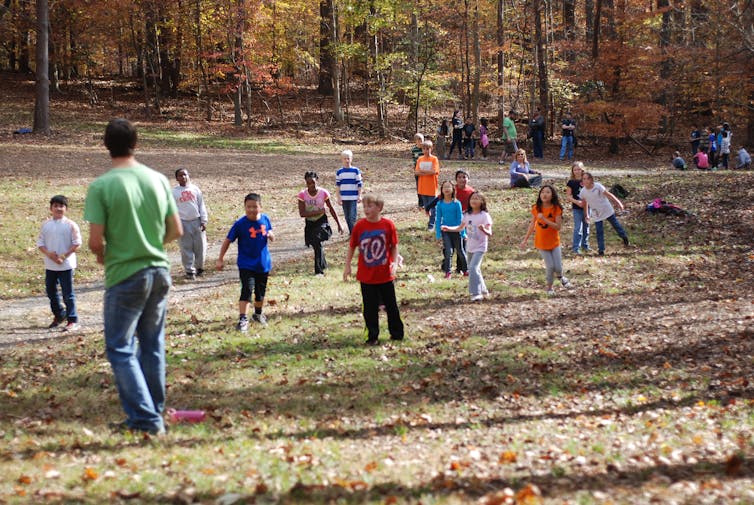
    A group of young children play a game in a field on an autumn day.
    Variations of ‘Red Light, Green Light’ exist around the world.
    Jarek Tuszyński/Wikimedia Commons, CC BY-SA

    Historically, children have reworked rhymes and clapping games to draw on popular culture of the day. “Georgie Best, Superstar,” sung to the tune of “Jesus Christ Superstar,” was a popular chant on U.K. playgrounds in the 1970s that celebrated the legendary soccer player George Best. And a variation of the clapping game “I went to a Chinese Restaurant” included the lyrics “My name is, Elvis Presley, girls are sexy, Sitting on the back seat, drinking Pepsi.”

    Making space for children’s culture

    One reason 6-7 became so popular is the low barrier to entry: Saying “6-7” and doing the accompanying hand movement is easy to pick up and translate into different cultural contexts. The simplicity of the meme allowed young Korean children to repeat the phrase in English. And deaf children have participated by signing the meme.

    Because the social worlds of children now exist across a range of online spaces, 6-7 has been able to seamlessly spread and evolve. On the gaming platform Roblox, for example, children can create avatars that resemble 6-7 and play games that feature the numbers.

    The strange words, nonsensical games and creative play of your childhood might seem ridiculous today. But there’s real value in these hidden worlds.

    With or without access to the internet, children will continue to transform language and games to suit their needs – which, yes, includes getting under the skin of adults.

    A great deal of attention is given to the omnipresence of digital technologies in children’s lives, but we think it’s worth taking a moment to appreciate the way children are using these technologies to innovate and connect in ways both creative and mundane.The Conversation

    Rebekah Willett, Professor in the Information School, University of Wisconsin-Madison; Amanda Levido, Lecturer, Southern Cross University, and Hyeon-Seon Jeong, Professor of Digital Media Education, Gyeongin National University of Education


    Source link

  • Games for Change Opens 2026 Student Challenge to Game Creators and Innovators Ages 10–25

    Games for Change Opens 2026 Student Challenge to Game Creators and Innovators Ages 10–25

    The annual global game design awards $20,000 in grand prizes for creative and impactful games that advance the UN Sustainable Development Goals

    NEW YORK, NY — [NOV 10, 2025] — Games for Change (G4C), the leading nonprofit that empowers game creators and innovators to drive real-world change, today announced the kick off of the 2025- 2026 Games for Change Student Challenge, a global game design program inviting learners ages 10–25 years old to tackle pressing world issues that address the United Nations Sustainable Development Goals, through creativity, play, and purposeful design.

    Now in its eleventh year, the Student Challenge has reached more than 70,000 students and almost 2,000 educators and faculty across 600cities in 91 countries, inspiring the creation of over 6,600 original student-designed games that connect learning to action. From November to April 2026, participants will design and submit games for consideration in regional and global competitions, with Game Jams taking place worldwide throughout the season.

    “The G4C Student Challenge continues to show that when young people design games about real-world issues, they see themselves not just as players, but as problem solvers and changemakers,” said Arana Shapiro, Chief Operations and Programs Officer at Games for Change. “Through game design, students learn to think critically, collaborate, and build solutions with purpose. In a world shaped by AI and constant change, durable skills like problem solving, critical thinking, and game design will allow all learners to thrive in their communities and worldwide.”

    This year, students will explore three new themes developed with world-class partners to inspire civic imagination and problem-solving:

    Two grand-prize winners will receive a total of $20,000 in scholarships, generously provided by Take-Two Interactive and Endless. Winners and finalists will be celebrated at the Student Challenge Awards on May 28, 2026, in recognition of exceptional creativity, social impact, and innovation in student game design.

    “With 3.4 billion players worldwide, the video games industry has an unprecedented ability to reach and inspire audiences across cultures and our next generation of leaders,” said Lisa Pak, Head of Operations at Playing for the Planet. “We’re excited about our collaboration with Games for Change, empowering students to use their creativity to spotlight the threats to reefs, rainforests, and our climate. Together, we’re transforming play into a powerful tool for awareness, education, and action.”

    More than 319 million people face severe hunger around the world today,” said Jessamyn Sarmiento, Chief Marketing Officer at World Food Program USA. “Through the ‘Outgrow Hunger’ theme, we’re giving the next generation a way to explore the root causes of food insecurity and imagine solutions through research, game design, and play. This collaboration helps students connect their creativity to one of the most urgent challenges of our time—ending hunger for good.”

    Additionally, G4C is expanding its educator support with the launch of the G4C Learn website, the world’s largest online resource library featuring lesson plans, tutorials, and toolkits to guide students, teachers, and faculty on topics like game design, game-based learning, esports, career pathways, and more. In partnership with Global Game Jam, educators worldwide can receive funding, training, and support to host Student Challenge Game Jams in their classrooms and communities.

    “Games turn learning into challenges students actually want to take on,” said Luna Ramirez, CTE teacher at Thomas A. Edison CTE High School based in New York City. “When students design games to tackle pressing global problems affecting their communities, they become curious about the world around them, experimenting, and bringing ideas to life. The best learning happens when students take risks, fail forward, and collaborate, and that’s exactly what the Games for Change Student Challenge empowers.”

    Educators, parents, and learners ages 10–25 can now registerfor the 2026 Games for Change Student Challenge and access free tools and resources at learn.gamesforchange.org.

    This year’s Student Challenge is made possible through the generous support of key partners, including Endless, General Motors, Verizon, Motorola Solutions Foundation, Take-Two Interactive, World Food Program USA, Playing for the Planet, Unity, and Global Game Jam.

    About Games for Change

    Since 2004, Games for Change (G4C) has empowered game creators and innovators to drive real-world change through games and immersive media, helping people learn, improve their communities, and make the world a better place. G4C partners with technology and gaming companies, nonprofits, foundations, and government agencies to run world-class events, public arcades, design challenges, and youth programs. G4C supports a global community of developers using games to tackle real-world challenges, from humanitarian conflicts to climate change and education. For more information, visit: https://www.gamesforchange.org/.

    Media contact(s):

    Alyssa Miller

    Games for Change

    [email protected]

    973-615-1292

    Susanna Pollack
    [email protected]

    Latest posts by eSchool News Contributor (see all)

    Source link

  • Why stories still matter in a fast-moving world

    Why stories still matter in a fast-moving world

    Key points:

    Seventeen years after Suzanne Collins first introduced us to The Hunger Games, the world is still captivated by Panem. The latest installment, Sunrise on the Reaping, dives into Haymitch’s backstory and has been called a “propulsive and heart-wrenching addition” to the series by The New York Times. For many of us, books like these aren’t just stories–they’re cultural moments.

    I remember reading the original trilogy on my iPad while training for a half-marathon. Katniss’ fight against the Capitol powered me through some of my longest runs. That’s the magic of books: They meet us where we are and carry us somewhere else entirely. They become part of our personal history, woven into our memories and milestones.

    But the power of books goes far beyond personal nostalgia. When a major title drops, it’s not just a release date–it’s a shared experience. Readers rush to get their hands on it. Social media lights up with reactions. Libraries field waitlists. These moments remind us why books matter. They connect us, challenge us, and inspire us.

    This fall, we’re about to experience two more of these moments. On October 21, Diary of a Wimpy Kid: Partypooper hits shelves. Jeff Kinney’s beloved series has become a rite of passage for young readers, and this latest installment–centered around Greg Heffley’s attempt to throw himself the ultimate birthday bash–is already generating buzz. It’s funny, relatable, and perfectly timed for a generation that’s grown up with Greg’s awkward, hilarious adventures.

    Just a few weeks later, on November 11, Dog Man: Big Jim Believes arrives. Dav Pilkey’s Dog Man series has redefined what it means to be a children’s book phenomenon. With its blend of humor, heart, and comic-style storytelling, Dog Man has helped countless kids fall in love with reading. This new title promises to be no different, offering a story about belief, friendship, and finding strength within.

    These books aren’t just for kids–they’re cultural touchstones. They bring generations together. Parents read them with their children. Teachers use them to spark classroom discussions. Librarians build displays around them. And kids? They devour them and talk about them with the kind of passion usually reserved for blockbuster movies or viral games.

    And yes, there’s a business side to books. Pricing, distribution, marketing strategies–they all matter. Behind every book on a shelf is a network of people working to make that moment possible. Publishers, authors, illustrators, binders, warehouse teams, sales reps, marketers, and more. It’s easy to forget that when you’re holding a finished book, but every title is the result of countless decisions, collaborations, and passions.

    In a world dominated by screens, short-form content, and constant notifications, books offer something different. They ask us to slow down. To focus. To imagine. To empathize. And that’s more important than ever.

    Literacy isn’t just about reading words on a page–it’s about understanding the world. It’s about critical thinking, emotional intelligence, and the ability to engage with complex ideas. Books help build those skills. They give kids the tools to navigate life, not just school.

    Because in a world that’s constantly changing, books remain one of our most powerful tools for understanding it–and each other. The world needs stories. And stories need us.

    Britten Follett
    Latest posts by Britten Follett (see all)

    Source link

  • Games and their cheat codes can show universities how to unlock new purpose

    Games and their cheat codes can show universities how to unlock new purpose

    I was recently browsing Board Game Geek, an online forum for nerds who like tabletop games, and came across a thread entitled “anyone have a use for the University?”

    This contained a complaint about the board game Puerto Rico. In Puerto Rico, although the University is potentially a very powerful card, it’s considered too expensive and therefore not worth players’ investment – and I couldn’t help being struck by a resonance with real life higher education in the UK.

    Following the recent increase in tuition fees, reports of students perceiving university education as a poor investment of time and money have proliferated. As such, understanding and communicating the value of higher education has become an increasingly pressing concern.

    Value and metaphor

    In 2024, over 1,000 papers were published which mention the value of higher education, going over themes like economic gain, professional and academic experience, networking, “cultural capital”, and a sense of the value that higher education institutions offer to society in general. Authors explore how value is perceived differently by applicants, students, graduates, staff and the public, and by different demographic communities within these groups. Undoubtedly, the value of higher education is multifaceted and complex.

    A powerful way of understanding value is through metaphor. When we use a metaphor, we ascribe the value of one thing to another. For instance, universities are beacons of knowledge positions universities as guiding lights, illuminating the path to progress (or something).

    Some common metaphors ascribed to universities include: universities are innovators that drive progress and create new ideas; universities are catalysts for personal and societal transformation; and universities are providers which supply a skilled workforce to deliver economic growth.

    When metaphors are layered together, they become a narrative – a way of conveying greater meaning through interconnected symbols. Games, as a form of interactive storytelling, take this concept even further. They combine metaphors with player agency, allowing players to actively engage with and shape the narrative. In games, players don’t just passively observe metaphors at work; they inhabit and interact with them.

    The player of games

    Because games are dynamic, this means that universities appear in games only when they are actively doing something: acting on the simulation and changing the outcome for the player. Analysing these dynamics leads to some thought-provoking insights into how universities are perceived as acting on the real world, and therefore what value higher education holds in society.

    Our most familiar metaphors for universities are easily recognisable in games. For example, in strategy games such as Age of Empires, universities are innovators which generate “research points” which can be spent to unlock new things. In city-building games like Megapolis, universities are providers that give the player more resources in the form of workers. In Cities: Skylines, universities are catalysts for growth: once a citizen has attended university their home will be upgraded to higher building levels, and they can get better jobs, which in turn levels up their place of employment.

    To return to Puerto Rico: in the normal rules of the board game, players can “construct” a building (such as a factory or warehouse) but cannot use it until the next “mayor phase” is triggered, at which point they can be “staffed”, and its benefits can be used by the player thereafter. The university card grants the player the ability to both “construct” and “staff” new buildings instantly, without waiting. This significantly speeds up the gameplay for the owner of the card.

    When used in this way, the university card changes the mechanics of the game for the player who can use it.

    Puerto Rico is not alone in this. For example, in Struggle for Catan, the university card allows the possessor to buy future cards more easily by swapping one required resource for any other kind. This has such an unbalancing effect that it changes the game from that point onwards. As one Board Game Geek user puts it:

    When I play with my wife we ban the University to keep it a friendly game […] In a four player game everyone just gangs up on whoever gets the University.

    In both of these games, universities are cheat codes: “a secret password […] that makes something unusual happen, for example giving a player unusual abilities or allowing them to advance in the game.”

    Cheat codes are used by players to create exceptions to the standard game rules everyone else must abide by. Universities change the mechanics of the game and enable players to act in a way that would be otherwise impossible.

    Real-life cheat codes

    The idea of students using universities to gain an advantage is not new. When university strategies talk about “transforming students’ lives”, this is generally what they’re referring to. “Educational gain”, “cultural capital”, “graduate attributes”, and “personal development”, are all facets of the same sort of idea.

    However, I’d argue that using the metaphor of a “cheat code” forces us to see students as active players who are using their experiences agentically and strategically, rather than just passively receiving something. When a player uses a cheat code, they generally have an intention in mind. Using the game metaphor reminds us to see students as individual players, who are interested in developing their own palette of cheat codes for their own personal goals.

    If the value of a university experience for students is in developing and testing cheat codes, then we should be intentionally structuring higher education to teach the most effective “hacks”. As Mark Peace has argued on this site in the past, we mustn’t be complacent about the process by which students “catch” transferrable skills. We need to be much more intentional about how we scaffold the development of these cheat codes, and how we work collaboratively with students to identify the skills they want to build and create meaningful ways to help them develop their own toolbox of cheat codes.

    Without this, there is a real danger that we will return to the original scenario of this article, the forum post bemoaning the high-cost, low-return of the university card in Puerto Rico. We must guard against the “university card” being almost unplayable, because it is too expensive, not flexible enough, or too dated. The challenge to institutions is to ensure our provision is more like the university card in Struggle for Catan: truly game-breaking.

    Thinking about universities in terms of game design invites us to rethink the rules we’re playing by and imagine a world where some rules don’t apply. It’s a reminder that the narratives that shape higher education aren’t set in stone. Players have autonomy and can change the direction of the game. This might mean building a toolbox for life with students – and for us, it means taking a wider look at the system we’re part of. What would it look like to recover our agency and, as Edward Venning puts it on HEPI recently, “recover an assertive self-confidence”? For too long, universities have been stuck playing the game instead of changing the rules.

    Source link

  • Classroom Games and Tech – Ed-Tech to Engage and Inspire: Free Number Line Game from TpT

    Classroom Games and Tech – Ed-Tech to Engage and Inspire: Free Number Line Game from TpT

    For the first week of April my elementary math number line game is free. You can find it here. It’s a card game that requires some printing and cutting to make the components. If you have any feedback on the game, please let me know!

    I included this information about the value of such games at the end of the rule document:

    I knew from teaching math that number lines were important for visualization. I created a number line game years ago, but when I tested it with some first graders, I soon found my initial ideas had some issues. I put the game on the shelf. Then recently I heard Jo Boaler make a statement like this one, 

    Researchers even found that after four 15-minute sessions of playing a game with a number line, differences in knowledge between students from low-income backgrounds and those from middle-income backgrounds were eliminated (Siegler & Ramani, 2008). (Quoted from here)

    I don’t know that Jo Boaler would endorse this game, but after hearing her, I knew I had to return to it! I fixed the gameplay problems and tested it with groups of students from ages 7 to 11. They were immediately hooked! I have been so impressed with how even the youngest students had no problems playing, even when some versions had a number line with negative numbers!

    Source link