Category: General

  • Three Elements of a Successful Onboarding Program – CUPA-HR

    Three Elements of a Successful Onboarding Program – CUPA-HR

    by CUPA-HR | September 14, 2022

    Onboarding programs consisting of a brief history lesson about the institution and instructions for how to get a parking pass aren’t likely to inspire new hires. Here are three elements of onboarding programs that go beyond the basics to create a deeper understanding of campus culture and a sense of belonging.

    Orient New Hires to Higher Education

    Learning industry-specific skills and knowledge is essential for employees to thrive in their workplaces. Higher education is no different. New hires must quickly get up to speed on how their departments function within the context of their institution and its mission. This can be overwhelming for anyone, especially someone new to higher education.

    To address this learning curve, CUPA-HR created Understanding Higher Ed Course 1 — An Overview of Higher Education for All Employees. The course is designed to help all higher ed employees understand different types of institutions, terminology, cultural hallmarks of the higher ed work environment, the basics of higher ed funding, and key soft skills that support success in the workplace.

    Create a Sense of Belonging

    A crucial aspect of the workplace that can’t be captured in a new-hire orientation video is the sense of belonging employees experience. And if staff members work remotely, opportunities to connect with coworkers and build community may be even more difficult to achieve.

    To overcome these challenges, the University of Florida’s Academic and Professional Assembly (APA), led by several HR employees, reconsidered their approach to onboarding. Through their Warm Welcome experience they helped create a campus culture that fosters a sense of belonging for new staff. The APA helps spark campus connections by hosting welcome events and small groups where new hires can interact with high-level leaders. During these events, leaders share personal stories and insights about leadership, diversity and inclusion and the value that staff bring in the pursuit of the university’s many goals. This storytelling approach draws out leaders’ personalities, camaraderie, sense of humor and transparency, and allows staff to see the “human” aspect of a large institution. Read more about UF’s Warm Welcome experience to learn how to design a warm welcome experience for your staff.

    Partner With Other Departments

    Onboarding shouldn’t fall solely on HR’s shoulders. Support from many areas of the institution is critical for a successful onboarding program. Additionally, shared responsibility for onboarding can positively affect organizational culture, departmental buy-in and employee retention. Presenters from the University of Colorado Boulder shared their strategic partner model in a 2019 CUPA-HR on-demand webinar “Onboarding: A Strategic Partner Model for Bringing About Cultural Change.” Watch the webinar recording to learn more about UC Boulder’s model to increase employee engagement, retention and productivity while keeping the focus on institutional goals.

    There are many reasons employees are drawn to work at an institution, and a successful onboarding program shows them why they should stay.


    Source link

  • CUPA-HR Submits Comments in Response to Title IX NPRM – CUPA-HR

    CUPA-HR Submits Comments in Response to Title IX NPRM – CUPA-HR

    by CUPA-HR | September 13, 2022

    On September 12, CUPA-HR submitted comments in response to the Department of Education (DOE)’s Notice of Proposed Rulemaking (NPRM) to amend Title IX. The NPRM seeks to rollback and replace the Trump administration’s 2020 Title IX rule, specifically with respect to its grievance procedures, and establish expanded protections against sex-based discrimination to cover sexual orientation, gender identity and pregnancy or related conditions.

    CUPA-HR filed comments to bring attention to the possible impact the proposed regulations could have on how higher education institutions address employment discrimination. In our comments, we highlight the two sets of grievance procedures promulgated by the proposal: procedures used for cases involving employee-on-employee sex-based harassment (section 106.45) and procedures used for sex-based harassment involving an employee and student, regardless of whether the employee involved is the complainant or respondent (section 106.46). Our comments argue that such procedures in cases where the employee is a respondent may be unnecessarily prescriptive and will interfere with existing obligations, policies and procedures already utilized by institutions that are required to handle such incidents of sex-based employment discrimination under Title VII of the Civil Rights Act of 1964 (Title VII) and state and local employment laws.

    In light of our concerns, our comments ask the DOE to exempt any sex-based harassment of employee respondents against a student complainant from the section 106.46 requirements, and to exempt all sex-based harassment claims where an employee is the respondent, regardless of whether the complainant is a student or an employee, from the section 106.45 requirements. These comments directly align with the concerns and requests written in the American Council on Education’s comments, which CUPA-HR also signed on to.

    Finally, our comments suggest that the DOE consult with other federal agencies with jurisdiction over discrimination law, including the Equal Employment Opportunity Commission to rationalize the requirements instituted by the Title IX regulations and Title VII, and to issue joint guidance on how to minimize potential conflicts between the obligations to claimants under Title VII and respondents under Title IX.

    The DOE received over 200,000 comments in response to the NPRM, which they must now review prior to issuing a final rule to implement their changes. It is therefore unclear when we can expect the final rule and effective date of the new regulations. CUPA-HR will keep members apprised of any updates on the Title IX regulations.


    Source link

  • Suicide Prevention and Awareness: Four Ways HR Can Lead the Conversation – CUPA-HR

    Suicide Prevention and Awareness: Four Ways HR Can Lead the Conversation – CUPA-HR

    by CUPA-HR | August 31, 2022

    This blog post was contributed by Maureen De Armond, Executive Director, Human Resources at Drake University.

    In higher education, we must plan for many worst-case scenarios, including tornados, fires, active-shooter situations, and, as we now know, pandemics. Among this wide range of difficult scenarios that could present themselves on our campuses at any time, suicide is one that deserves more attention and discussion.

    Like other scenarios, suicide prevention and planning should contain at least these components: awareness and prevention at the front end; crisis-response protocols to deploy in the moment; and post-incident support and debriefing.

    Here are four ways HR can take the lead on awareness and prevention efforts:

    Normalize Mental Health Conversations

    HR can set the example in normalizing conversations about mental health. From new employee orientation to leadership trainings to trainings offered during open enrollment, make mental health as normal a topic to discuss as being sick with the flu or needing rehab due to an injured back. We know that mental health carries a stigma; openly discussing mental health helps chip away at that stigma.

    Coordinate Messaging

    Tailor communications to your institution’s practices and use more than one channel for communication. If your institution sends newsletters, plan articles for each week of September. Consider emails as well. Be sure to provide your leadership teams with prepared messages and information they can share with their teams. Point them to helplines, training opportunities, reminders about EAPs, and tips for what to do and where to go if they or someone they know is having mental health crisis.

    Collaborative messaging sent from campus and community partners can also create a widespread impact. Consider reaching out to student services, the provost’s office, Title IX/Equal Opportunity, campus safety, student senate, faculty senate, student counseling, faculty subject matter experts, and your institution’s employee assistance program (EAP) providers and health plan partners to team up on mental health messaging throughout the month.

    Train, Train, Train

    Offer learning and development opportunities that focus on mental health awareness as well as suicide prevention. This fall semester, Drake University is offering Question, Persuade and Refer suicide prevention training in addition to Mental Health First Aid for Higher Education for faculty and staff. Faculty partners are facilitating these sessions. We’ve found that having faculty-led sessions can help attract faculty attendees, leverage internal expertise and offer faculty additional forms of service to the institution.

    Inventory Resources, Benefits and Policies

    Take a fresh look at your well-being/wellness programming. Does it appropriately address mental health? Explore what resources and trainings may be available through your existing EAP contracts. Does your health plan offer virtual doctor’s visits for mental health care? If so, shine a spotlight on those resources. Making mental health care as accessible as possible may mean more people will consider using it. Review sick, personal and other paid-time-off leave policies to ensure mental health is clearly addressed. This includes handbook and web language, too.

    While suicide awareness and prevention shouldn’t be a once-a-year conversation, September is a great month for HR to demonstrate leadership in normalizing conversations about mental health and suicide prevention and planning.

    Related resources:

    Reassessing Your Institution’s EAP: Steps for HR Pros to Increase Awareness and Accessibility (The Higher Ed Workplace Blog)
    HEERF Funds Can Be Used to Support Mental Health Resources (The Higher Ed Workplace Blog)

    Mental Health Month Focus: Higher Ed Campus Culture (The Higher Ed Workplace Blog)


    Source link

  • Time Is Running Out: Help Your Employees Navigate the Special PSLF Waiver – CUPA-HR

    Time Is Running Out: Help Your Employees Navigate the Special PSLF Waiver – CUPA-HR

    by CUPA-HR | August 24, 2022

    On Oct. 6, 2021, the U.S. Department of Education announced a change to the Public Service Loan Forgiveness (PSLF) program rules for a limited time as a result of the COVID-19 national emergency. Millions of non-profit and government employees have federal student loans and may now be eligible for loan forgiveness or additional credit through the limited PSLF waiver. But they need to act fast. The special waiver expires October 31, 2022.

    Here are several resources for HR professionals who want to get the word out to employees before the opportunity passes.

    Learn More and Get Tips for Educating Employees

    In June, CUPA-HR hosted the webinar, Helping Employees Understand and Navigate the Public Service Loan Forgiveness (PSLF) Program, where Department of Education representative Ashley Harrington shared details about the program and how HR can help guide employees through the necessary processes to achieve loan forgiveness. The recorded webinar is available for viewing any time.

    Explore the Department of Education’s Employer Toolkit

    The Department of Education’s PSLF waiver toolkit is a comprehensive resource that features a PSLF fact sheet, sample social media posts and email templates HR can use to spread the word to campus employees.

    Direct Employees to the Borrower Site

    For a clear explanation of the program and a simple step-by-step process to determine who is eligible for the program, direct employees to the Federal Student Aid website.


    Source link

  • DHS Proposes Rule Permitting Alternative Options for Form I-9 Document Examination – CUPA-HR

    DHS Proposes Rule Permitting Alternative Options for Form I-9 Document Examination – CUPA-HR

    by CUPA-HR | August 23, 2022

    On August 18, the Department of Homeland Security (DHS) published in the Federal Register its anticipated Notice of Proposed Rulemaking (NPRM) on optional alternative examination practices for employers when reviewing an individual’s identity and employment authorization documents required by the Form I-9, Employment Eligibility Verification. Interested stakeholders can submit comments on the NPRM through October 17.

    Under current law, employers are required to physically examine an individual’s identity and employment authorization documents within three business days after an individual’s first day of employment. The proposed rulemaking, however, would create a framework under which the Secretary of Homeland Security could allow alternative options for verifying those documents, such as reviewing the documents via video, fax or email.

    As explained in the NPRM, the proposal does not directly allow employers or agents acting on the employer’s behalf to use such alternative examination options, but instead would create a framework under which the Secretary would be authorized to extend the flexibilities. The Secretary would be authorized to implement the alternative options in a pilot program if they determine such procedures would offer an equivalent level of security, as a temporary measure to address a public health emergency declared by the Secretary of Health and Human Services, or a national emergency declared by the President.

    The DHS is issuing this rulemaking following the success of temporary changes to document verification procedures implemented at the onset of the COVID-19 pandemic. In March 2020, the DHS’s Immigration and Customs Enforcement deferred its physical examination requirements for Form I-9 and relaxed its enforcement. Employers were allowed to review documents through video, fax or email so long as they also retained copies of the documents. The policy proved successful and was extended several times, but is currently set to expire October 31, 2022. It may still be extended as the agency pursues this rulemaking.

    In December 2021, CUPA-HR submitted comments to the DHS in response to the agency’s Request for Public Input on remote document examination. In its comments, CUPA-HR reported the results of the survey it conducted of member institutions’ experiences with the agency’s Form I-9 flexibilities. CUPA-HR members reported positive experiences with the changes and said they did not run into challenges with implementation. Respondents strongly supported a permanent option for remote document examination and said the policy provides numerous benefits for higher education institutions, including providing more flexibility for remote work, reducing the time needed to complete document verification and reducing institutions’ paperwork burden. Respondents also criticized physical document examination as overly burdensome.

    CUPA-HR plans to submit comments on the NPRM and will likely ask members for their input in the coming weeks.


    Source link

  • August Recess Roundup: Congressional and Regulatory Updates – CUPA-HR

    August Recess Roundup: Congressional and Regulatory Updates – CUPA-HR

    by CUPA-HR | August 22, 2022

    When August arrives, Congress leaves D.C. and heads to their home districts for the annual August recess period. To keep CUPA-HR members apprised of recent and future actions on the Hill and in federal agencies, here are highlights of the latest actions by Congress, nominations they’ll have to consider when they return, and regulations that may be issued throughout the month.

    Legislative Updates

    On August 16, President Biden signed the Inflation Reduction Act into law following its passage, along partisan lines, in both the U.S. Senate and House of Representatives. The Inflation Reduction Act, which is a slimmed down version of the reconciliation bill Democrats have been pushing for, focuses on policies to mitigate the impacts of climate change, reduce healthcare costs and increase tax revenue to reduce the federal budget deficit. This reconciliation bill was narrowed down from the “Build Back Better” agenda, a step necessary to gain support from Senators Joe Manchin (D-WV) and Kyrsten Sinema (D-AZ) to get the bill over the 50-vote threshold. Notably, the final package did not include “Build Back Better” provisions like paid leave, universal community college and childcare.

    Additionally, on August 9, President Biden signed the CHIPS and Science Act, which provided new funding to boost U.S. investments in research and manufacturing of semiconductors. With respect to the research investments, the bill includes a five-year, $81 billion authorization of the National Science Foundation to go toward research funding. Additionally, the bill provides new funding to historically black colleges and universities and other minority-serving institutions, and for STEM programs at colleges and universities.

    Nominations Awaiting Confirmation

    On July 27, President Biden announced Jessica Looman as the new nominee for the Department of Labor (DOL)’s Wage and Hour Division Administrator. Looman has been serving as acting administrator for the agency since June 2021. Her nomination replaces Biden’s previously withdrawn nomination of David Weil, who failed to garner enough support in the Senate to be confirmed. Looman’s nomination will have to go through the Senate Health, Education, Labor and Pensions (HELP) Committee prior to going to the Senate floor for a full vote. Timing on both votes are uncertain at this point.

    Additionally, Kalpana Kotagal’s nomination for the Equal Employment Opportunity Commission (EEOC) continues to be held up in the Senate. In May, the Senate HELP Committee deadlocked on a vote to move her nomination to the full Senate, which means the full Senate will have to vote to advance her nomination out of committee — a logistical hurdle in a 50-50 Senate with sparse time on their legislative calendar. The result of this hold up means the EEOC will continue to operate with a Republican majority as federal statute allows Republican Commissioner Janet Dhillon, whose term expired in July, to remain an active member of the EEOC while her successor’s nomination is pending. If and when nominee Kotagal is confirmed, she will replace Commissioner Dhillon and tip control of the EEOC to a 3-2 Democratic majority. Her confirmation vote is also uncertain at this point.

    Regulatory Updates

    Though not guaranteed, there may be several proposals and final regulations that may be released by the Department of Education, the DOL and other relevant agencies throughout the month. Some of these include the expected proposed rule on Form I-9 remote verification flexibilities from the Department of Homeland Security, which has already had its review completed by the White House; a proposed rule on independent contractor classification, which was sent to the White House for review in July; and a final rule on the Deferred Action for Childhood Arrivals program, which has a target release date set for August.

    In addition to these proposed and final rules CUPA-HR is waiting to be released, the Department of Education is still undergoing its notice-and-comment period for the Title IX proposed rule that was released in June. CUPA-HR is assessing the proposal and will put together comments in response to the proposed rule. Comments are due September 12.

    CUPA-HR will keep members apprised of legislative and regulatory actions as August recess continues and we move into the fall.


    Source link

  • Event Planning, Institutional Research, Museum, and Tutor Positions See Significant Growth in the Wake of the Pandemic – CUPA-HR

    Event Planning, Institutional Research, Museum, and Tutor Positions See Significant Growth in the Wake of the Pandemic – CUPA-HR

    by CUPA-HR | August 10, 2022

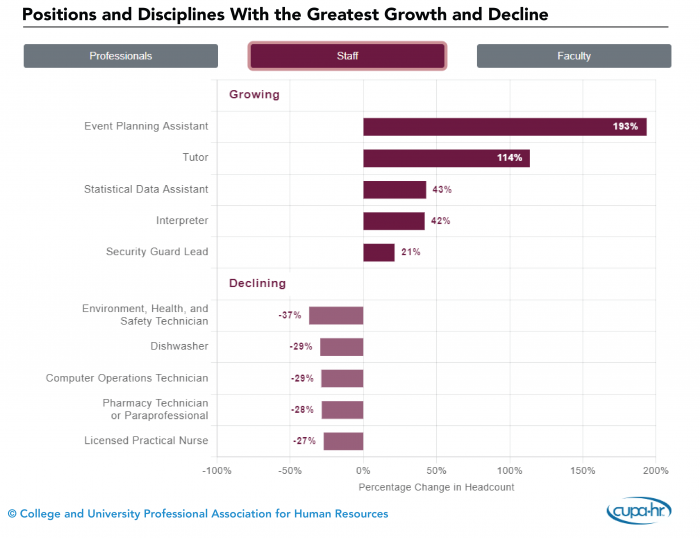
    According to data recently released by CUPA-HR, the higher ed workforce positions that saw the greatest growth from 2020-21 to 2021-22 were event planning assistant (up 193%), institutional research analyst (up 161%), head of campus museum (up 120%) and tutor (up 114%). These increases reflect an increase in the number of people hired to fill existing or newly created positions since 2020-21.

    The positions that saw the greatest decline in number of employees were environment, health and safety technician (down 37%), head of campus learning resources center (down 36%), online instruction operations manager (down 32%) and dishwasher (down 29%). These decreases reflect a decrease in the number of people in these positions since 2020-21, either because the institution has reduced the number of available positions or because those positions have unfilled vacancies.

    A new interactive graphic from CUPA-HR shows the Positions and Disciplines With the Highest Growth and Decline for higher ed professionals, staff and tenure-track faculty.

    The Ongoing Impact of COVID-19

    In many cases, the growth and decline in these positions over the past year reflect the impact of the COVID-19 recession that began in the spring of 2020. Like so many employers, institutions have experienced the effects of the Great Resignation and the subsequent challenges of talent recruitment amid the growing availability of remote and flexible work options.

    Other factors may also be at work. The return to in-person events, the growing demand for data to inform institutional decision-making, and the continued interest in honoring the cultural histories of institutions may have increased demand for the positions that saw the greatest increases. Also, as the high school graduates most impacted by the pandemic’s disruption of classroom learning make their way to college, more tutors may be needed to help them bridge anticipated gaps.

    Smaller Shifts in Faculty

    Overall, tenure-track faculty saw much smaller increases and declines in the years analyzed. Disciplines with the highest growth were Library Science (up 8.4%), Liberal Arts and Sciences (up 7.0%), and Area, Ethnic, Cultural, Gender and Group Studies (up 2.3%). Disciplines with the greatest declines were Communications Technologies (down 22%), Agriculture (down 9%) and Engineering Technologies and Technicians (down 6.4%).

    More About the Results

    The data for these results came from CUPA-HR’s annual Professionals in Higher Education Survey, Staff in Higher Education Survey and Faculty in Higher Education Survey. Analyses included more than 600 institutions that participated in each survey in both years of the comparison. For additional details, see the interactive graphic in the Research Center. These data and more are available through CUPA-HR’s DataOnDemand subscription service.


    Source link

  • The Wildfire Program Welcomes a New Cohort for 2022-23 – CUPA-HR

    The Wildfire Program Welcomes a New Cohort for 2022-23 – CUPA-HR

    by CUPA-HR | August 3, 2022

    For the higher ed HR community to thrive there must be a pipeline of early-career professionals waiting in the wings, and one way CUPA-HR equips early-career pros to grow in their role and take steps toward their career goals is through the Wildfire program.

    The program, sponsored in part by HigherEdJobs, is a 12-month immersive experience that connects a small, select group of early-career higher ed HR professionals with some of the top leaders in the profession, giving them a variety of learning opportunities.

    Rob Keel, a member of the 2019-20 Wildfire cohort and past president of the CUPA-HR Tennessee Chapter, had this to say about the program: “Wildfire helped open my eyes to the possibilities within higher education HR. The network I gained through my involvement with Wildfire has provided so much support as I navigate my career. If you want to develop relationships that have the power to transform, Wildfire has the power to do just that.”

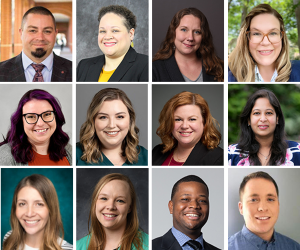
    As a new year gets underway, we want to congratulate and welcome the Wildfire program participants for 2022-23:

    • TJ Bowie, Equal Opportunity and HR Compliance Manager, Elon University
    • Joy Brownridge, Training and Development Specialist, University of Illinois System
    • Amanda Burshtynsky, Employee Payroll and Insurance Clerk, Genesee Community College
    • Kelleebeth Cantu, HR and Employment Coordinator, Trinity University
    • Audrey Ettesvold, Human Resource Specialist, Idaho State Board of Education
    • Alexis Hanscel, Benefits Manager, Denison University
    • Kathleen Hermacinski, Human Resource Coordinator, Eureka College
    • Anshuma Jain, HR Administrator, Hudson County Community College
    • Jessica Ludwick, Human Resources Consultant, University of North Carolina Wilmington
    • Tracey Pritchard, HR Coordinator, University of Iowa
    • Trevon Smith, HR Generalist, Drake University
    • Christopher Williams, HR Partner, University of Maine System Office

    Interested in joining our 2023-24 cohort? Learn more about the Wildfire program.


    Source link

  • Federal Judge Blocks Department of Education’s Title IX Guidance – CUPA-HR

    Federal Judge Blocks Department of Education’s Title IX Guidance – CUPA-HR

    by CUPA-HR | July 27, 2022

    On July 15, a federal judge from the U.S. District Court of the Eastern District of Tennessee issued a preliminary injunction blocking enforcement of the Department of Education’s Title IX guidance that prohibits discrimination on the basis of gender identity and sexual orientation. Specifically, the ruling blocks enforcement of a June 2021 Notice of Interpretation issued by the department’s Office for Civil Rights (OCR) in light of the Supreme Court’s 2020 decision in Bostock v. Clayton County and President Biden’s Executive Order, “Guaranteeing an Educational Environment Free from Discrimination on the Basis of Sex, Including Sexual Orientation and Gender Identity.”

    Twenty Republican-controlled states, led by their attorneys general, were listed as plaintiffs on the case, arguing that the department’s guidance should not be enforced by the agency as it did not go through the notice-and-comment rulemaking process and is not codified law. They claimed that the department’s enforcement of the guidance also puts states at risk of losing significant federal funding if they do not comply with the guidance. The Eastern District of Tennessee judge ruled in favor of the plaintiffs, issuing the preliminary injunction while stating that the guidance interferes with states’ abilities to enforce their own laws that prohibit transgender students from participating on sports teams or using restrooms that align with their gender identity.

    As it currently stands, the injunction applies only to the 20 states listed as plaintiffs in the case, potentially impacting the policies of colleges and universities in those states. Notably, the injunction does not impact the recently issued Title IX proposed regulations that are currently undergoing a 60-day notice-and-comment period. If the Title IX regulations are codified into law, however, they may face similar legal challenges.

    CUPA-HR will continue to monitor this issue and keep members apprised of any developments related to Title IX.


    Source link

  • More Than Half of College and University Employees Say They Are Likely to Look for Other Employment in the Near Future – CUPA-HR

    More Than Half of College and University Employees Say They Are Likely to Look for Other Employment in the Near Future – CUPA-HR

    by CUPA-HR | July 21, 2022

    New research from CUPA-HR shows that higher education institutions are in the midst of a talent crisis, as many staff, professionals and administrators are considering other employment opportunities due to dissatisfaction with their pay, their opportunities for advancement, their institutions’ remote and flex work policies, and more.

    The newly published research report, The CUPA-HR 2022 Higher Education Employee Retention Survey: Initial Results, provides an overview of what proportion of the higher ed workforce is at risk for leaving, why they’re considering leaving employment, and with which policies, work arrangements and benefits employees are satisfied or dissatisfied. The report includes several recommendations for addressing these issues.

    Data from 3,815 higher ed employees across 949 institutions and representing 15 departments/functional areas were analyzed for this report.

    Findings

    Higher ed employees are looking for other jobs, mostly because they desire a pay increase. More than half (57%) of the higher ed workforce is at least somewhat likely to look for other employment opportunities in the next 12 months. The most common reason for seeking other employment (provided by three-fourths of those likely to look for another job) is an increase in pay. Other reasons are that they desire more remote work opportunities, a more flexible schedule, and a promotion or more responsibility.

    Higher ed institutions are not providing the remote work opportunities that employees want. Nearly three-fourths (71%) of employees report that most of their duties can be performed remotely, and 69% would prefer to have at least at least a partially remote work arrangement, yet 63% are working mostly or completely on-site.

    Higher ed employees are working longer and harder than ever. Two-thirds (67%) of full-time staff typically work more hours each week than what is considered full-time. Nearly two-thirds (63%) have taken on additional responsibilities of other staff who have recently left, and nearly three-fourths (73%) have taken on additional responsibilities as a direct result of the pandemic.

    Higher ed employees have clear areas of satisfaction and dissatisfaction. Areas of satisfaction include benefits, relationship with supervisor, job duties, and feeling a sense of belonging. Areas of dissatisfaction include investment in career development, opportunities for advancement, fair pay, remote work policies and parental leave.

    Read the full report.


    Source link