Category: government policy

  • “we can’t leave education to political leaders” 

    “we can’t leave education to political leaders” 

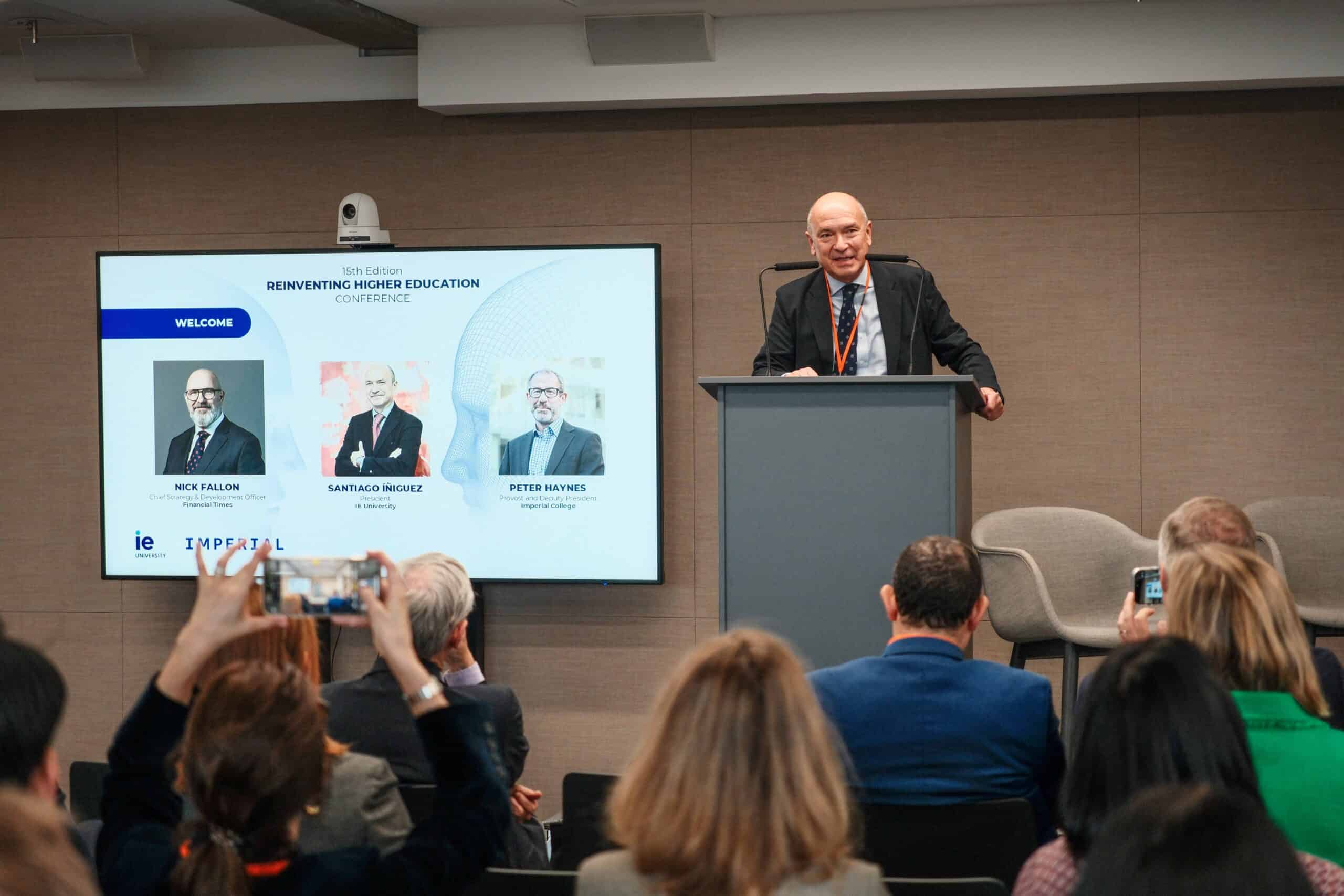
    “Politics is for short-term cycles, education is for the long-term,” said Baroness Usha Prashar, independent member of the UK House of Lords, speaking at the Reinventing Higher Education conference 2025, led by IE University, in London. 

    Prashar told university leaders in the room that institutions must not get “buffeted by the political pressures of the day,” urging them to think creatively to find ways of preserving core values.  

    Prashar pointed to cases in the US where she said universities were being “creative” and giving equality initiatives different names to save them from abolition under Trump’s anti-DEI crusade.  

    The US is perhaps the most striking current example of education coming under political pressure as the Trump administration attempts to reshape American higher education.  

    Earlier this month, the government rolled out its so-called “compact” for higher education to all US colleges, promising preferential federal funding for institutions that agree to a slew of commitments widely seen as an attack on academic research and institutional autonomy.  

    Faith Abiodun, executive director of United World Colleges (UWC) international, echoed Prashar’s advocacy, stating: “We can’t leave education to political leaders”, and warning that isolated institutions were more likely to be targeted.  

    He highlighted the dilemma faced by many US universities, compelled to choose between following the “pseudo kings” or lose access to vital federal funding. 

    Abiodun said the US previously attracted 60% of UWC’s school graduates, funded by the world’s largest privately funded tertiary education scholarship, but that students were fast turning away from the destination.  

    While Europe has stepped up efforts to attract talent pivoting away from the US – evident in the European Commission’s recent “Choose Europe for Science” campaign – IE University president Santiago Iñiguez de Onzoño emphasised international education wasn’t a “zero-sum game”. 

    “A number of continental European universities have benefitted from these increased barriers to mobility, but I don’t think it’s good news because in the end it puts up barriers to cross border mobility and good globalisation,” he told The PIE.  

    “Disruptions in the US are negative for all players.”

    Amid heightened visa restrictions and increased compliance measures across all of the ‘big four’ study destinations, western universities are ramping up efforts to establish branch campuses to reach students in traditional source destinations.  

    While providing “rich educational opportunities” for students who otherwise might be unable to access an international education, as well as allowing students and faculty to travel between campuses, Iñiguez warned that TNE was “at once an opportunity and a threat” which in some ways represents a step backwards from globalisation.  

    Politics is for short-term cycles, education is for the long-term

    Baroness Usha Prashar CBE, UK House of Lords

    In the US, the impact of declining international enrolments has not been felt uniformly across institutions, with the University of Notre Dame seeing “almost exactly the same yield of international undergraduate and postgraduate students” this semester, Notre Dame vice president and associate provost, David Go, told delegates.  

    “As a research university in the pursuit of truth we can position ourselves as nonpartisan and independent.”  

    “Universities can and should be the place for difficult conversations, which is at the root of diplomatic activity,” said Go, highlighting a recent event at Notre Dame which hosted two governors – one democratic and one republican – to discuss how to disagree well. 

    “While the broader political discourse in the US favours disagreeing poorly, to have two of our leaders come and have that conversation helped at least reset some of that discourse,” he said.  

    Elsewhere, speakers emphasised the importance of institutional neutrality to create spaces where people can disagree, at a time when universities are under increased pressure to take a political stance.  

    Julie Sanders, vice chancellor of Royal Holloway University in the UK, highlighted the necessity of institutions fostering debate when the political sphere is becoming more binary.  

    For Sanders, universities should be places for intellectual debate but also places of refuge for migrant students, highlighting the UK’s Chevening Scholarship which is one of the routes through which the UK opened its doors to Gazan students fleeing the war.

    Source link

  • Canada’s study permits plunge by 60% in immigration reset

    Canada’s study permits plunge by 60% in immigration reset

    New IRCC data has revealed plummeting international student arrivals from January to August this year, with stakeholders bracing for further declines as the government pushes forward with efforts to reduce temporary residents in Canada.  

    “The international education sector is rightly concerned that study permit approvals are far below the caps, but the news release makes clear that those concerns are not shared by the Carney government,” Regulated Canadian Immigration Consultant (RCIC) Matthew McDonald told The PIE News

    The figures showed less than 90,000 new international students entered Canada from January to August 2025, making it highly unlikely that Canada will meet its goal of issuing 437,000 study permits this year, as announced in January 2025.  

    While international student arrivals have fallen by 60%, the government has painted the figures as a “story of success” in reducing Canada’s temporary resident population, said McDonald.  

    Taken together, the number of work permit holders and study permit holders decreased by 22% from August 2024 to 2025 – a trend that the IRCC said was “a clear sign the measures we’ve put in place are working”.  

    The drop has brought the total number of study permit holders (including those who hold a work and study permit at the same time) down to 802,425 – 21% less than in 2024 and the lowest level since 2021 during the pandemic. 

    It sets Canada on track to drastically miss the government’s target of issuing a total of 437,000 study permits this year, which was a 10% reduction of the original 2024 cap

    Given the expected shortfall, stakeholders are calling for greater transparency about IRCC’s objectives, highlighting the detrimental impact of the decline on institutions whose budgets were largely guided by the 10% cap.  

    The TR data release is a weather balloon … to see if the Canadian public accepts the message that immigration is now under control in Canada

    Matthew McDonald, RCIC

    The timing of the release less than two weeks ahead of the 2025-2027 Immigration Levels plan has not gone unnoticed by commentators, who are expecting an update to align with the incoming 2025 budget and the shifting vision of Canada’s long-standing openness to immigration. 

    “The temporary resident (TR) data release is a weather balloon, alongside updated processing times, to see if the Canadian public accepts the message that immigration is now under control in Canada,” said McDonald. 

    “The Carney government is concerned about the floor, not the ceiling—i.e., about wrestling down the TR population below 5%,” he added.  

    Currently, the government aims to reach the 5% goal by the end of 2027, with Carney acknowledging it will take several years to reduce TR levels by restricting those coming in and transitioning more temporary residents to permanent residency.  

    Notwithstanding any surprises in the upcoming budget and Immigration Levels Plan, McDonald said he expected the government to “hold their foot” on new study and work permit approvals for several years to come.  

    Ahead of the federal budget announcement, the Canadian Bureau for International Education (CBIE) is urging the government to launch a renewed International Education Strategy to “restore Canada’s global brand to bolster its foreign policy and trade relationships”. 

    The body highlighted the economic contributions of international students who contributed nearly CA$40bn to the country in 2022, boosting local communities and filing labour shortages. 

    What’s more, CBIE emphasised the cultural perspectives international students bring to Canada’s campuses and their importance to the country’s soft power, with students who leave becoming ambassadors for Canada in their home countries.  

    Source link

  • New UK government video targets international students

    New UK government video targets international students

    Secretary of state for education, Bridget Phillipson, addressed students considering studying abroad, highlighting the benefits of a UK education and promoting the country’s post-study work opportunities.

    “In the new academic year, we will welcome thousands of international students who will be starting courses in our universities and I hope to see many more in the future,” Phillipson said in the video shared by the UK Council for International Student Affairs (UKCISA).

    “The UK is a wonderful and safe place to study. Our country is home to some of the very best universities in the world – four of the world’s top 10 can be found right here in the UK.

    “An education from a British university has been the springboard for success for so many global trailblazers, from politics to business, from the arts to the sciences, in fact dozens of current and recent world leaders studied here in the UK and our universities have driven some of the most exciting and valuable research anywhere in the world.

    “You could be part of the next groundbreaking wave of research and join a new generation of inspiring leaders,” she told prospective students.

    Phillipson went on to describe some of the ways in which UK universities support their international students through pastoral support, work experience, scholarships and bursaries.

    “You’ll also get have the chance to join Alumni UK – a global group of people from around the world who have studied here. It’s a fantastic professional network that you can tap into to get great advice and guidance.”

    Phillipson went on to promote the UK’s Graduate Route, describing the opportunity which lets graduates “work, live and contribute” in the UK.

    International students forge international friendships so by studying abroad, you can help build bridges between our countries, and these connections help make the world a better, brighter place.

    Bridget Phillipson, UK secretary of state for education

    “Studying in the UK sets you up for success in your career, but it’s more than that. International students forge international friendships so by studying abroad, you can help build bridges between our countries, and these connections help make the world a better, brighter place.”

    Phillipson previously addressed international students in a video not long after stepping into the role in July 2024.

    On the release of the latest video, Anne Marie Graham, UKCISA chief executive, said she was “encouraged” to see the continuing messages of welcome and support from the UK’s education secretary.

    “Current and prospective students will also welcome the secretary of state’s ongoing support for the graduate visa and her reflections on the mutual benefits of a UK education – not just the contributions that international students make to the UK, but the positive impact on their own careers and ambitions,” she told The PIE.

    “We look forward to continuing to work with the UK government to ensure international students are welcomed and supported, from pre-arrival visas to post-graduation work opportunities, so that all international students have a positive experience studying here.”

    Pedram Bani Asadi, chair of the UKCISA’s Student Advisory Group commented: “I welcome the support from this government for international students’ hopes and dreams, and recognition of all the contributions we make to both UK culture and the economy.

    “Having access to the Graduate Route has been absolutely essential for me to be able to reinforce the skills I learnt in my studies and contribute to the UK. I appreciate all the friends and experiences I’ve had here and look forward to continuing my role as a #WeAreInternational student ambassador, and working with the UK government to support my fellow international students to have a positive experience.”

    Since Labour took came into power, sector stakeholders have noted the government’s more welcoming tone toward international students, a marked contrast to the rhetoric of the previous Conservative government.

    Despite a change in rhetoric, the Labour government has shown no intention of reversing the Conservative’s decision to ban international students on UK taught master’s courses from bringing dependants with them to the UK.

    “While the new government has said many positive things about international students, the focus on immigration remains acute,” said Jamie Arrowsmith, director of Universities UK International in an update to sector earlier this month.

    The UK’s international educations strategy is currently under review, and the rollout of the new approach is set for April.

    Sector leaders gathered at the QS Reimagine Education summit in London late last year to discuss priorities for the UK’s international education sector going forward, giving suggestions for a refreshed strategy, which included improved post-study work rights.

    Source link