Category: Hawaii

  • Hawai’i DOE Spending More on Buses for Fewer Students – The 74

    Hawai’i DOE Spending More on Buses for Fewer Students – The 74


    Get stories like this delivered straight to your inbox. Sign up for The 74 Newsletter

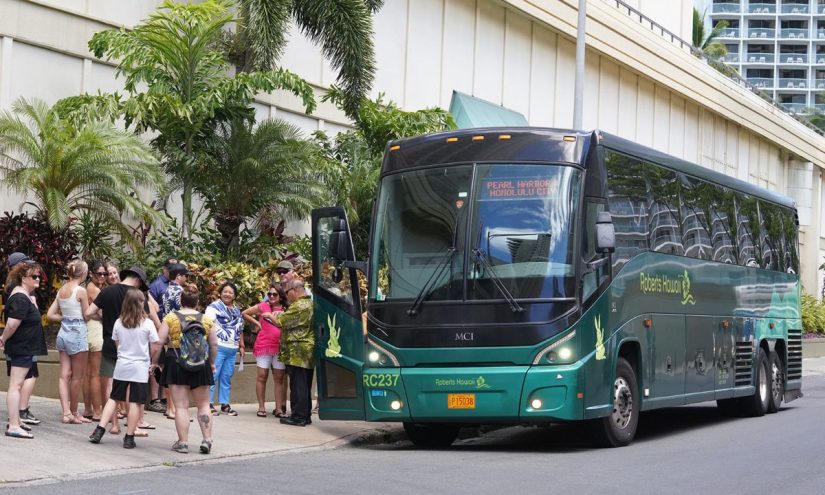
    The number of bus drivers serving Hawaiʻi schools has reached its highest point in four years, but the Department of Education is still falling short of meeting families’ transportation needs.

    This year, 545 bus drivers are serving Hawaiʻi schools, up from 436 last fall, according to recent datafrom the DOE. The department is still short 130 drivers, who are primarily provided through the bus companies Ground Transport Inc. and Roberts Hawaiʻi.

    The department sparked widespread criticism from parents and lawmakers last August when it abruptly cancelled over 100 bus routes for students days before the new school year. To avoid severe shortages this year, DOE consolidated some bus routes with low ridership and launched a new carpooling initiative for parents, according to a recent memo from Deputy Superintendent Jesse Souki. 

    Last year, nearly half of Hawaiʻi students didn’t qualify for bus transportation because they lived within walking distance to their local schools or received a geographic exception to attend a campus outside of their neighborhood. This fall, nearly 13% of students rely on the bus services available to regular education students, down from roughly 16% in the 2023-24 academic year

    Special education students receive their own bus services that are required under federal law. 

    Demand for bus drivers has fallen over the past two years, with DOE contracting for 694 drivers in 2023, compared to 675 this fall. Bus companies were better able to keep up with DOE’s demands before the Covid-19 pandemic, and the state was only short 28 drivers in 2019.

    Despite the decline in DOE’s need for drivers, the costs of transporting kids has increased over the past several years. Last school year, the department spent a total of $76 million in state and federal funds on student transportation, compared to $60 million in 2022.

    To reduce families’ reliance on buses, the department has offered free city bus passes to middle and high school students on Oʻahu and Kauaʻi. In the first quarter of the school year, roughly 6,200 Oʻahu students and 99 Kauaʻi students took advantage of the bus passes, according to the DOE, with the majority of participants from Oʻahu schools.

    Maui and Hawaiʻi County already offer free bus services to students.

    This fall, DOE also introduced a carpool pilot program, which allows parents in the Mililani and Kekaulike complexes to connect with nearby families who can transport their kids between school and home.

    Only 3% of families in the complexes have registered for the program, according to the DOE.

    The department will give more updates on student transportation during Thursday’s Board of Education meeting.


    Did you use this article in your work?

    We’d love to hear how The 74’s reporting is helping educators, researchers, and policymakers. Tell us how

    Source link

  • Kamehameha Schools’ Admission Policies May Face Legal Challenge – The 74

    Kamehameha Schools’ Admission Policies May Face Legal Challenge – The 74


    Get stories like this delivered straight to your inbox. Sign up for The 74 Newsletter

    A conservative mainland group whose lawsuit against Harvard University ended affirmative action in college admissions is now building support in Hawaiʻi to take on Kamehameha Schools’ policies that give preference to Native Hawaiian students.

    Students for Fair Admissions, based in Virginia, recently launched the website KamehamehaNotFair.org. It says that the admission preference “is so strong that it is essentially impossible for a non-Native Hawaiian student to be admitted to Kamehameha.”

    “We believe that focus on ancestry, rather than merit or need, is neither fair nor legal, and we are committed to ending Kamehameha’s unlawful admissions policies in court,” the website says.

    Kamehameha’s Board of Trustees and CEO Jack Wong said in a written statement that the school expected the policy would be challenged. The institution — a private school established through the estate of Princess Bernice Pauahi Bishop to educate Hawaiians — successfully defended its admission policy in a series of lawsuits in the early 2000s. The trustees and Wong promised to do so again.

    “We are confident that our policy aligns with established law, and we will prevail,” the statement said.

    The campaign also drew criticism from the Office of Hawaiian Affairs, established in the late 1970s for the betterment of Native Hawaiians. OHA’s Board of Trustees called it an “attack on the right of Native Hawaiians to care for our own, on our own terms.”

    “These attacks are not new — but they are escalating,” the trustees said in a written statement. “They aim to dismantle the hard-won protections that enable our people to heal, rise, and chart our future.”

    Several groups have tried and failed in the past to overturn Kamehameha’s admissions policy. Federal courts, siding with Kamehameha, have ruled that giving preference to Native Hawaiians helps alleviate historical injustices they faced after the overthrow of the Hawaiian Kingdom in 1893.

    In the 2006 decision upholding Kamehameha Schools’ admissions policy, a 9th Circuit Court of Appeals panel pointed to longstanding challenges Native Hawaiian students have faced in schools. 

    “It is clear that a manifest imbalance exists in the K-12 educational arena in the state of Hawaiʻi, with Native Hawaiians falling at the bottom of the spectrum in almost all areas of educational progress and success,” Judge Susan Graber wrote in the majority opinion. 

    These disparities persist. Just over a third of Native Hawaiian students in public schools were proficient in reading in 2024, compared to 52% of students statewide. Less than a quarter of Native Hawaiian students were proficient in math.

    The state education department has also fallen short of providing families with adequate access to Hawaiian language immersion programs, according to two lawsuits filed against the department this summer. The Hawaiian immersion programs are open to all students, not just those of Hawaiian ancestry.  

    Moses Haia III, a lawyer and former director of the Native Hawaiian Legal Corp., said that improving outcomes for Hawaiian students is Kamehameha’s primary reason for existing. He said this new challenge appears to be based on ignorance of Hawaiʻi’s history.

    “Ultimately, what I see is these people being uneducated,” Haia said of the mainland group. “Not knowing the history of Hawaiʻi, not knowing the reasons for Kamehameha’s existence, and just once again trying to push Hawaiians into this box… and wanting to be on top.”

    Past Challenges 

    The U.S. Supreme Court ruled in 1976 that private schools can’t discriminate based on race in a case called Runyon v. McCrary, which involved Black school students trying to gain admission to private schools that had yet to integrate non-white students.

    An anonymous student sued Kamehameha in 2003, invoking the 1976 ruling and alleging that the school’s policy of giving preference to Hawaiian children was discriminatory. The case eventually landed in the 9th U.S. Circuit Court of Appeals.

    A majority of the appeals court judges sided with Kamehameha. They used a part of the Civil Rights Act that prohibits discrimination in the workplace as a legal framework for looking at the admissions policy.

    Judge Graber wrote that a preference for Native Hawaiian students “serves a legitimate remedial purpose by addressing the socioeconomic and educational disadvantages facing Native Hawaiians, producing Native Hawaiian leadership for community involvement, and revitalizing Native Hawaiian culture, thereby remedying current manifest imbalances resulting from the influx of western civilization.”

    But it was a narrow victory for Kamehameha, an 8-to-7 vote. Dissenting judges wrote that admitting mostly Hawaiian students didn’t create a diverse student body; others said that the policy was clearly discriminatory.

    The anonymous student appealed to the U.S. Supreme Court. But Kamehameha entered a $7 million settlement with the student and their mother before the court decided whether to take up the case.

    While the settlement safeguarded the admission policy from a ruling by the nation’s highest court it also meant lawyers punted the issue.

    Another group of anonymous students challenged the admissions policy a few years later and again took that case to the Supreme Court. But the court declined to take up that case in 2011.

    Students for Fair Admissions previously brought two landmark cases against Harvard and the University of North Carolina, arguing that the two schools’ race-conscious admissions policies discriminated against Asian American and white applicants. The Supreme Court ruled in 2023 that colleges cannot use race as a factor in their admissions, although the decision didn’t specify what this could mean for K-12 schools.

    Last fall, the number of Black students enrolled at both universities fell, although some researchers cautioned that colleges might not see the full impact of the Supreme Court ruling until a few admissions cycles have passed. 

    The challenge to Kamehameha Schools’ admissions policies comes amid national pushback on efforts to promote diversity in schools. In February, the U.S. Department of Education said any colleges and K-12 schools using race-based practices in hiring and admissions could lose federal funding, although a court subsequently prevented the department from enforcing those requirements. 

    Kamehameha receives no funding from the federal government, according to its tax filings. The school, which is the state’s largest private landowner, has assets valued at about $15 billion.

    This story was originally published on Honolulu Civil Beat.


    Get stories like these delivered straight to your inbox. Sign up for The 74 Newsletter

    Source link

  • Hawaiʻi Is Increasingly Relying On Unlicensed Teachers To Fill Vacancies – The 74

    Hawaiʻi Is Increasingly Relying On Unlicensed Teachers To Fill Vacancies – The 74


    Get stories like this delivered straight to your inbox. Sign up for The 74 Newsletter

    As students returned to class earlier this month, Hawaiʻi schools reported the lowest number of teacher vacancies the state has seen in more than five years. As of last week, only 73 teacher positions were unfilled, compared to more than 1,000 in the aftermath of the Covid-19 pandemic.

    But schools are employing a growing number of unlicensed teachers, also known as emergency hires, to fill those vacancies. Last August, Hawaiʻi schools started the year with 670 emergency hires, an 80% increase from four years ago. 

    Emergency hires can work in schools for up to three years but must make progress toward earning their licenses. 

    The recent increase in emergency hires partly stems from state efforts to put more teachers in classrooms, including increasing pay for unlicensed educators in 2023. But while research shows that emergency hires tend to have higher retention rates, they may also be less effective than licensed teachers, who typically have more training and classroom experience.

    While the Hawaiʻi teacher licensing board tracks emergency hires in schools, it doesn’t publish regular data on how many of these teachers go on to earn their teacher licenses and continue working in public schools here.    

    Even so, principals and researchers say hiring unlicensed teachers is better than leaving positions vacant, which can leave schools scrambling for substitutes. The state has also explored other options to recruit and retain educators, like raising teacher pay and bringing in workers from the Philippines, but some solutions may only be temporary. 

    “There’s a united front to attract qualified educators that are already certified,” said Chris Sanita, principal at Hāna High and Elementary. “I think it’s a larger state issue on housing and affordability.” 

    A Growing Population

    In 2018, Brandon Galarita began teaching at Ke’elikōlani Middle School as an emergency hire, hoping to build on his experience as a substitute teacher and use his college degree in English. While the pay was low, Galarita said, working full-time as an emergency hire allowed him to earn a living while also completing the requirements for a teacher license. 

    “At least it starts building a teacher if they want to go into education,” said Galarita, who earned his license from the University of Hawaiʻi Mānoa in 2020. “I would hope that the influx of emergency hires will result in more teachers that are staying in the profession.” 

    University of Hawaiʻi Mānoa’s College of Education offers a program that helps cover the costs of tuition and fees for residents pursuing their teacher’s license. (Kevin Fujii/Civil Beat/2024)

    Osa Tui Jr., president of the state teachers’ union, said he attributes the big jump in emergency hires to the pay raise they received two years ago. Currently, emergency hires earn about $50,300 a year, compared to $38,500 previously. 

    “These numbers reflect exactly what we were hoping to accomplish,” Tui said. 

    The state has encouraged prospective educators, including emergency hires, to earn their licenses through the Grow Our Own initiative at UH Mānoa, which helps cover the costs of tuition for teacher preparation programs. Teachers who complete the program and earn their licenses must work in public schools for at least three years. 

    Emergency hire numbers don’t always reflect teachers’ progress toward earning their licenses, said Waiʻanae Intermediate School Principal John Wataoka. While he has around 11 emergency hires on staff this year, only one of the teachers has yet to complete a teacher preparation program.

    The rest have finished their training but are waiting to take a licensing exam or haven’t received the results of their final tests yet, Wataoka said. 

    “Right now, it’s just a waiting game,” he said. 

    But a recent study of emergency hires entering Massachusetts schools during the pandemic suggests that unlicensed teachers may be less effective than other educators. Students taught by emergency hires tended to have lower math and science test scores compared to their peers, according to research from the National Center for Analysis of Longitudinal Data in Education Research. 

    Jonathon Medeiros, a teacher at Kauaʻi High School and vice president of the Hawaiʻi Education Association, said he understands parents’ possible concerns about emergency hires and the quality of education students are receiving. But it’s still preferable to have an emergency hire in a classroom than a substitute — or nobody at all.

    In the past, Medeiros said, students were occasionally sent to the library or cafeteria for study hall when there weren’t enough educators to teach every class and the state faced a shortage of substitute teachers. 

    Unlike emergency hires, DOE doesn’t require substitute teachers to have a college degree.   

    “We all want skilled, caring, talented teachers who are from the community and committed to their schools,” Medeiros said. “How do we make sure we get those people in every single classroom is the key question.”

    Expanding The Pool

    While the boost in emergency hire pay has attracted more teachers to public schools, the state is still searching for other solutions to increase the hiring pool. 

    At Waiʻanae Intermediate, Wataoka said he’s hired seven international teachers to fill staff positions over the past two years. The J-1 visa program, which DOE has participated in since 2019, allows teachers from other countries, primarily the Philippines, to teach in the state for up to five years. 

    This year, the department hired around 100 new teachers through the visa program, Superintendent Keith Hayashi said in a Board of Education meeting earlier this month. International teachers’ interest in working in Hawaiʻi is comparable to past years, he said, despite concerns that participation could drop after Immigration Customs and Enforcement agents raided the shared Maui home of teachers from the Philippines last spring. 

    On Maui, Sanita said he’s also seeing the impact of the bonuses introduced for teachers in hard-to-fill positions five years ago. While it’s difficult to attract people to Hāna — a town with limited housing and no stop signs – the $8,000 bonus for remote schools helps retain teachers who would otherwise struggle with the high cost of living, Sanita said.   

    “The differentials have really helped people, our teachers in Hana, not to have five different side hustles,” Sanita said. “They can actually teach and make ends meet.” 

    The bonuses have also incentivized teachers to remain at Waiʻanae Intermediate even when they face long commutes from other parts of the island, Wataoka said. While the Leeward Coast has the greatest concentration of new teachers in the state, the $8,000 bonus has helped experienced teachers cover the cost of gas to West Oʻahu and remain at Waiʻanae Intermediate.

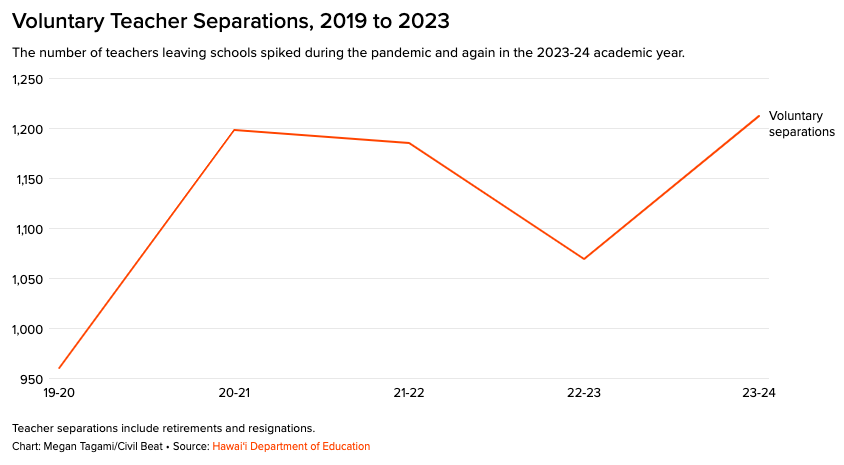
    But despite more retention measures in place, the department saw a jump in the number of teachers leaving schools last year. Over 1,200 teachers voluntarily resigned or retired from DOE in the 2023-24 school year, compared to roughly 1,000 the year before.

    Tui said there’s no single answer as to why the number of teachers leaving schools jumped. In some cases, teachers may have felt more comfortable changing jobs after the pandemic as they faced less uncertainty in the job market, he said. 

    This year, educators continuing to work in public schools will receive a 3% pay raise, with some veteran teachers receiving a larger raise of around 7%. While the pay increase will encourage teachers to stay in schools longer, Tui said, it’s possible the state will see a wave of educators retiring after three years as they qualify for higher state pensions. 

    For teachers hired before 2012, the state uses their three highest years of pay to determine their pensions. 

    “We have to make sure that we can get people into the profession that we can recruit to handle a drop off like that,” Tui said. 

    Civil Beat’s education reporting is supported by a grant from Chamberlin Family Philanthropy.


    Get stories like these delivered straight to your inbox. Sign up for The 74 Newsletter

    Source link

  • No One Will Say Why School Lunch Costs Hawaii DOE $9 A Plate – The 74

    No One Will Say Why School Lunch Costs Hawaii DOE $9 A Plate – The 74


    Get stories like this delivered straight to your inbox. Sign up for The 74 Newsletter

    In January, the Department of Education released a shocking number: it now costs nearly $9 to produce a school lunch in Hawaiʻi. Lawmakers and advocates — after they recovered from the sticker shock — responded with a reasonable question: Why are school meals so expensive? 

    Eight months later, the public still doesn’t have an answer. Despite pressure from lawmakers, the department has yet to publish detailed information about why it costs so much to feed students. 

    The department doesn’t share — and may not even collect — campus-level data on how much individual schools are spending on meals. It has provided no breakdown of how much the state spends on items like milk or fresh produce that go into lunches.

    But lawmakers say schools need to explain what’s driving up the costs, especially since the DOE is struggling to make ends meet with its lunch program and has requested an additional $40 million from the Legislature over the past two years on top of the state and federal funds it already receives for its meal program.

    Hawaiʻi law requires the education department to charge families half the cost of producing school meals, although current lunch prices fall far below that threshold. In January, the DOE proposed gradually raising meal prices over the next four years, but state lawmakers stepped in with funds to avoid increasing costs for families.  

    Under the DOE’s proposal, lunch for elementary and middle school students would cost $4.75 by 2028. High schoolers would pay $5 for meals. 

    Breaking Down The Numbers 

    The DOE serves more than 18 million meals every year to students across 258 campuses. This spring, lawmakers set aside roughly $50 million to fund the school meal program over the next two years. 

    The department publishes quarterly financial reports for its food services branch, but the online reports only track the total amount of money coming in and out of the meals program. Through the third quarterof the 2024-25 school year, the program brought in $108 million in student payments and state and federal funds, but spent roughly $123 million on meals, salaries and other expenses.

    In response to a Civil Beat public records request for school and state-level spending on lunches this spring, a representative from the superintendent’s office shared a one-page financial report breaking down the meal program’s spending and revenue in more detail. Roughly 40% of the 2023-24 budget went toward the salaries and benefits of workers, and the department spent roughly $81 million on food. 

    But there was little information explaining what goes into a $9 school meal — for example, how much the department spent on specific ingredients or juice, or what cafeteria supplies cost the department more than $5.6 million in 2024. The department provides more detailed estimates of its purchase of local ingredients in its annual report to the Legislature, but this spending makes up only 5% of the school meal budget.

    In response to Civil Beat’s request, the DOE also said it didn’t have records of schools’ annual financial reports for campus meal programs. The department did not respond to requests for interviews about the availability of school meal data and the rising costs of lunches.

    Jesse Cooke, vice president of investments and analytics at Ulupono Initiative, said he’s concerned about a lack of consistent tracking and reporting from schools. He said he hasn’t seen any data breaking down the costs of meal programs at individual schools on a regular basis, which makes it harder for the department and lawmakers to identify what’s driving up the costs of meals and understand how programs can operate more efficiently. 

    “When you’re trying to make decisions, trying to make something more efficient, you need pretty quick numbers,” Cooke said. “They’re not looking at specific schools and their numbers.”

    The education department has also come under fire from the federal government for its lack of data collection. When Hawaiʻi sought an increase in federal funds for school meals in 2015, officials denied the request because the department wasn’t able to provide enough details on the costs of its lunches, said Daniela Spoto, director of food equity at Hawaiʻi Appleseed Center for Law and Economic Justice. 

    “Historically, the only thing they could provide is what they provided here,” Spoto said. “Here’s our cost, and here’s the total number of meals we provide.” 

    Lawmakers passed two resolutions this spring asking the department to produce a detailed breakdown of its meal programs, including the cost of ingredients, beverages and supplies. The DOE currently has no process of reporting and publishing such costs, the resolutions stated.

    “It is essential to ensure that proper reporting processes are in place to provide transparency as to the costs of producing school meals,” one resolution said. 

    DOE leaders argued they publish enough information to justify rising lunch costs, but they’ve given lawmakers mixed messages on the data that’s readily available. 

    In one hearing, Interim School Food Services Branch Administrator Sue Kirchstein said the DOE already collects and publishes data on the costs of ingredients and other factors going into school meals. But another official said the DOE doesn’t collect data with the level of detail lawmakers were requesting, and the department’s communications team was unable to provide the report Kirchstein mentioned during the hearing. 

    Besides looking at rising inflation rates, the department hadn’t completed a detailed analysis of what’s increasing the costs of meals, former Deputy Superintendent Dean Uchida said in another hearing this spring, drawing strong criticism from lawmakers. 

    “You should be looking at it, and maybe there’s a different way that you can do things,” Sen. Troy Hashimoto said during the hearing. “But you won’t know that unless you do the analysis.” 

    The department has not said if it’s working on a cost analysis for the Legislature. Any report DOE submits to lawmakers won’t be published until late 2025 or early 2026 in the lead-up to the new legislative session. 


    Get stories like these delivered straight to your inbox. Sign up for The 74 Newsletter

    Source link

  • Hawaiʻi’s Working Families Need More Support – The 74

    Hawaiʻi’s Working Families Need More Support – The 74


    Get stories like this delivered straight to your inbox. Sign up for The 74 Newsletter

    Sarah Osofsky returned to school last year to earn her master’s degree in social work, hoping to give back to her community and find a job that would pay enough to survive Hawaiʻi’s high cost of living.

    Now, less than two weeks away from graduation, the mother of two is struggling to find a position that can sustain her family.

    Most social work jobs she’s seen in recent months offer salaries of $60,000 or less — enough to disqualify her from safety net programs like food stamps, but not enough to comfortably provide for her kids. She’s considered moving back to California where she has family who could support her, but she wants to stay in Hawaiʻi so her children can be near their dad.

    “What I’m balancing right now is, do I take a low, low paying job that then I’ll qualify for services like food stamps and Medicaid,” Osofsky said, “or do I hold out and try to find those few and far between really good jobs that will make enough so I don’t qualify but I don’t need it.”

    Osofsky’s struggle is a familiar one for working families in Hawaiʻi. In 2024, nearly 30% of Hawaiʻi households were living paycheck-to-paycheck and struggling to afford basic necessities like housing, child care and food, according to an annual count of the state’s ALICE families — an acronym for people who are asset limited, income constrained, and employed.

    Like Osofsky, roughly 40% of these families considered leaving the state over the past year, according to a study from Aloha United Way.

    While some reports indicate that more locals have been returning to Hawaiʻi in the last few years, the state’s high cost of living continues to drive some families away, straining the public education system and economy.

    Earlier this year, the Department of Education said its kindergarten enrollment dropped from 13,000 in 2019 to nearly 10,800 this year, citing estimates that 20% of people leaving Hawaiʻi are school-aged kids. The department is now starting the process of consolidating small schools, although it hasn’t yet identified which campuses are at risk of closure.

    A few years ago, state lawmakers grappling with the Covid-19 pandemic proposed a bold slate of reforms to improve the plight of working families: free school meals for all, universal access to preschool and paid family leave. But the state’s big plans for progress have resulted in incremental steps, and some families and advocates say change isn’t happening quickly enough.

    Lawmakers this session created a working group to study paid family leave but failed to turn the yearslong proposal into law. The state expanded eligibility for preschool tuition subsidies and funded preschool construction but failed to address the ongoing shortage of early learning educators. And Senate Bill 1300 — considered one of the biggest wins for students this year — expanded access to free school meals but stopped short of providing them for all kids.

    At the same time, uncertainty looms around the future of programs that rely on federal dollars to support working families, including school meals and early learning centers.

    Amid the upheaval, state lawmakers were hesitant to pass big spending measures this year, opting instead to set aside $200 million to help Hawaiʻi prepare for federal funding cuts. But some advocates say now is exactly the time for the state to make a bigger investment in families.

    “The state Legislature, and frankly, the counties, should be thinking, ‘Bad stuff is coming,’” said Deborah Zysman, executive director of Hawaiʻi Children’s Action Network. “We don’t quite know what yet, but we should be thinking about how to take care of our own people.”

    An Urgent Need For Child Care

    During the Covid-19 pandemic, Osofsky worried about the social development of her son, who was just turning 2 when lockdown restrictions began. But when he began attending the University of Hawaiʻi Mānoa Children’s Center later that year, Osofsky said, he received services for his speech delay and became comfortable making friends and recognizing letters.

    But paying for preschool was a challenge, Osofsky said. The Preschool Open Doors program provides a state subsidy to help cover tuition, but her son was ineligible when he started because the program only covered 4-year-olds at the time. The program expanded to include 3-year-olds last year.

    Hawaiʻi has pledged to offer preschool to all 3- and 4-year-olds by 2032. The Ready Keiki initiative, led by Lt. Gov. Sylvia Luke, currently estimates the state needs to add more than 330 classrooms in the next seven years to provide preschool to an additional 6,700 children.

    While lawmakers successfully expanded access to tuition subsidies and funded more preschool construction this year, progress toward the state’s ambitious goal has slowed on other fronts.

    One successful bill this session expands eligibility for preschool subsidies by including 2-year-olds and repealing the requirement that families must use the subsidy at a nationally accredited provider, which has created financial and administrative barriers for smaller programs in the past, Zysman said.

    But the Department of Human Services is on track to spend only $20 million of its $50 million budget for preschool subsidies this year, said Scott Morishige, administrator of the department’s Benefit, Employment and Support Services Division.

    To ramp up its spending, DHS is considering expanding the income eligibility to 500% of the federal poverty line. If DHS adopts the rules this summer, Morishige said, a family of four could make up to $184,000 annually and still be eligible for assistance, compared to the past income limit of $110,000.

    The state budget sets aside $20 million to build more public preschool classrooms over the next three years. The state plans on opening 25 public preschool classrooms this fall and an additional 25 classrooms the following year, far less than previous estimates that Hawaiʻi could build 40-50 classrooms annually.

    While the state would like to take a more aggressive approach to opening public preschool classrooms moving forward, Luke said, the Ready Keiki initiative is also relying on private providers and charter schools to help expand access. The state is starting larger construction projects, like standalone preschool centers, that could add seats more rapidly as they open in the next few years.

    “There is an urgency for us to open as many preschool seats as we can,” she said.

    But families’ demand for preschool could grow beyond what the state has anticipated if the federal government stops funding its own child care programs. Head Start, which relies on federal funding and serves roughly 2,800 children and pregnant mothers, is currently Hawaiʻi’s largest provider of early learning services, said Ryan Kusumoto, president and CEO of the nonprofit Parents And Children Together.

    The Trump administration has previously threatened to cut funding entirely for Head Start, although the most recent version of the federal budget keeps program funding intact. Some Hawaiʻi Head Start programs are still waiting to receive confirmation for next year’s funding, and the recent closure of some regional offices could create backlogs in awarding this money, said Ben Naki, president of the Head Start Association of Hawaiʻi.

    “There’s no existing infrastructure that can pick up those 2,800 kids,” Kusumoto said. “And we’re talking about kids who don’t have any other resources.”

    First Steps For Free Meals

    Since September, Christine Russo said paying for meals has become a greater challenge for her family as her twins joined her 10-year-old in attending school every day. She sets aside roughly $180 each month so her kids can purchase breakfast and lunch at school — a challenge for the public school teacher, whose husband is a retail store manager.

    Russo’s kids don’t qualify for free or reduced-price school meals, but she said her family could still benefit from the ongoing push to bring back a pandemic-era program that made meals free for all students.

    Lawmakers stopped short of funding a universal free meals program this year but took incremental steps by passing Senate Bill 1300. Starting next year, the state will provide free school meals to students who currently qualify for reduced-price lunch. The following year, eligibility for free school meals would be expanded to families making up to 300% of the federal poverty level, or roughly $110,000 for a family of four.

    The bill appropriates $565,000 to provide more free school meals next year and an additional $3.4 million for the program’s expansion the following year. More than 68,000 students in the Department of Education qualified for free meals this year, and 10,000 qualified for reduced-price meals.

    The bill also requires schools feed students who don’t have enough money to purchase lunch or already have meal debt. Students have accrued more than $105,000 in meal debt this school year, DOE communications director Nanea Ching said.

    At Castle High School, junior Tayli Kahoopii said she receives free meals, but some of her friends don’t qualify. When someone doesn’t have enough money in their account to purchase lunch, the register makes a buzzing sound — loud enough to embarrass students and, in one instance, deter Kahoopii’s friend from trying to purchase meals for a week.

    “On a daily basis, you see kids getting their food taken away, and there’s really nothing that they can do about it,” Kahoopii said, adding that it’s difficult for students to learn and focus when they don’t have access to food during the school day.

    Rep. Scot Matayoshi, who has introduced bills for the past three years proposing free school meals, said SB1300 is an important step. But he still plans on advocating for universal free school meals in the coming years, especially since it would reduce the administrative barriers schools and families face in determining who qualifies for free meals.

    Daniela Spoto, director of food equity at Hawaiʻi Appleseed, said providing all students with free school meals could also become more important with federal funding on the line. Proposed federal cuts to a program allowing schools in low-income areas to provide free meals to all children could impact 52 schools and more than 27,000 kids in Hawaiʻi, according to estimates from the Food Research and Action Center.

    “It should be a staple for our schools to have free school lunch,” said Castle junior Haliʻa Tom-Jardine, who will begin qualifying for free school meals next year. “It should be a right.”

    ‘Bad Things Are Coming’

    During the pandemic, people saw lawmakers step up and meet the needs of working families through federal initiatives like the child tax credit and free school meals, said Kayla Keehu-Alexander, vice president of community impact at Aloha United Way. Now, she said, state lawmakers need to do the same during times of uncertainty.

    “If we don’t start making some big policy changes around the cost of living, around housing, we could potentially be looking at a larger out-migration than we’ve had in the past,” she said.

    Hawaiʻi is already starting to see the possible impacts of out-migration on its schools and economy. While some people are coming back to Hawaiʻi to raise families, Keehu-Alexander said, it’s unclear if they’re joining the workforce in areas with the worst staffing shortages, like education or healthcare.

    Looking ahead to next year, Zysman said she would like to see a successful bill establishing paid family leave in Hawaiʻi, which would provide caregivers paid time off to care for their loved ones. Lawmakers have failed to pass a bill for several years, although they did approve a resolution last month establishing a working group that will study how to implement paid family leave over the next year.

    Zysman added that she’s concerned about the long-term impacts of the historic tax cut lawmakers passed last year. While she supports cuts that can make it more affordable for people to stay in Hawaiʻi, she said, she’s worried that tax breaks for the wealthiest will make it harder for the state to fund programs that can keep working families afloat.

    “In my gut, I feel like bad things are coming,” Zysman said, “and we should have acted more preemptively.”

    This story was originally published on Honolulu Civil Beat. Civil Beat’s education reporting is supported by a grant from Chamberlin Family Philanthropy.


    Get stories like these delivered straight to your inbox. Sign up for The 74 Newsletter
    Source link