Today’s middle schoolers continue to struggle post-pandemic to read and write at the level needed to successfully navigate more complex academic content in the upper grades and beyond, according to a new report from NWEA, a K-12 assessment and research organization.
Based on NWEA’s research, current 8th graders would need close to a full academic year of additional instruction to catch up to their pre-pandemic peers in reading. This trend was reiterated in recent assessment results from the National Assessment on Educational Progress (NAEP), with only 30 percent of eighth-grade students performing at or above the NAEP proficient level.
While early literacy initiatives have garnered attention in recent years, the fact remains that many students struggle to read and are not prepared for the rigors of middle school. Students quickly find themselves challenged to keep up as they no longer receive explicit, structured reading instruction, even as they are expected to comprehend increasingly complex materials across subjects, like science, history, or English Language Arts.
“Our current middle and high schoolers were just starting their literacy journey when the pandemic hit, and we cannot lessen the urgency to support them. But, middle school literacy is complex even for students who are reading on grade level. This demands intentional, well-funded, and focused policy leadership that includes support across the K-12 spectrum,” said Daughtery. “Simply put, learning to read is not done when a student exits elementary school; support cannot stop there either.”
Policymakers and district leaders must adopt a systems-level approach that supports both early learners and the unique literacy needs of middle and high school students.
The new report provides four components that can be leveraged to make this happen:
Use high-quality, grade-appropriate assessments that provide specific data on the literacy needs of middle schoolers.
Look at flexible scheduling and policies that promote literacy development throughout the entire school day and help districts more effectively use instructional time.
Understand and support the unique literacy needs of middle schoolers across subjects and disciplines from a systems perspective and invest in teacher professional learning in all disciplines, including at the upper grades, within state and district literacy plans.
Curate relationships with external partners, like community organizations and nonprofits, who share similar goals in improving literacy outcomes, and can both support and reinforce literacy development, stretching beyond the school’s hours and resources.
eSchool Media staff cover education technology in all its aspects–from legislation and litigation, to best practices, to lessons learned and new products. First published in March of 1998 as a monthly print and digital newspaper, eSchool Media provides the news and information necessary to help K-20 decision-makers successfully use technology and innovation to transform schools and colleges and achieve their educational goals.
NEW ORLEANS — Kapri Clark used the $50 to help pay for her braces. Lyrik Grant saved half of it, and used the rest for dance classes. Kevin Jackson said he squandered the cash on wings, ride shares for dates and some DJ equipment he later tossed.
For the past five years, Clark, Grant, Jackson and hundreds of high schoolers in New Orleans have shopped — or saved — as part of a project to explore what happens if you give cash directly to young people, no strings attached.
“That was the most helpful thing ever,” said Clark, now a student at the University of Louisiana at Lafayette, who said she could still use that extra cash.
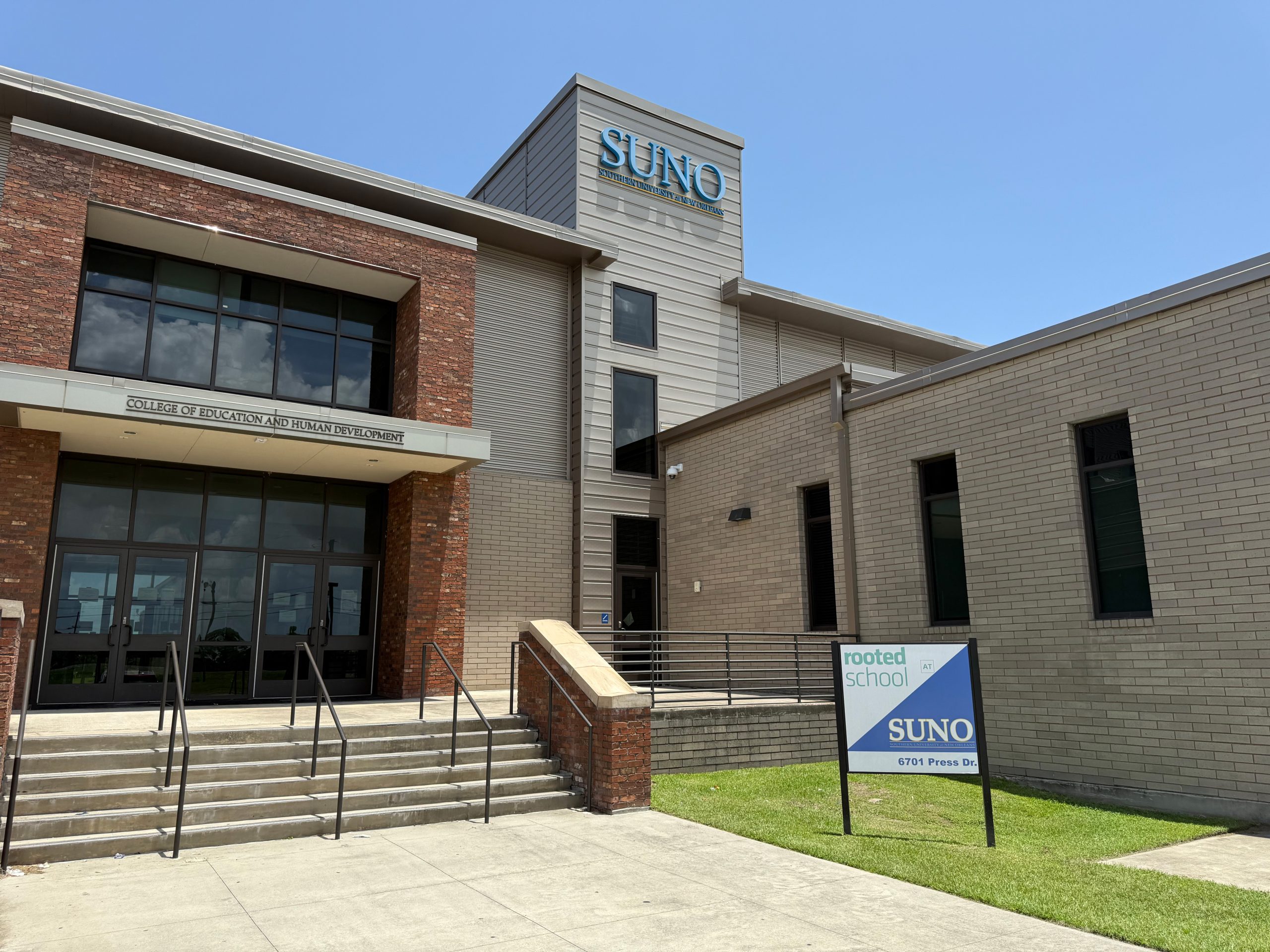
“The $50 study,” as it’s known, began at Rooted School, a local charter school, as an experiment to increase attendance. The study has since grown to eight other high schools in the city, as well as Rooted’s sister campus in Indianapolis, with students randomly selected to receive $50 every week for 40 weeks, or $2,000 total. By comparing their spending and savings habits to a larger control group, researchers wanted to figure out whether the money improved a teen’s financial capability and perception of themselves. They also wanted to know: Could the cash boost their grade-point averages and reading scores?
Now, as the experiment expands to Washington, D.C., and perhaps Texas, a final report of the $50 study suggests a little bit of spending cash can make a difference in young people’s lives.
The report, released Tuesday, shows students who received the cash payments were slightly more likely to attend school than those who didn’t. Academic performance did not differ between the groups. But financially, the extra cash helped students acquire stronger long-term planning skills and familiarity with savings accounts and other financial products. They ended the study, on average, with $300 saved away — a 15 percent savings rate, triple the national average for American adults.
“When young people are given the opportunity to manage money in low-stakes environments, they build the habits that shape long-term financial health,” said Stacia West, an associate professor at the University of Tennessee, Knoxville and co-founder of the Center for Guaranteed Income Research, which partnered with the Rooted School Foundation to run the study. “The short-term habits we’re seeing are laying the foundation for lifelong financial capability.”
Across the United States and the globe, hundreds of communities have tinkered with some form of universal basic income, or UBI, a social welfare program that provides people with regular cash payments to meet their needs. Direct cash transfer programs like the $50 study or the child tax credit for families are similar, but they often provide smaller amounts and target specific populations to boost a person’s income. Many studies have linked UBI to financial stability and better employment and health outcomes.
In the U.S. and Canada, researchers have found links between cash transfer pilots that focus on low-income families and better test scores and graduation rates for their kids. So far, though, few experiments have targeted young people or examined how the programs influence their lives specifically.
Talia Livneh, senior director of programs at the Rooted School in New Orleans, poses for a portrait on the school grounds. Credit: Daniella Zalcman for The Hechinger Report
“There’s a deep, deep distrust that we adults have of young people,” said Jonathan Johnson, CEO of the Rooted School Foundation, which operates the network’s four charter schools. “That distrust is to their detriment.”
In New Orleans, roughly 4 in 5 of Rooted students come from economically disadvantaged families, and during the pandemic, many struggled to prioritize school. Some students skipped class to provide child care for their working parents, or because they needed to work themselves, according to Johnson. With some seed funding from a local education nonprofit, Rooted started a “micropilot” to test whether cash could help students make ends meet and get themselves to school.
The original cohort included 20 students, half of whom received the $50 payment. In that micropilot, those receiving the cash saw their material wellbeing improve, meaning their family could more easily afford rent or utilities, and they gained skills around setting financial goals. Rooted added students from its Indianapolis campus and another high school in New Orleans, G.W. Carver. And for their final report released this week, researchers sifted through the spending and survey data from 170 students who received the cash payments and 210 students who did not.
The two-year report found students in the treatment group attended 1.23 more days of school, and spent close to half their funds on essentials like food and groceries. The report also noted that 70 percent of all students at the participating schools qualify for subsidized meals, suggesting “this spending may reflect efforts to meet immediate nutritional needs.” One 12th grader in a survey mentioned using the money to feed their siblings.
Kapri Clark recalled waiting every Wednesday morning for the $50 deposit to appear in her banking app. And every Wednesday afternoon, during her senior year at Carver High School, she put that money toward her $200 bill for braces she covered out of pocket.
She braided hair to cover the rest, and still books clients when she has time in between her studies to become a nurse at the Lafayette campus. Even in college, Clark can see the need for some supplemental income for herself and her peers.
“I make enough to take care of myself, but I watch every dollar,” said Clark. “There’s a lot of people struggling in life to eat, to live. Think if they got kids.”
Read Irvin, chief of staff for Collegiate Academies in New Orleans, a network of five charter high schools that includes Carver High, said the $2,000 had provided the extra incentive a few students needed to stick it out until graduation. “That’s incredibly impactful for their life trajectories,” she said.
In January 2024, the city of New Orleans invested $1 million to bankroll another extension of the study, as part of an economic mobility initiative that tapped federal Covid relief funding. During the pandemic, a skyrocketing murder rate and spike in overall crime had convinced the city to help more residents, especially young people, find stability.
“Research shows that people who are economically stable are less likely to commit crime,” said Courtney Wong, the city’s deputy director of economic development.
The city funding not only expanded the $50 study to nine high schools, it also set a longer timeline for the research: About 800 seniors who participate will have their data tracked for 18 months after their graduation.
A former high school teacher and administrator, Wong said $50 could have made a difference in the lives of many of her former students.
“This targets young people in that perfect moment,” she said. “They’re in the right spot where even a little amount of help could have big, positive impacts before issues of crime or unemployment or things like that even come up.”
Researchers also found students who received the $50 reported greater agency. They felt more control over their finances and more confidence about making long-term financial decisions. Students, according to the report, aligned their spending to future goals such as college prep classes and getting a driver’s license.
Lyrik Grant, a rising junior at Carver High School, is the second-youngest of six kids with two working parents. She could ask them for help, but the $50 allowed Grant to afford the tights and tops she needed for dance class on her own. The money helped cover a college entrance exam, which she aced, and Grant wants to learn how to drive soon.
“My first thought was: What am I going to do with all this money?” Grant said, adding that the cash helped some of her classmates find financial stability. “Children don’t always want to spend their parent’s money, and some parents don’t always have money to give them.”
Still, for some students, the money wasn’t exactly life-changing. Irvin of Collegiate Academies said many used the cash to “just be teenagers.”
That was true for Kevin Jackson, a rising junior at Rooted School New Orleans.
“It’s cool to get free money,” he said. “I was spending it on the TikTok shop: posters, keyboards, lights — stuff I liked, not stuff I actually needed.”
Despite the studies that show a positive impact from UBI, many Americans appear skeptical of the idea of a federal program that gives unconditional financial support to people. Aditi Vasan, a pediatrician and researcher at PolicyLab at the Children’s Hospital of Philadelphia, said skeptics often worry about recipients using public dollars for drug use or other illicit behavior, even though the data does not support that.
Still, that fear will likely keep any large-scale cash transfer program from being adopted in the United States any time soon, she said.
“That concern exists certainly for cash transfers in general but might be particularly magnified for teens,” Vasan said. “We’ve not seen that play out in the evidence from the quality studies that have been done.”
Next year, in Washington, D.C., the nonprofit Education Forward will fund a pilot of the $50 study with 40 high schoolers. The Rooted school network resumed talks, meanwhile, to take the study to neighboring Texas, after state lawmakers earlier this year failed to pass legislation that threatened to ban local governments from adopting guaranteed income programs.
Talia Livneh, senior director of programs for the Rooted School Foundation, said the politics may need to catch up to the research.
“I don’t think what we’re doing is so radical. I believe this just works,” she said. “Kids don’t lack character. They lack cash,” Livneh added. “They deserve deep, deep trust that students and people know what’s best for them.”
It’s been four years since Vernell Cheneau III received the $50 for 40 weeks while a student at Rooted in New Orleans, and his economic life isn’t easy. He struggled for months to find part-time work in his hometown. But on a recent summer morning, the same day he finally received a job offer, Cheneau recalled what he learned from the study.
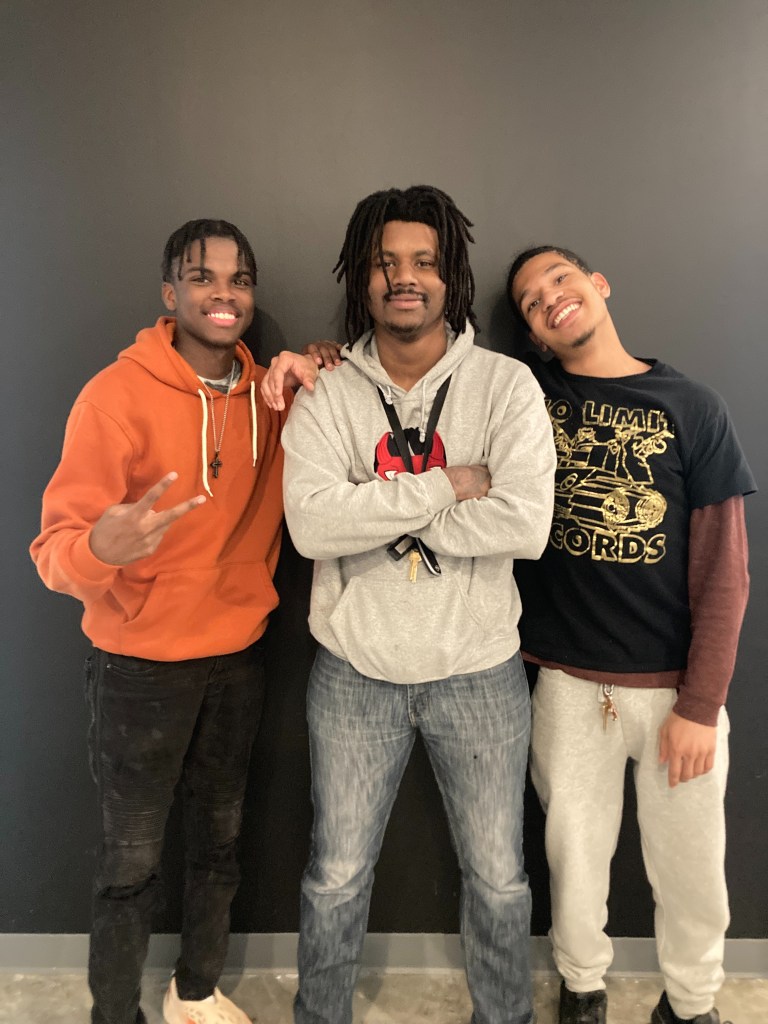
Vernell Cheneau III (left) with two other students who participated in the cash transfer program at Rooted School, in New Orleans. Credit: Courtesy of Rooted School
“You learn that money goes fast, especially if it’s free,” said Cheneau, 22.
As a student, he tried to use the money to build some credit history. Since then, he’s learned the full cost of being an adult in America: health care, fuel and maintenance for his car, getting your hair done before a new job. Cheneau has also spent that time trying to convince friends and family to support UBI.
Most oppose giving “free” money to people, he said. “How much does it cost to feed children? Get to work? We can’t just allow people to drown.”
“Everything costs something,” Cheneau added. “If you’re stuck in a rut, it’s expensive to restart. In this country, it’s expensive to be poor.”
Contact staff writer Neal Morton at 212-678-8247, on Signal at nealmorton.99, or via email at [email protected].
The Hechinger Report provides in-depth, fact-based, unbiased reporting on education that is free to all readers. But that doesn’t mean it’s free to produce. Our work keeps educators and the public informed about pressing issues at schools and on campuses throughout the country. We tell the whole story, even when the details are inconvenient. Help us keep doing that.
Students need more support around education paths and career options, including hands-on experiences, according to a new nationwide survey from the nonprofit American Student Assistance.
The survey of more than of 3,000 students in grades 7-12 offers insights into teens’ plans after high school. The research, Next Steps: An Analysis of Teens’ Post-High School Plans, uncovers evolving trends in teenagers’ attitudes, perceptions, and decision-making about their post-high school plans.
“This analysis of teens’ post high school plans reveals shifts in students’ thinking and planning. We need to change the way we help young people navigate the complex and evolving landscape of education and career options,” said Julie Lammers, Executive Vice President of ASA. “Starting in middle school, our young people need early access to opportunities that empowers them to explore careers that match their interests and strengths; hands-on, skills-based experiences in high school; and information and resources to navigate their path to postsecondary education and career. All of this will enable them to graduate informed, confident, and empowered about what they want to do with their futures.”
The survey offers notable findings regarding parental influence on teens’ planning, perceptions of nondegree pathways like trade or technical school, apprenticeships, and certificate programs, and a continued drop-off in kids’ plans to go to college immediately after high school graduation.
Key findings include:
Teens’ interest in college is down while nondegree paths are on the rise. Nearly half of all students said they aren’t interested in going to college, with just 45 percent saying two- or four-year college was their most likely next step. Meanwhile 38 percent of teens said they were considering trade or technical schools, apprenticeships, and technical bootcamp programs, although only 14 percent say that such a path is their most likely next step.
Parents are one of teens’ biggest influencers—and they’re skeptical of nondegree options. A vast majority (82 percent) of teens said their parents agree with their plans to go to four-year college, while only 66 percent said parents supported plans to pursue a nondegree route. In fact, teens reported parents were actually more supportive (70 percent) of foregoing education altogether right after high school vs. pursuing a nondegree program.
A concerning number of young people don’t have plans for further education or training. Nearly one quarter (23 percent) said they have no immediate plans to continue formal education or training upon graduation. Teens not planning to continue education after high school indicated they were thinking of beginning full-time work, entering a family business, starting their own business, or joining the military.
Teens, and especially middle schoolers, are feeling better prepared to plan their futures. In recent years policymakers, educators, employers, and other stakeholders have pushed to make career-connected learning a more prominent feature of our education to workforce system. Survey results say it’s paying off. Agreement with the statement “my school provides me with the right resources to plan for my next steps after high school” grew from just 59 percent in 2018, to 63 percent in 2021, to 82 percent in 2024. Notably, the largest increase occurred at the middle school level, where confidence in in-school planning resources jumped from 60 percent in 2018 to 90 percent in 2024.
Girls are much more likely to plan to attend college than boys. Boys and girls are equally interested in college when they’re in middle school, but by high school, more than half (53 percent) of girls say they’re likely to attend college compared to just 39 percent of boys. The gender gap is smaller when it comes to nondegree pathways: 15 percent of high school boys say they will likely attend vocational/trade school, participate in an apprenticeship, or take a certificate program, compared to 10 percent of high school girls.
City kids aren’t as “into” college. Urban teens were least likely (39 percent) to say they plan to go to college. Suburban teens are much more likely to plan to attend a college program (64 percent) while 46 percent of rural students planned on college.
Students of color are college bound. More than half (54 percent) of Black teens and 51 percent of Hispanic youth are planning to go to college, compared to 42 percent of White teens.
eSchool Media staff cover education technology in all its aspects–from legislation and litigation, to best practices, to lessons learned and new products. First published in March of 1998 as a monthly print and digital newspaper, eSchool Media provides the news and information necessary to help K-20 decision-makers successfully use technology and innovation to transform schools and colleges and achieve their educational goals.
DES MOINES, Iowa — Macon Smith stood in front of a nearly empty classroom 1,000 miles from home. He asked his opponent and the two judges in the room if they were ready to start, then he set a six-minute timer and took a deep breath.
“When tyranny becomes law, rebellion becomes duty,” he began.
In front of Macon, a 17-year-old high school junior, was a daunting task: to outline and defend the argument that violent revolution is a just response to political oppression.
In a few hours, Macon would stand in another classroom with new judges and a different opponent. He would break apart his entire argument and undo everything he had just said.
“An eye for an eye makes the whole world blind,” Macon started.
It doesn’t really matter what opinion Macon holds on violence or political oppression. In this moment in front of the judges, he believes what he’s saying. His job is to get the judges to believe with him.
Macon was one of more than 7,000 middle and high school students to compete in the National Speech and Debate Tournament this summer in Iowa, run by an organization that is celebrating a century in existence.
In that time, the National Speech and Debate Association has persevered through economic and social upheaval. It is entering its next era, one in which the very notion of engaging in informed and respectful debate seems impossible. The organizers of this event see the activity as even more important in a fracturing society.
“I don’t think there’s an activity in the world that develops empathy and listening skills like speech and debate,” said Scott Wunn, the organization’s president. “We’re continuing to create better citizens.”
Macon Smith, a rising senior from Bob Jones Academy in South Carolina, competes in the third round of the Lincoln-Douglas Debate at the National Speech and Debate Tournament in Iowa this summer. Credit: Meenakshi Van Zee for The Hechinger Report
Though the tournament is held in different cities around the country, for the 100th anniversary, the organizers chose to host it in Des Moines, where the association’s headquarters is based.
Preparing for this competition was a year in the making for Macon, who will be a senior at Bob Jones Academy, a Christian school in Greenville, South Carolina, this fall. Students here compete in more than two dozen categories, such as Original Oratory, in which they write and recite their own 10-minute speeches, or Big Questions, where they attempt to argue broad, philosophical ideas.
Macon’s specialty, the Lincoln-Douglas Debate, is modeled after a series of public, three-hour debates between Abraham Lincoln and Sen. Stephen Douglas in 1858. In this event, two students have just 40 minutes to set up their arguments, cross-examine each other and sway the judges.
“Even if I don’t personally believe it, I can still look at the facts and determine, OK, this is a good fact, or it’s true, and argue for that side,” Macon said.
Debaters often have to tackle topics that are difficult, controversial and timely: Students in 1927 debated whether there was a need for a federal Department of Education. In 1987, they argued about mandatory AIDS testing. In 2004, they debated whether the United States was losing the war on terror. This year, in the Public Forum division, students debated whether the benefits of presidential executive orders outweigh the harms.
While the speech and debate students practiced for their national event, adults running the country screamed over each other during a congressional hearing on state sanctuary policies. A senator was thrown to the floor and handcuffed during a press conference on sending the National Guard to immigration enforcement protests in Los Angeles. Most Americans feel political discourse is moving in the wrong direction — both conservatives and progressives say talking politics with someone they disagree with has become increasingly stressful and frustrating.
Speech and debate club, though, is different.
“First of all, it gives a kid a place to speak out and have a voice,” said Gail Nicholas, who for 40 years has coached speech and debate at Bob Jones Academy alongside her husband, Chuck Nicholas, who is Macon’s coach. “But then also learn to talk to other people civilly, and I think that’s not what’s being modeled out there in the real world right now.”
Macon Smith, a rising senior from Bob Jones Academy in South Carolina, shows off the notes that he took during debates at the National Speech and Debate Tournament in Iowa. Credit: Meenakshi Van Zee for The Hechinger Report
On the second day of the competition in a school cafeteria in West Des Moines, Macon was anxiously refreshing the webpage that would show the results of his rounds to learn whether he would advance to semifinals.
For most of the school year, Macon spent two days a week practicing after school, researching and writing out his arguments. Like many competitors, he has found that it’s easy to make snap judgments when you don’t know much about an issue. Decisively defending that view, to yourself and to others, is much harder.
“I tend to go in with an opinion and lose my opinion as the topic goes on,” said Daphne DiFrancesco, a rising senior from Cary Academy in Cary, North Carolina.
Traveling for regional events throughout the school year means Macon has become friends with students who don’t always share his conservative views. He knows this because in debate, discussing politics and religion is almost unavoidable.
“It doesn’t make me uncomfortable at all,” Macon said. “You don’t want to burn down a bridge before you make it with other people. If you stop your connection with a person right at their political beliefs, you’re already cutting off half of the country. That’s not a good way to conduct yourself.”
Macon, and other students in the clubs, said participating has made them think more deeply about their own beliefs. Last year, Macon debated a bill that would defund Immigration and Customs Enforcement, an agency he supports. After listening to other students, he developed a more nuanced view of the organization.
“When you look at the principle of enforcing illegal immigration, that can still be upheld, but the agency that does so itself is flawed,” he said.
Henry Dieringer, a senior from L.C. Anderson High School in Austin, Texas, went into one competition thinking he would argue in favor of a bill that would provide work permits for immigrants, which he agrees with. Further research led him to oppose the idea of creating a federal database on immigrants.
“It made me think more about the way that public policy is so much more nuanced than what we believe,” Henry said.
On the afternoon of the second day of the national tournament, Macon learned he didn’t advance to the next round. What’s sad, he said, is he probably won’t have to think this hard about the justness of violent revolution ever again.
“There’s always next year,” Macon said.
Callista Martin, 16, a rising senior from Bainbridge High School in Washington state, also didn’t make the semifinals. Callista and Macon met online this year through speech and debate so they could scrimmage with someone they hadn’t practiced with before. It gave them the chance to debate someone with differing political views and argument styles.
Macon Smith, a rising senior from Bob Jones Academy in South Carolina, takes notes during a round of the Lincoln-Douglas Debate at the National Speech and Debate Tournament in Iowa. Credit: Meenakshi Van Zee for The Hechinger Report
“In the rounds, I’m an entirely different person. I’m pretty aggressive, my voice turns kind of mean,” Callista said. “But outside of the rounds, I always make sure to say hi to them before and after and say things I liked about their case, ask them about their school.”
Talking to her peers outside of rounds is perhaps the most important part of being in the club, Callista said. This summer, she will travel to meet with some of her closest friends, people she met at debate camps and tournaments in Washington.
Since Callista fell in love with speech and debate as a freshman, she has devoted herself to keeping it alive at her school. No teacher has volunteered to be a coach for the debate club, so the 16-year-old is coaching both her classmates and herself.
A lack of coaches is a common problem. Just under 3,800 public and private high schools and middle schools were members of the National Speech and Debate Association at the end of this past school year, just a fraction of the tens of thousands of secondary schools in the country. The organization would like to double its membership in the next five years.
That would mean recruiting more teachers to lead clubs, but neither educators nor schools are lining up to take on the responsibility, said David Yastremski, an English teacher at Ridge High School in New Jersey who has coached teams for about 30 years.
It’s a major time commitment for teachers to dedicate their evenings and weekends to the events with little supplemental pay or recognition. Also, it may seem like a risk to some teachers at a time when states such as Virginia and Louisiana have banned teachers from talking about what some call “divisive concepts,” to oversee a school activity where engaging with controversial topics is the point.
“I primarily teach and coach in a space where kids can still have those conversations,” Yastremski said. “I fear that in other parts of the country, that’s not the case.”
Dennis Philbert, a coach from Central High School in Newark, New Jersey, who had two students become finalists in the tournament’s Dramatic Interpretation category, said he fears for his profession because of the scrutiny educators are under. It takes the fun out of teaching, he said, but this club can reignite that passion.
“All of my assistant coaches are former members of my team,” Philbert said. “They love this activity [so much] that they came back to help younger students … to show that this is an activity that is needed.”
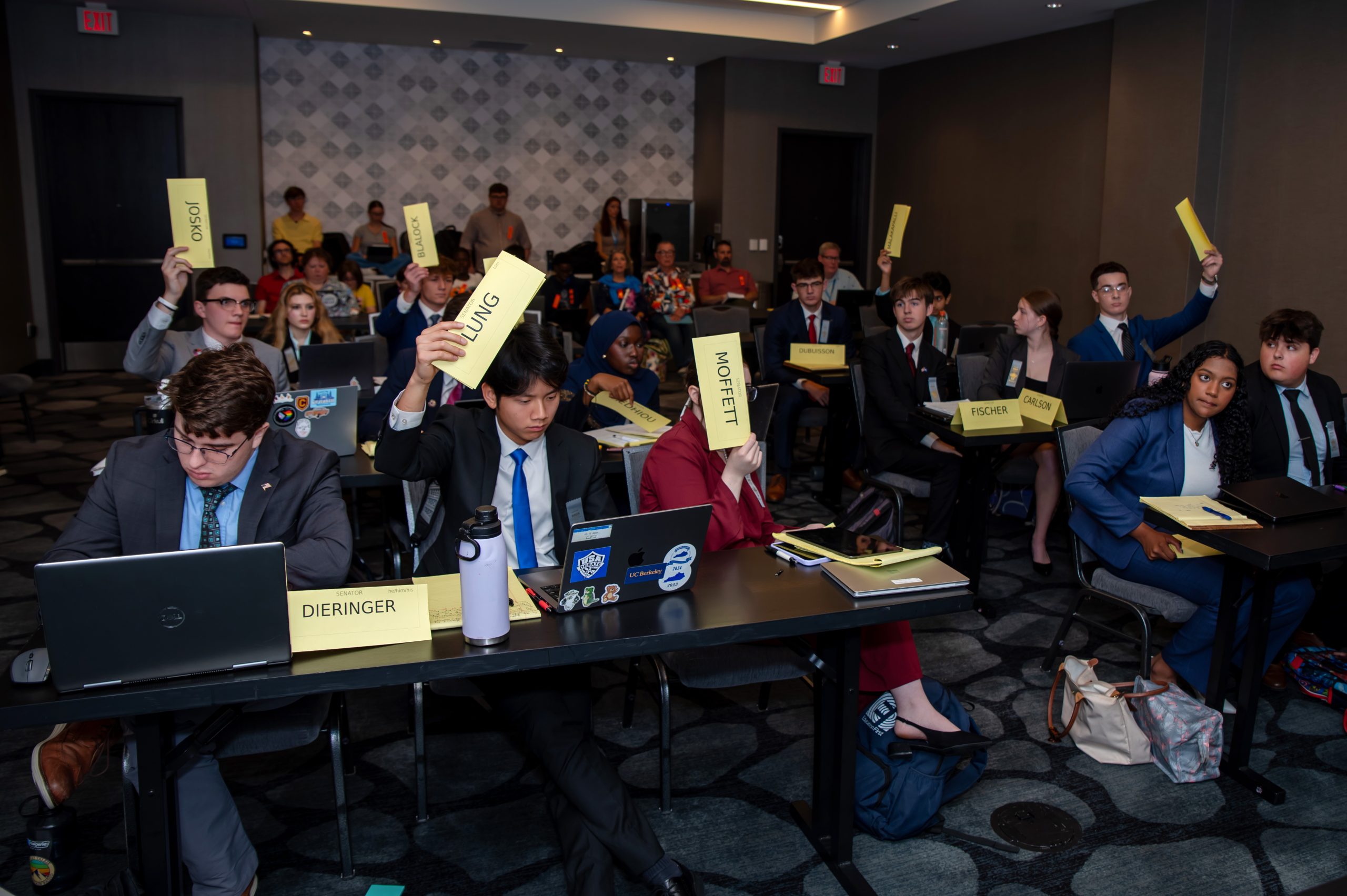
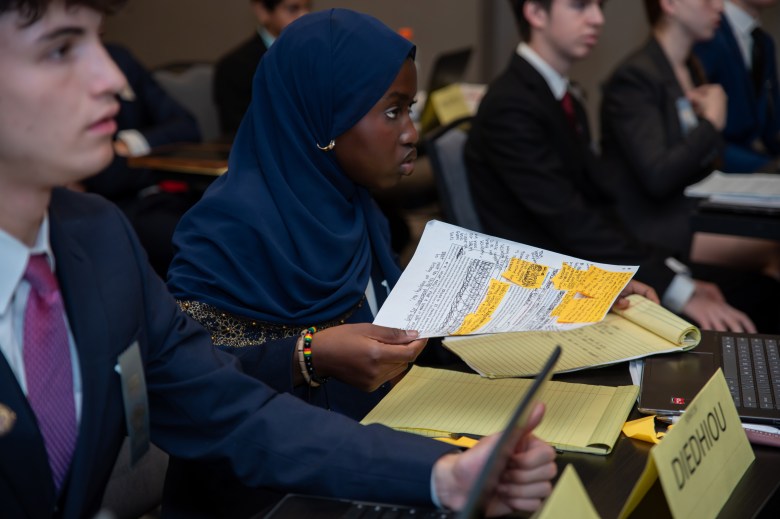
On the other side of Des Moines, Gagnado Diedhiou was competing in the Congressional Debate, a division of the tournament that mimics Congress and requires students to argue for or against bills modeled after current events. During one round, Gagnado spoke in favor of a bill to shift the country to use more nuclear energy, for a bill that would grant Puerto Rico statehood, and against legislation requiring hospitals to publicly post prices.
Gagnado Diedhiou, a senior from Eastside High School in South Carolina, competing in the first round of the Congressional Debate at the National Speech and Debate Tournament in Iowa in June. Credit: Meenakshi Van Zee for The Hechinger Report
Just like in Congress, boys outnumbered girls in this classroom. Gagnado was the only Black teenager and the only student wearing a hijab. The senior, who just graduated from Eastside High School in Greenville, South Carolina, is accustomed to being in rooms where nobody looks like her — it’s part of the reason she joined Equality in Forensics, a national student-led debate organization that provides free resources to schools and students across the country.
“It kind of makes you have to walk on eggshells a little bit. Especially because when you’re the only person in that room who looks like you, it makes you a lot more obvious to the judges,” said Gagnado, who won regional Student of the Year for speech and debate in her South Carolina district this year. “You stand out, and not always in a good way.”
Camille Fernandez, a rising junior at West Broward High School in Florida, said the competitions she has participated in have been dominated by male students. One opponent called her a vulgar and sexist slur after their round was over. Camille is a member of a student-led group — called Outreach Debate — trying to bridge inequities in the clubs.
“A lot of people think that debate should stay the same way that it’s always been, where it’s kind of just — and this is my personal bias — a lot of white men winning,” Camille said. “A lot of people think that should be changed, me included.”
Despite the challenges, Gagnado said her time in debate club has made her realize she could have an influence in the world.
“With my three-minute speech, I can convince a whole chamber, I can convince a judge to vote for this bill. I can advocate and make a difference with some legislation,” said Gagnado, who is bound for Yale.
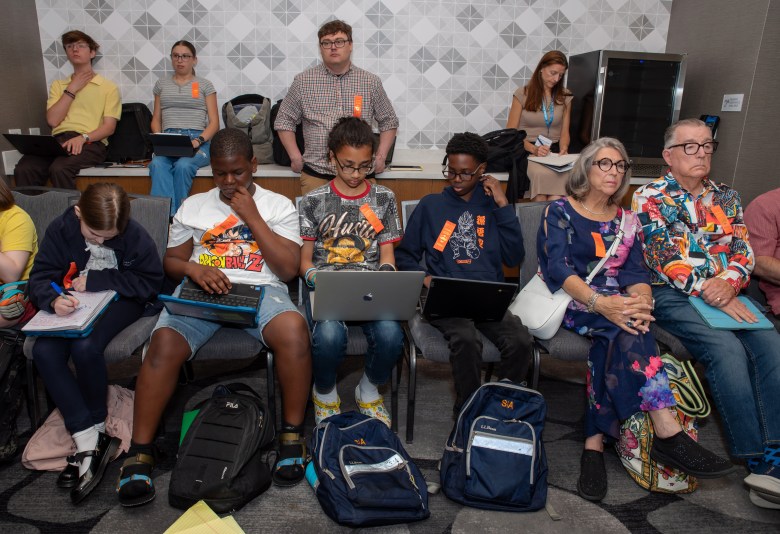
About 10,000 people attended the National Speech and Debate Tournament in Iowa this June during the organization’s centennial anniversary. Credit: Meenakshi Van Zee for The Hechinger Report
A day before the national tournament’s concluding ceremony, a 22-year-old attendee rushed the stage at the Iowa Event Center in Des Moines during the final round of the Humorous Interpretation speech competition, scaring everyone in the audience. After he bent down to open his backpack, 3,000 people in the auditorium fled for the exits. The man was later charged with possession of a controlled substance and disorderly conduct. For a brief moment, it seemed like the angry discourse and extreme politics from outside of the competition had become a part of it.
In response, the speech and debate organization shifted the time of some events, limited entrances into the building and brought in metal detectors, police officers and counselors. Some students, Gagnado among them, chose not to return to the event.
Still, thousands of attendees stayed until the end to celebrate the national champions. During the awards ceremony, where therapy dogs roamed the grounds, Angad Singh, a student from Bellarmine College Preparatory in California competing in Original Oratory, took the national prize for his speech on his Sikh identity and the phrase “thoughts and prayers” commonly repeated by American leaders after a tragedy, titled “Living on a Prayer.”
“I’ve prayed for change,” Singh told the audience. “Then I joined speech and debate to use my voice and fight for it.”
The Hechinger Report provides in-depth, fact-based, unbiased reporting on education that is free to all readers. But that doesn’t mean it’s free to produce. Our work keeps educators and the public informed about pressing issues at schools and on campuses throughout the country. We tell the whole story, even when the details are inconvenient. Help us keep doing that.
ELKHART, Ind. — Ever since Ty Zartman was little, people told him he had to go to college to be successful. “It was engraved on my brain,” he said.
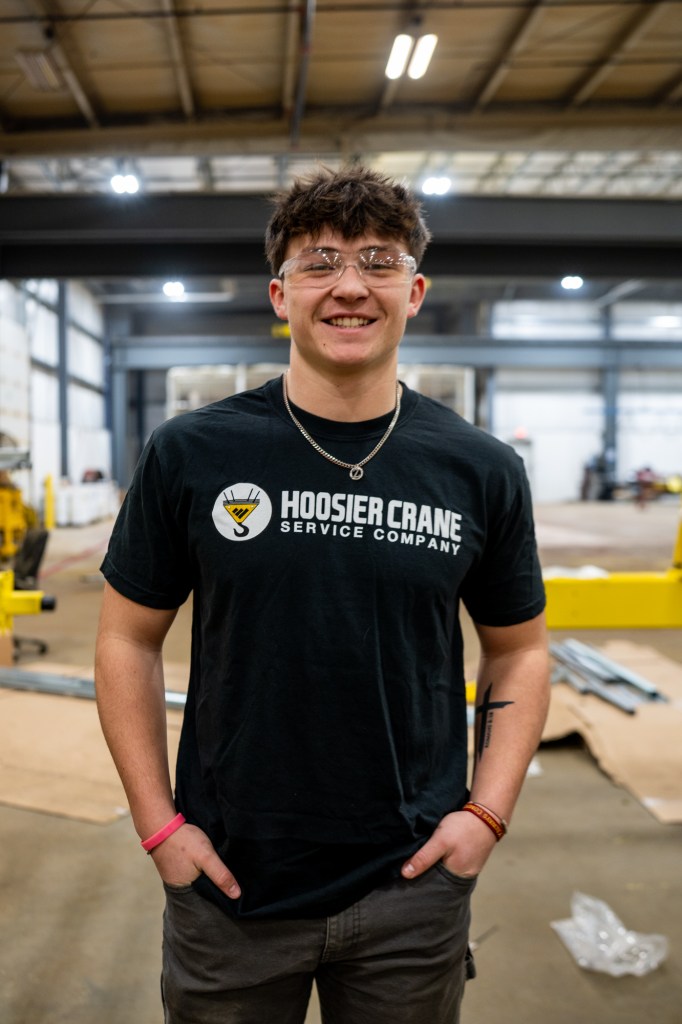
But despite earning straight A’s, qualifying for the National Honor Society, being voted prom king and playing on the high school football and baseball teams, the teen never relished the idea of spending another four years in school. So in fall 2023 he signed up through his Elkhart, Indiana, high school for an apprenticeship at Hoosier Crane Service Company, eager to explore other paths. There, he was excited to meet coworkers who didn’t have a four-year degree but earned good money and were happy in their careers.
Through the youth apprenticeship, Ty started his day at the crane manufacturing and repair business at 6:30 a.m., working in customer service and taking safety and training courses while earning $13 an hour. Then, he spent the afternoon at his school, Jimtown High, in Advanced Placement English and U.S. government classes.
In June, the 18-year-old started full-time at Hoosier Crane as a field technician.
“College is important and I’m not dissing on that,” Ty said. “But it’s not necessarily something that you need.”
Elkhart County is at the forefront of a movement slowly spreading across Indiana and the nation to make apprenticeships a common offering in high school.
In 2019, as part of a plan to boost the region’s economic prospects, county leaders launched an effort to place high schoolers in apprenticeships that combine work-based training with classroom instruction. About 80 students from the county’s seven school districts participated this academic year, in fields such as health care, law, manufacturing, education and engineering. In April, as part of a broader push to revamp high school education and add more work-based learning, the state set a goal of 50,000 high school apprentices by 2034.
Tim Pletcher, the principal of Jimtown High, said students are often drawn first to the chance to spend less time in class. But his students quickly realize apprenticeships give them work-based learning credits and industry connections that help them after graduation. They also earn a paycheck. “It’s really causing us to have a paradigm shift in how we look at getting kids ready for the next step,” he said.
Related: Become a lifelong learner. Subscribe to our free weekly newsletter featuring the most important stories in education.
This “earn and learn” model is taking hold in part because of deepening disillusionment with four-year college, and the fact that well-paying jobs that don’t require bachelor’s degrees are going unfilled nationally. The past three presidential administrations invested in expanding apprenticeships, including those for high schoolers, and in April, President Donald Trump signed an executive order calling for 1 million new apprentices. In a recent poll, more than 80 percent of people said they supported expanding partnerships between schools and businesses to provide work-based learning experiences for students.
Yet in the United States, the number of so-called youth apprenticeships for high schoolers is still “infinitesimally small,” said Vinz Koller, a vice president at nonprofit group Jobs for the Future. One estimate suggests they number about 20,000 nationally, while there are some 17 million high school students.By contrast, in Switzerland — which has been praised widely for its apprenticeship model, including by U.S. Education Secretary Linda McMahon — 70 percent of high schoolers participate. Indiana is among several states, including Colorado, South Carolina and Washington, that have embraced the model and sent delegations to Switzerland to learn more.
Elkhart, Indiana, known as the “RV capital of the world,” saw widespread unemployment during the Great Recession. That led community leaders to focus on apprenticeships as a way to diversify their economy. Credit: Camilla Forte/The Hechinger Report
Experts including Ursula Renold, professor of education systems at the Swiss Federal Institute of Technology (ETH) Zurich, note that importing the model to the United States at a large scale won’t be simple. Most businesses aren’t accustomed to employing apprentices, parents can be resistant to their students trading four-year college aspirations for work, and public transportation to take students to apprenticeships is limited, especially in rural areas. Many high schoolers don’t have a driver’s license, access to a car or money for gas. School districts already face a shortage of bus drivers that makes transporting students to apprenticeships difficult or impossible.
Still, Renold, who is known as the “grande dame of apprenticeships,” said Indiana’s commitment to apprenticeships at the highest levels of state government, as well as the funding the state has invested in work-based learning, at least $67 million, seem to be setting the state up for success, though it could take a decade to see results.
“If I had to make a bet,” said Renold, “I would say it’s Indiana who will lead the way.”
Elkhart County’s experiment with apprenticeships has its roots in the Great Recession. Recreational vehicle manufacturing dominates the local economy, and demand for the vehicles plummeted, contributing to a regional unemployment rate at that time of nearly 20 percent. Soon after, community leaders began discussing how to better insulate themselves from future economic instability, eventually focusing on high school education as a way to diversify industries and keep up with automation, said Brian Wiebe, who in 2012 founded local nonprofit Horizon Education Alliance, or HEA, to help lead that work.
Elkhart County, Indiana, was the first community in Indiana to encourage businesses to employ high school students as apprentices, where they can earn work-based learning credits and make industry connections that help them, even if they decide to go on to college. Credit: Camilla Forte/The Hechinger Report
That year, Wiebe and two dozen local and state political, business, nonprofit and education leaders visited Switzerland and Germany to learn more about the apprenticeship model. “We realized in the U.S., there was only a Plan A, a path to college,” he recalled. “We were not supporting the rest of our young people because there was no Plan B.”
HEA partnered with Elkhart County school districts and businesses, as well as with CareerWise, a youth apprenticeship nonprofit that works nationally. They began rolling out apprenticeships in 2019, eventually settling on a goal of increasing participation by 20 percent each year.
In 2021, Katie Jenner, the new secretary of education for Indiana, learned about Elkhart’s apprenticeships as she was trying to revamp high school education in the state so it better prepared students for the workforce. Elkhart, as well as six other apprenticeship pilot sites funded by Indianapolis-based philanthropy the Richard M. Fairbanks Foundation, provided a proof of concept for the apprenticeship model, said Jenner.
In December, the state adopted a new diploma system that includes an emphasis on experiential and work-based learning, through apprenticeships, internships and summer jobs.
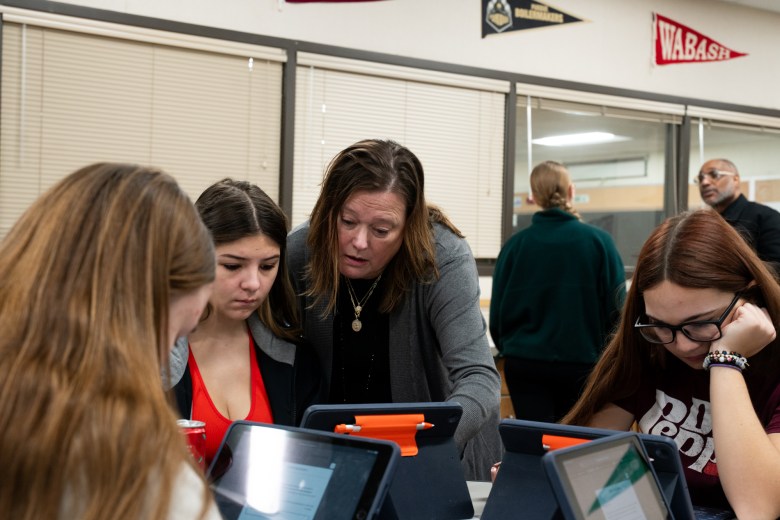
On a weekday this winter, 17 sophomores at Elkhart’s Concord High School were sitting at computers, creating resumes they planned to use to apply for apprenticeships. The students were among some 50 sophomores at the high school who’d expressed interest in apprenticing and met the school’s attendance and minimum 2.5 GPA requirements, out of a class of roughly 400. They would receive coaching and participate in mock interviews before meeting with employers.
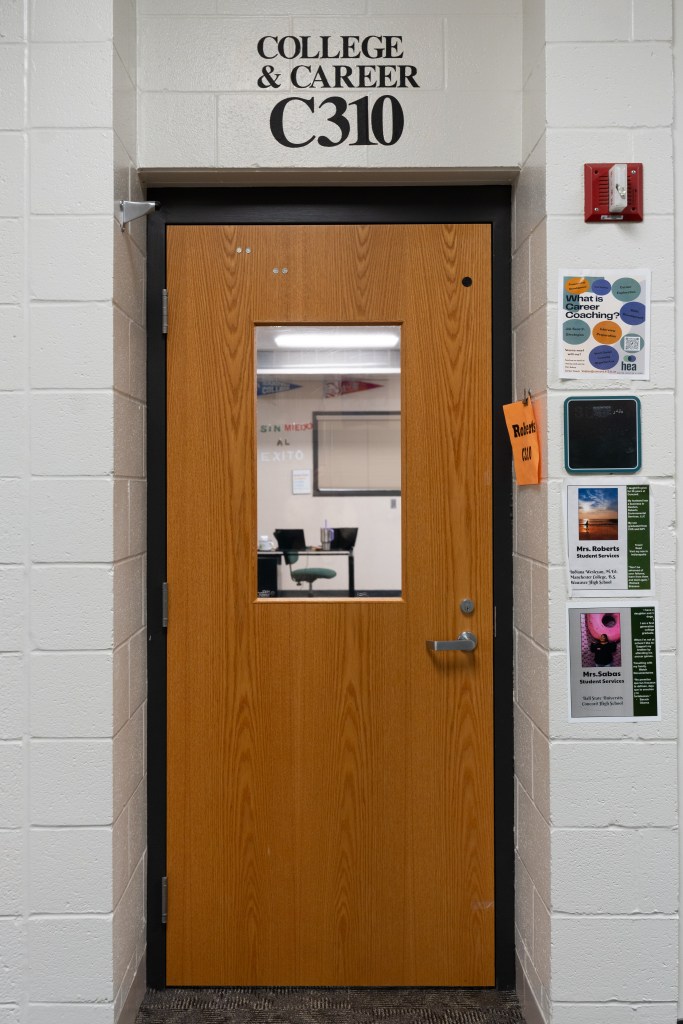
Becca Roberts, a former English teacher who now oversees the high school’s college and career programs, said apprenticeships help convince students of the importance of habits like punctuality, clear communication and regular attendance. “It’s not from a book,” she said. “They’re dealing with real life.”
Becca Roberts, who oversees college and career programs at Concord High School in Indiana, helps students research different companies offering apprenticeships, including job descriptions, work schedules and commuting distances. Credit: Camilla Forte/The Hechinger Report
One student, Ava Cripe, said she hoped for an apprenticeship of some sort in the health care field. She’d only been a pet sitter and was nervous at the thought of having a professional job. “You’re actually going out and working for someone else, like not for your parents or your grandma, so it’s a little scary,” she said.
CareerWise Elkhart has recently beefed up its support for students and businesses participating in apprenticeships. It employs a business partnership manager and customer success managers who help smooth over issues that arise in the workplace — an apprentice who isn’t taking initiative, for example, or an apprenticeship that isn’t sufficiently challenging. “Before, if an issue came up, a business would just fire a student or a student would leave,” said Sarah Koontz, director of CareerWise Elkhart County. “We’re now more proactive.”
In Elkhart and across the state, the embrace of work-based learning has worried some parents who fear it will limit, not expand, their children’s opportunities. In previous generations, career and technical programs (then known as vocational education) were often used to route low-income and Black and Hispanic students away from college and into relatively low-paying career paths.
Anitra Zartman, Ty’s mother, said she and her husband were initially worried when their son said he wanted to go straight to work. They both graduated from college, and her husband holds a master’s degree. “We were like, ‘Don’t waste your talent. You’re smart, go to college.’” But she says they came around after seeing how the work experience influenced him. “His maturity has definitely changed. I think it’s because he has a responsibility that he takes very seriously,” she said. “He doesn’t want to let people down.”
Her eldest daughter, Senica Zartman, also apprenticed during her final two years of high school, as a teacher’s assistant. She is now in college studying education. “The apprenticeship solidified her choice,” Anitra Zartman said, and it helped her decide to work with elementary students. Anitra Zartman said she would encourage her two youngest children to participate in apprenticeships too.
Ty Zartman works from 6 a.m. to noon at his apprenticeship at Hoosier Crane Service Company before he goes to school for afternoon classes. Credit: Camilla Forte/The Hechinger Report
Sarah Metzler, CEO of the nonprofit HEA, said apprenticeships differ from the vocational education of the past that tended only to prepare students for relatively low paid, entry-level jobs. With apprenticeships, she said, students must continually learn new skills and earn new licenses and industry certifications as part of the program.
Litzy Henriquez Monchez, 17, apprentices in human resources at a company of 50 people, earning $13.50 an hour. “I deal with payroll, I onboard new employees, I do a lot of translating. Anything that has to do with any of the employees, I deal with,” she said. She’s also earning an industry-recognized certification for her knowledge of a human resources management system, and says the company has offered to pay for her college tuition if she continues in the position.
Koontz said most companies pay for their apprentices to attend Ivy Tech, a statewide community college system, if they continue to work there. One is even paying for their apprentice’s four-year degree, she said.
Attracting employers has proven to be the biggest challenge to expanding youth apprenticeships — in Elkhart and beyond. In total, 20 companies worked with the Elkhart school districts last year, and 28 have signed on for this coming school year — only enough to employ about a third of interested students.
The obstacles, employers say, include the expense of apprentices’ salaries, training and other costs.
Metzler and others, though, point to studies showingbenefits for employers, including cost savings over time and improved employee loyalty. And in Indiana, the Fairbanks foundation and other organizations are working on ways to reduce employer costs, including by developing a standard curriculum for apprenticeships in industries like health care and banking so individual companies don’t bear the costs alone.
Business leaders who do sign on say they are happy with the experience. Todd Cook, the CEO of Hoosier Crane Service Company, employs 10 high schoolers, including Ty Zartman, as engineering and industrial maintenance technician apprentices, approximately 10 percent of his staff. He said the pipeline created by the apprenticeship program has helped reduce recruiting costs.
“We’re starting to build our own farm system of talent,” he said. Students initially earn $13 an hour, and finish their apprenticeship earning $18. If they continue with the company, he said, they can earn up to $50 an hour after about five years. And if they go on to become trainers or mentors, Cook said, “Honestly, there is no ceiling.”
Transportation has been a limiting factor too. There’s no public transit system, and students who can’t rely on their parents for rides are often out of luck. “We’d love to offer a bus to every kid, to every location, but we don’t have people to run those extra bus routes,” said Principal Pletcher.
The state has tried to help by investing $10 million to help students pay for costs such as transportation, equipment and certifications. Each school that provides work-based learning opportunities also receives an additional $500 per student.
Indiana has a goal to employ 50,000 high school students as apprentices by 2034. State leaders in business, education, government and nonprofits are working closely with Swiss experts to adopt a youth apprenticeship program similar to the one in that country. Credit: Camilla Forte/The Hechinger Report
Trump’s executive order called for the secretaries of education, labor and commerce to develop a plan by late August for adding 1 million new apprenticeships. The order does not set a date for reaching that milestone, and it applies to apprentices of all ages, not just high schoolers. Vinz Koller of Jobs for the Future said the goal is modest, and achievable; the number of youth apprenticeships has doubled just in the past few years, he said, and California alone has a goal of reaching 500,000 apprenticeships, across all ages, by 2029.
Still, the order did not include additional funding for apprenticeships, and the Trump administration’s proposed budget includes major cuts to workforce development training. In an email, a White House spokesperson said the administration had promoted apprenticeships through outreach programs but did not provide additional information including on whether that outreach had a focus on youth apprenticeships.
Back in Elkhart, Ty Zartman, the Hoosier Crane apprentice, has begun his technician job with the company after graduating in early June. He is earning $19 an hour. He is also taking a class at the local community college on electrical work and recently received a certificate of completion from the Department of Labor for completing 2,000 hours of his apprenticeship.
Anitra Zartman said she wishes he’d attended more school events like pep rallies, and sometimes worried he wasn’t “being a kid.” But Ty said his supervisor is “super flexible” and he was able to go to the winter formal and prom. “I think I still live a kid life,” he said. “I do a lot of fun things.”
Of his job, he said, “I love it so much.”
Contact editor Caroline Preston at 212-870-8965, via Signal at CarolineP.83 or on email at [email protected].
The Hechinger Report provides in-depth, fact-based, unbiased reporting on education that is free to all readers. But that doesn’t mean it’s free to produce. Our work keeps educators and the public informed about pressing issues at schools and on campuses throughout the country. We tell the whole story, even when the details are inconvenient. Help us keep doing that.
NEW YORK — The fish, glassy-eyedand inert, had been dead for decades. Yet its belly held possible clues to an environmental crisis unfolding in real time.
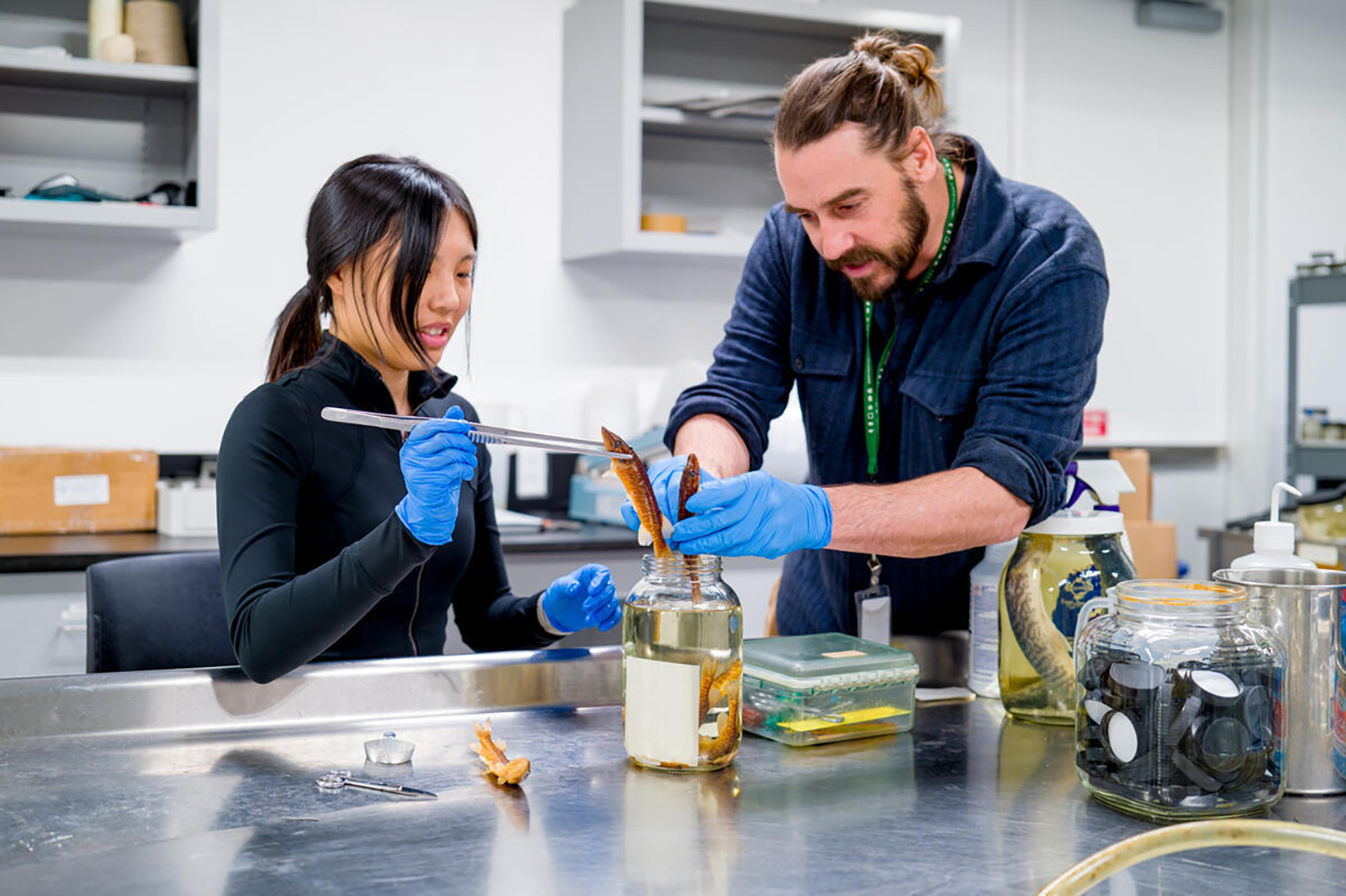
Forceps in hand, Mia Fricano, a high school junior, was about to investigate. She turned over the fish, a bluegill, and slid in a blade, before extracting its gastrointestinal tract. Then, she carried the fish innards to a beaker filled with a solution that would dissolve the biological material, revealing if there were any tiny particles of plastic — known as microplastics — inside.
Mia and two other high schoolers working alongside her in a lab this spring were part of a program at the American Museum of Natural History designed to give young people hands-on experience in professional science. Called the Science Research Mentoring Program, or SRMP (pronounced “shrimp”), the program enrolls roughly 60 high school juniors and seniors each year who collaborate with scientists on a research project.
Mia and her peers were matched with Ryan Thoni, an ichthyologist and curatorial associate in the museum’s division of vertebrate zoology. Thoni’s project to gather information on when and how microplastics began to enter the environment relied on the museum’s vast collection of fish specimens dating from more than a century ago — some 3.2 million in total.
Concern about the tiny pieces of plastic debris has grown in the last few years, along with early-stage research on the health risks they pose. The particles are found in human blood, breast milk and even the brain — and in animals, including, as it turned out, nearly all the fish in Thoni’s lab.
“It was kind of shocking to see just how many we did find,” Mia said later. “We weren’t expecting to find more than two to three per fish but in some fish, we would find over 15.” Specimens from the 1970s or earlierwere less likely to contain high levels of microplastic, more than three or so pieces, and fish near urban centers seemed to have more of the plastics, on average, than fish from less populated areas.
“It really does make you realize just how much the environment has been affected,” said Mia. “There hasn’t been a lot of research on it yet,” she added. “Our project might be able to help future people who are also doing research on microplastics.”
Related: Want to read more about how climate change is shaping education? Subscribe to our free newsletter.
SRMP, started in 2009, is operating at a time when the federal government is eliminating fellowships and other support for early career scientists, and defunding scientific research broadly. That both amplifies the need for, and complicates the work of, programs like this one, said Amanda Townley, executive director of the nonprofit National Center for Science Education. Over the last 15 years in particular, such programs have played a big role in giving students a chance to do the kind of applied science that is rarely available in K-12 classrooms because of money and time constraints, she said.
“Museums, university extensions, sometimes libraries, have really done this tremendous job of creating spaces for high school and younger students to engage with scientists doing science,” said Townley. “Those museums, libraries and universities are all under attack.” She added: “We’re going to see a generational impact.”
While the American Museum of Natural History has received some federal government funding, the SRMP program’s money comes from private foundations and individual donors, with additional support from the New York City Council. Students in SRMP participate in a summer institute in August, when they learn basics like how to investigate research questions. Then they spend two afternoons a week during the school year on their projects.
Each student receives a stipend, $2,500 over the course of the year. “It’s really important for high school students to know their time is valuable,” said Maria Strangas, the museum’s assistant director of science research experiences. “They are doing something here that is really useful for the researchers; it’s an education program, but they aren’t the only ones who are benefiting.”
Students from New York City schools that partner with the museum can apply, as well as those who have participated in programs with the museum in the past. SRMP has also spawned a network of about 30 similar programs across the city, with institutions including Brooklyn College, Bronx River Alliance and many others participating.
In the lab on the sixthfloor of the museum, Mia, who attends the New York City Museum School, cleaned out a beaker, while Yuki Chen, a senior at Central Park East High School, sat at a metal table, dissecting a pike. Thoni inserted a slide containing material harvested from one of the fish under a microscope, and pointed out a few microplastics, which looked like threads.
Ryan Thoni of the American Museum of Natural History, right, with high schoolers Mia Fricano (center) and Freyalise Matasar. Credit: Caroline Preston/The Hechinger Report
Freyalise Matasar, a junior at the Ethical Culture Fieldston School in the Bronx, plucked a white sucker fish from a jar. She said SRMP had altered her career trajectory. Before the program, she was considering studying journalism in college, but her experience this year persuaded her to focus on engineering and data science instead.
“I have totally fallen in love with science,” she said. “It’s been an amazing experience to see what professional science looks like — and more than just see it, to be a part of it.”
Freyalise said she wanted to build those skills in order to help fight climate change, perhaps by working on weather models to predict climate risks and ideally spur people to action. “It’s the biggest problem faced by our generation. It’s inescapable and unignorable, no matter how much people try,” she said. “It’s everyone’s responsibility to do what they can to fight it.”
Microplastics contribute to climate change in several ways, including by potentially disrupting oceans’ ability to sequester carbon and by directly emitting greenhouse gases.
Interest in climate science among young people is growing, even as the federal government tries to zero out funding for it. Other climate-related topics SRMP students explored this year included the climate on exoplanets, the ecology of sea anemones and aquatic wildlife conservation in New York City.
Sometimes the fish dissections were gross: Mia, who plans to study biology and machine learning in college, sliced into one large fish to find poorly preserved, rotten innards — and a major stink. Sometimes they provided a lesson beyond pollution: Yuki identified a small pickerel inside a larger one. (Pickerels prey even on members of their own species, the students learned.)
The scientists in the program, most of whom are postdoctoral fellows, are trained on how to be effective mentors. “Scientists are often not trained in mentorship; it’s something that people pick up organically seeing good or bad examples in their own lives,” said Strangas. “A lot of it comes down to: ‘Think about the impact you want to have, think about the impact you don’t want to have, think about the power dynamic at play, and what this student in front of you wants to get out of it.’”
Thoni earned rave reviews from the students, who said he ensured they understood each step of the research process without being patronizing.
Thoni’s next steps include working to publish the microplastics research, which could earn the students their first co-authorship in a scientific journal. “Aside from forgetting to put on gloves,” he said in a playful jab at one student, “they can operate this machine on their own. They do science.”
Contact editor Caroline Preston at 212-870-8965, via Signal at CarolineP.83 or on email at [email protected].
This story about science careers was produced by The Hechinger Report, a nonprofit, independent news organization focused on inequality and innovation in education. Sign up for the Hechinger newsletter on climate and education.
The Hechinger Report provides in-depth, fact-based, unbiased reporting on education that is free to all readers. But that doesn’t mean it’s free to produce. Our work keeps educators and the public informed about pressing issues at schools and on campuses throughout the country. We tell the whole story, even when the details are inconvenient. Help us keep doing that.
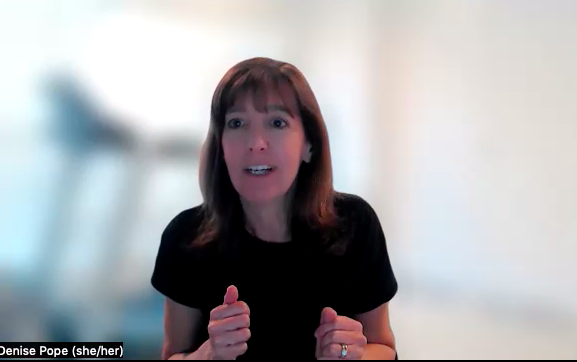
Tired of talking about AI? That’s too bad. The technology remains the most impactful force in education. The challenge becomes avoiding all the Claptrap. Thankfully, that’s where Denise Pope, Co-Founder of Challenge Success at the Stanford Graduate School of Education, comes in.
I had the chance to explore the current AI state-of-play from her perspective. One striking disparity I haven’t heard talked about: While AI usage among students has skyrocketed—from 25% to 60% at the middle school level and 45% to 75% at the high school level over just two school years—only 32% of teachers report using AI for academic purposes.
This gap has created what Denise describes as an educational “La La Land,” where students are experimenting with AI tools while many schools lack clear policies or guidance. The absence of structured approaches is breeding anxiety among both educators and students, who are left wondering when and how AI should appropriately be used in academic settings.
Click through to hear how Denise believes this issue can be addressed:
Kevin is a forward-thinking media executive with more than 25 years of experience building brands and audiences online, in print, and face to face. He is an acclaimed writer, editor, and commentator covering the intersection of society and technology, especially education technology. You can reach Kevin at [email protected]
This story was originally published by Chalkbeat. Sign up for their newsletters at ckbe.at/newsletters
When 18-year-old Edgar Brito thinks about what he’ll do in the future, mechanical engineering is high on the list.
The senior at Washington state’s Toppenish High School first considered the career after he joined a STEM group in middle school. In a ninth grade class, he researched the earning potential for a STEM degree (“so much more money”) and the demand for mechanical engineers (“exploding”).
So Brito took some engineering classes at his high school, became president of his state’s Technology Student Association, and is starting at the University of Washington this fall on a pre-science track.
Brito’s experience is what state education leaders hoped for when they replaced the high school exit exam with multiple pathways to graduation. When he graduates in June, Brito will have completed several diploma pathways, including ones aimed at preparing for college and building career skills.
But his experience isn’t necessarily typical. He has friends who have no idea what pathway they’re on — or if they’re on one at all. The requirements could be clearer and advisers could spend more time talking about them with students, he said.
“Making sure that we know exactly what our pathway is and what it means to be on a pathway would have definitely helped out a lot more students,” Brito said.
Five years after Washington rolled out its pathways, they appear to have helped more students who aren’t college-bound to graduate, which was part of the goal. But the system has also created new issues and replicated some old ones.
For the Class of 2023 — the most recent year with available data — around 1 in 5 seniors didn’t have a pathway. That meant they weren’t on track to graduate within four years and at risk of dropping out. Some students relied on pandemic-era waivers that don’t exist anymore. That’s similar to the share of students who didn’t graduate on time in 2019, the final year of the exit exam.
Asian and white students are much more likely to complete one of the math and English pathways, considered the college-prep route, while Native students, English learners, and students with disabilities are more likely to have no graduation pathway.
“The implementation of graduation pathways has reinforced that the student groups who are the furthest from educational justice are completing the requirement at lower rates,” state education officials wrote in a 2023 report.
Across the state, students don’t have equal access to the pathways. Many schools, especially smaller and rural ones, struggle to offer more than a handful of career and technical education classes. Some career pathways train students for low-paying jobs with little opportunity for advancement. Some students get funneled to the military pathway, despite having no aspirations to serve, because the aptitude test is easier to pass. Many teens, like Brito’s friends, find the pathways confusing.
Piling on more ways for students to graduate is not the answer, said Brian Jeffries, the policy director at the Partnership for Learning, an education foundation affiliated with the Washington Roundtable, which is made up of executives from across the state.
“Let’s better prepare our students to meet the pathways, [rather] than keep creating a smorgasbord or a cafeteria of options, which too often turn into trapdoors,” said Jeffries, who sits on the state task force that’s looking at graduation requirements. Until disadvantaged kids have access to better instruction and more support, he said, “we’re going to keep spinning this wheel.”
The path to 100 high school graduation pathways
Back in the early 2000s, many states raised the bar to graduate from high school with the hope it would get more kids to college. As a result, by 2012, half of all states required an exit exam, including Washington state.
But as student debt soared and some questioned the value of higher education, schools abandoned that college-for-all mentality. Critics of exit exams argued that they blocked too many disadvantaged students from graduating.
In Washington state’s final year of the exit exam, around 1 in 10 high school seniors didn’t pass the English language arts portion, and 1 in 5 didn’t pass the math test, the Seattle Times reported. The law that nixed the exit exam had broad support from the Washington teachers union, state education officials, and parents. Lawmakers passed it unanimously.
Just six states require an exit exam now, with New York and Massachusetts dropping their tests this school year.
Nationwide, there are now more than 100 ways to graduate from high school, according to a recent report from the Education Strategy Group, a K-12 consulting firm. The myriad options provide flexibility, but “also contribute to the lack of clarity about what it means to earn a diploma,” the report found.
When the nation’s main K-12 education law, the Every Student Succeeds Act, passed 10 years ago, it tasked schools with getting students ready for college and career. But many states and schools are still trying to figure out how to do the career part well.
“Part of the challenge, frankly, is that schools are going through a bit of a post-high-stakes-test-based accountability identity crisis,” said Shaun Dougherty, a professor of education and policy at Boston College.
Michael Petrilli, the president of the Thomas B. Fordham Institute, a conservative think tank, says that’s partly because for all the talk about changing high schools, graduation policies are still fairly restrictive. One reason Washington is revisiting its policies now is because some educators worry the state’s 24-credit requirement fills up students’ schedules, leaving little time for apprenticeships and other hands-on learning.
Many kids are still “sleepwalking through six or seven class periods a day, mostly through college-prep courses,” Petrilli said, with “maybe a few career-tech electives on the side.”
“We haven’t really unleashed high schools to do things very differently,” Petrilli said. “If we actually think that career tech is valuable, if we think that college-for-all was a mistake, then we need to be willing to act on it.”
Diploma pathways can bolster teens’ interest in school
What’s happening in the Toppenish School District illustrates the potential of the pathways model.
The district, which serves around 3,700 students in south-central Washington, is able to offer a wide range of career and technical courses, including in growing industries, like health care and agriculture. The career-oriented pathway has helped increase some students’ interest in school.
“It is very hands-on, and so it’s definitely more engaging,” said Monica Saldivar, Toppenish’s director of career and technical education. The old one-size-fits-all approach had “a negative impact for our students with diverse learning needs, academic challenges, and also language barriers.”
Just before the state overhauled its graduation requirements, over 81% of Toppenish students graduated within four years. Now over 89% do.
The improvements have been especially pronounced for English learners and Native students, many of whom live on the Yakama Nation. Since the state introduced pathways, Native student graduation rates have risen from 67% to 88%.
Since pathways launched, the district has added several career-technical education courses, including advanced welding and classes that prepare students to work as medical transcriptionists or home health care aides. That can require some careful career counseling with students, as those jobs are in high demand but don’t pay well unless students get additional training or schooling and move up the career ladder.
Still, the expanded offerings have helped some students tailor their post-high school plans.
Frances Tilley, a Toppenish senior who’s headed to Gonzaga University in the fall, will graduate in June after completing both college-prep and career-oriented pathways.
The 18-year-old took two of the new sports medicine classes and liked learning about what to do if you have a concussion. (Don’t try to stay awake. “We learned that’s not true,”Tilley said.)
She followed that up with another health care class that touched on different disciplines. She gravitated toward psychology and now plans to get a master’s in counseling and become a mental health worker.
Pathways can also help schools expose students to career options earlier.
Three years ago, Toppenish started offering middle schoolers two-week labs to test drive careers such as marketing, nursing, or culinary arts. By the end of eighth grade, they’ve learned about 10 different careers. Now school counselors use students’ interests to help plot their high school schedules.
Kaylee Celestino, 16, had long considered becoming a teacher. The Toppenish sophomore often gets “education” as an answer when she takes career quizzes. But the career-exploration labs also piqued her interest in science, and now she could also envision becoming a pediatric nurse. So her course schedule reflects that with advanced biology and college-level chemistry.
“I just want to help people out,” she said, “like my teachers have helped out me.”
Staffing, standards, data gaps make pathways challenging
Staffing career and technical classes is one of the biggest hurdles to doing pathways well.
“These are lucrative fields,” said Dougherty, who has researched career education programs in several states, including Washington. “It’s hard to convince people to give up that salary to become full-time educators.”
That creates extra work for schools. Saldivar, for example, meets regularly with regional employers to learn about their workforce needs. That helps inform whether Toppenish should drop or add certain classes, and which teachers to recruit. Saldivar is constantly networking and following up on “so and so may know someone” tips.
Figuring out how to hold all students to a high standard when they are meeting different criteria to graduate is a challenge, too. Some worry Washington’s pathways are too flexible.
“Where are they finding these people?” said Jeffries of the Partnership for Learning. “Is their opinion an expert opinion that we could trust, or is this based on vibes?”
Experts say it’s also important for students to understand what their likely earnings and other outcomes will be depending on which career pathway they follow.
“We should not be talking about CTE in a very generic way,” said Dan Goldhaber, a professor at the University of Washington who has researched career and technical education teacher preparation in the state. “What the concentration is matters.”
But Washington state doesn’t yet know how students’ outcomes may vary depending on which career and technical education concentration they chose, Katie Hannig, a spokesperson for Washington’s state education agency, wrote in an email. This is a common problem nationwide.
The state also doesn’t yet know whether the pathway, or pathways, students completed were connected to their post-high school plan, which they must create to graduate. That hasn’t assuaged concerns that students are completing pathways disconnected from their college and career goals.
The state expects to get that data in the future, Hannig wrote. Analyzing how diploma pathways affect graduation trends and postsecondary outcomes could help schools target resources and support.
“Any new policy is a work in progress, but the fundamental core value of this policy is preparing students for their next step after high school graduation,” Hannig wrote. “Washington is proud to be one of those states that have established and continue to refine those pathways.”
For now, districts like Toppenish are scrambling to coordinate weekly college presentations, field trips to work sites, and military recruiter visits — “a little of everything,” Saldivar said — to hedge their bets.
Kalyn Belsha is a senior national education reporter based in Chicago. Contact her at [email protected].
Chalkbeat is a nonprofit news site covering educational change in public schools.
The Alliant Credit Union Foundation has awarded a $108,000 grant to Digital Leaders Now, the nonprofit that powers the Digital Leaders Academy at Ridgewood Community High School District 234, to support the implementation of innovative digital opportunity programs.
The initiative will begin rolling out in Spring 2025, with full program implementation for the 2025-2026 school year. The grant will help students gain critical digital skills, enhance career preparation opportunities at Ridgewood and beyond, and ensure teachers have the necessary resources to integrate technology into the classroom effectively.
“The Alliant Credit Union Foundation is committed to fostering educational opportunities that prepare students for the future,” said Meredith Ritchie, President of The Alliant Credit Union Foundation. “By partnering with the Digital Leaders Academy, we are helping to bridge the digital divide and ensure that students in Ridgewood Community High School District 234 are equipped with the skills and knowledge they need to succeed in the evolving workforce.”
The grant will support key initiatives, including:
Integration of AI Tools: Students will gain hands-on experience using AI and emerging technologies to enhance their learning and problem-solving skills.
Teacher Training & Development: Supporting professional development programs that empower educators with the tools and knowledge to incorporate digital learning strategies into their curriculum.
Digital Fluency Expansion: Enhancing student digital literacy and technology-based learning experiences to build a foundation for future careers.
Career Readiness Programs: Preparing students for high-demand technology roles by connecting them with industry experts, mentorship opportunities, and real-world applications of digital skills.
Through this initiative, the Alliant Credit Union Foundation continues its mission of driving positive change in education by expanding access to technology and professional development resources.
“The Digital Leaders Academy is a testament to the power of partnership and community. With the support of Alliant, we’re equipping students, teachers, and parents with the tools to thrive in the digital age, because when we invest in digital fluency, we unlock limitless potential,” said Caroline Sanchez Crozier, Founder of Digital Leaders Now, an Illinois-based nonprofit, and creator of Digital Leaders Academy.
Ridgewood Community High School District 234 students will benefit from enhanced learning experiences, giving them a competitive edge in today’s digital economy.
Kevin is a forward-thinking media executive with more than 25 years of experience building brands and audiences online, in print, and face to face. He is an acclaimed writer, editor, and commentator covering the intersection of society and technology, especially education technology. You can reach Kevin at [email protected]
On a recent Thursday morning, Michael Taubman asked his class of seniors at North Star Academy’s Washington Park High School: “What do you think AI’s role should be in your future career?”
“In school, like how we use AI as a tool and we don’t use it to cheat on our work … that’s how it should be, like an assistant,” said Amirah Falana, a 17-year-old interested in a career in real estate law.
Fernando Infante, an aspiring software developer, agreed that AI should be a tool to “provide suggestions” and inform the work.
“It’s like having AI as a partner rather than it doing the work,” said Infante during class.
Falana and Infante are students in Taubman’s class called The Summit, a yearlong program offered to 93 seniors this year and expanding to juniors next year that also includes a 10-week AI course developed by Taubman and Stanford University.
As part of the course, students use artificial intelligence tools – often viewed in a negative light due to privacy and other technical concerns – to explore their career interests and better understand how technology could shape the workforce. The class is also timely, as 92% of companies plan to invest in more AI over the next three years, according to a report by global consulting firm McKinsey and Company.
The lessons provide students with hands-on exercises to better understand how AI works and how they can use it in their daily lives. They are also designed so teachers across subject areas can include them as part of their courses and help high school students earn a Google Career Certificate for AI Essentials, which introduces AI and teaches the basics of using AI tools.
Students like Infante have used the AI and coding skills they learned in class to create their own apps while others have used them to create school surveys and spark new thoughts about their future careers. Taubman says the goal is to also give students agency over AI so they can embrace technological changes and remain competitive in the workfield.
“One of the key things for young people right now is to make sure they understand that this technology is not inevitable,” Taubman told Chalkbeat last month. “People made this, people are making decisions about it, and there are pros and cons like with everything people make and we should be talking about this.”
Students need to know the basics of AI, experts say
As Generation Z, those born between 1997 and 2012, graduate high school and enter a workforce where AI is new, many are wondering how the technology will be used and to what extent.
Nearly half of Gen Z students polled by The Walton Family Foundation and Gallup said they use AI weekly, according to the newly released survey exploring how youth view AI. (The Walton Family Foundation is a supporter of Chalkbeat. See our funders list here.) The same poll found that over 4 in 10 Gen Z students believe they will need to know AI in their future careers, and over half believe schools should be required to teach them how to use it.
This school year, Newark Public Schools students began using Khan Academy’s AI chatbot tutor called Khanmigo, which the district launched as a pilot program last year. Some Newark teachers reported that the tutoring tool was helpful in the classroom, but the district has not released data on whether it helped raise student performance and test scores. The district in 2024 also launched its multimillion project to install AI cameras across school buildings in an attempt to keep students safe.
But more than just using AI in school, students want to feel prepared to use it after graduating high school. Nearly 3 in 4 college students said their colleges or universities should be preparing them for AI in the workplace, according to a survey from Inside Higher Ed and College Pulse’s Student Voice series.
Many of the challenges of using AI in education center on the type of learning approach used, accuracy, and building trust with the technology, said Nhon Ma, CEO of Numerade – an online learning assistant that uses AI and educators to help students learn STEM concepts. But that’s why it’s important to immerse students in AI to help them understand the ways it could be used and when to spot issues, Ma added.
“We want to prepare our youth for this competitive world stage, especially on the technological front so they can build their own competence and confidence in their future paths. That could potentially lead towards higher earnings for them too,” Ma said.
For Infante, the senior in Taubman’s class, AI has helped spark a love for computer science and deepened his understanding of coding. He used it to create an app that tracks personal milestones and goals and awards users with badges once they reach them. As an aspiring software developer, he feels he has an advantage over other students because he’s learning about AI in high school.
Taubman also says it’s especially important for students to understand how quickly the technology is advancing, especially for students like Infante looking towards a career in technology.
“I think it’s really important to help young people grapple with how this is new, but unlike other big new things, the pace is very fast, and the implications for career are almost immediate in a lot of cases,” Taubman added.
Students learn that human emotions are important as AI grows
It’s also important to remember the limitations of AI, Taubman said, noting that students need the basic understanding of how AI works in order to question it, identify any mistakes, and use it accordingly in their careers.
“I don’t want students to lose out on an internship or job because someone else knows how to use AI better than they do, but what I really want is for students to get the internship or the job because they’re skillful with AI,” Taubman said.
Through Taubman’s class, students are also identifying how AI increases the demand for skills that require human emotion, such as empathy and ethics.
Daniel Akinyele, a 17-year-old senior, said he was interested in a career in industrial and organizational psychology, which focuses on human behavior in the workplace.
During Taubman’s class, he used a custom AI tool on his laptop to explore different scenarios where he could use AI in his career. Many involved talking to someone about their feelings or listening to vocal cues that might indicate a person is sad or angry. Ultimately, psychology is a career about human connection and “that’s where I come into play,” Akinyele said.
“I’m human, so I would understand how people are feeling, like the emotion that AI doesn’t see in people’s faces, I would see it and understand it,” Akinyele added.
Falana, the aspiring real estate attorney, also used the custom AI tool to consider how much she should rely on AI when writing legal documents. Similar to writing essays in schools, Falana said professionals should use their original writing in their work but AI could serve as a launching pad.
“I feel like the legal field should definitely put regulations on AI use, like we shouldn’t be able to, draw up our entire case using AI,” Falana said.
During Taubman’s class, students also discussed fake images and videos created by AI. Infante, who wants to be a software developer, added that he plans to use AI regularly on the job but believes it should also be regulated to limit disinformation online.
Taubman says it’s important for students to have a healthy level of skepticism when it comes to new technologies. He encourages students to think about how AI generates images, the larger questions around copyright infringement, and their training processes.
“We really want them to feel like they have agency in this world, both their capacity to use these systems,” Taubman said, “but also to ask these broader questions about how they were designed.”
Chalkbeat is a nonprofit news site covering educational change in public schools.