Category: Higher Ed News

  • CUPA-HR Participates in Hill Meetings With House Ways and Means Committee Member Offices – CUPA-HR

    CUPA-HR Participates in Hill Meetings With House Ways and Means Committee Member Offices – CUPA-HR

    by CUPA-HR | May 10, 2022

    Over the last month, CUPA-HR’s government relations team joined the American Council on Education (ACE) and other higher education organizations in virtual Capitol Hill meetings to discuss tax priorities for the higher education community. Meetings have been held with staffers of Members of the House Ways and Means Committee to advocate for tax policies and proposals to alleviate various burdens placed on students, employees and institutions alike.

    Specifically, the meetings have allowed the higher education community to encourage members’ action on the following issues:

    • Supporting the extension and expansion of the universal, non-itemizer charitable deduction;
    • Repealing the taxability of scholarships and grant aid, specifically for the Pell Grant and other scholarships for graduate and medical students;
    • Enhancing higher ed tax credits like the American Opportunity Tax Credit and the Lifetime Learning Credit;
    • Repealing the endowment tax;
    • Expanding and modernizing tax-free employer-provided educational assistance as granted under Section 127 of the Internal Revenue Code (IRC);
    • Reinstating advance refunding of tax-exempt bonds and expanding debt issuance with a Direct Pay Bonds program;
    • Creating “lifelong learning and training accounts” to provide workers and employers the opportunity to make tax-free contributions to pay for future training and credentials; and
    • Repealing the unrelated business income tax “basketing” provision.

    In June 2021, ACE sent a letter to House Ways and Means Committee and Senate Finance Committee leadership requesting these proposals and others be included in the American Jobs and American Families Plans. CUPA-HR signed onto this letter, along with several other higher education groups.

    CUPA-HR joined the most recent meetings specifically to advocate for the Section 127 expansion and modernization. Section 127 of the IRC is an educational assistance program that allows employers to pay or reimburse an employee tuition or student loan repayments on a tax-free basis up to $5,250. CUPA-HR previously advocated for the program to include student loan repayments, which was granted under the 2020 CARES Act and the Consolidated Appropriations Act of 2021, as well as to increase the annual exclusion cap of $5,250 to an amount closer to $12,000, to expand coverage to employee’s partners and dependents, and to expand coverage to gig workers and independent contractors, all of which were a focus during the meetings.

    CUPA-HR will continue to participate in these meetings and will keep members apprised of any legislative proposals that result from these meetings.


    Source link

  • DHS to Temporarily Increase the Automatic Extension Period of Work Permits for Certain Visa Applicants – CUPA-HR

    DHS to Temporarily Increase the Automatic Extension Period of Work Permits for Certain Visa Applicants – CUPA-HR

    by CUPA-HR | May 4, 2022

    Effective May 4, U.S. Citizenship and Immigration Services (USCIS) announced a Temporary Final Rule (TFR) to increase the automatic extension period of expiring employment authorization documents (EADs) for certain renewal applicants from 180 days to 540 days.

    Specifically, the TFR applies to three groups of applicants in EAD categories currently eligible for the previous 180-day automatic extension of employment authorization and EAD validity. They are as follows:

    • Renewal applicants whose renewal Form I-765 application remains pending as of May 4, 2022, and whose EAD has not expired or whose current 180-day auto-extension has not yet lapsed.
    • New renewal applicants who file Form I-765 during the 18-month period following the rule’s publication to avoid a future gap in employment authorization and/or documentation.
    • Renewal applicants with a pending EAD renewal application whose 180-day automatic extension has lapsed and whose EAD has expired will be granted an additional period of employment authorization and EAD validity beginning on May 4, 2022, and lasting up to 540 days from the expiration date of their EAD.

    Categories that are eligible for the lengthened automatic extension can be found here and include refugees and asylees (a3 and a5), spouses of certain H-1B principal non-immigrants with an unexpired I-94 showing H-4 non-immigrant status (c26), and adjustment of status applicants (c9), among others.

    The TFR is part of a trio of efforts USCIS announced on March 29, 2022, to address the agency’s major backlogs and crisis-level processing delays. According to USCIS Director Ur M. Jaddou, “as USCIS works to address pending EAD caseloads, the agency has determined that the current 180-day automatic extension for employment authorization is currently insufficient,” and this temporary rule is necessary to “provide those non-citizens otherwise eligible for the automatic extension an opportunity to maintain employment and provide critical support for their families, while avoiding further disruption for U.S. employers.”

    CUPA-HR will continue to monitor the implementation of the new auto-extension period and keep members apprised of further developments.


    Source link

  • Award-Winning Work in Higher Ed HR – 2022 HR Excellence Award and Higher Ed HR Rock Star Award – CUPA-HR

    Award-Winning Work in Higher Ed HR – 2022 HR Excellence Award and Higher Ed HR Rock Star Award – CUPA-HR

    by CUPA-HR | May 3, 2022

    From creating diversity efforts and development initiatives to leading change, human resources teams and HR practitioners across the country are doing great work every day.

    CUPA-HR’s regional Higher Education HR Awards program recognizes some of the best and brightest in higher ed HR and honors HR professionals who have given their time and talents to the association.

    Here are this year’s regional award recipients:

    HR Excellence Award

    Honoring transformative HR work in higher education and recognizing a team that has provided HR leadership resulting in significant and ongoing organizational change within its institution

    Office of Human Resources Management, Fordham University (Eastern Region)

    Fordham University’s office of human resources management has transformed from a primarily transaction-focused department to a strategic partner that is relied upon throughout the university. The department has demonstrated its strategic strength on multiple fronts including the management of the university’s COVID-19 shutdown and reopening, return-to-work policies, customer service, technology, communication with employees that resulted in increased engagement and trust, anti-bias training, professional development initiatives and the performance management process. Additionally, in keeping with and living Fordham’s Jesuit mission of Cura Personalis, “caring for the whole person,” the office developed and implemented programs to help employees maintain a healthy work-life balance. Some health and wellness services that were developed include back-up childcare support, on-site and virtual physical fitness classes, and behavioral health services, such as a registered dietician available to employees. In doing so, the HR team has distinguished itself as a trusted advisor to employees, managers and senior leaders alike.
    University Human Resources, Iowa State University (Midwest Region)

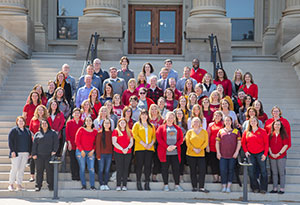
    In 2019, Iowa State University implemented a new financial management and human capital management system. In conjunction with the new system, finance and HR service delivery teams were developed, pulling distributed customer-facing finance and HR roles into two centralized teams. University human resources’ performance through this significant and ongoing organizational change has been positive for the entire campus community. The HR delivery model has led to increased consistency and standardization in delivery of services across the university. It has also created a more well-trained and cohesive team of professionals that work together up and down the chain to find creative solutions to HR challenges and opportunities. HR support for leaders across the institution has significantly improved through better access to accurate data, streamlined processes for workforce and position planning, compensation adjustments, support addressing low-preforming employees and behavioral issues, large-scale employee movement and reorganizations, and professional human capital consulting. The new HR delivery systems have resulted in a much more efficient, collaborative and cohesive HR unit that is better equipped to serve employees and supervisors. At the same time, employees and supervisors have benefitted from HR’s reliability, transparency, accountability and consistency in its efforts to support them.

    Talent and Culture Department, Broward College (Southern Region)

    Recognizing that HR alone cannot create culture but that it plays a critical role in ensuring the infrastructure is in place to support the cultural aspirations of an organization, the talent and culture department at Broward College has worked over the last several years to spearhead significant organizational change. Beginning in 2019, the university launched its three-year culture transformation plan. An integral step in the transformation process was the implementation of information-gathering discussions between the HR leadership team and employee groups comprised of administrators, faculty and professional technical staff, which provided substantive feedback on areas that needed the most attention. This organizational change, led by the talent and culture department, has resulted in more substantive collaboration; stronger relationships among faculty, staff and administrators; and greater trust and communication between employees and their supervisors. It has also served as a catalyst for innovative projects throughout the organization designed to maximize the experience of employees, students and the community. Some major initiative highlights include the creation of talent business partner roles, Leadership 360 Assessments, psychological safety workshops, employee resource groups, employee onboarding, and a leadership development program called BC LEAD that educates and empowers managers at all levels to rise to leadership excellence.
    HR Campus Climate Liaisons, The University of Texas Rio Grande Valley (Western Region)

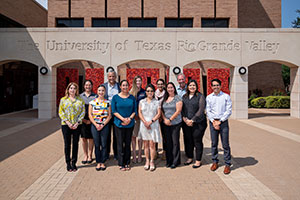
    After implementing a strategic action planning process, led by an internal HR workgroup called Campus Climate Liaisons, The University of Texas Rio Grande Valley saw double-digit improvements in climate survey results within three years, all amid a pandemic. The liaison group consists of individuals from various HR areas, such as talent development, organizational development, employee wellness and employee relations/business partners. The group was trained to provide support to assigned departments with result-sharing, action-planning and ongoing progress-reporting. This method ensured that all departments received the same level of support and helped the HR team better track progress toward climate goals. It also helped empower all department leaders to have conversations about campus climate and department climate. The biggest improvements were seen in areas of faculty, administration and staff relations; senior leadership; and facilities. The campus climate liaison model has been so successful that it will continue to be used for future campus climate initiatives and to provide ongoing support to all departments.

    Higher Ed HR Rock Star Award

    This award recognizes an individual who is serving in the first five years of a higher education HR career who has already made a significant impact.

    Audrey Davis, Assistant Director of Personnel, Texas Tech University (Western Region)

    With her enthusiasm and inspirational demeanor, Audrey Davis has built strong and trusting relationships with each department she works with, not only within university student housing, but within each auxiliary services area at Texas Tech University. Since taking over the personnel team, Audrey has demonstrated continuous innovation and creative thinking, which has completely changed the way the student housing personnel team operates and provides services. After only two years in her role, she has identified and eliminated major gaps in the onboarding/offboarding processes. She has also developed a collaborative hiring system that allows hiring managers to communicate efficiently with the personnel team to discuss new hires, promotions and terminations. Audrey’s initiatives have resulted in university student housing being named a center for excellence for human resourcing by the assistant vice president for auxiliary services. Audrey continues to make a positive impact with her role and demonstrates her passion through advocacy, by fostering a welcoming work environment and by building confidence in her team to serve as a one-stop shop for personnel services.


    Source link

  • 2022 Data: Changes in Higher Ed Pay and Workforce Size – CUPA-HR

    2022 Data: Changes in Higher Ed Pay and Workforce Size – CUPA-HR

    by CUPA-HR | April 27, 2022

    CUPA-HR has released its data on overall higher ed pay increases, as well as changes in workforce size for 2021-22.

    Higher Ed Pay Increases Have Not Kept Pace With Inflation

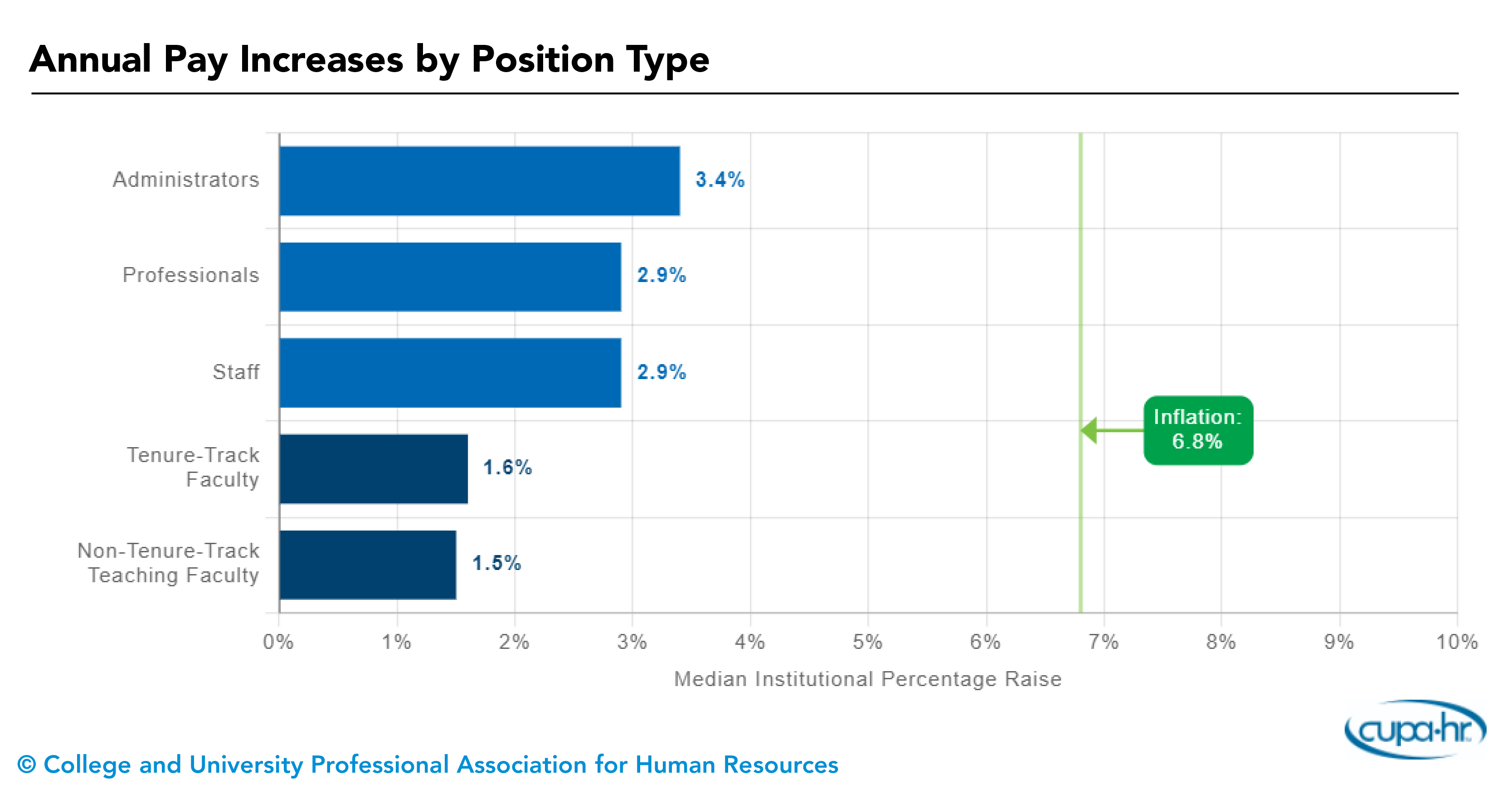
    The soaring inflation rate has far outpaced pay increases for the higher education workforce. According to findings from CUPA-HR’s annual workforce surveys for 2021-22, overall median salaries for administrators increased by 3.4%. Professionals and non-exempt staff saw increases of 2.9%, and salaries for tenure-track and non-tenure-track faculty increased by 1.6% and 1.5%, respectively. The inflation rate for 2021 was 6.8% and continues to climb.

    This is not the first year that pay increases have not kept up with inflation. Pay increases for administrators, professionals and staff last met or exceeded inflation in 2019-20.  Non-tenure-track faculty salary increases last met or exceeded inflation in 2016-17, and tenure-track faculty salary increases have not kept pace with inflation in any of the past six years.

    Explore pay-increase trends on CUPA-HR’s website.

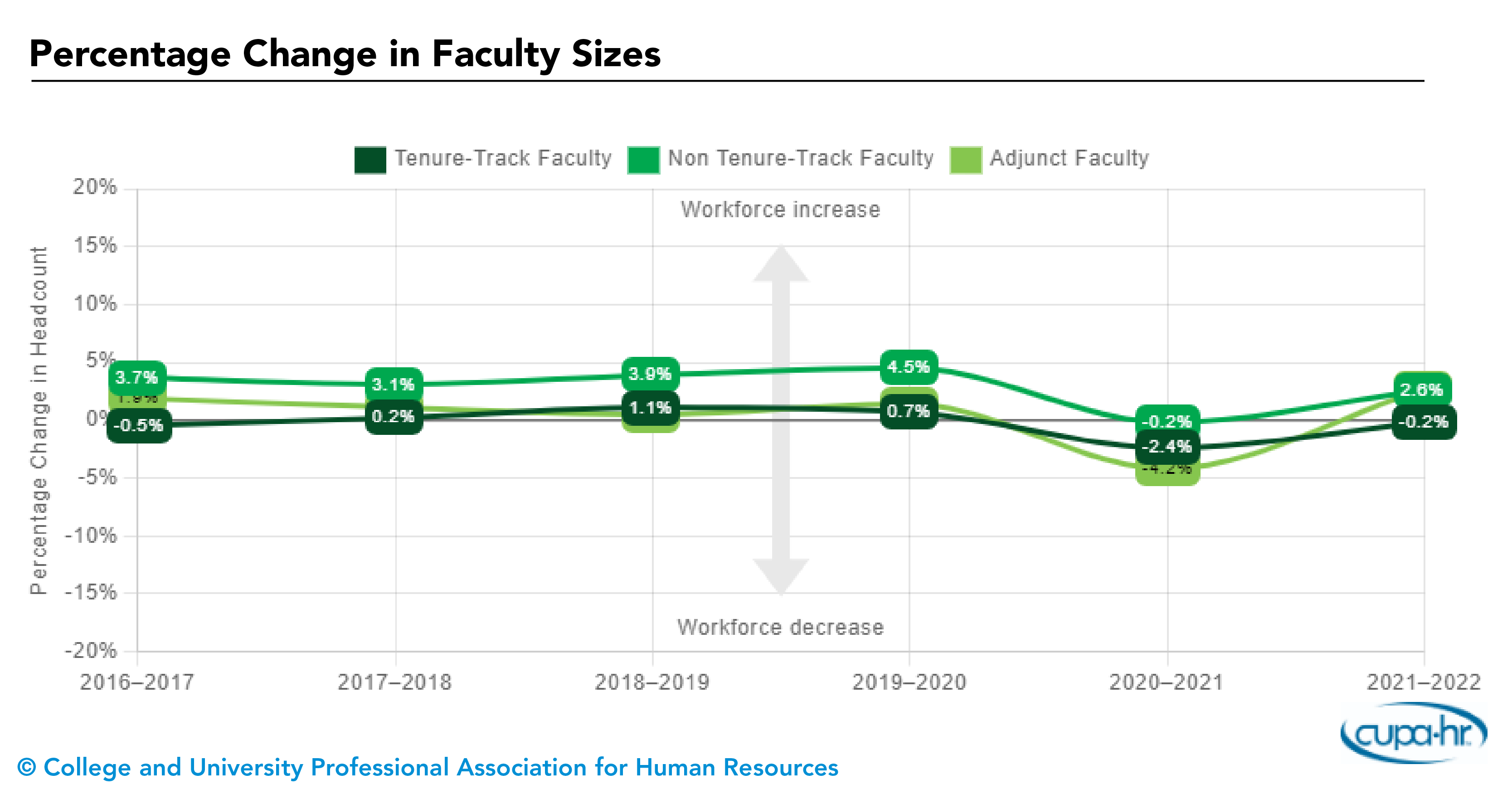
    Overall Workforce Size Has Declined in the Wake of the Pandemic

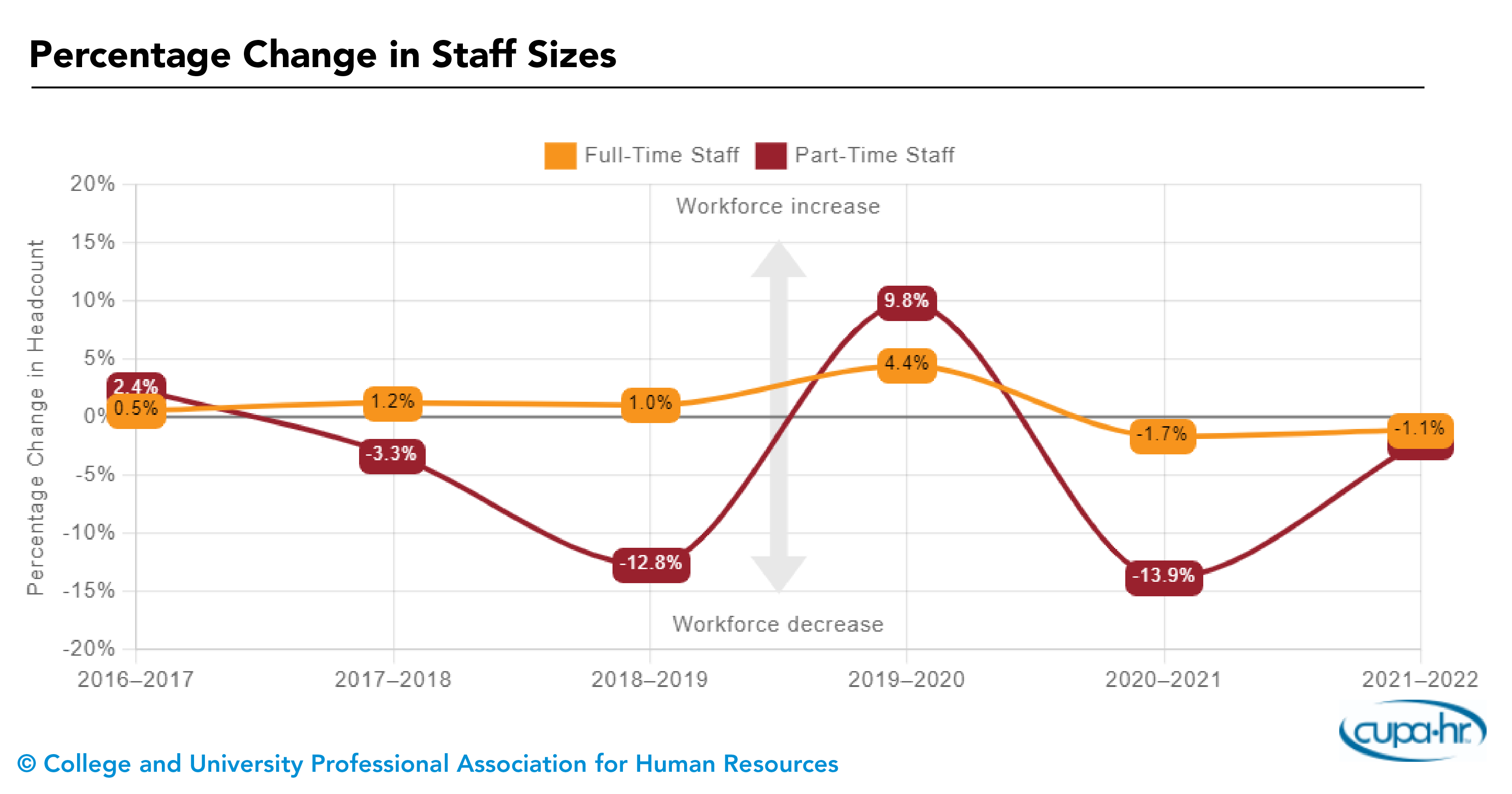
    Historically, the overall size of the higher education workforce has increased from year to year. However, colleges and universities are experiencing the same employee recruitment and retention challenges that most U.S. employers have struggled with in the past few years. In both 2020-21 and 2021-22, the size of full-time staff, part-time staff, and tenure-track faculty declined from the prior year.

    Two areas of the workforce that saw growth this year were those of non-tenure-track faculty and adjuncts. Although the number of non-tenure-track faculty and adjuncts declined between 2019-20 and 2020-21, those numbers have rebounded in 2021-22.

    Explore the trends in workforce size changes on CUPA-HR’s website.

    In-Depth Data and Custom Reports

    Higher ed institutions can use CUPA-HR’s DataOnDemand (DOD) subscription service to run comprehensive data tables and analyses.


    Source link

  • HR and the Courts – CUPA-HR

    HR and the Courts – CUPA-HR

    by CUPA-HR | April 13, 2022

    Each month, CUPA-HR General Counsel Ira Shepard provides an overview of several labor and employment law cases and regulatory actions with implications for the higher ed workplace. Here’s the latest from Ira.

    Court of Appeals to Decide Whether a Non-Citizen Applicant for U.S. College Soccer Coaching Position Is Covered Under U.S. Anti-Discrimination Laws 

    The U.S. Court of Appeals for the D.C. Circuit will review a federal trial court decision concluding that a non-citizen soccer coach applicant is not protected or covered by U.S. anti-discrimination statutes.

    The federal trial court dismissed the case against American University on summary judgement concluding that a non-citizen applicant living outside the United States is not protected under Title VII or the Civil Rights Act of 1866. The plaintiff has appealed to the D.C. Circuit claiming that he was discriminated against because of his race, ethnicity and national origin when he did not receive the position he applied for (Nahkid v. American University ( DC Cir. No. 21-cv-7107, 3/11/22)). The plaintiff was a citizen of Trinidad Tobago and was living in Lebanon when he applied for the position. The plaintiff is a graduate of American University and played on the soccer team when he was a student.

    Federal Court Jury Awards Professor $3 Million for Past and Future Emotional Distress, Pain and Suffering Resulting From Her Tenure Denial Based on Her Sex and Pregnancies

    A federal district court jury in west Texas awarded an assistant engineering professor more than $3 million in damages as a result of finding that the University of Texas At Austin denied her tenure because of her sex and pregnancies. The professor was awarded $1 million for past emotional pain and suffering, $2 million for future emotional pain and suffering and $50,000 for lost back pay and benefits (Nikolova v. University of Texas at Austin (W, Dist Tex. No. 1:19-cv-00877, jury verdict 3/14/22)). Motions may be filed to have the court reduce the jury’s damage verdict.

    Court of Appeals Dismisses Student Intern’s Title VII Discrimination Claims Due to No Employee/Employer Relationship

    The U.S. Court of Appeals for the Third circuit (covering Pennsylvania, New Jersey and Delaware) recently affirmed a trial court’s dismissal of a Temple University student intern’s race discrimination lawsuit against an opioid rehab facility, Prevention Point, where he was interning. The plaintiff was a student in Temple’s public health program and obtained the internship as part of the program to complete his degree. In an unpublished decision, the court of appeals concluded that the plaintiff did not have an employee/employer relationship with Prevention Point, so there was no Title VII jurisdiction (Payne v. Prevention Point Philadelphia (2022 BL 86265 Cir. No. 21-02173, unpublished, 3/15/22)).

    The court pointed to evidence that documented that the goals of the internship related to the plaintiff’s course work at Temple and that other documents supported the fact that university staff coordinated with the facility’s staff to manage the internship.

    New York State Court System Terminates 103 Unvaccinated Employees as Appeals Court Reinstates Presidential Vaccine Mandate Among Federal Workers

    New York state court administrators disclosed that they have terminated 103 employees for failure to adhere to the court system’s vaccine mandate. They also reported that another 12 employees have retired or resigned after they failed to comply with the court’s COVID-19 vaccine requirements. All unvaccinated employees were given a warning last month that they faced possible termination for not complying with the vaccine mandate. Forty-one people in that group did comply and were not among those terminated for non-compliance.

    Four judges also face further action for not complying as the court administrators do not have the power to terminate non-compliant judges. It appears that the court administrators will refer non-compliant judges to the judicial ethics independent watchdog for non-compliance and further potential action.

    Union officials representing the terminated employees continue to fight the terminations. Federal courts have ruled against attempts to block enforcement of the court administration’s vaccine mandate.

    Separately, the U.S. Court of Appeals for the Fifth Circuit reversed a Texas federal district court judge’s order, blocking the presidential requirement for federal civilian employees to be vaccinated. The court of appeals threw out the challenge to the presidential order, requiring over two million federal civilian employees to be vaccinated or face termination (Feds for Medical Freedom v. Joseph Biden (5th Cir. No. 22-40043, 4/7/22).

    States Beginning to Ban Employer Non-Disclosure Agreements

    The state of Washington recently became the latest state to restrict an employer’s ability to request or demand a non-disclosure agreement (NDA) as a condition of employment or as part of a settlement agreement in discrimination or other employment-related cases.

    The Washington state law takes effect on June 9, 2022. The law goes on step further than similar laws in California and New York, which ban NDAs. The Washington state law bans confidentiality agreements, in addition to NDAs, as part of workplace settlements related to allegations of illegal conduct.


    Source link

  • Reauthorization of Violence Against Women Act Signed Into Law – CUPA-HR

    Reauthorization of Violence Against Women Act Signed Into Law – CUPA-HR

    by CUPA-HR | April 12, 2022

    On March 15, President Biden signed into law the Violence Against Women Act (VAWA) Reauthorization Act of 2022. The legislation reauthorizes all current VAWA grant programs through 2027 and was included in the omnibus appropriations package, which provided $1.5 trillion to fund the federal government for fiscal year 2022.

    Several of the VAWA Reauthorization Act’s provisions will specifically impact higher education institutions. The bill:

    • requires colleges and universities to conduct campus climate surveys of students to track their experiences of sexual violence on campus;
    • expands and provides additional funding for the Rape Prevention and Education Grant Program and other existing campus grants designed to provide comprehensive prevention education for students;
    • establishes a pilot program that provides funding to colleges and universities (among other entities) to create programs on restorative practices to prevent and address sexual violence;
    • requires the Secretary of Health and Human Services to create a demonstration grant program for colleges and universities to provide comprehensive forensic training to train healthcare providers on forensic assessments and trauma-informed care to survivors of sexual violence; and
    • requires the Government Accountability Office to examine the relationships between victims of sexual violence and their ability to repay their student loans.

    Of particular concern for higher ed institutions is the survey to track student experiences of sexual violence on campus. Conducting the survey could create challenges for the institutions as well as for the Department of Education charged with developing it. Additionally, some institutions are already conducting similar surveys on their campuses, creating a risk of duplicated efforts. This will be a complex undertaking for both the department and higher ed institutions.

    CUPA-HR will update members on any additional information on the implementation of the VAWA Reauthorization Act as it is released.


    Source link

  • President Biden Nominates Kalpana Kotagal to Serve as EEOC Commissioner – CUPA-HR

    President Biden Nominates Kalpana Kotagal to Serve as EEOC Commissioner – CUPA-HR

    by CUPA-HR | April 11, 2022

    On April 1, President Biden announced his intention to nominate Kalpana Kotagal to serve as a commissioner on the Equal Employment Opportunity Commission (EEOC). If confirmed, Kotagal would give the EEOC Democratic control for the first time under the Biden administration, as she would fill the seat currently held by Janet Dhillon, a Republican appointee whose term expires on July 1.

    Kotagal is currently a partner at Cohen Milstein Sellers & Toll and is a member of the firm’s civil rights and employment practice group and chair of their hiring and diversity committee. In her time with Cohen Milstein, she has worked on several high-profile cases, including:

    • a class action lawsuit representing over 69,000 female employees against Sterling Jewelers alleging gender discrimination and Equal Pay Act violations — a case that may reach the Supreme Court; and
    • a class action against AT&T Mobility Services in which the company’s sales representatives allege that the company’s attendance and late policy amounts to pregnancy discrimination and violates the Pregnancy Discrimination Act, Americans with Disabilities Act and Family and Medical Leave Act.

    Kotagal is also a co-author of the Inclusion Rider, which is a legal template that individuals in the entertainment industry can add to their contracts to demand diversity and inclusivity on projects. She and her co-authors drafted the rider and made it public so anyone in the industry can use it.

    In addition to her work with Cohen Milstein, Kotagal sits on the board of directors of A Better Balance, a nonprofit that litigates pregnancy discrimination claims and advocates for “supportive policies,” including paid sick, family and medical leave, fair scheduling and accessible, and quality childcare and education. She is also a board member for the Public Justice Foundation, a nonprofit focused on “high-impact lawsuits to combat social and economic injustice, protect the earth’s sustainability and challenge predatory corporate conduct and government abuses.”

    Kotagal is also a co-chair of the alumni advisory board on equity and inclusion at the University of Pennsylvania Law School, a member of the American Constitution Society Task Force on #MeToo in the legal profession, and serves on the advisory counsel of the People’s Parity Project, which focuses on reforming the legal system.

    CUPA-HR will monitor and keep members apprised of any updates to her nomination during the confirmation process.


    Source link

  • DOL to Host Regional Listening Sessions for Proposed Overtime Rule Regulations – CUPA-HR

    DOL to Host Regional Listening Sessions for Proposed Overtime Rule Regulations – CUPA-HR

    by CUPA-HR | April 7, 2022

    In the Biden administration’s fall 2021 regulatory agenda, the Department of Labor (DOL)’s Wage and Hour Division (WHD) announced that it planned to release in April 2022 a Notice of Proposed Rulemaking (NPRM) changing criteria for the “executive, administrative and professional” exemptions from the overtime pay requirements under the Fair Labor Standards Act (FLSA). In May and June, the DOL will host five regional listening sessions allowing stakeholders to discuss the anticipated proposed rule aimed at changing the exemptions to the federal overtime pay requirements.

    With listening sessions extending into May, the WHD will not be able to meet the April target date, but we do expect the agency will release a proposed rule in 2022 with compliance likely required in 2023. While the DOL has not shared how it may change the exemptions, it is holding listening sessions to elicit stakeholder input as to whether changes are appropriate and what changes would be appropriate at this time.

    Background

    According to the regulatory agenda, one of the goals of the NPRM would be “to update the salary level requirement of the section 13(a)(1) exemption [under the FLSA].” Changes to the overtime exemption minimum salary threshold have been proposed recently under both the Obama and Trump administrations. In 2016, President Obama’s DOL issued a final rule to increase the salary threshold from $23,660 to $47,476 per year and impose automatic updates to the threshold every three years, but the rule was subsequently struck down by federal court before taking effect in 2017. In 2019, the Trump administration issued a new final rule that raised the minimum salary threshold from $23,660 to $35,568 annually, which went into effect on January 1, 2020. The $35,568 threshold remains in effect today.

    On March 29, in anticipation of the upcoming Biden administration rule, the DOL held a virtual higher education-specific listening session for D.C.-based higher education associations, including CUPA-HR. The listening session was scheduled after CUPA-HR and 14 other higher education associations submitted a request that the DOL hold such meetings prior to releasing the anticipated NPRM. CUPA-HR and several other higher education associations joined the session to discuss potential concerns institutions may have with an increase to the minimum salary threshold at this time.

    Regional Sessions

    In addition to the D.C. meeting held in March, the DOL is planning to host five additional regional listening sessions for employers. The sessions include the following:

    • Northeast Employers: May 13 at 3:30 p.m. EDT
    • Southeast Employers: May 17 at 2:00 p.m. EDT
    • Midwest Employers: May 20 at 3:30 p.m. EDT
    • Southwest Employers: May 27 at 3:00 p.m. EDT
    • West Employers: June 3 at 3:30 p.m. EDT

    If your institution is interested in participating in any of the regional meetings, please reach out to CUPA-HR’s Chief Government Relation Officer Josh Ulman at [email protected]. Additional information about the D.C. listening session and CUPA-HR’s talking points will be provided upon inquiry.


    Source link

  • CUPA-HR Files Comment Extension Request to USDA Regarding New Blacklisting Regulation for Federal Contractors – CUPA-HR

    CUPA-HR Files Comment Extension Request to USDA Regarding New Blacklisting Regulation for Federal Contractors – CUPA-HR

    by CUPA-HR | March 21, 2022

    On February 17, the U.S. Department of Agriculture (USDA) issued a Notice of Proposed Rulemaking (NPRM) outlining plans to impose new HR-related conditions on USDA contracts. If finalized, the rule would require federal contractors on projects procured by the USDA to certify their compliance with dozens of federal and state labor laws and executive orders. The proposal mirrors similar “blacklisting” regulations pursued by the USDA during the Obama administration.

    The USDA provided only 32 days for stakeholders to submit comments on the proposal. CUPA-HR, along with several other higher education associations, filed an extension request with the department asking for an additional 90 days to “evaluate the NPRM’s impact on [members’] research missions and collect the information needed in order to provide thoughtful and accurate input to the USDA.” CUPA-HR plans to file comments on the proposal as well.

    The new proposed rulemaking amends the Agriculture Acquisition Regulation (AGAR) to require federal contractors on USDA supply and service projects that exceed the simplified acquisition threshold to certify that they and their subcontractors and suppliers are “in compliance with” 15 federal labor laws, their state equivalents and executive orders. This includes, but is not limited to:

    • Fair Labor Standards Act;
    • Occupational Safety and Health Act;
    • National Labor Relations Act;
    • Service Contract Act;
    • Davis-Bacon Act;
    • Title VII of the Civil Rights Act;
    • Americans with Disabilities Act;
    • Age Discrimination in Employment Act; and
    • Family and Medical Leave Act.

    Additionally, federal contractors submitting offers for a project would be required to disclose to the USDA previous violations and certify they and their subcontractors “are in compliance with” any required corrective actions for those violations. They would also be required to alert USDA to any future adjudications of non-compliance.

    In 2011, the USDA tried to implement a similar policy via a Direct Final Rule and NPRM, but was forced to withdraw both due to stakeholder pushback. CUPA-HR filed comments with the Society for Human Resource Management calling the rules arbitrary and capricious. Our comments also criticized the rules for not adequately clarifying how contractors were expected to comply with the changes and for imposing severe penalties. Additionally, CUPA-HR joined comments filed by the American Council on Education and several other higher education associations that argued the USDA’s rules “impose[d] an unmanageable compliance burden and uncertain compliance risk for colleges and universities that conduct agricultural research under contracts with the [USDA].”

    Additionally, the Obama administration issued an executive order in July 2014 implementing a similar government-wide policy. The Federal Acquisition Regulation (FAR) Council and the Department of Labor issued regulations and guidance, respectively, implementing the order, but they were blocked by a federal judge in October 2016 for violating the First Amendment and due process rights. Congress also passed a Congressional Review Act challenge to the executive order in 2017, permanently withdrawing the executive order and barring the FAR Council from issuing any substantially similar regulations.

    Unlike past proposals, this time the USDA has stated that the certifications will be subject to the False Claims Act (FCA), which provides for substantially increased liability. The FCA provides for treble damages and penalties and allows for private citizens to file suits on behalf of the government (called “qui tam” suits). Qui tam litigants receive a portion of the government’s recovery. According to the Department of Justice (DOJ), the awards to qui tam litigants in FCA suits topped $238 million in 2021. The same DOJ statistics show qui tam suits were the majority of FCA claims, with the government filing 203 new suits under FCA in 2021 compared to 598 qui tam suits in the same year.

    CUPA-HR will continue to monitor this issue closely.


    Source link

  • Supreme Court Issues Decision Regarding Retirement Plan Fiduciary Duties in Hughes v. Northwestern – CUPA-HR

    Supreme Court Issues Decision Regarding Retirement Plan Fiduciary Duties in Hughes v. Northwestern – CUPA-HR

    by CUPA-HR | March 18, 2022

    On January 24, the Supreme Court issued its unanimous decision in Hughes v. Northwestern University, a case dealing with 403(b) retirement plan fiduciary duties under the Employee Retirement Income Security Act (ERISA). The court criticized the standard applied by the lower courts and sent the case back to the 7th Circuit to reevaluate the plaintiffs’ allegations.

    In the case, the three plaintiffs, all current or former employees of the university, alleged the plan fiduciaries violated the duty of prudence standard under ERISA by “(1) failing to monitor and control recordkeeping fees, resulting in unreasonably high costs to plan participants; (2) offering mutual funds and annuities in the form of ‘retail’ share classes that carried higher fees than those charged for otherwise identical share classes (institutional share class) of the same investments; and (3) offering investment options that were likely to confuse investors.”

    In their decision, which was written by Justice Sotomayor, the court explained that, when determining if a plan fiduciary violated the duty of prudence standard under ERISA, courts must engage in “a context-specific inquiry of the fiduciaries’ continuing duty to monitor investments and to remove imprudent ones” as articulated in Supreme Court precedent, Tibble. The court said the 7th Circuit was wrong in concluding that by providing a choice of investment options, plan fiduciaries insulated themselves from liability claims. It is important to note that the court chose not to weigh in on the plausibility of the plaintiffs’ claims, only on the standard applied by the lower courts.

    CUPA-HR, along with 17 other higher education associations, participated in an amicus brief filed in the case. In the brief, we supported the 7th Circuit’s decision in favor of Northwestern University. We explained, “The question in this case is whether petitioners have pleaded sufficient facts to state a plausible claim for breach of fiduciary duty in administering a retirement plan” under ERISA, but the complaints in this case “overlook important features of the university retirement system and ignore the discretion ERISA affords to plan fiduciaries.” We also clarified that universities and plan fiduciaries “must have the flexibility o administer the plans based upon the particular needs and preferences of the plan participants, without constant second-guessing.”

    The 7th Circuit now has the opportunity to revisit the case. It may choose to dismiss much of the case or review the record again.

    Following the decision, our amicus briefing counsel was quoted saying, “Despite some of the early headlines that have already been written suggesting this case is a really big deal, in fact, I view this as a limited ruling… [T]he Supreme Court did not reach any specific or detailed conclusions that any of the investments offered by the defendants in this case are actually inappropriate, nor did the justices come down and say a fiduciary can never offer retail shares of funds within their institutional retirement plans. Instead, what they said, in a nutshell, is that the 7th Circuit simply did not give enough consideration of the duty-to-monitor precedents set by Tibble.”

    Importantly, the final sentence of the Supreme Court’s decision provided a silver lining; “At times, the circumstances facing an ERISA fiduciary will implicate difficult tradeoffs, and courts must give due regard to the range of reasonable judgments a fiduciary may make based on her experience and expertise.” The court here is clarifying that fiduciaries must be given due deference when making tough decisions.

    That being said, the decision could pave the way for more cases on fiduciary duties to be filed, as plaintiffs’ attorneys may take advantage of the potential opening in order to force settlements.


    Source link