Category: Higher education affordability

  • 5 years after transcript withholding bans began, college students face fewer obstacles but advocates worry about enforcement

    5 years after transcript withholding bans began, college students face fewer obstacles but advocates worry about enforcement

    by Felicia Mello, The Hechinger Report
    December 23, 2025

    OAKLAND — In 2020, California led the nation in outlawing transcript-withholding, a debt collection practice that sometimes kept low-income college students from getting jobs or advanced degrees. Five years later, 24 of the state’s 115 community colleges still said on their websites that students with unpaid balances could lose access to their transcripts, according to a recent UC Merced survey. 

    The communications failure has been misleading, student advocates said, although overall, the state’s students have benefited from the law.  

    It “raises questions about what actual institutional practices are at colleges and the extent to which colleges know the law and are fully compliant with the law,” said Charlie Eaton, a UC Merced sociology professor who led the research team that conducted the survey in October. 

    California community colleges say they are following the law, which prohibits them from refusing to release the grades of a student who owes money to the school — anywhere from a $25 library fine to unpaid tuition. The misinformation on some college websites is a clerical problem that campuses have been asked to update,  the California Community Colleges chancellor’s office said in an emailed statement.   

    Without an official transcript, students can’t prove they’ve earned college credits to admissions offices elsewhere or to potential employers. Millions of students nationwide have lost access to their transcripts because of unpaid fees, according to estimates from the higher education consulting firm Ithaka S+R.  

    Student advocates argued that the practice made little money for colleges, while costing graduates opportunities that could help them pay back their debts. 

    California lawmakers agreed; in 2019, they passed legislation that took effect on Jan. 1 2020, barring colleges from using transcript holds to collect debts. 

    At least 12 other states have followed California’s lead, passing laws limiting or banning colleges from withholding transcripts. 

    A similar but less stringent federal rule approved during the Biden administration took effect last year. 

    The new rules have raised awareness about colleges’ debt collection practices and inspired some to find ways to help their students avoid falling behind on their payments in the first place or to pay off what they owe — including by forgiving their debts.

    Related: Interested in innovations in higher education? Subscribe to our free biweekly higher education newsletter.

    Transcript withholding was never an especially effective collection tool, researchers have found. One 2018 study estimated that Ohio’s public colleges only netted only $127 for each transcript they withheld.

    Colleges and universities, however, argued that withholding transcripts was one of the few ways they had to prevent students from bouncing among institutions and leaving unpaid bills in their wake. Some use another tactic, blocking them from registering for new courses until bills are paid. 

    When colleges choose to withhold transcripts, the burden falls more heavily on low-income students and students of color, according to the American Association of Collegiate Registrars and Admissions Officers. Often those students accrue debts when they withdraw partway through a course, leading the college to return part of their financial aid to the federal government and charge the bill to the student. 

    In states with laws limiting transcript withholding, many colleges have begun communicating earlier and more often with students about their debts and offering flexible payment plans, said Elizabeth Looker, a senior program manager at Ithaka S+R. Some have added financial literacy training or required students with unpaid bills to meet with counselors. 

    Eight public colleges and universities in Ohio went further, offering a deal to former students with unpaid balances: Reenroll at any of the eight, and get up to $5,000 of the outstanding debt forgiven. Called the Ohio College Comeback Compact, the program, which began in 2002 and concludes this fall, was open to former students who had at least a 2.0 GPA and had been out of school a year or more.

    The program was designed to give a second chance to students whose educations stalled because of events outside their control, such as losing a job in the middle of the semester, said Steve McKellips, vice president for enrollment management at the University of Akron.

    Since the Ohio College Compact’s inception, 79 students have returned to the university under the program, at a cost to the state of $54,174 in debt forgiven. The university netted five times that, or $271,924, in additional tuition, McKellips said. More than 700 students have used the compact to reenroll, according to Ithaka S+R, which helped coordinate the program and is studying the results.

    “I think sometimes people have this image of somebody walking away from a tuition bill because they just don’t care,” McKellips said. “But sometimes there’s just a boulder in the way and somebody needs to move it. Once the boulder was moved and they could move forward, we’re finding them continuing happily along the way they always intended to.”

    Related: City University of New York reverses its policy on withholding transcripts over unpaid bills 

    Another California bill, introduced this year, would have given students a one-time pass to register for courses, even if they owed a debt. It failed after the University of California, Cal State and many private colleges and universities opposed it. 

    The University of California cited expected cuts to federal and state funding as one reason it opposed the bill. “UC believes that maintaining the ability to hold registration is essential for its ability to reasonably secure unpaid student debt,” UC legislative director Jessica Duong wrote to lawmakers.

    Cal State spokesperson Amy Bentley-Smith said that Cal State wanted a flexible approach to debt collection and that campuses had started eliminating registration holds for minor debts such as parking tickets and lost library books. 

    “Students are able to move forward with their enrollment even with institutional debts in the low hundreds to the low thousands of dollars, depending upon the university,” she said.

    Supporters of the failed bill — which also would have barred colleges from reporting a student’s institutional debt to credit agencies — said curbing aggressive debt collection doesn’t just help low-income students; it speeds up the training of workers in industries crucial to the state’s economy.

    “Schools think about these institutional debts in a way that is very penny-wise and pound-foolish, and it’s preventing people from participating in the economy,” said Mike Pierce, executive director of Protect Borrowers.

    Related: Colleges fight attempts to stop them from withholding transcripts over unpaid bills

    Annette Ayala of Simi Valley, hoping to become a registered nurse,  took her for-profit college to court to force it to comply with California’s debt collection law.  

    She had earned her vocational nursing license from the school, the Professional Medical Careers Institute, and wanted to continue her studies to become a registered nurse. But the college refused to release her transcript —  citing a $7,500 debt that Ayala argued in court records she did not owe — and without the transcript she could not apply to other colleges. 

    In her case, California’s Bureau for Private Postsecondary Education, which regulates for-profit colleges under the state’s Department of Consumer Affairs, cited her former school for violating the state’s transcript-withholding law.

    The college was fined $1,000 and ordered to update its enrollment agreement. The school forgave the debt it said Ayala owed. It’s the only case in which a school has been cited for withholding a transcript since the bureau started monitoring compliance with the law more closely two years ago, said Monica Vargas, a spokesperson for consumer affairs. 

    School officials had been unaware of the California law at the time Ayala sued, the school’s controller, Joshua Taylor, said, and have since updated their catalog to comply with it.

    With her vocational nursing license, Ayala has been working in home health care. Now that she has her transcript, she’s applying for RN programs, and said her salary would roughly double once she has the new degree, allowing her to save for the future and help her son pay for college.

    “You’ve got to give people the chance to get through their program and pay their debts as they’re working,” she said. “You can’t hold them back from being able to make top dollar with their abilities to pay back these loans.”

    Contact editor Lawrie Mifflin at 212-678-4078 or [email protected]

    This story about student debt and transcript withholding was produced by The Hechinger Report, a nonprofit, independent news organization focused on inequality and innovation in education. Sign up for our higher education newsletter. Listen to ourhigher education podcast.

    This <a target=”_blank” href=”https://hechingerreport.org/5-years-after-california-banned-holding-college-students-transcripts-hostage-for-unpaid-debt-some-colleges-neglect-the-law/”>article</a> first appeared on <a target=”_blank” href=”https://hechingerreport.org”>The Hechinger Report</a> and is republished here under a <a target=”_blank” href=”https://creativecommons.org/licenses/by-nc-nd/4.0/”>Creative Commons Attribution-NonCommercial-NoDerivatives 4.0 International License</a>.<img src=”https://i0.wp.com/hechingerreport.org/wp-content/uploads/2018/06/cropped-favicon.jpg?fit=150%2C150&amp;ssl=1″ style=”width:1em;height:1em;margin-left:10px;”>

    <img id=”republication-tracker-tool-source” src=”https://hechingerreport.org/?republication-pixel=true&post=114067&amp;ga4=G-03KPHXDF3H” style=”width:1px;height:1px;”><script> PARSELY = { autotrack: false, onload: function() { PARSELY.beacon.trackPageView({ url: “https://hechingerreport.org/5-years-after-california-banned-holding-college-students-transcripts-hostage-for-unpaid-debt-some-colleges-neglect-the-law/”, urlref: window.location.href }); } } </script> <script id=”parsely-cfg” src=”//cdn.parsely.com/keys/hechingerreport.org/p.js”></script>


    Source link

  • OPINION: Workforce Pell can lead to good jobs for students if they get the support needed for long-term success

    OPINION: Workforce Pell can lead to good jobs for students if they get the support needed for long-term success

    by Alexander Mayer, The Hechinger Report
    December 16, 2025

    Ohio resident Megan Cutright lost her hospitality job during the pandemic. At her daughter’s urging, she found her way to Lorain County Community College in Ohio and onto a new career path.  

    Community colleges will soon have a new opportunity to help more students like Megan achieve their career goals. Starting next summer, federal funds will be available through a program known as Workforce Pell, which extends federal aid to career-focused education and training programs that last between eight and 15 weeks. 

    Members of Congress advocating for Pell Grants to cover shorter programs have consistently highlighted Workforce Pell’s potential, noting that the extension will lead to “good-paying jobs.”  

    That could happen. But it will only happen if states and colleges thoughtfully consider the supports students need for success.  

    This is important, because helping students pay for workforce programs is not enough. They also need support and wraparound services, much like the kind Megan was offered at Lorain, where her program followed an evidence-based model known as ASAP that assigns each student a career adviser. 

    Related: Interested in innovations in higher education? Subscribe to our free biweekly higher education newsletter. 

    Megan’s adviser “helped me from day one,” she said, in a story posted on the college’s website. “I told her I was interested in the radiologic technology program but that I had no idea where to start. We just did everything together.”  

    Megan went on to secure a job as an assistant in the radiology department at her local hospital, where she had interned as a student. She knew what steps she needed to take because her community college supported and advised her, using an evidence-backed practice, illustrating something we have learned from the experience of the community colleges that use the ASAP model: Support is invaluable.  

    Megan also knew that her path to a full-time position in radiologic technology required her to pass a licensure test — scheduled for four days after graduation.  

    The students who will enroll in Workforce Pell programs deserve the same careful attention. To ensure that Workforce Pell is effective for students, we should follow the same three critical steps that helped drive the expansion of ASAP and brought it to Megan’s college: (1) experiment to see what works, (2) collect and follow the data and (3) ensure that colleges learn from each other to apply what works. 

    Before ASAP was developed, the higher education community had some ideas about what might work to help students complete their degrees and get good jobs. When colleges and researchers worked together to test these ideas and gathered reliable data, though, they learned that those strategies only helped students at the margins. 

    There was no solid evidence about what worked to make big, lasting improvements in college completion until the City University of New York (CUNY) worked with researchers at MDRC to test ASAP and its combination of longer-lasting strategies. They kept a close eye on the data and learned that while some strategies didn’t produce big effects on their own, the combined ASAP approach resulted in significant improvements in student outcomes, nearly doubling the three-year college completion rate.  

    CUNY and MDRC shared what they learned with higher education leaders and policymakers, inspiring other community colleges to try out the model. Those colleges started seeing results too, and the model kept spreading. Today, ASAP is used in more than 50 colleges in seven states. And it’s paying off — in Ohio, for example, students who received ASAP services ended up earning significantly more than those who did not. 

    That same experimentation and learning mindset will be needed for Workforce Pell, because while short-term training can lead to good careers, it’s far from guaranteed.  

    For example, phlebotomy technician programs are popular, but without additional training or credentials they often don’t lead to jobs that pay well. Similarly, students who complete short-term programs in information technology, welding and construction-related skills can continue to acquire stackable credentials that substantially increase their earning potential, although that also doesn’t happen automatically. The complexity of the credentialing marketplace can make it impossible for students and families to assess programs and make good decisions without help.  

    Related: OPINION: Too many college graduates are stranded before their careers can even begin. We can’t let that happen 

    A big question for Workforce Pell will be how to make sure students understand how to get onto a career path and continue advancing their wider career aspirations. Workforce Pell grants are designed to help students with low incomes overcome financial barriers, but these same students often face other barriers.  

    That’s why colleges should experiment with supports like career advising to help students identify stepping-stones to a good career, along with placement services to help them navigate the job market. In addition, states must expand their data collection efforts to formally include noncredit programs. Some, including Iowa, Louisiana and Virginia, have already made considerable progress linking their education and workforce systems.  

    Offering student support services and setting up data systems requires resources, but Workforce Pell will bring new funds to states and colleges that are currently financing job training programs. Philanthropy can also help by providing resources to test out what works best to get students through short-term programs and onto solid career paths.  

    Sharing what works — and what doesn’t — will be critical to the success of Workforce Pell in the long-term. The same spirit of learning that fueled innovation around the ASAP model should be embedded in Workforce Pell from the start.  

    Alexander Mayer is director of postsecondary education at MDRC, the nonprofit research association. 

    Contact the opinion editor at [email protected]. 

    This story about Workforce Pell was produced by The Hechinger Report, a nonprofit, independent news organization focused on inequality and innovation in education. Sign up for Hechinger’s weekly newsletter. 

    This <a target=”_blank” href=”https://hechingerreport.org/opinion-workforce-pell-can-lead-to-good-jobs-for-students-if-they-get-the-support-needed-for-long-term-success/”>article</a> first appeared on <a target=”_blank” href=”https://hechingerreport.org”>The Hechinger Report</a> and is republished here under a <a target=”_blank” href=”https://creativecommons.org/licenses/by-nc-nd/4.0/”>Creative Commons Attribution-NonCommercial-NoDerivatives 4.0 International License</a>.<img src=”https://i0.wp.com/hechingerreport.org/wp-content/uploads/2018/06/cropped-favicon.jpg?fit=150%2C150&amp;ssl=1″ style=”width:1em;height:1em;margin-left:10px;”>

    <img id=”republication-tracker-tool-source” src=”https://hechingerreport.org/?republication-pixel=true&post=113877&amp;ga4=G-03KPHXDF3H” style=”width:1px;height:1px;”><script> PARSELY = { autotrack: false, onload: function() { PARSELY.beacon.trackPageView({ url: “https://hechingerreport.org/opinion-workforce-pell-can-lead-to-good-jobs-for-students-if-they-get-the-support-needed-for-long-term-success/”, urlref: window.location.href }); } } </script> <script id=”parsely-cfg” src=”//cdn.parsely.com/keys/hechingerreport.org/p.js”></script>

    Source link

  • Amid a national shortage of nurses, nursing apprenticeships are beginning to offer a solution to the problem

    Amid a national shortage of nurses, nursing apprenticeships are beginning to offer a solution to the problem

    This story was produced in partnership with Work Shift and reprinted with permission. 

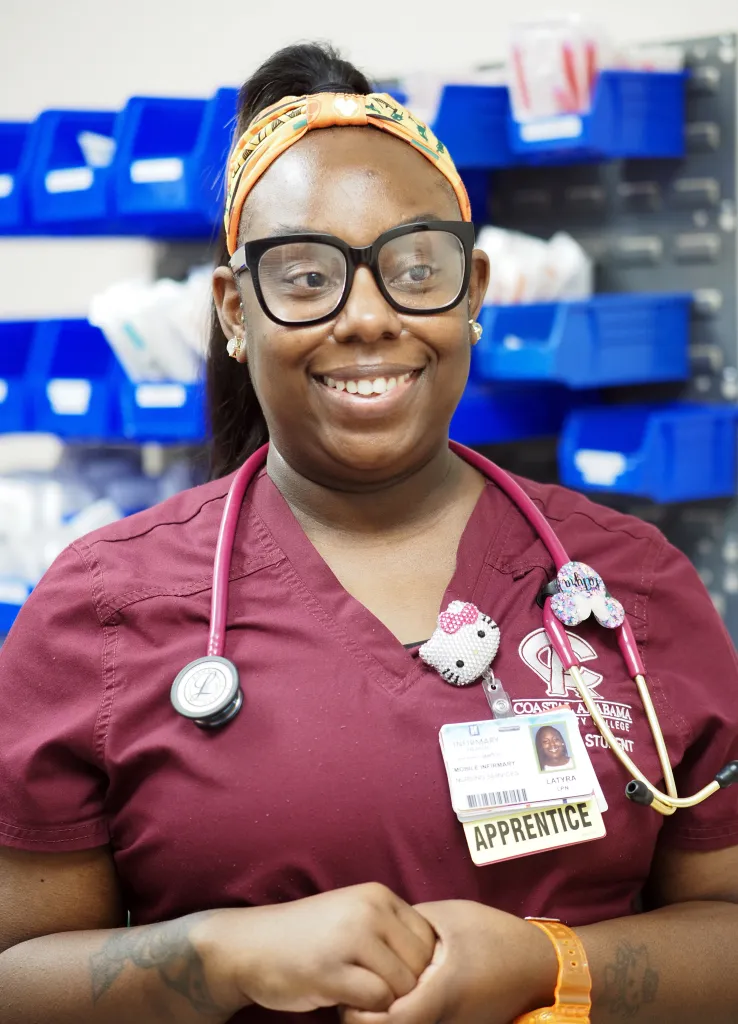
    MOBILE, Ala. — Three or four times a week, LaTyra Malone starts her day at Mobile Infirmary hospital at 6:30 a.m. For the next 12 hours, she makes her rounds and visits with patients — asking if they’re in pain, checking vitals, administering fluids. To an outside observer, she appears to be a nurse. 

    But Malone, 37, is a registered nurse apprentice. Everything she has learned how to do in her nursing classes at Coastal Alabama Community College, she can do at the hospital under the supervision of registered nurse Ondrea Berry, her journeyworker — a term typically used in the skilled trades. Unlike most nursing students who complete their required clinical hours in groups for no pay, Malone gets paid as an employee with benefits. She also gets much more personalized, hands-on learning time. 

    “It’s like having a little kid attached to your leg all day,” Berry joked. 

    For Malone, the partnership is invaluable.

    “I learn so much more one-on-one,” Malone said. “I might know the basics of disease processes or why we’re giving a certain medicine, but hearing her break it down to me helps a lot.”

    The pair work largely as a team, alternating duties to allow Malone a chance to observe and practice. By now, Malone knows the ropes pretty well: In addition to her apprenticeship training and classes, she has 16 years of experience as a certified nursing assistant and a medical assistant. And Berry, who is 25, says she benefits from the working relationship too. “There are teaching moments for both of us,” she said.

    Degreed nursing apprenticeships, like the one in Alabama, have emerged nationally as a potential solution to a thorny problem. The national nursing shortage is creeping toward crisis levels, with the demand for RNs like Berry and licensed practical nurses, or LPNs, projected to outstrip the supply for at least the next decade. At the same time, tens of thousands of people like Malone are already working in patient care in hospitals. Many aspire to be nurses — in fact, many certified nursing assistant programs sell the idea that you can start there, quickly land a job and then continue on to become a nurse. 

    But in reality, that’s a huge leap that requires an entirely different admissions process and English, math and science prerequisites that many nursing assistants don’t have. It also assumes that someone working an eight- or 12-hour shift for $18 an hour can find the time and the money for more education.

    “The sort of ‘we are excellent’ ethos in nursing might be self-defeating in that it is weeding out a lot of people who would be amazing nurses,” said Iris Palmer, director for community colleges with the education policy program at New America.

    Ondrea Berry, left, dispenses medication at Mobile Infirmary hospital while LaTyra Malone looks on. As an apprentice, Malone must be supervised by Berry at all times. Credit: Mike Kittrell for Work Shift

    Related: Interested in more news about colleges and universities? Subscribe to our free biweekly higher education newsletter.

    Several states, including Texas, North Carolina and Wisconsin, have begun growing registered apprenticeships in nursing — which have approval from the U.S. Department of Labor — to help address this problem. But no state has done quite as much as Alabama in scaling the model. 

    In 2021, the Alabama Board of Nursing worked with the state legislature to create a nursing apprenticeship license. Normally, nursing students are not licensed until after they graduate and pass a national licensure exam, and therefore they can’t be paid for their supervised clinical hours. The new apprenticeship license allows them to earn while they learn, making nursing school much more accessible for students like Malone and helping to fill critical staffing needs in hospitals.

    Since the law passed, 80 employers and 28 colleges and universities in Alabama have jointly created LPN and RN apprenticeship programs for those who are still working toward a degree. Nearly 450 apprentices — the great majority RNs — have completed the program and passed their exam, with more than 500 currently apprenticing. It’s too soon to say whether apprenticeships will solve the nursing shortage in the state, but early data shows benefits for employers and aspiring nurses alike.

    Mobile Infirmary has had over 90 nursing apprentices since the hospital’s program began in 2022, first with the LPN apprenticeship and soon after with the RN one. Graduates are required to stay at the hospital for one year after the apprenticeship ends, but most are staying beyond that. Only five have left so far, according to Stefanie Willis-Turner, the director of nursing school partnership and programs at Mobile Infirmary. 

    The hospital, like many others, already offered tuition reimbursement for employees who wanted to go back to college and move into nursing or another higher-level position. But such programs have notoriously low uptake, in part because most low-income employees can’t front the cost of tuition and also because many don’t know what steps to take.   

    “It amazed me the number of people that wanted to go back to school but didn’t really know where to get started,” Willis-Turner said. “Having a person to help guide them has really been our trigger, and that’s how we run this program.”

    LaTyra Malone is a two-time apprentice at Mobile Infirmary hospital. Last year, she worked with Ondrea Berry as a licensed practical nurse apprentice while she earned the certification. This year, she is a registered nurse apprentice. Credit: Mike Kittrell for Work Shift

    Willis-Turner played a crucial role in recruiting Malone for the apprenticeship. Malone has wanted to be a nurse since she was a teenager when she was president of her high school’s chapter of HOSA-Future Health Professionals, a global student-led organization that promotes careers in health care. But her plans to become a registered nurse were delayed when she became a mother. The financial burden plus the rigid schedules of nursing school made it difficult to make room for parenting, working and studying.

    With the apprenticeship, Malone doesn’t have to worry about paying for college, and she can provide for her family while improving her nursing skills. Her path stands in stark contrast to that of Berry, who worked at Dairy Queen throughout nursing school to pay for tuition and health insurance. Berry didn’t have kids to take care of, but she also didn’t have financial support from anyone else in her family. Her only on-the-job training in nursing school was the clinical hours, where she joined a group of students who took turns practicing new skills with just one nurse. Berry says she only attempted two IVs in that time. Malone has done so many she can’t count. 

    About 75 percent of the apprentices at Mobile Infirmary over the last three years were already working at the hospital. The rest came from surrounding medical facilities. Some even quit their jobs to transfer to Mobile Infirmary for a better chance at getting into the apprenticeship program. In addition to paying students for their work, Mobile Infirmary pays for any tuition that isn’t covered by scholarships or grants. The hospital also provides two uniforms free of charge. And students know they have a guaranteed job after they graduate and pass the nursing exam. 

    Related: Nurses are in high demand. Why can’t nursing schools keep up?

    This kind of targeted support is what makes the best apprenticeships successful in boosting individual economic mobility, its advocates say. Another key factor is the type of job an apprenticeship prepares people for. Most health care apprenticeships are for entry-level roles like CNAs, patient care technicians and medical assistants — jobs that, on average, pay $18-$20 an hour. 

    About half of states offer apprenticeships for LPNs, who make about 50 percent more than that, and half do so for RNs, whose median salaries are close to six figures, according to data from the U.S. Department of Labor. But far fewer apprentices are in those LPN and RN programs — and the majority of RN apprenticeships are for nurses who already have degrees, not for those who are still learning. That means aspiring nurses must still get all the way through the financial and logistical obstacles of nursing school before they can start to work.

    Josh Laney helped set up the different model in Alabama when he was director of the state’s Office of Apprenticeship. For a long time, he said, he bought into the “urban legend” that training more people to be certified nursing assistants, especially when they’re young, would get people onto the path to becoming nurses. 

    “The pitch was, ‘We get you the certificate and then you’re going to work at a hospital because it’s a very high-demand occupation. From there you can go on and move into nursing or whatever else you want to do,’” Laney said. “But there was no specified plan for how to do that — just a low-wage, very stressful and strenuous job.”

    The data backs that up. A 2018 study of federal Health Profession Opportunity Grants for CNA training showed that only 3 percent of those who completed the training went on to pursue further education to become an LPN or RN. Only 1 percent obtained an associate degree or above. A study in California showed slightly better odds: 22 percent of people who completed certificate programs at community colleges to become CNAs went on to get a higher-level credential in health care, but only 13 percent became registered nurses within six years.

    Because of these outcomes, Laney refused to pursue apprenticeships for CNAs in Alabama. One reason apprenticeships for CNAs and medical assistants are common, however, is that they are jobs that don’t require degrees and have fewer regulations when it comes to training. Setting up a registered apprenticeship for nurses who don’t already have a bachelor’s degree is complex and requires the work of many entities — the nursing board, colleges and employers. 

    When he went to the state board of nursing to propose LPN and RN apprenticeships, Laney was initially shut down. 

    “To their credit, they said, ‘Go away, bureaucrat! You’re not industry, you’re not the employer. You don’t really have anything to do with this,’” he recalled. “What I learned there, and what I’ve recommended to every other state who’s tried this, is let the employers carry your water. If they want it, they’ll get it done.”

    Related: How one college is tackling the rural nursing shortage 

    Laney then talked to the Alabama Hospital Association and Alabama Nursing Home Association, to reach employers. Given the shortages they had been experiencing, they bought into the idea and approached the nursing board themselves. Next, Laney’s team got community colleges on board, then universities. With the assurance that apprenticeships wouldn’t cut down on any of the required classes and clinical hours, the nursing board agreed to create the new license, following legislative approval.

    Other states embarking on nursing apprenticeships have faced similar challenges. 

    Apprenticeships aren’t a panacea. They hold promise for creating upward mobility, diversifying the profession and improving the odds a student makes it through to graduation, but they can’t solve all the knotty challenges of the nursing shortage. A lack of instructors in nursing schools — and therefore a lack of available seats for qualified students — is still one of the biggest factors. And in the apprenticeship model, every student needs one-on-one mentorship, meaning hospitals must have enough staff available and willing to work in a mentoring role for up to a year.

    Jay Prosser, executive director of the Massachusetts Nursing Council on Workforce Sustainability, knows all that. But he thinks apprenticeships will bring in more “practice-ready” nurses who are more likely to stay in the field long-term, especially those who were already working in patient care in the United States or other countries. Massachusetts is on the cusp of starting a licensed practical nurse apprenticeship with one employer and one academic partner, after working with the state nursing board and colleges for the past year. Unlike in Alabama, the nursing board didn’t need to create a new license, but rather the board judges whether educational programs meet regulations or not. 

    The Massachusetts Nursing Council on Workforce Sustainability is also creating a nursing apprenticeship network in the state, to make it easier for different institutions and programs to exchange ideas. 

    Prosser said one of the biggest barriers was making sure that the scope of practice for apprentices was clearly defined. He worked with local colleges to make sure of this. Prosser had previously worked as an assistant chief nursing officer in Birmingham, Alabama, and moved to Massachusetts in 2021 with the idea of apprenticeships already in mind. 

    Several other states have also created nursing apprenticeships for students who don’t already have a degree, but they’re limited to single institutions. In 2023, Texas began offering nursing apprenticeships for students who hadn’t already earned a degree in a collaboration between South Texas College and the Texas Workforce Commission. 

    The University of Wisconsin Health system has created a portfolio of nine registered apprenticeship programs, including an RN program launched in 2023 and a handful of other apprenticeship-style programs. Bridgett Willey, director of allied health education and career pathways, said the hospital started with entry-level apprenticeships, like medical assistants, before proposing degreed programs. 

    “There’s still kind of a myth that the colleges are going to do all this on their own,” Willey said. “Well, that’s not true. Employers have to sponsor, because we’re the ones hiring the apprentices and often supporting tuition costs, as well.”

    Related: No college degree, no problem? Not so fast

    The outcomes from the entry-level apprentice programs helped convince the health system that it was worth investing more. A three-year study showed that staff retention rates for those who participated in the hospital’s apprenticeships were 22% higher than for those who didn’t. In the two-year-old RN program, attrition is less than 10% so far — significantly lower than the attrition rate the hospital has seen with traditional students who participate in clinicals at the hospital. 

    UW Health supports efforts to scale their apprenticeship model across the state, but so far they haven’t panned out. Willey said employers are interested, but conversations often stall when questions arise about how to create more clinical capacity and find funding sources to support apprentices.

    Even so, Eric Dunker, founding executive director of the National Center for the Apprenticeship Degree, which is affiliated with Reach University, predicts that nursing apprenticeships are about to see major growth, as teaching apprenticeships did five years ago. Earlier this year, Reach University received a $1 million grant to expand apprenticeships in behavioral health, and is planning for nursing ones. The strict licensing regulations for nursing make it more complicated than scaling up teaching apprenticeships, but Dunker sees the possibility of expanding them if nursing boards, colleges and employers all come to the table, as they did in Alabama. 

    “There’s a lot of entry-level health care apprenticeships,” Dunker said. “But the key is upward mobility, which is nursing and nurse practitioners. There’s typically been a bottleneck in stacking these pathways, but that’s where you’re starting to see more states and systems become a little more creative.”

    Tyler Sturdivant, Coastal Alabama Community College’s associate dean of nursing, knows what that looks like. Figuring out the logistics of setting up an apprenticeship program was a challenge, he said, and required hiring an additional staff member to liaise between the college and hospital partners. But three years into the apprenticeship program for LPNs and RNs, the school is seeing higher completion rates than for traditional students.

    This means they’re producing more licensed nurses to fill positions and someday mentor, or even teach, other apprentices. 

    On a typical Friday morning in September at Mobile Infirmary, Malone and Berry visited a 70-year-old man who came in for a urinary tract infection that then weakened him. That day, the apprentice and journeyworker switched out his bed for one lower to the ground to reduce the fall risk, taught him how to raise the bed so he could sit upright, updated him on a plan for physical therapy and adjusted his socks for him. 

    Malone appeared comfortable and confident, taking the lead in the patient’s care while Berry assisted her. Malone says the many hours of practice she’s had through the apprenticeship has made her feel prepared for the job and ready to continue to follow her dreams. One day, she wants to become a nurse practitioner specializing in mental health.

    “I won’t feel complete until I actually become a nurse,” Malone says. “I thought I was going to be one sooner, but bumps in the road happened and I ended up having a child. If it wasn’t for the apprenticeship, I probably wouldn’t be here now.”

    Contact editor Lawrie Mifflin at 212-678-4078 or on email at [email protected].

    This story was produced in partnership with Work Shift and reprinted with permission.

    Since you made it to the bottom of this article, we have a small favor to ask. 

    We’re in the midst of our end-of-year campaign, our most important fundraising effort of the year. Thanks to NewsMatch, every dollar you give will be doubled through December 31.

    If you believe stories like the one you just finished matter, please consider pitching in what you can. This effort helps ensure our reporting and resources stay free and accessible to everyone—teachers, parents, policymakers—invested in the future of education.

    Thank you. 
    Liz Willen
    Editor in chief

    Source link

  • a parking lot where students can sleep safely in their cars 

    a parking lot where students can sleep safely in their cars 

    by Gail Cornwall, The Hechinger Report
    December 9, 2025

    LONG BEACH, Calif. — When Edgar Rosales Jr. uses the word “home,” the second-year college student with a linebacker’s build isn’t referring to the house he plans to buy after becoming a nurse or getting a job in public health. Rather, the Long Beach City College student is talking about the parking lot he slept in every night for more than a year. With Oprah-esque enthusiasm, Rosales calls the other students who use LBCC’s Safe Parking Program his “roommates” or “neighbors.” 

    Between 8 and 10:30 p.m., those neighbors drive onto the lot, where staff park during the day. Nearby showers open at 6 a.m. Sleeping in a car may not sound like a step up, but for Rosales — who dropped out of a Compton high school more than 20 years ago to become a truck driver — being handed a key fob to a bathroom stocked with toilet paper and hand soap was life-altering. He kept the plastic tab on his key ring, even though he was supposed to place it in a drop box each morning, because the sight of it brought comfort; the sense of it between his fingers, hard and slick, felt like peace.

    When Rosales and his son’s mother called it off again in the fall of 2024, just after he’d finished a GED program and enrolled at LBCC, he stayed with his brother for a week or so. But he didn’t want to be a burden. So one day after work at the trucking company — he’d gone part-time since enrolling, though he’d still regularly clock 40 hours a week — he circled the block in his beat-up sedan and parked on the side of the road, near some RVs and an encampment. The scariest part of sleeping in his car was the noises, Rosales said: “I heard a dog barking or I heard somebody running around or you see cop lights going down the street. You see people looking in your car.” He couldn’t sleep, let alone focus. Without the ability to bathe regularly, he began to avoid people to spare them the smell. The car became his sanctuary, but also, a prison. As he put it, “It starts messing with your mental health.”

    First, Rosales dropped a class. A few weeks later, he told his LBCC peer navigator he couldn’t do it anymore and needed her help to withdraw. Instead, she got Rosales signed up for the college’s Safe Parking Program, and everything flipped on its head. With the LBCC lot’s outlets and WiFi, the back seat of his car morphed into a study carrel. Campus security was there to watch over him, not threaten him like the police had, telling him to move along or issuing a citation that cost him a day’s pay. For the first time in a month, Rosales said, “I could just sleep with my eyes closed the whole night.”

    Related: Interested in more news about colleges and universities? Subscribe to our free biweekly higher education newsletter.

    Forty-eight percent of college students experience housing insecurity, meaning “challenges that prevent them from having a safe, affordable, and consistent place to live,” suggests the most recent Student Basic Needs Survey Report from the Hope Center at Temple University. That number rises to 60 percent for Black students, 67 percent for students who are parenting and 72 percent for former foster youth. The problem also tends to be worse for veterans and those who identify as LGBTQ+ or have been labeled undocumented, said Sara Abelson, an assistant professor and the Hope Center’s senior director of education and training. Fourteen percent of the nearly 75,000 students surveyed experienced homelessness, the most severe form of housing insecurity. Other analyses produce similar estimates.

    Of course, rates differ by institution. The Hope Center found that housing insecurity at two-year schools, like LBCC, was about 10 points higher than at their four-year counterparts. A similar gap divided institutions that serve high proportions of students classified as racial and ethnic minorities from those that don’t. Geography also matters: It’s much easier to find a rental unit in Wilmington, North Carolina, for example, than in Portland, Oregon. And yet, the problem is a national one, said Jillian Sitjar, director of higher education for the nonprofit SchoolHouse Connection, affecting both rural and urban areas and “not just a California thing.” That’s partly because of a national housing supply shortage and the fact that eligibility rules for affordable housing programs often exclude students; and it’s partly because the cost of college has risen nationwide as both government investment in higher education and the purchasing power of financial aid have fallen over the decades. The second Trump administration’s threatened and actual changes to Pell Grants, the largest federal student aid program, haven’t helped, nor have its cuts to the social safety net generally and erosion of laws meant to ensure equitable access to housing. 

    For years, colleges have primarily referred homeless students to shelters, nonprofits and other external organizations, but “there’s kind of a shift that’s happening,” Sitjar said: “Institutions are starting to look internally, being like, ‘OK, we need to do more.’” LBCC’s Safe Parking Program is one of the most visible of a new crop of programs addressing student housing insecurity by giving students unorthodox places to sleep: cars, hotels, napping pods, homes of alumni and even an assisted living facility. What sets these stopgap efforts apart from longer-term strategies — such as initiatives to reduce rents, build housing (including out of shipping containers), rapidly rehouse students, cover housing gaps (like summer and holidays) and provide students with more financial aid — is that they’re designed to be flawed. College administrators know full well that Band-Aid programs are insufficient, that they’re catching blood rather than addressing the source of the bleeding. And yet, while long-term projects are underway, what’s woefully inadequate can be quite a bit better than nothing.

    An oversize sink sure was for Mike Muñoz. Decades before earning his doctorate and becoming the president of LBCC, Muñoz was a community college student who worked in a mall as the assistant manager of a portrait studio. After coming out as gay, he couldn’t go home, and then the family lost their house to foreclosure so “there wasn’t a home to go back to,” he said. Many nights, he’d crash on friends’ couches, but in the week leading up to payday, he couldn’t afford the gas to get there from work. Feeling hopeless, Muñoz would find a parking spot near the mall and spend the night in his car, dealing with the exact same stressors Rosales would endure years later. In the morning, he’d take a sponge bath in the oversize sink that the studio used to develop film. His No. 1 concern, after survival, he says, was keeping anyone from finding out about his homelessness, especially on campus.

    President Muñoz — who is warm like Rosales yet more self-contained, often listening so intently as to become motionless — said the Safe Parking Program is about more than providing physical safety for students who sleep in their vehicles. Muñoz wants these students to feel safe bringing their full selves to college, in a way he didn’t until transferring to a four-year school and moving into student housing. “The mental load that I was carrying, I was able to set that down,” he said, “and I was able to then really focus that energy” — on classes, on who he wanted to be. That’s Muñoz’s answer to those who say emergency housing is a distraction, ancillary to the mission of a college.

    Indeed, research suggests that asking a student to thrive in college without a reliable place to sleep is no more reasonable than asking them to ace a test without access to books or lectures. Multiple studies find that housing insecurity is associated with significantly lower grades and well-being. Lacking a stable housing arrangement has also been shown to negatively affect class attendance, full-time enrollment and the odds of getting a degree. What’s more, a 2024 survey found that housing-insecure students rely more on risky credit services like payday loans and auto-title loans. This Gordian knot of need and peril, which often also includes child care obligations and food insecurity, makes it hard to prove that emergency housing alone will improve students’ lives. But Rashida Crutchfield, a professor of social work and executive director of the Center for Equitable Higher Education at California State University, Long Beach, said, “It’s one of those ‘obviously’ moments that if you house students, they do better.” 

    Related: Housing insecurity derails foster kids’ college dreams

    When a pandemic-era survey revealed at least 70 LBCC students living in their cars, Muñoz asked the college’s board to support him in implementing a safe parking program. They agreed something had to be done, but issues like legal liability concerned some LBCC staff. Additional worries included the cost and that it would mean less money for longer-term solutions, the risk of sending a message that it’s OK for students to have to sleep in their cars, and “the sky is falling kind of stuff” — visions of drugs, sex, trash, urine. But Muñoz pressed, and in 2021 the school piloted a program with 13 students and a startup budget of $200,000 from pandemic relief funds. That money covered private overnight security and paid for the nonprofit Safe Parking LA to train LBCC staff and help develop an application, liability waiver and more. The school’s facilities team installed security cameras, scheduled more cleaning and figured out how best to handle the extra opening and closing of the lot’s gates.

    Similar efforts sprang up during the pandemic but later shuttered. For example, a collaboration in Oakland between Laney College and West Side Missionary Baptist Church wound down as did the safe lot program near the University of Washington’s Seattle campus. “The funding isn’t there anymore,” explained Marguerita Lightfoot, a professor at OHSU-PSU School of Public Health. Yet still to this day, she said of sleeping in cars, “There are students who are doing that at every institution.” 

    Knowing that, LBCC was determined to keep the Safe Parking Program running even after the federal tap ran dry. The school moved the program from its original location to the lot Rosales would call home, which has a clear line of sight from the campus security office. One extra campus security position replaced the private company, cutting LBCC’s overall spend in half. In other words, Muñoz made it work.

    Other schools have swung different hammers at the same nail. Some colleges and universities with dorms maintain “in-and-out rooms,” beds set aside for short-term, emergency use, the way Roosevelt University in Chicago and Fort Lewis College in Colorado do. But Sitjar says a lot of red tape and considerable expense make in-and-out rooms uncommon. For specific student populations, some schools offer year-round housing, like West Chester University’s Promise Program for former foster youth and qualifying homeless students and a similar program at San Diego State University. But “during the summer, it’s really, really, really hard for institutions to try to keep those rooms set aside,” Sitjar said, since they otherwise generate revenue via summer camps, reunions and more, and during the academic year mean room-and-board money.

    And community colleges — which educate the majority of American college students — mostly don’t have dorms that allow for this option. A few have teamed up with four-year institutions to house students at a discounted rate. In New Jersey, Rider University hosts students from Mercer County Community College. Through a pilot program launched in 2019, Massachusetts reimburses four-year campuses for the cost of keeping dorm beds available for community college students experiencing homelessness. A review of the program, through which eight colleges and universities have hosted students, found that 72 percent of participants showed academic improvement and even more experienced improved mental health.

    Other types of partnerships also put roofs over students’ heads in short order. Cape Cod Community College works with a local health center to get students into hotel rooms on days the temperature falls below 32 degrees. And Norco College in Southern California is just one of dozens that contracts directly with a hotel. Religious organizations help too, such as Depaul USA in Philadelphia, which houses homeless college students in a converted convent. Around 400 miles south, in Wake County, North Carolina, HOST is a nonprofit that began with members of the NC State University community inviting students to move into their homes. And New York City’s LaGuardia Community College partners with Airbnb to house students short term, with the company reimbursing hosts.

    Related: From Pony Soldier Inn to student housing: How an old hotel shows one solution to community college housing problems

    A particularly unusual partnership resulted when Winona Health, a health care system in Minnesota, acquired a nursing home that had a mansion sitting on the same parcel of land. The century-old building, Watkins Manor, wasn’t ideal for assisted living, so in 2021 Winona invited students from nearby colleges to move in for a very low monthly rent plus volunteer hours. Students help senior citizens do things like troubleshoot tech, go shopping and participate in therapeutic recreation programs. “The residents love it, the students love it,” said Linda Atkinson, the administrator who oversees the program. While students don’t need to experience housing insecurity to apply, the program has provided emergency housing for those who have been kicked out of a parent’s home, experienced domestic violence and more.

    Some schools combine these solutions, inching toward more comprehensive support. At California State University, Sacramento, the CARES program maintains four beds in on-campus dorms for immediate use. It also partners with the Hampton Inn and offers rent subsidies, eviction-avoidance grants (a utility bill here, a late fee there) and move-in support grants (think security deposits), among others. Additionally, the program has helped connect students with members of local churches willing to open their homes. Understanding that some students don’t have cars, LBCC too offers much more than the Safe Parking Program. As Crutchfield put it, “Different people have lots of different needs, and we have to have a buffet of options.”

    At Howard Community College in Maryland, one smörgåsbord item is a place to nap. President Daria Willis doesn’t have anywhere to put a shelter for housing-insecure students, as Harvard, UCLA and the University of Southern California have done. “We are pretty much landlocked,” she explained, “I’ve got a hospital on my left side, and I’ve got neighborhoods on the right, back, and front side of the campus.” But she wanted to do something to help the exhausted students she walked by on the way to her office morning after morning. Students who worked night shifts, parented young kids or didn’t have a place to sleep at night were curled into chairs and draped over benches. In a pilot program, the school bought five chairs, known as sleeping pods, designed for rest. After Willis posted a picture on social media of herself relaxing in one, “it exploded,” she said: “Students were in them every single moment of the day,” often needing to be asked to leave when buildings closed at 11:30 p.m. So the school bought more sleeping pods. And more again. 

    No one, though, believes napping facilities and parking lots are really the answer.

    Rosales has leg issues and a bad back. “I’m a big guy,” he said as he folded himself into the back seat of his car in an origami-like series of steps in early September. The WiFi on the lot is spotty, one bathroom for more than a dozen people often means a line, there’s no fridge to store leftovers or microwave to reheat them, and Safe Parking Program users aren’t able to sleep in or get to bed early. Last semester, when he took a class that didn’t get out until 10 p.m., Rosales had to move as fast as his busted knees would carry him to make the cutoff at 10:30. And he was still homeless. He’d go to a restaurant, spending dollars he couldn’t spare and eating too much just “to feel like a normal person,” Rosales said. He’d say hello to everybody and strike up a conversation with his server, to try to “be normal for a minute.”

    Yet despite its limitations, the Safe Parking Program let Rosales “breathe, relax, continue on,” he said. And the lot offered a chance to build community. He began encouraging new arrivals to connect: “Trust me, we’ll help you,” Rosales would say. And they do often require help like that. Even when campus resources exist, two-thirds of students in need lack awareness about available supports, the Hope Center researchers concluded. Stigma is part of the problem. As Rosales put it, “We’re scared that we’re going to get judged or someone’s going to give us pity or give us a look … like, ‘Oh, there goes the homeless one.’” He didn’t even tell his family about his homelessness. In fact, Rosales’ peer navigator was the first to know — and he only had one of those to turn to because of LBCC’s surveys and targeted outreach.

    Recently, Rosales organized a free breakfast to connect his “roommates and neighbors” with campus resources and each other. He felt terrible that he still couldn’t do much for the son he’d barely seen since moving out, especially after being laid off by the trucking company on Christmas Eve. But gathering participants in the Safe Parking Program, helping them — now he could add value to someone. And he felt valued by LBCC, having been given comprehensive support and case management meant to find an on-ramp to stable housing, as well as money for car repairs. (Each year, between $23,000 and $115,000 from the LBCC Foundation — which swelled after a $30 million gift from MacKenzie Scott, the philanthropist formerly married to Jeff Bezos — goes to students for vehicle registration, insurance, repairs and daytime parking permits.) Rosales felt like he mattered at LBCC, even after bringing his whole self to campus, just as Muñoz had hoped.

    Related: Overdue tuition and fees — as little as $41 — derail hundreds of thousands of California community college students 

    At some point in the nation’s history, homelessness on college campuses was nonexistent, a rounding error when it did occur, because students had to have wealth behind them to access higher education. As efforts to democratize admissions and attendance (like the GI Bill) have borne fruit, “more of those who are facing these issues are getting to institutions,” said Abelson, the Hope Center’s senior director of education and training, combining with housing and funding shortages to create need that “has largely gone under the radar and unrecognized.” Efforts to equalize opportunity have been insufficient, and yet, they’ve made it possible for someone like Muñoz to graduate and then rise through the ranks. They’ve made it possible for his days of rationing gas and sink-bathing to open an institution’s eyes to the need for a net to catch students who are slipping off its ivory tower, and for Muñoz to push to create one, even if it must be stitched together from imperfect materials.

    But the reality is that the majority of schools have massive holes in their nets, or to return to Crutchfield’s metaphor, they don’t offer any of these emergency housing dishes, let alone the whole spread. For the most part, colleges and universities still just create a list of resources and refer students out, suggesting they try their luck with local shelters and Craigslist. It’s inadequate. “Our shelter systems are overtaxed,” Crutchfield said, “there’s just not enough capacity.” And even when there is, “students don’t see shelter systems as for them,” she said. In some ways, they’re right: Shelter rules, including the need to queue up and turn lights off when there’s homework still to be done, often clash with students’ needs. 

    “If I fall down and I’m bleeding, definitely get me medical attention, get me a Band-Aid,” Crutchfield said. “But if the road is broken, and that’s why people keep falling down, you have to deal with the road.” So yes to safe parking, she said, but also, “What are we going to do next?” 

    In addition to building housing, participating in rapid rehousing models and advocating for financial aid that covers the true cost of college, some schools have hired homeless liaisons, staff members dedicated to assisting students experiencing homelessness. According to SchoolHouse Connection, California, Florida, Illinois, Louisiana, Maryland and Tennessee require schools to establish these roles. Maine encourages doing so, and California, Minnesota and Washington even set aside funds that can be used to pay for them. The impact appears to be significant. In Washington, 22 out of 25 community colleges surveyed said they provide some sort of emergency housing. Sitjar said, “For institutions and states that have these individuals, that have these roles, we’re then seeing those colleges make the really unique solutions of addressing housing.”

    She pointed to bipartisan federal legislation, two bills that are expected to be reintroduced this session, that would require homeless liaisons as well as force colleges to develop plans for housing during academic breaks, do a better job of identifying students struggling with homelessness and more. One of the bills would update the Low-Income Housing Tax Credit program to allow full-time students to live in LIHTC housing if they’ve experienced homelessness within the last seven years. Abelson said the Hope Center and others support this reform as well as similar efforts aimed at “reducing the many barriers that students face to accessing [government] benefits.” 

    These days, Rosales still eats his feelings sometimes, he said, but “it’s slowly getting better because I see a therapist every two weeks through the school.” When LBCC told him in September that he’d been offered housing through a rapid rehousing program called Jovenes — a two-bedroom, two-bath to be shared with three roommates — Rosales began to cry, from relief but also from fear. “I never thought I was going to get out of here,” he said of the Safe Parking Program. “This is my home, this is where I live, this is where I’ve been — holidays, weekends, a birthday.” He finds comfort in knowing that the lot is always an option, as it is for the dozens of LBCC students living on the brink who have signed up for the program just in case. But he doesn’t sleep there anymore. “I’m not going back,” Rosales said, and for the first time, he believes in his ability to make that happen. He can feel in his truck-weary bones that he’ll graduate, that he’ll get that house he’s been dreaming about: “I’m moving ahead.”

    Contact editor Caroline Preston at 212-870-8965, via Signal at CarolineP.83 or on email at [email protected]

    This story about emergency housing was produced by The Hechinger Report, a nonprofit, independent news organization focused on inequality and innovation in education. Sign up for the Hechinger newsletter.

    This <a target=”_blank” href=”https://hechingerreport.org/a-new-solution-to-student-homelessness-a-parking-lot-where-students-can-sleep-safely-in-their-cars/”>article</a> first appeared on <a target=”_blank” href=”https://hechingerreport.org”>The Hechinger Report</a> and is republished here under a <a target=”_blank” href=”https://creativecommons.org/licenses/by-nc-nd/4.0/”>Creative Commons Attribution-NonCommercial-NoDerivatives 4.0 International License</a>.<img src=”https://i0.wp.com/hechingerreport.org/wp-content/uploads/2018/06/cropped-favicon.jpg?fit=150%2C150&amp;ssl=1″ style=”width:1em;height:1em;margin-left:10px;”>

    <img id=”republication-tracker-tool-source” src=”https://hechingerreport.org/?republication-pixel=true&post=113649&amp;ga4=G-03KPHXDF3H” style=”width:1px;height:1px;”><script> PARSELY = { autotrack: false, onload: function() { PARSELY.beacon.trackPageView({ url: “https://hechingerreport.org/a-new-solution-to-student-homelessness-a-parking-lot-where-students-can-sleep-safely-in-their-cars/”, urlref: window.location.href }); } } </script> <script id=”parsely-cfg” src=”//cdn.parsely.com/keys/hechingerreport.org/p.js”></script>


    Source link

  • I earned my associate degree while still in high school, and it changed my life

    I earned my associate degree while still in high school, and it changed my life

    by Maxwell Fjeld, The Hechinger Report
    December 1, 2025

    Earning an associate degree alongside my high school diploma was an ambitious goal that turned into a positive high school experience for me. By taking on the responsibilities of a college student, I further prepared myself for life after high school.  

    I needed to plan out my own days. I needed to keep myself on task. I needed to learn how to monitor and juggle due dates, lecture times and exams while ensuring that my extracurricular activities did not create conflicts. 

    All of this was life-changing for a rural Minnesota high school student. Dual enrollment through Minnesota’s PSEO program saved me time and money and helped me explore my interests and narrow my focus to business management. After three years of earning dual credits as a high school student, I graduated from community college and was the student speaker at the commencement earlier this year in May — one month before graduating from high school. 

    As a student earning college credits while still in high school, I gained exposure to different career fields and developed a passion for civic engagement. At the beginning of my senior year, while taking courses at the local community and technical college, I was elected to serve as that school’s first cross-campus student body president. 

    Related: A lot goes on in classrooms from kindergarten to high school. Keep up with our free weekly newsletter on K-12 education.  

    While most states have dual-enrollment programs, Minnesota’s support for its PSEO students stands out. As policymakers consider legislative and funding initiatives to strengthen dual enrollment in other states, I believe that three features of our program could provide a blueprint for states that want to do more. 

    First, the college credits I earned are transferable and meet degree requirements.  

    Second, the PSEO program permitted me to take enough credits each semester to earn my associate degree. While the number of dual-enrollment credits high school students can earn varies by state and program, when strict limitations are set on those numbers, the program can become a barrier to higher education instead of an alternate pathway.  

    Third, Minnesota’s PSEO program limits the cost burden placed on students. With rising costs and logistical challenges to pursuing higher education credentials, the head start that students can create for themselves via loosened restrictions on dual-enrollment credits can make a real financial impact, especially for students like me from small towns. 

    Dual-enrollment costs vary significantly from state to state, with some programs charging for tuition, fees, textbooks and other college costs. In Minnesota, those costs are covered by the Department of Education. In addition, if families meet income requirements, the expenses incurred by students for education-related transportation are also covered.  

    If I did not have state support, I would not have been able to participate in the program. Financial support is a crucial component to being a successful dual-enrollment student. When the barrier of cost is removed, American families benefit, especially students from low-income, rural and farming backgrounds.  

    Early exposure to college helped me choose my major by taking college classes to experiment — for free. When I first started, I was interested in computer science as a major. After taking a computer science class and then an economics class the following semester, I chose business as my major.  

    The ability to explore different fields of study was cost-saving and game-changing for me and is an opportunity that could be just as beneficial for other students. 

    Targeted investments in programs like this have benefited many students, including my father in the 1990s. His dual-enrollment experience allowed him to get a head start on his education and gain valuable life skills at a young age and is a great example of dual enrollment’s potential generational impact. 

    Related: STUDENT VOICE: I’m thriving in my dual-enrollment program, but it could be a whole lot better 

    When dual-enrollment students receive guidance and support, it can be transformational. Early exposure to college introduced me to college-level opportunities. As student government president, I went to Washington, D.C., to attend a national student summit. I was able to meet with congressional office staffers and advocate for today’s students and for federal investment in dual-enrollment programs, explaining my story and raising awareness. 

    The daily life of high school is draining for some and can be devastating for others. I had many friends who came to believe that the bullying, peer-pressure and culture they experienced in high school would continue in college, so they deemed higher education “not worth it.” 

    Through dual enrollment, I saw the difference in culture; students who face burnout from daily high school life can refocus and feel good about their futures again. 

    Congress can help state legislatures by establishing strong dual-enrollment programs nationwide. With adequate government support, dual-enrollment programs can help students from all walks of life and increase college graduation rates. If all states offer access to the same opportunities that I had in high school, our next generation will be better prepared for the workforce and more successful. 

    Maxwell Fjeld is pursuing his bachelor’s degree at the University of Minnesota Twin Cities’ Carlson School of Management after earning an associate degree upon high school graduation through dual enrollment. He is also a student ambassador fellow at Today’s Students Coalition. 

    Contact the opinion editor at [email protected]. 

    This story about dual-enrollment programs was produced by The Hechinger Report, a nonprofit, independent news organization focused on inequality and innovation in education. Sign up for Hechinger’s weekly newsletter. 

    This <a target=”_blank” href=”https://hechingerreport.org/student-voice-i-earned-my-associate-degree-while-still-in-high-school-and-it-changed-my-life/”>article</a> first appeared on <a target=”_blank” href=”https://hechingerreport.org”>The Hechinger Report</a> and is republished here under a <a target=”_blank” href=”https://creativecommons.org/licenses/by-nc-nd/4.0/”>Creative Commons Attribution-NonCommercial-NoDerivatives 4.0 International License</a>.<img src=”https://i0.wp.com/hechingerreport.org/wp-content/uploads/2018/06/cropped-favicon.jpg?fit=150%2C150&amp;ssl=1″ style=”width:1em;height:1em;margin-left:10px;”>

    <img id=”republication-tracker-tool-source” src=”https://hechingerreport.org/?republication-pixel=true&post=113590&amp;ga4=G-03KPHXDF3H” style=”width:1px;height:1px;”><script> PARSELY = { autotrack: false, onload: function() { PARSELY.beacon.trackPageView({ url: “https://hechingerreport.org/student-voice-i-earned-my-associate-degree-while-still-in-high-school-and-it-changed-my-life/”, urlref: window.location.href }); } } </script> <script id=”parsely-cfg” src=”//cdn.parsely.com/keys/hechingerreport.org/p.js”></script>
    Source link

  • As the supply of applicants declines, college admissions gets kinder and gentler

    As the supply of applicants declines, college admissions gets kinder and gentler

    by Jon Marcus, The Hechinger Report
    November 18, 2025

    PLEASANTVILLE, N.Y. — As she approached her senior year in high school, the thought of moving on to college was “scary and intimidating” to Milianys Santiago — especially since she would be the first in her family to earn a degree.

    Once she began working on her applications this fall, however, she was surprised. “It hasn’t been as stressful as I thought it would be,” she said.

    It’s not that Santiago’s anxiety was misplaced: The college admissions process has been so notoriously anxiety inducing that students and their parents plan for it for years and — if social media is any indication — seem to consider an acceptance as among the greatest moments of their lives.

    It’s that getting into college is in fact becoming easier, with admissions offices trying to lure more applicants from a declining pool of 18-year-olds. They’re creating one-click applications, waiving application fees, offering admission to high school seniors who haven’t even applied and recruiting students after the traditional May 1 cutoff.

    The most dramatic change is in the odds of being admitted. Elite universities such as Harvard and CalTech take as few as 1 applicant in 33, but they are the exception. Colleges overall now accept about 6 in 10 students who apply, federal data show. That’s up from about 5 out of 10 a decade ago, the American Enterprise Institute calculates.

    “The reality is, the overwhelming majority of universities are struggling to put butts in seats. And they need to do everything that they can to make it easier for students and their families,” said Kevin Krebs, founder of the college admission consulting firm HelloCollege.

    This has never been as true as now, when the number of high school graduates entering higher education is about to begin a projected 15-year drop, starting with the class now being recruited. That’s on top of a 13 percent decline over the last 15 years.

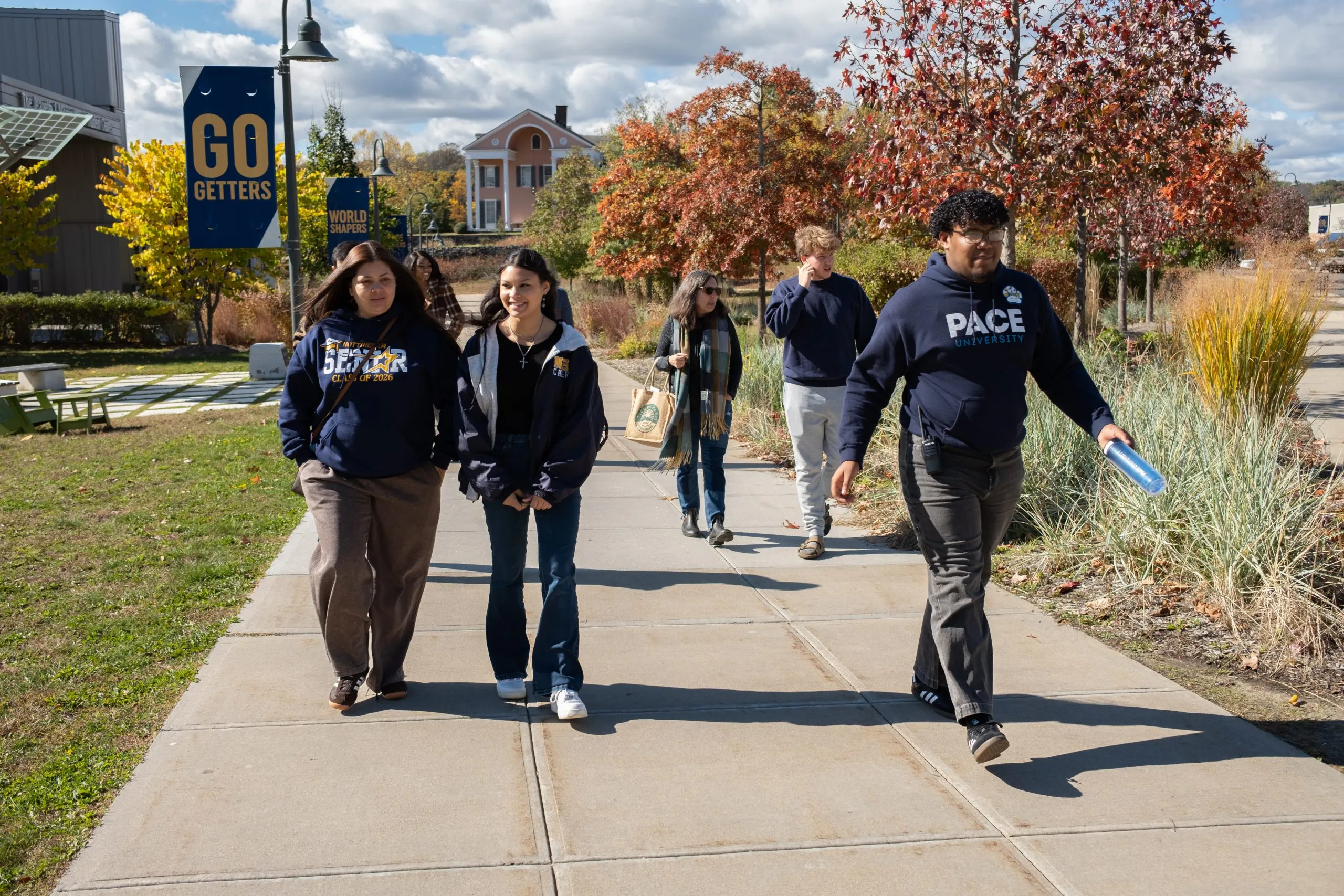
    Santiago, who lives in Hamilton, New Jersey, was waiting for a tour to start at Pace University as a video on repeat showed exuberant students and drone footage of the leafy, 200-acre grounds about 30 miles north of New York City, where the university also has a campus. 

    Related: Interested in more news about colleges and universities? Subscribe to our free biweekly higher education newsletter.

    Pace was one of 130 New York state colleges and universities that during October waived their application fees of from $50 to $90 per student, per school. That’s just one of the ways it’s trying to make admissions easier. 

    “That was a little eye-opening, when we received that letter,” Sueane Goodreau of Ithaca, New York, said about the free application offer as she waited for a tour of Pace’s campus with her high school senior son, Will. Compared to when her older daughter applied to college just three years ago, said Goodreau, “it does feel a little more receptive.”

    There was an even bigger incentive offered by Pace: Prospects such as Santiago and Goodreau who visit are promised an additional $1,000 a year of financial aid if they enroll. Applicants who come to visit a campus are twice as likely to enroll as those who don’t, research has found.

    The students’ names awaited them on a welcome sign at the reception desk in the office where tours depart. “You Belong Here,” pronounced another placard, on an easel in the waiting area. There was a QR code they could scan if they wanted to chat one-on-one with an admissions officer — who, in earlier times at many schools, were often unapproachable.

    “I feel like I’m already a student here,” Santiago quipped.

    The reason the university encourages that feeling? It’s simple, said Andre Cordon, dean of admission, in the distinctive pink Choate House at the center of the campus: “We want more students to apply. We don’t want to put up hurdles.”

    So many hurdles previously stood along the route to college admission, it’s become a part of popular culture. “Everyone thinks we’re sadists — that we like saying no,” noted Tina Fey in her role as a Princeton admissions officer in the 2013 movie “Admission.” 

    Related: The number of 18-year-olds is about to drop sharply, packing a wallop for colleges — and the economy 

    Perceptions such as those are hard to change. Not only do young Americans aged 18 to 29 believe it isn’t any easier to get into college than it was for people in their parents’ generation, 45 percent of them think it’s harder, a Pew Research Center survey found. More than three-quarters say the admissions process is complex, and more than half that it’s more stressful than anything else they’ve done during their time in elementary, middle or high school, according to a separate survey, by the National Association for College Admission Counseling, or NACAC.

    “People have that notion that all campuses are in the same category as MIT, Harvard, Stanford” with their impossibly low acceptance rates, said Cordon. (Pace took 76 percent of its applicants last year, university statistics show.) And “teenagers are still teenagers. There’s anxiety no matter what. They overthink things, and they overthink the admissions process.”

    There’s also still a lot of genuine emotion in the process, he said. For many parents, “It’s a pride thing. It’s a status thing. It’s showing off. Or from the student’s side, it’s, ‘I want to make my parents proud.’ ”

    In the new world of university admissions, however, that no longer necessarily even requires filling out an application.

    “Congratulations! You’ve been admitted,” a new California State University website tells prospective students, before they enter a single piece of information about themselves. 

    Cal State is the latest system to deploy so-called direct admission: They will automatically accept any student who earns at least a C in a list of required high school courses, starting in January for students in some and expanding the following year to every high school in the state.

    Related: To fill seats, more colleges offer credit for life experience

    Public universities or systems in Alabama, Arizona, Connecticut, Georgia, Hawai’i, Idaho, Illinois, Indiana, Minnesota, New York, North Carolina, Tennessee, Texas, Utah, Washington and Wisconsin also now offer various forms of direct admission — some beginning this fall — accepting students automatically if they meet certain high school benchmarks.

    Several systems now allow students to apply to several public universities and colleges with a single application, avoiding the time-consuming process of completing different forms, writing essays, collecting letters of recommendation or paying fees. 

    Through Illinois’s new One Click College Admit, for instance, high school students can have their transcripts provided instantly to 10 of the state’s 12 four-year public universities and all of its community colleges and get back a guaranteed offer of admission to at least one, depending on their grades.

    “Especially first-generation students, they don’t have that knowledge of how to apply to college,” said José Garcia, spokesman for the Illinois Board of Higher Education. “That’s among the people we’re trying to reach — those who might be intimidated by the name of an institution or not feel confident in their academic abilities or their grades.”

    Several of these programs have been advocated for public institutions by governors and legislatures worried about a continued supply of college-educated workers in their states as the proportion of high school graduates going on to get degrees declines.

    “Basically we need to have a bigger pipeline,” said David Troutman, deputy commissioner for academic affairs at the Texas Higher Education Coordinating Board. “We have to do everything we can to open that door to all students, not just a few. So we have to make sure we’re making the process as painless as we can.”

    Now private colleges are jumping aboard the direct-admission bandwagon. More than 210 have arranged through the Common App — an online application used by about 1,100 institutions nationwide — to extend offers of direct admission for the coming academic year to students who filed the Common App but have not applied. That’s almost twice as many as signed on last year, when Common App says 119 institutions in 35 states made more than 733,000 unsolicited offers. 

    It’s still early to definitively know the effect of this on whether students ultimately enroll. In Idaho, which in 2015 became the first state to try direct admission, enrollment of first-time undergraduates at participating public universities rose 11 percent

    Direct admission by itself does not resolve the other reasons students forgo college, however, said James Murphy, director of postsecondary policy at the nonprofit Education Reform Now, which advocates for more access to and diversity in higher education.

    “It’s the furthest thing from a panacea,” Murphy said. “How do we know? Because colleges embraced it so quickly. Any reform taken up so quickly by colleges is likely to have more benefit to colleges than to students.”

    While direct admission might help colleges get closer to enrollment targets, for example, he said, “it works best when it’s paired with financial aid and other resources that actually make it easier” to pay.

    Waiving application fees has driven increases in applications, some research has shown. During the month that fees were waived last fall in New York state, a quarter of a million students applied to the public State University of New York, up 41 percent from the same period the year before, according to the state’s Higher Education Services Corporation, or HESC. 

    Related: After years of quietly falling, college tuition is on the rise again

    While college applications may not seem expensive, at around $50 each, many students “aren’t just paying one application fee. They can be paying multiple fees,” which add up, said Angela Liotta, HESC’s director of communication. 

    Universities and colleges are trying other ways to ease the process. More than 2,000 continue to make submitting the results of SAT and ACT scores optional, for instance, something many started doing during the pandemic. More have extended their deadlines or recruited after the traditional May 1 cutoff, when incoming classes were previously considered locked in. 

    Students are noticing. One way is through the massive amount of marketing materials they’re getting, begging them to apply. The median high school student gets more than 100 letters and emails from colleges and universities each month, a survey by the education technology company CollegeVine found — an old-style approach that CollegeVine found turns out for this generation to be generally ineffective.

    Will Goodreau, who was visiting Pace, for instance, got “so many emails and texts,” he said, laughing. “I must have given somebody my number for something.”

    All of these things appear to be slowly changing students’ perception of admission. In that NACAC survey, fewer of those who had already gone through the process — while they still found it challenging — considered it as challenging as students who hadn’t started yet.

    There could be more changes ahead. A lawsuit was filed in August against 32 colleges and universities that practice so-called early decision, under which students who apply before the usual admission period are more likely to get in, but are obligated to enroll. The practice, which the lawsuit seeks to end, helps colleges fill their classes, but prevents students from shopping around for better offers of financial aid.

    Whatever happens, students and their parents should know that “they’re actually the ones in control of this process,” said Krebs, of HelloCollege. “The reality is that at a lot of schools, if you have the grades, you’re going to get in.”

    Contact writer Jon Marcus at 212-678-7556, [email protected] or jpm.82 on Signal.

    This story about applying to college was produced by The Hechinger Report, a nonprofit, independent news organization focused on inequality and innovation in education. Sign up for our higher education newsletter. Listen to our higher education podcast.

    This <a target=”_blank” href=”https://hechingerreport.org/colleges-ease-the-dreaded-admissions-process-as-the-supply-of-applicants-declines/”>article</a> first appeared on <a target=”_blank” href=”https://hechingerreport.org”>The Hechinger Report</a> and is republished here under a <a target=”_blank” href=”https://creativecommons.org/licenses/by-nc-nd/4.0/”>Creative Commons Attribution-NonCommercial-NoDerivatives 4.0 International License</a>.<img src=”https://i0.wp.com/hechingerreport.org/wp-content/uploads/2018/06/cropped-favicon.jpg?fit=150%2C150&amp;ssl=1″ style=”width:1em;height:1em;margin-left:10px;”>

    <img id=”republication-tracker-tool-source” src=”https://hechingerreport.org/?republication-pixel=true&post=113378&amp;ga4=G-03KPHXDF3H” style=”width:1px;height:1px;”><script> PARSELY = { autotrack: false, onload: function() { PARSELY.beacon.trackPageView({ url: “https://hechingerreport.org/colleges-ease-the-dreaded-admissions-process-as-the-supply-of-applicants-declines/”, urlref: window.location.href }); } } </script> <script id=”parsely-cfg” src=”//cdn.parsely.com/keys/hechingerreport.org/p.js”></script>

    Source link

  • College students are tired of being told that we ‘should be grateful’ for our internships. We also want to get paid

    College students are tired of being told that we ‘should be grateful’ for our internships. We also want to get paid

    by Savannah Celeste Scott, The Hechinger Report
    November 17, 2025

    Imagine clocking out of an eight-hour shift and your compensation is a pat on the back and experience for your resume.  

    This scenario is a disturbing reality for around one million college students, and it needs to stop. Students work countless hours on top of their academic pursuits only to be told they should be “grateful for the opportunity.”  

    The government must pass legislation mandating that all internships include monetary compensation; employers must stop exploiting students and recent graduates while they build necessary work experience.  

    The idea of an unpaid internship is odd considering that most of us grew up learning that work is rewarded. Some 71 percent of American households give children ages 5 to 17 an allowance for doing their chores, a Wells Fargo study found.  

    Practices like that have led many of us to believe that labor should be paid, and it should be no different when we enter the job market.  

    Related: Interested in innovations in higher education? Subscribe to our free biweekly higher education newsletter.  

    There is a disturbing correlation between unpaid internships and exploitation, especially for people from marginalized communities. Historically, Black people have been the face of working without compensation — a phenomenon dating back to early American slave practices.  

    Unpaid work is not just exploitation — it is dehumanizing. No person can survive without money, so no one should be required to work with no compensation to help them live. The reality is that, unlike higher-income students, low-income students cannot afford to work for free. They need money to cover their tuition, afford groceries and pay for a place to live. This is why unpaid internships further the cycle of economic exploitation, the student-run Columbia Spectator noted.  

    Yet there are plenty of people who believe compensation does not always have to be monetary. Many students have heard employers extol the value of “experience” as they try to persuade them to work without pay.  

    Such was the case for me when I was hired for a legal internship as a freshman in college. I thoroughly enjoyed my internship, as it gave me both professional and social opportunities. But it was an extremely difficult time for me both mentally and financially.  

    I was taking 16 credit hours, regularly writing for a student publication and working another part-time job to save money for law school. The stress of going into the office every day to handle casework — often ranging from domestic violence to sexual assault cases — was mentally taxing when combined with schoolwork and extracurricular responsibilities.  

    While the experience that the internship provided was incredible, monetary compensation would have made it much less stressful, as I would not have needed the other job.  

    Unpaid internships can also hurt graduates’ prospects in the job market. Those who have had unpaid internships receive fewer job offers on average than those who completed paid internships, statistics from the National Association of Colleges and Employers (NACE) show.  

    The average student who completed an unpaid internship also saw $22,500 less in their starting salaries than those who completed paid internships. According to the Delta Institute, “employers offering compensation tend to invest more in mentoring, performance feedback, and skill-building”; that added investment provides students with more preparation for the job market and helps them look more impressive to an employer.  

    Related: Looking for internships? They are in short supply 

    Unpaid interns have been fighting for compensation for decades. A lawsuit filed by two interns against Fox Searchlight over their lack of compensation when working on the movie “Black Swan” resulted in a legal battle that lasted five years. The two interns were finally compensated a total of $13,500 for their work — despite the film grossing more than $300 million.  

    The Fox Searchlight lawsuit sparked a wave of other impassioned interns to plead their cases as well, including a class-action lawsuit against NBCUniversal back in July 2013. That resulted in a $6.4 million settlement split among thousands of interns.  

    In both cases, the employers made millions of dollars in profits but still refused to pay their interns until they were legally forced to do so.  

    According to Shawn VanDerziel, the president and chief executive officer of NACE, paid internships are a “game changer” to employers and employees alike. The dilemma is this: Employers want labor, and students want internships. The most obvious solution would be to pay students for the work that they do.  

    Students do not work for fun. They work because they want to create better futures for themselves; their success will be less likely if they don’t receive monetary compensation. The government needs to make it illegal for employers to exploit students by having them work without pay.  

    College students should not be expected to work for free.  

    Savannah Celeste Scott is a senior at the University of Georgia in Athens, studying journalism, Spanish and law, jurisprudence and the state on a pre-law track.  

    Contact the opinion editor at [email protected].  

    This story about unpaid internships was produced by The Hechinger Report, a nonprofit, independent news organization focused on inequality and innovation in education. Sign up for Hechinger’s weekly newsletter.

    This <a target=”_blank” href=”https://hechingerreport.org/student-voice-college-students-are-tired-of-being-told-that-we-should-be-grateful-for-our-internships-we-also-want-to-get-paid/”>article</a> first appeared on <a target=”_blank” href=”https://hechingerreport.org”>The Hechinger Report</a> and is republished here under a <a target=”_blank” href=”https://creativecommons.org/licenses/by-nc-nd/4.0/”>Creative Commons Attribution-NonCommercial-NoDerivatives 4.0 International License</a>.<img src=”https://i0.wp.com/hechingerreport.org/wp-content/uploads/2018/06/cropped-favicon.jpg?fit=150%2C150&amp;ssl=1″ style=”width:1em;height:1em;margin-left:10px;”>

    <img id=”republication-tracker-tool-source” src=”https://hechingerreport.org/?republication-pixel=true&post=113342&amp;ga4=G-03KPHXDF3H” style=”width:1px;height:1px;”><script> PARSELY = { autotrack: false, onload: function() { PARSELY.beacon.trackPageView({ url: “https://hechingerreport.org/student-voice-college-students-are-tired-of-being-told-that-we-should-be-grateful-for-our-internships-we-also-want-to-get-paid/”, urlref: window.location.href }); } } </script> <script id=”parsely-cfg” src=”//cdn.parsely.com/keys/hechingerreport.org/p.js”></script>
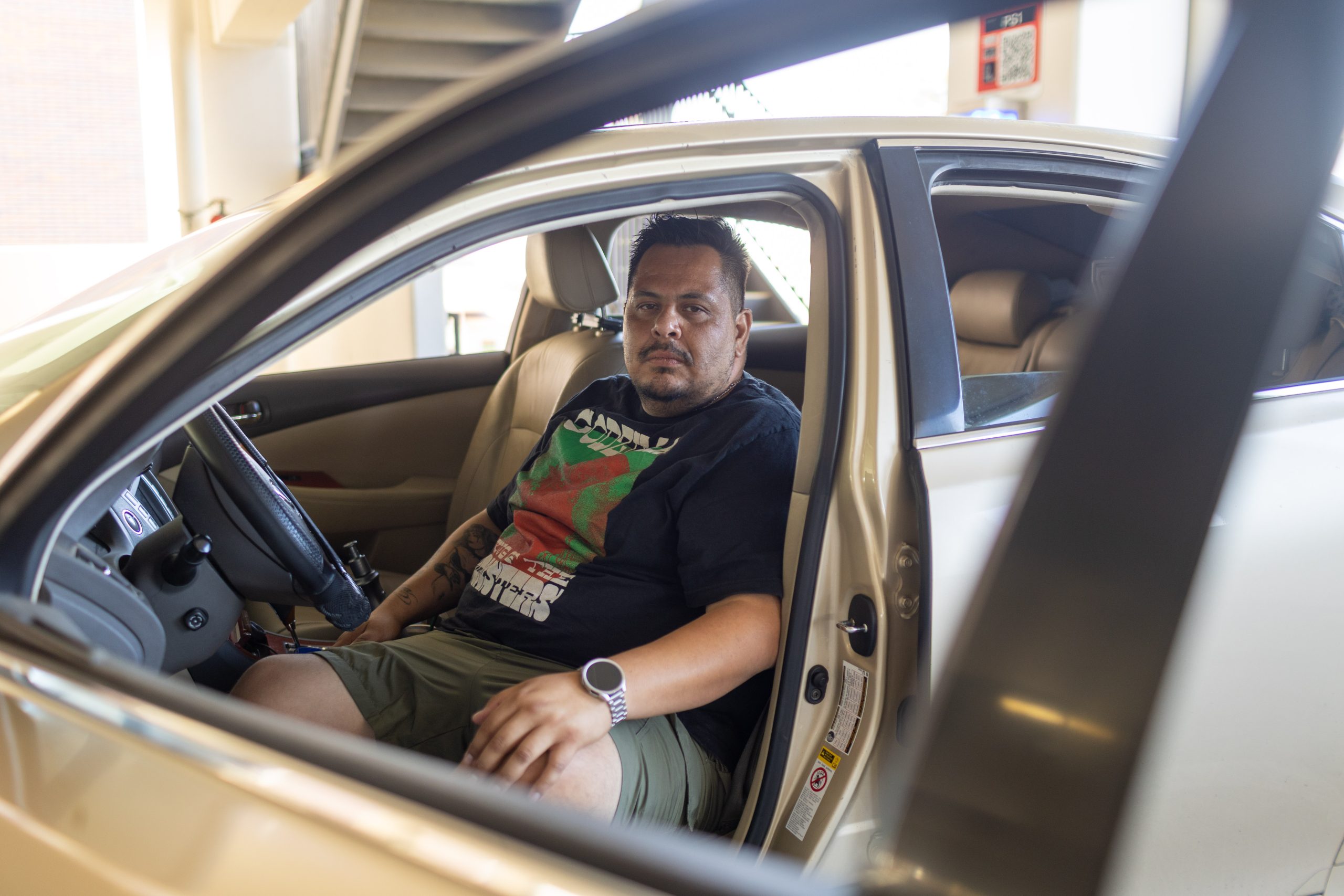
    Source link

  • College students hedge their bets in a chaotic labor market by double-majoring

    College students hedge their bets in a chaotic labor market by double-majoring

    by Jon Marcus, The Hechinger Report
    November 5, 2025

    After he graduates from the University of Wisconsin-Madison, Drew Wesson hopes to begin a career in strategic communication, a field with higher-than-average job growth and earnings.

    One year into his time at the university, Wesson became more strategic about this goal. Like nearly 1 in 3 of his classmates, he declared a second major to better stand out in an unpredictable labor market.

    It’s part of a trend that’s spreading nationwide, according to a Hechinger Report analysis of federal data, as students fret about getting jobs in an economy that some fear is shifting faster than a traditional college education can keep up.

    “There’s kind of a fear of graduating and going out into the job market,” said Wesson, a sophomore from Minneapolis who is double-majoring in international security and journalism. “And having more skills and more knowledge and more majors gives you a competitive edge.”

    The number of students at UW-Madison who double-major has grown by 25 percent over the last decade, the data show. But double-majoring is also on the rise at private, nonprofit colleges across the country, and at other public institutions, including the University of California, San Diego, and the University of North Carolina at Chapel Hill. 

    Nearly 5.4 million credentials — degrees or certificates — were earned by the 4.8 million college and university graduates in 2023-24, the most recent year for which the figure is available. That means about 12 percent left school with more than one, compared to 6 percent ten years earlier. Academic minors don’t count as a credential and aren’t tracked..

    Related: Interested in innovations in higher education? Subscribe to our free biweekly higher education newsletter.

    “Students are feeling a sort of spiraling lack of control in a very dynamic labor market,” said Rachel Slama, associate director of Cornell University’s Future of Learning Lab, which studies how technology and other innovations are changing education. “They’re probably clinging to the one thing that’s in their control, which is the majors they choose. And they think that more is more.”

    They may be right, according to one of the few studies of this topic, by scholars at St. Lawrence University and Vanderbilt Law School. Students who have one major in business and a second in science, technology, engineering or math, it found, earn more than if they majored in only one of those disciplines, the 2016 study found. 

    Graduates who double-major are also 56 percent less likely to be laid off, have their pay cut or suffer other negative effects in economic downturns, according to another study, released last year by researchers at Ohio State and four other universities. These outcomes show “the importance of diverse skill sets,” the researchers concluded. If there’s a drop in demand for the skills associated with one major, “a double major can pursue a job related to the unaffected major.” 

    At Wisconsin, nearly 6 in 10 students in computer science who pick a second major choose the lucrative discipline of data science; the number of jobs in data science is projected by the Bureau of Labor Statistics to increase 34 percent over about the next 10 years, at salaries that are nearly twice the national average.

    The unemployment rate among new bachelor’s degree recipients is now higher than for workers overall, and at its highest level since 2014, not including the pandemic years, according to the Federal Reserve Bank of St. Louis. That’s partly because artificial intelligence and other factors are transforming what employers need. 

    Nearly half of recent graduates feel underqualified to apply for even entry-level jobs, a survey by the education technology company Cengage Group finds. Only 30 percent say they have full-time jobs related to the fields that they studied.

    Meanwhile, colleges and universities — traditionally slow to transform what and how they teach — are encouraging students to combine majors as a faster way to keep up with changes in the labor market, said Taylor Odle, an assistant professor at UW-Madison who studies the economics of education and the value of credentials in the workforce.

    “Institutions are thinking strategically about how to align their degree programs with industry, and it might be by pairing two things they already have,” Odle said.

    There are other reasons for the rising popularity of double majors. At UW-Madison, for example, one factor propelling the growth is that there are no minors, noted Taylor Odle, an assistant professor there who studies the economics of education and the value of credentials in the workforce.. 

    Double-majoring isn’t easy. It typically means earning more than the usual minimum number of credits required to graduate, on top of extracurricular and other obligations. Wesson, at UW-Madison, for instance, is an officer of student government, a reporter and photographer for the campus newspaper and an honors student.

    Some separate majors have overlapping requirements. Even if they don’t, most universities and colleges charge the same tuition per semester no matter how many courses undergraduates take. So unless a second major extends the number of semesters a student needs to complete required courses, or forces him or her to take additional classes in the summers, double-majoring doesn’t typically cost more or take longer.

    Meanwhile, more students are arriving at college having already knocked off credits by taking dual-enrollment and Advanced Placement classes in high school. 

    About 2.5 million high school students participate in dual enrollment, according to an analysis of federal data by the Community College Research Center at Teachers College, Columbia University. (The Hechinger Report, which produced this story, is an independent unit of Teachers College.)

    This means they have room in their schedules in college for second majors, said Kelle Parsons, who focuses on higher education as a principal researcher at the American Institutes for Research.

    Related: After years of quietly falling, college tuition is on the rise again

    For some students, double-majoring makes more sense than changing majors altogether. About 30 percent of students change their majors at least once, and 10 percent two or more times, according to the U.S. Department of Education. Adding a second major is less drastic than dropping a first one and starting again from scratch, said Patrick Denice, an associate professor of sociology at the University of Western Ontario.

    “If you add a [second] major, you hedge your bets against a changing labor market without losing those credits and that coursework you’ve already earned” toward the first one, said Denice, who has studied why students at U.S. universities pick and change their majors.

    There’s yet another reason students are increasingly double-majoring. Even as they crowd into specialties associated with career opportunities, such as business and health-related disciplines — which together now account for nearly 1 in 3 undergraduate fields of study — some are adding second majors for which they simply have a passion.

    Related: Students can’t get into basic college courses, dragging out their time in school

    “They’re trying to satisfy their parents, who want them to be employed,” said J. Wesley Null, vice provost for undergraduate education and academic affairs at Baylor University, where there were more than twice as many double majors last year than there were in 2014. “But they’re also interested in a lot of interdisciplinary kinds of things. They’ll combine biology with Sanskrit or Chinese. These really bright students have a lot of diverse interests.”

    At the University of Chicago, where the number of double majors has also more than doubled, “I see students committing to one career but wanting to have more breadth,” said Melina Hale, dean of the college. “They’re going and exploring all of these other majors and finding one they love.”

    Double-majoring is also “a great way for students to demonstrate that they know how to think in different ways,” said Hale, herself a biologist who has collaborated with engineers. “If you’re going into a job in finance and have a deep background in history, you’re bringing different ways of approaching problems.”

    Related: To fill seats, more colleges offer credit for life experience

    This way of thinking is pushing still another trend: More students nationwide are earning certificates, which they can get in a matter of months and alongside their degrees, in subjects such as business management. Seventeen percent of bachelor’s degree recipients also finished college with at least one certificate in 2023-24, the National Student Clearinghouse Research Center reports.

    Known as “stackable credentials,” these kinds of certificates “have been talked about for a long time,” said Ryan Lufkin, vice president of global academic strategy at the educational technology company Instructure. “And now there’s really demand for them.” 

    That’s because — like double-majoring and minoring — they make applicants stand out to employers, said Odle, at UW-Madison. 

    Students, he said, “are trying to emphasize their attractiveness in the labor market. They’re trying to cover their bases.”

    Contact writer Jon Marcus at 212-678-7556, [email protected] or jpm.82 on Signal.

    This story about double majors was produced by The Hechinger Report, a nonprofit, independent news organization focused on inequality and innovation in education.

    Data analysis by Marina Villeneuve.

    Sign up for our higher education newsletter. Listen to our higher education podcast.

    This <a target=”_blank” href=”https://hechingerreport.org/students-worried-about-getting-jobs-extra-majors/”>article</a> first appeared on <a target=”_blank” href=”https://hechingerreport.org”>The Hechinger Report</a> and is republished here under a <a target=”_blank” href=”https://creativecommons.org/licenses/by-nc-nd/4.0/”>Creative Commons Attribution-NonCommercial-NoDerivatives 4.0 International License</a>.<img src=”https://i0.wp.com/hechingerreport.org/wp-content/uploads/2018/06/cropped-favicon.jpg?fit=150%2C150&amp;ssl=1″ style=”width:1em;height:1em;margin-left:10px;”>

    <img id=”republication-tracker-tool-source” src=”https://hechingerreport.org/?republication-pixel=true&post=113148&amp;ga4=G-03KPHXDF3H” style=”width:1px;height:1px;”><script> PARSELY = { autotrack: false, onload: function() { PARSELY.beacon.trackPageView({ url: “https://hechingerreport.org/students-worried-about-getting-jobs-extra-majors/”, urlref: window.location.href }); } } </script> <script id=”parsely-cfg” src=”//cdn.parsely.com/keys/hechingerreport.org/p.js”></script>
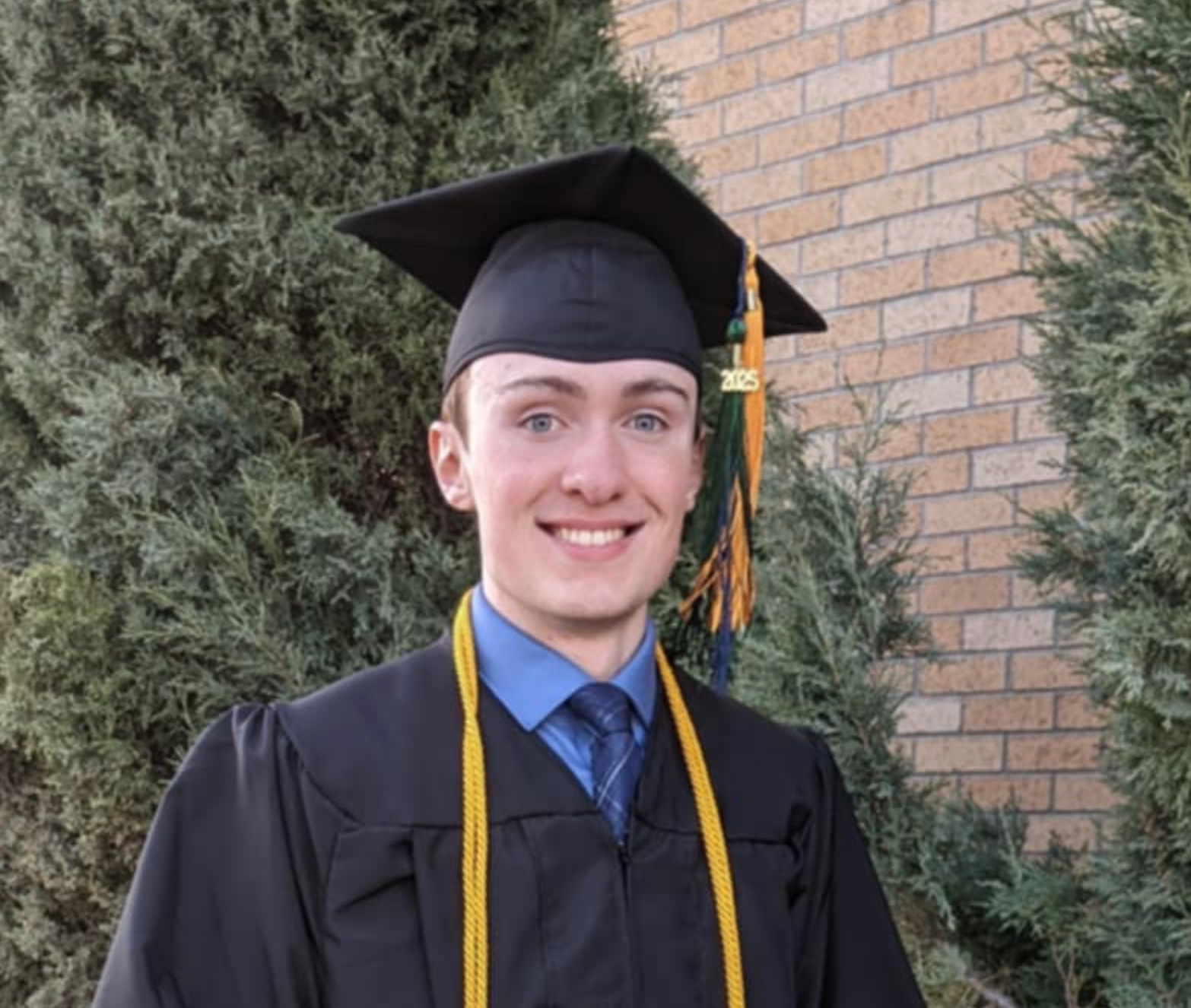
    Source link

  • Student-parents belong on college campuses. So do their children

    Student-parents belong on college campuses. So do their children

    Too many student-parents never make it to graduation, in no small part because their campuses don’t adequately help them fit college into their lives — or even just fit in.

    Yet over 3 million student-parents across the nation, myself included, are pursuing higher education, seeking the intergenerational benefits that come with earning a degree. To reap them, we must overcome many obstacles, as colleges aren’t designed for students like us.

    For me, the last hurdle I had to clear was graduation itself. After years of sacrifice — not just my own, but my whole family’s — walking the stage with my four children at my graduation from the University of California, Santa Cruz was deeply important.

    The university, however, didn’t understand that or account for us. When I asked to accept my diploma with my kids, I was met with resistance, a particularly tough reminder of the work institutions have left to do to meet the needs and priorities of student-parents.

    Related: Interested in innovations in higher education? Subscribe to our free biweekly higher education newsletter.

    Earning my college degree in my late 30s was undoubtedly a major achievement, but so was going back for my bachelor’s in the first place — I didn’t even finish high school the first time around.

    After I became a mom at 20, I earned my GED, hoping it would help me support my family. Continuing my education only got harder. I started and stopped community college more times than I can count, juggling bills, jobs, custody battles and parenting.

    Finally, I transferred to UCSC, proud that I was taking this step two decades in the making and changing the trajectory of my and my family’s lives.

    However, I didn’t fully realize what my education would cost my children. Used to our tight-knit Tongan community, they felt like cultural outsiders when we moved to Santa Cruz, no longer surrounded by family, our native language or familiar foods and music.

    My children sacrificed their home and sense of belonging so that I could pursue this dream. As graduation approached, I knew I wanted to walk the stage with them. They had earned it just as much as I had.

    Yet the administration denied my request, citing the added logistical difficulties. They suggested I bring my kids to a separate, informal celebration for those of us living in family student housing instead. The offer sounded like “be invisible or settle for less.”

    I immediately started mobilizing UCSC’s Student Parent Organization, where I was president. Working with the student government, I drafted a resolution permitting student-parents to walk with their children. I reached out to alumni, administrators, fellow parents and friends for support.

    Thanks to our collective voice, the dean of students changed his mind, offered an apology and committed to changing the policy going forward for all graduating student-parents. Though my kids and I were placed at the end of the ceremony, we crossed the stage together as a family.

    That seed of inclusion will grow in them, just like it will for all the children of student-parents who walk that path in the future.

    The next year, my mentee and friend walked with her son at the UCSC commencement, this time without pushback. The university invited them to rehearsal, and on graduation day, they had VIP seats. She was one of the first to walk, not the last.

    That is the power of advocacy. It turns exclusion into inclusion. It rewrites the rules not just for one person, but for those who come after. I am proud to continue my advocacy work as a graduate student at the University of San Francisco and a member of The California Alliance for Student Parent Success.

    I have since seen institutions across California make good progress on their efforts to support student-parents, but colleges and universities nationwide must still do more. At the University at Buffalo, university police chased a graduating student across the stage when he attempted to bring his infant son with him.

    Related: A federal program helped student-parents thrive. Now it’s on life support

    These stories and the momentum building in the wake of September’s National Student Parent Month should serve as a call to higher education leaders across the country to cultivate campus climates that build trust and belonging among student-parents.

    This work should start before we even step foot on campus and continue until we graduate.

    Institutions that truly wish to serve families will ensure that the value we bring to higher education is visible. They will account for student-parents when planning campus events and weave together support networks of faculty, staff and peers who can respond to our needs.

    When we ask institutions for policies and practices to better accommodate our families, they will listen and act. They will hold themselves accountable to all of their students, parents included.

    Walking the stage with my kids was a step in the right direction, albeit an uphill climb. Let’s keep going and do better by student-parents and their families.

    Krystle Pale is a UC Santa Cruz graduate, a mother of five and a recent Advisory Committee member of The California Alliance for Student Parent Success.

    Contact the opinion editor at [email protected].

    This story about student-parents was produced by The Hechinger Report, a nonprofit, independent news organization focused on inequality and innovation in education. Sign up for Hechinger’s weekly newsletter.

    The Hechinger Report provides in-depth, fact-based, unbiased reporting on education that is free to all readers. But that doesn’t mean it’s free to produce. Our work keeps educators and the public informed about pressing issues at schools and on campuses throughout the country. We tell the whole story, even when the details are inconvenient. Help us keep doing that.

    Join us today.

    Source link

  • Higher Education must help shape how students learn, lead and build the skills employers want most

    Higher Education must help shape how students learn, lead and build the skills employers want most

    For the first time in more than a decade, confidence in the nation’s colleges and universities is rising. Forty-two percent of Americans now say they have “a great deal” or “quite a lot” of confidence in higher education, up from 36 percent last year.  

    It’s a welcome shift, but it’s certainly not time for institutions to take a victory lap. 

    For years, persistent concerns about rising tuition, student debt and an uncertain job market have led many to question whether college was still worth the cost. Headlines have routinely spotlighted graduates who are underemployed, overwhelmed or unsure how to translate their degrees into careers.  

    With the rapid rise of AI reshaping entry-level hiring, those doubts are only going to intensify. Politicians, pundits and anxious parents are already asking: Why aren’t students better prepared for the real world?  

    But the conversation is broken, and the framing is far too simplistic. The real question isn’t whether college prepares students for careers. It’s how. And the “how” is more complex, personal and misunderstood than most people realize.  

    Related: Interested in innovations in higher education? Subscribe to our free biweekly higher education newsletter. 

    What’s missing from this conversation is a clearer understanding of where career preparation actually happens. It’s not confined to the classroom or the career center. It unfolds in the everyday often overlooked experiences that shape how students learn, lead and build confidence.  

    While earning a degree is important, it’s not enough. Students need a better map for navigating college. They need to know from day one that half the value of their experience will come from what they do outside the classroom.  

    To rebuild America’s trust, colleges must point beyond course catalogs and job placement rates. They need to understand how students actually spend their time in college. And they need to understand what those experiences teach them. 

    Ask someone thriving in their career which part of college most shaped their success, and their answer might surprise you. (I had this experience recently at a dinner with a dozen impressive philanthropic, tech and advocacy leaders.) You might expect them to name a major, a key class or an internship. But they’re more likely to mention running the student newspaper, leading a sorority, conducting undergraduate research, serving in student government or joining the debate team.  

    Such activities aren’t extracurriculars. They are career-curriculars. They’re the proving grounds where students build real-world skills, grow professional networks and gain confidence to navigate complexity. But most people don’t discuss these experiences until they’re asked about them.  

    Over time, institutions have created a false divide. The classroom is seen as the domain of learning, and career services is seen as the domain of workforce preparation. But this overlooks an important part of the undergraduate experience: everything in between.  

    The vast middle of campus life — clubs, competitions, mentorship, leadership roles, part-time jobs and collaborative projects — is where learning becomes doing. It’s where students take risks, test ideas and develop the communication, teamwork and problem-solving skills that employers need.  

    This oversight has made career services a stand-in for something much bigger. Career services should serve as an essential safety net for students who didn’t or couldn’t fully engage in campus life, but not as the launchpad we often imagine it to be. 

    Related: OPINION: College is worth it for most students, but its benefits are not equitable 

    We also need to confront a harder truth: Many students enter college assuming success after college is a given. Students are often told that going to college leads to success. They are rarely told, however, what that journey actually requires. They believe knowledge will be poured into them and that jobs will magically appear once the diploma is in hand. And for good reason, we’ve told them as much. 

    But college isn’t a vending machine. You can’t insert tuition and expect a job to roll out. Instead, it’s a platform, a laboratory and a proving ground. It requires students to extract value through effort, initiative and exploration, especially outside the classroom.  

    The credential matters, but it’s not the whole story. A degree can open doors, but it won’t define a career. It’s the skills students build, the relationships they form and the challenges they take on along the way to graduation that shape their future. 

    As more college leaders rightfully focus on the college-to-career transition, colleges must broadcast that while career services plays a helpful role, students themselves are the primary drivers of their future. But to be clear, colleges bear a grave responsibility here. It’s on us to reinforce the idea that learning occurs everywhere on campus, that the most powerful career preparation comes from doing, not just studying. It’s also on us to address college affordability, so that students have the time to participate in campus life, and to ensure that on-campus jobs are meaningful learning experiences.  

    Higher education can’t afford public confidence to dip again. The value of college isn’t missing. We’re just not looking in the right place. 

    Bridget Burns is the founding CEO of the University Innovation Alliance (UIA), a nationally recognized consortium of 19 public research universities driving student success innovation for nearly 600,000 students. 

    Contact the opinion editor at [email protected]. 

    This story about college experiences was produced by The Hechinger Report, a nonprofit, independent news organization focused on inequality and innovation in education. Sign up for Hechinger’s weekly newsletter. 

    The Hechinger Report provides in-depth, fact-based, unbiased reporting on education that is free to all readers. But that doesn’t mean it’s free to produce. Our work keeps educators and the public informed about pressing issues at schools and on campuses throughout the country. We tell the whole story, even when the details are inconvenient. Help us keep doing that.

    Join us today.

    Source link