Category: Higher Education Funding

  • The Coming Federal Cuts – Part 3: ISED

    The Coming Federal Cuts – Part 3: ISED

    Monday, we looked at the country’s overall financial situation (dire), and yesterday we looked at how cuts of a magnitude of 15% might affect key programs like the Canada Education Savings Program and the Canada Student Financial Assistance Program. Today, we’re going to look at how a 15% cut might affect the Government of Canada’s research subsidies, which in the main are run through the Ministry of innovation, Science and Economic Development (ISED). 

    (I will be speaking about “the tri-councils” as a single funding line; I am aware that the Canadian Institute for Health Research (CIHR) is funded through Health Canada but for this exercise it is easier just to lump them together).

    Let’s start by acknowledging that ISED is a sprawling mess of a department with small programs with very little political protection littered all over the place. I wouldn’t bet the farm on the $12 million “Futurpreneur Canada” making it out of this budget round alive. I also doubt the Universal Broadband Fund is going to continue at $900 million per year. Computers for Schools (sounded great in the 90s, less so now) and Computers for Schools Interns would also be on my endangered list. I suspect that the various regional development funds might be in for an outsized hit as well. All of which is to say that it is possible that the research enterprise – that is, the tri-Councils, the National Research Council (NRC), the Canada Foundation for Innovation (CFI) and all those organizations that get part or all their money through the Strategic Science Fund – might not get hit with a 15% cut. It’s quite possible all these other areas might take an outsized hit and allow the actual science stuff to get off with a lighter cut.

    That said, remember this key point: the budget exercise is not about cutting 15% of funding from where it should theoretically be in three years’ time (the government has a fiscal framework that extends out four or five years). It is about cutting expenditures from a 2024-25 baseline. That means that to get through any previously planned increase in spending, the cuts to existing programs must be more than 15%. 

    This matters for two reasons. First, it is because the government runs its subsidies to electric vehicles manufacturers through ISED. Those subsidies were worth $39M in 2024-25; they were planned to cost $2.1 billion this year and $4.2 billion in 2027-28 (i.e. it’s about half the department’s direct budget spend come two years from now, and about a third of total sci/tech spend if you include the tri-councils). To accommodate that increase while following the letter of the budget reduction request would basically mean requiring the entire department to shut down. That’s probably not happening (though one presumes that Carney’s announcement last week releasing Canadian auto manufacturers from their 20% EV sales target in 2026 might also lead to a reduction in EV subsidies to manufacturers). 

    Second, remember budget 2024? The one where the Liberals promised $1.8 billion in new spending on research and the whole sector cheered with relief? Yeah, well only $75 million went into the budget framework for 2024-25; 87% of that 1.8 billion is backloaded until after spring 2026. So, basically none of it is protected, and it’s all at risk. I wouldn’t be surprised in the least if they just cancelled the whole thing. And then, on top of that, we must worry about what happens to existing programs, and whether they take a 15% hit.

    CIHR transfers about $1.2 billion to Canadian post-secondary institutes each year, while the National Science and Engineering Research Council (NSERC) transfers about $1 billion, and the Social Sciences and Humanities Research Council (SSHRC) transfers about $440 million (although a fair bit of that last one includes combined tri-council projects which administratively run through SSHRC, including – if I am not mistaken – funding for the Canada First Research Excellence Fund). CFI is another $550 million a year or so. NRC is about $1.7 billion per year. The Strategic Science Fund is another $900 million or so, closer to a billion if you include base funding for Genome Canada. Canada Research Chairs are another $300 million. Call it $6.2 billion in total. Required savings to get to a 15% cut is therefore just under $1 billion.

    Where to start?

    Ask most researchers at universities what they would prefer, and the answer is likely that they would eliminate everything except the tri-council funding. Ditch CFI, significantly cut NRC, definitely obliterate the Strategic Science Fund – anything, anything, anything but touch tri-Council grants. I understand the preference, but as I noted last week, this is a monumentally detrimental position for the sector to take. Yes, basic research and the existing grant system are the basis of the existing tenure and promotion system, and as such is naturally dear to those in the system, but almost no one in Ottawa thinks that’s what these systems are for. If we’re going to keep research funding afloat, it’s probably going to be through more spending on things like the Strategic Science Fund.

    I have very little insight into the state of official Ottawa’s current thinking on the relative value of these various programs, but I could imagine three basic scenarios that get us to $1 billion in savings.

    Option 1 is a straight 15% cut across the board. Take out $400 million or so from the granting councils, $80 million from CFI, $250 million from NRC, cut the Strategic Science Fund and Genome Canada to the tune of $150 million or so, and lose about 350 Canada Research Chairs. 

    Option 2 would be the spare the professors approach. Now, you probably can’t spare them entirely, because they are such a big proportion of the overall expenditure, but if you jacked up the cuts to CFI, NRC and Strategic Science to say 25%, you could hold the losses to CRCs and the tri-councils to under $100M. I think this is unlikely, but it is a possible scenario.

    Option 3 would be the hammer the tri-councils approach. Because, as I said, I don’t think they are particularly well-liked at Finance/PMO. This is close to the inverse of option 2; zero cuts to NRC and Strategic Science, keep the CFI cut at 15% and take the rest of the necessary money out of the tri-councils. That would mean a cut of about $800 million or about 30% to council funding.

    And remember, all of this is on top of walking back the measures announced in the 2024 Budget. Ugly doesn’t even begin to cover it.

    To be clear: I suspect it is unlikely that the research area will get a cut of 15%, in part because officials will feel bad about doing serious damage to existing budgets after, I suspect, already taking away the Budget 2024 measures. If I had to guess, I would say that the department will probably come down hardest on regional development subsidies. Nevertheless, the scenarios above are possible even if not probable. Universities should start thinking about what they might mean and how they might cope. 
    Source link

  • The Coming Federal Cuts – Part 2: ESDC

    The Coming Federal Cuts – Part 2: ESDC

    Yesterday, I explained why the federal government now finds itself in a position where it has to cut program budgets by at least 15% just to keep the budget deficit to $50 billion by 2028. Today, I am going to explain how this will play out at Employment and Social Development Canada (ESDC), which plays a major role in funding for skills and education in Canada, mainly through the Canada Education Savings Program (CESP) and the Canada Student Financial Assistance Program (CSFAP).

    Now, just a note at the start. It is vanishingly unlikely that the feds will actually look for 15% savings in every program. The 15% rule is for the Department as a whole, and ESDC is one big mother of a department. It includes all sorts of programs including EI (which in theory is exempt from cuts), and child care.

    So, let’s start with CESP, which delivers about a billion dollars a year via matching grants to parents saving for their kids’ education via Registered Education Savings Plans (RESPs). This program doesn’t allow for a lot of nuance in cutting. The program gives out about $1.1 billion a year in Canada Education Savings Grants (CESGs), roughly 85% of which goes on a basic 20 cent-to the dollar match rate and about 15% of which goes to “additional” (i.e. higher) matching rates for lower-income Canadians (A-CESGs). It also runs the Canada Learning Bond Program, which is another roughly $150 million per year which is a non-matching grant of up to $2000 to children from low-income backgrounds to start their educational savings.

    There are basically four options here:

    1) The government could cut program spending across the board by 15%. That is, it could lower the base CESG matching rate from 20% to 17%, and A-CESG payment rates for lower income contributors to 26.5% and 34% from the current 30% and 40%. That would save about $150 million/year. It could also reduce the CLB payout to $1700.  

    2) The government could eliminate the A-CESG pieces entirely and go with a flat 20% coverage. That’s a pretty quick way to a 15% reduction.

    3) The government could axe the CLB. Again, a very quick way to get close to 15% reduction.

    4) The government could hold the A-CESG and CLB harmless and reduce the CESG base rate even further, to about 15%.  

    Now, personally, I think CESG probably comes out of this unscathed – that is, a 0% cut – because it’s one of the most popular government programs in existence. But these options give you a sense of what cuts might be, if applied uniformly across the department.

    (Yes, there are also presumably some savings to be made on the personnel side, but it’s a pretty simple and lean program – if you could get savings equal to even 0.5% of total expenditures from that, I’d be shocked).

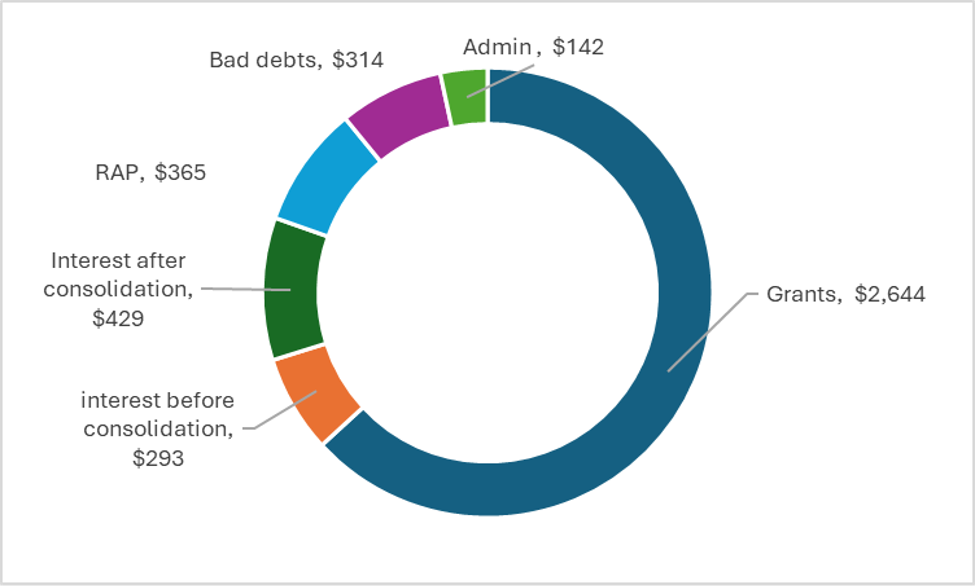
    Let’s now head over to CSFAP spending and see how that might fare. It’s a bit more complex than CESG so it’s worth looking at its basic cost-structure. Using data from the CSFAP’s 2023 Actuarial report, it’s possible to look at overall direct program costs, as shown below in Figure 1. Technically, this is not a full state of program costs because there’s another billion or so in “alternative payments” to jurisdictions that do not participate in the CSFAP (i.e. Quebec, Nunavut and the NWT). But since this sum is calculated as a fraction of direct programs, we can more or less ignore them here – a 15% cut of the direct costs automatically translates through to a 15% cut in alternative payments as well. And our target number – given that CSFAP direct expenses are about $4.2 billion – would be about $628 million.

    Figure 1: Major areas of CSFAP spending, in millions, 2023-24

    So where do you carve out that much money from CSLP? Well for starters we could and should get rid of the $429 million we spent eliminating interest on loans after graduation. These subsidies do nothing for access; rather, they boost the incomes of middle-class 20–30-year-olds who have already finished school. And it is not a long-standing program. It is, in fact, a quite recent thing, announced by then-finance minister Chrystia Freeland in 2023 when the Liberals were desperately trying to throw a bone to house-poor urban twenty-somethings who at the time were threatening to vote not-Liberal. Now cutting this wouldn’t be a straight $429 million savings – loss of that subsidy would likely lead to increases in bad debt and Repayment Assistance program (RAP) charges somewhat. So, let’s call that a $350M win.  

    Where to find the other $275 million? Not administration: most of the admin money is tied up in payments to provinces for running the front end of the program or to the National Student Loans Service Centre (an outsourced agency which resides over by Square One in Mississauga for running the back end), neither of which can easily be changed in the short term. Maybe you could lose a couple of million in staff costs but not much more. Very little you can do about bad debts either.  RAP and interest subsidies before consolidation could be made less generous. In particular, the income threshold for access to RAP could be brought back down from the current $45K (roughly – it depends on family size) to say $38K, and interest during school could be brought up from zero to the current inflation rate or the government rate of borrowing (i.e. somewhere between 2 and 2.5%). I don’t have access to detailed financial figures on this, but my guess is that the RAP measure might save $50M or so; in-school interest might get you $100M.

    That still doesn’t quite get us to the required $625 million, so the only option left here is to start hacking away at grants. A straight cut in the maximum grant would be the easiest way to cut costs; bringing that down from $4200/year to, say, $3500/year would reduce spending by something along the lines of $400M/year. Another and more likely option would be for the feds to copy what Doug Ford did when he wanted to contain student aid costs – change grant eligibility criteria in such a way as to make grants harder to obtain. The obvious way to do this, I think, would be to change the rules for dependent/independent student status (i.e. the point at which students are considered to no longer get money from their parents) so that it took students five years to reach such independent status instead of four. I am not exactly sure how much that would save, but I’d wager it would be a minimum of a quarter-billion. 

    So, your menu of cut options for cutting CSFAP is, essentially:

    Bring back interest after graduation $350 million
    Admin $3-5 million
    Reduce RAP threshold to $38K $50 million
    Introduce in-school interest of 2.5% $100 million
    Cut maximum grants by $700/year $400/million
    Change definition of independent student $250 million

    (To be clear here, I am guessing a bit on some of these numbers. Intelligently, I hope, but they are guesses. Don’t take the numbers here as gospel. And if any friends at CSLP want to correct me, please do!)

    If it were me, to get to (roughly) the required $625 million I’d bring back interest after graduation – or introduce an equal-to-government-rate-of-borrowing interest rate for the entire life of the loan, which probably ends up with similar savings – and change the definition of independent students. Neither are pleasant but these are the ones that would probably affect access the least.  

    (Again, the Liberals may choose not to cut anything in CSFAP, because hey this is an income security program of a sort, and if we’re obsessing about “affordability” – but that just means cuts elsewhere in the portfolio will be larger).

    Of course, ESDC is much more than these two programs. Take a gander at the full list of programs the programs the Ministry runs (I make it about fifty if you include everything). A lot of those are scattered skills initiatives like Youth Employment and Skills, Indigenous Skills and Employment Training, the Skills and Partnership Fund, Skills for Success Program, the Innovative Work-integrated Learning Initiative. I have no idea what most of these do exactly, nor is it easy to access any budget data about them. But let’s put it this way – few of these programs have a particularly large policy constituency to back them up. My guess is that cuts across these programs will be significantly higher than 15% and some of them may cease to exist altogether.  

    Enough for today.  Tomorrow we’ll do research funding.

    Source link

  • The Coming Federal Cuts – Part 1

    The Coming Federal Cuts – Part 1

    The biggest thing everyone is going to be talking about this year – barring another university doing a surprise Laurentian – is the set of federal cuts coming down the pike. They are big. And they are nasty. So, it’s worth understanding exactly the scale of what is heading in our direction. This is going to be a three-parter. Today, I will talk about the overall size of the cuts to come, and on Tuesday and Wednesday I will talk about how this will affect the two ministries that have the most to do with post-secondary education: Employment and Skills Development Canada (ESDC, tomorrow) and Innovation, Science and Economic Development Canada (ISED, Wednesday).

    So: we don’t know the exact scope of the budget cuts the government is contemplating. What we do know is the following:

    Preliminary budget figures for Fiscal 2024-25 show that the government of Canada posted a budget deficit of $43.2 billion on revenues of $495B, program expenses of $480B, debt charges (that is, interest on existing debt) of $54B and actuarial losses of $4B. We didn’t have a budget this spring, but spending projections for 25-26 from the 2024-25 budget show a projected deficit of $39 billion on revenues of $515B, program expenses of $496B, debt charges of $55B and actuarial losses of $2B.

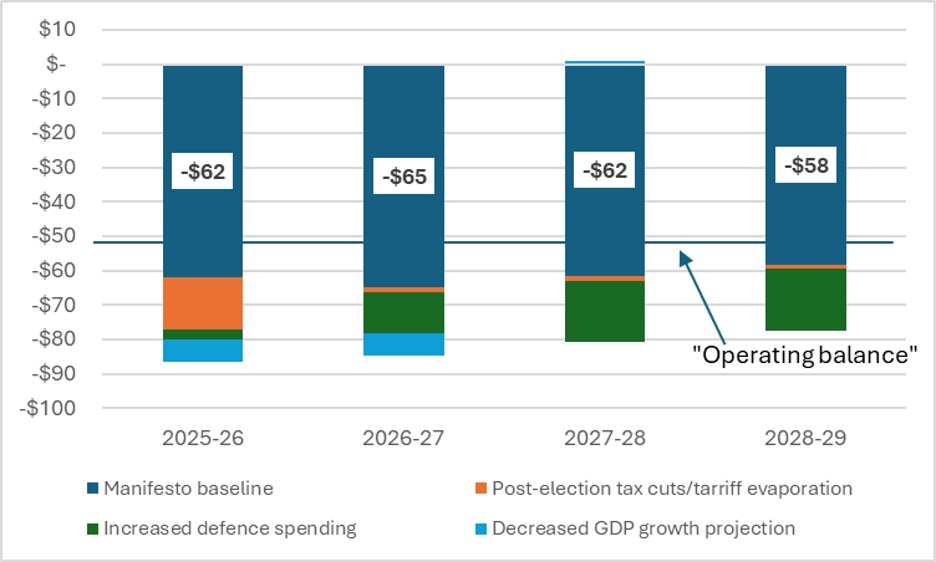
    The Liberal Manifesto for election 2025 planned deficits of $60 billion or so right through to 2028-29. Its fiscal plan was basically i) existing spending commitments, ii) 30-odd billion in new spending and tax cuts and iii) tiny revenue changes, plus $20 Billion or so in counter-tariffs for 2025-26. (Yes, they also promised “savings from increased productivity” – otherwise known as “frantic handwaving” – of $6B, $9B and $13B in fiscal years ’27, ’28 and ’29. I am excluding them here but will return to them in a sec).

    Figure 1: Government of Canada fiscal picture according to the Liberal manifesto, minus the handwaving, in Billions.

    (The foregoing might all sound strange to those of you who recall Carney making pledges about balanced budgets. But, of course, as I pointed out back here, he never actually promised that. He promised balanced operating budgets, that is budgets with an only vaguely defined “capital spending” netted out. By a complete coincidence, the Liberal platform claimed the government spent roughly $50 billion in capital, so basically the government is already basically in balance.  Neat trick, but not sure bondholders will see it that way. I digress.)

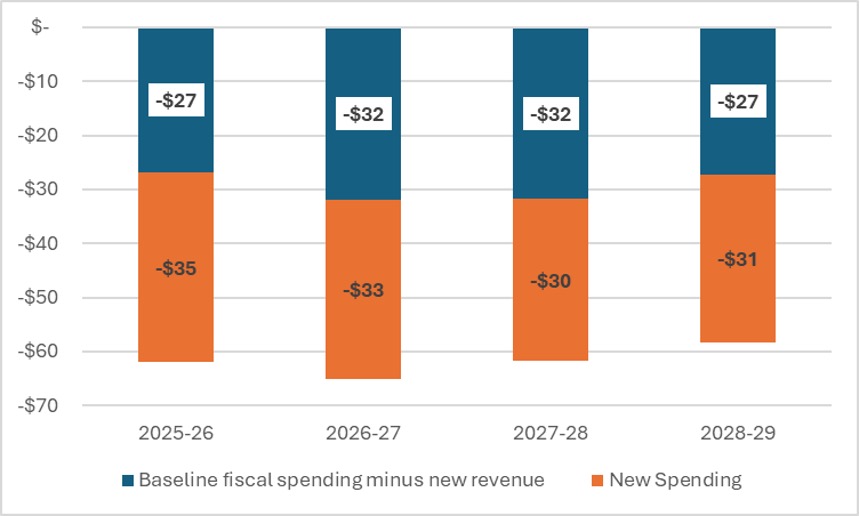
    Since the election, a few things have happened. Counter-tariffs are not collecting anything like the $20 billion forecast, we ditched the Digital Services Tax in a futile attempt to get the Americans to be nicer to us, and, most importantly of all, the prime minister promised to up defense spending by about $18 billion over the next four years in order to reach 2% of GDP by 2028. That means the actual fiscal picture, before any handwaving about savings, looks like this:

    Figure 2: Government of Canada fiscal picture, according to the Liberal Manifesto, minus the handwaving, including proposed spending and tariffs since April 28, in Billions.

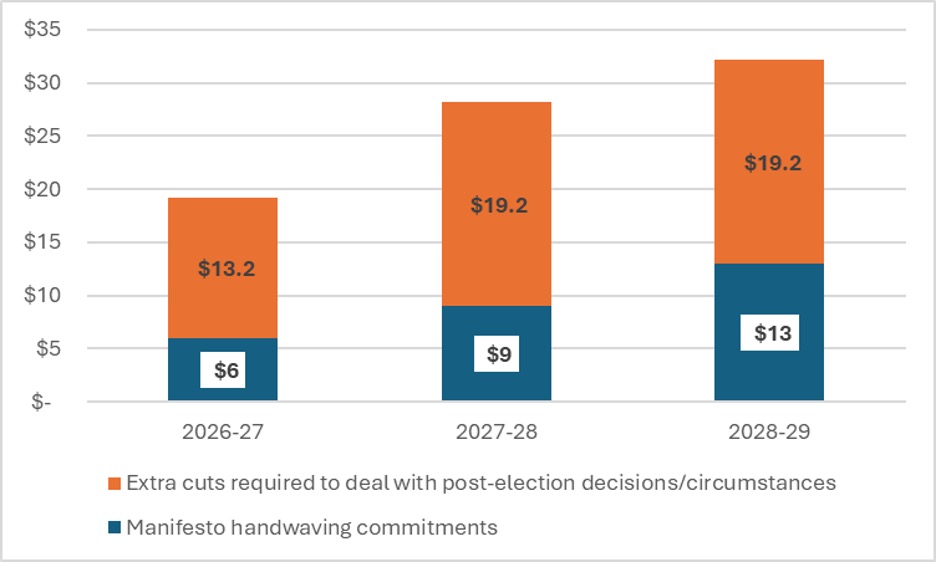
    As you can see, we are a lot further away today from “operating balance” (i.e. a $50B deficit) than we were when Carney was elected. And this is where the handwaving/cuts come into play. So, let’s start thinking about how much money it would take to keep us at “operating balance”. In Figure 3, we see that by 2028-29, we are looking at about $32 Billion in cuts. The handwaving “efficiencies” in the Liberal manifesto were meant to cover just $13 billion of that, leaving another $19.2 billion or so to be made up, somewhere, somehow.

    Figure 3: Cuts Required Just to Keep the Government of Canada at Operating Balance (i.e. a $50B deficit), By Source, in Billions.

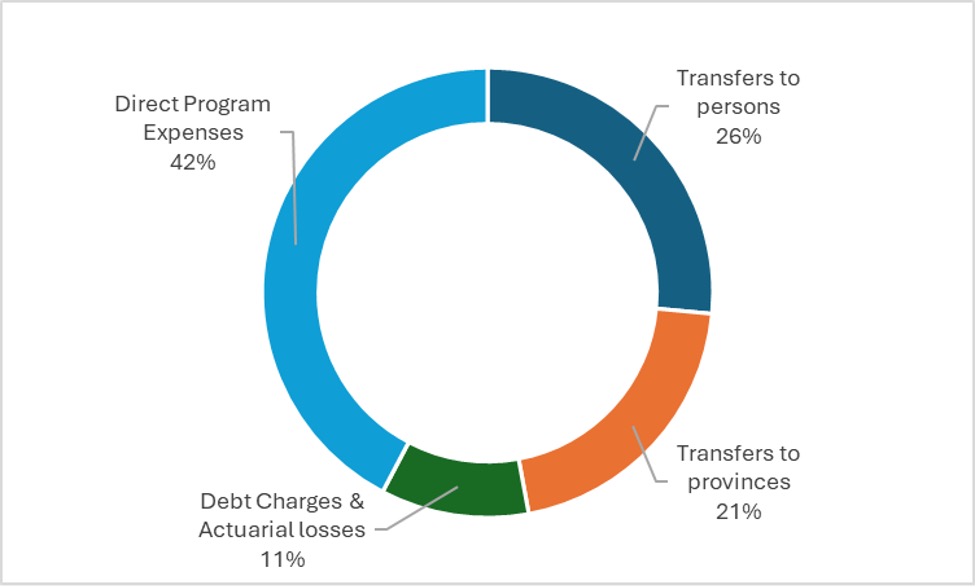
    I said “somewhere”, but there isn’t much mystery here. As Figure 4 shows, you divide government spending into four categories: debt charges (which the government has to pay regardless), transfers to provinces (which Carney has promised he won’t touch), transfers to individuals (ditto) and then “program spending”. As Figure 4 shows, the first three areas make up 58% of total spending. That means that the last area, program spending, is going to take up the entirety of these cuts. In 2025-26, program spending is estimated at $227 billion; a $32 billion cut to that equals an overall reduction in program spending of 14% by 2028. (Coincidentally, this was more or less exactly the size of the program cuts in the “savage” 1995 budget – $7 billion phased in over three years on a base budget of about $52 billion. Government grew back, as you can see.)  

    Figure 4: Government of Canada Expenditures by Category, 2025-26

    It’s worth being careful here. Overall program spending is $227 billion, but $46 billion of that is currently being spent on defense and housing, two areas that are almost certainly immune to cuts given the government’s overall priorities. Excluding these two fields from cuts means that the field of “cuttable” programs shrinks to $181 billion, and the size of the cuts required to meet the $50 billion target balloons to 17.7%.  

    This brings us to the program review that has been going on in Ottawa since July. Recall that Minsters were asked to bring forward scenarios that involved cuts of 7.5% for next year, 10% the year after that and 15% the year after that. Many thought initially that these numbers were deliberately overdone so that big cuts could be made in some departments so as to shield other departments from having to do the same. Now I am not so sure. That 15% target is awfully close to the 17% overall target the Liberals need to hit just to keep the deficit at $50 billion, and so I am starting to think that in fact the cuts might not be dispersed unequally between departments. They might really need 15% from everybody – and then some.

    There are a couple of alternatives of course that could lessen the blow. For instance, while Carney promised not to cut transfers to provinces, to my knowledge he never ruled out cutting the rate of growth of transfer payments (currently about 5% per year, across CHT, CST and equalization combined). Slash that in half and you’ve got yourself another $8 billion to play with by 2028, thereby reducing by a quarter the required amount of program cuts. Something similar could be achieved by de-indexing pensions for a couple of years. Or, unlikely as it seems, the Government could actually increase taxes (elbows up requires some sacrifices, no?). But, absent those measures, I think we need to seriously brace for impact. These cuts are real, they are huge, and even if they don’t hit this fall (it’s not impossible that the alleged fall budget might actually just be the usual fall economic statement under another name), they are for sure going to hit in early 2026.

    The question, really, is, what needs to be saved? What should the sectors’ priorities be? I’ll discuss that over the next two days.

    Source link