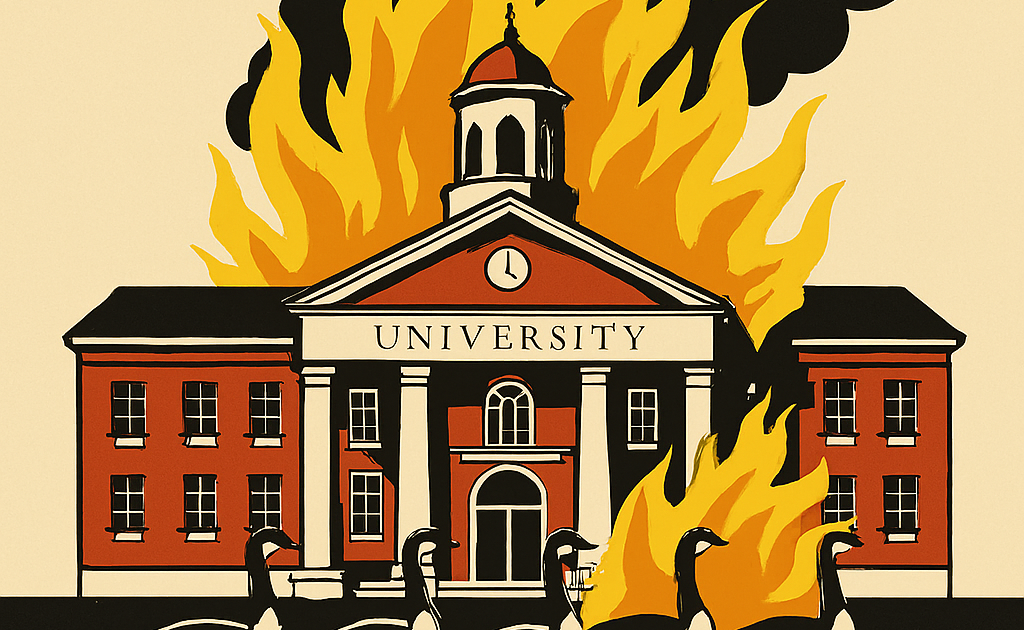
In December 2016, the Higher Education Inquirer published a set of 18 predictions warning of an ongoing “U.S. College Meltdown.” At the time, these warnings ran counter to the dominant narrative promoted by university leaders, accreditation agencies, Wall Street analysts, and much of the higher education press. College, readers were assured, remained a sound investment. Institutional risks were described as isolated, manageable, or limited to a small number of poorly run schools.
Nearly nine years later, that confidence has collapsed.
A comprehensive review of publicly available data, investigative journalism, court records, and government reports shows that 17 of the Higher Education Inquirer’s 18 predictions—94.4 percent—have been fully or partially confirmed. What was once framed as speculation now reads as an early diagnosis of a system already in advanced decline.
This article is not a victory lap. It is an accounting—of warnings ignored, of structural failures compounded, and of a higher education system reshaped less by learning than by debt, austerity, and financial engineering.
The Growth of Student Debt
In 2016, total student loan debt stood at approximately $1.4 trillion. By 2025, it had surpassed $1.8 trillion, despite repeated claims that the crisis was stabilizing. Millions of borrowers cycled in and out of forbearance, delinquency, and default, often unaware of the long-term consequences of capitalization, interest accrual, and damaged credit.
Temporary relief programs—pandemic pauses, income-driven repayment plans, and selective forgiveness—offered short-term breathing room while failing to address the underlying cost structure of higher education. Legal challenges and administrative reversals further destabilized borrower expectations, reinforcing the sense that student debt had become a permanent feature of American life rather than a transitional burden.
The Higher Education Inquirer warned in 2016 that student loans would increasingly function as a disciplinary mechanism, constraining career choice, delaying family formation, and suppressing economic mobility. That warning has proven prescient.
Graduate Underemployment and the Erosion of the Degree Premium
Another core prediction concerned the labor market. While headline unemployment numbers often appeared strong, the quality of employment deteriorated. By the early 2020s, a majority of recent four-year college graduates were underemployed—working in jobs that did not require a degree or offered limited advancement.
Wages stagnated even as credential requirements rose. Employers demanded more education for the same roles, while offering less stability in return. The result was a generation of graduates caught between rising expectations and diminishing returns.
This shift exposed a contradiction at the heart of the modern university: institutions continued to market degrees as pathways to prosperity, even as internal data increasingly showed that outcomes varied dramatically by institution, major, race, and class.
Enrollment Decline and the Demographic Cliff
The enrollment downturn predicted in 2016 arrived in waves. First came post–Great Recession skepticism. Then demographic decline reduced the number of traditional college-age students. Finally, the pandemic accelerated distrust, remote learning fatigue, and financial strain.
By the mid-2020s, enrollment losses were no longer cyclical. They were structural.
Colleges responded not by rethinking pricing or mission, but by cutting costs. Programs were eliminated, faculty positions left unfilled, and student services hollowed out. In rural and working-class regions, entire communities lost anchor institutions that had served as employers, cultural centers, and pathways to upward mobility.
Institutional Debt, Financialization, and Risk Shifting
One of the most underreported developments has been the rise of institutional debt. Facing declining tuition revenue, many colleges turned to bond markets to finance operations, capital projects, or refinancing. This strategy delayed collapse but increased long-term vulnerability.
The Higher Education Inquirer warned that debt-financed survival strategies would transfer risk downward—onto students through higher tuition, onto staff through layoffs, and onto local governments when institutions failed. That pattern has repeated itself across the country.
Meanwhile, elite universities with massive endowments continued to expand, insulate themselves from risk, and benefit from tax advantages unavailable to less wealthy institutions.
Closures, Mergers, and Asset Stripping
Since 2016, well over one hundred colleges have closed, merged, or been absorbed. Many closures were preceded by years of warning signs: declining enrollment, deferred maintenance, accreditation scrutiny, and emergency fundraising campaigns.
In some cases, institutions sold land, buildings, or entire campuses to survive. In others, boards pursued mergers that preserved branding while eliminating local governance and jobs.
These were not isolated failures. They were the predictable outcome of a system that prioritized growth, prestige, and financial metrics over resilience and public accountability.
The Limits of Reform and the Failure of Oversight
Perhaps the most sobering confirmation of the 2016 analysis is not any single data point, but the broader failure of reform. Despite abundant evidence of harm, regulatory responses remained fragmented and reactive. Accreditation agencies rarely intervened early. Federal enforcement was inconsistent. Media coverage often framed crises as unfortunate anomalies rather than systemic outcomes.
The Higher Education Inquirer argued in 2016 that the greatest risk was not collapse itself, but normalization—the slow acceptance of dysfunction as inevitable. That normalization is now visible in policy debates that treat mass underemployment, lifelong debt, and institutional instability as the cost of doing business.
A Crisis Foretold
The U.S. college meltdown did not arrive as a single dramatic event. It unfolded slowly, unevenly, and predictably—through spreadsheets, bond prospectuses, enrollment dashboards, and borrower accounts.
The accuracy of these forecasts underscores a deeper truth: the crisis was foreseeable. It was documented. It was warned about. What was missing was the willingness to act.
The Higher Education Inquirer published its predictions in 2016 not to provoke fear, but to provoke accountability. Nine years later, the record is clear. The meltdown was not an accident. It was a choice—made repeatedly, by institutions and policymakers who believed the system could absorb unlimited strain.
It could not.
Sources
LendingTree; EducationData; Inside Higher Ed; Higher Ed Dive; Forbes; NPR; Brookings Institution; National Bureau of Economic Research (NBER)