Category: Higher Education Marketing

  • 10 Strategies to Attract and Enroll the Modern Learner

    10 Strategies to Attract and Enroll the Modern Learner

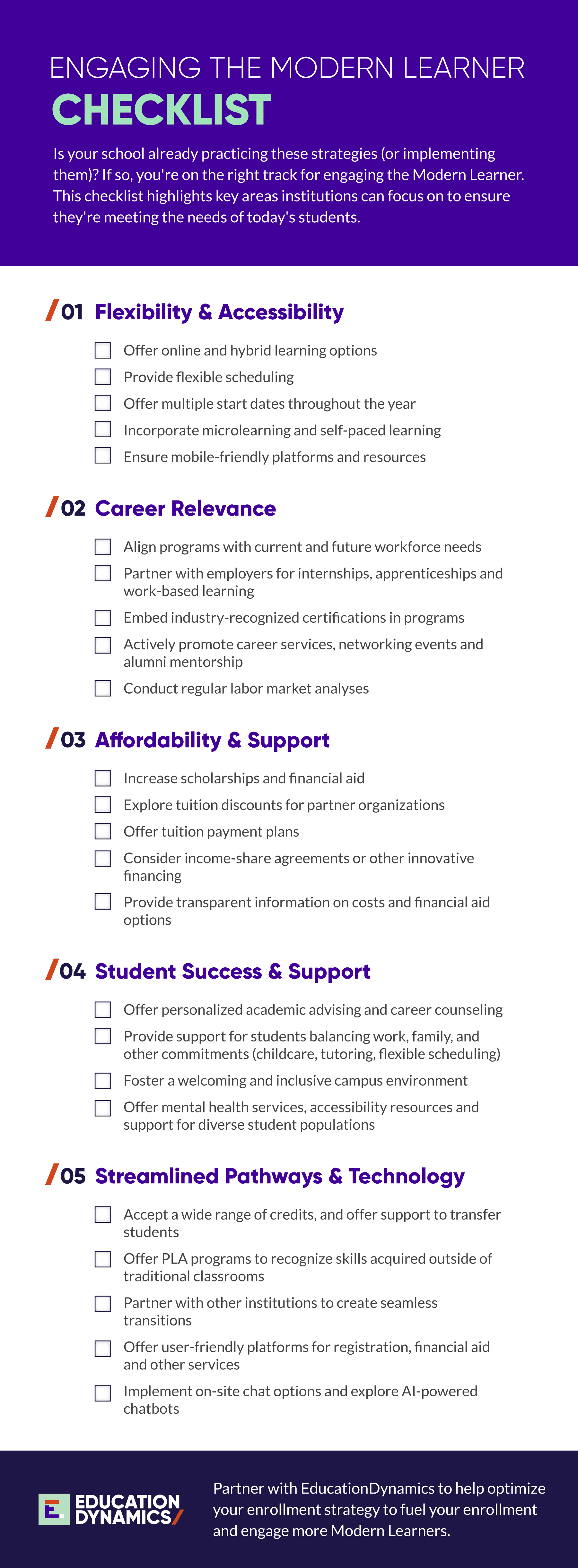
    As the higher education landscape continues to shift and evolve, the expectations and priorities of today’s students are shifting as well. To stay relevant, institutions are expanding their focus beyond traditional academic models to better meet the needs of a more discerning audience. Modern Learners are no longer bound by age or conventional learning modalities—today’s students are driven by different priorities, presenting a challenge for institutions relying on outdated methods to engage this demographic.  

    With primary motivators including career advancement and the need for flexibility, Modern Learners demand educational opportunities that offer accessibility, transparency and value. They are more selective, especially as the perceived value of a college degree has been questioned amid economic uncertainty. With rising student debt, these learners are looking for programs that provide a clear return on investment—an education that advances their careers while offering flexible options that meet their financial and personal needs. Success lies in striking a balance between value and cost-effectiveness, ensuring students feel seen, supported and equipped for the future. 

    Explore ten essential strategies for higher education institutions to expand their offerings and better engage Modern Learners. From improving strategies to leveraging resources and fostering deeper connections with students, these strategies aim to engage with Modern Learners based on their preferences and behavior rather than demographics by embracing a Unified Enrollment Strategy that fuels sustainable growth. 

    1. Build a Cohesive Brand

    In a competitive landscape where a strong brand is essential, the increasingly selective nature of Modern Learners calls for an institution’s brand to resonate with prospective students.

    Your institution’s brand identity should authentically reflect its values, mission and unique offerings. A compelling brand narrative not only showcases your unique selling proposition (USP), but also serves as an opportunity to connect on a deeper level with potential students, fostering trust and engagement.

    Building a cohesive brand experience involves aligning visual elements, messaging and tone to create consistency across all touchpoints—from your website to social media, emails and beyond. This alignment strengthens students’ understanding of your value proposition, guiding them throughout their journey and ensuring they feel engaged at every stage.

    At EducationDynamics, our in-house Creative team specializes in data-driven brand positioning and strategy. We take the time to understand your institution’s unique strengths and craft creative solutions that support the student journey, from initial discovery to enrollment. Discover how our creative services can help your institution’s brand thrive and successfully engage Modern Learners.

    2. Adopt a Full-Funnel Marketing Approach 

    As Modern Learners increasingly seek personalized learning experiences that align with their needs, institutions need to elevate their marketing strategies to meet their growing expectations. By embracing a full-funnel approach, schools can more effectively engage with students at every stage of their journey, leading to stronger enrollment outcomes.  

    A holistic full-funnel marketing approach not only boosts engagement, but also augments long-term growth by nurturing students from awareness to decision.  As students continue to research more throughout their journey and prioritize personalized content, institutions must adopt comprehensive approaches to effectively reach them.  

    With EducationDynamics’ multi-channel digital marketing expertise, schools can target students across various platforms, ensuring personalized messaging and an engaging experience across every touchpoint. If you want to learn more about how to build a successful full-funnel marketing approach, check out our Full-Funnel Marketing Guide for Higher Education.  

    3. Utilize Market Research to Identify High-Growth Programs 

    To effectively meet the evolving priorities of Modern Learners, institutions must develop programs that align with market trends and career opportunities. Leveraging market research allows schools to refine their offerings and better address students’ shifting needs and expectations. 

    Resources such as EducationDynamics’ eLearning Index Web App, serve as a powerful resource. The Web App, developed by EducationDynamics’ Market Research team, utilizes current National Center for Education Statistics (NCES) data, to showcase an accurate view of the current labor market and relevant trends regarding degree completions. Administrators can use the app’s interactive features to isolate the data by region, modality and program. By providing insights into the highest opportunity programs available for each educational level and a convenient user interface, the eLearning Index Web App tool empowers schools to optimize their program offerings, ensuring that they are offering degrees that are relevant to Modern Learners. Through aligning programs with high-growth career opportunities, institutions can not only boost retention but also empower students with the skills and support they need to thrive in the current job market.

    4. Nurture Leads and Personalize the Journey  

    Modern Learners often research extensively before finalizing their enrollment decision, seeking personalized and relevant information at every stage. Building relationships early and maintaining engagement over time is essential, whether you’re connecting with prospective students for the first time, re-engaging stopped-out students, or reconnecting with dormant inquiries.  

    Effective lead nurturing helps institutions build these relationships through tailored content that addresses the specific needs and interests of each student. Consistent communication guides students through their decision-making journey, ensuring they feel supported. 

    Marketing automation can help streamline these efforts. Through automation of communication workflows, institutions can deliver timely and personalized messaging that resonates with students. This level of personalization and consideration throughout multiple touchpoints in the student journey improves overall engagement and student experiences.  

    At EducationDynamics, our Nurturing Services offer institutions multi-channel engagement, using best-in-class marketing automation technology.  By delivering personalized communications across various platforms, we help schools strengthen connections with students at every stage of their journey.

    5. Provide 24/7 Support with AI Chatbots 

    As institutions seek to attract and enroll the Modern Learner, implementing AI Chatbots serves as a key tool by delivering real-time assistance and tailored responses to common student inquiries. Prospective students frequently encounter obstacles when searching for relevant information during their enrollment journey. With Modern Learners expecting immediate access to information, these challenges can lead to a frustrating experience, potentially impeding their enrollment decision. Employing AI Chatbots can help address this, through instant responses that answer commonly asked questions regarding program details, financial aid and academic support at any time of day. These chatbots not only help manage routine tasks, but they also allow admissions staff to focus on the more complex, high-touch interactions. By incorporating AI Chatbots into your institution’s communication strategy, you enhance student support and ensure that every inquiry receives proper, timely attention.  

    6. Showcase Your Innovative Spirit 

    Standing out amid the competitive higher education landscape is vital for attracting Modern Learners, who seek educational opportunities that align with their evolving needs and aspirations. Today’s students are not merely seeking to fulfill degree requirements; they are looking for an education that resonates with their interests and provides long-term growth opportunities. This is where innovation can play a vital role. By highlighting your university’s unique offerings and distinct culture, you can offer Modern Learners attractive reasons to choose your school, while demonstrating how you are adapting to meet the growing demands of Modern Learners.  

    At EducationDynamics’ Higher Ed Marketing Agency, our team of experts understand the importance of showcasing each institution’s unique selling points and innovative approaches within the higher education space.  Our services are designed to communicate the value of choosing your school, whether it’s through digital campaigns, social media content, or compelling copywriting. We empower you to emphasize your distinct strengths, enabling your institution to foster deeper connections with Modern Learners and guide them towards enrollment.  

    7. Create a Seamless Student Journey 

    The traditional, linear student journey no longer applies to today’s Modern Learners. With various commitments, such as family and work responsibilities, modern students engage with their educational environment in different ways than in years past. As a result, institutions need to adjust how they approach the student journey. By implementing student journey mapping, institutions can better understand the various stages of the student experience and refine it to reduce pain points. 

    EducationDynamics’ student journey mapping process provides institutions with actionable insights to optimize every stage of the student experience, from inquiry to enrollment. The process begins with a comprehensive analysis of your current student recruitment and services, including existing marketing materials, communication technology and student support systems. Using data-driven insights, we then create a visual student journey map that identifies key touch points and opportunities to enhance communication. From there, we develop a communication plan with targeted messaging and content designed to nurture, guide and support students across their enrollment journey. By integrating student journey mapping, institutions can better visualize the Modern Learner’s journey, while meeting their evolving needs.   

    8. Invest in Financial Aid Support 

    Financial aid is among the first pieces of information students seek and often plays a pivotal role in their enrollment decision. Equipping your institution’s advising team with the tools to engage in financial aid conversations early in the student journey is critical to meeting the expectations of Modern Learners and encouraging them to choose your institution over another.  

     EducationDynamics’ Financial Aid Advising services offer personalized support through dedicated coaches who manage student inquiries and provide individualized guidance. This streamlined approach allows your admissions team to focus on key priorities, while ensuring students receive the financial aid support they need. By delivering clear answers and a supportive experience, students are more likely to enroll, resulting in higher enrollment and retention rates. 

    9. Streamline Your CRM and Marketing Data Integration  

    A robust Customer Relationship Management (CRM) system is essential for navigating the Modern Learner’s enrollment journey. By collecting and managing student data, CRMs promote personalized communication that resonates with students. To truly maximize their potential, CRM systems should be optimized through technology integration, data quality assessments and user adoption, ensuring they effectively reach Modern Learners while driving scalable enrollment growth.  

    EducationDynamics recognizes the importance of an integrated CRM system. Our team of integration experts specialize in implementing and maintaining clean, actionable data that supports a cohesive strategy, giving your institution a holistic overview of each student and ensuring your CRM is built for long-term success.   

    10. Optimize Your Enrollment Team  

    As the primary point of contact for prospective students, your enrollment team is one of the most critical investments you can make. The expertise and engagement of your enrollment staff directly influences prospective students’ decisions, making them essential to student success outcomes.   

    At EducationDynamics, we believe in empowering both institutions and students by investing in staff development. Through our The U School platform, institutions can access exclusive 8-week programs designed to equip your team with the skills needed to meet the unique demands of Modern Learners. By strengthening staff training, we help build more effective enrollment pathways, ultimately increasing student engagement, satisfaction and enrollment growth.  

    Empowering Your Institution to Engage Modern Learners

    Attracting and enrolling Modern Learners requires a comprehensive approach that acknowledges their unique needs and preferences. By implementing the ten key strategies outlined in this article, higher education institutions can engage a new demographic of learners while nurturing meaningful connections with students. Embracing innovative solutions like student journey mapping and leveraging available resources allows institutions to transform the student experience. As the higher education environment continues to change and enrollment challenges arise due to shifting economic and demographic factors, institutions who proactively understand and cater to the unique needs of Modern Learners will differentiate themselves from the competition.  As your strategic partner, EDDY is committed to empowering your institution to confidently navigate these challenges while collectively advancing our mission to expand opportunity through education. 

    Source link

  • InsightsEDU 2025 – Marketing and Enrollment Management for Adult and Online Education 

    Date: February 12-14, 2025
    Location: The Ritz Carlton, New Orleans

    EducationDynamics’ InsightsEDU is one of the only higher education marketing and enrollment management conferences focused on the Modern Learner. Every year, InsightsEDU brings together thought leaders, decision-makers, and professionals from colleges, universities, and education-related organizations nationwide. The mission of InsightsEDU is to create a platform for the exchange of ideas, strategies, and innovations that propel higher education forward.

  • 2025 Presidents Institute

    Date: January 4–7, 2025
    Location: San Antonio, TX  

    The Council of Independent Colleges’ 2025 Presidents Institute serves as a pivotal gathering amid the shifting higher education environment, offering a space for leaders to address key challenges. The 2025 gathering will provide over 300 college and university presidents, along with nearly 750 participants, the opportunity to explore how strategic community engagement can transform challenges into opportunities. With a focus on critical issues like financial sustainability, legal challenges, DEI and belonging, and federal policy, this event offers timely insights for navigating higher education’s political landscape.

  • SXSW EDU Conference & Festival 2025  

    Date: March 3-6, 2025 
    Location: Austin, TX 

    Immerse yourself in four days of unparalleled learning and collaboration at the SXSW EDU Conference & Festival. Designed for education professionals, industry leaders, and policymakers, this pivotal event ignites creativity and fosters innovation in the field of education. 

  • 2025 UPCEA Annual Conference 

    Date: March 24-26, 2025
    Location: Denver, CO  

    UPCEA’s Annual Conference is one of the most significant assemblies of thought leaders and practitioners today in the field of professional, continuing, and online education. Deans and other senior university leaders, key staff, and teams responsible for the management, administration, and growth of professional, continuing, and online education programs attend every year to gain insights on the most pressing topics in the higher education landscape – including federal policy, finance and operations, marketing and enrollment management, instructional design, noncredit programs, alternative credentialing, and more.  

  • American Association of Community Colleges (AACC) 2025 

    Date: April 12-16, 2025
    Location: Nashville, TN

    The American Association of Community Colleges (AACC) Annual Conference hosts a premier professional development event for leaders and stakeholders in the community college sector. It features impactful keynote presentations, focused breakout sessions, technology showcases, and peer-to-peer exchanges, all aimed at addressing the most pressing challenges and opportunities in two-year colleges. With a focus on innovation, problem-solving, and extensive networking opportunities, the AACC Annual Conference serves as an essential platform for shaping the future of community college education.

  • The American Association of Collegiate Registrars and Admission Officers (AACRAO) 110th Annual Meeting 

    Date: March 30 – April 2, 2025
    Location: Seattle, WA 

    Join a global network of higher education professionals at the AACRAO Annual Meeting, where leaders from various disciplines come together to explore, engage, and advance the field. This event provides an opportunity to discuss the ever-changing landscape of higher education, share valuable insights, and collaborate on practical solutions to real-world challenges. Each year, the AACRAO Annual Meeting tackles emerging issues and trends, offering attendees the chance to deepen their knowledge, expand their network, and contribute to the future of higher education.

  • OLC Innovate 2025 

    Date: April 1-4, 2025
    Location: Nashville, TN

    The Online Learning Consortium (OLC) is a group of higher education leaders and innovators who work to advance quality digital teaching and learning experiences. OLC Innovate 2025 offers educators of all experience levels to explore, share, and advance digital and blended learning. Themed “The Rhythm of Innovation: Hitting the High Notes in Digital Education,” the conference will reimagine how today’s disruptions shape tomorrow’s classrooms.

  • 2024 Higher Learning Commission (HLC) Annual Conference 

    Date: April 5-8, 2025
    Location: Chicago, IL 

    HLC’s Annual Conference is geared towards administrators in the higher education community, including administrative professionals, faculty members, CEOs, presidents, and chancellors. Sessions, speakers, and workshops provide opportunities for institutions that seek accreditation and offer information on the latest developments, issues, and best practices in higher education. The 2025 conference will explore how colleges and universities use higher education to address evolving student and societal needs, impart workforce skills, fuel innovation, and tackle today’s most pressing challenges.

  • ASU+GSV Summit 2025 – Learning at the Speed of Light 

    Date: April 6-9, 2025
    Location: San Diego, CA 

    The ASU GSV Summit brings together leading thinkers in digital learning and workforce skills to create a future where everyone has equal access to opportunity. It is a community of educators, entrepreneurs, investors, and innovators in the educational technology and higher education industry who are motivated in reshaping society and education through innovation.  

  • NAGAP, The Association for Graduate Enrollment – 2025 Graduate Enrollment Management Summit 

    Date: April 23-26, 2025  
    Location: San Francisco, CA

    NAGAP’s annual summit unites professionals engaged in every aspect of the graduate enrollment lifecycle—from admissions and recruitment to financial aid, academic affairs, and beyond. As the only professional organization dedicated exclusively to graduate enrollment management, NAGAP provides a unique platform for addressing the specific concerns and challenges faced by those in this field.

  • Digital University Week – Inside Higher Ed/Times Higher Education 

    Date: May 2025
    Location: TBD

    Digital University Week, hosted by Inside Higher Ed and Times Higher Education, brings together leaders in higher education’s digital transformation to explore the opportunities and challenges of a digital-first future. The event focuses on overcoming institutional silos, fostering industry collaboration, and maximizing resources while emphasizing a human-centered approach for equitable digital learning. The series offers an intimate setting for impactful conversations, sparking new ideas and building connections to reshape the future of education. 

  • 2025 Career Education Colleges and Universities (CECU) Convention 

    Date: May 27-29, 2025
    Location: Las Vegas, NV

    The 2025 North American Career Education Convention is regarded as the largest gathering of private career education professionals nationwide. Featuring renowned keynote speakers, expert-led sessions, and ample opportunities to connect with sector leaders, this conference attracts a diverse audience each year, fostering collaboration and innovation in postsecondary career education.

  • Slate Summit 2025 

    Date: June 25-27, 2025
    Location: Las Vegas, NV

    The Slate Summit, an exclusive event led by the Slate community, provides a deep dive into specific Slate topics through expert-led sessions and offers networking opportunities with like-minded peers in affinity group breakouts. This year’s Summit, tailored for admissions, student success, and advancement professionals, promises to be the most engaging and informative yet, featuring industry experts, interactive workshops, and unparalleled networking opportunities. 

  • eduWeb Summit 2025 

    Date: July 15-17, 2025 
    Location: Portland, ME 

    The eduWeb Summit is a community of higher education professionals and industry partners who are passionate about advancing their marketing, communications, and digital work. This conference gathers higher education professionals and industry partners from 16 countries and all 50 states. Attendees benefit from enhanced networking opportunities, engaging with peers and potential partners while gaining valuable insights into web and digital experiences, AI and analytics, leadership and innovation, and enrollment marketing. 

  • UPCEA DT&L and SOLA+R 2024 – Distance Teaching & Learning Conference and Summit for Online Leadership & Administration + Roundtable 

    Date: TBD
    Location: TBD

    UPCEA’s DT&L and SOLA+R event combines 2 conferences into 1 seamless experience. It captures all the elements of digital transformation and leadership in a holistic way—from teaching and learning to leadership and administration—preserving the salient issues for two distinct professional communities, while catalyzing dialogue across all facets of the larger field. This event is ideal for key campus leaders – presidents, provost, deans, instructional designers, faculty, and other focused on digital leadership. 

    UPCEA DT&L and SOLA+R 2025 Conference details have not been released at this time, but you can view last year’s event page for more information. 

  • UNCF Unite 2025 

    Date: July 20-24, 2025
    Location: Atlanta, GA 

    UNITE, powered by the United Negro College Fund (UNCF), is the nation’s leading annual gathering for Historically Black Colleges and Universities (HBCUs) and Predominately Black Institutions (PBIs). This influential event brings together thought leaders, change agents, and community partners to accelerate institutional transformation, address shared challenges, and celebrate achievements. Through networking, discussions, and celebration, UNITE fosters innovation within higher education and propels institutions towards a brighter future for all students.  

    UNCF Unite 2025 Conference details have not been released at this time, but you can view last year’s event page for more information.

  • HashtagHigherEd 2025

    Date: TBD
    Location: TBD

    HashtagHigherEd is a dedicated forum of professionals in higher education marketing and communications to converge, fostering the exchange of best practices amidst the complexities of a competitive and ever-evolving landscape. This dedicated forum provides a space for these professionals to collaboratively discuss effective communication, marketing, and branding strategies tailored to the unique challenges of the higher education sector.   

    HashtagHigherEd US 2025 Conference details have not been released at this time, but you can view last year’s event page for more information.

  • HighEdWeb Association Annual Conference 2025 

    Date: September 28-October 1, 2025
    Location: Online and Grand Rapids, Michigan  

    Connect with colleagues and explore the impact of digital media on higher education at the HighEdWeb Annual Conference 2025. Designed for professionals across all roles—programmers, marketers, social media experts, managers, designers, and writers—this event offers diverse track sessions, an inspiring keynote, and group discussions. Engage with a vibrant community, gain valuable insights, and address unique digital challenges faced by colleges and universities, all while expanding your network and enhancing your professional development. 

  • NACAC Conference 2025 

    Date: September 18-20, 2025 
    Location: Columbus, OH

    The NACAC Conference 2025 will gather over 6,000 dedicated counselors in Los Angeles to exchange best practices, gain inspiration, and explore cutting-edge research in admission counseling. This event provides higher education counselors with the chance to discover innovative strategies, engage with thought leaders and peers, stay updated with the latest research, and connect with a diverse community of professionals. 

  • UPCEA Convergence 

    Date: TBD
    Location: TBD

    The UPCEA Convergence conference explores contemporary trends and emerging models within the realm of alternative credentials. This event, a collaborative effort by UPCEA and AACRAO, serves as a platform for key campus figures involved in credential innovation. This includes deans of professional education, chief online learning officers, registrars, and their respective teams. Together, they aim to delineate and refine institutional strategies concerning alternative credentials.  

    UPCEA Convergence 2025 conference details have not been released at this time, but you can view the 2024 event page for more information. 

  • P3 EDU – Innovation and Public-Private Partnership in Higher Education

    Date: TBD
    Location: TBD 

    P3 EDU is an invitation-only annual conference that brings together university administrators, government officials, and representatives from foundations and corporations to discuss public-private partnerships in higher education. Attendees will delve into partnership opportunities, share best practices, and address the challenges of implementing successful public-private partnerships in higher education.  

    P3 EDU 2025 conference details have not been released at this time, but you can view the 2024 event page for more information.

  • Educause Annual Conference 2025

    Date: October 27-29, 2025 
    Location: Nashville, TN and Online 

    The Educause Annual Conference is the premier event for higher education technology professionals, connecting the brightest minds in the field. This global gathering brings together individuals from diverse backgrounds within the higher education industry – practitioners, researchers, and solution providers – to share ideas, develop their expertise, and discover innovative solutions to contemporary challenges.  

    The Educause Annual 2025 Conference details have not been released at this time, but you can view the 2024 event page for more information. 

  • 2025 AMA Symposium for the Marketing of Higher Education  

    Date: TBD
    Location: TBD 

    For over 30 years, the AMA Symposium for the Marketing of Higher Education has offered a dynamic glimpse into the ever-evolving landscape of higher education. With a program featuring peer-reviewed content, attendees gain the strategic insights needed to elevate their marketing strategies, enhance their institutional reputation, and ensure financial strength. Beyond the wealth of sessions, the Symposium serves as a vibrant community where knowledge seamlessly transitions into actionable initiatives, making it an invaluable resource for marketers looking to shape the future of higher education, foster growth, and ensure vitality.   

    The 2025 AMA Symposium Conference details have not been released at this time, but you can view the 2024 event page for more information. 

  • OLC Accelerate 2025

    Date: November 17-20, 2025
    Location: Orlando, FL 

    The OLC Accelerate conference showcases groundbreaking research and effective practices in online, blended, and digital learning. It offers a diverse range of sessions and activities designed to support administrators, designers, and educators by addressing the unique challenges and goals of the entire community. This event is a comprehensive resource for staying at the forefront of innovative practices in digital education.  

    The OLC Accelerate 2025 Conference details have not been released at this time, but you can view last year’s event page for more information.

  • UPCEA MEMS 2025

    Date: TBD
    Location: TBD

    UPCEA MEMS is a must-attend conference for education professionals who want to stay on top of the trends in higher ed marketing. Presented from a variety of perspectives, sessions elevate the conversation about today’s higher education landscape. For over 30 years, MEMS has drawn professionals from institutions of all sizes to showcase thought leadership in higher education and explore trends in adult student recruitment and retention.

    UPCEA MEMS 2025 Conference details have not been released at this time, but you can view the 2024 event page for more information.

  • NAICU 2025 Annual Meeting and Advocacy Day

    Date: February 2-5, 2025
    Location: Washington, DC

    NAICU’s Annual Meeting & Advocacy Day is the premier policy and advocacy event for private, nonprofit higher education leadership, including college and university presidents, government relations personnel, and executives from state and mission-specific higher education associations. The meeting annually offers briefings on pressing policy issues affecting higher education and focuses advocacy efforts on these critical concerns.

  • WCET 37th Annual Meeting

    Date: October 21-23, 2025
    Location: Denver, CO

    The WCET Annual Meeting brings together higher education professionals and practitioners to foster critical discussions, share the latest advancements in digital learning, and navigate the evolving regulatory landscape. With a registration limit of 500, the intimate and collegial setting of the WCET Annual Meeting offers unique opportunities for meaningful dialogue and insights, making it a valuable event for leaders and practitioners in digital learning.

    WCET 2025 Conference details have not been released at this time, but you can view last year’s event page for more information.

  • 2025 Engage Summit

    Date: June 24-26, 2025
    Location: Charlotte, NC

    The Engage Summit focuses on practical applications of AI, equipping attendees to lead their institutions through AI transformation. Participants will gain insights into the modern student’s mindset—understanding their motivations, interactions, and expectations in today’s digital landscape. This event serves as a great opportunity for educational leaders to prepare their campuses for the evolving future of learning.

    The 2025 Engage Summit Conference details have not been released at this time, but you can view last year’s event page for more information.

Conferences offer invaluable opportunities for higher education professionals to stay current with industry trends, discover innovative strategies, and connect with like-minded individuals. Whether you’re seeking to advance your career, enhance your skills, or simply stay informed, attending a relevant conference can be a hugely rewarding experience.  

If you see any of our experts at EducationDynamics (EDDY) at one of these events, come and say hello! We’re excited about making new connections with people from all over the world who share a passion for learning more about what it means to understand, find, enroll, and retain adult, online, or non-traditional students.  

We look forward to seeing you there; drop us a line if you’re attending any of the conferences above. 

Source link

  • A New Era of Higher Education- EducationDynamics

    A New Era of Higher Education- EducationDynamics

    The frequently used term “adult students” no longer captures the dynamic, diverse, and evolving population pursuing a degree today. Data from EducationDynamics’ Online College Students and Marketing & Enrollment Management Benchmarks reports show that the average age of learners is decreasing, and that their needs are growing more complex. Whether they are first-generation college students, single parents or veterans seeking to advance their career, these individuals represent what we now define as the Modern Learner. These learners are shaping the future of higher education by driving a demand for flexible, accessible, and affordable learning opportunities that meet their diverse needs. In a recent episode of the EdUp Experience Podcast, Dr. Joe Sallustio, the host of The EdUp Experience, Dr. Melik Khoury, President and Chief Executive Officer at Unity Environmental University and Greg Clayton, President of Enrollment Management Services of EducationDynamics, discuss the trends reshaping higher education and offer insights into how institutions can better serve Modern Learners amidst changing times.  

    Beyond Traditional Categories

    The Modern Learner is not defined by age – it’s a mindset. Gone are the days when “traditional student” and “adult learner” were distinct categories. Today, a diverse range of individuals, from recent high school graduates to seasoned professionals, are seeking education on their own terms. This shift is driven by a fundamental change in how students approach education, influenced by technology, individual aspirations, and an evolving job market. 

    Modern Learners often juggle busy lives, whether they are working professionals, parents, or recent graduates. Therefore, an education that seamlessly integrates with their personal and career goals has become crucial. They seek learning experiences that fit their unique circumstances, allowing them to pursue their passions and advance their careers.  

    Regardless of what their circumstances are, Modern Learners are not limited by geographic location or traditional educational barriers. They expect affordable and accessible learning opportunities. 

    As a result, Modern Learners have redefined the typical adult student profile by prioritizing flexible, career-focused programs that fit into their busy schedules. Traditional models and assumptions about age are no longer relevant, and institutions must adapt to these needs, focusing on providing accessible education that aligns with the personal and professional goals of Modern Learners.  

    Building a Student-Centric Model 

    Responding to the needs of the Modern Learner requires higher education institutions to move away from an institution-centric model and embrace a student-centric one. This involves a deep commitment to understanding and addressing the diverse needs of Modern Learners, rather than adhering to outdated practices and structures. Embracing various learning modalities including online, hybrid, and residential programs, while acknowledging the value of each, is paramount. Additionally, by recognizing that online learning is a valuable and equal learning pathway, institutions can provide more flexible, accessible, and relevant educational opportunities that align with the goals and lifestyles of today’s Modern Learners.  

    We really started to look at each and every one of our subsidiaries for, it didn’t matter how old you were, it was more how did you want to learn?

    Dr. Melik Khoury, President of Unity Environmental University

    To fully address these evolving needs, institutions must create personalized learning experiences and adapt program structures to accommodate varying schedules and preferences, which will more effectively engage Modern Learners.

    Navigating the Challenges of Change

    However, adapting to the needs of the Modern Learner is not without its challenges. Many institutions encounter resistance to change, ingrained practices, and varying levels of awareness about the evolving student landscape. 

    This resistance often stems from a reliance on traditional models, driven by a fear of disrupting established practices and structures. As a result, institutions may hesitate to adopt online learning, resist new marketing strategies, or cling to familiar, albeit outdated, approaches. 

    It’s amazing how many universities, if you ask them about the cost of acquisition, they would have no idea…Many institutions don’t even understand the concept of you can’t have a regional recruitment and marketing strategy and hope for a national draw.

    Dr. Melik Khoury, President of Unity Environmental University

    Traditional marketing strategies are becoming less effective in reaching the Modern Learner, as this population responds better to online channels, targeted digital marketing campaigns, and social media engagement. Adapting marketing strategies to better connect with this demographic is crucial. Additionally, demonstrating a clear return on investment is equally important, as Modern Learners make quick decisions—often within one or two weeks—based on the immediate value and benefits of their program choices. 

    The thinking about marketing and how to market to students has to evolve…The amount of time they want to wait is one to two weeks before, so maybe a month. And that’s it.

    Dr. Joe Sallustio, Co-Founder & Host of The EdUp Experience

    Embracing Innovation and Iteration

    Successfully meeting the needs of the Modern Learner is rooted in building a culture of innovation and experimentation. This involves a willingness to embrace new approaches, learn from mistakes, and continually refine programs and processes to better serve student needs. 

    A key aspect of serving the Modern Learner is pivoting to shorter, more skill-focused program offerings. By aligning curricula with industry demands and ensuring flexibility, institutions can better support students in acquiring relevant skills and advancing their careers.

    We actually don’t care anymore about majors…my faculty doesn’t identify their value based on our majors, but by the disciplines.

    Dr. Melik Khoury, President of Unity Environmental University

    Beyond adapting program design, Modern Learners also require a positive and supportive learning experience. Investing in technology, enhancing student support services, and cultivating a campus culture that fosters engagement and success are essential components of this experience.  

    Additionally, prioritizing data-driven decision-making is vital to guiding program development and implementation.  By using data to assess program effectiveness, track student success, and inform resource allocation and program design, institutions can ensure their strategies are grounded in evidence rather than relying on traditional methods.

    Are You Ready to Attract the Modern Learner?

    The higher education landscape is changing, and adapting to the needs of the Modern Learner is essential for success. Embracing innovation, moving away from traditional practices, and prioritizing the student experience are critical components for success in today’s learning environment.  

    Don’t ask me to be innovative and be bound to tradition, be bound to what has come before me, be bound to pedagogy that is tried and true

    Dr. Melik Khoury, President of Unity Environmental University

    Flexibility, adaptability, and continuous improvement serve as tenets for institutions successful in meeting the Modern Learner’s needs. Institutions that excel in these areas are more likely to distinguish themselves from the competition. By shifting their governance structures, decision-making processes, and faculty training to encourage innovation and flexibility, they can better meet the evolving expectations of Modern Learners and remain competitive in a rapidly changing higher education environment.  

    The future of higher education hinges on the ability to adapt. By prioritizing innovation, the student experience, and fostering a culture of continuous improvement, institutions can not only survive, but thrive in this new era of learning. To enter this new era of higher education and elevate your institution’s programs to new heights, reach out to EducationDynamics. Together, we can drive meaningful change and achieve your goals.  

    Source link

  • NCES Data Show Modern Learners Want Career Focused Degrees

    NCES Data Show Modern Learners Want Career Focused Degrees

    Brief

    The 2023 NCES completion data points to some interesting – and impactful – student trends that continue to paint a picture of a fundamentally changing set of priorities for the Modern Learner. Specifically, more students are moving towards degrees that have firm career outcomes, either in furthering their current career or starting a new endeavor.

    Institutions need to pay attention to these trends in order to prepare themselves for a radically different higher education market in the next 5-7 years. This includes prioritizing programs that align with the market’s appetite, as well as re-investing in the value proposition of programs that are currently declining in popularity.

    Other Highlights

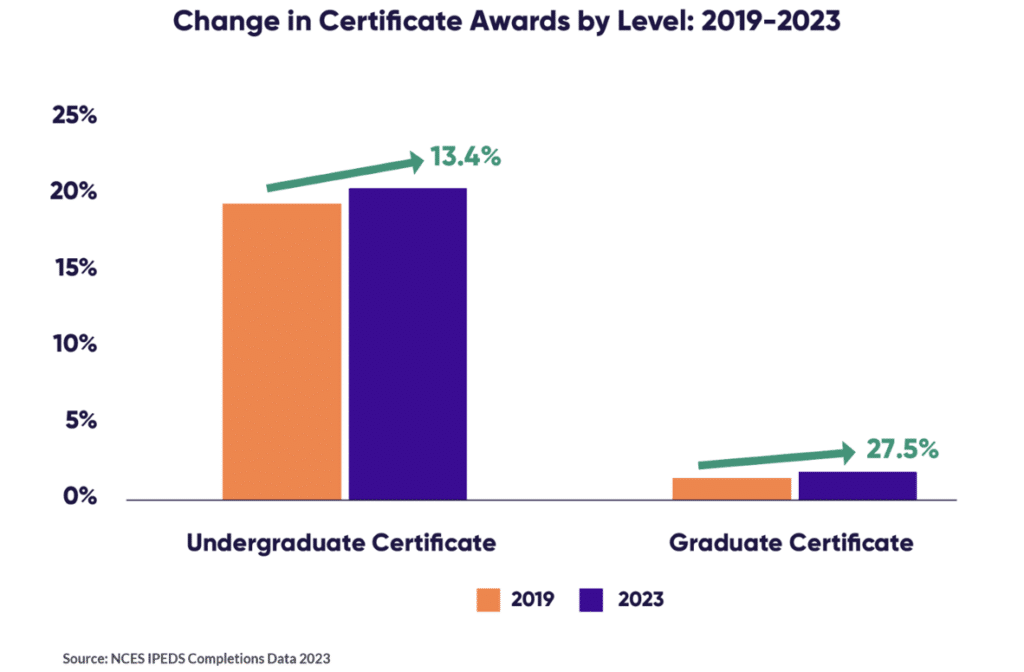
    • Associate degree completions saw marked decline, which is notable considering the growth of Undergraduate Certificate completions. Students seem to be preferring certificates that can lead to employment opportunities.
    • STEM programs continue to either grow or remain stable, depending on the level of the degree. This was most notable at the Graduate level. As more jobs continue to require advanced degrees, this trend is set to only grow in importance.
    • Liberal Arts programs across all levels experienced significant YoY reductions in completions. Schools that are defined by their Liberal Arts programs will need to assess ways in which they continue to project relevance as the market shifts.
    • Undergraduate Health Profession programs also saw a decline, which goes against the commonly held belief that the labor market and these programs are continuing to grow. This is something that should definitely be monitored and evaluated, to ensure that institutions do not over-invest in a sector that may be slowing.

    2023 NCES Completions Data and the Changing Priorities of the Modern Learner

    The 2023 National Center for Education Statistics (NCES) completions data offers a rich and complex tapestry of insights into the trajectory that the Modern Learner is taking their education. As enrollment managers and marketers, it is our imperative to move beyond surface-level observations and delve into the intricate patterns and implications woven within these numbers. This data serves not merely as a historical record but as a powerful compass, guiding us towards a deeper understanding of the Modern Learner’s market demands, and the strategic decisions that will chart the course for institutions in the years to come.

    This year’s data unveils a series of significant shifts in student choices, reflecting both the evolving needs of the labor market and the lingering reverberations of the COVID-19 pandemic. We observe a notable decline in associate degree completions, particularly in general studies and humanities, while undergraduate certificates continue their upward trajectory. At the bachelor’s level, STEM fields remain stable, while other areas, especially those associated with traditional liberal arts programs, face headwinds. Graduate programs, particularly in STEM disciplines, are experiencing a surge in completions, and both undergraduate and graduate certificates continue to gain popularity.

    In this analysis, we will dive deep into the data, exploring the specific programs experiencing growth or decline, examining the multifaceted factors driving these trends, and discussing the profound implications for higher ed. We will delve into the remarkable growth in graduate programs and certificates, highlighting the increasing demand for advanced credentials in the labor market. We will also confront the undergraduate decline, exploring the potential impact of the COVID-19 pandemic and the looming 2025 enrollment cliff, with a particular focus on the challenges facing private non-profit liberal arts schools. By understanding these multifaceted trends and their interconnectedness, we can proactively adapt our strategies, ensuring that our institutions not only remain relevant and competitive but also thrive amidst a landscape in flux.

    Associate Degree: Trade Focused

    The 5% decline in associate degree completions is notable both in what programs dropped and which programs are continuing to see growth. The most significant drop emanates from Liberal Arts and Sciences, General Studies, and Humanities, programs that have historically served as a bridge to further education or a broad foundation for diverse career paths. 61% of the YoY decline were in this category. The decline in these areas, coupled with the simultaneous rise in undergraduate certificates, suggests a growing preference among students for more focused, career-oriented pathways that offer a faster and more tangible return on investment.

    This shift in student preferences is not surprising in the context of a rapidly changing labor market that increasingly values specialized skills and knowledge. Students are seeking educational pathways that provide them with a clear and direct route to employment and career advancement. In this environment, the perceived value of broad-based, general education programs may be diminishing.

    However, amidst this overall decline, we observe encouraging signs of growth in fields directly aligned with high-demand skills. Programs such as Construction Trades, Mechanic and Repair Technologies/Technicians, and Computer and Information Sciences and Support Services have all witnessed increases in completions. This trend underscores the enduring value of associate degrees that equip students with tangible, marketable skills, enabling them to seamlessly transition into the workforce and meet the demands of employers seeking skilled talent.

    Bachelor’s Degree: Value Proposition Challenges

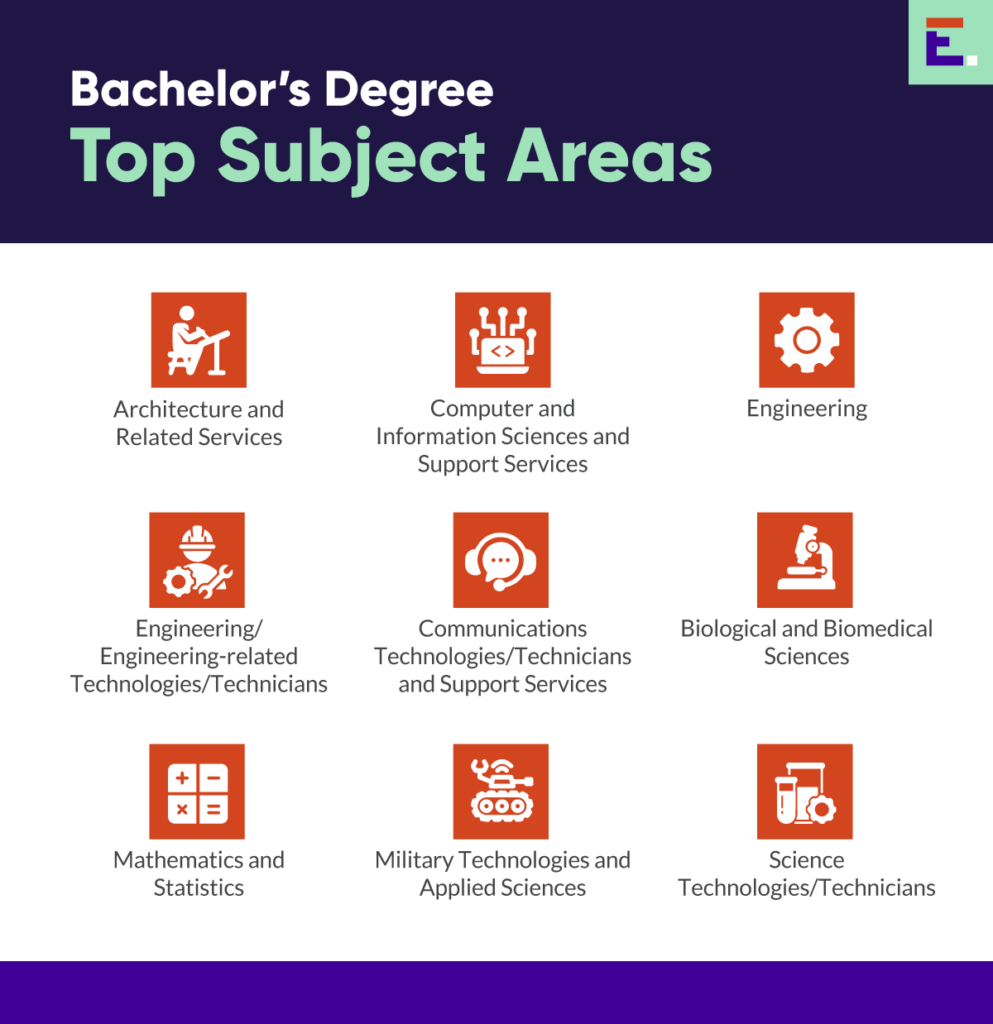
    At the bachelor’s level, we encounter a mixed bag of stability and change. While STEM fields remain a stronghold, with only a negligible 0.07% dip, other areas, particularly those associated with traditional liberal arts programs, are facing challenges. The most pronounced decline occurs in Health Professions, a field traditionally associated with strong job prospects and stable growth. This decline, juxtaposed with the increase in master’s level completions in Health Professions, suggests a potential shift towards requiring advanced degrees for certain healthcare roles. This mirrors a broader trend of “graduate degree bloat” in the labor market, where employers increasingly demand advanced credentials for positions that previously required only a bachelor’s degree.

    The COVID-19 pandemic has undoubtedly exacerbated the challenges facing undergraduate programs. The disruption to traditional learning models, coupled with economic uncertainty and concerns about the value of a college degree, has led many students to reconsider their educational plans. The looming 2025 enrollment cliff, which predicts a significant drop in the number of high school graduates, further compounds these challenges, creating a perfect storm for undergraduate enrollment.

    Private non-profit liberal arts schools are particularly vulnerable in this environment. The growth areas in the undergraduate space are mainly concentrated in STEM programs, leaving liberal arts institutions grappling with declining enrollments and a need to reimagine their value proposition. Adapting to this changing landscape will require innovative approaches to curriculum design, student support, and career services. Tuition driven, liberal arts institutions must demonstrate the relevance and value of their programs in today’s world, not only highlighting the critical thinking, communication, and problem-solving skills that their graduates possess (which has always been their particular promise), but also their undergraduate’s career opportunities.

    Graduate Studies: Career Growth and Specialization

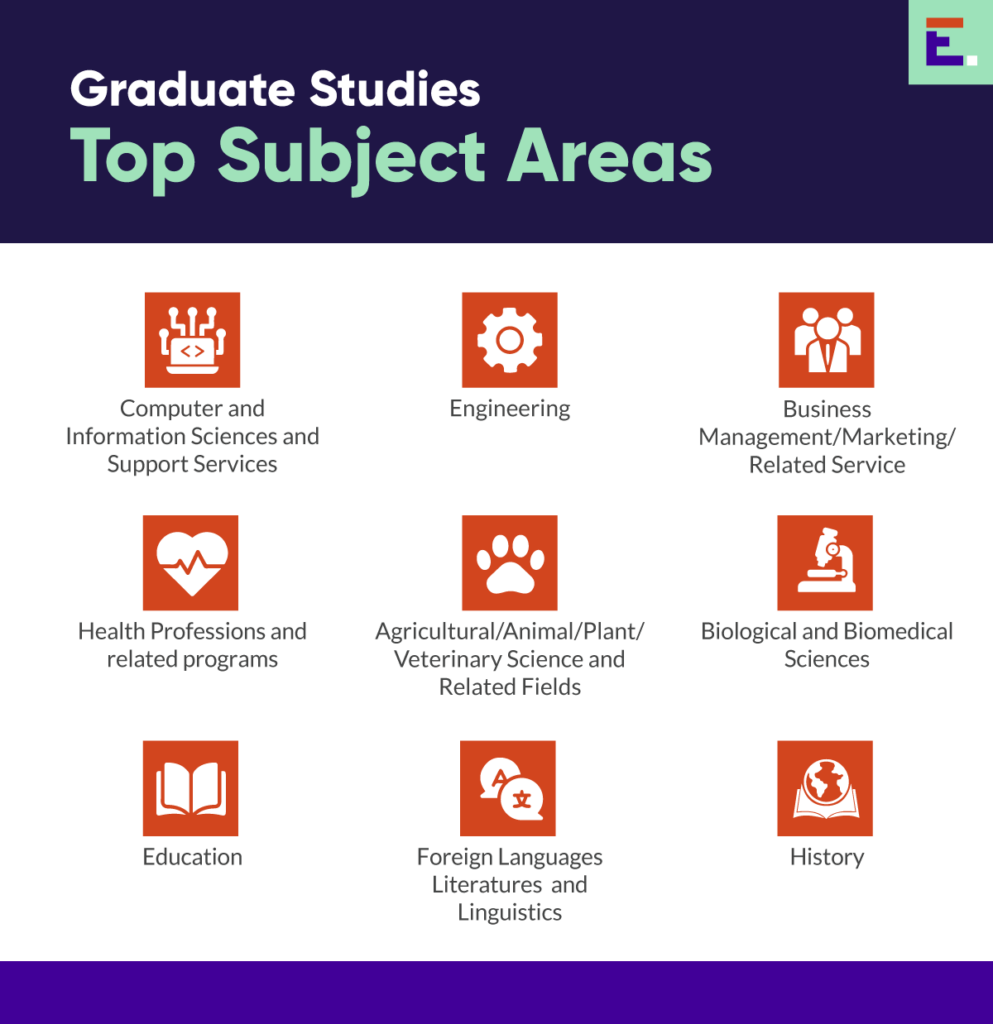
    Graduate programs, especially those in STEM disciplines, are experiencing a period of remarkable growth. The 51% and 25% surges in Computer and Information Science and Support Services and Engineering master’s completions, respectively, echo the trends at the bachelor’s level and underscore the premium placed on advanced technical expertise. The overall 30% rise in STEM master’s completions further solidifies this trend, reflecting the insatiable demand for skilled professionals in these fields.

    This surge in graduate completions aligns with the broader trend of graduate degree bloat (others might more favorably describe it as “expansion”) in the labor market. As certain industries and professions increasingly require advanced degrees for career advancement, we can anticipate continued growth in graduate programs, particularly in fields that offer a clear pathway to high-demand, well-paying jobs. This presents a significant opportunity for institutions to expand their graduate offerings and cater to the growing population of working professionals seeking to upskill and advance their careers.

    Graduate certificates are also experiencing growth, with a 2% increase in completions. The growth in fields like Computer and Information Technology, Psychology, and Engineering/Engineering-related Technologies/Technicians demonstrates the appeal of these focused credentials for professionals seeking to enhance their skill sets or transition into new careers. The flexibility and shorter duration of graduate certificates make them an attractive option for busy professionals who may not have the time or resources to pursue a full master’s degree – especially if the certificates are tied to a degree later.

    The flourishing graduate landscape presents a wealth of opportunities for institutions. Expanding graduate program offerings, enhancing online and hybrid learning options, and strategically marketing to working professionals are all essential strategies for capitalizing on this growth. The increasing popularity of graduate certificates also underscores the need for institutions to develop a diverse portfolio of graduate programs that cater to the varied needs and preferences of learners.

    Navigating the Data’s Implications for Engaging with the Modern Learner

    The 2023 NCES completions data provides a roadmap for navigating the complexities of the higher education landscape. The trends we’ve observed highlight the growing preference for career-focused programs, specialized credentials, and flexible learning options. They also underscore the challenges facing undergraduate programs, particularly in the liberal arts, in the wake of the COVID-19 pandemic and the approaching enrollment cliff.

    To thrive in this environment, institutions must be proactive, agile, and data-driven. The Modern Learner is looking for clear career outcomes – not just in program availability but in the flexibility that comes with balancing work with furthering education. They want to know exactly what they can expect from their investment of time and money to the program. Schools must also reimagine their programs, enhance student support services, and strategically market offerings to meet the evolving needs of learners and the demands of the labor market. They need to embrace innovation and explore new models of education that provide students with the skills and knowledge they need to succeed in the 21st century.

    For associate degree programs, this may involve a greater emphasis on career-focused pathways, stackable credentials, and partnerships with employers. Bachelor’s degree programs, especially in the liberal arts, may need to re-articulate their value proposition, highlighting the transferable skills and lifelong learning benefits that their graduates acquire. Graduate programs should continue to expand and innovate, offering a mix of traditional degrees and flexible certificates to meet the diverse needs of working professionals.

    Above all else, if this data is speaking to troubling realities on campus, the most important takeaway should be: trying the same strategies that are producing tepid results in regards to enrollment growth will not be the solution going forward. If you are seeing challenging enrollment numbers for any level of program, think about how your institution can more readily adapt to these changing trends, whether that be introducing multiple starts per term, reworking tuition costs, or making better strategic use of marketing and enrollment processes for priority programs.

    Is Your Institution Ready for the Modern Learner?

    We help schools all the time who have been trying to fit a square peg into a round hole, and often the solution is for an outside perspective to create a vision for the future. The time to act is right now, there is a quickly closing time frame for ensuring a flourishing future for your institution. In fact for many schools, it is already too late. The Modern Learner is moving at a swift pace, and if universities do not keep up, they will quickly be left behind.

    Source link

  • TikTok Marketing in the Face of Potential Bans

    TikTok Marketing in the Face of Potential Bans

    If you’ve scrolled TikTok recently, you might have noticed that some of your favorite creators have started bringing up their other handles, encouraging you to follow them on different platforms. With the ban possibly becoming effective as early as January 2025, this trend is becoming increasingly popular. From micro-influencers to brand giants, creators are taking decisive action, urging their audiences to follow them on alternative platforms as a failsafe. These creators aren’t just reacting—they are leading the pack by ensuring that their followers stay connected, no matter what challenges lie ahead.

    As the calendar inches closer to January, the time to rethink and implement your digital strategy is now.

    For marketers who have leveraged TikTok’s platform to amplify their brands and connect with consumers in unprecedented ways, the looming possibility of bans or restrictions raises pressing questions about the sustainability of their marketing strategies. As we navigate this pivotal moment in digital marketing history, it’s crucial for marketers to assess the implications of potential TikTok bans and explore alternative strategies to adapt to an evolving landscape. 

    Understanding the Current Landscape

    In April 2024, President Biden signed the “Protecting Americans from Foreign Adversary Controlled Applications Act,” requiring TikTok’s parent company, ByteDance, to find a buyer within nine months or face a nationwide ban in The United States. The legislation, if enacted, would result in TikTok losing all market share in the U.S., effectively removing the app from the country’s digital landscape and preventing millions of American users from accessing its content.

    The ban stems from rising concerns over national security and data privacy, given ByteDance’s origins in China. American policymakers and critics of TikTok contend that the Chinese government could gain access to sensitive data and influence Americans on geopolitical issues, both posing significant concerns for American users’ privacy and national security. U.S. Lawmakers have cited these concerns by drawing attention to potential laws that could “allow the Chinese government to secretly demand data from Chinese companies and citizens for intelligence-gathering operations.”  Additional concerns include the app’s ability to fuel misinformation through TikTok’s content recommendations.  This isn’t the first time these fears have been highlighted, as President Trump attempted to ban the video-sharing app back in 2020.

    In May 2024, TikTok responded to President Biden’s proposed ban with a lawsuit, arguing that the bill violates Americans’ First Amendment rights. If the bill succeeds, the ban will remove TikTok from all app stores, effectively hindering the ability for the platform to garner new downloads and provide updates to active users, which would render TikTok obsolete over time.

    The ban on TikTok could significantly impact the way marketers manage their advertising. Currently, U.S. ad businesses on TikTok are anticipated to see $10.42 billion in ad revenues in 2024. Furthermore, forecasts anticipate that TikTok will “make up 12% of US social network ad spend and 3.4% of US digital ad spend in 2024.” TikTok’s potential ban underscores the critical need for marketers to stay informed and adaptable, given the platform’s sizeable relevance in the U.S. ad market.

    Building a Multi-Platform Ecosystem

    In an era of rapid digital evolution, building a multi-platform ecosystem is no longer just a strategy—it’s a necessity. The volatility of social media platforms is no secret. Given recent challenges with platforms like Twitter, now X, we’re well aware of the vast changes in the realm of social media. The potential TikTok ban further underscores the risk of relying too heavily on a single platform. For marketers, this means a single-threaded approach to video marketing is a vulnerability they cannot afford.

    One of the most effective ways to mitigate such vulnerability is to diversify. At EducationDynamics, we have long recommended a diversified approach when it comes to marketing at any point in the funnel. This strategy involves distributing your marketing efforts across multiple stages to achieve optimal stability and reach.

    Our target audience consumes media across multiple channels and mediums, and always has. New vendors will always appear in the mix to test and integrate into full funnel marketing plans, but it is never recommended to place all your eggs in one basket. We need to reach our audience multiple times across multiple platforms to have effective reach and frequency.

    Lora Polich, Senior Director of Awareness Media

    Building a robust brand presence beyond TikTok is crucial, and investing in owned media channels such as websites and email newsletters is essential for gaining the most long-term value. An optimized website serves as the hub for your institution’s brand, providing credibility and important information about your institution’s unique offerings.

    Similarly, email newsletters play an instrumental role in the student journey by fostering engagement and creating lasting relationships with both prospective and current students. Through personalized and consistent email communications, you will be able to keep your student audiences connected, engaged, and informed on the latest updates and offerings your institution has.

    Lastly, it is essential to monitor ongoing regulatory developments and adapt your strategies accordingly. The looming TikTok ban, and ever-changing social media landscape illustrate that shifts can occur at any time. Staying informed about these changes is crucial for being able to pivot your strategy and remain compliant with the latest regulations. By equipping yourself with the most current information, you can ensure that your marketing efforts stay relevant and that you can continue to effectively reach your audience.

    Evaluating Alternative Platforms 

    As the social media environment continues to shift, understanding where your target audience is most engaged becomes increasingly important. In EducationDynamics’ 2024 Online College Student Report, we surveyed students to ascertain their media consumption habits and platform preferences.  

    According to the report, most online college students reported using Facebook (75%), TikTok (74%), and Instagram (72%) daily. However, a significant portion reported daily use of Snapchat (66%), Twitter (56%), Discord (48%) and LinkedIn (44%).  

    While Facebook, TikTok, and Instagram dominated daily usage, online college students reported LinkedIn (42%) as the most helpful and trustworthy platform when researching schools. Reddit (33%), Facebook (32%), Twitter (28%), and Instagram (25%) followed in terms of usefulness for this purpose. Only 19% found TikTok helpful for school research. 

    Given the potential ban on TikTok, the most viable options for delivering video content are LinkedIn for its trustworthiness and strong daily usage, Facebook and Instagram for broader reach and informal engagement, and Facebook and Instagram Reels for further boosting informal engagement and brand building opportunities.  

    Understanding which platforms are best suited for specific types of content and engagement can help you maximize their potential and mitigate potential losses from a TikTok ban. Prioritizing LinkedIn for research, strategically utilizing Facebook and Instagram, as well as exploring the latter platforms’ reels features for informal engagement opportunities offers a balanced approach to reaching and engaging online students in a changing social media landscape.  

    Expanding Reach through Multi-Platform Video Marketing  

    The 2024 Online College Student Report also found that nearly all online college students (98%) consume content from one or more streaming services. Seventy-five percent of online college students stream media daily on YouTube, making it the platform with the largest usage and largest opportunity for schools to build brand awareness and consideration. This highlights the importance of a diverse marketing strategy with a full funnel approach comprised of multiple platforms that deliver personalized messaging tailored to prospective students’ place withing their enrollment journeys.  

    At EducationDynamics, we encourage video production that can be used across platforms, in a variety of dimensions, and highlights what makes the university unique, such as student testimonials and graduation. By capturing this ‘evergreen’ video, we can quickly shift focus in social media platforms when challenges (or exciting changes like new apps) like this arise

    Caryn Tate, Senior Manager of Digital Marketing 

    The rise in alternative platforms for video marketing offers marketers a flexible approach by enabling the use of the same video content across multiple channels. This adaptability ensures that marketers can maximize their reach across multiple audiences by tailoring their content to the unique preferences of each platform. Additionally, marketers can now repurpose video files across platforms without worrying about intrusive cropping or coverage by platform-specific icons, titles, or captions. This ‘safe zone’ within a video guarantees visibility on all platforms, reducing the stress of potentially losing valuable messaging.  

    Consider These TikTok Alternatives for Your Video Marketing Needs: 

    • Instagram Reels  
    • Facebook Reels
    • YouTube Shorts
    • Reddit
    • LinkedIn

    If the TikTok ban goes completely undownloadable, schools need to take away how TikTok changed the social media playing field. It changed how brands entertain while delivering information. Schools can see what content was successful for the platform and how they can develop other content for different platforms. TikTok also showed how quickly audiences can adapt to social media platforms, meaning it is essential to stay up to date with all social media adaptations and changes.

    John Michael Szczepaniak, Senior Social Media Strategist

    The landscape of higher education marketing, like all sectors in the digital realm, is marked by constant evolution. As both consumers and marketers, we understand the importance of safeguarding our data and audiences across platforms. The potential fate of TikTok serves as a reminder that new platforms will inevitably emerge, challenging the status quo and reshaping how we engage with audiences. Just as marketers have navigated through shifts in platforms in recent years, adaptability and proactivity remain paramount. The resilience of marketers throughout history underscores the industry’s ability to weather such storms. While legal challenges to platforms like TikTok may present hurdles, they are just one of many bumps in the road, and with each challenge comes an opportunity for innovation and growth. 

    With the uncertainty around platforms like TikTok, now is the perfect time to adopt a multi-platform approach designed for the entire student journey. Our experts can help you build a resilient, full-funnel marketing strategy that drives enrollment, regardless of future shifts. Reach out today to start the conversation.  

    FAQs About the TikTok Ban

    This FAQ section will be regularly updated to reflect the latest developments regarding the TikTok Ban. Check back for new insights and answers to frequently asked questions.  

    How did we get here? 

    TikTok’s undeniable popularity surged during the pandemic, with lockdowns driving a significant increase in users.  During this time, the app saw a staggering 45% increase in monthly active users from July 2020 to July 2022. According to data from the 2024 Online College Students Report, 74% of online college students who use social media visit TikTok daily. With over 1 billion monthly active users, TikTok quickly became a major player in social media, known for its ability to spark viral trends and innovative marketing opportunities. However, its future is now uncertain due to growing regulatory and geopolitical challenges. As these issues continue to unfold, TikTok’s position in social media has become increasingly uncertain. 

    What is the current status of the TikTok ban? 

    While a complete US TikTok ban isn’t in effect yet, the situation is evolving rapidly. Several states have banned TikTok on government devices, and there’s ongoing discussion at the federal level about potential security risks and data privacy concerns. 

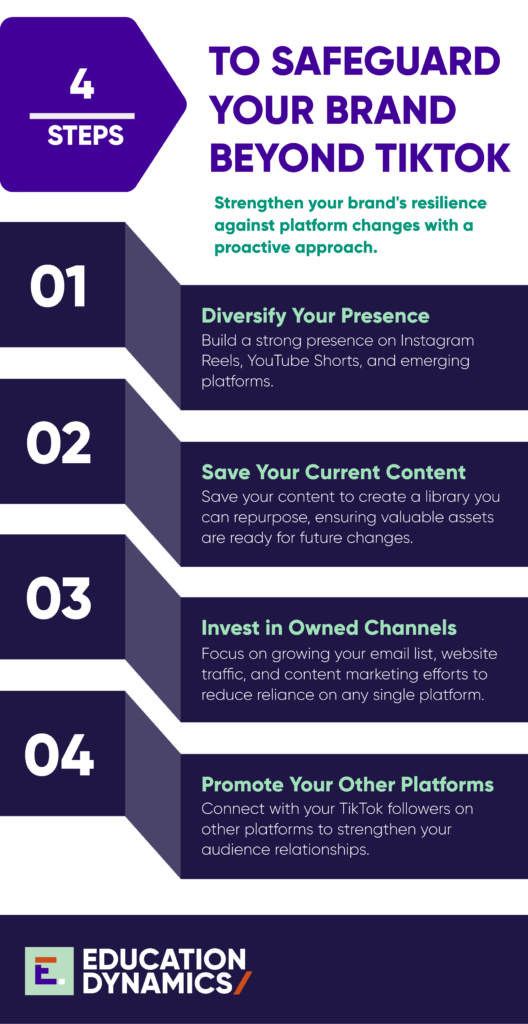
    4 steps marketers can take to safeguard their brand in light of the TikTok ban.

    How might a TikTok ban affect my marketing efforts? 

    TikTok ban could significantly disrupt your marketing efforts if you rely heavily on the platform to reach prospective students. Losing access to your TikTok audience and content could mean losing valuable brand awareness, engagement, and lead generation opportunities. 

    Are there any contingency plans I should have in place? 

    Absolutely. Don’t wait for a ban to happen before you act. Here’s what you should be doing: 

    • Diversify your social media presence: Focus on building a strong presence on other platforms like Instagram Reels, YouTube Shorts, and even emerging platforms relevant to your target audience. 
    • Download and save your existing TikTok content: This way, you’ll have a library of assets you can potentially repurpose on other platforms if needed. 
    • Focus on building your owned channels: Prioritize growing your email list, website traffic, and content marketing efforts to reduce reliance on any single platform. 
    • Engage with your TikTok followers on other platforms: Encourage them to connect with you elsewhere to maintain that connection. 

    What are the potential alternatives to TikTok for marketing purposes? 

    • LinkedIn: Enables targeted outreach to prospective students during their decision-making process, capitalizing on the platform’s reputation for credible professional networking and industry insights. 
    • Facebook and Instagram: Offer powerful tools for amplifying brand awareness, cultivating vibrant online communities, and driving early-stage engagement through diverse content formats and a vast, active user base. 
    • YouTube Shorts: Provide access to YouTube’s massive audience, allowing institutions to connect with prospective students through engaging short-form video content while also leveraging the platform’s strength in longer-form video. 

    How can I stay updated on the latest developments regarding TikTok bans? 

    To stay updated, don’t hesitate to leverage your EDDY resources, as we are always here to help you with your marketing and enrollment journeys! In addition, we recommend following Social Media Today and HubSpot’s Blog as resources for staying aware of the latest industry updates.  

    Links to additional resources about the latest news about TikTok:

    Source link

  • Creating Durability with the Modern Learner

    Creating Durability with the Modern Learner

    In this episode of the EdUp Experience Podcast, we dive deep into the world of the Modern Learner. Host Dr. Joe Sallustio and his guest co-host, Greg Clayton, President of Enrollment Management Services at EducationDynamics, are joined by Dr. Melik Khoury, President of Unity Environmental University. Together, they challenge traditional thinking about higher education and explore how institutions can adapt to meet the unique needs of today’s diverse student population. You’ll hear insightful discussions about changing student behavior, the importance of accessibility, and the need for innovative program development. Listen to the podcast below or read the transcript.

    Transcript

    Dr. Joe Sallustio:

    Welcome back, everybody. It’s your time to EdUp on the EdUp Experience Podcast where we make education your business on this very special episode, one of many that we’re doing here. The title of this group of episodes is called Education Elevated: Creating Durability with the Modern Learner, brought to you by EducationDynamics. I got to ask you first, if you’re listening to this, what comes to your mind when I ask you to describe today’s modern learner?

    What springs to mind is likely quite varied, and depends quite a bit on your institution, program, role, and experiences. It’s not as straightforward as you might think. The modern learner can be working adults, parents, veterans, lifelong learners who are juggling multiple responsibilities, while pursuing their education. The modern learner is also younger, recent high school graduates on a direct path to graduation. The lines between adult and traditional students are blurring, as both education and students evolve, and it’s changing the game for higher ed.

    Welcome to this special six part miniseries on the EdUp Experience, where we’re diving deep into the world of the modern learner. I’m your host as always, Dr. Joe Sallustio, and I’m thrilled to be your guide as we explore the challenges and opportunities these learners bring to our campuses, virtual and physical. Joining me on this journey will be friends from EducationDynamics who’ve spent the past 35 years serving, supporting, and engaging a rapidly evolving higher ed ecosystem.

    Over a series of several months, we’ll be bringing you periodic episodes of this miniseries, where we’re going to talk to some of the brightest minds in higher education about how to adapt, evolve, and thrive in this new landscape. We’ll uncover strategies for building a more durable, agile, and energized approach to serving modern learners. We’re going to discuss everything from enrollment and marketing, to student success in the future of education.

    As you know, I don’t like to do any of this alone, so I have an amazing guest cohost returning again, ladies and gentlemen, let’s bring him in appropriately. He’s Greg Clayton, he’s the President of Enrollment Management Services at EducationDynamics, AKA EDDY. What’s going on, Greg?

    Greg Clayton:

    Hi, Joe. It is great to be here. Great to be here. Glad to be back. I think I remember all Rules of the Road for being a co-host.

    Dr. Joe Sallustio:

    Well, you know what? We’re going to find out how your memory is, Greg. We’re going to find out here live, so don’t make no, don’t make… It’s all good and it’s all fun. I always say that this podcast, the work that we do in this podcast, much like you do at EducationDynamics, is all about iteration. You test and you make some mistakes, and then you get better, and then you get better.

    We like to leave in those mistakes, because it helps us learn for the next time. After 900 episodes of this podcast, I’m still learning, Greg, how to be a good podcast host. I’ll take my cues from you this time.

    Greg Clayton:

    Don’t forget, optimize. We optimize.

    Dr. Joe Sallustio:

    Oh, yeah, yeah, optimize. By the way, let me just quick plug. Nobody asked me to do this, but obviously, for those that know, I’ve started a new role. I’m the Vice President of Industry Engagement at Ellucian, and I recently came from an institution where I brought on EducationDynamics, and you guys helped me absolutely kill it.

    In fact, I can tell you that the institution that I came from currently now has nearly doubled their online population directly due to the efforts of EducationDynamics and the support that you gave us. I can tell you that my colleague that’s there, still at that institution, they’re just doing incredible work with you all.

    Greg Clayton:

    Yeah, thank you, Joe. We’re super happy you brought us on, and the work has been amazing. They’re great partners at that institution, and the sky is the limit with how far we can go with them.

    Dr. Joe Sallustio:

    Well, speaking of great partners, I think we’re bringing him back for a fourth time in this podcast, but the first in a while since we did a panel together, in fact, at Insights EDU this last what, March, April, it was? We had a good time and a back and forth, talking about the future of higher education. I said, “We got to have him back here and we can talk about what is this modern learner? How do we think about the learner?”

    Ladies and gentlemen, here he is, back for another time on EdUp Mic. He’s Dr. Melik Peter Khoury, he is the President of Unity Environmental University, America’s Environmental University. What’s going on Melik? How are you?

    Dr. Melik Khoury:

    Hey, Joe. Hey, Greg. Thank you for having me back on the show. Always up for a good conversation.

    Dr. Joe Sallustio:

    Good things happening at Unity. Every time we talk to you, Melik, it’s like, okay, we’re going to bring Melik back. There’s some good things happening, let’s catch up with him. Then it’s like, wait a minute, there’s some more good things happening. We got to catch up with him again. Then more good things happening and we got to…

    It’s like, the growth is just not stopping. Can you give us a little bit of, first of all, for anybody that hasn’t heard of Unity, just give us a quick two-minute elevator, and then tell us some of the good things happening.

    Dr. Melik Khoury:

    Sure. Unity Environmental University started as Unity College in 1965, like many of the small private residential colleges back in the day. Over the last 65 years, we’ve always been at the forefront of trying to figure out how to best serve those individuals out there who really care about the environment, but understand that it’s a green career, and not just the more traditional concept of and ethereal conversation.

    Over the last 10 years, we’ve evolved from being primarily residential freshmen. Earlier, you talked when you introduced a show about all different kinds of students, to what would the environmental science university look like if it had a private system with multiple subsidiaries, each supporting a different kind of learner in a different kind of modality, in a different kind of personal situation? We’ve really growing to become more of the most affordable, and accessible, and flexible private environmental science institutions in the nation.

    A lot of my teams say we are becoming the real online STEM school with both in-person, remote, and residential options For those who want it.

    Dr. Joe Sallustio:

    Changes is easy in higher ed, right, Melik? All this has just, it’s been super easy for you to do. Now, it’s funny, I interviewed another president a while back, I can’t remember where, but I remember him saying that he was “assassinated.” There were two assassination attempts.

    I don’t know if that’s in poor taste now because of what’s recently happened, but he was speaking of it figuratively, as in no confidence votes, as in backlash, people trying to get him out of his role because he was trying to enact significant university change. Can you talk a little bit about the experience to get from A to B, and what it’s been like for you?

    Dr. Melik Khoury:

    Sure. I think, as you know, the higher education model was ported from Europe from the 1800s, and until about 70 years ago, was really designed for 5% of the population. The governance structure, it really was you send your students to the monastery, they come back four years later, transformed. In 1965, we as a country decided that this type of education should be afforded to everyone.

    We took an unscalable, highly privileged model that really only worked for the heavily subsidized and those institutions with huge endowments, and tried to mass produce it. 65 years later, we are trying to create a model, a monolith of a model, if you will, that as if all universities are the same. Joe, let’s assume you and I went to college together. I’m going to get to your question. You are the child of a trust fund, and I…

    Dr. Joe Sallustio:

    I wish that would true.

    Dr. Melik Khoury:

    I know, right?

    Dr. Joe Sallustio:

    Yeah.

    Dr. Melik Khoury:

    I was a child where basically, I needed to get a job in order to pay my bills. You and I, our lifestyle can’t be the same, right? You can stay in and play guitar, and follow your passion, and all of that. I have to get a job in order to pay for tuition and pay my bills. I think sometimes in higher ed, we created this governance structure that was always designed to protect something.

    As these tuition driven institutions have grown, the Department of Ed, the accreditors, the institutions, we look at all of us as a monolith. I’m not surprised that that individual had a hard time, because my guess is their governance structure was designed around having a president whose job is to protect the status quo. They never updated their policy, their governance, their structure, their decision-making paradigm to be a tuition-driven institution.

    Yeah, if you were to ask a monarch about a democracy, it wouldn’t work. If you were to ask a democracy to run as a monarchy, it wouldn’t work. We as an industry have to diversify and look at each institution as, who are we? Are we a highly subsidized, are we a tuition driven? Who do we serve? I think that’s where your colleague faced that, because this one size fit all has been, I would say, the reason many colleges have closed.

    Dr. Joe Sallustio:

    Greg, I want to come over to you to take over here, but I want to just say that that recently, and you’ll have to clarify when, EducationDynamics came out with the naming of the modern learner, I don’t know what you call it, the main naming or the packaging of the modern learner, because more of the behavior of the learner, not of the characteristics or the profile, so to speak, but the way that we’re behaving with technology, and choosing, and wanting different things. I got to tell you, I think it is brilliant.

    I think it’s brilliant to describe the type of student that we’re working with. In fact, I was telling our colleague, Eric, that I’ve been using it in episodes to describe, because I had one university recently, a college president I was talking to, some of these things you guys won’t believe. He’s describing things to me, and he says, “This is who we call the adult student.” I went, “Wow, we got to catch up, all of us.”

    The adult student’s kind of an old way to say it. Over to you, where did this whole idea of the modern student come from? How’d you pick it? What does it describe? Then you can take it from there.

    Greg Clayton:

    Yeah, great question. We have been studying, researching the preferences and behaviors of, let’s just call them learners for right now, for over a decade, 13, 14, 15 years. We produce studies we release to the market. There’s one called the Online College Student Report that we release every year. You can go download it from our website. Over time, we really look at what’s changed year over year from the different studies that we do, and just observed things.

    What we observed over the last five or six years, and it really accelerated during the COVID period, is that the average age of the learner was becoming younger and younger. It got to the point where the phrase behind the term modern learner is a phrase that we came up with that says that age is no longer a predictor of learner modality preferences. Our advice to the industry is to stop thinking about learners in the context of age. Start thinking about them simply as learners. We came up with the term modern learner to describe it.

    It does not matter how old the learner is, or where they are along the journey. What matters is how they engage a first time freshmen student, whether they’re first gen or second gen, or whatever, they engage in points in time along their journey and path through high school. An adult learner engages much faster than that, within two to three months. They want to start very quickly in all the things. The overarching message to learners about the benefits of higher education, about the benefits of learning, are all the same.

    Some of the same questions arise from the learner that they want to have a conversation with an institution about before applying and enrolling are all of the same. There’s more of a unified approach that we see and a unified message to addressing the needs of that learner. We think that what Unity has done, Unity was doing this in 2019. They were thinking, actually, Melik was thinking about this before that, before 2019. We first started engaging with Unity in 2019, and it was a great match for us because we think about the learner in the same context that Melik was thinking about it at the time.

    I’m curious to ask Melik, how did he develop the vision for Unity Environmental University? I think when the first time we spoke in 2019, Unity had somewhere around 500 students, and you were really trying to get that pivot off the ground to go online and address the modern learner. You had a real vision for it, in doing it in a way that no other institution has done. How did you come up with that?

    Dr. Melik Khoury:

    I think for me, without going to a very, very long story about my experience through college and universities, from R1s, to small private residentials, to online schools, I think what you and Joe are talking about about the modern student is key. I realized very, very quickly that access to education did transcend market segment, and we wanted to put specific age groups tied directly to specific modalities. We were confounding modality with age.

    We were also looking at anything that was not a residential lecture-based education as a secondary form of education that was there to support the real education. When we came up with the enterprise model, what we said is, “No, some folks are looking for residential, some folks are looking for commuter, some folks are looking for remote, some folks are looking for online.” By creating these kind of don’t confuse quality with modality, and really look at the lanes with which people were looking for different flexibility based on where they are in their lives, allowed us to really lean into differentiated calendars, differentiated pedagogy, differentiated tuition.

    A 37-year-old woman who has a full-time job in California would care less about a football team. Why does she have to work within the same governance structure, the same approach as somebody who does? Your concept in EducationDynamics about the modern student kind resonated with us a little bit, because we really started to look at each and every one of our subsidiaries for, it didn’t matter how old you were. It was more, how did you want to learn? I use the example of music.

    Do you like your music live? Do you like your music in vinyl? Do you like your music stream? It doesn’t change the song. I think over time, we’ve confounded online to mean keyboard, when in reality, it just means untethered. For us, Greg, what we were trying to find out is Tinto came about, said this, “Most students don’t complete their education, not because of the academic readiness, but with things outside of academia,” and we’ve ignored that.

    It was really more about that. Greg, I think your company knows this about us, we also made some really interesting assumptions that were proven wrong. We just assumed that the adults would want to be more flexible and remote. We found out all of our students, regardless of age, liked the one course at a time. We found that when students were able to just take a hybrid model of where they might take a few courses online, take a few courses in person, that was more preferable to the all or nothing.

    It was about creating a model that was iterative that allowed us to make assumptions, but not get so tied into those assumptions that when we were wrong, we saw it as such shame that we would rather close or fail than adapt. You remember, we picked a term model that we changed after six months. We changed a tuition model that we changed after a year. We picked a service model that now, each and every one of our subsidiaries has a different level of academic and student support.

    I think too many times as higher ed, we just create these perfect product, and are looking for people to buy it instead of saying, “Where are our students? What are they looking for?” Even though the science is science, chemistry is chemistry, where, how, when, and the modality in which that they want to learn it, can be different. That, I think, is where you and I started this journey. I remember we were hoping to have a hundred students a term. Now, we are talking about a thousand students per term, with the same level of anxiety as a hundred.

    Dr. Melik Khoury:

    Suffice to say, there is demand for quality education. I would say stop looking at what is the real university and what are the ancillary pedagogies, and look at each one as if they were their own lane, their own faculty, their own staff, their own pedagogy. I think any institution, if they look at that, not what is the main and what is the secondary, I think has a better chance of adapting to the modern student.

    Dr. Joe Sallustio:

    Boy, I got lots of questions, Greg, so keep going if you want.

    Greg Clayton:

    Yeah, one more. I think Melik said a key word there, accessibility. We talk about that a lot, and everything that Melik was communicating there points to the thinking of students first, or thinking student centric versus institution centric thinking, and accessibility is like a real key to it. Keeping the, how do you keep the whole system efficient? How do you keep it affordable, and how do you make it accessible, and even more accessible to all? All the things Melik just checked off as we’ve learned, and as Unity has learned over the course of the work.

    One thing that struck me, I did get a chance to go to Unity’s commencement in May, and as part of it, they had something really I thought was brilliant. There were a lot of graduating students there from their Distance Education Program, from all over the United States, and some from all over the world. They had a map of the United States, and the graduating students could go and put a pin in the map with where they lived. They had a globe, and you could stick a pin in the globe from what country you were from.

    The pins were all over the place. It was fascinating to watch those students come and put a pin in the map of the globe, wherever they were. That really drove the accessibility point home to me, that this set of programs is reaching a universe of students that are looking for what Unity has to deliver. Everything was captured in that in terms of what Melik just said, about being student-centric in the thinking.

    Dr. Joe Sallustio:

    By the way, I’ve never, one of the states I’ve not been to is Maine. I’ve yet to have anybody invite me there. I don’t know-

    Dr. Melik Khoury:

    Well, Joe, let me be the first on air to invite you to our May graduation. We are actually going to have a high profile graduation speaker that you’re going to want to meet. Consider this an invitation, and I’ll work with you on the logistics.

    Dr. Joe Sallustio:

    Maybe we’ll podcast live from the graduation at Unity Environmental University.

    Dr. Melik Khoury:

    That would be awesome. Consider it done, let’s work out the details later.

    Dr. Joe Sallustio:

    That subliminal message wasn’t so subliminal, but I do want to bring this up, and this is something that I see, Greg and Melik, I want to see what you think about this. Let’s come back to the concept of the modern learner. This is a learner who has certain behaviors that I believe are evolved from behaviors of the past. Just like anything else, technology evolves, behavior evolves. Universities typically, though, and the ones that, when we think university, we think 200 years old, and blah, blah, blah, but those universities, and I want to know what you did here, they don’t market the right way.

    They’re very traditional in their thinking. They do this, billboards, and they do this, and they do that, and they say, “But we want more students that come from the some college, no credential group, but we’re going to get them by doing mature email campaigns over the next six months.” It’s like, “Well, wait a minute. The thinking about marketing and how to market to students has to evolve too. How did you move Unity from the traditional marketing to evolved marketing?

    Dr. Melik Khoury:

    Sure. Greg loves this story, because one of his colleagues tells this story every chance we get. I think, Joe, it is amazing how many universities, if you ask them about the cost of acquisition, they would have no idea. I remember being a director of admissions, bringing in 200 students, and my president said to me, “I need you to bring in 400, but your budget is the same.” Cutting my cost of acquisition in half, but having no idea what I meant by that. Many institutions don’t even understand the concept of you can’t have a regional recruitment and marketing strategy, and hope for a national draw. A lot of folks don’t differentiate the idea that some programs are more expensive to recruit, some programs are more expensive to teach. This concept of market segmentation, national versus regional, this idea that… I know the amount of institutions who are struggling, because with SAT being optional, you can’t buy names. What do you do?

    Dr. Joe Sallustio:

    So right.

    Dr. Melik Khoury:

    I think for us, I went through a couple of years of frustration because I worked with a lot of firms, trying to help us really get our message out there, and we were a nail and they were a hammer. If I hear one more time about discount rates, and, “We need to analyze your student population,” I’m like, “No, you don’t understand. My student population is dwindling. If you actually get that persona, you’re going to find these students who don’t exist. Everybody is into a drying well, you can’t look backwards. You have to look forward.”

    Finally, when I was talking to Greg, they were the first organization that actually didn’t mock us. They didn’t laugh at us. They didn’t look at us as a small player, because back then, we wanted like 50 or 60 students at a time, but said, “Look, there is a population of students out there that doesn’t even know we exist.” We know how much we can afford to pay for recruitment and marketing at our tuition price point. We started to experiment. I bet you a dime to a dollar, there are many institutions who don’t know the lifetime revenue of a student.

    They don’t know the cost of teaching, they don’t know the cost of acquisition. I think that’s the problem, because up until now, Joe, everybody went to college. Everybody knew the value of a college. Well, that was the case when only 5% went and when it cost you 600 bucks to go to college or you got a scholarship. I think people sometimes get mad at me because they say I talk about students in such statistical terms, right? Cost of acquisition, market segmentation.

    I say, “Don’t get mad at me. Get mad at your government for not funding education to the point where we don’t have to change, but until such time as education is free, I am not going to let education, especially environmental science education, only be accessible to those lucky enough to get a scholarship or go to a residential program. Until you fix the global issue about education or at least the US issue, I’m going to try to find a way to get that.”

    For that, you have to understand, are you regional? Are you local? Are you national? What is your competition spending? What is your value proposition? We are, for our Distance Education, for example, we retain at an average of 65% a year. That is unheard of in the online open world, but we did not take a residential model and put it online. We changed our learning design, our instructional design, dedicated advisors. There is a lot of work that goes into taking a gasoline fueled car and creating an electric one. It’s not simply using the same engine.

    Joe, I know that was a very long answer to your question, but at the end of the day, you can’t assume that your recruitment budget is static, and you cannot underestimate the cost of your vision, whether it’s local, regional, or national. That’s kind of where I think people make a mistake.

    Dr. Joe Sallustio:

    Yeah, and Greg, I’ll pass back to you, but I want the second part of that is the identity politics that have to be worked out. Even getting to that point where you want to go after a different segment of students, you have a group of people internally that go, “Well, wait a minute, we don’t want to do that. Here’s who we are.” Then you get another group of people that go, “Well, that’s not who we are. We’re this school.”

    Even within colleges, you have different opinions of who the target student is, and then therefore, you have a bunch of policies that back into one type of student, to Melik’s point. Then you can’t do what you set out to do, which is to recruit a different type of student, Greg. Those are just some of the things that I have written about and get frustrated with. It’s really nonsensical when you think of it.

    Dr. Melik Khoury:

    Joe, before Greg goes, you raise a point where I think has been the fundamental game changer for us. Think about this. If you are a small, private, residential tuition-driven institution, your faculty and your staff are good at that product, right?

    Dr. Joe Sallustio:

    Yes.

    Dr. Melik Khoury:

    They are also having full-time jobs. No matter what new audience you bring to the table, to a hammer, everything is a nail. If you seriously want to create a new audience, a new market, a new demographic, the idea that those people have to do what they do, and also do that, is part of the problem. Sometimes it’s a lack of investment. For example, with us, we told the folks who cared about that side of the house to stay doing that.

    I actually made the promise that anybody who jumped into this new pedagogy and this new audience, that we would backfill the positions. You can’t have your people think that is a sense of loss, but you can’t have a university that is a single product university. What I mean by that is residential, the four-year, lecture base, and try to recruit people who are looking for different experiences into that, and wonder why.

    Think about this. If I’m a 42-year-old man, do I really care about that ice cream social? Do I really care about this idea that orientation is about something that geared towards a freshman? Nor should a freshman have to sit through an adult orientation. This idea that you talk about recruitment, but even the experience, we cannot sell an iPad as a laptop.

    Dr. Joe Sallustio:

    Greg?

    Greg Clayton:

    Yeah, and back, Joe, some of the things you were talking about with the marketing element of it, I think when we started up with Melik and Unity to try to figure out what path we were going to take to generate the demand, and capture it, and so forth, there was no particular persona that existed for this. That can be a very scary thing for both marketers and for college presidents, even those that are as forward-thinking as Melik, but there was confidence there that it’s there, no one has ever found it before.

    It won’t show up in a zip code, in a research report, or anything like that. We blaze the trail together. I think finding the right message and delivering it to the prospective student in the right place at the right time was the key to it. We had to blaze a trail, and Melik talked about the iteration, the iterative part of it.

    Not all of it was figured out from the beginning. There was definitely vision and a commitment, which was really important to getting it done, but kind of blazing that trail, and figuring out the parts and pieces of things that we didn’t know, and iterating on it, and then finding what was there along the way, and doubling down on it was a key to it. The audience was there. The audience was looking for what Unity had to present to it. The results that are being achieved today are a testament to it.

    Dr. Melik Khoury:

    Yeah, to Greg’s point, you hear a lot of institutions talk about being innovative, but then the first question they ask you is, “Who else is doing it?” They ask you to be-

    Dr. Joe Sallustio:

    That’s so right on, by the way, that’s so right.

    Dr. Melik Khoury:

    Right? They ask you to be innovative, but then they say, “What are the benchmarks?” They ask you to be innovative and they want to know, guarantee, you cannot try something new but only be willing to do… This is a higher ed thing, right? Pre like 60 years ago, I understand that, but we are an industry that is predicated on taking two years to make a decision, where adding a new major is the pinnacle of innovation.

    By saying I can’t be innovative and be bound to tradition, be bound to what has come before me, be bound to pedagogy that is tried and true, then don’t ask me to be innovative. Tell me to drill more in this particular well, and that well is dwindling. I think that’s the issue. All of these colleges who are talking about innovation are using, they’re looking for certainties that don’t exist. Many, at least for me in working with some of my peers, having an initiative fail is such an affront to our reputations.

    There’s a university, Joe, that closed recently that had more students than we did, and I can only guess that the fear of their reputational hit for actually trying to make profound change was less desirable than just closing. That’s wrong with our industry.

    Dr. Joe Sallustio:

    Yeah, that’s a really good point about universities right now, because you do wonder, from a board of trustee standpoint, from a digital experience standpoint, is it easier to just fold it than really innovate with the risk? You said it, Melik, and you know this to be true, and I do too. “Oh, we’re going to be innovative. We would like to know the other five universities that has done this before we do.” It’s like, “Okay, well, wait a minute. If you’re going to be innovative, that means doing something nobody else is doing.”

    We are, as an industry, designed to prevent innovation. When you talk about two years, the pinnacle of innovation being a product or new program, it’s because we designed it to be two years. Even if you took out everything and you just went right to the accrediting body, it’d still take a little bit of time, but not the amount of time it takes to go through committees, and update this person, and update that person. We designed that.

    The reason why it all looks the same is because this university took the idea from that university. It took the idea from this university, and so on. It’s like a domino effect to self-fulfilling prophecy as it were. It’s very hard to break. You said something earlier, you said quality and modality, right? Quality can be maintained with different modalities, but you have people, that the minute you say, we’re going to offer this in a different way, will say something like this.

    Dr. Joe Sallustio:

    Right? You’ve got faculty that just go, “Well, you can’t get the same outcome with this program online. It has to be taught on ground.” That is the ingrained culture that we work in, and it’s very hard to break. I’m bringing this up because you speak about this, you speak about this model of change that you’ve achieved at Unity.

    You speak about it like it was preordained, almost, but it is not been easy, and you have to have a steadfast leadership style of breaking glass, so to speak, to get to that point.

    Dr. Melik Khoury:

    Do you know what’s the number one question I’m asked, which is really annoying?

    Dr. Joe Sallustio:

    How did you do it?

    Dr. Melik Khoury:

    I wish. It’s, how am I still here?

    Dr. Joe Sallustio:

    Well, yeah, well, I could see that, right? The system is designed to take out anyone who pushes the envelope too far on innovation. It’s the way system’s designed.

    Dr. Melik Khoury:

    Correct. What’s been really interesting for me is the first question isn’t, how did you do it? The first question is always, how did you survive that?

    Dr. Melik Khoury:

    Then many presidents would go, “I’m not going to put my reputation.” You saw an article I wrote not too long ago, where I really got upset at all these presidents who are going out there, saying everything on their campus is okay, get a consulting gig, and then say their campus is crap. Really? Seriously, how are we going to change? To be fair, most presidents, if you were to ask 17 people on a campus what their job is, some of them tell you they have fundraisers, some of them…

    At the end of the day, we were always built to be facilitators, because it was never about revenue. It was always about protection. You talk about not designed to change, absolutely. Your idea or your question about modality and quality, I have seen some really poor in-person learning courses. I once knew somebody who taught, the textbook that they would teach was out of print, and they would photocopy it and give it to students. This is not here, this was at my old-

    Dr. Joe Sallustio:

    Greg, you weren’t the instructor, were you, Greg?

    Dr. Melik Khoury:

    We also make it so unfair for faculty members, where they graduate from these PhD programs, they’ve got no pedagogical training. They go to a university, there’s no instructional designers, no learning designers, no curriculum designers. Then we say to them, “Save the world.”

    Dr. Joe Sallustio:

    Figure it out. Yeah.

    Dr. Melik Khoury:

    To be fair, we were never designed to be anything but what we were 18th century ago, and don’t get me wrong, the R1s are always going to be R1s, right? The small private elite schools are always going to be there. They are really hedge funds, and they’re looking to perpetuate their mission. For the other regional state schools, for the private schools that are tuition driven, I would say up till five years ago, it was still even, who’s going to survive? Now the question is, is higher education as is currently constructed, going to survive the next 10 years, especially with AI?

    It’s not even who’s going to survive anymore. Think about this, Joe, the first institution to figure out a new currency that is not based on the credit hour, and to create a rigorous, and affordable, and accessible curriculum that is not dependent on Title 4 is going to be the new university of the future.

    Dr. Joe Sallustio:

    Yep. So much to think about there. Greg, I do kick it to you. I do want to preface something that we haven’t talked about, but I think it’s important, because you can’t do what you’ve done with Unity, if you go all the way back to what Melik said at the beginning, when you talk to these marketing companies that have their entire product design is the traditional learner, and the traditional high school learner getting these things, getting this communication, being nurtured for a year.

    Then what those companies will do is they sell an upgrade. Like, “Okay, we’ve got you. You work with us on this traditional learner, we’re going to go after the adult student too. We’re going to sell you this upgrade.” EducationDynamics is sitting over here is basically the market, not basically, the market leader for accessing the modern learner. Where do we get stuck in higher ed? Do we just do the same old because it’s easy, instead of taking what makes sense?

    Greg Clayton:

    Yeah, that’s a great question. I think, going back to some of the comments I’ve made about the modern learner, thinking has to evolve. We sometimes look at, talk to different institutions and presidents, and there are so many institutions out there that need to be working with us and having conversations with us, similar to the ones that Melik was having with us five or six years ago. We looked at a school that has a similar profile to Unity in Wisconsin, I believe, that was on the brink of shutting down.

    It’s just traditional campus. It’s an environmentally focused oriented college, private college. Their enrollments had been flat for 10 years, and there was no pivot to online. There was no vision or strategy that we could see there. Took a look at that, and we took a look at Unity’s trends in enrollment from 2010 through, I think we had data to 2022 or ’23 at that point. It’s amazing. Those two schools would’ve been along the same trend line, except something happened in 2019 and Unity’s enrollments went due north on the grid.

    It was interesting to compare those two things. I think for a lot of schools, the moment has already passed for them to be thinking along those lines, but for others, it’s not too late to do it. It takes an evolution in thinking, and cutting against the grain, and taking the risk of Melik is still here. We’re glad that he’s still here, and I think he will be here, but you got to take that risk and do it.

    Doing the same old, same old is going to result in what we’re seeing every day, reading about a new college that’s having to close its doors. That is no good for higher ed, and it’s no good for students.

    Dr. Melik Khoury:

    Joe, if I may add to Greg’s point, because I agree with it, and I know the college he’s talking about. I think a lot of schools think if you actually spend more money just on recruitment and marketing, that you will solve this problem, when in reality, there is a product issue as well.

    Dr. Joe Sallustio:

    Thank you, thank you, thank you. It’s so right.

    Dr. Melik Khoury:

    I think where I sometimes get upset for Greg and his team is when I hear secondhand that the colleges they’re talking to want to create an online program to create enough money to subsidize their residential program. You have to look at them at differentiated product lines. You have to have your own P&Ls for all of them. Maybe one of them can be a lost leader, but this idea that is the real school, and then we have to work with Greg to do the online so that we can pay for the real school, is fundamentally why these colleges fail.

    Those who see the two as different but important, different faculty, different staff, different pedagogy, different services, I think are more likely to be successful, because this idea that it’s online, but has the residential ethos is part of the problem. Yamaha is a good example, right? Yamaha is one company, but you want to tell me the designers of the pianos and the designers of their motorcycles are the same designers? No, but it’s still Yamaha.

    Dr. Joe Sallustio:

    Or the other bit is, let’s say you have an online version of an on-ground program that an institution is selling now. A lot of them have those because of COVID. Instead of going after the modern learner with dollars, you can’t just take a program that nobody’s already buying and put more money behind it, and more people will buy it. They’re already not buying it. It doesn’t matter how much money you put in it.

    You have to evolve the educational product to the point where the modern learner wants to buy it. There’s a whole ecosystem of things that you have to consider, Greg. I think we saw that too a little bit in our work together, where it was just trying to take something that exists and boost it. I’m going, “You can’t just do that. You can’t just…”

    Dr. Melik Khoury:

    Joe, find me the best salespeople in the world. Now, go have them sell a 100 million units of Betamax.

    Dr. Joe Sallustio:

    Yeah, exactly.

    Dr. Melik Khoury:

    Then give me the dumbest salesperson and then have them sell a Netflix subscription. To your point, though, just to put a more final point on it, when we did our market research internally at Unity, especially in our core programs like marine biology, which never had more than like 48 students at a time, or animal care, which never had more than like 70 students at a time, what we realized was our curriculum, the market, the industry wasn’t the problem.

    People wanted marine biology, people wanted animal care, but we could not get more than 50 to 60 students at the college, because the people who wanted it couldn’t afford it. When we changed our model to say, “Those who want that can have it, and those who can’t and are place bound, we are going to create a completely different product, but keeping the true sense of the curriculum in place.” We now have like 3,000 marine biology students who focus in aquaculture. What’s changed?

    The delivery mechanism, allowing them to use their own local fauna, their own local flora, their own local communities and economies, where they can work in small aquaculture farms all across the country, instead of waiting four years and paying that extra $15,000 in alternative loans for room and board. Don’t get me wrong, I love those who could afford it. I am glad for those who get a scholarship to experience it, but I’m not going to deprive 10,000 students from getting that knowledge because they can’t come and spend four years in Maine.

    I think that’s where some of these colleges get it wrong. It’s not a lesser product. It is a different product. I would argue that the technology that goes into the learning designers, the curriculum designers, figuring out ways to assess them in their local community, that is why our residential, our face-to-face and our online programs are not identical, but they do map in outcomes, because it’s different. That’s where, I think, people sometimes miss the mark. It’s not a singular product.

    Dr. Joe Sallustio:

    Greg, I’m guessing this is why you put me and Melik on the panel together, because we work each other up, but he’s highly productive. He’s one of the people that I know that can out-talk me about change in higher ed, so gets all the credit in the world.

    Greg Clayton:

    Agreed. He’s great for a cohost, too. I just get to sit here and listen to him. It’s amazing.

    Dr. Joe Sallustio:

    Well, Greg, why don’t you, anything else you want to add about the modern learner, since this is really a podcast or a series of six episodes where we want to cover the modern learner? Is there anything else you want to add from your work, your research?

    Greg Clayton:

    There’s one last thing that I would love for Melik to touch on for just a minute. We barely scratched the surface on new product development, but one of the three things that we always come back to, it’s what is a modern learner looking for? It’s how much does it cost? The affordability question. How fast can I get it, which covers a lot of ground in terms of how fast can they access the program, and the flexibility, and modality, all of those things.

    The last thing is the ROI, which covers a lot of ground as well. That ground is partially tied to what kind of return can I get on my investment of time, and money, and so forth? That is something that does require innovation, especially with the pace of change and technology, and the pace and change in need of skills within the employer universe.

    When you think about new product development in terms of programs for a higher ed institution, Melik and I have talked about this before just together, but I love the way he thinks about it, and I’d love for him to share it. I’ll steal a little bit of it. It has to do with failing fast and failing often.

    Dr. Melik Khoury:

    Absolutely. We launch products, majors, for example, modalities with the understanding that we design the measures of success prior to launch, so that the decision to kill something or to launch something is not an emotional one. One of the things that I love about my academics at Unity is we actually don’t care anymore about majors. My faculty don’t identify their value based on our majors, but by the disciplines, because a major is nothing more than an amalgamation of different disciplines that lends you towards a career.

    To Greg’s point, one is we don’t invest enough in launch. When I look at a program launch, I don’t look at what I’m going to lose money in year one, but what will this major, or this program, or this subsidiary be in the black once it’s fully matured? If I’m launching a program today, let’s say engineering, and I need 250 students for it to break even, I can’t assume that because in year one, I’m not going to break even, I can’t launch it. I think a lot of people at universities make decisions on annual cycles.

    Greg and I work on this all the time. We have a series of programs that are established and those, we are looking at them on an annual cycle. We have programs that we are trying to launch, and we cannot look at the cost of acquisition. We can’t look at profitability, we can’t look at net revenue in the same way, because it’s going to take two to four years before it’s fully matured, but we have to have gates along the way.

    The ability to invest, the ability to understand the lifecycle, the lifetime value of a student based on your program, and the willingness to have an objective lens in which we can cut something, no matter how much passion we have into it, is a level of discipline and system that most higher education, in a very relational and social capital sort of way, have not been able to adapt to.

    Dr. Joe Sallustio:

    By the way, if you offer, no matter how good your product is, if you offer only once or twice a year and you’re hoping to get some profitability out of it in year two, and you have students, don’t wait, by the way. Students don’t wait for those cycles to come around. You have to offer a frequency of start date that allows you to put in enough mass so that you can achieve some profitability in year three and four, which you talk to schools about adding more start dates. It’s like, you’re breaking brains.

    That’s one of the keys, I think, is the modern learner does not wait. We know their consideration set is very small, two to three schools, and the amount of time they want to wake is one to two weeks before, so maybe a month. That’s it.

    Dr. Melik Khoury:

    To give Greg and his team a compliment, one of the reasons why I’ve worked with them as long as I have is because they are not obsequious. They are constantly telling me everything that I’m doing wrong. They’re constantly pushing back at some of the decisions we want to make. They’re constantly showing us the data.

    For example, we know now that if we can’t package a student on their financial aid within 48 hours, if I cannot get my team to package daily, if I cannot get my team to do transcript evaluations and give a degree audit within 48 hours, I can beat the small private residential school that’s going out of business, but I will lose that student to a number one of our competitors.

    To your point, Joe, this idea that, and imagine if those decisions had to be made by a committee, and had to be made by people who are going to feel a sense of loss. At Unity, one of the things that we’ve done is each and every one of my positions has something called rule, scope, and authority. What decision do they get to make? When Greg is working with somebody who has the ability and the authority to launch a program, killer program, move a process, he doesn’t have to wait for them to go create a committee and come back in six months.

    He can get an answer in 48 hours. That’s where I think a lot of colleges who have not had to make that change are still doing well. Once they hit that cliff where they actually have to change their process, that’s when you’re going to know if they’re resilient enough as an organization. I think that’s where Greg’s team has been very, very good. They tell us, we don’t always agree with them, and it took them a few years to figure out that they weren’t going to lose our business for being honest with us.

    Greg Clayton:

    We also, I think we held Melik back a little bit too.

    Dr. Melik Khoury:

    Yeah, I know. It’s really fun when the partner is like, “Slow down, dude.” Like, so serious. Love to take… We’ll get there, I swear.

    Dr. Joe Sallustio:

    Well, there you have it, everyone. Thank you for joining us on this episode of the Education Elevated miniseries on the EdUp Experience podcast, brought to you by EducationDynamics. We hope today’s conversation has sparked some ideas and given you a fresh perspective on serving the modern learner. If you’re looking for more resources and insights, be sure to check out EducationDynamics, and mark your calendars for the InsightsEDU 2025 conference in New Orleans from February 12th to 14th.

    I know I will be there, and so will Elvin. Valentine’s Day is my birthday, so we’re going to have a very good time. It’s the premier event, Insights EDU is the premier event for higher education leaders who want to stay ahead of the curve and master the art of serving today’s modern learners. Register today at InsightsEDU.com. Of course, we’ll be back next month with another episode of Education Elevated: Creating Durability with the Modern Learner miniseries event.

    Until then, of course, we’ll be back tomorrow, and the day after that, and the day after that with brand new episodes of the EdUp Experience podcast. I want to thank my guests, my guest host, he’s Greg Clayton, and our guest of honor, Dr. Melik Peter Khoury of Unity Environmental University, and of course, thank you EducationDynamics for sponsoring this miniseries. Ladies and gentlemen, you’ve just ed-upped.

    Source link