Higher education faces a pivotal moment as Generative AI becomes increasingly embedded within academic practice. While AI technologies offer the potential to personalize learning, streamline processes, and expand access, they also risk exacerbating existing inequalities if not intentionally aligned with inclusive values. Building on our QAA-funded project outputs, this blog outlines a strategic framework for deploying AI to foster inclusion, equity, and ethical responsibility in higher education.
The digital divide and GenAI
Extensive research shows that students from marginalized backgrounds often face barriers in accessing digital tools, digital literacy training, and peer networks essential for technological confidence. GenAI exacerbates this divide, demanding not only infrastructure (devices, subscriptions, internet access) but also critical AI literacy. According to previous research, students with higher AI competence outperform peers academically, deepening outcome disparities.
However, the challenge is not merely technological; it is social and structural. WP (Widening Participation) students often remain outside informal digital learning communities where GenAI tools are introduced and shared. Without intervention, GenAI risks becoming a “hidden curriculum” advantage for already-privileged groups.
A framework for inclusive GenAI adoption
Our QAA-funded “Framework for Educators” proposes five interrelated principles to guide ethical, inclusive AI integration:
Understanding and Awareness Foundational AI literacy must be prioritized. Awareness campaigns showcasing real-world inclusive uses of AI (eg Otter.ai for students with hearing impairments) and tiered learning tracks from beginner to advanced levels ensure all students can access, understand, and critically engage with GenAI tools.
Inclusive Collaboration GenAI should be used to foster diverse collaboration, not reinforce existing hierarchies. Tools like Miro and DeepL can support multilingual and neurodiverse team interactions, while AI-powered task management (eg Notion AI) ensures equitable participation. Embedding AI-driven teamwork protocols into coursework can normalize inclusive digital collaboration.
Access to Resources Infrastructure equity is critical. Universities must provide free or subsidized access to key AI tools (eg Grammarly, ReadSpeaker), establish Digital Accessibility Centers, and proactively support economically disadvantaged students.
Ethical Responsibility Critical AI literacy must include an ethical dimension. Courses on AI ethics, student-led policy drafting workshops, and institutional AI Ethics Committees empower students to engage responsibly with AI technologies.
Implementation strategies
To operationalize the framework, a phased implementation plan is recommended:
Phase 1: Needs assessment and foundational AI workshops (0–3 months).
Phase 2: Pilot inclusive collaboration models and adaptive learning environments (3–9 months).
Key success metrics include increased AI literacy rates, participation from underrepresented groups, enhanced group project equity, and demonstrated critical thinking skill growth.
Discussion: opportunities and risks
Without inclusive design, GenAI could deepen educational inequalities, as recent research warns. Students without access to GenAI resources or social capital will be disadvantaged both academically and professionally. Furthermore, impersonal AI-driven learning environments may weaken students’ sense of belonging, exacerbating mental health challenges.
Conversely, intentional GenAI integration offers powerful opportunities. AI can personalize support for students with diverse learning needs, extend access to remote or rural learners, and reduce administrative burdens on staff – freeing them to focus on high-impact, relational work such as mentoring.
Conclusion
The future of inclusive higher education depends on whether GenAI is adopted with a clear commitment to equity and social justice. As our QAA project outputs demonstrate, the challenge is not merely technological but ethical and pedagogical. Institutions must move beyond access alone, embedding critical AI literacy, equitable resource distribution, community-building, and ethical responsibility into every stage of AI adoption.
Generative AI will not close the digital divide on its own. It is our pedagogical choices, strategic designs, and values-driven implementations that will determine whether the AI-driven university of the future is one of exclusion – or transformation.
This blog is based on the recent outputs from our QAA-funded project entitled: “Using AI to promote education for sustainable development and widen access to digital skills”
Dr Eleni Meletiadou is an Associate Professor (Teaching) at London Metropolitan University specialising in Equity, Diversity, and Inclusion (EDI), AI, inclusive digital pedagogy, and multilingual education. She leads the Education for Social Justice and Sustainable Learning and Development (RILEAS) and the Gender Equity, Diversity, and Inclusion (GEDI) Research Groups. Dr Meletiadou’s work, recognised with the British Academy of Management Education Practice Award (2023), focuses on transforming higher education curricula to promote equitable access, sustainability, and wellbeing. With over 15 years of international experience across 35 countries, she has led numerous projects in inclusive assessment and AI-enhanced learning. She is a Principal Fellow of the Higher Education Academy and serves on several editorial boards. Her research interests include organisational change, intercultural communication, gender equity, and Education for Sustainable Development (ESD). She actively contributes to global efforts in making education more inclusive and future-ready. LinkedIn: https://www.linkedin.com/in/dr-eleni-meletiadou/
by Estefania Gamarra, Marion Heron, Lewis Baker and Harriet Tenenbaum
Do you remember when you started university, and you were expected to use a whole new language? We don’t just mean new nomenclature such as ‘seminars’ or ‘tutorials’, but language that can help you make a clear argument or disagree politely with a classmate. This language, or educational dialogue, and in particular disagreeing politely, is critical to be an engaged citizen in a healthy democracy, without otherwise descending into unhealthy practices such as ‘cancel culture’ as recently highlighted in the media. In this blog post, we argue that universities have a responsibility not only to teach students how to talk in an academic context, but also for this teaching to be discipline-specific and embedded in the disciplinary study where possible.
There is a long-held misperception that all students who start university are able to talk the talk of the university, that is, they have the language skills, the terminology, and the confidence to articulate their opinions from their first day. This is just simply not true for many undergraduate students. Having English as a first language is also not necessarily an advantage. Bourdieu et al (1994, p8) said, “academic language… is no one’s mother tongue, not even that of children of the cultivated classes”.
What do we mean by language here? We have drawn on the pedagogy and research from compulsory school education, namely the work of scholars at Cambridge University. Their work on educational dialogue has been successfully incorporated into school teaching with impressive results. Educational dialogue here refers to communicative acts such as agreeing, disagreeing, reasoning and expressing ideas. Research in school settings has shown that encouraging such dialogue can boost academic attainment. One study highlighted the relationship between elaborating on ideas and attainment in reading, spelling, punctuation and grammar. Despite this compelling evidence, similar strategies have been underexplored in higher education.
In our university classrooms, we hear students say things such as: ‘I know the answer, but don’t know how to phrase it’ and ‘I need to learn how to express my answer like that’. So, if students are themselves noticing a need for academic language, why are we so behind in the higher education context? And more importantly, what language do these students need? Do they all need the same academic language to confidently talk the talk? This is exemplified by the dialogue below between two engineering students working on answering multiple-choice questions together, an excerpt from our forthcoming research:
Student A: Yeah, listen, we need to be able when we say “force”, to say why.
Student B: Yeah, to flip it.
Student A: Because we were right, like, C is incorrect, but we don’t say why it is not incorrect.
Student B: I don’t know how to word it, you know.
In our current research project, supported by a Nuffield Foundation grant, we explore whether pairs of Foundation Year students across Engineering, Psychology and Bioscience, engaging in discipline-specific multiple-choice questions, can learn to develop these academic language skills and the extent to which they can do this in an academic year-long intervention programme.
Our early findings indicate that while students are capable of using academic language, the forms they adopt vary by discipline. For example, consider one of the most basic interactions in academic discussions – giving and asking for reasons. Typically, the default marker for requesting justification is “why?”. The following extract from a psychology discussion illustrates this:
Student A: Why do you think that is?
Student B: Because, uh, if you got negative emotion, you know, so that is not called positive psychology. Yep, yeah, so I’m thinking about understanding like how to prevent negative emotions.
In contrast, in science courses such as biology or engineering, it was more common to use “how?” rather than “why?” when asking for reasoning. Consider this extract from an engineering discussion:
Student A: Yes. Then the same as D.
Student B: D? How?
Student A: And then it’s…
Student B: Oh.
Student A: And this is…
Student B: So the arrow goes this way…
Student A: So then P goes this way…
Here, Student B not only asks for the reasoning by using “how?”, but the response unfolds as a sequence of steps outlining the reasoning process. This example also highlights another subject-specific difference: while psychology students typically expand on each other’s arguments or examples, engineering students more frequently build on each other’s equations, often with the assistance of pen and paper.
So, based on these snippets of authentic student dialogues, let’s return to the question posed at the beginning. Yes, all students can and do need to learn academic language to talk to each other and develop understanding, but the type of language depends on the discipline. Disciplinary differences can be seen in the way students build on each other’s ideas (eg long turns, short turns) as well as the words and phrases used. The evidence from our project shows this.
We argue that learning to talk the language of higher education should not be considered a prerequisite but instead, should be an essential feature of the higher education curriculum embedded within disciplinary studies.
Why is this important? Integrating academic language training into the curriculum can enhance students’ academic confidence, foster a stronger sense of belonging, and ultimately improve retention rates. In a post‐COVID world, where student engagement is waning, this conversation‐based approach may also help rebuild the social and collaborative fabric of university life.
Moreover, the skills developed through such training are highly transferable beyond academia. Students acquire essential discussion and teamwork abilities that prove invaluable in their future careers. It is important to emphasise that developing these skills requires deliberate training; we must not assume that students will acquire them without practice and guidance.
Although students may already use discipline‐specific language, targeted training helps them become accustomed to engaging in – and, more importantly, listening to – disagreement. These conversational practices become part of their repertoires, enabling them to generalize these skills across various contexts. As noted earlier, we must all learn to engage in constructive disagreement to counteract cancel culture. While the manner of such discourse may vary by discipline, developing these skills is essential for active participation in a healthy, thriving democracy.
Estefania Gamarra Burga is a Postdoctoral Research Fellow at the University of Surrey. Her research interests include educational dialogue, discourse analysis, gender, and spatial cognition in STEM and higher education.
Marion Heron is Associate Professor of Educational Linguistics in the Surrey Institute of Education, University of Surrey. She supervises doctoral students on topics in the field of applied linguistics and higher education. She researches in the areas of language and education, with a particular interest in classroom discourse, genre and doctoral education.
Lewis Baker is a Senior Lecturer in the Faculty of Engineering and Physical Sciences and a Chartered Science Teacher. His research interests include teaching pedagogy and science education, often within a foundation year context.
Harriet Tenenbaum is Professor of Social and Developmental Psychology. Her research focuses on social justice in young people, everyday conversations, and teaching and learning across the lifespan.
U.S. universities have long relied on international students, and the big tuition checks they bring, to hit enrollment goals and keep the lights on. But now, just as the number of American college-aged students begins to fall — the trend that higher education experts call the “demographic cliff”— global tensions are making international students think twice about coming to the United States for college.
In this episode, hosts Kirk Carapezza and Jon Marcus take you inside the world of international admissions. With student visa revocations on the rise and a growing number of detentions tied to student activism, some international families say they are rethinking their U.S. college plans. And that has college leaders sounding the alarm.
In fact, international student interest was already falling. Now, as the Trump administration ramps up immigration crackdowns on campuses across the country, many worry the U.S. could lose its status as the top destination for global talent. So what happens if international enrollment drops just as domestic numbers dry up?
The stakes are high, not just for international students and colleges but for what everybody else pays — and for the whole U.S. economy.
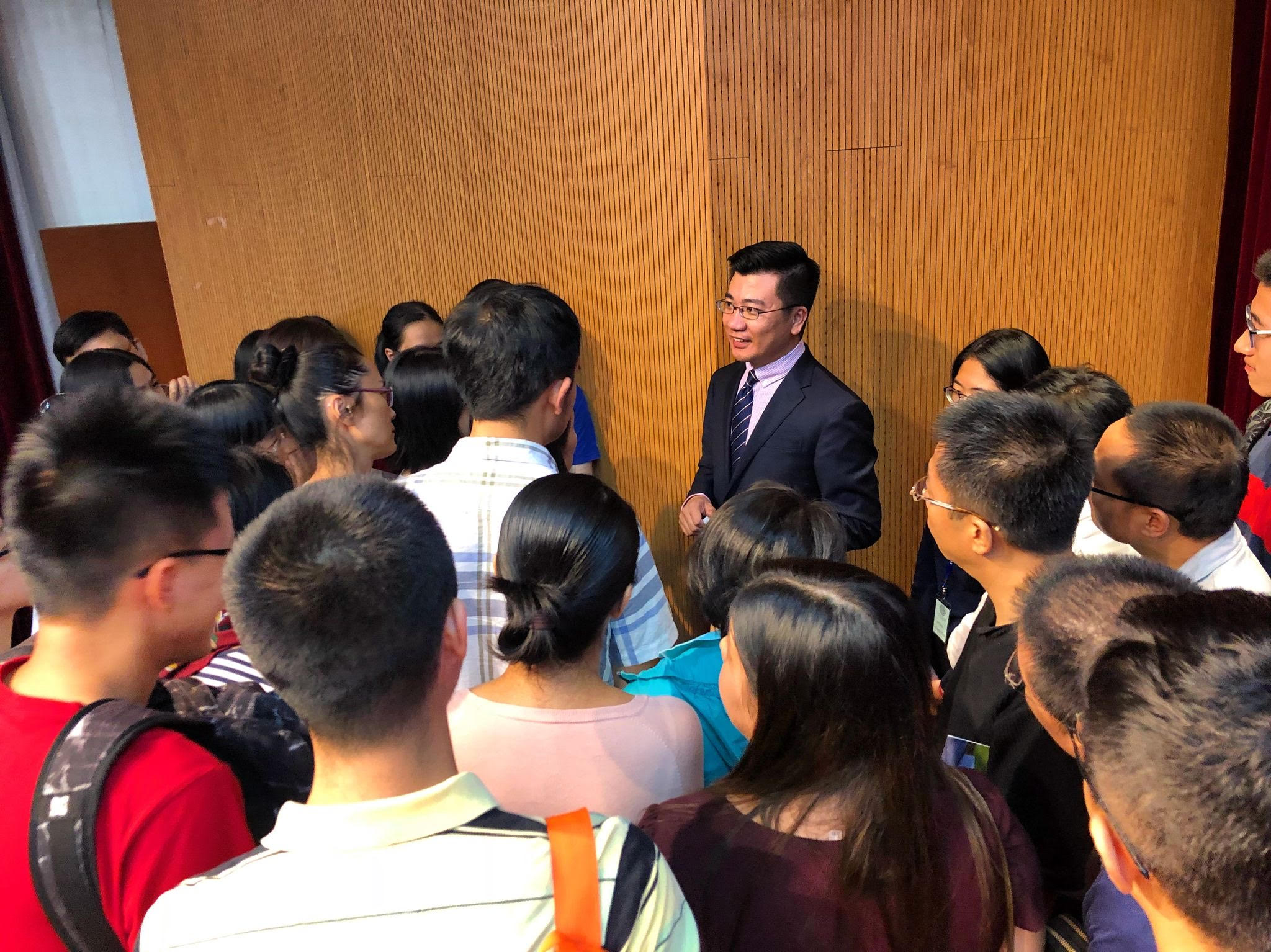
[Kirk] That’s Xiaofeng Wan, making his pitch in Mandarin to Chinese students and parents at a high school in Shanghai. Wan used to be an admissions officer at Amherst College in western Massachusetts. Now he’s a private college consultant, guiding Chinese students through the maze that is college admissions in the U.S.
[Xiaofeng Wan] So I’ll walk them through the initial high school years before they apply. And then by the time of their college applications, I’ll help them go through the process as well.
[Kirk] This is big business for colleges. Like most international students, Chinese families do not qualify for financial aid, and often they pay the full cost. Wan also trains guidance counselors across China, showing them how to support students heading abroad. So he’s got a front-row seat to what Chinese families are thinking right now.
[Xiaofeng Wan] They see the United States as a primary study-abroad destination.
[Kirk] But Wan says that might be starting to shift.
[Xiaofeng Wan] America has an image problem right now, so we will definitely start to see reluctance from families.
[Kirk] I caught up with him while he was in Ningbo, a port city known for manufacturing, on the same morning President Trump’s tariffs on Chinese goods took effect.
[sound of news anchor] Across the globe this weekend, world leaders are trying to figure out how to respond to President Trump’s attempt to reshape the global economy by imposing steep tariffs. …
[Kirk] Just hours later, the Chinese government warned the more than 270,000 Chinese students already studying in the U.S. to think twice about staying. Wan says that kind of message stokes fear that’s been building. House Republicans sent letters to six universities saying America’s student visa system has become a Trojan horse for Beijing, and a lot of Chinese parents worry the U S government doesn’t want their kids.
[Xiaofeng Wan] That’s what they’ve been hearing from President Trump, his rhetoric toward Chinese students. And now they’re seeing news about how international student visas are being revoked.
[Kirk] This is College Uncovered, a podcast pulling back the ivy to reveal how colleges really I’m Kirk Carapezza with GBH News …
[Jon] … and I’m Jon Marcus with The Hechinger Report. Colleges don’t want you to know how they operate, so GBH …
[Kirk] … in collaboration with The Hechinger Report, is here to show you.
This season, we’re staring down the demographic cliff.
[Jon] If you’re just joining us, a quick refresher here: The demographic cliff is a steep drop in the number of 18-year-olds. That’s because many Americans stopped having children after the Great Recession of 2008. And now, 18 years later, colleges are feeling the pinch.
[Kirk] Yeah, and just when many of them thought the situation couldn’t get any worse, international students are under threat. During President Donald Trump’s first term, we saw visa restrictions and travel bans contribute to a 12 percent drop in new international enrollment. So we’ll ask, could that happen again, just as schools are scrambling to fill empty seats?
[Jon] And we’ll explain what all of this means for you, whether you’re an international student or a domestic one, and why you should care.
Today on the show: The Student Trade Wars.
[Kirk] Since Trump’s return to power, his administration has yanked more than 1,000 student visas, often without explanation. Some students have been detained and faced deportation, fulfilling a pledge he often made on the campaign trail.
[Donald Trump] If you come here from another country and try to bring jihadism or anti-Americanism or antisemitism to our campuses, we will immediately deport you. You’ll be out of that school.
[Kirk] In just a few months, that hardline rhetoric has become policy, putting campuses on edge. ICE agents have detained pro-Palestinian student activists, including Mahmoud Khalil at Columbia and Rumeysa Ozturk at Tufts.
[sound from arrest of Rumeysa Ozturk]
[Kirk] This video of her arrest has shaken the international campus community and sparked protests across the country.
[sound of protesters] Free Rumeysa, free her now! We want justice, you say how? Free Rumeysa, free her now!
[Kirk] And now many international students won’t even go on the record, too scared the federal government will target them, or that they’ll be doxxed and ostracized online.
[Frank Zhao] The biggest difficulty for us is building trust.
[Kirk] At Harvard, student journalist Frank Zhao has seen that fear firsthand. He hosts the weekly news podcast for the student newspaper.
[sound of podcast] From The Harvard Crimson, I’m Frank Zhao. This is ‘News Talk.’
[Kirk] Zhao isn’t an international student himself, but the Chinese-American junior from Dallas is plugged into the campus, where a quarter of students are international.
How would you describe the current climate for international students?
[Frank Zhao] The overwhelming sentiment is anxiety. There are so many international student group chats where students were saying, ‘Oh my gosh, there are ICE agents on campus.’ And so it’s quite the Armageddon scenario.
[Kirk] The Trump administration has demanded Harvard turn over detailed records of all foreign students’ — quote — illegal and violent activities, or lose the right to enroll any international students. Harvard says it has complied but won’t publicly disclose details.
The university is suing the administration over this and other demands, but some faculty and students question how hard Harvard is really pushing back. Conservatives, though, defend increased immigration enforcement.
[Simon Hankinson] If a student is studying and minding their own business and obeying the rules of the college and of the United States and the state that they live in, they have nothing to worry about. This is a very small number of people that is being looked at for fraud.
[Kirk] Simon Hankinson is a senior fellow at the Heritage Foundation. He says visa vetting on and off campus is essential for national security after a year of disruptive campus protests.
[Simon Hankinson] Maybe your parents are shelling out a lot of money for you to go, or you’re getting a scholarship. Get your education. Make that the priority. Sure, go out and hold a placard if you want to, and do your thing, light a candle, but if your primary focus is protest and vandalism, I think you’re on the wrong type of visa, and we don’t have a visa for that.
[Jon] Higher education is now a global marketplace, and international students have emerged as a key part of the university funding equation. They’re fully baked into the business model as full-pay customers for colleges who subsidize the cost for domestic students.
[Kirk] And even before the demographic cliff, the competition for international students was fierce.
[Gerardo Blanco] It always has been and sometimes it is intended to be that way, but this is just making it like the Hunger Games
[Kirk] That’s Gerardo Blanco, director of the Center for International Higher Education at Boston College. He warns tht Trump’s America First approach, combined with federal funding cuts, is putting U.S. colleges at risk of losing a generation of global talent.
Is that hyperbole?
[Gerardo Blanco] I don’t think it’s hyperbole in any way.
[Kirk] Why not?
[Gerardo Blanco] The system has been built on the assumption that there wouldn’t be decreases in a dramatic scale to the funding dedicated to research. And therefore they have made some decisions that are somewhat risky.
[Kirk] What’s your biggest concern when it comes to international students?
[Gerardo Blanco] It’s just the generalized sense of uncertainty. I think there are so many balls up in the air and I think it’s really difficult to even focus our attention.
[Kirk] Take the reduction of research funding, for example. It’s affecting many graduate students, especially those who are international and can’t find work in labs. Some schools like Iowa State University, Penn, and West Virginia University are rescinding graduate admissions offers.
[Gerardo Blanco] So that’s one squeeze. We also are looking at just the general rhetoric that tends to be negative.
[Kirk] And Blanco says that rhetoric matters. One survey at the start of Trump’s second term found that nearly 60 percent of European students were less interested in coming to the U.S. Blanco said, considering the demographic cliff, the timing for all of this uncertainty couldn’t be worse for colleges.
[Gerardo Blanco] The clock is ticking and nobody really knows what’s happening.
[Kirk] Okay, so, Jon, why should American students and citizens care about all of this?
[Jon] Well, international students bring different perspectives and experiences to the classroom. And as we said earlier, they also tend to pay full tuition. So they subsidize tuition that American students pay.
But a drop in international student numbers isn’t just a college cash-flow problem. It’s a broader economic one. International students infuse $44 billion into the U.S. economy each year.
Here’s Barnet Sherman, a business professor at Boston University. It’s New England’s largest private university, and one in five students there are international.
[Barnet Sherman] Look, I just teach business and finance. So if one of my top 10 customers comes to me with $44 billion to spend and creates a lot of American jobs, over 375,000 American jobs, I don’t know about you, but I’m opening up the door and giving them the best treatment I possibly can.
[Jon] Here in Massachusetts alone, there are about 80,000 international students contributing $4 billion to the state’s economy each year. That puts the state fourth in the U.S., after California, Texas and New York. So, yeah, this matters.
But Sherman says the impact goes far beyond big cities like Boston, New York, and L.A. Take the tiny town of Mankato, Minnesota, for example — population, 45,000.
[Barnet Sherman] And they’ve got about 1,700 international students there contributing to the local economy. They’re bringing in literally over $25 million to, you know, a perfectly nice burg.
[Jon] In addition to tuition dollars, these students contribute to businesses and local communities that are losing population.
[Kirk] And, Jon, if fewer international and domestic students are coming through the pipeline to fill jobs that require college educations, it puts the U.S. at a serious disadvantage, just as other countries are actively recruiting talent and increasing the number of their citizens with degrees. More and more countries are recruiting international students, including Canada, France, Japan, South Korea and Spain, but also countries that hadn’t recruited before, like Poland and Kazakhstan.
Right before Trump’s first term, I went to Germany, where the government was offering free language classes to attract international students and scholars, including Americans. Because just like the U.S., Germany is losing population. A demographic cliff has already hit Europe, so it needs immigrants and international students, too. Think of it like this: It’s a global talent draft. All of these students, they’re the trading cards. The collectors are the countries. And the more talent you attract, the more ideas, innovation and business growth you get.
[Dorothea Ruland] If you look at Germany, the only resource we do have are human resources, actually.
[Kirk] Dorothea Ruland is the former secretary general of the German Academic Exchange Service, which is in charge of Germany’s international push. When I visited Bonn, we had coffee at her headquarters.
[Dorothea Ruland] We depend on innovation, on inventions, of course, and where do they come from? From institutions of higher education or from research institutions.
[Kirk] Ruland told me nearly half of foreign students earning degrees in Germany stick around. And not just for the short-term. About half of them stay for at least a decade. In the U.S., most international graduates leave and take their talent back home, often because of scarce visas available for skilled workers.
Do you see Germany competing with American universities?
[Dorothea Ruland] Yes, I would say so. You know, we are doing marketing worldwide because we are part of this world and we cannot neglect these trends going on. So of course we are competitors.
[Kirk] But she also made it clear the student trade war isn’t just about competition. It’s about collaboration.
[Dorothea Ruland] If you look at the global challenges everybody’s talking about, questions of climate change, energy, water, high tech, whatever, this cannot be solved by one institution or one country. So you have to have big international networks.
[Kirk] Since my visit, though, isolationism has been creeping in, not only in Germany, but Hungary and Russia, and obviously here in the U.S., too. Some professors and students have pointed to recent issues with visas and detainments without due process and accused the Trump administration of taking an authoritarian approach.
[sound of protest]
[Kirk] Outside Harvard’s Memorial Church in Cambridge, more than 100 students and faculty recently held signs and waved American flags, cheering the university for standing up to the White House and calling on Harvard to do more to protect their civil rights. Among other things, they spoke out about visa revocations. It is incredibly scary here.
Leo Gerdén is a senior from Sweden. He says the administration is trying to divide the campus community.
[Leo Gerdén] At first I was very anxious about speaking up. They want us to point fingers to each other and say, you know, deport them, don’t deport us. And you know, it’s classic authoritarian playbook.
[Jon] Trump supporters? Well, they see it very differently.
[Simon Hankinson] I would call that ridiculous. I mean, that’s an insane argument to make.
[Jon] Simon Hankinson is a senior fellow at the Heritage Foundation’s Center for Border Security and Immigration. We heard from him at the top of this episode, and we should also add he’s a career foreign service officer.
[Simon Hankinson] So I’ve certainly interviewed tens of thousands of these applicants, including thousands of students.
[Jon] Hankinson acknowledges the uptick in visa revocations lately, but says it’s still a tiny number compared to the one million international students in the U.S.
[Simon Hankinson] But just looking at the scale of it all, it is more than we’ve seen in the past, because, generally speaking, this wasn’t something that the government devoted a lot of resources to. But it was always a power that they had.
[Jon] And he’s not buying the narrative that these changes and the crackdowns on visas will scare off students from coming to the U.S.
[Simon Hankinson] Are people not going to go to Harvard because, you know, they’re afraid that they’re going to get hassled. No. Try going to Russia or China and speaking your mind. Good luck with that.
[Jon] Hankinson also argues some universities — especially ones with a high percentage of international students, like Columbia, NYU, Northeastern, and Boston University — they have a financial incentive for complaining.
[Simon Hankinson] It’s a strong constituency that they want to keep happy and they want to keep the money flowing. So they want to make this as big an issue as possible. They want to cry panic.
[Jon] So, Kirk, colleges signal all the time that they’re open to international students. Just listen to some of these welcome videos.
[sound of international recruiting videos]
[Jon] But parents like Claire from Beijing don’t feel like their kids are welcome.
[Claire] I think the government is really hostile right now.
[Jon] Claire asked us to withhold her full name, worried it could affect her son, who’s already studying here. She also has a daughter in high school who was thinking about college in the U.S., but now they’re rethinking her plans and looking at schools in the UK, Canada, Singapore and Hong Kong.
[Claire] You know, we have to consider all the possibilities, obviously in a trade war, you know, like, because next year, when my child has to go to college, you know, Trump is still the president.
[Kirk] Claire says she still believes in the power of an American education, so it’s really hard for her to just write it off completely.
[Jon] Okay. So, Kirk, we’ve tackled a lot in this episode. Bottom line, do you think American colleges will still be able to recruit and enroll enough international students to help offset this looming shortage we’ve been talking about in the number of 18-year-olds?
[Kirk] Well, it’s not looking great for colleges. International enrollment, as we said, dropped 12 percent during Trump’s first term, and now we’re heading toward a 15 percent drop in the number of 18-year-olds by 2039. That’s a big gap to fill, and the reality is the current climate would have to shift dramatically and quickly for the U.S. to stay competitive.
International students are essential for filling seats and making budgets, especially in regions like New England and the Midwest, where the demographic cliff isn’t coming — it’s already here. A college consultant once told me, if your campus isn’t near an international airport, the clock is ticking on your institution. And that was before America developed this reputation as an unwelcoming place.
[Jon] So what do you think you’ll be watching as we continue to cover this issue?
[Kirk] Yeah, for me, one of the biggest questions is how colleges handle what I see as a major communication and messaging problem. Administrators and faculty haven’t done a great job telling the full story of what U.S. universities actually do, or why international mobility benefits the country as a whole.
[Jon] This is College Uncovered. I’m Jon Marcus from The Hechinger Report …
[Kirk] … and I’m Kirk Carapezza from GBH News.
[Jon] This episode was produced and written by Kirk Carapezza …
[Kirk] … and Jon Marcus, and it was edited by Jonathan A. Davis.
Our executive editor is Jenifer McKim.
Our fact checker is Ryan Alderman.
GBH’s Robert Goulston contributed reporting to this episode.
[Jon] Mixing and sound design by David Goodman and Gary Mott.
All of our music is by college bands. Our theme song and original music is by Left Roman out of MIT.
Mei He is our project manager, and head of GBH podcasts is Devin Maverick Robins.
[Kirk] College Uncovered is made possible by Lumina Foundation. It’s a production of GBH News and The Hechinger Report and distributed by PRX.
Thanks so much for listening.
The Hechinger Report provides in-depth, fact-based, unbiased reporting on education that is free to all readers. But that doesn’t mean it’s free to produce. Our work keeps educators and the public informed about pressing issues at schools and on campuses throughout the country. We tell the whole story, even when the details are inconvenient. Help us keep doing that.
MUSCATINE, Iowa — The suspect moved menacingly toward her, but Elexiana Oliva stood her ground, gun drawn and in a half crouch as she calmly tried to talk him down.
The confrontation wasn’t real, and neither was the gun. But the lesson was deadly serious.
Oliva is a criminal justice major at Muscatine Community College in this largely agricultural community along the Mississippi River. She was in a simulation lab, with that scenario projected on a screen as classmates watched, spellbound.
Just 18, Oliva is determined to become a police detective, a plan that includes earning a bachelor’s degree after she finishes her associate degree here. But she’ll have to go somewhere else to do it — likely, in her case, to a university in Texas.
“It’s not our fault that we grew up in a place where there’s not a lot of big colleges and big universities,” Oliva said.
Related: Interested in innovations in higher education? Subscribe to our free biweekly higher education newsletter.
Iowa has joined a growing number of states that are considering letting community colleges like this one offer bachelor’s degrees, or where community colleges have already started adding them, as a way of filling these so-called rural higher education deserts and training workers in rural places for jobs in fields where there are growing shortages.
“It would be a big game-changer, especially for those who have a low income or a medium income and want to go and further our education,” Oliva said.
Downtown Muscatine, Iowa. About an hour from the nearest public university, Muscatine could benefit from a proposal to let community colleges offer bachelor’s degrees. Credit: Mike Rundle for The Hechinger Report
Abouthalf of states allow community colleges to offer bachelor’s degrees. In Iowa, which is among the half that don’t, lawmakers have commissioned a study to determine whether it should add bachelor’s degrees in some programs at the state’s 15 community colleges. An interim report is due in May.
A similar proposal in Illinois is backed by that state’s governor, JB Pritzker, who has said the move would make it easier and more affordable for residents to get degrees — “particularly working adults in rural communities.” Three-quarters of community college students in Illinois said they would pursue bachelor’s degrees if they could do it on the same campus, according to a survey released by Pritzker’s office.
And in Texas, Temple College will open a center in June where students at the two-year public institution will be able to earn bachelor’s degrees through partner Texas A&M University-Central Texas, including in engineering technology with a concentration in semiconductors.
“When you can offer university classes on community college campuses, that makes a world of difference” to rural students, said Christy Ponce, the president of Temple.
What’s been blocking many of these students from continuing their educations, Ponce said, “is the sheer distance. There’s not a public university option within an hour or more away. And affordability and transportation barriers are huge issues.”
Fewer than 25 percent of rural Americans hold bachelor’s degrees or higher, according to the National Center for Education Statistics, compared to the national average of 33 percent. And the gap is getting wider, the U.S. Department of Agriculture finds in its most recent analysis of this.
Significantly fewer students in rural places than in urban areas believe that they can get degrees, a Gallup survey for the Walton Family Foundation found, citing the lack of nearby four-year universities as a principal reason.
In those states that already allow community colleges to offer bachelor’s degrees, they’re often limited to certain high-demand fields, such as teaching and nursing. Even as this idea has spread, America’s 960 public community colleges collectively confer only about 1 percent of bachelor’s degrees each year, the American Association of Community Colleges reports.
In many places, what’s stopping them from giving out more is opposition from four-year universities and colleges, many of which are increasingly hard up for students as the number of 18-year-olds begins to fall — a phenomenon enrollment managers have dubbed the demographic cliff.
That Illinois proposal, for example, is stalled in committee after several public and private university presidents issued a statement opposing it. Negotiations are continuing.
While community colleges in California have been allowed since 2021 to offer bachelor’s degrees, several have been blocked from adding four-year programs that the California State University System contends it already offers. An independent mediator has been brought in to resolve the impasse.
And while the two-year, public College of Western Idaho will launch a bachelor’s degree in business administration in the fall, it’s doing so only over the objections of Boise State University, which said it “could hurt effective and efficient postsecondary education in Idaho, cannibalizing limited resources available to postsecondary education and duplicating degree offerings.”
Community colleges also need more students; their enrollment declined by 39 percent from 2010 to 2021, and they face that same impending demographic cliff. Those that add bachelor’s degrees increase their full-time enrollment from 11 percent to 16 percent, research conducted at the University of Michigan has found.
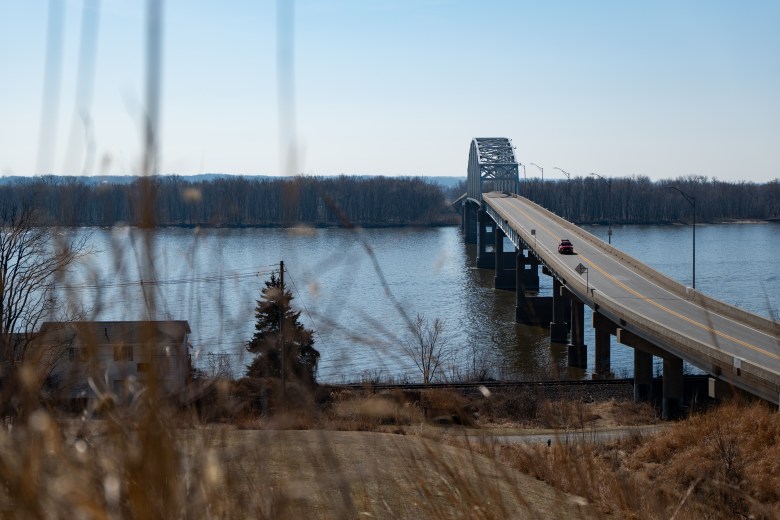
The Norbert F. Beckey Bridge, seen from the Mark Twain Overlook in Muscatine, Iowa, which links Muscatine with Rock Island County, Illinois, across the Mississippi River. Credit: Mike Rundle for The Hechinger Report
The principal impetus for the largely bipartisan push to offer bachelor’s degrees at community colleges, however, is to train more workers for those fields in which there are shortages.
“What I think is misunderstood is that, in general, these are not like the baccalaureates that conventional four-year institutions offer,” said Davis Jenkins, a senior research scholar at the Community College Research Center at Teachers College, Columbia University. (The Hechinger Report, which produced this story, is an independent unit of Teachers College.)
Bachelor’s degrees at community colleges, said Jenkins, “meet an economic need for bachelor’s degree graduates that isn’t being met by other institutions.”
That includes by helping rural workers move up in their jobs without leaving home. “It’s all about serving our workforce needs,” said Iowa state Rep. Taylor Collins, Republican chair of Iowa’s House Committee on Higher Education, who requested the study into whether bachelor’s degrees should be offered at community colleges in that state. “It’s a way to upskill our workforce.”
In his own district, south of Muscatine, “we’re kind of on an island where we only have the community college” — especially since the closing of nearby private Iowa Wesleyan University in 2023. “There are a lot of students who are place-bound. There are a lot of students who want to live locally” and not move away to get a bachelor’s degree.
That’s a focus of the ongoing study, said Emily Shields, executive director of Community Colleges for Iowa, which is conducting it. “Sometimes people have ties, responsibilities, jobs, family things, where moving to where there is a degree available isn’t an option for them,” Shields said.
Sure, she said, rural students can take courses online. But “you’re not getting the student services, you’re not getting activities, you’re not getting the other sort of enrichment support and belonging that a lot of our students, I think, are looking for.”
Many also say they’re looking for the kind of individual attention they get in their hometown and at a community college such as the one in Muscatine, which has an enrollment of 1,800.
Shiloh Morter stayed in his hometown of Muscatine, Iowa, to go to community college. Among the advantages, he says: “The sunsets here are pretty nice. I can tell you, there’s not a whole lot of other places that have clouds like we do.” Credit: Mike Rundle for The Hechinger Report
Shiloh Morter bikes to campus on all but the very coldest days. He plans to become an engineer, but “figured I would save the money and go to community college and try and branch out and develop better habits” first, said Morter, who is 20.
In the automotive technology garage off the main corridor of the small school, cars were lined up neatly with their hoods popped. Nursing students worked on anatomically correct crash test dummy-style “patients.”
Twenty-year-old Mykenah Pothoff enrolled at the college when it debuted a registered nursing program, saving herself money on tuition and a nearly hourlong drive, each way, to the University of Iowa. She also was worried about “just, like, finding my way around” the university, which has more than 30,000 students.
Jake Siefers is majoring in psychology at an Iowa community college. If he could stay and get his bachelor’s degree in the same place, “it would be huge,” he says. “There’s a lot of untapped human potential” in rural places that could benefit from more access to higher education. Credit: Mike Rundle for The Hechinger Report
Jake Siefers, 32, is a psychology major planning to go on to get bachelor’s and master’s degrees. Siefers said he hopes to help other people who, like him, are recovering from alcoholism, and for whom he said there are too few services in Iowa. So he came home to Muscatine to start working toward an associate degree at the community college.
“I could afford it, and it was close and I actually know a lot of people that work here,” said Siefers. “It’s great coming in here and being, like, ‘Hey, I went to high school with you, and you work in the office.’ I mean, that’s everyone in Iowa, right?”
If he could stay and get his bachelor’s degree in Muscatine, “it would be huge,” he said. “There’s a lot of untapped human potential” in rural places that could benefit from the kind of access to a higher education that is now more limited, said Siefers.
Letting students like them finish bachelor’s degrees near where they live “would make it easier for everybody,” said Jaylea Perez, 19, another psychology major who also plans to earn one.
Jaylea Perez is enrolled in community college in Iowa but eventually hopes to earn a bachelor’s degree in psychology. Adding bachelor’s degrees at community colleges “would make it easier for everybody,” she says. Credit: Mike Rundle for The Hechinger Report
Simply having bachelor’s degrees available would make rural students aspire to them who otherwise might not, said Naomi DeWinter, president of Muscatine Community College.
“Everything opens up to them,” said DeWinter, in a coffee shop across the highway from the Walmart.
She sees the most potential among people already working, such as paraprofessionals in schools who want to become teachers; a state job board lists nearly 1,000 vacancies in Iowa for teachers.
DeWinter recalled a graduate so exemplary that he was featured in a promotional video, who after earning his associate degree started substitute-teaching while commuting in his free time to the University of Iowa to get his bachelor’s degree — one course at a time.
“He said, ‘That’s how I’m juggling my work, my family and the affordability,’ ” she said. “His whole career is going to be over before he’s a [full-time] teacher. I feel as though we failed him.”
Like the substitute teacher, students said they want to stay in Muscatine, despite those limits. They like the peace and quiet compared to cities — hardly anyone ever honks, they noted — and the sense of community evident among the friends who run into each other at the Hy-Vee.
“We don’t have the best view of the Milky Way, but we for sure definitely don’t have a bad one,” said Shiloh Morter, ticking down a list of advantages to living on the sweeping plain carpeted with cultivated fields and dotted with barns and silos. “And, yeah, the sunsets here are pretty nice. I can tell you, there’s not a whole lot of other places that have clouds like we do.”
The Hechinger Report provides in-depth, fact-based, unbiased reporting on education that is free to all readers. But that doesn't mean it's free to produce. Our work keeps educators and the public informed about pressing issues at schools and on campuses throughout the country. We tell the whole story, even when the details are inconvenient. Help us keep doing that.
The idea that universities have stopped believing in themselves as institutions that can take on the challenges of the day and find solutions that are better than those developed by private rivals echoes a point recently revived by Mariana Mazzucato. Mazzucato explains how private firms often are portrayed like lions. Bold animals that make things happen. The public sector and third-sector organisations, on the contrary, are too often seen as gerbils. Timid animals that are no good at developing new and innovative solutions.
Skilled salesmen convinced some universities that private companies are better than universities at teaching and recruiting for university preparatory programmes. The inbuilt premise of this pitch is that universities are gerbils and private providers are lions. One university staff member explained what it felt like meeting such salesmen:
“The thing that sticks most in my mind is the dress. And how these people sat differently, looked differently, spoke differently, and we felt parochial. We felt like a bunch of country bumpkins against some big suits.” (University staff)
The lion-gerbil pitch worked in institutions across England because universities were stifled by three interlocking practices of inaction: outsourcing capability development; taking ambiguous stands on international tuition fees; and refusing to cooperate with other universities.
Outsourcing capability
Universities are increasingly outsourcing core aspects of their operations, such as recruiting international students. While university leadership is often characterised as conservative, my research suggest that this trope misses something critical about contemporary university leadership in English higher education. The problem with the term ‘conservative’ is that it implies that leadership is risk-averse, and comfortable projecting past power structures, practices and norms into the future. This does not correspond to historical developments and practices in the sector for international pathways.
The University of Exeter, for example, submitted incorporation documents for their limited liability partnership with INTO University Partnerships only six years after the Limited Liability Partnerships Act 2000 was passed, which marked the first time in England’s history that this legal setup was possible. They took a big leap of faith in the private sector’s ability to recruit students for them, and after doing so invested time and resources helping INTO to further develop its capability. They even invited them onto their campuses. It is hard to overstate how much these actions diverged from historical practice and thus ‘conservative’ leadership.
What was once a highly unusual thing to do, has over the last two decades thoroughly normalised—to the extent that partnering with pathways now seems unavoidable. One respondent from the private sector explained this change in the following way:
“In 2006, ‘07, ‘08, ‘09, ‘10, the pathway providers were, if you like, the unwelcome tenants in the stately home of the university. We had to be suffered because we did something for them. Now, the relationship has totally moved. It’s almost as if they roll out the red carpet for the pathway providers” (C-suite)
The far more conservative strategy would have been to lean into the university’s core capabilities – teaching and admissions – and scale this up over time. Yet that is precisely what my respondents said ‘conservative’ university leaders were unwilling to do: they did not believe the university could manage overseas recruitment by themselves. As argued by former Warwick VC Nigel Thrift, this timidity is not unique to the recruitment of international students, but also extends to their engagement with government agencies. University management by and large “has done as it has been told. It hasn’t exactly rolled over and played dead, but sometimes it can feel as though it is dangerously close to Stockholm Syndrome” (Thrift, 2025, p3).
Ambiguous stands on international fees have deepened the current crises
There is no law in England that compels universities to charge high international students fees. By setting them as high as possible and rapidly increasing the intake of international students, universities de facto offset and thus obfuscated the havoc that changing funding regimes wreaked on university finances. This has contributed to what Kings’ Vice Chancellor Shitij Kapur calls the ‘triangle of sadness’ between domestic students, universities, and the government.
Had universities chosen to stand in solidarity with their international students by aligning their fees more closely to the fees of home students, then the subsequent crises in funding would have forced universities to either spend less money, or make it clearer to the wider public that more funding was needed, before building up the dependencies and subsequent vulnerabilities to intake fluctuations that are currently on full display. These vulnerabilities were exacerbated by overoptimistic growth plans, and university leadership not always fully understanding the added costs that came with such growth. In an example of this delayed realisation, one Pro-Vice-Chancellor explained to me what it felt like to partner with a private foundation pathway:
“At the time you are signing up for these things, there is euphoria around because they are going to deliver against this business plan, which is showing hundreds of students coming in. International student is very buoyant, you sign up for a 35-year deal. So, everything is rosy. If you then just take a step back and think ‘so what am I exposing the university to?’ … because in year seven, eight, ten, fifteen whatever, it can all go pear-shaped, and you are left then with the legacy building.” (Pro-Vice-Chancellor)
By seeing fee setting as a practice, that is, something universities do to their own students rather than something that is inflicted by external (market or government) powers, we make visible its ideological nature and implications. The longer history of international fees in Brittan was thus an important site of ideological co-option; it was a critical juncture at which universities could have related in a more solidaric manner towards their students.
Unwillingness to cooperate on increased student acquisition costs
You might, at this stage, be wondering: what was the alternative? The answer is in recognising the structure of the market for what it is: efficiently recruiting and training a large number of international students requires some degree of cooperation between universities. My research, however, suggests that universities have often been unwilling to cooperate because they see each other chiefly as competitors. This competition is highly unequal given the advantage conferred to prestigious universities located in internationally well-known cities.
The irony is that many universities nevertheless end up – perhaps unwittingly – cooperating by partnering with one of the few private companies that offer international foundation programmes. These private providers can only reach economies of scale because they partner with multiple universities at the same time. One executive explains how carrying a portfolio of universities for agents to offer their clients is precisely what gives them a competitive advantage:
“The importance of the pathways to the agents is that they carry a portfolio of universities, and the ambition is that you have some which are very well-ranked and academically quite difficult to get into. And, you try and have a bottom-feeder or two, which is relatively easy to get into academically. The agent is then able to talk to its clients and say, look, I can get offers into these universities. Some of them are at the very top. If you are not good enough there, then you might get one in the middle and I’ve always got my insurance offer for you. […] what the pathways do is that they provide a portfolio that makes that easier.” (Private Executive)
A public consortium with pooled resources and that isn’t shy about strategically coordinating student flows would have functioned just as well, and the Northern Consortium is living proof of this. The consortium in fact inspired Study Group to get into the pathway business themselves. The limited growth of the Consortium, relative to its private rivals, is equally proof of missed chances and wasted opportunities.
Could the gerbil eat the lion?
Private providers can use and have used these practices of inaction to pit universities against each other, over time resulting in lower entry requirements and higher recruitment costs. In this climate, public alternatives such as in-house programmes struggle to survive. Once invited in, pathway companies are also well positioned to expand their business with their partner universities in other ways, deepening their dependence. As one senior executive told me:
“Our aspiration is to say that the heart of what we are is a good partner to universities. They trust us. […] for some of our core partners, we bring in a lot of revenue. And, that then puts us in a really good position to think about the other services that we can add of value.” (Private Executive)
The economic downside of relying on these ‘good’ partners is the expensive and volatile market dynamics that follow. As long as universities are trapped by the notion that they are chiefly competitors best served by outsourcing capabilities to sales-oriented firms and leaving international students to pick up the bill, there is limited hope for any genuine inter-university collaboration and innovation. This limits the public potential for scaling an economically viable and resilient market in the long-run. As a sector, HE has the know-how, experience, capital, and repute to do this. It’s just about getting on with it!
Morten Hansen is a Lecturer in Digital Economy and Innovation Education at the Department of Digital Humanities, King’s College London.
May 5, 2025, by Dean Hoke: For years, there have been conversations among many higher education podcasters asking: Why isn’t there a podcasting conference just for us? This question lingered, raised in passing at virtual meetups, in DM threads, and on campuses where faculty and staff were creating podcasts with little external support or collaboration.
Last winter, a group of us decided it was time to do something about it.
Joe Sallustio and Elvin Freytes of The EdUp Experience, Dean Hoke of Small College America, and Gregg Oldring and Neil McPhedran of Higher Ed Pods took a leap of faith and began planning a first-time national gathering. We believed there was a clear void. Podcasting in higher education was growing rapidly, but most lacked a community outside of their home institution to network with, share ideas, and be inspired.
That leap of faith is now a reality. On Saturday, July 12, 2025, we will convene in Chicago for the inaugural HigherEd PodCon—the first conference built by and for higher education podcasters and digital media creators.
Hosted at the University of Illinois, Chicago
This one-day event will bring together over 40 presenters, 15 sessions, and 25+ institutions and organizations from across North America. Whether you’re a faculty innovator, student producer, tech strategist, or communications pro, HigherEd PodCon offers an immersive, hands-on experience designed to elevate the impact of campus-based podcasting.
Sessions run from 8:30 a.m. to 6:00 p.m., which includes networking opportunities and a reception closing out the day. The program is structured across three practical and dynamic tracks:
Strategy, Growth & Discovery
Content & Production
Tech, Tools & Analytics
The keynote speaker is Matt Abrahams, lecturer in Strategic Communication at Stanford Graduate School of Business and host of Think Fast, Talk Smart. His insights on clarity, message delivery, and audience engagement will set the tone for a day of meaningful exploration.
A National Cross-Section of Institutions
HigherEd PodCon showcases participation from institutions of all sizes and types, including:
Purdue University
Stanford University
University of South Carolina Beaufort
Lansing Community College
Brigham Young University
Penn State University
Whether it’s a faculty-led series, a student-led network, or an advancement-focused production, you’ll hear how campuses are using podcasts to educate, engage, and amplify their stories.
Session Spotlights
Here are three sessions you won’t want to miss:
1. Podcasting, Social Media, and Video: Oh My! Kate Young and Maria Welch, Purdue University With more than 130 episodes and thousands of monthly downloads, This Is Purdue is among the country’s top university podcasts. In this session, Kate and Maria walk through their formula for success, including social media workflows, video strategy, and content optimization.
2. Why Podcasts Fail (And How to Make Sure Yours Doesn’t) Dave Jackson, Podpage; Podcast Hall of Fame Inductee Dave Jackson has helped hundreds of shows succeed—and watched others fall flat. This session offers practical guidance for anyone launching or relaunching a podcast with purpose. Topics include budget-friendly production, YouTube distribution, and sustainable growth.
3. From 5 to 30: Growing a Podcast Network That Speaks Higher Ed Daedalian Lowry and Layne Ingram, Lansing Community College What started as five faculty shows grew into a 30+ program podcast network that engages the entire campus and community. Learn how Lansing Community College scaled LCC Connect with collaboration, creativity, and cross-departmental buy-in.
Why Attend HigherEd PodCon?
Whether you’re just starting out or looking to take your podcast to the next level, this is the community you’ve been waiting for. Here are three reasons not to miss it:
Network with your peers: Build meaningful relationships with fellow higher ed podcasters and digital media innovators.
Gain tools and templates you can use immediately: From show planning to promotion, walk away with actionable strategies you can implement on Monday.
Stay ahead of the curve: Learn how leading institutions are using podcasts to engage students, alumni, donors, and the public.
Save the Date
HigherEd PodCon 2025 is your opportunity to help shape the future of podcasting in higher education—and to find your people in the process.
Learn more and register at www.higheredpodcon.com. We have room for only 200 attendees in this inaugural event. Early bird rate of $249 available until the end of May
Dean Hoke is Managing Partner of Edu Alliance Group, a higher education consultancy, and a Senior Fellow with the Sagamore Institute. He formerly served as President/CEO of the American Association of University Administrators (AAUA). With decades of experience in higher education leadership, consulting, and institutional strategy, he brings a wealth of knowledge on small colleges’ challenges and opportunities. Dean, along with Kent Barnds, is a co-host for the podcast series Small College America.
UPDATE: The hearing scheduled for May 9 has been postponed until May 16 at the U.S. District Court for the District of Columbia. The court will hear two similar motions at the same time and consider whether to temporarily restore the cuts to research and data collections and bring back fired federal workers at the Education Department. More details on the underlying cases in the article below.
Some of the biggest names in education research — who often oppose each other in scholarly and policy debates — are now united in their desire to fight the cuts to data and scientific studies at the U.S. Department of Education.
The roster includes both Grover J. “Russ” Whitehurst, the first head of the Institute of Education Sciences (IES) who initiated studies for private school vouchers, and Sean Reardon, a Stanford University sociologist who studies inequity in education. They are just two of the dozens of scholars who have submitted declarations to the courts against the department and Secretary Linda McMahon. They describe how their work has been harmed and argue that the cuts will devastate education research.
Professional organizations representing the scholars are asking the courts to restore terminated research and data and reverse mass firings at the Institute of Education Sciences, the division that collects data on students and schools, awards research grants, highlights effective practices and measures student achievement.
Related: Our free weekly newsletter alerts you to what research says about schools and classrooms.
Three major suits were filed last month in U.S. federal courts, each brought by two different professional organizations. The six groups are the Association for Education Finance and Policy (AEFP), Institute for Higher Education Policy (IHEP), American Educational Research Association (AERA), Society for Research on Educational Effectiveness (SREE), National Academy of Education (NAEd) and the National Council on Measurement in Education (NCME). The American Educational Research Association alone represents 25,000 researchers and there is considerable overlap in membership among the professional associations.
Prominent left-wing and progressive legal organizations spearheaded the suits and are representing the associations. They are Public Citizen, Democracy Forward and the Legal Defense Fund, which was originally founded by the National Association for the Advancement of Colored People (NAACP) but is an independent legal organization. Allison Scharfstein, an attorney for the Legal Defense Fund, said education data is critical to documenting educational disparities and improve education for Black and Hispanic students. “We know that the data is needed for educational equity,” Scharfstein said.
Officers at the research associations described the complex calculations in suing the government, mindful that many of them work at universities that are under attack by the Trump administration and that its members are worried about retaliation.
“A situation like this requires a bit of a leap of faith,” said Elizabeth Tipton, president of the Society for Research on Educational Effectiveness and a statistician at Northwestern University. “We were reminded that we are the Society for Research on Educational Effectiveness, and that this is an existential threat. If the destruction that we see continues, we won’t exist, and our members won’t exist. This kind of research won’t exist. And so the board ultimately decided that the tradeoffs were in our favor, in the sense that whether we won or we lost, that we had to stand up for this.”
The three suits are similar in that they all contend that the Trump administration exceeded its executive authority by eliminating activities Congress requires by law. Private citizens or organizations are generally barred from suing the federal government, which enjoys legal protection known as “sovereign immunity.” But under the Administrative Procedure Act of 1946, private organizations can ask the courts to intervene when executive agencies have acted arbitrarily, capriciously and not in accordance with the law. The suits point out, for example, that the Education Science Reform Act of 2002 specifically requires the Education Department to operate Regional Education Laboratories and conduct longitudinal and special data collections, activities that the Education Department eliminated in February among a mass cancelation of projects.
The suits argue that it is impossible for the Education Department to carry out its congressionally required duties, such as the awarding of grants to study and identify effective teaching practices, after the March firing of almost 90 percent of the IES staff and the suspension of panels to review grant proposals. The research organizations argue that their members and the field of education research will be irreparably harmed.
Of immediate concern are two June deadlines. Beginning June 1, researchers are scheduled to lose remote access to restricted datasets, which can include personally identifiable information about students. The suits contend that loss harms the ability of researchers to finish projects in progress and plan future studies. The researchers say they are also unable to publish or present studies that use this data because there is no one remaining inside the Education Department to review their papers for any inadvertent disclosure of student data.
The second concern is that the termination of more than 1,300 Education Department employees will become final by June 10. Technically, these employees have been on administrative leave since March, and lawyers for the education associations are concerned that it will be impossible to rehire these veteran statisticians and research experts for congressionally required tasks.
The suits describe additional worries. Outside contractors are responsible for storing historical datasets because the Education Department doesn’t have its own data warehouse, and researchers are worried about who will maintain this critical data in the months and years ahead now that the contracts have been canceled. Another concern is that the terminated contracts for research and surveys include clauses that will force researchers to delete data about their subjects. “Years of work have gone into these studies,” said Dan McGrath, an attorney at Democracy Forward, who is involved in one of the three suits. “At some point it won’t be possible to put Humpty Dumpty back together again.”
In all three of the suits, lawyers have asked the courts for a preliminary injunction to reverse the cuts and firings, temporarily restoring the studies and bringing federal employees back to the Education Department to continue their work while the judges take more time to decide whether the Trump administration exceeded its authority. A first hearing on a temporary injunction is scheduled on Friday in federal district court in Washington.*
A lot of people have been waiting for this. In February, when DOGE first started cutting non-ideological studies and data collections at the Education Department, I wondered why Congress wasn’t protesting that its laws were being ignored. And I was wondering where the research community was. It was so hard to get anyone to talk on the record. Now these suits, combined with Harvard University’s resistance to the Trump administration, show that higher education is finally finding its voice and fighting what it sees as existential threats.
The three suits:
Public Citizen suit
Plaintiffs: Association for Education Finance and Policy (AEFP) and the Institute for Higher Education Policy (IHEP)
Attorneys: Public Citizen Litigation Group
Defendants: Secretary of Education Linda McMahon and the U.S. Department of Education
Date filed: April 4
Where: U.S. District Court for the District of Columbia
A concern: Data infrastructure. “We want to do all that we can to protect essential data and research infrastructure,” said Michal Kurlaender, president of AEFP and a professor at University of California, Davis.
Status: Public Citizen filed a request for a temporary injunction on April 17 that was accompanied by declarations from researchers on how they and the field of education have been harmed. The Education Department filed a response on April 30. A hearing is scheduled for May 9.
Democracy Forward suit
Plaintiffs: American Educational Research Association (AERA) and the Society for Research on Educational Effectiveness (SREE)
Attorneys: Democracy Forward
Defendants: U.S. Department of Education, Institute of Education Sciences, Secretary of Education Linda McMahon and Acting Director of the Institute of Education Sciences Matthew Soldner
Date filed: April 14
Where: U.S. District Court for the District of Maryland, Southern Division
A concern: Future research. “IES has been critical to fostering research on what works, and what does not work, and for providing this information to schools so they can best prepare students for their future,” said Ellen Weiss, executive director of SREE. “Our graduate students are stalled in their work and upended in their progress toward a degree. Practitioners and policymakers also suffer great harm as they are left to drive decisions without the benefit of empirical data and high-quality research,” said Felice Levine, executive director of AERA.
Status: A request for a temporary injunction was filed April 29, accompanied by declarations from researchers on how their work is harmed.
Legal Defense Fund suit
Plaintiffs: National Academy of Education (NAEd) and the National Council on Measurement in Education (NCME)
Attorneys: Legal Defense Fund
Defendants: The U.S. Department of Education and Secretary of Education Linda McMahon
Date filed: April 24
Where: U.S. District Court for the District of Columbia
A concern: Data quality. “The law requires not only data access but data quality,” said Andrew Ho, a Harvard University professor of education and former president of the National Council on Measurement in Education. “For 88 years, our organization has upheld standards for valid measurements and the research that depends on these measurements. We do so again today.”
Status: A request for a temporary injunction was filed May 2.*
* Correction: This paragraph was corrected to make clear that lawyers in all three suits have asked the courts to temporarily reverse the research and data cuts and personnel firings. Also, May 9th is a Friday, not a Thursday. We regret the error.
The Hechinger Report provides in-depth, fact-based, unbiased reporting on education that is free to all readers. But that doesn’t mean it’s free to produce. Our work keeps educators and the public informed about pressing issues at schools and on campuses throughout the country. We tell the whole story, even when the details are inconvenient. Help us keep doing that.
After a five-year pause, the Trump administration is bringing back financial penalties for the many millions of borrowers who are too far behind on their student loan payments. It’s led to confusion and financial uncertainty.
At least 5 million people are in default, meaning they have failed to make payments on their loans for at least nine months — and millions more are projected to join them in the coming months.
The Hechinger Report spoke to student loan experts about what to expect and how to prepare, as well as about a separate effort in Congress to adjust how student loans work.
The Biden administration restarted loan repayments in October 2023. That came without any consequences, however, for about a year. But interest, which had also been frozen since the start of the pandemic, has been piling up for some borrowers since the fall of 2023.
All told, about 43 million federal student loan borrowers owe a total of $1.6 trillion in debt. Starting May 5, those in default face having tax refunds withheld and wages garnished if they don’t start making regular payments.
A college degree can be a path to long-term financial security, but the process of repaying loans can lead to financial hardship for many borrowers. About half of all students with a bachelor’s degree graduate with debt, which averages more than $29,000. And although average debt tends to be lower for graduates of public universities (about $20,000), close to half of people who attend those schools still leave with debt.
Related: Interested in more news about colleges and universities? Subscribe to our free biweekly higher education newsletter.
The student loan landscape is likely to change in some way over in the coming months: The Trump administration is expected to push the limits on aggressive collection practices, while Republicans in Congress are determined to adjust repayment options. Here’s what we know about what the Trump administration’s actions mean for student borrowers.
Once you’ve failed to make a loan payment in 270 days, you will probably enter into default. That means, as of May 5, the government can take your federal tax refund and apply it to your debt. Starting in June, the government can also withhold up to 15 percent of any money you receive from Social Security, including disability payments. And later this summer, officials said, they will start the process of taking a cut ofyour paycheck, although borrowers have the right to appeal. Going into default can also harm your credit score, which can make it harder to rent an apartment or borrow money for other reasons, like buying a car.
Can I go back to school to avoid repaying my loans?
Some influencers on social media have recommended enrolling in school as a way to delay making payments. It’s true that most loans are deferred while you’re in school, meaning you wouldn’t have to pay while you’re taking classes, but you may also add to what you already owe if you spend more time in college. Unless you’re confident a new certificate or degree will boost your income, delaying repayment and increasing what you owe could make paying off your loans even more difficult.
I can’t afford to repay my loan. What should I do?
There are other options. One type links your monthly payments to what you earn. These income-based repayment plans can shrink your monthly loan bill. There is also a graduated repayment plan that can lower your payments initially, after which they increase every two years. A third option is an extended repayment plan, which lowers your monthly payments but adds months or years to the time it will take to pay off your loans. The government’s Loan Simulator is one way to find options available to you.
Where can I go if I need help?
The Education Department’s Default Resolution Group can help provide advice for borrowers who are already in default. The Federal Student Aid call center is set up to answer questions. Borrowers can also reach out to their loan servicers for guidance.
What’s the difference between loan deferment, loan forbearance and default?
Loan deferment: The Education Department may grant a loan deferment for several reasons, including when a borrower is experiencing an extreme economic hardship or is unemployed. That means the borrower can temporarily stop paying off the loan without any financial penalties; in the case of subsidized undergraduate loans, interest doesn’t keep accruing during that time.
Forbearance: A loan forbearance also allows a borrower to stop payments, or make smaller ones, without any penalties. However, interest usually keeps building on all loans during that time.
Default: If a borrower is in default, it means they have failed to make payments for at least 270 days without permission. That’s when the government can begin to garnish tax refunds, Social Security benefits and wages, and a borrower’s credit score will drop.
I’ve heard income-driven repayment plans are in trouble. Is that true?
There are several types of income-driven repayment plans, which are meant to keep payments affordable. The Biden administration’s Saving for a Valuable Education (SAVE) plan is on hold because of legal challenges from Republican-led states. That plan previously offered eligible borrowers a repayment plan with lower monthly payments and a quicker path to loan forgiveness than other previously available options. But borrowers can still enroll in the Pay As You Earn (PAYE) plan and other income-based repayment options, in which payments are capped at 10 percent of a borrower’s income, or the Income-Contingent Repayment Plan, which requires payments of up to 20 percent of income and allows full repayment more quickly. Congressional Republicans hope to eliminate several of these plans in favor of just one income-based repayment plan, but it’s unclear if that bill will pass the Senate.
What’s happening with the court cases challenging the SAVE program?
Courts have effectively paused the SAVE plan. The 8 million borrowers who are enrolled don’t have to make payments, and interest will not be added while the court decides the case. With those payments paused, borrowers in this group who are intending to seek loan forgiveness for working in public service are also not making progress toward that goal. If Congress eliminates the SAVE program or the courts officially kill it, those borrowers would need to enroll in a different repayment plan.
Does Public Service Loan Forgiveness (PSLF) still exist?
Yes, the Public Service Loan Forgiveness program is still available. Borrowers should still be eligible if they are in an income-driven repayment plan and make regular payments for 10 years. They must work for the federal, state or local government — teachers and firefighters are eligible, for example — or for qualifying nonprofit organizations, such as some health care clinics or foster care agencies. The goal of PSLF is to encourage graduates to pursue careers that may pay less than jobs with private companies but which benefit their communities or the country as a whole.
The Trump administration issued an executive order in March aimed at limiting which organizations’ jobs could qualify for PSLF — for instance, a nonprofit could be excluded if the government decides it is “supporting terrorism,” engaging in civil disobedience or aiding undocumented immigrants in violation of federal law. So far, it’s unclear what the effect will be.
What other changes might be in store for student loans?
As part of the federal budget process, congressional Republicans have proposed a slew of changes to student loans that some policymakers worry will make borrowing more expensive for students — especially those in graduate programs.
The proposals include changes to:
Subsidized loans: Congressional Republicans want to get rid of subsidized loans for undergraduates, which would mean interest would accrue while a student was in college. They also want to cap total undergraduate borrowing at $50,000.
Grad Plus: They also want to end the Grad Plus program, which allows students to borrow money to cover the cost of graduate school. Student advocates worry that this would push more students into the private student loan market, which has fewer protections for borrowers.
Income-driven repayment: One proposal would simplify income-driven repayment into one option and prevent interest from causing student debt to balloon for students in income-driven repayment plans.
The proposed changes are included in the federal budget bill and may undergo many revisions as Congress figures out its spending priorities for the year.
This story about student loan repayment was produced by The Hechinger Report, a nonprofit, independent news organization focused on inequality and innovation in education. Sign up for the Hechinger newsletter.
The Hechinger Report provides in-depth, fact-based, unbiased reporting on education that is free to all readers. But that doesn’t mean it’s free to produce. Our work keeps educators and the public informed about pressing issues at schools and on campuses throughout the country. We tell the whole story, even when the details are inconvenient. Help us keep doing that.
RIVER FOREST, Illinois — Cuando Jacqueline Quintero empezó a explorar opciones para ir a la universidad cuando se graduara de secundaria, se dio cuenta de algo que muchas parecían tener en común.
“No me gusta decirlo, pero todo el mundo parecía tan blanco”, dijo Quintero, cuyos padres llegaron a Estados Unidos desde México. “Simplemente no sentía que yo pertenecía allí”.
Hasta que fue a una recepción para estudiantes admitidos en la Dominican University, cerca de donde creció en los suburbios del oeste de Chicago. Entre las cosas que la hicieron decidirse casi de inmediato a ir allí: Se proporcionaba información a las familias tanto en inglés como en español.
“Por fin mis padres pudieron hacer preguntas” en su lengua materna, dice Quintero, que ahora cursa el penúltimo año de la carrera de Derecho. “Estaba acostumbrada a traducirles toda mi vida. Me puse a llorar, literalmente”.
Este aparentemente pequeño detalle es uno de los muchos que han ayudado a impulsar la matrícula de Dominican en casi un 25 por ciento desde 2021, un período durante el cual las instituciones comparables han luchado por atraer estudiantes y cuando el número de jóvenes de 18 años está a punto de comenzar un largo declive.
Esto se debe a que la universidad ha aprovechado un grupo de clientes potenciales que está creciendo: Los graduados hispanos como Quintero.
Históricamente, a las universidades y escuelas superiores no les ha ido bien a la hora de reclutar estudiantes hispanos. Ahora su propio éxito puede depender en gran medida de ello.
“La demografía de nuestro país está cambiando, y la enseñanza superior tiene que adaptarse”, afirma Glena Temple, presidenta de Dominican.
O, como dijo Quintero, sonriendo: “Ahora nos necesitan”.
Relacionado: ¿Te interesa recibir más noticias sobre universidades? Suscríbete a nuestro boletín quincenal gratuito de educación superior.
Jacqueline Quintero, hija de inmigrantes mexicanos, estudia en la Dominican University y tiene previsto estudiar Derecho. “Ahora nos necesitan”, dice refiriéndose a las universidades que reclutan estudiantes hispanos como ella. Credit: Camilla Forte/The Hechinger Report
Mientras que se prevé que en 2041 las cifras de graduados en enseñanza secundaria blancos, negros y asiáticos disminuyan en un 26%, un 22% y un 10%, respectivamente, se prevé que el número de graduados hispanos en enseñanza secundaria durante ese periodo aumente un 16%, según la Western Interstate Commission for Higher Education, que realiza el seguimiento de estos datos.
Según el Centro Nacional de Estadísticas Educativas, casi 1 de cada 3 alumnos desde preescolar hasta 12º curso es hispano. Esta cifra es superior a la de menos de 1 de cada 4 de hace una década. La proporción de alumnos hispanos en las escuelas públicas es aún mayor en algunos estados, como California (56%), Texas (53%) y Florida (38%).
Esto hace que estos jóvenes – a menudo hijos o nietos de inmigrantes, o inmigrantes ellos mismos – adquieran una nueva importancia para las universidades, que históricamente no han conseguido atraer a tantos estudiantes hispanos como a gente de otros orígenes raciales.
Sin embargo, en un momento en que la educación superior necesita que aumente, la proporción de estudiantes hispanos que van a la universidad ha ido disminuyendo. Invertir esa tendencia es todo un reto, por muchas razones – el elevado costo, la necesidad de encontrar un trabajo inmediatamente después de la secundaria, el hecho de que muchos proceden de familias sin experiencia universitaria a las que pedir consejo – agravadas por los ataques cada vez más agresivos a los programas de diversidad de los campus, que podrían dificultar aún más la captación y el apoyo a estos estudiantes.
En el pasado, según Deborah Santiago, directora ejecutiva de la organización de defensa de los hispanos Excelencia in Education, las instituciones de enseñanza superior “podían alcanzar sus cifras [de matriculación] sin implicar a esta población. Eso ya no es así”.
Ese gran número de estudiantes hispanos que se acercan a la edad universitaria “es para lo que tenemos que prepararnos como instituciones de enseñanza superior y para satisfacer las necesidades de nuestras comunidades”, afirma Greg Mosier, presidente del Kansas City Kansas Community College, que ahora se anuncia en periódicos en español y en la radio en español.
“A medida que los baby boomers se jubilan, la población joven es mucho menor y tiene que sostener a una población de más edad”, afirma Michael Collins, vicepresidente del Centro para la Equidad Económica Racial de la organización sin fines de lucro Jobs for the Future.
El Centro para la Liberación Cultural de la Dominican University, cerca de Chicago. La sala es un lugar de estudio, conversación y encuentro para estudiantes de todas las procedencias. Credit: Camilla Forte/The Hechinger Report
A menos que las universidades construyan redes más amplias, dijo Collins – incluyendo la ayuda para que más hispanoamericanos puedan acceder a empleos mejor pagados – “nuestra calidad de vida será menor. Es un panorama bastante desolador”.
Incluso los más pequeños esfuerzos por matricular y apoyar a los estudiantes hispanos se complican aún más con la retirada de los programas de diversidad y las ayudas económicas a los estudiantes indocumentados, muchos de ellos hispanos.
Aunque la base jurídica de esa decisión ha sido ampliamente cuestionada, tiene en vilo a las instituciones de enseñanza superior. Incluso muchos colegios y universidades que los activistas elogiaron por impulsar la matriculación de hispanos no quisieron hablar de ello.
Algunos expertos dicen que la mayoría de los programas para reclutar y apoyar a los estudiantes hispanos no se verían afectados por las campañas anti DEI, ya que se ofrecen a cualquiera que los necesite. “Estas cosas funcionan para todos los estudiantes”, dijo Anne-Marie Núñez, directora ejecutiva del Instituto para el Éxito de los Estudiantes Hispanos de la Universidad de Texas en El Paso.
La proporción de graduados de secundaria hispanos que van directamente a la universidad es inferior a la de sus compañeros blancos, y está disminuyendo: del 70% al 58% entre 2012 y 2022. Ese es el último periodo para el que se dispone de cifras del Centro Nacional de Estadísticas Educativas. Los estudiantes hispanos que se matriculan en la universidad también la abandonan en mayor proporción.
Hay razones económicas y culturales para ello.
Según la Oficina del Censo, el ingreso medio anual de las familias hispanas es más de un 25% inferior al de las familias blancas, lo que significa que la universidad puede parecer fuera de su alcance. El Center for Law and Social Policy ha calculado que más de tres cuartas partes de los estudiantes hispanos que acuden incluso a colegios comunitarios de bajo coste tienen necesidades financieras no cubiertas.
Esto empuja a muchos directamente al mercado laboral. Muchos estudiantes universitarios hispanos trabajan al menos a tiempo parcial mientras estudian, algo que, según las investigaciones, reduce la probabilidad de graduarse.
Cuando Eddie Rivera terminó la secundaria en Carolina del Norte, “la universidad no era realmente una opción. Mi consejero no me ayudó. Sólo seguí lo que mi cultura hispana nos dice, que es ir a trabajar”.
Cuando Eddie Rivera terminó la secundaria en Carolina del Norte, “sólo seguí lo que mi cultura hispana nos dice, que es ir a trabajar”. Animado por sus compañeros, acabó matriculándose en la Dominican University. Credit: Camilla Forte/The Hechinger Report
Rivera, que tiene el estatus DACA, o Acción Diferida para los Llegados en la Infancia, trabajó en una residencia de ancianos, en un parque de trampolines cubierto y en un hospital durante la pandemia, donde sus colegas le animaron a ir a la universidad. Con la ayuda de un programa de becas para estudiantes indocumentados, también terminó en Dominican, donde a sus 28 años es estudiante de tercer año y se especializa en relaciones internacionales y diplomacia, con planes de obtener una maestría en política exterior y seguridad nacional.
Dominican, una pequeña universidad católica que data de 1922 y que antes se llamaba Rosary College, tiene una historia de educación de hijos de inmigrantes, del norte y centro de Europa, inicialmente.
Hoy, de las farolas del campus de 30 acres cuelgan pancartas con fotos de antiguos alumnos hispanos de éxito, y una banda de mariachis dirige las celebraciones del Día de los Muertos.
Las visitas a la institución se realizan en inglés y español, se ofrece a los estudiantes trabajo en el campus y el personal ayuda a familias enteras a superar crisis sanitarias, de vivienda y financieras. Dominican añadió un campus satélite en otoño en el barrio mexicano-americano de Pilsen, en Chicago, que ofrece titulaciones de dos años orientadas al empleo. Todos los estudiantes de la universidad reciben ayuda financiera, según datos federales.
“Todos los días me encuentro con un miembro del personal o un profesor que me pregunta qué me pasa en la vida y cómo pueden ayudarme”, dice Aldo Cervantes, estudiante de tercer año de Negocios con especialización en Contabilidad, que quiere dedicarse a la banca o a los recursos humanos.
También hay una Academia Familiar para que los padres, abuelos, hermanos y primos de los estudiantes conozcan los recursos de la universidad; como incentivo, las familias que acudan a cinco sesiones obtienen créditos para que su estudiante realice un curso de verano sin costo alguno.
Un armario de ropa en la Dominican University para estudiantes que necesitan trajes de negocios para entrevistas de trabajo. Uno de los factores que frenan la matriculación de hispanos en la universidad es la menor renta media de los hogares. Credit: Camilla Forte/The Hechinger Report
“Cuando observamos a la población latina que va a la universidad, no se trata de una elección individual”, afirma Gabe Lara, Vicepresidente de Éxito y Compromiso Estudiantil, utilizando el término preferido por la universidad para referirse a las personas de ascendencia latinoamericana. “Es una elección familiar”.
Estas y otras medidas han contribuido a más que duplicar la proporción de estudiantes hispanos en los últimos 10 años, hasta casi el 70% de los 2.570 estudiantes de Dominican, según cifras facilitadas por la universidad.
Genaro Balcazar dirige las estrategias de matriculación y marketing como director de operaciones de la universidad, tiene una forma pragmátuca de ver la situación.
“Atendemos las necesidades de los alumnos no por quiénes son”, dijo Balcázar, “sino porque necesitan la ayuda”.
Este artículo sobre la enseñanza superior y el reclutamiento de alumnos hispanos fue producido por The Hechinger Report, una organización de noticias independiente sin fines de lucro centrada en la desigualdad y la innovación en la educación. Suscríbete a nuestro boletín. Escucha nuestro podcast sobre educación.
The Hechinger Report provides in-depth, fact-based, unbiased reporting on education that is free to all readers. But that doesn’t mean it’s free to produce. Our work keeps educators and the public informed about pressing issues at schools and on campuses throughout the country. We tell the whole story, even when the details are inconvenient. Help us keep doing that.
Oklahoma wants some of its less-expensive universities to cut travel and operational costs, consolidate departments and reduce energy use — all in the name of saving money.
Already, earning a degree at one of these regional institutions is relatively inexpensive for students, costing in total as much as $15,000 less per year than bigger state universities in Oklahoma. And the schools, including Southeastern Oklahoma State University and the University of Central Oklahoma, graduate more teachers and nurses than those research institutions. Those graduates can fill critically needed roles for the state.
Still, state policymakers think there are more efficiencies to be found.
Higher education is one of the specific areas targeted by a new state-run agency with a familiar name, with the goal of “protecting our Oklahoma way of life,” Republican Gov. Kevin Stitt said in the first DOGE-OK report this spring. The Oklahoma Division of Government Efficiency, created around the same time as the federal entity with a similar title, counts among its accomplishments so far shifting to automated lawn mowers to cut grass at the state capital, changing to energy-efficient LED lighting and cutting down on state government cell phone bills. The Oklahoma governor’s office did not respond to a request for comment about this effort.
Oklahoma is one of about a dozen states that has considered an approach similar to the federal DOGE, though some state attempts were launched before the Trump administration’s. The federal Department of Government Efficiency, established the day Trump took office on Jan. 20, has commanded deep cuts to federal spending and the federal workforce, with limited justification.
As academia becomes a piñata for President Donald Trump and his supporters, Republican state lawmakers and governors are assembling in line: They want to get their whacks in too.
Related: Interested in more news about colleges and universities? Subscribe to our free biweekly higher education newsletter.
Beyond Oklahoma, Florida Gov. Ron DeSantis launched FL DOGE in February, with a promise to review state university and college operations and spending. Republicans in the Ohio statehouse formed an Ohio DOGE caucus. One of the Iowa DOGE Task Force’s three main goals is “further refining workforce and job training programs,” some of which are run through community colleges, and its members include at least two people who work at state universities.
The current political environment represents “an unprecedented attack on higher education,” said Veena Dubal, a law professor at the University of California, Irvine, and general counsel for the American Association of University Professors.
The state-level scrutiny comes atop those federal job cuts, which include layoffs of workers who interact with colleges, interdepartmental spending cuts that affect higher education and the shrinking of contracts that support research and special programs at colleges and universities. Other research grants have been canceled outright. The White House is pursuing these spending cuts at the same time as it is using colleges’ diversity efforts, their handling of antisemitism and their policies about transgender athletes to force a host of changes that go beyond cost-cutting — such as rules about how students protest and whether individual university departments require more supervision.
Florida Atlantic University students Zayla Robinson, Aadyn Hoots and Meadow Swantic (from left to right) sit together at the Boca Raton campus. Swantic objects to Florida’s efforts to dictate what subjects universities can or can’t teach: “You can’t erase history.” Credit: Michael Vasquez for The Hechinger Report
Higher education, which relies heavily on both state dollars and federal funding in the form of student loans and Pell grants, research grants and workforce training programs, faces the prospect of continued, and painful, budget cuts.
“Institutions are doing things under the threat of extinction,” Dubal said. “They’re not making measured decisions about what’s best for the institution, or best for the public good.”
For instance, the Trump administration extracted a number of pledges from Columbia University as part of its antisemitism charge, suspending $400 million in federal grants and contracts as leverage. This led campus faculty and labor unions to sue, citing an assault on academic freedom. (The Hechinger Report is in an independent unit of Teachers College.) Now Harvard faces a review of $9 billion in federal funding, also over antisemitism allegations, and the list of universities under similar scrutiny is only growing.
Budget cuts are nothing new for higher education — when a recession hits, it is one of the first places state lawmakers look to cut, in blue states or red. One reason: Public universities can sometimes make up the difference with tuition increases.
What DOGE brings, in Washington and statehouses, is something new. The DOGE approach is engaging in aggressive cost-cutting that specifically targets certain programs that some politicians don’t like, said Jeff Selingo, a special adviser to the president at Arizona State University.
“It’s definitely more political than it is fiscal or policy-oriented,” said Selingo, who is also the author of several books on higher education.
“Universities haven’t done what certain politicians wanted them to do,” he added. “This is a way to control them, in a way.”
The current pressure on Florida colleges extends far beyond budget matters. DeSantis has criticized college campuses as “intellectually repressive environments.” In 2021, Florida state lawmakers passed a law, signed by the governor, to fight this perceived ideological bent by requiring a survey of public university professors and students to assess whether there is enough intellectual diversity on campus.
A diversity-themed bus transports students at the University of Central Florida’s Orlando campus. Credit: Michael Vasquez for The Hechinger Report
At New College in Sarasota, DeSantis led an aggressive cultural overhaul to transform the college’s atmosphere and identity into something more politically conservative. The governor has cited Hillsdale College, a conservative private Christian institution in Michigan, as a role model.
Faculty and students at New College sued. Their complaints included allegations of academic censorship and a hostile environment for LGBTQ+ students, many of whom transferred elsewhere. One lawsuit was ultimately dropped. Since the takeover, the college added athletics programs and said it has attracted a record number of new and transfer students.
Across America, Republicans control both the legislature and the governor’s mansion in 23 states, compared with 15 states fully controlled by Democrats. In those GOP-run states, creating a mini-DOGE carries the potential for increased political might, with little oversight.
In Florida, “state DOGE serves as an intimidation device,” one high-ranking public university administrator told The Hechinger Report. The administrator, who asked not to be named for fear of retribution, said “there’s also just this atmosphere of fear.”
In late March, university presidents received a letter signed by the “DOGE Team” at the governor’s office. The letter promised a thorough review by FL DOGE officials, with site visits and the expectation that each college appoint a designated liaison to handle FL DOGE’s ongoing requests.
The letter highlighted some of the items FL DOGE might request going forward, including course codes, descriptions and syllabi; full detail of all centers established on campus; and “the closure and dissolution of DEI programs and activities, as required by law.”
The student union at Florida Atlantic University in Boca Raton. Florida Gov. Ron DeSantis, a Republican, launched FL DOGE in February, promising to review state university and college operations and spending. Credit: Michael Vasquez for The Hechinger Report
The state did not respond to a question about whether FL DOGE is designed to attack higher education in the state. Molly Best, the deputy press secretary, noted that FL DOGE is now up and running, and cities and counties are also receiving letters requesting certain information and that the public will be updated in the future.
DOGE in Florida also follows other intervention in higher education in the state: Florida’s appointed Board of Governors, most of whom are chosen by the governor, removed dozens of courses from state universities’ core curriculum to comply with the Stop WOKE Act, a state law that took effect in 2022. The law, which DeSantis heavily promoted, discourages the teaching of concepts such as systemic racism or sexism. The courses removed from Florida’s 12 state universities were primarily sociology, anthropology and history courses.
“You can’t erase history,” said Meadow Swantic, a criminal justice major at Florida Atlantic University, a public institution, in an interview at its Boca Raton campus. “There’s certain things that are built on white supremacy, and it’s a problem.”
Fellow Florida Atlantic student Kayla Collins, however, said she has noticed some professors’ liberal bias during class discussions.
“I myself have witnessed it in my history class,” said Collins, who identifies as Republican. “It was a great history class, but I would say there were a lot of political things brought up, when it wasn’t a government class or a political science class.”
At the University of Central Florida in Orlando, political science major Liliana Hogan said she had a different experience of her professors’ political leanings.
“You hear ‘people go to university to get woke’ or whatever, but actually, as a poli-sci student, a lot of my professors are more right-wing than you would believe,” Hogan said. “I get more right-leaning perspectives from my teachers than I would have expected.” Hogan said.
Another UCF student, Johanna Abrams, objected to university budget cuts being ordered by the state government. Abrams said she understands that tax dollars are limited, but she believes college leaders should be trusted with making the budget decisions that best serve the student body.
“The government’s job should be providing the funding for education, but not determining what is worthy of being taught,” Abrams said.
Whatever their missions and attempts at mimicry, state-level DOGE entities are not necessarily identical to the federal version.
For instance, in Kansas, the Committee on Government Efficiency, while inspired by DOGE, is in search of ideas from state residents about ways to make the state bureaucracy run better rather than imposing its own changes. A Missouri Senate portal inspired by the federal DOGE works in a similar way. Yet the federal namesake isn’t taking suggestions from the masses to inform its work.
And at the federal level, then-DOGE chief Elon Musk in February emailed workers, asking them to respond “to understand what they got done last week,” he posted on X. “Failure to respond will be taken as a resignation.” Employees were asked to reply with a list of five accomplishments.
The Ohio DOGE Caucus noted explicitly it won’t be doing anything like that.
“We’re not going to be emailing any state employees asking them to give us five things they worked on throughout the week,” Ohio state Rep. Tex Fischer, a Republican, told a local radio station. “We’re really just trying to get like-minded people into a room to talk about making sure that government is spending our money wisely and focusing on its core functions that we all agree with.”
Contact editor Nirvi Shah at 212-678-3445, securely on Signal at NirviShah.14 or via email at [email protected].
The Hechinger Report provides in-depth, fact-based, unbiased reporting on education that is free to all readers. But that doesn’t mean it’s free to produce. Our work keeps educators and the public informed about pressing issues at schools and on campuses throughout the country. We tell the whole story, even when the details are inconvenient. Help us keep doing that.