Category: higher education

  • How Trump is disrupting efforts by schools and colleges to combat climate change

    How Trump is disrupting efforts by schools and colleges to combat climate change

    This week I dug into how the Trump administration’s anti-climate blitz is hampering schools’ and colleges’ ability to green their operations, plus a new report on the California wildfires’ impact on students. Thank you for reading, and reply to this email to be in touch. — Caroline Preston

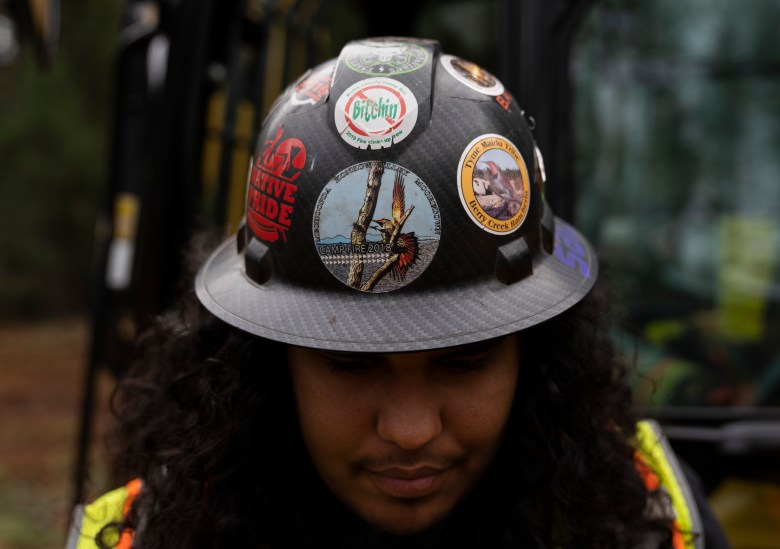
    LeeAnn Kittle helps oversee the Denver public school district’s work to reduce carbon emissions by 90 percent by 2050.

    In January, her job got a lot tougher. 

    Denver expected to receive tax credits via the Inflation Reduction Act for an additional 25 electric school buses. President Donald Trump attempted to freeze clean energy funds through the IRA in his first days in office. Kittle, the district’s executive director of sustainability, also considered applying for tax credit-like payments for energy-efficient heat pumps for the district’s older buildings that lack air conditioning. And she’d intended to apply this spring for a nearly $12 million grant through Renew America’s Schools, a Department of Energy program to help schools become more energy efficient. Staff working on that program have left and its future is uncertain.  

    “I think we’re all in shock,” said Kittle. “It’s like someone put us in a snow globe and shook us up, and now we’re asked to stand straight. And it’s like I don’t know how to stand straight right now.”

    Since January, the Trump administration has launched a broadside against efforts to reduce gases that cause climate change, including by freezing clean energy spending, slashing environmental staff and research, scrubbing the words “climate change” from websites, and rethinking decades of science showing the harms of global warming to human health and the planet. Experts and education leaders say those actions — some of which have been challenged in court — are disrupting, but not extinguishing, efforts by schools and colleges to curtail their emissions and reduce their toll on the planet.

    Related: Want to read more about how climate change is shaping education? Subscribe to our free newsletter.

    At the start of the year, the State University of New York was awarded $15 million to buy 350 electric vehicle charging stations. “We have yet to see the dollars,” said its chancellor, John B. King Jr. A webinar on the Department of Transportation grant program, which is funded by the bipartisan infrastructure act, was canceled. “It’s been radio silence,” said Carter Strickland, the SUNY chief sustainability officer. 

    The SUNY system, which owns a staggering 40 percent of New York State’s public buildings, had also planned to apply for IRA payments for a variety of projects to electrify campuses, reduce pollution and improve energy efficiency. In November, it applied for approximately $1.45 million for an Oneonta campus project that uses geothermal wells to provide heating and cooling. It still expects to get that money since the project is complete and the IRA remains law, but it can no longer count on payments for newer projects, King said. 

    “What the IRA did was turbocharged everything and gave many more players the ability to see themselves as part of a clean energy economy,” said Timothy Carter, president of Second Nature, a group that supports climate work in higher education. But the confusion that the Trump administration has sowed — even though the IRA has not been repealed — means both K-12 and higher education institutions are reconsidering clean energy projects. 

    There’s no count of how many colleges have sought funding through the IRA and bipartisan infrastructure act-funded programs, said Carter, but the work is spread across red and blue states, and some education systems have dozens of projects under construction. The University of California system, for example, filed applications for more than 70 projects, including a $1 billion project to replace UC Davis’s leaky and inefficient heating and cooling system and a project at UC Berkeley to phase out an old power plant and replace it with a microgrid. 

    “We remain hopeful that funding will be provided per the program provisions,” David Phillips, associate vice president for capital programs at the University of California, wrote in an email. 

    Sara Ross, co-founder of Undaunted K12, which helps school districts green their operations, said her group tells school leaders that for now, “energy tax credits are still the law of the land.” 

    But she expects those credits could be eliminated in the new tax bill that Congress is negotiating this year. 

    In the past, entities that begin construction on projects before any changes in a new law go into effect have been grandfathered in and still received that money, she said. “No promises,” Ross said, but historically that’s how such tax credit scenarios have worked. She said some school districts are speeding up projects to beat that possible deadline, while others are abandoning them.

    There is some political movement to preserve clean energy tax credits. Roughly 85 percent of the private-sector dollars that have gone into clean energy projects are in GOP-led districts, according to a report last year. Some GOP lawmakers have advocated for maintaining that funding, which has contributed to a surge in renewable energy jobs.  

    Steven Bloom, assistant vice president of government relations with the American Council on Education, said that gives supporters of the IRA some hope. But he said that many higher education institutions are facing so much pain and uncertainty from other Trump administration actions, like the National Institutes of Health’s plan to slash overhead payments and investigations into alleged antisemitism, that unfortunately “climate investments may get pushed down the ladder of priorities in the near term.” 

    Related: How colleges can become ‘living labs’ for combating climate change

    Another important vehicle for greening schools, the Renew America’s Schools grant program, was started in 2022 with $500 million for school districts. Many of the Department of Energy staff working on that effort have left, Ross said, and some school districts have not heard back about the status of funding for their projects.    

    In Massachusetts, the Lowell school district won a prize through the Renew America program that could unlock up to $15 million to help the district improve its aged facilities. The district’s facilities for the most part lack air conditioning and schools have been closed on occasion due to high temperatures.

    Katherine Moses, the city of Lowell’s sustainability director, wrote in an email that the district had so far pocketed $300,000 that it is using for energy audits to identify inefficiencies and lay the groundwork for a larger investment. It’s unclear what could happen beyond that and if the district will receive more money. She said Lowell is proceeding according to the requirements of the grant “until we hear otherwise from DOE.” 

    More than 3,400 school districts have applied for money through programs created under the bipartisan infrastructure law and the IRA to electrify school buses. After a federal judge ruled against the administration’s freeze on clean energy spending, grants through those programs appear to have been unfrozen and districts have been able to access payments, said Sue Gander, director of the electric school bus initiative with the nonprofit World Resources Institute. 

    But rebates for electric buses are still stalled, she said. Districts are submitting forms to receive rebates, she said, “but there’s no communication coming back to them through the system about the status of their award or any indication that any payment that may have been requested is being provided.”  

    The Transportation and Energy departments and the Environmental Protection Agency, which runs the Clean School Bus Program, did not respond by deadline to requests for comment for this article.  

    King, of SUNY, noted that climate change is already negatively affecting young people and contributing to worsening disasters like floods and fires. For some faculty, staff and students, the backtracking from climate action at the federal level is stirring disappointment and fear, he said. “There is this very intense frustration that as a society we are stopping efforts to deal with what is truly an existential threat.” 

    Contact Caroline Preston at 212-870-8965, on Signal at CPreston.83 or via email at [email protected]

    This story about clean energy was produced by The Hechinger Report, a nonprofit, independent news organization focused on inequality and innovation in education. Sign up for our climate and education newsletter.

    What I’m reading:

    My colleague Neal Morton traveled to northwest Colorado for a story on how phasing out coal-powered plants affects school budgets and career prospects for graduates. School districts haven’t done enough to plan for those changes or prepare students for alternate careers, he writes, and renewable energy projects are not popping up fast enough to smooth the financial pain.  

    Some 725,000 students at more than 1,000 schools faced school closures during the California wildfires in January, according to a new report from Undaunted K12 and EdTrust. The fire had a disproportionate impact on students living in poverty and from underrepresented backgrounds, the report says: Three-quarters of the affected students came from low-income households, and 66 percent were Hispanic. 

    The U.S. Coast Guard Academy removed the words “climate change” from its curriculum, reports Inside Climate News. The academy falls under the purview of the Department of Homeland Security, whose new director, Kristi Noem, issued a directive in February to “eliminate all climate change activities and the use of climate change terminology in DHS policies and programs.”

    Schools with satisfactory heating systems reduce student absences by 3 percent and suspensions by 6 percent, and record a 5 percent increase in math scores, according to a study by researchers at the University at Albany, State University of New York. Schools with satisfactory cooling systems see an increase of 3 percent in reading scores. 

    Contact editor Caroline Preston at 212-870-8965, on Signal at CPreston.83 or via email at [email protected].

    This story about clean energy was produced by The Hechinger Report, a nonprofit, independent news organization focused on inequality and innovation in education. Sign up for our climate and education newsletter.

    The Hechinger Report provides in-depth, fact-based, unbiased reporting on education that is free to all readers. But that doesn’t mean it’s free to produce. Our work keeps educators and the public informed about pressing issues at schools and on campuses throughout the country. We tell the whole story, even when the details are inconvenient. Help us keep doing that.

    Join us today.

    Source link

  • Online college courses are popular, why do they still cost so much?

    Online college courses are popular, why do they still cost so much?

    Emma Bittner considered getting a master’s degree in public health at a nearby university, but the in-person program cost tens of thousands of dollars more than she had hoped to spend.

    So she checked out master’s degrees she could pursue remotely, on her laptop, which she was sure would be much cheaper.

    The price for the same degree, online, was … just as much. Or more.

    “I’m, like, what makes this worth it?” said Bittner, 25, who lives in Austin, Texas. “Why does it cost that much if I don’t get meetings face-to-face with the professor or have the experience in person?”

    Among the surprising answers is that colleges and universities are charging more for online education to subsidize everything else they do, online managers say. Huge sums are also going into marketing and advertising for it, documents show.

    Universities and colleges “see online higher education as an opportunity to make money and use it for whatever they want to make money for,” said Kevin Carey, vice president of education and work at the left-leaning think tank New America.

    Online higher education is projected to pass an impressive if little-noticed milestone this year: For the first time, more American college students will be learning entirely online than will be learning 100 percent in person.

    Bittner’s confusion about the price is widespread. Eighty percent of Americans think online learning after high school should cost less than in-person programs, according to a 2024 survey of 1,705 adults by New America.

    After all, technology has reduced prices in many other industries. And online courses don’t require classrooms or other physical facilities and can theoretically be taught to a much larger number of students, creating economies of scale.

    While consumers complained about remote learning during the pandemic, online enrollment has been rising faster than was projected before Covid hit.

    Yet 83 percent of online programs in higher education cost students as much as or more than the in-person versions, an annual survey of campus chief online learning officers finds. About a quarter of universities and colleges even tack on an additional “distance learning fee,” that survey found.

    In addition to using the income from their online divisions to help pay for the other things they do, universities say they have had to pay more than they anticipated on advising and support for online students, who get worse results, on average, than their in-person counterparts.

    Bringing down the price of a degree “was certainly a key part of the appeal” when online higher education began, said Richard Garrett, co-director of that survey of online education managers and chief research officer at Eduventures, an arm of the higher education technology consulting company Encoura.

    “Online was going to be disruptive. It was supposed to widen access. And it would reduce the price,” said Garrett. “But it hasn’t played out that way.”

    Related: Interested in more news about colleges and universities? Subscribe to our free biweekly higher education newsletter.

    Today, online instruction for in-state students at four-year public universities costs $341 a credit, the independent Education Data Initiative finds — more than the average $325 a credit for face-to-face tuition. That adds up to about $41,000 for a degree online, compared to about $39,000 in tuition for a degree obtained in person.

    Two-thirds of private four-year universities and colleges with online programs charge more for them than for their face-to-face classes, according to the survey of online managers. The average tuition for online learning at private universities and colleges comes to $516 per credit.

    And community colleges, which collectively enroll the largest number of students who learn entirely online, charge them the same as or more than their in-person counterparts in 100 percent of cases, the survey of online officers found (though Garrett said that’s likely because community college tuition overall is already comparatively low).

    Social media is riddled with angry comments about this. A typical post: “Can someone please explain to me why taking a course online can cost a couple $1000 more than in person?”

    Online education officers respond that online programs face steep startup costs and need expensive technology specialists and infrastructure. In a separate survey of faculty by the consulting firm Ithaka S+R, 80 percent said it took them as much time, or more, to plan and develop online courses as it did in-person ones because of the need to incorporate new kinds of technology.

    Online programs also need to provide faculty who are available for office hours, online advisors and other resources exclusively to support online students, who tend to be less well prepared and get worse results than their in-person counterparts. For the same reasons, many online providers have put caps on enrollment, limiting those expected economies of scale.

    “You still need advisers, you still need a writing center, a tutoring center, and now you have to provide those services for students who are at a distance,” said Dylan Barth, vice president of innovation and programs at the Online Learning Consortium, which represents online education providers.

    Related: The number of 18-year-olds is about to drop sharply, packing a wallop for colleges — and the economy

    Still, 60 percent of public and more than half of private universities are taking in more money from online education than they spend on it, the online managers’ survey found. About half said they put the money back into their institutions’ general operating budgets.

    Such cross subsidies have long been a part of higher education’s financial strategy, under which students in classes or fields that cost less to teach generally subsidize their counterparts in courses or disciplines that cost more. English majors subsidize their engineering classmates, for example. Big first-year lecture classes subsidize small senior seminars. Graduate students often subsidize undergrads.

    “Online education is another revenue stream from a different market,” said Duha Altindag, an associate professor of economics at Auburn University who has studied online programs.

    Universities “are not trying to use technology to become more efficient. They’re just layering it on top of the existing model,” said New America’s Carey, who has been a critic of some online education models.

    “Public officials are not stopping them,” he said. “They’re not coming and saying, ‘Hey, we’re seeing this new opportunity to save money. These online courses could be cheaper. Make them cheaper.’ This is just a continuation of the status quo.”

    Another page that online managers have borrowed from higher education’s traditional pricing playbook is that consumers often equate high prices with high quality, especially at brand-name colleges and universities.

    “Market success and reputation can support higher prices,” Garrett said. It’s not what online courses cost to provide that determines the price, in other words, but how much consumers are willing to pay.

    Related: Apprenticeships are a trending alternative to college — but there’s a hitch

    With online programs competing for customers across the country, rather than for those within commuting distance of a campus or willing to relocate to one, universities and colleges are also putting huge amounts into marketing and advertising.

    An example of this kind of spending was exposed in a review by the consulting firm EY of the University of Arizona Global Campus, or UAGC, which the university created by acquiring for-profit Ashford University in 2020. Obtained through a public-records request by New America, the report found that the university was paying out $11,521 in advertising and marketing for every online student it enrolled.

    The online University of Maryland Global Campus committed to spending $500 million for advertising to out-of-state students over six years, a state audit found.

    “What if you took that money and translated it into lower tuition?” asked Carey.

    The online University of Maryland Global Campus is spending $500 million to market and advertise to out-of-state students over six years.

    While they’re paying the same as or more than their in-person counterparts, meanwhile, online students get generally poorer success rates.

    Online instruction results in lower grades than face-to-face education, according to research by Altindag and colleagues at American University and the University of Southern Mississippi — though they also found that the gap is narrowing. Students online are more likely to have to withdraw from or repeat courses and less likely to graduate on time, these researchers found, which further increases the cost.

    Another study, by University of Central Florida Institute of Higher Education Director Justin Ortagus, found that taking all of their courses online reduces the odds that community college students will ever graduate.

    Lower-income students fare especially poorly online, that and other research shows; scholars say this is in part because many come from low-resourced public high schools or are balancing their classes with work or family responsibilities.

    Students who learn entirely online at any level are less likely to have graduated within eight years than students in general, who have a 66 percent eight-year graduation rate, data from the National Center for Education Statistics shows.

    Graduation rates are particularly low at for-profit universities, which enroll a quarter of the students who learn exclusively online. In the American InterContinental University System, for example, only 11 percent of students graduated within eight years after starting, federal data shows, and at the American Public University System, 44 percent. The figures are for the period ending in 2022, the most recent for which they have been widely submitted.

    Several private, nonprofit universities and colleges also have comparatively lower eight-year graduation rates for students who are online only, the data shows, including Southern New Hampshire University (37 percent) and Western Governors University (52 percent).

    Related: Some colleges aim financial aid at a declining market: students in the middle class

    If they do receive degrees, online-only students earn more than their entirely in-person counterparts for the first year after college, Eduventures finds — perhaps because they tend to be older than traditional-age students, researchers speculated. But that advantage disappears within four years, when in-person graduates overtake them.

    For all the growth in online higher education, employers appear to remain reluctant to hire graduates of it, according to still other research conducted at the University of Louisville. That study found that applicants for jobs who listed an online as opposed to in-person degree were about half as likely to get a callback for the job.

    How strongly consumers feel that online higher education should cost less than the in-person kind was evident in lawsuits brought against universities and colleges that continued to charge full tuition even after going remote during the Covid-19 pandemic.

    Students had part of their payments refunded under multimillion-dollar settlements with the University of Chicago, Pennsylvania State University, Rensselaer Polytechnic Institute, the University of Maine System and others.

    Yet students keep signing on. For all the complaining about remote learning at the time, its momentum seems to have been speeded up by the pandemic, which was followed by a 12 percent increase in online enrollment above what had been projected before it hit, according to an analysis of federal data by education technology consultant Phil Hill.

    Online students save on room and board costs they would face on residential campuses, and online higher education is typically more flexible than the in-person kind.

    Sixty percent of campus online officers say that online sections of classes tend to fill first, and nearly half say online student numbers are outpacing in-person enrollment.

    There have been some widely cited examples of online programs with dramatically lower tuition, such as a $7,000 online master’s degree in computer science at the Georgia Institute of Technology (compared to the estimated nearly $43,000 for the two-year in-person version), which has attracted thousands of students and a few copycat programs.

    There are also early signs that prices for online higher education could fall. Competition is intensifying from national nonprofit providers such as Western Governors, which charges a comparatively low average $8,300 per year, and Southern New Hampshire, whose undergraduate price per credit hour is a slightly lower-than-average (for online courses) $330.

    Related: Fewer students and fewer dollars mean states face closing public universities and colleges

    Universities have started cutting their ties with for-profit middlemen, called online program managers, who take big cuts of up to 80 percent of revenues. Nearly 150 such deals were canceled or ended and not renewed in 2023, the most recent year for which the information is available, the market research firm Validated Insights reports.

    Another thing that could lower prices: As more online programs go live, they no longer require high up-front investment — just periodic updating.

    “It is possible to save money on downstream costs if you offer the same course over a number of years,” Ortagus said.

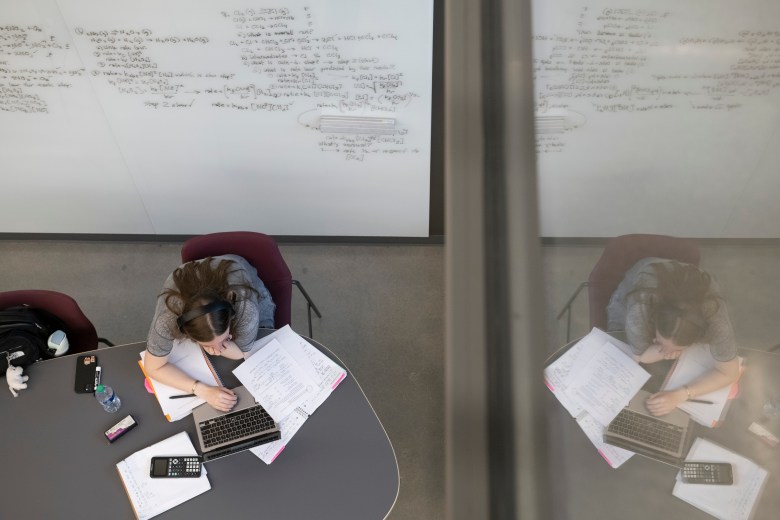
     A student studies on her laptop. The number of college students who learn entirely online will this year surpass the number who take all their classes in person.

    While that survey of online officers found a tiny decline in the proportion of universities charging more for online than in-person classes, however, the drop was statistically insignificant. And as their enrollments continue to plummet, institutions increasingly need the revenue from online programs.

    Bittner, in Texas, ended up in an online master’s program in public health that was just being started by a private, nonprofit university, and was cheaper than the others she’d found.

    Her day job is at the national nonprofit Young Invincibles, which pushes for reforms in higher education, health care and economic security for young Americans. And she still doesn’t understand the online pricing model.

    “I’m so confused about it. Even in the program I’m in now, you don’t get the same access to stuff as an in-person student,” she said. “What are you putting into it that costs so much?”

    Contact writer Jon Marcus at 212-678-7556 or [email protected].

    This story about the cost of online higher education was produced by The Hechinger Report, a nonprofit, independent news organization focused on inequality and innovation in education. Sign up for our higher education newsletter. Listen to our higher education podcast.

    The Hechinger Report provides in-depth, fact-based, unbiased reporting on education that is free to all readers. But that doesn’t mean it’s free to produce. Our work keeps educators and the public informed about pressing issues at schools and on campuses throughout the country. We tell the whole story, even when the details are inconvenient. Help us keep doing that.

    Join us today.

    Source link

  • IES, the Institute of Education Sciences, is in disarray after layoffs

    IES, the Institute of Education Sciences, is in disarray after layoffs

    President Donald Trump promises he’ll make American schools great again. He has fired nearly everyone who might objectively measure whether he succeeds.

    This week’s mass layoffs by his secretary of Education, Linda McMahon, of more than 1,300 Department of Education employees delivered a crippling blow to the agency’s ability to tell the public how schools and federal programs are doing through its statistics and research branch. The Institute of Education Sciences (IES) is now left with fewer than 20 federal employees, down from more than 175 at the start of the second Trump administration, according to my reporting. It’s not clear how the institute can operate or even fulfill its statutory obligations set by Congress. 

    IES is modeled after the National Institutes of Health and was established in 2002 during the administration of former President George W. Bush to fund innovations and identify effective teaching practices. Its largest division is a statistical agency that dates back to 1867 and is called the National Center for Education Statistics (NCES), which collects basic statistics on the number of students and teachers. NCES is perhaps best known for administering the National Assessment of Educational Progress, which tracks student achievement across the country. The layoffs  “demolished” the statistics agency, as one former official characterized it, from roughly 100 employees to a skeletal staff of just three. 

    “The idea of having three individuals manage the work that was done by a hundred federal employees supported by thousands of contractors is ludicrous and not humanly possible,” said Stephen Provasnik, a former deputy commissioner of NCES who retired early in January. “There is no way without a significant staff that NCES could keep up even a fraction of its previous workload.”

    Related: Our free weekly newsletter alerts you to what research says about schools and classrooms.

    Even the new acting commissioner of education statistics, a congressionally mandated position, was terminated with everyone else on March 11 after just 15 days on the job, according to five former employees. Chris Chapman replaced Biden-appointee Peggy Carr, who was suddenly removed on Feb. 24 without explanation before her congressionally designated six-year term was to end in 2027. It was unclear who, if anyone, will serve as the commissioner after Chapman’s last day on March 21. (Chapman did not respond to an email for comment.) Meanwhile, the chief statistician, Gail Mulligan, was put on administrative leave until her early retirement on April 1.* There is apparently no replacement to review the accuracy of figures reported to the public.  

    Two offices spared

    Only two IES offices were untouched by this week’s layoffs: the National Center for Special Education Research, an eight-person office that awards grants to study effective ways to teach children with disabilities, and the Office of Science, a six-person office that reviews research for quality, accuracy and validity. It was unclear why they were spared. Other areas of the Education Department that fund and oversee education for children with disabilities also had relatively lighter layoffs.

    A draft of an executive order to eliminate the Education Department was prepared in early March, but Trump hadn’t signed it as of this week. Instead, McMahon said on Fox News that she began firing employees as a “first step” toward that elimination. Former department employees believe that McMahon and her team decided which offices to cut. Weeks before her confirmation, about a half dozen people from McMahon’s former think tank, the right-wing America First Policy Institute, were inside the department and looking at the bureaucracy, according to a former official at the Education Department. The Education Department did not respond to my email queries.

    The mass firings this month were preceded by a Feb. 10 onslaught, when Elon Musk’s Department of Government Efficiency terminated much of the work that is overseen by these education research and statistics units. Most of the department’s research and data collections are carried out by outside contractors, and nearly 90 of these contracts were canceled, including vital data collections on students and teachers. The distribution of roughly $16 billion in federal Title I aid to low-income schools cannot be calculated properly without this data. Now, the statisticians who know how to run the complicated formula are also gone. 

    ‘Five-alarm fire’

    The mass firings and contract cancellations stunned many. “This is a five-alarm fire, burning statistics that we need to understand and improve education,” said Andrew Ho, a psychometrician at Harvard University and president of the National Council on Measurement in Education, on social media.  

    Former NCES Commissioner Jack Buckley, who ran the education statistics unit from 2010 to 2015, described the destruction as “surreal.” “I’m just sad,” said Buckley. “Everyone’s entitled to their own policy ideas, but no one’s entitled to their own facts. You have to share the truth in order to make any kind of improvement, no matter what direction you want to go. It does not feel like that is the world we live in now.”

    The deepest cuts

    While other units inside the Education Department lost more employees in absolute numbers, IES lost the highest percentage of employees — roughly 90 percent of its workforce. Education researchers questioned why the Trump administration targeted research and statistics. “All of this feels like part of an attack on universities and science,” said an education professor at a major research university, who asked not to be identified for fear of retaliation. 

    That fear is well-founded. Earlier this month the Trump administration canceled $400 million in federal contracts and grants with Columbia University, blaming the university’s failure to protect Jewish students from antisemitism during campus protests last year over Israeli attacks on Gaza. Among them were four research grants that had been issued by IES, including an evaluation of the effectiveness of the Federal Work-Study program, which costs the government $1 billion a year. That five-year study was near completion and now the public will not learn the results. (The Hechinger Report is an independent news organization at Teachers College, Columbia University.

    Related: Tracking Trump: His actions on education

    Tom Brock, executive director of the Community College Research Center at Teachers College, Columbia University, said he had been cautiously optimistic that he could successfully appeal the cancellation of his $2.8 million in education research grants. (He planned to argue that Teachers College is a separate entity from the rest of Columbia with its own president and board of trustees and it was not affected by student protests to the same degree.) But now the IES office that issued the grants, the National Center for Education Research, has lost its staff. “I’m very discouraged,” said Brock. “Even if we win on appeal, all the staff have been laid off. Who would reinstate the grant? Who would we report to? Who would monitor it? They have completely eliminated the infrastructure. I could imagine a scenario where we would win on appeal and it can’t be put into effect.”

    Active contracts

    Many contracts with outside organizations for data collection and research grants with university professors remain active. That includes the National Assessment of Educational Progress, which tracks student achievement, and the Integrated Postsecondary Education Data System (IPEDS), which collects data on colleges and universities. But now there are almost no employees left to oversee these efforts, review them for accuracy or sign future contracts for new data collections and studies. 

    “My job was to make sure that the limited public dollars for education research were spent as best as they could be,” said one former education official who issued grants for the development of new innovations. “We make sure there’s no fraud, waste and abuse. Now there’s no watchdog to oversee it.” 

    The former official asked to remain anonymous as did more than a dozen other former employees whom I talked to while reporting this story. Some explained that the conditions of their termination, called a “reduction in force” or “RIF,” could mean losing their severance if they talked to the press. The terminated employees are supposed to work from home until their last day on March 21, and they described having limited access to their work computer systems. That is stymying efforts to wind down their work with their colleagues and outside contractors in an orderly way. One described how she had to take a cellphone picture of her termination notice on her laptop because she could no longer save or send documents on it. 

    Related: DOGE’s death blow to education studies

    So far, there has been no sign of protest among congressional Republicans, even though some of the cuts affect data and research they have mandated. A spokesman for Sen. Bill Cassidy, Republican of Louisiana and chairman of the Senate committee on Health, Education, Labor and Pensions, directed me to Cassidy’s statement on X. “I spoke to @EDSecMcMahon and she made it clear this will not have an impact on @usedgov ability to carry out its statutory obligations. This action is aimed at fulfilling the admin’s goal of addressing redundancy and inefficiency in the federal government.”

    Following the law

    In theory, a skeletal staff might be able to fulfill the law, which is often “ambiguous,” said former NCES commissioner Buckley. For example, the annual report to Congress on the condition of education could be as short as one page. Laws mention several data collections, such as ones on financial aid to college students and on the experiences of teachers, but often don’t specify how often they must be produced. Technically, they could be paused for many years without running afoul of statutes.

    The remaining skeleton crew could award contracts to outside organizations to do all the work and have them “supervise themselves,” said Buckley. “I’m not advocating that oversight be pushed out to contractors, but you could do it in theory. It depends on your tolerance for contracting out work.”

    NAEP anxiety

    Many are anxious about the future of NAEP, also known as the Nation’s Report Card. Even before the firings, William Bennett, Education Secretary under President Ronald Reagan, penned an open letter along with conservative commentator Chester Finn in The 74, urging McMahon to preserve NAEP, calling it “the single most important activity of the department.” 

    Colorado Gov. Jared Polis, a Democrat who chairs the National Governors Association, is especially concerned. In an email, Polis’ spokesman emphasized that Polis believes that “NAEP is critical.” He warned that “undercutting data collection and removing this objective measuring stick that helps states understand and improve performance will only make our efforts more difficult.” 

    Though much of the test development and administration is contracted out to private organizations and firms, it is unclear how these contracts could be signed and overseen by the Education Department with such a diminished staff. Some officials suggested that the National Assessment Governing Board (NAGB), which sets NAEP policy, could take over the test’s administration. But the board’s current staff doesn’t have the testing or psychometrics expertise to do this. 

    Related: Former Trump commissioner blasts DOGE education data cuts

    In response to questions, board members declined to comment on the future of NAEP and whether anyone in the Trump administration had asked them to take it over. One former education official believes there is “apparently some confusion” in the Trump administration about the division of labor between NAGB and NCES and a “misunderstanding of how work gets done in implementing” the assessment.

    Mark Schneider, a former IES director who is now a senior fellow at the American Enterprise Institute, said he hoped that McMahon would rebuild NCES into a modern, more efficient statistical agency that could collect data more cheaply and quickly, and redirect IES’s research division to drive breakthrough innovations like the Defense Department has. But he conceded that McMahon also cut some of the offices that would be needed to modernize the bureaucracy, such as the centralized procurement office. 

    So far, there’s no sign of Trump’s or McMahon’s intent to rebuild. 

    * Clarification: An earlier version of this story said that Mulligan had been terminated, but she revised a social media post about her status after publication of this story to clarify that she was not subject to the “reduction in force” notice. 

    Contact staff writer Jill Barshay at 212-678-3595, jillbarshay.35 on Signal, or [email protected].

    This story about the Institute of Education Sciences was written by Jill Barshay and produced by The Hechinger Report, a nonprofit, independent news organization focused on inequality and innovation in education. Sign up for Proof Points and other Hechinger newsletters.

    The Hechinger Report provides in-depth, fact-based, unbiased reporting on education that is free to all readers. But that doesn’t mean it’s free to produce. Our work keeps educators and the public informed about pressing issues at schools and on campuses throughout the country. We tell the whole story, even when the details are inconvenient. Help us keep doing that.

    Join us today.

    Source link

  • Gettysburg College – Edu Alliance Journal

    Gettysburg College – Edu Alliance Journal

    March 10, 2025, by Dean Hoke: This profile of Gettysburg College is the fifth in a series presenting small colleges throughout the United States.

    Background

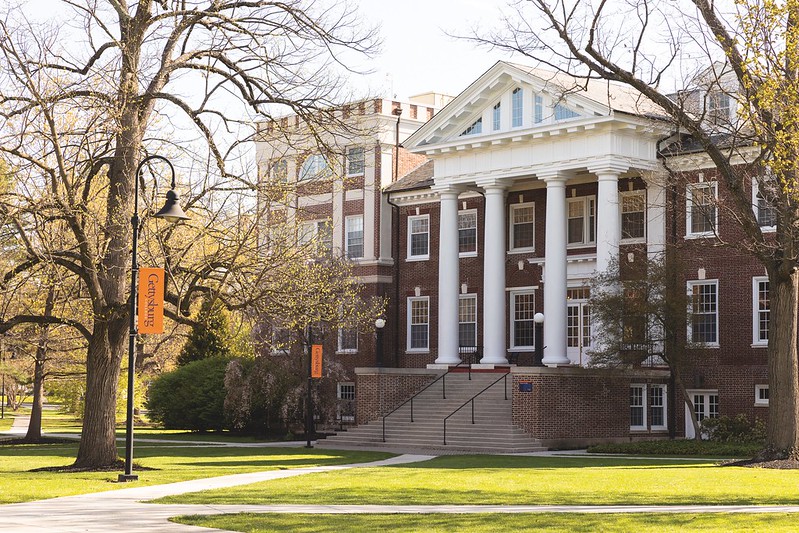
    Founded in 1832, Gettysburg College is a private liberal arts institution located in Gettysburg, Pennsylvania. The 225-acre campus is steeped in history, having served as a field hospital during the Battle of Gettysburg​. An alumnus (David Wills, Class of 1851) invited President Abraham Lincoln to deliver the Gettysburg Address in 1863, tying the college to this pivotal moment in American history​. Gettysburg’s historical significance (from its Civil War connections to President Dwight D. Eisenhower’s post-presidency involvement on its Board of Trustees) contributes to its distinctive identity.​

    The college is known for its rigorous academics, close faculty-student mentorship, and emphasis on leadership development. Gettysburg maintains a 10:1 student-to-faculty ratio, ensuring personalized instruction. It enrolls approximately 2,200 students from across the country and abroad, fostering a diverse and engaged learning community.

    Curricula

    Gettysburg College offers more than 40 majors and 40 minors, spanning the arts, humanities, sciences, and social sciences. Popular programs include Business, Political Science, Economics, Psychology, and Health Sciences. The college is home to the Eisenhower Institute provides students with opportunities to engage in public policy and leadership development, while the Civil War Era Studies minor leverages the college’s historical location for in-depth academic exploration. Five years after graduation (as of Fall 2021), 45 percent of this graduating class had received and/or were enrolled in a graduate/professional degree program five years after graduating from Gettysburg. Graduation rates have remained high. The latest 6-year graduation rate was 83%

    Strengths

    • Strong Post-Graduate Outcomes: 98% of graduates are employed or enrolled in graduate school within a year of graduation.
    • Experiential Learning: Over 78% of students complete at least one internship, and 55% participate in faculty-mentored research.
    • Leadership Development: Programs such as the Eisenhower Institute provide hands-on training in policy and governance.
    • Historical and Civic Engagement: The college’s proximity to the Gettysburg Battlefield and its Civil War Era Studies program offer students a unique educational experience.

    Weaknesses

    • Financial Resources: Gettysburg’s endowment is moderate compared to some peer institutions, affecting the availability of internal funding for scholarships and program expansion.
    • Enrollment Challenges: The college has seen a gradual decline in student enrollment over the past decade, from a peak of over 2,700 students in 2013 to approximately 2,207 in 2024. Gettysburg’s rural location and relatively small town setting may also be a hurdle in recruiting students who prefer an urban environment or a more expansive social scene.
    • Diversity Initiatives: About 21% of undergraduates are domestic students of color, and 14% are international. While improving, the college’s domestic student diversity (21%) lags behind national averages.

    Economic Impact

    Gettysburg College serves as a major economic engine in its local and regional economy. As one of the largest employers in Adams County, the college provides hundreds of jobs for faculty, administrators, and staff, injecting substantial income into the community through payroll and benefits. The college also attracts thousands of visitors annually for events like Orientation, Family Weekend, Homecoming, and Commencement, as well as academic conferences and cultural events at its facilities (such as the Majestic Theater, a college-owned performing arts center). Also, Gettysburg College’s investment in revitalizing downtown Gettysburg through projects like the Majestic Theater restoration and its support of local internships/service programs help strengthen the social and economic fabric of the area.

    Broader economic analyses highlight the significant spillover effects of colleges like Gettysburg. Many graduates remain in or return to Pennsylvania, joining the workforce and paying taxes. (Statewide data from the Association of Independent Colleges & Universities of PA suggests that if ~57% of one graduating class stays in Pennsylvania to work, that cohort would add about $1.5 billion to the state economy over their careers.​

    Enrollment Trends

    As of Fall 2024, Gettysburg College enrolls approximately 2,207 students. Over the past five years, undergraduate enrollment has declined from a peak of 2,500 to 2,200. The shift is attributed to demographic changes and increasing competition among liberal arts colleges. Efforts to stabilize enrollment include enhanced recruitment strategies and expanded financial aid options.

    In the Fall of 2022, Gettysburg College launched and began offering classes for its first part-time master’s degree program, the Master of Arts in American History, in partnership with the Gilder Lehrman Institute of American History. This fully online, 30-credit program is designed for K-12 educators, district supervisors, librarians, museum professionals, and National Park Service employees affiliated with the Gilder Lehrman Institute. It is growing; new graduate programs are in the process of being offered.

    Degrees Awarded by Major

    In the 2023 graduating class, Gettysburg College conferred degrees across the various disciplines.

    Alumni

    According to the college, Gettysburg College has an alumni network of over 32,000 graduates. Approximately 25% of alumni reside in Pennsylvania, with a significant concentration in the greater Washington, D.C., and Philadelphia areas. The college’s alumni are well-represented in fields such as business, law, government, education, and the arts. Career services and networking opportunities ensure that graduates remain engaged and professionally supported.

    Notable Alumni

    • Michael Bishop (Class of 1957): Nobel Prize-winning biomedical researcher in virology and cancer research.
    • Fred Fielding (Class of 1961): 9/11commissioner and White House Council for President Ronald Regan and  George W. Bush.
    • Carol Bellamy (Class of 1963): Former Executive Director of UNICEF and Peace Corps Director.
    • Bruce S. Gordon (Class of 1968): Former President of the NAACP.
    • Kathryn Wolford (Class of 1979: Former President of the McKnight Foundation and Past President of Lutheran World Relief.
    • Carson Kressley (Class of 1991): Television personality, fashion expert, and actor.

    Endowment and Financial Standing

    As of 2023, Gettysburg College’s endowment stands at approximately $380–$400 million. While this represents growth over the past five years, the college remains tuition-dependent, with about 80% of its operating budget coming from student fees. Gettysburg College is stable but budget-conscious. Forbes’ 2023 financial health evaluation gave Gettysburg an approximate “B–” grade, with a financial GPA of around 2.71 on a 4.5 scale, indicating that while the college is not financially distressed.

    Why is Gettysburg College Important

    • Academic Excellence: The college provides a strong liberal arts foundation with small class sizes and individualized instruction.
    • High Graduate Success Rates: With 98% of graduates employed or in graduate school within a year, Gettysburg’s outcomes are among the best for liberal arts colleges.
    • Leadership Development: Programs such as the Eisenhower Institute and Center for Public Service prepare students for civic engagement and public service careers.
    • Historical Significance and Cultural Impact: Its Civil War connections and Lincoln’s legacy make it a unique institution with a strong civic mission. Also Gettysburg College plays a key role in supporting local businesses, employment, and tourism in Gettysburg and beyond.

    With its strong commitment to liberal arts education, leadership development, and historical legacy, Gettysburg College remains a distinguished institution that prepares students for success in an ever-changing world.


    Dean Hoke is Managing Partner of Edu Alliance Group, a higher education consultancy, and a Senior Fellow with the Sagamore Institute. He formerly served as President/CEO of the American Association of University Administrators (AAUA). With decades of experience in higher education leadership, consulting, and institutional strategy, he brings a wealth of knowledge on small colleges’ challenges and opportunities. Dean, along with Kent Barnds, are co-hosts for the podcast series Small College America. Season two begins on March 11, 2025.

    Source link

  • Math can be a path to success after prison

    Math can be a path to success after prison

    Hancy Maxis spent 17 years incarcerated in New York prisons. He knew that he needed to have a plan for when he got out.

    “Once I am back in New York City, once I am back in the economy, how will I be marketable?” he said. “For me, math was that pathway.”

    In 2015, Maxis completed a bachelor’s degree in math through the Bard Prison Initiative, an accredited college-in-prison program. He wrote his senior project about how to use game theory to advance health care equity, after observing the disjointed care his mom received when she was diagnosed with breast cancer. (She’s now recovered.)

    When he was released in 2018, Maxis immediately applied for a master’s program at Columbia University’s Mailman School of Public Health. He graduated and now works as the assistant director of operations at Montefiore Medical Center in the Bronx. He helped guide the hospital’s response to Covid.

    Maxis is one of many people I’ve spoken to in recent years while reporting on the role that learning math can play in the lives of those who are incarcerated. Math literacy often contributes to economic success: A 2021 study of more than 5,500 adults found that participants made $4,062 more per year for each correct answer on an eight-question math test.

    While there don’t appear to be any studies specifically on the effect of math education for people in prison, a pile of research shows that prison education programs lower recidivism rates among participants and increase their chances of employment after they’re released.

    Hancy Maxis spent 17 years incarcerated in New York prisons. He now works as the assistant director of operations at Montefiore Medical Center in the Bronx. Credit: Yunuen Bonaparte for The Hechinger Report

    Plus, math — and education in general — can be empowering. A 2022 study found that women in prison education programs reported higher self-esteem, a greater sense of belonging and more hope for the future than women who had never been incarcerated and had not completed post-secondary education.

    Yet many people who enter prison have limited math skills and have had poor relationships with math in school. More than half (52 percent) of those incarcerated in U.S. prisons lack basic numeracy skills, such as the ability to do multiplication with larger numbers, long division or interpret simple graphs, according to the most recent numbers from the National Center for Educational Statistics. The absence of these basic skills is even more pronounced among Black and Hispanic people in prison, who make up more than half of those incarcerated in federal prisons.

    In my reporting, I discovered that there are few programs offering math instruction in prison, and those that do exist typically include few participants. Bard’s highly competitive program, for example, is supported primarily through private donations, and is limited to seven of New York’s 42 prisons. The recent expansion of federal Pell Grants to individuals who are incarcerated presents an opportunity for more people in prison to get these basic skills and better their chances for employment after release.

    Alyssa Knight, executive director of the Freedom Education Project Puget Sound, which she co-founded while incarcerated, said that for years, educational opportunities in prison were created primarily by people who were incarcerated, who wrote to professors and educators to ask if they might send materials or teach inside the prison. But public recognition of the value of prison education, including math, is rising, and the Pell Grant expansion and state-level legislation have made it easier for colleges to set up programs for people serving time. Now, Knight said, “Colleges are seeking prisons.”

    Related: Interested in innovations in higher education? Subscribe to our free biweekly higher education newsletter.

    Jeffrey Abramowitz understands firsthand how math can help someone after prison. After completing a five-year stint in a federal prison, his first post-prison job was teaching math to adults who were preparing to take the GED exam.

    Fast forward nearly a decade, and Abramowitz is now the CEO of The Petey Greene Program, an organization that provides one-on-one tutoring, educational supports and programs in reading, writing and now math, to help people in prison and who have left prison receive the necessary education requirements for a high school diploma, college acceptance or career credentials.

    The average Petey Greene student’s math skills are at a fourth- or fifth-grade level, according to Abramowitz, which is in line with the average for “justice-impacted” learners; the students tend to struggle with basic math such as addition and multiplication.

    “You can’t be successful within most industries without being able to read, write and do basic math,” Abramowitz said. “We’re starting to see more blended programs that help people find a career pathway when they come home — and the center of all this is math and reading.”

    Abramowitz and his team noticed this lack of math skills particularly among students  in vocational training programs, such as carpentry, heating and cooling and commercial driving. To qualify to work in these fields, these students often need to pass a licensing test, requiring math and reading knowledge.

    The nonprofit offers “integrated education training” to help  students learn the relevant math for their professions. For instance, a carpentry teacher will teach students how to use a saw in or near a classroom where a math teacher explains fractions and how they relate to the measurements needed to cut a piece of wood.

    “They may be able to do the task fine, but they can’t pass the test because they don’t know the math,” Abramowitz said.

    Math helped Paul Morton after he left prison, he told me. When he began his 10.5 years in prison, he only could do GED-level math. After coming across an introductory physics book in the third year of his time in prison, he realized he didn’t have the math skills needed for the science described in it.

    He asked his family to send him math textbooks and, over the seven years until his release, taught himself algebra and calculus.

    The recent expansion of federal Pell Grants to individuals who are incarcerated presents an opportunity for more people in prison to get these basic skills and better their chances for employment after release. Credit: Helen H. Richardson/The Denver Post via Getty Images

    “I relentlessly spent six hours on one problem one day,” he said. “I was determined to do it, to get it right.”

    I met Morton through the organization the Prison Mathematics Project, which helped him develop his math knowledge inside prison by connecting him with an outside mathematician. After his release from a New York prison in 2023, he moved to Rochester, New York, and is hoping to take the actuarial exam, which requires a lot of math. He continues to study differential equations on his own.

    Related: It used to be a notoriously violent prison. Now it’s home to a first-of-its-kind higher education program

    The Prison Mathematics Project delivers math materials and programs to people in prison, and connects them with mathematicians as mentors. (It also brings math professors, educators and enthusiasts to meet program participants through “Pi Day” events; I attended one such event in 2023 when I produced a podcast episode about the program, and the organization paid for my travel and accommodations.)

    The organization was started in 2015 by Christopher Havens, who was then incarcerated at Washington State Penitentiary in Walla Walla. Havens’ interest in math puzzles, and then in algebra, calculus and other areas of mathematics, was ignited early in his 25-year- term when a prison volunteer slid some sudoku puzzles under his door.

    “I had noticed all these changes happening inside of me,” Havens told me. “My whole life, I was searching for that beauty through drugs and social acceptance … When I found real beauty [in math], it got me to practice introspection.”

    As he fell in love with math, he started corresponding with mathematicians to help him solve problems, and talking to other men at the prison to get them interested too. He created a network of math resources for people in prisons, which became the Prison Mathematics Project.

    The group’s website says it helps people in prison use math to help with “rebuilding their lives both during and after their incarceration.”

    Related: How Danielle Metz got an education after incarceration

    But Ben Jeffers, its executive director, has noticed that the message doesn’t connect with everyone in prison. Among the 299 Prison Mathematics Project participants on whom the program has data, the majority — 56 percent — are white, he told me, while 25 percent are Black, 10 percent are Hispanic, 2 percent are Asian and 6 percent are another race or identity. Ninety-three percent of project participants are male.

    Yet just 30 percent of the U.S. prison population is white, while 35 percent of those incarcerated are Black, 31 percent are Hispanic and 4 percent are of other races, according to the United State Sentencing Commission. (The racial makeup of the program’s 18 female participants at women’s facilities is much more in line with that of the prison population at large.)

    “[It’s] the same issues that you have like in any classroom in higher education,” said Jeffers, who is finishing his master’s in math in Italy. “At the university level and beyond, every single class is majority white male.”

    He noted that anxiety about math tends to be more acute among women and people of any gender who are Black, Hispanic, or from other underrepresented groups, and may keep them from signing up for the program. 

    Sherry Smith understands that kind of anxiety. She didn’t even want to step foot into a math class. When she arrived at Southern Maine Women’s Reentry Center in December 2021, she was 51, had left high school when she was 16, and had only attended two weeks of a ninth grade math class.

    “I was embarrassed that I had dropped out,” she said. “I hated to disclose that to people.”

    Related: ‘Revolutionary’ housing: How colleges aim to support a growing number of formerly incarcerated students 

    Smith decided to enroll in the prison’s GED program because she could do the classes one-on-one with a friendly and patient teacher. “It was my time,” she said. “Nobody else was listening, I could ask any question I needed.”

    In just five months, Smith completed her GED math class. She said she cried on her last day. Since 2022, she’s been pursuing an associate’s degree in human services — from prison — through a remote program with Washington County Community College.

    In Washington, Prison Mathematics Project founder Havens is finishing his sentence and continuing to study math. (Havens has been granted a clemency hearing and may be released as early as this year.) Since 2020, he has published four academic papers: three in math and one in sociology. He works remotely from prison as a staff research associate in cryptography at the University of California, Los Angeles, and wrote a math textbook about continued fractions.

    Havens is still involved in the Prison Mathematics Project, but handed leadership of the program over to Jeffers in October 2023. Now run from outside the prison, it is easier for the program to bring resources and mentorship to incarcerated students.

    “For 25 years of my life, I can learn something that I wouldn’t have the opportunity to learn in any other circumstances,” Havens said. “So I decided that I would, for the rest of my life, study mathematics.”

    Contact editor Caroline Preston at 212-870-8965 or [email protected].

    This story about math in prison was produced by The Hechinger Report, a nonprofit, independent news organization focused on inequality and innovation in education. Sign up for the Hechinger higher education newsletter.

    The Hechinger Report provides in-depth, fact-based, unbiased reporting on education that is free to all readers. But that doesn’t mean it’s free to produce. Our work keeps educators and the public informed about pressing issues at schools and on campuses throughout the country. We tell the whole story, even when the details are inconvenient. Help us keep doing that.

    Join us today.

    Source link

  • The disruptive idea of the university

    The disruptive idea of the university

    by Rob Cuthbert

    Ideas of the university in the public domain are hopelessly impoverished. ‘Impoverished’ because they are unduly confined to a small range of possible conceptions of the university; and ‘hopelessly’ because they are too often without hope, taking the form of either a hand-wringing over the current state of the university or merely offering a defence of the emerging nature of ‘the entrepreneurial university’.”

    Fifty years on from the Robbins Report, that was how Ron Barnett began Imagining the University in 2013, and it seems that nothing much has changed since then. Stefan Collini had written a much-cited book, What are universities for?, in 2012, which as the Guardian review said (Conrad, 2012) was “heavy on hand-wringing and light on real answers”. Tom Sperlinger, Josie McLellan and Richard Pettigrew wrote Who are universities for? Remaking higher education in 2018, which despite its respectable intentions was more akin to what Barnett called a ‘defence of the emerging nature of the entrepreneurial university’, aiming in the authors’ words to “make UK universities more accessible and responsive to a changing economy.”

    By 2019 Raewyn Connell was taking a rather different tack in The Good University: What Universities Actually Do and Why It’s Time for Radical Change:

    “… what should a ‘good university’ look like? … Raewyn Connell asks us to consider just that, challenging us to rethink the fundamentals of what universities do. Drawing on the examples offered by pioneering universities and educational reformers around the world, Connell outlines a practical vision for how our universities can become both more engaging and more productive places, driven by social good rather than profit, helping to build fairer societies.”

    Simon Marginson and his colleagues in the Centre for Global Higher Education have pursued a broad programme to conceptualise and promote the idea of the public good of higher education, but in his interviews with English university leaders:

    “Nearly all advocated a broad public good role … and provided examples of public outcomes in higher education. However, these concepts lacked clarity, while at the same time the shaping effects of the market were sharply understood.”

    His sad conclusion was that:

    “English policy on the public good outcomes of higher education has been hi-jacked, reworked, and emptied out in Treasury’s long successful drive to implement a fee-based market.”

    This means that everyday pressures too often drive us back to either handwringing or apologetic entrepreneurialism, or some mixture of the two. Even Colin Riordan, one of the most thoughtful of VCs during his tenure at Cardiff, could not break the mould:

    “What are universities for? Everybody knows that universities exist to educate students and help to create a highly educated workforce. Most people know they’re also the place where research is done that ends up in technologies like smartphones, fuel-efficient cars and advanced medical care. That means universities are a critical part of the innovation process.”

    These ideas sell the university short, and leave their leaders and managers ill-equipped to live the values they need to protect.

    We are entering an era when Donald Trump and Elon Musk seem determined to ‘move fast and break things’, as the Facebook motto once had it. Mark Zuckerberg tried to move on ten years ago to “Move fast with stable infrastructure”, but it seems that Elon Musk didn’t get the memo, as the ‘Department of Government Efficiency’ cuts huge swathes through and – as it presumably hopes – out of US government. Whether or not DOGE succeeds we will soon discover, but the disregard for stable infrastructure may well prove fatal to its own efforts.

    People would not normally accuse a university of moving fast, but what some might see as an excessive concern for stable infrastructure perhaps conceals the speed at which universities move to break existing ideas and understandings. The pursuit of truth may be an imperfect way to describe the aim of the university, but as an academic motivation it suffices to explain how one way of understanding will sometimes rapidly give way to another. Yes, we know that some paradigms hang on doggedly, often supported long past their sell-by date by academics with too much invested in them. But usually and eventually, often more suddenly, the truth will out.

    How can universities best protect their distinctive quality, of encouraging open-minded teaching and research which will create the most favourable conditions for learning, individually and collectively? Strategies and academic values have their place, they might even constitute the stable infrastructure that is needed for a university to flourish. But the infrastructure needs to be built on a simple idea which everyone can comprehend. And that simple idea has to be infinitely flexible while staying perpetually relevant – here is one I prepared earlier:

    “Many people can’t shake off the idea that management in higher education is or at least it should be about having clear objectives, and working out what to do through systematic analysis and ‘cascading’ objectives down through the organisation. They want to see the university as a rational machine, and the manager as a production controller, because Western scientistic culture has encouraged them to think that way.

    The best way to deal with that way of thinking is to agree with it. You say: yes, we must focus on our key objective. In teaching our key objective is personal learning, development and growth for students, a process which cannot be well specified in advance. In research our key objective is the generation of new knowledge. So in higher education the key objective in each of our two main activities is the generation of unpredictable outcomes. Now please tell me what your key performance indicators will be.”[1]

    The fundamental test of performance for a university is that it generates unpredictable outcomes. An infinitely flexible, endlessly relevant idea that everyone can understand – and always disruptive. That is why higher education matters – not just training students for the economy, not just innovation in research for economic growth. Universities need to keep generating unpredictable outcomes because that is their unique function as open public institutions, and that is what their wider society needs and deserves.

    Rob Cuthbert is editor of SRHE News and the SRHE Blog, Emeritus Professor of Higher Education Management, University of the West of England and Joint Managing Partner, Practical Academics. Email [email protected]. Twitter/X @RobCuthbert.


    [1] Text taken from inaugural professorial lecture; Rob Cuthbert, 7 November 2007

    Author: SRHE News Blog

    An international learned society, concerned with supporting research and researchers into Higher Education

    Source link

  • Small College America – Profile College of Wooster – Edu Alliance Journal

    Small College America – Profile College of Wooster – Edu Alliance Journal

    March 3, 2025, by Dean Hoke: This profile of the College of Wooster is the fourth in a series presenting small colleges throughout the United States.

    Background

    The College of Wooster, founded in 1866, is a private liberal arts institution located in Wooster, Ohio. Known for its commitment to mentored undergraduate research, Wooster offers a comprehensive liberal arts education in a residential setting. The college enrolls approximately 1,800 students representing diverse backgrounds from 47 U.S. states and 76 countries. The student-to-faculty ratio is 11:1, ensuring personalized attention and mentorship. For the 2022-2023 academic year, the total cost of attendance, including tuition, fees, room, and board, is $71,000. Notably, more than 85% of students receive financial aid, with an average award of $50,000.

    Curricula

    Wooster offers over 50 academic programs in the sciences, humanities, social sciences, and arts. A distinctive feature of the Wooster experience is the Independent Study program. In this program, students engage in a year-long research project under faculty mentorship, culminating in a thesis or creative work. This program fosters critical thinking, problem-solving, and effective communication skills.

    Strengths

    • Mentored Research: The Independent Study program exemplifies Wooster’s dedication to undergraduate research. It provides students with hands-on experience in their chosen fields.
    • Diverse Community: With 27% U.S. students of color and 14% international students, Wooster boasts a vibrant and inclusive campus environment.
    • High Graduate Success Rate: Within six months of graduation, 96% of alums are employed or enrolled in graduate programs, with 94% accepted into their top-choice graduate schools.

    Weaknesses

    • Cost of Attendance: Despite substantial financial aid offerings, the total cost may be a barrier for some prospective students.
    • Limited Graduate Programs: As an institution focused primarily on undergraduate education, Wooster offers limited opportunities for postgraduate studies.

    Economic Impact

    The College of Wooster significantly contributes to the local economy of Wooster, Ohio, which has a population of 27,012 and is the county seat of Wayne County, which has a population of 116,500. The college is a major employer in the region and attracts students, faculty, and visitors, bolstering local businesses and services. Additionally, cultural and academic events hosted by the college enrich the community’s cultural landscape. According to LeadIQ, approximately 1,200 people are employed by the college, and its annual operating expenses are over $88 million.

    LinkedIn data shows that the college has nearly 17,000 alums, 4,700 of whom reside in Ohio and 1,120 in the Wooster, Ohio, area.

    Enrollment Trends

    Over the past decade, Wooster’s enrollment has slightly declined, from 2,100 to 1875 over a 10-year period. The student base is 35% in-state and 65% out-of-state and international. The college consistently attracts a diverse student body from across the United States and around the world. 98% of the student population lives in campus housing, and the age range is 18-24. Wooster does not have any graduate degree programs.

    Degrees Awarded by Major

    In the most recent report, 18 majors had graduates Wooster Degrees Conferred.

    Alumni

    Employment and or attending graduate school is very high. In the class of 2023, 97% of Wooster graduates secured employment or enrolled in graduate programs within six months post-graduation. 78% entered the workforce, 15% are attending graduate or professional school, 4% were applying for graduate school, and only 3% are seeking employment. Also, an average over the past three years shows that 91% of the Wooster graduates were accepted into their top choice graduate school. (Source: College of Wooster Destination Report, Class of 2023)

    LinkedIn data shows the college has nearly 17,000 alumni. 28% live in Ohio, 18% in the greater Cleveland area, and 7% in the city of Wooster.

    Notable Alumni:

    • J.C. Chandor ‘96 Acclaimed filmmaker known for works such as “Margin Call” and “All Is Lost.” Nominated for the Academy Awards in 2011
    • Laurie Kosanovich ’94, general counsel for the Rock and Roll Hall of Fame
    • John Dean ’61 Former White House Counsel for President Richard Nixon, notable for his role in the Watergate scandal.
    • Duncan Jones, ‘95, award-winning filmmaker director of Source Code and Moon. He is the son of David Bowie.
    • Jennifer Haverkamp ’79, Professor of Practice Gerald R Ford School of Public Policy, the University of Michigan
    • Donald Kohn ’64, former vice chairman of the Federal Reserve
    • Dr. Sangram Sisodia ’77, The Department of Neurobiology, specializing in Alzheimer’s disease. University of Chicago.

    Endowment and Financial Standing

    As of June 30, 2023, The College of Wooster’s endowment stands at $395.5 million, reflecting prudent financial management and generous alum support. This endowment supports scholarships, faculty positions, and various institutional initiatives, ensuring the college’s long-term financial health.  According to the 2023 Forbes financial report, The College of Wooster is rated 2.421 and a B- grade. Wooster has maintained a stable financial position. 

    Why is The College of Wooster Important?

    1. Commitment to Mentored Undergraduate Research – The College of Wooster is distinguished for its dedication to undergraduate research, providing students with personalized mentorship that fosters inquiry, intellectual growth, and academic excellence.
    2. Independent Study Program – A hallmark of Wooster’s education, the year-long Independent Study program requires every student to complete a rigorous research project, developing critical thinking, effective communication, and independent judgment skills.
    3. Diverse and Inclusive Community – Wooster attracts students from all 50 states and over 60 countries, creating a dynamic and inclusive environment where cross-cultural dialogue and global perspectives thrive.
    4. Strong Financial Foundation –Wooster maintains financial stability through prudent management and strategic investments, ensuring long-term institutional sustainability.
    5. Economic Impact – The College plays a vital role in the local economy, contributing to job creation, community development, and regional growth through its sustained presence and financial stewardship.
    6. Distinguished Alumni Network – Wooster graduates excel in various fields, including academia, business, public service, and the arts. The College’s alumni include Nobel laureates, influential public figures, and innovators who make significant contributions to society.

    This structured format highlights The College of Wooster’s key strengths, reinforcing its importance as a leading liberal arts institution.


    Dean Hoke is Managing Partner of Edu Alliance Group, a higher education consultancy, and formerly served as President/CEO of the American Association of University Administrators (AAUA). With decades of experience in higher education leadership, consulting, and institutional strategy, he brings a wealth of knowledge on small colleges’ challenges and opportunities. Dean, along with Kent Barnds, are co-hosts for the podcast series Small College America. Season two begins on March 11, 2025.

    Source link

  • A new Utah law has caused the University of Utah to severely limit DEI initiatives on campus, in a case study of what might happen in other states

    A new Utah law has caused the University of Utah to severely limit DEI initiatives on campus, in a case study of what might happen in other states

    SALT LAKE CITY — Nineteen-year-old Nevaeh Parker spent the fall semester at the University of Utah trying to figure out how to lead a student group that had been undercut overnight by matters far beyond student control.

    Parker, the president of the Black Student Union, feared that a new Utah law banning diversity, equity and inclusion efforts at public colleges had sent a message to students from historically marginalized groups that they aren’t valued on campus. So this spring, while juggling 18 credit hours, an internship, a role in student government and waiting tables at a local cafe, she is doing everything in her power to change that message.

    Because the university cut off support for the BSU — as well as groups for Asian American and for Pacific Islander students — Parker is organizing the BSU’s monthly meetings on a bare-bones budget that comes from student government funding for hundreds of clubs. She often drives to pick up the meeting’s pizza to avoid wasting those precious dollars on delivery fees. And she’s helping organize large community events that can help Black, Asian and Latino students build relationships with each other and connect with people working in Salt Lake City for mentorship and professional networking opportunities.

    Nineteen-year-old University of Utah student Nevaeh Parker is working hard to keep the Black Student Union going after the organization lost financial support.  Credit: Image provided by Duncan Allen

    “Sometimes that means I’m sacrificing my grades, my personal time, my family,” Parker, a sophomore, said. “It makes it harder to succeed and achieve the things I want to achieve.”

    But she’s dedicated to keeping the BSU going because it means so much to her fellow Black students. She said several of her peers have told her they don’t feel they have a place on campus and are considering transferring or dropping out.

    Utah’s law arose from a conservative view that DEI initiatives promote different treatment of students based on race, ethnicity, gender or sexuality. House Bill 261, known as “Equal Opportunity Initiatives,” which took effect last July, broadly banished DEI efforts and prohibited institutions or their representatives speaking about related topics at public colleges and government agencies. Violators risk losing state funding.

    Now President Donald Trump has set out to squelch DEI work across the federal government and in schools, colleges and businesses everywhere, through DEI-related executive orders and a recent “Dear Colleague” letter. As more states decide to banish DEI, Utah’s campus may represent what’s to come nationwide.

    Related: Interested in more news about colleges and universities? Subscribe to our free biweekly higher education newsletter.

    Because of the new state law, the university last year closed the Black Cultural Center, the Center for Equity and Student Belonging, the LGBT Resource Center and the Women’s Resource Center – in addition to making funding cuts to the student affinity groups.

    In place of these centers, the university opened a new Center for Community and Cultural Engagement, to offer programming for education, celebration and awareness of different identity and cultural groups, and a new Center for Student Access and Resources, to offer practical support services like counseling to all students, regardless of identity.

    For many students, the changes may have gone unnoticed. Utah’s undergraduate population is about 63 percent white. Black students are about 1 percent, Asian students about 8 percent and Hispanic students about 14 percent of the student body. Gender identity and sexuality among students is not tracked.

    For others, however, the university’s racial composition makes the support of the centers that were eliminated that much more significant.

     In response to a new state law that broadly banned diversity, equity and inclusion efforts, the University of Utah closed its Center for Equity and Student Belonging, the Black Cultural Center, the Women’s Resource Center and the LGBT Resource Center. Credit: Olivia Sanchez/The Hechinger Report

    Some — like Parker — have worked to replace what was lost. For example, a group of queer and transgender students formed a student-run Pride Center, with support from the local Utah Pride Center. A few days a week, they set up camp in a study room in the library. They bring in pride flags, informational fliers and rainbow stickers to distribute around the room, and sit at a big table in case other students come looking for a space to study or spend time with friends.

    Lori McDonald, the university’s vice president of student affairs, said so far, her staff has not seen as many students spending time in the two new centers as they did when that space was the Women’s Resource Center and the LGBT Resource Center, for example.

    “I still hear from students who are grieving the loss of the centers that they felt such ownership of and comfort with,” McDonald said. “I expected that there would still be frustration with the situation, but yet still carrying on and finding new things.”

    One of the Utah bill’s co-sponsors was Katy Hall, a Republican state representative. In an email, she said she wanted to ensure that support services were available to all students and that barriers to academic success were removed.

    “My aim was to take the politics out of it and move forward with helping students and Utahns to focus on equal treatment under the law for all,” Hall said. “Long term, I hope that students who benefitted from these centers in the past know that the expectation is that they will still be able to receive services and support that they need.”

    The law allows Utah colleges to operate cultural centers, so long as they offer only “cultural education, celebration, engagement, and awareness to provide opportunities for all students to learn with and from one another,” according to guidance from the Utah System of Higher Education.

    Given the anti-DEI orders coming from the White House and the mandate from the Department of Education earlier this month calling for the elimination of any racial preferences, McDonald said, “This does seem to be a time that higher education will receive more direction on what can and cannot be done.”

    But because the University of Utah has already had to make so many changes, she thinks that the university will be able to carry on with the centers and programs it now offers for all students.

    Related: Facing legal threats, colleges back off race-based programs

    Research has shown that a sense of belonging at college contributes to improved engagement in class and campus activities and to retaining students until they graduate. 

    “When we take away critical supports that we know have been so instrumental in student engagement and retention, we are not delivering on our promise to ensure student success,” said Royel M. Johnson, director of the national assessment of collegiate campus climates at the University of Southern California Race and Equity Center.

    Creating an equitable and inclusive environment requires recognizing that there is no one-size-fits-all approach to supporting students, said Paulette Granberry Russell, president of the National Association of Diversity Officers in Higher Education. A student who grew up poor may not have had the same opportunities in preparing for college as a student from a wealthy or middle-class family. Students from some minority groups or those who are the first in their family to go to college may not understand how to get the support they need.

    “This should not be a situation where our students arrive on campus and are expected to sink or swim,” she said.

    Student Andy Whipple wears a beaded bracelet made at a “Fab Friday” event hosted by the LGBT Resource Center at the University of Utah. The LGBT Resource Center was closed recently to comply with a new state law that limits diversity, equity and inclusion work. Credit: Olivia Sanchez/The Hechinger Report

    Kirstin Maanum is the director of the new Center for Student Access and Resources; it administers scholarships and guidance previously offered by the now-closed centers. She formerly served as the director of the Women’s Resource Center.

    “Students have worked really hard to figure out where their place is and try to get connected,” Maanum said. “It’s on us to be telling students what we offer and even in some cases, what we don’t, and connecting them to places that do offer what they’re looking for.”

    That has been difficult, she said, because the changeover happened so quickly, even though some staffers from the closed centers were reassigned to the new centers. (Others were reassigned elsewhere.)

    “It was a heavy lift,” Maanum said. “We didn’t really get a chance to pause until this fall. We did a retreat at the end of October and it was the first time I felt like we were able to really reflect on how things were going and essentially do some grief work and team building.”

    Before the new state law, the cultural, social and political activities of various student affinity groups used to be financed by the university — up to $11,000 per group per year — but that money was eliminated because it came from the Center for Equity and Student Belonging, which closed. The groups could have retained some financial support from the university if they agreed to avoid speaking about certain topics considered political and to explicitly welcome all students, not just those who shared their race, ethnicity or other personal identity characteristics, according to McDonald. Otherwise, the student groups are left to fundraise and petition the student government for funding alongside hundreds of other clubs.

    Related: Tracking Trump — a week-by-week look at his actions on education

    Parker said the restrictions on speech felt impossible for the BSU, which often discusses racism and the way bias and discrimination affect students. She said, “Those things are not political, those things are real, and they impact the way students are able to perform on campus.”

    She added: “I feel as though me living in this black body automatically makes myself and my existence here political, I feel like it makes my existence here debatable and questioned. I feel like every single day I’m having to prove myself extra.”

    In October, she and other leaders of the Black Student Union decided to forgo being sponsored by the university, which had enabled traditional activities such as roller skating nights, a Jollof rice cook-off (which was a chance to engage with different cultures, students said) and speaker forums.

    Alex Tokita, a senior who is the president of the Asian American Student Association, said his group did the same. To maintain their relationship with the university by complying with the law, Tokita said, was “bonkers.”

     Alex Tokita, a senior at the University of Utah, is the president of the Asian American Student Association. The organization chose to forgo university sponsorship because it did not want to comply with a new state law that restricts speech on certain topics. Credit: Olivia Sanchez/The Hechinger Report

    Tokita said it doesn’t make sense for the university to host events in observation of historical figures and moments that represent the struggle of marginalized people without being able to discuss things like racial privilege or implicit bias.

    “It’s frustrating to me that we can have an MLK Jr. Day, but we can’t talk about implicit bias,” Tokita said. “We can’t talk about critical race theory, bias, implicit bias.” 

    As a student, Tokita can use these words and discuss these concepts. But he couldn’t if he were speaking on behalf of a university-sponsored organization.

    LeiLoni Allan-McLaughlin, of the new Center for Community and Cultural Engagement, said that some students believe they must comply with the law even if they are not representing the university or participating in sponsored groups.

    “We’ve been having to continually inform them, ‘Yes, you can use those words. We cannot,’” Allan-McLaughlin said. “That’s been a roadblock for our office and for the students, because these are things that they’re studying so they need to use those words in their research, but also to advocate for each other and themselves.”

    Related: Cutting race-based scholarships blocks path to college, students say

    Last fall, Allan-McLaughlin’s center hosted an event around the time of National Coming Out Day, in October, with a screening of “Paris Is Burning,” a film about trans women and drag queens in New York City in the 1980s. Afterward, two staff members led a discussion with the students who attended. They prefaced the discussion with a disclaimer, saying that they were not speaking on behalf of the university.

    Center staffers also set up an interactive exhibit in honor of National Coming Out Day, where students could write their experiences on colorful notecards and pin them on a bulletin board; created an altar for students to observe Día de los Muertos, in early November, and held an event to celebrate indigenous art. So far this semester, the center has hosted several events in observance of Martin Luther King Jr. Day and Black History Month, including an educational panel, a march and a pop-up library event.

    Such events may add value to the campus experience overall, but students from groups that aren’t well represented on campus argue that those events do not make up for the loss of dedicated spaces to spend time with other students of similar backgrounds.

     Sophomore Juniper Nilsson looks at a National Coming Out Day exhibit in the student union at the University of Utah. The exhibit was set up by the new Center for Community and Cultural Engagement. Credit: Olivia Sanchez/The Hechinger Report

    For Taylor White, a recent graduate with a degree in psychology, connecting with fellow Black students through BSU events was, “honestly, the biggest relief of my life.” At the Black Cultural Center, she said, students could talk about what it was like to be the only Black person in their classes or to be Black in other predominantly white spaces. She said without the support of other Black students, she’s not sure she would have been able to finish her degree. 

    Nnenna Eke-Ukoh, a 2024 graduate who is now pursuing a master’s in higher educational leadership at nearby Weber State University, said it feels like the new Center for Community and Cultural Engagement at her alma mater is “lumping all the people of color together.”

    “We’re not all the same,” Eke-Ukoh said, “and we have all different struggles, and so it’s not going to be helpful.”

    Contact staff writer Olivia Sanchez at 212-678-8402 or [email protected].

    This story about campus DEI initiatives was produced by The Hechinger Report, a nonprofit, independent news organization focused on inequality and innovation in education. Sign up for the Hechinger newsletter.

    The Hechinger Report provides in-depth, fact-based, unbiased reporting on education that is free to all readers. But that doesn’t mean it’s free to produce. Our work keeps educators and the public informed about pressing issues at schools and on campuses throughout the country. We tell the whole story, even when the details are inconvenient. Help us keep doing that.

    Join us today.

    Source link

  • What Is Organizational Development? – Archer Education

    What Is Organizational Development? – Archer Education

    Applying Principles of Organizational Development in Higher Education

    If you work in higher education, you know the industry is constantly evolving. Shifting student demographics, emerging technologies, and market pressures require institutions to be proactive in building a stronger, more adaptable foundation for long-term success. 

    That’s where organizational development (also known as org dev or OD) comes in.

    OD uses a strategic approach that goes beyond surface-level fixes to create lasting, meaningful change. In higher ed, that means optimizing infrastructure, investing in the right people and resources, and fostering the leadership skills necessary to drive sustainable growth. This article breaks down the four essential pillars of organizational development and how they can help your institution navigate change with confidence.

    Organizational Development Definition 

    Organizational development is a strategic, science-backed approach to improving an organization’s effectiveness, adaptability, and culture. 

    Rather than focusing on quick, short-term fixes, org dev emphasizes long-term, sustainable change through: 

    At its core, org dev is about aligning people, processes, and strategy to create a stronger, more resilient institution. 

    How Is Org Dev Applied in the Higher Ed Industry?

    At higher education institutions, organizational development is used to drive strategic change, improve institutional effectiveness, and enhance the student and faculty experience. 

    Universities can apply OD to initiatives such as: 

    By leveraging data, collaboration, and iterative improvement strategies, org dev helps institutions stay competitive in a volatile educational landscape. 

    But how can your institution actually execute on these initiatives? Let’s dig into the nuts and bolts of true organizational development. 

    The Four Pillars of Organizational Development 

    Organizational development can be distilled into four essential pillars that need to be addressed to create lasting, effective change. From the right technological infrastructure to the competencies that drive leadership, each element plays a critical role in shaping a university’s success. 

    1. Infrastructure     

    A strong OD strategy starts with the right tools. A school’s information technology (IT) infrastructure encompasses all the systems and programs that support the institution’s goals by facilitating seamless communication, data management, and student engagement across all departments. 

    Learning management systems (LMS), customer relationship management (CRM) platforms, and student information systems (SIS) are all essential for effective operations.

    Additionally, collaboration tools — like Asana, Trello, Monday.com, Slack, and Microsoft Teams — are critical for project management and internal communications. With a solid tech foundation, faculty, staff, and administrators can more easily work toward common objectives.           

    2. Resources 

    People and capital investments drive organizational development forward. Universities need dedicated staff to support their online and on-campus programs, including instructional designers, student success coaches, and faculty development specialists. 

    Beyond personnel, financial resources play a crucial role in funding curriculum development, marketing initiatives, and partnerships with third-party service providers. The right investments empower institutions by giving them the capacity to scale programs, enhance student support, and maintain a competitive edge. 

    3. Skills 

    Skills are the specific, teachable abilities that allow team members to execute org dev initiatives effectively. In higher education, these range from technical expertise — such as search engine optimization (SEO), paid media management, and statistical analysis skills — to operations skills in areas such as course mapping, instructional design, and system administration for LMS, CRM, and SIS platforms. 

    Providing training and professional development to staff members in these skill areas can help them better implement and manage institutional improvement efforts.

    4. Competencies

    While skills focus on execution, competencies are the broader abilities needed to apply knowledge and lead meaningful change. Important org dev competencies for university leaders and staff members include being able to align online growth initiatives with institutional goals, make data-driven decisions, and foster a culture of adaptability. 

    Higher ed leaders also should be able to communicate a clear vision and gain buy-in from stakeholders to navigate transitions with confidence. Without these competencies, even the most well-equipped institutions can struggle to implement lasting transformation. 

    Benefits of Org Dev for Institutions 

    Effective organizational development creates lasting improvements in how institutions operate, innovate, and serve students. By investing in OD, colleges and universities can:

    Ready to Level Up Your Institution’s Org Dev Strategy? 

    At Archer Education, we take a strategic, structured approach to organizational development, starting with a full assessment of your institution across all four pillars using our Good, Better, Best framework. 

    From there, we partner with you to implement targeted changes, optimize your processes, and drive your long-term growth.

    Our ultimate goal? To make ourselves obsolete. By the time we’re done, your institution will be operating at its best across all dimensions, equipped to sustain growth and innovation without relying on external vendors.

    Let’s build a stronger, more resilient future — together. Contact us today to get started.

    Subscribe to the Higher Ed Marketing Journal:

    Source link

  • Modern Learners, Modern Strategies: The New Rules of Engagement

    Modern Learners, Modern Strategies: The New Rules of Engagement

    Brett is a working professional with a packed schedule, balancing career growth with personal responsibilities. He knows that advancing in his field requires new skills and credentials, but he needs a program that fits his life, one that is flexible, aligned with his career and worth the investment. Brett is just one example of Modern Learner, a growing population of students who prioritize efficiency, affordability and real-world outcomes in their education.  

    Higher education has undergone a decade of transformation, from evolving enrollment patterns to advancements in technology and changing student expectations. As the landscape continues evolves, so do the behaviors and preferences of students like Brett—giving rise to the Modern Learner.  

    EducationDynamics’ latest report, “Engaging the Modern Learner: The 2025 Report on the Preferences and Behaviors Shaping Higher Ed,” examines these emerging trends. For over a decade, we have tracked student behavior and preferences, adapting our research to reflect the evolving higher education environment. Previously known as the Online College Students Report, this study has expanded in scope to provide a more comprehensive understanding of Modern Learners and their needs.  

    Explore the most significant changes over the past ten years, key findings from our research and actionable strategies to help higher education leaders challenge the status quo and drive innovative outcomes.  

    How Have Student Behaviors and Preferences Changed in the Last Decade?

    Student search, decision-making, and engagement behaviors have shifted significantly over the past decade. Strategies that once drove enrollment may no longer be as effective, requiring institutions to adapt. By examining these changes, we can identify emerging patterns that will shape the future of higher education.  

    Modern Learners Expect Immediate Admit Decisions 

    With greater access to information through technology, prospective students are making decisions faster than ever before. As a result, Modern Learners expect rapid responses from institutions. In 2015, 43% of fully online learners said that they would enroll at the first school that contacted them. By 2025, the urgency has increased significantly, with nearly 75% of online learners indicating that they would enroll in the first school that admits them. This shift underscores the growing need for institutions to streamline their admissions processes, ensuring quick response times and efficient decision-making to remain competitive in enrolling Modern Learners.

    Search Initializes at the Brand Level

    Student search behavior is another trend that has faced a significant shift in recent years, with more students starting their search by focusing on schools rather than specific programs.

    Recent data reveals that 58% of respondents begin their search by considering schools first. This trend is even more pronounced among online learners, where approximately 60% prioritize finding a school before narrowing down their program options. Following school, the next most common search is subject area, with students increasingly exploring broader categories before selecting a specific program.

    Given this shift, higher education marketing strategies need to reflect an approach that encompasses both promotion of programs and the institution itself. As prospective students often initiate their search with a school-focused mindset, schools must position their brand clearly to effectively engage and capture early interest, which will guide students towards relevant programs as they progress through the enrollment funnel.

    AI Impacts Consideration Sets 

    The adoption of AI tools, such as website chatbots and on-demand engagement platforms, has grown steadily over the past decade. Recent data highlights notable increases in the use of chatbots. In 2015, only about 15% of online learners engaged with website chatbots or live chat agents. Now, in 2025, that number has more than doubled, reaching 30% of fully online students.  

    Moreover, students increasingly turn to AI tools like Search Generative Experience (SGE) for answers to critical questions about schools and their offerings, with 37% of Modern Learners using AI for information gathering. As students refine their consideration sets, AI-driven engagement tools provide timely and relevant information, making them a key touchpoint in the decision-making process. The growing reliance on these platforms calls for institutions to employ the use of informative and accessible AI tools to offer students seamless support throughout their research and decision-making processes.  

    Preference and Acceptance of Online Modality has Increased

    It’s no secret that in the past decade, online education has not only gained traction but has become the preferred education modality for a growing population of students. In 2015, only 32% of fully online students believed their online education was better than their previous classroom study. However, that number has more than doubled for today’s respondents. 71% of online learners express a preference for online higher education experiences when compared to classroom education, indicating a fundamental change in student expectations and satisfaction with digital learning environments.  

    Engaging the Modern Learner

    At EducationDynamics, our research continually seeks to understand the evolving needs of students. Through years of research and emerging insights from our 2025 survey, a clear picture of the Modern Learner has emerged—one defined by a focus on flexibility, career, and a desire for personalized education experiences. Modern Learners are not only looking to complete a degree, they also aim to shape their own learning journeys in ways that align with their personal and professional goals. 

    Shared Demands and Preferences 

    Despite their diverse backgrounds, Modern Learners share several key expectations. They prioritize affordability, flexible learning formats and responsive support. If their needs aren’t met, they will quickly seek alternative options. This shift in expectations means that institutions need to rethink how they attract, engage and support students. Meeting the Modern Learner where they are is no longer optional; it is essential for long-term success. 

    The Power of Brand & Reputation

    A strong institutional brand plays a crucial role in the student decision-making process. As students begin their search with a school-focused mindset, a well-established reputation can be the deciding factor in where they apply. In fact, reputation ranked as the third most influential factor in application decisions, cited by 31% of students overall and 51% of traditional undergraduates, in our 2025 survey. To remain competitive, institutions must build a credible and respected brand that not only attracts prospective students but also reinforces trust and long-term value throughout their educational journey. 

    Value and Affordability

    While cost is a significant consideration for Modern Learners, affordability alone doesn’t drive enrollment decisions. A well-rounded value proposition plays an equally important role. Our research shows that 46% of students cite tuition cost as a critical factor, but other factors like program relevance to careers, flexibility, and reputation also weigh heavily in their decision-making process. 

    Supporting students with financial literacy is crucial, as 38% of students identify it as a helpful resource during the enrollment process. By clearly communicating both affordability and long-term value such as career outcomes, program flexibility and personalized support, schools can resonate with the priorities of cost-conscious, value-driven Modern Learners.  

    The Importance of Career Focus

    For Modern Learners, education is a direct pathway to career advancement. Regardless of age or background, they share a strong motivation to upskill quickly and gain credentials that lead to tangible career outcomes. This focus on career alignment is evident, with 20% of Modern Learners citing a program’s relevance to their career as a determining factor in their enrollment decision.

    The Modern Learner Survey reveals that 76% of students feel their institution clearly outlines potential career paths related to their program. While this is positive, gaps remain. Traditional undergraduates are the most informed, with 84% receiving clear career guidance, compared to 73% of non-traditional students and 77% of graduate students. These gaps highlight the need for institutions to consistently communicate career values across all Modern Learner segments, ensuring they understand how their education supports their professional goals.

    The Demand for Flexible Learning Models

    Flexibility is no longer an educational preference; it is a necessity for Modern Learners. As today’s students move away from traditional classroom modalities and increasingly seek flexible environments, institutions must invest in program models that accommodate careers and family commitments.  

    When deciding where to apply, 31% of Modern Learners cited flexible course schedules as a key factor. This need is particularly evident among graduate students, who are more likely to be balancing family and work responsibilities. While 53% of respondents do not have children under 18 at home, a notable portion are managing family commitments in addition to their studies. Among fully online students, the number of children at home has increased by 15%, reinforcing the growing demand for learning models that complement busy schedules. 

    The Role of AI and Social Media

    AI and social media play an increasingly important role in shaping student decisions. Social media is no longer merely an avenue for entertainment; it has evolved into a tool for student engagement and research throughout the entire decision-making process. With students interacting across multiple platforms daily, schools must harness these channels to stay visible and relevant as students progress through the consideration phase. To successfully leverage social media, marketing teams should prioritize creating dynamic, visually engaging experiences, particularly through video content, which resonates strongly with Modern Learners.  

    At the same time, AI enhances this by personalizing interactions and providing real-time insights into student preferences, helping institutions refine their marketing strategies. With the rise of generative AI tools, nearly 70% of Modern Learners now use AI in some capacity, including AI chatbots like ChatGPT, to assist their search for school information. Approximately 37% use these tools specifically to gather information about schools, with tuition fees (57%), course offerings (51%), and admission requirements (43%) being the most sought-after details. This highlights the opportunity for schools to integrate AI into their marketing strategies to provide comprehensive, accessible information that supports prospective students with their enrollment decision.  

    Modern Strategies to Engage the Modern Learner 

    As the needs and expectations of students continue to evolve, it’s important for institutions to adapt in ways that truly serve and support Modern Learners. Here are actionable steps to create a personalized, student-centered experience that fosters trust and drives success.  

    1. Embrace Data-Driven Decision Making: Modern Learners expect personalized experiences, and data is the key to delivering them. Through leveraging market research and insights, like those from the 2025 Modern Learner Report, institutions can better understand student preferences and behaviors. To turn those insights into action, invest in tools for data collection and analysis that allow for continuous improvement and refinement.  
    2. Build a Strong and Authentic Brand: A cohesive and authentic brand is integral to connecting with students. Focus on building a positive online experience that bolsters brand visibility, while garnering trust that your institution can provide timely and reliable information that students seek.  
    3. Prioritize Career Outcomes: Career outcomes are top of mind for students as they consider their educational investment. Make career pathways clear by showcasing programs, internship opportunities, alumni success stories and career counseling services to help students see the tangible benefits of their degree.  
    4. Create Flexible and Personalized Learning Pathways: Flexibility is essential for meeting the diverse needs of Modern Learners. Offer programs with adaptable schedules and learning formats, allowing students to choose a pathway that best aligns their lifestyle and goals.  
    5. Optimize the Digital Experience (Especially Websites and Al): An engaging digital experience is critical to attracting and retaining students. Through regular website updates and the integration of AI-powered tools to offer support, institutions can streamline the user experience to ensure a smooth journey from inquiry to enrollment. 
    6. Enhance Communication Speed: Modern Learners expect timely and informative responses and are quicker to make decisions than in years past. Adopt tools that provide real-time communication capabilities, such as chatbots or automated updates, to keep students engaged and informed throughout the enrollment process.   
    7. Develop a Dynamic Social Media Strategy: Social media is a powerful tool for building connections and increasing brand awareness among Modern Learners. With platforms like Instagram, TikTok, and YouTube playing a major role in their online engagement, video content is especially effective in capturing their attention.  By understanding your audience’s media habits and aligning your content with platforms they use the most, you can deliver the right message at the right time, keeping your institution top of mind.  
    8. Don’t Forget About the Human Touch: While technology undoubtedly plays a significant role in modern times, students still seek personal connections. Ensure that students can engage with advisors, staff, or faculty to guide them through the enrollment process, while providing the support they need.

    Aligning with Modern Learners: A New Era in Enrollment

    In this evolving landscape, Modern Learners are placing greater emphasis on career relevance, affordability, and flexibility, demanding more from their education than ever before. The findings from the Modern Learner Survey underscore the importance of aligning educational programs with career paths, improving financial transparency, and providing tailored support to meet diverse needs. The time is now for higher education leaders to challenge outdated enrollment strategies that no longer resonate with today’s highly discerning, cost-conscious, and value-focused students.  

    To navigate these changes effectively, institutions must adopt innovative, data-driven strategies that speak directly to the Modern Learner’s priorities. For a deeper dive into these insights and actionable recommendations, explore the full “Engaging the Modern Learner” report today.  

    Source link