Category: higher education

  • How one state revamped high school to reflect that not everyone goes to college

    How one state revamped high school to reflect that not everyone goes to college

    This story is part of Hechinger’s ongoing coverage about rethinking high school. Read about high school apprenticeships in Indiana, a new diploma in Alabama that trades chemistry for carpentry, and “career education for all” in Kentucky.

    ELKHART, Ind. — The numbers were discouraging, and in some cases getting worse. Nearly 30 percent of Indiana’s high schoolers were chronically absent in 2022. Only about 52 percent of students in the state enrolled in college in 2023, a 12-percentage-point drop in seven years. Fewer students were pursuing other paths, too: The share of students enlisting in the military, for example, declined by 41 percent from 2018 to 2022.

    When Katie Jenner toured the state after becoming education secretary in 2021, she heard from many students who said they simply didn’t value high school or see how it would help them. “That was really hard to hear,” Jenner said. “We had to look in the mirror and say, ‘OK, this is the reality. Let’s do better.’”   

    Jenner and her team began redesigning what high school looks like in Indiana, in an effort to make it more relevant to young people’s futures and help them gain a better grasp of career paths. For too long, she and others argued, kids had been pushed to plan for four-year college, yet only about half of seniors actually enrolled, and those who did go often dropped out before graduating. 

    When a draft of the plan was released in early 2024, it drew fierce protest from many parents and educators who worried the state was prioritizing workforce learning over academics. Jenner and her staff reworked the proposal, eventually crafting a plan that alleviated some, though not all, of the concerns. 

    The “New Indiana Diploma” — which was signed into law in April and goes into effect for all incoming first-year students this academic year — gives students the option to earn different “seals” in addition to a basic diploma, depending on whether they plan to attend college, go straight to work or serve in the military. Jenner describes it as an effort to tailor the diploma to students’ interests, expose students to careers and recognize different forms of student achievement. 

    Experts said the template is something of a model nationally, at a time when more states are reconsidering how to help students prepare for careers and the federal government is also pushing alternatives to four-year college. Elements of that effort have earned bipartisan support: Presidents from both parties have advocated for expanding work-based learning, and President Donald Trump recently called for the creation of 1 million new apprenticeships.  

    “The basic architecture of American high school is being questioned and challenged,” said Timothy Knowles, president of the Carnegie Foundation.* Indiana is at the forefront of an effort to incorporate more experiential learning instead of restricting education to school buildings, he said: “Indiana is really breaking ground.” 

    Related: A lot goes on in classrooms from kindergarten to high school. Keep up with our free weekly newsletter on K-12 education.

    The initial proposal Jenner’s agency drafted would have created two high school diplomas, “Graduates Prepared to Succeed” and “Graduates Prepared to Succeed Plus.” Both would have scaled back math and science requirements and loosened recommendations for world languages and other electives. Meanwhile, they would have encouraged all students to participate in work-based learning in apprenticeships, internships or job shadowing, with at least 75 hours in such activities required for the “plus” diploma. 

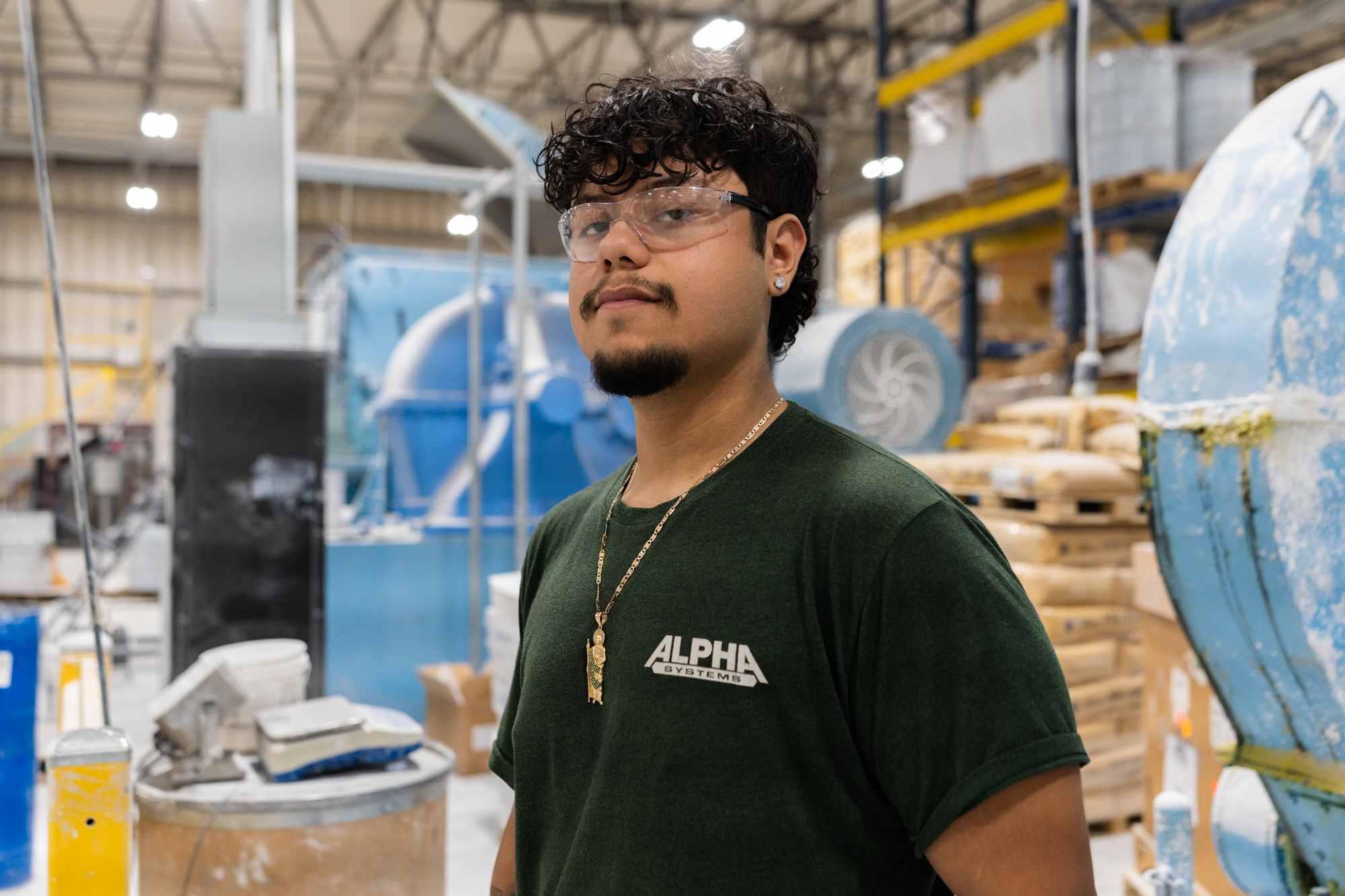
    Indiana hopes that work-based learning opportunities at companies like Alpha Systems and Hoosier Crane Service Company, in Elkhart, Indiana, can flourish under the new diploma system. Credit: Camilla Forte/The Hechinger Report

    In 2024, the state board of education held dozens of meetings to gather feedback on the proposal for the revamped diplomas — and the backlash was intense. Leaders of higher education institutions, including the state’s flagship schools, Indiana and Purdue universities, said students graduating under the new system would not meet minimum requirements for admission. Purdue’s president, Mung Chiang, wrote a letter to Jenner showing that the proposed diploma system required too few credits in every subject except English.   

    Hoosier parents were furious that their children might have to sacrifice more challenging courses to fulfill the mandatory work experience requirement under the “plus” option. At an Indiana Department of Education hearing in June 2024, parent Michelae Hill was among dozens who criticized the proposal, calling it “intentionally dumbing down our population” and warning that “what will happen is that we are ensuring a permanent underclass, we are ensuring cheap workers.” There were also questions about the logistics of workplace learning, including transportation and possible safety issues on job sites. 

    State education policy makers went back to the drawing board. The revised version, adopted last December, establishes one basic diploma that all graduates earn, plus the seals students can pursue depending on their post-high-school plans. Even within each seal, students have several ways of meeting the requirements.  

    For example, to receive the “enrollment” seal — meant primarily for college-bound students — high schoolers can choose from more advanced classes in math, science, social studies and world languages, and may earn additional credits in Advanced Placement, International Baccalaureate or other such college-level courses. An “enrollment honors plus” seal requires that students concurrently obtain a credential such as an associate’s degree or technical certificate and complete 75 hours of work-based learning in apprenticeships, internships or other such programs. 

    “We wanted rigor and flexibility and less cookie cutter,” said Jenner.  

    Related: Apprenticeships for high schoolers are touted as the next big thing. One state leads the way

    Even the updated system has critics, though. For the basic diploma, students must earn a minimum of 42 credits, two more than before. But how students reach that threshold is different: Economics, geometry and Algebra II are no longer required, while courses in financial literacy and communication are. Physical education is one credit instead of two, and world languages and fine arts are no longer recommended electives.

    Professor Michael Hicks, who runs the Center for Business and Economic Research at Ball State University in Indiana, said he worries about the reduced mathematics rigor in particular. While most states do not require Algebra II for graduation, the class is often seen as a necessity for admission to selective colleges and for certain careers. Hicks said high-achieving, well-resourced students may benefit from the flexibility of the new diploma, as could students committed to the military. But many other students could be harmed, he said, if they are left with the impression that the basic diploma alone will prepare them well for college when it does not. 

    “It is essentially funneling children away from academic opportunity very early at a time when we really needed to have more kids pushed into the academic options that would get them into college,” he said, arguing that people with college degrees outearn those with only a high school education and have also fueled the state’s and country’s economic growth of the past several decades. “This curriculum will cause the Indiana economy to stall and potentially go into reverse.” 

    At public meetings last winter, some parents and educators raised concerns that the new system amounted to an unfunded mandate for school districts and would put a huge burden in particular on counselors, who would be working closely with students to help chart their diploma paths. Critics also objected to the de-emphasis of other classes like music and foreign languages. Megan Worcester, the president of the Indiana Foreign Language Teachers Association, said the reduced emphasis on foreign language would hurt the state’s economy; she cited a study in which nearly 1 in 4 employers surveyed said they had lost or couldn’t pursue a business opportunity because of language barriers. 

    Jenner, a former high school teacher, said the new diploma allows students greater flexibility to choose electives depending on their goals, which could include language and music study. While Algebra II is no longer required, students must take four math credits beyond the required Algebra I and personal finance, she said. Jenner also said the state had allocated a portion of $50 million in discretionary funding to train counselors in helping students navigate the new diploma system. In addition, it dedicated up to $10 million in grants to help students pay for transportation, equipment and certifications related to work-based learning, and also provided financial assistance to companies that take on apprentices. Each school that offers work-based learning will receive an extra $500 per participating student.

    The new plan eventually quieted the concerns of many education leaders. Several universities, including Indiana and Purdue, released letters of support. “We appreciate the thoughtful adjustments to the work based learning requirements, AP testing and transferability of dual credits,” wrote Pamela Whitten, president of Indiana University. (Neither university agreed to an interview with its leaders.) All major education groups in the state, including the Indiana State Teachers Association, Indiana School Boards Association and the Indiana Association of Public School Superintendents, endorsed the plan. 
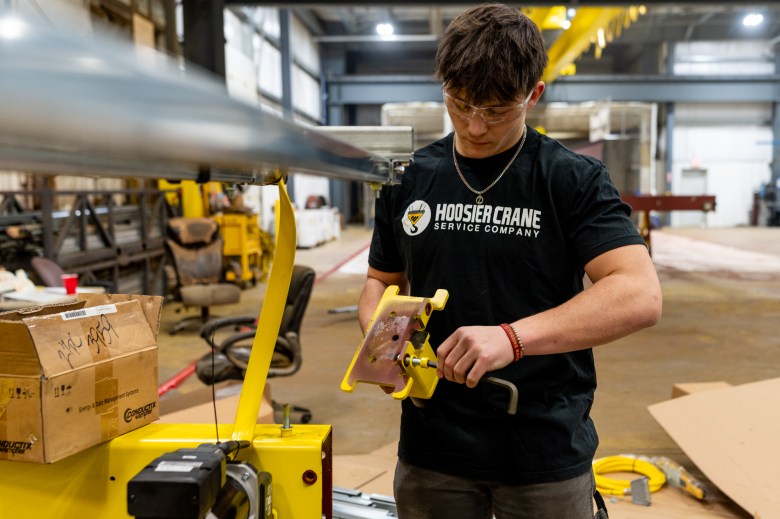
    Ty Zartman, a student apprentice at Hoosier Crane Service Company in Elkhart, Indiana, decided to go straight to work after graduating high school, despite being a straight A student. Parents and educators objected to Indiana’s first proposal for a new high school diploma system, arguing that the emphasis on workplace experience would crowd out academic learning. Credit: Camilla Forte/The Hechinger Report

    In April, Gov. Mike Braun announced that beginning this year, students who earn the state’s “enrollment honors plus” seal will be automatically accepted into the state’s public colleges and universities, including Purdue and Indiana, potentially persuading more students to enroll. 

    Parent Chantee Eldridge said she believes the new diploma will make higher education more affordable and help students sharpen their career plans at an earlier age. Her son, Micah, is a 16-year-old senior at Brownsburg High School, near Indianapolis, and has already taken dual credit courses through a partnership with Vincennes University. College credits can be expensive, she said, so earning them at no cost in high school can be a big money saver. 

    Micah, who has a 3.7 GPA and plays semi pro soccer, said he’s always enjoyed challenging classes and plans to go to college. “When things get repeated, that’s when I get bored and start to tap out mentally,” he said. In college, he anticipates studying psychology — a surprise to his mother, who expected him to pursue math or physics, two topics he’s always excelled in. She likes the idea of him doing an internship with a psychologist, so he can learn more about the field and gain practical work experience before he goes to college; that’s the sort of opportunity that will become more common under this new diploma system. 

    “Very rarely do you know exactly what you want to do between 16 and 18,” Eldridge said. “That will help students and their families make an informed decision.”  

    Related: Schools push career education ‘for all,’ even kids heading to college 

    For students who want to go straight into the workforce, the employment seals are designed to provide exposure to career options and work experience that boost students more quickly into higher-paying roles. Under the “employment honors” seal, students must: take coursework or earn a credential aligned to a specific occupation; complete 150 hours of work-based learning; and demonstrate communication, collaboration and work ethic skills. The “employment honors plus” seal requires that students also earn an associate’s degree or advanced industry certificate and complete 650 hours of work-based learning.

    Matt Mindrum, president and CEO of the Indy Chamber, said that most of the 150,000 vacant jobs in Indiana right now don’t require a four-year degree. “And yet 100 percent of our high school students are pushed through a college preparatory path. That makes no sense,” he said. He believes an alternate path is critical for driving economic growth in the state, by helping to fill existing jobs and attract new businesses. 

    Edgar Soto, a senior at Concord High School in Elkhart, is the kind of student Mindrum has in mind. Soto said he has never wanted to attend a four-year college. To get workforce experience, he enrolled in an apprenticeship through his school and is up before dawn each morning to start work with manufacturing technology company Alpha Systems. “It’s something new every day. I love it,” he said. He earns $17 an hour and gives half his paycheck to his mom for family expenses. When school is in session, he spends his afternoons taking classes back at Concord High. 
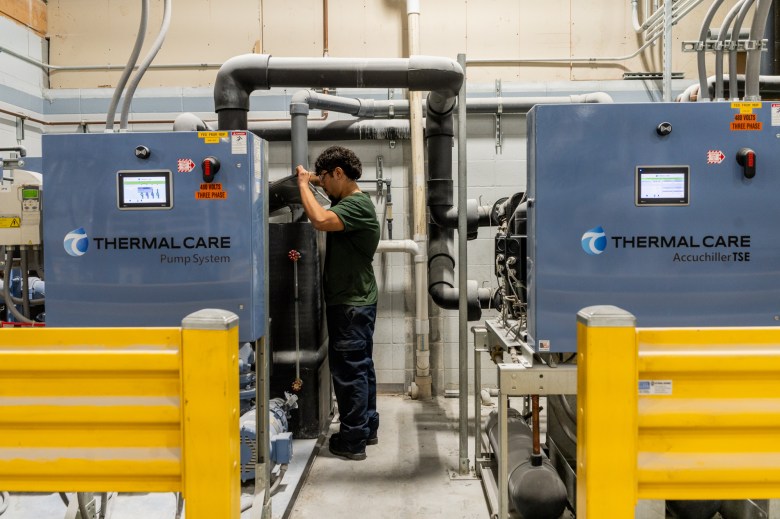
    Indiana’s Elkhart County has been at the forefront of expanding apprenticeships to high schoolers, but it’s had trouble recruiting companies — a challenge for the state as it tries to expand work-based learning. Credit: Camilla Forte/The Hechinger Report

    Working has motivated him to study harder at school, he said; he’s never cared for math, but when he realized it was important for his job, he began asking his teacher for extra help. “I got a taste of the real world and I want to be that type of person who does things right,” he said. 

    Alpha Systems pays for him to take classes in industrial systems through the state community college system, Ivy Tech, and has promised to pay for any further postsecondary education if he stays with the company. In just a few years, company executives said, he could easily make more than $40 an hour, approximately $80,000 a year. 

    Mindrum is working with employers around the state to try to increase work-based learning opportunities so they match student demand, a particular challenge in rural areas. Communities that have already made a commitment to work-based learning have had trouble recruiting enough employers: For example, in Elkhart County, only 1 in 3 high schoolers who apply for an apprenticeship gets one. Schools will also have to reorganize class schedules and overcome transportation challenges to ensure students can complete the necessary work-based learning under the various seals. The state has a goal of 50,000 apprenticeships by 2030. “It’s an aggressive but achievable target,” Mindrum said. 

    Related: A new kind of high school diploma trades chemistry for carpentry 

    Supporters hope the revamped diploma will also encourage more students to enlist in military service. Nationally, the military is struggling to recruit, and according to Army data, just 23 percent of 17- to 24-year-olds who apply to the U.S. military meet its medical fitness and academic requirements. In Indiana, the number of students enlisting in the National Guard dropped by 38 percent between 2018 and 2022, the sharpest decline of any state. 

    Retired Maj. Gen. Dale Lyles, who led the Indiana National Guard and helped create the “enlistment” seal criteria, said students often don’t know much about enlisting and the benefits of military service. In Indiana, for example, serving in the National Guard unlocks free tuition to state colleges.

    The new diploma options are meant to fix that: Students in the “enlistment honors” and “enlistment honors plus” seals are taught about each branch of service, what it means to swear an oath to your country and the many different job opportunities available. They also must take a public service course or complete a year of Junior ROTC and receive a certain score on the military’s aptitude test, the Armed Services Vocational Aptitude Battery, among other requirements. Students can receive coaching for the test and have the opportunity to visit Camp Atterbury-Muskatatuck, a nearly 35,000-acre military post, for hands-on learning opportunities.

    “Today’s military is much different than it was even five years ago, just because of the high degree of technology,” said Lyles, citing the Indiana National Guard’s platoon that flies automated aerial drones and its cyber warfare battalion. “We are in a battle for talent.” He added that the pathway emphasizes that there are other ways to serve, including as a firefighter, as a police officer or in the Department of Homeland Security. 

    Nicholas Purdy, a 17-year-old from Marion, has three grandparents who served in the military and said he’s always been interested in enlisting. In his first year of high school, he signed up for JROTC, and he said he loves traveling to other states for competitions and leadership camps where students participate in activities such as rappelling, water operations and land navigation. “It doesn’t matter what your background is, how much money you have, your looks,” he said of the experience. “The only thing that matters is your character.” 

    His mother, Stephanie Purdy, said she’s seen his confidence deepen as a result of his experiences with JROTC. Nicolas has won ribbons and pins for marksmanship and leadership that he wears on his uniform, and he likes the idea that under the new seals, those accomplishments would be reflected on his high school transcript. Nicholas wants to become a combat medic in the army. “The training set me up for really good opportunities, and it’s all paid for,” he said. 

    Jenner’s work continues — with a pressing deadline, as schools roll out these changes for first-year students this year. Her office is working on an online advising tool, a pilot program to help communities identify solutions to transportation challenges, guidance for educators on the new diploma options and courses, and incentives for school districts to measure skills like communication, collaboration and work ethic, not just academic outcomes.   

    It’s a big task. “This is new terrain for our country when you think about the level of scale we’re trying to accomplish,” said Jenner. “We don’t have a model to just copy and paste, so we’re going to learn some lessons along the way.” 

    *Due to an editing error, an earlier version of this story included an inaccurate description of the Carnegie Foundation.

    Contact editor Caroline Preston at 212-870-8965, via Signal at CarolineP.83 or on email at [email protected]

    This story about work-based learning was produced by The Hechinger Report, a nonprofit, independent news organization focused on inequality and innovation in education. Sign up for the Hechinger newsletter.
    The Hechinger Report provides in-depth, fact-based, unbiased reporting on education that is free to all readers. But that doesn’t mean it’s free to produce. Our work keeps educators and the public informed about pressing issues at schools and on campuses throughout the country. We tell the whole story, even when the details are inconvenient. Help us keep doing that.

    Join us today.

    Source link

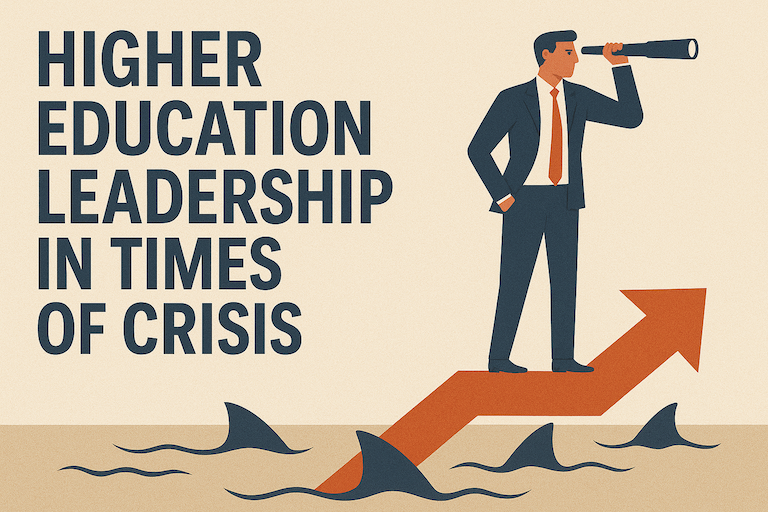
  • Higher Education Leadership in Times of Crisis – Edu Alliance Journal

    Higher Education Leadership in Times of Crisis – Edu Alliance Journal

    First in Leadership Series by Barry Ryan, PhD, JD August 11, 2025

    It is hard to think of a time when higher education was swimming in a pool filled with a greater number of shark-like threats than at present.

    Some of these were predictable (in hindsight), some not so much. Let’s set aside blame, however, on either an institutional level or on a more global basis. The vital thing now is for genuine leaders to help chart courses that will lead higher education, not just to mere survival, but to new and meaningful purposes that will benefit this generation and the next.

    When situations are “normal,” we may be tempted to imagine that we need leadership that can keep the legacy intact, turn the crank, not rock the boat. But normal no longer exists, does it?

    I remember a senior university leader, who admonished me, as I began a new presidency: “everything’s going great—just don’t mess it up” (using slightly more colorful language). One year later, seismic changes in higher ed created an unexpected crisis and necessitated major changes in the institution. Almost everything that had contributed to its prior success turned, overnight, into a liability.

    There is, of course, more than one crisis in which higher ed is being buffeted. The sheer number of colleges and universities that have ceased to exist at all, or have been merged to various extents with others, or are currently teetering on the brink, appears in news stories almost every day. The root causes are legion and often woven together: financial shortfalls, a shrinking number of students, reductions in state and federal support, the disappearance of many international students, families, and prospective students increasingly unable to justify the cost of a degree, the “value” of which is seriously questioned. The list goes on.

    Of the three large “types” of higher education in the United States—public (state) colleges and universities, private not-for-profit colleges and universities, and for-profit entities—the vast majority are struggling in meaningful ways.

    If you find yourself in a leadership role in this age of crisis, what are some key things you can do to keep becoming a better leader and more effectively serve your institution and your colleagues? Here are three suggestions that you may find helpful.

    First, don’t panic.

    And even if you do feel panic welling up inside you, do your best to keep it from becoming obvious. Phil Slott, who was involved in the Dry Idea marketing campaign in the 1980s, seems to have coined a relevant phrase: “Never let them see you sweat.” It just stresses you out more and does little to inspire confidence in those who are looking to you for leadership.

    Once you’ve steadied yourself, the next critical realization is that leadership in crisis cannot be solitary work.

    Second, remember every day, you can’t do this alone.

    A 19th-century lawyer by the name of Abe Lincoln is credited with the adage: “A person who represents himself in court has a fool for a client.” That rings true for any leader who tries to do everything and assumes they have sufficient knowledge (or wisdom or experience or insight) to solve every problem on their own. No one does—no matter how experienced.

    So where do you turn for help? The answer is two-fold: internally and externally. You need to draw on both circles and find confidential, experienced, and reliable counsel.

    Choose very carefully with whom you share the issues internally. Depending on the nature of the problem you’re trying to address, success might well be thwarted if there is a lapse of absolute confidentiality. At the starting point of the process, you need to be able to rely on one other person, or perhaps a very small circle, with which you will be able to expand bit by bit as the timeline moves along.

    There are difficult audiences and stakeholders in the life of an academic institution, and ultimately, all must be included in the process of working through a crisis. The sequencing of sharing information and inviting input, though, must be very carefully structured. If you’re a president, oftentimes the first person you seek is a senior member of the administration—a provost, vice president, or someone in a similar position. At times, it could be the chair of the board or a wise and thoughtful alum. But whoever the person(s) may be, the timing of sharing the situation and seeking input for solutions is everything.

    It’s very important not to neglect external assistance as well. It is all but impossible to generate a sufficient perspective on a crisis from only one (your) vantage point, or even from that of your small, trustworthy group. You’re very likely not the first institution to face these problems, and consulting with trusted external leaders can provide not only perspective but also ideas you may not have thought of on your own.

    Some of these leaders may be in academic institutions, but not necessarily. It is always helpful to have relationships with leaders in other professional fields as well, who may be particularly helpful in providing fresh perspectives and ideas. For example, in my own experience, I’ve found such people in leadership of non-profit organizations or boards, key corporate positions, government at various levels, and experienced friends with whom I served long ago, and could provide input on both my institution’s situation and also my own strengths and weaknesses. In addition, external folks don’t have the same emotional investment as someone internal, so the chances of a more neutral observation point are increased significantly.

    There is a temptation—and often a prudent one—to seek external input from lawyers. There are, of course, a fair number of attorneys and firms with expertise in higher education, which can be a plus. Higher education is a very specialized field, and, frankly, most lawyers have a huge knowledge deficit in terms of the operational realities of a college or university. Their tendency is to think, “Well, I know higher ed—after all, I went to college and law school” (or maybe even taught a course or two). Beware the well-intentioned lawyer who does not have directly relevant practice experience.

    This, of course, does not at all preclude seeking competent legal advice for certain aspects of the problems you may be facing. For example, most institutions have or will need counsel in employment matters. Even if not the center of your challenge, these issues will likely arise as part of the need for a solution to your challenges. If it appears you will have to make difficult financial decisions that might impact faculty or staff, you should seek excellent employment counsel much sooner rather than later. With students, Title IX requirements, for example, may dictate the need for specialized counsel, as might certain types of accreditation issues.

    Third, leadership is not “one size fits all.”

    Every leader has different abilities and personalities. Even though many institutions experience similar types of crises, the circumstances of each call for a bespoke solution.

    However, some very important leadership characteristics can increase the probability of success in these situations. In part two, we’ll examine these and how to cultivate them.


    Dr. Barry Ryan invested the first half of his career in higher education in teaching and the second half in administration. During that same timeframe, he pursued a parallel career in law and legal education. He​ served as the Supreme Court Fellow in the chambers of Chief Justice William H. Rehnquist and is a​ member of numerous federal and state bars. He has been appointed as the president of five universities and provost and chief of staff at three others. Among the institutions he served have been state, private non-profit, and private for-profit universities. Included in his academic experience were two terms as a Commissioner of the regional accreditor WASC​ (WSCUC).

    He has been appointed as the president of five universities and provost and chief of staff at three others. Among the institutions he served have been state, private non-profit, and private for-profit universities. Included in his academic experience were two terms as a Commissioner of the regional accreditor WASC​ (WSCUC). Dr. Ryan has led institutions through mergers, acquisitions, and affiliations that have preserved academic​ quality, expanded access, and strengthened long-term viability. His leadership has been marked by​ transparency, shared governance, and a commitment to stakeholder engagement at every stage of these processes.

    He earned his Ph.D. from the University of California, Santa Barbara, his J.D. from the University of​ California, Berkeley, and his Dipl.GB in international business from the University of Oxford.


    Edu Alliance Journal provides expert commentary and practical insights on U.S. and international higher education, focusing on innovation, policy, and institutional growth. Published by Edu Alliance, a consulting firm with offices in the United States and the United Arab Emirates, the Journal reflects the organization’s mission to help colleges, universities, and educational organizations achieve sustainable success through strategic partnerships, market intelligence, and program development.

    Source link

  • This school built high-end career and technical education training sites on campus to prepare students for local skilled jobs

    This school built high-end career and technical education training sites on campus to prepare students for local skilled jobs

    This story is part of Hechinger’s ongoing coverage about rethinking high school. See our articles about a new diploma in Alabama, a “career education for all” model in Kentucky, and high school apprenticeships in Indiana

    BELOIT, Wis. — As Chris Hooker eyed a newly built piece of ductwork inside Beloit Memorial High School, a wry smile crept over his face. “If you worked for me,” he told a student, considering the obviously crooked vent, “I might ask if your level was broken.”

    Hooker, the HVAC manager of Lloyd’s Plumbing and Heating Corp. in nearby Janesville, was standing inside a hangar-sized classroom in the school’s advanced manufacturing academy, where students construct full-size rooms, hang drywall and learn the basics of masonry. His company sends him to the school twice a week for about two months a year to help teach general heating, venting and air conditioning concepts to students. 

    “I cover the mountaintop stuff,” he said, noting that at a minimum students will understand HVAC when they become homeowners.

    But the bigger potential payoff is that these students could wind up working alongside Hooker after they graduate. If his firm has an opening, any student recommended by teacher Mike Wagner would be a “done deal,” Hooker said. “Plus, if they come through this class, I know them.” 

    Manufacturing and construction dominate the business needs inside Beloit, a small city of 36,000 just minutes from the Illinois border. Sitting at the nexus of two major highways, and within 100 miles of Chicago, Milwaukee and Madison, Beloit is home to a range of businesses that include a Frito-Lay production plant, an Amazon distribution center and a Navy subcontractor. In the next two years, a $500 million casino and hotel complex is scheduled to open. 

    But staffing these companies into the future is a major concern. Across the country, the average age of manufacturing workers is increasing, and one in four of these workers is age 55 or older, according to U.S. Bureau of Labor Statistics’ 2021 figures, the most recent available. In many other jobs the workforce is aging, too. Wisconsin is one of several states looking to boost career and technical education, or CTE, as a possible solution to the aging and shrinking workforce. 

    Having industry standard machines is a key part of Beloit Memorial High School’s manufacturing program; here a student uses a JET metalworking machine to create precise cuts for his project. Credit: Wayne D’Orio for The Hechinger Report

    While the unemployment rate of Rock County, which includes Beloit, is 3.6 percent, only slightly higher than the state’s 3.2 percent, there’s a worker mismatch in the city, according to Drew Pennington, its economic development director.

    Every day, 14,000 city residents travel outside of Beloit to work, while the same number commute into the city to fill mostly higher-paying jobs, said Pennington. 

    So when Beloit decided to revamp its public high school in 2018, CTE and work-based learning were at the forefront of the transformation. 

    The 1,225-student school now has three academies that cover 13 different career paths. After ninth grade, students choose to concentrate in an area, which means taking several courses in a specific field. Students also have the option to do work-based learning, which can mean internships, a youth apprenticeship or working at high-end simulated job sites inside the school. 

    “This creates not just a pipeline to jobs but also to career choices,” said Jeff Stenroos, the district’s director of CTE and alternative education.

    Related: A lot goes on in classrooms from kindergarten to high school. Keep up with our free weekly newsletter on K-12 education.

    “There are a lot of really good-paying jobs in this area. Students don’t need to leave, or go earn a four-year degree,” Stenroos said. An auto mechanic can “earn six figures by the age of 26 and that’s more than an educator with a master’s degree,” he said.

    Beloit’s effort is a shift in high school emphasis similar to the extensive CTE programs being run in other places, notably Indiana, Kentucky and Alabama. In 2024, 40 states enacted 152 CTE-related policies, the biggest push in five years, according to Advance CTE, a nonprofit group that represents state CTE officials. Nationwide, about 20 percent of high school students take a concentration of CTE courses, it says, adding that the high school graduation rate for students who concentrate in CTE is 90 percent, 15 percentage points higher than the national average. 

    Three years ago, Wisconsin called for 7 percent of its high school students to be in workplace learning programs by 2026. Beloit’s progress puts it far ahead of that target. In Beloit Memorial, nearly 1 in 3 students meet this designation today, Stenroos said. 

    The high school features a cavernous construction area where students build full-scale rooms, learn masonry and complete plumbing and electrical wiring projects. The metal shop offers 16 welding stations and a die-cutter machine that allows students to create customized pieces to fit projects. Down the street, the school runs an eight-bay car repair center, a space it took over when a Sears autobody shop left town.

    These spaces are “better than a lot of technical colleges,” Stenroos said.

    In addition to their high school courses, Beloit Memorial students pile up industry-recognized certifications, Stenroos said. More than 40 percent of its students graduate with at least one certification, and 1 in 4 of them has multiple certifications. 

    Related: Schools push career ed classes for all, even kids heading to college

    While some simple certifications, such as OSHA Workplace Safety, can be accomplished in just 10 hours, others, such as those for the American Welding Society, require up to 500 hours of student work, he added. The state has called for 9 percent of graduating high school students to have earned at least one certification by next year. To incentivize schools to offer these opportunities, the state’s Department of Workforce Development pays schools for each student who earns a certification; in 2024, Beloit received $85,000 through this program, Stenroos said.

    One of the school’s best automotive students, Geiry Lopez, graduated this year with five Automotive Service Excellence certifications. Standing less than 5 feet tall, Lopez said she is not bothered that she might not look like a typical mechanic. “I know I can do this,” she said, adding that she hopes to work on heavy machinery such as tractor trailers after she graduates.

    She’s worked on her own car, with some fellow students, replacing the brakes, a front axle, rotors and wheel bearings at the school’s garage, she said, although she still hasn’t been able to drive it.

    “My dad is taking forever to teach me how to drive,” she said. 

    The garage operates like an actual business, but the only customers are teachers and other Beloit staffers and students. Students estimate work costs, order parts and communicate with customers before any repairs take place. While oil changes and brake replacements are common, some students are totally rebuilding an engine in one car. 

    Over in the welding room, rising senior Cole Mellom was putting the finishing touches on a smoker he built in less than a month’s time. He said he loved the creativity of finding a plan, cutting the metal and building something that he could sell, all while in school. Plus, he knows that welding is a key skill needed for his dream job, race-car fabrication.

    Officials revamped the Beloit Memorial High School in 2018 to funnel students into academies that are connected to jobs in the area and the state. Credit: Wayne D’Orio for The Hechinger Report

    In the past, students created a custom-made protective plate that the city’s police use on a bomb squad vehicle.

    The welding program has 125 students this year and had to turn away 65 more because of space limitations, Stenroos said; last year, 17 of the school’s welding academy graduates enlisted in the armed forces to specialize in welding. 

    These programs are designed to help meet the future needs of the state’s workforce. More than one-third of Wisconsin jobs will require education beyond high school but less than a bachelor’s degree by 2031, according to the Association for Career and Technical Education. For the last four years, the state has had more job openings than people on unemployment.

    “There’s more jobs than there are people to fill them right now,” said Deb Prowse, a former career academy coach at Beloit Memorial who now works at Craftsman with Character, an area nonprofit that helps train students for careers in skilled trades.

    Hooker, the Lloyd’s Plumbing HVAC manager, agreed. “Every project we work on has a delay, from a multimillion-dollar mansion to a three-bedroom spec,” he said. “There aren’t enough workers.”

    The main reason Beloit Memorial has been able to zoom past state and national goals for both CTE and work-based learning is the school’s single-minded focus since 2018 on helping to ensure that its graduates will understand what businesses need and giving them a head start toward gaining those skills.

    High school officials actually pared back the program from 44 pathways to 13, Stenroos said, part of an effort to tie each pathway to specific jobs. About 75 percent of pathways target area jobs, with the remaining quarter highlighting prominent professions within the state, he added. 

    Even though three straight budget referendum defeats have left the district with a $6.2 million funding gap, Stenroos said he’s been able to keep the CTE equipment modernized through donations and strategic allocation of the school’s federal Perkins grant and the state reimbursement for student certifications. In one instance, the school recently bought a $20,000 scanner for its automotive program; the machine can not only help diagnose a car problem, but also connect students to garages throughout the country that have successfully fixed the specified problem. 

    “It’s an expensive piece of equipment,” Stenroos said, “but it’s industry-certified and will give students real-life experience.”

    Each of the three academies has an advisory board of teachers and industry professionals who work out how to embed practical lessons in classroom curriculum. “We ask business people, ‘What do you need, and how can we help our kids get there?’” said Stenroos.

    Related: A new kind of high school diploma trades chemistry for carpentry

    “It’s really cool how receptive the school is to feedback,” said Heather Dobson, the business development manager at Corporate Contractors, Inc., a 200-person general contracting firm.

    She explained that the district has incorporated small changes over the years, such as having students work in Microsoft programs instead of Google Classroom apps and teaching them how to write a professional email.

    “Rarely is there an idea presented that they don’t embrace,” said Celestino Ruffini, the CEO of Visit Beloit, a nonprofit that promotes tourism of the city. The school is expanding its hospitality program because of the expected influx of jobs connected to the new casino and hotel, he said. 

    All the changes aren’t at the high school, however. In order to employ Beloit Memorial students, Frito-Lay had to alter its corporate policy of not allowing anyone under 18 to work in its plants, according to Angela Slagle, a supply chain manager there. The company now hires Beloit Memorial students for its career exploration youth apprenticeship program, she added. 

    The connection to area businesses goes beyond the school’s leaders. Each year, about 10 teachers complete an externship in which they spend one week of their summer at a local business. Teachers are paid $1,000 for the 20 hours, and they not only learn about what jobs a company may have but also find ways to incorporate real-world problems into their classroom lessons.

    A few summers back, math teacher Michelle Kelly spent a week at Corporate Contractors. She was searching for different ways to use construction-based math problems with her students. In addition to using math to estimate a bid for a project or calculate the surface area of a job, she realized that complex math is needed to build a truss, the framework used to support a roof or bridge.

    Because the triangular truss is supported by different lengths of wood inside its structure, Kelly said, building one requires the calculation of angles, total area, how much wood is needed and more. Since all her algebra students were in the school’s construction academy, she partnered with those teachers to go beyond blueprints and have the 10th graders build trusses, a collection of which sit in the back of her classroom.

    A student’s detailed outline for creating a truss in Michelle Kelly’s 10th grade algebra class at Beloit Memorial High School, which is embracing career and technical education. Credit: Wayne D’Orio for The Hechinger Report

    She sees this work as one way to help counter the chronic absenteeism that has existed since Covid. Teaching with this kind of hands-on work makes students see the relevance of algebra, she said. “Would it be easier to just have them take a test? Yes.” 

    Beloit Memorial Principal Emily Pelz said the school’s work is paying off. In the last four years, the school’s four-year graduation rate has ticked up slightly, from 83.4 percent in 2021-22 to 85.2 percent in 2024-25, while its attendance went from 78.5 percent to 84.8 percent in the same period, Pelz said. 

    Related: ‘Golden ticket to job security’: Trade union partnerships hold promise for high school students

    Rik Thomas, a rising senior who already has his own business repairing and modifying cars, said this work has definitely made him more interested in school. While he thought the academy would merely explain what a construction career might include, “It’s nice to find out how to do the work.” His father works in construction and, Thomas added, “He loves that I take this program.” 

    Thomas and his classmates built a wooden shed earlier this year and were able to sell it for $2,500, with the money going to pay for more materials. Likewise, the first smoker created in the welding class was bought by Stenroos; the students are looking forward to posting the second one for sale after they determine how much they should charge. 

    While the school’s construction and other trade-related fields have drawn the most attention, its three academies also offer career paths in healthcare, education, business, the arts, hospitality and more. 

    For example, rising senior Tayvon Cates said he hopes to study pre-med at a historically Black college or university on his way to becoming a cardiology radiologist. Cates, who is in the school’s health and education academy, said, “If you want to do something, the school can help you do it.”

    This story about career and technical education was produced by The Hechinger Report, a nonprofit, independent news organization focused on inequality and innovation in education. Sign up for Hechinger’s weekly newsletter.

    The Hechinger Report provides in-depth, fact-based, unbiased reporting on education that is free to all readers. But that doesn’t mean it’s free to produce. Our work keeps educators and the public informed about pressing issues at schools and on campuses throughout the country. We tell the whole story, even when the details are inconvenient. Help us keep doing that.

    Join us today.

    Source link

  • Limited resources at underserved schools can keep students from getting the support they need

    Limited resources at underserved schools can keep students from getting the support they need

    As the first in my family to attend college, I felt a profound commitment to excel academically and gain admission to a top university. Growing up amid the hustle and bustle of Silicon Valley, I always envisioned a bright future ahead, with college at the forefront of my goals since elementary school.

    At my Title I elementary and middle schools, student-to-teacher ratios were even higher than those listed online. There was a lack of classroom technology and resources like history textbooks. Our two middle school counselors each managed students by the hundreds, making it nearly impossible for them to keep track of individual academic progress and educational goals. Afterward, I attended a private high school, thanks to support from my family. Our caring teachers made the effort to get to know each student, and dedicated counselors advocated for me when it mattered most.

    Yet when conversations about college came around, navigating the complex system was difficult. I had to chart my own path to success through independent research, often looking at data that was scattered and inconsistent. It hindered my ability to educate myself on college-going rates, costs, outcomes and employment prospects post-graduation.

    Related: Interested in innovations in higher education? Subscribe to our free biweekly higher education newsletter.

    Limited resources available at many underserved schools across the nation make it a more challenging environment for students to get support and excel, thus limiting their true academic potential.

    In my senior year of high school, after gaining newfound confidence while serving as a commissioner at-large in my county’s youth commission, I decided to try to challenge the status quo in higher education through the power of data and find a way to speak up for other first-generation students who find themselves interacting with systems not designed with their experiences in mind. My mentors at a regional food bank where I volunteered shaped me to lead with confidence and heart.

    When I received my admission letter from the University of California, Berkeley, I felt deeply honored to earn a place at one of the world’s leading research and teaching institutions.

    I am now an advisory board member of the recently formed California Cradle-to-Career Data System, the state’s longitudinal system that connects education and career outcomes data in one central place. I have learned firsthand that the resources available for students to gauge their potential postgraduate earnings often rely on self-submitted data or estimates, rather than on an accurate overview of college and career outcomes.

    Related: To better serve first-generation students, expand the definition

    As part of this work, I am now helping my state’s leaders develop tools like the Student Pathways dashboard, which provides insights on the higher education options available to students after high school.

    The tool provides information on a single website for everyone to access at any time. By streamlining access to this data, it allows students and the adults helping them to easily pinpoint which types of degrees or certifications are right for them, which may lead to employment opportunities where they live and which colleges or universities the students’ classmates are headed to.

    Students need access that can help them map out their futures — whether they hope to attend college, earn a certificate or enter the workforce directly after high school. Using data in the pathways tool can clarify how others have navigated to and through college and hopefully help students chart their own paths.

    As the youngest advisory board member, I have the opportunity to provide proposals and recommendations from a student’s perspective on how the system can engage with communities to make its data more accessible. Community engagement involves ensuring that Californians are aware of the data system, can understand and interpret the available data and have an opportunity to share their feedback.

    I often think about how the countless hours I spent trying to find information to help guide my goals and decision-making were both a burden and barrier to attending college. I know firsthand how the power of data can help build a successful future.

    Today, many first-generation and low-income college students do not have the opportunity to assess which pathways will yield the most fruit. I’m confident that with accessible facts and data for our decision-making, we can confidently forge the paths that will bring our dreams to life.

    Mike Nguyen is a rising junior studying business administration and science, technology, and society at the Haas School of Business at the University of California, Berkeley. This piece was written in collaboration with Alexis Takagi, a basic needs coordinator at Santa Clara University. Both Nguyen and Takagi are advisory board members of the California Cradle-to-Career Data System.

    Contact the opinion editor at [email protected].

    This story first-generation college students was produced by The Hechinger Report, a nonprofit, independent news organization focused on inequality and innovation in education. Sign up for Hechinger’s weekly newsletter.

    The Hechinger Report provides in-depth, fact-based, unbiased reporting on education that is free to all readers. But that doesn’t mean it’s free to produce. Our work keeps educators and the public informed about pressing issues at schools and on campuses throughout the country. We tell the whole story, even when the details are inconvenient. Help us keep doing that.

    Join us today.

    Source link

  • Students Increasingly Rely on Chatbots, but at What Cost? – The 74

    Students Increasingly Rely on Chatbots, but at What Cost? – The 74


    Get stories like this delivered straight to your inbox. Sign up for The 74 Newsletter

    Students don’t have the same incentives to talk to their professors — or even their classmates — anymore. Chatbots like ChatGPT, Gemini and Claude have given them a new path to self-sufficiency. Instead of asking a professor for help on a paper topic, students can go to a chatbot. Instead of forming a study group, students can ask AI for help. These chatbots give them quick responses, on their own timeline.

    For students juggling school, work and family responsibilities, that ease can seem like a lifesaver. And maybe turning to a chatbot for homework help here and there isn’t such a big deal in isolation. But every time a student decides to ask a question of a chatbot instead of a professor or peer or tutor, that’s one fewer opportunity to build or strengthen a relationship, and the human connections students make on campus are among the most important benefits of college.

    Julia Freeland-Fisher studies how technology can help or hinder student success at the Clayton Christensen Institute. She said the consequences of turning to chatbots for help can compound.

    “Over time, that means students have fewer and fewer people in their corner who can help them in other moments of struggle, who can help them in ways a bot might not be capable of,” she said.

    As colleges further embed ChatGPT and other chatbots into campus life, Freeland-Fisher warns lost relationships may become a devastating unintended consequence.

    Asking for help

    Christian Alba said he has never turned in an AI-written assignment. Alba, 20, attends College of the Canyons, a large community college north of Los Angeles, where he is studying business and history. And while he hasn’t asked ChatGPT to write any papers for him, he has turned to the technology when a blank page and a blinking cursor seemed overwhelming. He has asked for an outline. He has asked for ideas to get him started on an introduction. He has asked for advice about what to prioritize first.

    “It’s kind of hard to just start something fresh off your mind,” Alba said. “I won’t lie. It’s a helpful tool.” Alba has wondered, though, whether turning to ChatGPT with these sorts of questions represents an overreliance on AI. But Alba, like many others in higher education, worries primarily about AI use as it relates to academic integrity, not social capital. And that’s a problem.

    Jean Rhodes, a psychology professor at the University of Massachusetts Boston, has spent decades studying the way college students seek help on campus and how the relationships formed during those interactions end up benefitting the students long-term. Rhodes doesn’t begrudge students integrating chatbots into their workflows, as many of their professors have, but she worries that students will get inferior answers to even simple-sounding questions, like, “how do I change my major?”

    A chatbot might point a student to the registrar’s office, Rhodes said, but had a student asked the question of an advisor, that person may have asked important follow-up questions — why the student wants the change, for example, which could lead to a deeper conversation about a student’s goals and roadblocks.

    “We understand the broader context of students’ lives,” Rhodes said. “They’re smart but they’re not wise, these tools.”

    Rhodes and one of her former doctoral students, Sarah Schwartz, created a program called Connected Scholars to help students understand why it’s valuable to talk to professors and have mentors. The program helped them hone their networking skills and understand what people get out of their networks over the course of their lives — namely, social capital.

    Connected Scholars is offered as a semester-long course at U Mass Boston, and a forthcoming paper examines outcomes over the last decade, finding students who take the course are three times more likely to graduate. Over time, Rhodes and her colleagues discovered that the key to the program’s success is getting students past an aversion to asking others for help.

    Students will make a plethora of excuses to avoid asking for help, Rhodes said, ticking off a list of them: “‘I don’t want to stand out,’ ‘I don’t want people to realize I don’t fit in here,’ ‘My culture values independence,’ ‘I shouldn’t reach out,’ ‘I’ll get anxious,’ ‘This person won’t respond.’ If you can get past that and get them to recognize the value of reaching out, it’s pretty amazing what happens.”

    Connections are key

    Seeking human help doesn’t only leave students with the resolution to a single problem, it gives them a connection to another person. And that person, down the line could become a friend, a mentor or a business partner — a “strong tie,” as social scientists describe their centrality to a person’s network. They could also become a “weak tie” who a student may not see often, but could, importantly, still offer a job lead or crucial social support one day.

    Daniel Chambliss, a retired sociologist from Hamilton College, emphasized the value of relationships in his 2014 book, “How College Works,” co-authored with Christopher Takacs. Over the course of their research, the pair found that the key to a successful college experience boiled down to relationships, specifically two or three close friends and one or two trusted adults. Hamilton College goes out of its way to make sure students can form those relationships, structuring work-study to get students into campus offices and around faculty and staff, making room for students of varying athletic abilities on sports teams, and more.

    Chambliss worries that AI-driven chatbots make it too easy to avoid interactions that can lead to important relationships. “We’re suffering epidemic levels of loneliness in America,” he said. “It’s a really major problem, historically speaking. It’s very unusual, and it’s profoundly bad for people.”

    As students increasingly turn to artificial intelligence for help and even casual conversation, Chambliss predicted it will make people even more isolated: “It’s one more place where they won’t have a personal relationship.”

    In fact, a recent study by researchers at the MIT Media Lab and OpenAI found that the most frequent users of ChatGPT — power users — were more likely to be lonely and isolated from human interaction.

    “What scares me about that is that Big Tech would like all of us to be power users,” said Freeland-Fisher. “That’s in the fabric of the business model of a technology company.”

    Yesenia Pacheco is preparing to re-enroll in Long Beach City College for her final semester after more than a year off. Last time she was on campus, ChatGPT existed, but it wasn’t widely used. Now she knows she’s returning to a college where ChatGPT is deeply embedded in students’ as well as faculty and staff’s lives, but Pacheco expects she’ll go back to her old habits — going to her professors’ office hours and sticking around after class to ask them questions. She sees the value.

    She understands why others might not. Today’s high schoolers, she has noticed, are not used to talking to adults or building mentor-style relationships. At 24, she knows why they matter.

    “A chatbot,” she said, “isn’t going to give you a letter of recommendation.”

    This article was originally published on CalMatters and was republished under the Creative Commons Attribution-NonCommercial-NoDerivatives license.


    Get stories like these delivered straight to your inbox. Sign up for The 74 Newsletter

    Source link

  • Announcing a Special Small College America Webinar – Edu Alliance Journal

    Announcing a Special Small College America Webinar – Edu Alliance Journal

    “Guiding Through Change: How Small Colleges Are Responding to New Realities”: A Live Conversation with Three Small College Presidents

    August 2, 2025, by Dean Hoke: Over the past several months, higher education has experienced an unprecedented wave of transformation. The elimination or curtailment of Diversity, Equity, and Inclusion (DEI) initiatives, shifting federal financial aid policies, declining enrollment in traditional undergraduate programs, and heightened visa scrutiny and geopolitical tensions pose potential risks to international student enrollment, an area of growing importance for many small colleges.

    Dr. Chet Haskell, in a recent piece for the Edu Alliance Journal, captured the mood succinctly: “The headlines are full of uncertainty for American higher education. ‘Crisis’ is a common descriptor. Federal investigations of major institutions are underway. Severe cuts to university research funding have been announced. The elimination of the Department of Education is moving ahead. Revisions to accreditation processes are being floated. Reductions in student support for educational grants and loans are now law. International students are being restricted. These uncertainties and pressures affect all higher education, not just targeted elite institutions. In particular, they are likely to exacerbate the fragility of smaller, independent non-profit institutions already under enormous stress.”

    Small colleges—often mission-driven, community-centered, and tuition-dependent—are feeling these disruptions acutely.

    As we enter the third season of Small College America, a podcast series that spotlights the powerful impact of small colleges across the nation, my co-host Kent Barnds and I wanted to mark the moment with something special. Rather than recording a typical podcast episode, we’re hosting a live webinar to engage in a timely and candid discussion with three dynamic presidents of small colleges.

    Join us for a special Small College America webinar:

    “Guiding Through Change: How Small Colleges Are Responding to New Realities”

    Wednesday, August 27, 1:00 PM – 2:00 PM Eastern

    Our panelists bring deep experience, insight, and a strong commitment to the mission of small colleges:

    • Dr. Andrea Talentino is the president of Augustana College in Rock Island, Illinois. She previously served as provost at Nazareth College in Rochester, N.Y., and Dean of the College of Liberal Arts at Norwich University in Northfield, Vermont. In her administrative work, she has focused on building strong teams and developing a positive organizational culture.
    • Dr. Tarek Sobh is the President of Lawrence Technological University. A distinguished academic leader, he previously served as Provost at LTU and as Executive VP at the University of Bridgeport. An expert in robotics, AI, and STEM education, Dr. Sobh has published extensively and presented internationally. He is passionate about aligning academic programs with workforce needs.
    • Dr. Anita Gustafson, President of Presbyterian College, is a historian and long-time faculty leader who assumed the presidency in 2023. She has been a strong advocate for the value of the liberal arts and the importance of community engagement. Dr. Gustafson returned to PC after seven years as the dean of the College of Liberal Arts and Sciences and a professor of history at Mercer University in Macon, Ga.

    This one-hour webinar will explore how small private colleges are navigating today’s evolving environment and planning strategically for the future.

    Who Should Attend:

    • Institutional Leaders and Academic Faculty
    • Trustees and Advisory Members
    • Donors and Corporate Supporters
    • Alumni of Small Colleges
    • Community Leaders and Advocates

    👉 Click Here to Register

    There is no charge to attend—secure your spot today!

    We hope you’ll join us for this thoughtful and timely conversation.

    Source link

  • The urgent need to facilitate environmental justice learning in HE institutions

    The urgent need to facilitate environmental justice learning in HE institutions

    by Sally Beckenham

    The crises we are facing globally, from climate change and climate change dispossession to drought and food insecurity, are intersecting social and environmental issues, which need to be recognized and addressed accordingly through integrated and holistic measures. This can only be achieved by eschewing the tendency of existing governance and economic systems to silo social and environmental problems, as if they are separate concerns that can be managed – and prioritised – hierarchically. Much of this requires a better understanding of environmental injustice – the ways in which poor, racialised, indigenous and other marginalized communities are overlooked and/or othered in this power hierarchy, such that they must face a disproportionate burden of environmental harm.

    This is happening with disconcerting regularity around the world, often going under the radar but sometimes making headlines, as for example in May this year, when institutionalised environmental racism in the U.S. manifested in the placement of a copper mine on land inhabited by and sacred to the Apache indigenous group (Sherman, 2025). With limited political power to challenge it they are left to face dispossession, loss of livelihood and physical and mental health ill-effects (Morton-Ninomiya et al, 2023). We have seen this making headlines closer to home recently too, with evidence suggesting that toxic air in the UK is killing 500 people a week and most affecting those in socioeconomically disadvantaged areas (Gregory, 2025). An environmental problem (such as air pollution) cannot be disentangled from its social causes and effects. Or to put it another way, violence done to the environment is violence done to a particular group of people.

    A transformative response to our global challenges that re-centres environmental justice will require a paradigm shift in the ways that we govern, construct our societies, build our communities, run our economies, design our technologies and engage with the non-human world. The role of higher education will be critical to even a modest move in this direction. This is because, as they are probably tired of hearing, this generation of students will shape our collective futures, so it matters that they are literate in the deep entanglement of environmental and social justice challenges. Moreover, as Stickney and Skilbeck caution, “it is inconceivable that we will meet drastic carbon reduction targets without massive coordinated efforts, involving policymakers and educators working in concert at all levels of our governments and education systems (Stickney and Skilbeck, 2020).

    In Ruth Irwin’s article ‘Climate Change and Education’ she alerts us to Heidegger’s treatise in Being and Time (1962) that the effectiveness of a tool’s readiness is ‘hidden’ – only revealed when it ceases to function. Climate might be viewed as a heretofore ‘hidden’ tool, in that it affords opportunities for human action; it has “smoothly enabled our existence without conscious consideration” (Irwin, 2019). Yet its dynamic quality is now an overt, striking, looming spectre threatening the existence of all life on earth; the ‘environment’ writ large is revealing itself through ecological and social breakdown, surfacing our essential reliance upon it as natural beings. Thus unless higher education is competent in dealing with the issues of environmental crisis at all of its registers – social, environmental, political and ecological – the institution of education will be unable to fulfil its fundamental task of knowledge transfer for what is a clear public good (Irwin, 2019). Put another way, “HEIs have a responsibility to develop their educational provision in ways that will support the social transformation needed to mitigate the worst effects of the environmental crisis.” (Owens et al, 2023).

    Indeed, HE requires a paradigm shift in itself given that these realities are unfolding alongside widespread scrutiny of higher education institutions; including about decolonising the academy (Jivraj, 2020; Mintz, 2021), free speech on university campuses and how they are preparing students to meet these pressing issues (Woodgates, 2025). To keep pace with these changes and meet such challenges, educators from across disciplines will need to commit to embedding environmental justice education more widely across programme curricula, session design and teaching practices. It must be recognised as a vital – rather than token – component of environmental education. Doing so fully and effectively also requires us to recognise that environmental justice education encompasses not only subject matter but pedagogical practice. This is the case for all academic disciplines – including those that might seem peripheral to the teaching of environmental issues.

    EJE in HE is a developing area of scholarship and field of study that has gathered pace only over the last decade. Much of the research to date has been focused on the US, where studies have shown that environmental justice remains marginal to or excluded from the curricular offerings of most environmental studies programmes – let alone those not directly related to environmental education (Garibay et al, 2016). A report by the North American Association for Environmental Education (NAAEE), which studied the policies of 230 public U.S. HE institutions and 36 state boards of higher education, found that only 6% of institutions with climate change content in their policies referred to climate justice issues and indigenous knowledge practices (MECCE Project & NAAEE, 2023). Other work has shown that STEM education has tended to frame questions around exploitation of natural resources or technological development as disconnected from social and economic inequalities, though this is starting to be challenged (Greenberg et al, 2024).

    Emerging research into EJ in HE encompasses pedagogical approaches (Rabe, 2024; Moore, 2024); classroom and teaching practices (Walsh et al, 2022; Cachelin & Nicolosi, 2022; D’Arcangelis & Sarathy, 2015), the relationship between sustainability and climate justice education (Haluza-DeLay, 2013; Kinol et al, 2023) and curriculum development (Garibay et al, 2016). In identifying what EJE looks like these studies foreground the importance of community-engaged learning (CEL), providing students with the opportunity to learn about a socio-environmental problem from those with lived experience; critical thinking with regards to positionality, power structures and (especially indigenous) knowledge systems, and a deep concern with place. These critical components are crucial because tackling an act or acts of environmental injustice against marginalised populations often cannot be achieved without addressing systemic power imbalances.

    What also links these studies is an acknowledgement of the complexity of EJE. It is a difficult subject and practice to grapple with for several reasons. Firstly, it means exposing students (and educators) to “an onslaught of bad news,” (Cachelin & Nicolosi, 2022) which can elicit feelings of hopelessness and helplessness, so it is little wonder that expressions of anxiety and alarm are growing within these cohorts (Wallace, Greenburg & Clark, 2020) and that needs to be borne in mind. Secondly EJE requires us to find a way to meaningfully connect with philosophical, discursive, historical and practical questions about power, ethics and the relationship between human beings and the natural environment, within the disciplinary parameters of a specific curricula. This means doing difficult work not only to change current systems and processes (Forsythe et al, 2023) but also to make transformative rather than piecemeal efforts. For example, this might mean actively absorbing students into a community partner’s work in an engaged rather than service-learning model, or moving beyond a simple ‘guest lecture’ format to invite more in-depth input into modules or programmes from a community partner.

    This is a challenge that we shouldn’t understate for many academics and institutions already coping with high workloads (Smith, 2023), stress (Kinman et al, 2019) and job insecurity across a beleaguered sector (The Independent, 2024; The Guardian, 2025). Through this emerging EJE scholarship literature, we are starting to see that, “promoting opportunities for HE educators to develop and enact critical and transformative environmental pedagogy… is a complex business mediated by a variety of (personal, material and social) factors. It involves negotiating conflict, and understanding and confronting entrenched structures of power, from the local and institutional to the national and global.” (Owens et al, 2023). 

    A third (though by no means final) challenge in teaching and learning EJ in higher education is in finding and making space for it in a landscape that is strongly oriented towards sustainability education. Although there is certainly overlap – for example to the extent that the liberal logic underpinning the latter also informs distributive justice – sustainability education has different intellectual and ideological origins to EJ scholarship. Both are valuable, but we should be questioning whether we can justify a lack of explicit EJ practice and framing simply because we are already having sustainability conversations, and instead find space for both. It can be easy to (inadvertently) depoliticise environmental education by avoiding the perceived messiness and complexity of justice in favour of the more technocratic and measurable ‘sustainability’ (Haluza-DeLay, 2013).

    My research seeks to develop a better understanding of the state of environmental justice education in the HE landscape, beginning by mapping its development in the UK. This will reveal the extent and means by which EJE is being incorporated across programme curricula, session design and teaching practices in the UK HE context. In doing so we can identify the intersections of EJE with other dominant pedagogies, including sustainability education and solutions-focused approaches. To pursue a provincialising agenda and avoid the parochial perspective that EJE is the preserve of HEIs in the global North, there is also much value in exploring what EJE looks like in HEIs in the global South, and where cross-cultural lessons can be shared. The questions we need to be asking are:

    • How is environmental justice being taught and learnt and where do we go from here?
    • How are educators overcoming the challenges involved in engaging with EJE?
    • What best practices could we champion?

    Sharing methods, strategies and pedagogical approaches for EJE cross-institutionally and cross-culturally will be a step towards helping us build a better collective, collaborative response to the urgency of our intersecting socio-environmental crises.

    Dr Sally Beckenham is Lecturer in Human Geography and Programme Lead and Admissions Tutor for the BA Human Geography & Environment in the Department of Environment & Geography, University of York. She is also Chair of the Teaching Development Pool and member of the Interdisciplinary Global Development Centre (IGDC). She is an interdisciplinary political geographer with degrees in Modern History, International Politics and International Relations, and welcomes collaboration. Email: [email protected] Bluesky: @sallybeckenham.bsky.social.

    Author: SRHE News Blog

    An international learned society, concerned with supporting research and researchers into Higher Education

    Source link

  • Federal cuts to AmeriCorps could make it harder for recent graduates to find jobs

    Federal cuts to AmeriCorps could make it harder for recent graduates to find jobs

    This story about AmeriCorps jobs was produced by The Hechinger Report, a nonprofit, independent news organization focused on inequality and innovation in education. Sign up for the Hechinger newsletter.

    Lily Tegner didn’t know what she wanted to do when she graduated from Oregon State University with a chemical engineering degree five years ago. She entered the workforce at a point when unemployment briefly skyrocketed and companies were freezing hiring because of the Covid pandemic. “I didn’t have a very clear direction as far as where I was going in life,” she said. 

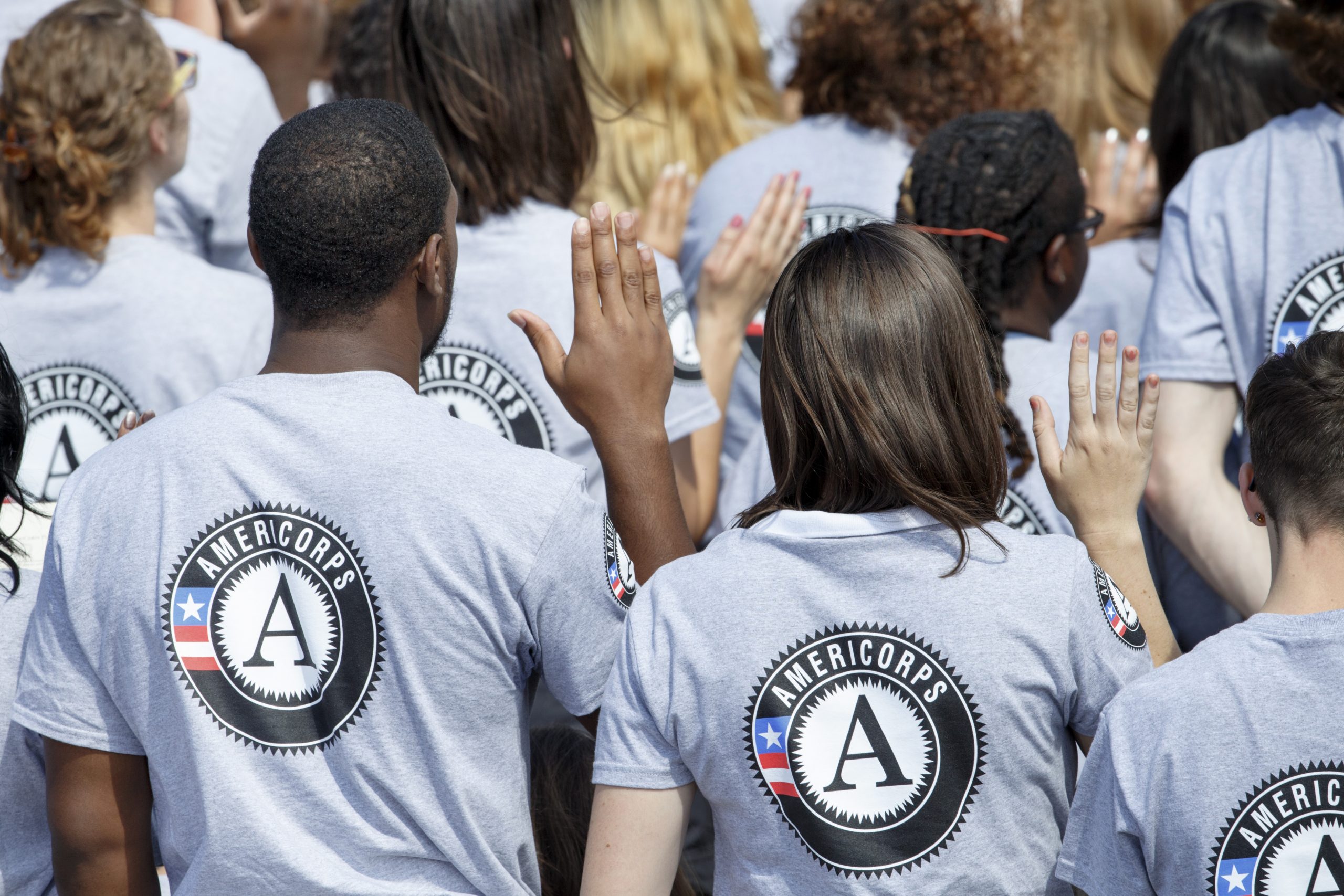
    Like hundreds of thousands of other young adults, Tegner kick-started her career through AmeriCorps, a federal agency that sends its members to communities across the country to tutor students, help after disasters strike and restore wildlife habitats, among other activities. She took a position at the Alaska Afterschool Network, where her job was to help find ways to expand science, technology, engineering and math access in its programs. Four years later, she’s still there — now, as a full-time employee managing the nonprofit’s AmeriCorps program. 

    “This state became my home,” Tegner said, adding that her year in AmeriCorps “completely changed the trajectory of my career.” 

    An AmeriCorps member poses with a student in one of the Alaska Afterschool Network’s funded programs. The organization lost its AmeriCorps funding last spring. Credit: Courtesy of Alaska Afterschool Network

    This spring, Alaska Afterschool Network was one of hundreds of organizations abruptly notified that its AmeriCorps funding had been terminated. Federal funding cuts forced the nonprofit to eliminate three full-time positions and cancel 19 internships scheduled for this summer. Tegner’s job is also at risk, though the organization is trying to find a way to keep her on. 

    In late April, the Trump administration slashed 41 percent of AmeriCorps’ funding, cutting about $400 million in grants and letting go of more than 32,000 members serving in hundreds of programs across the United States. In June and also this month, judges ordered the government to restore some funding, but the ruling does not reinstate all the money that was taken away. Shrinking AmeriCorps is among the many steps the Trump administration has taken to curb what he has called “waste, fraud and abuse” of federal funds. More action is expected in the months ahead. 

    Related: Become a lifelong learner. Subscribe to our free weekly newsletter featuring the most important stories in education. 

    Over the years, the program former President Bill Clinton created has deployed more than a million people. On top of gutting AmeriCorps, the cuts have diminished the reach of an agency that has been a critical path to a career for recent high school and college graduates at a time when entry-level jobs can be difficult to find.

    AmeriCorps was created more than three decades ago to oversee expanded federal volunteer programs, incorporating existing projects including Volunteers in Service to America and the National Civilian Community Corps. Its members take on community service positions across the country that can last for up to two years. They receive a small living stipend, and full-time members are eligible for health insurance. At the end of their terms, members are awarded a grant that can be used to pay college tuition or student loans.

    “AmeriCorps dollars have a powerful ripple effect, for both the AmeriCorps members and the students that they serve,” said Leslie Cornfeld, founder and CEO of the National Education Equity Lab, a nonprofit that brings college courses to high-poverty schools. “In many instances, it helps them define their careers.” 

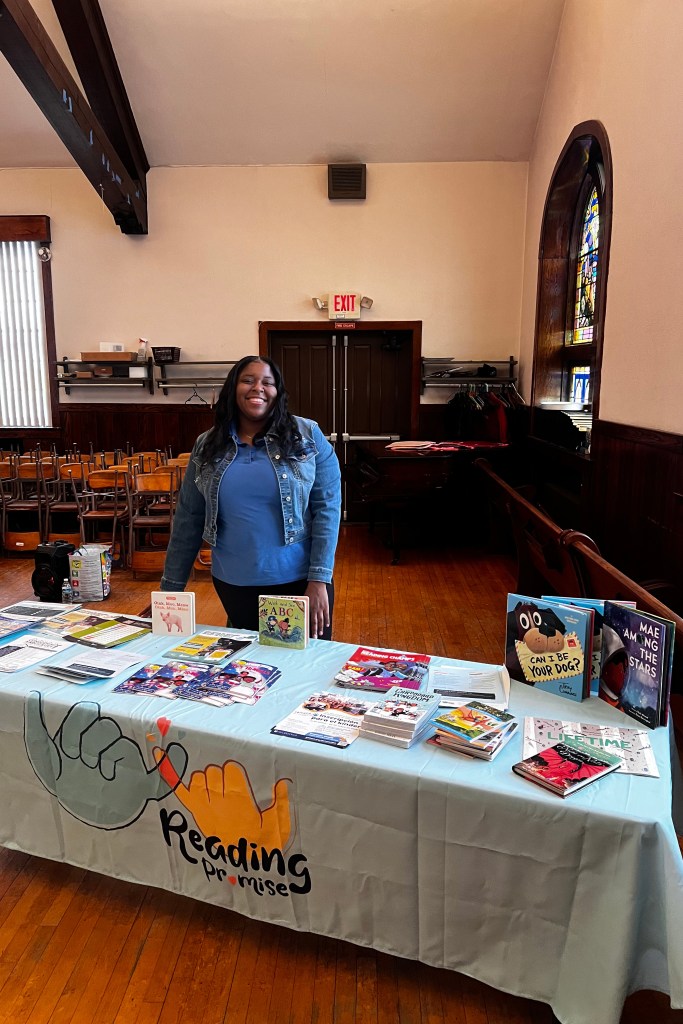
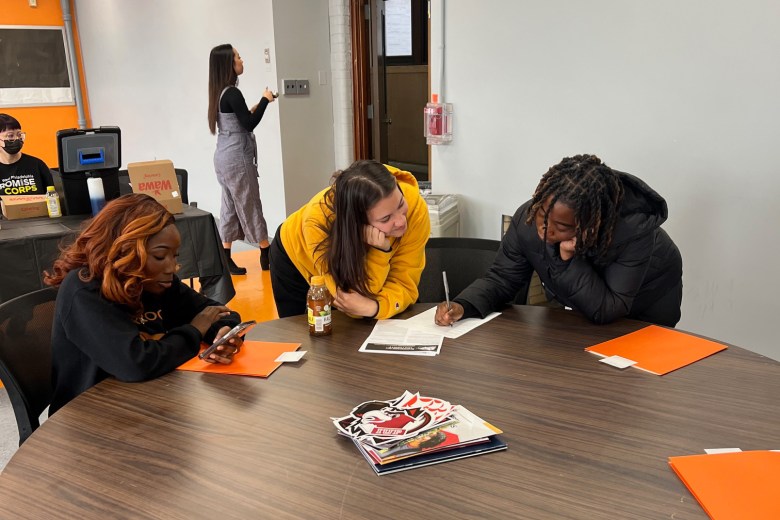
    About half of the AmeriCorps funding for the Philadelphia Higher Education Network for Neighborhood Development was cut this spring. Credit: Courtesy of PHENND

    Federal surveys of AmeriCorps members from 2019, 2021 and 2023 show that 90 percent of members joined the national program in part to gain skills that would help them in school and work, and well over 80 percent said their experience in AmeriCorps helped further their “professional goals and endeavors.”

    The Trump administration cited fraud as part of its reason for nearly halving the AmeriCorps budget. Audits of the agency have raised questions about its financial management. 

    Related: Hundreds of thousands of students are entitled to training and help finding jobs. They don’t get it

    Peter Fleckenstein, 23, joined Aspire Afterschool in Arlington, Virginia, through AmeriCorps last year after graduating from the University of Delaware with a degree in psychology. He saw AmeriCorps as a way to build out his resume; even the entry-level positions he encountered during his job search required experience in the field. 

    In his position at the after-school program, Fleckenstein leads daily activities for a group of about two dozen fourth grade students. The experience has helped him crystallize his career aspirations: Before AmeriCorps, he was considering clinical social work or teaching. Now, he wants to become a counselor.

    “Working with the kids here is a lot of behavior management: problem solving, helping them regulate themselves,” Fleckenstein said. “Doing one-on-one work with them, building habits and routines with them — that is something that I could focus on more if I was in a counseling job.”

    Fleckenstein’s position was cut in April before he could complete his one-year term set to end in August, but Aspire Afterschool was able to raise money through donations to hire him and some of the nonprofit’s other AmeriCorps members part-time to finish out their grant year. 

    The Philadelphia Higher Education Network for Neighborhood Development lost half of its AmeriCorps funding this past spring when the federal agency was slashed. Credit: Courtesy of PHENND

    While some members have joined Americorps after graduating, student Deja Johnson, 24, joined as a way to help pay for college. Her term at The Scholarship Academy — a nonprofit in Atlanta helping low-income high school students navigate financial aid applications — was supposed to end with a $7,400 education grant. Because the terms were cut short, members have been told they’ll get only a prorated portion of the money.

    “It’s a little bit of a shame,” said Johnson, who is using the education grant to pursue a bachelor’s degree in nonprofit leadership. 

    “That’s what a lot of us look forward to with this work that we’re doing, because we know how much of a sacrifice it can be at times. It’s that ‘pouring into our community’ — and that’s how our community pours into us,” Johnson said.

    The AmeriCorps termination letters told grantees that their programs no longer met agency priorities, but the nonprofits were not told what those priorities are. Programs with different missions, in both Democratic- and Republican-led communities, were cut.

    Sira Coulibaly, a member with the Philadelphia Higher Education Network for Neighborhood Development’s Next Steps AmeriCorps program, packs bags of food for the Metropolitan Area Neighborhood Nutrition Alliance. Credit: Courtesy of PHENND

    The Hindman Settlement School, a nonprofit in rural Kentucky, was one victim of the cuts. The organization receives about $1 million a year from AmeriCorps for its program tutoring students with math and reading learning disabilities in more than two dozen schools. Losing that funding means drastically scaling back services, said Josh Mullins, senior director of operations at the Hindman Settlement School. He said he does not know why Hindman’s grants were terminated: The nonprofit regularly passes its audits, and its last annual report showed an average gain of seven months in reading levels among students in its dyslexia intervention program.

    A statement published in January on an AmeriCorps webpage says the agency is in the process of “conducting a full review” to comply with President Donald Trump’s executive order banning diversity, equity and inclusion in federal programs. But Mullins and other AmeriCorps grantees said diversity, equity and inclusion efforts were not listed anywhere as part of their operations.

    “That’s what’s devastating,” Mullins said. “It was completely out of our control. There was nothing you could do.”

    Related: Tracking Trump: His actions to dismantle the Education Department, and more

    The administration also gutted 85 percent of the agency’s federal staff, which has caused problems even for programs that are still receiving AmeriCorps funding. 

    The federal government terminated about half of the AmeriCorps grants for the Philadelphia Higher Education Network for Neighborhood Development. The group uses the funding to place members in local nonprofits and to help develop community partnerships in high-poverty schools. Director Hillary Kane said she’s been experiencing delays from the national AmeriCorps office in getting members approved for the programs that are still operating.

    “We need the humans in D.C. to do the stuff that they do, so we can do the stuff that we do,” Kane said. “The person we communicate with isn’t there.”

    About half of the AmeriCorps funding for the Philadelphia Higher Education Network for Neighborhood Development was cut this spring. Credit: Courtesy of PHENND

    On June 5, a federal judge granted a temporary injunction ordering the Trump administration to restore AmeriCorps funding in states that had sued over the budget cuts. The lawsuit, which was filed by two dozen Democratic-led states in May, challenges the administration’s authority to cancel the funding without Congressional approval. But the judge’s injunction does not require the Trump administration to reinstate AmeriCorps’ federal employees, and funding is not being restored to programs in states that did not sign on to the lawsuit, including Alaska, home of the Alaska Afterschool Network, or Virginia, where Aspire Afterschool is based.

    The Hindman Settlement School in Kentucky was one organization whose funding was restored this summer because of the lawsuit. Mullins said he’s hopeful the nonprofit will continue to receive AmeriCorps funding for the upcoming grant cycle in the fall.

    For Kane, the injunction does not undo the chaos caused by the abrupt cancellation of half of her Philadelphia organization’s funding. Many terminated members that were with Kane’s organization have already moved on. 

    “It’s too late for us,” she said.

    Related: Schools push career ed classes ‘for all,’ even kids heading to college

    Programs whose grants were cut can apply again in the next grant cycle, but the president’s 2026 budget calls for shutting down AmeriCorps entirely. 

    While the debate in Washington rages, current and former volunteers mourn the potential loss of a program they said gave their lives meaning and led to employment. The avenue AmeriCorps provided for Tegner to start a career at the Alaska Afterschool Network gave her purpose in life, she said. She’s worried if the program ends, there won’t be another pathway on the same scale for young idealists who aren’t sure what they want to do with their lives.

    “It helps young people of all ages grow and try new things,” Tegner said. “That’s very much what it was for me.”

    Contact staff writer Ariel Gilreath on Signal at arielgilreath.46 or at [email protected].   

    This story about AmeriCorps jobs was produced by The Hechinger Report, a nonprofit, independent news organization focused on inequality and innovation in education. Sign up for the Hechinger newsletter.
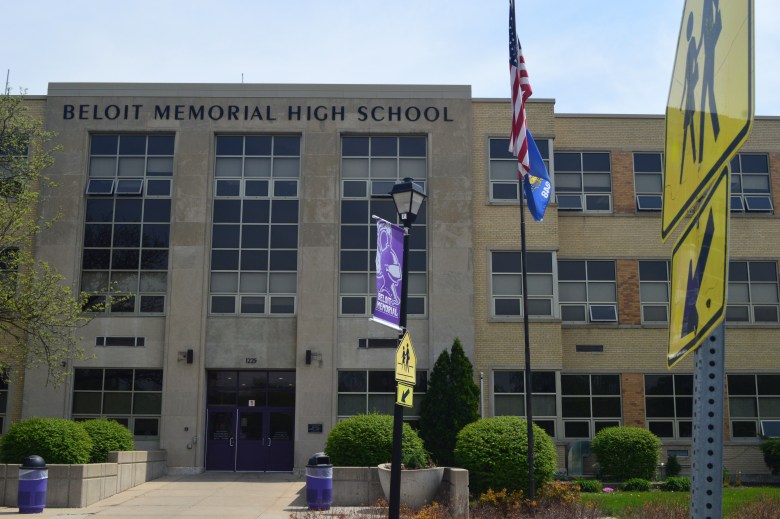
    The Hechinger Report provides in-depth, fact-based, unbiased reporting on education that is free to all readers. But that doesn’t mean it’s free to produce. Our work keeps educators and the public informed about pressing issues at schools and on campuses throughout the country. We tell the whole story, even when the details are inconvenient. Help us keep doing that.

    Join us today.

    Source link

  • Is There a Collaborative Middle Ground Between Mergers and Consortia for the Sustainability of Small Independent Institutions?

    Is There a Collaborative Middle Ground Between Mergers and Consortia for the Sustainability of Small Independent Institutions?

    July 28, 2025, by Dr. Chet Haskell: The headlines are full of uncertainty for American higher education. “Crisis” is a common descriptor. Federal investigations of major institutions are underway. Severe cuts to university research funding have been announced. The elimination of the Department of Education is moving ahead. Revisions to accreditation processes are being floated. Reductions in student support for educational grants and loans are now law. International students are being restricted.

    These uncertainties and pressures affect all higher education, not just targeted elite institutions. In particular, they are likely to exacerbate the fragility of smaller, independent non-profit institutions already under enormous stress. Such institutions, some well-known, others known only locally, will be hard hit particularly hard by the combination of Trump Administration pressures and the developing national demographic decline for traditional-age students.(https://www.highereddive.com/news/decline-high-school-graduates-demographic-cliff-wiche-charts/738281/) These small colleges have been a key element of the American higher education scene, as well as for numerous local communities, for many decades.

    It is widely understood that the vibrancy of American higher education comes, in part, from the diversity of its institutions and educational goals. The rich mixture of American colleges and universities is a strength that many other nations lack. Students have opportunities to start and stop their educations, to change directions and academic goals, to move among different types of institutions.

    Smaller undergraduate colleges play important roles in this non-systemic system. They provide focused educational opportunities for younger adults, where they can build their lives on broad principles. Impressively large percentages of small college graduates go on to graduate education for various professions. Small colleges provide large numbers of graduates who enter PhD programs and eventually enter the professorate.

    There are approximately 1179 accredited private institutions with enrollments of fewer than 3000 students. Of these, 185 have between 3000 and 2000 students. Another 329 have enrollments below 2000 but above 1000. A final 650 institutions have enrollments below 1000. These 1179 institutions students include few wealthy colleges such as Williams, Amherst, Carleton or Pomona, as well as numerous struggling, relatively unknowns.

    A basic problem is one of scale. In the absence of significant endowments or other external support, it is very difficult to manage small institutions in a cost effective manner. Institutions with enrollments below 1000 are particularly challenged in this regard. The fundamental economics of small institutions are always challenging, as most are almost completely dependent on student enrollments, a situation getting worse with the coming decline of traditional college age students. There are limited options available to offset this decline. Renewed attention to student retention is one. Another is adding limited graduate programs. However, both take investment, appropriate faculty and staff capacity and time, all of which are often scarce.

    These institutions have small endowments measured either in total or per student value. Of the 1179. There are only 80 with total endowments in excess of $200 million. While a handful have per student endowments that rival the largest private universities, (Williams, Amherst and Pomona all have per student endowments in excess of $1.8 million), the vast majority have per student endowments in the $40,000 range and many far less.

    Most of these schools have high tuition discount rates, often over 50%, so their net tuition revenue is a fraction of posted expense.  They are all limited by size – economies of scale are difficult to achieve. And most operate in highly competitive markets, where the competition is not only other small schools, but also a range of public institutions.

    So, what is the underendowed, under resourced small college to do?

    The most common initiatives designed to address these sorts of challenges are consortia, collaborative arrangements among institutions designed to increase student options and to share expenses. There are numerous such arrangements, examples being the Colleges of the Fenway in Boston, the Five Colleges of Western Massachusetts, the Washington DC Metropolitan Area Consortium, and the Claremont Colleges in California, among others.

    The particulars of each of these groups differ, but there are commonalities. Most are geographically oriented, seeking to take advantage from being near each other. Typically, these groups want to provide more opportunities for students through allowing cross-registrations, sharing certain academic programs or joint student activities. They usually have arrangements for cost-sharing or cost reductions through shared services  for costs like security services, IT, HR, risk management options, pooled purchasing and the like. In other cases (like the Claremont Consortium) they may share libraries or student athletic facilities. Done well, these arrangements can indeed reduce costs while also attracting potential students through wider access to academic options.

    However, it is unlikely that such initiatives, no matter how successful, can fundamentally change the basic financial situation of an independent small college. Such shared services savings are necessary and useful, but usually not sufficient to offset the basic enrollment challenge. The financial impact of most consortia is at the margins.

    Furthermore, participating institutions have to be on a solid enough financial basis to take part in the first place. Indeed, a consortium like Claremont is based on financial strength. Two of the members have endowments in excess of $1.2 billion (Pomona’s is $2.8 billion.) The endowments of the others range from a low of $67 million (Keck Graduate with 617 students) to Scripps with $460 million for 1100 students.) The Consortium is of clear value to its members, but none of these institutions is on the brink of failure. Rather, all have strong reputations, a fact that provides another important enrollment advantage.

    One important factor in these consortia arrangements is that the participating institutions do not have to give up their independence or modify their missions. Their finances, alumni and accreditation are separate.  And while the nature of the arrangement indicates certain levels of compromise and collaboration, their governance remains basically unchanged with independent fiduciary boards.

    At the other end of the spectrum are two radically different situations. One is merging with or being acquired by another institution. Prep Scholar counts 33 such events since 2015. (https://blog.prepscholar.com/permanently-closed-colleges-list). Lacking the resources for financial sustainability, many colleges have had no choice but to take such steps.

    Merging or being acquired by a financially stronger institution has many advantages. Faculty and staff jobs may be protected. Students can continue with their studies. The institution being acquired may be able to provide continuity in some fashion within the care of the new owner. Endowed funds may continue. The institution’s name may continue as part of an “institute” or “center” within the new owner’s structure. Alumni records can be maintained. Real estate can be transferred. Debts may be paid off and so forth. There are multiple examples of the acquiring institution doing everything possible along these lines.

    But some things end. Independent governance and accreditation cease as those functions are subsumed by the acquiring institution. Administrative and admissions staffs are integrated and some programs, people and activities are shed. Operational leadership changes. And over time, what was once a beloved independent institution may well fade away.

    The second situation is, bluntly, oblivion. While there are cases of loyal alumni trying to keep an institution alive with new funding, the landscape is replete with institutions that have failed to be financially sustainable.https://www.insidehighered.com/news/governance/executive-leadership/2025/03/27/how-sweet-briar-college-defied-odds-closure. At least 170 smaller institutions have closed in the past two decades. Significantly, it looks like the rate of closure is increasing, in part because of pressures experienced during the pandemic and in part because of continuing enrollment declines.(https://www.highereddive.com/news/how-many-colleges-and-universities-have-closed-since-2016/539379/)

    The end of a college is a very sad thing for all involved and, indeed, for society in general. Often a college is an anchor institution in a small community and the loss is felt widely. The closure of a college is akin to the closure of a local factory. As Dean Hoke and others have noted, this is a particular problem for rural communities.

    Are there other possible avenues, something between a consortium and a merger or outright closure?

    One relatively new model has been organized by two quite different independent institutions, Otterbein University and Antioch University, that came together in 2022 to create the Coalition for the Common Good. Designed to be more than a simple bilateral partnership, the vision of the Coalition is eventually to include several institutions in different locations linked by a common mission and the capacity to grow collective enrollments.

    At its core, the Coalition is based on academic symbiosis. Otterbein is a good example of the high-quality traditional undergraduate residential liberal arts institution. It has been well-run and has modest financial resources. Facing the demographic challenges noted earlier (in a state like Ohio that boasts dozens of such institutions), it developed a set of well-regarded graduate programs, notably in nursing and health-related fields, along with locally based teacher education programs and an MBA. However, despite modest success, they faced the limitations of adult programs largely offered in an on-campus model. Regardless of quality, they lacked the capacity to expand such programs beyond Central Ohio.

    Antioch University, originally based in Ohio, had evolved over the past 40 years into a more national institution with locations in California, Washington State and New Hampshire offering a set of graduate professional programs to older adults mostly through distance modalities in hybrid or low-residency forms. Antioch, however, was hampered by limited resources including a very small endowment. It had demonstrated the capacity to offer new programs in different areas and fields but lacked the funds necessary for investment to do so.

    Within the Coalition, the fundamental arrangement is for Antioch to take over Otterbein’s graduate programs and, with Otterbein financial support, to expand them in other parts of the country. The goal is significant aggregate enrollment growth and sharing of new revenues. While they plan a shared services operation to improve efficiencies and organizational effectiveness, their primary objective is growth. Antioch seeks to build on Otterbein’s successes, particularly with nursing programs. It already has considerable experience in managing academic programs at a distance, a fact that will be central as it develops the Otterbein nursing and health care programs in a new Antioch Graduate School of Nursing and Health Professions.

    It is assumed that additional new members of the Coalition will resemble Otterbein in form, thus further increasing opportunities for growth through enhanced reach and greater scale. New members in other geographic locations will provide additional opportunities for expansion. One early success of the Coalition has been the capacity to offer existing Antioch programs in Central Ohio, including joint partnerships with local organizations, health care and educational systems. Crucially, both institutions remain separately accredited with separate governance and leadership under a Coalition joint  “umbrella” structure.

    This is not to assert that this model would work for many other institutions. First, many schools with limited graduate programs will be reluctant to “give up” some or all these programs to another partner in the same fashion as Otterbein has with Antioch. Others may not fit geographically, being too remote for expansion of existing programs. Still others may not wish to join a group with an avowed social justice mission.  Finally, as with some consortia, the Coalition arrangement assumes a certain degree of institutional financial stability – it cannot work for institutions on the brink of financial disaster, lest the weakest institution drag down the others.

    Are there other organizational variants that are more integrated than consortia, but allow the retention of their independence in ways impossible in a merger or acquisition model? What can be learned from the Coalition initiative that might help others? How might such middle-ground collaboration models be encouraged and supported?

    How can philanthropy help?

    This is an opportunity for the segments of the philanthropic world to consider possible new initiatives to support the small college elements of the education sector. While there will always be efforts to gain foundation support for individual colleges, there will never be enough money to buttress even a small portion of deserving institutions that face the financial troubles discussed above

    Philanthropy should take a sectoral perspective. One key goal should be to find ways to support  smaller institutions in general. Instead of focusing on gifts to particular institutions, those interested in supporting higher education should look at the multiple opportunities for forms of collaborative or collective action. Central to this effort should be exploration of ways of supporting diverse collaborative initiatives. One example would be to provide sufficient backing to a struggling HBCU or women’s college to enable it to be sufficiently stable to participate in a multi-institutional partnership.

    As noted, institutional consortia are well established as one avenue for such collaboration. Consortia have existed for many years. There are consortia-based associations that encourage and support consortia efforts. However, every consortium is unique in its own ways, as participating institutions have crafted a specific initiative of a general model to meet their particular situations and need. Consortia can be important structures for many institutions and should be encouraged.

    But there is a large middle ground between consortia arrangements and mergers and acquisitions. The Coalition for the Common Good is but one such arrangement and it is still in its early stages. What has been learned from the experience thus far that might be of use to other institutions and groups? How might this middle ground be explored further for the benefit of other institutions?

    One thing learned from the Coalition is the complexity of developing a new model for collective action.  Antioch and Otterbein separately pursued individual explorations of options for two or more years before determining that their partnership together should move forward. It then took a full year to get to the point of announcing their plans and another year to complete negotiations and sign completed legal documents and to obtain the necessary accreditor, regulator and Department of Education approvals. The actual implementation of their plans is still in a relatively early stage. In short, it takes time.

    It also takes tremendous effort by leadership on both sides, as they must work closely together while continuing to address the daily challenges of their separate institutions. Everyone ends up with at least two major jobs. Communication is vital. Boards must continue to be supportive. The engagement of faculty and staff takes time and can be costly.

    What is often referred to as “fit” – the melding of cultures and attitudes at both the institutional and individual levels – is essential. People must be able to work together for shared goals. The burdens of accreditation, while necessary, are time-consuming and multifaceted. There are many things that can go wrong. Indeed, there are examples of planned and announced mergers or collaborations that fall apart before completion.

    Philanthropic institutions could support this work in numerous ways, first for specific initiatives and then for the sector, by providing funding and expertise to facilitate new forms of coalitions. These could include:

    • Providing financial support for the collaborative entity. While participating institutions eventually share the costs of creating the new arrangement, modest dedicated support funding could be immensely useful for mitigating the impact of legal expenses, due diligence requirements, initial management of shared efforts and expanded websites.
    • Providing support for expert advice. The leaders of two institutions seeking partnership need objective counsel on matters financial, legal, organizational, accreditation and more. Provision of expertise for distance education models is often a high priority, since many small colleges have limited experience with these.
    • Funding research. There are multiple opportunities for research and its dissemination. What works? What does not? How can lessons learned by disseminated?
    • Supporting communication through publications, workshops, conferences and other venues.
    • Developing training workshops for boards, leadership, staff and faculty in institutions considering collaborations.
    • Crafting a series of institutional incentives through seed grant awards to provide support for institutions just beginning to consider these options.
    • These types of initiatives might be separate, or they might be clustered into a national center to support and promote collaboration.

    These and other ideas could be most helpful to many institutions exploring collaboration. Above all, it is important to undertake such explorations before it is too late, before the financial situation becomes so dire that there are few, if any, choices.

    Conclusions

    This middle ground is not a panacea. The harsh reality is that not all institutions can be saved. It takes a certain degree of stability and a sufficient financial base to even consider consortia or middle ground arrangements like the Coalition for the Common Good. Merging with or being acquired by stronger institutions is not a worst-case scenario – there are often plenty of reasons, not just financial, that this form of change makes great sense for a smaller, weaker institution.

    It is also important for almost all institutions, even those with significant endowment resources, to be thinking about possible options. The stronger the institution, the stronger the resistance to such perspectives is likely to be. There are examples of wealthy undergraduate institutions with $1 billion endowments that are losing significant sums annually in their operating budgets. Such endowments often act like a giant pillow, absorbing the institutional challenges and preventing boards and leaders from facing difficult decisions until it may be too late. Every board should be considering possible future options.

    In the face of likely government rollbacks of support, the ongoing demographic challenges for smaller institutions and the general uncertainties in some circle about the importance of higher education itself, independent private higher education must be more creative and assertive about its future. Also, it is essential to remember that the existential financial challenges facing these institutions predate the current Presidential Administration and certainly will remain once it has passed into history.

    Just trying to compete more effectively for enrollments will not be sufficient. Neither will simply reducing expense budgets. New collaborative models are needed. Consortia have roles to play. The example of the Coalition for the Common Good may show new directions forward. Anyone who supports the diversity of American higher education institutions should work to find new ways of assuring financial stability while adhering to academic principles and core missions.


    Chet Haskell is an independent higher education consultant. Most recently, he was Vice Chancellor for Academic Affairs and University Provost at Antioch University and Vice President for Graduate Programs of the Coalition for the Common Good.

    Source link

  • Schools and colleges nationwide face Trump investigations

    Schools and colleges nationwide face Trump investigations

    The Trump administration moved quickly after taking office to open dozens of investigations into schools and universities nationwide. Most of those announced publicly mark a dramatic shift in priorities from previous administrations.

    The Education Department and other agencies are looking into allegations of antisemitism and racial discrimination against white students at dozens of colleges. The agency also has begun investigating policies that protect transgender athletes and, in some cases, targeted entire state departments of education as part of that work.

    Related: Become a lifelong learner. Subscribe to our free weekly newsletter featuring the most important stories in education. 

    Here’s a look at investigations the Trump administration has announced. This map and list will be updated. Know of an investigation we missed? Tell us: [email protected]

    Although the majority of investigations that have been opened are in states considered to be liberal, almost every state in the country has at least one entity under scrutiny. And many institutions face more than one investigation.

    Related: Tracking Trump: His actions to dismantle the Education Department, and more

    To date, colleges and universities have received the most attention from the administration, with more than 60 targeted over alleged incidents of antisemitism and another 45 under scrutiny over their work with a program that aims to increase diversity among Ph.D. candidates. Most of the K-12 investigations involve transgender policies, including those about access to sports and locker rooms. 

    Contact investigations editor Sarah Butrymowicz at [email protected] or on Signal: @sbutry.04

    This story about Trump investigations was produced by The Hechinger Report, a nonprofit, independent news organization focused on inequality and innovation in education. Sign up for the Hechinger newsletter.

    The Hechinger Report provides in-depth, fact-based, unbiased reporting on education that is free to all readers. But that doesn’t mean it’s free to produce. Our work keeps educators and the public informed about pressing issues at schools and on campuses throughout the country. We tell the whole story, even when the details are inconvenient. Help us keep doing that.

    Join us today.

    Source link