by Joseph David Blacklock, Jeanette Baird and Bjørn Stensaker
Risk-based’ models for higher education quality regulation have been increasingly popular in higher education globally. At the same time there is limited knowledge of how risk-based regulation can be implemented effectively.
Australia’s Tertiary Education Quality and Standards Agency (TEQSA) started to implement risk-based regulation in 2011, aiming at an approach balancing regulatory necessity, risk and proportionate regulation. Our recent published study analyses TEQSA’s evolution between 2011 and 2024 to contribute to an emerging body of research on the practice of risk-based regulation in higher education.
The challenges of risk-based regulation
Risk-based approaches are seen as a way to create more effective and efficient regulation, targeting resources to the areas or institutions of greatest risk. However, it is widely acknowledged that sector-specificities, political economy and social context exert a significant influence on the practice of risk-based regulation (Black and Baldwin, 2010). Choices made by the regulator also affect its stakeholders and its perceived effectiveness – consider, for example, whose ideas about risk are privileged. Balancing the expectations of these stakeholders, along with their federal mandate, has required much in the way of compromise.
The evolution of TEQSA’s approaches
Our study uses a conceptual framework suggested by Hood et al (2001) for comparative analyses of regimes of risk regulation that charts aspects respectively of context and content. With this as a starting point we end up with two theoretical constructs of ‘hyper-regulation’ and ‘dynamic regulation’ as a way to analyse the development of TEQSA over time. These opposing concepts of regulatory approach represent both theoretical and empirical executions of the risk-based model within higher education.
From extensive document analysis, independent third-party analysis, and Delphi interviews, we identify three phases to TEQSA’s approach:
2011-2013, marked by practices similar to ‘hyper-regulation’, including suspicion of institutions, burdensome requests for information and a perception that there was little ‘risk-based’ discrimination in use
2014-2018, marked by the use of more indicators of ‘dynamic regulation’, including reduced evidence requirements for low-risk providers, sensitivity to the motivational postures of providers (Braithwaite et al. 1994), and more provider self-assurance
2019-2024, marked by a broader approach to the identification of risks, greater attention to systemic risks, and more visible engagement with Federal Government policy, as well as the disruption of the pandemic.
Across these three periods, we map a series of contextual and content factors to chart those that have remained more constant and those that have varied more widely over time.
Of course, we do not suggest that TEQSA’s actions fit precisely into these timeframes, nor do we suggest that its actions have been guided by a wholly consistent regulatory philosophy in each phase. After the early and very visible adjustment of TEQSA’s approach, there has been an ongoing series of smaller changes, influenced also by the available resources, the views of successive TEQSA commissioners and the wider higher education landscape as a whole.
Lessons learned
Our analysis, building on ideas and perspectives from Hood, Rothstein and Baldwin offers a comparatively simple yet informative taxonomy for future empirical research.
TEQSA’s start-up phase, in which a hyper-regulatory approach was used, can be linked to a contextual need of the Federal Government at the time to support Australia’s international education industry, leading to the rather dominant judicial framing of its role. However, TEQSA’s initial regulatory stance failed to take account of the largely compliant regulatory posture of the universities that enrol around 90% of higher education students in Australia, and of the strength of this interest group. The new agency was understandably nervous about Government perceptions of its performance, however, a broader initial charting of stakeholder risk perspectives could have provided better guardrails. Similarly, a wider questioning of the sources of risk in TEQSA’s first and second phases could have highlighted more systemic risks.
A further lesson for new risk-based regulators is to ensure that the regulator itself has a strong understanding of risks in the sector, to guide its analyses, and can readily obtain the data to generate robust risk assessments.
Our study illustrates that risk-based regulation in practice is as negotiable as any other regulatory instrument. The ebb and flow of TEQSA’s engagement with the Federal Government and other stakeholders provides the context. As predicted by various authors, constant vigilance and regular recalibration are needed by the regulator as the external risk landscape changes and the wider interests of government and stakeholders dictate. The extent to which there is political tolerance for any ‘failure’ of a risk-based regulator is often unstated and always variable.
Joseph David Blacklock is a graduate of the University of Oslo’s Master’s of Higher Education degree, with a special interest in risk-based regulation and government instruments for managing quality within higher education.
Jeanette Baird consults on tertiary education quality assurance and strategy in Australia and internationally. She is Adjunct Professor of Higher Education at Divine Word University in Papua New Guinea and an Honorary Senior Fellow of the Centre for the Study of Higher Education at the University of Melbourne.
Bjørn Stensaker is a professor of higher education at University of Oslo, specializing in studies of policy, reform and change in higher education. He has published widely on these issues in a range of academic journals and other outlets.
Blacklock, JD, Baird, J & Stensaker, B (2025) ‘Evolutionary stages in risk-based quality regulation in Australian higher education 2011–2024’ Policy Reviews in Higher Education, 1–23.
June 2, 2025, by Dean Hoke: In the ongoing debate about the future of higher education, small colleges are often overlooked—yet they are indispensable. On May 21st, Higher Education Digest published my article, “Small Colleges Are Essential to American Higher Education,” in which I make the case for why these institutions remain vital to our national educational fabric.
Small colleges may not grab headlines, but they provide transformative experiences, especially for first-generation students, rural communities, and those seeking a deeply personal education. As financial pressures mount and demographic shifts continue, it’s easy to underestimate the impact of these campuses—but doing so comes at a cost. These schools are not only educators; they are regional economic engines, community partners, and laboratories for innovation.
In the article, I outline key reasons why we need to support and strengthen small colleges, including their unique role in economic development, workforce provider, and civic engagement. I also explore the consequences of neglecting this sector and what we can do about it.
I hope you’ll take a few minutes to read the whole piece and share it with your colleagues and networks. Read the article here.
As always, I welcome your thoughts and reflections.
Dean Hoke is Managing Partner of Edu Alliance Group, a higher education consultancy. He formerly served as President/CEO of the American Association of University Administrators (AAUA). With decades of experience in higher education leadership, consulting, and institutional strategy, he brings a wealth of knowledge on small colleges’ challenges and opportunities. Dean is the Executive Producer and co-host for the podcast series Small College America.
This spring, the National Institutes of Health quietly began terminating programs at scores of colleges that prepared promising undergraduate and graduate students for doctoral degrees in the sciences.
At least 24 University of California and California State University campuses lost training grants that provided their students with annual stipends of approximately $12,000 or more, as well as partial tuition waivers and travel funds to present research at science conferences. The number of affected programs is likely higher, as the NIH would not provide CalMatters a list of all the cancelled grants.
Cal State San Marcos, a campus in north San Diego County with a high number of low-income learners, is losing four training grants worth about $1.8 million per year. One of the grants, now called U-RISE, had been awarded to San Marcos annually since 2001. San Marcos students with U-RISE stipends were often able to forgo part-time jobs, which allowed them to concentrate on research and building the skills needed for a doctoral degree.
The cuts add to the hundreds of millions of dollars of grants the agency has cancelled since President Donald Trump took office for a second term.
To find California campuses that lost training grants, CalMatters looked up known training grants in the NIH search tool to see if those grants were still active. If the grant’s award number leads to a broken link, that grant is dead, a notice on another NIH webpage says.
The NIH web pages for the grants CalMatters looked up, including U-RISE, are no longer accessible. Some campuses, including San Marcos, Cal State Long Beach, Cal State Los Angeles and UC Davis, have updated their own websites to state that the NIH has ended doctoral pathway grants.
“We’re losing an entire generation of scholars who wouldn’t have otherwise gone down these pathways without these types of programs,” said Richard Armenta, a professor of kinesiology at San Marcos and the associate director of the campus’s Center for Training, Research, and Educational Excellence that operates the training grants.
At San Marcos, 60 students who were admitted into the center lost grants with stipends, partial tuition waivers and money to travel to scientific conferences to present their findings.
From loving biology to wanting a doctoral degree
Before the NIH terminations, Marisa Mendoza, a San Marcos undergraduate, received two training grants. As far back as middle school, Mendoza’s favorite subjects were biology and chemistry.
To save money, she attended Palomar College, a nearby community college where she began to train as a nurse. She chose that major because it would allow her to focus on the science subjects she loved. But soon Mendoza realized she wanted to do research rather than treat patients.
At Palomar, an anatomy professor introduced her to the NIH-funded Bridges to the Baccalaureate, a training grant for community college students to earn a bachelor’s and pursue advanced degrees in science and medicine.
“I didn’t even know what grad school was at the time,” she said. Neither of her parents finished college.
The Bridges program connected her to Cal State San Marcos, where she toured different labs to find the right fit. At the time she was in a microbiology course and found a lab focused on bacteria populations in the nearby coastal enclaves. The lab was putting into practice what she was learning in the abstract. She was hooked.
“It just clicked, like me being able to do this, it came very easily to me, and it was just something that I came to be very passionate about as I was getting more responsibility in the lab,” Mendoza said.
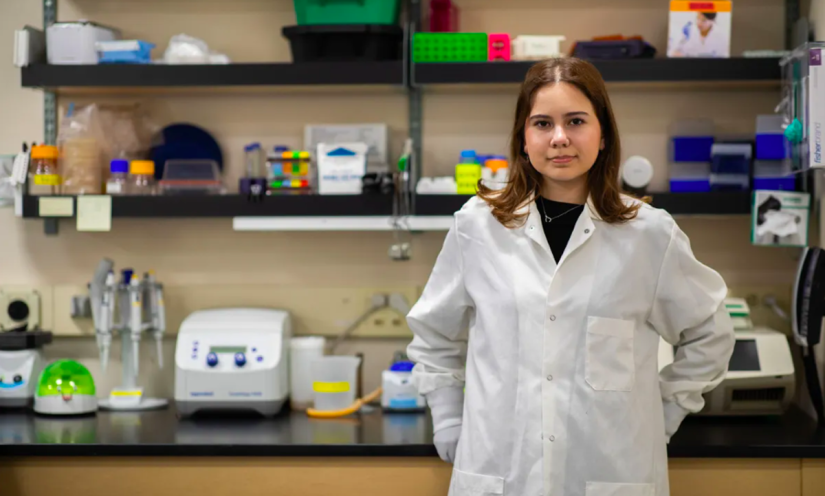
Marisa Mendoza, right, and Camila Valderrama-Martínez, left, get ready to demonstrate how they use lab equipment for their research work at Cal State San Marcos on May 6, 2025. Photo by Adriana Heldiz, CalMatters
From Palomar she was admitted as a transfer student to San Marcos and more selective campuses, including UCLA and UC San Diego. She chose San Marcos, partly to live at home but also because she loved her lab and wanted to continue her research.
She enrolled at San Marcos last fall and furthered her doctoral journey by receiving the U-RISE grant. It was supposed to fund her for two years. The NIH terminated the grant March 31, stripping funds from 20 students.
For a school like San Marcos, where more than 40% of students are low-income enough to receive federal financial aid called Pell grants, the loss of the NIH training awards is a particular blow to the aspiring scientists.
The current climate of doctoral admissions is “definitely at a point where one needs prior research experience to be able to be competitive for Ph.D. programs,” said Elinne Becket, a professor of biological sciences at Cal State San Marcos who runs the microbial ecology lab where Mendoza and other students hone their research for about 15 hours a week.
San Marcos doesn’t have much money to replace its lost grants, which means current and future San Marcos students will “100%” have a harder time entering a doctoral program, Becket added. “It keeps me up at night.”
Research is ‘a missing piece’
In a typical week in Becket’s lab, Mendoza will drive to a nearby wetland or cove to retrieve water samples — part of an ongoing experiment to investigate how microbial changes in the ecosystem are indications of increased pollution in sea life and plants. Sometimes she’ll wear a wetsuit and wade into waters a meter deep.
The next day she’ll extract the DNA from bacteria in her samples and load those into a sequencing machine. The sequencer, which resembles a small dishwasher, packs millions or billions of pieces of DNA onto a single chip that’s then run through a supercomputer a former graduate student built.
“Once I found research, it was like a missing piece,” Mendoza, a Pell grant recipient, said through tears during an interview at Cal State Marcos. Research brought her joy and consumed her life “in the best way,” she added. “It’s really unfortunate that people who are so deserving of these opportunities don’t get to have these opportunities.”
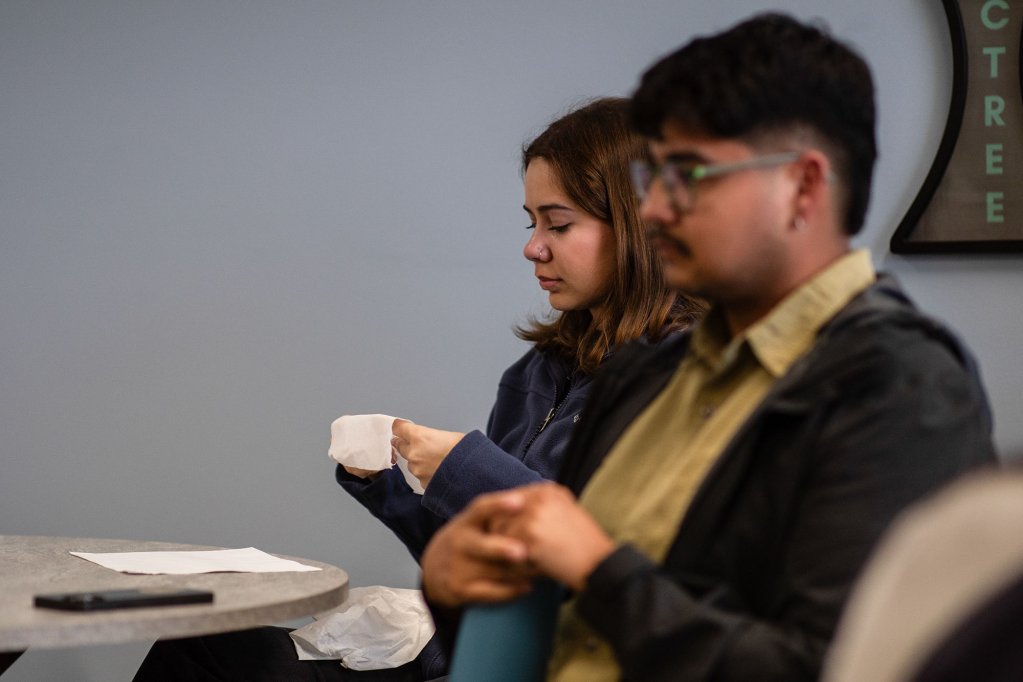
Student Marisa Mendoza gets emotional while she speaks about her research at Cal State San Marcos on May 6, 2025. Photo by Adriana Heldiz, CalMatters
The origins of the San Marcos training center date back to 2002. Through it, more than 160 students have either earned or are currently pursuing doctoral degrees at a U.S. university.
The grant terminations have been emotionally wrenching. “There had been so many tears in my household that my husband got me a puppy,” said Denise Garcia, the director of the center and a professor of biological sciences.
Garcia recalls that in March she was checking a digital chat group on Slack with many other directors of U-RISE grants when suddenly the message board lit up with updates that their grants were gone. At least 63 schools across the country lost their grants, NIH data show.
In the past four years of its U-RISE grant the center has reported to the NIH that 83% of its students entered a doctoral program. That exceeds the campus’s grant goal, which was 65% entering doctoral programs.
Mendoza is grateful: She was one of two students to win a campus scholarship that’ll defray much, but not all, of the costs of attending school after losing her NIH award. That, plus a job at a pharmacy on weekends, may provide enough money to complete her bachelor’s next year.
Others are unsure how they’ll afford college while maintaining a focus on research in the next school year.
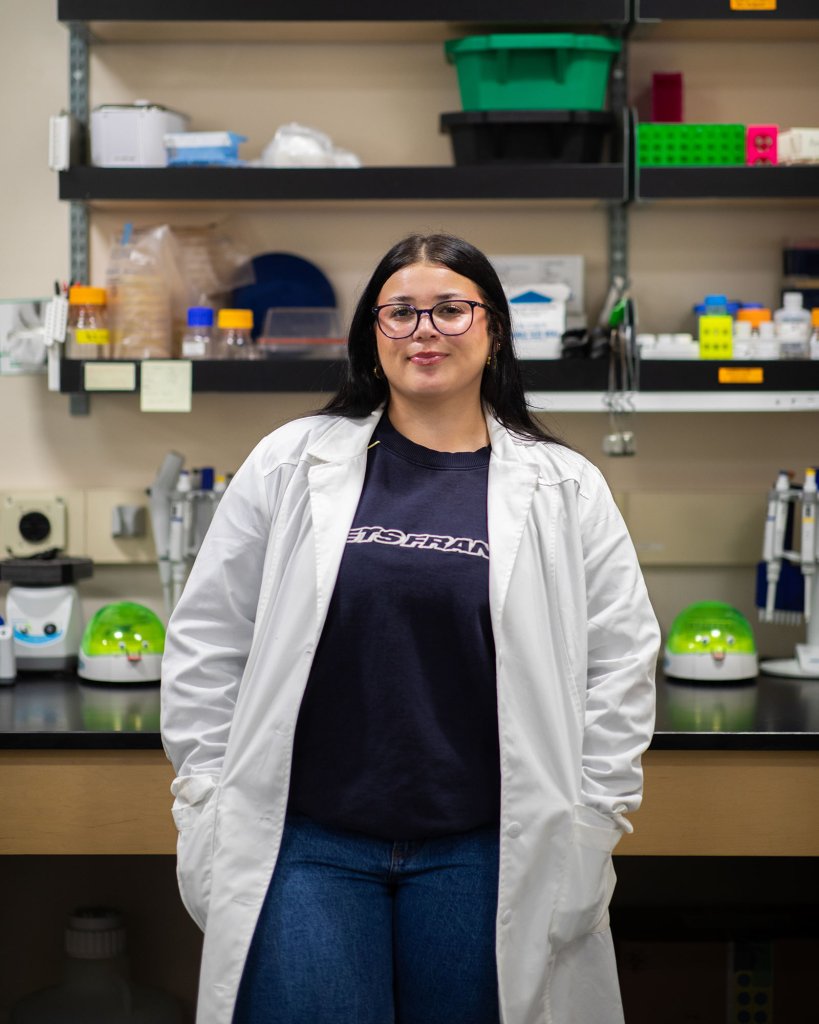
Student Camila Valderrama-Martínez in a lab at Cal State San Marcos on May 6, 2025. Photo by Adriana Heldiz, CalMatters
“You work so hard to put yourself in a position where you don’t have to worry, and then that’s taken away from you,” said Camila Valderrama-Martínez, a first-year graduate student at San Marcos who also earned her bachelor’s there and works in the same lab as Mendoza. She was in her first year of receiving the Bridges to the Doctorate grant meant for students in master’s programs who want to pursue a biomedical-focused doctoral degree. The grant came with a stipend of $26,000 annually for two years plus a tuition waiver of 60% and money to attend conferences.
She can get a job, but that “takes away time from my research and my time in lab and focusing on my studies and my thesis.” She relies solely on federal financial aid to pay for school and a place to live. Getting loans, often anathema for students, seems like her only recourse. “It’s either that or not finish my degree,” she said.
Terminated NIH grants in detail
These grant cancellations are separate from other cuts at the NIH since Trump took office in January, including multi-million-dollar grants for vaccine and disease research. They’re also on top of an NIH plan to dramatically reduce how much universities receive from the agency to pay for maintaining labs, other infrastructure and labor costs that are essential for campus research. California’s attorney general has joined other states led by Democrats in suing the Trump administration to halt and reverse those cuts.
In San Marcos’ case, the latest U-RISE grant lasted all five years, but it wasn’t renewed for funding, even though the application received a high score from an NIH grant committee.
Armenta, the associate director at the Cal State San Marcos training center, recalled that his NIH program officer said that though nothing is certain, he and his team should be “cautiously optimistic that you would be funded again given your score.” That was in January. Weeks later, NIH discontinued the program.
He and Garcia shared the cancellation letters they received from NIH. Most made vague references to changes in NIH’s priorities. However, one letter for a specific grant program cited a common reason why the agency has been cancelling funding: “It is the policy of NIH not to prioritize research programs related to Diversity (sic), equity, and inclusion.”
That’s a departure from the agency’s emphasis on developing a diverse national cadre of scientists. As recently as February, the application page for that grant said “there are many benefits that flow from a diverse scientific workforce.”
Future of doctoral programs unclear
Josue Navarrete graduated this spring from Cal State San Marcos with a degree in computer science. Unlike the other students interviewed for this story, Navarrete, who uses they/them pronouns, was able to complete both years of their NIH training grant and worked in Becket’s lab.
But because of the uncertain climate as the Trump administration attempts to slash funding, Vanderbilt University, which placed Navarrete on a waitlist for a doctoral program, ultimately denied them admission because the university program had to shrink its incoming class, they said. Later, Navarrete met a professor from Vanderbilt at a conference who agreed to review their application. The professor said in any other year, Navarrete would have been admitted.
The setback was heartbreaking.
Josue Navarrete at the Cal State San Marcos campus on May 6, 2025. Photo by Adriana Heldiz, CalMatters
“I’m gripping so hard to stay in research,” Navarrete said. With doctoral plans delayed, they received a job offer from Epic, a large medical software company, but turned it down. “They wanted me to be handling website design and mobile applications, and that’s cool. It’s not for me.”
Valderrama-Martinez cited Navarrete’s story as she wondered whether doctoral programs at universities will have space for her next year. “I doubt in a year things are going to be better,” she said.
She still looks forward to submitting her applications.
So does Mendoza. She wants to study microbiology — the research bug that bit her initially and brought her to San Marcos. Eventually she hopes to land at a private biotech firm and work in drug development.
“Of course I’m gonna get a Ph.D., because that just means I get to do research,” she said.
In 2025, much of my professional focus has been on small colleges in the United States. But as many of you know, my colleague and Edu Alliance co-founder, Dr. Senthil Nathan, and I also consult extensively in the international higher education space. Senthil, based in Abu Dhabi, UAE—where Edu Alliance was founded was asked by a close friend of ours, Chet Haskell, about how the Middle East and its students are reacting to the recent moves by the Trump Administration. Dr. Nathan shared a troubling May 29th article from The National, a UAE English language paper titled, “It’s not worth the risk”: Middle East students put US dreams on hold amid Trump visa crackdown.
The article begins with this chilling line:
“Young people in the Middle East have spoken of their fears after the US government decided to freeze overseas student interviews and plan to begin vetting their social media accounts. The directive signed by Secretary of State Marco Rubio and sent to diplomatic and consular posts halts interview appointments at US universities.”
The UAE, home to nearly 10 million people—90% of whom are expatriates—is a global crossroads. Many of their children attend top-tier international high schools and are academically prepared to study anywhere in the world. Historically, the United States has been a top choice for both undergraduate and graduate education.
But that is changing.
This new wave of student hesitation, and in many cases fear, represents a broader global shift. Today, even the most qualified international students are asking whether the United States is still a safe, welcoming, or stable destination for higher education. And their concerns are justified.
At a time when U.S. institutions are grappling with enrollment challenges—including a shrinking pool of domestic high school graduates—we are simultaneously sending signals that dissuade international students from coming. That’s not just bad policy. It’s bad economics.
According to NAFSA: Association of International Educators, international students contributed $43.8 billion to the U.S. economy during the 2023–2024 academic year and supported 378,175 jobs across the country. These students fill key seats in STEM programs, support local economies, and enrich our campuses in ways that go far beyond tuition payments.
And the stakes go beyond higher education.
A 2024 study found that 101 companies in the S&P 500 are led by foreign-born CEOs. Many of these executives earned their degrees at U.S. universities, underscoring how American higher education is not just a national asset but a global talent incubator that fuels our economy and leadership.
Here are just a few examples:
Jensen Huang: Born in Taiwan (NVIDIA) – B.S. from Oregon State, M.S. from Stanford
Elon Musk: Born in South Africa (Tesla, SpaceX) – B.A. from the University of Pennsylvania
Sundar Pichai: Born in India (Alphabet/Google) – M.S. from Stanford, MBA from Wharton
Mike Krieger: Born in Brazil (Co-founder of Instagram) B.S. and M.S. Symbolic Systems and Human-Computer Interaction, Stanford University
Satya Nadella: Born in India (Microsoft) – M.S. from the University of Wisconsin–Milwaukee, MBA from the University of Chicago
Max Levchin: Born in Ukraine (Co-founder of PayPal, Affirm), Bachelor’s in Computer Science, University of Illinois at Urbana-Champaign
Arvind Krishna: Born in India (IBM) – Ph.D. from the University of Illinois, Urbana-Champaign
Safra Catz: Born in Israel (Oracle) – Undergraduate & J.D. from University of Pennsylvania
Jane Fraser: Born in the United Kingdom (Citigroup) – MBA from Harvard Business School
Nikesh Arora: Born in India (Palo Alto Networks) – MBA from Northeastern
Jan Koum: Born in Ukraine (Co-founder of WhatsApp), Studied Computer Science (did not complete degree) at San Jose State University
These leaders represent just a fraction of the talent pipeline shaped by U.S. universities.
According to a 2023 American Immigration Council report, 44.8% of Fortune 500 companies were founded by immigrants or their children, including iconic firms like Apple, Google, and Tesla. Together, these companies generate $8.1 trillion in annual revenue and employ over 14.8 million people globally.
The Bottom Line
The American higher education brand still carries immense prestige. But prestige alone won’t carry us forward. If we continue to restrict and politicize student visas, we will lose not only potential students but also future scientists, entrepreneurs, job creators, and community leaders.
We must ask: Are our current policies serving national interests, or undermining them?
Our classrooms, campuses, corporations, and communities are stronger when they include the world’s brightest minds. Let’s not close the door on a future we have long helped build.
Dean Hoke is Managing Partner of Edu Alliance Group, a higher education consultancy. He formerly served as President/CEO of the American Association of University Administrators (AAUA). With decades of experience in higher education leadership, consulting, and institutional strategy, he brings a wealth of knowledge on international partnerships and market evaluations.
El College Board modificó este mes los criterios de concesión de becas del Programa Nacional de Reconocimiento o National Recognition Program, en una medida que podría desplazar decenas de miles de dólares de becas de estudiantes negros y latinos a estudiantes blancos.
Las universidades utilizaban los premios para contratar y ofrecer becas a estudiantes de alto rendimiento procedentes de grupos subrepresentados en la enseñanza superior. Anteriormente, el premio reconocía los logros académicos de estudiantes de cinco categorías: negros, hispanos, indígenas americanos, de primera generación y residentes en zonas rurales o ciudades pequeñas.
Las categorías raciales fueron eliminadas.
Ahora, los estudiantes que viven en ciudades pequeñas y zonas rurales pueden seguir obteniendo el premio si obtienen en el PSAT -precursor del SAT que se administra en las escuelas secundarias de todo el país- una puntuación que se sitúe en el 10% superior de todos los estudiantes de ciudades pequeñas y zonas rurales de su estado. Lo mismo ocurre con los estudiantes de primera generación, pero no con los de categorías raciales subrepresentadas.
Relacionados: ¿Le interesan más noticias sobre universidades? Suscríbase a nuestro boletín sobre educación superior quincenal gratuito .
Los críticos se mostraron decepcionados por la decisión del College Board.
“Creían que la desigualdad racial era algo importante que había que abordar ayer, y al cambiar eso, están dando a entender que no es algo importante por lo que luchar ahora”, dijo Rachel Perera, investigadora de estudios gubernamentales en la liberal Brookings Institution. “Esa es la cuestión central que se debate, aunque no se haga de forma explícita: ¿existe la discriminación racial?”.
En una declaración en su sitio web, el College Board recordó la sentencia del Tribunal Supremo de 2023 que prohibió el uso de la raza como criterio en las admisiones, aunque los premios del Programa Nacional de Reconocimiento se utilizaban para becas y contratación, no para admisiones.
“Las recientes acciones legales y regulatorias han limitado aún más la utilidad de estos premios para los estudiantes y las universidades”, dice la declaración. Además, el presidente Donald Trump ha dejado claro en repetidas ocasiones que desaprueba las políticas que tienen en cuenta la raza en la educación superior, y algunos estados han prohibido la consideración de la raza en las decisiones sobre becas.
En 2023-24, el College Board concedió 115.000 premios de reconocimiento y algo menos de la mitad correspondieron a categorías raciales. El año anterior hubo más de 80.000 premios y la mayoría fueron para estudiantes negros, hispanos e indígenas americanos. Aunque el College Board no reparte dinero por sí mismo, las universidades lo utilizan para seleccionar a los estudiantes que recibirán becas. Según Holly Stepp, directora de comunicaciones del College Board, éste no mantiene una lista de las instituciones que utilizaron las categorías raciales.
El College Board inició el programa en 1983 para reconocer a los estudiantes hispanos de alto rendimiento. En 2020, se añadieron las otras dos categorías raciales y las designaciones de ciudad pequeña y rural. Los estudiantes de primera generación pudieron ganar el premio a partir del año pasado. Las ciudades pequeñas podían incluir aquellas con ingresos modestos o enclaves ricos como Aspen (Colorado). Además, todos los estudiantes deben tener al menos una media de B+.
Aunque ahora estudiantes de todas las razas pueden obtener los premios, la supresión de las categorías raciales afectará probablemente de forma desproporcionada a los estudiantes negros e hispanos.
En promedio, los estudiantes asiáticos y blancos obtienen puntuaciones más altas en el PSAT. La puntuación media de los estudiantes blancos en el PSAT del año pasado fue de 994, frente a los 821 de los estudiantes negros, lo que supone una diferencia de 173 puntos. La media de los estudiantes asiáticos fue aún mayor, 1108, mientras que la de los hispanos y los indígenas americanos fue de 852 y 828 puntos, respectivamente.
“Se trata de un avance hacia las categorías que no tienen en cuenta la raza, cuando sabemos que la educación y el acceso a la educación no son independientes de la raza”, afirmó Wil Del Pilar, vicepresidente senior de EdTrust, un grupo político de tendencia izquierdista.
Sin embargo, algunos conservadores elogiaron la medida, argumentando que los programas de becas y contratación en función de la raza eran formas de eludir las sentencias de la Corte Suprema sobre la acción afirmativa y que constituían una forma de discriminación inversa.
Jonathan Butcher, investigador principal de política educativa en la conservadora Heritage Foundation, dijo que cree que la discriminación racial existe y debe abordarse, pero que las políticas educativas que tienen en cuenta la raza son ilegales e ineficaces.
“Si se utilizan preferencias raciales, se está preparando a los estudiantes para que pierdan la confianza en sí mismos cuando se enfrenten a una situación para la que no están preparados”, afirma Butcher.
En lugar de las categorías raciales, este año se ha añadido una nueva designación que reconoce a los estudiantes que obtienen una puntuación en el PSAT dentro del 10% de los mejores de su escuela secundaria.
Los expertos afirman que es poco probable que las universidades ofrezcan becas a todos los estudiantes que obtengan las mejores notas del 10% de todos las escuelas secundarias del país, dado el coste que ello supondría. Funcionarios de la Universidad de Nuevo México, por ejemplo, dijeron que dejarían de utilizar las designaciones del College Board a partir del año escolar 2026-27.
“Actualmente estamos analizando nuestra estrategia de becas, pero se harán cambios en todos los ámbitos”, dijo Steve Carr, director de comunicaciones de la universidad, en un correo electrónico.
En 2023-24, la Universidad de Nuevo México concedió becas por valor de 15.000 dólares cada una a 149 estudiantes negros, hispanos e indígenas americanos.
La Universidad de Arizona también ofreció becas a los estudiantes que obtuvieron premios del Programa de Reconocimiento Nacional en las designaciones raciales el año pasado.
“La universidad ya estaba evaluando su estrategia de becas y tendrá en cuenta el anuncio del College Board a la hora de determinar la mejor manera de avanzar y apoyar a nuestros estudiantes”, dijo Mitch Zak, portavoz de la Universidad de Arizona, en un correo electrónico.
Además de las puntuaciones obtenidas en el PSAT, los estudiantes pueden optar al premio del College Board si obtienen una puntuación de 3 o más en dos de los cinco exámenes de Colocación Avanzada o Advanced Placement realizados durante su noveno y/o décimo curso, aunque muchas escuelas secundarias no ofrecen de manera uniforme cursos AP a los estudiantes de primer y segundo año.
“No podemos hablar de méritos si no estamos todos en el mismo punto de partida en cuanto a lo que recibimos de nuestra educación primaria y secundaria”, dijo Del Pilar, “y cómo podemos desenvolvernos en el entorno de preparación de exámenes, o la falta de preparación de exámenes que reciben ciertas comunidades”.
Comunícate Meredith Kolodner en el 212-870-1063 o en [email protected] o en Signal en merkolodner.04
Esta historia sobre el College Board fue producida por The Hechinger Report, una organización de noticias independiente y sin ánimo de lucro centrada en la desigualdad y la innovación en la educación. Suscríbase al boletín de Hechinger.
The Hechinger Report provides in-depth, fact-based, unbiased reporting on education that is free to all readers. But that doesn’t mean it’s free to produce. Our work keeps educators and the public informed about pressing issues at schools and on campuses throughout the country. We tell the whole story, even when the details are inconvenient. Help us keep doing that.
Decatur, Illinois, has been losing factory jobs for years. A training program at a local community college promises renewal and provides training for students from disenfranchised communities
DECATUR, IL. — A fistfight at a high school football game nearly defined Shawn Honorable’s life.
It was 1999 when he and a group of teen boys were expelled and faced criminal charges over the incident. The story of the “Decatur Seven” drew national headlines and protests led by the Rev. Jesse Jackson, who framed their harsh treatment as blatant racism. The governor eventually intervened, and the students were allowed to attend alternative schools.
Honorable, now 41, was encouraged by support “from around the world,” but he said the incident was traumatizing and he continued to struggle academically and socially. Over the years, he dabbled in illegal activity and was incarcerated, most recently after a 2017 conviction for accepting a large amount of marijuana sent through the mail.
Today, Honorable is ready to start a new chapter, having graduated with honors last week from a clean energy workforce training program at Richland Community College, located in the Central Illinois city of Decatur. He would eventually like to own or manage a solar company, but he has more immediate plans to start a solar-powered mobile hot dog stand. He’s already chosen the name: Buns on the Run.
“By me going back to school and doing this, it shows my nephews and my little cousins and nieces that it is good to have education,” Honorable said. “I know this is going to be the new way of life with solar panels. So I’ll have a step up on everyone. When it comes, I will already be aware of what’s going on with this clean energy thing.”
Shawn Honorable graduated with honors last week from Richland Community College’s clean energy workforce training program in Decatur, Illinois, part of a network of hubs funded by the state’s 2021 Climate and Equitable Jobs Act. Credit: Lloyd DeGrane/Canary Media
After decades of layoffs and factory closings, the community of Decatur is also looking to clean energy as a potential springboard.
Located amid soybean fields a three-hour drive from Chicago, the city was long known for its Caterpillar, Firestone Tire, and massive corn-syrup factories. Industrial jobs have been in decline for decades, though, and high rates of gun violence, child poverty, unemployment, and incarceration were among the reasons the city was named a clean energy workforce hub funded under Illinois’ 2021 Climate and Equitable Jobs Act (CEJA).
Decatur’s hub, based at Richland Community College, is arguably the most developed and successful of the dozen or so established statewide. That’s thanks in part to TCCI Manufacturing, a local, family-owned factory that makes electric vehicle compressors. TCCI is expanding its operations with a state-of-the-art testing facility and an on-site campus where Richland students will take classes adjacent to the manufacturing floor. The electric truck company Rivian also has a factory 50 miles away.
“The pieces are all coming together,” Kara Demirjian, senior vice president of TCCI Manufacturing, said by email. “What makes this region unique is that it’s not just about one company or one product line. It’s about building an entire clean energy ecosystem. The future of EV manufacturing leadership won’t just be on the coasts — it’s being built right here in the Midwest.”
Powering Rural Futures:Clean energy is creating new jobs in rural America, generating opportunities for people who install solar panels, build wind turbines, weatherize homes and more. This five-part series from the Rural News Network explores how industry, state governments and education systems are training this growing workforce.
Related: Want to read more about how climate change is shaping education? Subscribe toour free newsletter.
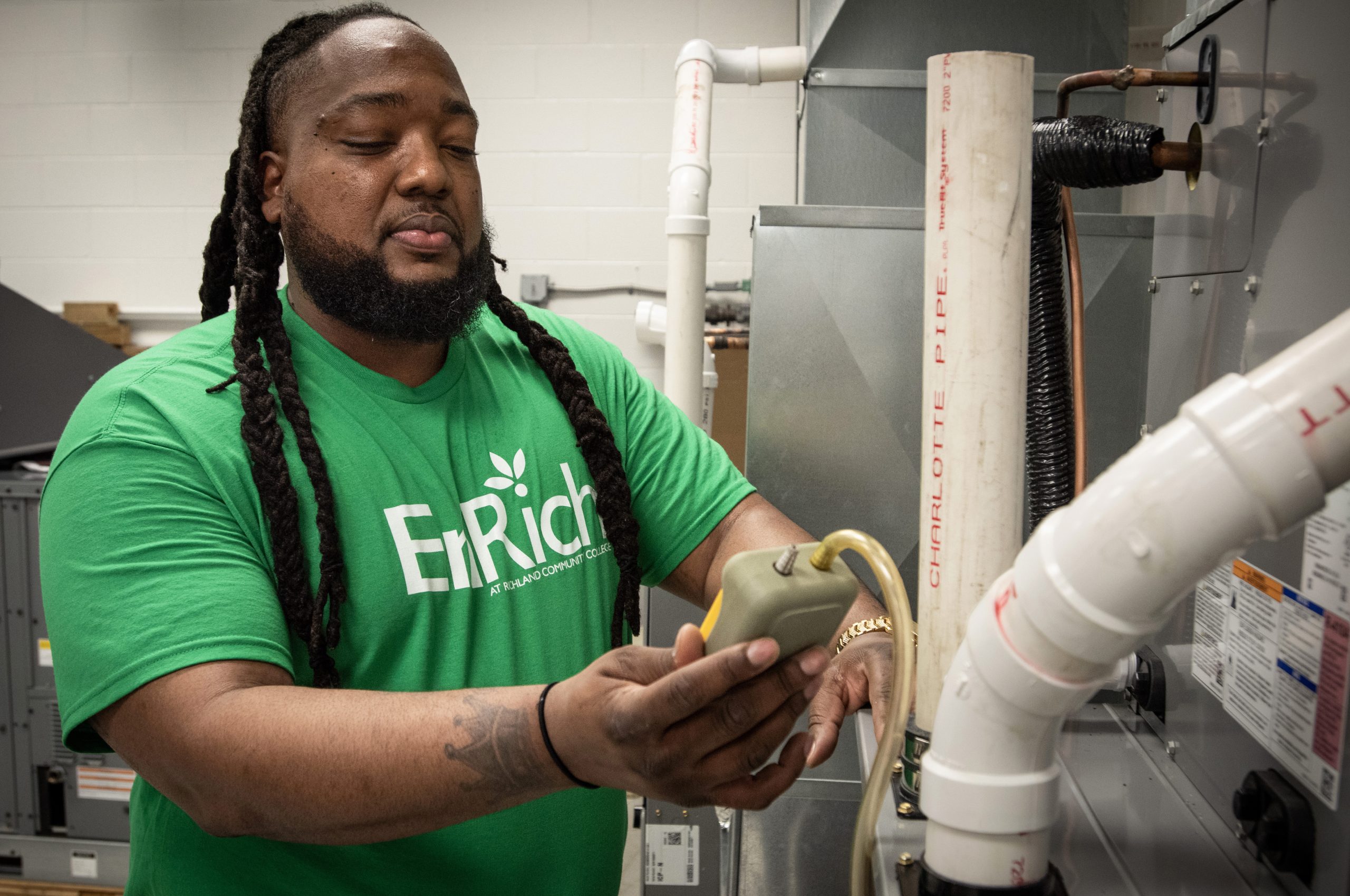
The Decatur CEJA program has also flourished because it was grafted onto a preexisting initiative, EnRich, that helps formerly incarcerated or otherwise disenfranchised people gain new skills and employment. The program is overseen by the Rev. Courtney Carson, a childhood friend of Honorable and another member of the Decatur Seven.
“So many of us suffer significantly from our unmet needs, our unhealed traumas,” said Carson, who was jailed as a young man for gun possession and later drag racing. With the help of mentors including Rev. Jackson and a college basketball coach, he parlayed his past into leadership, becoming associate pastor at a renowned church, leading a highway construction class at Richland, and in 2017 being elected to the same school board that had expelled him.
Carson, now vice president of external relations at the community college, tapped his own experience to shape EnRich as a trauma-informed approach, with wraparound services to help students overcome barriers — from lack of childcare to PTSD to a criminal record. Carson has faith that students can overcome such challenges to build more promising futures, like Decatur itself has done.
“We have all these new opportunities coming in, and there’s a lot of excitement in the city,” Carson said. “That’s magnificent. So what has to happen is these individuals who suffered from closures, they have to be reminded that there is hope.”
Richland Community College’s clean energy jobs training starts with an eight-week life skills course that has long been central to the larger EnRich program. The course uses a Circle of Courage practice inspired by Indigenous communities and helps students prepare to handle stressful workplace situations like being disrespected or even called a racial slur.
“Being called the N-word, couldn’t that make you want to fight somebody? But now you lose your job,” said Carson. “We really dive deep into what’s motivating their attitude and those traumas that have significantly impacted their body to make them respond to situations either the right way or the wrong way.”
The training addresses other dynamics that might be unfamiliar to some students — for example, some male students might not be prepared to be supervised by a woman, Carson noted, or others might not be comfortable with LGBTQ+ coworkers.
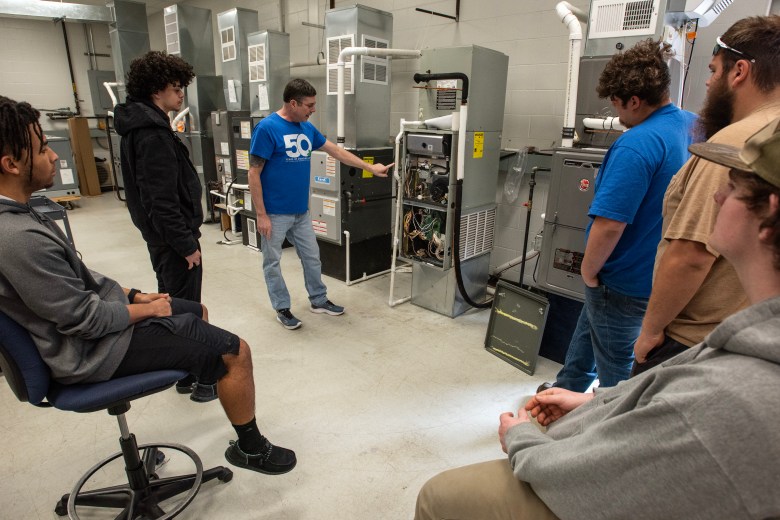
Karl Evans instructs Richland Community College students on the inner workings of a gas furnace. Credit: Lloyd DeGrane/Canary Media
Life skills are followed by a construction math course crucial to many clean energy and other trades jobs. During a recent class, 24-year-old Brylan Hodges joked with the teacher while converting fractions to decimals and percentages on the whiteboard. He explained that he moved from St. Louis to Decatur in search of opportunity, and he hopes to become a property manager overseeing solar panel installation and energy-efficiency upgrades on buildings.
Students take an eight-hour primer in clean energy fields including electric vehicles, solar, HVAC, and home energy auditing. Then they choose a clean energy track to pursue, leading to professional certifications as well as a chance to continue at Richland for an associate degree. Under the state-funded program, students are paid for their time attending classes.
Marcus James was part of the first cohort to start the program last October, just days after his release from prison.
He was an 18-year-old living in Memphis, Tennessee, when someone shot at him, as he describes it, and he fired back, with fatal consequences. He was convicted of murder and spent 12 years behind bars. After his release he made his way to Decatur, looking for a safer place to raise his kids. Adjusting to life on the outside wasn’t easy, and he ended up back in prison for a year and a half on DUI and drug possession charges.
Following his release, he was determined to turn his life around.
“After I brought my kids up here, I end up going back to prison. But at that moment, I realized, man, I had to change,” James told a crowd at an event celebrating the clean jobs program in March.
The Rev. Courtney Carson, vice president of external relations at the community college. Credit: Lloyd DeGrane/Canary Media
James said that at first, he showed up late to every class. But soon the lessons sank in, and he was never late again. He always paid attention when people talked, and he gained new confidence.
“As long as I put my mind to it, I can do it,” said James, who would like to work as a home energy auditor. Richland partners with the energy utility Ameren to place trainees in such positions.
“I like being out in the field, learning new stuff, dealing with homes, helping people,” James said, noting he made energy-efficiency improvements to his own home after the course.
Illinois’ 2017 Future Energy Jobs Act (FEJA) launched the state’s clean energy transition, baking in equity goals that prioritize opportunities for people who benefited least and were harmed most by the fossil fuel economy. It created programs to deploy solar arrays and provide job training in marginalized and environmental justice communities.
FEJA’s rollout was rocky. Funding for equity-focused solar installations went unspent while workforce programs struggled to recruit trainees and connect them with jobs. The pandemic didn’t help. The follow-up legislation, CEJA, expanded workforce training programs and remedied snafus in the original law.
Melissa Gombar is principal director of workforce development programs for Elevate, a Chicago-based national nonprofit organization that oversaw FEJA job training and subcontracts for a Chicago-area CEJA hub. Gombar said many community organizations tasked with running FEJA training programs were relatively small and grassroots, so they had to scramble to build new financial and human resources infrastructure.
“They have to have certain policies in place for hiring and procurement. The influx of grant money might have doubled their budget,” Gombar said. Meanwhile, the state employees tasked with helping the groups “are really talented and skilled, trying their best, but they’re overburdened because of the large lift.”
CEJA, by contrast, tapped community colleges like Richland, which already had robust infrastructure and staffing. CEJA also funds community organizations to serve as “navigators,” using the trust and credibility they’ve developed in communities to recruit trainees.
Richland Community College received $2.6 million from April 2024 through June 2025, and the Community Foundation of Macon County, the hub’s navigator, received $440,000 for the same time period. The other hubs similarly received between $1 million and $3.3 million for the past year, and state officials have said the same level of funding will be allocated for each of the next two years, according to the Illinois Clean Jobs Coalition.
CEJA hubs also include social service providers that connect trainees with wraparound support; businesses like TCCI that offer jobs; and affiliated entrepreneur incubators that help people start their own clean energy businesses. CEJA also funded apprenticeship and pre-apprenticeship programs with labor unions, which are often a prerequisite for employment in utility-scale solar and wind.
“The sum of the parts is greater than the whole,” said Drew Keiser, TCCI vice president of global human resources. “The navigator is saying, ‘Hey, I’ve connected with this portion of the population that’s been overlooked or underserved.’ OK, once you get them trained, send their resumes to me, and I’ll get them interviewed. We’re seeing a real pipeline into careers.”
The hub partners go to great lengths to aid students — for example, coordinating and often paying for transportation, childcare, or even car repairs.
“If you need some help, they always there for you,” James said.
In 1984, TCCI began making vehicle compressors in a Decatur plant formerly used to build Sherman tanks during World War II. A few decades later, the company began producing compressors for electric vehicles, which are much more elaborate and sensitive than those for internal combustion engines.
In August 2023, Gov. JB Pritzker joined TCCI President Richard Demirjian, the Decatur mayor, and college officials for the groundbreaking of an Electric Vehicle Innovation Hub, which will include a climatic research facility — basically a high-tech wind tunnel where companies and researchers from across the world can send EV chargers, batteries, compressors, and other components for testing in extreme temperatures, rain, and wind.
A $21.3 million capital grant and a $2.2 million electric vehicle incentive from the state are funding the wind tunnel and the new facilities where Richland classes will be held. In 2022, Pritzker announced these investments as furthering the state goal of 1 million EVs on the road by 2030.
Far from the gritty industrial environs that likely characterized Decatur workplaces of the past, the classrooms at TCCI feature colorful decor, comfortable armchairs, and bright, airy spaces adjacent to pristine high-tech manufacturing floors lined with machines.
“This hub is a game changer,” said Keiser, noting the need for trained tradespeople. “As a country, we place a lot of emphasis on kids going to college, and maybe we’ve kind of overlooked getting tangible skills in the hands of folks.”
A marketing firm founded by Kara Demirjian – Richard Demirjian’s sister – and located on-site with TCCI also received clean energy hub funds to promote the training program. This has been crucial to the hub’s success, according to Ariana Bennick, account executive at the firm, DCC Marketing. Its team has developed, tested, and deployed digital billboards, mailers, ads, Facebook events, and other approaches to attract trainees and business partners.
“Being a part of something here in Decatur that’s really leading the nation in this clean energy initiative is exciting,” Bennick said. “It can be done here in the middle of the cornfields. We want to show people a framework that they can take and scale in other places.”
With graduation behind him, Honorable is planning the types of hot dogs and sausages he’ll sell at Buns on the Run. He said Tamika Thomas, director of the CEJA program at Richland, has also encouraged him to consider teaching so he can share the clean energy skills he’s learned with others. The world seems wide open with possibilities.
“A little at a time — I’m going to focus on the tasks in front of me that I’m passionate about, and then see what’s next,” Honorable said. He invoked a favorite scene from the cartoon TV series “The Flintstones,” in which the characters’ leg power, rather than wheels and batteries, propelled vehicles: “Like Fred and Barney, I’ll be up and running.”
The Hechinger Report provides in-depth, fact-based, unbiased reporting on education that is free to all readers. But that doesn’t mean it’s free to produce. Our work keeps educators and the public informed about pressing issues at schools and on campuses throughout the country. We tell the whole story, even when the details are inconvenient. Help us keep doing that.
The College Board this month changed the criteria for its National Recognition Program awards in a move that could shift tens of thousands of scholarship dollars from Black and Latino students to white students.
Colleges used the awards to recruit and offer scholarships to high-performing students from groups underrepresented in higher education. The award previously recognized academic achievement by students in five categories — Black, Hispanic, Native American, first-generation and those living in rural areas or small towns.
The racial categories have been eliminated.
Now, students living in small towns and rural areas can still earn the award if they score in the top 10 percent among all small-town and rural students in their state on the PSAT — a precursor to the SAT that is administered in high schools around the country. The same is true for first-generation students but not for students in underrepresented racial categories.
Related: Interested in more news about colleges and universities? Subscribe to our free biweeklyhigher education newsletter.
Critics said they were disappointed by the College Board’s decision.
“They believed racial inequality was something important to address yesterday, and by changing that, they’re implying that it’s not something important to fight for now,” said Rachel Perera, a fellow in government studies at the liberal Brookings Institution. “That’s the heart of the question that’s being debated — although it’s not being debated in explicit terms — does racial discrimination exist?”
In a statement on its website, the College Board noted the 2023 Supreme Court ruling that prohibited the use of race in admissions, although the National Recognition Program awards were used for scholarships and recruitment, not admissions.
“Recent legal and regulatory actions have further limited the utility of these awards for students and colleges,” the statement says. Also, President Donald Trump has repeatedly made clear his disapproval of race-conscious policies in higher education, and some states have banned consideration of race in scholarship decisions.
In 2023-24, the College Board issued 115,000 recognition awards, and a little less than half were in the racial categories. The previous year there were more than 80,000 awards and the majority were for Black, Hispanic and Native American students. While the College Board doesn’t hand out money itself, universities use it to select students for scholarships. The Board has not maintained a list of which institutions used the racial categories, according to Holly Stepp, College Board’s director of communications.
The College Board started the program in 1983 to recognize high-performing Hispanic students. In 2020, the other two racial categories and the small town and rural designations were added. First-generation students could win the award starting last year. Small towns could include those with modest incomes or wealthy enclaves like Aspen, Colorado. All students must also have at least a B+ average.
While students of all races can now earn the awards, the removal of the racial categories will likely disproportionately affect Black and Hispanic students.
On average, Asian and white students score higher on PSATs. White students’ average score on the PSAT last year was 994 last year compared with 821 for Black students — a gap of 173 points. Asian students’ average was even higher at 1108 while Hispanic and Native American students averaged 852 and 828 respectively.
“It’s a move towards race-blind categories when we know that education and access to education isn’t race-blind,” said Wil Del Pilar, senior vice president at the left-leaning policy and advocacy group EdTrust.
Some conservatives praised the move, however, arguing that race-conscious scholarship and recruitment programs were ways to get around the Supreme Court’s rulings on affirmative action and that they were a form of reverse discrimination.
Jonathan Butcher, senior research fellow in education policy at the conservative Heritage Foundation, said he believes that racial discrimination does exist and should be addressed, but that race-conscious education policies were both illegal and ineffective.
“If you are using racial preferences, you are setting students up for a loss of confidence when they struggle in a situation they’re not prepared for,” Butcher said.
In place of the racial categories, a new designation has been added this year that recognizes students who score in the top 10 percent of their high school on the PSAT.
Experts say colleges are unlikely to offer scholarships to all students who score in the top 10 percent of every high school in the country, given the cost that would entail. Officials at the University of New Mexico, for example, said they would stop using the College Board designations beginning in the 2026-27 school year.
“We’re currently analyzing our scholarship strategy, but changes will be made across the board,” said Steve Carr, the university’s director of communications, in an email.
In 2023-24, the University of New Mexico awarded scholarships based on the College Board designations worth $15,000 each to 149 Black, Hispanic and Native American students.
The University of Arizona also offered scholarships to students who earned National Recognition Program awards in the racial designations last year.
“The university was already evaluating its scholarship strategy and will consider the College Board’s announcement as we determine how best to move forward and support our students,” said Mitch Zak, spokesman for the University of Arizona, in an email.
In addition to the PSAT scores, students are eligible for the College Board award if they score a 3 or higher out of 5 on two Advanced Placement exams taken during their ninth and/or 10th grade year, although many high schools don’t uniformly offer AP courses to freshmen and sophomores.
“We can’t really have a conversation around merit if we’re not all at the same starting point in terms of what we receive from our K-12 education,” said Del Pilar, “and how we’re able to navigate the test prep environment, or the lack of test prep that certain communities receive.”
Contact senior investigative reporter Meredith Kolodner at 212-870-1063 or [email protected] or on Signal at merkolodner.04
The Hechinger Report provides in-depth, fact-based, unbiased reporting on education that is free to all readers. But that doesn’t mean it’s free to produce. Our work keeps educators and the public informed about pressing issues at schools and on campuses throughout the country. We tell the whole story, even when the details are inconvenient. Help us keep doing that.
Psychosocial and Academic Trust Alienation (PATA) Theory as a Methodological Lens
Higher education is experiencing post-pandemic challenges which have increased pressure on students in multifaceted and interconnecting ways (Jones & Bell, 2024). Existing research suggests that post-pandemic, students’ mental health and wellbeing has been significantly impacted (Chen & Lubock, 2022; Defeyter et al, 2021; Jones & Bell, 2025; McGiven & Shepherd, 2022; Nunn et al, 2021). This indicates that research into the field of higher education is needed more pro-actively than ever before, especially given the diverse student market.
Currently there is considerable research in the form of critique of policy trends or evaluation of the effectiveness of changes in practice; however, the PATA theory lens suggests an approach to research centring on the educational psychologies and intricacies of the student and the enigma of student engagement (Buckley, 2018; Jones & Nangah, 2020: McFarlane & Thomas, 2017).
Our recent article presents the PATA theory as a methodological lens through which higher education student behaviours, characteristics, and demographics can be researched. Furthermore, it provides an explanation of the PATA theory with specific links to student engagement. The idea of the PATA theory was first explored by Jones in 2017 and developed further in 2020 and 2021 in response to recognised issues faced relating to student engagement in widening participation student demographics. This research establishes the theory which can be applied to investigating the complexities of student demographics, with the aim being to develop knowledge and understanding of issues affecting students such as post-pandemic engagement.
Guidelines from the QAA (2018) state that due to the demographic of the students who attend each institution, student engagement needs to be interpreted and encouraged in response to student/higher education institutional need. Therefore, student engagement can be interpreted in a variety of ways, examining the links between time, energy and other properties invested by HEIs and students with the aims of cultivating the student experience, strengthening educational outcomes, encouraging development and raising student achievement. Positive student engagement can lead to successful student outcomes, lower attrition rates and improved social mobility, demonstrating the importance of research for understanding and investing in student engagement practices.
The PATA theory sits under the umbrella of alienation theory: it considers the individual student’s psychosocial status (self-concept/self-esteem levels) and has identified links to academic trust levels (Jones, 2021), particularly for students from the widening participation demographics or those who have experienced socio-economic disadvantage, see figure 1.
The PATA theory fits as a methodology within the realms of phenomenology as it enables researchers to present a narrative to represent the phenomena studied to extract significant statements from the data to formulate meaning. Neubauer, Witkop and Varpio (2019, p91) believe it is imperative for the researcher engaging in phenomenological research to be familiar with the philosophical ‘interpretations of human experience’, whilst Morrow, Rodriguez and King (2015, p644) advise that ‘descriptive phenomenology is especially valuable in areas where there is little existing research’. An additional crucial aspect of phenomenology is understanding that social reality has to be grounded in an individual’s encounters in authentic social situations. The focal point of the PATA theory lens research is to understand how students’ psychosocial status affects the academic trust of their higher education experiences and the relationships that arise out of the social exchanges therein, permitting researchers to construe the associations that the participants make.
This article analyses the PATA theory potential range of research methods that can be employed and used in higher education practice and is supported by three case vignette examples with reflection points. For example, we would usually see student disengagement relating to activities such as non-attendance, but the PATA theory shows us that the concept of student engagement is much more complex and encourages higher education institutions and professionals to view the issue in a more holistic student-centred way rather than homogenously.
Additionally, post-Covid there has been a significant rise in the number of students presenting with mental health issues, with students struggling to attend and engage with their programmes of study. Currently, the assessment strategies used by HEIs for capturing student engagement fail accurately to measure both student engagement and sense of belonging. However, using the PATA theory as the research lens would provide a deeper insight into the post pandemic issues faced, by focussing on student alienation and the strengthening of trust between the student and the institution. HEIs could then scrutinise their existing on-campus experiences to aid the re-engagement process, and practice could be adapted to increase the student experience, such as including more pastoral 1:1 support time within the timetable.
Some further practical illustrations of how the PATA theory might influence our understanding or make a difference in practice are:
To understand potential psychological barriers to student engagement based on demographics, behaviours and characteristics.
To identify success stories of positive engagement where good practice can be disseminated or shared to improve student outcomes.
To take a deep dive into higher education practices, course or programmes to find out if there are specific teaching and learning barriers affecting students.
Provides time and space to analyse intricate needs of specific demographics; behaviours and characteristics such as impact of low tariff on entry gaps or previous educational experiences.
Can lead to bespoke action to address potential equality and inclusion concerns.
Can be used as an early intervention tool to support students’ re-engagement potentially contributing to reduced attrition and improvements in social mobility.
Can be used to explore wider societal issues that affect engagement
The PATA theory has its limitations, being a new and emerging theoretical perspective, and is very much open to academic critique. However, this concept does bring new insight to the complexities of the student community, the higher education institutional and political landscapes and could be used as a methodological lens to develop deeper knowledge and understanding of student engagement challenges. Whilst the PATA theory is a complex idea applied to a range of complex student issues, when the phenomenon is understood well, there is the potential to really make a difference to the educational outcomes for students. Furthermore, existing theories do not make connections between psychosocial status and academic trust which is where the PATA theory can contribute to a stronger understanding of the student phenomena.
The article on which this blog is based is
Jones, C. S., and Sweeney, L (2025) ‘The Psychosocial and Academic Trust Alienation (PATA) Theory: A new lens to research higher education student phenomena: behaviours, characteristics, and demographics’ Student Engagement in Higher Education Journal, 6(1), 79–110 https://sehej.raise-network.com/raise/article/view/1240.
Caroline Jones is an applied social sciences teaching professional with extensive experience working in the children and young people field and lecturing/programme leading in Higher Education. Currently employed as a Tutor based within the Health and Education Faculty at Manchester Metropolitan University, having previously been a Lecturer at the University Campus Oldham and at Stockport University Centre. Also an External Examiner for Derby University/Middlesex University and a Peer Reviewer for IETI. Research interests include; leadership and management, social mobility and social policy, risk, resilience and adolescent mental health, young care leavers, widening participation and disadvantage, originator of the ‘psychosocial and academic trust alienation’ (PATA) theory.
Leonie Sweeney is a teaching professional within the Applied Social Sciences faculty at Manchester Metropolitan University, with many years of experience working within the children and young people sector. Currently employed as a Higher Education Course Leader and Lecturer, delivering Children and Young People and Early Years degree courses. Additionally, is an External Examiner for University of Chichester and University of Sunderland. Research interests include: student engagement, social mobility, widening participation.
May 19, 2025, by Dean Hoke: In my recent blog series and podcast, Small College America, I’ve highlighted the essential role small colleges play in the fabric of U.S. higher education. These institutions serve as academic homes to students who often desire alternatives to larger universities, and as cultural and economic anchors, especially in rural and small-town America, where, according to IPEDS, 324 private nonprofit colleges operate. Many are deeply embedded in the towns they serve, providing jobs, educational access, cultural life, and long-term economic opportunity.
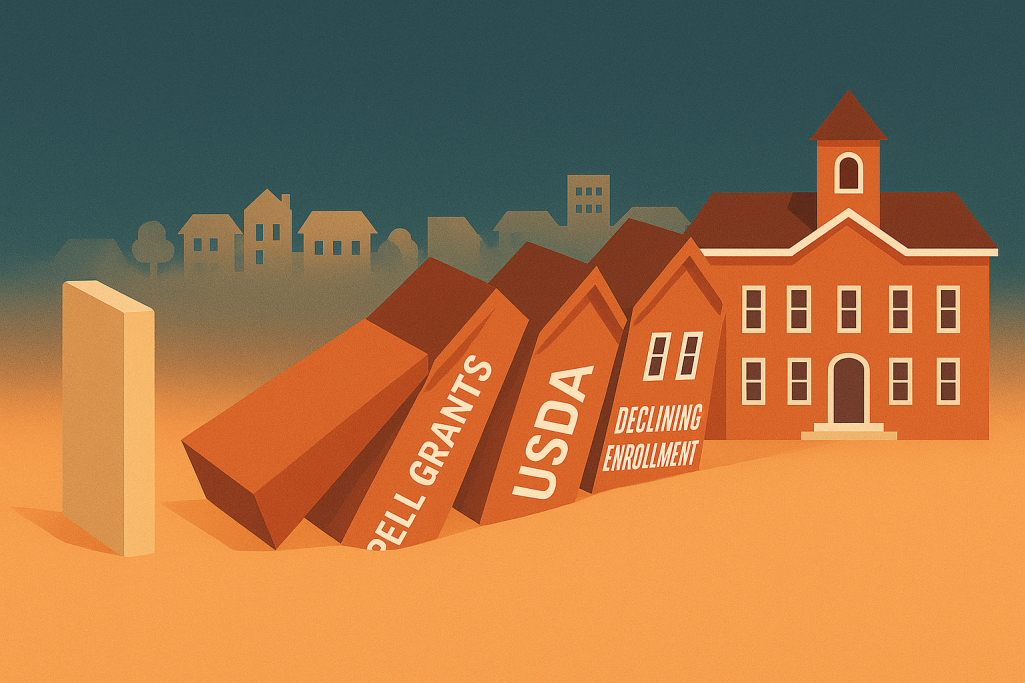
Unfortunately, a wave of proposed federal budget cuts may further severely compromise these institutions’ ability to function—and in some cases, survive. Without intervention, the ripple effects could devastate entire communities.
Understanding the DOE and USDA Budget Cuts
The proposed reductions to the U.S. Department of Education (DOE) and U.S. Department of Agriculture (USDA) budgets present a two-pronged threat to small colleges, particularly those in rural areas or serving low-income student populations.
Department of Education (DOE)
The most significant concerns center on proposed changes to Pell Grants, a vital financial resource for low-income students. One House proposal would redefine full-time enrollment from 12 to 15 credit hours per semester. If enacted, this change would reduce the average Pell Grant by approximately $1,479 for students taking 12 credits. Students enrolled less than half-time could become ineligible entirely.
Additionally, the Federal Work-Study (FWS) and Supplemental Educational Opportunity Grants (SEOG) programs face serious threats. The House Appropriations Subcommittee has proposed eliminating both programs, which together provide over $2 billion annually in aid to low-income students.
Programs like TRIO and GEAR UP, which support first-generation, low-income, and underrepresented students, have been targeted in previous proposals; however, current budget drafts maintain level funding. Nonetheless, their future remains uncertain as negotiations continue.
The Title III Strengthening Institutions Program, which funds academic support services, infrastructure, and student retention efforts at under-resourced colleges, received a proposed funding increase in the FY 2024 President’s Budget, though congressional appropriations may differ.
Department of Agriculture (USDA)
The USDA’s impact on small colleges, while less direct, is nonetheless critical. Discretionary funding was reduced by more than $380 million in FY 2024, reflecting a general pullback in rural investment.
Programs like the Community Facilities Direct Loan & Grant Program, which supports broadband access, healthcare facilities, and community infrastructure, were level-funded at $2.8 billion. These investments often benefit rural colleges directly or indirectly by enhancing the communities in which they operate.
While some funding has been maintained, the broader trend suggests tighter resources for rural development in the years ahead. For small colleges embedded in these communities, the consequences could be substantial: delayed infrastructure upgrades, reduced student access to services, and weakened town-gown partnerships.
Why Small Colleges Are Particularly Vulnerable
Small private nonprofit colleges—typically enrolling fewer than 3,000 students—operate on thin margins. Many are tuition-dependent, with over 80% of their operating revenue derived from tuition and fees. They lack the substantial endowments or large alumni donor bases that buoy more prominent institutions during hard times.
What exacerbates their vulnerability is the student profile they serve. Small colleges disproportionately enroll Pell-eligible, first-generation, and minority students. Reductions in federal financial aid and student support programs have a direct impact on student enrollment and retention. If students can’t afford to enroll—or stay enrolled—colleges see revenue declines, leading to cuts in academic offerings, faculty, and student services.
Additionally, small colleges are often located in areas experiencing population decline. The so-called “demographic cliff”—a projected 13% drop in the number of high school graduates from 2025 to 2041 will affect 38 states and is expected to hit rural and non-urban regions the hardest. This compounds the enrollment challenges many small colleges are already facing.
Economic and Social Impact on Rural Towns
The closure of a small college doesn’t just mean the loss of a school; it signifies a seismic shift in a community’s economic and social structure. Colleges often rank among the top employers in their towns. When a college closes, hundreds of jobs disappear—faculty, staff, groundskeepers, maintenance, food services, IT professionals, and more.
Consider Mount Pleasant, Iowa, where the closure of Iowa Wesleyan University in 2023 cost the local economy an estimated $55 million annually. Businesses that relied on student and faculty patronage—restaurants, barbershops, bookstores, and even landlords—felt the immediate impact. Community organizations lost vital volunteers. Town officials were left scrambling to figure out what to do with a sprawling, empty campus in the heart of their city.
Colleges also provide cultural enrichment that is often otherwise absent in small towns. Lectures, concerts, art exhibitions, and sporting events bring together diverse groups and add vibrancy to the local culture. Many offer healthcare clinics, counseling centers, or continuing education for adults—services that disappear with a campus closure.
USDA investments in these communities are often tied to colleges, whether in the form of shared infrastructure, grant-funded development projects, or broadband expansions to support online learning. As these federal investments diminish, so too does a town’s ability to attract and retain both residents and employers.
Real-Life Implications and Stories
The headlines tell one story, but the real impact is felt in the lives of students, faculty, and the surrounding communities.
Presentation College in Aberdeen, South Dakota, ceased operations on October 31, 2023, after citing unsustainable financial and enrollment challenges. Hundreds of students, many drawn to its affordability, rural location, and nursing programs, were forced to reconsider their futures. The college quickly arranged teach-out agreements with over 30 institutions, including Northern State University and St. Ambrose University, which offered pathways for students to complete their degrees. The Presentation Sisters, the founding order, are now seeking a buyer for the campus aligned with their values, while local officials explore transforming the site into a technical education hub to continue serving the community.
Birmingham-Southern College in Alabama, a 168-year-old institution, closed its doors on May 31, 2024, after a $30 million state-backed loan request was ultimately rejected despite initial legislative support. The college had a $128 million annual economic impact on Birmingham and maintained partnerships with K–12 schools, correctional institutions, and nonprofits. The closure triggered the transfer of over 150 students to nearby colleges like Samford University, but left faculty, staff, and the broader community facing economic and cultural losses. A proposed sale of the campus to Miles College fell through, leaving the site’s future in limbo.
Even college leaders who have weathered the past decade worry they’re nearing a breaking point. Rachel Burns of the State Higher Education Executive Officers Association (SHEEO) has tracked dozens of recent closures and warns that many institutions remain at serious risk, despite their best efforts. “They just can’t rebound enrollment,” she says, noting that pandemic aid only temporarily masked deeper structural vulnerabilities.
Potential Closures and Projections
College closures are accelerating across the United States. According to the State Higher Education Executive Officers Association (SHEEO), 467 institutions closed between 2004 and 2020—over 20% of them private, nonprofit four-year colleges. Since 2020, at least 75 more nonprofit colleges have shut down, and many experts believe this pace is quickening.
A 2023 analysis by EY-Parthenon warned that 1 in 10 four-year institutions—roughly 200 to 230 colleges—are currently in financial jeopardy. These schools are often small, private, rural, and tuition-dependent, serving large numbers of first-generation and Pell-eligible students. Even a modest drop of 5–10% in tuition revenue can be catastrophic for colleges already operating on razor-thin margins.
Compounding the challenge, the Federal Reserve Bank of Philadelphia released a 2024 predictive model forecasting that as many as 80 additional colleges could close by 2034 under sustained enrollment decline driven by demographic shifts. This figure accounts for closures only—not mergers—and spans public, private nonprofit, and for-profit sectors.
Layered onto these economic and demographic vulnerabilities are the potential impacts of proposed federal education funding cuts. The Trump administration’s FY 2026 budget blueprint once again targets student aid programs, proposing the elimination or severe reduction of subsidized student loans, TRIO, GEAR UP, Federal Work-Study, and the Supplemental Educational Opportunity Grant (SEOG). Although similar proposals from Trump’s first term (FY 2018–2021) were rejected by Congress, the renewed push signals ongoing political pressure to curtail support for low-income and first-generation students.
To assess the potential impact of these policy shifts, a policy stress test was applied to both the Philadelphia Fed model and the historical closure trend. The analysis suggests that if these cuts were enacted, an additional 50 to 70 closures could occur by 2034.
Philadelphia Fed model baseline: 80 projected closures
With policy cuts: Up to 130 closures
Historical average trend (2020–2024): ~14 closures/year
10-year projection (status quo): ~140 closures
With policy cuts: Up to 210 closures
In short, depending on the scenario, anywhere from 130 to 210 additional college closures may occur by 2034. Institutions most at risk are those that serve the very populations these federal programs are designed to support. Without intervention—through policy, partnerships, or funding—the number of closures could rise sharply in the years ahead.
These scenario-based projections are summarized in the chart below.
Why Should Congress Care
According to the National Association of Independent Colleges and Universities (NAICU), a private, nonprofit college or university is located in 395 of the 435 congressional districts. These institutions are not only centers of learning but also powerful economic engines that generate:
$591.5 billion in national economic impact
$77.6 billion in combined local, state, and federal tax revenue
3.4 million jobs supported or sustained
1.1 million people are directly employed in private nonprofit higher education
1.1 million graduates are entering the workforce each year
As such, the fate of small private colleges is not just a higher education issue—it is a national economic and workforce development issue that should command bipartisan attention.
Strategies for Resilience and Policy Recommendations
There are clear, actionable strategies to reduce the risk of widespread college closures:
Consortium and shared governance models: Small colleges can boost efficiency and sustainability by sharing administrative functions, faculty, academic programs, technology infrastructure, and enrollment services. This allows institutions to reduce operational costs while maintaining their distinct missions and brands. In some cases, these arrangements evolve into formal mergers. An emerging example is the Coalition for the Common Good, a new model of mission-aligned institutions that maintain individual identities but operate under shared governance. This structure offers long-term financial stability without sacrificing institutional purpose or community impact.
Strategic partnerships: Collaborations with community colleges, online education providers, regional employers, and nonprofit organizations can expand reach, enhance curricular offerings, and improve student outcomes. These partnerships can support 2+2 transfer pipelines, workforce-aligned certificate programs, and hybrid learning models that meet the needs of adult learners and working professionals, often underserved by traditional residential colleges.
State action: States should establish stabilization grant programs and offer targeted incentive funding to support mergers, consortium participation, and regional collaboration. Policies that protect institutional access in rural and underserved areas are especially urgent, as closures can leave entire regions without viable higher education options. States can also play a role in convening institutions to plan for shared services and long-term viability.
Federal investment: Continued and expanded funding for Pell Grants, TRIO, SEOG, Title III and V, and USDA rural development programs is essential to sustaining the institutions that serve low-income, first-generation, and rural students. These investments should be treated as critical infrastructure, not discretionary spending, given their role in expanding educational equity, enhancing workforce readiness, and promoting rural economic development. Consistent federal support can help stabilize small colleges and enable long-term planning.
College leaders, local governments, and community groups must advocate in unison. The conversation should move beyond institutional survival to one of community survival. As the saying goes, when a college dies, the town begins to die with it.
Conclusion
Small colleges are not expendable. They are vital threads in the educational, economic, and cultural fabric of America, especially in rural and underserved communities. The proposed federal budget cuts across the Departments of Education and Agriculture represent a direct threat not only to these institutions but to the communities that depend on them.
If policymakers fail to act, the consequences will be widespread and enduring. The domino effect is real: reduced funding leads to fewer students, tighter budgets, staff layoffs, program cuts, and eventually, campus closures. And when those campuses close, entire towns are left to absorb the fallout—economically, socially, and spiritually.
We have a choice. We can invest in the future of small colleges and the communities they anchor, or we can stand by as they vanish—along with the promise they hold for millions of students and the towns they call home.
References
U.S. Department of Education, FY 2025 Budget Summary and Justifications
National Association of Student Financial Aid Administrators (NASFAA), Analysis of Proposed Pell Grant and Campus-Based Aid Reductions
State Higher Education Executive Officers Association (SHEEO) and Higher Ed Dive, Data on College Closures and Institutional Viability Trends
Fitch Ratings, Reports on Financial Pressures in U.S. Higher Education Institutions
Iowa Public Radio and The Hechinger Report, Case Studies on Rural College Closures and Community Impact
Council for Opportunity in Education (COE), Statements and Data on TRIO Program Reach and Effectiveness
Federal Reserve Bank of Philadelphia, Predictive Modeling of U.S. College Closures (2024)
EY-Parthenon, 2023 Report on Financial Vulnerability Among Four-Year Institutions
U.S. Department of Agriculture (USDA), Rural Development and Community Facilities Loan & Grant Program Summaries
Interviews and commentary from institutional leaders, TRIO program directors, and SHEEO policy staff
Integrated Postsecondary Education Data System (IPEDS), Data on Enrollment, Institution Type, and Geographic Distribution
Dean Hoke is Managing Partner of Edu Alliance Group, a higher education consultancy. He formerly served as President/CEO of the American Association of University Administrators (AAUA). With decades of experience in higher education leadership, consulting, and institutional strategy, he brings a wealth of knowledge on small colleges’ challenges and opportunities. Dean is the Executive Producer and co-host for the podcast series Small College America.
DAVENPORT, Iowa — The Catholic prayer for the faithful echoed off the limestone walls and marble floor of the high-ceilinged chapel.
It implored God to comfort the poor and the hungry. The sick and the suffering. The anxious and the afraid.
Then it took an unexpected turn.
“Lord, hear our prayer for St. Ambrose and Mount Mercy University,” the young voice said, “that the grace of the Holy Spirit may help us to follow God’s plan for our new partnership.”
The speaker was talking about ongoing efforts to unite St. Ambrose University, where this weeknight Mass was being held, with fellow Catholic university Mount Mercy. Small religious schools in rural states are shutting down at an accelerating rate, a fate these two are attempting to avoid.
Credit: Mike Rundle for The Hechinger Report
“Lord, hear our prayer,” responded the congregation of students in St. Ambrose-branded T-shirts and hoodies.
The heads of both St. Ambrose and Mount Mercy, which is in Cedar Rapids, said they’ve watched as nearby religiously affiliated colleges, athletic rivals and institutions that employed their friends and former colleagues closed.
With falling numbers of applicants to college — especially in the Midwest — “we just don’t have the demographics anymore,” said St. Ambrose President Amy Novak. Now, as fewer graduates emerge from high schools, combining forces is a way to forestall “the reality that we might all see in five or seven years,” Novak said.
For many other small religiously affiliated institutions, time has already run out.
More than half of the 77 nonprofit colleges and universities that have closed or merged since 2020, or announced that they will close or merge, were religiously affiliated, according to a Hechinger Report analysis of news coverage and federal data. More than 30 that are still in business are on a U.S. Department of Education list of institutions considered “not financially responsible” because of comparatively low cash reserves and net income and high levels of debt.
Related: Interested in innovations in higher education? Subscribe to our free biweekly higher education newsletter.
Some small, religiously affiliated institutions that are not on these lists are also showing signs of strain. Saint Augustine’s University in North Carolina, which is Episcopal, has 200 students, down from 1,100 two years ago, and has lost its accreditation. The 166-year-old St. Francis College in New York, which is Catholic, has sacked a quarter of its staff. Catholic Saint Louis University in Missouri laid off 20 employees, eliminated 130 unfilled faculty and staff positions and sold off its medical practice after running a deficit.
Bluffton University in Ohio, which is Mennonite, is looking for a new partner after a planned merger fell through in February and the president resigned. Catholic St. Norbert College in Wisconsin is eliminating 11 majors and minors and 21 faculty positions. And Georgetown College in Kentucky averted closing only after an alumnus gave it $16 million, which, along with another $12 million in donations, was enough to pay off crippling debt that was costing the small Baptist institution $3 million a year just in interest.
Other religiously affiliated schools are also taking steps to buttress themselves against demographic and financial challenges. Ursuline College in Ohio, for instance, which has fewer than 1,000 students, has agreed to merge with larger Gannon University, 95 miles away. Both are Catholic. Spring Hill College in Alabama and Rockhurst University in Missouri, both also Catholic, are teaming up so they can jointly offer more academic programs, though they will remain independent.
More than a fifth of colleges and universities in the United States, or 849 out of 3,893, are religiously affiliated, according to the most recent figures from the National Center for Education Statistics.
The threats to them are getting new attention. Presidents of 20 Catholic universities and colleges met in November in Chicago at a conference sponsored by DePaul University and held at the offices of the Deloitte consulting firm, which collected data to help them figure out solutions to the challenges they face.
“The intent was to think about a blueprint for the future of Catholic higher education,” including more partnerships, shared services and other kinds of alliances, said Donna Carroll, president of the Association of Catholic Colleges and Universities. “Survival of the fittest is not the strategy that will advance the common good of Catholic higher education. We have to work together.”
The American Council on Education last year launched a Commission on Faith-Based Colleges and Universities, with leaders of what has since grown to 17 institutions including Pepperdine, Brigham Young and Yeshiva universities and the University of Notre Dame.
The idea of the commission, which is scheduled to meet in Washington in June, is “to increase visibility for the important contributions of religious and faith-based colleges and universities and to foster collaboration” among them.
Some religious colleges and universities are doing fine, and even posting enrollment gains — at least in part because of growing political divisions, campus protests and ideological attacks on secular institutions, said David Hoag, president of the Council for Christian Colleges and Universities.
Credit: Mike Rundle for The Hechinger Report
Parents are “wanting to put their son or daughter at a safe place that’s going to have a biblical worldview or a way to look at challenges that’s not polarized,” Hoag said. “At our institutions, you’re not going to be seeing protests or things that are happening at many of these [other] universities and colleges. You’re going to see them rallying together, whether it’s for a sporting event or for a revival or baptisms.”
Other trends also offer some hope to religiously affiliated colleges and universities. A long decline in the proportion of adults who consider themselves affiliated with a religion appears to have leveled off, the Pew Research Center finds. And while enrollment at parochial schools that feed graduates to Catholic universities fell more than 10 percent from 2017 to 2021, the most recent year for which the figure is available, the number of students at other kinds of religious primary and secondary schools is up.
Even religiously affiliated institutions confronting the realities of falling enrollment and financial woes fill a critically important role, their advocates say. They often serve low-income students who are the first in their families to go to college and are reluctant to enroll at large public universities.
Many are in rural areas where access to higher education is more limited than in urban and suburban places and is becoming less available still as public universities in rural states have merged or closed or cut dozens of majors.
Attending a small rural, religiously affiliated institution “is, I think — especially for rural students — a great opportunity,” said Todd Olson, president of Mount Mercy, above the sound of trains crossing Cedar Rapids outside his window. “I know kids from very small towns around Iowa,” like the one where he grew up, Olson said. “This campus is a much more comfortable place for them.”
Credit: Mike Rundle for The Hechinger Report
When Jacob Lange arrived at St. Ambrose from East Dubuque, Illinois, and attended a Mass on campus, “all of a sudden all these new people I had never met were kind of chatting with me and it was really kind of nice. It felt like I was kind of included and I didn’t really think I would be originally,” he said. “You figure, ‘I’m probably going to sit in the back and probably not talk to anyone all night,’ and then I showed up, and I walked out here and all of a sudden they’re, like, ‘Here, come join our group.’ ”
His parents also liked that he decided to go to a Catholic university, Lange said. “You know, you go to one of these big schools with 25,000 kids, and you’re kind of worried about your kid — like, what kind of dumb things is he going to get up to?”
Catholic universities in particular have a slightly higher four-year graduation rate than the national average, according to the Center for Catholic Studies at St. Mary’s University in Texas. Graduates have a stronger sense of community purpose, the center found in a survey. Alumni are 9 percentage points more likely to say they participate in civic activities.
More students at religiously affiliated than at secular institutions receive financial aid, the American Council on Education says. Three out of five get scholarships from the colleges themselves, compared to fewer than one in four at other kinds of schools. At both Mount Mercy and St. Ambrose, which have about 1,450 and 2,700 students, respectively, 100 percent get financial aid.
But these benefits for students can be vulnerabilities for budgets, said Novak, at St. Ambrose.
“We serve the poor. We educate the poor,” she said. “That is a risky financial proposition at the moment for small, regional institutions that are largely tuition-driven.”
The threats to smaller religiously affiliated institutions in rural areas stem largely from the downturn in the already short supply of high school graduates choosing to enroll. The proportion of such students going straight to college has fallen even more sharply in many largely rural states.
While they’re generous with their financial aid, religiously affiliated colleges are also generally more expensive than many other higher education institutions, at a time when many families are questioning the return on their investments in tuition. Median tuition and fees average $25,416 a year, according to the American Council on Education.
St. Ambrose and Mount Mercy, about 90 minutes away,are teaming up from positions of relative strength. Publicly available financial documents suggest that neither faces the immediate enrollment or financial crises that threaten many similar institutions. But their leaders say that they’re trying to fend off problems that could arise later. By joining forces, each can increase its number of programs while lowering administrative costs.
Reaction among students and alumni has been mixed.
Combining with St. Ambrose “was kind of nerve-racking at the beginning because it’s, like, ‘Oh, this is a lot of change,’ ” said Alaina Bina, a junior nursing major at Mount Mercy.
She picked the university in the first place because she liked the small, hilly campus.
“I came from a small town, so I didn’t really want to go bigger,” she said. “Even when I came here on a tour, people would say ‘Hi’ to each other. You just know everyone, and that’s kind of how it is in a small town, too.”
Students were worried about what name would appear on their degrees (the degrees will still say “Mount Mercy”) and whether sports teams that once competed against each other would be merged. Novak and Olson promised to keep their athletics programs separate and even add a sport at Mount Mercy: football, beginning in 2026.
Combining sports teams “would not be wise at all from a business perspective,” Olson said the two agreed, because they are “a powerful enrollment driver” for both schools.
Credit: Mike Rundle for The Hechinger Report
“Honestly, this was probably the biggest student concern,” said Nasharia Patterson, student government president at Mount Mercy, who was wearing a brace on her wrist from an awkward back tuck basket catch during cheer practice. Keeping the athletics teams “gives us a piece of Mount Mercy specifically to just hold on to.”
Among alumni, meanwhile, “there’s mixed feelings” about what’s happening to their alma mater, said Sarah Watson, a leadership development consultant who graduated from Mount Mercy in 2008.
Still, she said, “I know the great challenges that higher ed is facing right now. It’s not just Mount Mercy. It’s not just St. Ambrose. It’s the bigger schools, too. Enrollment numbers have dropped. The desire to go to a traditional four-year college is just not quite what it used to be.”
For Mount Mercy, which was founded by an order of nuns in 1928, Watson said, “If we don’t do this, what’s the alternative? We want to be around for another hundred years.”
After all, said Novak, the St. Ambrose president, “to watch universities close across the heartland because we can’t make it work will leave our communities fallow.”
Carroll, of the Catholic colleges and university association, said that many other religiously affiliated institutions are closely watching what’s happening at St. Ambrose and Mount Mercy.
“It’s a leap of faith,” she said. “And who better to take a leap of faith than a Catholic institution?”
Religiously affiliated colleges that have closed or merged, or announced that they will merge, since 2020
Alderson Broaddus University, West Virginia, Baptist
Alliance University, New York, Christian
Ancilla College, Indiana, Catholic
B. H. Carroll Theological Institute, Texas, Baptist
Birmingham-Southern College, Alabama, Methodist
Bloomfield College, New Jersey, Presbyterian
Cabrini University, Pennsylvania, Catholic
Cardinal Stritch University, Wisconsin, Catholic
Chatfield College, Ohio, Catholic
Clarks Summit University, Pennsylvania, Baptist
College of Saint Rose, New York, Catholic
Compass College of Film & Media, Michigan, Christian
Concordia College New York, Lutheran
Concordia University, Oregon, Lutheran
Eastern Nazarene College, Massachusetts, Christian
Finlandia University, Michigan, Lutheran
Fontbonne University, Missouri, Catholic
Holy Family College, Wisconsin, Catholic
Holy Names University, California, Catholic
Iowa Wesleyan University, Iowa, Methodist
Judson College, Alabama, Baptist
Limestone University, South Carolina, Christian
Lincoln Christian University, Illinois, Christian
MacMurray College, Illinois, Methodist
Magdalen College, New Hampshire, Catholic
Martin Methodist College, Tennessee, Methodist
Marymount California University, California, Catholic
Mount Mercy University, Iowa, Catholic
Multnomah University, Oregon, Christian
Nebraska Christian College, Nebraska, Christian
Notre Dame College of Ohio, Catholic
Ohio Valley University, West Virginia, Christian
Presentation College, South Dakota, Catholic
Rosemont College, Pennsylvania, Catholic
St. Louis Christian College, Missouri, Christian
St. Augustine College, Illinois, Episcopal
St. John’s University Staten Island campus, New York, Catholic
University of Saint Katherine, California, Orthodox Christian
Ursuline College, Ohio, Catholic
Wave Leadership College, Virginia, Christian
Wesley College, Delaware, Methodist
SOURCE: Hechinger Report analysis of news coverage and federal data.
The Hechinger Report provides in-depth, fact-based, unbiased reporting on education that is free to all readers. But that doesn’t mean it’s free to produce. Our work keeps educators and the public informed about pressing issues at schools and on campuses throughout the country. We tell the whole story, even when the details are inconvenient. Help us keep doing that.