The legal challenge takes aim at Rubio’s use of statutes to deport legal noncitizens, namely international students Mahmoud Khalil and Rümeysa Öztürk, for their speech alone. It was filed by the Foundation for Individual Rights and Expression (FIRE) on August 6.
“In the United States of America, no one should fear a midnight knock on the door for voicing the wrong opinion,” said FIRE attorney Conor Fitzpatrick: “Free speech isn’t a privilege the government hands out. Under our constitution it is the inalienable right of every man, woman and child.”
FIRE, a non-partisan advocacy group, is seeking a landmark ruling that the first amendment trumps the statutes that the government used to deport international students and other lawfully present noncitizens for protected speech earlier this year.
It cites the case of Mahmoud Khalil, an international student targeted by the Trump administration for his pro-Palestinian activism, who was held in detention for three months after being arrested by plain clothed immigration officers in a Columbia University building.
The complaint also highlights the targeting of Tufts University student Rümeysa Öztürk, detained on the street and held for nearly seven weeks for co-authoring an op-ed calling for Tufts to acknowledge Israel’s attacks on Palestine and divest from companies with ties to Israel.
FIRE has said that that Rubio and Trump’s targeting of international students is “casting a pall of fear over millions of noncitizens, who now worry that voicing the ‘wrong’ opinion about America or Israel will result in deportation”.
This spring, thousands of students saw their visas revoked by the administration, after a speech from Rubio warning them: “We give you a visa to come and study to get a degree, not to become a social activist that tears up our university campuses”.
Free speech isn’t a privilege the government hands out
Conor Fitzpatrick, FIRE
Though the students’ statuses have since been restored following a court hearing deeming the mass terminations to be illegal, some students opted to leave the US amid fears of being detained or deported.
This summer, international student interest in the US fell to its lowest level since mid-pandemic, with new estimates forecasting a potential 30-40% decline in new international enrolments this fall following the state department’s suspension of new visa interviews.
Plaintiffs in the lawsuit include The Stanford Daily – the independent, student newspaper at Stanford University – and two legal noncitizens with no criminal record who fear deportation and visa revocation for engaging in pro-Palestinian speech.
“There’s real fear on campus and it reaches into the newsroom,” said Greta Reich, editor-in-chief of The Stanford Daily.
“I’ve had reporters turn down assignments, request the removal of some of their articles, and even quit the paper because they fear deportation for being associated with speaking on political topics, even in a journalistic capacity.
“The Daily is losing the voices of a significant portion of our student population,” said Reich.
The complaint argues that Rubio’s wielding of two provisions of the Immigration and Nationality Act is unconstitutional when used to revoke a visa or deport someone for the first amendment right of free speech.
“The first allows the secretary of state to render a noncitizen deportable if he ‘personally determines’ their lawful ‘beliefs, statements, or associations’ ‘compromise a compelling United States foreign policy interest’”, explains the document.
“The second allows the secretary ‘at any time, in his discretion, revoke’ a ‘visa or other documentation’”.
The complaint argues that both provisions are unconstitutional as applied to protected speech, based on the first amendment promise “that the government may not subject a speaker to disfavoured treatment because those in power do not like his or her message”.
In our free country, you shouldn’t have to show your papers to speak your mind
Will Creeley, FIRE
According to the claimants, Trump and Rubio’s targeting of international students is evidence of noncitizens not being afforded the same free speech protections as US nationals, which, they say, runs against America’s founding principles.
“Every person – whether they’re a US citizen, are visiting for the week, or are here on a student visa – has free speech rights in this country,” said FIRE.
“Two lawful residents of the United States holding the same sign at the same protest shouldn’t be treated differently just because one’s here on a visa,” said FIRE legal director Will Creeley.
“The First Amendment bars the government from punishing protected speech – period. In our free country, you shouldn’t have to show your papers to speak your mind.”
The lawsuit comes amid heightened scrutiny of international students in the US, with the state department ordering consular officers to ramp up social media screening procedures.
As of June 2025, US missions abroad will now vet students for instances of “advocacy for, aid, or support of foreign terrorists and other threats to US national security,” as well as any signs of “anti-Semitic harassment and violence” among applicants.
School (in)Security is our biweekly briefing on the latest school safety news, vetted by Mark Keierleber. Subscribe here.
In a battle over undocumented students’ access to public schooling — and, frankly, their futures — the Trump administration agreed this week to pause new federal rules designed to bar immigrants from Head Start and other education programs.
My colleague Jo Napolitano reports the reprieve, through Sept. 3, applies in 20 states and Washington, D.C., after state attorneys general sued to stop new rules designed to give undocumented preschoolers and other immigrant students the boot.
Health and Human Services Secretary Robert. F. Kennedy Jr. visits a Head Start program on May 21 to promote healthy eating. On July 10, he issued a directive barring undocumented students from the federally funded early education program. (Facebook/HeadStart.gov)
Those regulations could end up restricting educational opportunities for the youngest learners. But as Jo explains in her newest analysis, it’s just one part of a multifaceted approach to bar undocumented students from learning from cradle to career.
Read Jo’s full analysis — and learn how the changes could undercut the chance immigrant youth get for a better life.
In the news
More on Trump’s immigration crackdown: In Arizona, unaccompanied minors are facing immigration judges alone — without help from lawyers — after the administration cut off access to funding for their defense. A court order has restored the money temporarily through September. | Arizona Republic
The Trump administration instructed federal agents to give detained migrant teenagers the option of voluntarily returning to their home countries instead of being confined in government-overseen shelters. | CBS News
Attorneys for immigrant children say youth and families are being detained in “prison-like” facilities even as the administration seeks to terminate rules that mandate basic safety and sanitary conditions for children. | CBS News
The Denver school district says fear of federal immigration enforcement led to a surge in student absences. A review of attendance data by The Denver Gazette suggests a more nuanced picture. | The Denver Gazette
Undocumented students who attended K-12 schools in the U.S. last year before getting deported share their stories. | USA Today
Sign-up for the School (in)Security newsletter.
Get the most critical news and information about students’ rights, safety and well-being delivered straight to your inbox.
Penny Schwinn, who was in line to be the Education Department’s second in command, has dropped out of consideration following critiques of her conservative bona fides, including for past support of campus equity initiatives. | The 74
‘Trampling upon women’s rights’: The Oregon Department of Education is the latest agency to come under federal investigation over allegations the state allows transgender students to compete in women’s sports. | Oregon Public Broadcasting
New Education Department guidance encourages the use of federal money to expand artificial intelligence in classrooms, which the agency said has “the potential to revolutionize” schools. | Education Week
The Trump administration’s “AI Action Plan” comes after the Senate failed to pass rules in the “big, beautiful” tax-and-spending bill designed to prevent states from regulating AI. Instead, Trump’s guidance directs the Federal Communications Commission to evaluate state regulations and block any “AI-related federal funding” to any states with rules deemed “burdensome.” | The White House
How a 45-second TikTok video portraying a campus shooting — created by middle school cheerleaders — led to criminal charges. | ProPublica
A phishing campaign has taken advantage of mass layoffs at the Education Department by mimicking a portal maintained by the agency to manage grants and federal education funding. | DarkReading
Drones are being pitched as the next big thing to thwart school shootings — but district leaders are balking at the million-dollar price tag. | WCTV
‘Critical gaps’: An inspector general report in Washington, D.C., uncovered flaws in the city school system’s gun violence prevention efforts, including a backlog on repairs to security equipment. | The Washington Post
Wisconsin schools are installing controversial license plate readers that have been used by law enforcement to track down undocumented immigrants. | Milwaukee Journal Sentinel
Announcing the news on July 29, Immigration, Refugees and Citizenship Canada (IRCC) said the move supported its “commitment to… transparency” and, in theory, has been hailed as welcome news for prospective students, institutions and representatives.
“This is a welcome step that many of us in the sector have long advocated, however how it is actually implemented remains to be seen,” director of global engagement at the University of British Columbia, Philipp Reichert, told The PIE News.
The move is intended to provide greater transparency and clarity in IRCC’s decision-making, giving applicants a better understanding of the reasons for their visa refusal, and reducing the need to submit Access to Information Requests (ATIR) or file Judicial Reviews challenging visa decisions.
And yet, “the real test will be whether these officer decision notes provide meaningful detail, rather than generic statement, to support informed reapplications”, said Reichert.
Given the frustration of applicants and representatives who previously received template refusal letters, Canadian immigration lawyer Will Tao said it was “largely justifiable” that colleagues had generally reacted positively to the news.
However, heeding caution, Tao raised concerns “that having letters which provide only the summary of the final decision, the ‘last entry notes’ so to speak, may not move us forward very much”.
Just two days into the new policy, early examples of IRCC decision notes are already circulating among educators and immigration lawyers, with Reichert calling them “disappointingly brief and surface-level”.
Stakeholders have stressed that the policy will only be effective if decision notes meaningfully explain how an officer reached their conclusion. “Transparency without clarity risks being a missed opportunity,” warned Reichert.
In the policy’s early phase, decision notes are being provided with visa refusal letters for study permits, work permits, visitor visas and extensions, with more application types to be added over time.
The change comes amid rising sector concerns over the falling study permit approval rate which dropped from 60% in 2023 to 48% in 2024, meaning half of all prospective international students were denied entry to Canadian institutions last year.
What’s more, the declining approval rate comes as the pool of applicants is shrinking due to the federal cap on international students – a trend that has surprised some stakeholders who had expected the applicant pool to have become stronger.
As approval rates have fallen, a growing number of international students are relying on information requests to obtain basic information about the reasons for refusal, as well as appealing the decision through judicial reviews.
If implemented correctly, clear officer decision notes could reduce the number of ATIP requests and judicial reviews by addressing some of the uncertainty that drives these decisions.
Superficial or templated notes are unlikely to make a significant difference to JR volumes
Philipp Reichert, University of British Columbia
Not only would this make for a fairer process, but it would also lower the administrative burden and costs on the IRCC system and “create a smoother experience for everyone involved”, noted Reichert.
“However, this will depend heavily on the quality of the information provided. Superficial or templated notes are unlikely to make a significant difference to Judicial Review volumes,” said Reichert.
Based on initial examples, Tao said the notes so far had provided “merely the same boilerplate language” except without the disclosure of the use of Chinook (the IRCC’s software system), triage and timestamp information, which, he warned, would make it difficult to uncover bulk decision-making.
At the same time, commentators have highlighted that it is still “early days”, with Tao suggesting that the use of tools including IRCC GPT could drive more case-specific refusal reasons over time.
Notably, the change comes as the IRCC is planning to de-platform its case management system (GCMS) altogether, meaning that the officer notes could be all that applicants can access in the new Digital Platform Modernisation, ‘DPM 3’, due to be rolled out across IRCC’s temporary resident visa program next year.
Though until that happens: “my clients will likely still need to file ATIPs and also judicial review decisions telling the court full reasons were not received,” said Tao.
ALBUQUERQUE, N.M. — La casa de Maggi, situada en un barrio residencial de esta ciudad, es un refugio para las familias locales. Es un lugar donde, tras solo unas semanas en el programa de cuidado infantil familiar de Maggi esta primavera, un niño en edad preescolar empezó a llamarla “mamá” y a su marido “papá”. Los niños que han terminado el programa de Maggi siguen rogando a sus padres que los lleven a su casa en lugar ir de al colegio.
En los últimos meses, cada vez son menos las familias que acuden a la guardería: se han intensificado las medidas de control de la inmigración y las políticas migratorias han cambiado rápidamente. Tanto Maggi como las familias que dependen de ella, algunas de las cuales son inmigrantes, ya no se sienten seguras.
“Hay mucho miedo en la comunidad latina, y todos ellos son buenas personas, gente buena y trabajadora”, dijo Maggi, de 47 años, en español a través de un intérprete una mañana reciente, mientras observaba a un recién nacido dormir en lo que solía ser su sala de estar. Desde que comenzó su propio negocio de cuidado infantil hace dos años, ha dedicado casi cada centímetro de su espacio común a crear un oasis colorido y lleno de juguetes para los niños. Maggi no entiende por qué tantos inmigrantes corren ahora el riesgo de ser deportados. “Llevamos aquí mucho tiempo”, dijo. “Hemos estado trabajando honestamente”.
Los inmigrantes como Maggi desempeñan un papel crucial en el cuidado infantil en el hogar, así como en el sistema de cuidado infantil más amplio de Estados Unidos, que cuenta con más de 2 millones de trabajadores, en su mayoría mujeres. (The Hechinger Report no utiliza el apellido de Maggi por motivos de seguridad, tanto para ella como para las familias que utilizan sus servicios). Es muy difícil encontrar y retener a los cuidadores, no solo porque el trabajo es duro, sino también por los salarios bajos y las prestaciones limitadas. A nivel nacional, los inmigrantes representan casi el 20 % de la mano de obra dedicada al cuidado infantil. En la ciudad de Nueva York, los inmigrantes representan más del 40 % de la mano de obra dedicada al cuidado infantil. En Los Ángeles, casi el 50 %.
Maggi juega con una de sus pupilas en el patio trasero de su guardería. Maggi dirige una de las pocas guarderías que ofrecen atención las 24 horas del día, los 7 días de la semana, en su ciudad. Credit: Jackie Mader/The Hechinger Report
La guerra de largo alcance de la administración Trump contra la inmigración, que incluye cuotas diarias para la detención de inmigrantes, nuevas restricciones a los permisos de trabajo y la detención de residentes legales, amenaza el ya frágil sistema de cuidado infantil de Estados Unidos. Los proveedores inmigrantes, especialmente aquellos que atienden a familias inmigrantes, se han visto especialmente afectados. Al igual que Maggi, los proveedores de cuidado infantil de todo el país están viendo cómo las familias desaparecen de su cuidado, lo que amenaza la viabilidad de esos negocios. En Estados Unidos, uno de cada cuatro niños menores de seis años tiene al menos un progenitor nacido en el extranjero. Algunos niños que podrían beneficiarse de cuidadores experimentados se encuentran ahora en casa con hermanos mayores o parientes ancianos, perdiéndose la socialización y la preparación para el jardín de infancia que los centros de cuidado proveen. Algunos trabajadores inmigrantes, independientemente de su situación, tienen demasiado miedo para ir a trabajar, lo que agrava la escasez de personal. Recientemente, la administración anunció que prohibiría el acceso de los niños indocumentados a Head Start, el programa de cuidado infantil financiado por el gobierno federal para niños de familias con bajos ingresos.
Relacionado: Los niños pequeños tienen necesidades únicas y proporcionarles los cuidados adecuados puede ser un reto. Nuestro boletín gratuitosobre educación infantil hace un seguimiento de estos temas.
“Las políticas antiinmigrantes pueden y van a debilitar toda nuestra infraestructura de cuidado infantil”, afirmó Karla Coleman-Castillo, analista política sénior del Centro Nacional de Derecho de la Mujer. Los programas domiciliarios, en particular, se verán afectados, ya que suelen atender a más familias inmigrantes. “Cualquier cosa que amenace la estabilidad de la capacidad y la comodidad de las familias para acceder a la educación infantil, y la comodidad de los educadores para incorporarse o permanecer en el mercado laboral, va a afectar a un sector ya de por sí precario”.
Para Maggi, las consecuencias no se han hecho esperar. En febrero, solo unas semanas después de que se anunciaran los primeros cambios, su matrícula pasó de 15 niños al día a siete. Algunas familias regresaron a México. Otras se pusieron tan nerviosas que no se atrevían a desviarse de sus rutas de trabajo ni siquiera para dejar a sus hijos rápidamente. Algunas ya no querían dar su información al estado para obtener ayuda para pagar la guardería.
En mayo, solo dos niños, un bebé y un niño de 4 años, estaban matriculados a tiempo completo, junto con seis niños que acudían a la guardería antes o después del colegio. Maggi acepta a niños que pagan de forma privada y a aquellos que pagan con subsidios de cuidado infantil a través del programa estatal para niños de bajos ingresos. Gana unos 2.000 dólares al mes por el bebé y el niño en edad preescolar, y unos doscientos más cada semana por el cuidado después de la escuela, lo que supone una reducción significativa con respecto a los 9.000 o 10.000 dólares de finales de 2024. Para los padres que no reciben subsidios estatales, mantiene sus tarifas bajas: menos de 7 dólares la hora. “Me dicen que soy barata”, dice Maggi con una leve sonrisa. Pero ella no está dispuesta a subir sus tarifas. “Yo era madre soltera”, dijo. “Recuerdo que me costaba mucho encontrar a alguien que cuidara de mis hijos cuando tenía que trabajar”.
Como muchos proveedores de cuidado infantil que emigraron a Estados Unidos siendo adultos, Maggi comenzó su carrera en un campo completamente diferente. Cuando era una joven madre, Maggi se licenció en Derecho en una universidad de México y trabajó en la fiscalía del estado de Coahuila, en el norte del país. Su trabajo le obligaba a trabajar muchos fines de semana y hasta altas horas de la noche, haciendole difícil cumplir con sus obligaciones como madre soltera. “Me siento muy mal por no haber podido pasar más tiempo con mis hijas”, añade. “Me perdí gran parte de su infancia”.
Durante un año, cuando sus hijas estaban en la escuela primaria, Maggi las matriculó en un internado, las dejaba allí los domingos por la noche y las recogía los viernes por la tarde. Algunos fines de semana, se llevaba a las niñas a su oficina, aunque sabía que no era un lugar adecuado para ellas. Maggi anhelaba un trabajo diferente en el que pudiera pasar más tiempo con ellas.
Hace unos 15 años, cuando la violencia se recrudeció en México, Maggi empezó a pensar seriamente en emigrar. Su primo fue secuestrado y los policías con los que trabajaba fueron asesinados. Maggi recibió amenazas de muerte de los delincuentes a los que había ayudado a procesar. Entonces, un día, unos hombres la detuvieron y le dijeron que sabían dónde vivía y que tenía hijas. “Fue entonces cuando dije: esto no es seguro para mí”.
En 2011, Maggi y las niñas emigraron a Estados Unidos, llevándose todo lo que cupo en cuatro maletas. Terminaron en El Paso, Texas, donde Maggi vendía gelatina y tamales para ganarse la vida. Tres años más tarde, se mudaron a Albuquerque. Maggi conoció a su marido, se casaron y poco después dieron la bienvenida a un hijo, su cuarto hijo.
En Albuquerque, Maggi se estableció en una vida dedicada al cuidado infantil profesional, lo que le resultó natural y le permitió pasar más tiempo con su familia que lo que había podido en México. Ella y su marido se sometieron a un intenso proceso de selección y se convirtieron en padres de acogida. (Nuevo México no exige que las personas tengan un estatus migratorio legal para ser padres de acogida). Maggi matriculó a su hijo menor en un centro Head Start, donde los administradores la animaron a empezar a trabajar como voluntaria. Le encantaba estar en el aula con los niños, pero sin permiso de trabajo no podía convertirse en profesora de Head Start. En su lugar, después de que su hijo empezara la escuela primaria, empezó a ofrecer cuidados infantiles de manera informal a familias que conocía. Maggi obtuvo la licencia del estado hace dos años, tras un largo proceso que incluyó varias inspecciones, una verificación de antecedentes y una formación obligatoria en RCP y principios de cuidado infantil.
Maggi no tardó en crear un negocio muy respetado que cubría una necesidad acuciante en Albuquerque. El suyo es uno de los pocos programas de cuidado infantil de la zona que ofrece atención las 24 horas del día, los 7 días de la semana, algo poco habitual en el sector a pesar de la gran necesidad que existe. Los padres que confían en ella son profesores, cuidadores de personas mayores y personas que atienden llamadas al 911.
En la sala de estar de Maggi, los niños se mueven libremente entre áreas de aprendizaje cuidadosamente seleccionadas con estanterías repletas de juguetes de colores, materiales de arte colocados en una mesa en miniatura y filas de libros. Los pósters educativos de sus paredes refuerzan los colores, los números y las formas. Le encanta exponer a los niños a nuevas experiencias, y con frecuencia los lleva de excursión a tiendas de comestibles o restaurantes. Es cariñosa, pero tiene grandes expectativas para los niños, insistiendo en que recojan lo que ensucian, sigan las instrucciones y digan “por favor” y “gracias”.
“Quiero que tengan valores”, dijo Maggi. “Les enseñamos a respetar a los animales, a las personas y a los demás”.
A finales de 2024, el negocio de Maggi estaba floreciendo y ella esperaba seguir creciendo.
Aún no se han publicado datos sobre hasta qué punto las políticas de inmigración de la actual administración han afectado a la disponibilidad de servicios de cuidado infantil. Pero las entrevistas con los proveedores de cuidado infantil y las investigaciones apuntan a lo que puede suceder en el futuro, y que ya está sucediendo.
Después de que una política de 2008 permitiera al Servicio de Inmigración y Control de Aduanas verificar el estatus migratorio de las personas detenidas por la policía local, se produjo un marcado descenso en la matriculación en guarderías tanto de niños inmigrantes como no inmigrantes. También se produjo una disminución en la oferta de trabajadores de guarderías. Aunque las mujeres eran una minoría entre los deportados, los investigadores descubrieron que la política provocó temor en las comunidades de inmigrantes y muchos abandonaron sus rutinas normales.
En el sector del cuidado infantil, eso es problemático, según los expertos. Los inmigrantes que trabajan en este sector suelen tener un alto nivel de formación y están muy capacitados para interactuar positivamente con los niños, incluso más que los trabajadores nativos. Si una parte cualificada de la mano de obra es esencialmente “purgada” porque tiene demasiado miedo de ir a trabajar, eso reducirá la calidad del cuidado infantil, afirma Chris Herbst, profesor asociado de la Universidad Estatal de Arizona que ha estudiado el efecto de la política de inmigración en el cuidado infantil. “Como resultado, los niños recibirán un servicio deficiente”.
Los programas domiciliarios como el de Maggi se encuentran entre los más vulnerables. Los hijos de inmigrantes son más propensos a estar en esos entornos de cuidado infantil. Sin embargo, en la década anterior a la pandemia, el número de programas domiciliarios disminuyó en un 25 % en todo el país, en parte debido a las dificultades financieras para mantener este tipo de negocios.
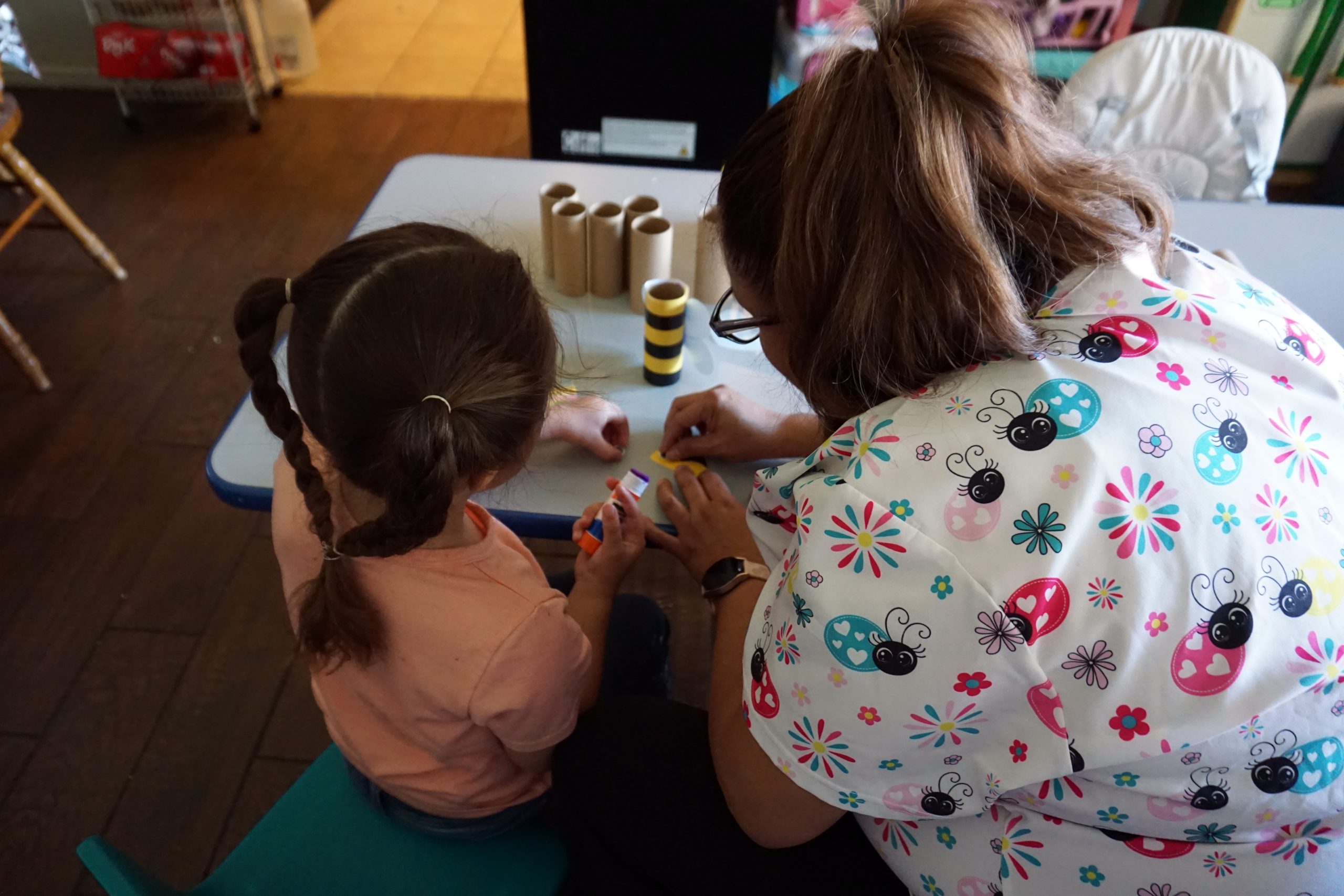
Una mañana reciente, Maggi estaba de pie en su sala de estar, vestida con una bata blanca adornada con coloridas mariquitas de dibujos animados. El año pasado, la sala habría estado llena de niños. Ahora está en silencio, salvo por la charla de Kay, la única niña en edad preescolar a la que cuida cada día. (The Hechinger Report no utiliza el nombre completo de Kay para proteger su privacidad). Mientras la pequeña se sentaba en una de las mesitas a hacer una manualidad, Maggi acunaba al bebé, que acababa de despertarse de la siesta. Los ojos del bebé se fijaron en el rostro de Maggi mientras ella lo mimaba.
“¡Hola, chiquito!”, le dijo en español. Él esbozó una sonrisa y el rostro de Maggi se iluminó.
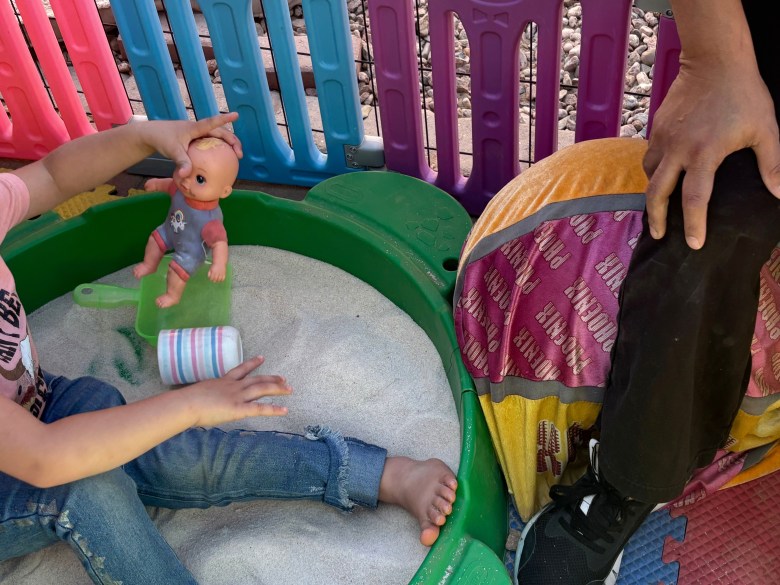
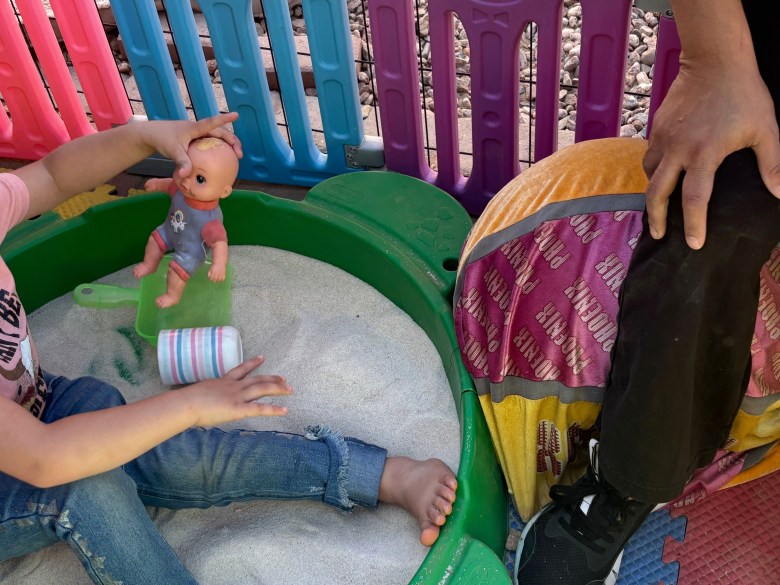
Mientras una de sus hijas se encargaba de alimentar al recién nacido, Maggi siguió a Kay al exterior. La niña de preescolar saltaba del arenero a los columpios y a la casita de juegos, con Maggi siguiéndola diligentemente y jugando a su lado.
Los defensores y expertos afirman que el aumento de las medidas de control de la inmigración puede causar estrés y traumas a los niños pequeños. En Estados Unidos, uno de cada cuatro niños menores de seis años tiene al menos un progenitor nacido en el extranjero. Credit: Jackie Mader/The Hechinger Report
Finalmente, Kay se detuvo y apoyó la cabeza en la cadera de Maggi. Maggi le acarició suavemente la cabeza y le preguntó si estaba lista para mostrar sus habilidades preescolares. Las dos se sentaron en una mesita a la sombra y Kay observó con entusiasmo mientras Maggi sacaba pequeños juguetes de plástico. Kay apiló tres tortugas de plástico. “¡Mamá, mira! ¡Son amigas!”, dijo Kay, riendo.
Kay llegó al programa de Maggi después de que su madre la sacara de otro programa en el que sentía que no la trataban bien. Aquí, Kay es tan feliz que se esconde cuando su madre viene a recogerla. Sin embargo, a Kay le falta un aspecto clave de la experiencia del cuidado infantil. Normalmente, la niña tendría varios amigos de su edad con los que jugar. Ahora, cuando le preguntan quiénes son sus amigos, nombra a las hijas adultas de Maggi.
A Maggi le preocupan aún más los niños que ya no ve. La mayoría están ahora al cuidado de sus abuelos, pero es poco probable que esos familiares sepan cómo estimular el desarrollo y la educación de los niños, dijo Maggi. Muchos no pueden correr con los niños como ella lo hace, y es más probable que recurran a las tabletas o la televisión para entretenerlos.
Ha visto los efectos en los niños que abandonan su programa y regresan más tarde habiendo retrocedido. “Algunos de ellos están haciendo bien las cosas conmigo, y luego, cuando regresan, se han quedado atrás”, dijo. Por ejemplo, un niño al que Maggi solía cuidar acababa de empezar a caminar cuando su madre lo sacó de la guardería a principios de este año, al comienzo de la campaña de represión de la inmigración. Al estar al cuidado de un familiar, Maggi descubrió que ahora pasan gran parte del día sentados en casa.
Antes de que comenzara la segunda administración Trump, el panorama de la atención infantil parecía prometedor en Nuevo México, un estado con una tasa de pobreza infantil crónicamente alta. En 2022, Nuevo México comenzó a implementar una serie de cambios en las políticas de atención infantil. Los votantes aprobaron una enmienda constitucional que garantiza el derecho a la educación infantil temprana, con financiación sostenida para apoyarla. El estado ahora permite que las familias que ganan hasta el 400 % del nivel federal de pobreza, o casi 125.000 dólares al año, puedan optar a la guardería gratuita. Eso incluye a la mayoría de los hogares del estado. Entre otros cambios está que ahora se paga más a los proveedores por los niños que inscriben a través del programa de asistencia del estado.
El aumento ha sido útil para muchos proveedores, incluida Maggi. Antes de la pandemia, recibía unos 490 dólares al mes del estado por cada niño en edad preescolar inscrito en su programa, frente a los 870 dólares al mes que recibe ahora. Si inscribe a bebés que cumplen los requisitos para recibir asistencia para el cuidado infantil, recibe 1.100 dólares al mes, casi 400 dólares más que antes de la pandemia. Sin embargo, necesita que los niños estén inscritos para recibir los pagos. El hecho de que su programa funcione las 24 horas del día, los siete días de la semana, le ayuda. Gana dinero extra del estado cuando cuida a los niños por las tardes y los fines de semana, y recibe una mensualidad para cubrir los gastos de los niños en acogida que recibe.
Los defensores del cuidado infantil en Nuevo México están preocupados porque la política de inmigración afectará al progreso del sector. “Me preocupa que podamos perder centros de educación infantil que podrían ayudar a las familias trabajadoras”, afirmó Maty Miranda, organizadora de OLÉ Nuevo México, una organización sin ánimo de lucro dedicada a la defensa de los derechos. “Podríamos perder a valiosos profesores y los niños perderían esos fuertes vínculos”. Las medidas de control de la inmigración han tenido “un enorme impacto emocional” en los proveedores del estado, añadió.
Las autoridades estatales no respondieron a una solicitud de datos sobre cuántos proveedores de cuidado infantil son inmigrantes. En todo el estado, los inmigrantes representan alrededor del 13 % de la población activa total.
Muchos educadores locales de la primera infancia están asustados debido a la aplicación más extrema de las leyes de inmigración, al igual que lo están los niños a su cargo, dijo Miranda. “A pesar del miedo, los maestros me dicen que cuando entran en sus aulas, intentan olvidar lo que está pasando fuera”, añadió. “Son profesionales que intentan continuar con su trabajo”.
Maggi dijo que está tan ocupada con los niños que permanecen a su cuidado que no tiene tiempo extra para trabajar en otro empleo y obtener más ingresos. No especula sobre cuánto tiempo podrá sobrevivir su familia, sino que prefiere centrarse en la esperanza de que las cosas mejoren.
El mayor temor de Maggi en este momento es el bienestar de los hijos de los inmigrantes a los que ella y tantos otros proveedores de servicios a domicilio atienden. Sabe que algunos de sus niños y familias corren el riesgo de ser detenidos por el ICE, y que ese tipo de interacciones, para los niños, pueden provocar trastornos de estrés postraumático, alteraciones en el desarrollo cerebral y cambios de comportamiento. Algunos de los padres de Maggi le han dejado números de emergencia por si son detenidos por los funcionarios de inmigración.
Muchos de los niños a los que Maggi cuida después de la escuela tienen la edad suficiente para comprender que la deportación es una amenaza. “Muestran miedo, porque sus padres están asustados”, dijo Maggi. “Los niños están empezando a vivir con eso”.
En medio de los vertiginosos cambios políticos, Maggi intenta seguir mirando hacia adelante. Está trabajando para mejorar sus habilidades en inglés. Su marido está obteniendo una credencial para poder ayudarla más en su programa. Sus tres hijas están estudiando para convertirse en educadoras de la primera infancia, con el objetivo de unirse al negocio familiar. Con el tiempo, quiere atender a niños de preescolar inscritos en el programa estatal, lo que le proporcionará una fuente de ingresos estable.
A pesar de toda la incertidumbre, Maggi dice que la sostiene un propósito mayor. “Quiero que disfruten de su infancia”, dijo en una tarde soleada, mirando con cariño a Kay mientras la niña dejaba sus pequeños zapatos rosas a un lado y saltaba a un arenero. Es el tipo de infancia que Maggi recuerda en México. Kay se rió encantada cuando Maggi se agachó y vertió arena fresca sobre los pies de la pequeña. “Una vez que creces, no hay vuelta atrás”.
The Hechinger Report provides in-depth, fact-based, unbiased reporting on education that is free to all readers. But that doesn’t mean it’s free to produce. Our work keeps educators and the public informed about pressing issues at schools and on campuses throughout the country. We tell the whole story, even when the details are inconvenient. Help us keep doing that.
As student visa backlogs continue to plague US embassies around the world and the start of the fall semester looms, a bipartisan group of 14 lawmakers have urged the US state department to resolve issues with Indian student visas.
“As members of Congress who represent research universities, we are concerned by reports from our constituent universities about Indian students who have been unable to obtain visas to continue their education in the United States,” they urged Rubio.
Indian students, the largest group of international students in the US, contribute $9 billion annually to the US economy, added the lawmakers, led by Democratic congresswoman Deborah Ross of North Carolina.
In a letter sent to the State Department on July 24, the group said they had seen “first-hand” how the contributions of Indian students to science and research “keep our nation competitive”.
“We are dismayed at the possibility that many of these bright young individuals may be blocked… from continuing their education and research in the United States,” they continued.
Thirteen of the letter’s 14 signatories are member of the Democratic party, with Nebraska representative Don Bacon the only Republican to join the efforts.
With classes starting in just over a month, thousands of students… are at risk of missing the start of the academic year
The letter follows a near four-week suspension of student visa appointments by the state department that began during the peak season for visa processing, causing continued backlogs that remain nearly one month on from the lifting of the freeze.
Though backlogs are impacting students across the globe, the congresspeople raised particular concerns about delays at Indian embassies, with the Indian mission website still carrying a warning that the scheduling of visa appointments this summer cannot be guaranteed.
The Indian Ministry of External Affairs (MEA) is understood to have taken the matter up with the US Embassy in New Delhi as well as the US State Department, with news of the delays being widely circulated by Indian media.
As previously reported by The PIE News, some Indian education consultancies are expecting 80% declines in student levels going to the US, reporting that students are “refreshing their portal everyday” in search of appointments.
The largest source market to the US, visa issuance to Indian students saw a notable drop this May, falling by 41% compared to the same period in 2025, with stakeholders fearing that June data will reveal a worsening picture as the full impact of the visa pause takes hold.
Across the board, May 2024 data showed a 22% year-on-year reduction in the number of F-1 visas issued. Exchange visitor visas were also down 13%.
Appealing to Rubio, the congresspeople emphasised the integral contributions of Indian students to research universities in the US, as well as the wider value of educational exchange: “vital to encouraging collaboration between our nations”.
Advocacy efforts are also stepping up in the sector, led by the US for Success Coalition, a national alliance of more than 50 organisations spanning business, education and innovation.
“This delay and the resulting backlogs couldn’t have come at a worse time,” said Jill Welch, spokesperson for the coalition.
“With classes starting in just over a month, thousands of students – particularly from high-demand countries like India – are at risk of missing the start of the academic year,” Welch said.
The coalition highlighted the widespread consequences of the visa backlogs. If students are barred from entering the US, it could jeopardise the country’s position as the leading destination for global talent, with ripple effects touching local economies and long-term implications for scientific research.
“When we close doors – intentionally or by bureaucratic delay – we send a clear message to the world: that the US may longer be the destination of choice for the best and brightest,” it said. “That is not just a lost opportunity; it is a strategic risk”.
The alliance has called on the State Department to immediately “surge” resources to process new and returning international student visas and ensure there is interview capacity in high-demand countries.
Referring to Rubio’s new rules around social media vetting, it called on the department to prioritise both security and efficiency, “so that screening processes do not become barriers to opportunity”.
“For every three international students, one US job is created or sustained,” said the coalition, citing their annual economic contribution of nearly $44bn annually.
What’s more, “they are ambassadors of democracy and American values creating allyship between the United States and other countries,” they said, highlighting the value of people-to-people exchanges in ensuring the country’s national security.
The increasingly challenging visa policy landscape is already having an impact on student interest, with young people increasingly turning to other destinations, namely the UK.
Sector leaders are calling for “immediate action” to prevent the worst damages while there is still time before the full extent of declines become clear in September.
Min, a student from Bangladesh, remembers his excitement after learning he had been accepted into a US university. It meant he would be learning from some the world’s leading medical experts in healthcare – learning skills he hopes to use to improve the healthcare system in his home country.
Min, who asked not to use his name due to the enhanced US screening policies, was recently granted a visa and is due to start his freshman year this fall.
The road to get there, however, was not a smooth one. Following the State Department’s three-week worldwide pause on interviews in June, and the implementation of enhanced screening policies, many of Min’s peers had their interview appointments delayed.
It took Min three months to secure his required interview at the embassy for his student visa. He said the software used to schedule the interview kept crashing and the embassy had limited appointment times, checking multiple times a day for openings.
While Min saw his visa approved, several of his friends had their student visas denied at the end of their interview, he said, leading some of them to apply for universities in other countries. Most often, it’s another English-speaking country, since that’s the most common secondary language for Bangladeshi students, he said.
“In recent, years, a lot of my friends have applied to Australia, because for the US, there are more uncertainties,” Min said.
The student visa application process has come into the spotlight recently. That’s because of the Trump administration’s changes to how visa officers review students’ social media activity. Some visa applicants have expressed concerns that the policies could lead to an increase in visa denials.
However, education nonprofits have for years raised alarms about high rates of visa denials and long interview wait times – warning it could hinder the global competitiveness of US higher education.
Visa denials differ for world regions
The US State Department rejected over 650,000 student visa applications worldwide from 2018 through 2022. Students from developing nations in South Asia and Africa have their visas rejected at much higher rates compared to those from wealthier countries.
That’s according to a study that looked at eight years’ data – authored by The Presidents’ Alliance and Shorelight student support company. The report shines a light on experiences of students from Asia and Africa, who struggle with long wait times to schedule visa interviews.
For European students who apply to study in the US, getting denied entry is rare – fewer than 8% in 2023, according to the study. That’s a stark difference from Africa, where 61% of students were denied a visa that year, not including South Africa and some neighbouring countries with very low denial rates. For South Asia, including Nepal, between 36% and 55% students have their visas denied each year.
The world’s population of young, smart minds is exploding out of sub-Saharan Africa
Carly O’Keefe, Monroe Community College, Rochester
Rajika Bhandari, a senior advisor with the Presidents’ Alliance who led the study, said the findings reflect patterns that college administrators have noticed for decades.
“From the campus perspective, these students have been fully vetted and deemed worthy of being offered admission,” said Bhandari, once a US international student herself. “Yet they’re facing this final barrier.”
A visa officer decides whether to grant a student entry after interviewing them at an embassy or consulate. One goal of the interview, lasting several minutes at most, is to assess whether the student is likely to return to their homeland after graduating.
If the student can’t demonstrate strong homeland connections – such as through owning property, having a job lined up after graduation, or strong family ties – it can be grounds for denial. The visa officer will also review documents showing the student’s eligibility to study internationally, including financial statements showing the student can afford college.
Many students, Bhandari said, have expressed concerns to college leaders that they’ve met every requirement but are still denied – leaving them bewildered. Visa officers rarely share the specific reason for the denial with applicants.
“You may go back a second time and be denied yet again because you don’t know what it is that you need to fix,” Bhandari said.
The State Department didn’t directly respond to a request for comment but has said in the past that it’s committed to a fair visa review process. The department said that applications, especially from Africa, have skyrocketed in the past few years and “a commensurate increase in denials is expected.”
According to the department, more visas were issued to African students in 2023 than ever before, with Nigerian students granted the highest share. However, the visa denial rate for African students grew that year by three percentage points, according to the study, while the denial rate for European and South American students dropped.
The State Department doesn’t publish data on visa denials but does disclose how many student visas are issued for each country every month. So far this year, the number of F-1 visas issued for Nigerian students is 23% less compared to this time last year, based on data published through May. For Bangladeshi students, like Min, the number of visas issued is about the same as last year.
Experience with getting a visa denied
Sooraj Sahani, entering his sophomore year at Texas State, knows how confusing and emotional it can be to have a visa denied. He had his visa denied on the first try, before applying again and getting it approved three weeks before the start of freshman year in fall of 2024.
In his village in the plains of Nepal, Sahani fed his fascination for physics by taking online classes from some of the world’s top experts. He aspired to be like the professors who mentored him virtually through the World Science Scholars program, a nonprofit based in New York City. That’s why Sahani decided he wanted to study at a US university, determined to become a theoretical physics researcher.
When he learned that Texas State was offering him a full undergraduate scholarship, he thought he was on track to fulfil his dream. His scholarship meant the US couldn’t deny his student visa for financial reasons, Sahani said. But he still ran into issues.
When Sahani tried last summer to book a visa interview appointment for the US embassy in Kathmandu, Nepal, all the slots were full for weeks. Instead, he traveled to New Delhi for an interview with a visa officer. Sahani said that, at the end of the roughly one-minute interview, the officer told him he wasn’t eligible for a visa without any explanation.
Students can wait up to nine months for a US visa interview in Dhaka, Bangladesh
US State Department data
“With a very sad face, I had to come back from India. It took me some time to tell myself that, OK, it happens. I’m not giving up,” he said.
After getting his visa denied, Sahani scheduled his second visa interview appointment at the embassy in Kathmandu. To secure a slot, he repeatedly woke up in the middle of the night to check online for appointments.
“I woke up at 2am, 3am, 4am, just to see if there was a visa slot. We have a lot of students applying for the US but we just have one embassy,” he said.
Since releasing its study, the Presidents’ Alliance and other education nonprofits have met with State Department leaders about improving visa processing. The department says it’s made progress in lowering wait times worldwide by hiring more staff and giving visa officers the authority to waive some interviews.
However, some countries still have too few embassies or staff members to keep up with the high number of students, Bhandari said. For the embassy in Dhaka, Bangladesh, it’s currently a nine month wait time for a student visa interview, according to the department’s website.
“Academic loss and economic loss”
Higher education leaders warn that if visa issues persist, they’ll hinder the US’s global competitiveness. In January NAFSA wrote a letter to the incoming Trump administration calling for action to make visa processing times more predictable. The letter also advocates for creating a pathway for international students to become permanent residents after graduation, which, according to Bhandari, may help to address visa denials.
If students can choose to live and work in the US after graduation, they wouldn’t have to prove their intentions to return to their home country – a source of many denials. In April, Congress introduced the Keep STEM Talent Act with bipartisan support, aiming to create this kind of “dual intent” pathway for international students pursuing science, technology, or maths degrees. Most of the 1.1 million international students who came to the US last academic year chose STEM fields.
The high rate of visa denial for African students is both an academic loss and an economic loss, said Carly O’Keefe, the designated school official for international student enrolment at Monroe Community College in Rochester, NY.
Like many other states, college enrolment in New York has been declining. New York’s comptroller warns that 2025 could mark the start of an “enrolment cliff” – a sharp decline in applications reflecting the steady decline in US births since a historic high in 2007. Several colleges in the state have closed in recent years due to low enrolment.
Meanwhile, Africa’s young population is increasing. By 2050, Nigeria is expected to become the world’s third most populous country, behind only India and China. Africa isn’t just full of college-aged youth, O’Keefe said, but also innovation led by youth. As technology is becoming more available in Africa, the number of youth-led startups is booming.
“The world’s population of young, smart minds is exploding out of sub-Saharan Africa,” she said. “Just think of the brain power and the potential talent in the world.”
Last fall, MCC welcomed about 90 international students, the most since 2018, from 30 countries. However, as with most colleges that host international students, the number enrolled was fewer than the number who planned to come because of visa denials. Colleges across the US, O’Keefe said, are missing out on talent because of the denials.
“We’re potentially missing out on very qualified students enrolling at our colleges and universities across the country that could be doing amazing academic work,” she said.
Two years ago, I bought each of the teachers at Hamilton Elementary in San Diego’s City Heights neighborhood a blue chair. I told them to put it in the back of their classrooms, and that if a parent or caregiver wanted to visit to see how their children are learning — no matter what the reason — that this would be a dedicated space for them.
I may have earned some exaggerated eye-rolls from educators that day. After all, I can appreciate the disruption to learning that classroom visitors can sometimes cause, especially among excitable elementary schoolers.
But school is our home, and it is our responsibility to invite families into our home and welcome them. And this was a necessary olive branch, my way of saying to families: “From here on out, things are going to be different.”
And they were. They also can be different at other schools, because the benefits of family engagement go well beyond student achievement.
Research has long shown that when parents and caregivers are involved and engaged with their children’s education — whether that’s by attending parent-teacher conferences or participating in school events — student achievement, motivation and social-emotional well-being increase.
Parent involvement with reading activities has a positive impact on reading achievement, language comprehension, expressive language skills and level of attention in the classroom, according to the National Literacy Trust.
Research also shows that educators enjoy increased job satisfaction and are more likely to keep teaching at the school, families enjoy stronger relationships with their children and feel less isolated, and even school districts themselves become better places to live and raise children.
None of this was the case when we returned to normalcy following Covid. Just 13 percent of students were reading on grade level, and 37 percent were chronically absent. I knew right away that before we even attempted to tackle academics, we needed to engage families and make them feel deeply connected and committed to the community I envisioned building here.
Today, 45 percent of students are reading at grade-level, and chronic absenteeism, at 12 percent on the most recent official numbers, is down to 10 percent in our own tracking, with a goal of pushing it down to 8 percent in 2025-26.
But it wasn’t easy given the distrust that had boiled over during the pandemic, with families skeptical of our ability to effectively support their children and school staff feeling defensive and exhausted.
It was clear to me that families weren’t excited to send their kids to school, didn’t feel informed about what was happening on our campus and, moreover, didn’t feel comfortable — let alone capable — of communicating their needs to us.
Complicating matters further was the need to share information across many languages other than English, which can make relationship-building and communicating expectations difficult.
Roughly half of our students are English learners, and while the majority of their families are Spanish-speakers, there are growing populations of students whose first languages are Haitian-Creole, Pashto and Vietnamese.
The first thing I did was establish open communication with parents using ClassDojo, a mobile app that gives families an easy, intuitive central access point to our teachers and staff, automatically translates all messages into parents’ native languages and allows us to share stories about what is happening in school.
It became an easy way to build trust and collaboration between families and staff.
Creating that type of visibility was key to breaking down walls between us. And in those early days, we didn’t post about literacy, math or anything related to academics. Instead, we focused solely on attendance and getting families to come inside the school as much as possible.
We focused on relationship-building activities and joyful learning. We hosted after-school art classes and monthly family Fridays, when families could come to school to engage in a fun activity.
We organized a Halloween costume drive with candy and fun games for kids; we hosted a Read Across America event where we passed out Play-Doh; and we organized other low-stakes events at school, rooted in building a partnership between home and school.
Again, our goal wasn’t learning during these meet-ups. It was all in service of building trust and creating meaningful relationships with students and their families.
Once we had the foundation in place, we added a focus on academics — though we rooted that learning in family engagement, too. For example, our schoolwide focus last year was phonics, so we sent activities home for families to complete with their children that were tied specifically to concepts the students needed reinforced, based on their individual assessments, like long vowel patterns and sight words.
These activities were taught by the students and their teachers to family members during conferences.
Beyond helping students, the exercise challenged a false narrative so many families had assumed — that they either didn’t know enough about what was happening in school to help, weren’t confident enough to help or didn’t have enough time.
Today, the atmosphere at Hamilton feels radically different than when I first walked through the doors. When we first started hosting Family Fridays, about 10 family members and their children showed up.
Now, we have roughly 200 caregivers at every meet-up. Families run most of the community-based initiatives at the school — from a boutique where families can shop among donated clothes twice a month, to a food distribution center, to a book club, English classes and a monthly meet-up where families can socialize.
When district leaders visit, they’re always impressed by the participation. I tell them, if you care about family engagement, it has to be so deeply embedded into the system that people don’t have a choice but to do it.
That’s why I’m constantly thinking about how to center family engagement in staff meetings, in attendance meetings, in literacy and math plans, in behavioral and counseling plans and in meetings about school procedures and budgets.
It’s a strategy that not only involves families but also supports academic achievement and student well-being. For me, family engagement is the ultimate strategy for academics.
Sometimes in the K-12 world we keep outreach and academics separate, but in reality, engagement is the key that unlocks our ability to hit academic goals and create a joyful school community.
The Hechinger Report provides in-depth, fact-based, unbiased reporting on education that is free to all readers. But that doesn’t mean it’s free to produce. Our work keeps educators and the public informed about pressing issues at schools and on campuses throughout the country. We tell the whole story, even when the details are inconvenient. Help us keep doing that.
School (in)Security is our biweekly briefing on the latest school safety news, vetted by Mark Keierleber. Subscribe here.
As far-right political operative David Barton leads a Christian nationalist crusade, he’s traveled to state capitols across the country this year to support dozens of bills requiring Ten Commandments displays in classrooms.
My latest story digs into a well-coordinated and deep-pocketed campaign to inject Protestant Christianity into public schools that could carry broader implications for students’ First Amendment rights. Through a data analysis of 28 bills that have cropped up across 18 states this year, I show how Barton’s role runs far deeper than just being their primary pitchman.
The analysis reveals how the language, structure and requirements of these bills nationwide are inherently identical. Time and again, state legislation took language verbatim from a Barton-led lobbying blitz to reshape the nation’s laws around claims — routinely debunked — about Christianity’s role in the country’s founding and its early public education system.
Three new state laws in Louisiana, Arkansas and Texas mandating Ten Commandments posters in public schools are designed to challenge a 1980 Supreme Court ruling against such government-required displays in classrooms. GOP state lawmakers embracing these laws have expressed support for eradicating the separation of church and state — a pursuit critics fear will coerce students and take away their own religious freedom.
In the news
Updates to Trump’s immigration crackdown: Immigration and Customs Enforcement has released from custody a 6-year-old boy with leukemia more than a month after he and his family were sent to a rural Texas detention center. | Slate
As the Department of Homeland Security conducts what it calls wellness checks on unaccompanied minors, the young people who migrated to the U.S. without their parents “are just terrified.” | Bloomberg
‘It looks barbaric’: Video footage purportedly shows some two dozen children in federal immigration custody handcuffed and shackled in a Los Angeles parking garage. | Santa Cruz Sentinel
The Department of Homeland Security is investigating surveillance camera footage purportedly showing federal immigration officers urinating on the grounds of a Pico Rivera, California, high school in broad daylight. | CBS News
California sued the Trump administration after it withheld some $121 million in education funds for a program designed to help the children of migrant farmworkers catch up academically. | EdSource
Undocumented children will be banned from enrolling in federally funded Head Start preschools, the Trump administration announced. | The Washington Post
Legal pushback: Parents, Head Start providers challenge new rule barring undocumented families. | The 74
Getty Images
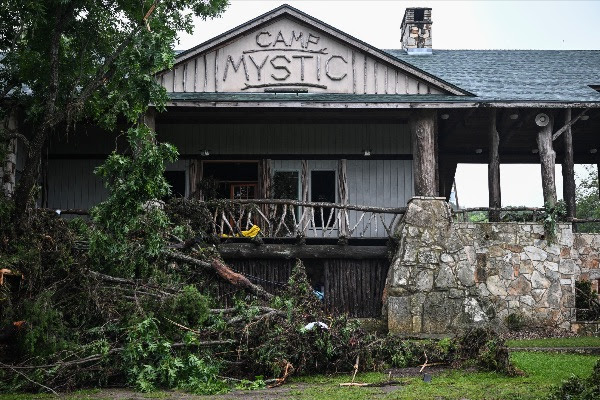
The executive director of Camp Mystic in Texas didn’t begin evacuations for more than an hour after he received a severe flood warning from the National Weather Service. The ensuing tragedy killed 27 counselors and campers. | The Washington Post
The day after the Supreme Court allowed the Education Department’s dismantling, Secretary Linda McMahon went ahead with plans to move key programs. | The 74
Now, with fewer staff, the Office for Civil Rights is pursuing a smaller caseload. During a three-month period between March and June, the agency dismissed 3,424 civil rights complaints. | Politico
Sign-up for the School (in)Security newsletter.
Get the most critical news and information about students’ rights, safety and well-being delivered straight to your inbox.
Massachusetts legislation seeks to ban anyone under the age of 18 from working in the state’s seafood processing facilities after an investigation exposed the factories routinely employed migrant youth in unsafe conditions. | The Public’s Radio
An end to a deadly trend: School shootings decreased 22% during the 2024-25 school year compared to a year earlier after reaching all-time highs for three years in a row. | K-12 Dive
Florida is the first state to require all high school student athletes to undergo electrocardiograms in a bid to detect heart conditions. | WUSF
The Senate dropped rules from Trump’s “big, beautiful” tax-and-spending bill that would have prevented states from regulating artificial intelligence tools, including those used in schools. | The Verge
Food stamps are another matter: The federal SNAP program will be cut by about a fifth over the next decade, taking away at least some nutrition benefits from at least 800,000 low-income children. | The 74
ALBUQUERQUE, N.M. — Maggi’s home in a suburban neighborhood here is a haven for local families. It’s a place where after just a few weeks in Maggi’s family-run child care program this spring, one preschooler started calling Maggi “mama” and Maggi’s husband “papa.” Children who have graduated from Maggi’s program still beg their parents to take them to her home instead of school.
Over the past few months, fewer families are showing up for care: Immigration enforcement has ramped up and immigration policies have rapidly changed. Both Maggi and the families who rely on her — some of whom are immigrants — no longer feel safe.
“There’s a lot of fear going on within the Latino community, and all of these are good people — good, hard-working people,” Maggi, 47, said in Spanish through an interpreter on a recent morning as she watched a newborn sleep in what used to be her living room. Since she started her own child care business two years ago, she has dedicated nearly every inch of her common space to creating a colorful, toy-filled oasis for children. Maggi doesn’t understand why so many immigrants are now at risk of deportation. “We’ve been here a long time,” she said. “We’ve been doing honest work.”
Immigrants like Maggi play a crucial role in home-based child care, as well as America’s broader child care system of more than 2 million predominantly female workers. (The Hechinger Report is not using Maggi’s last name out of concern for her safety and that of the families using her care.) Caregivers are notoriously difficult to find and keep, not only because the work is difficult, but because of poverty-level wages and limited benefits. Nationwide, immigrants make up nearly 20 percent of the child care workforce. In New York City, immigrants make up more than 40 percent of the child care workforce. In Los Angeles, it’s nearly 50 percent.
The Trump administration’s far-reaching war on immigration, which includes daily quotas for immigrant arrests, new restrictions on work permits and detainment of legal residents, threatens America’s already-fragile child care system. Immigrant providers, especially those who serve immigrant families, have been hit especially hard. Just like at Maggi’s, child care providers nationwide are watching families disappear from their care, threatening the viability of those businesses. In America, 1 in 4 children under the age of 6 has at least one foreign-born parent. Some kids who could benefit from experienced caregivers are now instead at home with older siblings or elderly relatives, losing out on socialization and kindergarten preparation. Some immigrant workers, regardless of status, are too scared to come to work, exacerbating staffing shortages. And in recent days, the administration announced that it would bar undocumented children from Head Start, the federally funded child care program for children from low-income families.
Related: Young children have unique needs and providing the right care can be a challenge. Our free early childhood education newsletter tracks the issues.
“Anti-immigrant policy can and will weaken our entire caregiving infrastructure,” said Karla Coleman-Castillo, senior policy analyst at the National Women’s Law Center. Home-based programs in particular will feel the squeeze, she said, since they tend to serve more immigrant families. “Anything that threatens the stability of families’ ability and comfort accessing early childhood education — and educators’ comfort entering or remaining in the workforce — is going to impact an already precarious sector.”
For Maggi, the fallout has been swift. In February, just a few weeks after the first changes were announced, her enrollment dropped from as many as 15 children each day to seven. Some families returned to Mexico. Others became too nervous to stray from their work routes for even a quick drop off. Some no longer wanted to give their information to the state to get help paying for care.
Maggi plays with a child in the back yard of her child care program. Maggi runs one of a few child care programs that provides 24/7 care in her town. Credit: Jackie Mader/The Hechinger Report
By May, only two children, an infant and a 4-year-old, were enrolled full time, along with six kids who came for before- or after-school care. She accepts children who pay privately and those who pay with child care subsidies through the state program for low-income children. She brings in about $2,000 a month for the infant and preschooler, and a couple hundred more each week for after-school care — down significantly from the $9,000 to $10,000 of late 2024. For parents who don’t receive a state subsidy, she keeps her rates low: less than $7 an hour. “They tell me that I’m cheap,” Maggi said with a slight smile. But she isn’t willing to raise her rates. “I was a single mom,” she said. “I remember struggling to find someone to care for my children when I had to work.”
Like many child care providers who emigrated to the United States as adults, Maggi started her career in an entirely different field. As a young mother, Maggi earned a law degree from a college in Mexico and worked in the prosecutor’s office in the northern Mexico state of Coahuila. Her job required working many weekends and late evenings, which took a toll on her parenting as a single mother. “I really feel bad that I was not able to spend more time with my daughters,” she added. “I missed a lot of their childhood.”
For a year when her girls were in elementary school, Maggi enrolled them in a boarding school, dropping them off Sunday nights and picking them up Friday afternoons. On some weekends, she took the girls to her office, even though she knew it wasn’t a place for children. Maggi longed for a different job where she could spend more time with them.
She started thinking seriously of emigrating about 15 years ago, as violence escalated. Her cousin was kidnapped and police officers she worked with were killed. Maggi received death threats from criminals she helped prosecute. Then one day, she was stopped by men who told her they knew where she lived and that she had daughters. “That’s when I said, this is not safe for me.”
In 2011, Maggi and the girls emigrated to America, bringing whatever they could fit into four suitcases. They ended up in El Paso, Texas, where Maggi sold Jell-O and tamales to make ends meet. Three years later, they moved here to Albuquerque. Maggi met her husband and they married, welcoming a son, her fourth child, shortly after.
In Albuquerque, Maggi settled into a life of professional caregiving, which came naturally and allowed her to spend more time with her family than she had in Mexico. She and her husband went through an intensive screening process and became foster parents. (New Mexico does not require individuals to have lawful immigration status to foster.) Maggi enrolled her youngest in a Head Start center, where administrators encouraged her to start volunteering. She loved being in the classroom with children, but without a work permit could not become a Head Start teacher. Instead, after her son started elementary school, she started offering child care informally to families she knew. Maggi became licensed by the state two years ago after a lengthy process involving several inspections, a background check and mandatory training in CPR and tenets of early childhood care.
It didn’t take long for Maggi to build up a well-respected business serving an acute need in Albuquerque. Hers is one of few child care programs in the area that offers 24/7 care, a rarity in the industry despite the desperate need. The parents who rely on her are teachers, caregivers for the elderly and people answering 911 calls.
In Maggi’s living room, carefully curated areas allow children to move freely between overflowing shelves of colorful toys, art supplies parked on a miniature table and rows of books. Educational posters on her walls reinforce colors, numbers and shapes. She delights in exposing the children to new experiences, frequently taking them on trips to grocery stores or restaurants. She is warm, but has high expectations for the children, insisting they clean up after themselves, follow directions and say “please” and “thank you.”
“I want them to have values,” Maggi said. “We teach them respect toward animals, people and each other.”
By the end of 2024, Maggi’s business was flourishing, and she looked forward to continued growth.
Data has yet to be released about the extent to which the current administration’s immigration policies have affected the availability of child care. But interviews with child care providers and research hint at what may lie ahead — and is already happening.
After a 2008 policy allowed Immigration and Customs Enforcement to check the immigration status of people taken into custody by local police, there was a marked decline in enrollment in child care among both immigrant and non-immigrant children. There was also a decrease in the supply of child care workers. Even though women were the minority of those deported, researchers found the policy sparked fear in immigrant communities, and many pulled back from their normal routines.
In the child care sector, that’s problematic, experts say. Immigrants in the industry tend to be highly educated and skilled at interacting with children positively, more so even than native workers. If a skilled portion of the workforce is essentially “purged” because they’re too afraid to go to work, that will lower the quality of child care, said Chris Herbst, an associate professor at Arizona State University who has studied immigration policy’s effect on child care. “Kids will be ill-served as a result.”
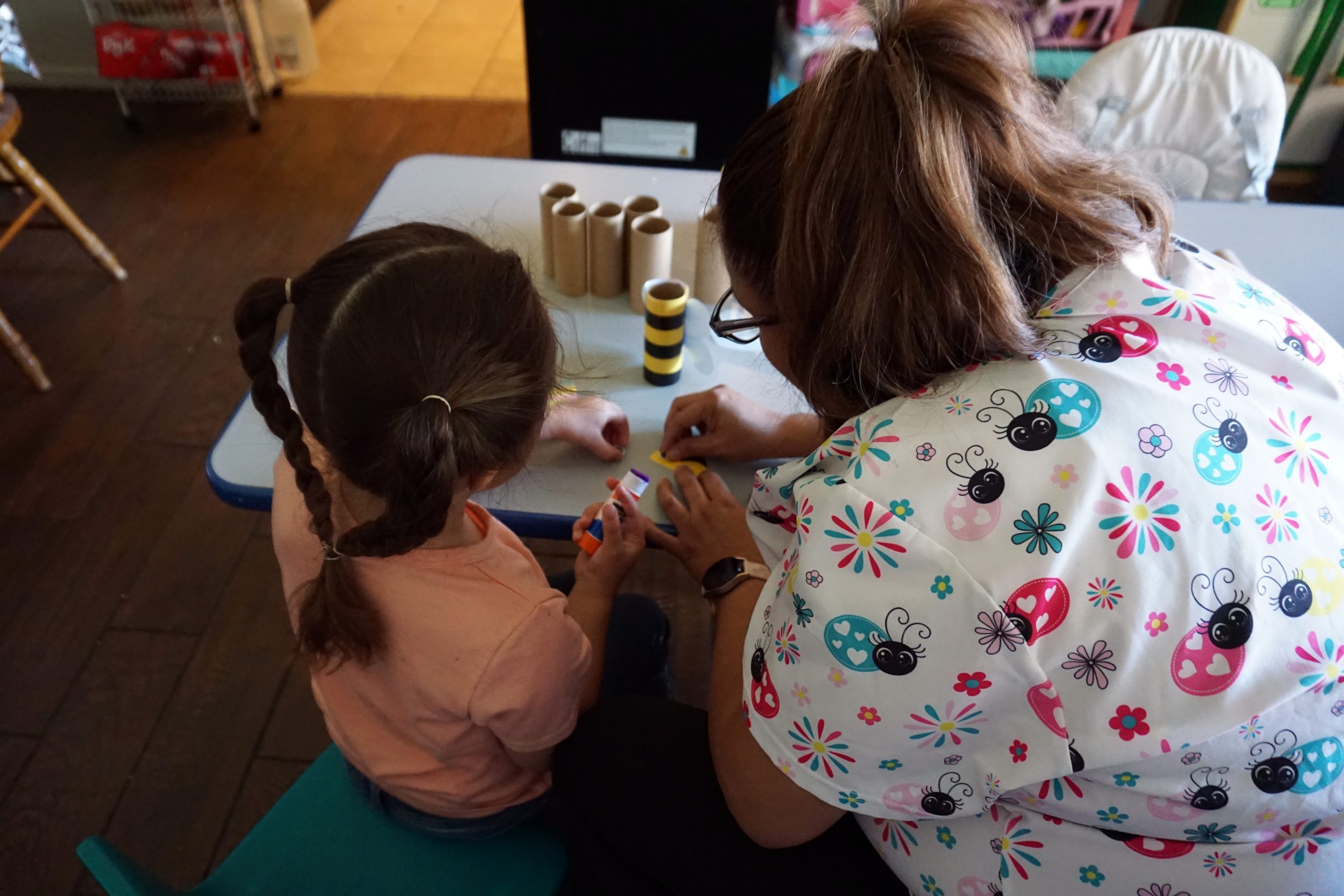
On a recent morning, Maggi stood in her living room, wearing white scrubs adorned with colorful cartoon ladybugs. Last year, the room would have been buzzing with children. Now, it’s quiet, save for chatter from Kay, the sole preschooler in her care each day. (The Hechinger Report is not using Kay’s full name to protect her privacy.) While Kay sat at a table working on a craft, Maggi cradled the infant, who had just woken up from a nap. The baby’s eyes were latched onto Maggi’s face as she fawned over him.
“Hello little one!” she cooed in Spanish. He cracked a smile and Maggi’s face lit up.
As one of her daughters took over to feed the newborn, Maggi followed Kay outside. The preschooler bounced around from the sandbox to the swings to a playhouse, with Maggi diligently following and playing alongside her.
Advocates and experts say upticks in immigration enforcement can cause stress and trauma for young children. In America, 1 in 4 children under the age of 6 has at least one foreign-born parent. Credit: Jackie Mader/The Hechinger Report
Finally Kay came to a standstill, resting her head against Maggi’s hip. Maggi gently patted her head and asked if she was ready to show off her pre-kindergarten skills. The pair sat down at a small table in the shade and Kay watched eagerly as Maggi poured out small plastic trinkets. Kay pulled three plastic toy turtles into a pile. “Mama, look! They’re friends!” Kay said, giggling.
Kay came to Maggi’s program after her mother pulled her out of another program where she felt the girl wasn’t treated well. Here, Kay is so happy, she hides when her mom comes back to get her. Still, a key aspect of the child care experience is missing for Kay. Normally, the girl would have several friends her own age to play with. Now when she is asked who her friends are, she names Maggi’s adult daughters.
Maggi worries even more about the children she doesn’t see anymore. Most are cared for by grandparents now, but those relatives are unlikely to know how to support child development and education, Maggi said. Many are unable to run around with the children like she does, and are more likely to turn to tablets or televisions for them.
She has seen the effects in children who leave her program and come back later having regressed. “Some of them are doing things well with me, and then when they come back, they have fallen behind,” she said. One child Maggi used to care for, for example, had just started to walk when the mother pulled them out of full-time care earlier this year, at the start of the immigration crackdown. In the care of a relative, Maggi found out they now spend much of the day sitting at home.
Before the second Trump administration began, the child care landscape looked bright in New Mexico, a state with a chronically high child poverty rate. In 2022, New Mexico started rolling out a host of child care policy changes. Voters approved a constitutional amendment guaranteeing a right to early childhood education, with sustained funding to support it. The state now allows families earning up to 400 percent of the federal poverty level, or nearly $125,000 a year, to qualify for free child care. That includes the majority of households in the state. Among the other changes: Providers are now paid more for children they enroll via the state’s assistance program.
The increase has been helpful for many providers, including Maggi. Before the pandemic, she received about $490 a month from the state for each preschooler enrolled in her program, compared to $870 a month now. If she enrolls infants who qualify for child care assistance, she gets paid $1,100 a month, nearly $400 more than pre-pandemic. She needs children enrolled to get the payments, however. Running her program 24 hours a day, seven days a week helps. She earns extra money from the state when caring for children evenings and weekends, and she is paid monthly to cover the cost of housing foster children.
Child care advocates in New Mexico are concerned that immigration policy will affect the industry’s progress. “I am worried because we could be losing early childhood centers that could help working families,” said Maty Miranda, an organizer for OLÉ New Mexico, a nonprofit advocacy organization. “We could lose valuable teachers and children will lose those strong connections.” Immigration crackdowns have had “a huge impact emotionally” on providers in the state, she added.
State officials did not respond to a request for data on how many child care providers are immigrants. Across the state, immigrants account for about 13 percent of the entire workforce.
Many local early educators are scared due to more extreme immigration enforcement, as are the children in their care, Miranda said. They are trying to work regardless. “Even with the fear, the teachers are telling me that when they go into their classrooms, they try to forget what’s going on outside,” she added. “They are professionals who are trying to continue with their work.”
Maggi said she’s so busy with the children who remain in her care that there is no extra time to work an additional job and bring in more income. She won’t speculate on how long her family can survive, instead choosing to focus on the hope that things will improve.
Maggi’s biggest fear at the moment is the well-being of the children of immigrants she and so many other home-based providers serve. She knows some of her kids and families are at risk of being detained by ICE, and that interactions like that, for kids, can lead to post-traumatic stress disorder, disrupted brain development and behavior changes. Some of Maggi’s parents have left her with emergency numbers in case they are detained by immigration officials.
Many of the children Maggi cares for after school are old enough to understand that deportation is a threat. “They show fear, because their parents are scared,” Maggi said. “Children are starting to live with that.”
Amid the dizzying policy changes, Maggi is trying to keep looking forward. She is working on improving her English skills. Her husband is pursuing a credential to be able to help more in her program. All three of her daughters are studying to become early childhood educators, with the goal to join the family business. Eventually, she wants to serve pre-K children enrolled in the state’s program, which will provide a steady stream of income.
In spite of all the uncertainty, Maggi said she is sustained by a bigger purpose. “I want them to enjoy their childhood,” she said on a sunny afternoon, looking fondly at Kay as the girl flung her tiny pink shoes aside and hopped into a sandbox. It’s the type of childhood Maggi remembers from her earliest days in Mexico. Kay giggled with delight as Maggi crouched down and poured cool sand over the little girl’s feet. “Once you grow up, there’s no going back.”
The Hechinger Report provides in-depth, fact-based, unbiased reporting on education that is free to all readers. But that doesn’t mean it’s free to produce. Our work keeps educators and the public informed about pressing issues at schools and on campuses throughout the country. We tell the whole story, even when the details are inconvenient. Help us keep doing that.
This story was produced by The 19th and reprinted with permission.
On July 4, Nory Sontay Ramos stepped off a flight from San Antonio into a country she hardly recognized: Guatemala.
The summer wasn’t supposed to start this way. The 17-year-old had plans. In early June, she wrapped up 11th grade on a high note, having made the honor roll and represented her Los Angeles high school in the city finals for track. With track season over, she turned her attention to cross-country, showing up to campus for practice after the school year ended.
Everything changed when she and her mother, Estela Ramos — both undocumented — appeared at what they thought was a standard check-in visit with immigration officials on June 30.
“ICE took us to a room, and they ended up telling my mom, ‘Your case is over, so we have to take you guys with us,’” Sontay Ramos told The 19th. Over the objections of their attorney, federal agents led them away.
The next day, she and her mother were shipped to Texas. And by July 4, they were on a plane to Guatemala, a country where neither of them have lived for over a decade. On Independence Day — an occasion associated with freedom, with hope — their American dream shattered. Sontay Ramos has no idea what will become of the friends, family members and school community her deportation forced her to leave behind in Los Angeles.
A lawyer hired after she and her mother were detained said Monday that a motion to reopen the case has been filed with the Board of Immigration Appeals but provided no other information to The 19th.
A year shy of becoming a high school graduate in the United States, the teen’s life — and opportunities — completely changed in the span of five days.
“I’m confused,” Sontay Ramos said, her voice breaking. “I don’t know. I’m just really sad about everything.”
President Donald Trump campaigned for a return to office with the promise of mass deportations, characterizing undocumented immigrants as criminals and threats to women and girls. But as his administration has ramped up enforcement of his policy priority, undocumented people with no criminal backgrounds have made up the largest share of immigrants targeted. Those who are pursuing legal status through the proper channels have also become vulnerable — showing up to check-ins, like Sontay Ramos and her mother — only to be detained. These developments, recent polls reveal, have led to public disapproval of the Trump administration’s strategies.
Civil liberties and advocacy groups have raised concerns that undocumented immigrants are being removed so quickly they have been denied the right to due process. With Trump’s One Big Beautiful Bill Act directing $150 billion more toward mass deportations, expedited removals of undocumented immigrants will almost certainly increase — and those immigrants who arrived in the United States as children like Sontay Ramos stand to get caught in the middle.
The Trump administration deported more than 93,800 people from January 20 to June 11, with ICE more than doubling its arrests compared with the same period in 2024, revealed an analysis by the Washington Post based on information from the Deportation Data Project. (The data does not reflect arrest and removal numbers from Customs and Border Protection.) Of those, 61 percent did not have criminal records and almost 90 percent were men, underscoring how relatively uncommon it is for a mother and daughter to be removed.
The Trump administration has not provided a tally of how many minors have been deported this year, but The 19th’s review of figures from the Deportation Data Project found that only about 3 percent of removals involved children. When ICE targets juveniles, the incidents often make national headlines, such as when a 9-year-old boy and his father living in Torrance, California, were detained in May and swiftly deported to Honduras. In states including Michigan, Massachusetts and New York, the detainment of teenagers, including those who are technically legal adults, have also garnered widespread media attention this year.
But when Sontay Ramos and her mother exited their Guatemala-bound flight on Friday, they weren’t met with fanfare. None of their family members in the Central American nation knew to expect them. With the help of an internet connection, they managed to contact one of Sontay Ramos’ older sisters, with whom they’re now living. The teenager isn’t sure which part of Guatemala she’s in, though she describes the area as rural.
Just six when she left Guatemala, Sontay Ramos struggles to recall what life there was like. But she remembers the emotion she felt as a small child: fear.
“I was scared because there’s gangsters here, and they tried to kill my mom,” she said. A family member involved in a gang threatened her mother, once attacking her so badly she needed to be hospitalized, she said. “My mom was scared.”
A research study exploring the root causes of immigration from Guatemala from 2012 to 2019 found violence, poverty, climate change and corruption to be among the driving factors and that many such migrants hail from rural parts of the country.
“The two major reasons, especially if we look at families, have to do with violence and drought,” said David Leblang, a coauthor of that study and politics professor at the University of Virginia. “It has been drought and then flood, hurricane and then drought that has just decreased the ability for families to put food on the table, so you see a combination of economic insecurity, but more so for families, food insecurity — because when you can’t feed your kids, that’s when families are going to pick up and they’re going to move first to more urban areas and then out of the country.”
About 11 years ago, Sontay Ramos and her mother headed by car to the United States in search of safety and opportunity. There, other family members awaited them and they hoped to be granted asylum, she said.
The transition was not easy. They left behind three of Sontay Ramos’ older siblings who did not want to come to the United States, she said. Her father remained in Guatemala, too. His death from illness shortly after she moved away was devastating.
“Unfortunately, her dad passed away at a young age, just like two weeks after her arrival to the States,” recalled Jennifer Ramos, Sontay Ramos’ 22-year-old cousin who lives in Los Angeles. “She grew up with her dad, so that also hit her at such a young age, just coming to a new country at six years old and not knowing the language here and losing her father. It was definitely hard for her.”
Getting accustomed to life in Los Angeles also wasn’t easy. Sontay Ramos and her mother are Indigenous Guatemalans, fluent in K’iche’. Few resources in their native tongue made assimilation more challenging in a city where English and Spanish are the primary languages.
Jennifer Ramos helped her little cousin learn to speak English. “She would come over, and I would help her with her homework. When she first came to the States, my younger sister was kind of her only friend in school because she didn’t know anybody and, again, the language barrier. She actually does struggle speaking Spanish.”
In time, Sontay Ramos and her mother adjusted to life in California. Her mother ultimately became a garment worker, employed as a seamstress until physical setbacks — illness and surgery — sidelined her earlier this year. Her deportation has separated her from her life partner, with whom she and her daughter shared an apartment in the Westlake District of Los Angeles, the neighborhood where an ICE raid at a Home Depot close to an elementary school in June panicked families, and days of demonstrations in nearby downtown escalated after Trump deployed 4,000 National Guard troops and 700 Marines.
Los Angeles is a deeply blue city in a liberal state, with the nation’s highest concentration of immigrants — a place that the president has made ground zero for his immigration raids. In November, the City Council voted unanimously to make L.A. a sanctuary city, which bars it from using resources for immigration enforcement. Last week, the Trump administration filed suit, challenging the law. Meanwhile, advocacy groups including the American Civil Liberties Union of Southern California and Public Counsel are suing the Trump administration for what it describes as a pattern of federal violations during immigration raids in Greater Los Angeles.
Before Trump’s immigration policies roiled her neighborhood and upended her life, Sontay Ramos was indistinguishable from her peers born in the United States. She grew up on the Netflix shows “Stranger Things” and “Cobra Kai,” enjoys the music of Lana Del Rey and The Weeknd and dotes on her cat, Max, who turned one on May 15. He is black — one of her two favorite colors. In her spare time, Sontay Ramos practices taekwondo, which she’s been learning for nearly four years.
“I just liked it,” she said of the martial art. Knowing how to fight, she added, helps her feel protected.
Sontay Ramos never sensed she was in danger before the immigration check-in that would push her out of the United States.
But her cousin Jennifer Ramos worried. The night before, Ramos’ father invited the family over to have Sunday dinner with his wife and three daughters. The evening was largely festive. Her father made shrimp ceviche and was eager for his family to enjoy the tangy, citrusy dish — especially Estela Ramos, who had just celebrated her 45th birthday. But when Estela mentioned that she and her daughter had an immigration check-in scheduled, everyone fell quiet.
“We were kind of scared,” Jennifer Ramos said. “We were like, ‘Are you sure you should go?’”
Estela Ramos poses for a picture with Jennifer Ramos at her quinceanera in 2017. Credit: COURTESY OF JENNIFER RAMOS
But her aunt tried to reassure them by letting them know their lawyer said it would be fine. After all, they had shown up for previous check-ins without incident, and if they didn’t appear, immigration officials would just find them at home.
Now, Jennifer Ramos doesn’t know when she’ll see her aunt and cousin again.
“It is unfair that a young student like her has been detained,” she said. “She’s the most deserving person. This should be the least of her worries.”
Sontay Ramos couldn’t help but tear up when she described what she was looking forward to about senior year — graduation, her friends, track-and-field and cross-country.
Although excited to reunite with family members they hadn’t seen in years, she and her mother have been weeping off and on since they arrived in Guatemala.
“I was happy, but I was expecting to see them in another way,” she said of her relatives. “Not like this.”
Sleeping and eating have been tough as has the constant feeling of disorientation. She doesn’t know where she is. In K’iche’, she asked her mother for the name of the town they’re in, but it didn’t register.
She also continues to feel blindsided about why she and her mother were deported at all. She doesn’t understand how or why their case was closed.
Recent polls, particularly those conducted after the immigration raids in Los Angeles, reveal that the Trump’s administration’s immigration crackdowns may be unpopular with the majority of the public. A PBS News/NPR/Marist poll released July 1 found that just 43 percent of Americans support Trump’s tactics.
Sixty-four percent of registered voters support giving most undocumented immigrants in the United States a pathway to legal status, with 31 percent preferring deportation for most of them, according to a Quinnipiac University national poll released June 26. Six months ago, only 55 percent of voters supported giving unauthorized immigrants a path to legal status, while 36 percent backed deportation.
Leblang, the politics professor, said that ultimately the economy will sway the public to take a stand on immigration.
“All of those people who are being deported, they’re consuming goods that are produced by natives,” he said. “So, what the evidence suggests is that’s going to affect native workers’ wages, so across the board, this is going to have a negative effect on the economy.”
For Manuel Guevara — a physical education teacher and coach at the Miguel Contreras Learning Complex, where Sontay Ramos is enrolled as a student — immigration isn’t an economic issue but a personal one. He came to the United States at 11 months in the mid-1980s amid El Salvador’s horrific 12-year civil war, becoming a citizen as a teenager. He fears that more deportations of youth from his school are imminent. He knows some families skipped school graduations in the area due to their concerns over raids. Some are so worried they refuse to let their children attend football practice. He’s heard that other families intend to self deport.
“This is not normal,” Guevara said. “Our whole community is beyond vulnerable. A lot of their [students’] parents, sad to say, don’t know how to read and write. Their kids need to do that for them. If they’re presented with [immigration] paperwork, they might not even be able to read it because that’s not their primary language.”
Before her deportation, Nory Sontay Ramos was recognized at school for her academic and athletic achievements. Credit: COURTESY OF JENNIFER RAMOS
He can hardly believe that Sontay Ramos, whom he taught for most of her high school years, is gone.
“She was smiling, happy-go-lucky,” Guevara said. He’s astounded that she was detained and deported in less than a week. “Nory is going into her senior year, which is another thing that’s just killing me. She was going into her senior year with all this momentum.”
Guevara fondly recalled the teen’s high-pitched voice that gets even higher when she’s excited.
“You could tell when she’s coming from down the hallway, for sure,” he said. But her trademark voice is now subdued due to her deportation ordeal. Through tears, she expressed gratitude for how her teachers, classmates and other supporters have donated nearly $7,000 to her GoFundMe campaign.
“I just want to thank everybody for the support and tell them to just be safe out there and be strong no matter what’s going to happen,” she said.
If she can’t return to the United States, she will figure out how to finish her education in Guatemala, Sontay Ramos said.
Guevara is certain she has the aptitude for greatness. Her academics and extracurricular activities are just hints of what she’s capable of, he said.
“She was about to reach cruising altitude,” he said. “Some of our students are capable of reaching the clouds up there and doing some great things. And I really believe that she was on her way.”
The Hechinger Report provides in-depth, fact-based, unbiased reporting on education that is free to all readers. But that doesn’t mean it’s free to produce. Our work keeps educators and the public informed about pressing issues at schools and on campuses throughout the country. We tell the whole story, even when the details are inconvenient. Help us keep doing that.