Category: immigration

  • COLUMN: Trump is bullying, blackmailing and threatening colleges, and they are just beginning to fight back

    COLUMN: Trump is bullying, blackmailing and threatening colleges, and they are just beginning to fight back

    Patricia McGuire has always been an outspoken advocate for her students at Trinity Washington University, a small, Catholic institution that serves largely Black and Hispanic women, just a few miles from the White House. She’s also criticized what she calls “the Trump administration’s wholesale assault on freedom of speech and human rights.”

    In her 36 years as president, though, McGuire told me, she has never felt so isolated, a lonely voice challenging an agenda she believes “demands a vigorous and loud response from all of higher education. “

    It got a little bit louder this week, after Harvard University President Alan Garber refused to capitulate to Trump’s demands that it overhaul its operations, hiring and admissions. Trump is now calling on the IRS to rescind Harvard’s tax-exempt status.

    The epic and unprecedented battle with Harvard is part of Trump’s push to remake higher education and attack elite schools, beginning with his insistence that Harvard address allegations of antisemitism, stemming from campus protests related to Israel’s bombardment of Gaza following attacks by Hamas in October 2023.

    Related: Become a lifelong learner. Subscribe to our free weekly newsletter featuring the most important stories in education.

    Garber responded that “no government — regardless of which party is in power — should dictate what private universities can teach, whom they can admit and hire, and which areas of study and inquiry they can pursue” — words that Harvard faculty, students and others in higher education had been urging him to say for weeks. Students and faculty at Brown and Yale are asking their presidents to speak out as well.

    Many hope it is the beginning of a new resistance in higher education. “Harvard’s move gives others permission to come out on the ice a little,” McGuire said. “This is an answer to the tepid and vacillating presidents who said they don’t want to draw attention to themselves.”

    Harvard paved the way for other institutions to stand up to the administration’s demands, Ted Mitchell, president of the American Council on Education, noted in an interview with NPR this week.

    Stanford University President Jonathan Levin immediately backed Harvard, noting that “the way to bring about constructive change is not by destroying the nation’s capacity for scientific research, or through the government taking command of a private institution.”

    Former President Barack Obama on Monday urged others to follow suit.

    A minuscule number of college leaders had spoken out before Harvard’s Garber, including Michael Gavin, president of Delta College, a community college in Michigan; Princeton University’s president, Christopher Eisgruber; Danielle Holley of Mount Holyoke; and SUNY Chancellor John B. King Jr. Of more than 70 prominent higher education leaders who signed a petition circulated Tuesday supporting Garber, only a handful were current college presidents, including Michael Roth of Wesleyan, Susan Poser of Hofstra, Alison Byerly of Carleton, David Fithian of Clark University, Jonathan Holloway of Rutgers University and Laura Walker of Bennington College.

    Speaking out and opposing Trump is not without consequences: The president retaliated against Harvard by freezing $2.2 billion in grants and $60 million in contracts to Harvard.

    Related: For our republic to survive, education leaders must remain firm in the face of authoritarianism

    Many higher ed leaders think it’s going to take a bigger, collective effort fight for everything that U.S. higher education stands for, including those with more influence than Trinity Washington, which has no federal grants and an endowment of just $30 million. It’s also filled with students working their way through school.

    About 15 percent are undocumented and live in constant fear of being deported under Trump policies, McGuire told me. “We need the elites out there because they have the clout and the financial strength the rest of us don’t have,” she said. “Trinity is not on anyone’s radar.”

    Some schools are pushing back against Trump’s immigration policies, hoping to protect their international and undocumented students. Occidental College President Tom Stritikus is among the college presidents who signed an amicus brief this month detailing concerns about the administration’s revocation of student and faculty visas and the arrest and detention of students based on campus advocacy.

    “I think the real concern is the fear and instability that our students are experiencing. It is just heartbreaking to me,” Stritikus told me. He also spoke of the need for “collective action” among colleges and the associations that support them.

    Related: Tracking Trump: His actions to abolish the Education Department, and more

    The fear is real: More than 210 colleges and universities have identified 1,400-plus international students and recent graduates who have had their legal status changed by the State Department, according to Inside Higher Ed. Stritikus said Occidental is providing resources, training sessions and guidance for student and faculty.

    Many students, he said, would like him to do more. “When I’m around students, I’m more optimistic for our future,” Stritikus said. “Our higher education system has been the envy of the world for a very long time. Clearly these threats to institutional autonomy, freedom of expression and the civil rights of our community put all that risk.”

    Back at Trinity Washington, McGuire said she will continue to make calls, talk to other college presidents and encourage them to take a stronger stand.

    “I tell them, you will never regret doing what is right, but if you allow yourself to be co-opted, you will have regret that you caved to a dictator who doesn’t care about you or your institution.”

    Contact Liz Willen at [email protected]

    This story about the future of higher education was produced by The Hechinger Report, a nonprofit, independent news organization focused on inequality and innovation in education. Sign up for the Hechinger newsletter.

    The Hechinger Report provides in-depth, fact-based, unbiased reporting on education that is free to all readers. But that doesn’t mean it’s free to produce. Our work keeps educators and the public informed about pressing issues at schools and on campuses throughout the country. We tell the whole story, even when the details are inconvenient. Help us keep doing that.

    Join us today.

    Source link

  • ‘Economically Reckless’ Businesses Slam Bill to Bar Immigrant Kids From School – The 74

    ‘Economically Reckless’ Businesses Slam Bill to Bar Immigrant Kids From School – The 74


    Get stories like this delivered straight to your inbox. Sign up for The 74 Newsletter
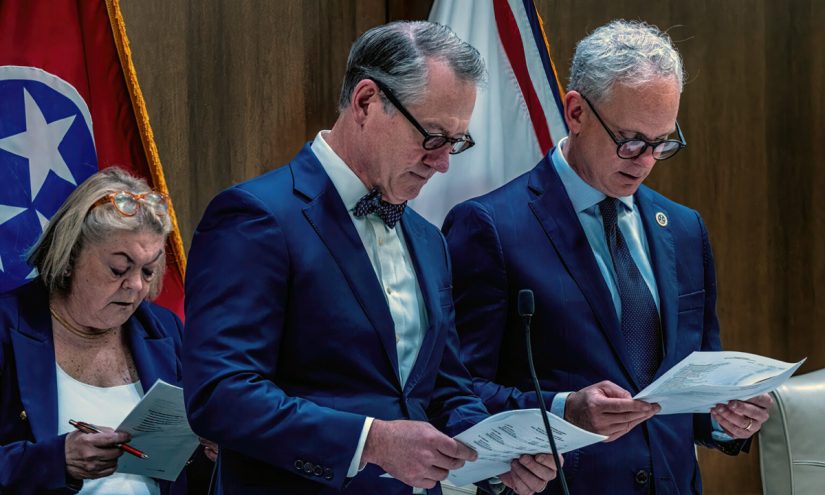
    More than two dozen Chattanooga business owners are condemning a bill to require student immigration background checks in Tennessee’s public schools as “economically reckless.”

    The Tennessee Small Business Alliance represents restaurants, real estate firms, retail stores and other local employers operating within the district represented by Sen. Bo Watson.

    Watson, a Republican, is cosponsoring the legislation to require proof of legal residence to enroll in public K-12 and charter schools.  The bill would also give public schools the option of charging tuition to the families of children unable to prove they legally reside in the United States – or to deny them the right to a public education altogether.

    House Leader William Lamberth of Gallatin is a co-sponsor of the bill, which has drawn significant — but not unanimous — support from fellow Tennessee Republicans. Lamberth’s version of the bill differs from Watson’s in that it would make it optional — rather than mandatory — to check students’ immigration status in all of Tennessee’s more than 1700 public schools.

    The bill, one of the most controversial being considered during the 2025 Legislative session, has significant momentum as the Legislature winds down for the year even as it has drawn raucous protests at times.  The legislation will next be debated on Monday in a House committee.

    A statement released by the business alliance described the legislation as a “political stunt that’s cruel, economically reckless, and completely out of step with local values.”

    Citing estimates compiled by the nonprofit advocacy organization, American Immigration Council, the statement noted that more than 430,000 immigrants in Tennessee paid $4.4 billion in taxes – more than $10,000 per immigrant.

    Watson, in an emailed statement from Chattanooga public relations firm Waterhouse Public Relations, said his bill “raises important questions about the financial responsibility of educating undocumented students in Tennessee—questions that have long gone unaddressed.”

    The statement said the Supreme Court’s 1982 decision in Plyler v. Doe, which established the right to a public school education for all children regardless of immigration status, has “never been re-examined in the context of today’s challenges.” The statement said Watson is committed to a “transparent, fact-driven discussion about how Tennessee allocates its educational resources and how federal mandates impact our state’s budget and priorities.”

    Watson has previously also said the legislation was prompted, in part, by the rising costs of English-language instruction in the state’s public schools.

    Democrats have criticized that argument as based on inaccurate assumptions that English language learners lack legal immigration status.

    Kelly Fitzgerald, founder of a Chattanooga co-working business and one of 27 employers that signed onto the statement of condemnation, criticized lawmakers.

    “Do our representatives believe that undocumented children — who had no say in their immigration status — should be denied a public education, even though their families already pay taxes that fund our schools?” said Fitzgerald, whose own children attend Hamilton County Public schools

    “My children are receiving a great education in our public schools, and I want every child to have the same rights and opportunities as mine do,” she said.

    “In my opinion, this is not something our legislators should be spending their resources on when there are much larger issues at hand in the current environment,” she said. “We should leave children out of the conversation.”

    Tennessee Lookout is part of States Newsroom, a nonprofit news network supported by grants and a coalition of donors as a 501c(3) public charity. Tennessee Lookout maintains editorial independence. Contact Editor Holly McCall for questions: [email protected].


    Get stories like these delivered straight to your inbox. Sign up for The 74 Newsletter

    Source link

  • Decoder: The Silence of America

    Decoder: The Silence of America

    Iconic photos from the Cold War cover the corridors of the Prague headquarters of Radio Free Europe and Radio Liberty, news networks created by the U.S. government to counter censorship and disinformation from the Soviet Union and their East European satellite nations during the Cold War.

    Images from 1989, the year communist rule melted away in more than a dozen countries, were reminders of earlier days when Radio Free Europe and Radio Liberty had broadcast news in Polish, Czech, Slovakian and the Baltic languages; those countries are now robust democracies as well as members of the European Union and NATO.

    Those historic photos jostle with more recent images from countries where human rights and democracy are not observed, including Russia, Belarus, Iran, Afghanistan and other nations across Central and South Asia. In total, the two networks broadcasted in 27 languages to 23 countries providing news coverage and cultural programming where free media doesn’t exist or is threatened.

    The journalists who broadcast there often do so at great risk. 

    Many are exiles unable to return to their own countries. Three of their journalists are currently jailed in Russian-occupied Crimea, Russia and Azerbaijan. The charges against them are viewed as politically motivated.

    Countering power with news

    On 14 March 2025, U.S. President Donald Trump signed an executive order which cut the funding for the U.S. Agency for Global Media, the parent agency of Radio Free Europe and Radio Liberty. It also cut the funding of Radio Free Asia and the Middle East Broadcasting Network, the Voice of America — the “official” voice of the United States — as well as Radio & Television Marti which broadcasts to Cuba.

    The funding cuts would effectively silence these networks. In response, Radio Free Europe and Radio Liberty filed a lawsuit in Washington, D.C. 18 March that argued that Congress has exclusive authority over federal spending and that cannot be altered by a presidential executive order. Voice of America Director Michael Abramowitz filed suit 26 March. 

    On March 27, the Trump administration announced it had restored the funding for Radio Free Europe and Radio Liberty. 

    Radio Free Europe and Radio Liberty came into being after the end of the second World War when Europe became a divided continent. While the wartime allies, including Britain and the United States, focused on rebuilding their economies after years of war, Soviet leader Joseph Stalin sent his army to occupy most of Eastern Europe. 

    Despite promises made at a meeting in the Crimea, known as the Yalta Conference, during the final months of the war in 1945, Stalin refused to allow free elections in East Germany, Romania, Bulgaria, Poland, Hungary and Czechoslovakia. 

    Neither were free elections held in the three Baltic countries — Estonia, Latvia and Lithuania — which the Soviet Union had annexed in 1940. The crushing of democratic rule in so many nations was characterised by British Prime Minister Winston Churchill as “an iron curtain” that had “descended across the continent.” 

    After years of fighting Nazi Germany, half of Europe was now ruled under a Soviet dictatorship.

    Containing communism

    The United States responded with a policy of ‘containment’ that aimed to halt the spread of communism without using soldiers and tanks. Radio Free Europe started broadcasting in 1950 followed by Radio Liberty in 1953. 

    With a system of transmitters pointing east, news programmes that countered the state propaganda were beamed to the countries in the Soviet bloc, eventually in 17 languages. These were tactics that came to be known as ‘soft power’.

    Based in Munich, Radio Free Europe and Radio Liberty, or RFE/RL as they became known, attracted dissidents who opposed the Soviet-imposed governments. Their audiences grew during the Cold War, despite threats of prosecution. 

    In addition to news, broadcasts covered music, sports and science. Banned literature written by dissidents who challenged the communist systems could be heard on RFE/RL. Czech dissident Vaclav Havel was one of those voices.

    The Berlin Wall tumbled down in November 1989. It was followed by the Velvet Revolution that overthrew the Czech government and installed as its president, the former political prisoner Haval. He invited RFE/RL to move their base from Munich to Prague. 

    “My confinement in prison might have lasted longer had it not been for the publicity I had through these two stations,” Haval said at the time. 

    An outcry in Europe and elsewhere

    The news that the Trump administration would shut down the radio networks spread quickly. Listeners, viewers and supporters who had lived through the Cold War years when only pro-government broadcasts were legal, shared their stories on social media:

    “In Romania, they [RFE] lightened communism with the hope of freedom.”

    “As a small girl, living under a communist regime in Poland, I remember my grandfather listening every night to Radio Free Europe, to get uncensored news from around the world, to get different opinions on the world’s affairs, and probably hoping that one day, he would live in a free world. It was illegal to listen to this Radio, and the quality was very poor, and yet, he would do it every night … ” 

    Polish Foreign Minister Radek Sikorski recalled how his father had listened to Radio Free Europe and Voice of America. “This is a great shame,” he wrote. “My grandfather was listening to RFE in Soviet-occupied Poland in 80s. It’s how we learned basic facts about our own countries because communist propaganda was so tightly controlled.”

    On 17 March the Czech Republic asked the foreign ministers of the European Union to support RFE/RL so the journalism could continue. 

    One diplomat who was in the meeting said that stopping RFE/RL’s broadcasts would “be a gift to Europe’s adversaries.” Already Russia’s state broadcaster, Russia Today, had tweeted that cutting the funding for RFE/RL was an “awesome decision by Trump.”

    When Vaclav Havel welcomed Radio Free Europe and Radio Liberty to Prague after democracy had been restored to Czechoslovakia, he said that having RFE/RL in the Czech capital was equivalent to having three NATO divisions. 

    The supporters of the networks are hoping that the soft power of free media is indeed able to pack a powerful punch for free media.

    Update to this story: As of 30 March, Radio Free Liberty has informed News Decoder that, while two weeks worth of funds have been received, the rest of U.S. government funding had not yet been restored. We will continue to update this story as we learn of further developments. 


    Three questions to consider:

    1. Why, during the Cold War, were radio broadcasts across closed borders one of the few ways people could receive news that was not controlled by the government?
    2. In what ways are people limited in accessing news, culture and music?
    3. In what ways might a free media be important in a democracy?


    Source link

  • Canadian associations welcome collaboration with new Prime Minister

    Canadian associations welcome collaboration with new Prime Minister

    With Mark Carney sworn in as Canada’s new Prime Minister, major education groups have urged the incoming cabinet to recognise international students’ vital role in the country’s economy. 

    As Canada has already implemented study permit caps and post-graduation work permit restrictions over the past year, stakeholders are pinning their hopes on Carney. 

    His decision to remove immigration minister Marc Miller – widely seen as a key architect of temporary resident restrictions – has fuelled expectations for change. 

    “New leadership brings a fresh perspective on policies and challenges, and we welcome the opportunity to meet with the new minister to discuss the vital role of international students in Canada’s immigration strategy,” a Universities Canada spokesperson told The PIE News

    Despite the optimism, Carney’s stance on immigration policies in Canada leaves much to consider.

    Terming the North American country’s immigration policies as “failure of executions,” Carney has previously stated that Canada has failed to live up to its “immigration values.”

    “We had much higher levels of foreign workers, students and new Canadians coming in than we could absorb, that we have housing for, that we have health care for, that we have social services for, that we have opportunities for. And so we’re letting down the people that we let in, quite frankly,” Carney stated at a Cardus event – a Christian non-partisan think tank – in November.  

    Moreover, according to a CIC News report, Carney’s policy aims to address Canada’s housing crisis by “capping immigration until it can be returned to its sustainable pre-pandemic trend,” as stated in policy documents released in February 2025.

    This aligns with the government’s aim to reduce Canada’s total population of temporary residents by about 445,000 in 2025 followed by another 445,000 in 2026. 

    According to the Universities Canada spokesperson, while Carney intends to follow a similar direction in temporarily reducing immigration, Canadian universities “stand ready to collaborate on a responsible, sustainable plan that aligns with the country’s labour needs”.

    “This approach should be targeted – prioritising individuals with the right skills – while also addressing internal issues like processing delays that hinder Canada’s ability to attract top global talent,” stated the spokesperson. 

    According to Larissa Bezo, president and CEO, Canadian Bureau of International Education, Canada’s International Student Program is not expected witness any new major changes. 

    “Against the backdrop of an existential threat to Canada’s sovereignty and policy focus on Canada’s economic resilience, CBIE does not anticipate further policy changes affecting international students in the near term,” stated Bezo.

    “CBIE is actively engaging with policymakers to ensure that any future policy recalibration reflects the strategic role international students play in Canada’s long-term economic and demographic sustainability.”

    Though Carney hasn’t made direct statements about further restrictions on international students, he has previously blamed Canadian provinces for underfunding higher education, which pushed institutions to rely on international students.

    “Transfers from provincial coffers have been frozen, leaving universities to rely completely on international students for growth,” he stated at an event, as per Canadian media reports. 

    Ontario’s universities predicted nearly $1 billion in financial losses over the next two years as international student caps exacerbate “years of underfunding”, as reported by The PIE News.

    The figures do not yet account for the additional impacts of policies that further reduce the cap and including postgraduate students, among other changes.

    Several Canadian colleges and universities across various provinces have also recently reduced programs and staff due to a decline in international student enrolment. 

    While Sheridan College in Ontario is suspending 40 academic programs with an expected revenue loss of $112 million, Douglas College in British Columbia suspended its business and technology programmes and laid off 15% of its faculty. 

    Alberta’s Bow Valley College reported a 25% decline in international student enrolment, cancelled five diploma programs, and laid off staff, while Nova Scotia’s Cape Breton University has paused intake for certain engineering and technology programs, and cut staff to manage budgetary constraints.

    “While our advocacy focuses on the federal level, we recognise the persistent underfunding of the post-secondary sector in many provinces,” stated the Universities Canada spokesperson. 

    Canadian universities, especially ones in Ontario, have not only witnessed decline in public funding but also reduction in domestic tuition fees, in recent years.

    “The immigration policy changes of the past year have exposed what is a chronic under-funding and undervaluing of post-secondary education in this country,” stated Bezo. 

    “Ultimately, we need commitment by provinces and territories to properly fund post-secondary education in Canada to ensure a high-quality offering for Canadian students which is not reliant on revenues from international student tuition for operational survival.”

    “In 2022 alone, they injected $30.9 billion into the economy, surpassing the auto parts manufacturing industry, and supported over 361,000 jobs.”

    Universities Canada spokesperson

    The organisations have also highlighted the economic impact of international students, who have contributed $31 billion to Canada’s GDP in 2022, as reported by The PIE News. 

    “In 2022 alone, they injected $30.9 billion into the economy, surpassing the auto parts manufacturing industry, and supported over 361,000 jobs,” stated the Universities Canada spokesperson. 

    “Their contributions also generated $7.4 billion in tax revenue, funding essential services like hospitals, schools, and infrastructure.”

    “We need to see more recognition for the fact that international students are integral to meeting Canada’s economic, demographic, and workforce priorities,” added Bezo.  

    “International students fill critical workforce shortages, strengthen Canada’s research and innovation ecosystem, and enhance regional economic development.”

    Source link

  • OPINION: Here’s why we cannot permit America’s partnership with higher education to weaken or dissolve

    OPINION: Here’s why we cannot permit America’s partnership with higher education to weaken or dissolve

    Abrupt cuts in federal funding for life saving medical research. Confusing and misleading new guidance about campus diversity programs. Cancellation, without due process, of hundreds of millions of dollars in federal grants and contracts held by a major university. Mass layoffs at the Education Department, undermining crucial programs such as federal student aid.

    All of this, and more, in the opening weeks of the second Trump administration.

    The president has made clear that colleges and universities face a moment of unprecedented challenge. The partnership the federal government forged with American higher education long ago, which for generations has paid off spectacularly for our country’s civic health, economic well-being and national security, appears in the eyes of many to be suddenly vulnerable.

    America must not permit this partnership to weaken or dissolve. No nation has ever built up its people by tearing down its schools. Higher education builds America — and together, we will fight to ensure it continues to do so.  

    Related: Tracking Trump: his actions on education    

    Some wonder why more college and university presidents aren’t speaking out. The truth is, many of them fear their institutions could be targeted next.

    They are also juggling immense financial pressures and striving to fulfill commitments to teaching and research.

    But the American Council on Education, which I lead, has always stood up for higher education. We have done it for more than a century, and we are doing it now. We will use every tool possible — including litigation, advocacy and coalition-building — to advance the cause.

    ACE is the major coordinating body for colleges and universities. We represent institutions of all kinds — public and private, large and small, rural and urban — with a mission of helping our members best serve their students and communities.

    Let me be clear: We welcome scrutiny and accountability for the public funds supporting student aid and research. Our institutions are subject to state and federal laws and must not tolerate any form of discrimination, even as they uphold freedom of expression and the right to robust but civil protest. 

    We also know we have much work to do to raise public confidence in higher education and the value of a degree.

    However, we cannot allow unwarranted attacks on higher education to occur without a vigorous and proactive response.

    When the National Institutes of Health announced on Feb. 7 a huge cut in funding that supports medical and health research, ACE joined with the Association of American Universities, the Association of Public and Land-grant Universities and a number of affected universities in a lawsuit to stop this action.

    ACE has almost never been a plaintiff in a lawsuit against the federal government, but the moment demanded it. We are pleased that a federal judge has issued a nationwide preliminary injunction to preserve the NIH funding.

    When the Education Department issued a “Dear Colleague” letter Feb. 14 that raised questions about whether campus programs related to diversity, equity      and inclusion would be permissible under federal law, ACE organized a coalition of more than 70 higher education groups calling for the department to rescind the letter.      

    We raised concerns about the confusion the letter was causing. We pointed out that the majority opinion from Chief Justice John Roberts in the Students for Fair Admissions case acknowledged that diversity-related goals in higher education are “commendable” and “plainly worthy.”    

     We invited the department to engage with the higher education community to promote inclusive and welcoming educational environments for all students, regardless of race or ethnicity or any other factors. We remain eager to work with the department. 

    Related: Fewer scholarships and a new climate of fear follow      the end of affirmative action

    Unfortunately, in recent days the administration has taken further steps we find alarming.

    ACE denounced the arbitrary cancellation of $400 million in federal grants and contracts with Columbia University. Administration officials claimed their action was a response to failures to adequately address antisemitism at Columbia, though it bypassed well-established procedures for investigating such allegations. (The Hechinger Report is an independent unit of Teachers College, Columbia University.)

    Ultimately, this action will eviscerate academic and research activities, to the detriment of students, faculty, medical patients and others.

    Make no mistake: Combating campus antisemitism is a matter of utmost priority for us. Our organization, along with Hillel International and the American Jewish Committee, organized two summits on this topic in 2022 and 2024, fostering important dialogue with dozens of college and university presidents.

    We also are deeply concerned about the letter the Trump administration sent to Columbia late last week that makes certain demands of the university, including a leadership change for one of its academic departments. To my mind, the letter obliterated the boundary between institutional autonomy and federal control. That boundary is essential. Without it, academic freedom is at risk.

    Meanwhile, layoffs and other measures slashing the Education Department’s workforce by as much as half will cause chaos and harm to financial aid and other programs that support millions of students from low- and middle-income families. We strongly urge the administration to change course and Congress to step in if it does not.

    Despite all that has happened in the past several weeks, we want President Trump and his administration to know this: Higher education is here for America, and ready to keep building. Colleges and universities have long worked with the government in countless ways to strengthen our economy, democracy, health and security. We cannot abandon that partnership. We must fortify it. 

    Ted Mitchell is president of the American Council of Education in Washington, D.C.

    Contact the opinion editor at [email protected].

    This story about academic freedom was produced by The Hechinger Report, a nonprofit, independent news organization focused on inequality and innovation in education. Sign up for Hechinger’s weekly newsletter.

    The Hechinger Report provides in-depth, fact-based, unbiased reporting on education that is free to all readers. But that doesn’t mean it’s free to produce. Our work keeps educators and the public informed about pressing issues at schools and on campuses throughout the country. We tell the whole story, even when the details are inconvenient. Help us keep doing that.

    Join us today.

    Source link

  • Marc Miller removed as Canadian immigration minister

    Marc Miller removed as Canadian immigration minister

    The cabinet reshuffle came upon Carney’s swearing-in ceremony as Canada’s new Prime Minister on Friday 14 March, following his landslide victory in the Liberal leadership race announced on March 10.  

    Miller has been replaced by Rachel Bendayan, formerly the minister of official languages and associate minister of public safety under Trudeau. Bendayan is one of 11 female ministers in Carney’s 24-member cabinet.  

    Holding various government positions since being elected to parliament in 2019, Bendayan was the first Canadian of Moroccan descent to join the federal government.  

    While a change of tack regarding immigration is unlikely until after the federal election, international education stakeholders are hopeful about Miller’s successor who will head up Immigration, Refugees and Citizenship Canada (IRCC).

    “Canada is due for a reset on the immigration file. The former minister rode a wave of negative sentiment to make Canada feel increasingly unwelcoming to international students and their family members,” Canadian immigration lawyer Matthew McDonald told The PIE News.

    “My hope is that Minister Rachel Bendayan will bring a more positive spirit to the country’s immigration conversation,” he added.

    Based on Bendayan’s role as minister for official languages, McDonald said he expected she would continue IRCC’s commitment to the prominence of the French language in permanent residence programs.

    Bendayan’s legal background also suggests that she may continue the “technocratic approach” to policy seen of her predecessor, he added.

    The former minister rode a wave of negative sentiment to make Canada feel increasingly unwelcoming to international students

    Matthew McDonald, Canadian Immigration Services

    “We are changing how things work, so our government can deliver to Canadians faster – and we have an experienced team that is made to meet the moment we are in. Our government is united and strong, and we are getting right to work,” said Prime Minister Carney.  

    Carney, formerly head of the Bank of Canada and Bank of England, and a relative political newcomer, will succeed Justin Trudeau as relations hot up between the US and Canada over Donald Trump’s trade war against its northern neighbour.  

    Trudeau’s large cabinet was made up of 37 ministers, including his longtime personal friend and the best man at his wedding, immigration minister Marc Miller.  

    Carney himself never sat on Trudeau’s cabinet, which was part of his appeal to some Liberal voters.  

    While several Trudeau stalwarts have been dropped from Carney’s cabinet, there is still considerable overlap and only three new faces, which Carney’s team said would ensure “continuity”.

    We are changing how things work, so our government can deliver to Canadians faster

    Mark Carney, Canadian Prime Minister

    In the absence of an education minister at the federal level, Miller has delivered many of the turbulent policy changes in international higher education over the past 14 months. He has become notorious in the sector for repeatedly doing so on a Friday afternoon.  

    During this time, Canadian institutions have been delivered study permit caps, twice, restrictions on post-graduate work opportunities and procedural changes around recruiting and enrolling international students, among myriad further disruptions.  

    Against the backdrop of a recent increase in anti-immigration sentiment across Canada, McDonald said that Bendayan had “the opportunity to seize this existential moment for Canada and reinforce that we are a country whose past, present, and future is an immigration story”.

    Previous statements made by Carney about tackling Canada’s housing crisis, prioritising those already in Canada for permanent residency and reducing temporary foreign worker levels suggest the government’s ongoing immigration policy will largely align with Miller’s going forward.  

    While Carney has not explicitly said anything about limiting international students, he has previously voiced concerns about institutions’ reliance on international students and has advocated for increased funding for postsecondary education.  

    Under Canada’s current immigration levels plan, the government is aiming to reduce temporary residents including international students and temporary workers to 5% of the total population by 2027.  

    Canada’s next federal election is currently scheduled for October, though there is speculation that Carney could call an election before parliament is expected to return on March 24.  

    Source link

  • Immigration policies in focus as Mark Carney sworn in as Canadian PM

    Immigration policies in focus as Mark Carney sworn in as Canadian PM

    Succeeding Justin Trudeau as Canada’s 24th Prime Minister, Carney’s swearing-in ceremony was conducted by governor general Mary Simon at Rideau Hall in Ottawa.

    Carney’s appointment as Canada’s leader comes at a time when the country is navigating through an increasingly tumultuous relationship with its closest neighbour and ally, the United States.

    Canada’s ties with the US have worsened after President Donald Trump imposed steep tariffs on Canadian goods and floated the idea of integrating Canada into the US, sparking strong backlash.

    Considered a political newcomer, who played significant roles as the governor of the Bank of Canada and the Bank of England between 2008 to 2020, Carney is known for having a tough stance on immigration. 

    Calling Canada’s immigration policy “failures of executions”, Carney stated that Canada has taken in more people than its economy has been able to handle. 

    “I think what happened in the last few years is we didn’t live up to our values on immigration,” he said at a Cardus event – a Christian non-partisan think tank – in November last year, according to Canadian media reports.

    “We had much higher levels of foreign workers, students and new Canadians coming in than we could absorb, that we have housing for, that we have health care for, that we have social services for, that we have opportunities for. And so we’re letting down the people that we let in, quite frankly.”

    Carney’s statement suggests that he will uphold the Canadian federal government’s plan to reduce immigration targets over the next three years.

    Recently, the federal government announced a shift in its immigration strategy, cutting the number of newcomers by 21% – from approximately 500,000 in 2024 to 395,000 in 2025 and 380,000 in 2026.

    In its race to reduce temporary residency numbers and overall inflow of immigrants, international students in Canada have faced the brunt of policy changes in the country.

    Canada has imposed more caps on study permits, eliminated fast-track study permit processing, increased PGWP eligibility and English proficiency requirements, in an effort to “align its immigration planning with capacity”.  

    Over the past year, policy restrictions have already had a significant impact in Canada, with the total number of study permits processed by the IRCC expected to be 39% lower than in 2023.

    A former international student himself, Carney is expected to continue with restrictive policies on the cohort, as he previously blamed Canadian provinces for “underfunding higher education”, which pushed institutions to rely on international students. 

    “Do we value higher education in this country or not? Well, if we value higher education, maybe we should start funding our universities,” stated Carney. 

    “On the foreign student side, it’s more on provincial policy, on squeezing universities, in a sense.”

    Daljit Nirman, an immigration lawyer based in Ottawa and founder, Nirman’s Law, believes aggressive student recruitment has contributed to housing shortages, an oversaturated job market, and increased strain on health care, making effective newcomer integration in Canada more difficult.

    “Given Carney’s stance and these recent policy changes, it is likely that Canada will continue implementing stricter controls on international student admissions during his tenure,” Nirman told The PIE News.

    “This measured approach aims to preserve the benefits of international education while ensuring that Canada’s infrastructure can effectively support those who choose to study and settle in the country.”

    According to Priyanka Roy, senior recruitment advisor at York University, while Carney’s stance on immigration may appear stricter, it will ultimately result in a more “balanced approach.”

    “While it may seem like a tougher stance on immigration, we believe that Prime Minister Carney’s stance is to create a balanced approach to immigration, ensuring that international student enrolment aligns with Canada’s economic capacity and does not place undue pressure on local infrastructure,” Roy told The PIE News.

    “York is proactively adapting by offering sustainable solutions, such as a four-year housing guarantee, on-campus job opportunities, and co-op programs; provisions that help our international students integrate into Canadian life while maintaining a balanced and healthy relationship with the local community.”

    Prime Minister Carney’s leadership presents a valuable opportunity to rebuild stronger ties between India and Canada, fostering an environment of trust and collaboration
    Priyanka Roy, York University

    The former banker, who won the Liberal Party race by 86% of the votes, also acknowledged immigration’s role in contributing to Canada’s economic future. 

    Emphasising the need for productivity and a growing labour force, Carney has previously highlighted that Canada’s growing labour force is “going to largely come through new young Canadians”.

    With immigration poised to be a key issue, rebuilding ties with India – one of Canada’s largest sources of migrants – will be crucial for the prime minister-designate.

    Having already expressed a willingness to mend relations following a major diplomatic crisis, Carney’s efforts to indulge in discussions with India could spell good news for Indian students eyeing Canada as a study destination.

    “Prime Minister Carney’s leadership presents a valuable opportunity to rebuild stronger ties between India and Canada, fostering an environment of trust and collaboration,” stated Roy.

    “As diplomatic relations improve, we are confident that more Indian students will continue to view Canada as an attractive destination for higher education and realign their preference for higher education in Canada.”

    Source link

  • PGWP eligibility expanded for college degree students

    PGWP eligibility expanded for college degree students

    Canada’s college sector has welcomed a recent policy change from the IRCC stating that graduates of college degree programs will now join university students in being exempted from PGWP field of study requirements announced in October 2024.  

    At the time, the IRCC updated the eligibility criteria for students applying for a post-graduation work permit, allowing only college graduates from certain fields of study to apply for a PGWP, thus putting the college sector at a severe disadvantage.  

    The most recent revision has been hailed as a rare piece of good news for Canadian colleges, which stakeholders warned were at risk of being “decimated” by the IRCC’s eligibility criteria.  

    Conestoga College senior vice-president Gary Hallam said the decision was an “important step forward” for the sector, acknowledging “the excellence of our academic programming and the essential role colleges play in ensuring graduates have the skills and knowledge needed for success in today’s workforce”.

    “We are particularly pleased our international students will now benefit from the breadth of our programming,” added Hallam, highlighting Conestoga’s 25 degree programs offering a blend of theory and hands-on practical learning.

    The change applies to students who applied for a study permit after November 1, 2024, to pursue a college bachelor’s, master’s or doctoral degree program.  

    Coupled with other restrictions, the field of study requirements were already having a dramatic impact on Canadian institutions, with new international college enrolments seeing a 60% decline in 2024, triggering a stream of course closures and layoffs felt hardest in Ontario.  

    The IRCC’s decision… acknowledges the essential role colleges play in ensuring graduates have the skills and knowledge needed for success in today’s workforce

    Gary Hallam, Conestoga College

    The English and French language requirements announced last year remain in place for all PGWP applicants, and non-degree students will still have to meet the field of study requirements intended to foster greater alignment between education and labour-market needs.  

    Earlier this year, the IRCC added education as an eligible field of study reflecting labour market shortages across the regions in areas such as early childhood education, teaching assistance and childcare provision.  

    Despite some confusion regarding the wording of the IRCC’s guidance, the Canadian Bureau for International Education (CBIE) confirmed the change, and that the department was working to update its website.  

    Since January 2024, the IRCC has stepped up scrutiny of international student recruitment at Canadian institutions, capping international student numbers with the aim of reducing temporary residents from 6.5% of Canada’s total population to 5% by the end of 2026.

    Source link

  • TN Schools Could Exclude Immigrant Kids Without Legal Status in GOP-Backed Bill – The 74

    TN Schools Could Exclude Immigrant Kids Without Legal Status in GOP-Backed Bill – The 74


    Get stories like this delivered straight to your inbox. Sign up for The 74 Newsletter

    Tennessee lawmakers on Wednesday voted to advance a bill that would require public K-12 and charter schools to verify student immigration status and allow them to bar children who cannot prove they lawfully reside in the United States unless they pay tuition.

    The 5-4 vote by the Senate Education Committee came despite the Legislature’s own fiscal analysis, which said the proposed legislation “may jeopardize federal funding to the state and to local governments” and violate the federal Civil Rights Act, which specifically prohibits discrimination based on national origin in programs receiving federal dollars. Three Republicans joined the committee’s sole Democrat in voting “no.”

    Immediately after the vote was cast, shouts of “so shameful” and “that’s trash” erupted inside the hearing room. Others, including school-age children in attendance, streamed out of the room in tears.

    The bill (HB793/SB836) by Sen. Bo Watson, a Hixson Republican, and House Majority Leader William Lamberth, a Portland Republican, says that local school districts and public charter schools “shall require” students to provide one of three forms of documentation: proof of U.S. citizenship, proof the student is in the process of obtaining citizenship or proof they have legal immigration status or a visa.

    Students who lack one of the three forms of documentation could then be barred by their local school district from enrolling unless their parents paid tuition.

    Watson,  the bill’s sponsor, said he brought the measure in response to the increasing cost to the state of providing English-as-a-second-language instruction.

    “Remember, we are not talking about people who are here lawfully,” Watson said. “What I’m trying to discuss here is the financial burden that exists with what appears to be an increasing number of people who are not lawfully here.”

    In response to a question from Sen. Raumesh Akbari of Memphis, the sole Democrat on the panel, Watson said he had received no formal request from any school official to introduce the measure.

    “In an official capacity, this is one of those issues people do not talk about,” Watson said. “This is a very difficult bill to present. It is very difficult to have all these eyes on you.”

    “In an unofficial capacity at numerous events, have people mentioned this problem to me? Absolutely,” Watson said.

    Akbari responded: “I’m from the largest school district in the state. I have not had those conversations.”

    “I am offended by this legislation,” Akbari said. “I find that it is so antithetical to the very foundation of this country….This is saying that babies – you start school at five years old – that you do not deserve to be educated.”

    The bill’s sponsors have acknowledged the measure is likely to face a legal challenge if enacted. The proposed legislation, they have said, is intended to serve as a vehicle to potentially overturn the Supreme Court’s Plyler v. Doe decision, which established a constitutional right to a public school education for all children. The 1982 decision was decided by a 5-4 vote, Watson noted.

    “Many 5-4 decisions taken to the court today might have a different outcome,” Watson said.

    The proposed legislation is part of an unprecedented slate of immigration-related bills introduced in the Tennessee legislature this year as Gov. Bill Lee and the General Assembly’s GOP supermajority seek to align with the Trump Administration’s immigration policies.

    Lee last month signed into law legislation to create a state immigration enforcement office to liaise with the Trump administration, create distinct driver’s licenses for noncitizens and levy felony charges at local elected officials who vote in favor of sanctuary policies.

    Among nearly three dozen other immigration-related bills still being considered is one to require hospitals that accept Medicaid payments to report on the immigration status of their patients. Another bill would open up charitable organizations, including churches, to lawsuits if they have provided housing services to an individual without permanent legal immigration status and that individual goes on to commit a crime.

    Following Wednesday’s hearing in the Senate Education Committee, hundreds congregated in a hallway of the Legislature, chanting “education for all” and pledged to return as the bill winds through the committee process.

    The bill “instills fear and hopelessness in these students,” said Ruby Aguilar, a Nashville teacher who testified against the bill during the hearing.  “Education is not merely a privilege, it is a shared human right every child should have access to.”

    Tennessee Lookout is part of States Newsroom, a nonprofit news network supported by grants and a coalition of donors as a 501c(3) public charity. Tennessee Lookout maintains editorial independence. Contact Editor Holly McCall for questions: [email protected].


    Get stories like these delivered straight to your inbox. Sign up for The 74 Newsletter

    Source link

  • Parents turn to international education as path to residency

    Parents turn to international education as path to residency

    If families looking to relocate to “top destinations” such as the US and Canada choose the right program for their children, they may be granted permanent residency as domestic students or even graduate from their chosen institution as residents or citizens, according to Tess Wilkinson, director of education services at Henley & Partners Education in the UK.

    “We’re now seeing a real uptick in the types of families who are now becoming aware that there is an option for them,” she told The PIE News.

    “For families looking at relocating, there can be real gains in the amount of fees they spend on education in places like Canada,” she explained. “They can they can save [up to] $150,000 on fees.”

    The sheer number of clients asking for assistance in this area signals that education is swiftly becoming “one of the key drivers for people looking at second residences to citizenships”, she added.

    Henley & Partners refers to itself as a “global leader in residence and citizenship by investment”. Its education arm, Wilkinson explained, helps to “advise transnational families who are looking for global education solutions”.

    Working with families all over the world with children and adults of all ages – from K-12 to those seeking master’s degrees or MBAs – it “assists them to find the right match”, taking into account children’s individual needs and the types of residency or citizenship that may become available to its clients through educational opportunities.

    “We can advise on all the top-tier destinations. So we have a family, for instance, who are considering the UK, the US and Australia and they’re putting in applications for all three countries,” Wilkinson shared.

    We’re now seeing a real uptick in the types of families who are now becoming aware that there is an option for them
    Tess Wilkinson, Henley & Partners Education

    With immigration policies in key markets such as the UK, the US, Canada and Australia shifting all the time, Wilkinson acknowledged that it “is not something that is simple”.

    But she said that, with expertise across a number of key markets, Henley & Partners can provide families with education counsellors to help match children to institutions that suit them best, as well as help with applying to universities or summer programs.

    The ‘big four’ international education destination countries are all seeing turbulence in their respective markets. Some of these restrictive policies are having an impact on students’ ability to study in the countries, hindering them from securing post-graduate residency in their chosen destination.

    Australia and Canada are both subject restrictions on international students, while UK universities’ international departments have been blighted by a crackdown on overseas students’ ability to bring their families into the country with them.

    Meanwhile, Donald Trump’s second term as US President continues to present challenges to the sector, as he freezes study abroad funding, battles against DEI legislation and moves to arrest or even deport international student protestors.

    Tess Wilkinson will be speaking at The PIE Live Europe at the PIEx Power Up Expanding horizons: accessing global education & opportunity via investment migration on March 11 at 16:00. Tickets are available online here.

    Source link